







生物技术通报 ›› 2025, Vol. 41 ›› Issue (10): 292-302.doi: 10.13560/j.cnki.biotech.bull.1985.2025-0313
潘忠飞1,2,3( ), 尹倩1,2,3, 马容1,2,3, 熊欢1,2, 董文统1,2, 邹锋1,2,3()
收稿日期:2025-03-25
出版日期:2025-10-26
发布日期:2025-10-28
通讯作者:
邹锋,男,博士,教授,研究方向 :经济林栽培育种;E-mail: zoufeng06@126.com作者简介:潘忠飞,男,硕士研究生,研究方向 :经济林栽培育种;E-mail: 1771326636@qq.com
基金资助:
PAN Zhong-fei1,2,3(), YIN Qian1,2,3, MA Rong1,2,3, XIONG Huan1,2, DONG Wen-tong1,2, ZOU Feng1,2,3()
Received:2025-03-25
Published:2025-10-26
Online:2025-10-28
摘要:
目的 探究外源接种伯克霍尔德菌(Burkholderia sp.)与泛菌(Pantoea sp.)等溶磷菌株对田间油茶根际环境与养分吸收的影响,为红壤地区油茶菌肥的研发应用提供理论依据。 方法 以3年生大田栽植的‘长林40号’油茶为试验材料,设单接伯克霍尔德菌(Burkholderia sp.)HS5、单接泛菌(Pantoea sp.)CL37、混接Burkholderia sp. HS5+Pantoea sp. CL37、添加等量无菌水对照(CK)4个处理。通过测定油茶叶片养分、土壤理化性质、生物有效性磷组分、磷酸酶活性和细菌群落等指标,并对测定指标进行冗余分析和Mantel分析。 结果 与CK处理相比,外源接种溶磷菌显著提高了油茶养分吸收。HS5+CL37处理显著提高土壤有效磷(AP)、磷素活化系数(PAC)、NH
潘忠飞, 尹倩, 马容, 熊欢, 董文统, 邹锋. 外源溶磷菌促进油茶养分吸收的机制[J]. 生物技术通报, 2025, 41(10): 292-302.
PAN Zhong-fei, YIN Qian, MA Rong, XIONG Huan, DONG Wen-tong, ZOU Feng. The Mechanism of Exogenous Phosphate-solubilizing Bacteria Promoting Nutrient Absorption in Camellia oleifera[J]. Biotechnology Bulletin, 2025, 41(10): 292-302.
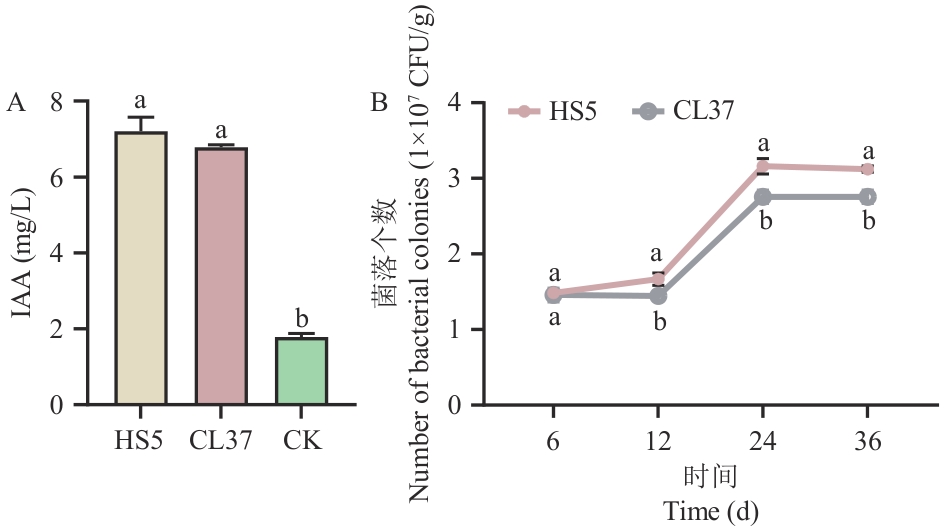
图1 两株溶磷菌分泌IAA及定殖变化不同小写字母表示同一时期差异显著(P<0.05)
Fig. 1 IAA secretion and colonization variations of two PSB strainsDifferent lowercase letters indicate significant differences during the same period (P<0.05)

图2 外源接种溶磷菌对油茶叶片养分积累的影响不同小写字母表示不同处理差异显著(P<0.05)。下同
Fig. 2 Effect of exogenous PSB inoculation on the nutrient accumulation in C. oleifera leavesDifferent lowercase letters indicate significant differences in different treatments (P< 0.05). The same below
| 指标 Index | 处理 Treatments | ||||
|---|---|---|---|---|---|
| HS5 | CL37 | HS5+CL37 | CK | ||
| 硝态氮 NO | 3.30±0.53ab | 4.26±0.60a | 3.75±0.57ab | 2.68±0.88b | |
| 氨态氮 NH | 6.19±2.35a | 5.29±0.72a | 6.83±2.24a | 4.42±0.50b | |
| 有效磷 AP (mg/kg) | 1.86±0.31a | 1.60±0.28a | 2.08±0.40a | 0.91±0.25b | |
| 全磷 TP (g/kg) | 0.68±0.01b | 0.74±0.08b | 0.72±0.18b | 1.14±0.36a | |
| 磷活化系数 PAC | 0.27±0.04ab | 0.22±0.03b | 0.29±0.02a | 0.09±0.05c | |
| 有机碳 SOC (g/kg) | 0.80±0.08ab | 1.05±0.13a | 0.84±0.09ab | 0.51±0.37b | |
| pH值 pH value | 4.57±0.04a | 4.55±0.03a | 4.46±0.13a | 4.59±0.10a | |
| 碱性磷酸酶活性 ALP (U/g) | 5 437.08±1 285.49a | 4 958.70±808.46ab | 4 432.32±897.85ab | 4 072.95±629.65b | |
| 酸性磷酸酶活性 ACP (U/g) | 16 062.07±509.46a | 16 153.59±1 258.73a | 17 009.93±3 248.91a | 15 498.8±200.98a | |
表1 外源接种溶磷菌对油茶根际土壤养分与酶活性的影响
Table 1 Effect of exogenous PSB inoculation on the rhizosphere soil nutrient and phosphatase activity of C. oleifera
| 指标 Index | 处理 Treatments | ||||
|---|---|---|---|---|---|
| HS5 | CL37 | HS5+CL37 | CK | ||
| 硝态氮 NO | 3.30±0.53ab | 4.26±0.60a | 3.75±0.57ab | 2.68±0.88b | |
| 氨态氮 NH | 6.19±2.35a | 5.29±0.72a | 6.83±2.24a | 4.42±0.50b | |
| 有效磷 AP (mg/kg) | 1.86±0.31a | 1.60±0.28a | 2.08±0.40a | 0.91±0.25b | |
| 全磷 TP (g/kg) | 0.68±0.01b | 0.74±0.08b | 0.72±0.18b | 1.14±0.36a | |
| 磷活化系数 PAC | 0.27±0.04ab | 0.22±0.03b | 0.29±0.02a | 0.09±0.05c | |
| 有机碳 SOC (g/kg) | 0.80±0.08ab | 1.05±0.13a | 0.84±0.09ab | 0.51±0.37b | |
| pH值 pH value | 4.57±0.04a | 4.55±0.03a | 4.46±0.13a | 4.59±0.10a | |
| 碱性磷酸酶活性 ALP (U/g) | 5 437.08±1 285.49a | 4 958.70±808.46ab | 4 432.32±897.85ab | 4 072.95±629.65b | |
| 酸性磷酸酶活性 ACP (U/g) | 16 062.07±509.46a | 16 153.59±1 258.73a | 17 009.93±3 248.91a | 15 498.8±200.98a | |
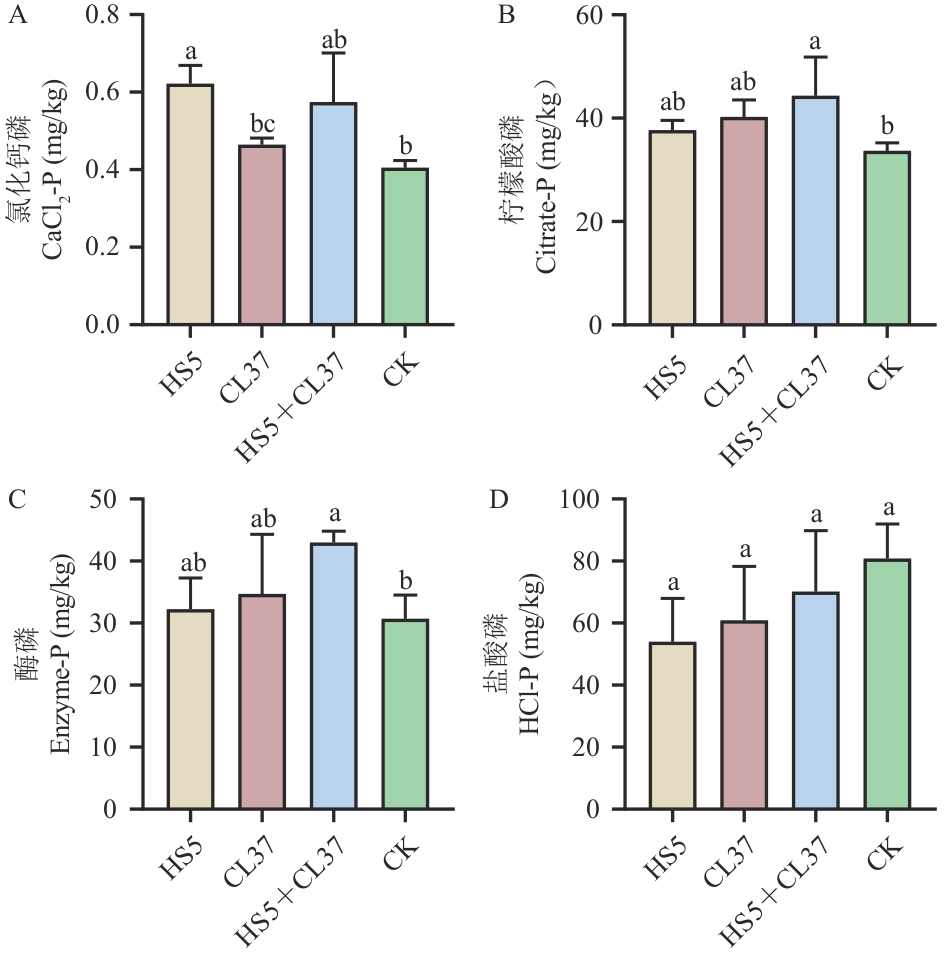
图3 外源接种溶磷菌对油茶根际磷素形态的影响
Fig. 3 Effect of exogenous PSB inoculation on the phosphorus fraction in rhizosphere of C. oleifera
处理 Treatment | ACE指数 ACE index | Chao1指数 Chao1 index | 辛普森指数 Simpson index | 香农指数 Shannon index |
|---|---|---|---|---|
| HS5 | 2 063.47±207.13a | 2 061.37±207.73a | 0.997 4a | 9.57±0.09a |
| CL37 | 2 099.18±381.60a | 2 096.07±381.53a | 0.996 8a | 9.46±0.11a |
| HS5+CL37 | 1 915.64±386.80a | 1 913.08±387.55a | 0.996 5a | 9.35±0.29a |
| CK | 2 093.00±274.390a | 2 089.76±274.54a | 0.997 3a | 9.59±0.19a |
表2 外源接种溶磷菌对油茶根际土壤细菌群落多样性的影响
Table 2 Effect of exogenous PSB treatments on bacterial community diversity in the rhizosphere soil of C. oleifera
处理 Treatment | ACE指数 ACE index | Chao1指数 Chao1 index | 辛普森指数 Simpson index | 香农指数 Shannon index |
|---|---|---|---|---|
| HS5 | 2 063.47±207.13a | 2 061.37±207.73a | 0.997 4a | 9.57±0.09a |
| CL37 | 2 099.18±381.60a | 2 096.07±381.53a | 0.996 8a | 9.46±0.11a |
| HS5+CL37 | 1 915.64±386.80a | 1 913.08±387.55a | 0.996 5a | 9.35±0.29a |
| CK | 2 093.00±274.390a | 2 089.76±274.54a | 0.997 3a | 9.59±0.19a |
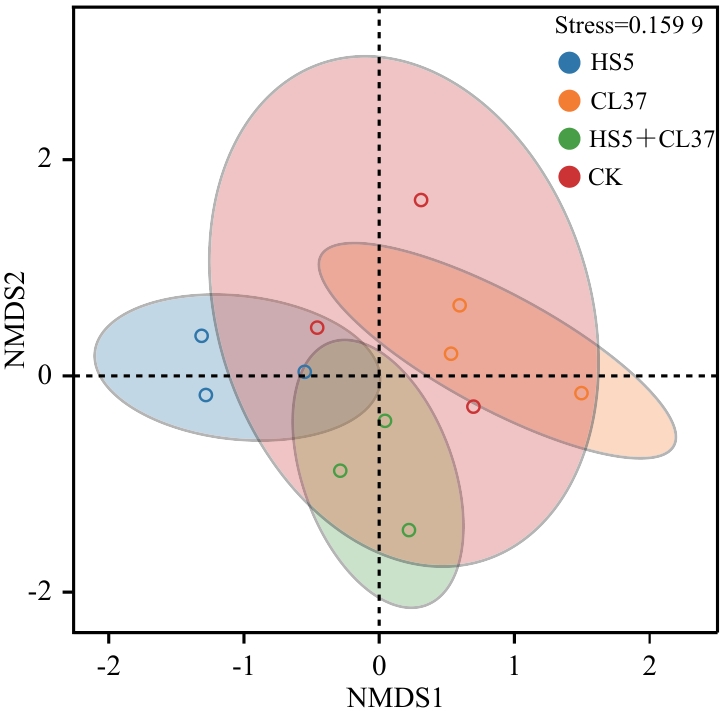
图4 油茶根际土壤细菌多样性的NMDS分析
Fig. 4 NMDS analysis of bacterial diversity in the rhizosphere soil of C. oleifera
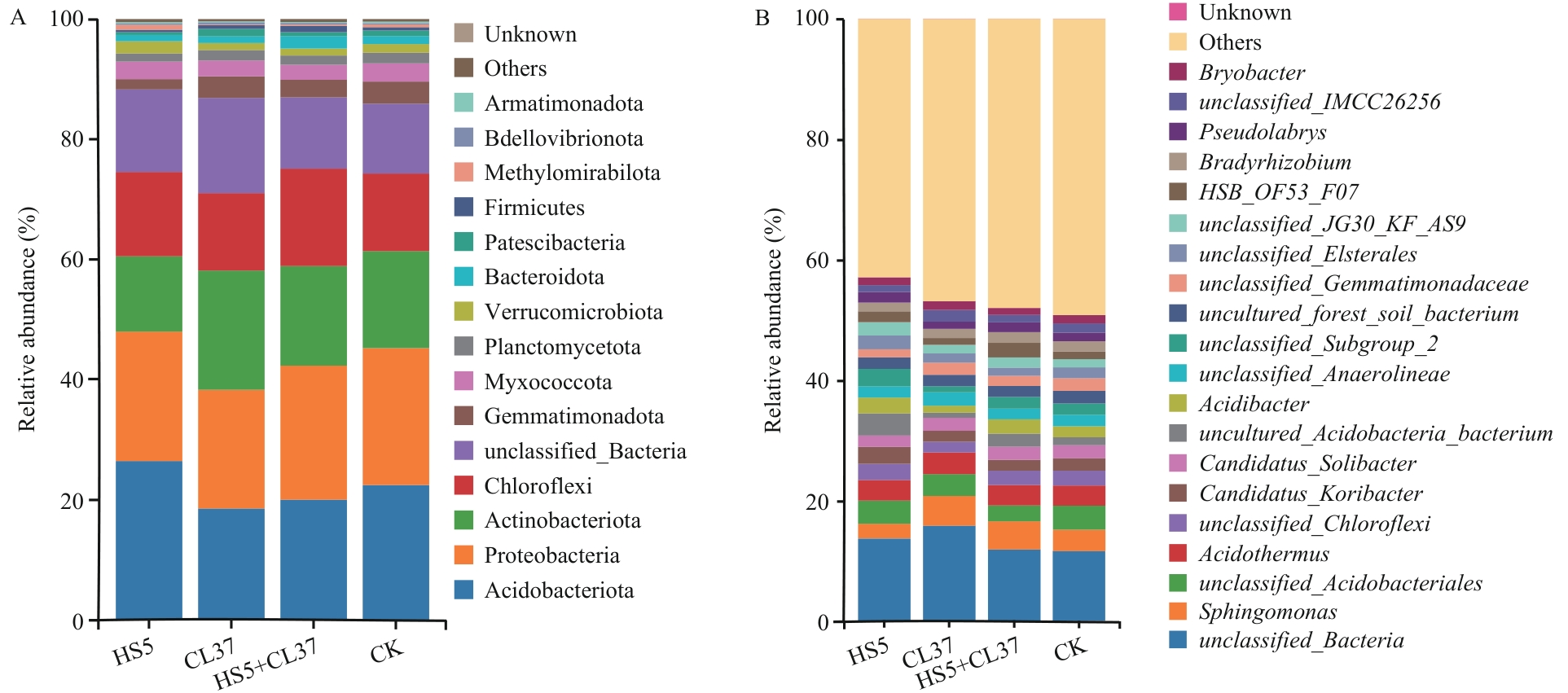
图5 外源接种溶磷菌对油茶根际土壤细菌群落组成的影响
Fig. 5 Effect of exogenous PSB inoculation on the community composition in the rhizosphere soil of C. oleifera
处理 Treatment | Actinobacteriota (%) | Unclassified_Bacteria (%) | Verrucomicrobiota (%) | Patescibacteria (%) | Methylomirabilota (%) | Bdellovibrionota (%) | Elusimicrobiota (%) |
|---|---|---|---|---|---|---|---|
| HS5 | 12.58±0.64b | 13.61±1.31ab | 2.03±0.06a | 0.45±0.08b | 0.83±0.15a | 0.22±0.06b | 0.15±0.02a |
| CL37 | 19.59±2.93a | 15.93±2.94a | 1.21±0.3b | 1.20±0.41a | 0.10±0.12b | 0.35±0.06a | 0.07±0.05b |
| HS5+CL37 | 16.64±2.83a | 11.87±0.63b | 1.16±0.39b | 0.65±0.06b | 0.23±0.19b | 0.29±0.08ab | 0.04±0.03b |
| CK | 16.13±0.29bc | 11.79±1.18b | 1.39±0.29b | 0.91±0.37ab | 0.38±0.4ab | 0.22±0.01b | 0.07±0.03b |
表3 外源接种溶磷菌对油茶根际土壤主要优势细菌门类相对丰度的影响
Table 3 Relative abundance of dominant bacterial at phylum kevel of C. oleifera rhizosphere soil under exogenous PSB inoculation
处理 Treatment | Actinobacteriota (%) | Unclassified_Bacteria (%) | Verrucomicrobiota (%) | Patescibacteria (%) | Methylomirabilota (%) | Bdellovibrionota (%) | Elusimicrobiota (%) |
|---|---|---|---|---|---|---|---|
| HS5 | 12.58±0.64b | 13.61±1.31ab | 2.03±0.06a | 0.45±0.08b | 0.83±0.15a | 0.22±0.06b | 0.15±0.02a |
| CL37 | 19.59±2.93a | 15.93±2.94a | 1.21±0.3b | 1.20±0.41a | 0.10±0.12b | 0.35±0.06a | 0.07±0.05b |
| HS5+CL37 | 16.64±2.83a | 11.87±0.63b | 1.16±0.39b | 0.65±0.06b | 0.23±0.19b | 0.29±0.08ab | 0.04±0.03b |
| CK | 16.13±0.29bc | 11.79±1.18b | 1.39±0.29b | 0.91±0.37ab | 0.38±0.4ab | 0.22±0.01b | 0.07±0.03b |
| 差异菌属 Differential bacterial genus | 处理 Treatments | ||||
|---|---|---|---|---|---|
| HS5 | CL37 | HS5+CL37 | CK | ||
| unclassified_Bacteria | 13.61±1.31ab | 15.93±2.94a | 11.87±0.63b | 11.79±1.18b | |
| Sphingomonas | 2.46±0.57c | 4.84±0.91a | 4.69±0.68ab | 3.47±0.54bc | |
| unclassified_Acidobacteriales | 3.80±0.44a | 3.71±0.74a | 2.63±0.59b | 3.95±0.19a | |
| Acidibacter | 2.59±0.25a | 1.17±0.10b | 2.36±0.57a | 1.93±0.75ab | |
| uncultured_Acidobacteria_bacterium | 3.59±0.84a | 0.88±0.47bc | 2.17±0.47b | 1.37±0.42c | |
| unclassified_Subgroup_2 | 2.89±0.44a | 1.04±0.62b | 1.93±0.50b | 1.83±0.29b | |
| Pseudolabrys | 1.77±0.06a | 1.23±0.29b | 1.63±0.18a | 1.43±0.21ab | |
| unclassified_IMCC26256 | 1.13±0.10b | 1.92±0.53a | 1.24±0.12b | 1.60±0.37ab | |
表4 外源接种溶磷菌对油茶根际土壤主要优势细菌属类相对丰度的影响 ( (%)
Table 4 Effect of exogenous PSB inoculation on the relative abundance of dominant bacterial at genera kevel in rhizosphere soil of C. oleifera
| 差异菌属 Differential bacterial genus | 处理 Treatments | ||||
|---|---|---|---|---|---|
| HS5 | CL37 | HS5+CL37 | CK | ||
| unclassified_Bacteria | 13.61±1.31ab | 15.93±2.94a | 11.87±0.63b | 11.79±1.18b | |
| Sphingomonas | 2.46±0.57c | 4.84±0.91a | 4.69±0.68ab | 3.47±0.54bc | |
| unclassified_Acidobacteriales | 3.80±0.44a | 3.71±0.74a | 2.63±0.59b | 3.95±0.19a | |
| Acidibacter | 2.59±0.25a | 1.17±0.10b | 2.36±0.57a | 1.93±0.75ab | |
| uncultured_Acidobacteria_bacterium | 3.59±0.84a | 0.88±0.47bc | 2.17±0.47b | 1.37±0.42c | |
| unclassified_Subgroup_2 | 2.89±0.44a | 1.04±0.62b | 1.93±0.50b | 1.83±0.29b | |
| Pseudolabrys | 1.77±0.06a | 1.23±0.29b | 1.63±0.18a | 1.43±0.21ab | |
| unclassified_IMCC26256 | 1.13±0.10b | 1.92±0.53a | 1.24±0.12b | 1.60±0.37ab | |

图6 油茶根际土壤差异细菌与土壤理化和磷酸酶活性的冗余分析
Fig. 6 Redundancy analysis of differential bacteria in the rhizosphere of C. oleifera and soil physicochemical and phosphatase activity

图7 外源接种溶磷菌下环境因子及细菌群落对油茶养分吸收的影响
Fig. 7 Effects of environmental factors and bacterial communities on the nutrient uptake of C. oleifera under exogenous PSB inoculation
| [1] | Bargaz A, Elhaissoufi W, Khourchi S, et al. Benefits of phosphate solubilizing bacteria on belowground crop performance for improved crop acquisition of phosphorus [J]. Microbiol Res, 2021, 252: 126842. |
| [2] | 韦双, 韩小美, 黄伟, 等. 望天树人工林根际溶磷细菌的筛选及溶磷特性 [J]. 北京林业大学学报, 2023, 45(3): 79-92. |
| Wei S, Han XM, Huang W, et al. Screening and characteristics of phosphorus solubilizing bacteria in the rhizosphere of Parashorea chinensis plantation [J]. J Beijing For Univ, 2023, 45(3): 79-92. | |
| [3] | Prasad P, Kalam S, Sharma NK, et al. Phosphate solubilization and plant growth promotion by two Pantoea strains isolated from the flowers of Hedychium coronarium L [J]. Front Agron, 2022, 4: 990869. |
| [4] | Hsu PL, Condron L, O'Callaghan M, et al. HemX is required for production of 2-ketogluconate, the predominant organic anion required for inorganic phosphate solubilization by Burkholderia sp. Ha185 [J]. Environ Microbiol Rep, 2015, 7(6): 918-928. |
| [5] | Tian SQ, Xu YF, Zhong YL, et al. Exploring the organic acid secretion pathway and potassium solubilization ability of Pantoea vagans ZHS-1 for enhanced rice growth [J]. Plants, 2024, 13(14): 1945. |
| [6] | Elhaissoufi W, Khourchi S, Ibnyasser A, et al. Phosphate solubilizing rhizobacteria could have a stronger influence on wheat root traits and aboveground physiology than rhizosphere P solubilization [J]. Front Plant Sci, 2020, 11: 979. |
| [7] | 吕俊, 潘洪祥, 于存. 马尾松根际溶磷细菌Paraburkholderia sp.的筛选、鉴定及溶磷特性研究 [J]. 生物技术通报, 2020, 36(9): 147-156. |
| Lyu J, Pan HX, Yu C. Screening,identification and phosphate-solubilizing characteristics of phosphate-solubilizing Paraburkholderia sp. from Pinus massoniana rhizosphere soil [J]. Biotechnol Bull, 2020, 36(9): 147-156. | |
| [8] | Liu YH, Bai SH, Wang DJ, et al. Relationships among phosphatase activities, functional genes and soil properties following amendment with the bacterium Burkholderia sp. ZP-4 [J]. Land Degrad Dev, 2022, 33(17): 3427-3437. |
| [9] | Luo D, Shi J, Li M, et al. Consortium of phosphorus-solubilizing bacteria promotes maize growth and changes the microbial community composition of rhizosphere soil [J]. Agronomy, 2024, 14(7): 1535. |
| [10] | 潘忠飞, 熊欢, 尹倩, 等. 油茶根际溶磷细菌对不同红壤质地磷组分及磷素转化的影响 [J]. 微生物学报, 2025, 65(5): 2014-2033. |
| Pan ZF, Xiong H, Yin Q, et al. Effects of phosphate-solubilizing bacteria in the rhizosphere of Camellia oleifera on phosphorus fractions and phosphorus transformation in red soil with different textures [J]. Acta Microbiol Sin, 2025, 65(5): 2014-2033. | |
| [11] | 陈永忠. 我国油茶科技进展与未来核心技术 [J]. 中南林业科技大学学报, 2023, 43(7): 1-22. |
| Chen YZ. Scientific and technological progress and future core technologies of oil tea Camellia in China [J]. J Cent South Univ For Technol, 2023, 43(7): 1-22. | |
| [12] | Cao MG, Liu RC, Xiao ZY, et al. Symbiotic fungi alter the acquisition of phosphorus in Camellia oleifera through regulating root architecture, plant phosphate transporter gene expressions and soil phosphatase activities [J]. J Fungi, 2022, 8(8): 800. |
| [13] | Wu F, Li JR, Chen YL, et al. Effects of phosphate solubilizing bacteria on the growth, photosynthesis, and nutrient uptake of Camellia oleifera Abel [J]. Forests, 2019, 10(4): 348. |
| [14] | Huang YX, Lin YL, Zhang LP, et al. Effects of interaction between Claroideogolmus etuicatum and Bacillus aryabhattai on the utilization of organic phosphorus in Camellia oleifera Abel [J]. J Fungi, 2023, 9(10): 977. |
| [15] | 王梦姣, 郑天骄. 蓝莓根际土壤微生物群落结构及促生菌筛选 [J]. 西南农业学报, 2023, 36(5): 983-991. |
| Wang MJ, Zheng TJ. Microbial community structure and screening of growth-promoting bacteria in blueberry rhizosphere soil [J]. Southwest China J Agric Sci, 2023, 36(5): 983-991. | |
| [16] | 李颖, 龙长梅, 蒋标, 等. 两株PGPR菌株的花生定殖及对根际细菌群落结构的影响 [J]. 生物技术通报, 2022, 38(9): 237-247. |
| Li Y, Long CM, Jiang B, et al. Colonization on the peanuts of two plant-growth promoting rhizobacteria strains and effects on the bacterial community structure of rhizosphere [J]. Biotechnol Bull, 2022, 38(9): 237-247. | |
| [17] | 李思思, 符运会, 罗宇, 等. 一株高效溶磷菌的条件优化及其促生特性研究 [J]. 河南农业科学, 2022, 51(11): 73-81. |
| Li SS, Fu YH, Luo Y, et al. Optimization of the conditions of an efficient phosphate-solubilizing bacterium and study of its growth-promoting effect [J]. J Henan Agric Sci, 2022, 51(11): 73-81. | |
| [18] | 鲍士旦. 土壤农化分析 [M]. 3版. 北京: 中国农业出版社, 2000. |
| Bao SD. Soil and agricultural chemistry analysis [M]. 3rd ed. Beijing: China Agriculture Press, 2000. | |
| [19] | Yang YG, Geng YQ, Zhou HJ, et al. Effects of gaps in the forest canopy on soil microbial communities and enzyme activity in a Chinese pine forest [J]. Pedobiologia, 2017, 61: 51-60. |
| [20] | DeLuca TH, Glanville HC, Harris M, et al. A novel biologically-based approach to evaluating soil phosphorus availability across complex landscapes [J]. Soil Biol Biochem, 2015, 88: 110-119. |
| [21] | Peng X, Zhang XW, Li ZX, et al. Unraveling the ecological mechanisms of Aluminum on microbial community succession in epiphytic biofilms on Vallisneria natans leaves: Novel insights from microbial interactions [J]. J Hazard Mater, 2024, 469: 133932. |
| [22] | Ji XY, Tang JL, Zhang JP. Effects of salt stress on the morphology, growth and physiological parameters of Juglansmicrocarpa L. seedlings [J]. Plants, 2022, 11(18): 2381. |
| [23] | 周晓倩, 冯薇, 贺斌, 等. 毛乌素沙地土壤解磷菌的分离筛选及其解磷机制 [J]. 农业工程学报, 2024, 40(11): 109-118. |
| Zhou XQ, Feng W, He B, et al. Isolation and screening of soil phosphate-solubilizing bacteria and their phosphate solubilization mechanisms in the Mu Us Desert [J]. Trans Chin Soc Agric Eng, 2024, 40(11): 109-118. | |
| [24] | Mohamed TA, Wu JQ, Zhao Y, et al. Insights into enzyme activity and phosphorus conversion during kitchen waste composting utilizing phosphorus-solubilizing bacterial inoculation [J]. Bioresour Technol, 2022, 362: 127823. |
| [25] | Adhikari P, Jain R, Sharma A, et al. Plant growth promotion at low temperature by phosphate-solubilizing Pseudomonas spp. isolated from high-altitude Himalayan soil [J]. Microb Ecol, 2021, 82(3): 677-687. |
| [26] | 蔡观, 胡亚军, 王婷婷, 等. 基于生物有效性的农田土壤磷素组分特征及其影响因素分析 [J]. 环境科学, 2017, 38(4): 1606-1612. |
| Cai G, Hu YJ, Wang TT, et al. Characteristics and influencing factors of biologically-based phosphorus fractions in the farmland soil [J]. Environ Sci, 2017, 38(4): 1606-1612. | |
| [27] | 杨豆, 石福习, 万松泽, 等. 金黄蓝状菌对毛竹土壤磷组分及苗木生物量的影响 [J]. 林业科学研究, 2021, 34(3): 145-151. |
| Yang D, Shi FX, Wan SZ, et al. Influence of Talaromyces aurantiacus on the soil phosphorus fraction and biomass of Moso Bamboo Seedling [J]. For Res, 2021, 34(3): 145-151. | |
| [28] | Wang Y, Zhang M, Dong LG, et al. Interactions between root and rhizosphere microbes mediate phosphorus acquisition in Pinus tabulaeformis [J]. Ind Crops Prod, 2024, 215: 118624. |
| [29] | 陈嘉琪, 赵光宇, 李仰龙, 等. 杉木人工林土壤磷素形态及含量的林龄变化 [J]. 林业科学, 2022, 58(5): 10-17. |
| Chen JQ, Zhao GY, Li YL, et al. Age changes of soil phosphorus form and content in Chinese Fir Plantations [J]. Sci Silvae Sin, 2022, 58(5): 10-17. | |
| [30] | Wang YM, Peng S, Hua QQ, et al. The long-term effects of using phosphate-solubilizing bacteria and photosynthetic bacteria as biofertilizers on peanut yield and soil bacteria community [J]. Front Microbiol, 2021, 12: 693535. |
| [31] | Raymond NS, Gómez-Muñoz B, van der Bom FJT, et al. Phosphate-solubilising microorganisms for improved crop productivity: a critical assessment [J]. New Phytol, 2021, 229(3): 1268-1277. |
| [32] | Li X, Feng CL, Chen L, et al. Cultivable rhizobacteria improve Castor bean seedlings root and plant growth in Pb-Zn treated soil [J]. Rhizosphere, 2021, 19: 100406. |
| [33] | Zhu Y, Xing YJ, Li Y, et al. The role of phosphate-solubilizing microbial interactions in phosphorus activation and utilization in plant-soil systems: a review [J]. Plants, 2024, 13(19): 2686. |
| [34] | Xu HY, Lv J, Yu C. Combined phosphate-solubilizing microorganisms jointly promote Pinus massoniana growth by modulating rhizosphere environment and key biological pathways in seedlings [J]. Ind Crops Prod, 2023, 191: 116005. |
| [35] | 陈详腾, 魏书蒙, 焦如珍, 等. 乌汶伯克霍尔德菌P5和格氏假单胞菌RP22促杉木生长机制探究 [J]. 林业科学研究, 2024, 37(5): 33-45. |
| Chen XT, Wei SM, Jiao RZ, et al. Mechanism of Burkholderia ubonensis P5 and Pseudomonas grimontii RP22 to promote growth of Chinese fir [J]. For Res, 2024, 37(5): 33-45. | |
| [36] | Huang YM, Zhai LM, Chai XF, et al. Bacillus B2 promotes root growth and enhances phosphorus absorption in apple rootstocks by affecting MhMYB15 [J]. Plant J, 2024, 119(4): 1880-1899. |
| [37] | Zeng QW, Wu XQ, Wen XY. Identification and characterization of the rhizosphere phosphate-solubilizing bacterium Pseudomonas frederiksbergensis JW-SD2, and its plant growth-promoting effects on poplar seedlings [J]. Ann Microbiol, 2016, 66(4): 1343-1354. |
| [38] | 吴林坤, 林向民, 林文雄. 根系分泌物介导下植物-土壤-微生物互作关系研究进展与展望 [J]. 植物生态学报, 2014, 38(3): 298-310. |
| Wu LK, Lin XM, Lin WX. Advances and perspective in research on plant-soil-microbe interactions mediated by root exudates [J]. Chin J Plant Ecol, 2014, 38(3): 298-310. | |
| [39] | Lu JY, Cai JP, Dijkstra FA, et al. Rhizosphere priming and effects on mobilization and immobilization of multiple soil nutrients [J]. Soil Biol Biochem, 2024, 199: 109615. |
| [40] | 张仲富, 王四海, 杨卫, 等. 蒜头果根际细菌群落结构与功能特征对其健康状态的响应 [J]. 植物生态学报, 2023, 47(7): 1020-1031. |
| Zhang ZF, Wang SH, Yang W, et al. Response of rhizosphere microbial community structure and functional characteristics to health status of Malania oleifera [J]. Chin J Plant Ecol, 2023, 47(7): 1020-1031. | |
| [41] | Kalam S, Basu A, Ahmad I, et al. Recent understanding of soil acidobacteria and their ecological significance: a critical review [J]. Front Microbiol, 2020, 11: 580024. |
| [42] | 陶先法, 李冰, 喻召雄, 等. 稻虾共生模式对水稻结实期根系分泌物及微生物的影响 [J]. 水产学报, 2022, 46(11): 2122-2133. |
| Tao XF, Li B, Yu ZX, et al. Effects of rice-crayfish integrated model on root exudates and microorganisms of rice during grain filling [J]. J Fish of China, 2022, 46(11): 2122-2133. | |
| [43] | He T, Xu ZJ, Wang JF, et al. Improving cadmium accumulation by Solanum nigrum L. via regulating rhizobacterial community and metabolic function with phosphate-solubilizing bacteria colonization [J]. Chemosphere, 2022, 287(Pt 2): 132209. |
| [1] | 黄丹, 彭兵阳, 张盼盼, 焦悦, 吕佳斌. 油茶HD-Zip基因家族鉴定及其在非生物胁迫下的表达分析[J]. 生物技术通报, 2025, 41(6): 191-207. |
| [2] | 夏馨媛, 薛道晟, 李鑫静, 龙俊杰, 陆开形, 丁沃娜, 李梦莎. 稻油轮作土壤多功能促生菌的鉴定及其对油菜生长和根际细菌群落的影响[J]. 生物技术通报, 2025, 41(4): 289-301. |
| [3] | 慕雪男, 吴桐, 郑子薇, 张越, 王志刚, 徐伟慧. 一株番茄青枯病生防细菌的筛选、鉴定及其生防潜力分析[J]. 生物技术通报, 2025, 41(1): 276-286. |
| [4] | 刘传和, 贺涵, 邵雪花, 何秀古. 不同覆盖处理对菠萝园土壤代谢物和细菌群落结构的影响[J]. 生物技术通报, 2024, 40(7): 247-258. |
| [5] | 杜兵帅, 邹昕蕙, 王子豪, 张馨元, 曹一博, 张凌云. 油茶SWEET基因家族的全基因组鉴定及表达分析[J]. 生物技术通报, 2024, 40(5): 179-190. |
| [6] | 李雪, 李容欧, 孔美懿, 黄磊. 解淀粉芽孢杆菌SQ-2对水稻的促生作用[J]. 生物技术通报, 2024, 40(2): 109-119. |
| [7] | 雷美玲, 饶文华, 胡进锋, 岳琪, 吴祖建, 范国成. 黄龙病发病芦柑根际土壤细菌群落组成与多样性特征[J]. 生物技术通报, 2024, 40(2): 266-276. |
| [8] | 叶柳健, 贺愉岚, 王小虎, 韦圣博, 何双, 朱绮霞, 卢洁, 周礼芹. 解淀粉芽孢杆菌YK3对沃柑溃疡病的防效及叶际细菌群落相关性的影响[J]. 生物技术通报, 2024, 40(11): 248-258. |
| [9] | 李颖, 龙长梅, 蒋标, 韩丽珍. 两株PGPR菌株的花生定殖及对根际细菌群落结构的影响[J]. 生物技术通报, 2022, 38(9): 237-247. |
| [10] | 谢田朋, 柳娜, 刘越敏, 曲馨, 薄双琴, 景明. 化肥减量配施中药源植物生长调节剂对当归质量和根际土壤细菌群落的影响[J]. 生物技术通报, 2022, 38(3): 79-91. |
| [11] | 刘传和, 贺涵, 何秀古, 刘开, 邵雪花, 赖多, 匡石滋, 肖维强. 不同连作年限菠萝园土壤差异代谢物和细菌群落结构分析[J]. 生物技术通报, 2021, 37(8): 162-175. |
| [12] | 魏畅, 戚秀秀, 吴越, 刘晓丹, 王祎, 姜瑛, 柳海涛. 砂质潮土高效溶磷菌的筛选鉴定、条件优化及应用[J]. 生物技术通报, 2021, 37(4): 85-95. |
| [13] | 林淼, 王阔鹏, 陈映良, 孙文婧, 封丽梅, 胡梓轩. 乙醇对瘤胃液接种稻秸的体外发酵产物及细菌群落结构的影响[J]. 生物技术通报, 2020, 36(2): 91-99. |
| [14] | 王永妍, 赵炳赫, 梁广钰, 李云, 徐仰仓. 不同季节使用微生态制剂后养殖海水细菌群落特征[J]. 生物技术通报, 2020, 36(2): 126-133. |
| [15] | 吴学玲, 周翔宇, 吴晓燕, 罗奎, 顾怡超, 周晗, 廖婉晴, 曾伟民. 四环素降解菌共培养体系构建及废水修复的群落分析[J]. 生物技术通报, 2020, 36(10): 116-126. |
| 阅读次数 | ||||||
|
全文 |
|
|||||
|
摘要 |
|
|||||
