







生物技术通报 ›› 2025, Vol. 41 ›› Issue (12): 351-359.doi: 10.13560/j.cnki.biotech.bull.1985.2025-0553
马顺1( ), 赵旭1(), 刘雪1, 陈广坤1, 高悦1, 丁瑾1, 张竞伊1, 赵怡萌1, 公丽玉1, 李洪涛2()
收稿日期:2025-05-31
出版日期:2025-12-26
发布日期:2026-01-06
通讯作者:
赵旭,女,博士,副教授,研究方向:家禽营养;E-mail: kity850814@163.com作者简介:马顺,男,硕士研究生,研究方向:家禽营养;E-mail: 1714903652@qq.com
MA Shun1(), ZHAO Xu1(), LIU Xue1, CHEN Guang-kun1, GAO Yue1, DING Jin1, ZHANG Jing-yi1, ZHAO Yi-meng1, GONG Li-yu1, LI Hong-tao2()
Received:2025-05-31
Published:2025-12-26
Online:2026-01-06
摘要:
目的 探究γ-氨基丁酸(GABA)对肉鸡生长性能、肉品质、抗氧化能力以及盲肠菌群结构的影响。 方法 选取408只体重相近的1日龄罗斯308肉鸡,随机分为2组(每组6个重复,每个重复34只鸡):对照组(CON组)饲喂基础饲粮,GABA组饲喂在基础饲粮中添加GABA(50 mg/kg)的试验饲粮。试验期共42 d。 结果 饲粮添加GABA显著提高了肉鸡胸肌粗脂肪含量、肝脏超氧化物歧化酶(SOD)和谷胱甘肽过氧化物酶(GSH-Px)活性以及总抗氧化能力(T-AOC)(P<0.05),显著降低了胸肌剪切力和血清丙二醛(MDA)含量(P<0.05)。微生物分析表明,GABA组肉鸡盲肠微生物群落组成与CON组存在显著差异(P<0.05),其中另枝菌属和布劳特氏菌属的相对丰度较CON组显著提高(P<0.05),文肯菌属和副拟杆菌属的相对丰度显著降低(P<0.05),且另枝菌属和布劳特氏菌属的相对丰度与肉鸡胸肌粗脂肪含量、肝脏SOD、GSH-Px活性以及T-AOC呈正相关(P<0.05),与胸肌剪切力、血清MDA含量呈负相关(P<0.05),文肯菌属相对丰度与肉鸡肝脏GSH-Px活性和T-AOC呈负相关(P<0.05)。此外,PICRUSt2功能预测结果显示,GABA组肉鸡盲肠菌群在戊糖与葡萄糖醛酸互变、鞘脂代谢、硝基甲苯降解、类固醇激素生物合成和N-聚糖生物合成方面的功能较CON组显著提高(P<0.05),在阿米巴病方面的功能较CON组显著降低(P<0.05)。 结论 在饲粮中添加50 mg/kg的GABA具有促进42日龄肉鸡胸肌脂肪沉积、提高胸肌嫩度、增强抗氧化能力、改变盲肠菌群结构的作用。
马顺, 赵旭, 刘雪, 陈广坤, 高悦, 丁瑾, 张竞伊, 赵怡萌, 公丽玉, 李洪涛. γ-氨基丁酸对肉鸡抗氧化能力及盲肠菌群结构的影响[J]. 生物技术通报, 2025, 41(12): 351-359.
MA Shun, ZHAO Xu, LIU Xue, CHEN Guang-kun, GAO Yue, DING Jin, ZHANG Jing-yi, ZHAO Yi-meng, GONG Li-yu, LI Hong-tao. Effects of γ-Aminobutyric Acid on Antioxidant Capacity and Cecal Microbial Structure of Broilers[J]. Biotechnology Bulletin, 2025, 41(12): 351-359.
项目 Item | CON组 CON group | GABA组 GABA group | P值 P-value |
|---|---|---|---|
| 平均日采食量 ADFI (g/d) | 94.68±0.63 | 95.54±0.62 | 0.353 |
| 平均日增重 ADG (g/d) | 63.92±0.53 | 64.24±0.42 | 0.654 |
| 料重比 F/G | 1.48±0.01 | 1.49±0.01 | 0.583 |
| 欧洲效益指数 EPI | 417.26±5.51 | 417.65±4.28 | 0.957 |
表1 CON组和GABA组肉鸡生长性能比较分析
Table 1 Comparative analysis of the growth performance of broilers between the CON group and the GABA group
项目 Item | CON组 CON group | GABA组 GABA group | P值 P-value |
|---|---|---|---|
| 平均日采食量 ADFI (g/d) | 94.68±0.63 | 95.54±0.62 | 0.353 |
| 平均日增重 ADG (g/d) | 63.92±0.53 | 64.24±0.42 | 0.654 |
| 料重比 F/G | 1.48±0.01 | 1.49±0.01 | 0.583 |
| 欧洲效益指数 EPI | 417.26±5.51 | 417.65±4.28 | 0.957 |
项目 Item | CON组 CON group | GABA组 GABA group | P值 P-value |
|---|---|---|---|
| 干物质 DM (%) | 26.30±0.23 | 26.50±0.31 | 0.615 |
| 粗蛋白质 CP (%) | 21.77±0.17 | 21.64±0.31 | 0.737 |
| 粗脂肪 EE (%) | 2.33±0.09 | 3.09±0.06 | <0.001 |
| 能量 Energy (KJ/g) | 6.12±0.04 | 6.34±0.11 | 0.090 |
| pHi | 6.03±0.02 | 6.08±0.02 | 0.134 |
| pHu | 5.56±0.05 | 5.63±0.02 | 0.208 |
ooked meat percentage (%) 熟肉率 C | 71.05±0.51 | 70.97±0.60 | 0.914 |
| 蒸煮损失 Cooking loss (%) | 15.16±0.96 | 14.00±0.24 | 0.299 |
| 剪切力 Shear force (N) | 85.88±7.20 | 62.82±2.01 | 0.008 |
表2 CON组和GABA组肉鸡胸肌肉品质比较分析
Table 2 Comparative analysis of the breast meat quality of broilers between the CON group and the GABA group
项目 Item | CON组 CON group | GABA组 GABA group | P值 P-value |
|---|---|---|---|
| 干物质 DM (%) | 26.30±0.23 | 26.50±0.31 | 0.615 |
| 粗蛋白质 CP (%) | 21.77±0.17 | 21.64±0.31 | 0.737 |
| 粗脂肪 EE (%) | 2.33±0.09 | 3.09±0.06 | <0.001 |
| 能量 Energy (KJ/g) | 6.12±0.04 | 6.34±0.11 | 0.090 |
| pHi | 6.03±0.02 | 6.08±0.02 | 0.134 |
| pHu | 5.56±0.05 | 5.63±0.02 | 0.208 |
ooked meat percentage (%) 熟肉率 C | 71.05±0.51 | 70.97±0.60 | 0.914 |
| 蒸煮损失 Cooking loss (%) | 15.16±0.96 | 14.00±0.24 | 0.299 |
| 剪切力 Shear force (N) | 85.88±7.20 | 62.82±2.01 | 0.008 |
部位 Parts | 项目 Items | CON组 CON group | GABA组 GABA group | P值 P-value |
|---|---|---|---|---|
胸肌 Breast muscle | 丙二醛 MDA (nmol/gprot) | 404.76±39.74 | 350.54±29.70 | 0.320 |
| 超氧化物歧化酶 SOD (U/mgprot) | 3.71±0.11 | 3.80±0.08 | 0.555 | |
肝脏 Liver | 丙二醛 MDA (nmol/gprot) | 620.36±78.42 | 570.87±95.13 | 0.695 |
| 超氧化物歧化酶 SOD (U/mgprot) | 73.72±6.16 | 115.81±9.26 | 0.005 | |
| 谷胱甘肽过氧化物酶 GSH-Px (U/mgprot) | 55.69±4.00 | 99.27±6.31 | <0.001 | |
| 总抗氧化能力 T-AOC (U/mgprot) | 2.28±0.12 | 3.73±0.06 | <0.001 | |
血清 Serum | 丙二醛 MDA (nmol/mL) | 4.08±0.11 | 3.18±0.21 | 0.005 |
| 超氧化物歧化酶 SOD (U/mL) | 118.44±6.02 | 119.84±6.23 | 0.875 | |
| 谷胱甘肽过氧化物酶 GSH-Px (U/mL) | 2 580.88±161.53 | 3 009.12±253.61 | 0.208 | |
| 总抗氧化能力 T-AOC (U/mL) | 17.85±0.26 | 17.60±1.49 | 0.871 |
表3 CON组和GABA组肉鸡抗氧化能力比较分析
Table 3 Comparative analysis of the antioxidant capacity of broilers between the CON group and the GABA group
部位 Parts | 项目 Items | CON组 CON group | GABA组 GABA group | P值 P-value |
|---|---|---|---|---|
胸肌 Breast muscle | 丙二醛 MDA (nmol/gprot) | 404.76±39.74 | 350.54±29.70 | 0.320 |
| 超氧化物歧化酶 SOD (U/mgprot) | 3.71±0.11 | 3.80±0.08 | 0.555 | |
肝脏 Liver | 丙二醛 MDA (nmol/gprot) | 620.36±78.42 | 570.87±95.13 | 0.695 |
| 超氧化物歧化酶 SOD (U/mgprot) | 73.72±6.16 | 115.81±9.26 | 0.005 | |
| 谷胱甘肽过氧化物酶 GSH-Px (U/mgprot) | 55.69±4.00 | 99.27±6.31 | <0.001 | |
| 总抗氧化能力 T-AOC (U/mgprot) | 2.28±0.12 | 3.73±0.06 | <0.001 | |
血清 Serum | 丙二醛 MDA (nmol/mL) | 4.08±0.11 | 3.18±0.21 | 0.005 |
| 超氧化物歧化酶 SOD (U/mL) | 118.44±6.02 | 119.84±6.23 | 0.875 | |
| 谷胱甘肽过氧化物酶 GSH-Px (U/mL) | 2 580.88±161.53 | 3 009.12±253.61 | 0.208 | |
| 总抗氧化能力 T-AOC (U/mL) | 17.85±0.26 | 17.60±1.49 | 0.871 |
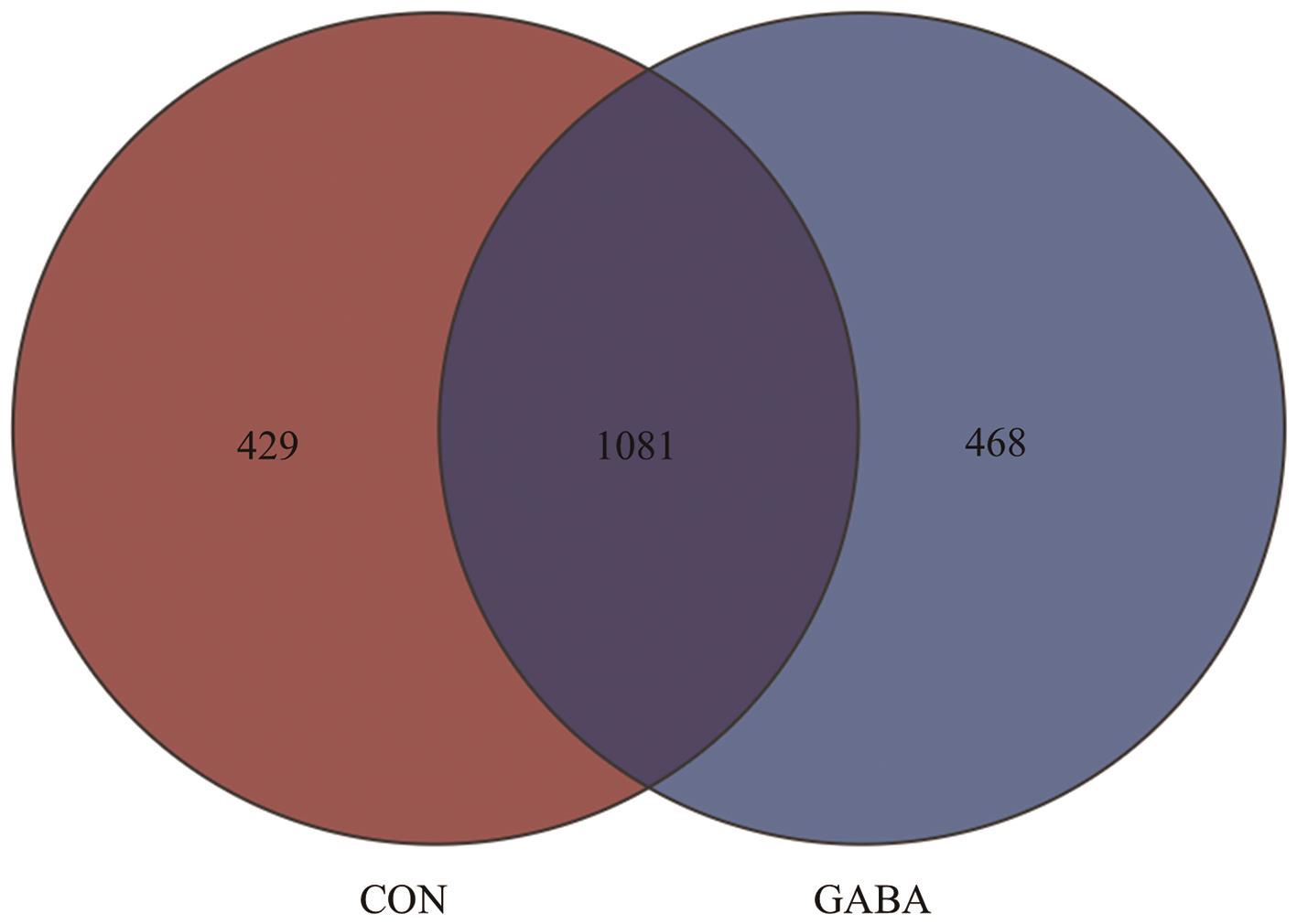
图1 CON组和GABA组肉鸡盲肠菌群OTU的Venn图
Fig. 1 Venn diagram of the OTU of cecal microbiota of broilers in the CON group and the GABA group

图2 CON组和GABA组肉鸡盲肠菌群α多样性比较分析
Fig. 2 Comparative analysis of the α diversity of cecal microbiota of broilers between the CON group and the GABA group
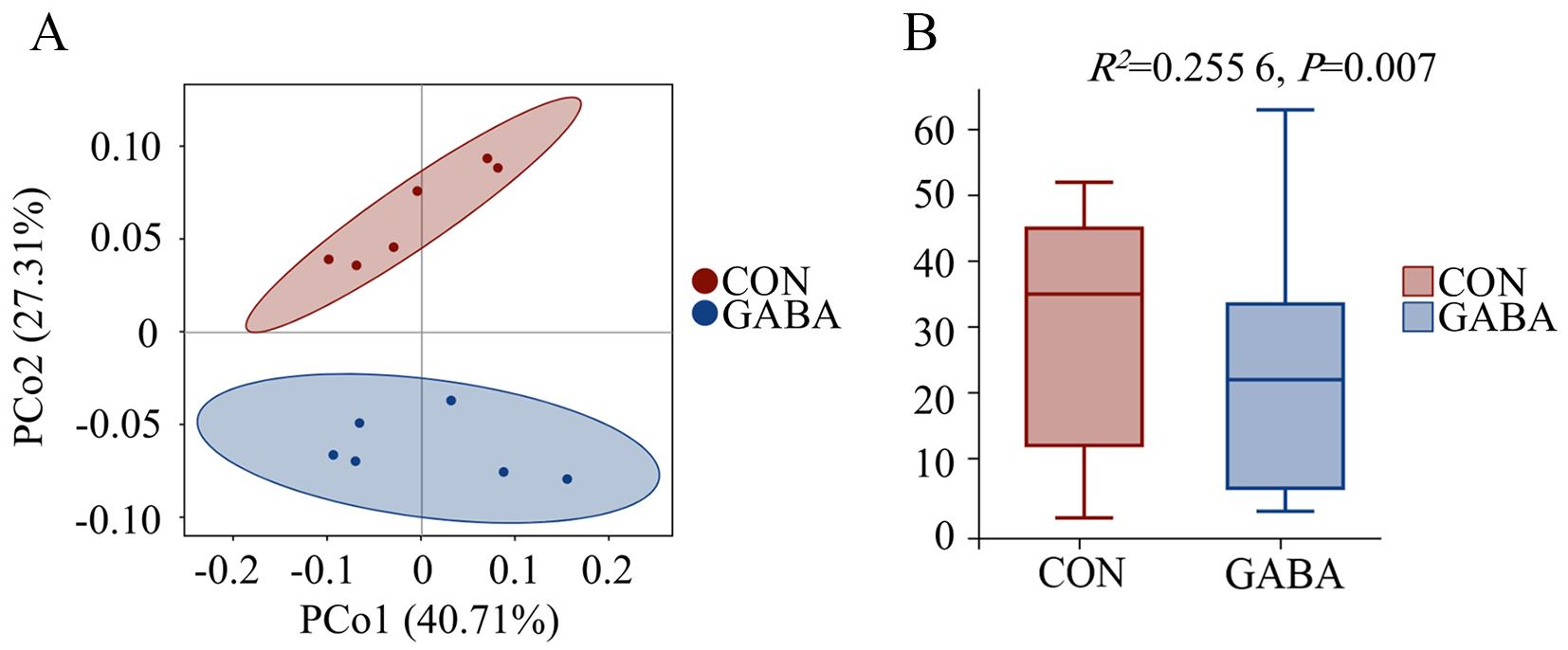
图3 CON组和GABA组肉鸡盲肠菌群β多样性比较分析A:CON组和GABA组肉鸡盲肠菌群PCoA分析;B:CON组和GABA组肉鸡盲肠菌群Adonis分组检验
Fig. 3 Comparative analysis of the β diversity of cecal microbiota of broilersA: Analysis of the PCoA of cecal microbiota of broilers in the CON group and the GABA group. B: Adonis grouping test of cecal microbiota of broilersin the CON group and the GABA groupbetween the CON group and the GABA group
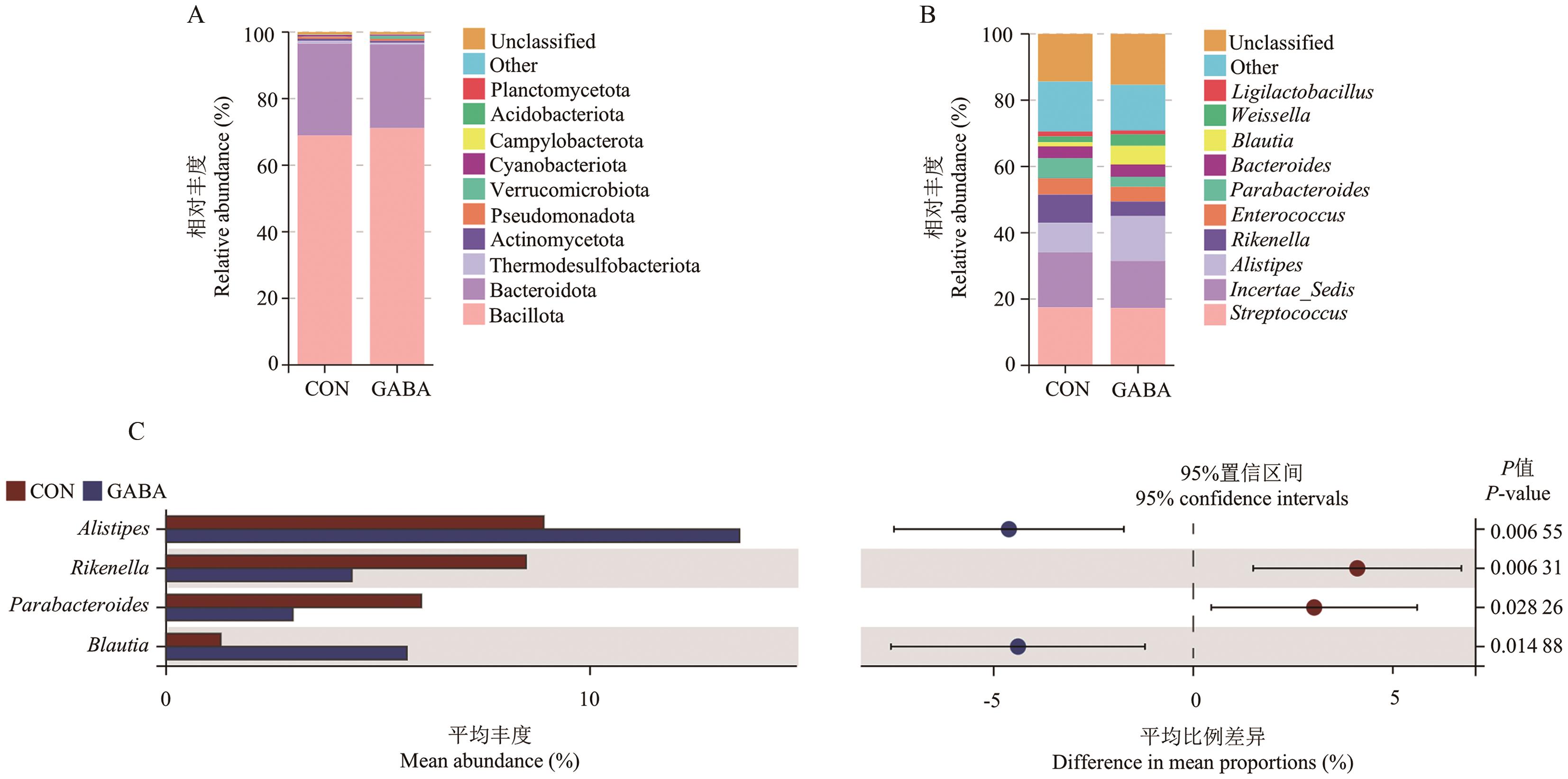
图4 CON组和GABA组肉鸡盲肠菌群组成比较分析A:CON组和GABA组肉鸡盲肠门水平菌群组成(前10);B:CON组和GABA组肉鸡盲肠属水平菌群组成(前10);C:CON组和GABA组肉鸡盲肠属水平菌群差异比较分析
Fig. 4 Comparative analysis of the composition of cecal microbiota of broilers between the CON group and the GABA groupA: Composition of cecal microbiota at phylum level of broilers betwwen the CON group and the GABA group (top 10). B: Composition of cecal microbiota at genus level of broilers between the CON group and the GABA group (top 10). C: Comparative analysis of the differences of cecal microbiota at genus level of broilers between the CON group and the GABA group
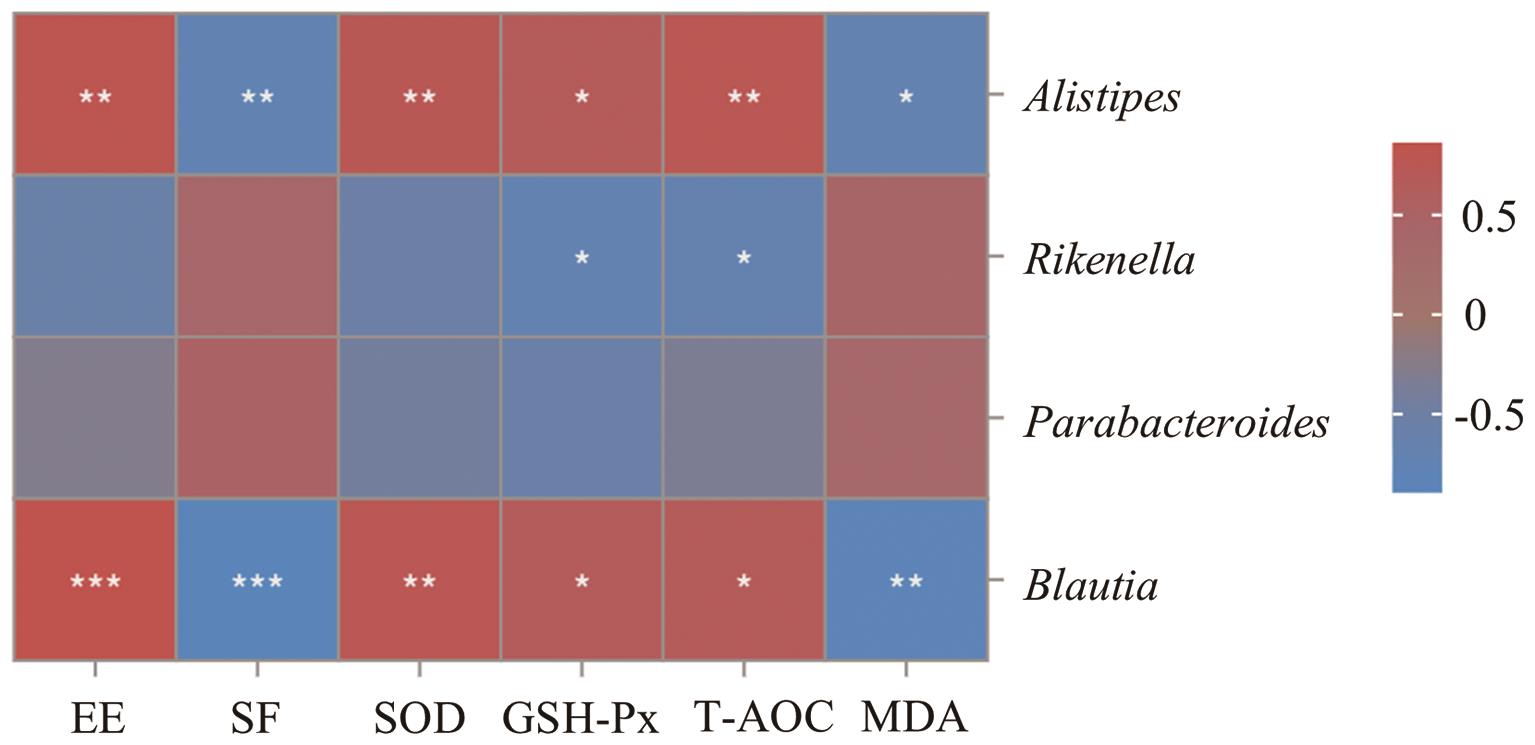
图5 肉鸡盲肠属水平差异菌群(前10)与差异胸肌肉品质、抗氧化指标的Spearman相关性分析EE:胸肌粗脂肪含量;SF:胸肌剪切力;SOD:肝脏SOD活性;GSH-Px:肝脏GSH-Px活性;T-AOC:肝脏T-AOC;MDA:血清MDA含量。*表示显著相关(P<0.05),**和***表示极显著相关(P<0.01和P<0.001)
Fig. 5 Spearman correlation analysis of significantly different meat quality and antioxidant indicators with significantly different cecal microbiota at genus level (top 10) of broilersEE: Breast muscle crude fat content. SF: Breast muscle shear force. SOD: Liver superoxide dismutase activity. GSH-Px: Liver glutathione peroxidase (GSH-Px) activity. T-AOC: Liver total antioxidant capacity (T-AOC). MDA: Serum malondialdehyde content. * indicates significant correlation (P<0.05), and ** and *** indicate extremely significant correlation (P<0.01 and P<0.001)
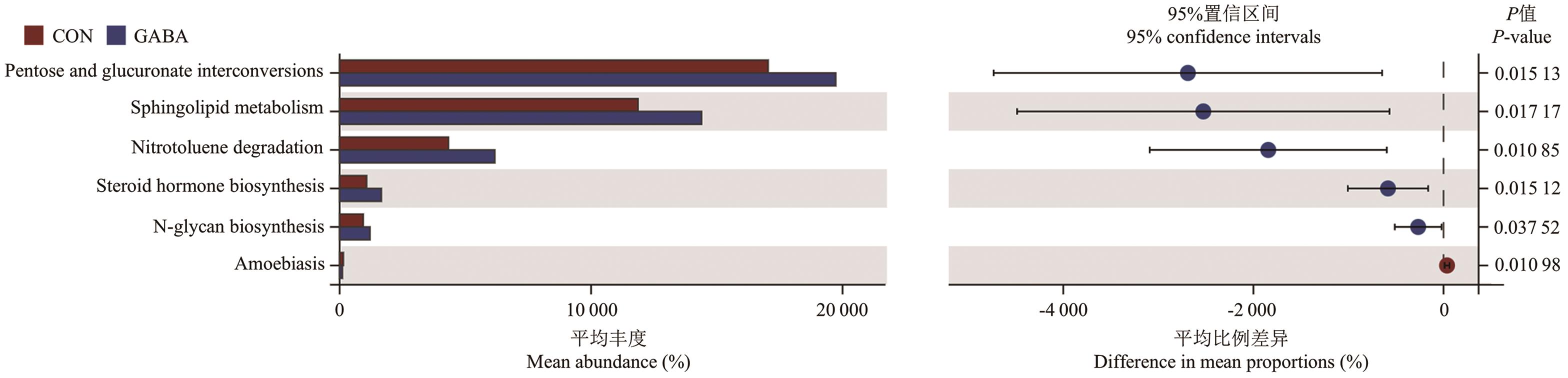
图6 CON组和GABA组肉鸡盲肠菌群差异功能预测分析
Fig. 6 Prediction analysis of different function of cecal microbiota of broilers in the CON group and the GABA group
| [1] | 沙珊珊, 董世荣, 杨玉菊. 肠道菌群及代谢物调控宿主肠道免疫的研究进展 [J]. 生物技术通报, 2023, 39(8): 126-136. |
| Sha SS, Dong SR, Yang YJ. Research progress in gut microbiota and metabolites regulating host intestinal immunity [J]. Biotechnol Bull, 2023, 39(8): 126-136. | |
| [2] | 胡晓迪, 甄文瑞, 白东英, 等. 应激与家禽肠道菌群的互作及其机制 [J]. 中国畜牧兽医, 2024, 51(6): 2471-2480. |
| Hu XD, Zhen WR, Bai DY, et al. Interactions and their mechanisms between stress and poultry intestinal microbiota [J]. China Anim Husb Vet Med, 2024, 51(6): 2471-2480. | |
| [3] | Zhao JS, Zhao F, Li XM, et al. Multi-omics reveals the mechanisms underlying Lactiplantibacillus plantarum P8-mediated attenuation of oxidative stress in broilers challenged with dexamethasone [J]. Anim Nutr, 2023, 14: 281-302. |
| [4] | 谢春琳. 肠道微生物调节生长育肥猪脂肪沉积的机制研究 [D]. 武汉: 华中农业大学, 2022. |
| Xie CL. Mechanism of fat deposition regulated by intestinal microbiota in growing-finishing pigs [D]. Wuhan: Huazhong Agricultural University, 2022. | |
| [5] | 鲍晓虹, 叶田园, 程肖蕊. GABA能神经传递在焦虑症中的作用及相关动物模型的研究进展 [J]. 中国现代应用药学, 2024, 41(16): 2288-2297. |
| Bao XH, Ye TY, Cheng XR. Research progress on the role of GABAergic neurotransmission in anxiety disorder and related animal models [J]. Chin J Mod Appl Pharm, 2024, 41(16): 2288-2297. | |
| [6] | Liwinski T, Lang UE, Brühl AB, et al. Exploring the therapeutic potential of gamma-aminobutyric acid in stress and depressive disorders through the gut-brain axis [J]. Biomedicines, 2023, 11(12): 3128. |
| [7] | 李佳佳, 杨彪, 陈明星, 等. 源于肠道菌群的γ-氨基丁酸对机体的调节机制 [J]. 中国兽医学报, 2021, 41(2): 388-392, 400. |
| Li JJ, Yang B, Chen MX, et al. Regulation mechanism of γ-aminobutyric acid produced by intestinal flora [J]. Chin J Vet Sci, 2021, 41(2): 388-392, 400. | |
| [8] | 吕旦, 陈冰, 曹俊明, 等. γ-氨基丁酸的生物学功能及其在动物生产中的应用 [J]. 动物营养学报, 2024, 36(11): 6903-6916. |
| Lyu D, Chen B, Cao JM, et al. Biological functions of γ-aminobutyric acid and its application in animal production [J]. Chin J Anim Nutr, 2024, 36(11): 6903-6916. | |
| [9] | Zhao YY, Wang J, Wang H, et al. Effects of GABA supplementation on intestinal SIgA secretion and gut microbiota in the healthy and ETEC-infected weanling piglets [J]. Mediat Inflamm, 2020, 2020(1): 7368483. |
| [10] | Li YL, Zhen SB, Sun FX, et al. Effects of γ-aminobutyric acid on growth performance, immunity, antioxidant capacity, and intestinal microbiota of growing minks [J]. Vet Sci, 2024, 11(9): 398. |
| [11] | 马顺, 宋阳, 林晓艳, 等. 包被丁酸钠对肉鸡生长性能、肉品质、血清生化指标及盲肠菌群结构的影响 [J]. 动物营养学报, 2025, 37(2): 950-960. |
| Ma S, Song Y, Lin XY, et al. Effects of coated sodium butyrate on growth performance, meat quality, serum biochemical indices and cecal microbial structure of broilers [J]. Chin J Anim Nutr, 2025, 37(2): 950-960. | |
| [12] | 刘子明, 刘馨忆, 李龙飞. γ-氨基丁酸对肉鸡生长性能、免疫功能及血清生化指标的影响 [J]. 饲料研究, 2024, 47(18): 40-44. |
| Liu ZM, Liu XY, Li LF. Effects of γ-aminobutyric acid on growth performance, immune function, and serum biochemical indexes of broilers [J]. Feed Res, 2024, 47(18): 40-44. | |
| [13] | 柯岩. γ-氨基丁酸对鸡下丘脑采食相关基因调控的研究 [D]. 锦州: 锦州医科大学, 2017. |
| Ke Y. The effect of gamma-aminobutyric on the regulation of feed intake related genes in the hypothalamus neurons of chicken [D]. Shenyang: Jinzhou Medical University, 2017. | |
| [14] | 张丽英. 饲料分析及饲料质量检测技术 [M]. 4版. 北京: 中国农业大学出版社, 2016. |
| Zhang LY. Feed analysis and quality test technology [M]. 4th ed. Beijing: China Agricultural University Press, 2016. | |
| [15] | 赵旭. 丁酸梭菌对肉鸡脂肪代谢的影响及其机理研究 [D]. 北京: 中国农业大学, 2014. |
| Zhao X. Effects of Clostridium butyricum on lipid metabolism of: broiler chickens and its underlying mechanism [D]. Beijing: China Agricultural University, 2014. | |
| [16] | 彭增起, 将爱民. 畜产品加工学实验指导 [M]. 第2版.北京:中国农业大学出版社,2014. |
| Peng ZQ, Jiang AM. The experiment guidance of animal product processing [M]. 2th ed. Beijing: China Agricultural Press, 2014. | |
| [17] | Chen Q, Hu D, Wu XT, et al. Dietary γ-aminobutyric acid supplementation inhibits high-fat diet-induced hepatic steatosis via modulating gut microbiota in broilers [J]. Microorganisms, 2022, 10(7): 1281. |
| [18] | Li HF, Zhao LQ, Liu S, et al. Propionate inhibits fat deposition via affecting feed intake and modulating gut microbiota in broilers [J]. Poult Sci, 2021, 100(1): 235-245. |
| [19] | 曹宪福, 杨志成, 姜廷波, 等. 肌肉嫩度的影响因素分析 [J]. 黑龙江畜牧兽医, 2016(21): 60-63. |
| Cao XF, Yang ZC, Jiang TB, et al. Analysis of influencing factors of muscle tenderness [J]. Heilongjiang Anim Sci Vet Med, 2016(21): 60-63. | |
| [20] | 戴四发. 谷氨酰胺和γ-氨基丁酸对肉鸡抗热应激和肉品质的影响及机理探讨 [D]. 南京: 南京农业大学, 2012. |
| Dai SF. Effects and mechanism of glutamine and gamma-aminobutyric acid supplementation on anti-stress resistance and meat quality of broilers under heat stress [D]. Nanjing: Nanjing Agricultural University, 2012. | |
| [21] | 戴思凡, 王梓蓓, 和世春, 等. 肠道微生物对畜禽脂质代谢的影响 [J]. 饲料研究, 2024, 47(11): 138-142. |
| Dai SF, Wang ZB, He SC, et al. Effects of intestinal microorganisms on lipid metabolism in livestock and poultry [J]. Feed Res, 2024, 47(11): 138-142. | |
| [22] | 袁维维. 多阶段生酮饮食对肥胖人群肠道菌群结构特征的影响 [D]. 无锡: 江南大学, 2021. |
| Yuan WW. The effect of multi-stage ketogenic diet on the structural characteristics of gut microbiota in obese people [D]. Wuxi: Jiangnan University, 2021. | |
| [23] | 康永波. 魔芋葡甘露聚糖通过调控肠道微生物治疗肥胖的机制研究 [D]. 昆明: 昆明理工大学, 2018. |
| Kang YB. Mechanism of konjac glucomannan treating obesity by regulating gut microbiota [D]. Kunming: Kunming University of Science and Technology, 2018. | |
| [24] | Lee SY, Lee HY, Song JH, et al. Adipocyte-specific deficiency of de novo sphingolipid biosynthesis leads to lipodystrophy and insulin resistance [J]. Diabetes, 2017, 66(10): 2596-2609. |
| [25] | 王明会, 刘志梅, 王昊棋, 等. 糖皮质激素和饲粮脂肪水平对肉鸡脂肪代谢的影响 [J]. 动物营养学报, 2018, 30(9): 3772-3780. |
| Wang MH, Liu ZM, Wang HQ, et al. Effects of glucocorticoid and dietary fat level on lipid metabolism of broilers [J]. Chin J Anim Nutr, 2018, 30(9): 3772-3780. | |
| [26] | Li JH, Shi Q, Xue Y, et al. The effects of in ovo feeding of selenized glucose on liver selenium concentration and antioxidant capacity in neonatal broilers [J]. Chin Chem Lett, 2024, 35(6): 109239. |
| [27] | 李泽坤, 肖宇, 焦阳, 等. 脂质和蛋白质氧化对肉品质的影响 [J]. 中国食品学报, 2024, 24(7): 438-449. |
| Li ZK, Xiao Y, Jiao Y, et al. Effects of lipid and protein oxidation on meat quality [J]. J Chin Inst Food Sci Technol, 2024, 24(7): 438-449. | |
| [28] | 孙刘锁, 周维仁, 闫俊书, 等. 新型复合抗氧化剂对青脚麻鸡生长性能及抗氧化功能的影响 [J]. 动物营养学报, 2023, 35(3): 1596-1609. |
| Sun LS, Zhou WR, Yan JS, et al. Effects of new compound antioxidants on growth performance and antioxidant function of cyan-shank partridge chickens [J]. Chin J Anim Nutr, 2023, 35(3): 1596-1609. | |
| [29] | Wang YX, Wu PP, Shen HY. Effect of ampicillin wastewater on the T-AOC and LDH activities of zebrafish [J]. IOP Conf Ser Earth Environ Sci, 2019, 295(2): 012018. |
| [30] | 任继武, 陈哲秀, 乔君毅, 等. 葡萄籽原花青素对四川白鹅生长性能和抗氧化能力的影响 [J]. 动物营养学报, 2023, 35(12): 7817-7827. |
| Ren JW, Chen ZX, Qiao JY, et al. Effects of grape seed proanthocyanidins on growth performance and antioxidant capacity of Sichuan white geese [J]. Chin J Anim Nutr, 2023, 35(12): 7817-7827. | |
| [31] | 钟光. 精氨酸、γ-氨基丁酸、有机铬和硒对热应激黄羽肉鸡的作用研究 [D]. 泰安: 山东农业大学, 2019. |
| Zhong G. Effects of arginine, gamma-aminobutyric acid, organic chromium and selenium on yellow-feathered broilers exposed to heat stress [D]. Tai’an: Shandong Agricultural University, 2019. | |
| [32] | Fathi M, Saeedyan S, Kaoosi M. Gamma-amino butyric acid (GABA) supplementation alleviates dexamethasone treatment-induced oxidative stress and inflammation response in broiler chickens [J]. Stress, 2023, 26(1): 2185861. |
| [33] | 李君, 王鹤洁, 安洁, 等. NF-κB和Nrf2信号通路在成肌细胞抗氧化应激中的作用 [J]. 山西农业科学, 2023, 51(11): 1252-1259. |
| Li J, Wang HJ, An J, et al. Role of NF-κB and Nrf2 signaling pathways in anti-oxidative stress of myoblasts [J]. J Shanxi Agric Sci, 2023, 51(11): 1252-1259. | |
| [34] | Liu XY, Jiang LL, Pang JM, et al. Maternal dietary supplementation with γ-aminobutyric acid alleviated oxidative stress in gestating sows and their offspring by regulating GABRP [J]. Animals, 2022, 12(19): 2539. |
| [35] | 孟亚轩, 刘彦, 王晶, 等. 氨基葡萄糖对断奶仔猪血清抗氧化、炎症指标以及肠道微生物的影响 [J]. 畜牧兽医学报, 2025, 56(8): 3908-3921. |
| Meng YX, Liu Y, Wang J, et al. Effects of glucosamine on serum anti-oxidation, inflammatory indexes and intestinal microbes in weaned piglets [J]. Acta Vet Zootechnica Sin, 2025, 56(8): 3908-3921. |
| [1] | 苗昊翔, 张颖, 郭世鹏, 张健. 一株高产γ-氨基丁酸短乳杆菌TCCC13007全基因组测序及比较基因组分析[J]. 生物技术通报, 2025, 41(11): 166-176. |
| [2] | 孙志勇, 杜怀东, 刘阳, 马嘉欣, 于雪然, 马伟, 姚鑫杰, 王敏, 李培富. 水稻籽粒γ-氨基丁酸含量的全基因组关联分析[J]. 生物技术通报, 2024, 40(8): 53-62. |
| [3] | 单新雨, 李太春, 杨若晨, 段香茹, 康佳, 张英杰, 刘月琴. γ-氨基丁酸对绵羊卵巢颗粒细胞凋亡及类固醇激素分泌的影响[J]. 生物技术通报, 2024, 40(3): 312-321. |
| [4] | 耿若涵, 王炳贺, 徐昌文, 钱虹萍, 林金星, 崔亚宁. 蛋白的翻译后修饰调控植物囊泡转运的研究进展[J]. 生物技术通报, 2024, 40(10): 139-148. |
| [5] | 焦帅, 付域泽, 崔凯, 张吉贤, 王杰, 毕研亮, 刁其玉, 张建新, 张乃锋. 短小芽孢杆菌对羔羊肠道炎症和屏障功能的影响[J]. 生物技术通报, 2024, 40(1): 344-352. |
| [6] | 王小河, 辜夕容, 祁顺菊, 李杰, 崔瑶, 李得霞, 杨莉荟. 巴山榧树枝和叶提取物的抗氧化能力、抑菌活性与挥发性成分[J]. 生物技术通报, 2021, 37(8): 152-161. |
| [7] | 刘淑君, 陈苗, 王凤忠, 包郁明, 辛凤姣, 温博婷. 谷氨酸(钠)对人体肠道菌群影响的体外发酵研究[J]. 生物技术通报, 2020, 36(12): 104-112. |
| [8] | 黄元霞, 彭传海, 丁宁, 邱忠平, 李星, 邹美慧. 一种三联乳酸菌的体外降胆固醇和抗氧化能力研究[J]. 生物技术通报, 2020, 36(12): 113-120. |
| [9] | 王悦, 欧阳丹, 汤伟, 刘仕博, 顾燕, 何增国. 六株红酵母抗氧化活性的研究[J]. 生物技术通报, 2020, 36(10): 156-164. |
| [10] | 叶洲辰, 吴友根, 于靖, 张军锋, 杨东梅, 胡新文. 不同产地油茶籽油提取物的抗氧化活性比较分析及其营养评价[J]. 生物技术通报, 2019, 35(10): 80-88. |
| [11] | 黄燕, 宿玲恰, 吴敬. 重组谷氨酸脱羧酶制备γ-氨基丁酸的工艺条件优化[J]. 生物技术通报, 2016, 32(6): 199-204. |
| [12] | 徐灯, 耿丽丽, 张敏红, 卢凡, 张杰. 转基因水稻cry1Ab/Ac基因及蛋白在肉鸡肠道中的残留检测[J]. 生物技术通报, 2015, 31(9): 84-90. |
| [13] | 郭尚敬;李妹芳;孟庆杰;冀芦沙;. 甜椒叶绿体小分子量热激蛋白(CaHSP26)对大肠杆菌抗氧化能力的影响[J]. , 2012, 0(11): 155-160. |
| [14] | 张利鑫;刘强;. 添加N-乙酰-D-半乳糖胺消除大豆凝集素抗营养活性的可行性研究[J]. , 2009, 0(07): 156-159. |
| [15] | 衡文娜;郭春华;张晓晖;张重庆;陈玉红;. 小型猪与梅山猪Prop1基因的比较分析[J]. , 2007, 0(05): 144-147. |
| 阅读次数 | ||||||
|
全文 |
|
|||||
|
摘要 |
|
|||||
