







生物技术通报 ›› 2026, Vol. 42 ›› Issue (7): 257-268.doi: 10.13560/j.cnki.biotech.bull.1985.2025-1193
• 研究报告 • 上一篇
郭家鑫1,2, 王梦霞3, 马耀武3, 张麒宇3, 张振宇3, 柳海涛3, 裴久渤1,2( ), 姜瑛2,3()
收稿日期:2025-11-04
出版日期:2026-07-26
发布日期:2026-07-20
通讯作者:
裴久渤 E-mail: peijiubo@163.com基金资助:
GUO Jia-xin1,2, WANG Meng-xia3, MA Yao-wu3, ZHANG Qi-yu3, ZHANG Zhen-yu3, LIU Hai-tao3, PEI Jiu-bo1,2(), JIANG Ying2,3()
Received:2025-11-04
Published:2026-07-26
Online:2026-07-20
摘要:
目的 从重金属污染土壤中筛选耐镉促生菌,评估其镉(Cd)耐受性与促生功能,为镉污染农田的微生物修复及植物促生菌肥开发提供菌种资源。 方法 以河南省新乡市卫辉市污染土壤为样本,通过含镉培养基分离获得菌株,分别采用火焰光度法、铬天青S(CAS)法和Salkowski比色法测定其解钾、产铁载体和产吲哚乙酸(IAA)能力。对优势菌株进行形态学、生理生化及16S rDNA鉴定,并结合全基因组测序,通过生物信息学方法进行基因组装、功能注释以及耐镉与促生相关基因的挖掘。通过小麦和玉米籽粒发芽实验,分析镉胁迫下菌株对发芽率、芽长和根长的影响。 结果 共分离到8株耐镉菌,其中菌株F2镉耐受性最强,经鉴定为高地芽胞杆菌(Bacillus altitudinis)。该菌株在Cd2+浓度为50 mg/L的LB培养基中培养72 h后,镉去除率为27.59%,产IAA量为31.72 μg/mL,解钾量为23.10 mg/L,铁载体相对产量为65.30%。全基因组测序显示,其染色体大小为3 718 742 bp,GC含量为41.34%,共预测到3 726个编码基因,并含有79个tRNA和24个rRNA。功能注释表明,该菌株携带多个与重金属耐受和植物促生相关的基因。在镉胁迫条件下,菌株F2可显著提高小麦和玉米籽粒的发芽率、芽长和根长。 结论 高地芽胞杆菌F2是一株具有多重促生功能的耐镉菌,全基因组分析揭示其耐镉与促生的遗传基础,该菌株在镉胁迫下对作物种子萌发和生长有显著促进作用,展现出作为微生物肥料的良好应用潜力。
郭家鑫, 王梦霞, 马耀武, 张麒宇, 张振宇, 柳海涛, 裴久渤, 姜瑛. 一株耐镉促生菌的筛选、鉴定及全基因组分析[J]. 生物技术通报, 2026, 42(7): 257-268.
GUO Jia-xin, WANG Meng-xia, MA Yao-wu, ZHANG Qi-yu, ZHANG Zhen-yu, LIU Hai-tao, PEI Jiu-bo, JIANG Ying. Screening, Identification, and Whole-genome Analysis of a Cadmium-tolerant Plant Growth-promoting Bacterium[J]. Biotechnology Bulletin, 2026, 42(7): 257-268.
菌株 Strains | Cd2+浓度 Cd2+ concentration (mg/L) | |||||
|---|---|---|---|---|---|---|
| 10 | 25 | 50 | 100 | 150 | 200 | |
| B2 | +++ | +++ | ++ | + | - | - |
| D1 | +++ | ++ | + | - | - | - |
| D2 | +++ | ++ | ++ | + | - | - |
| D3 | +++ | ++ | + | - | - | - |
| F1 | +++ | ++ | ++ | + | - | - |
| F2 | +++ | +++ | +++ | ++ | + | - |
| F3 | +++ | +++ | ++ | + | - | - |
| F31 | +++ | ++ | + | - | - | - |
表1 菌株在不同浓度Cd2+胁迫下的生长情况
Table 1 Growth of strains under Cd²⁺ stress at different concentrations
菌株 Strains | Cd2+浓度 Cd2+ concentration (mg/L) | |||||
|---|---|---|---|---|---|---|
| 10 | 25 | 50 | 100 | 150 | 200 | |
| B2 | +++ | +++ | ++ | + | - | - |
| D1 | +++ | ++ | + | - | - | - |
| D2 | +++ | ++ | ++ | + | - | - |
| D3 | +++ | ++ | + | - | - | - |
| F1 | +++ | ++ | ++ | + | - | - |
| F2 | +++ | +++ | +++ | ++ | + | - |
| F3 | +++ | +++ | ++ | + | - | - |
| F31 | +++ | ++ | + | - | - | - |
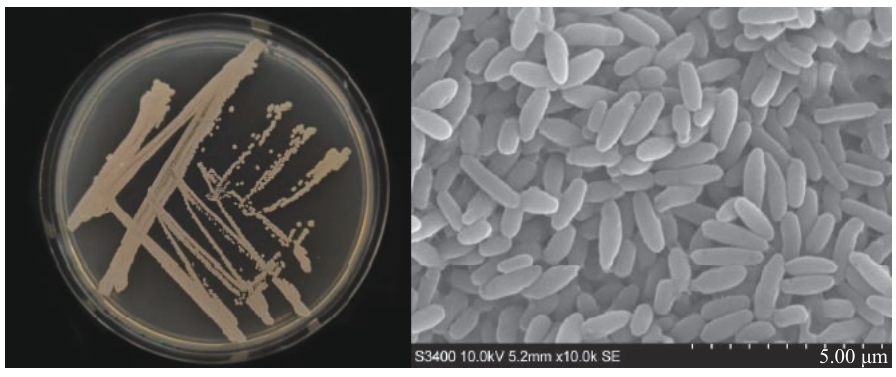
图1 菌株F2菌落形态及电镜图
Fig. 1 Colony morphology and electron micrographs of strain F2
项目 Item | F2 | 参比菌株B. altitudinis 41KF2B[ Reference strain B. altitudinis 41KF2B |
|---|---|---|
过氧化氢酶 Catalase | + | + |
甲基红 Methyl red(MR) | - | - |
VP实验 Voges-Proskauer test(VP test) | + | - |
革兰氏染色 Gram staining | + | + |
淀粉水解 Starch hydrolysis | - | + |
明胶水解 Gelatin hydrolysis | + | + |
硝酸盐还原 Nitrate reduction | + | - |
ONPG试验 ONPG assay | + | + |
表2 菌株F2生理生化实验鉴定结果
Table 2 Identification results of physiological and biochemical tests for strain F2
项目 Item | F2 | 参比菌株B. altitudinis 41KF2B[ Reference strain B. altitudinis 41KF2B |
|---|---|---|
过氧化氢酶 Catalase | + | + |
甲基红 Methyl red(MR) | - | - |
VP实验 Voges-Proskauer test(VP test) | + | - |
革兰氏染色 Gram staining | + | + |
淀粉水解 Starch hydrolysis | - | + |
明胶水解 Gelatin hydrolysis | + | + |
硝酸盐还原 Nitrate reduction | + | - |
ONPG试验 ONPG assay | + | + |
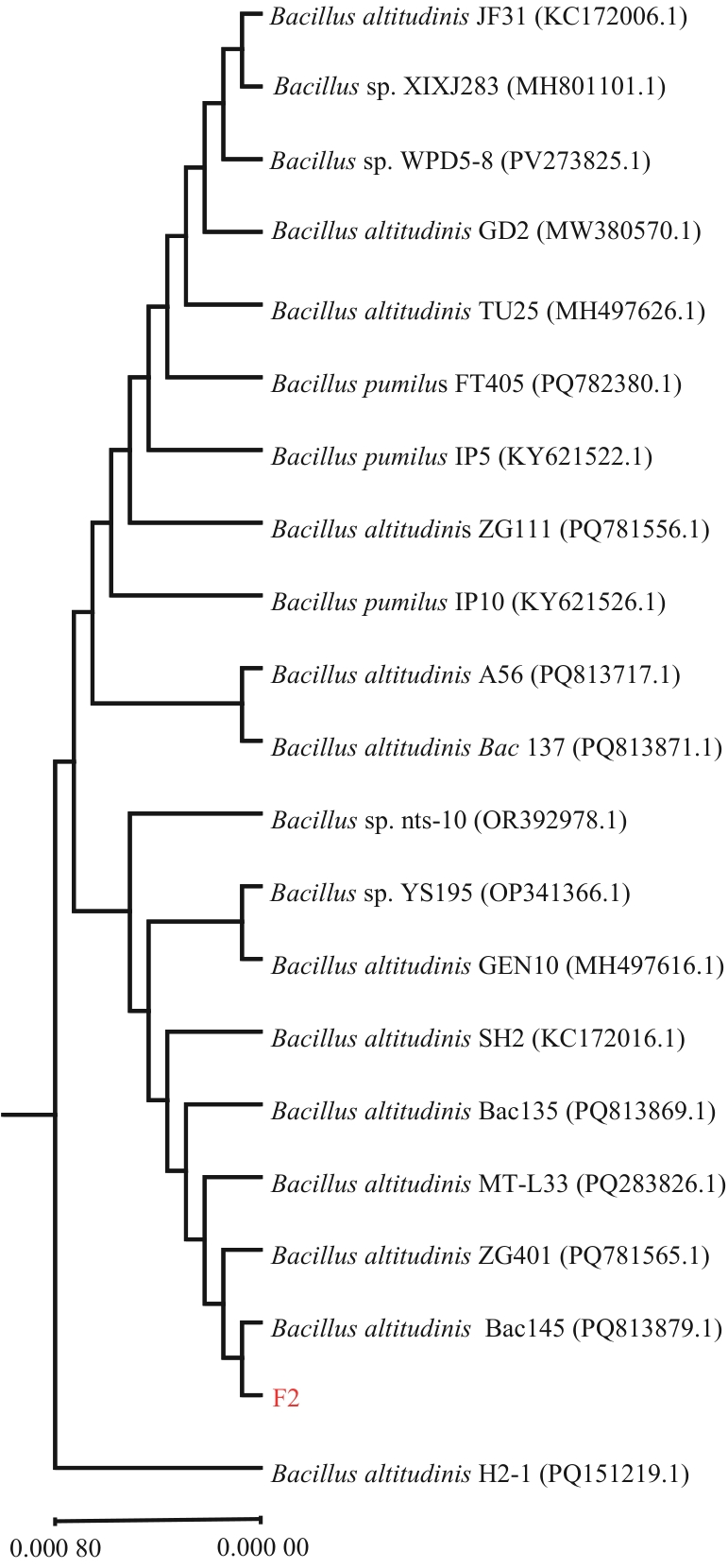
图2 菌株F2系统发育树标尺代表每10 000个核苷中有8个核苷替代
Fig. 2 Phylogenetic tree of strain F2Scale bar indicates 8 nucleotide substitutions per 10 000 nucleotides
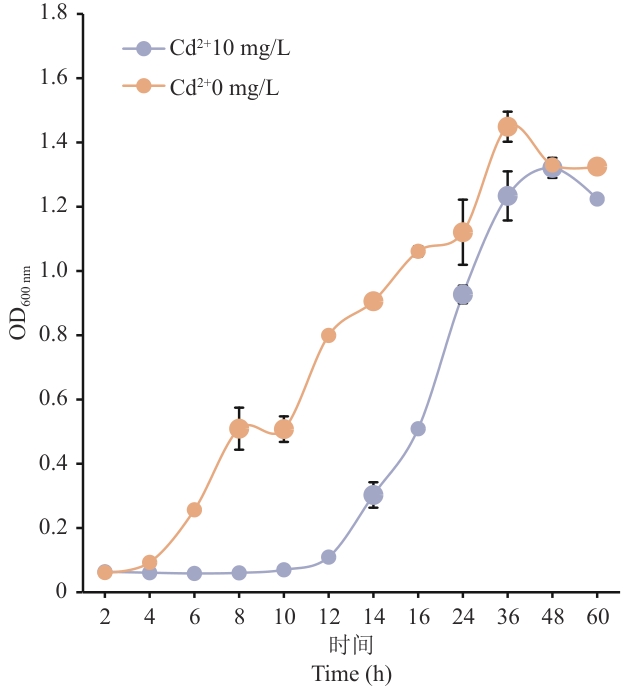
图3 F2菌株不同Cd2+浓度下生长曲线
Fig. 3 Growth curves of strain F2 under different Cd2+ concentrations
特征 Features | 染色体 Chromosome |
|---|---|
| Size (bp) | 3 718 742 |
| G+C content (%) | 41.34 |
| tRNA | 79 |
| rRNA | 24 |
| Total number of CDSs | 3 726 |
| CDSs with NR number assignments | 3 722 |
| CDSs with COG number assignments | 3 026 |
| CDSs with GO assignments | 1 754 |
| CDSs with KEGG pathway | 2 781 |
| CDSs with TCDB assignments | 1 754 |
表3 菌株全基因组的一般特征
Table 3 General characteristics of the whole genome of the strain
特征 Features | 染色体 Chromosome |
|---|---|
| Size (bp) | 3 718 742 |
| G+C content (%) | 41.34 |
| tRNA | 79 |
| rRNA | 24 |
| Total number of CDSs | 3 726 |
| CDSs with NR number assignments | 3 722 |
| CDSs with COG number assignments | 3 026 |
| CDSs with GO assignments | 1 754 |
| CDSs with KEGG pathway | 2 781 |
| CDSs with TCDB assignments | 1 754 |
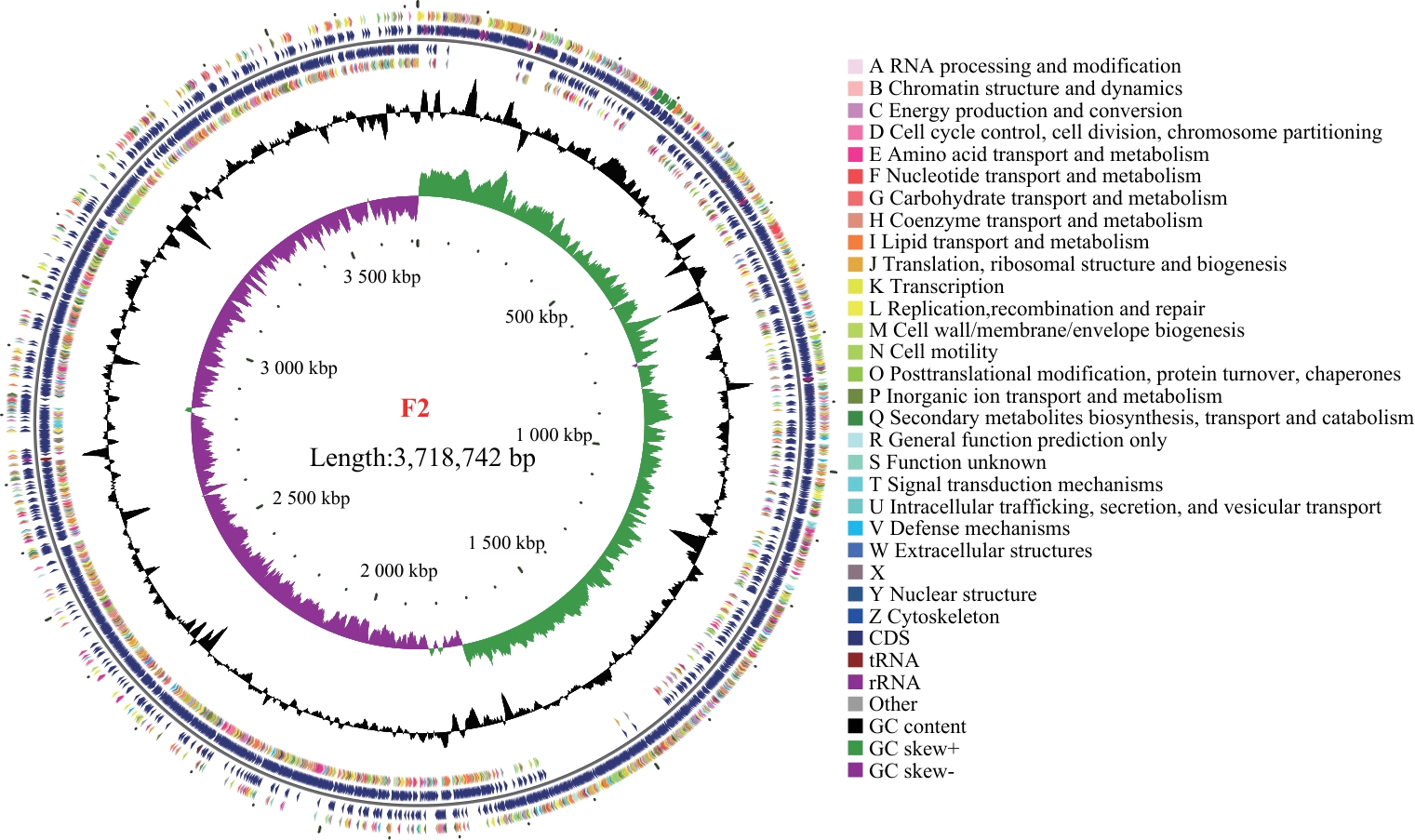
图4 菌株基因组圈图
Fig. 4 Circular genome map of the strain
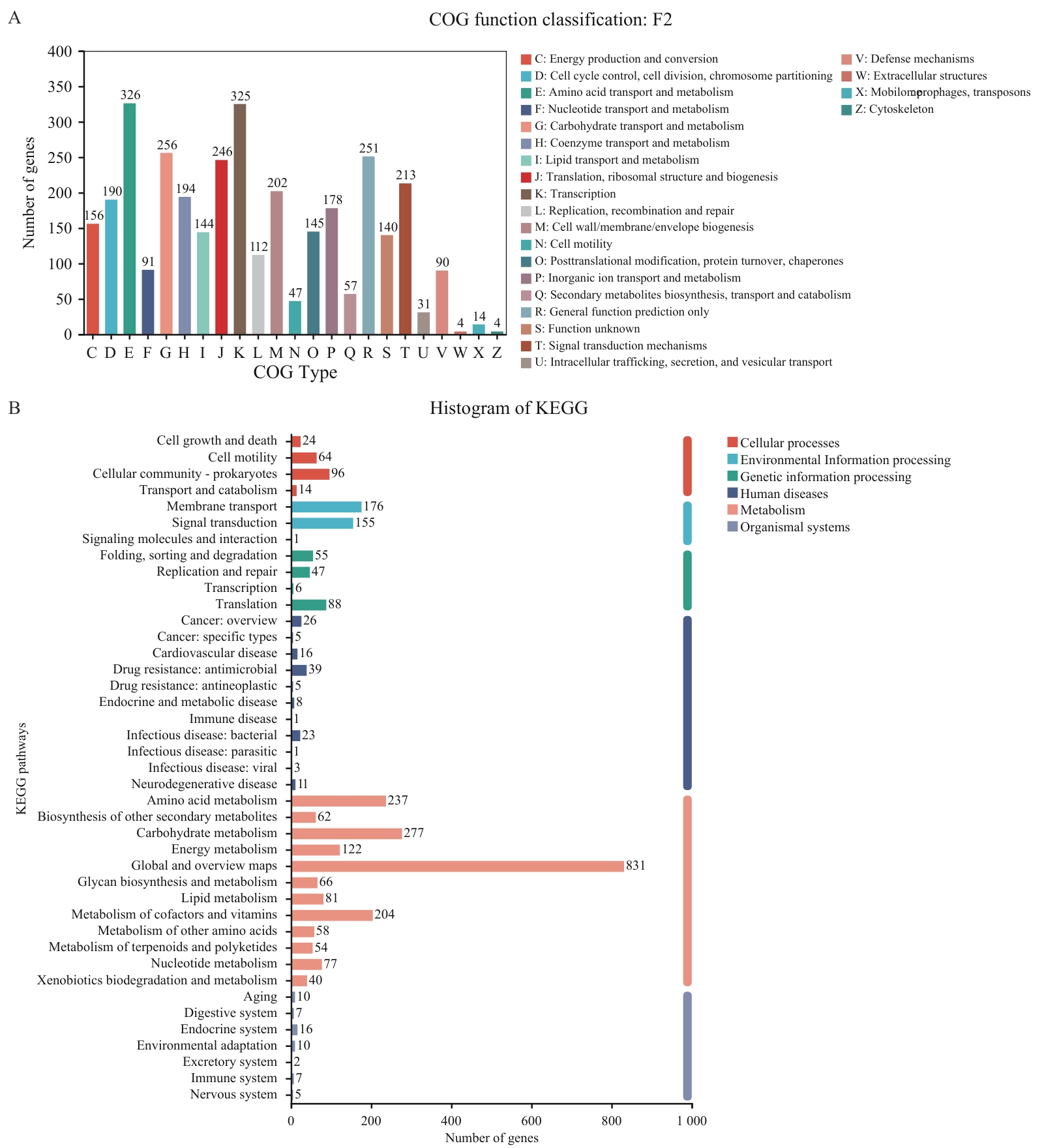
图5 F2基因组的功能基因注释A: COG功能注释;B: KEGG功能注释
Fig. 5 Functional gene annotation of F2 genomeA: COG annotation. B: KEGG annotation
基因编号 Gene ID | 基因名称 Gene name | 产物 Product |
|---|---|---|
| gene0479 | mntH | 二价金属阳离子转运蛋白 |
| gene3685 | merR | HTH型转录调节因子 |
| gene1342 | zntA | 镉、锌和钴转运ATP酶 |
| gene1785 | arsR | HTH型转录阻遏物 |
| gene0952 | cueR | 汞抗性操纵子调节蛋白 |
| gene0777 | corA | 假定的金属离子转运蛋白 |
| gene0377 | arsB | 推定砷泵膜蛋白 |
| gene0254 | csoR | 铜感应转录阻遏子 |
| gene3123 | copA | 铜输出P型ATP酶 |
| gene3455 | dgcB | 可能的铁硫结合氧化还原酶 |
表4 菌株耐Cd2+与重金属相关基因注释
Table 4 Annotation of genes related to Cd2+ and heavy metal tolerance in the strain
基因编号 Gene ID | 基因名称 Gene name | 产物 Product |
|---|---|---|
| gene0479 | mntH | 二价金属阳离子转运蛋白 |
| gene3685 | merR | HTH型转录调节因子 |
| gene1342 | zntA | 镉、锌和钴转运ATP酶 |
| gene1785 | arsR | HTH型转录阻遏物 |
| gene0952 | cueR | 汞抗性操纵子调节蛋白 |
| gene0777 | corA | 假定的金属离子转运蛋白 |
| gene0377 | arsB | 推定砷泵膜蛋白 |
| gene0254 | csoR | 铜感应转录阻遏子 |
| gene3123 | copA | 铜输出P型ATP酶 |
| gene3455 | dgcB | 可能的铁硫结合氧化还原酶 |
功能 Function | 基因编号 Gene ID | 基因名称 Gene name | 产物 Product |
|---|---|---|---|
| IAA合成 | gene1120 | trpS | 色氨酸-tRNA连接酶 |
| IAA synthesis | gene2063 | trpA | 色氨酸合酶α链 |
| gene2064 | trpB | 色氨酸合酶β链 | |
| gene2066 | trpC | 吲哚-3-甘油-磷酸合酶 | |
| gene2060 | aroA | 3-磷酸莽草酸1-羧乙烯基转移酶 | |
| gene2068 | trpE | 邻氨基苯甲酸合酶组分 | |
| gene2952 | comQ | 色氨酸二甲基烯丙基转移酶 | |
| 铁载体合成/转运 | gene3056 | fecE | 铁载体转运系统ATP结合蛋白 |
| Siderophore | gene0215 | ABC.FEV.A | Fe3+离子导入ATP结合蛋白 |
| synthesis/transport | gene3610 | htsC | 铁载体结合蛋白 |
| gene2593 | sdhb | 琥珀酸脱氢复合物铁硫亚基B | |
溶磷、解钾相关 Related to phosphorus solubilization and potassium dissolution | gene2294 | pstB | 磷酸ABC转运蛋白ATP结合蛋白 |
| gene2298 | pstS | 磷酸ABC转运蛋白周质结合蛋白 | |
| gene2648 | pyk | 丙酮酸激酶 | |
| gene1445 | pyc | 丙酮酸羧化酶 | |
| gene2666 | acka | 醋酸激酶 | |
| gene1917 | glta | 柠檬酸合酶 |
表5 菌株促生功能相关基因注释
Table 5 Annotation of genes related to plant growth-promoting functions of the strain
功能 Function | 基因编号 Gene ID | 基因名称 Gene name | 产物 Product |
|---|---|---|---|
| IAA合成 | gene1120 | trpS | 色氨酸-tRNA连接酶 |
| IAA synthesis | gene2063 | trpA | 色氨酸合酶α链 |
| gene2064 | trpB | 色氨酸合酶β链 | |
| gene2066 | trpC | 吲哚-3-甘油-磷酸合酶 | |
| gene2060 | aroA | 3-磷酸莽草酸1-羧乙烯基转移酶 | |
| gene2068 | trpE | 邻氨基苯甲酸合酶组分 | |
| gene2952 | comQ | 色氨酸二甲基烯丙基转移酶 | |
| 铁载体合成/转运 | gene3056 | fecE | 铁载体转运系统ATP结合蛋白 |
| Siderophore | gene0215 | ABC.FEV.A | Fe3+离子导入ATP结合蛋白 |
| synthesis/transport | gene3610 | htsC | 铁载体结合蛋白 |
| gene2593 | sdhb | 琥珀酸脱氢复合物铁硫亚基B | |
溶磷、解钾相关 Related to phosphorus solubilization and potassium dissolution | gene2294 | pstB | 磷酸ABC转运蛋白ATP结合蛋白 |
| gene2298 | pstS | 磷酸ABC转运蛋白周质结合蛋白 | |
| gene2648 | pyk | 丙酮酸激酶 | |
| gene1445 | pyc | 丙酮酸羧化酶 | |
| gene2666 | acka | 醋酸激酶 | |
| gene1917 | glta | 柠檬酸合酶 |
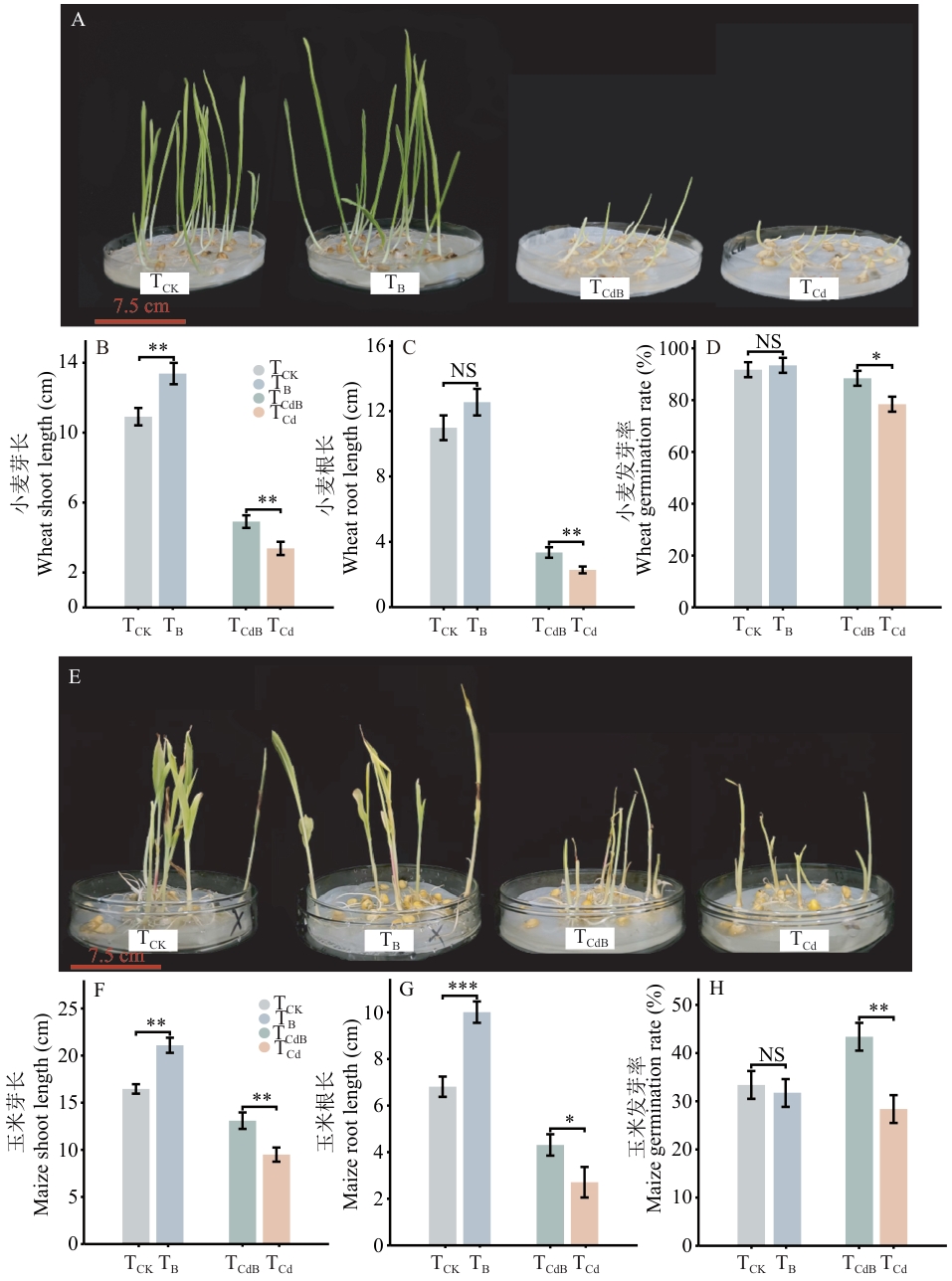
图6 菌株F2对Cd2+胁迫下小麦(A-D)和玉米(E-H)籽粒萌发及长势的影响TCK:去离子水培养;TB:种子菌悬液摇瓶后,去离子水培养;TCdB:种子菌悬液摇瓶后,20 mg/L Cd2+培养;TCd:20 mg/L Cd2+溶液培养,NS表示差异不显著,*,**,***分别表示P<0.05,P<0.01和P<0.001
Fig. 6 Effect of strain F2 on the seeed germination and growth of wheat (A-D) and maize (E-H) under Cd2+ stressTCK: Cultured with deionized water. TB: Cultured with deionized water after shaking seeds in bacterial suspension. TCdB: Cultured with 20 mg/L Cd2+ after shaking seeds in bacterial suspension. TCd: Cultured with 20 mg/L Cd2+ solution. NS: Not significant, * P<0.05, ** P<0.01, and ***P<0.001
| [1] | Xia F, Zhao ZF, Niu X, et al. Integrated pollution analysis, pollution area identification and source apportionment of heavy metal contamination in agricultural soil [J]. J Hazard Mater, 2024, 465: 133215. |
| [2] | Chen RH, Zhang QR, Chen HY, et al. Source apportionment of heavy metals in sediments and soils in an interconnected river-soil system based on a composite fingerprint screening approach [J]. J Hazard Mater, 2021, 411: 125125. |
| [3] | 中华人民共和国农业部. 关于印发《到2020年化肥使用量零增长行动方案》和《到2020年农药使用量零增长行动方案》的通知 [Z]. 北京: 中华人民共和国农业部. (2015-02-17)[2025-12-27]. |
| Ministry of agriculture of the People’s Republic of China. Notice on issuing the action plan for zero growth in chemical fertilizer use by 2020 and the action plan for zero growth in pesticide Use by 2020 [Z]. Beijing: ministry of agriculture of the People’s Republic of China. (2015-02-17)[2025-12-27]. | |
| [4] | Satarug S, Garrett SH, Sens MA, et al. Cadmium, environmental exposure, and health outcomes [J]. Environ Health Perspect, 2010, 118(2): 182-190. |
| [5] | Nordberg GF. Historical perspectives on cadmium toxicology [J]. Toxicol Appl Pharmacol, 2009, 238(3): 192-200. |
| [6] | 环境保护部, 国土资源部. 全国土壤污染状况调查公报 [R]. 北京: 环境保护部, 国土资源部. (2014-04-17)[2026-01-05]. |
| Ministry of environmental protection, Ministry of land and resources. Report on the national general survey of soil contamination [R]. Beijing: Ministry of environmental protection, Ministry of land and resources. (2014-04-17)[2026-01-05]. | |
| [7] | Yuan XH, Xue ND, Han ZG. A meta-analysis of heavy metals pollution in farmland and urban soils in China over the past 20 years [J]. J Environ Sci, 2021, 101: 217-226. |
| [8] | Huang FY, Chen L, Yang X, et al. Unveiling the impacts of microplastics on cadmium transfer in the soil-plant-human system: a review [J]. J Hazard Mater, 2024, 477: 135221. |
| [9] | Lewis AE. Review of metal sulphide precipitation [J]. Hydrometallurgy, 2010, 104(2): 222-234. |
| [10] | 王泓博, 苟文贤, 吴玉清, 等. 重金属污染土壤修复研究进展: 原理与技术 [J]. 生态学杂志, 2021, 40(8): 2277-2288. |
| Wang HB, Gou WX, Wu YQ, et al. Progress in remediation technologies of heavy metals contaminated soil: Principles and technologies [J]. Chin J Ecol, 2021, 40(8): 2277-2288. | |
| [11] | 徐文婷, 陈国梁, 屈志慧, 等. 微生物在镉污染土壤修复中的应用及其作用机理 [J]. 生物工程学报, 2023, 39(7): 2612-2623. |
| Xu WT, Chen GL, Qu ZH, et al. Microbial remediation of cadmium-contaminated soils and its mechanisms: a review [J]. Chin J Biotechnol, 2023, 39(7): 2612-2623. | |
| [12] | Priyadarshanee M, Das S. Biosorption and removal of toxic heavy metals by metal tolerating bacteria for bioremediation of metal contamination: a comprehensive review [J]. J Environ Chem Eng, 2021, 9(1): 104686. |
| [13] | Bravo D, Braissant O. Cadmium-tolerant bacteria: current trends and applications in agriculture [J]. Lett Appl Microbiol, 2022, 74(3): 311-333. |
| [14] | Hou J, Liu MQ, Li Y, et al. Seed-borne and environmental transmission mechanisms drive diverse heavy metal-resistant plant growth-promoting bacteria (PGPB) in rice [J]. Environ Int, 2025, 204: 109840. |
| [15] | Guzmán-Moreno J, García-Ortega LF, Torres-Saucedo L, et al. Bacillus megaterium HgT21: a promising metal multiresistant plant growth-promoting bacteria for soil biorestoration [J]. Microbiol Spectr, 2022, 10(5) |
| [16] | Ankati S, Podile AR. Metabolites in the root exudates of groundnut change during interaction with plant growth promoting rhizobacteria in a strain-specific manner [J]. J Plant Physiol, 2019, 243: 153057. |
| [17] | 王亚, 冯发运, 葛静, 等. 植物根系分泌物对土壤污染修复的作用及影响机理 [J]. 生态学报, 2022, 42(3): 829-842. |
| Wang Y, Feng FY, Ge J, et al. Effects and mechanisms of plant root exudates on soil remediation [J]. Acta Ecol Sin, 2022, 42(3): 829-842. | |
| [18] | Guo JK, Muhammad H, Lv X, et al. Prospects and applications of plant growth promoting rhizobacteria to mitigate soil metal contamination: a review [J]. Chemosphere, 2020, 246: 125823. |
| [19] | 唐飞, 陈亚刚, 龙新宪. 金属抗性促生菌对玉米的生长和累积镉的影响 [J]. 农业环境科学学报, 2013, 32(10): 1941-1949. |
| Tang F, Chen YG, Long XX. Effects of metal-resistant plant growth promoting bacteria on growth and cadmium accumulation of corn [J]. J Agro Environ Sci, 2013, 32(10): 1941-1949. | |
| [20] | Vazquez A, Zawoznik M, Benavides MP, et al. Azospirillum brasilense Az39 restricts cadmium entrance into wheat plants and mitigates cadmium stress [J]. Plant Sci, 2021, 312: 111056. |
| [21] | Wang YJ, Zheng XY, He XS, et al. Effects of Pseudomonas TCd-1 on rice (Oryza sativa) cadmium uptake, rhizosphere soils enzyme activities and cadmium bioavailability under cadmium contamination [J]. Ecotoxicol Environ Saf, 2021, 218: 112249. |
| [22] | Guo JK, Chi J. Effect of Cd-tolerant plant growth-promoting Rhizobium on plant growth and Cd uptake by Lolium multiflorum Lam. and Glycine max (L.) Merr. in Cd-contaminated soil [J]. Plant Soil, 2014, 375(1): 205-214. |
| [23] | 陈素素. 产脲酶菌修复典型矿冶园区周边农田土壤镉、铅污染研究 [D]. 北京: 北京有色金属研究总院, 2022. |
| Chen SS. Study on the remediation of Cd-Pb contaminated farmland soil by urease-producing bacteria in typical mining and metallurgy parks [D]. Beijing: General Research Institute for Nonferrous Metals, 2022. | |
| [24] | 王鑫. 产碱菌Bacillus XT-4的筛选、鉴定及阻控蔬菜镉积累效应的研究 [D]. 南京: 南京农业大学, 2019. |
| Wang X. Study on isolation and identification of an alkaline-producing Bacillus XT-4 and its effect on cadmium accumulation by vegetables [D]. Nanjing: Nanjing Agricultural University, 2019. | |
| [25] | 布坎南. 伯杰细菌鉴定手册第八版 [M]. 8版. 北京: 科学出版社, 1984. |
| Buchanan RE. Bergey’s manual of determinative bacteriology [M]. 8th ed. Beijing: Science Press, 1984. | |
| [26] | Yin DX, Niu LL, Liu J, et al. Cadmium-resistant bacterium Ralstonia sp. YDR alleviated Cd toxicity in rice seedlings by enhancing antioxidant defense and inhibiting Cd2+ influx and H+ efflux [J]. Environ Technol Innov, 2024, 34: 103614. |
| [27] | Schober I, Koblitz J, Sardà Carbasse J, et al. BacDive in 2025: the core database for prokaryotic strain data [J]. Nucleic Acids Res, 2025, 53(D1): D748-D756. |
| [28] | 李卓阳, 曹苗苗, 周登博, 等. 高耐镉细菌Burkholderia sp. DF3-1对镉的吸附特性及机理 [J]. 热带作物学报, 2022, 43(3): 589-596. |
| Li ZY, Cao MM, Zhou DB, et al. Adsorption characteristics and mechanism of high cadmium-tolerant bacteria Burkholderia sp. DF3-1 to cadmium [J]. Chin J Trop Crops, 2022, 43(3): 589-596. | |
| [29] | Abdollahi S, Golchin A, Shahryari F. Lead and cadmium-resistant bacterial species isolated from heavy metal-contaminated soils show plant growth-promoting traits [J]. Int Microbiol, 2020, 23(4): 625-640. |
| [30] | Cho I, Lee SY, Cho KS. Enhancement of the germination and growth of Panicum miliaceum and Brassica juncea in Cd- and Zn-contaminated soil inoculated with heavy-metal-tolerant Leifsonia sp. ZP3 [J]. World J Microbiol Biotechnol, 2024, 40(8): 245. |
| [31] | 谢伟霞, 朱梦可, 范瑞娟, 等. 抗镉菌株的吸附特性及抗镉机制 [J]. 农业环境科学学报, 2024, 43(12): 2889-2900. |
| Xie WX, Zhu MK, Fan RJ, et al. Cadmium adsorption characteristics and mechanisms of cadmium-resistant strains [J]. J Agro Environ Sci, 2024, 43(12): 2889-2900. | |
| [32] | 唐敏, 李荣萍, 梅娟, 等. 高地芽孢杆菌的分离鉴定及对稻瘟病的防控机制 [J]. 微生物学通报, 2026, 53(2): 1024-1039. |
| Tang M, Li RP, Mei J, et al. Screening and identification of Bacillus altitudinis and revealing of its biocontrol mechanism against rice blast (Magnaporthe oryzae) [J]. Microbiol China, 2026, 53(2): 1024-1039. | |
| [33] | 高强, 王丽丽, 张渐隆, 等. 高地芽孢杆菌CY1的分离鉴定及其对烟草黑胫病的防治作用 [J]. 浙江农业学报, 2025, 37(2): 405-416. |
| Gao Q, Wang LL, Zhang JL, et al. Screening and identification of Bacillus altitudinis strain CY1 and its control effects against tobacco black shank [J]. Acta Agric Zhejiangensis, 2025, 37(2): 405-416. | |
| [34] | Shan YJ, Wang D, Zhao FH, et al. Insights into the biocontrol and plant growth promotion functions of Bacillus altitudinis strain KRS010 against Verticillium dahliae [J]. BMC Biol, 2024, 22(1): 116. |
| [35] | Khan M, Kamran M, Kadi RH, et al. Harnessing the potential of Bacillus altitudinis MT422188 for copper bioremediation [J]. Front Microbiol, 2022, 13: 878000. |
| [1] | 孔兵兵, 王清, 蒋标, 韩丽珍. 根际促生菌共发酵菌液育苗基质对辣椒育苗的影响[J]. 生物技术通报, 2026, 42(6): 326-339. |
| [2] | 阳涛, 曾繁城, 曾宇笑, 陶瑞岩, 薛志红, 陶茜, 仲阳, 江帆, 熊兴耀, 程旭. 复合菌群的构建及其对马铃薯生长的影响[J]. 生物技术通报, 2026, 42(5): 89-100. |
| [3] | 李琼瑶, 鲍瑞, 雷海涛, 杨苑姁, 韩丽珍. 抗逆促生菌恶臭假单胞菌对辣椒种子萌发及幼苗生长的影响[J]. 生物技术通报, 2026, 42(5): 257-271. |
| [4] | 林宝妹, 李珊珊, 李海明, 洪佳敏, 张帅, 吴妙鸿, 吴维坚, 吴水金. 香蕉枯萎病拮抗菌的筛选鉴定与生防作用[J]. 生物技术通报, 2026, 42(4): 272-286. |
| [5] | 董宇韬, 包慧芳, 何苗, 侯鹏, 李烽, 王之西, 秦瑶, 罗青红. 沙枣根际耐盐促生复合菌剂发酵工艺优化及其促生效果研究[J]. 生物技术通报, 2026, 42(4): 297-309. |
| [6] | 郭道祥, 苏全, 李奥婷, 王燕, 陈清, 王小蓉, 何文. 柚MYB基因家族的鉴定及其在砧穗不亲和叶片黄化中的功能分析[J]. 生物技术通报, 2026, 42(4): 170-181. |
| [7] | 何启露, 田卓, 邓静, 李俊杨, 杨汶霖, 刘湘, 余秀梅. 产铁载体细菌对石灰性紫色土壤中花生的影响[J]. 生物技术通报, 2026, 42(2): 188-196. |
| [8] | 刘长命, 张新悦, 杨昕萌, 刘阳, 李玥涵, 汪可清. 一株新的魔芋软腐病致病菌的生物学特性及基因组分析[J]. 生物技术通报, 2026, 42(1): 294-304. |
| [9] | 白雨果, 李婉迪, 梁建萍, 石志勇, 卢庚龙, 刘红军, 牛景萍. 哈茨木霉T9131对黄芪幼苗的促生机理[J]. 生物技术通报, 2025, 41(8): 175-185. |
| [10] | 石艳华, 李朔, 高玉珠, 郑保坤, 朱杰华, 张岱, 杨志辉. 贝莱斯芽胞杆菌NZ-4挥发性有机物的促生作用及其活性成分分析[J]. 生物技术通报, 2025, 41(8): 300-310. |
| [11] | 孙孟雪, 张艺潆, 徐鹏, 孙卓, 王云贺, 韩忠明. 防风内生细菌的分离鉴定及其促生特性分析[J]. 生物技术通报, 2025, 41(7): 299-311. |
| [12] | 张钧杰, 刘爽, 胡明珠, 石雪瑞, 代金霞. 荒漠植物根际土壤固氮微生物的筛选及其抗逆促生特性[J]. 生物技术通报, 2025, 41(6): 317-326. |
| [13] | 张慧, 卢文才, 王冬, 刘倩, 马连杰. 一株高产吲哚乙酸的Bacillus cereus YT2-1C的鉴定及促生作用[J]. 生物技术通报, 2025, 41(5): 300-309. |
| [14] | 夏馨媛, 薛道晟, 李鑫静, 龙俊杰, 陆开形, 丁沃娜, 李梦莎. 稻油轮作土壤多功能促生菌的鉴定及其对油菜生长和根际细菌群落的影响[J]. 生物技术通报, 2025, 41(4): 289-301. |
| [15] | 马耀武, 张麒宇, 杨淼, 蒋诚, 张振宇, 张伊琳, 李梦莎, 许嘉阳, 张斌, 崔光周, 姜瑛. 烟草根际促生菌的筛选鉴定及促生性能研究[J]. 生物技术通报, 2025, 41(3): 271-281. |
| 阅读次数 | ||||||
|
全文 |
|
|||||
|
摘要 |
|
|||||
