







• 研究报告 •
李聪聪1,2,3,4, 孙长胜1, 徐秋良1,2,3,4( )
)
收稿日期:2026-03-10
出版日期:2026-09-07
通讯作者:
徐秋良15136251005@163.com基金资助:
LI Cong-cong1,2,3,4, SUN Chang-sheng1, XU Qiu-liang1,2,3,4()
Received:2026-03-10
Published:2026-09-07
摘要:
目的 建立逆转录环介导等温扩增(RT-LAMP)与CRISPR/Cas12a系统联合检测体系,为猪流行性腹泻病毒(porcine epidemic diarrhea virus, PEDV)的快速诊断提供新的技术手段。 方法 基于PEDV M基因保守序列区域设计特异性crRNA、PCR及LAMP引物,通过筛选确定最优crRNA,建立并优化LAMP-CRISPR/Cas12a检测体系,利用JOE和ROX荧光报告分子实现可视化检测。采用实时荧光定量PCR(RT-qPCR)、PCR-CRISPR/Cas12a和LAMP-CRISPR/Cas12a三种检测方法进行灵敏度对比分析,评估检测系统的特异性。最后利用临床粪便样本验证所建立检测方法的准确性。 结果 建立的RT-LAMP-CRISPR/Cas12a检测系统集前处理、核酸扩增、Cas12a介导的特异性识别与荧光信号转换于一体,可在80 min内实现PEDV的可视化检测,适用于粪便样本的全流程检测。针对目标质粒的检测灵敏度为9.03×10⁻⁷ copies/μL,相比RT-qPCR和PCR-CRISPR/Cas12a检测方法的灵敏度提高了10个数量级。特异性评估结果表明仅目标病毒产生强荧光信号。采用RT-LAMP-CRISPR/Cas12a和RT-PCR-CRISPR/Cas12a系统检测30份猪粪便样本,两种方法均检出9个阳性样本,检出率为30%,结果一致性为100%。 结论 成功构建了RT-LAMP-CRISPR/Cas12a检测PEDV的技术体系,该体系具有高灵敏度、强特异性、快速高效、操作简便等优势,能够满足快速检测的应用需求。
李聪聪, 孙长胜, 徐秋良. 基于CRISPR/Cas12a技术的猪流行性腹泻病毒检测方法的建立[J]. 生物技术通报, doi: 10.13560/j.cnki.biotech.bull.1985.2026-0272.
LI Cong-cong, SUN Chang-sheng, XU Qiu-liang. Establishment of a Detection Method for Porcine Epidemic Diarrhea Virus Based on CRISPR/Cas12a Technology[J]. Biotechnology Bulletin, doi: 10.13560/j.cnki.biotech.bull.1985.2026-0272.
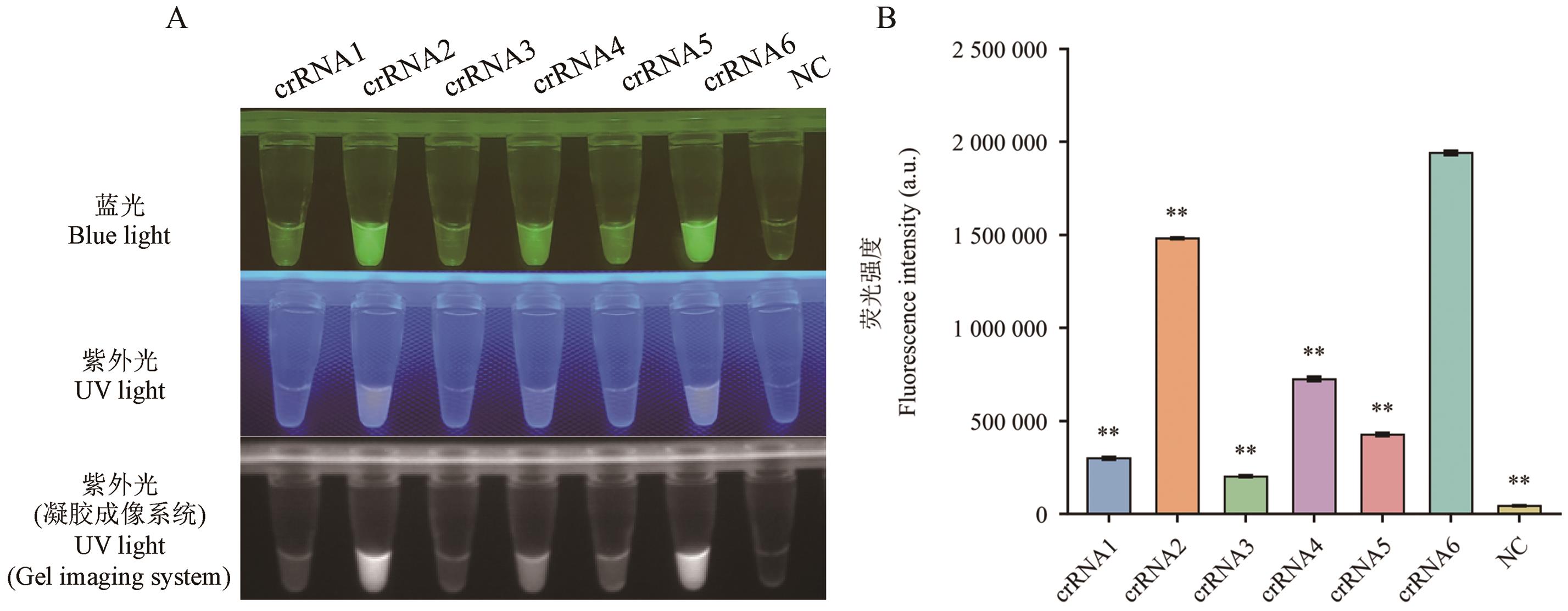
图1 最适crRNA的筛选A:不同激发光下 crRNA的LbCas12a酶切图;B: LbCas12a酶切检测终点收集的荧光信号值。NC为阴性对照。**P<0.01,下同
Fig. 1 Optimal crRNA selectionA: Cleavage patterns of crRNA by LbCas12a enzyme under different excitation lights. B: The fluorescence signal values were collected at the endpoint of the LbCas12a enzyme cleavage assay. NC represents the negative control. **P<0.01, the same below
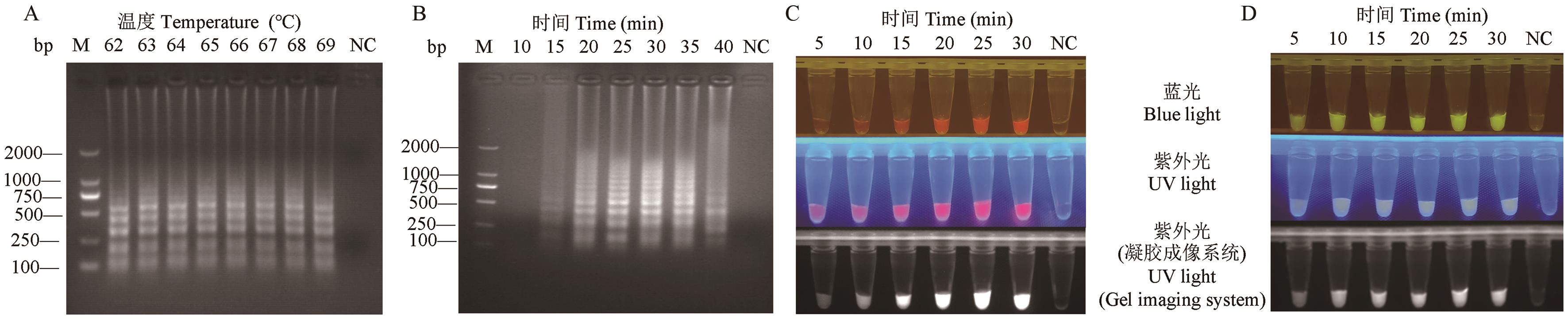
图2 反应条件优化A:LAMP最适反应温度筛选;B:LAMP最适反应时间筛选;C: ROX探针最适LbCas12a酶酶切时间筛选;D:JOE探针最适LbCas12a酶酶切时间筛选。NC为阴性对照,M为DL2000 marker
Fig. 2 Optimization of reaction conditionsA: Screening for the optimal reaction temperature of LAMP. B: Screening for the optimal reaction time of LAMP. C: Optimization of the cleavage time of the LbCas12a enzyme with the ROX probe. D: Optimization of the cleavage time of the LbCas12a enzyme with the JOE probe. NC represents the negative control, while M denotes DL2000 marker
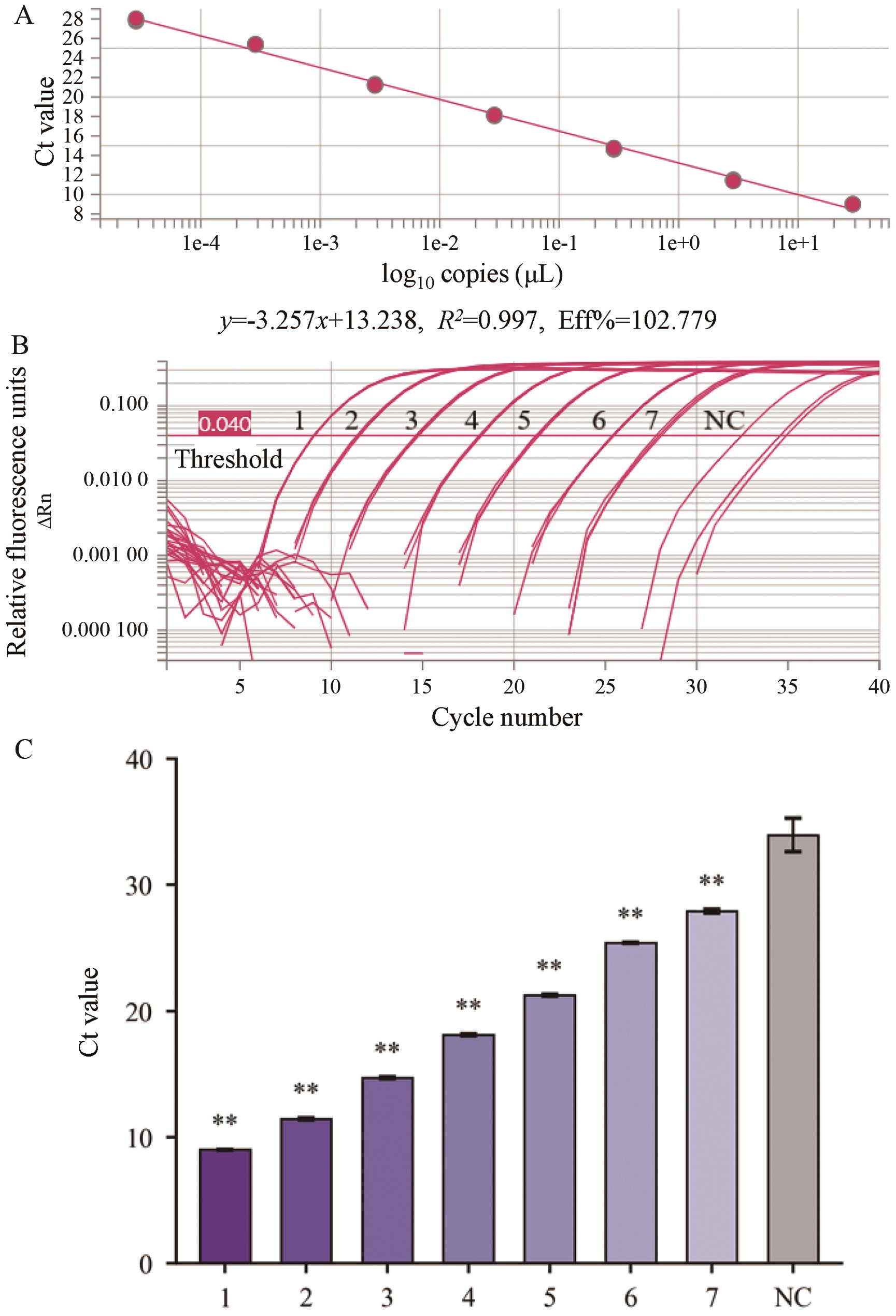
图3 猪流行性腹泻病毒荧光定量PCR灵敏度检测A:标准曲线;B:扩增曲线;C:梯度稀释比例质粒的Ct值。1-7对应的质粒模板浓度分别为9.03×10⁹、9.03×10⁸、9.03×10⁷、9.03×10⁶、9.03×10⁵、9.03×10⁴、9.03×10³ copies/μL
Fig. 3 Sensitivity assessment of porcine epidemic diarrhea virus detection through real-time fluorescent quantitative PCRA: Standard curve. B: Amplification curve. C: The Ct values of a plasmid dilution series. The plasmid template concentrations corresponding to 1-7 are 9.03×10⁹, 9.03×10⁸, 9.03×10⁷, 9.03×10⁶, 9.03×10⁵, 9.03×10⁴, and 9.03×10³ copies/μL
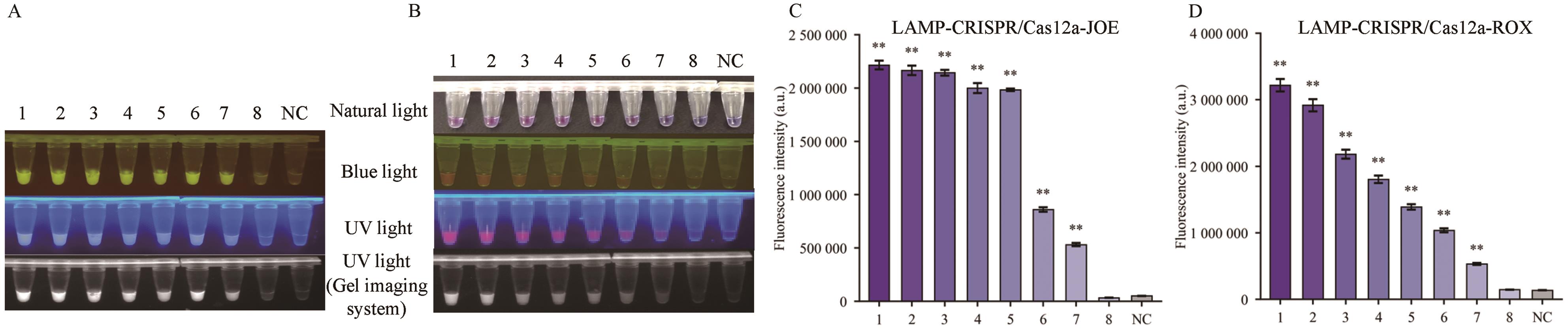
图5 LAMP 结合CRISPR/Cas12a 系统的灵敏度检测A:LAMP-CRISPR/Cas12a-JOE各激发光下LbCas12a酶切结果;B:LAMP-CRISPR/Cas12a-ROX各激发光下LbCas12a酶切结果;C:PCR-CRISPR/Cas12a-JOE各质粒浓度荧光强度值;D:LAMP-CRISPR/Cas12a-ROX各质粒浓度荧光强度值。1-8扩增模板浓度依次为9.03×10-1、9.03×10-2、9.03×10-3、9.03×10-4、9.03×10-5、9.03×10-6、9.03×10-7、9.03×10-8 copies/μL
Fig. 5 Detection sensitivity of the LAMP combined with the CRISPR/Cas12a systemA: Cleavage results of LbCas12a enzyme under different excitation wavelengths for LAMP-CRISPR/Cas12a-JOE. B: Cleavage results of LbCas12a enzyme under different excitation wavelengths for LAMP-CRISPR/Cas12a-ROX. C: Fluorescence intensity values of various plasmid concentrations for PCR-CRISPR/Cas12a-JOE. D: Fluorescence intensity values of various plasmid concentrations for LAMP-CRISPR/Cas12a-ROX. Template concentrations 1-8 are 9.03×10⁻¹, 9.03×10⁻², 9.03×10⁻³, 9.03×10⁻⁴, 9.03×10⁻⁵, 9.03×10⁻⁶, 9.03×10⁻⁷, 9.03×10⁻⁸ copies/μL
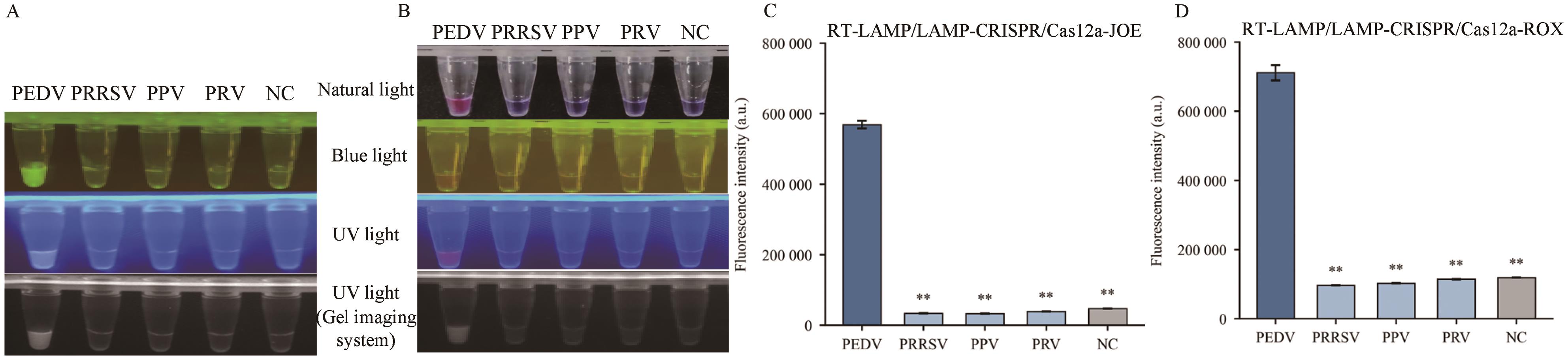
图6 RT-LAMP/ LAMP 结合CRISPR/Cas12a系统的特异性检测A:RT-LAMP/LAMP-CRISPR/Cas12a-JOE各激发光下LbCas12a特异性酶切结果;B:RT-LAMP/LAMP-CRISPR/Cas12a-ROX各激发光下LbCas12a特异性酶切结果;C:RT-LAMP/LAMP-CRISPR/Cas12a-JOE各病毒荧光强度值;D:RT-LAMP/LAMP-CRISPR/Cas12a-ROX各种病毒荧光强度值。PEDV:猪流行性腹泻病毒,PRRSV:猪繁殖与呼吸综合征病毒,PRV:猪伪狂犬病毒,PPV:猪细小病毒
Fig. 6 Specific detection through the combination of RT-LAMP/LAMP and the CRISPR/Cas12a systemA: Specific cleavage results of LbCas12a under different excitation lights in RT-LAMP/LAMP-CRISPR/Cas12a-JOE. B: Specific cleavage results of LbCas12a under different excitation lights in RT-LAMP/LAMP-CRISPR/Cas12a-ROX. C: Fluorescence intensity values of various viruses in RT-LAMP/LAMP-CRISPR/Cas12a-JOE. D: Fluorescence intensity values of different viruses in RT-LAMP/LAMP-CRISPR/Cas12a-ROX. PEDV: Porcine epidemic diarrhea virus, PRRSV: Porcine reproductive and respiratory syndrome virus, PRV: Pseudorabies virus, PPV: Porcine parvovirus
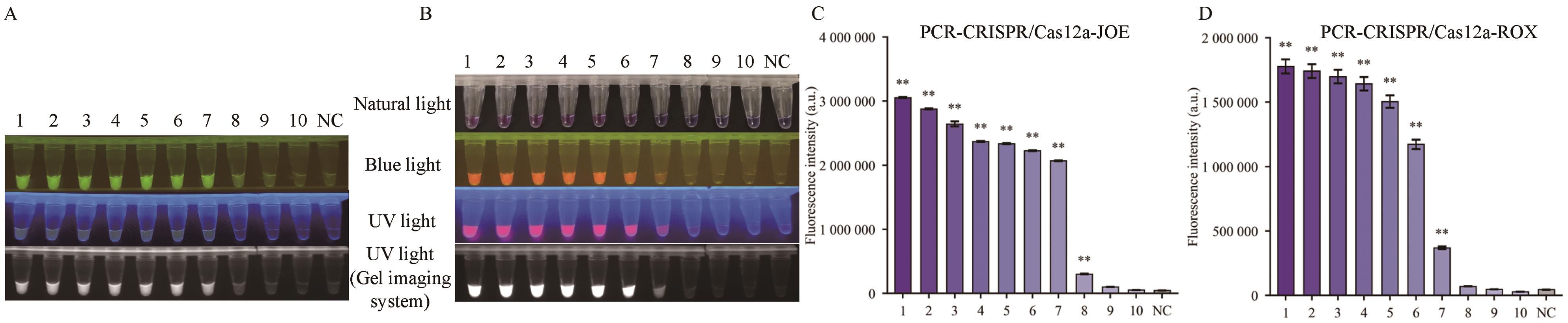
图4 PCR结合CRISPR/Cas12a 系统的灵敏度检测A:PCR-CRISPR/Cas12a-JOE各激发光下LbCas12a酶切结果;B:PCR-CRISPR/Cas12a-ROX各激发光下LbCas12a酶切结果;C:PCR-CRISPR/Cas12a-JOE各质粒浓度荧光强度值;D:PCR-CRISPR/Cas12a-ROX各质粒浓度荧光强度值。1-10扩增模板浓度依次为9.03×109、9.03×108、9.03×107、9.03×106、9.03×105、9.03×104、9.03×103、9.03×102、9.03×101、9.03×100 copies/μL
Fig. 4 Detection of sensitivity in PCR combined with the CRISPR/Cas12a systemA: Enzymatic cleavage results of LbCas12a under different excitation wavelengths for PCR-CRISPR/Cas12a-JOE. B: Enzymatic cleavage results of LbCas12a under different excitation wavelengths for PCR-CRISPR/Cas12a-ROX. C: Fluorescence intensity values of various plasmid concentrations for PCR-CRISPR/Cas12a-JOE. D: Fluorescence intensity values of various plasmid concentrations for PCR-CRISPR/Cas12a-ROX. Template concentrations 1-10 are 9.03×10⁹, 9.03×10⁸, 9.03×10⁷, 9.03×10⁶, 9.03×10⁵, 9.03×10⁴, 9.03×10³, 9.03×10², 9.03×101, 9.03×100 copies/μL
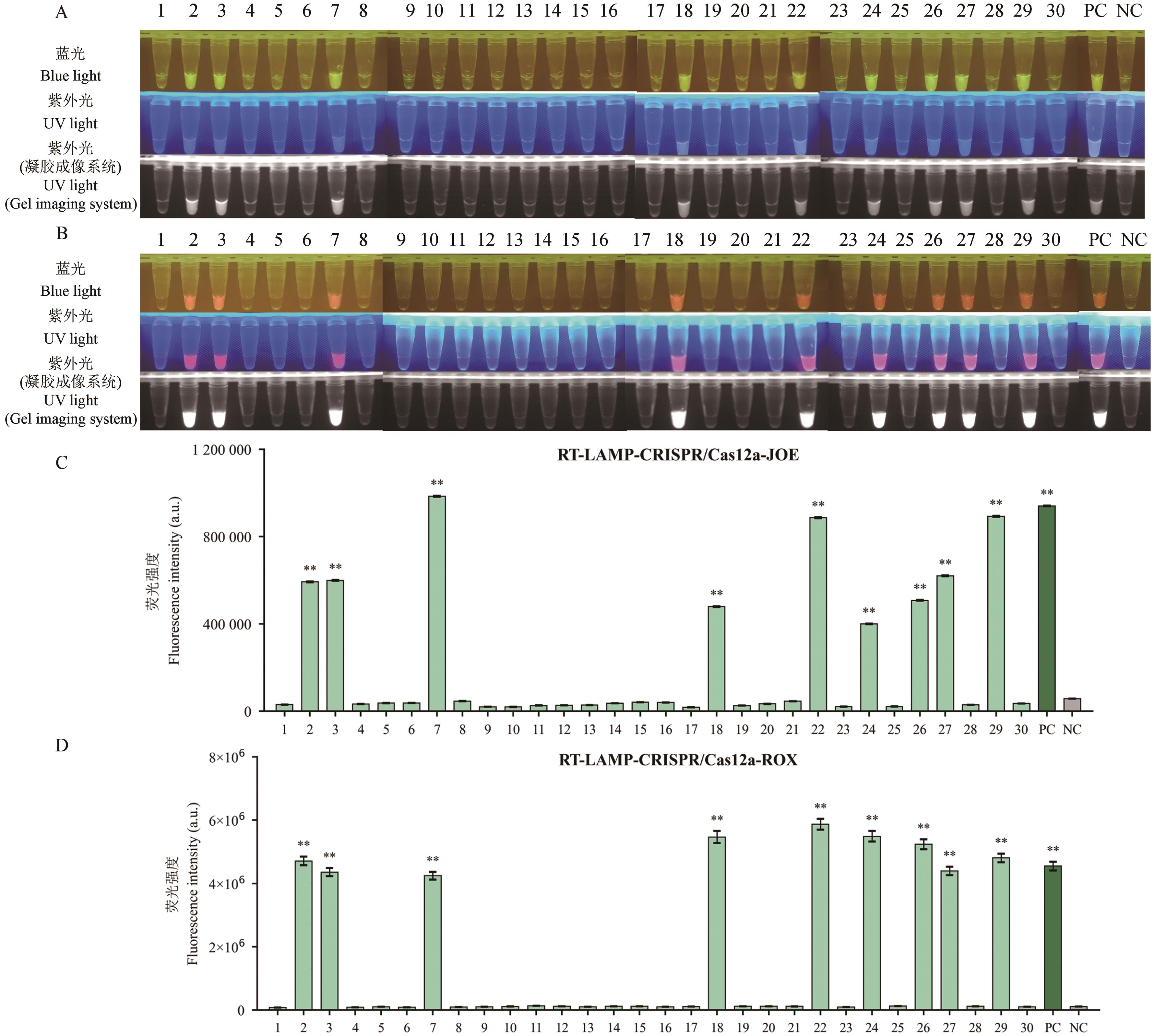
图7 猪流行性腹泻病毒RT-LAMP-CRISPR/Cas12a系统粪便样本检测A:粪便样本RT-LAMP-CRISPR/Cas12a-JOE不同激发光下LbCas12a酶酶切结果;B:粪便样本RT-LAMP-CRISPR/Cas12a-ROX不同激发光下LbCas12a酶酶切结果;C:粪便样本RT-LAMP-CRISPR/Cas12a-JOE荧光强度值;D:粪便样本RT-LAMP-CRISPR/Cas12a-ROX荧光强度值。1-30为粪便样本号,PC为阳性对照,NC为阴性对照
Fig. 7 Fecal sample detection of porcine epidemic diarrhea virus through RT-LAMP-CRISPR/Cas12a systemA: Results of LbCas12a enzyme cleavage under different excitation lights in fecal samples using RT-LAMP-CRISPR/Cas12a-JOE. B: Results of LbCas12a enzyme cleavage under different excitation lights in fecal samples using RT-LAMP-CRISPR/Cas12a-ROX. C: Fluorescence intensity values in fecal samples using RT-LAMP-CRISPR/Cas12a-JOE. D: Fluorescence intensity values in fecal samples using RT-LAMP-CRISPR/Cas12a-ROX. Sample numbers 1-30 represent fecal sample IDs. PC denotes positive control, and NC denotes negative control
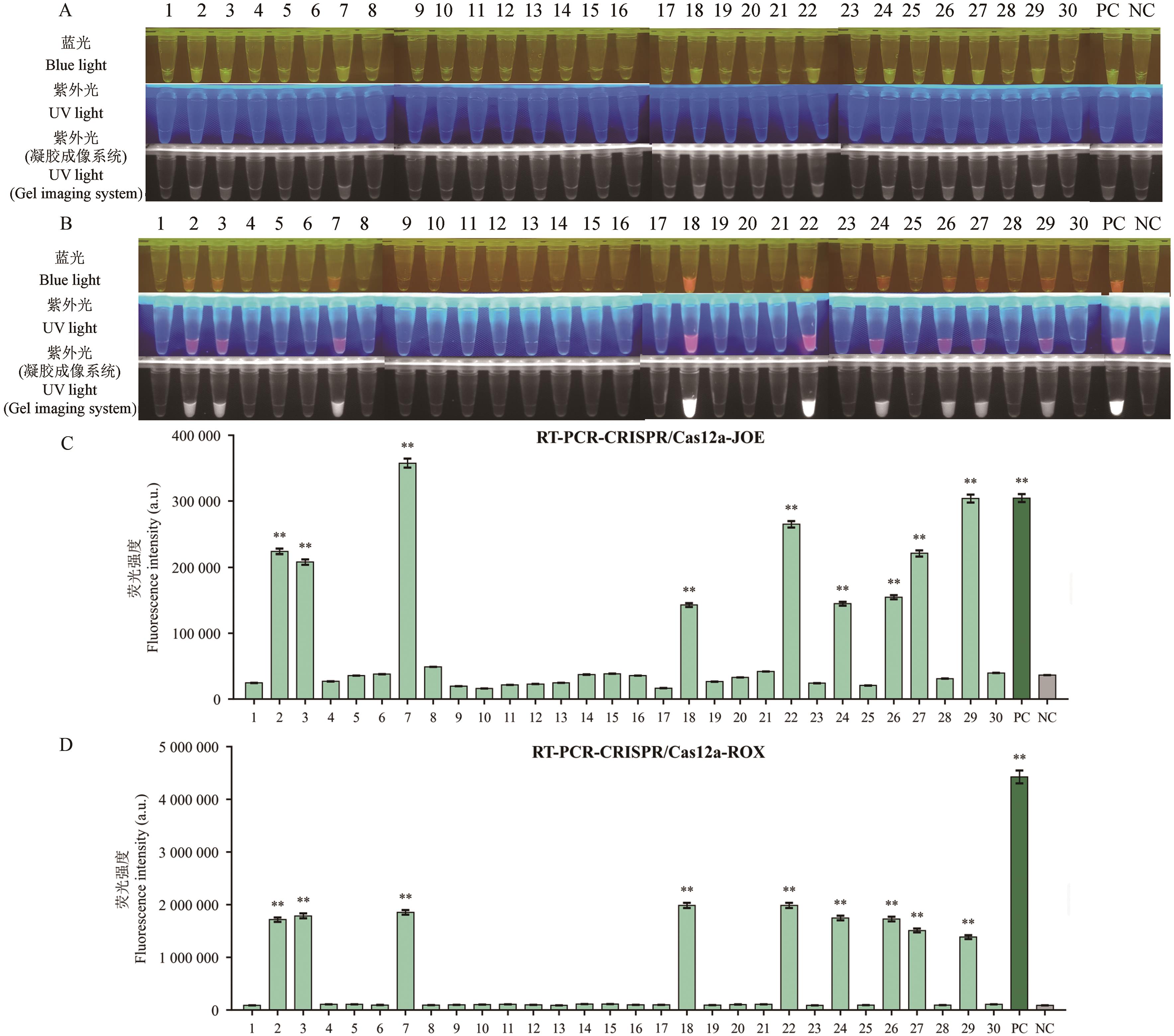
图8 猪流行性腹泻病毒RT-PCR-CRISPR/Cas12a系统粪便样本检测A:粪便样本RT-PCR-CRISPR/Cas12a-JOE不同激发光下LbCas12a酶酶切结果;B:粪便样本RT-PCR-CRISPR/Cas12a-ROX不同激发光下LbCas12a酶酶切结果;C:粪便样本RT-PCR-CRISPR/Cas12a-JOE荧光强度值; D:粪便样本RT-PCR-CRISPR/Cas12a-ROX荧光强度值。1-30为粪便样本号,PC为阳性对照,NC为阴性对照
Fig. 8 Fecal sample detection of porcine epidemic diarrhea virus through the RT-PCR-CRISPR/Cas12a systemA: Results of LbCas12a enzyme cleavage under different excitation lights in fecal samples using RT-PCR-CRISPR/Cas12a-JOE. B: Results of LbCas12a enzyme cleavage under different excitation lights in fecal samples using RT-PCR-CRISPR/Cas12a-ROX. C: Fluorescence intensity values in fecal samples using RT-PCR-CRISPR/Cas12a-JOE. D: Fluorescence intensity values in fecal samples using RT-PCR-CRISPR/Cas12a-ROX. Sample numbers 1-30 represent fecal sample IDs. PC denotes positive control, and NC denotes negative control
| [1] | Jung K, Saif LJ, Wang QH. Porcine epidemic diarrhea virus (PEDV): an update on etiology, transmission, pathogenesis, and prevention and control [J]. Virus Res, 2020, 286: 198045. |
| [2] | Kocherhans R, Bridgen A, Ackermann M, et al. Completion of the porcine epidemic diarrhoea coronavirus (PEDV) genome sequence [J]. Virus Genes, 2001, 23(2): 137-144. |
| [3] | Liu Z, Li LL, Fang MT, et al. Distinguished loop-mediated isothermal amplification assay to detect porcine epidemic diarrhea virus genotypes I and II [J]. Vet Sci, 2025, 12(5): 399. |
| [4] | Vlasova AN, Marthaler D, Wang QH, et al. Distinct characteristics and complex evolution of PEDV strains, North America, may 2013-February 2014 [J]. Emerg Infect Dis, 2014, 20(10): 1620-1628. |
| [5] | Huang LZ, Yan LM, Zeng MY, et al. G2c-lineage dominance and S1 epitope-glycan drift of porcine epidemic diarrhea virus in Guangdong Province, China, 2022-2024 [J]. Vet Sci, 2025, 12(11): 1056. |
| [6] | Xiao L, Kang RM, et al. Prevalence and S gene characterization of porcine epidemic diarrhea virus in Sichuan Province, China (2023-2024) [J]. Front Vet Sci, 2026, 12: 1748998. |
| [7] | Tian CH, Feng LL, Zhou X, et al. A portable one-tube assay integrating RT-RPA and CRISPR/Cas12a for rapid visual detection of Eurasian avian-like H1N1 swine influenza virus in the field [J]. Viruses, 2026, 18(1): 47. |
| [8] | Xu BR, Gong P, Zhang Y, et al. A one-tube rapid visual CRISPR assay for the field detection of Japanese encephalitis virus [J]. Virus Res, 2022, 319: 198869. |
| [9] | Jiang CH, Wang HB, Guo RX, et al. Rapid molecular detection of Senecavirus A based on reverse transcription loop-mediated isothermal amplification (RT-LAMP) and CRISPR/Cas12a [J]. Front Bioeng Biotechnol, 2025, 13: 1451125. |
| [10] | Chen JM, Tao DG, Yang F, et al. Development of a rapid visual detection assay for duck tembusu virus using RT-LAMP-CRISPR/Cas12a [J]. Animals, 2024, 14(23): 3439. |
| [11] | Liu JJ, Tao DG, Chen XQ, et al. Detection of four porcine enteric coronaviruses using CRISPR-Cas12a combined with multiplex reverse transcriptase loop-mediated isothermal amplification assay [J]. Viruses, 2022, 14(4): 833. |
| [12] | Zhao CZ, Zheng XG, Qu WB, et al. CRISPR-offinder: a CRISPR guide RNA design and off-target searching tool for user-defined protospacer adjacent motif [J]. Int J Biol Sci, 2017, 13(12): 1470-1478. |
| [13] | Olech M. Current state of molecular and serological methods for detection of porcine epidemic diarrhea virus [J]. Pathogens, 2022, 11(10): 1074. |
| [14] | Niu JW, Li JH, Guan JL, et al. Development of a multiplex RT-PCR method for the detection of four porcine enteric coronaviruses [J]. Front Vet Sci, 2022, 9: 1033864. |
| [15] | Ren J, Li FJ, Yu X, et al. Development of a TaqMan-based multiplex real-time PCR for simultaneous detection of porcine epidemic diarrhea virus, Brachyspira hyodysenteriae, and Lawsonia intracellularis [J]. Front Vet Sci, 2024, 11: 1450066. |
| [16] | Ren J, Zu CC, Li Y, et al. Establishment and application of a TaqMan-based multiplex real-time PCR for simultaneous detection of three porcine diarrhea viruses [J]. Front Microbiol, 2024, 15: 1380849. |
| [17] | Ye CW, Xu JR, Fan SS, et al. Establishment and application of a quadruple RT-qPCR method for simultaneous detection of porcine enteric coronaviruses [J]. Front Vet Sci, 2025, 12: 1714780. |
| [18] | Baek JH, Lee YM, Vu ND, et al. A multiplex real-time RT-qPCR assay for simultaneous detection of porcine epidemic diarrhea virus, porcine deltacoronavirus, and swine acute diarrhea syndrome coronavirus [J]. Arch Virol, 2024, 169(4): 82. |
| [19] | Xin ZH, Li SH, Lu X, et al. Development and clinical application of a molecular assay for four common porcine enteroviruses [J]. Vet Sci, 2024, 11(7): 305. |
| [20] | Li CH, Liang JL, Yang D, et al. Visual and rapid detection of porcine epidemic diarrhea virus (PEDV) using reverse transcription loop-mediated isothermal amplification method [J]. Animals, 2022, 12(19): 2712. |
| [21] | Wu XH, Liu YJ, Gao LG, et al. Development and application of a reverse-transcription recombinase-aided amplification assay for porcine epidemic diarrhea virus [J]. Viruses, 2022, 14(3): 591. |
| [22] | Song D, Xu CY, Sang PY, et al. Rapid and contamination-free detection of cucumber green mottle mosaic virus as a viral indicator in wastewater via UDG-RT-LAMP combined with CRISPR/Cas12a [J]. J Hazard Mater, 2025, 497: 139571. |
| [1] | 赵磊, 戴阳明, 何姝颖, 朱玲, 徐志文. 基于RAA-CRISPR/EsCas13d的猪繁殖与呼吸综合征病毒II型的可视化快速检测方法[J]. 生物技术通报, 2026, 42(8): 81-89. |
| [2] | 彭彦, 安晨, 韶也, 毛毕刚, 张学文, 赵炳然. 植物重金属响应可视化系统的构建与验证[J]. 生物技术通报, 2026, 42(7): 105-115. |
| [3] | 李雅琦, 孙萌, 李秀丽, 魏静娜, 赵琳琳, 赵云平, 刘征辉, 苏蘩. 多种Cas12a蛋白普适性的高性能低成本荧光检测缓冲体系优化[J]. 生物技术通报, 2026, 42(4): 83-91. |
| [4] | 霍贯中, 张欣濡, 田士军, 李君. CRISPR/Cas12a基因编辑技术在植物中的研究进展[J]. 生物技术通报, 2025, 41(6): 1-11. |
| [5] | 高畅, 庄添驰, 李宁, 刘云, 顾鹏飞, 赵昕怡, 季明辉. RPA-CRISPR/Cas12a结合重力驱动微流控芯片的MTB快检方法的建立[J]. 生物技术通报, 2025, 41(5): 62-69. |
| [6] | 姚雪春, 李磊, 王志贤, 盛长忠, ZHOU Zeqi, TAN Cherie S. 基于CRISPR-Cas12a技术的呼吸道合胞病毒检测方法的建立[J]. 生物技术通报, 2025, 41(1): 103-109. |
| [7] | 陈墨岩, 祝诚. 基于CRISPR/Cas12a的生物传感平台的机制研究及应用[J]. 生物技术通报, 2024, 40(7): 90-98. |
| [8] | 成温玉, 张博昕, 赵鸿远, 陈艳, 谢娟平. 天然产物抗猪流行性腹泻病毒研究进展[J]. 生物技术通报, 2022, 38(12): 127-136. |
| [9] | 胡秀文, 刘华, 王宇, 唐雪明, 王金斌, 曾海娟, 蒋玮, 李红. CRISPR-Cas系统在核酸检测中的应用研究[J]. 生物技术通报, 2021, 37(9): 266-273. |
| [10] | 陈婷, 谢梅英, 魏立民, 欧阳坤, 程晓, 张永亮. 猪乳外泌体对猪流行性腹泻病毒的抑制作用[J]. 生物技术通报, 2021, 37(12): 141-150. |
| [11] | 殷志斌, 黄文洁, 伍欣宙, 晏石娟. 空间分辨代谢组学进展和挑战[J]. 生物技术通报, 2021, 37(1): 32-51. |
| [12] | 成温玉, 白云, 贾怀杰, 强桃艳, 赵鸿远, 张博艺, 郭晓荟. 猪流行性腹泻病毒蛋白拮抗宿主天然免疫应答的研究进展[J]. 生物技术通报, 2020, 36(12): 229-238. |
| [13] | 景志刚, 董浩, 狄栋栋, 田莉莉, 范伟兴. 重组酶聚合酶扩增技术研究进展[J]. 生物技术通报, 2016, 32(6): 47-53. |
| [14] | 程涛;王慧煜;梅琳;韩雪清;. 悬浮芯片技术应用进展[J]. , 2011, 0(09): 48-51. |
| [15] | 彭丹;曾志磊;陈晓;朱丹;余建萍;展群岭;翟红;谢鹏;. 新疆部分地区动物Nipah病毒和Hendra病毒感染的调查[J]. , 2009, 0(S1): 331-335. |
| 阅读次数 | ||||||
|
全文 |
|
|||||
|
摘要 |
|
|||||
