







• 技术与方法 •
耿远来1, 张颖梓1,2, 赵丹晨1, 谭伟双1, 陈晓妮1, 王运生2, 史斌斌3, 唐冬梅3, 李大志1,2( ), 周嘉3,4()
收稿日期:2026-04-08
出版日期:2026-08-20
通讯作者:
周嘉zhoujia4301@163.com基金资助:
GENG Yuan-lai1, ZHANG Ying-zi1,2, ZHAO Dan-chen1, TAN Wei-shuang1, CHEN Xiao-ni1, WANG Yun-sheng2, SHI Bin-bin3, TANG Dong-mei3, LI Da-zhi1,2(), ZHOU Jia3,4()
Received:2026-04-08
Published:2026-08-20
摘要:
目的 猕猴桃作为重要的经济果树,其产业高质量发展长期受品种混乱、同物异名及侵权现象制约,亟需建立一套精准、高效的种质资源遗传鉴定技术体系。 方法 系统收集贵州、江西、重庆等地79份猕猴桃种质资源,包括野生种质36份和栽培品种43份。基于泛基因组及重测序数据,开发结构变异(structural variants, SV)分子标记,开展遗传聚类分析,并构建DNA指纹图谱与分子身份证。 结果 从50个SV位点对应的标记引物中,经初步筛选与扩大材料验证,获得5对高多态性核心SV引物。利用这5对引物组合,可有效区分77份供试种质,鉴别率达到97.47%。基于扩增基因型数据构建的二元(0/1)矩阵,绘制了供试材料的DNA指纹图谱,并进一步为每份种质生成了10位数字的专属分子身份证。UPGMA聚类分析显示,供试材料遗传多样性丰富,聚类结果与现有猕猴桃植物学分类基本一致。 结论 开发的SV标记可高效应用于猕猴桃种质资源遗传多样性分析与品种精准鉴定。
耿远来, 张颖梓, 赵丹晨, 谭伟双, 陈晓妮, 王运生, 史斌斌, 唐冬梅, 李大志, 周嘉. 基于SV标记的猕猴桃种质资源遗传多样性分析及DNA分子身份证构建[J]. 生物技术通报, doi: 10.13560/j.cnki.biotech.bull.1985.2026-0397.
GENG Yuan-lai, ZHANG Ying-zi, ZHAO Dan-chen, TAN Wei-shuang, CHEN Xiao-ni, WANG Yun-sheng, SHI Bin-bin, TANG Dong-mei, LI Da-zhi, ZHOU Jia. Genetic Diversity Analysis and DNA Molecular ID Construction in Kiwifruit Germplasm Resources Based on SV Markers[J]. Biotechnology Bulletin, doi: 10.13560/j.cnki.biotech.bull.1985.2026-0397.
| 染色体位置 Chromosomal location | 标记编号 Marker ID | 引物名称 Primer name | 引物序列 Primer sequence (5'‒3') |
|---|---|---|---|
| LG23 | P1 | Del_799-F | TTCAGTCAGAGTAAGCGCCC |
| Del_799-R | CACCATATTCGCAAGCACGG | ||
| LG3 | P2 | Del_981-F | TTACATTGACCACCCCGAGG |
| Del_981-R | TACACTGAACACCCCTGAGG | ||
| LG10 | P3 | Del_677-F | CATGCATGTCTTCTGCCACG |
| Del_677-R | AGTCAGCAGAAGGGGAAGGA | ||
| LG12 | P4 | Del_441-F | ATGCCATGTTGGGAAGCTCA |
| Del_441-R | TGCACCTAAGGACTCAATGGG | ||
| LG24 | P5 | Ins_622-F | CTGATATGTCGCGGCCCATA |
| Ins_622-R | TGTCCTGGATTCCTTGGTGG |
表1 核心SV标记的引物信息
Table 1 Primer information for the core SV markers
| 染色体位置 Chromosomal location | 标记编号 Marker ID | 引物名称 Primer name | 引物序列 Primer sequence (5'‒3') |
|---|---|---|---|
| LG23 | P1 | Del_799-F | TTCAGTCAGAGTAAGCGCCC |
| Del_799-R | CACCATATTCGCAAGCACGG | ||
| LG3 | P2 | Del_981-F | TTACATTGACCACCCCGAGG |
| Del_981-R | TACACTGAACACCCCTGAGG | ||
| LG10 | P3 | Del_677-F | CATGCATGTCTTCTGCCACG |
| Del_677-R | AGTCAGCAGAAGGGGAAGGA | ||
| LG12 | P4 | Del_441-F | ATGCCATGTTGGGAAGCTCA |
| Del_441-R | TGCACCTAAGGACTCAATGGG | ||
| LG24 | P5 | Ins_622-F | CTGATATGTCGCGGCCCATA |
| Ins_622-R | TGTCCTGGATTCCTTGGTGG |
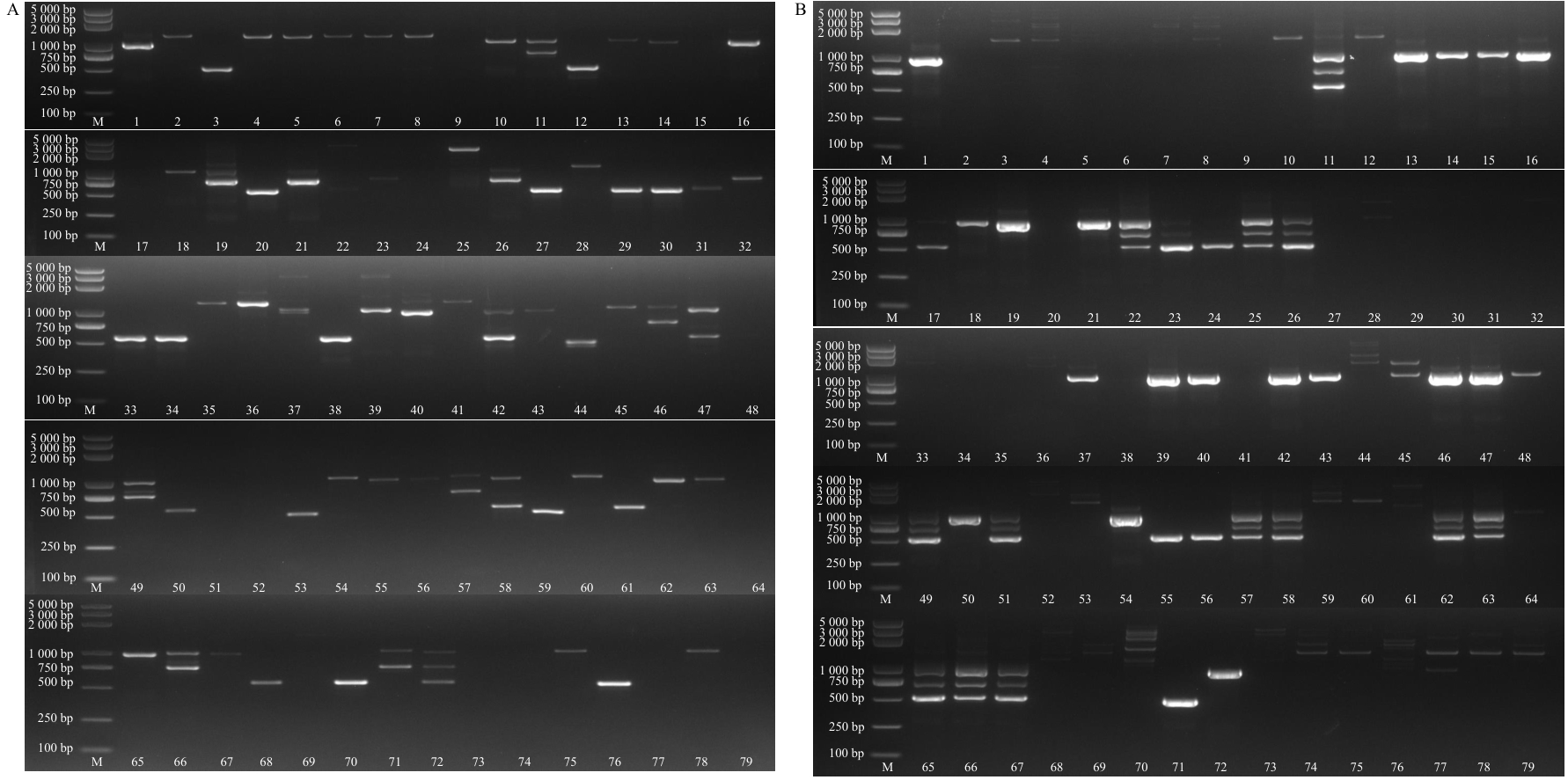
图1 部分核心标记凝胶电泳图A:Del_677标记;B:Del_441标记。M:DNA marker;1‒79编号同附表1
Fig. 1 Results of gel electrophoresis analysis for partial core markersA: Marker Del_677. B: Marker Del_441. M: DNA marker. See supplementary table 1 for details of samples 1-79
| 标记组合 Marker combination | 可鉴别材料 Materials identified | 小计 Subtotal | 总计 Total |
|---|---|---|---|
| P3 | 11,19,26,36,40,58,72 | 7 | 7 |
| P3+P2 | 3,4,6,7,10,13,14,16,18,20,21,22,23,25,27,30,32,33,35,37,39,41,44,46,48,49,50,51,52,53,55,56,57,59,60,61,65,66,67,68,70,71,73,75,76,77,78 | 47 | 54 |
| P3+P2+P4 | 1,2,5,8,9,12,17,24,28,42,45,54,69,74,79 | 15 | 69 |
| P3+P2+P4+P5 | 15,34,38,43,47,64 | 6 | 75 |
| P3+P2+P4+P5+P1 | 29,31 | 2 | 77 |
表2 逐渐增加标记可区分材料汇总
Table 2 Summary of distinguishable materials using incrementally added markers
| 标记组合 Marker combination | 可鉴别材料 Materials identified | 小计 Subtotal | 总计 Total |
|---|---|---|---|
| P3 | 11,19,26,36,40,58,72 | 7 | 7 |
| P3+P2 | 3,4,6,7,10,13,14,16,18,20,21,22,23,25,27,30,32,33,35,37,39,41,44,46,48,49,50,51,52,53,55,56,57,59,60,61,65,66,67,68,70,71,73,75,76,77,78 | 47 | 54 |
| P3+P2+P4 | 1,2,5,8,9,12,17,24,28,42,45,54,69,74,79 | 15 | 69 |
| P3+P2+P4+P5 | 15,34,38,43,47,64 | 6 | 75 |
| P3+P2+P4+P5+P1 | 29,31 | 2 | 77 |
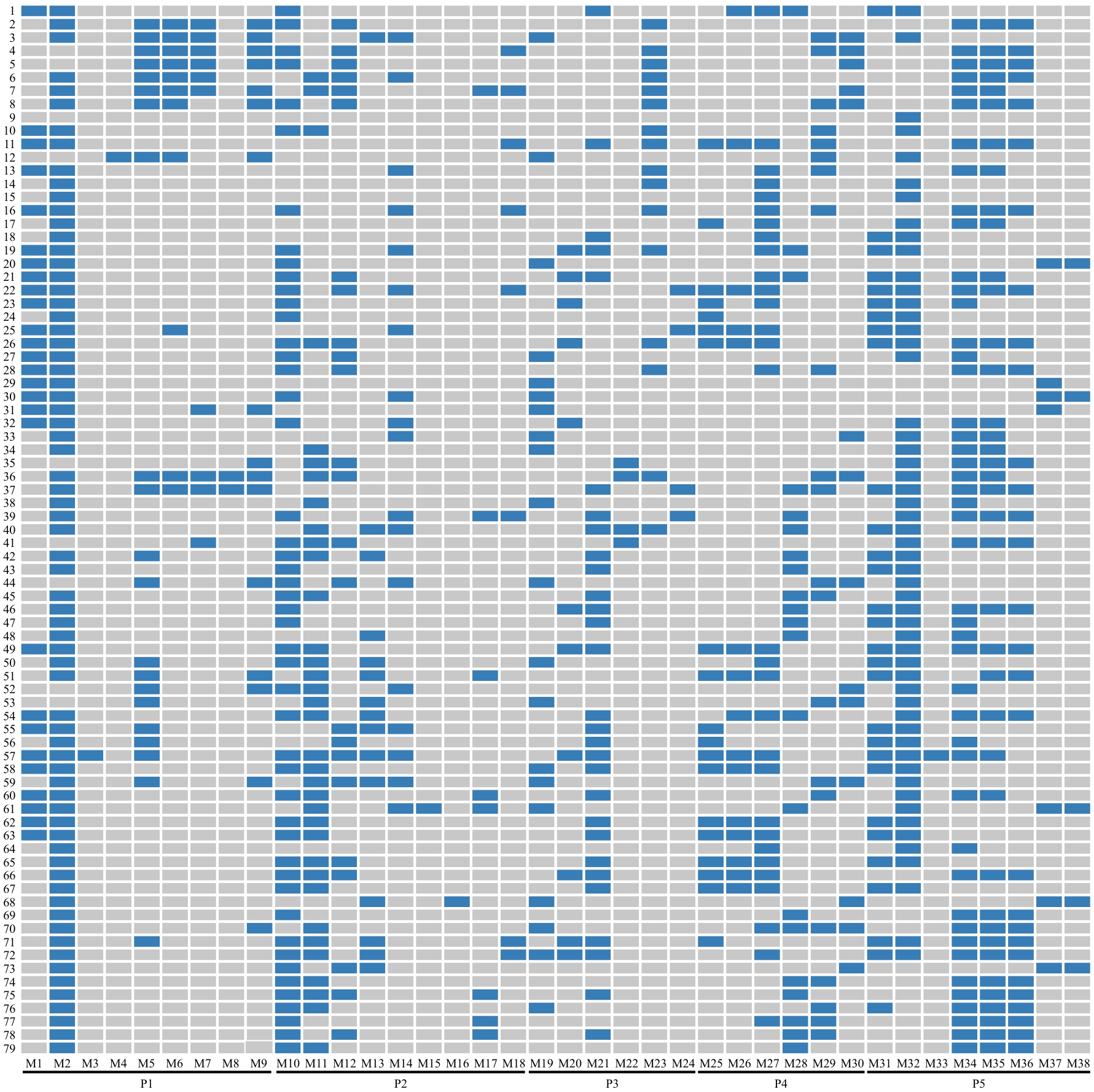
图2 基于5对标记构建的DNA指纹图谱图谱中蓝色方格代表有条带(1),灰色方格代表无条带(0);M1‒M38为基于标记扩增的38种条带;1‒79为样品编号
Fig. 2 Construction of DNA fingerprint based on the five marker pairsIn the fingerprint, blue squares represent the presence of a band (1), and gray squares represent the absence of a band (0); M1‒M38 correspond to the 38 banding types based on marker amplification; 1‒79 are sample numbers
| 序号 Code | 品种名 Name | 分子身份证 Molecular ID | 序号 Code | 品种名 Name | 分子身份证 Molecular ID |
|---|---|---|---|---|---|
| 1 | 魁蜜 | 0117061211 | 40 | 贵猕2号 | 0813090511 |
| 2 | 魁绿 | 0222030104 | 41 | 1807 | 1333040109 |
| 3 | A10 | 0206140405 | 42 | 贵丰 | 1431060511 |
| 4 | 丰绿 | 0323030404 | 43 | 2024033 | 0817060511 |
| 5 | 恒优1号 | 0322030204 | 44 | 1826 | 1525140405 |
| 6 | 紫玉 | 0415030104 | 45 | 江口梵之语 | 0828060605 |
| 7 | 红宝石星 | 0236030203 | 46 | 23259 | 0817120515 |
| 8 | 龙城2号 | 0522030404 | 47 | 金丰 | 0817060513 |
| 9 | 徐香 | 0601010105 | 48 | G3 | 0804010507 |
| 10 | 华特 | 0128030305 | 49 | 黔雄1号 | 0128121515 |
| 11 | 翠香 | 0102081604 | 50 | 金艳 | 1431140711 |
| 12 | 1813 | 0701140305 | 51 | 金阳 | 1612011512 |
| 13 | 翠玉 | 0103030803 | 52 | XWZYP大籽 | 1530010207 |
| 14 | 金怡 | 0801030705 | 53 | 中砧1号 | 1711140405 |
| 15 | 楚红 | 0801010705 | 54 | 中猕1号 | 0131061209 |
| 16 | 贵长 | 0120030804 | 55 | 红阳 | 1808061311 |
| 17 | 哑特 | 0801011408 | 56 | 东红 | 1407061313 |
| 18 | G9 | 0801060711 | 57 | 米良1号 | 1935121516 |
| 19 | 金硕 | 0119130911 | 58 | 金圆 | 0128151511 |
| 20 | 金桃 | 0117140102 | 59 | 花叶水杨桃 | 1616140405 |
| 21 | 金魁 | 0122120914 | 60 | 2024001 | 0129060308 |
| 22 | 磨山3号 | 0126021515 | 61 | 2024002 | 0110140506 |
| 23 | 武植3号 | 0117101413 | 64 | 翡翠香果 | 0801010707 |
| 24 | 金霞 | 0817011311 | 65 | 建香 | 0833061511 |
| 25 | 华优 | 0903021511 | 66 | 朝晖 | 0833121504 |
| 26 | 大山10号 | 0133111515 | 67 | 金什 | 0828061511 |
| 27 | 2023002 | 0122140107 | 68 | 2024007 | 0805140202 |
| 28 | 2023004 | 0122030804 | 69 | 2024010 | 0817010504 |
| 29 | 2023006 | 0101140101 | 70 | 2024011 | 2009141104 |
| 30 | 2023010 | 0119140102 | 71 | 瑞玉 | 1432121315 |
| 31 | 2023015 | 1001140101 | 72 | 2024014 | 0832150715 |
| 32 | 2023017 | 0119100108 | 73 | 2024017 | 0827010202 |
| 33 | 2023022 | 0803140208 | 74 | 2024018 | 0828010604 |
| 34 | 2023201 | 0809140108 | 75 | 2024023 | 0834060504 |
| 35 | 2023224 | 1114040109 | 76 | 2024027 | 0828140310 |
| 36 | 2023245 | 1214050408 | 77 | 2024034 | 0818011004 |
| 37 | 2023244 | 1201070615 | 78 | 2024042 | 0824060604 |
| 38 | 2023246 | 0809140107 | 79 | 2024051 | 0828010504 |
| 39 | 中猕2号 | 0821070509 |
表3 供试材料十位数分子身份证
Table 3 10-digit molecular IDs of the tested materials
| 序号 Code | 品种名 Name | 分子身份证 Molecular ID | 序号 Code | 品种名 Name | 分子身份证 Molecular ID |
|---|---|---|---|---|---|
| 1 | 魁蜜 | 0117061211 | 40 | 贵猕2号 | 0813090511 |
| 2 | 魁绿 | 0222030104 | 41 | 1807 | 1333040109 |
| 3 | A10 | 0206140405 | 42 | 贵丰 | 1431060511 |
| 4 | 丰绿 | 0323030404 | 43 | 2024033 | 0817060511 |
| 5 | 恒优1号 | 0322030204 | 44 | 1826 | 1525140405 |
| 6 | 紫玉 | 0415030104 | 45 | 江口梵之语 | 0828060605 |
| 7 | 红宝石星 | 0236030203 | 46 | 23259 | 0817120515 |
| 8 | 龙城2号 | 0522030404 | 47 | 金丰 | 0817060513 |
| 9 | 徐香 | 0601010105 | 48 | G3 | 0804010507 |
| 10 | 华特 | 0128030305 | 49 | 黔雄1号 | 0128121515 |
| 11 | 翠香 | 0102081604 | 50 | 金艳 | 1431140711 |
| 12 | 1813 | 0701140305 | 51 | 金阳 | 1612011512 |
| 13 | 翠玉 | 0103030803 | 52 | XWZYP大籽 | 1530010207 |
| 14 | 金怡 | 0801030705 | 53 | 中砧1号 | 1711140405 |
| 15 | 楚红 | 0801010705 | 54 | 中猕1号 | 0131061209 |
| 16 | 贵长 | 0120030804 | 55 | 红阳 | 1808061311 |
| 17 | 哑特 | 0801011408 | 56 | 东红 | 1407061313 |
| 18 | G9 | 0801060711 | 57 | 米良1号 | 1935121516 |
| 19 | 金硕 | 0119130911 | 58 | 金圆 | 0128151511 |
| 20 | 金桃 | 0117140102 | 59 | 花叶水杨桃 | 1616140405 |
| 21 | 金魁 | 0122120914 | 60 | 2024001 | 0129060308 |
| 22 | 磨山3号 | 0126021515 | 61 | 2024002 | 0110140506 |
| 23 | 武植3号 | 0117101413 | 64 | 翡翠香果 | 0801010707 |
| 24 | 金霞 | 0817011311 | 65 | 建香 | 0833061511 |
| 25 | 华优 | 0903021511 | 66 | 朝晖 | 0833121504 |
| 26 | 大山10号 | 0133111515 | 67 | 金什 | 0828061511 |
| 27 | 2023002 | 0122140107 | 68 | 2024007 | 0805140202 |
| 28 | 2023004 | 0122030804 | 69 | 2024010 | 0817010504 |
| 29 | 2023006 | 0101140101 | 70 | 2024011 | 2009141104 |
| 30 | 2023010 | 0119140102 | 71 | 瑞玉 | 1432121315 |
| 31 | 2023015 | 1001140101 | 72 | 2024014 | 0832150715 |
| 32 | 2023017 | 0119100108 | 73 | 2024017 | 0827010202 |
| 33 | 2023022 | 0803140208 | 74 | 2024018 | 0828010604 |
| 34 | 2023201 | 0809140108 | 75 | 2024023 | 0834060504 |
| 35 | 2023224 | 1114040109 | 76 | 2024027 | 0828140310 |
| 36 | 2023245 | 1214050408 | 77 | 2024034 | 0818011004 |
| 37 | 2023244 | 1201070615 | 78 | 2024042 | 0824060604 |
| 38 | 2023246 | 0809140107 | 79 | 2024051 | 0828010504 |
| 39 | 中猕2号 | 0821070509 |

图3 二维码分子身份证及扫码信息示例
Fig. 3 Example of a QR code molecular ID and its scanned information
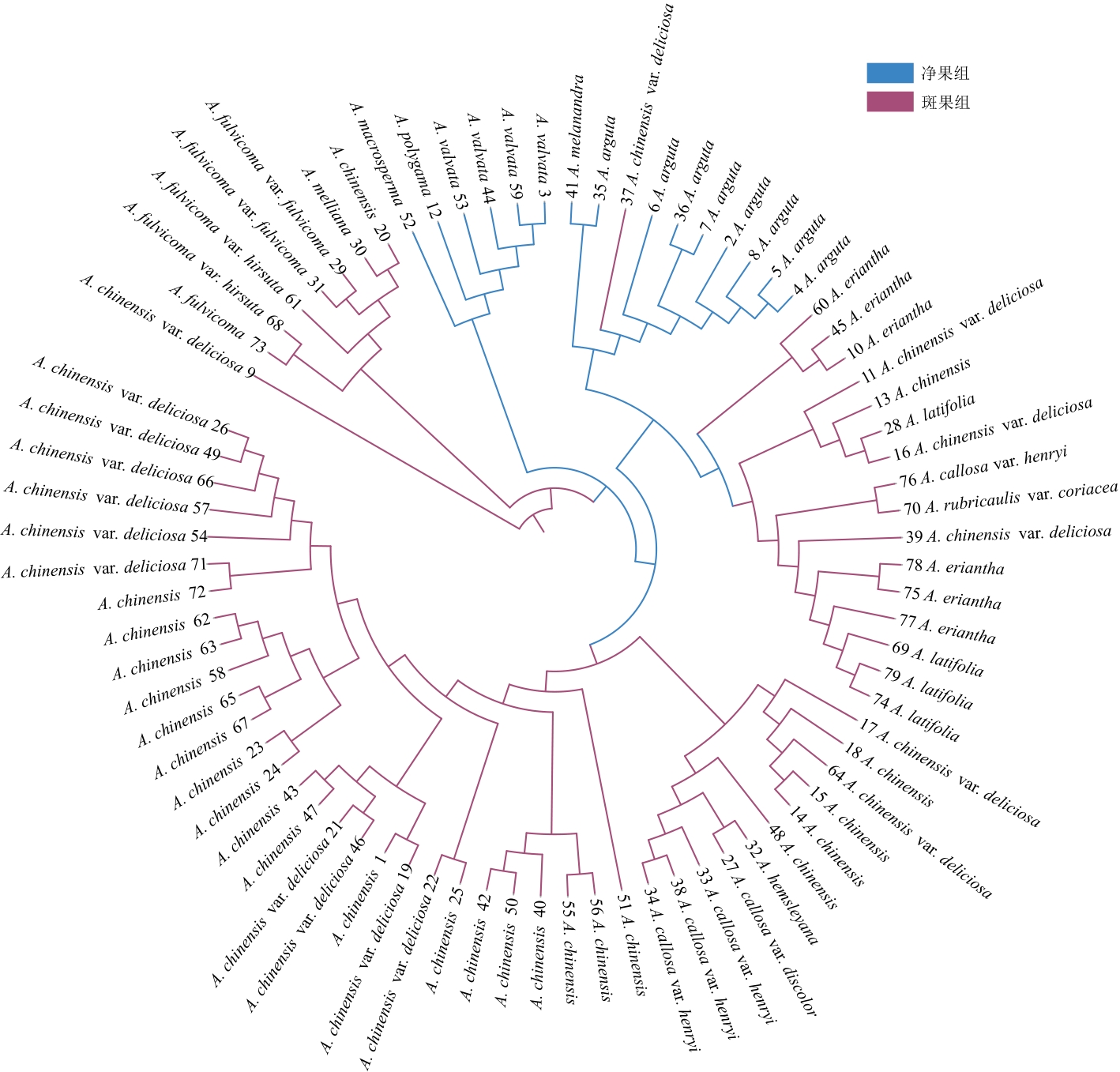
图4 基于SV标记79份猕猴桃种质资源的聚类分析
Fig. 4 Cluster analysis of 79 kiwifruit germplasm accessions based on SV markers
| [1] | Tu MY, Jiang GL, Chen D, et al. Development status and countermeasures of kiwifruit industry in Sichuan Province [J]. Asian Agric Res, 2013, 5(3): 1-4. |
| [2] | Wang SN, Qiu Y, Zhu F. Kiwifruit (Actinidia spp.): a review of chemical diversity and biological activities [J]. Food Chem, 2021, 350: 128469. |
| [3] | Satpal D, Kaur J, Bhadariya V, et al. Actinidia deliciosa (Kiwi fruit): a comprehensive review on the nutritional composition, health benefits, traditional utilization, and commercialization [J]. J Food Process Preserv, 2021, 45(6): e15588. |
| [4] | Richardson DP, Ansell J, Drummond LN. The nutritional and health attributes of kiwifruit: a review [J]. Eur J Nutr, 2018, 57(8): 2659-2676. |
| [5] | Drummond L. The composition and nutritional value of kiwifruit [M]//Nutritional Benefits of Kiwifruit. Amsterdam: Elsevier 2013: 33-57. |
| [6] | 李大卫, 黄文俊, 钟彩虹. 中国猕猴桃产业现状及“十五五”发展建议 [J]. 果树学报, 2024, 41(11): 2149-2159. |
| Li DW, Huang WJ, Zhong CH. Current status of China’s kiwifruit industry and development recom-mendations for the “15th Five-Year Plan” [J]. J Fruit Sci, 2024, 41(11): 2149-2159. | |
| [7] | Pinto D, Delerue-Matos C, Rodrigues F. Bioactivity, phytochemical profile and pro-healthy properties of Actinidia arguta: a review [J]. Food Res Int, 2020, 136: 109449. |
| [8] | 刘嘉艺. 基于毛花猕猴桃基因组SSR的性别鉴定分子标记的筛选和通用性验证 [D]. 合肥: 合肥工业大学, 2021. |
| Liu JY. Screening and universal validation of molecular markers for sex identification based on SSR of Actinidia eriantha [D]. Hefei: Hefei University of Technology, 2021. | |
| [9] | 汤雨晴, 杨惠栋, 闫承璞, 等. 基于重测序的‘金兰柚’基因组InDel标记的开发及应用 [J]. 园艺学报, 2023, 50(1): 15-26. |
| Tang YQ, Yang HD, Yan CP, et al. Development and application of Jinlan pummelo (Citrus maxima) InDel markers based on genome re-sequencing [J]. Acta Hortic Sin, 2023, 50(1): 15-26. | |
| [10] | Nguyen PL, Jung JK, Park JS, et al. Low-density SNP marker sets for genetic variation analysis and variety identification in cultivated Citrus [J]. BMC Plant Biol, 2025, 25: 146. |
| [11] | Xu YS, Gao ZH, Tao JM, et al. Genome-wide detection of SNP and SV variations to reveal early ripening-related genes in grape [J]. PLoS One, 2016, 11(2): e0147749. |
| [12] | 廖光联, 黄春辉, 贾东峰, 等. 毛花猕猴桃(Actinidia eriantha)种质资源研究进展 [J]. 中国果树, 2024(11): 32-38. |
| Liao GL, Huang CH, Jia DF, et al. Research progress on germplasm resources of Actinidia eriantha [J]. China Fruits, 2024(11): 32-38. | |
| [13] | Wang R, Bourke PM, Li SK, et al. QTL mapping of fruit quality traits in tetraploid kiwiberry (Actinidia arguta) [J]. Hortic Plant J, 2025, 11(3): 1090-1102. |
| [14] | Wu HL, Yang WJ, Dong GY, et al. Construction of the super pan-genome for the genus Actinidia reveals structural variations linked to phenotypic diversity [J]. Hortic Res, 2025, 12(6): uhaf067. |
| [15] | 帅琴, 罗义维, 卢承琼, 等. 桑树SV分子标记的开发及在F1群体的偏分离分析 [J]. 蚕业科学, 2014, 40(3): 374-381. |
| Shuai Q, Luo YW, Lu CQ, et al. The development of structure variation marker in mulberry and the segregation distortion analysis in F1 population [J]. Acta Sericologica Sin, 2014, 40(3): 374-381. | |
| [16] | Saxena RK, Edwards D, Varshney RK. Structural variations in plant genomes [J]. Brief Funct Genom, 2014, 13(4): 296-307. |
| [17] | Uddin N, Ali N, Nisar M, et al. SSR-based population structure, molecular diversity and identity cards of Ziziphus species from Pakistan and China [J]. Genet Resour Crop Evol, 2021, 68(6): 2391-2409. |
| [18] | 向芝菲, 何淙, 耿远来, 等. 基于SV标记的杂柑遗传多样性分析及分子身份证构建[J].果树学报, 2026. doi: 10.13925/j.cnki.gsxb.20250559 . |
| Xiang ZF, He C, Geng YL, et al. Genetic diversity analysis and fingerprinting of citrus hybrid varieties based on SV markers [J]. J Fruit Sci, 2026. doi: 10.13925/j.cnki.gsxb.20250559 . | |
| [19] | 赵娜斐, 刘琳, 马钧, 等. 云南冷凉山地72份苹果种质资源遗传多样性分析及分子身份证的构建 [J]. 落叶果树, 2025, 57(6): 22-27. |
| Zhao NF, Liu L, Ma J, et al. Genetic diversity analysis and molecular identification card construction of 72 apple accessions in the cool mountainous areas of Yunnan [J]. Deciduous Fruits, 2025, 57(6): 22-27. | |
| [20] | 赵通, 赵军营, 朱元龙, 等. 基于SSR技术的44份梨种质材料遗传多样性分析 [J]. 甘肃林业科技, 2025, 50(4): 1-9, 42. |
| Zhao T, Zhao JY, Zhu YL, et al. Genetic diversity analysis of 44 pear germplasm materials based on SSR [J]. J Gansu For Sci Technol, 2025, 50(4): 1-9, 42. | |
| [21] | 许学, 张绘蕊, 潘伟芹, 等. 水稻两系不育系遗传多样性分析及分子身份证构建[J].杂交水稻, 2025, 40(3): 11-19. |
| Xu X, Zhang HR, Pan WQ, et al. Genetic diversity analysis and construction of molecular IDs for two-line sterile lines in rice[J]. Hybrid Rice, 2025, 40(03): 11-19. | |
| [22] | 冷宇鑫. 贵州猕猴桃种质的分子鉴定及特征DNA分子身份证构建 [D]. 贵阳: 贵州大学, 2024. |
| Leng YX. Molecular identification of kiwifruit germplasm in Guizhou and construction of characteristic DNA molecular ID [D]. Guiyang: Guizhou University, 2024. | |
| [23] | Zhou H, Ma RJ, Gao L, et al. A 1.7-Mb chromosomal inversion downstream of a PpOFP1 gene is responsible for flat fruit shape in peach [J]. Plant Biotechnol J, 2021, 19(1): 192-205. |
| [24] | 王直新, 孙亚林, 王海宁, 等. 基于SNP构建芋种质资源的分子身份证 [J]. 植物遗传资源学报, 2026, 27(2): 398-406. |
| Wang ZX, Sun YL, Wang HN, et al. Construction of molecular ID in taro germplasm using SNP markers [J]. J Plant Genet Resour, 2026, 27(2): 398-406. | |
| [25] | 李思凯,王然,齐秀娟.猕猴桃分子标记、遗传图谱及QTL定位应用研究进展[J]. 果树学报, 2022, 39(4): 662-673. |
| Li SK, Wang R, Qi XJ. Recent advances in research on the molecular markers, genetic map and QTL mapping in kiwifruit[J]. J Fruit Sci, 2022, 39(4): 662-673. | |
| [26] | 温淳, 魏嘉鸿, 赵伊然, 等. 猕猴桃性别分子标记鉴定与开发 [J]. 四川大学学报: 自然科学版, 2025, 62(2): 271-278. |
| Wen C, Wei JH, Zhao YR, et al. Identification and development of molecular markers for sex in kiwifruit [J]. J Sichuan Univ Nat Sci Ed, 2025, 62(2): 271-278. | |
| [27] | Xie QL, Zhang HB, Yan F, et al. Morphology and molecular identification of twelve commercial varieties of kiwifruit [J]. Molecules, 2019, 24(5): 888. |
| [28] | 朱海峰, 王天鹏, 全瀚仪, 等. 基于KASP标记的芥菜种质资源分子身份证构建 [J]. 中国蔬菜, 2025(3): 34-45. |
| Zhu HF, Wang TP, Quan HY, et al. Construction of molecular identity card for mustard germplasm resources based on KASP markers [J]. China Veg, 2025(3): 34-45. | |
| [29] | 白晓倩, 陈于, 张仕杰, 等. 基于表型性状和SSR标记的板栗品种遗传多样性分析及分子身份证构建 [J]. 植物遗传资源学报, 2022, 23(4): 972-984. |
| Bai XQ, Chen Y, Zhang SJ, et al. Genetic diversity analysis and fingerprinting of chestnut varieties based on phenotypic traits and SSR markers [J]. J Plant Genet Resour, 2022, 23(4): 972-984. | |
| [30] | 张成才, 王亚萍, 王开良, 等. 利用SSR构建薄壳山核桃主要品种的分子身份证 [J]. 植物遗传资源学报, 2022, 23(6): 1835-1846. |
| Zhang CC, Wang YP, Wang KL, et al. Construction of molecular IDs for major cultivars in pecan (Carya illinoinensis) using SSR markers [J]. J Plant Genet Resour, 2022, 23(6): 1835-1846. | |
| [31] | 肖文芳, 陈和明, 吕复兵. 43份蝴蝶兰原生种质的遗传多样性分析和分子身份证构建 [J]. 中国农业大学学报, 2026, 31(2): 104-115. |
| Xiao WF, Chen HM, Lyu FB. Analysis on genetic diversity and construction of molecular identities for 43 samples of Phalaenopsis original species [J]. J China Agric Univ, 2026, 31(2): 104-115. |
| [1] | 汪志, 胡光明, 罗轩, 高磊, 叶丽霞, 黄穷, 肖涛, 张蕾. 革叶猕猴桃叶绿体基因组特征及系统发育分析[J]. 生物技术通报, 2026, 42(8): 173-187. |
| [2] | 杨东升, 牛誉驰, 卢倩倩, 樊敬镛, 刘雨雷, 刘权, 郭利平, 郝水源. 29份苏丹草种质材料的SSR指纹图谱构建及分析[J]. 生物技术通报, 2026, 42(6): 198-207. |
| [3] | 刘嘉欢, 曹德法, 于玟瑶, 邓红红, 谭伦东, 郭海, 黄光卉, 王均, 王迅, 汪志辉. 晚熟柑橘花粉直感效应及SCoT分子标记鉴定[J]. 生物技术通报, 2026, 42(6): 227-236. |
| [4] | 魏丽娜, 蒋景龙, 邓茜茜, 李岩, 李丽, 邓家锐, 丁德宽. 基于表型性状与SSR标记的香橼种质资源遗传多样性分析[J]. 生物技术通报, 2026, 42(4): 202-215. |
| [5] | 刘林娅, 刘欢艳, 梁鑫钰, 宋姝熠, 何斌, 王绪英, 黄亚成. ‘红阳’猕猴桃BGAL基因家族的全基因组鉴定与表达分析[J]. 生物技术通报, 2026, 42(3): 312-323. |
| [6] | 卢瑶, 袁平平, 金鑫, 毛向红, 范向斌, 白小东. 基于SSR标记的马铃薯野生种和地方种遗传多样性分析和指纹图谱构建[J]. 生物技术通报, 2025, 41(9): 94-104. |
| [7] | 裴红霞, 汪露瑶, 李生梅, 高晶霞. 基于SCoT、SRAP和SSR分子标记的220份辣椒种质资源遗传多样性分析[J]. 生物技术通报, 2025, 41(8): 165-174. |
| [8] | 段敏杰, 李怡斐, 王春萍, 黄任中, 黄启中, 张世才. 辣椒果实颜色性状与SSR分子标记的关联分析及指纹图谱构建[J]. 生物技术通报, 2025, 41(7): 81-94. |
| [9] | 段永红, 杨欣, 于冠群, 夏俊俊, 宋陆帅, 白小东, 彭锁堂. 125份马铃薯种质资源遗传多样性及主成分分析[J]. 生物技术通报, 2025, 41(6): 130-143. |
| [10] | 宋姝熠, 蒋开秀, 刘欢艳, 黄亚成, 刘林娅. ‘红阳’猕猴桃TCP基因家族鉴定及其在果实中的表达分析[J]. 生物技术通报, 2025, 41(3): 190-201. |
| [11] | 于静, 于桂爽, 孙昊杰, 姜春姣, 苑广迪, 杨珍, 王志伟, 王超, 王传堂. 花生种用品质影响因素及相关标记研究[J]. 生物技术通报, 2025, 41(2): 284-294. |
| [12] | 贺涵, 刘传和, 喻梦凡, 袁梦萍, 魏岳荣, 杨敏, 邝瑞彬, 周陈平, 吴夏明, 徐泽. 基于重测序的菠萝基因组InDel标记的开发[J]. 生物技术通报, 2025, 41(2): 65-76. |
| [13] | 宋英培, 王灿, 周会汶, 孔可可, 许孟歌, 王瑞凯. 基于全基因组关联分析和遗传多样性的大豆裂荚性状解析[J]. 生物技术通报, 2025, 41(2): 97-106. |
| [14] | 杜雨晴, 蒋路园, 汪奕衡, 吴宸炜, 杨梦露, 刘旭升, 王晓君, 邱德有, 樊玮, 杨艳芳. 太行山地区南方红豆杉SSR遗传多样性分析[J]. 生物技术通报, 2025, 41(12): 214-224. |
| [15] | 毛向红, 卢瑶, 范向斌, 杜培兵, 白小东. 基于SSR荧光标记毛细管电泳的马铃薯品种遗传多样性分析及分子身份证构建[J]. 生物技术通报, 2024, 40(9): 131-140. |
| 阅读次数 | ||||||
|
全文 |
|
|||||
|
摘要 |
|
|||||
