






生物技术通报 ›› 2026, Vol. 42 ›› Issue (11): 240-251.doi: 10.13560/j.cnki.biotech.bull.1985.2026-0073
• 研究报告 • 上一篇
张愈甜1, 王怡2, 王子阳3, 付曼青2, 吴鹏宇2( )
收稿日期:2026-01-18
出版日期:2026-11-26
发布日期:2026-11-03
通讯作者:
吴鹏宇3131073@nyist.edu.cn基金资助:
ZHANG Yu-tian1, WANG Yi2, WANG Zi-yang3, FU Man-qing2, WU Peng-yu2()
Received:2026-01-18
Published:2026-11-26
Online:2026-11-03
摘要:
目的 探究南阳月季产区病原真菌种类及青岛假单胞菌BYX7的生防潜力与应用价值,为月季真菌病害绿色防控提供菌株资源与技术支撑。 方法 采用组织分离法从南阳月季病叶及茎段中分离病原真菌,结合形态学特征与ITS分子生物学技术进行鉴定;通过平板对峙法筛选拮抗菌并分析其抑菌谱;采用透明圈法、比色法、无氮培养基接种法、CAS培养基法分别检测目标菌株的产酶、解磷、固氮、产铁载体及IAA合成能力;运用单因素试验与响应面法优化菌株高密度发酵条件;通过载体与保护剂筛选制备微生物菌粉;采用盆栽试验评价菌剂对月季褐斑病的防控效果。 结果 分离鉴定出8种对月季具有致病性的真菌,其中隐秘刺盘孢菌为优势病原菌;青岛假单胞菌BYX7对8种病原菌的抑制率为50%‒99%,兼具尿素酶、纤维素酶活性,可产12.40 mg/L IAA,且具有产铁载体、溶磷(将1 g/L无机磷降至10.1 mg/L)和固氮能力;优化后的发酵条件为木糖20 g/L、鱼蛋白胨20 g/L、K2HPO4 1 g/L、初始pH 7.5、33 ℃、179 r/min,菌体浓度达2.71×1010 CFU/mL(较优化前提高22倍);以沸石粉为载体、海藻糖为保护剂制备的菌粉活菌数1.60×108 CFU/g,存活率66.46%,对月季褐斑病的盆栽防治指数达38.61%。 结论 青岛假单胞菌BYX7兼具广谱抑菌活性与多重促生功能,其优化后的高密度发酵工艺及微生物菌剂制备技术可行,对月季褐斑病具有良好防控效果,可作为月季真菌病害绿色防控的优质菌株资源。
张愈甜, 王怡, 王子阳, 付曼青, 吴鹏宇. 月季病原真菌鉴定及青岛假单胞菌BYX7生防潜力研究[J]. 生物技术通报, 2026, 42(11): 240-251.
ZHANG Yu-tian, WANG Yi, WANG Zi-yang, FU Man-qing, WU Peng-yu. Identification of Pathogenic Fungi on Rosa chinensis and Biocontrol Potential of Pseudomonas qingdaonensis BYX7[J]. Biotechnology Bulletin, 2026, 42(11): 240-251.
编号 Number | 名称 Name | 保藏编号 Preservation number |
|---|---|---|
| BYXC5 | 日本假黄单胞菌 Pseudoxanthomonas japonensis | 2021060102 |
| BYX7 | 青岛假单胞菌 P. qingdaonensis | 2021060105 |
| BYX1E | 边缘假单胞菌 P. marginalis | 2021060112 |
| BYX5 | 空气芽胞杆菌 Bacillus aerius | 2021060123 |
| BYXB | 海口芽胞杆菌 B. haikouensis | 2021060124 |
| BYXF | 托拉氏假单胞菌 P. tolaasii | 2021060502 |
| BYX1J | 摩氏假单胞菌 P. mosselii | 2021060504 |
| BYXD2 | 克氏假单胞菌 P. knackmussii | 2021060522 |
表1 拮抗微生物种类
Table 1 Antagonistic microbial species
编号 Number | 名称 Name | 保藏编号 Preservation number |
|---|---|---|
| BYXC5 | 日本假黄单胞菌 Pseudoxanthomonas japonensis | 2021060102 |
| BYX7 | 青岛假单胞菌 P. qingdaonensis | 2021060105 |
| BYX1E | 边缘假单胞菌 P. marginalis | 2021060112 |
| BYX5 | 空气芽胞杆菌 Bacillus aerius | 2021060123 |
| BYXB | 海口芽胞杆菌 B. haikouensis | 2021060124 |
| BYXF | 托拉氏假单胞菌 P. tolaasii | 2021060502 |
| BYX1J | 摩氏假单胞菌 P. mosselii | 2021060504 |
| BYXD2 | 克氏假单胞菌 P. knackmussii | 2021060522 |
| 编号 Symbol | 因素 Factor | 编码水平 Coded levels | ||
|---|---|---|---|---|
| -1 | 0 | +1 | ||
| A | 温度 Temperature (℃) | 31 | 33 | 35 |
| B | 转速 Speed (r/min) | 160 | 180 | 200 |
| C | pH | 7 | 7.5 | 8 |
表2 Box-Behnken试验设计
Table 2 Box-Behnken experimental design
| 编号 Symbol | 因素 Factor | 编码水平 Coded levels | ||
|---|---|---|---|---|
| -1 | 0 | +1 | ||
| A | 温度 Temperature (℃) | 31 | 33 | 35 |
| B | 转速 Speed (r/min) | 160 | 180 | 200 |
| C | pH | 7 | 7.5 | 8 |
载体种类 Type of adsorption carrier | 载体质量 Carrier quality (g) | 生理盐水 Sodium chloride solution (mL) | 干燥时间 Drying time (min) | 干燥前质量 The mass before drying (g) | 干燥后质量 The mass after drying (g) |
|---|---|---|---|---|---|
| 活性炭 Activated carbon | 5 | 4.7 | 60 | 1.79 | 1 |
| 木屑 Sawdust | 8 | 6.0 | 65 | 1.57 | 1 |
| 硅藻土 Diatomaceous earth | 4 | 5.0 | 50 | 2.00 | 1 |
| 玉米芯粉 Corn cob powder | 2 | 7.0 | 90 | 4.13 | 1 |
| 沸石粉 Zeolite powder | 9 | 4.0 | 45 | 1.32 | 1 |
| 麸皮 Bran | 3 | 5.0 | 65 | 2.52 | 1 |
表3 不同载体的初始添加比例及干燥参数
Table 3 Initial addition ratios of different carriers and their corresponding drying parameters
载体种类 Type of adsorption carrier | 载体质量 Carrier quality (g) | 生理盐水 Sodium chloride solution (mL) | 干燥时间 Drying time (min) | 干燥前质量 The mass before drying (g) | 干燥后质量 The mass after drying (g) |
|---|---|---|---|---|---|
| 活性炭 Activated carbon | 5 | 4.7 | 60 | 1.79 | 1 |
| 木屑 Sawdust | 8 | 6.0 | 65 | 1.57 | 1 |
| 硅藻土 Diatomaceous earth | 4 | 5.0 | 50 | 2.00 | 1 |
| 玉米芯粉 Corn cob powder | 2 | 7.0 | 90 | 4.13 | 1 |
| 沸石粉 Zeolite powder | 9 | 4.0 | 45 | 1.32 | 1 |
| 麸皮 Bran | 3 | 5.0 | 65 | 2.52 | 1 |
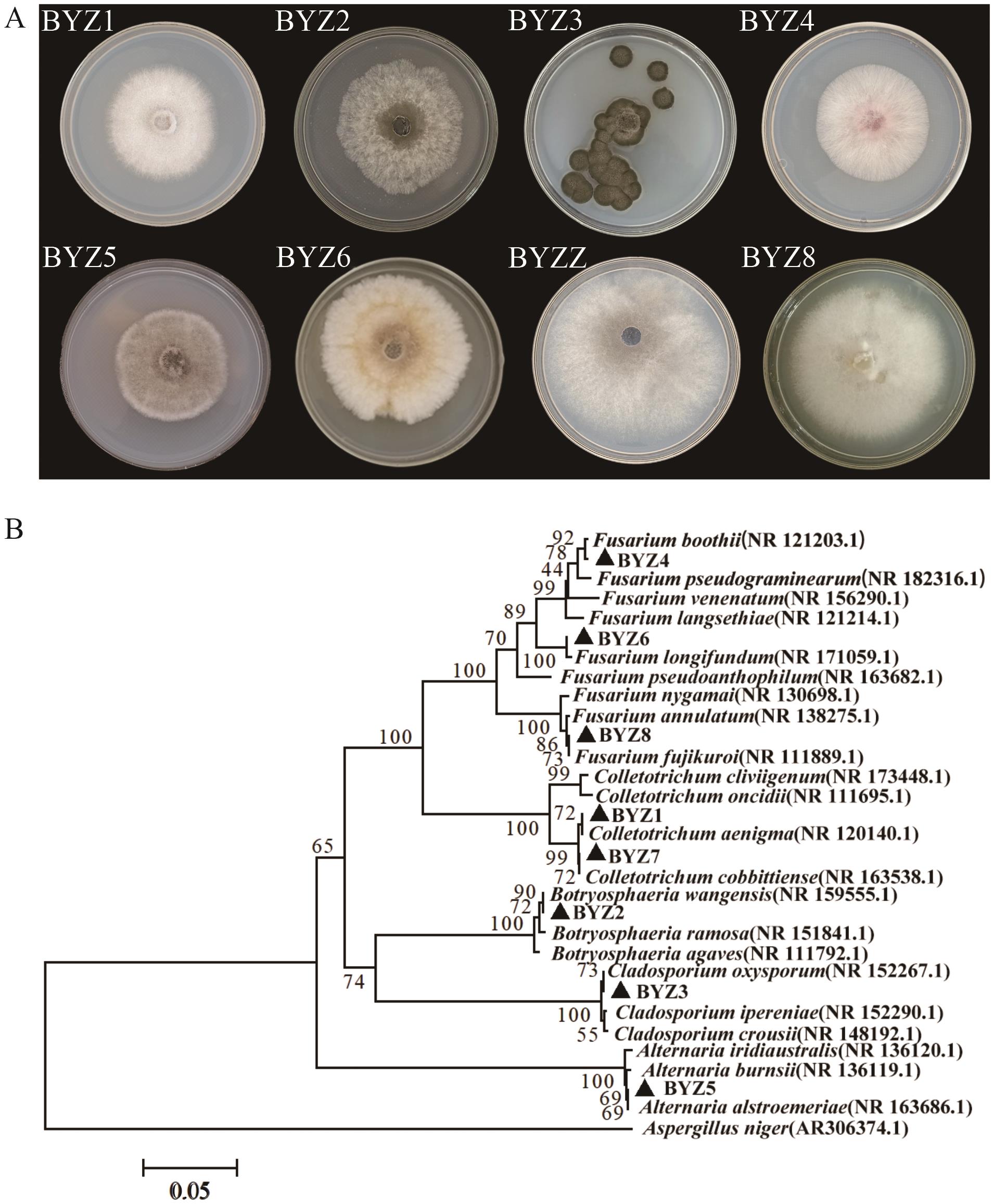
图1 病原真菌的菌落形态(A)及基于ITS序列构建的系统发育树(B)
Fig. 1 Colony morphology (A) of the pathogenic fungi and phylogenetic tree (B) based on ITS sequences
编号 Number | 菌株名称 Strain name | 序列相似度 Similarity (%) | GenBank 登录号 Accession number |
|---|---|---|---|
| BYZ1 | Colletotrichum aenigma | 100.00 | NR 120140.1 |
| BYZ2 | Botryosphaeria wangensis | 100.00 | NR 159555.1 |
| BYZ3 | Cladosporium oxysporum | 100.00 | NR 152267.1 |
| BYZ4 | Fusarium boothii | 99.81 | NR 121203.1 |
| BYZ5 | Alternaria alstroemeriae | 99.81 | NR 163686.1 |
| BYZ6 | Fusarium longifundum | 99.81 | NR 171059.1 |
| BYZ7 | Colletotrichum cobbittiense | 100.00 | NR 163538.1 |
| BYZ8 | Fusarium fujikuroi | 99.81 | NR 111889.1 |
表4 病原真菌鉴定结果
Table 4 Identification of pathogenic fungi
编号 Number | 菌株名称 Strain name | 序列相似度 Similarity (%) | GenBank 登录号 Accession number |
|---|---|---|---|
| BYZ1 | Colletotrichum aenigma | 100.00 | NR 120140.1 |
| BYZ2 | Botryosphaeria wangensis | 100.00 | NR 159555.1 |
| BYZ3 | Cladosporium oxysporum | 100.00 | NR 152267.1 |
| BYZ4 | Fusarium boothii | 99.81 | NR 121203.1 |
| BYZ5 | Alternaria alstroemeriae | 99.81 | NR 163686.1 |
| BYZ6 | Fusarium longifundum | 99.81 | NR 171059.1 |
| BYZ7 | Colletotrichum cobbittiense | 100.00 | NR 163538.1 |
| BYZ8 | Fusarium fujikuroi | 99.81 | NR 111889.1 |
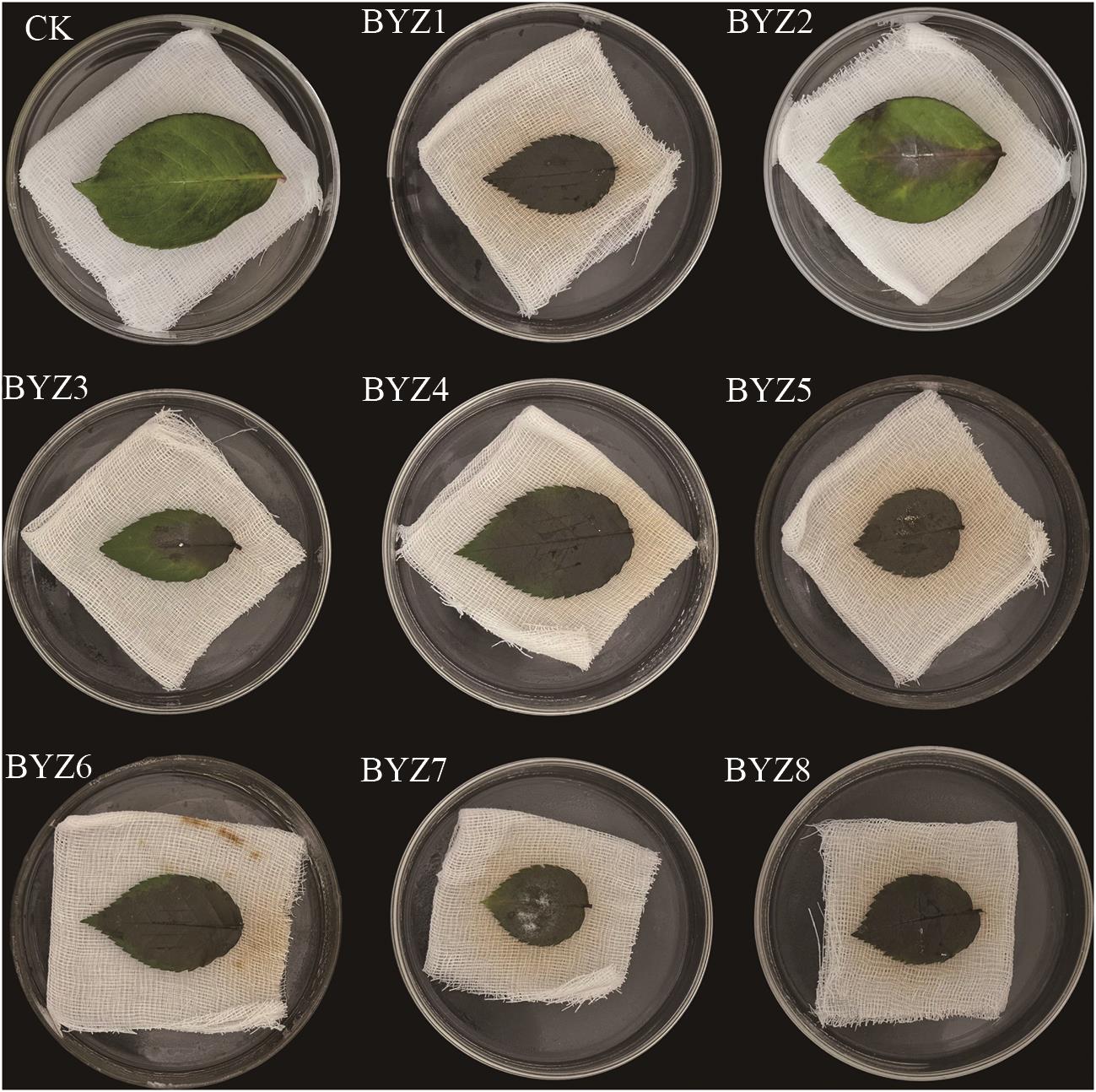
图2 8种真菌的致病性测定
Fig. 2 Pathogenicity test of the eight fungi
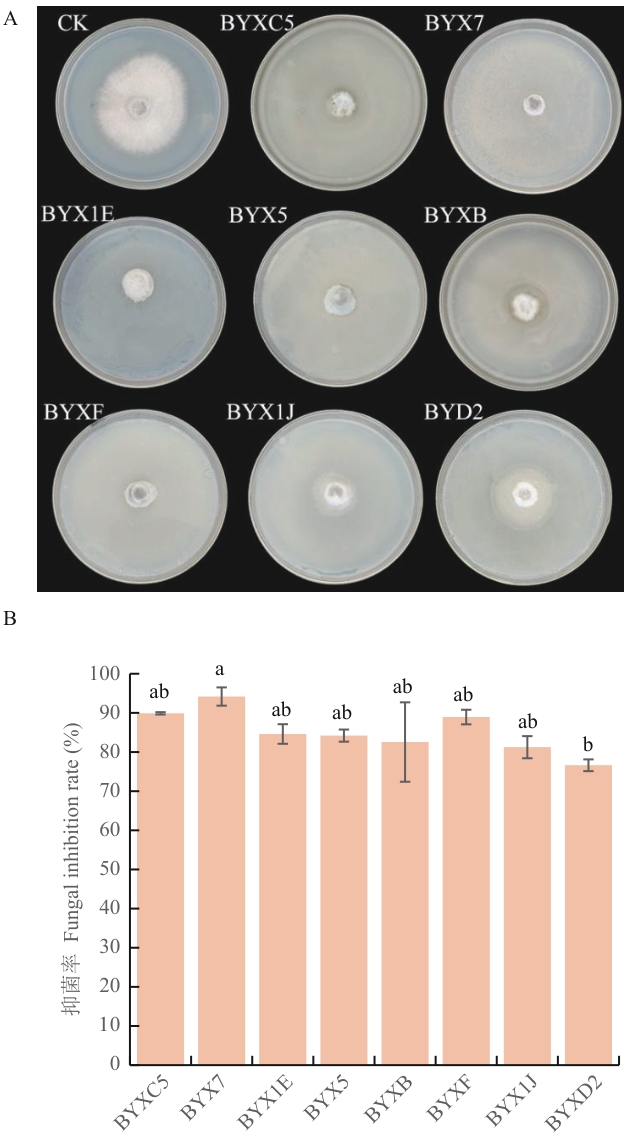
图3 8种拮抗菌对隐秘刺盘孢菌的抑菌效果(A)及抑菌率(B)不同字母表示差异显著(P<0.05),下同
Fig. 3 Antifungal effects (A) and inhibition rates (B) of eight antagonistic bacteria against C. aenigmaDifferent letters indicate significant differences(P<0.05). The same below
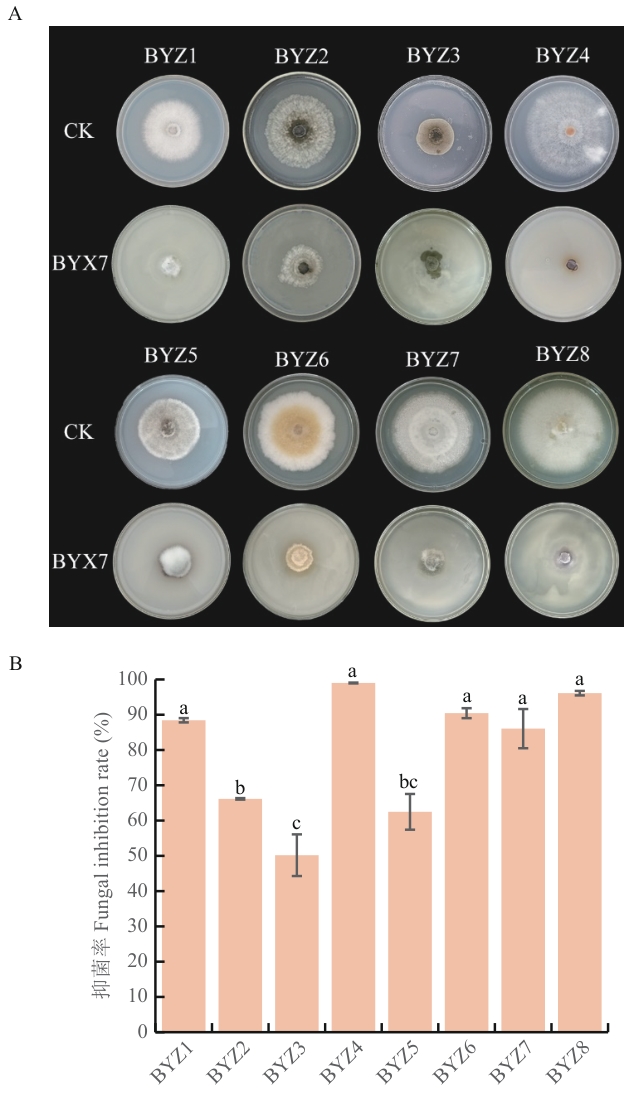
图4 青岛假单胞菌BYX7对8种病原菌的抑菌效果(A)及抑菌率(B)
Fig. 4 Antifungal effects (A) and inhibition rates (B) of P. qingdaonensis BYX7 against eight pathogenic fungi
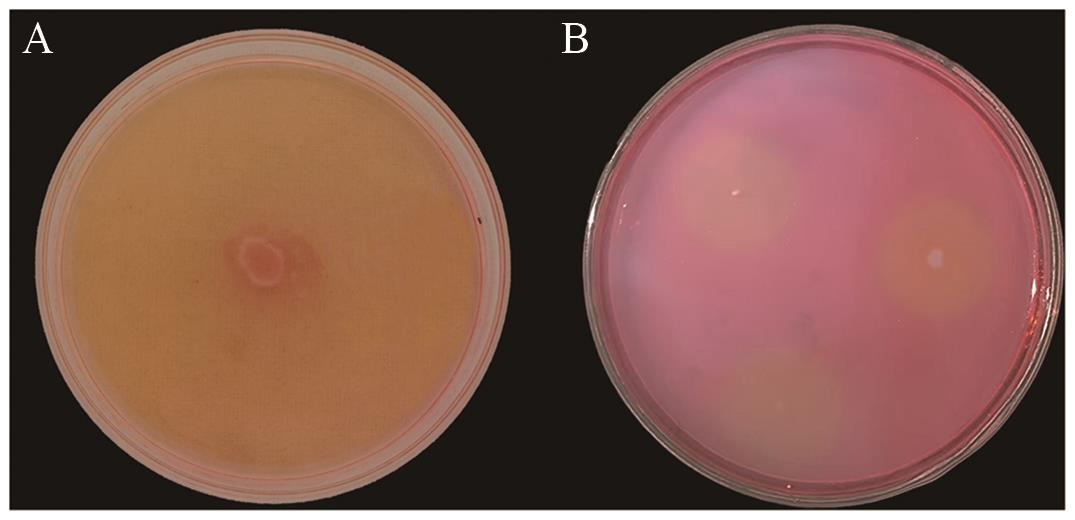
图5 青岛假单胞菌BYX7生物酶活性A:尿素酶活性;B:纤维素酶活性
Fig. 5 The enzymatic activity of P. qingdaonensis BYX7A: Urease activity. B: Cellulase activity
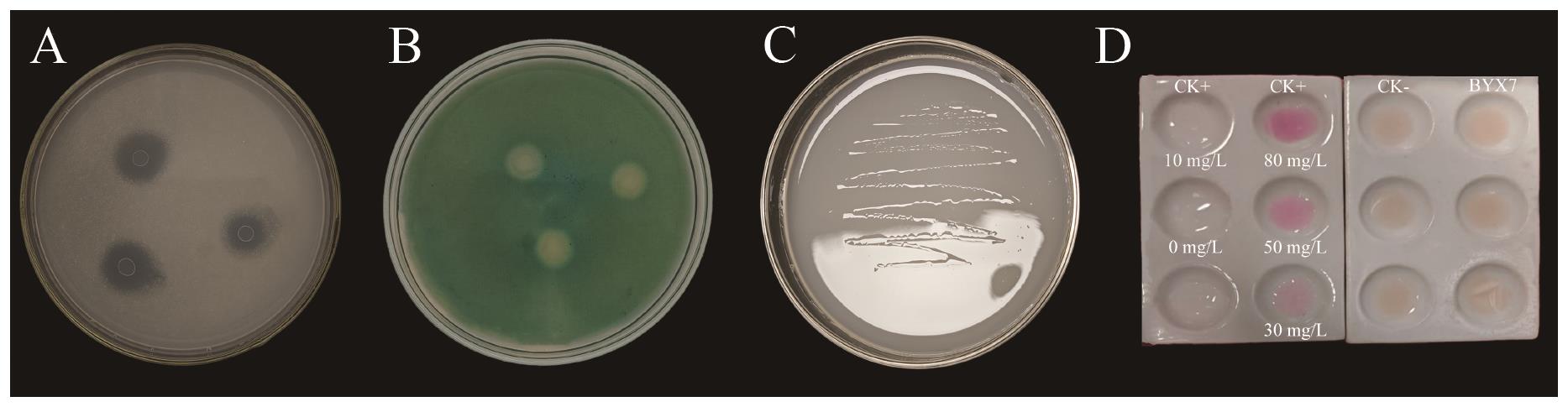
图6 青岛假单胞菌BYX7促生能力测定A:解磷实验;B:产铁载体测定;C:固氮实验;D:产IAA测定
Fig. 6 Determination of the growth-promoting ability of P. qingdaonensis BYX7A: Phosphorus dissolution experiment. B: Determination of siderophores. C: Nitrogen fixation experiment. D: Determination of IAA production
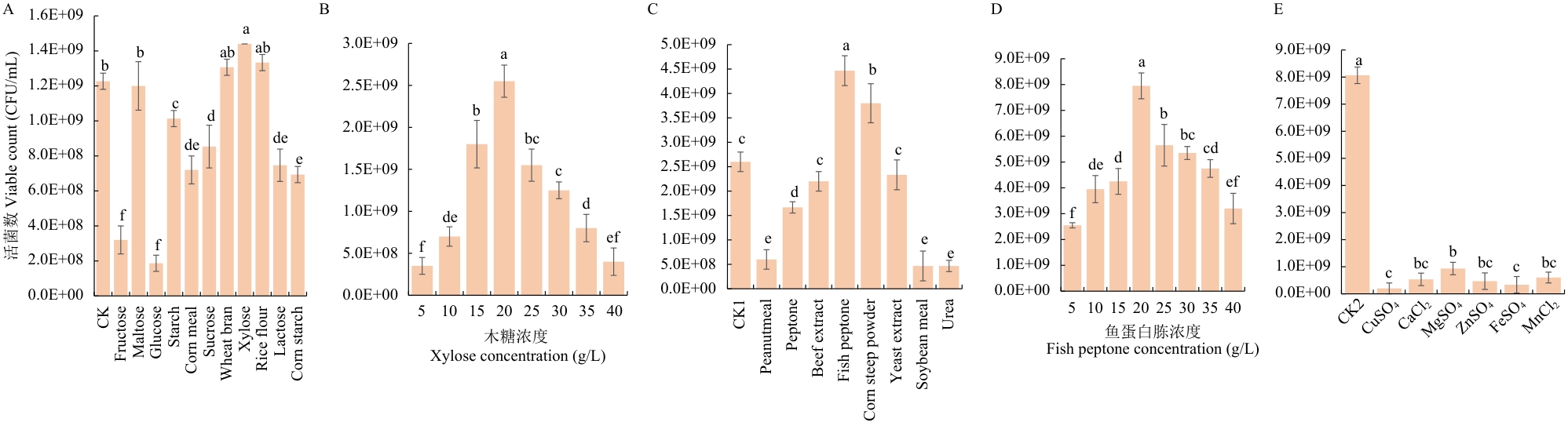
图7 发酵培养基成分优化A:碳源种类;B:碳源添加量;C:氮源种类;D:氮源添加量;E:无机盐种类
Fig. 7 Optimization of fermentation medium compositionA: Types of carbon sources. B: Addition amount of carbon source. C: Type of nitrogen source. D: Nitrogen source addition amount. E: Types of inorganic salts
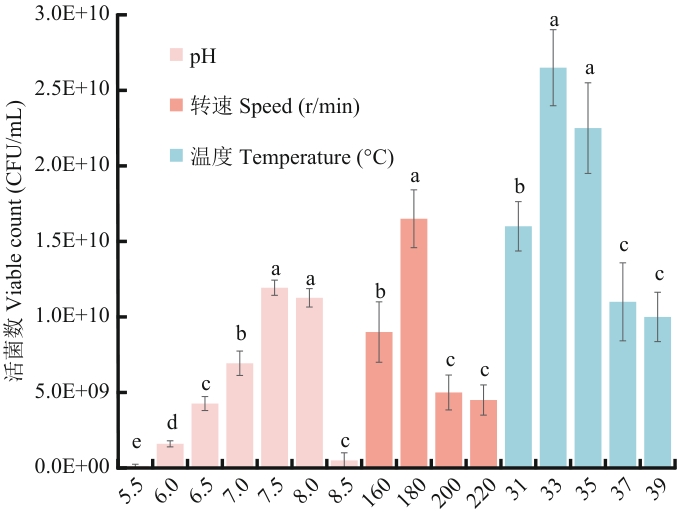
图8 发酵条件的优化
Fig. 8 Optimization of fermentation conditions
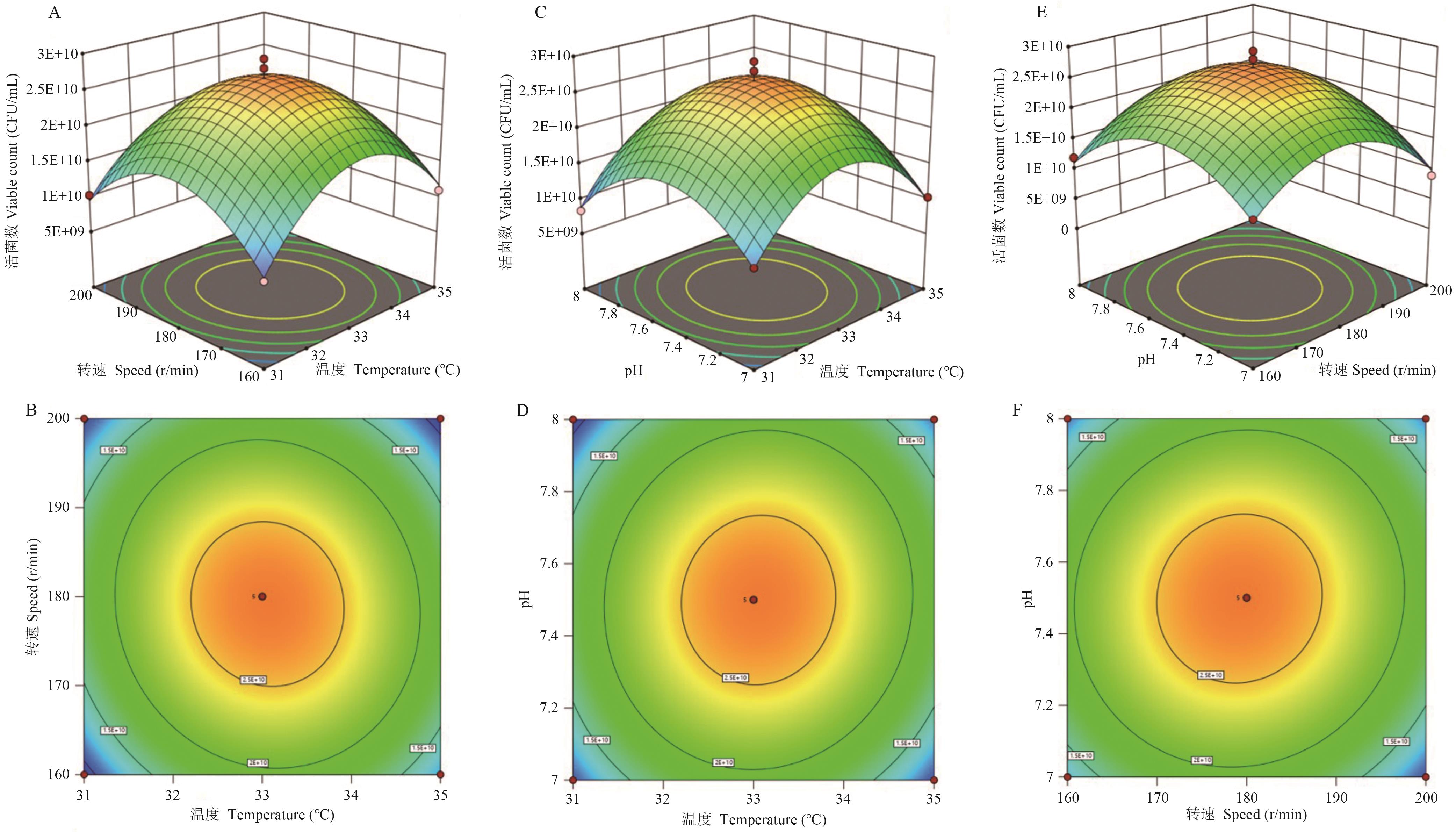
图9 发酵条件影响青岛假单胞菌BYX7活菌数的响应曲面(A、C、E)和等高线(B、D、F)
Fig. 9 Response surface (A, C, E) and contour plots (B, D, F) illustrating the effect of fermentation conditions on the viable cell count of P. qingdaonensis BYX7
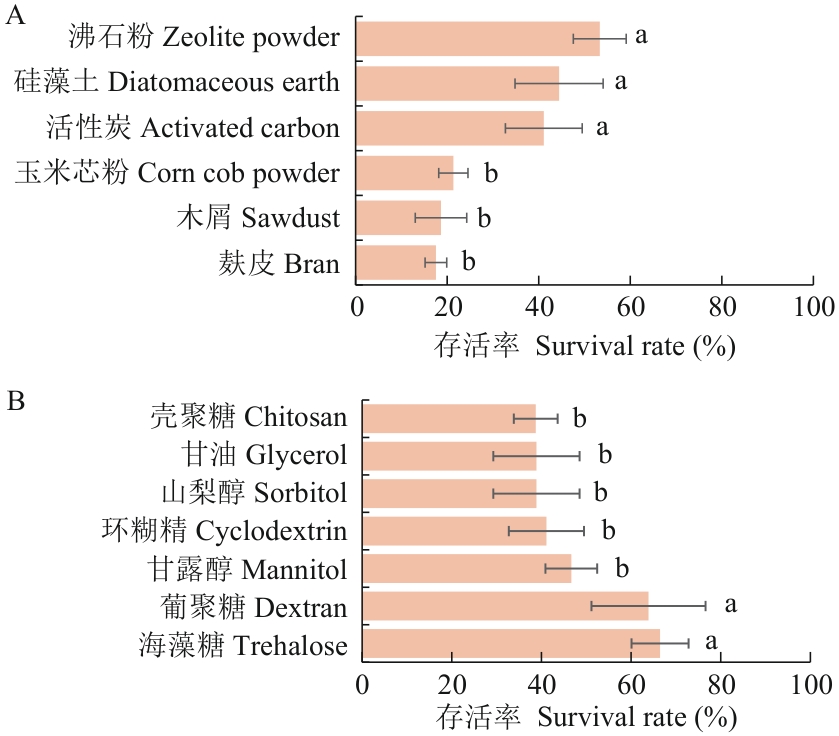
图10 菌粉吸附载体和保护剂种类的优化A:吸附载体种类;B:保护剂种类
Fig. 10 Optimization of the types of adsorption carriers and protective agents for bacterial powderA: Types of adsorption carriers. B: Types of protective agents
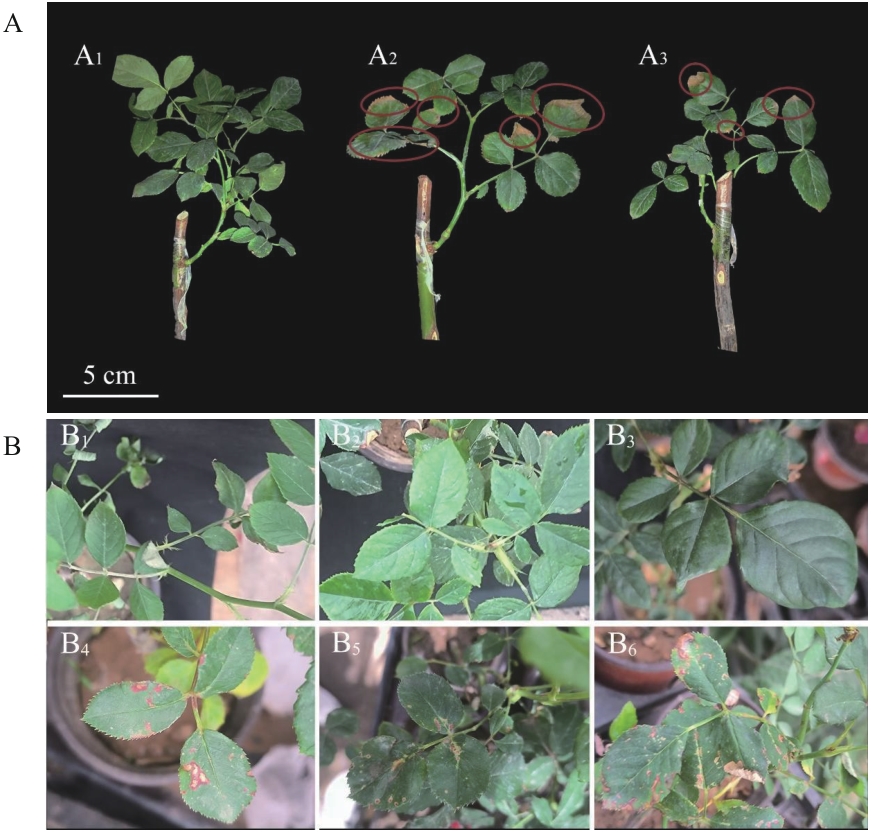
图11 BYX7对月季盆栽苗的回接试验(A)及对褐斑病的防治效果(B)A1:回接试验;A2:对照组;A3:实验组;B1‒B3:健康叶片;B4‒B6:病害叶片
Fig. 11 The re-inoculation experiment of BYX7 on rose potted seedlings (A) and its efficacy in preventing brown spot disease (B)A1: Re-inoculation group. A2: Control group. A3: Experimental group. B1-B3: Healthy leaves. B4-B6: Diseased leaves
组别 Group | 发病率 Incidence rate (%) | 病情指数 Disease index (%) | 防治指数 Prevention and control index (%) |
|---|---|---|---|
对照组 Control group | 72.29±17.28a | 90.50±10.14a | — |
实验组 Experimental group | 32.40±22.08b | 55.56±15.72a | 38.61 |
表5 盆栽实验发病率、病情指数及防治指数
Table 5 Incidence rate, disease index, and prevention and control index of the pot experiment
组别 Group | 发病率 Incidence rate (%) | 病情指数 Disease index (%) | 防治指数 Prevention and control index (%) |
|---|---|---|---|
对照组 Control group | 72.29±17.28a | 90.50±10.14a | — |
实验组 Experimental group | 32.40±22.08b | 55.56±15.72a | 38.61 |
| [1] | 贾静怡, 孙倩, 张玮, 等. 北京市月季丽赤壳褐斑病病原菌鉴定 [J]. 植物病理学报, 2021, 51(3): 446-450. |
| Jia JY, Sun Q, Zhang W, et al. Identification of pathogen causing Calonectria leaf spot on Rosa chinensis in Beijing [J]. Acta Phytopathol Sin, 2021, 51(3): 446-450. | |
| [2] | 李艳杰. 月季黑斑病病原菌分离鉴定及防治初步研究 [D]. 昆明: 西南林业大学, 2024. |
| Li YJ. Preliminary study on isolation, identification and prevention and control of black spot disease of Rosa chinensis jacq [D]. Kunming: Southwest Forestry University, 2024. | |
| [3] | 杨珊. 绿针假单胞菌zm-1生物防治花生白绢病的作用机理研究 [D]. 开封: 河南大学, 2022. |
| Yang S. Mechanisms of biological control agaist peanut stem rot by Pseudomonas chlororaphis zm-1 [D]. Kaifeng: Henan University, 2022. | |
| [4] | Guzmán-Guzmán P, Santoyo G. Action mechanisms, biodiversity, and omics approaches in biocontrol and plant growth-promoting Pseudomonas: an updated review [J]. Biocontrol Sci Technol, 2022, 32(5): 527-550. |
| [5] | Purtschert-Montenegro G, Cárcamo-Oyarce G, Pinto-Carbó M, et al. Pseudomonas putida mediates bacterial killing, biofilm invasion and biocontrol with a type IVB secretion system [J]. Nat Microbiol, 2022, 7(10): 1547-1557. |
| [6] | 田洁, 唐有林, 王启璋, 等. 植物根际促生菌Pseudomonas putida UW4对菊花扦插苗生长及生理特性的影响 [J]. 植物生理学报, 2023, 59(1): 179-190. |
| Tian J, Tang YL, Wang QZ, et al. Effects of plant growth promoting rhizobacteria Pseudomonas putida UW4 on the growth and physiological characteristics of Chrysanthemum cuttings [J]. Plant Physiol J, 2023, 59(1): 179-190. | |
| [7] | 赵子璇, 李俊辉, 杜公福, 等. 防御假单胞ZF509的分离鉴定及其对甜瓜细菌性果斑病的防治效果研究 [J]. 中国生物防治学报, 2024, 40(3): 690-700. |
| Zhao ZX, Li JH, Du GF, et al. Isolation and identification of Pseudomonas ZF509 and its control effect on bacterial fruit blotch of melon [J]. Chin J Biol Control, 2024, 40(3): 690-700. | |
| [8] | 李潇潇, 师桂英, 张立彭, 等. 荧光假单胞菌(Pseudomonas fluorescens)在植物病害生物防治中的研究及展望 [J]. 草原与草坪, 2021, 41(5): 148-156. |
| Li XX, Shi GY, Zhang LP, et al. Application of Pseudomonas fluorescens in biological control of plant disease and its prospects [J]. Grassland Turf, 2021, 41(5): 148-156. | |
| [9] | 王传琪. 一株托拉氏假单胞菌Pseudomonas tolaasii DL001的物种鉴定及其抑菌活性物质研究 [D]. 大理: 大理大学, 2019. |
| Wang CQ. Study on the identification and antibacterial components from Pseudomonas tolaasii DL001 [D]. Dali: Dali University, 2019. | |
| [10] | Chlebek D, Płociniczak T, Gobetti S, et al. Analysis of the genome of the heavy metal resistant and hydrocarbon-degrading rhizospheric Pseudomonas qingdaonensis ZCR6 strain and assessment of its plant-growth-promoting traits [J]. Int J Mol Sci, 2022, 23(1): 214. |
| [11] | Zainurin N, Imran M, Shaffique S, et al. New insights into the synergistic interaction between Pseudomonas qingdaonensis NZ 1 and silicon to mitigate drought stress in rice [J]. Microorganisms, 2025, 13(5): 1046. |
| [12] | 张晓勇, 李树江, 龙巧芳, 等. 新几内亚凤仙花根腐病病原菌鉴定及杀菌剂室内毒力测定 [J]. 园艺学报, 2023, 50(5): 1130-1140. |
| Zhang XY, Li SJ, Long QF, et al. Identification of Phytopythium helicoides causing root rot of Impatiens hawkeri and toxicity test of different fungicides in laboratory [J]. Acta Hortic Sin, 2023, 50(5): 1130-1140. | |
| [13] | 杨瑾, 高佳欣, 李珍华, 等. 月季黑斑病病原菌的分离及生防菌的筛选 [J]. 运城学院学报, 2025, 43(3): 35-40. |
| Yang J, Gao JX, Li ZH, et al. Isolation of pathogenic bacteria and screening of biocontrol bacteria against rose black spot disease [J]. J Yuncheng Univ, 2025, 43(3): 35-40. | |
| [14] | 黄丽, 陈振民, 闫训博, 等. 一株假蕈状芽胞杆菌及在制备植物病原菌抑菌剂中的应用: CN114703094A [P]. 2022-07-05. |
| Huang L, Chen ZM, Yan XB, et al. A strain of Bacillus pseudomycoides and its application in the preparation of an antimicrobial agent against plant pathogens: CN114703094A [P]. 2022-07-05. | |
| [15] | 张嘉馨. 产氨基糖苷类次级代谢产物链霉菌的筛选及其化合物挖掘 [D]. 阿拉尔: 塔里木大学, 2023. |
| Zhang JX. Screening of Streptomyces producing aminoglycoside secondary metabolites and their compound mining [D]. Ala'er: Tarim University, 2023. | |
| [16] | 贾金姗, 马悦, 张俊杰, 等. 双叉犀金龟肠道纤维素降解菌的筛选及酶活力比较 [J]. 环境昆虫学报, 2025, 47(2): 361-371. |
| Jia JS, Ma Y, Zhang JJ, et al. Screening of intestinal cellulose-degrading bacteria and comparison of enzyme activity in the Allomyrina dichotoma [J]. J Environ Entomol, 2025, 47(2): 361-371. | |
| [17] | 王瑞琪, 赵为民, 魏丽萍, 等. 西藏林芝油菜根际拮抗细菌筛选及其促生特性研究 [J]. 中国植保导刊, 2021, 41(10): 16-23, 37. |
| Wang RQ, Zhao WM, Wei LP, et al. Screening and growth-promoting characterization of antagonistic bacteria in the rhizosphere of oilseed rape on the plateau in Linzhi [J]. China Plant Prot, 2021, 41(10): 16-23, 37. | |
| [18] | Lucero CT, Lorda GS, Anzuay MS, et al. Peanut endophytic phosphate solubilizing bacteria increase growth and P content of soybean and maize plants [J]. Curr Microbiol, 2021, 78(5): 1961-1972. |
| [19] | 聂丽妍. 巨柏根际溶磷菌的筛选与促生特性研究 [D]. 林芝: 西藏农牧学院, 2023. |
| Nie LY. Screening and growth-promoting characteristics of phosphorus solubilizing strains in the of rhizosphere of cypress gigantica [D]. Linzhi: Tibet Agricultural and Animal Husbandry Universi, 2023. | |
| [20] | 蒋鑫. 玉米PGPR筛选、鉴定及其促生作用研究 [D]. 沈阳: 沈阳农业大学, 2024. |
| Jiang X. Screening, identification and growth promoting effect of PGPR in maize [D]. Shenyang: Shenyang Agricultural University, 2024. | |
| [21] | 郑运祥, 刘洋, 郭文霞. 5种复配杀菌剂防治海棠锈病的田间药效试验 [J]. 北方果树, 2024(2): 21-23. |
| Zheng YX, Liu Y, Guo WX. Field efficacy trials of 5 compound fungicides against Malus spectabilis rust disease [J]. North Fruits, 2024(2): 21-23. | |
| [22] | 秦维彩, 闫晓静, 檀根甲, 等. 烯酰吗啉与嘧菌酯对辣椒疫霉病菌生物活性的比较 [J]. 植物保护学报, 2010, 37(1): 42-48. |
| Qin WC, Yan XJ, Tan GJ, et al. Comparative study on the efficacies of dimethomorph and azoxystrobin against Phytophthora capsici [J]. J Plant Prot, 2010, 37(1): 42-48. | |
| [23] | 马小方, 雷纤慧, 向义元, 等. 首次报道藤仓镰刀菌危害柑橘 [J]. 植物病理学报, 2024, 54(5): 1045-1049. |
| Ma XF, Lei XH, Xiang YY, et al. First report of Fusarium fujikuroi causing citrus diseases in China [J]. Acta Phytopathol Sin, 2024, 54(5): 1045-1049. | |
| [24] | 李坤, 洪秀杰, 王欣悦, 等. 贝莱斯芽孢杆菌TC-52的分离鉴定及其对水稻幼苗生长和立枯病的影响 [J]. 江苏农业科学, 2024, 52(10): 129-137. |
| Li K, Hong XJ, Wang XY, et al. Isolation and identification of Bacillus velezensis TC-52 and its effect on rice seedling growth and blight [J]. Jiangsu Agric Sci, 2024, 52(10): 129-137. | |
| [25] | 王飞, 杨瑾, 李雪梦, 等. 2株丹参根内促生细菌的分离鉴定及促生作用评价 [J]. 河南农业科学, 2025, 54(10): 71-80. |
| Wang F, Yang J, Li XM, et al. Isolation, identification and effect evaluation of two growth⁃promoting endophytic bacteria in Salvia miltiorrhiza roots [J]. J Henan Agric Sci, 2025, 54(10): 71-80. | |
| [26] | 戴梅, 宫象辉, 丛蕾, 等. PGPR制剂研发现状与发展趋势 [J]. 山东科学, 2006, 19(6): 45-48. |
| Dai M, Gong XH, Cong L, et al. Recent advances and research trend of PGPR agents [J]. Shandong Sci, 2006, 19(6): 45-48. | |
| [27] | Wang Y, Pruitt RN, Nürnberger T, et al. Evasion of plant immunity by microbial pathogens [J]. Nat Rev Microbiol, 2022, 20(8): 449-464. |
| [28] | Obradović A, Stepanović J, Krnjaja V, et al. First report of maize ear rot caused by Fusarium boothii in Serbia [J]. Plant Dis, 2025, 109(3): 716. |
| [29] | Wegulo SN, Valverde-Bogantes E, Bolanos-Carriel C, et al. First report of Fusarium boothii causing head blight of wheat in the United States [J]. Plant Dis, 2018, 102(12): 2646. |
| [30] | Wang WY, Zhang JH, Chen BZ, et al. Occurrence of Fusarium boothii causing Fusarium head blight and crown rot of wheat in China [J]. Plant Dis, 2025, 109(7): 1590. |
| [31] | 王杰, 王海春, 祁鹤兴, 等. 青海省民和县青贮玉米叶斑病及其病原调查初报 [J]. 植物医学, 2023, 2(1): 44-49. |
| Wang J, Wang HC, Qi HX, et al. Preliminary report on leaf spot and pathogens of silage maize in Minhe County of Qinghai Province [J]. Plant Health Med, 2023, 2(1): 44-49. | |
| [32] | Gao YZ, Zhang ZX, Ji M, et al. Identification and pathogenicity of Fusarium species from herbaceous plants on grassland in Qiaojia county, China [J]. Microorganisms, 2025, 13(1): 113. |
| [33] | 马莹, 曹梦圆, 石孝均, 等. 植物促生菌的功能及在可持续农业中的应用 [J]. 土壤学报, 2023, 60(6): 1555-1568. |
| Ma Y, Cao MY, Shi XJ, et al. Functions of plant growth-promoting bacteria and their application in sustainable agriculture [J]. Acta Pedol Sin, 2023, 60(6): 1555-1568. | |
| [34] | 李雪艳. 棉花内生与根际拮抗菌对黄萎病的防病机理研究 [D]. 乌鲁木齐: 新疆大学, 2019. |
| Li XY. Study on the mechanism of cotton endophytic and rhizosphere antagonism against Verticillium wilt [D]. Urumqi: Xinjiang University, 2019. | |
| [35] | 刘梓豪. 防控玉米种栖镰刀菌的根际菌群构建与菌群内部互作机制研究 [D]. 南京: 南京农业大学, 2021. |
| Liu ZH. The construction and internal interaction mechanism of a synthetic rhizosphere microbiota in inhibiting the seed-borne Fusarium of maize [D]. Nanjing: Nanjing Agricultural University, 2021. | |
| [36] | Lo Cantore P, Giorgio A, Iacobellis NS. Bioactivity of volatile organic compounds produced by Pseudomonas tolaasii [J]. Front Microbiol, 2015, 6: 1082. |
| [37] | 田永强, 张倩男, 薛致成, 等. 一株克氏假单胞菌及其应用: CN120098867B [P]. 2025-09-05. |
| Tian YQ, Zhang QN, Xue ZC, et al. A strain of Pseudomonas knackmussii and its application: CN120098867B [P]. 2025-09-05. | |
| [38] | 张雪岩, 陈雅君, 石延霞, 等. 月季褐斑病病原菌鉴定 [C]//庆祝中国园艺学会创建80周年暨第11次全国会员代表大会论文集. 广州: 《园艺学报》编辑部, 2009: 198. |
| Zhang XY, Chen YJ, Shi YX, et al. Identification of the pathogen causing rose brown spot disease [C]//Proceedings of the 80th Anniversary of the Chinese Society for Horticultural Science and the 11th National Congress. Guangzhou: Editorial Office of Acta Horticulturae Sinica, 2009: 198. |
| [1] | 李琼瑶, 鲍瑞, 雷海涛, 杨苑姁, 韩丽珍. 抗逆促生菌恶臭假单胞菌对辣椒种子萌发及幼苗生长的影响[J]. 生物技术通报, 2026, 42(5): 257-271. |
| [2] | 林宝妹, 李珊珊, 李海明, 洪佳敏, 张帅, 吴妙鸿, 吴维坚, 吴水金. 香蕉枯萎病拮抗菌的筛选鉴定与生防作用[J]. 生物技术通报, 2026, 42(4): 272-286. |
| [3] | 苏秀敏, 韩文清, 王佼, 李鹏, 王秋兰, 李万星, 曹晋军. 哈茨木霉M408的分离鉴定、生物学特性及对番茄早疫病的生防效果[J]. 生物技术通报, 2025, 41(9): 277-288. |
| [4] | 陈永旗, 李志文, 李鑫, 原若曦, 王春旭, 韩毅强, 高亚梅. 黑土区大豆根际土壤放线菌的分离与功能研究[J]. 生物技术通报, 2025, 41(5): 255-266. |
| [5] | 周江鸿, 夏菲, 仲丽, 仇兰芬, 李广, 刘倩, 张国锋, 邵金丽, 李娜, 车少臣. 黄栌枯萎病拮抗细菌CCBC3-3-1的全基因组测序及比较基因组分析[J]. 生物技术通报, 2024, 40(7): 235-246. |
| [6] | 叶柳健, 贺愉岚, 王小虎, 韦圣博, 何双, 朱绮霞, 卢洁, 周礼芹. 解淀粉芽孢杆菌YK3对沃柑溃疡病的防效及叶际细菌群落相关性的影响[J]. 生物技术通报, 2024, 40(11): 248-258. |
| [7] | 方澜, 黎妍妍, 江健伟, 成胜, 孙正祥, 周燚. 盘龙参内生真菌胞内细菌7-2H的分离鉴定和促生特性研究[J]. 生物技术通报, 2023, 39(8): 272-282. |
| [8] | 张玲, 张荣意, 刘盛科, 谭志琼. 瓜类细菌性果斑病菌拮抗细菌的筛选及其抑菌作用[J]. 生物技术通报, 2023, 39(1): 253-263. |
| [9] | 高晓蓉, 丁尧, 吕军. 芘降解菌Pseudomonas sp. PR3的植物促生特性及其对芘胁迫下水稻生长的影响[J]. 生物技术通报, 2022, 38(9): 226-236. |
| [10] | 唐嘉城, 梁毅珉, 马葭思, 彭桂香, 谭志远. 百香果内生细菌多样性及促生长特性[J]. 生物技术通报, 2022, 38(1): 86-97. |
| [11] | 徐秀倩, 吴小芹, 吴天宇, 曾梦嫚. 林木根际细菌JYZ-SD5的促生抗逆性能及种类鉴定[J]. 生物技术通报, 2019, 35(3): 31-38. |
| [12] | 周泠璇,刘娅. 红提葡萄内生细菌的分离鉴定及灰霉病拮抗菌的筛选[J]. 生物技术通报, 2016, 32(4): 184-189. |
| [13] | 张晓龙,肖静,王瑞明,汪俊卿,王兴吉,王正祥. 共表达透明颤菌血红蛋白对毕赤酵母产Β-甘露聚糖酶发酵过程的影响[J]. 生物技术通报, 2015, 31(12): 193-199. |
| [14] | 史册,韩梅,张一鸣,郭双双,杨利民. 人参病原菌拮抗放线菌的分离筛选与鉴定[J]. 生物技术通报, 2014, 30(9): 102-108. |
| [15] | 闵兆升, 郭会明, 颜旭, 洪厚胜. 巴斯德毕赤酵母(P. pastoris)高密度发酵研究进展[J]. 生物技术通报, 2014, 30(3): 42-49. |
| 阅读次数 | ||||||
|
全文 |
|
|||||
|
摘要 |
|
|||||
