







生物技术通报 ›› 2026, Vol. 42 ›› Issue (7): 138-147.doi: 10.13560/j.cnki.biotech.bull.1985.2025-1249
• 研究报告 • 上一篇
刘倩, 王宗燕, 罗浚豪, 吴张璋, 胡振, 吕建珍( ), 姜亮()
收稿日期:2025-11-19
出版日期:2026-07-26
发布日期:2026-07-20
通讯作者:
吕建珍lvjianzhen110@163.com基金资助:
LIU Qian, WANG Zong-yan, LUO Jun-hao, WU Zhang-zhang, HU Zhen, LYU Jian-zhen(), JIANG Liang()
Received:2025-11-19
Published:2026-07-26
Online:2026-07-20
摘要:
目的 落粒性是作物驯化过程中关键的人工选择性状。定位并克隆调控落粒性的主效基因,为阐明谷子驯化的遗传基础、开发分子标记辅助育种工具提供理论依据和应用价值。 方法 以易落粒种质资源YLL5和抗落粒现代育成品种冀谷42(Si42)为研究对象,运用石蜡切片比较两亲本离层(abscission zone)细胞结构与细胞壁成分差异。为定位控制落粒性基因,构建F₄遗传群体。采用BSA-Seq(Bulked segregant analysis sequencing),并结合ED、G′ value、SNP-loess和SNP-index等连锁分析方法初步定位相关性状位点。对定位区间内注释基因进行筛选,通过实时荧光定量PCR(quantitative reverse transcription PCR, RT-qPCR)验证候选基因在两亲本多组织中的表达差异。 结果 石蜡切片结果显示,YLL5和Si42在细胞排列、组织结构及细胞壁成分上存在显著差异。经关联分析,初步将控制目标性状的位点定位在第5(3.3 Mb)和第8(1.1 Mb)染色体。利用InDel标记将目标区间精细定位至第5染色体约0.3 Mb的区域,该区间共注释25个基因,从中筛选出在穗部高表达的基因。RT-qPCR分析表明,候选基因Seita.5G087200在易落粒亲本YLL5的穗和穗码组织中的表达量显著高于Si42,其表达模式与落粒表型高度一致。Sanger测序进一步揭示,该基因第2个外显子存在一处转座子插入变异;基于该变异开发的分子标记能够有效区分不同落粒表型,具备分子标记辅助选择的应用潜力。 结论 Seita.5G087200可能是调控谷子落粒性状的关键候选基因。
刘倩, 王宗燕, 罗浚豪, 吴张璋, 胡振, 吕建珍, 姜亮. 基于BSA-Seq谷子落粒主效基因的定位与候选基因分析[J]. 生物技术通报, 2026, 42(7): 138-147.
LIU Qian, WANG Zong-yan, LUO Jun-hao, WU Zhang-zhang, HU Zhen, LYU Jian-zhen, JIANG Liang. Mapping and Candidate Gene Analysis of the Major Gene Controlling Seed Shattering in Foxtail Millet Based on BSA-Seq[J]. Biotechnology Bulletin, 2026, 42(7): 138-147.
样本名称 Sample name | 质控后Clean reads | 过滤后的碱基数 Clean bases | GC(%) | Q30(%) | 比对效率 Mapping efficiency (%) | 平均测序深度 Average sequencing depth (×) | 覆盖率Coverage(≥1×) (%) |
|---|---|---|---|---|---|---|---|
| Si42 | 21 809 827 | 6 531 588 068 | 43.71 | 96.55 | 98.13 | 16 | 95.82 |
| YLL5 | 21 479 290 | 6 431 795 254 | 43.84 | 96.58 | 98.24 | 16 | 90.46 |
| NSH | 61 192 923 | 18 322 677 641 | 43.69 | 96.88 | 98.59 | 43 | 99.46 |
| SH | 54 118 595 | 16 205 874 945 | 43.52 | 97.23 | 98.83 | 38 | 98.33 |
表1 样本测序数据质控统计分析
Table 1 Statistical analysis of sample sequencing data quality control
样本名称 Sample name | 质控后Clean reads | 过滤后的碱基数 Clean bases | GC(%) | Q30(%) | 比对效率 Mapping efficiency (%) | 平均测序深度 Average sequencing depth (×) | 覆盖率Coverage(≥1×) (%) |
|---|---|---|---|---|---|---|---|
| Si42 | 21 809 827 | 6 531 588 068 | 43.71 | 96.55 | 98.13 | 16 | 95.82 |
| YLL5 | 21 479 290 | 6 431 795 254 | 43.84 | 96.58 | 98.24 | 16 | 90.46 |
| NSH | 61 192 923 | 18 322 677 641 | 43.69 | 96.88 | 98.59 | 43 | 99.46 |
| SH | 54 118 595 | 16 205 874 945 | 43.52 | 97.23 | 98.83 | 38 | 98.33 |
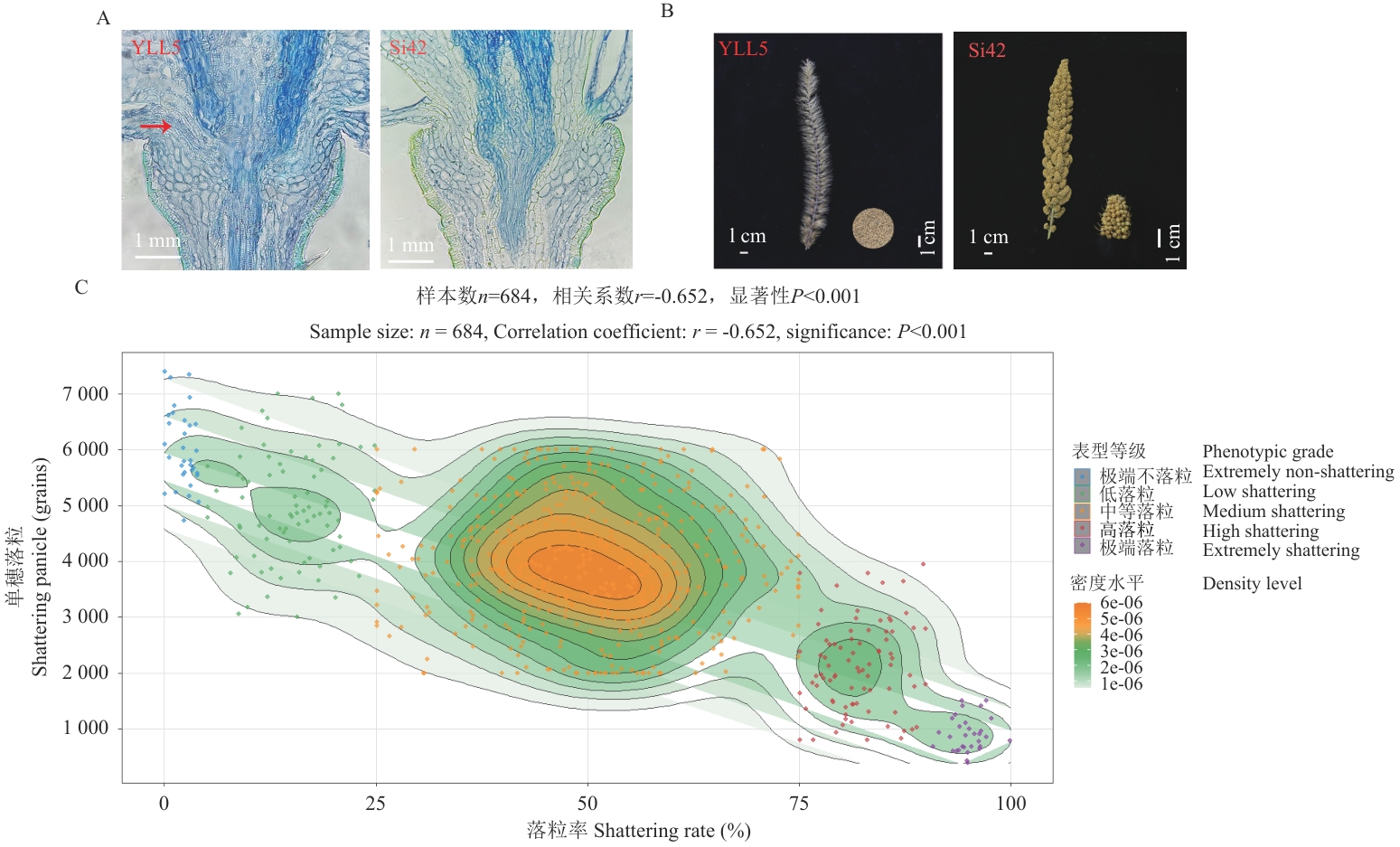
图1 杂交群体落粒性状调查A:亲本离层区甲苯胺蓝染色石蜡切片;B:亲本极端落粒(YLL5)和极端不落粒(Si42)穗部表型图;C:684份F4分离群体落粒率与单穗籽粒数二维分布密度图
Fig. 1 Investigation on the shattering trait of hybrid populationA: Toluidine blue-stained paraffin sections of the parental abscission zone (AZ). B: Panicle phenotypes of the parental lines with extreme shattering in YLL5 and extreme non-shattering in Si42. C: Two-dimensional density distribution plot of shattering rate versus grain number per panicle for the 684 F₄ segregating population
样本名称 Sample name | SNP数量 No. of SNPs | 转换 Transition | 颠换 Transversion | 转换颠换比 Ti/Tv | 杂合SNP数 Number of heterozygous SNPs | 纯合SNP数Number of homozygous SNPs |
|---|---|---|---|---|---|---|
| Si42 | 956 457 | 705 022 | 251 957 | 2.80 | 144 654 | 4 603 689 |
| YLL5 | 3 224 385 | 2 380 056 | 846 130 | 2.81 | 407 128 | 4 293 680 |
| NSH | 3 199 121 | 2 350 746 | 851 613 | 2.76 | 2 968 098 | 1 971 634 |
| SH | 3 394 412 | 2 499 872 | 898 351 | 2.78 | 2 920 233 | 1 985 825 |
表2 BSA-Seq检测到SNP的数量与类型
Table 2 Number and types of SNPs detected by BSA-Seq
样本名称 Sample name | SNP数量 No. of SNPs | 转换 Transition | 颠换 Transversion | 转换颠换比 Ti/Tv | 杂合SNP数 Number of heterozygous SNPs | 纯合SNP数Number of homozygous SNPs |
|---|---|---|---|---|---|---|
| Si42 | 956 457 | 705 022 | 251 957 | 2.80 | 144 654 | 4 603 689 |
| YLL5 | 3 224 385 | 2 380 056 | 846 130 | 2.81 | 407 128 | 4 293 680 |
| NSH | 3 199 121 | 2 350 746 | 851 613 | 2.76 | 2 968 098 | 1 971 634 |
| SH | 3 394 412 | 2 499 872 | 898 351 | 2.78 | 2 920 233 | 1 985 825 |
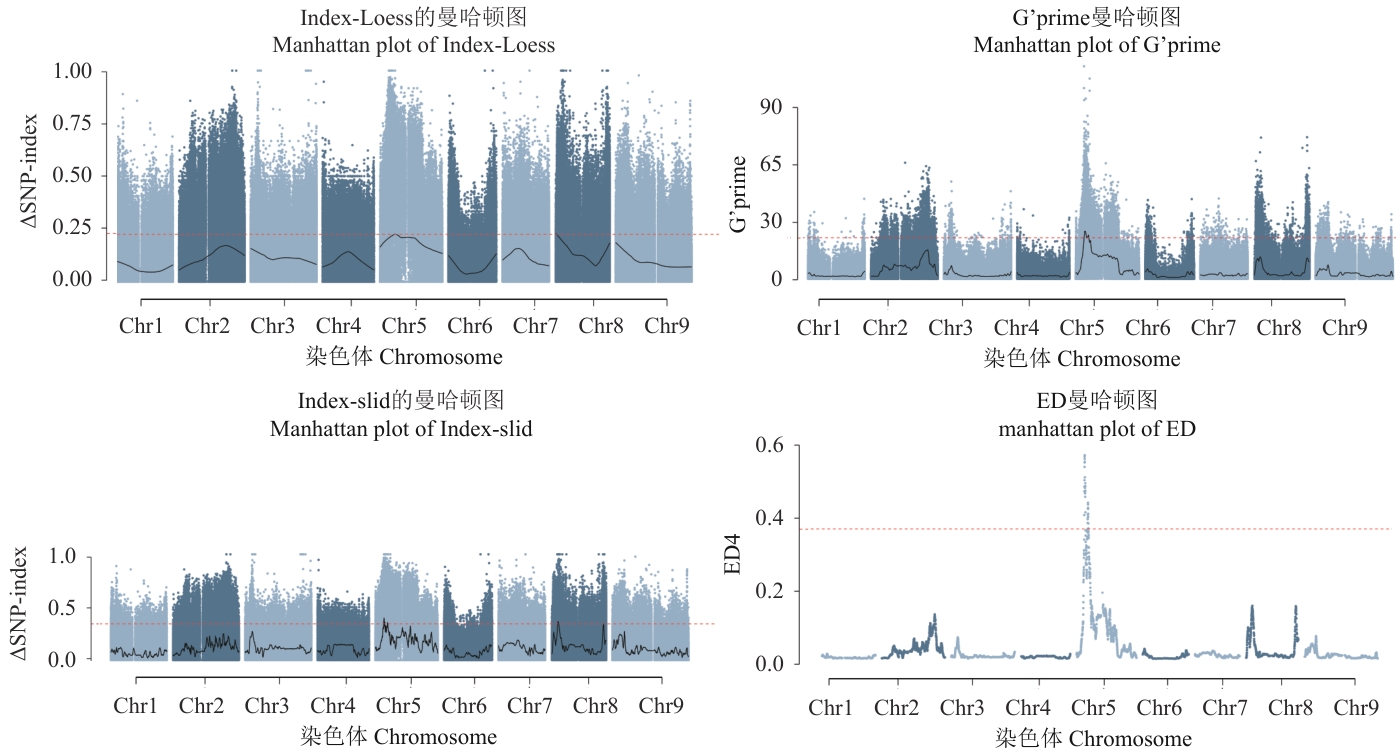
图2 ED、G′ value、SNP-loess及SNP-index定位区间图
Fig. 2 Plots of the mapping intervals of ED, G′ value, SNP-loess and SNP-index
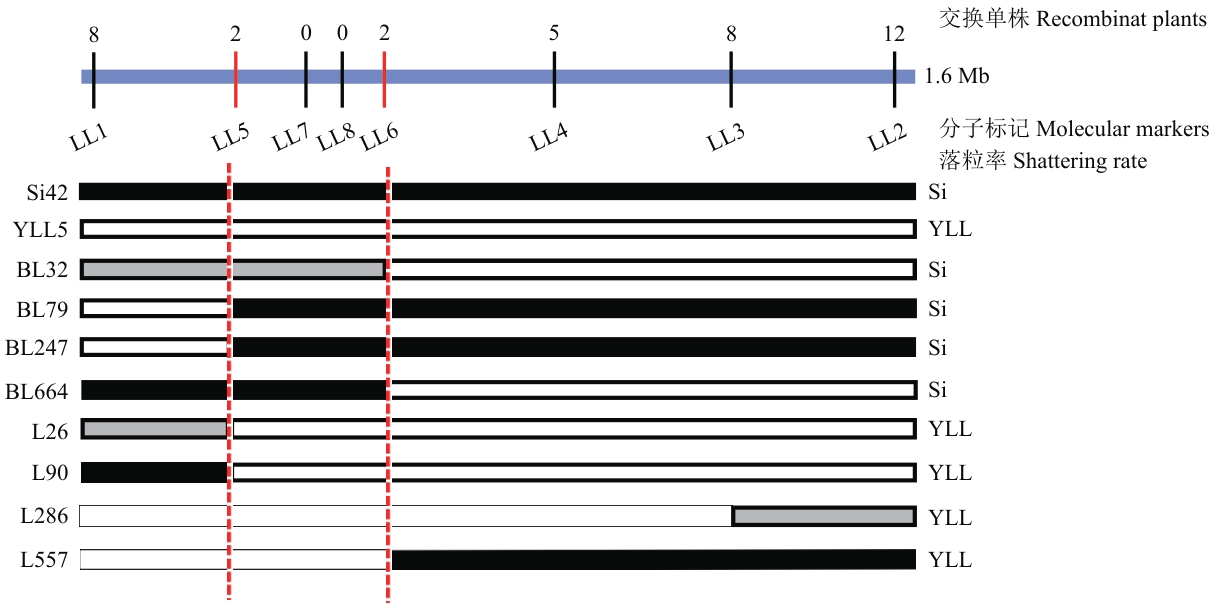
图3 落粒性状相关基因的精细定位图BL32-BL664:极端不落粒后代;L26-L557:极端落粒后代;黑色、白色和灰色格分别代表Si42、YLL5和杂合体基因型;Si为极端不落粒性状,YLL为极端落粒性状;红色虚线之间为精细定位候选区间
Fig. 3 Fine mapping of the candidate gene for the seed shattering traitBL32-BL664: Extreme non-shattering progeny. L26-L557: Extreme shattering progeny. Black, white, and gray cells represent the genotypes of Si42, YLL5, and heterozygotes, respectively; Si represents the extreme non-shattering trait, YLL the extreme shattering trait. The region between the red dashed lines is the candidate interval for fine mapping
基因编号 Gene_ID | 基因功能注释 Annotation of gene function |
|---|---|
| Seita.5G086900 | 类受体蛋白激酶(与拟南芥At4g00960同源) |
| Seita.5G087000 | 甘露糖-6-磷酸异构酶1 |
| Seita.5G087200 | R2R3-MYB转录因子家族(含保守MYB结构域) |
| Seita.5G087300 | 核酸内切酶2 |
| Seita.5G087400 | 核酸内切酶2 |
| Seita.5G087500 | 叶绿体定位的MAO HUZI 4蛋白 |
| Seita.5G087700 | 突触结合蛋白-5 |
| Seita.5G087800 | 泛素相关蛋白家族(含泛素结合结构域) |
| Seita.5G088000 | 含LOB结构域蛋白42 |
| Seita.5G088100 | WD40重复结构域蛋白家族(含WD40保守结构域) |
| Seita.5G088300 | 金属耐受蛋白7同工型X1 |
| Seita.5G088500 | α-木糖苷酶1 |
| Seita.5G088700 | 丝氨酸蛋白酶家族(含丝氨酸蛋白酶保守结构域) |
| Seita.5G088900 | 跨膜蛋白家族(含7次跨膜结构域) |
| Seita.5G089100 | 乙烯响应转录因子ERF118 |
| Seita.5G089200 | 信号肽酶复合物亚基3 |
| Seita.5G089300 | Bowman-Birk型创伤诱导蛋白酶抑制剂WIP1 |
表 3 候选区间内基因的注释信息
Table 3 Annotation information of genes in candidate intervals
基因编号 Gene_ID | 基因功能注释 Annotation of gene function |
|---|---|
| Seita.5G086900 | 类受体蛋白激酶(与拟南芥At4g00960同源) |
| Seita.5G087000 | 甘露糖-6-磷酸异构酶1 |
| Seita.5G087200 | R2R3-MYB转录因子家族(含保守MYB结构域) |
| Seita.5G087300 | 核酸内切酶2 |
| Seita.5G087400 | 核酸内切酶2 |
| Seita.5G087500 | 叶绿体定位的MAO HUZI 4蛋白 |
| Seita.5G087700 | 突触结合蛋白-5 |
| Seita.5G087800 | 泛素相关蛋白家族(含泛素结合结构域) |
| Seita.5G088000 | 含LOB结构域蛋白42 |
| Seita.5G088100 | WD40重复结构域蛋白家族(含WD40保守结构域) |
| Seita.5G088300 | 金属耐受蛋白7同工型X1 |
| Seita.5G088500 | α-木糖苷酶1 |
| Seita.5G088700 | 丝氨酸蛋白酶家族(含丝氨酸蛋白酶保守结构域) |
| Seita.5G088900 | 跨膜蛋白家族(含7次跨膜结构域) |
| Seita.5G089100 | 乙烯响应转录因子ERF118 |
| Seita.5G089200 | 信号肽酶复合物亚基3 |
| Seita.5G089300 | Bowman-Birk型创伤诱导蛋白酶抑制剂WIP1 |
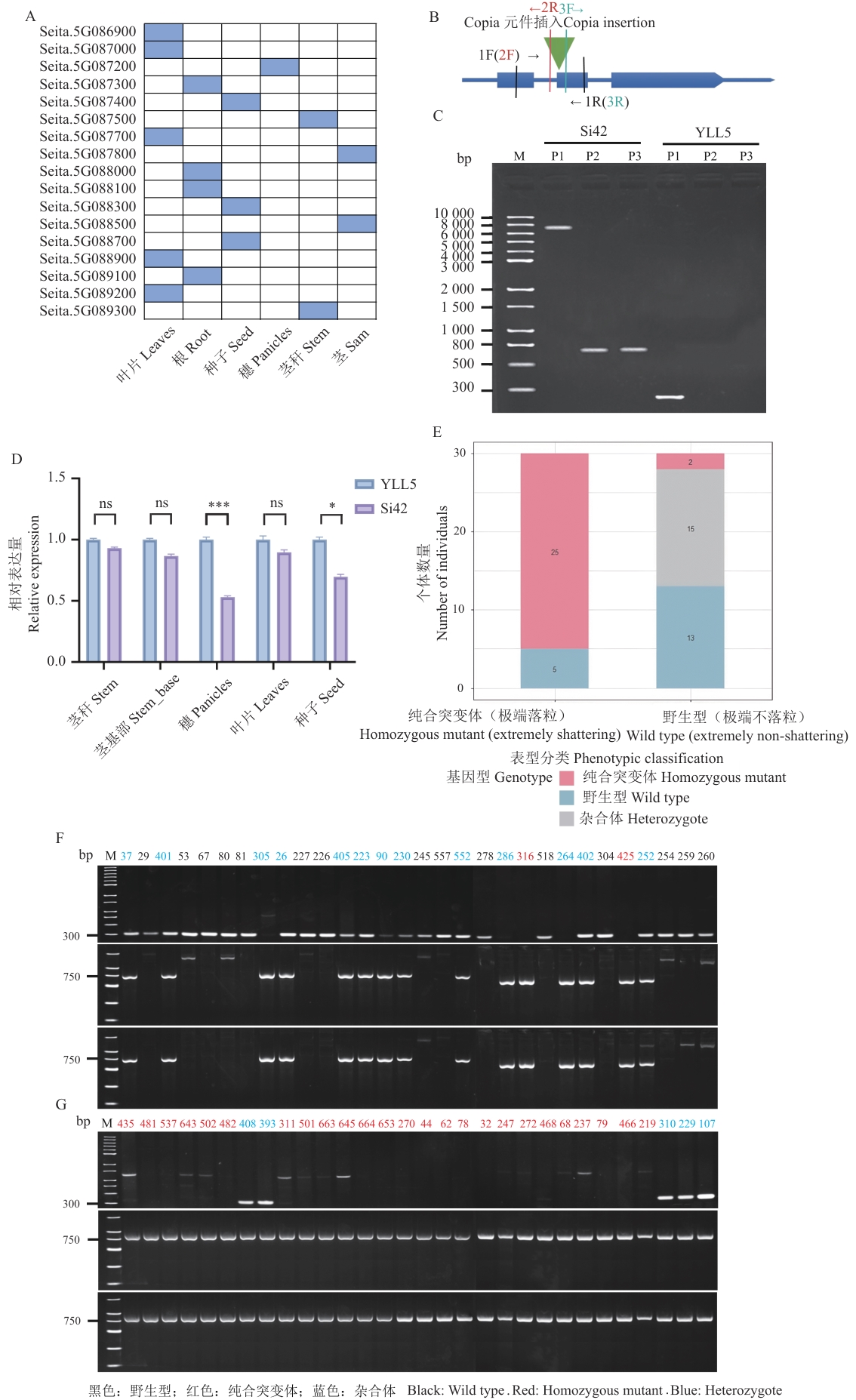
图4 YLL5与Si42中Seita.5G087200/Sevir.5G085400基因座转座子插入A:候选基因在各组织中的最高表达量;B:Setia.5G087200与Sevir.5G085400基因结构对比图;C:YLL5与Si42中Seita.5G087200/Sevir.5G085400基因座转座子插入PCR验证图;D:YLL5与Si42内不同组织部位Seita.5G087200的表达分析。*和***分别表示在P<0.05和P<0.001水平差异显著;E:Sv插入基因型与落粒表型共分离分析叠加统计;F:极端不落粒P1、P2、P3基因型与表型检测;G:极端落粒P1、P2、P3基因型与表型检测。P1、P2、P3分别为3对特异性引物(P1:跨越转座子插入位点,预期Si42产物7 000 bp、YLL5产物294 bp;P2:F-转座子左侧基因组,R-转座子内部,预期Si42产物750 bp;P3:F-转座子内部,R-转座子右侧基因组,预期Si42产物750 bp)
Fig. 4 Transposon insertion at the Seita.5G087200/Sevir.5G085400 locus in Si42 and YLL5A: Maximum expression levels of candidate genes across different tissues. B: Comparison of gene structures between Setia.5G087200 and Sevir.5G085400. C: PCR validation of transposon insertion at the Seita.5G087200/Sevir.5G085400 locus in YLL5 and Si42. D: Expression analysis of Seita.5G087200 in different tissues of YLL5 and Si42. * and *** indicate significant differences at P<0.05 and P<0.001 levels, respectively. E: Overlay statistical analysis of co-segregation between Sv insertion genotype and shattering phenotype. F: Detection of genotype and phenotype in extremely non-shattering P1, P2, P3. G: Detection of genotype and phenotype in extremely shattering P1, P2, P3. P1, P2, and P3 represent three pairs of specific primers (P1: spanning the transposon insertion site, expected product sizes: 7 000 bp in Si42 and 294 bp in YLL5; P2: F-genomic region left of the transposon, R-internal region of the transposon, expected product: 750 bp in Si42; P3: F-internal region of the transposon, R-genomic region right of the transposon, expected product: 750 bp in Si42)
| [1] | Li CB, Zhou AL, Sang T. Rice domestication by reducing shattering [J]. Science, 2006, 311(5769): 1936-1939. |
| [2] | Liu HQ, Fang XJ, Zhou LN, et al. Transposon insertion drove the loss of natural seed shattering during foxtail millet domestication [J]. Mol Biol Evol, 2022, 39(6): msac078. |
| [3] | Lin ZW, Li XR, Shannon LM, et al. Parallel domestication of the Shattering1 genes in cereals [J]. Nat Genet, 2012, 44(6): 720-724. |
| [4] | Wu H, He Q, He B, et al. Gibberellin signaling regulates lignin biosynthesis to modulate rice seed shattering [J]. Plant Cell, 2023, 35(12): 4383-4404. |
| [5] | 郭艳. 高粱B140落粒基因的克隆与种子休眠性的QTL分析 [D]. 北京: 中国农业大学, 2015. |
| Guo Y. Cloning and QTL analysis of seed dormancy of sorghum B140 [D]. Beijing: China Agricultural University, 2015. | |
| [6] | Meyer RS, Purugganan MD. Evolution of crop species: genetics of domestication and diversification [J]. Nat Rev Genet, 2013, 14(12): 840-852. |
| [7] | Win KT, Yamagata Y, Doi K, et al. A single base change explains the independent origin of and selection for the nonshattering gene in African rice domestication [J]. New Phytol, 2017, 213(4): 1925-1935. |
| [8] | Yan HX, Ma L, Wang Z, et al. Multiple tissue-specific expression of rice seed-shattering gene SH4 regulated by its promoter pSH4 [J]. Rice, 2015, 8: 12. |
| [9] | Yang XY, Wan ZW, Perry L, et al. Early millet use in northern China [J]. Proc Natl Acad Sci USA, 2012, 109(10): 3726-3730. |
| [10] | Doebley JF, Gaut BS, Smith BD. The molecular genetics of crop domestication [J]. Cell, 2006, 127(7): 1309-1321. |
| [11] | Michelmore RW, Paran I, Kesseli RV. Identification of markers linked to disease-resistance genes by bulked segregant analysis: a rapid method to detect markers in specific genomic regions by using segregating populations [J]. Proc Natl Acad Sci USA, 1991, 88(21): 9828-9832. |
| [12] | He Q, Tang S, Zhi H, et al. A graph-based genome and pan-genome variation of the model plant Setaria [J]. Nat Genet, 2023, 55(7): 1232-1242. |
| [13] | Schneider CA, Rasband WS, Eliceiri KW. NIH Image to ImageJ: 25 years of image analysis [J]. Nat Methods, 2012, 9(7): 671-675. |
| [14] | McKenna A, Hanna M, Banks E, et al. The genome analysis toolkit: a MapReduce framework for analyzing next-generation DNA sequencing data [J]. Genome Res, 2010, 20(9): 1297-1303. |
| [15] | Cingolani P, Platts A, Wang LL, et al. A program for annotating and predicting the effects of single nucleotide polymorphisms, SnpEff: SNPs in the genome of Drosophila melanogaster strain w1118; iso-2; iso-3 [J]. Fly, 2012, 6(2): 80-92. |
| [16] | Abe A, Kosugi S, Yoshida K, et al. Genome sequencing reveals agronomically important loci in rice using MutMap [J]. Nat Biotechnol, 2012, 30(2): 174-178. |
| [17] | Anvar SY, Tucker A, Vinciotti V, et al. Interspecies translation of disease networks increases robustness and predictive accuracy [J]. PLoS Comput Biol, 2011, 7(11): e1002258. |
| [18] | Hill JT, Demarest BL, Bisgrove BW, et al. MMAPPR: Mutation mapping analysis pipeline for pooled RNA-seq [J]. Genome Res, 2013, 23(4): 687-697. |
| [19] | 康海岐, 常红叶, 许育彬, 等. 水稻籽粒胚乳的石蜡切片方法改良及其结构发育观察 [J]. 西北植物学报, 2008, 28(5): 1069-1074. |
| Kang HQ, Chang HY, Xu YB, et al. Improvement of paraffin section methods and structural observation to endosperm development of rice kernel [J]. Acta Bot Boreali Occidentalia Sin, 2008, 28(5): 1069-1074. | |
| [20] | Chomczynski P, Sacchi N. Single-step method of RNA isolation by acid guanidinium thiocyanate-phenol-chloroform extraction [J]. Anal Biochem, 1987, 162(1): 156-159. |
| [21] | Lambret-Frotté J, de Almeida LC, de Moura SM, et al. Validating internal control genes for the accurate normalization of qPCR expression analysis of the novel model plant setaria viridis [J]. PLoS One, 2015, 10(8): e0135006. |
| [22] | Livak KJ, Schmittgen TD. Analysis of relative gene expression data using real-time quantitative PCR and the 2-ΔΔCt method [J]. Methods, 2001, 25(4): 402-408. |
| [23] | Ji H, Kim SR, Kim YH, et al. Inactivation of the CTD phosphatase-like gene OsCPL1 enhances the development of the abscission layer and seed shattering in rice [J]. Plant J, 2010, 61(1): 96-106. |
| [24] | Patterson SE. Cutting loose. abscission and dehiscence in Arabidopsis [J]. Plant Physiol, 2001, 126(2): 494-500. |
| [25] | Cosgrove DJ. Plant cell wall extensibility: connecting plant cell growth with cell wall structure, mechanics, and the action of wall-modifying enzymes [J]. J Exp Bot, 2016, 67(2): 463-476. |
| [26] | Konishi S, Izawa T, Lin SY, et al. An SNP caused loss of seed shattering during rice domestication [J]. Science, 2006, 312(5778): 1392-1396. |
| [27] | Huang JF, Guo YJ, Sun QW, et al. Genome-wide identification of R2R3-MYB transcription factors regulating secondary cell wall thickening in cotton fiber development [J]. Plant Cell Physiol, 2019, 60(3): 687-701. |
| [28] | Fujimoto SY, Ohta M, Usui A, et al. Arabidopsis ethylene-responsive element binding factors act as transcriptional activators or repressors of GCC box-mediated gene expression [J]. Plant Cell, 2000, 12(3): 393-404. |
| [29] | Li HY, Tao HF, Xiao Y, et al. ZmXYL modulates auxin-induced maize growth [J]. Plant J, 2023, 115(6): 1699-1715. |
| [30] | Binder BM. Ethylene signaling in plants [J]. J Biol Chem, 2020, 295(22): 7710-7725. |
| [1] | 吴夏明, 周陈平, 杨敏, 徐泽, 邝瑞彬, 刘传和, 贺涵, 魏岳荣. 基于BSA-seq的番木瓜株高候选基因定位[J]. 生物技术通报, 2025, 41(9): 54-61. |
| [2] | 程雪, 付颖, 柴晓娇, 王红艳, 邓欣. 谷子LHC基因家族鉴定及非生物胁迫表达分析[J]. 生物技术通报, 2025, 41(8): 102-114. |
| [3] | 李新妮, 李俊怡, 马雪华, 何卫, 李佳丽, 于佳, 曹晓宁, 乔治军, 刘思辰. 谷子果胶甲酯酶抑制子PMEI基因家族鉴定及其对非生物胁迫的响应分析[J]. 生物技术通报, 2025, 41(7): 150-163. |
| [4] | 王月琛, 韩鑫骐, 魏文敏, 崔兆兰, 罗阳美, 陈鹏如, 王海岗, 刘龙龙, 张莉, 王纶. 黍稷落粒的生物学基础研究及落粒调控基因的鉴定[J]. 生物技术通报, 2025, 41(7): 164-171. |
| [5] | 何卫, 李俊怡, 李新妮, 马雪华, 邢媛, 曹晓宁, 乔治军, 刘思辰. 谷子泛素连接酶U-box E3基因家族的鉴定及响应非生物胁迫分析[J]. 生物技术通报, 2025, 41(5): 104-118. |
| [6] | 郭浩杰, 王成, 杨馥熔, 杜冰, 孟超敏. 谷子SiSPX9基因的克隆及耐低磷分析[J]. 生物技术通报, 2025, 41(12): 114-123. |
| [7] | 李禹欣, 李苗, 杜晓芬, 韩康妮, 连世超, 王军. 谷子SiSAP基因家族的鉴定与表达分析[J]. 生物技术通报, 2025, 41(1): 143-156. |
| [8] | 王腾辉, 葛雯冬, 罗雅方, 范震宇, 王玉书. 基于极端混合池(BSA)全基因组重测序的羽衣甘蓝白色叶基因定位[J]. 生物技术通报, 2023, 39(9): 176-182. |
| [9] | 韩华蕊, 杨宇琭, 门艺涵, 韩尚玲, 韩渊怀, 霍轶琼, 侯思宇. 基于代谢组学研究谷子SiYABBYs参与花发育过程中鼠李糖苷的生物合成[J]. 生物技术通报, 2023, 39(6): 189-198. |
| [10] | 王海龙, 李雨倩, 王勃, 邢国芳, 张杰伟. 谷子SiMAPK3基因的克隆和表达特性分析[J]. 生物技术通报, 2023, 39(3): 123-132. |
| [11] | 邢媛, 宋健, 李俊怡, 郑婷婷, 刘思辰, 乔治军. 谷子AP基因家族鉴定及其对非生物胁迫的响应分析[J]. 生物技术通报, 2023, 39(11): 238-251. |
| [12] | 周诗晨, 仪治本, 王馨翊, 杨晓颖, 孙丽娜, 栾维江, 梁闪闪. 高粱双粒突变体Dgs的遗传分析与基因定位[J]. 生物技术通报, 2022, 38(7): 171-177. |
| [13] | 韩立杰, 才宏伟. 高粱粒重遗传研究进展[J]. 生物技术通报, 2019, 35(5): 15-27. |
| [14] | 董斌, 李荣喜, 黄永芳, 洪文泓, 谭莎. 分子标记在油茶研究中的应用[J]. 生物技术通报, 2015, 31(6): 74-80. |
| [15] | 袁进成,刘颖慧,董志平. 谷子成熟胚诱导愈伤组织及植株再生的研究和条件的优化[J]. 生物技术通报, 2013, 0(3): 77-82. |
| 阅读次数 | ||||||
|
全文 |
|
|||||
|
摘要 |
|
|||||
