







生物技术通报 ›› 2026, Vol. 42 ›› Issue (9): 29-41.doi: 10.13560/j.cnki.biotech.bull.1985.2026-0390
刘洋1, 许作鹏1,2( ), 张宏根1, 刘巧泉1, 汤述翥1
收稿日期:2026-04-08
出版日期:2026-09-26
发布日期:2026-09-16
通讯作者:
许作鹏xuzplinyi@yzu.edu.cn基金资助:
LIU Yang1, Xu Zuo-peng1,2(), ZHANG Hong-gen1, Liu Qiao-quan1, Tang Shu-zhu1
Received:2026-04-08
Published:2026-09-26
Online:2026-09-16
摘要:
质核互作雄性不育(cytoplasmic male sterility)是由细胞质基因和核基因共同控制的雄性不育类型,水稻雄性不育植株雌性器官正常,可接受外来花粉而结实,利用这一特性可省去人工去雄的步骤,从而高效简便地获得杂交种。目前水稻已有多种细胞质雄性不育类型应用于生产,并且随着基因组学、基因编辑技术的发展,多个细胞质雄性不育基因及育性恢复基因被鉴定或克隆。本文主要介绍了水稻雄性不育胞质的类型及利用现状、雄性不育基因的鉴定与验证策略、雄性不育机理、不同不育胞质育性恢复基因的定位及恢复机制等方面的研究进展,进而对规范命名、深入应用线粒体编辑技术、解析质核互作雄性不育及育性恢复分子机制、重视微效恢复基因等方面提出展望,旨在为水稻质核互作雄性不育及育性恢复的基础研究及育种应用提供参考。
刘洋, 许作鹏, 张宏根, 刘巧泉, 汤述翥. 水稻质核互作雄性不育及育性恢复研究进展[J]. 生物技术通报, 2026, 42(9): 29-41.
LIU Yang, Xu Zuo-peng, ZHANG Hong-gen, Liu Qiao-quan, Tang Shu-zhu. Research Progress on Cytoplasmic Male Sterility and Fertility Restoration in Rice[J]. Biotechnology Bulletin, 2026, 42(9): 29-41.
雄性不育类型 CMS type | 胞质来源 Cytoplasmic origin | 主要败育特征 Major abortion characteristics | 遗传特点 Genetic characteristics | 参考文献 References |
|---|---|---|---|---|
| D1 | 东乡野生稻 | 总体上无花粉,偶有典败花粉 | 孢子体不育 | [ |
| 野败(WA) | 海南野生稻 | 典败 | 孢子体不育 | [ |
| 矮败(DA) | 江西野生稻 | 典败 | 孢子体不育 | [ |
| 印水(ID) | 印尼水田谷6号 | 典败 | 孢子体不育 | [ |
| D | 籼稻Dissi | 典败 | 孢子体不育 | [ |
| 冈(G) | 西非籼稻冈比亚卡 | 典败 | 孢子体不育 | [ |
| K | 云南粳稻K52 | 典败 | 孢子体不育 | [ |
| FA | 福建野生稻 | 有文献指出其为典败,但其花粉败育图片与D1型较为相似 | 孢子体不育 | [ |
| 红莲(HL) | 红芒野生稻 | 圆败 | 配子体不育 | [ |
| 包台(BT) | 印度籼稻Chinsurah Boro Ⅱ | 染败 | 配子体不育 | [ |
| 滇1 | 云南高海拔籼稻 | 染败 | 配子体不育 | [ |
| LD | 缅甸籼稻品种lead rice | 染败 | 配子体不育 | [ |
| CW | 中国野生稻 | 花粉经I2-KI染色后外观正常,但无萌发活力 | 配子体不育 | [ |
| RT98 | 普通野生稻 | 花粉经I2-KI染色后外观正常,但无萌发活力 | 配子体不育 | [ |
| TA | 菲律宾籼稻品种Tadukan | 花粉经I2-KI染色后外观正常,具有萌发活力,但花药不开裂 | 未见明确报道 | [ |
| Tetep | 越南籼稻品种Tetep | 花粉经I2-KI染色后外观正常,具有萌发活力,但花药不开裂 | 未见明确报道 | [ |
| RT102 | 普通野生稻 | 同时含不染色花粉和深染花粉,均无萌发活力 | 未见明确报道 | [ |
表1 已报道的部分细胞质雄性不育类型
Table 1 Some reported cytoplasmic male sterility types
雄性不育类型 CMS type | 胞质来源 Cytoplasmic origin | 主要败育特征 Major abortion characteristics | 遗传特点 Genetic characteristics | 参考文献 References |
|---|---|---|---|---|
| D1 | 东乡野生稻 | 总体上无花粉,偶有典败花粉 | 孢子体不育 | [ |
| 野败(WA) | 海南野生稻 | 典败 | 孢子体不育 | [ |
| 矮败(DA) | 江西野生稻 | 典败 | 孢子体不育 | [ |
| 印水(ID) | 印尼水田谷6号 | 典败 | 孢子体不育 | [ |
| D | 籼稻Dissi | 典败 | 孢子体不育 | [ |
| 冈(G) | 西非籼稻冈比亚卡 | 典败 | 孢子体不育 | [ |
| K | 云南粳稻K52 | 典败 | 孢子体不育 | [ |
| FA | 福建野生稻 | 有文献指出其为典败,但其花粉败育图片与D1型较为相似 | 孢子体不育 | [ |
| 红莲(HL) | 红芒野生稻 | 圆败 | 配子体不育 | [ |
| 包台(BT) | 印度籼稻Chinsurah Boro Ⅱ | 染败 | 配子体不育 | [ |
| 滇1 | 云南高海拔籼稻 | 染败 | 配子体不育 | [ |
| LD | 缅甸籼稻品种lead rice | 染败 | 配子体不育 | [ |
| CW | 中国野生稻 | 花粉经I2-KI染色后外观正常,但无萌发活力 | 配子体不育 | [ |
| RT98 | 普通野生稻 | 花粉经I2-KI染色后外观正常,但无萌发活力 | 配子体不育 | [ |
| TA | 菲律宾籼稻品种Tadukan | 花粉经I2-KI染色后外观正常,具有萌发活力,但花药不开裂 | 未见明确报道 | [ |
| Tetep | 越南籼稻品种Tetep | 花粉经I2-KI染色后外观正常,具有萌发活力,但花药不开裂 | 未见明确报道 | [ |
| RT102 | 普通野生稻 | 同时含不染色花粉和深染花粉,均无萌发活力 | 未见明确报道 | [ |
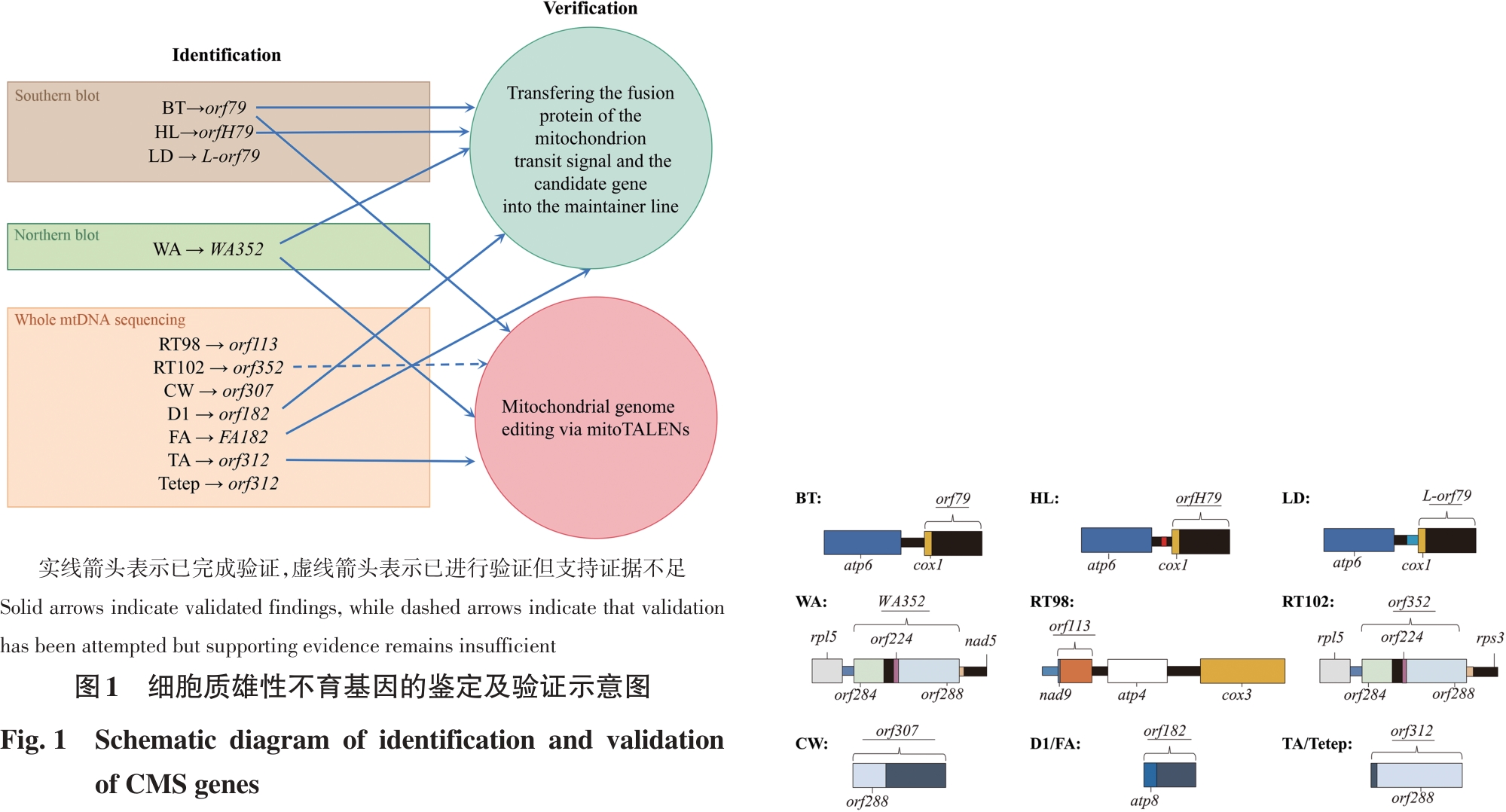
图2 细胞质雄性不育基因的结构图(改自文献[35])
Fig. 2 Structural diagram of CMS genes (Adapted from reference [35])
不育胞质类型 CMS type | 名称 Name | 编码跨膜蛋白(预测) Encoding transmembrane protein (Predicted) | 编码嵌合蛋白 Encoding chimeric protein | 验证 Validated | 参考文献 References |
|---|---|---|---|---|---|
| BT | orf79 | 是 | 是 | 是 | [ |
| HL | orfH79 | 是 | 是 | 是 | [ |
| LD | L-orf79 | 是 | 是 | 暂不明确 | [ |
| WA | WA352 | 是 | 是 | 是 | [ |
| RT98 | orf113 | 是 | 是 | 暂不明确 | [ |
| RT102 | orf352 | 是 | 是 | 未完成有效验证 | [ |
| CW | orf307 | 是 | 是 | 暂不明确 | [ |
| D1 | orf182 | 否 | 是 | 是 | [ |
| FA | FA182 | 否 | 是 | 是 | [ |
| TA | orf312 | 是 | 是 | 是 | [ |
| Tetep | orf312 | 是 | 是 | 暂不明确 | [ |
表2 细胞质雄性不育基因的一般特征
Table 2 General characteristics of CMS genes
不育胞质类型 CMS type | 名称 Name | 编码跨膜蛋白(预测) Encoding transmembrane protein (Predicted) | 编码嵌合蛋白 Encoding chimeric protein | 验证 Validated | 参考文献 References |
|---|---|---|---|---|---|
| BT | orf79 | 是 | 是 | 是 | [ |
| HL | orfH79 | 是 | 是 | 是 | [ |
| LD | L-orf79 | 是 | 是 | 暂不明确 | [ |
| WA | WA352 | 是 | 是 | 是 | [ |
| RT98 | orf113 | 是 | 是 | 暂不明确 | [ |
| RT102 | orf352 | 是 | 是 | 未完成有效验证 | [ |
| CW | orf307 | 是 | 是 | 暂不明确 | [ |
| D1 | orf182 | 否 | 是 | 是 | [ |
| FA | FA182 | 否 | 是 | 是 | [ |
| TA | orf312 | 是 | 是 | 是 | [ |
| Tetep | orf312 | 是 | 是 | 暂不明确 | [ |
恢复基因类型 Restorer gene types | 基因 Gene | 编码蛋白的标志性结构域 Signature domain of encoding protein | 编码蛋白存在线粒体定位特征(预测或实验证明) Presence of mitochondrial localization features of encoding protein (Predicted or experimentally confirmed) | 可能的恢复育性层面 Possible level of fertility restoration | 可能的育性恢复机制 Possible mechanism of fertility restoration | 参考文献 References |
|---|---|---|---|---|---|---|
| WA | Rf4 | PPR | 是 | 转录后 | 降解WA352 | [ |
| WA | Rf20 | PPR | 是 | 翻译后 | 和WA352竞争性结合COX11 | [ |
| HL | Rf5(Rf1a) | PPR | 是 | 转录后 | 以育性恢复复合体形式介导atp6-orfH79的剪切(降解) | [ |
| HL | Rf6 | PPR | 是 | 转录后 | 介导atp6-orfH79的剪切(降解) | [ |
| BT | Rf1a(Rf5) | PPR | 是 | 转录后 | 介导atp6-orf79的剪切(降解) | [ |
| BT | Rf1b | PPR | 是 | 转录后 | 介导atp6-orf79的降解 | [ |
| BT | Rf2 | GRP | 是 | 转录后 | 介导atp6-orf79的降解 | [ |
| BT | Rf6 | PPR | 是 | 转录后 | 介导atp6-orf79的剪切(降解) | [ |
| FA | OsRf19 | PPR | 是 | 转录后 | 介导FA182的剪切(降解) | [ |
| LD | Rf2 | GRP | 是 | 转录后 | 介导atp6-L-orf79的降解 | [ |
| CW | Rf17 | ACPS-like | 是 | 暂不明确 | 暂不明确 | [ |
| RT98 | PPR762 | PPR | 是 | 暂不明确 | 暂不明确 | [ |
表3 部分已克隆水稻恢复基因的基本信息
Table 3 Basic information of some cloned rice restorer genes
恢复基因类型 Restorer gene types | 基因 Gene | 编码蛋白的标志性结构域 Signature domain of encoding protein | 编码蛋白存在线粒体定位特征(预测或实验证明) Presence of mitochondrial localization features of encoding protein (Predicted or experimentally confirmed) | 可能的恢复育性层面 Possible level of fertility restoration | 可能的育性恢复机制 Possible mechanism of fertility restoration | 参考文献 References |
|---|---|---|---|---|---|---|
| WA | Rf4 | PPR | 是 | 转录后 | 降解WA352 | [ |
| WA | Rf20 | PPR | 是 | 翻译后 | 和WA352竞争性结合COX11 | [ |
| HL | Rf5(Rf1a) | PPR | 是 | 转录后 | 以育性恢复复合体形式介导atp6-orfH79的剪切(降解) | [ |
| HL | Rf6 | PPR | 是 | 转录后 | 介导atp6-orfH79的剪切(降解) | [ |
| BT | Rf1a(Rf5) | PPR | 是 | 转录后 | 介导atp6-orf79的剪切(降解) | [ |
| BT | Rf1b | PPR | 是 | 转录后 | 介导atp6-orf79的降解 | [ |
| BT | Rf2 | GRP | 是 | 转录后 | 介导atp6-orf79的降解 | [ |
| BT | Rf6 | PPR | 是 | 转录后 | 介导atp6-orf79的剪切(降解) | [ |
| FA | OsRf19 | PPR | 是 | 转录后 | 介导FA182的剪切(降解) | [ |
| LD | Rf2 | GRP | 是 | 转录后 | 介导atp6-L-orf79的降解 | [ |
| CW | Rf17 | ACPS-like | 是 | 暂不明确 | 暂不明确 | [ |
| RT98 | PPR762 | PPR | 是 | 暂不明确 | 暂不明确 | [ |
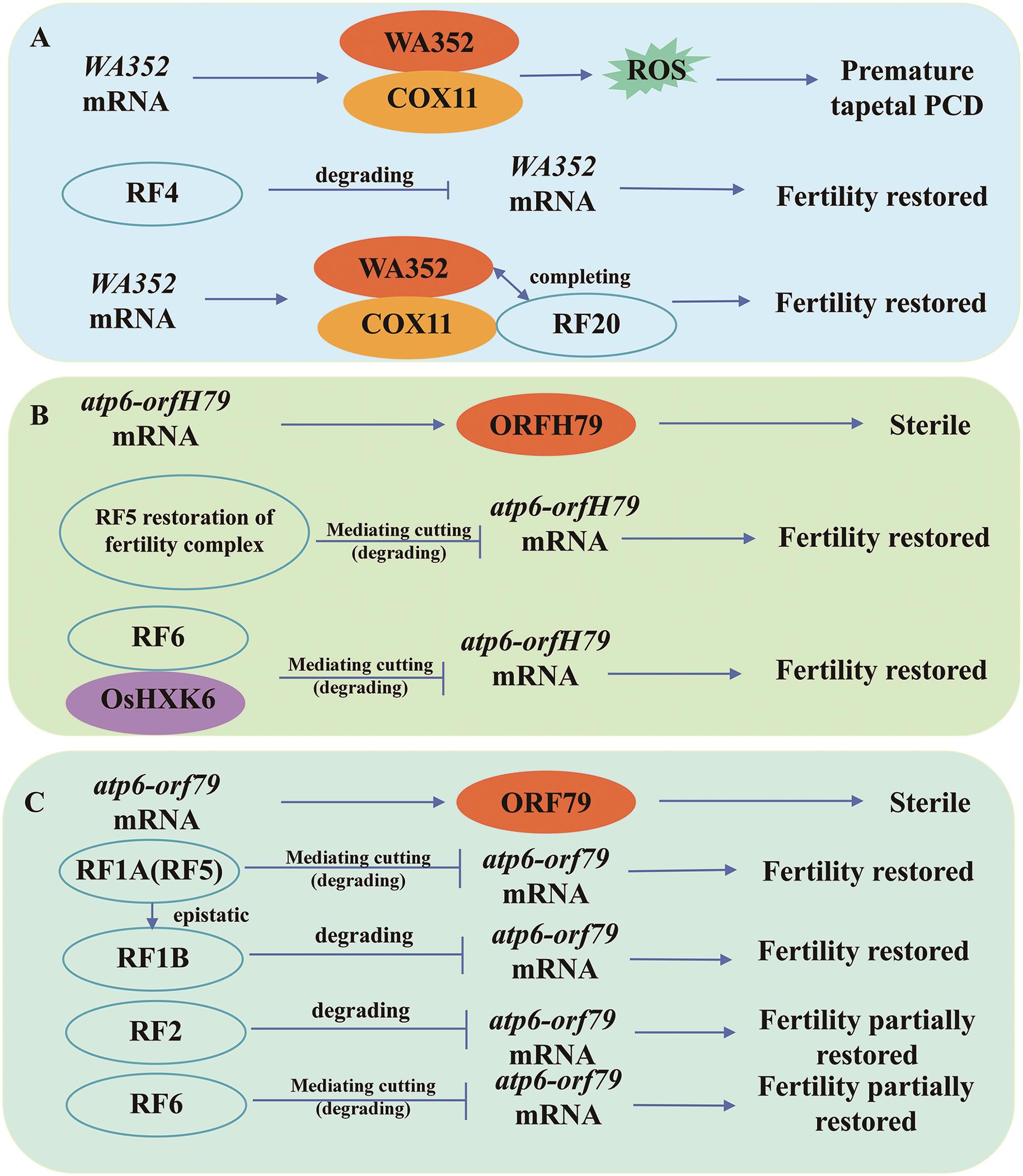
图3 已克隆WA、HL、BT型恢复基因的推测恢复机制A:已克隆WA型恢复基因的推测恢复机制。WA352与COX11互作,引起ROS爆发,诱导绒毡层细胞提前PCD。RF4降解WA352转录本,RF20和WA352竞争性结合COX11;B:已克隆HL型恢复基因的推测恢复机制。ORFH79促进败育。RF5育性恢复复合体介导atp6-orfH79转录本的剪切(降解)。RF6和OsHXK6互作,介导atp6-orfH79转录本的剪切(降解);C:已克隆BT型恢复基因的推测恢复机制。ORF79促进败育。RF1A (RF5)介导atp6-orf79的剪切(降解),RF1B介导atp6-orf79转录本的降解,RF1A (RF5)对RF1B具有上位性。RF2介导atp6-orf79转录本的降解。RF6介导atp6-orf79转录本的剪切(降解)
Fig. 3 Putative restoration mechanisms of cloned WA-, HL-, and BT-type restorer genesA: Putative restoration mechanisms of cloned WA-type restorer genes. WA352 interacts with COX11, promoting ROS burst and triggering premature PCD in tapetal cells. RF4 degrades WA352 transcripts, whereas RF20 competes with WA352 for binding to COX11. B: Putative restoration mechanisms of cloned HL-type restorer genes. ORFH79 promotes sterility. The RF5 fertility restoration complex mediates cleavage (degradation) of atp6-orfH79 transcripts. RF6 interacts with OsHXK6, mediating cleavage (degradation) of atp6-orfH79 transcripts. C: Putative restoration mechanisms of cloned BT-type restorer genes. ORF79 promotes sterility. RF1A (RF5) mediates cleavage (degradation) of atp6-orf79 transcripts, RF1B mediates degradation of atp6-orf79 transcripts, and RF1A (RF5) is epistatic to RF1B. RF2 mediates degradation of atp6-orf79 transcripts. RF6 mediates cleavage (degradation) of atp6-orf79 transcripts
| [1] | Li SQ, Yang DC, Zhu YG. Characterization and use of male sterility in hybrid rice breeding [J]. J Integr Plant Biol, 2007, 49(6): 791-804. |
| [2] | Fujii S, Toriyama K. Molecular mapping of the fertility restorer gene for ms-CW-type cytoplasmic male sterility of rice [J]. Theor Appl Genet, 2005, 111(4): 696-701. |
| [3] | 李广贤, 姚方印, 庄杰云, 等. 水稻细胞质雄性不育的育性遗传及恢复基因的定位研究进展 [J]. 杂交水稻, 2006, 21(3): 1-6. |
| Li GX, Yao FY, Zhuang JY, et al. Inheritance of fertility restoration and molecular mapping of restoring genes of CMS in rice [J]. Hybrid Rice, 2006, 21(3): 1-6. | |
| [4] | 杨振玉, 李志彬, 东丽, 等. 中国杂交粳稻发展与展望 [J]. 科学通报, 2016, 61(35): 3770-3777. |
| Yang ZY, Li ZB, Dong L, et al. Development and prospect of hybrid Japonica rice in China [J]. Chin Sci Bull, 2016, 61(35): 3770-3777. | |
| [5] | Hu J, Zhu RS, Li SQ, et al. Discovery, utilization and perspective of Honglian cytoplasmic male sterile rice [J]. Chin Sci Bull, 2016, 61(35): 3813-3821. |
| [6] | 张丽佳. Rf5对HL型粳稻不育系的恢复力研究及WA型恢复基因Rf19(t)的定位 [D]. 扬州: 扬州大学, 2017. |
| Zhang LJ. Effect of Rf5 on the fertility restoration of HL-type Japonica cytoplasmic male sterile lines and mapping of WA-type fertility restoration gene Rfl9(t) in rice [D]. Yangzhou: Yangzhou University, 2017. | |
| [7] | Xie HW, Peng XJ, Qian MJ, et al. The chimeric mitochondrial gene orf182 causes non-pollen-type abortion in Dongxiang cytoplasmic male-sterile rice [J]. Plant J, 2018, 95(4): 715-726. |
| [8] | 陈乐天, 刘耀光. 水稻野败型细胞质雄性不育的发现利用与分子机理 [J]. 科学通报, 2016, 61(35): 3804-3812. |
| Chen LT, Liu YG. Discovery, utilization and molecular mechanisms of CMS-WA in rice [J]. Chin Sci Bull, 2016, 61(35): 3804-3812. | |
| [9] | 谢建坤. 水稻细胞质雄性不育育性恢复遗传机理研究 [D]. 杭州: 浙江大学, 2001. |
| Xie JK. The Inheritance of the fertility restoration for cytoplasmic male sterility in rice (Oryza sativa L.) [D]. Hangzhou: Zhejiang University, 2001. | |
| [10] | 李亮杰. 水稻印水型CMS恢复基因、金黄色颖壳和节间基因的初步定位 [D]. 北京: 中国农业科学院, 2007. |
| Li LJ. Mapping of fertility-restoring genes for Yinshui cytoplasmic male sterility and gold hull and internode gene in rice (Oryza sativa L.) [D]. Beijing: Chinese Academy of Agricultural Sciences, 2007. | |
| [11] | 曹罡. D型杂交水稻恢复系主效恢复基因遗传分析及精细定位 [D]. 雅安: 四川农业大学, 2002. |
| Cao G. The genetic analysis and fine mapping of the major restorergene of ‘D’type hybrid rice restorer line [D]. Yaan: Sichuan Agricultural University, 2002. | |
| [12] | 李实蕡.冈型及D型杂交稻的选育, 利用和遗传研究 [J]. 杂交水稻, 1997, 12(S): 1-25. |
| Li SF. Breeding, utilization and genetic study of gangtype and d-type hybrid rice [J]. Hybrid Rice, 1997, 12(S): 1-25. | |
| [13] | 王乃元, 梁康迳, 李毓, 等. 水稻新质源(CMS-FA)雄性不育恢复基因的遗传 [J]. 作物学报, 2008, 34(11): 1929-1937. |
| Wang NY, Liang KJ, Li Y, et al. Inheritance of restorer gene for CMS-FA hybrid rice [J]. Acta Agron Sin, 2008, 34(11): 1929-1937. | |
| [14] | Jiang HC, Lu Q, Qiu SQ, et al. Fujian cytoplasmic male sterility and the fertility restorer gene OsRf19 provide a promising breeding system for hybrid rice [J]. Proc Natl Acad Sci U S A, 2022, 119(34): e2208759119. |
| [15] | Huang WC, Hu J, Yu CC, et al. Two non-allelic nuclear genes restore fertility in a gametophytic pattern and enhance abiotic stress tolerance in the hybrid rice plant [J]. Theor Appl Genet, 2012, 124(5): 799-807. |
| [16] | 文建成. 水稻细胞质雄性不育系育性回复株的遗传分析 [D]. 昆明: 云南农业大学, 2008. |
| Wen JC. Genetic analysis of fertility revertants in CMS lines of rice (Oryza sativa L.) [D]. Kunming: Yunnan Agricultural University, 2008. | |
| [17] | Itabashi E, Iwata N, Fujii S, et al. The fertility restorer gene, Rf2, for Lead Rice-type cytoplasmic male sterility of rice encodes a mitochondrial Glycine-rich protein [J]. Plant J, 2011, 65(3): 359-367. |
| [18] | Igarashi K, Kazama T, Motomura K, et al. Whole genomic sequencing of RT98 mitochondria derived from Oryza rufipogon and northern blot analysis to uncover a cytoplasmic male sterility-associated gene [J]. Plant Cell Physiol, 2013, 54(2): 237-243. |
| [19] | Takatsuka A, Kazama T, Toriyama K. Cytoplasmic male sterility-associated mitochondrial gene orf312 derived from rice (Oryza sativa L.) cultivar tadukan [J]. Rice, 2021, 14: 46. |
| [20] | Jin Z, Seo J, Kim B, et al. Identification of a candidate gene for the novel cytoplasmic male sterility derived from inter-subspecific crosses in rice (Oryza sativa L.) [J]. Genes, 2021, 12(4): 590. |
| [21] | Okazaki M, Kazama T, Murata H, et al. Whole mitochondrial genome sequencing and transcriptional analysis to uncover an RT102-type cytoplasmic male sterility-associated candidate gene derived from Oryza rufipogon [J]. Plant Cell Physiol, 2013, 54(9): 1560-1568. |
| [22] | Kadowaki KI, Harada K. Differential organization of mitochondrial genes in rice with normal and male-sterile cytoplasms [J]. Ikushugaku Zasshi, 1989, 39(2): 179-186. |
| [23] | Kadowaki KI, Suzuki T, Kazama S. A chimeric gene containing the 5′ portion of atp6 is associated with cytoplasmic male-sterility of rice [J]. Molec Gen Genet, 1990, 224(1): 10-16. |
| [24] | Wang ZH, Zou YJ, Li XY, et al. Cytoplasmic male sterility of rice with boro II cytoplasm is caused by a cytotoxic peptide and is restored by two related PPR motif genes via distinct modes of mRNA silencing [J]. Plant Cell, 2006, 18(3): 676-687. |
| [25] | Yi P. Discovery of mitochondrial chimeric-gene associated with cytoplasmic male sterility of HL-rice [J]. Chin Sci Bull, 2002, 47(9): 744. |
| [26] | Itabashi E, Kazama T, Toriyama K. Characterization of cytoplasmic male sterility of rice with Lead Rice cytoplasm in comparison with that with Chinsurah Boro II cytoplasm [J]. Plant Cell Rep, 2009, 28(2): 233-239. |
| [27] | Luo DP, Xu H, Liu ZL, et al. A detrimental mitochondrial-nuclear interaction causes cytoplasmic male sterility in rice [J]. Nat Genet, 2013, 45(5): 573-577. |
| [28] | Xie HW, Wang J, Qian MJ, et al. Mitotype-specific sequences related to cytoplasmic male sterility in Oryza species [J]. Mol Breeding, 2014, 33(4): 803-811. |
| [29] | Fujii S, Kazama T, Yamada M, et al. Discovery of global genomic re-organization based on comparison of two newly sequenced rice mitochondrial genomes with cytoplasmic male sterility-related genes [J]. BMC Genom, 2010, 11: 209. |
| [30] | Peng XJ, Wang K, Hu CF, et al. The mitochondrial gene orfH79 plays a critical role in impairing both male gametophyte development and root growth in CMS-Honglian rice [J]. BMC Plant Biol, 2010, 10: 125. |
| [31] | Kazama T, Okuno M, Watari Y, et al. Curing cytoplasmic male sterility via TALEN-mediated mitochondrial genome editing [J]. Nat Plants, 2019, 5(7): 722-730. |
| [32] | Zhou JW, Nie LY, Zhang S, et al. Mitochondrial genome editing of WA352 via mitoTALENs restore fertility in cytoplasmic male sterile rice [J]. Plant Biotechnol J, 2024, 22(7): 1960-1962. |
| [33] | Takatsuka A, Kazama T, Arimura SI, et al. TALEN-mediated depletion of the mitochondrial gene orf312 proves that it is a Tadukan-type cytoplasmic male sterility-causative gene in rice [J]. Plant J, 2022, 110(4): 994-1004. |
| [34] | Omukai S, Arimura SI, Toriyama K, et al. Disruption of mitochondrial open reading frame 352 partially restores pollen development in cytoplasmic male sterile rice [J]. Plant Physiol, 2021, 187(1): 236-246. |
| [35] | Toriyama K. Molecular basis of cytoplasmic male sterility and fertility restoration in rice [J]. Plant Biotechnol, 2021, 38(3): 285-295. |
| [36] | Krogh A, Larsson B, von Heijne G, et al. Predicting transmembrane protein topology with a hidden Markov model: application to complete genomes [J]. J Mol Biol, 2001, 305(3): 567-580. |
| [37] | 张健. 水稻红莲型细胞质雄性不育基因orfH79的表达对大肠杆菌生长的抑制机理 [D]. 南昌: 南昌大学, 2012. |
| Zhang J. Expression of mitochondrial gene OrfH79 from CMS Honglian rice inhibit the growth of Escherichia coli [D]. Nanchang: Nanchang University, 2012. | |
| [38] | 包灿明. 水稻不同类型细胞质雄性不育基因对大肠杆菌生长抑制的机理 [D]. 南昌: 南昌大学, 2016. |
| Bao CM. Mechanism of various cytoplasmic male sterility associated genes on inhibition of E .coli growth [D]. Nanchang: Nanchang University, 2016. | |
| [39] | 刘石锋, 陈倩, 洪广成, 等. 水稻细胞质雄性不育及育性恢复研究进展 [J]. 植物生理学报, 2018, 54(1): 1-9. |
| Liu SF, Chen Q, Hong GC, et al. Research progress of cytoplasmic male sterility and fertility restoration in rice (Oryza sativa) [J]. Plant Physiol J, 2018, 54(1): 1-9. | |
| [40] | Wang K, Gao F, Ji YX, et al. ORFH79 impairs mitochondrial function via interaction with a subunit of electron transport chain complex III in Honglian cytoplasmic male sterile rice [J]. New Phytol, 2013, 198(2): 408-418. |
| [41] | Zhang H, Li SQ, Yi P, et al. A Honglian CMS line of rice displays aberrant F0 of F0F1-ATPase [J]. Plant Cell Rep, 2007, 26(7): 1065-1071. |
| [42] | Liu G, Tian H, Huang YQ, et al. Alterations of mitochondrial protein assembly and jasmonic acid biosynthesis pathway in Honglian (HL)-type cytoplasmic male sterility rice [J]. J Biol Chem, 2012, 287(47): 40051-40060. |
| [43] | Matilla AJ. Cellular oxidative stress in programmed cell death: focusing on chloroplastic 1O2 and mitochondrial cytochrome-c release [J]. J Plant Res, 2021, 134(2): 179-194. |
| [44] | Ye CJ, Zheng SY, Jiang DG, et al. Initiation and execution of programmed cell death and regulation of reactive oxygen species in plants [J]. Int J Mol Sci, 2021, 22(23): 12942. |
| [45] | 李绍清. 水稻红莲型细胞质雄性不育与育性恢复的分子机理 [D]. 武汉: 武汉大学, 2004. |
| Li SQ. The molecular mechanism for Honglian cytoplasmic male sterility and its corresponding fertility restoration of rice [D]. Wuhan: Wuhan University, 2004. | |
| [46] | Wan CX, Li SQ, Wen L, et al. Damage of oxidative stress on mitochondria during microspores development in Honglian CMS line of rice [J]. Plant Cell Rep, 2007, 26(3): 373-382. |
| [47] | Wang X, Guan ZY, Gong Z, et al. Crystal structure of WA352 provides insight into cytoplasmic male sterility in rice [J]. Biochem Biophys Res Commun, 2018, 501(4): 898-904. |
| [48] | Owusu-Ansah E, Yavari A, Mandal S, et al. Distinct mitochondrial retrograde signals control the G1-S cell cycle checkpoint [J]. Nat Genet, 2008, 40(3): 356-361. |
| [49] | Fujii S, Toriyama K. DCW11 down-regulated gene 11 in CW-type cytoplasmic male sterile rice, encoding mitochondrial protein phosphatase 2C is related to cytoplasmic male sterility [J]. Plant Cell Physiol, 2008, 49(4): 633-640. |
| [50] | Fujii S, Komatsu S, Toriyama K. Retrograde regulation of nuclear gene expression in CW-CMS of rice [J]. Plant Mol Biol, 2007, 63(3): 405-417. |
| [51] | Fujii S, Yamada M, Fujita M, et al. Cytoplasmic-nuclear genomic barriers in rice pollen development revealed by comparison of global gene expression profiles among five independent cytoplasmic male sterile lines [J]. Plant Cell Physiol, 2010, 51(4): 610-620. |
| [52] | Kazama T, Toriyama K. A fertility restorer gene, Rf4, widely used for hybrid rice breeding encodes a pentatricopeptide repeat protein [J]. Rice, 2014, 7: 28. |
| [53] | Tang HW, Luo DP, Zhou DG, et al. The rice restorer Rf4 for wild-abortive cytoplasmic male sterility encodes a mitochondrial-localized PPR protein that functions in reduction of WA352 transcripts [J]. Mol Plant, 2014, 7(9): 1497-1500. |
| [54] | Zhao Z, Ding Z, Huang JJ, et al. Copy number variation of the restorer Rf4 underlies human selection of three-line hybrid rice breeding [J]. Nat Commun, 2023, 14: 7333. |
| [55] | Zhang G, Lu Y, Bharaj TS, et al. Mapping of the Rf-3 nuclear fertility-restoring gene for WA cytoplasmic male sterility in rice using RAPD and RFLP markers [J]. Theoret Appl Genetics, 1997, 94(1): 27-33. |
| [56] | Yao FY, Xu CG, Yu SB, et al. Mapping and genetic analysis of two fertility restorer loci in the wild-abortive cytoplasmic male sterility system of rice (Oryza sativa L.) [J]. Euphytica, 1997, 98(3): 183-187. |
| [57] | 亓芳丽, 姜明松, 袁守江, 等. 水稻野败型细胞质雄性不育恢复基因Rf3的定位 [J]. 中国农学通报, 2008(8): 114-117. |
| Qi FL, Jiang MS, Yuan SJ, et al. Mapping of fertility-restoring gene Rf3 for wild-abortive cytoplasmic male sterility in rice [J]. Chin Agric Sci Bull, 2008(8): 114-117. | |
| [58] | Li PB, Su GC, Feng FC, et al. Mapping of minor quantitative trait loci (QTLs) conferring fertility restoration of wild abortive cytoplasmic male sterility and QTLs conferring stigma exsertion in rice [J]. Plant Breed, 2014, 133(6): 722-727. |
| [59] | 赵哲. 筛选稳定内参基因的高效方法与水稻CMS-WA型恢复基因Rf3的克隆 [D]. 广州: 华南农业大学, 2019. |
| Zhao Z. Efficient method for screening stable reference genes and cloning of restorer gene Rf3 for CMS-WA in rice [D]. Guangzhou: South China Agricultural University, 2019. | |
| [60] | Xu ZP, Du YY, Li XX, et al. Identification and fine mapping of a fertility restorer gene for wild abortive cytoplasmic male sterility in the elite indica rice non-restorer line 9311 [J]. Crop J, 2023, 11(3): 887-894. |
| [61] | Song SF, Li YX, Qiu MD, et al. Structural variations of a new fertility restorer gene, Rf20, underlie the restoration of wild abortive-type cytoplasmic male sterility in rice [J]. Mol Plant, 2024, 17(8): 1272-1288. |
| [62] | Zhang HG, Li XX, Xu ZP, et al. Precise genetic mapping of Rf18(t), a new fertility restorer gene from ‘Nipponbare’ for wild abortive cytoplasmic male sterility in rice (Oryza sativa L.) [J]. Theor Appl Genet, 2022, 135(8): 2687-2698. |
| [63] | 廖金花. 籼型红米具有的恢复性及其基因定位 [J]. 安徽农业科学, 2009, 37(9): 3967-3968. |
| Liao JH. The restoring ability of normal indica red rice ruby and it’s restoring gene mapping [J]. J Anhui Agric Sci, 2009, 37(9): 3967-3968. | |
| [64] | 庄杰云, 樊叶杨, 吴建利, 等. 水稻CMS-WA育性恢复基因的定位 [J]. 遗传学报, 2001, 28(2): 129-134. |
| Zhuang JY, Fan YY, Wu JL, et al. Mapping genes for rice CMS-WA fertility restoration [J]. Acta Genet Sin, 2001, 28(2): 129-134. | |
| [65] | Bazrkar L, Ali AJ, Babaeian NA, et al. Tagging of four fertility restorer loci for wild abortive—cytoplasmic male sterility system in rice (Oryza sativa L.) using microsatellite markers [J]. Euphytica, 2008, 164(3): 669-677. |
| [66] | 李平, 周开达, 陈英, 等. 利用分子标记定位水稻野败型核质互作雄性不育恢复基因 [J]. 遗传学报, 1996, 23(5): 357-362. |
| Li P, Zhou KD, Chen Y, et al. RFLP mapping of genes confering fertility restoration of wild cytoplasmic- genetic male sterility in rice (Oryza sativa subsp, indica) [J]. J Genet Genom, 1996, 23(5): 357-362. | |
| [67] | 段琉颖, 吴婷, 李霞, 等. 水稻细胞质雄性不育及其育性恢复基因的研究进展 [J]. 作物杂志, 2022(1): 20-30. |
| Duan LY, Wu T, Li X, et al. Progress on cytoplasmic male sterility and fertility restoration genes in rice [J]. Crops, 2022(1): 20-30. | |
| [68] | Hu J, Wang K, Huang WC, et al. The rice pentatricopeptide repeat protein RF5 restores fertility in Hong-Lian cytoplasmic male-sterile lines via a complex with the Glycine-rich protein GRP162 [J]. Plant Cell, 2012, 24(1): 109-122. |
| [69] | Huang WC, Yu CC, Hu J, et al. Pentatricopeptide-repeat family protein RF6 functions with hexokinase 6 to rescue rice cytoplasmic male sterility [J]. Proc Natl Acad Sci U S A, 2015, 112(48): 14984-14989. |
| [70] | Qin XJ, Huang Q, Xiao HJ, et al. The rice DUF1620-containing and WD40-like repeat protein is required for the assembly of the restoration of fertility complex [J]. New Phytol, 2016, 210(3): 934-945. |
| [71] | 黄齐. 红莲型CMS水稻RF5恢复复合体及成员RCF2的功能研究 [D]. 武汉: 武汉大学, 2014. |
| Huang Q. Studies on the RF5’s restoration of fertility complex and restoration of complex Factor2 in Honglian-CMS rice [D]. Wuhan: Wuhan University, 2014. | |
| [72] | 徐杨红. 红莲型CMS水稻RF5育性恢复复合体及其亚基RFC5的功能研究 [D]. 武汉: 武汉大学, 2020. |
| Xu YH. Study on the fertility restoration complex of red Lotus CMS rice RF5 and the function of its subunit RFC5 [D]. Wuhan: Wuhan University, 2020. | |
| [73] | 刘航, 李丹, 李绍波. 水稻红莲型CMS育性恢复QTL分析 [J]. 武汉植物学研究, 2005, 23(2): 111-115. |
| Liu H, Li D, Li SB. Mapping of QTL for fertility restoration of HL-type cytoplasmic male sterility in rice (Oryza sativa L.) [J]. J Wuhan Bot Res, 2005, 23(2): 111-115. | |
| [74] | 黄青阳, 景润春, 何予卿, 等. 水稻红莲型细胞质雄性不育性及其恢复性的遗传 [J]. 武汉大学学报: 自然科学版, 1999, 45(4): 455-458. |
| Huang QY, Jing RC, He YQ, et al. Genetics of ‘HL’Type cytoplasmic male sterility and its fertility restoration in rice (Oryza sativa L.) [J]. Wuhan Univ J Nat Sci Ed, 1999, 45(4): 455-458. | |
| [75] | Shinjyo C. Cytoplasmic-genetic male sterility in cultivated rice, ORYZA SATIVA l.: ii. the inheritance of male sterility [J]. Jpn J Genet, 1969, 44(3): 149-156. |
| [76] | Ichikawa N, Kishimoto N, Inagaki A, et al. A rapid PCR-aided selection of a rice line containing the Rf-1 gene which is involved in restoration of the cytoplasmic male sterility [J]. Mol Breed, 1997, 3(3): 195-202. |
| [77] | Komori T, Yamamoto T, Takemori N, et al. Fine genetic mapping of the nuclear gene, Rf-1, that restores the BT-type cytoplasmic male sterility in rice (Oryza sativa L.) by PCR-based markers [J]. Euphytica, 2003, 129(2): 241-247. |
| [78] | Kazama T, Toriyama K. A pentatricopeptide repeat-containing gene that promotes the processing of aberrant atp6 RNA of cytoplasmic male-sterile rice [J]. FEBS Lett, 2003, 544(1-3): 99-102. |
| [79] | Komori T, Ohta S, Murai N, et al. Map-based cloning of a fertility restorer gene, Rf-1, in rice (Oryza sativa L.) [J]. Plant J, 2004, 37(3): 315-325. |
| [80] | Kazama T, Nakamura T, Watanabe M, et al. Suppression mechanism of mitochondrial ORF79 accumulation by Rf1 protein in BT-type cytoplasmic male sterile rice [J]. Plant J, 2008, 55(4): 619-628. |
| [81] | Kazama T, Itabashi E, Fujii S, et al. Mitochondrial ORF79 levels determine pollen abortion in cytoplasmic male sterile rice [J]. Plant J, 2016, 85(6): 707-716. |
| [82] | Zhang HG, Che JL, Ge YS, et al. Ability of Rf5 and Rf6 to restore fertility of chinsurah boro II-type cytoplasmic male sterile Oryza sativa (ssp. Japonica) lines [J]. Rice, 2017, 10: 2. |
| [83] | 曾亚菲. PPR基因恢复水稻细胞质雄性不育性的机理研究 [D]. 武汉: 武汉大学, 2020. |
| Zeng YF. Study on the mechanism of PPR gene restoring cytoplasmic male sterility in rice [D]. Wuhan: Wuhan University, 2020. | |
| [84] | Ohta H, Ogino A, Kasai M, et al. Fertility restoration by Ifr1 in rice with BT-type cytoplasmic male sterility is associated with a reduced level, but not processing, of atp6-orf79 co-transcribed RNA [J]. Plant Cell Rep, 2010, 29(4): 359-369. |
| [85] | Sano Y, Eiguchi M. A nuclear gene inducing fertility restoration in cytoplasmic male-sterile rice [J]. Rice Genet Newsl, 1991, 8: 113-115. |
| [86] | Fujii S, Toriyama K. Suppressed expression of RETROGRADE-REGULATED MALE STERILITY restores pollen fertility in cytoplasmic male sterile rice plants [J]. Proc Natl Acad Sci U S A, 2009, 106(23): 9513-9518. |
| [87] | 段琉颖. 利用遗传图谱和BSA-seq关联分析鉴定“东乡野生稻”育性恢复QTLs [D]. 南昌: 江西师范大学, 2022. |
| Duan LY. Identification of QTLs for fertility restoration of Dongxiang wild rice by genetic mapping and BSA-seq correlation analysis [D]. Nanchang: Jiangxi Normal University, 2022. | |
| [88] | 李新奇, 袁隆平, McCouch Susan. 水稻质核互作雄性不育系的微效恢复基因定位和排除方法研究 [J]. 杂交水稻, 2010, 25(S1): 276-281. |
| Li XQ, Yuan LP, Mccouch SS. Studies on mapping and discarding of minor fertility genes in rice CMS lines [J]. Hybrid Rice, 2010, 25(S1): 276-281. | |
| [89] | Igarashi K, Kazama T, Toriyama K. A gene encoding pentatricopeptide repeat protein partially restores fertility in RT98-type cytoplasmic male-sterile rice [J]. Plant Cell Physiol, 2016, 57(10): 2187-2193. |
| [90] | Zhang ZX, Ding Z, Feng XY, et al. Ubiquitin-mediated degradation restricts spatiotemporal accumulation of the cytoplasmic male sterility protein WA352 to anthers in rice [J]. Proc Natl Acad Sci U S A, 2025, 122(42): e2504381122. |
| [91] | 高明尉. 杂交水稻的一些遗传与育种问题 [J]. 浙江农业科学, 1980, 21(5): 235-239. |
| Gao MW. Some genetic and breeding problems of hybrid rice [J]. J Agric Sci, 1980, 21(5): 235-239. | |
| [92] | Shalini P, Manonmani S, Robin S. Genetic analysis of fertility restoration under CGMS system in rice (Oryza sativa L.) using three-way test-cross method [J]. J Genet, 2015, 94(1): 9-16. |
| [1] | 宋子慧, 薛丽, 王森, 孙建昌, 韩冰, 崔迪, 韩龙植, 赵正武, 马小定. 基于全基因组关联分析挖掘水稻抗旱相关基因[J]. 生物技术通报, 2026, 42(8): 97-105. |
| [2] | 金曼, 龚奕杭, 潘文波, 罗培润, 高伟, 李平东, 唐晓艳. 基因编辑技术在创制抗除草剂水稻中的研究进展[J]. 生物技术通报, 2026, 42(8): 8-21. |
| [3] | 杨群, 李京, 符德保, 许婷婷. OsbHLH069通过对LAX1-LAX2复合体的竞争性干扰负调控水稻穗发育[J]. 生物技术通报, 2026, 42(8): 113-122. |
| [4] | 彭彦, 安晨, 韶也, 毛毕刚, 张学文, 赵炳然. 植物重金属响应可视化系统的构建与验证[J]. 生物技术通报, 2026, 42(7): 105-115. |
| [5] | 陈义焰, 张冬儿, 张涛, 刘育灏, 唐杰, 盛夏冰, 胡远艺, 艾治勇, 李应将, 刘小林. 水稻OsSULTR2;2基因功能及调控苗期耐盐性分析[J]. 生物技术通报, 2026, 42(7): 116-125. |
| [6] | 殷亚龙, 张明洋, 王洁敏, 苗雪雪, 陈劲, 王伟平. 水稻非生物胁迫协同耐受机制研究进展[J]. 生物技术通报, 2026, 42(4): 26-37. |
| [7] | 王程程, 黄天宇, 张晴, 史来权, 方慧敏, 张龙. 一个水稻粉质胚乳突变体的表型分析和基因定位[J]. 生物技术通报, 2026, 42(2): 169-177. |
| [8] | 杨跃琴, 邢英, 仲子荷, 田维军, 杨雪清, 王建旭. 甲基汞胁迫下水稻OsMATE34的表达及功能分析[J]. 生物技术通报, 2026, 42(1): 86-94. |
| [9] | 费思恬, 侯鹰翔, 李兰, 张超. 水稻赤霉素信号负调控因子SLR1的生物学功能及其调控网络[J]. 生物技术通报, 2026, 42(1): 13-30. |
| [10] | 王芳, 邵会茹, 吕林龙, 赵点, 胡振, 吕建珍, 姜亮. 植物和细菌TurboID邻近蛋白标记方法的建立[J]. 生物技术通报, 2025, 41(9): 44-53. |
| [11] | 邓美壁, 严浪, 詹志田, 朱敏, 和玉兵. RUBY辅助的水稻高效CRISPR基因编辑[J]. 生物技术通报, 2025, 41(8): 65-73. |
| [12] | 侯鹰翔, 费思恬, 黎妮, 李兰, 宋松泉, 王伟平, 张超. 水稻miRNAs响应生物胁迫研究进展[J]. 生物技术通报, 2025, 41(7): 69-80. |
| [13] | 吴浩, 董伟峰, 贺子天, 李艳肖, 谢辉, 孙明哲, 沈阳, 孙晓丽. 水稻BXL基因家族的全基因组鉴定及表达分析[J]. 生物技术通报, 2025, 41(6): 87-98. |
| [14] | 杜量衡, 唐黄磊, 张治国. 控制水稻光响应基因ELM1的图位克隆[J]. 生物技术通报, 2025, 41(5): 82-89. |
| [15] | 刘园园, 陈析丰, 钱前, 高振宇. 水稻穗发育调控的分子机制研究进展[J]. 生物技术通报, 2025, 41(5): 1-13. |
| 阅读次数 | ||||||
|
全文 |
|
|||||
|
摘要 |
|
|||||
