







生物技术通报 ›› 2025, Vol. 41 ›› Issue (10): 253-263.doi: 10.13560/j.cnki.biotech.bull.1985.2025-0265
秦文俊( ), 熊言杰(), 赵冉, 马萧然, 叶霄萌, 宋江华()
收稿日期:2025-03-12
出版日期:2025-10-26
发布日期:2025-10-28
通讯作者:
宋江华,女,教授,研究方向 :蔬菜分子育种;E-mail: jhsong@ahau.edu.cn作者简介:秦文俊,男,硕士研究生,研究方向 :蔬菜遗传育种;E-mail: 18855395519@163.com基金资助:
QIN Wen-jun(), XIONG Yan-jie(), ZHAO Ran, MA Xiao-ran, YE Xiao-meng, SONG Jiang-hua()
Received:2025-03-12
Published:2025-10-26
Online:2025-10-28
摘要:
目的 鉴定甘蓝生长素响应因子ARF基因家族成员,分析BoARF基因在甘蓝多种非生物胁迫中的表达模式,为明确甘蓝ARF基因家族功能奠定基础。 方法 通过生物信息学方法,在甘蓝基因组中鉴定出36个ARF基因家族成员,并对其进行系统发育树构建、保守基序鉴定、染色体定位、顺式作用元件预测以及共线性分析。采用实时荧光定量PCR技术,检测甘蓝BoARF基因在不同非生物胁迫(低温、高温、干旱和盐胁迫)下的表达模式。 结果 系统发育分析表明,36个BoARF基因可被划分为4组,这些基因分布于甘蓝的9条染色体上。36个BoARF基因都包含ARF家族的保守结构域Auxin_resp。除BoARF31外,其余35个成员均含有B3型DNA结合结构域。在基因结构方面,大多数成员含有12‒15个外显子。种内共线性分析检测到17对具有共线性关系的基因对,种间共线性分析发现甘蓝ARF基因家族与拟南芥中有27个共线性关系,与白菜含有30对共线性基因。启动子分析发现多种与光响应、激素响应及逆境响应相关的顺式作用元件。BoARF基因在非生物胁迫下的表达模式分析发现,BoARF基因对低温、高温、盐和干旱胁迫处理具有不同程度的响应,表明ARF基因家族可能参与甘蓝对非生物胁迫的适应性调控。 结论 甘蓝中共鉴定出36个BoARF基因,定位于9条染色体。ARF基因启动子含有与非生物胁迫相关的顺式作用元件。BoARF基因在非生物胁迫下表现出不同的表达模式。
秦文俊, 熊言杰, 赵冉, 马萧然, 叶霄萌, 宋江华. 甘蓝ARF基因家族的鉴定及其在非生物胁迫下的表达分析[J]. 生物技术通报, 2025, 41(10): 253-263.
QIN Wen-jun, XIONG Yan-jie, ZHAO Ran, MA Xiao-ran, YE Xiao-meng, SONG Jiang-hua. Identification and Expression Analysis of the ARF Gene Family in Cabbage under Abiotic Stress[J]. Biotechnology Bulletin, 2025, 41(10): 253-263.
| 引物名称 Primer name | 序列 Sequence (5′-3′) |
|---|---|
| BoActin-QF | CCTCCGTCTTGACCTTGC |
| BoActin-QR | GTCTCCATCTCCTGCTCGT |
| BoARF3-F | TACCACTAACCTCTCCTCTGGG |
| BoARF3-R | CTTAACTACCTCGGTGGCTGTT |
| BoARF18-F | CTCAGGGACACATCGAGCAG |
| BoARF18-R | CGGTATCAACCTCCGCCTTT |
| BoARF20-F | ATTTCGAGGAACTGAGGGTGTC |
| BoARF20-R | AAGCTGTTCTATGTGCCCTTGA |
| BoARF22-F | AGCAACGAAGCGACTAACGA |
| BoARF22-R | CCCGGTTATCCATGTCTTTCTCA |
| BoARF28-F | GTCTTCCCCTGTTGGATGTGT |
| BoARF28-R | CAAAAGAGTCTCCAGCAACCA |
| BoARF29-F | AACAGCTACAGCCACATAAGCT |
| BoARF29-R | GATGTTTGTTGTGCCTGATGCT |
| BoARF30-F | AGGAACAAACGACCGAGACC |
| BoARF30-R | GGATTTCCACACACCATCAGG |
| BoARF33-F | AATCCTCATCCTCATGAAGTTACA |
| BoARF33-R | AAGAGGACCAGCACAAGCAT |
表1 定量PCR引物序列
Table 1 Primers sequences in quantitative PCR
| 引物名称 Primer name | 序列 Sequence (5′-3′) |
|---|---|
| BoActin-QF | CCTCCGTCTTGACCTTGC |
| BoActin-QR | GTCTCCATCTCCTGCTCGT |
| BoARF3-F | TACCACTAACCTCTCCTCTGGG |
| BoARF3-R | CTTAACTACCTCGGTGGCTGTT |
| BoARF18-F | CTCAGGGACACATCGAGCAG |
| BoARF18-R | CGGTATCAACCTCCGCCTTT |
| BoARF20-F | ATTTCGAGGAACTGAGGGTGTC |
| BoARF20-R | AAGCTGTTCTATGTGCCCTTGA |
| BoARF22-F | AGCAACGAAGCGACTAACGA |
| BoARF22-R | CCCGGTTATCCATGTCTTTCTCA |
| BoARF28-F | GTCTTCCCCTGTTGGATGTGT |
| BoARF28-R | CAAAAGAGTCTCCAGCAACCA |
| BoARF29-F | AACAGCTACAGCCACATAAGCT |
| BoARF29-R | GATGTTTGTTGTGCCTGATGCT |
| BoARF30-F | AGGAACAAACGACCGAGACC |
| BoARF30-R | GGATTTCCACACACCATCAGG |
| BoARF33-F | AATCCTCATCCTCATGAAGTTACA |
| BoARF33-R | AAGAGGACCAGCACAAGCAT |
| 基因 Gene | 序列号 Sequence ID | 氨基酸 Amino acid (aa) | 分子质量 Molecular weight (kD) | 等电点 Isoelectric point | 亚细胞定位 Prediction of subcellular localization |
|---|---|---|---|---|---|
| BoARF1 | Bo2g161810.1 | 832 | 92.897 96 | 6.12 | Nucleus |
| BoARF2 | Bo9g076090.1 | 509 | 57.927 90 | 8.61 | Nucleus |
| BoARF3 | Bo6g081980.1 | 543 | 59.727 75 | 5.26 | Nucleus |
| BoARF4 | Bo7g114200.1 | 724 | 80.341 36 | 8.10 | Nucleus |
| BoARF5 | Bo8g097320.1 | 561 | 62.937 75 | 6.02 | Nucleus |
| BoARF6 | Bo4g136370.1 | 820 | 90.502 65 | 5.96 | Nucleus |
| BoARF7 | Bo8g068380.1 | 1 020 | 113.085 42 | 6.20 | Nucleus |
| BoARF8 | Bo2g023110.1 | 1 174 | 129.795 23 | 6.36 | Nucleus |
| BoARF9 | Bo8g069820.1 | 846 | 93.808 66 | 5.60 | Nucleus |
| BoARF10 | Bo7g109250.1 | 631 | 71.227 49 | 6.15 | Nucleus |
| BoARF11 | Bo6g099440.1 | 777 | 87.012 40 | 5.92 | Nucleus |
| BoARF12 | Bo5g062810.1 | 900 | 99.001 81 | 5.87 | Nucleus |
| BoARF13 | Bo1g037360.1 | 609 | 69.110 45 | 5.95 | Nucleus |
| BoARF14 | Bo1g090350.1 | 662 | 73.478 58 | 5.97 | Nucleus |
| BoARF15 | Bo3g108130.1 | 848 | 94.489 99 | 6.43 | Nucleus |
| BoARF16 | Bo6g121520.1 | 557 | 60.514 57 | 5.41 | Mitochondrion, nucleus |
| BoARF17 | Bo7g067390.1 | 543 | 62.129 71 | 6.69 | Nucleus |
| BoARF18 | Bo9g014770.1 | 829 | 92.567 60 | 6.34 | Nucleus |
| BoARF19 | Bo3g039330.1 | 563 | 63.229 87 | 6.07 | Nucleus |
| BoARF20 | Bo9g007780.1 | 491 | 56.626 32 | 6.98 | Nucleus |
| BoARF21 | Bo1g014600.1 | 651 | 71.906 42 | 7.59 | Nucleus |
| BoARF22 | Bo4g071620.1 | 703 | 77.829 81 | 6.56 | Nucleus |
| BoARF23 | Bo9g143570.1 | 769 | 85.178 70 | 6.29 | Nucleus |
| BoARF24 | Bo4g008150.1 | 583 | 65.667 65 | 6.88 | Nucleus |
| BoARF25 | Bo5g027930.1 | 880 | 97.244 45 | 5.84 | Nucleus |
| BoARF26 | Bo4g182310.1 | 594 | 65.639 33 | 6.73 | Nucleus |
| BoARF27 | Bo4g041340.1 | 608 | 66.607 46 | 6.52 | Nucleus |
| BoARF28 | Bo9g055750.1 | 480 | 54.965 61 | 6.41 | Nucleus |
| BoARF29 | Bo9g151530.1 | 1 174 | 129.754 34 | 6.63 | Nucleus |
| BoARF30 | Bo4g083590.1 | 682 | 76.161 90 | 6.29 | Nucleus |
| BoARF31 | Bo3g135810.1 | 630 | 70.641 54 | 5.85 | Nucleus |
| BoARF32 | Bo7g062090.1 | 860 | 95.380 51 | 5.71 | Nucleus |
| BoARF33 | Bo3g148950.1 | 849 | 93.716 25 | 6.11 | Nucleus |
| BoARF34 | Bo5g027250.1 | 1052 | 116.626 96 | 6.19 | Nucleus |
| BoARF35 | Bo2g024860.1 | 606 | 68.317 08 | 9.51 | Nucleus |
| BoARF36 | Bo4g039540.1 | 548 | 62.465 99 | 6.01 | Nucleus |
表2 甘蓝ARF 基因家族的理化特性和基因在细胞中的位置预测
Table 2 Physicochemical properties of the Brassica oleracea ARF gene family and location prediction of genes on cells
| 基因 Gene | 序列号 Sequence ID | 氨基酸 Amino acid (aa) | 分子质量 Molecular weight (kD) | 等电点 Isoelectric point | 亚细胞定位 Prediction of subcellular localization |
|---|---|---|---|---|---|
| BoARF1 | Bo2g161810.1 | 832 | 92.897 96 | 6.12 | Nucleus |
| BoARF2 | Bo9g076090.1 | 509 | 57.927 90 | 8.61 | Nucleus |
| BoARF3 | Bo6g081980.1 | 543 | 59.727 75 | 5.26 | Nucleus |
| BoARF4 | Bo7g114200.1 | 724 | 80.341 36 | 8.10 | Nucleus |
| BoARF5 | Bo8g097320.1 | 561 | 62.937 75 | 6.02 | Nucleus |
| BoARF6 | Bo4g136370.1 | 820 | 90.502 65 | 5.96 | Nucleus |
| BoARF7 | Bo8g068380.1 | 1 020 | 113.085 42 | 6.20 | Nucleus |
| BoARF8 | Bo2g023110.1 | 1 174 | 129.795 23 | 6.36 | Nucleus |
| BoARF9 | Bo8g069820.1 | 846 | 93.808 66 | 5.60 | Nucleus |
| BoARF10 | Bo7g109250.1 | 631 | 71.227 49 | 6.15 | Nucleus |
| BoARF11 | Bo6g099440.1 | 777 | 87.012 40 | 5.92 | Nucleus |
| BoARF12 | Bo5g062810.1 | 900 | 99.001 81 | 5.87 | Nucleus |
| BoARF13 | Bo1g037360.1 | 609 | 69.110 45 | 5.95 | Nucleus |
| BoARF14 | Bo1g090350.1 | 662 | 73.478 58 | 5.97 | Nucleus |
| BoARF15 | Bo3g108130.1 | 848 | 94.489 99 | 6.43 | Nucleus |
| BoARF16 | Bo6g121520.1 | 557 | 60.514 57 | 5.41 | Mitochondrion, nucleus |
| BoARF17 | Bo7g067390.1 | 543 | 62.129 71 | 6.69 | Nucleus |
| BoARF18 | Bo9g014770.1 | 829 | 92.567 60 | 6.34 | Nucleus |
| BoARF19 | Bo3g039330.1 | 563 | 63.229 87 | 6.07 | Nucleus |
| BoARF20 | Bo9g007780.1 | 491 | 56.626 32 | 6.98 | Nucleus |
| BoARF21 | Bo1g014600.1 | 651 | 71.906 42 | 7.59 | Nucleus |
| BoARF22 | Bo4g071620.1 | 703 | 77.829 81 | 6.56 | Nucleus |
| BoARF23 | Bo9g143570.1 | 769 | 85.178 70 | 6.29 | Nucleus |
| BoARF24 | Bo4g008150.1 | 583 | 65.667 65 | 6.88 | Nucleus |
| BoARF25 | Bo5g027930.1 | 880 | 97.244 45 | 5.84 | Nucleus |
| BoARF26 | Bo4g182310.1 | 594 | 65.639 33 | 6.73 | Nucleus |
| BoARF27 | Bo4g041340.1 | 608 | 66.607 46 | 6.52 | Nucleus |
| BoARF28 | Bo9g055750.1 | 480 | 54.965 61 | 6.41 | Nucleus |
| BoARF29 | Bo9g151530.1 | 1 174 | 129.754 34 | 6.63 | Nucleus |
| BoARF30 | Bo4g083590.1 | 682 | 76.161 90 | 6.29 | Nucleus |
| BoARF31 | Bo3g135810.1 | 630 | 70.641 54 | 5.85 | Nucleus |
| BoARF32 | Bo7g062090.1 | 860 | 95.380 51 | 5.71 | Nucleus |
| BoARF33 | Bo3g148950.1 | 849 | 93.716 25 | 6.11 | Nucleus |
| BoARF34 | Bo5g027250.1 | 1052 | 116.626 96 | 6.19 | Nucleus |
| BoARF35 | Bo2g024860.1 | 606 | 68.317 08 | 9.51 | Nucleus |
| BoARF36 | Bo4g039540.1 | 548 | 62.465 99 | 6.01 | Nucleus |
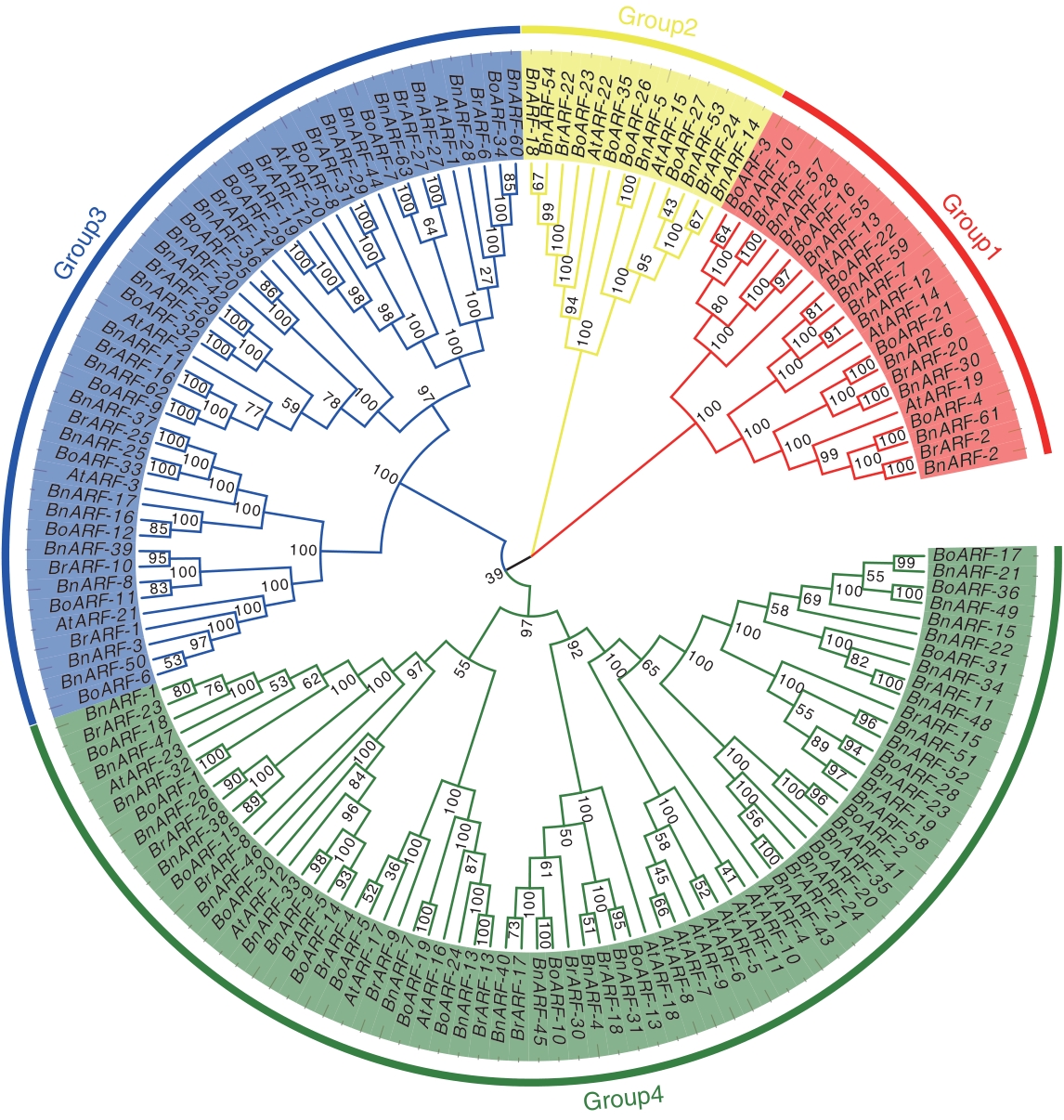
图1 甘蓝ARF基因家族进化树分析Bn:甘蓝型油菜;Br:白菜;At:拟南芥
Fig. 1 Phylogenetic tree of Brassica oleraceaARF gene familyBn: Brassica napus. Br: Brassica rapa. At: Arabidopsis thaliana

图2 甘蓝ARF基因家族保守基序(A)、保守结构域(B)和基因结构分析(C)
Fig. 2 Analysis of conserved motifs (A) , conserved structural domains (B) and gene structures (C) of the ARF gene family in B. oleracea
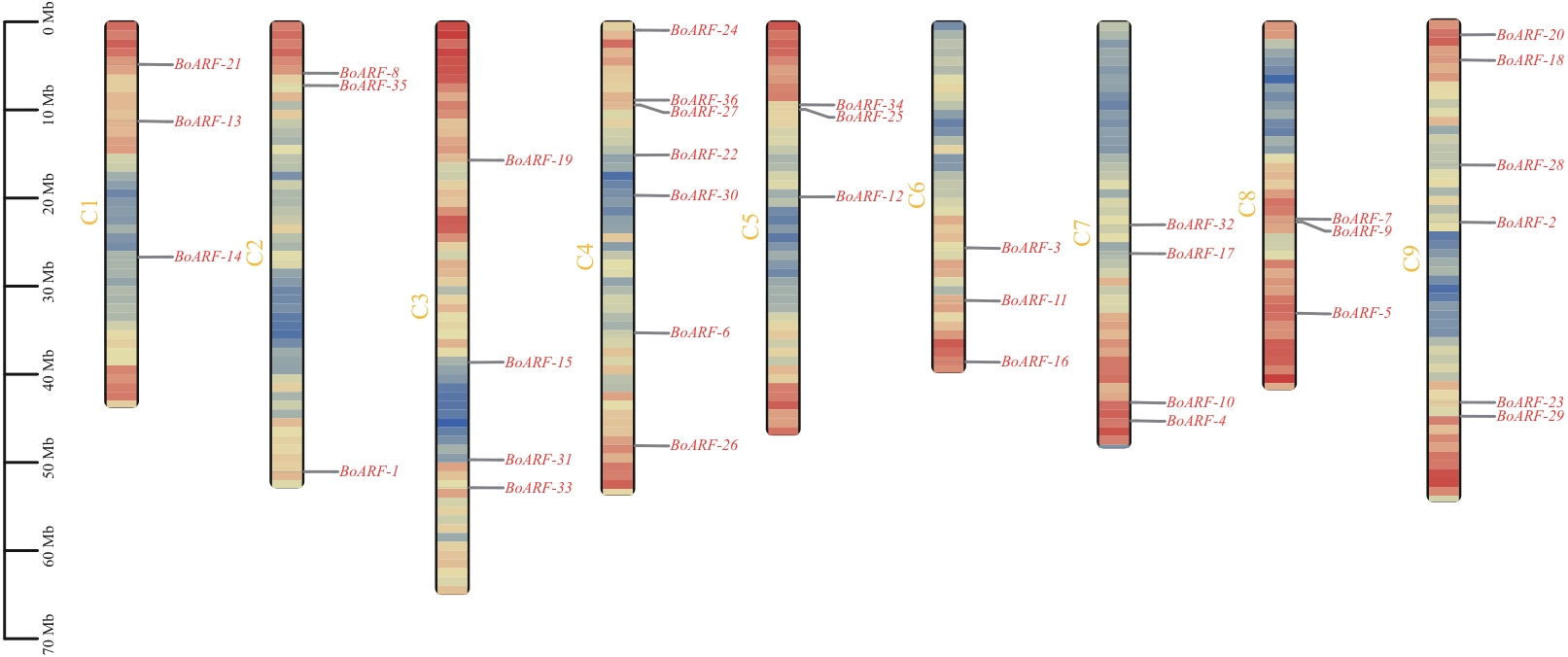
图3 甘蓝ARF基因家族成员在染色体上的定位
Fig. 3 Location of ARF gene family on the chromosomes of B. oleracea

图4 ARF基因家族启动子顺势作用元件分析
Fig. 4 Analysis of the cis-acting elements of the ARF gene family

图5 ARF 基因家族的共线性分析A:ARF 基因家族的共线性分析;B:拟南芥、白菜和甘蓝之间的共线性分析;图中亮线为ARF基因家族的共线性基因对
Fig. 5 Analysis of co-lineage of the ARF gene familyA: Co-lineage relationships of the ARF gene family. B: Co-lineage relationships between A. thaliana, B. rapa, B. oleracea. Bright lines indicate co-lineage gene pairs of the ARF gene family

图6 甘蓝 ARF 基因家族成员在非生物胁迫下的表达分析A:低温胁迫;B:高温胁迫;C:盐胁迫;D:干旱胁迫;误差线代表3个生物学重复的标准误差,不同的小写字母表示在P<0.05水平上有显著差异
Fig. 6 Expression analysis of cabbage ARF gene family members under abiotic stressA: Low-temperature stress. B: High-temperature stress. C: Salt stress. D: Drought stress. Error bars indicate standard errors of three biological replicates. The different lowercase letters indicate significant differences at the P<0.05 level
| [1] | Raza MA, Sohail H, Ahmad Hassan M, et al. Cold stress in Brassica vegetables: morpho-physiological and molecular responses underlying adaptive mechanism [J]. Sci Hortic, 2024, 329: 113002. |
| [2] | Zhang Y, Xu J, Li RF, et al. Plants’ response to abiotic stress: mechanisms and strategies [J]. Int J Mol Sci, 2023, 24(13): 10915. |
| [3] | Li YH, Han S, Qi YH. Advances in structure and function of auxin response factor in plants [J]. J Integr Plant Biol, 2023, 65(3): 617-632. |
| [4] | Gao ZY, Wu YZ, Li MZ, et al. The auxin response factor (ARF) gene family in Cyclocarya paliurus: genome-wide identification and their expression profiling under heat and drought stresses [J]. Physiol Mol Biol Plants, 2024, 30(6): 921-944. |
| [5] | Singh VK, Rajkumar MS, Garg R, et al. Genome-wide identification and co-expression network analysis provide insights into the roles of auxin response factor gene family in chickpea [J]. Sci Rep, 2017, 7(1): 10895. |
| [6] | Chandler JW. Auxin response factors [J]. Plant Cell Environ, 2016, 39(5): 1014-1028. |
| [7] | 孟思达, 聂晓雨, 叶云珠, 等. 植物ARF家族成员研究进展 [J]. 沈阳农业大学学报, 2025, 56(2): 160-168. |
| Meng SD, Nie XY, Ye YZ, et al. Research progress on members of the plant ARF family [J]. J Shenyang Agric Univ, 2025, 56(2): 160-168. | |
| [8] | Chen FQ, Zhang JQ, Ha X, et al. Genome-wide identification and expression analysis of the Auxin-Response factor (ARF) gene family in Medicago sativa under abiotic stress [J]. BMC Genomics, 2023, 24(1): 498. |
| [9] | Cancé C, Martin-Arevalillo R, Boubekeur K, et al. Auxin response factors are keys to the many auxin doors [J]. New Phytol, 2022, 235(2): 402-419. |
| [10] | Xu L, Wang DZ, Liu S, et al. Comprehensive atlas of wheat (Triticum aestivum L.) AUXIN RESPONSE FACTOR expression during male reproductive development and abiotic stress [J]. Front Plant Sci, 2020, 11: 586144. |
| [11] | Du LM, Bao CL, Hu TH, et al. SmARF8, a transcription factor involved in parthenocarpy in eggplant [J]. Mol Genet Genomics, 2016, 291(1): 93-105. |
| [12] | Song XY, Xiong YL, Kong XZ, et al. Roles of auxin response factors in rice development and stress responses [J]. Plant Cell Environ, 2023, 46(4): 1075-1086. |
| [13] | Wang ZF, Shang Q, Zhang WE, et al. Identification of ARF genes in Juglans sigillata Dode and analysis of their expression patterns under drought stress [J]. Mol Biol Rep, 2024, 51(1): 539. |
| [14] | Kang C, He SZ, Zhai H, et al. A sweetpotato auxin response factor gene (IbARF5) is involved in carotenoid biosynthesis and salt and drought tolerance in transgenic Arabidopsis [J]. Front Plant Sci, 2018, 9: 1307. |
| [15] | Jin LF, Yarra R, Zhou LX, et al. The auxin response factor (ARF) gene family in oil palm (Elaeis guineensis Jacq.): Genome-wide identification and their expression profiling under abiotic stresses [J]. Protoplasma, 2022, 259(1): 47-60. |
| [16] | Song SW, Hao LY, Zhao P, et al. Genome-wide identification, expression profiling and evolutionary analysis of auxin response factor gene family in potato (Solanum tuberosum group phureja) [J]. Sci Rep, 2019, 9(1): 1755. |
| [17] | Cui J, Li XY, Li JL, et al. Genome-wide sequence identification and expression analysis of ARF family in sugar beet (Beta vulgaris L.) under salinity stresses [J]. PeerJ, 2020, 8: e9131. |
| [18] | Matsui A, Ishida J, Morosawa T, et al. Arabidopsis transcriptome analysis under drought, cold, high-salinity and ABA treatment conditions using a tiling array [J]. Plant Cell Physiol, 2008, 49(8): 1135-1149. |
| [19] | Mistry J, Chuguransky S, Williams L, et al. Pfam: the protein families database in 2021 [J]. Nucleic Acids Res, 2021, 49(D1): D412-D419. |
| [20] | Chen CJ, Chen H, Zhang Y, et al. TBtools: an integrative toolkit developed for interactive analyses of big biological data [J]. Mol Plant, 2020, 13(8): 1194-1202. |
| [21] | Feng SY, Li N, Chen HL, et al. Large-scale analysis of the ARF and Aux/IAA gene families in 406 horticultural and other plants [J]. Mol Hortic, 2024, 4(1): 13. |
| [22] | Remington DL, Vision TJ, Guilfoyle TJ, et al. Contrasting modes of diversification in the Aux/IAA and ARF gene families [J]. Plant Physiol, 2004, 135(3): 1738-1752. |
| [23] | Kumar R, Tyagi AK, Sharma AK. Genome-wide analysis of auxin response factor (ARF) gene family from tomato and analysis of their role in flower and fruit development [J]. Mol Genet Genomics, 2011, 285(3): 245-260. |
| [24] | Wan SB, Li WL, Zhu YY, et al. Genome-wide identification, characterization and expression analysis of the auxin response factor gene family in Vitis vinifera [J]. Plant Cell Rep, 2014, 33(8): 1365-1375. |
| [25] | Xing HY, Pudake RN, Guo GG, et al. Genome-wide identification and expression profiling of auxin response factor (ARF) gene family in maize [J]. BMC Genomics, 2011, 12: 178. |
| [26] | Mun JH, Yu HJ, Shin JY, et al. Auxin response factor gene family in Brassica rapa: genomic organization, divergence, expression, and evolution [J]. Mol Genet Genomics, 2012, 287(10): 765-784. |
| [27] | Okushima Y, Overvoorde PJ, Arima K, et al. Functional genomic analysis of the auxin response factor gene family members in Arabidopsis thaliana: unique and overlapping functions of arf7 and arf19 [J]. Plant Cell, 2005, 17(2): 444-463. |
| [28] | Wen J, Guo PC, Ke YZ, et al. The auxin response factor gene family in allopolyploid Brassica napus [J]. PLoS One, 2019, 14(4): e0214885. |
| [29] | Chen J, Wang SJ, Wu FL, et al. Genome-wide identification and functional characterization of auxin response factor (ARF) genes in eggplant [J]. Int J Mol Sci, 2022, 23(11): 6219. |
| [30] | Li WB, Chen FB, Wang YP, et al. Genome-wide identification and functional analysis of ARF transcription factors in Brassica juncea var. tumida [J]. PLoS One, 2020, 15(4): e0232039. |
| [31] | Hou QD, Qiu ZL, Wen Z, et al. Genome-wide identification of ARF gene family suggests a functional expression pattern during fruitlet abscission in Prunus avium L [J]. Int J Mol Sci, 2021, 22(21): 11968. |
| [32] | 卫聪聪, 江定, 吴根堃, 等. 甘蓝ARF基因家族的鉴定与生物信息学分析 [J]. 北方园艺, 2017(19): 16-24. |
| Wei CC, Jiang D, Wu GK, et al. Genome-wide identification and bioinformatics analysis of ARF gene family in Brassica oleracea [J]. North Hortic, 2017(19): 16-24. | |
| [33] | Wang DK, Pei KM, Fu YP, et al. Genome-wide analysis of the auxin response factors (ARF) gene family in rice (Oryza sativa) [J]. Gene, 2007, 394(1/2): 13-24. |
| [34] | Gechev T, Petrov V. Reactive oxygen species and abiotic stress in plants [J]. Int J Mol Sci, 2020, 21(20): 7433. |
| [35] | Zhang MJ, Xue YY, Xu S, et al. Identification of ARF genes in Cucurbita pepo L and analysis of expression patterns, and functional analysis of CpARF22 under drought, salt stress [J]. BMC Genomics, 2024, 25(1): 112. |
| [1] | 李珊, 马登辉, 马红义, 姚文孔, 尹晓. 葡萄SKP1基因家族鉴定与表达分析[J]. 生物技术通报, 2025, 41(9): 147-158. |
| [2] | 黄国栋, 邓宇星, 程宏伟, 但焱南, 周会汶, 吴兰花. 大豆ZIP基因家族鉴定及响应铝胁迫的表达分析[J]. 生物技术通报, 2025, 41(9): 71-81. |
| [3] | 巩慧玲, 邢玉洁, 马俊贤, 蔡霞, 冯再平. 马铃薯LAC基因家族的鉴定及盐胁迫下表达分析[J]. 生物技术通报, 2025, 41(9): 82-93. |
| [4] | 程婷婷, 刘俊, 王利丽, 练从龙, 魏文君, 郭辉, 吴尧琳, 杨晶凡, 兰金旭, 陈随清. 杜仲查尔酮异构酶基因家族全基因组鉴定及其表达模式分析[J]. 生物技术通报, 2025, 41(9): 242-255. |
| [5] | 程雪, 付颖, 柴晓娇, 王红艳, 邓欣. 谷子LHC基因家族鉴定及非生物胁迫表达分析[J]. 生物技术通报, 2025, 41(8): 102-114. |
| [6] | 白雨果, 李婉迪, 梁建萍, 石志勇, 卢庚龙, 刘红军, 牛景萍. 哈茨木霉T9131对黄芪幼苗的促生机理[J]. 生物技术通报, 2025, 41(8): 175-185. |
| [7] | 任睿斌, 司二静, 万广有, 汪军成, 姚立蓉, 张宏, 马小乐, 李葆春, 王化俊, 孟亚雄. 大麦条纹病菌GH17基因家族的鉴定及表达分析[J]. 生物技术通报, 2025, 41(8): 146-154. |
| [8] | 曾丹, 黄园, 王健, 张艳, 刘庆霞, 谷荣辉, 孙庆文, 陈宏宇. 铁皮石斛bZIP转录因子家族全基因组鉴定及表达分析[J]. 生物技术通报, 2025, 41(8): 197-210. |
| [9] | 化文平, 刘菲, 浩佳欣, 陈尘. 丹参ADH基因家族的鉴定与表达模式分析[J]. 生物技术通报, 2025, 41(8): 211-219. |
| [10] | 腊贵晓, 赵玉龙, 代丹丹, 余永亮, 郭红霞, 史贵霞, 贾慧, 杨铁钢. 红花质膜H+-ATPase基因家族成员鉴定及响应低氮低磷胁迫的表达分析[J]. 生物技术通报, 2025, 41(8): 220-233. |
| [11] | 黄诗宇, 田姗姗, 杨天为, 高曼熔, 张尚文. 赤苍藤WRI1基因家族的全基因组鉴定及表达模式分析[J]. 生物技术通报, 2025, 41(8): 242-254. |
| [12] | 李凯月, 邓晓霞, 殷缘, 杜亚彤, 徐元静, 王竞红, 于耸, 蔺吉祥. 蓖麻LEA基因家族的鉴定和铝胁迫响应分析[J]. 生物技术通报, 2025, 41(7): 128-138. |
| [13] | 牛景萍, 赵婧, 郭茜, 王书宏, 赵晋忠, 杜维俊, 殷丛丛, 岳爱琴. 基于WGCNA鉴定大豆抗大豆花叶病毒NAC转录因子及其诱导表达分析[J]. 生物技术通报, 2025, 41(7): 95-105. |
| [14] | 韩燚, 侯昌林, 唐露, 孙璐, 谢晓东, 梁晨, 陈小强. 大麦HvERECTA基因的克隆及功能分析[J]. 生物技术通报, 2025, 41(7): 106-116. |
| [15] | 李霞, 张泽伟, 刘泽军, 王楠, 郭江波, 辛翠花, 张彤, 简磊. 马铃薯转录因子StMYB96的克隆及功能研究[J]. 生物技术通报, 2025, 41(7): 181-192. |
| 阅读次数 | ||||||
|
全文 |
|
|||||
|
摘要 |
|
|||||
