







生物技术通报 ›› 2025, Vol. 41 ›› Issue (10): 242-252.doi: 10.13560/j.cnki.biotech.bull.1985.2025-0363
王静( ), 常雪瑞(), 贾旭, 黄嘉欣, 王田田, 梁燕平()
收稿日期:2025-04-05
出版日期:2025-10-26
发布日期:2025-10-28
通讯作者:
梁燕平,女,硕士,副研究员,研究方向 :蔬菜种质资源创新及新品种选育;E-mail: truthlyp@163.com作者简介:王静,女,博士,讲师,研究方向 :辣椒功能基因挖掘与种质创新;E-mail: wangjing315@sxau.edu.cn基金资助:
WANG Jing(), CHANG Xue-rui(), JIA Xu, HUANG Jia-xin, WANG Tian-tian, LIANG Yan-ping()
Received:2025-04-05
Published:2025-10-26
Online:2025-10-28
摘要:
目的 泛素结合酶E2(ubiquitin conjugating enzyme, UBC)是底物泛素化的关键酶,在植物生长发育中具有调控作用。探究CaUBC38基因在辣椒果实成熟和高温胁迫响应过程中的作用,为辣椒的分子育种奠定基础。 方法 以辣椒(Capsicum annuum)骨干亲本‘6421’为材料,从辣椒中克隆CaUBC38,并对其蛋白序列、蛋白结构、亚细胞定位、表达模式进行详细分析;通过RT-qPCR技术分析CaUBC38在辣椒根、茎、叶、花、果实不同发育时期的表达模式,构建CaUBC38病毒诱导的基因沉默(virus induced gene silencing, VIGS)载体,以离体辣椒果实为材料,探索CaUBC38基因的功能;同时构建CaUBC38过表达载体,得到转基因株系。 结果 辣椒CaUBC38编码区393 bp,共编码130个氨基酸;包含典型的UBCc超家族保守结构域,属于UBC基因家族;蛋白的分子质量为14.80 kD,推测为酸性的不稳定蛋白,无跨膜结构域和信号肽;含有9个丝氨酸磷酸化位点;CaUBC38的二级、三级结构预测结果表明,其主要由无规卷曲和α-螺旋组成。系统进化分析表明,CaUBC38与茄科其他物种的同源性较高。亚细胞定位结果显示CaUBC38蛋白主要定位于细胞质膜、细胞核上。RT-qPCR检测发现,CaUBC38在辣椒果实中的表达量高于根、茎、叶、花,且果实转色期的表达量高于红熟期、绿熟期、未熟期。通过VIGS技术沉默CaUBC38后发现,辣椒果实转色延缓。同时构建CaUBC38过表达载体,得到转基因拟南芥株系,CaUBC38过表达拟南芥植株耐热性降低。 结论 沉默CaUBC38延缓辣椒果实成熟,过表达CaUBC38拟南芥株系耐热性降低。
王静, 常雪瑞, 贾旭, 黄嘉欣, 王田田, 梁燕平. 辣椒CaUBC38基因的克隆及功能分析[J]. 生物技术通报, 2025, 41(10): 242-252.
WANG Jing, CHANG Xue-rui, JIA Xu, HUANG Jia-xin, WANG Tian-tian, LIANG Yan-ping. Cloning and Fuctional Analysis of CaUBC38 Gene in Pepper[J]. Biotechnology Bulletin, 2025, 41(10): 242-252.
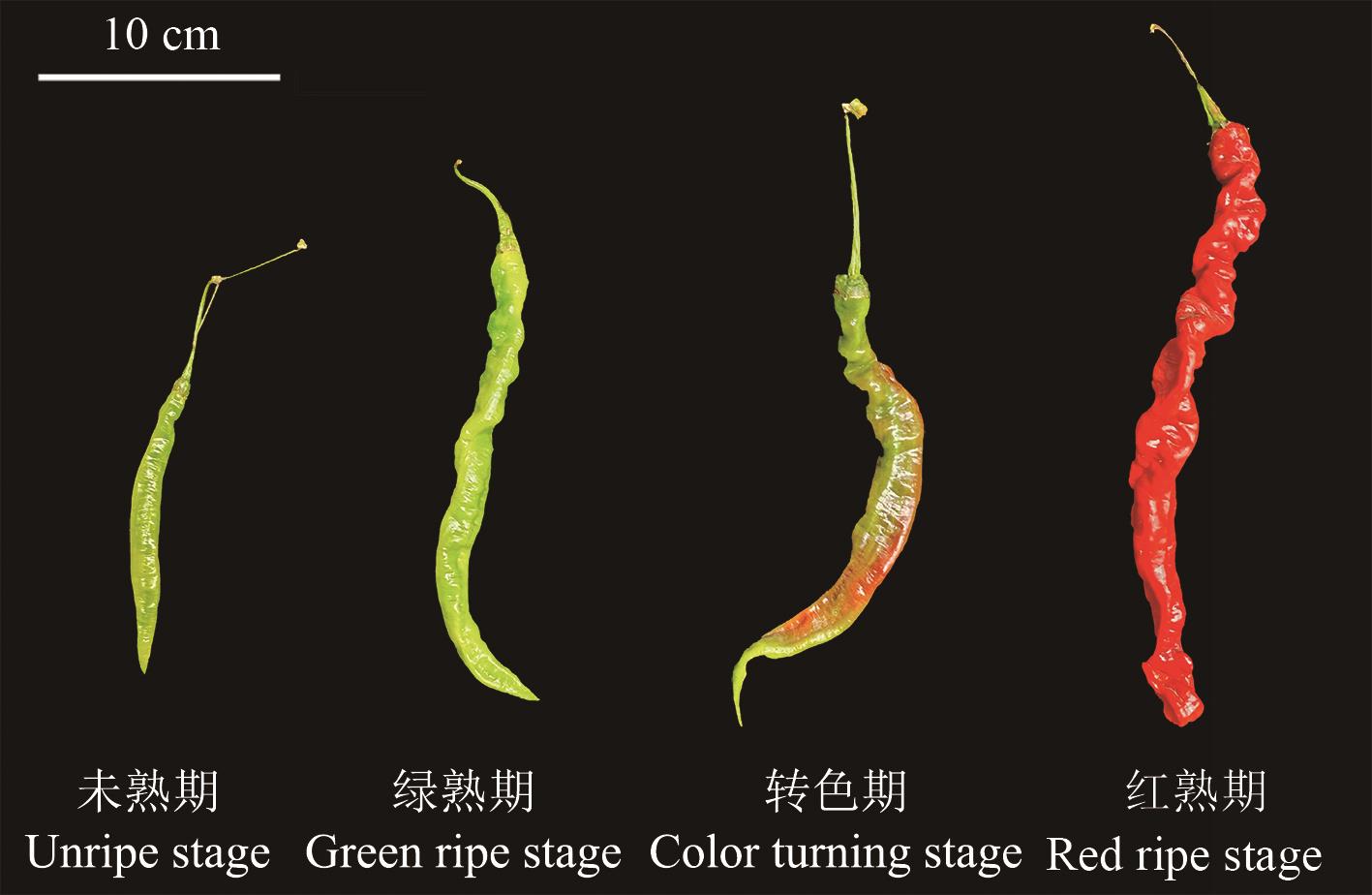
图1 辣椒4个时期的果实
Fig. 1 Fruits of peppers at 4 stages
| 引物名称 Primer name | 引物序列 Primer sequence (5′‒3′) |
|---|---|
| CaUBC38-F | GCGGAAAGTCCTTATCATGG |
| CaUBC38-R | GATCAACAGGACCTGCCATT |
| qCaUBC38-F | GCGGAAAGTCCTTATCATGG |
| qCaUBC38-R | GATCAACAGGACCTGCCATT |
qβ-Actin-F qβ-Actin-R | CCACCTCTTCACTCTCTGCTCT ACTAGGAAAAACAGCCCTTGGT |
CaUBC38-pART-CAM-EGFP-F CaUBC38-pART-CAM-EGFP-R | CATTTGGAGAGGACACGCATGTCTTCTCCGAGCAAACG TCGCCCTTGCTCACCATGAATGGATCAACAGGACCTGC |
| CaUBC38-VIGS-F | GAAGGCCTCCATGG |
| CaUBC38-VIGS -R | GCCTCGAGACGCGT |
| PTRV2-SEQS | AACAAAGTCCGTTCCCCTAT |
| CaUBC38-OE-F | GAGCTTTCGCGAGCTC |
| CaUBC38-OE-R | GCAGGTCGACTCTAGA |
表1 试验所用引物名称及序列
Table 1 Names and sequences of the primers used in the experiment
| 引物名称 Primer name | 引物序列 Primer sequence (5′‒3′) |
|---|---|
| CaUBC38-F | GCGGAAAGTCCTTATCATGG |
| CaUBC38-R | GATCAACAGGACCTGCCATT |
| qCaUBC38-F | GCGGAAAGTCCTTATCATGG |
| qCaUBC38-R | GATCAACAGGACCTGCCATT |
qβ-Actin-F qβ-Actin-R | CCACCTCTTCACTCTCTGCTCT ACTAGGAAAAACAGCCCTTGGT |
CaUBC38-pART-CAM-EGFP-F CaUBC38-pART-CAM-EGFP-R | CATTTGGAGAGGACACGCATGTCTTCTCCGAGCAAACG TCGCCCTTGCTCACCATGAATGGATCAACAGGACCTGC |
| CaUBC38-VIGS-F | GAAGGCCTCCATGG |
| CaUBC38-VIGS -R | GCCTCGAGACGCGT |
| PTRV2-SEQS | AACAAAGTCCGTTCCCCTAT |
| CaUBC38-OE-F | GAGCTTTCGCGAGCTC |
| CaUBC38-OE-R | GCAGGTCGACTCTAGA |
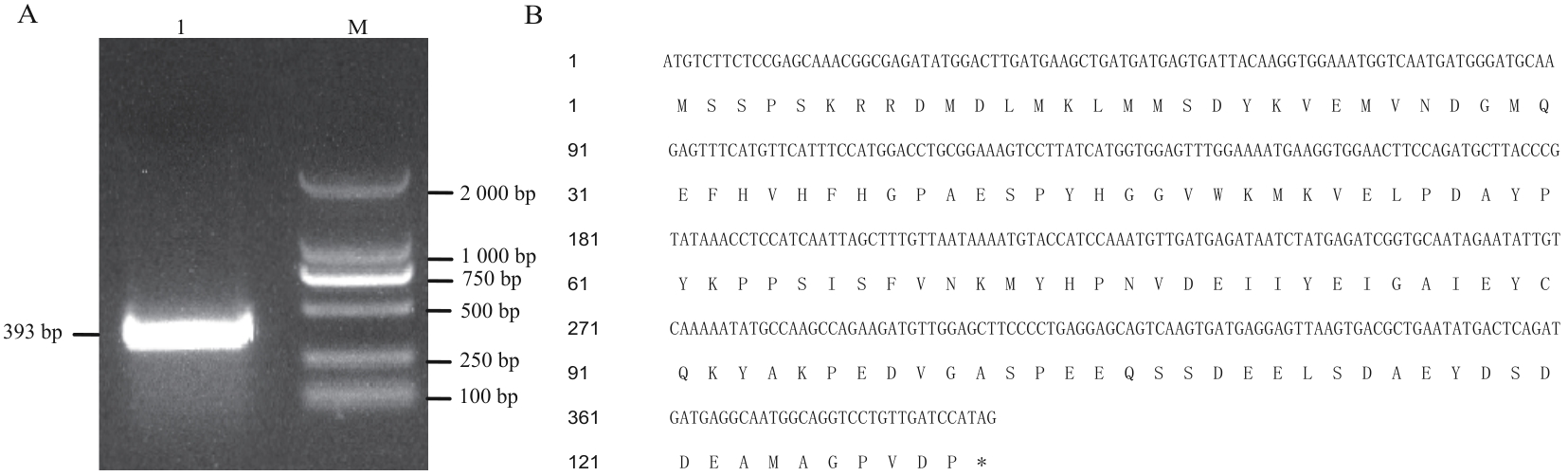
图2 CaUBC38基因PCR扩增(A)和CaUBC38全长核苷酸序列及预测氨基酸序列(B)M:DNA marker;1:PCR产物
Fig. 2 PCR amplification of CaUBC38 gene (A) and full-length nucleotide sequence of CaUBC38 and predicting amino acid sequence (B)M: DNA marker; 1: PCR amplified product
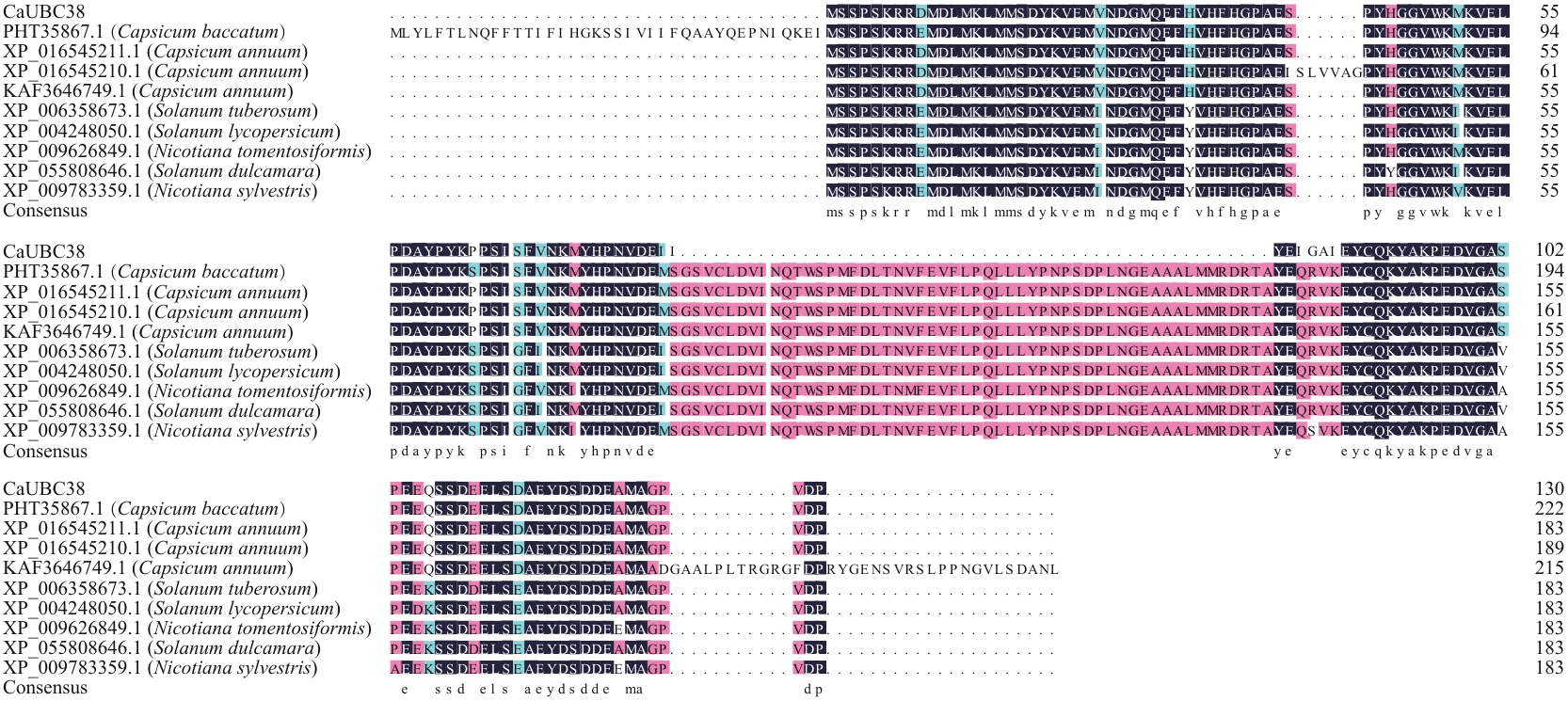
图3 蛋白序列对比分析
Fig. 3 Comparative analysis of protein sequences

图4 CaUBC38蛋白的保守结构域
Fig. 4 Conserved domain of CaUBC38 protein
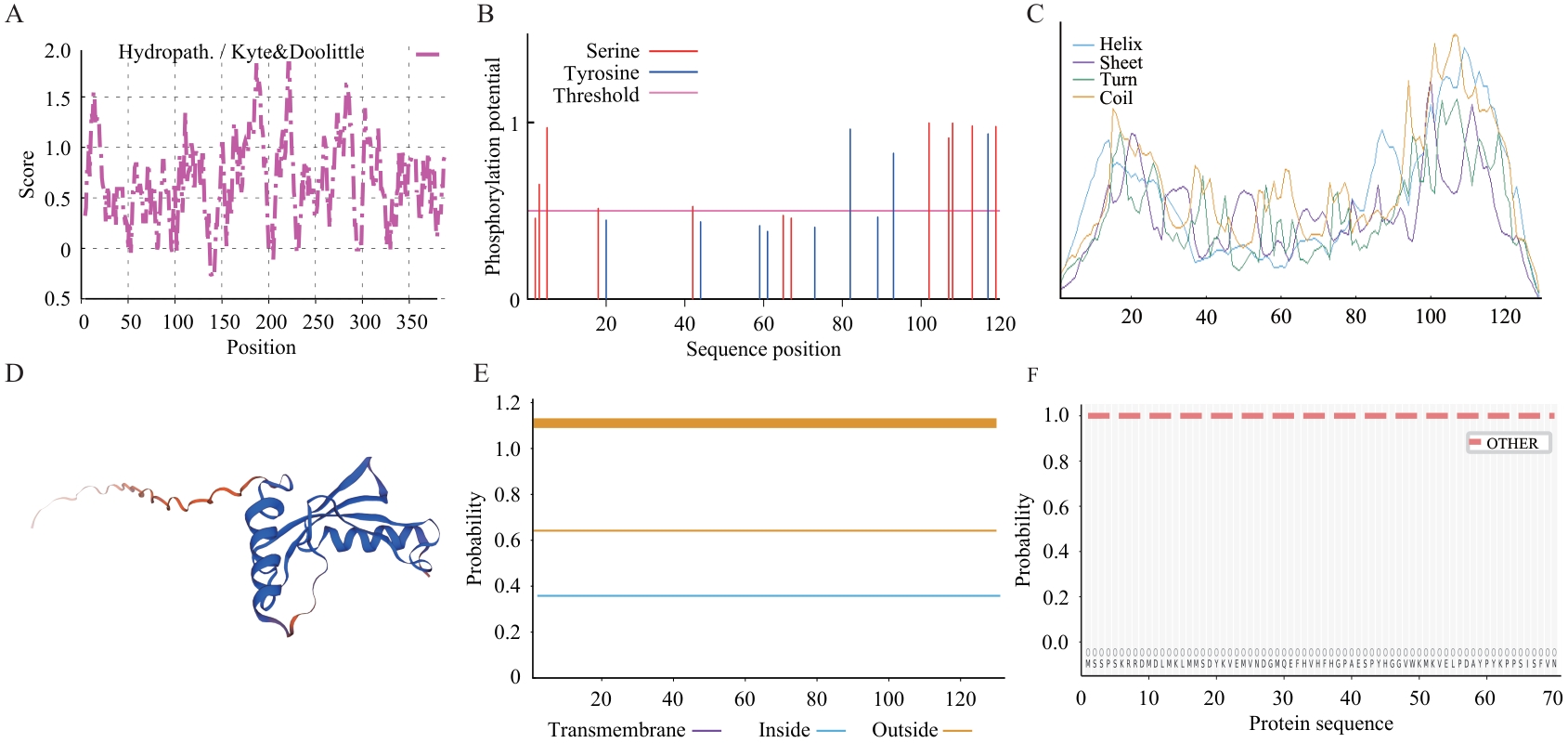
图5 辣椒CaUBC38蛋白的基本信息A:亲疏水性预测;B:蛋白磷酸化位点预测;C:二级结构;D:三级结构;E:跨膜结构;F:信号肽
Fig. 5 Basic information on CaUBC38 protein in pepperA: Hydrophilic and hydrophobic prediction. B: Protein phosphorylation site prediction. C: Secondary structure. D: Tertiary structure. E: Transmembrane structure. F: Signal peptide
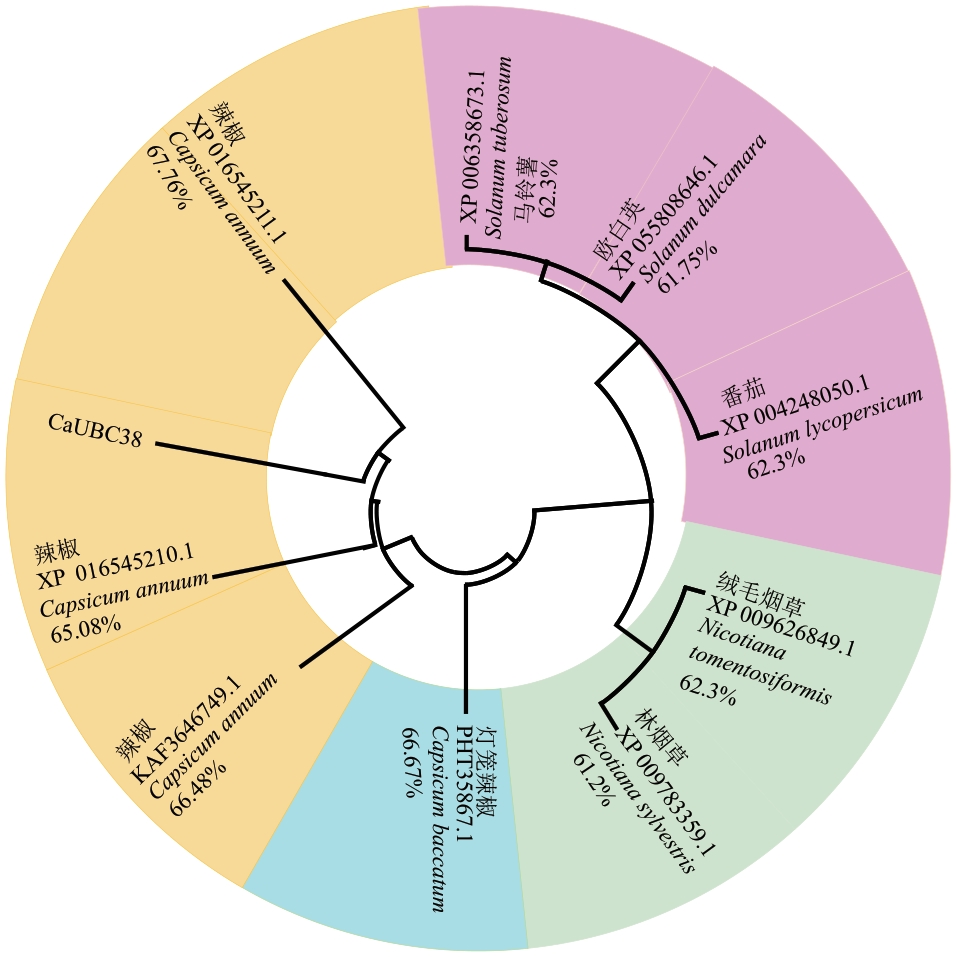
图6 CaUBC38的系统进化树分析
Fig. 6 Phylogenetic tree analysis of CaUBC38
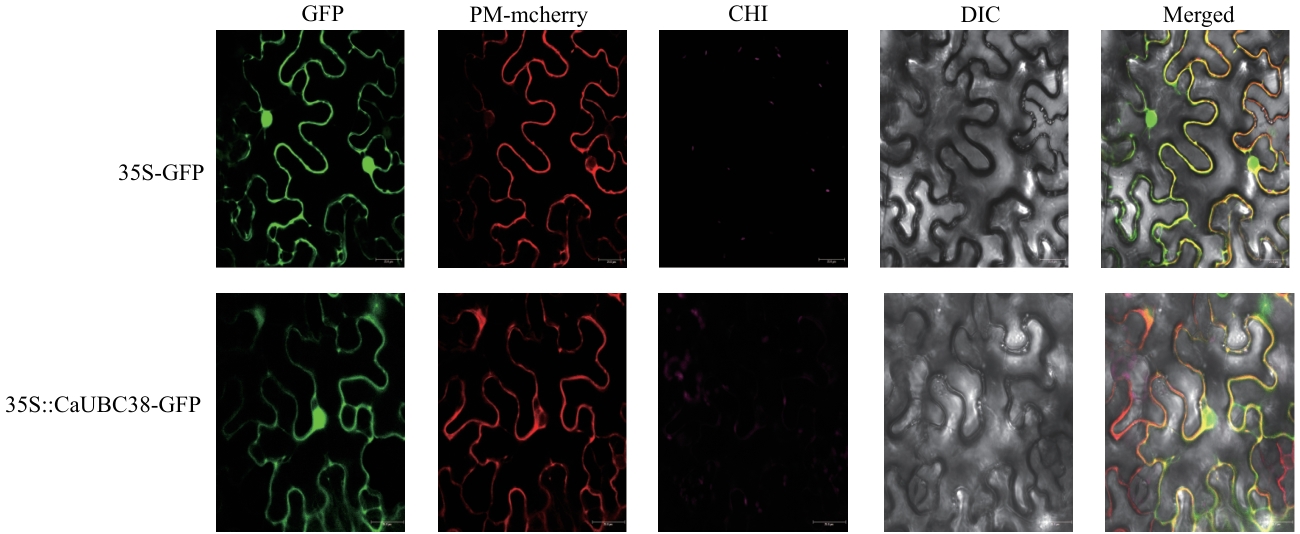
图7 CaUBC38蛋白的亚细胞定位从左到右分别为GFP绿色荧光蛋白、PM-mcherry通道、叶绿体荧光通道、明场和叠加图。比例尺=25.0 μm
Fig. 7 Subcellular localization of CaUBC38From left to right, GFP green fluorescent protein, PM-mcherry channel, chloroplast fluorescence channel, bright, and merge. Scale bar = 25.0 μm
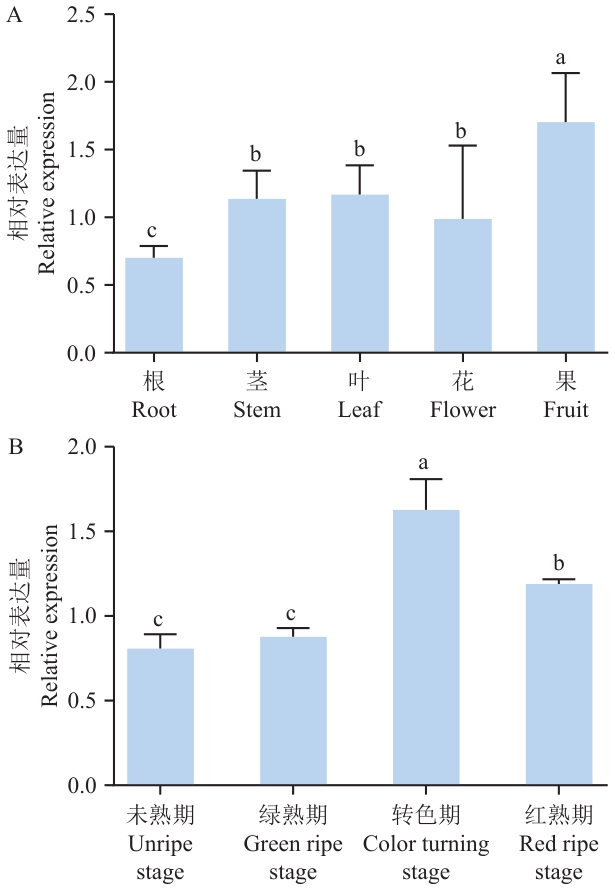
图8 CaUBC38基因在辣椒不同组织(A)及果实不同发育时期(B)的表达模式不同小写字母表示差异显著(P<0.05)
Fig. 8 Expression patterns of CaUBC38 gene in different tissues (A) and fruit development stages (B) of pepperDifferent lower letters indicate significant differences (P<0.05)

图9 VIGS载体鉴定(A)、沉默效率(B)和CaUBC38基因沉默果实表型(C、D)M:DNA marker 2000;1‒3:VIGS载体鉴定;pTRV2:基因沉默阴性对照;pTRV2:CaUBC38: CaUBC38基因沉默果实
Fig. 9 Identification of VIGS vector (A), silencing efficiency (B), and CaUBC38 genes silenced fruit phenotype (C, D)M: DNA marker 2000; 1‒3: identification of VIGS vector; pTRV2: negative control; pTRV2: CaUBC38: CaUBC38-silenced fruit
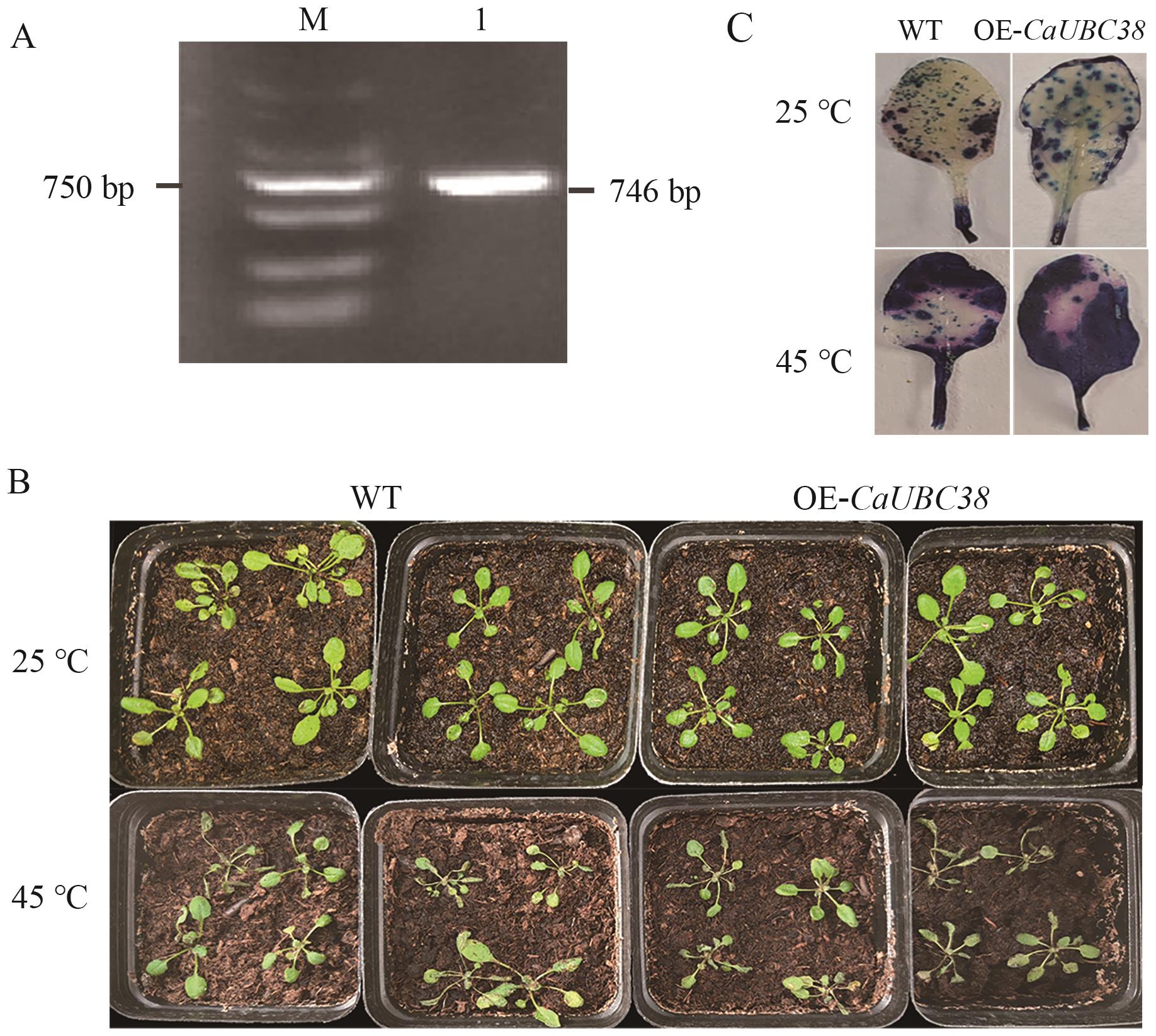
图10 过表达载体鉴定(A)、CaUBC38基因过表达拟南芥表型(B)及死细胞含量测定(C)M:DNA marker 2000;1:过表达载体鉴定
Fig. 10 Identification of overexpression vectors (A), phenotypes of Arabidopsis thaliana overexpressing the CaUBC38 gene (B), and determination of dead cells content (C)M: DNA marker 2000; 1: identification of over-expression vector
| [1] | Nagels Durand A, Pauwels L, Goossens A. The ubiquitin system and jasmonate signaling [J]. Plants, 2016, 5(1): 6. |
| [2] | Liu XT, Zhou YY, Du MS, et al. The calcium-dependent protein kinase CPK28 is targeted by the ubiquitin ligases ATL31 and ATL6 for proteasome-mediated degradation to fine-tune immune signaling in Arabidopsis [J]. Plant Cell, 2022, 34(1): 679-697. |
| [3] | Gil KE, Kim WY, Lee HJ, et al. ZEITLUPE contributes to a thermoresponsive protein quality control system in Arabidopsis [J]. Plant Cell, 2017, 29(11): 2882-2894. |
| [4] | Kim SH, Park JS, Lee MH, et al. The N-degron pathway governs autophagy to promote thermotolerance in Arabidopsis [J]. Nat Commun, 2025, 16(1): 5889. |
| [5] | Liu WG, Tang X, Fu X, et al. Functional characterization of potato UBC13-UEV1s genes required for ubiquitin Lys63 chain to polyubiquitination [J]. Int J Mol Sci, 2023, 24(3): 2412. |
| [6] | Cheng MC, Kuo WC, Wang YM, et al. UBC18 mediates ERF1 degradation under light-dark cycles [J]. New Phytol, 2017, 213(3): 1156-1167. |
| [7] | Pickart CM. Mechanisms underlying ubiquitination [J]. Annu Rev Biochem, 2001, 70: 503-533. |
| [8] | Ye YH, Rape M. Building ubiquitin chains: E2 enzymes at work [J]. Nat Rev Mol Cell Biol, 2009, 10(11): 755-764. |
| [9] | Wang PC, Guo K, Su Q, et al. Histone ubiquitination controls organ size in cotton (Gossypium hirsutum) [J]. Plant J, 2022, 110(4): 1005-1020. |
| [10] | 董发才, 宋纯鹏. 植物细胞中的泛素及其生理功能 [J]. 植物生理学通讯, 1999, 35(1): 54-59. |
| Dong FC, Song CP. Ubiquitin in plant cells and its physiological functions [J]. Plant Physiol Commun, 1999, 35(1): 54-59. | |
| [11] | Dong C, Hu HG, Jue DW, et al. The banana E2 gene family: Genomic identification, characterization, expression profiling analysis [J]. Plant Sci, 2016, 245: 11-24. |
| [12] | Jue DW, Sang XL, Shu B, et al. Characterization and expression analysis of genes encoding ubiquitin conjugating domain-containing enzymes in Carica papaya [J]. PLoS One, 2017, 12(2): e0171357. |
| [13] | Kim S, Park M, Yeom SI, et al. Genome sequence of the hot pepper provides insights into the evolution of pungency in Capsicum species [J]. Nat Genet, 2014, 46(3): 270-278. |
| [14] | 李广存, 庄飞云, 王立浩, 等. 蔬菜生物育种发展概述 [J]. 中国基础科学, 2022, 24(4): 29-36. |
| Li GC, Zhuang FY, Wang LH, et al. Development of vegetable bio-breeding [J]. China Basic Sci, 2022, 24(4): 29-36. | |
| [15] | 邹学校, 马艳青, 戴雄泽, 等. 辣椒在中国的传播与产业发展 [J]. 园艺学报, 2020, 47(9): 1715-1726. |
| Zou XX, Ma YQ, Dai XZ, et al. Spread and industry development of pepper in China [J]. Acta Hortic Sin, 2020, 47(9): 1715-1726. | |
| [16] | 邹学校, 朱凡. 辣椒的起源、进化与栽培历史 [J]. 园艺学报, 2022, 49(6): 1371-1381. |
| Zou XX, Zhu F. Origin, evolution and cultivation history of the pepper [J]. Acta Hortic Sin, 2022, 49(6): 1371-1381. | |
| [17] | 胡悦. 辣椒中辣椒红素抗氧化活性理论与实验研究 [D]. 包头: 内蒙古科技大学, 2024. |
| Hu Y. Theoretical and experimental study on antioxidant activity of capsanthin in pepper [D]. Baotou: Inner Mongolia University of Science & Technology, 2024. | |
| [18] | 邹学校, 杨莎, 戴雄泽, 等. 中国辣椒产业快速发展40年回顾与展望 [J]. 园艺学报, 2025, 52(1): 247-258. |
| Zou XX, Yang S, Dai XZ, et al. The rapid development of China’s chili pepper industry over the past 40 years [J]. Acta Hortic Sin, 2025, 52(1): 247-258. | |
| [19] | 高成安. 发育阶段和高温、干旱对辣椒果实辣椒素代谢的影响 [D]. 杭州: 浙江农林大学, 2025. |
| Gao CA. Effects of development stage, high temperature and drought on capsaicin metabolism in pepper fruit [D]. Hangzhou: Zhejiang A & F University, 2025. | |
| [20] | 梁宝萍, 段莹, 姜俊, 等. 高温胁迫对辣椒果实活性氧代谢的影响 [J]. 陕西农业科学, 2022, 68(8): 93-96, 102. |
| Liang BP, Duan Y, Jiang J, et al. Effect of high-temperature stress on active oxygen metabolism in Capsicum annuum L fruit [J]. Shaanxi J Agric Sci, 2022, 68(8): 93-96, 102. | |
| [21] | Lin TH, Lin SW, Wang YW, et al. Growing environment and heat treatment effects on intra- and interspecific pollination in Chile pepper (Capsicum spp.) [J]. Agronomy, 2021, 11(7): 1275. |
| [22] | 李连英, 谢培菡, 曾广明, 等. 赣南地区蔬菜产业基本情况调研报告 [J]. 北方园艺, 2021(7): 135-142. |
| Li LY, Xie PH, Zeng GM, et al. Investigation report on the basic situation of vegetable industry in southern Jiangxi [J]. North Hortic, 2021(7): 135-142. | |
| [23] | 常雪瑞, 王田田, 王静. 辣椒E2基因家族的鉴定及分析 [J]. 生物技术通报, 2024, 40(6): 238-250. |
| Chang XR, Wang TT, Wang J. Identification and analysis of E2 gene family in pepper (Capsicum annuum L.) [J]. Biotechnol Bull, 2024, 40(6): 238-250. | |
| [24] | 马艳青, 戴雄泽, 李雪峰, 等. 辣椒骨干亲本6421及其衍生系的创制与利用 [J]. 中国蔬菜, 2015(6): 11-16. |
| Ma YQ, Dai XZ, Li XF, et al. Creation and utilization of pepper backbone parent 6421 and its derivated lines [J]. China Veg, 2015(6): 11-16. | |
| [25] | 田士林. 辣椒果实中辣椒红素合成的分子机理及其调控研究 [D]. 杨凌: 西北农林科技大学, 2014. |
| Tian SL. Study on molecular mechanism and regulation of capsaicin synthesis in pepper fruit [D]. Yangling: Northwest A & F University, 2014. | |
| [26] | Liu WG, Tang X, Qi XH, et al. The ubiquitin conjugating enzyme: an important ubiquitin transfer platform in ubiquitin-proteasome system [J]. Int J Mol Sci, 2020, 21(8): 2894. |
| [27] | Gao YY, Wang Y, Xin HP, et al. Involvement of ubiquitin-conjugating enzyme (E2 gene family) in ripening process and response to cold and heat stress of Vitis vinifera [J]. Sci Rep, 2017, 7: 13290. |
| [28] | 罗传英. 草莓泛素结合酶基因家族鉴定和调控果实成熟的功能初探 [D]. 雅安: 四川农业大学, 2022. |
| Luo CY. Identification of ubiquitin-binding enzyme gene family in strawberry and preliminary study on its function of regulating fruit ripening [D]. Ya’an: Sichuan Agricultural University, 2022. | |
| [29] | 张明先, 张芮豪, 李平平, 等. 辣椒CMB1基因克隆与表达分析 [J]. 广东农业科学, 2023, 50(11): 50-58. |
| Zhang MX, Zhang RH, Li PP, et al. Cloning and expression analysis of CMB1 gene in pepper [J]. Guangdong Agric Sci, 2023, 50(11): 50-58. | |
| [30] | 董晨, 李金枝, 郑雪文, 等. 基于转录组的荔枝泛素结合酶基因家族的鉴定及表达分析 [J]. 热带作物学报, 2022, 43(5): 882-892. |
| Dong C, Li JZ, Zheng XW, et al. Transcriptome-wide identification and analysis of UBC gene family in Litchi chinensis sonn [J]. Chin J Trop Crops, 2022, 43(5): 882-892. | |
| [31] | Wang YY, Wang WH, Cai JH, et al. Tomato nuclear proteome reveals the involvement of specific E2 ubiquitin-conjugating enzymes in fruit ripening [J]. Genome Biol, 2014, 15(12): 548. |
| [32] | 高维东, 胡城祯, 张龙, 等. 小麦泛素结合酶TaUBC16基因的克隆与功能分析 [J]. 作物学报, 2024, 50(8): 1971-1988. |
| Gao WD, Hu CZ, Zhang L, et al. Cloning and functional analysis of ubiquitin-conjugating enzymes TaUBC16 gene in wheat [J]. Acta Agron Sin, 2024, 50(8): 1971-1988. |
| [1] | 陈强, 于璎霏, 张颖, 张冲. 茉莉酸甲酯对薄皮甜瓜‘绿宝石’采后冷害的调控[J]. 生物技术通报, 2025, 41(9): 105-114. |
| [2] | 刘建国, 刘格儿, 郭颖欣, 王斌, 王玉昆, 卢金凤, 黄文庭, 朱云娜. 转录组和代谢组联合解析‘桂柚1号’和‘沙田柚’果实品质差异[J]. 生物技术通报, 2025, 41(9): 168-181. |
| [3] | 刘佳丽, 宋经荣, 赵文宇, 张馨元, 赵子洋, 曹一博, 张凌云. 蓝莓R2R3-MYB基因鉴定及类黄酮调控基因表达分析[J]. 生物技术通报, 2025, 41(9): 124-138. |
| [4] | 黄诗宇, 田姗姗, 杨天为, 高曼熔, 张尚文. 赤苍藤WRI1基因家族的全基因组鉴定及表达模式分析[J]. 生物技术通报, 2025, 41(8): 242-254. |
| [5] | 裴红霞, 汪露瑶, 李生梅, 高晶霞. 基于SCoT、SRAP和SSR分子标记的220份辣椒种质资源遗传多样性分析[J]. 生物技术通报, 2025, 41(8): 165-174. |
| [6] | 段敏杰, 李怡斐, 王春萍, 黄任中, 黄启中, 张世才. 辣椒果实颜色性状与SSR分子标记的关联分析及指纹图谱构建[J]. 生物技术通报, 2025, 41(7): 81-94. |
| [7] | 许慧珍, SHANTWANA Ghimire, RAJU Kharel, 岳云, 司怀军, 唐勋. 马铃薯SUMO E3连接酶基因家族分析及StSIZ1基因的克隆与表达模式分析[J]. 生物技术通报, 2025, 41(6): 119-129. |
| [8] | 罗嗣芳, 张祖铭, 谢丽芳, 郭紫晶, 陈兆星, 杨月华, 严翔, 张洪铭. 山金柑GATA基因家族全基因组鉴定及在果实发育中的表达分析[J]. 生物技术通报, 2025, 41(5): 218-230. |
| [9] | 彭绍智, 王登科, 张祥, 戴雄泽, 徐昊, 邹学校. 辣椒CaFD1基因克隆、表达特征及功能验证[J]. 生物技术通报, 2025, 41(5): 153-164. |
| [10] | 王田田, 常雪瑞, 黄婉洋, 黄嘉欣, 苗如意, 梁燕平, 王静. 辣椒GASA基因家族的鉴定及分析[J]. 生物技术通报, 2025, 41(4): 166-175. |
| [11] | 王天禧, 杨炳松, 潘荣君, 盖文贤, 梁美霞. 苹果PLATZ基因家族鉴定及MdPLATZ9基因功能研究[J]. 生物技术通报, 2025, 41(4): 176-187. |
| [12] | 吴夏明, 杨敏, 周陈平, 邝瑞彬, 刘传和, 贺涵, 徐泽, 魏岳荣. 不同浓度褪黑素处理对高温胁迫下草莓苗生理特性的影响[J]. 生物技术通报, 2025, 41(3): 181-189. |
| [13] | 宋姝熠, 蒋开秀, 刘欢艳, 黄亚成, 刘林娅. ‘红阳’猕猴桃TCP基因家族鉴定及其在果实中的表达分析[J]. 生物技术通报, 2025, 41(3): 190-201. |
| [14] | 林紫依, 吴一舟, 叶芳贤, 朱淑颖, 刘燕敏, 刘骕骦. 大豆GmPM31基因启动子响应高温高湿胁迫的功能分析[J]. 生物技术通报, 2025, 41(3): 90-97. |
| [15] | 陈慧婷, 夏一楠, 颜伟, 张梦菲, 陈周梅, 侯丽霞, 刘新. 外源绿原酸处理对设施番茄果实品质的影响[J]. 生物技术通报, 2025, 41(2): 119-126. |
| 阅读次数 | ||||||
|
全文 |
|
|||||
|
摘要 |
|
|||||
