







生物技术通报 ›› 2025, Vol. 41 ›› Issue (7): 205-213.doi: 10.13560/j.cnki.biotech.bull.1985.2025-0069
付博晗( ), 毛华, 赵薪程, 陆虹, 欧庸彬(), 姚银安
收稿日期:2025-01-16
出版日期:2025-07-26
发布日期:2025-07-22
通讯作者:
欧庸彬,男,博士,副教授,研究方向 :植物学;E-mail: oyb84@swust.edu.cn作者简介:付博晗,女,硕士研究生,研究方向 :植物学;E-mail: 2480198434@qq.com
基金资助:
FU Bo-han(), MAO Hua, ZHAO Xin-cheng, LU Hong, OU Yong-bin(), YAO Yin-an
Received:2025-01-16
Published:2025-07-26
Online:2025-07-22
摘要:
目的 SOS1(salt overly sensitive1)作为定位于质膜上的Na+/H+反向转运蛋白,在植物盐胁迫响应中扮演着关键角色。比较分析杨属(Populus)不同树种的SOS1基因启动子,为理解和应用SOS1基因及其启动子进行抗逆改良奠定基础。 方法 以杨属不同树种作为试验材料,通过实时定量PCR分析SOS1基因的表达模式,进一步从新疆杨(P. alba)、胡杨(P. euphratica)和俄罗斯杨(P. russkii)中克隆了SOS1基因的启动子片段,与GUS(β-glucuronidase)报告基因连接并转化毛白杨(P. tomentosa)获得转基因植株,利用转基因毛白杨通过GUS组织化学染色和酶活性定量研究了启动子的组织特异性和对盐胁迫的响应。 结果 不同树种中SOS1基因的表达模式差异明显,例如,盐胁迫下在新疆杨茎中SOS1基因上调表达,胡杨变化不显著,俄罗斯杨则下调表达。3个启动子片段均可驱动GUS基因在转基因毛白杨叶、茎、根中表达,具有启动子活性,在茎和根中的活性较高。新疆杨的SOS1启动子在茎的表皮和皮层中有活性,而在韧皮部、形成层、木质部中的活性极低;俄罗斯杨的SOS1启动子则在木质部中活性较高,而在形成层和树皮中活性极低;胡杨的SOS1启动子在各个部位均有活性,尤其是在形成层中活性最高。在盐胁迫条件下,3个启动子的活性均上调。 结论 不同杨树SOS1基因启动子均可响应盐胁迫但具有差异明显的组织特异性。
付博晗, 毛华, 赵薪程, 陆虹, 欧庸彬, 姚银安. 不同杨树SOS1基因启动子的克隆及盐胁迫响应分析[J]. 生物技术通报, 2025, 41(7): 205-213.
FU Bo-han, MAO Hua, ZHAO Xin-cheng, LU Hong, OU Yong-bin, YAO Yin-an. Cloning of SOS1 Gene Promoters from Poplar and Analysis of Its Response to Salt Stress[J]. Biotechnology Bulletin, 2025, 41(7): 205-213.
| 引物Primer | 序列Sequence (5′-3′) | 功能Function |
|---|---|---|
qRT-PopSOS1-F qRT-PopSOS1-R | ACTTGGCTTCCCATGAACCT AGCAATACCACTGTCACCAA | 检测SOS1基因表达水平 Detection of SOS1 gene expression level |
qRT-PopUBQ-F qRT-PopUBQ-R | CCAAGCCCAAGAAGATCAAGC GCACCGCACTCAGCATTAGG | 内参,校正上样量的差异 Internal reference, correcting for loading variance |
pro-PopSOS1Pro-F pro-PopSOS1Pro-R | GG CC | 克隆杨树SOS1基因启动子 Cloning of the promoters of poplar SOS1 genes |
NPT Ⅱ-F NPT Ⅱ-R | GCTATGACTGGGCACAACAG ATACCGTAAAGCACGAGGAA | 鉴定转基因阳性植株 Checking transgenic positive plants |
表1 试验中使用的引物
Table 1 Primers used in this study
| 引物Primer | 序列Sequence (5′-3′) | 功能Function |
|---|---|---|
qRT-PopSOS1-F qRT-PopSOS1-R | ACTTGGCTTCCCATGAACCT AGCAATACCACTGTCACCAA | 检测SOS1基因表达水平 Detection of SOS1 gene expression level |
qRT-PopUBQ-F qRT-PopUBQ-R | CCAAGCCCAAGAAGATCAAGC GCACCGCACTCAGCATTAGG | 内参,校正上样量的差异 Internal reference, correcting for loading variance |
pro-PopSOS1Pro-F pro-PopSOS1Pro-R | GG CC | 克隆杨树SOS1基因启动子 Cloning of the promoters of poplar SOS1 genes |
NPT Ⅱ-F NPT Ⅱ-R | GCTATGACTGGGCACAACAG ATACCGTAAAGCACGAGGAA | 鉴定转基因阳性植株 Checking transgenic positive plants |
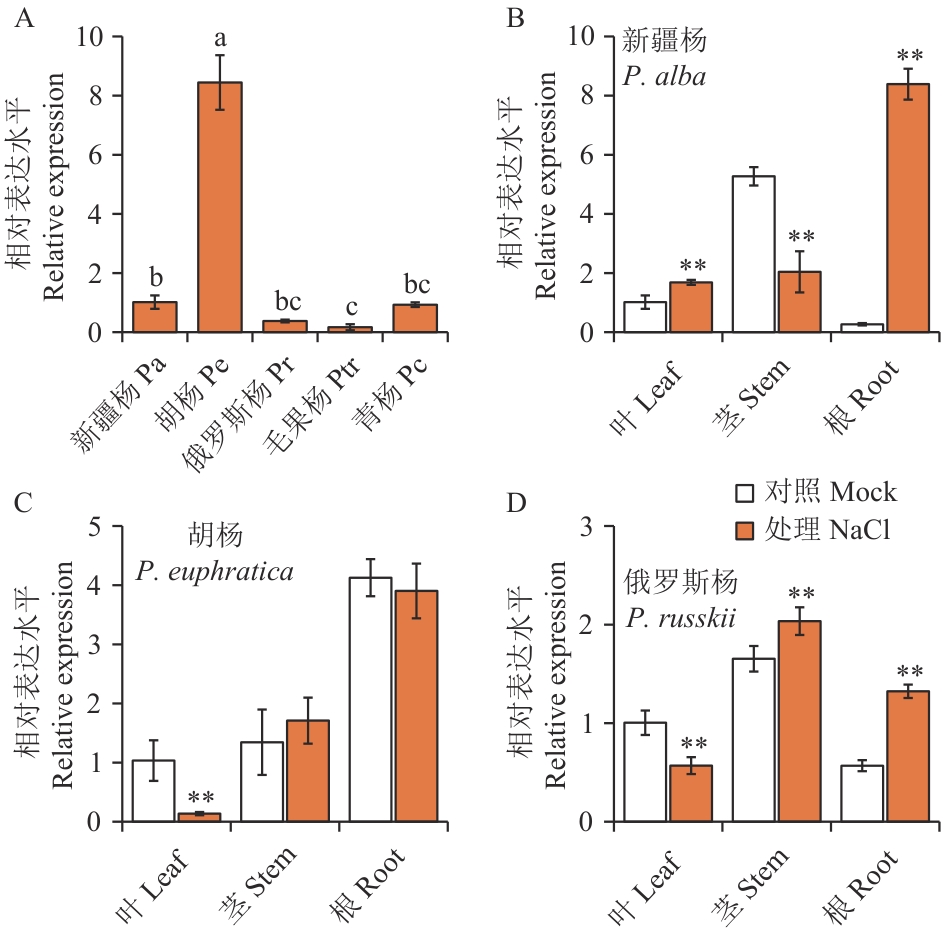
图1 不同杨树中SOS1基因的表达水平及其对盐胁迫的响应A:新疆杨、胡杨、俄罗斯杨、毛果杨和青杨等不同杨树叶片中SOS1的相对表达水平。将SOS1在新疆杨叶片中的表达水平设为1。不同小写字母表示经邓肯氏检验在P<0.05的水平上差异显著。B,C,D:盐胁迫下新疆杨(B)、胡杨(C)和俄罗斯杨(D)植株不同部位中SOS1表达水平的变化。以温室盆栽培养2月(新疆杨和俄罗斯杨扦插苗)或6月(胡杨实生苗)的树苗为试验材料进行盐胁迫处理,在含有5 L土壤的花盆中浇灌1 L 200 mmol/L NaCl溶液,每12 h浇250 mL,在第1次浇灌后48 h取样。以相同方式浇灌1 L去离子水作为对照。将各树种对照组叶片中SOS1的表达水平均设为1。**表示处理与对照之间差异极显著(t-test,P<0.01)
Fig. 1 Relative expressions of SOS1 genes in different poplar species and their responses to salt stressA: The relative expressions of SOS1 in the leaves of P. alba (Pa), P. euphratica (Pe), P. russkii (Pr), P. trichocarpa (Ptr) and P. cathayana (Pc). The relative expression of SOS1 in the leaves of Pa was set to 1. Different normal letters indicate statistical significance among different tree species at P<0.05 level by Duncan's test. B, C, D: The response to salt stress of SOS1 genes in different parts of Pa (B), Pe (C) and Pr (D). Two-month-old greenhouse potted cuttings of Pa or Pr, or six-month-old seedlings of Pe were used as experimental materials for salt stress treatment. In pots with 5 L soils, 200 mmol/L NaCl solution was irrigated every 12 h, 250 mL each time, for a total of 4 times. Samples were collected 48 h after the first irrigation. The same way, 1 L of deionized water was irrigated as the mock. The expressions of SOS1 genes in the leaves of the mock group of each tree species was set to 1. ** indicates statistical significance between the treatment and the mock (t-test, P<0.01)

图2 杨树SOS1基因启动子载体的构建和转基因株系鉴定A:杨树SOS1基因启动子扩增片段的电泳检测;B:杨树SOS1基因启动子上的顺式作用元件;C:启动子载体的双酶切鉴定;D:载体结构示意图;E:转基因植株的PCR鉴定;F:转基因试管苗叶片的GUS组织化学染色。M为DNA分子量标准Trans2K Plus (A),TaKaRa DL15000 (C)和Trans15K (E);Pa:新疆杨,Pe:胡杨,Pr:俄罗斯杨;TSS:转录起始位点,ATG:起始密码子;NPT Ⅱ:新霉素磷酸转移酶Ⅱ,NOS-T:胭脂碱合成酶基因的终止子;+:正对照;-:负对照;CaMV 35Spro:花椰菜花叶病毒35S启动子;Pa-1、Pa-2、Pa-6等为不同转基因株系
Fig. 2 Construction of vectors for poplar SOS1 promoters and the identification of transgenic linesA: Electrophoresis detection of the amplified fragment of the poplar SOS1 promoters. B: Cis-acting elements of the PopulusSOS1 gene promoters. C: Double digestion of the promoter vectors. D: Schematic diagrams of the vectors. E: Identification of transgenic plants by PCR. F: GUS histochemical staining of transgenic plantlet leaves. M indicates Trans2K Plus DNA marker (A), TaKaRa DL15000 (C), and Trans15K (E); Pa: P. alba, Pe: P. euphratica, Pr: P. russkii; TSS: transcription start site; ATG: start codon. NPT Ⅱ: Neomycin phosphotransferase Ⅱ; NOS-T: nopaline synthase gene terminator. +: Positive control; -: negative control; CaMV35Spro: Cauliflower mosaic virus 35S promoter; Pa-1, Pa-2, Pa-6, etc. are different transgenic lines

图3 盐胁迫下转基因杨树的GUS组织化学染色及GUS活性定量分析A:用打孔器从成熟叶片上采集的叶盘进行GUS组织化学染色;B:茎段第5节节间部位横切面的GUS组织化学染色;C:根尖部位GUS组织化学染色;D:不同组织部位的GUS活性。用含100 mmol/L NaCl的1/2霍格兰溶液处理砂培杨树苗,盐胁迫处理7 d时采样。对照为不额外添加NaCl的1/2霍格兰溶液进行培养。每个启动子均采用了3个株系进行试验,变化模式较一致,因此仅展示其中1个株系的染色结果。标尺为1 cm(A)或1 mm(B和C)。*表示处理与对照之间差异显著(t-test, P<0.05),**表示处理与对照之间差异极显著(t-test, P<0.01)
Fig. 3 GUS histochemical staining and quantitative analysis of GUS activity in transgenic poplar under salt stressGUS histochemical staining of leaf discs (A) collected from mature leaves using a punch, transverse section of the 5th internode of the stem (B), and root tips (C). D: GUS activity of different plant parts. Sand-cultured poplars were treated with 1/2 Hoagland solution containing 100 mmol/L NaCl for 7 d before sampling. The mock was cultured with 1/2 Hoagland solution without additional NaCl. Three lines were used for each promoter, and the change pattern was consistent, thus the staining results of only one of them were shown. Scale bars: 1 cm (A) or 1 mm (B and C). * and ** indicate statistical significance by t-test between the treatment and the mock at P<0.05 or P<0.01, respectively
| [1] | Munns R, Tester M. Mechanisms of salinity tolerance [J]. Annu Rev Plant Biol, 2008, 59: 651-681. |
| [2] | 王甜甜, 郝怀庆, 冯雪, 等. 植物HKT蛋白耐盐机制研究进展 [J]. 植物学报, 2018, 53(5): 710-725. |
| Wang TT, Hao HQ, Feng X, et al. Research advances in the function of the high-affinity K+ transporter (HKT) proteins and plant salt tolerance [J]. Chinese Bull Bot, 2018, 53(5): 710-725. | |
| [3] | Navada S, Vadstein O, Gaumet F, et al. Biofilms remember: Osmotic stress priming as a microbial management strategy for improving salinity acclimation in nitrifying biofilms [J]. Water Res, 2020, 176: 115732. |
| [4] | Almeida DM, Margarida Oliveira M, Saibo NJM. Regulation of Na+ and K+ homeostasis in plants: towards improved salt stress tolerance in crop plants [J]. Genet Mol Biol, 2017, 40(1 ): 326-345. |
| [5] | Pan T, Liu MM, Kreslavski VD, et al. Non-stomatal limitation of photosynthesis by soil salinity [J]. Crit Rev Environ Sci Technol, 2021, 51(8): 791-825. |
| [6] | Brett CL, Donowitz M, Rao R. Evolutionary origins of eukaryotic sodium/proton exchangers [J]. Am J Physiol Cell Physiol, 2005, 288(2): C223-C239. |
| [7] | Blumwald E, Aharon GS, Apse MP. Sodium transport in plant cells [J]. Biochim Biophys Acta, 2000, 1465(1/2): 140-151. |
| [8] | Ali A, Petrov V, Yun DJ, et al. Revisiting plant salt tolerance: novel components of the SOS pathway [J]. Trends Plant Sci, 2023, 28(9): 1060-1069. |
| [9] | Shi H, Ishitani M, Kim C, et al. The Arabidopsis thaliana salt tolerance gene SOS1 encodes a putative Na+/H+ antiporter [J]. Proc Natl Acad Sci USA, 2000, 97(12): 6896-6901. |
| [10] | 朱业胜, 伍国强, 魏明. 质膜Na+/H+逆向转运蛋白SOS1在植物离子稳态平衡中的作用 [J]. 生物技术通报, 2023, 39(12): 16-32. |
| Zhu YS, Wu GQ, Wei M. Roles of plasma membrane Na+/H+ antiporter SOS1 in maintaining ionic homeostasis of plants [J]. Biotechnol Bull, 2023, 39(12): 16-32. | |
| [11] | Olías R, Eljakaoui Z, Li J, et al. The plasma membrane Na+/H+ antiporter SOS1 is essential for salt tolerance in tomato and affects the partitioning of Na+ between plant organs [J]. Plant Cell Environ, 2009, 32(7): 904-916. |
| [12] | Wu SJ, Ding L, Zhu JK. SOS1, a genetic locus essential for salt tolerance and potassium acquisition [J]. Plant Cell, 1996, 8(4): 617-627. |
| [13] | Martínez-Atienza J, Jiang XY, Garciadeblas B, et al. Conservation of the salt overly sensitive pathway in rice [J]. Plant Physiol, 2007, 143(2): 1001-1012. |
| [14] | Xu HX, Jiang XY, Zhan KH, et al. Functional characterization of a wheat plasma membrane Na+/H+ antiporter in yeast [J]. Arch Biochem Biophys, 2008, 473(1): 8-15. |
| [15] | Qiu QS, Guo Y, Dietrich MA, et al. Regulation of SOS1, a plasma membrane Na+/H+ exchanger in Arabidopsis thaliana, by SOS2 and SOS3 [J]. Proc Natl Acad Sci USA, 2002, 99(12): 8436-8441. |
| [16] | Liu J, Ishitani M, Halfter U, et al. The Arabidopsis thaliana SOS2 gene encodes a protein kinase that is required for salt tolerance [J]. Proc Natl Acad Sci USA, 2000, 97(7): 3730-3734. |
| [17] | Liu J, Zhu JK. A calcium sensor homolog required for plant salt tolerance [J]. Science, 1998, 280(5371): 1943-1945. |
| [18] | Lu KK, Song RF, Guo JX, et al. CycC1;1-WRKY75 complex-mediated transcriptional regulation of SOS1 controls salt stress tolerance in Arabidopsis [J]. Plant Cell, 2023, 35(7): 2570-2591. |
| [19] | Tuskan GA, Difazio S, Jansson S, et al. The genome of black cottonwood, Populus trichocarpa (Torr. & Gray) [J]. Science, 2006, 313(5793): 1596-1604. |
| [20] | 谢望, 李天静, 李鑫窈, 等. 胡杨PeNAC121基因启动子的分离鉴定和胁迫应答模式分析 [J]. 植物研究, 2022, 42(2): 234-242. |
| Xie W, Li TJ, Li XY, et al. Identification of PeNAC121 gene promoter and stress response pattern analysis in Populus euphratica [J]. Bull Bot Res, 2022, 42(2): 234-242. | |
| [21] | 高永峰, 杨丰铭, 李琴中, 等. 番茄SlWRKY31基因启动子的克隆与逆境应答模式分析 [J]. 西北植物学报, 2018, 38(12): 2155-2164. |
| Gao YF, Yang FM, Li QZ, et al. Cloning and analysis of stress response pattern of SlWRKY31 gene promoter from tomato [J]. Acta Bot Boreali Occidentalia Sin, 2018, 38(12): 2155-2164. | |
| [22] | Reguera M, Bassil E, Blumwald E. Intracellular NHX-type cation/H+ antiporters in plants [J]. Mol Plant, 2014, 7(2): 261-263. |
| [23] | Zhou HP, Wang CW, Tan TH, et al. Patellin1 negatively modulates salt tolerance by regulating PM Na+/H+ antiport activity and cellular redox homeostasis in Arabidopsis [J]. Plant Cell Physiol, 2018, 59(10): 2165. |
| [24] | Shi HZ, Quintero FJ, Pardo JM, et al. The putative plasma membrane Na(+)/H(+) antiporter SOS1 controls long-distance Na(+) transport in plants [J]. Plant Cell, 2002, 14(2): 465-477. |
| [25] | 黄伦增, 许云泓, 孟凡文, 等. 杨树PtTST3基因启动子克隆及表达活性分析 [J]. 分子植物育种, 2022, 20(17): 5649-5657. |
| Huang LZ, Xu YH, Meng FW, et al. Cloning and expression activity analysis of PtTST3 gene promoter in poplar [J]. Mol Plant Breeding, 2022, 20(17): 5649-5657. | |
| [26] | Guan QM, Wu JM, Yue XL, et al. A nuclear calcium-sensing pathway is critical for gene regulation and salt stress tolerance in Arabidopsis [J]. PLoS Genet, 2013, 9(8): e1003755. |
| [27] | Liscovitch-Brauer N, Montalbano A, Deng JL, et al. Profiling the genetic determinants of chromatin accessibility with scalable single-cell CRISPR screens [J]. Nat Biotechnol, 2021, 39(10): 1270-1277. |
| [28] | Inaba Y, Zhong WQ, Zhang XH, et al. Specificity of expression of the GUS reporter gene (uidA) driven by the tobacco ASA2 promoter in soybean plants and tissue cultures [J]. J Plant Physiol, 2007, 164(7): 824-834. |
| [29] | Maghuly F, Khan MA, Fernandez EB, et al. Stress regulated expression of the GUS-marker gene (uidA) under the control of plant calmodulin and viral 35S promoters in a model fruit tree rootstock: Prunus incisa x Serrula [J]. J Biotechnol, 2008, 135(1): 105-116. |
| [30] | El Mahi H, Pérez-Hormaeche J, De Luca A, et al. A critical role of sodium flux via the plasma membrane Na+/H+ exchanger SOS1 in the salt tolerance of rice [J]. Plant Physiol, 2019, 180(2): 1046-1065. |
| [1] | 王芳, 乔帅, 宋伟, 崔鹏娟, 廖安忠, 谭文芳, 杨松涛. 甘薯IbNRT2基因家族全基因组鉴定和表达分析[J]. 生物技术通报, 2025, 41(7): 193-204. |
| [2] | 魏雨佳, 李岩, 康语涵, 弓晓楠, 杜敏, 涂岚, 石鹏, 于子涵, 孙彦, 张昆. 白颖苔草CrMYB4基因的克隆和表达分析[J]. 生物技术通报, 2025, 41(7): 248-260. |
| [3] | 张泽, 杨秀丽, 宁东贤. 花生4CL基因家族鉴定及对干旱与盐胁迫响应分析[J]. 生物技术通报, 2025, 41(7): 117-127. |
| [4] | 李小欢, 陈相宇, 陶麒宇, 朱玲, 唐铭, 姚银安, 汪丽君. PtoMYB61对毛白杨木质素合成及耐盐性的影响[J]. 生物技术通报, 2025, 41(6): 284-296. |
| [5] | 程珊, 王会伟, 陈晨, 朱雅婧, 李春鑫, 别海, 王树峰, 陈献功, 张向歌. 油莎豆MYB转录因子基因CeMYB154克隆及耐盐功能分析[J]. 生物技术通报, 2025, 41(6): 218-228. |
| [6] | 杨春, 王晓倩, 王红军, 晁跃辉. 蒺藜苜蓿MtZHD4基因克隆、亚细胞定位及表达分析[J]. 生物技术通报, 2025, 41(5): 244-254. |
| [7] | 宋慧洋, 苏宝杰, 李京昊, 梅超, 宋倩娜, 崔福柱, 冯瑞云. 马铃薯StAS2-15基因的克隆及盐胁迫下功能分析[J]. 生物技术通报, 2025, 41(5): 119-128. |
| [8] | 李志强, 罗正乾, 徐琳黎, 周国慧, 屈丝雨, 刘恩良, 顼东婷. 基于T2T基因组鉴定大豆R2R3-MYB基因家族及干旱和盐胁迫下的表达分析[J]. 生物技术通报, 2025, 41(5): 141-152. |
| [9] | 刘涛, 王志淇, 吴文博, 石文婷, 王超楠, 杜崇, 杨中敏. 马铃薯GRAM基因家族鉴定与表达分析[J]. 生物技术通报, 2025, 41(4): 145-155. |
| [10] | 梁丽存, 王克芬, 宋祖洹, 刘梦婷, 李佳玉, 罗会颖, 姚斌, 杨浩萌. 优化sgRNA提高塔宾曲霉基因编辑效率[J]. 生物技术通报, 2025, 41(3): 62-70. |
| [11] | 林紫依, 吴一舟, 叶芳贤, 朱淑颖, 刘燕敏, 刘骕骦. 大豆GmPM31基因启动子响应高温高湿胁迫的功能分析[J]. 生物技术通报, 2025, 41(3): 90-97. |
| [12] | 李彩霞, 李艺, 穆宏秀, 林俊轩, 白龙强, 孙美华, 苗妍秀. 中国南瓜bHLH转录因子家族的鉴定与生物信息学分析[J]. 生物技术通报, 2025, 41(1): 186-197. |
| [13] | 袁柳娇, 黄文琳, 陈崇志, 梁敏, 黄梓淇, 陈雪雪, 陈日檬, 王锂韫. 盐胁迫对广藿香叶片生理特性、超微结构及药效成分的影响[J]. 生物技术通报, 2025, 41(1): 230-239. |
| [14] | 寇焙森, 程萌萌, 郭雪琴, 葛彬, 刘迪, 陆海, 李慧. 组蛋白去乙酰化酶抑制剂TSA处理对杨树茎生长发育的影响[J]. 生物技术通报, 2025, 41(1): 240-251. |
| [15] | 张静安, 胡孝龙, 曹蓓蓓, 廖敏, 束长龙, 张杰, 王奎, 操海群. 苏云金芽胞杆菌可视化快速表达载体的构建与特性分析[J]. 生物技术通报, 2025, 41(1): 95-102. |
| 阅读次数 | ||||||
|
全文 |
|
|||||
|
摘要 |
|
|||||
