







生物技术通报 ›› 2026, Vol. 42 ›› Issue (9): 316-326.doi: 10.13560/j.cnki.biotech.bull.1985.2025-1247
• 研究报告 • 上一篇
聂雨杉1, 张艳芳1, 袁舒琪1, 李娜1, 索宁宁1, 谭桂莲2, 霍秀文1( )
)
收稿日期:2025-11-17
出版日期:2026-09-26
发布日期:2026-09-16
通讯作者:
霍秀文huoxiuwen@imau.edu.cn基金资助:
NIE Yu-shan1, ZHANG Yan-fang1, YUAN Shu-qi1, LI Na1, SUO Ning-ning1, TAN Gui-lian2, HUO Xiu-wen1()
Received:2025-11-17
Published:2026-09-26
Online:2026-09-16
摘要:
目的 鉴定并分析山药DoAGPL基因家族(DoAGPLs)成员,为阐明山药淀粉合成分子机制及抗逆代谢网络提供依据。 方法 采用生物信息学方法对DoAGPLs编码蛋白的理化性质、系统进化关系及基因结构等方面进行分析;利用RT-qPCR分析其在不同发育时期、组织及非生物胁迫下的表达模式;对DoAGPL1进行亚细胞定位,采用酵母双杂交技术(Y2H)和双分子荧光互补(BiFC)实验验证DoAGPL1与DoAGPS、DoMADS的互作关系。 结果 鉴定出6个山药DoAGPLs成员,编码275-561个氨基酸,系统发育树将其分为4支,含10个保守基序。RT-qPCR显示,DoAGPL1在块茎中高表达,在块茎膨大早期表达下调、盛期上调,DoAGPL1可能是调控块茎淀粉合成的一个核心基因。此外,DoAGPL1对低温和干旱胁迫有响应,且各基因成员在不同非生物胁迫中具有不同程度的表达。亚细胞定位表明DoAGPL1蛋白定位于细胞核和细胞膜,通过酵母双杂交筛选出DoAGPS、DoMADS为DoAGPL1的互作蛋白并验证它们之间存在互作关系。 结论 从山药转录组和蛋白组中共鉴定出6个DoAGPLs成员,其中DoAGPL1基因受低温和干旱胁迫上调,并在山药块茎中高表达,表明其在山药响应逆境及块茎膨大阶段的淀粉合成中具有潜在调控作用。
聂雨杉, 张艳芳, 袁舒琪, 李娜, 索宁宁, 谭桂莲, 霍秀文. 山药AGPL基因家族鉴定及DoAGPL1互作蛋白筛选[J]. 生物技术通报, 2026, 42(9): 316-326.
NIE Yu-shan, ZHANG Yan-fang, YUAN Shu-qi, LI Na, SUO Ning-ning, TAN Gui-lian, HUO Xiu-wen. Identification of the AGPL Gene Family in Yam and Screening of DoAGPL1 Interacting Proteins[J]. Biotechnology Bulletin, 2026, 42(9): 316-326.
基因名称 Gene name | 蛋白长度 Protein length (aa) | 相对分子量 Molecular weight (Da) | 理论等电点 Isoelectric point | 不稳定指数 Instability index | 亲水性 Grand average of hydropathicity | 脂肪系数 Aliphatic index | 亚细胞定位预测 Subcellular localization prediction |
|---|---|---|---|---|---|---|---|
| DoAGPL1 | 533 | 59 161.22 | 7.05 | 35.403 | -0.116 | 82.48 | 细胞膜/叶绿体 |
| DoAGPL2 | 533 | 59 182.18 | 6.53 | 34.883 | -0.114 | 82.48 | 细胞质 |
| DoAGPL3 | 550 | 60 270.60 | 6.84 | 44.561 | -0.229 | 87.45 | 叶绿体 |
| DoAGPL4 | 561 | 62 279.13 | 9.25 | 37.753 | -0.243 | 85.92 | 叶绿体 |
| DoAGPL5 | 307 | 34 795.22 | 6.02 | 37.229 | -0.181 | 88.93 | 细胞质 |
| DoAGPL6 | 275 | 31 206.12 | 7.72 | 35.696 | -0.193 | 90.07 | 细胞质 |
表1 山药DoAGPLs蛋白理化性质
Table 1 Physicochemical properties of DoAGPLs protein
基因名称 Gene name | 蛋白长度 Protein length (aa) | 相对分子量 Molecular weight (Da) | 理论等电点 Isoelectric point | 不稳定指数 Instability index | 亲水性 Grand average of hydropathicity | 脂肪系数 Aliphatic index | 亚细胞定位预测 Subcellular localization prediction |
|---|---|---|---|---|---|---|---|
| DoAGPL1 | 533 | 59 161.22 | 7.05 | 35.403 | -0.116 | 82.48 | 细胞膜/叶绿体 |
| DoAGPL2 | 533 | 59 182.18 | 6.53 | 34.883 | -0.114 | 82.48 | 细胞质 |
| DoAGPL3 | 550 | 60 270.60 | 6.84 | 44.561 | -0.229 | 87.45 | 叶绿体 |
| DoAGPL4 | 561 | 62 279.13 | 9.25 | 37.753 | -0.243 | 85.92 | 叶绿体 |
| DoAGPL5 | 307 | 34 795.22 | 6.02 | 37.229 | -0.181 | 88.93 | 细胞质 |
| DoAGPL6 | 275 | 31 206.12 | 7.72 | 35.696 | -0.193 | 90.07 | 细胞质 |
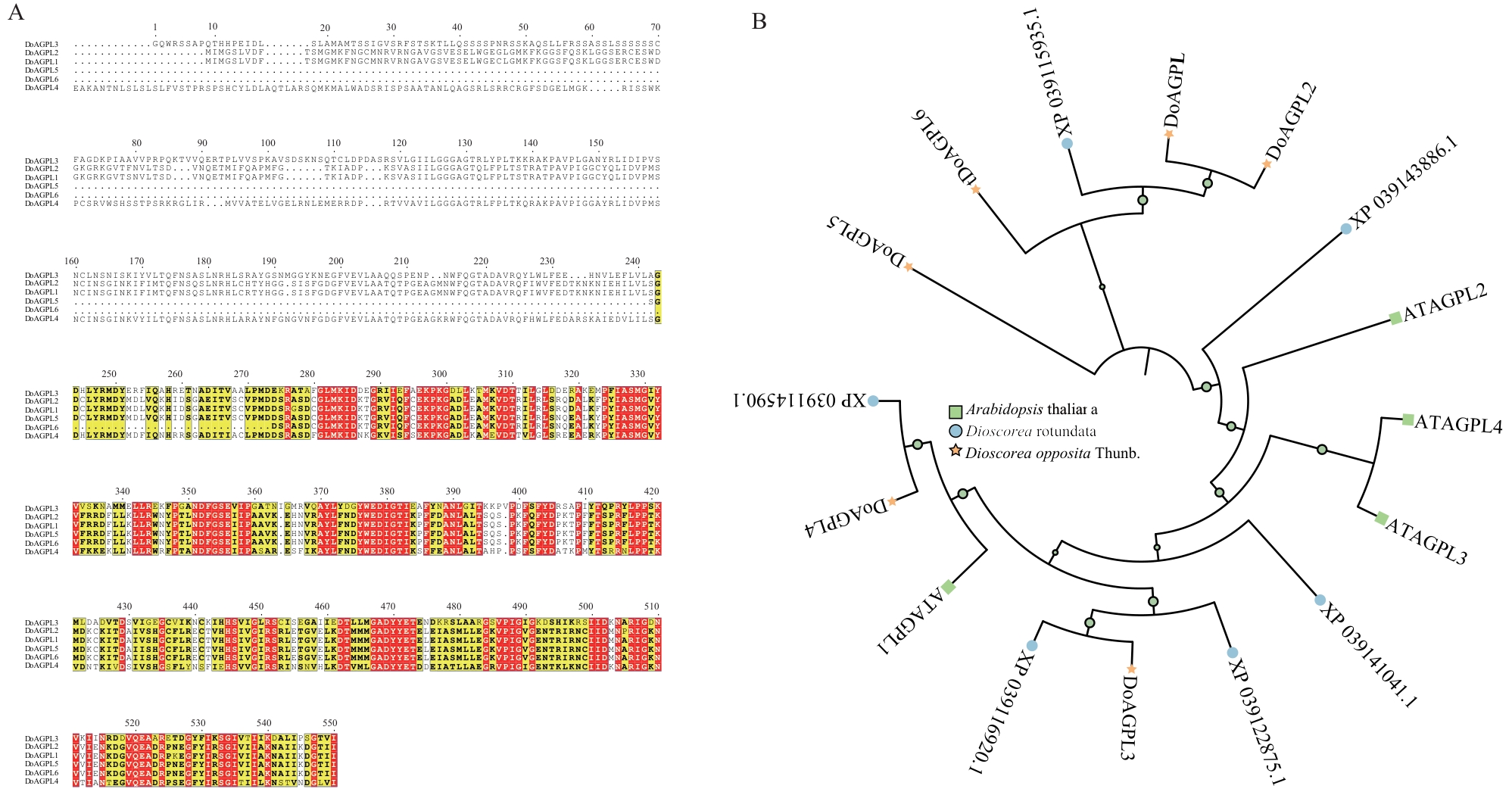
图1 DoAGPLs的多序列比对及系统进化分析A:多序列比对;B:DoAGPLs的系统进化树分析
Fig. 1 Multiple sequence alignment and phylogeneic tree analysis of DoAGPLsA: Multiple sequence alignment. B: Phylogeneic tree analysis of DoAGPLs
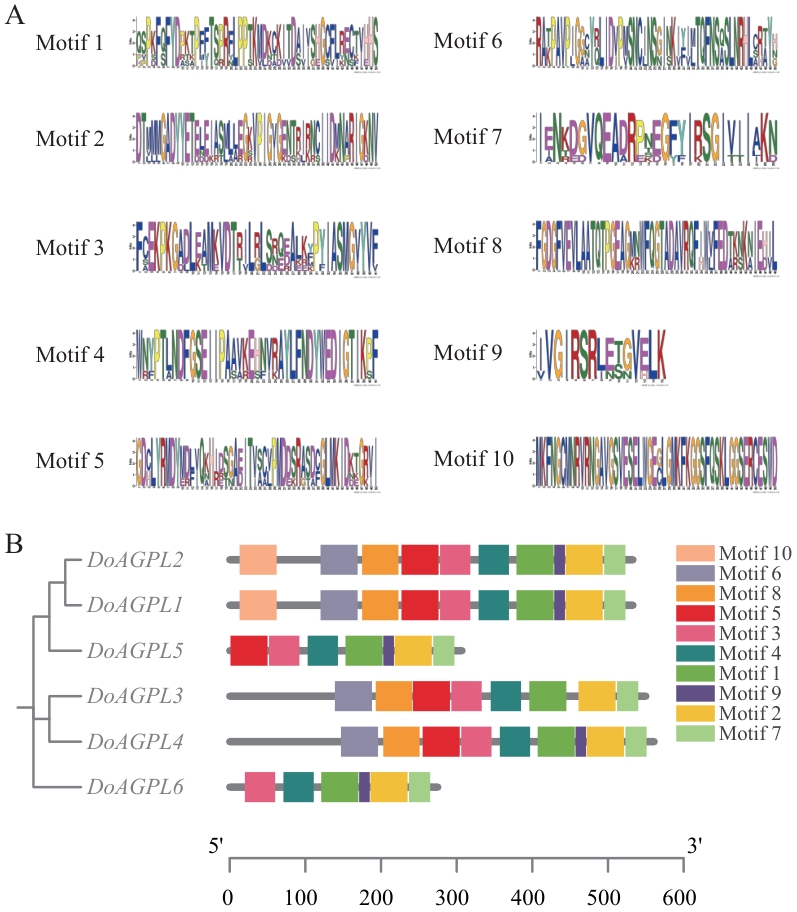
图2 DoAGPLs保守基序分析A:基序序列徽标(每个字母的高度表示该位置氨基酸出现的频率);B:保守基序
Fig. 2 Conserved motifs analysis of the DoAGPLsA: Motif sequence logo (the height of each letter indicates the frequency of amino acid occurrence at that position); B: conserved motifs
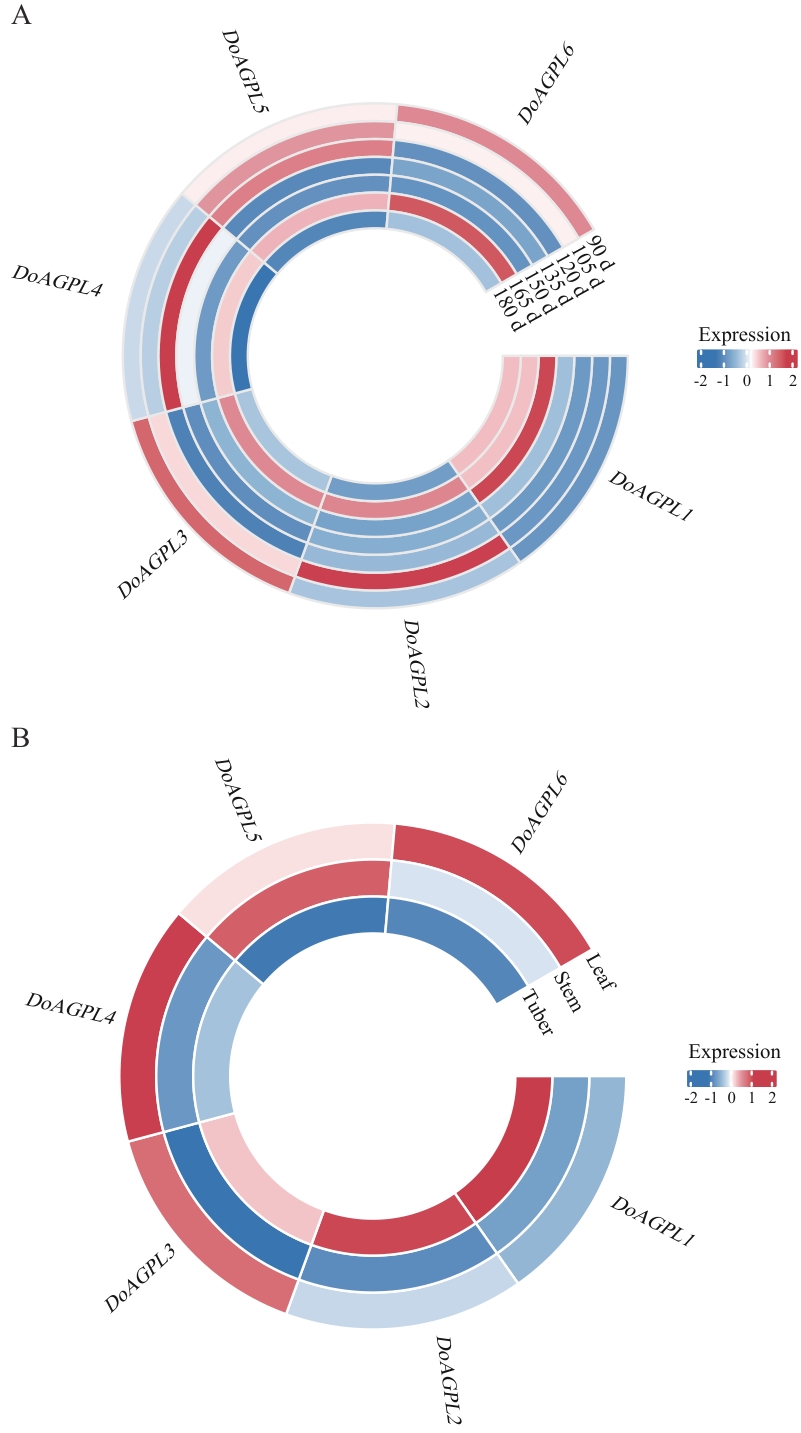
图3 DoAGPLs在山药不同发育时期及不同组织的表达模式分析A:山药转录组数据中DoAGPLs的表达分析;B:DoAGPLs在不同组织中的表达分析
Fig. 3 Analysis of expression patterns of the DoAGPLs in different developmental stages and tissues of the yamA: Expression analysis of DoAGPLs in yam transcriptome data. B: Expression analysis of DoAGPLs in different tissues of yam
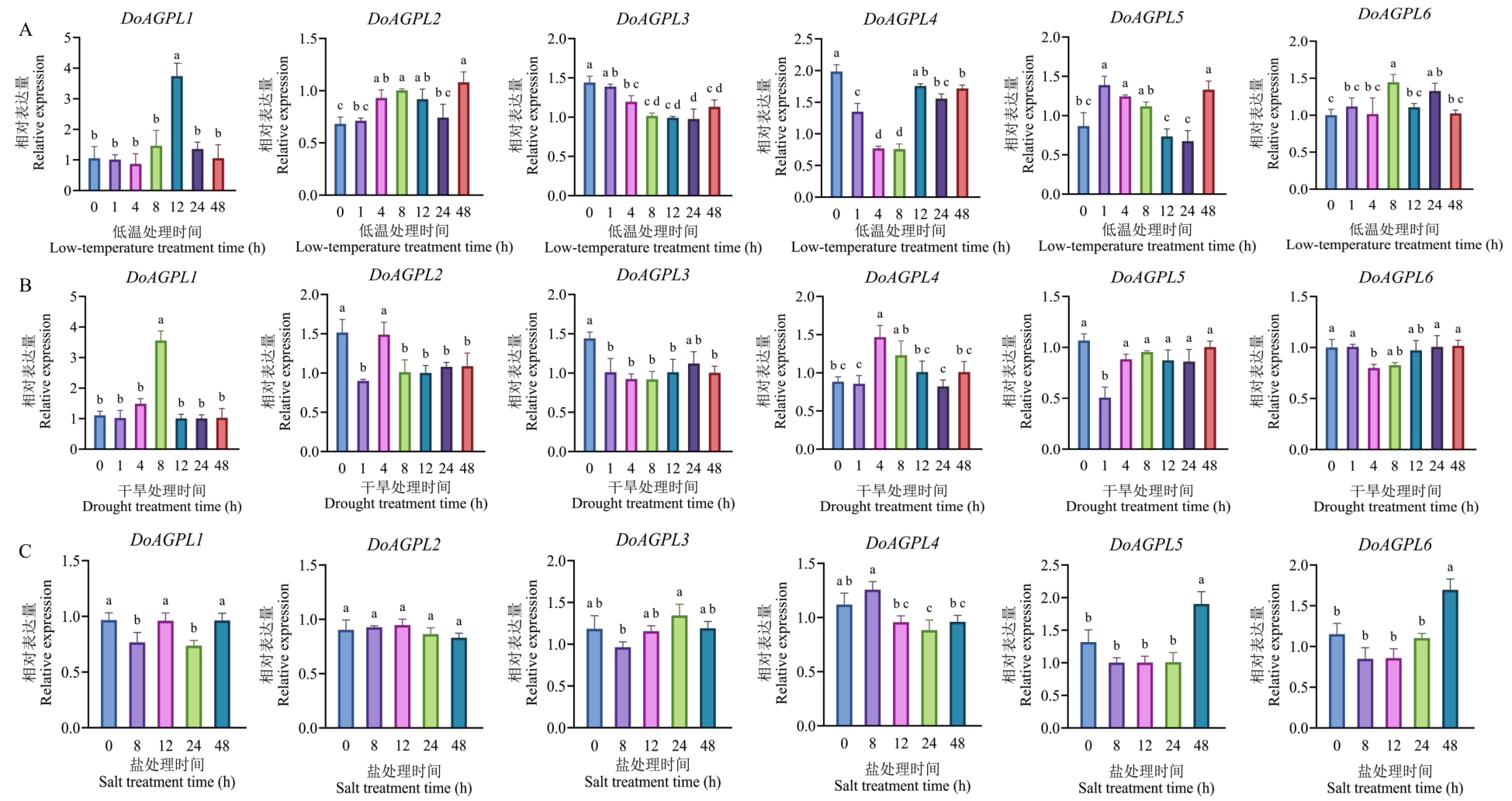
图4 不同非生物胁迫处理下DoAGPLs的表达模式分析A:低温处理;B:干旱处理;C:盐处理;不同小写字母表示P<0.05水平差异显著
Fig. 4 Expression pattern analysis of DoAGPLs under different abiotic stressA: Low-temperature treatment. B: Drought treatment. C: Salt treatment. Different lowercase letters indicate significant difference at P<0.05 level
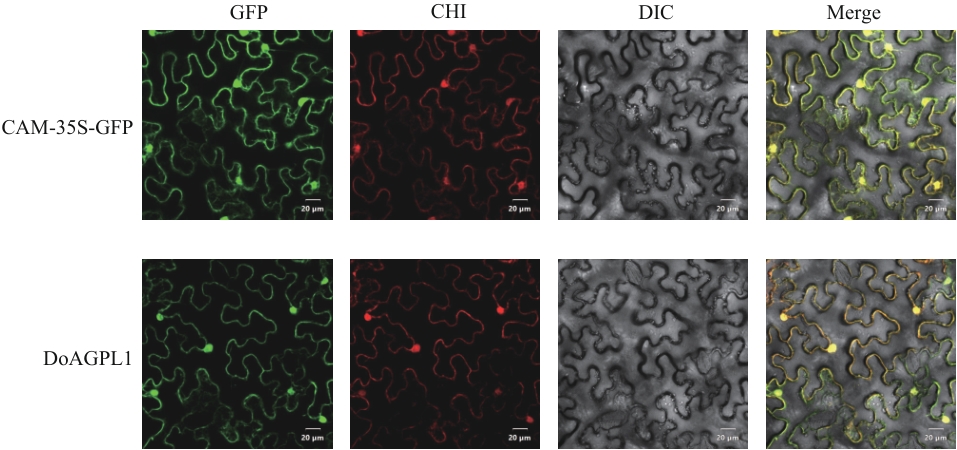
图5 DoAGPL1的亚细胞定位
Fig. 5 Subcellular localization of DoAGPL1
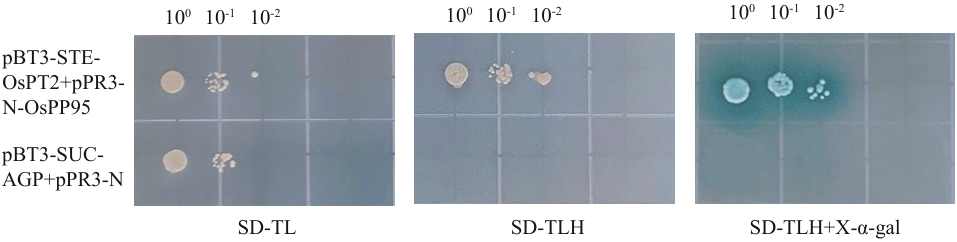
图6 诱饵载体 pBT3-SUC-DoAGPL1 的自激活检测
Fig. 6 Self-activation detection of the bait vector pBT3-SUC-DoAGPL1
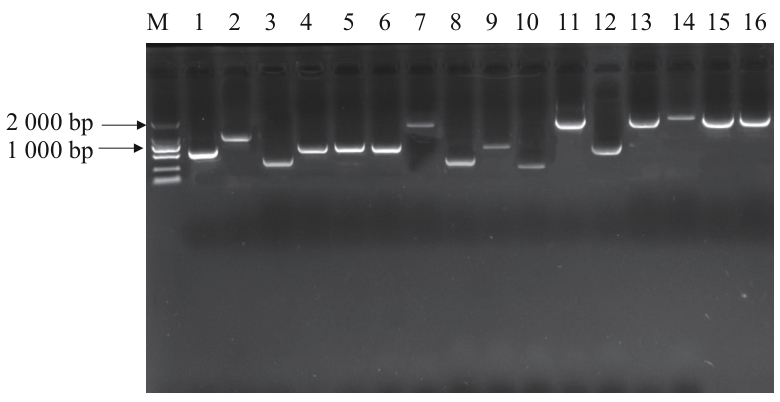
图7 阳性克隆菌落PCR检测M:DL2 000 DNA标记;1-16:菌液PCR结果
Fig. 7 Positive clonal colonies were detected by PCRM: DL2 000 DNA marker; 1-16: PCR results of 1-16 bacterial solution
| 编号 No. | 功能注释 Function annotation | 序列号 Serial number |
|---|---|---|
| 1 | 葡萄糖-1-磷酸腺苷基转移酶小亚基 | XM_039260986.1 |
| 2 | SPX结构域含蛋白4 | XM_039273168.1 |
| 3 | NAC结构域的蛋白74样 | XM_039268517.1 |
| 4 | MADS-box蛋白 | XM_039259047.1 |
表2 互作蛋白Blast分析
Table 2 Blast analysis of interacted proteins
| 编号 No. | 功能注释 Function annotation | 序列号 Serial number |
|---|---|---|
| 1 | 葡萄糖-1-磷酸腺苷基转移酶小亚基 | XM_039260986.1 |
| 2 | SPX结构域含蛋白4 | XM_039273168.1 |
| 3 | NAC结构域的蛋白74样 | XM_039268517.1 |
| 4 | MADS-box蛋白 | XM_039259047.1 |
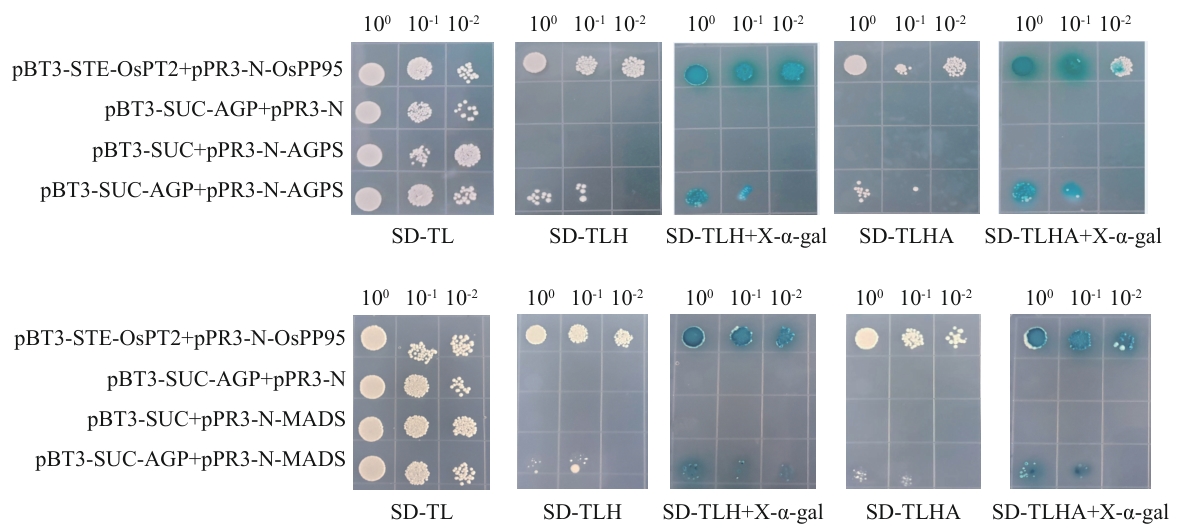
图8 DoAGPL1与DoAGPS/MADSF互作验证
Fig. 8 Verification of interaction between DoAGPL1 and DoAGPS/MADS
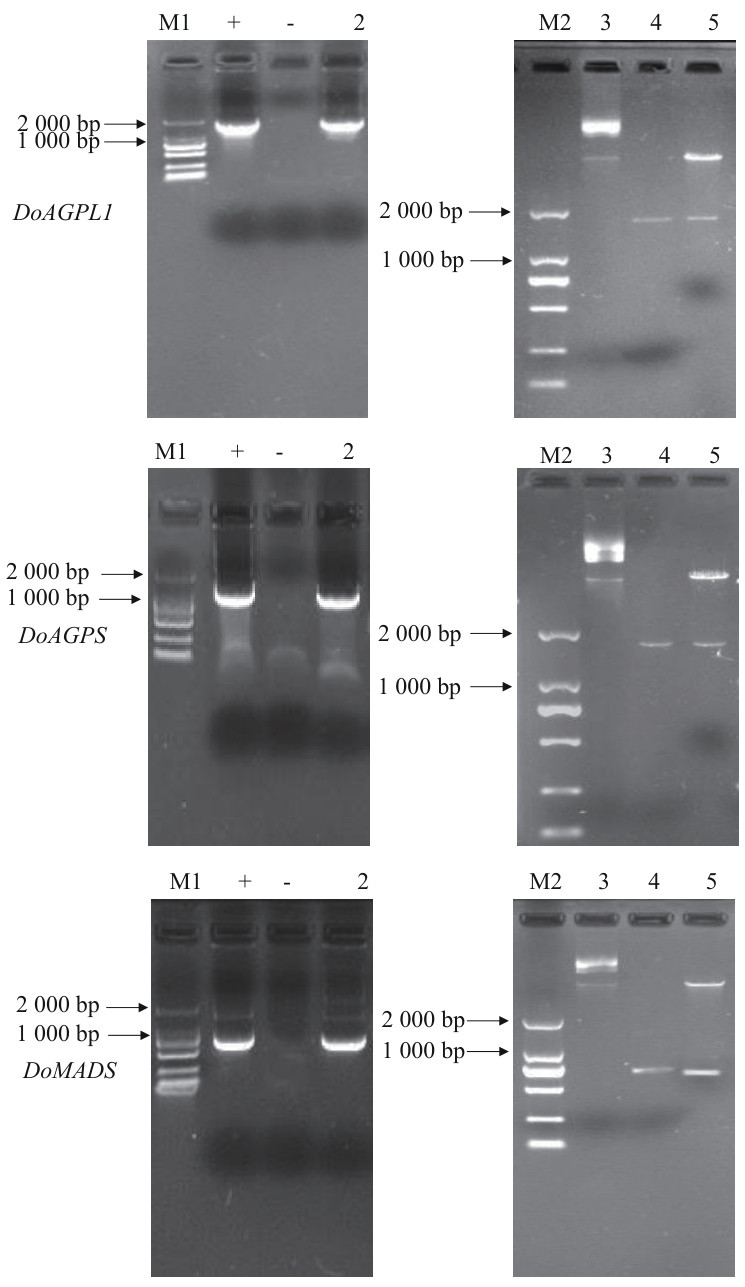
图9 AGPL、AGPS、MADS载体构建的质粒PCR和双酶切鉴定M1,M2:DL2 000 DNA标记;+:阳性对照;-:阴性对照;2:PCR扩增产物;3:重组质粒;4:阳性对照;5:酶切鉴定
Fig. 9 AGPL, AGPS, MADS plasmid PCR and double enzyme digestion identification of vector constructionM1, M2: DL2 000 DNA marker; +: positive control; -: negative control; 2: PCR amplification product; 3: recombinant plasmid; 4: positive control; 5: enzyme digestion identification
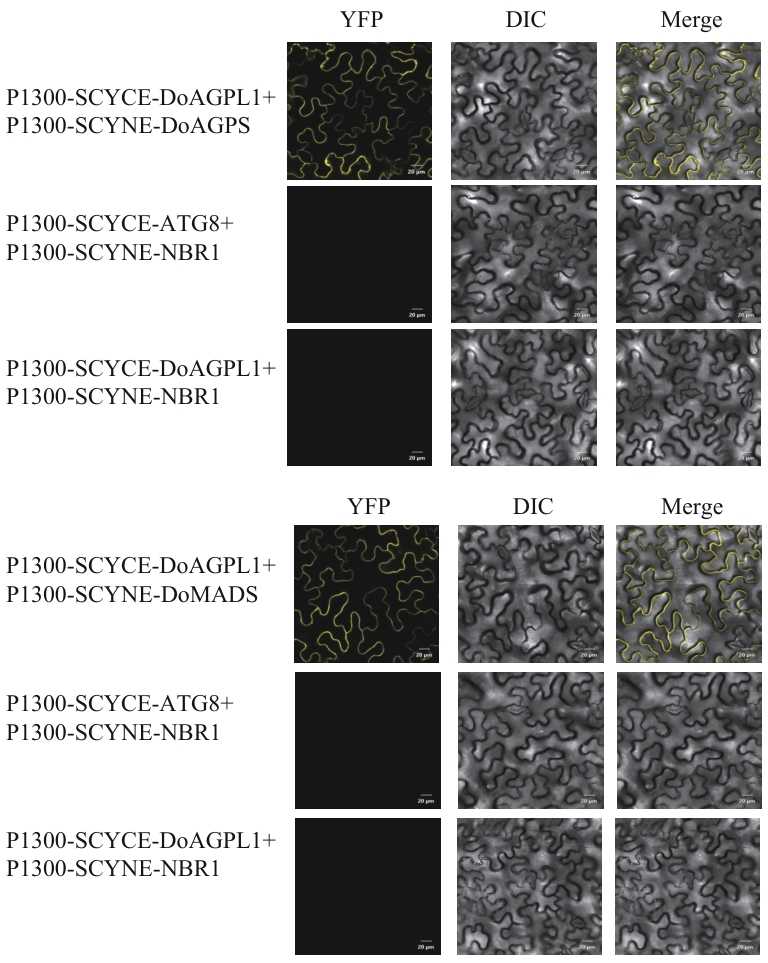
图10 双分子荧光互补验证蛋白互作关系
Fig. 10 BiFC verifying the interaction of proteins
| [1] | Shan N, Wang PT, Zhu QL, et al. Comprehensive characterization of yam tuber nutrition and medicinal quality of Dioscorea opposita and D. alata from different geographic groups in China [J]. J Integr Agric, 2020, 19(11): 2839-2848. |
| [2] | 李月仙, 黄东益, 黄小龙, 等. 山药的研究进展 [J]. 中国农学通报, 2009, 25(9): 91-96. |
| Li YX, Huang DY, Huang XL, et al. Progress of study on Dioscorea opposita thunb [J]. Chin Agric Sci Bull, 2009, 25(9): 91-96. | |
| [3] | 覃维治, 韦本辉, 甘秀芹, 等. 不同淮山药种质(品种)的粘度比较与聚类分析 [J]. 南方农业学报, 2012, 43(2): 176-179. |
| Qin WZ, Wei BH, Gan XQ, et al. Comparative analysis of different yam (Dioscorea opposita Thunb.) germplasm resources and their clustering on the basis of viscosity characteristics [J]. J South Agric, 2012, 43(2): 176-179. | |
| [4] | 孙怡青. 山药(Dioscorea opposita thunb.)BAM1和BAM3基因克隆及BAM1功能鉴定与互作蛋白筛选 [D]. 呼和浩特: 内蒙古农业大学, 2025. |
| Sun YQ. Cloning of BAM1 and BAM3 genes and functional identification of BAM1 with interaction protein screening in Chinese yam (Dioscorea opposita thunb.) [D]. Hohhot: Inner Mongolia Agricultural University, 2025. | |
| [5] | Tuncel A, Okita TW. Improving starch yield in cereals by over-expression of ADP glucose pyrophosphorylase: Expectations and unanticipated outcomes [J]. Plant Sci, 2013, 211: 52-60. |
| [6] | Espada J. Enzymic synthesis of adenosine diphosphate glucose from glucose 1-phosphate and adenosine triphosphate [J]. J Biol Chem, 1962, 237(12): 3577-3581. |
| [7] | 周彩琴, 王丽娟. 腺苷二磷酸葡萄糖焦磷酸化酶研究进展 [J]. 农业科学研究, 2011, 32(2): 56-59. |
| Zhou CQ, Wang LJ. Advances of research on ADP-glucose pyrophosphorylase [J]. J Agric Sci, 2011, 32(2): 56-59. | |
| [8] | Georgelis N, Braun EL, Shaw JR, et al. The two AGPase subunits evolve at different rates in angiosperms, yet they are equally sensitive to activity-altering amino acid changes when expressed in bacteria [J]. Plant Cell, 2007, 19(5): 1458-1472. |
| [9] | Crevillén P, Ventriglia T, Pinto F, et al. Differential pattern of expression and sugar regulation of Arabidopsis thaliana ADP-glucose pyrophosphorylase-encoding genes [J]. J Biol Chem, 2005, 280(9): 8143-8149. |
| [10] | Lu FH, Park YJ. Sequence variations in OsAGPase significantly associated with amylose content and viscosity properties in rice (Oryza sativa L.) [J]. Genet Res, 2012, 94(4): 179-189. |
| [11] | Tang XJ, Peng C, Zhang J, et al. ADP-glucose pyrophosphorylase large subunit 2 is essential for storage substance accumulation and subunit interactions in rice endosperm [J]. Plant Sci, 2016, 249: 70-83. |
| [12] | Han SX, Lin YH, Meng YY, et al. Genome-wide identification and analysis of SUS and AGPase family members in sweet potato: response to excessive nitrogen stress during storage root formation [J]. Int J Mol Sci, 2024, 25(15): 8236. |
| [13] | 王明, 肖鑫辉, 应东山, 等. 木薯AGPase基因家族的生物信息学及其表达分析 [J]. 南方农业学报, 2019, 50(2): 222-229. |
| Wang M, Xiao XH, Ying DS, et al. Bioinformatics and expression of AGPase gene family in cassava [J]. J South Agric, 2019, 50(2): 222-229. | |
| [14] | Mistry J, Chuguransky S, Williams L, et al. Pfam: The protein families database in 2021 [J]. Nucleic Acids Res, 2021, 49(D1): D412-D419. |
| [15] | Artimo P, Jonnalagedda M, Arnold K, et al. ExPASy: SIB bioinformatics resource portal [J]. Nucleic Acids Res, 2012, 40(W1): W597-W603. |
| [16] | Horton P, Park KJ, Obayashi T, et al. WoLF PSORT: protein localization predictor [J]. Nucleic Acids Res, 2007, 35(): W585-W587. |
| [17] | Kumar S, Nei M, Dudley J, et al. MEGA: a biologist-centric software for evolutionary analysis of DNA and protein sequences [J]. Brief Bioinform, 2008, 9(4): 299-306. |
| [18] | Li N, Zhang YF, Huo XW, et al. Genome-wide identification and expression profiling of plasma membrane-localized SWEET gene family associated with sugar transport during yam tuber development [J]. Int J Mol Sci, 2025, 26(12): 5847. |
| [19] | Xing LN, Zhang YF, Xing YP, et al. Reference genes selection and validation in yam by real-time quantitative polymerase chain reaction [J]. Sci Rep, 2025, 15: 19947. |
| [20] | Qu JZ, Xu ST, Zhang ZQ, et al. Evolutionary, structural and expression analysis of core genes involved in starch synthesis [J]. Sci Rep, 2018, 8: 12736. |
| [21] | 赵步洪, 张文杰, 常二华, 等. 水稻灌浆期籽粒中淀粉合成关键酶的活性变化及其与灌浆速率和蒸煮品质的关系 [J]. 中国农业科学, 2004, 37(8): 1123-1129. |
| Zhao BH, Zhang WJ, Chang EH, et al. Changes in activities of the key enzymes related to starch synthesis in rice grains during grain filling and their relationships with the filling rate and cooking quality [J]. Sci Agric Sin, 2004, 37(8): 1123-1129. | |
| [22] | 梁任繁, 李创珍, 张娟, 等. 山药块茎发育中物质积累及相关代谢酶变化 [J]. 作物学报, 2011, 37(5): 903-910. |
| Liang RF, Li CZ, Zhang J, et al. Changes of matter accumulation and relative enzymatic activity during yam tuber development [J]. Acta Agron Sin, 2011, 37(5): 903-910. | |
| [23] | Batra R, Saripalli G, Mohan A, et al. Comparative analysis of AGPase genes and encoded proteins in eight monocots and three dicots with emphasis on wheat [J]. Front Plant Sci, 2017, 8: 19. |
| [24] | 晁毛妮, 董洁, 胡根海, 等. 陆地棉AGPase基因家族的鉴定及表达分析 [J]. 棉花学报, 2022, 34(4): 299-312. |
| Chao MN, Dong J, Hu GH, et al. Identification and expression analysis of AGPase gene family in upland cotton (Gossypium hirsutum L.) [J]. Cotton Sci, 2022, 34(4): 299-312. | |
| [25] | 何芳练, 刘莉莉, 蒋慧萍, 等. 芋ADP-葡萄糖焦磷酸化酶(AGPase)基因家族的克隆、生物信息学及表达分析 [J]. 热带作物学报, 2022, 43(8): 1554-1564. |
| He FL, Liu LL, Jiang HP, et al. Cloning, bioinformatics and expression analysis of ADP-glucose py-rophosphorylase gene family in Colocasia esculenta [J]. Chin J Trop Crops, 2022, 43(8): 1554-1564. | |
| [26] | Dickinson DB, Preiss J. ADP glucose pyrophosphorylase from maize endosperm [J]. Arch Biochem Biophys, 1969, 130: 119-128. |
| [27] | 石桃雄, 唐彬, 任蓉蓉, 等. 苦荞AGPase编码基因FtAGPL和FtAGPS全基因组鉴定和表达分析 [J]. 贵州师范大学学报: 自然科学版, 2021, 39(4): 52-57. |
| Shi TX, Tang B, Ren RR, et al. Genome-wide identification and gene expression analyses of AGPase encoding genes FtAGPL and FtAGPS in Tartary buckwheat (Fagopyrum tataricum) [J]. J Guizhou Norm Univ Nat Sci, 2021, 39(4): 52-57. | |
| [28] | Dong MY, Fan XW, Li YZ. Cassava AGPase genes and their encoded proteins are different from those of other plants [J]. Planta, 2019, 250(5): 1621-1635. |
| [29] | Miao HX, Sun PG, Liu Q, et al. The AGPase family proteins in banana: genome-wide identification, phylogeny, and expression analyses reveal their involvement in the development, ripening, and abiotic/biotic stress responses [J]. Int J Mol Sci, 2017, 18(8): 1581. |
| [30] | La Cognata U, Willmitzer L, Müller-Röber B. Molecular cloning and characterization of novel isoforms of potato ADP-glucose pyrophosphorylase [J]. Molec Gen Genet, 1995, 246(5): 538-548. |
| [31] | Chao MN, Zhang QF, Huang L, et al. ADP-glucose pyrophosphorylase gene family in soybean and implications in drought stress tolerance [J]. Genes Genom, 2024, 46(10): 1183-1199. |
| [32] | Akihiro T, Mizuno K, Fujimura T. Gene expression of ADP-glucose pyrophosphorylase and starch contents in rice cultured cells are cooperatively regulated by sucrose and ABA [J]. Plant Cell Physiol, 2005, 46(6): 937-946. |
| [33] | 董洁, 李鸽子, 韩巧霞, 等. 小麦TaAGPL1基因上游转录因子TabHLH39的分离及其功能研究 [J]. 中国农业科技导报, 2020, 22(10): 18-26. |
| Dong J, Li GZ, Han QX, et al. Isolation and function of TabHLH39 transcription factor regulating expression of the TaAGPL1 gene in bread wheat [J]. J Agric Sci Technol, 2020, 22(10): 18-26. | |
| [34] | Meng Q, Zhang WQ, Hu X, et al. Two ADP-glucose pyrophosphorylase subunits, OsAGPL1 and OsAGPS1, modulate phosphorus homeostasis in rice [J]. Plant J, 2020, 104(5): 1269-1284. |
| [35] | Kaur V, Madaan S, Behl RK. ADP-glucose pyrophosphorylase activity in relation to yield potential of wheat: Response to independent and combined high temperature and drought stress [J]. Cereal Res Commun, 2017, 45(2): 181-191. |
| [36] | Ku AT, Huang YS, Wang YS, et al. IbMADS1 (Ipomoea batatas MADS-box 1 gene) is involved in tuberous root initiation in sweet potato (Ipomoea batatas) [J]. Ann Bot, 2008, 102(1): 57-67. |
| [37] | Xia YF, Jiang SX, Ren YY, et al. Genome-wide identification of MADS-box gene family members in poplar and functional characterization of PagMADS23a in the regulation of stomatal density [J]. Ind Crops Prod, 2026, 241: 122735. |
| [1] | 袁舒琪, 张艳芳, 聂雨杉, 李娜, 索宁宁, 谭桂莲, 霍秀文. 山药HXKs鉴定及DoHXK3互作蛋白验证[J]. 生物技术通报, 2026, 42(9): 306-315. |
| [2] | 谭澍, 沈红建, 高晓磊, 尹倩, 邹锋. 油茶MYB转录因子家族鉴定及CoMYB107基因在雄蕊发育中的功能分析[J]. 生物技术通报, 2026, 42(9): 196-209. |
| [3] | 董向向, 侯威威, 缪百灵, 陈娟娟, 李亮杰, 翟敏, 朱庆松, 刘松虎. 过表达森林草莓FvBBX22促进拟南芥花青素合成和延迟开花时间[J]. 生物技术通报, 2026, 42(9): 231-237. |
| [4] | 吕正, 连如赢, 刘怡德, 刘易科, 宁强, 王书平. 小麦HD-Zip基因家族的鉴定及对禾谷镰刀菌的响应[J]. 生物技术通报, 2026, 42(8): 123-132. |
| [5] | 秦娟, 卢蔚雯, 李佳徽, 李晨, 李斌, 王治业. 红花2个G6PDH基因的克隆与表达特征分析[J]. 生物技术通报, 2026, 42(8): 217-228. |
| [6] | 陈萃, 兰丽霞, 苏梦雨, 翁年东, 张震. 苹果蛋白磷酸酶基因MdPP2C24的克隆及功能鉴定[J]. 生物技术通报, 2026, 42(8): 153-161. |
| [7] | 阎晓光, 杜艳伟, 马志远, 王彬, 王国梁, 胡丹珠. 玉米ZmDIR基因家族的全基因组鉴定与表达模式分析[J]. 生物技术通报, 2026, 42(7): 126-137. |
| [8] | 段雅馨, 李成晨, 潘玉玲, 王丽, 安康, 李小波, 祝光涛, 刘计涛. 马铃薯LEA_2基因家族鉴定及响应低温与激素功能分析[J]. 生物技术通报, 2026, 42(6): 40-52. |
| [9] | 张雅宁, 毛春力, 胡志勇, 杨丹, 吴佳海, 王碧娴, 黄琳凯. 象草Dof转录因子的全基因组分析及其对低温胁迫的响应[J]. 生物技术通报, 2026, 42(6): 267-278. |
| [10] | 金旋, 向芬, 戴翠婷, 杨辉, 李赛君, 刘红艳, 钱思维, 蔺万煌, 李维. 茶树CsTDIFL基因的克隆、表达特性分析及其对氨基酸合成的调控[J]. 生物技术通报, 2026, 42(5): 323-331. |
| [11] | 张欣, 陈骋, 霍元博, 黄仁丽, 张丽, 张凯, 童华荣, 袁连玉. 茶树CsCRD1基因的克隆及其对叶绿素生物合成的影响[J]. 生物技术通报, 2026, 42(5): 280-291. |
| [12] | 许孟歌, 宋火焱, 罗佳, 苏亿, 周会汶, 王灿, 孔可可. 大豆GmRLK19基因表达分析及互作蛋白的筛选[J]. 生物技术通报, 2026, 42(4): 92-100. |
| [13] | 苏燕竹, 李达, 张爱爱, 刘永光, 张秀荣, 薛其勤. 大豆CAD基因家族的鉴定及表达分析[J]. 生物技术通报, 2026, 42(4): 101-113. |
| [14] | 刘青媛, 吴洪启, 陈秀娥, 陈剑, 姜远泽, 何燕子, 喻奇伟, 刘仁祥. 转录因子NtMYB96a调控烟草耐旱性的功能研究[J]. 生物技术通报, 2026, 42(4): 239-250. |
| [15] | 陈登科, 兰刚, 夏芝, 侯保国, 杨六六, 曹彩荣, 李朋波, 吴翠翠. 花生ZF-HD基因家族的鉴定和非生物胁迫响应分析[J]. 生物技术通报, 2026, 42(4): 114-128. |
| 阅读次数 | ||||||
|
全文 |
|
|||||
|
摘要 |
|
|||||
