







生物技术通报 ›› 2026, Vol. 42 ›› Issue (11): 222-229.doi: 10.13560/j.cnki.biotech.bull.1985.2026-0173
• 研究报告 • 上一篇
武郁洁, 王宇倩, 刘翠双, 郁羽宵, 耿静泽, 盖颖( )
收稿日期:2026-02-04
出版日期:2026-11-26
发布日期:2026-11-03
通讯作者:
盖颖gaiying@bjfu.edu.cn基金资助:
WU Yu-jie, WANG Yu-qian, LIU Cui-shuang, YU Yu-xiao, GENG Jing-ze, GAI Ying()
Received:2026-02-04
Published:2026-11-26
Online:2026-11-03
摘要:
目的 亚硝酸盐还原酶(nitrite reductase, NiR)是植物氮同化关键酶,可催化亚硝酸盐还原为铵态氮,保障氮同化高效进行。研究日本落叶松(Larix kaempferi)LkNiR基因启动子的表达特性及亚硝酸盐胁迫响应规律,为选育氮高效利用型林木品种提供理论支撑。 方法 从日本落叶松基因组DNA中克隆LkNiR启动子序列,利用PlantCARE与PLACE数据库预测顺式作用元件;构建LkNiR-GFP报告载体,通过农杆菌介导的遗传转化获得转基因烟草(Nicotiana tabacum)及日本落叶松毛状根,结合PCR鉴定、荧光观察与RT-qPCR技术检测启动子活性;以100 mmol/L亚硝酸钠处理日本落叶松幼苗,采用RT-qPCR技术分析LkNiR基因的时序表达模式。 结果 LkNiR基因启动子(登录号:PV700087)全长1 941 bp,含TATA-box、CAAT-box等核心元件及多种激素与胁迫响应元件,LkNiR启动子含9个氮同化响应顺式元件。该启动子在转基因烟草中呈现组织偏好性表达,在根中活性较CaMV35S启动子高92.1%,在落叶松毛状根中活性较CaMV35S启动子高103.3%。亚硝酸盐胁迫下,LkNiR基因表达呈时空分化,根中早期快速响应,茎中响应平缓,叶中诱导最强且持续。 结论 LkNiR启动子具有明显的根部偏好表达特性,其活性受亚硝酸盐信号诱导且具有时空分化特征,在日本落叶松氮同化与逆境响应过程中发挥关键调控作用。
武郁洁, 王宇倩, 刘翠双, 郁羽宵, 耿静泽, 盖颖. 日本落叶松LkNiR启动子的克隆及表达特性分析[J]. 生物技术通报, 2026, 42(11): 222-229.
WU Yu-jie, WANG Yu-qian, LIU Cui-shuang, YU Yu-xiao, GENG Jing-ze, GAI Ying. Cloning and Expression Characteristics Analysis of LkNiR Promoter from Larix kaempferi[J]. Biotechnology Bulletin, 2026, 42(11): 222-229.
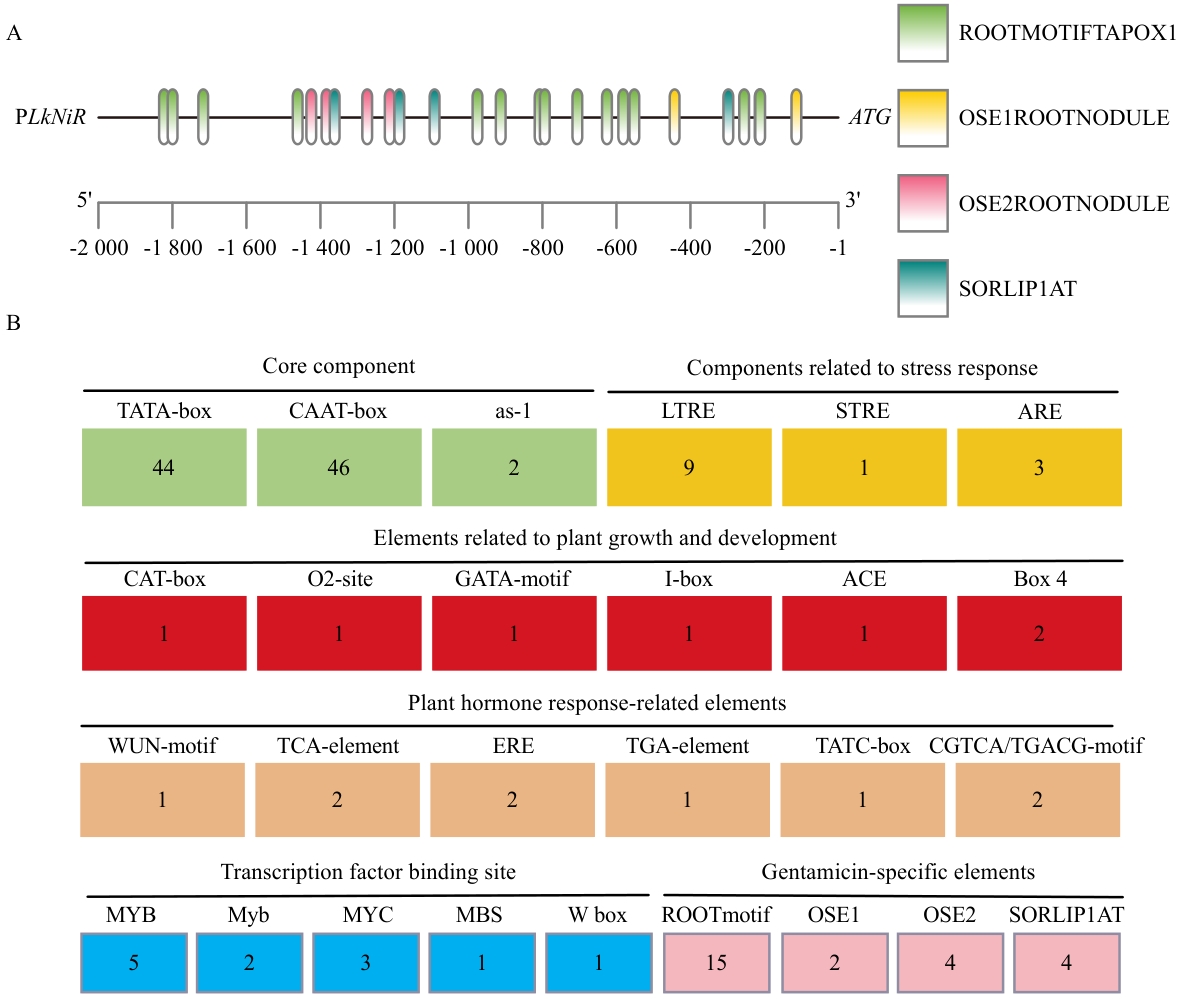
图1 LkNiR基因启动子顺式作用元件分布A:LkNiR基因启动子根特异性顺式作用元件分布;B:LkNiR基因启动子核心顺式作用元件数量
Fig. 1 Distribution of cis-acting elements in the LkNiR gene promoterA: Distribution of root-specific cis-acting elements in the LkNiR gene promoter. B: Number of core cis-acting elements in the LkNiR gene promoter
序号 No. | 物种 Species | 元件数量 No. of elements |
|---|---|---|
| 1 | 落叶松 Larix kaempferi | 9 |
| 2 | 油松 Pinus tabuliformis | 6 |
| 3 | 火炬松 Pinus taeda | 10 |
| 4 | 挪威云杉 Picea abies | 8 |
| 5 | 白云杉 Picea glauca | 3 |
| 6 | 杨树 Populus trichocarpa | 14 |
| 7 | 拟南芥 Arabidopsis thaliana | 5 |
| 8 | 大豆 Glycine max | 16 |
| 9 | 水稻 Oryza sativa | 10 |
| 10 | 玉米 Zea mays | 9 |
表1 不同物种NiR基因启动子中氮同化响应元件数量
Table 1 Number of nitrogen assimilation-responsive elements in NiR gene promoters from different species
序号 No. | 物种 Species | 元件数量 No. of elements |
|---|---|---|
| 1 | 落叶松 Larix kaempferi | 9 |
| 2 | 油松 Pinus tabuliformis | 6 |
| 3 | 火炬松 Pinus taeda | 10 |
| 4 | 挪威云杉 Picea abies | 8 |
| 5 | 白云杉 Picea glauca | 3 |
| 6 | 杨树 Populus trichocarpa | 14 |
| 7 | 拟南芥 Arabidopsis thaliana | 5 |
| 8 | 大豆 Glycine max | 16 |
| 9 | 水稻 Oryza sativa | 10 |
| 10 | 玉米 Zea mays | 9 |
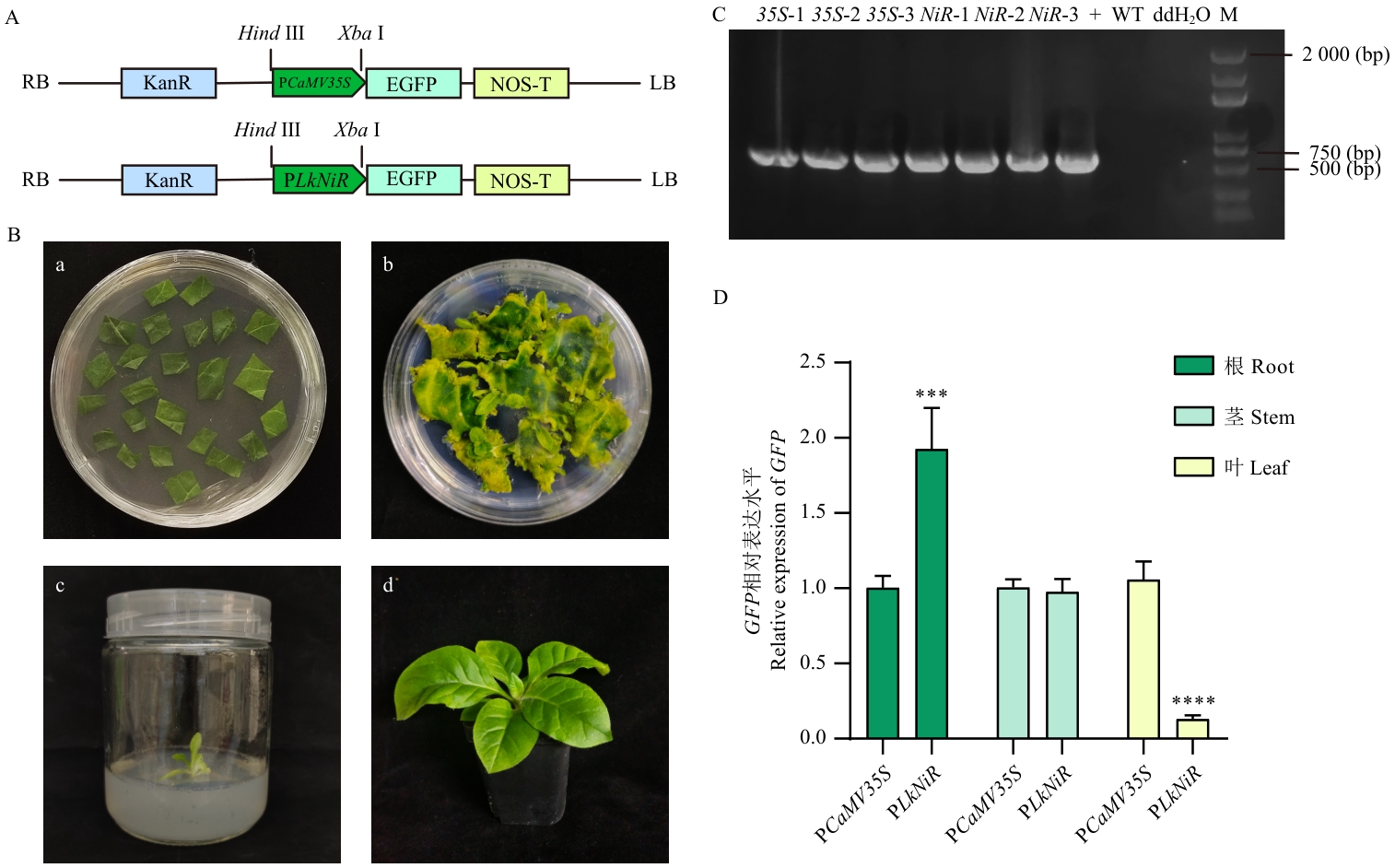
图2 转基因烟草中组织表达分析A:重组载体构建示意图;B:转基因烟草植株4个阶段(a:预培养,b:再生培养,c:生根培养,d:炼苗阶段);C:转基因烟草PCR鉴定结果(+:阳性对照,WT:野生型对照,ddH2O:阴性对照,M:2 000 bp DNA marker);D:转基因烟草根、茎、叶组织中GFP基因相对表达量。* P<0.05,** P<0.01,*** P<0.001,**** P<0.000 1(t-test)。下同
Fig. 2 Tissue expression analysis in transgenic tobaccoA: Schematic diagram of recombinant vector construction. B: Four stages of transgenic tobacco plants (a: pre-culture, b: regeneration culture, c: rooting culture, d: hardening stage). C: PCR identification result of transgenic tobacco (+: positive control; WT: wild-type control; ddH2O: negative control; M: 2 000 bp DNA marker). D: Relative expression level of GFP gene in roots, stems and leaves of transgenic tobacco.* P<0.05, ** P<0.01, *** P<0.001, **** P<0.000 1 (t-test). The same below
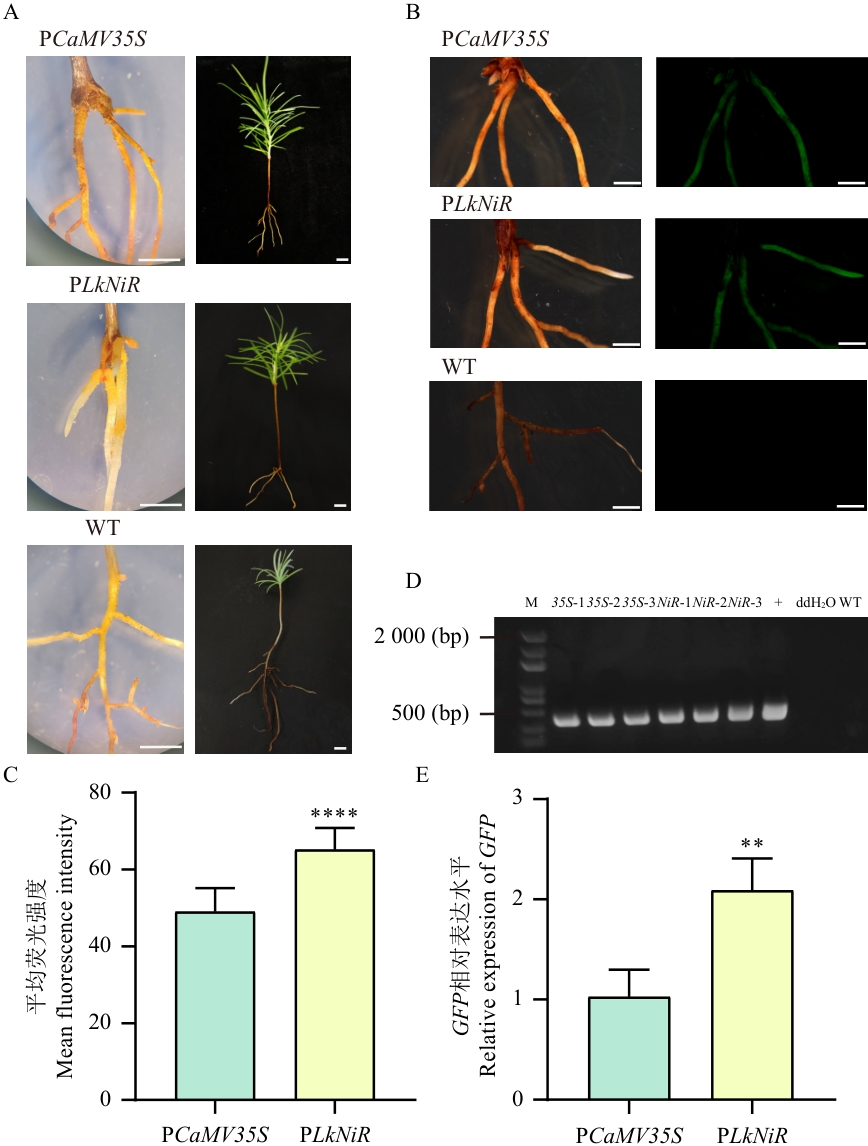
图3 转基因落叶松毛状根中LkNiR启动子活性分析A:落叶松毛状根表型观察,比例尺为5 mm;B:落叶松毛状根GFP荧光观察,比例尺为3 mm;C:转基因毛状根GFP荧光强度定量分析;D:转基因毛状根PCR鉴定结果;E:转基因毛状根GFP基因相对表达量
Fig. 3 Activity analysis of the LkNiR promoter in transgenic L. kaempferi hairy rootsA: Phenotypic observation of L. kaempferi hairy roots, scale bar=5 mm. B: GFP fluorescence observation of L. kaempferi hairy roots, scale bar=3 mm. C: Quantitative analysis of GFP fluorescence intensity in transgenic hairy roots. D: PCR identification result of transgenic hairy roots. E: Relative expression level of GFP gene in transgenic hairy roots
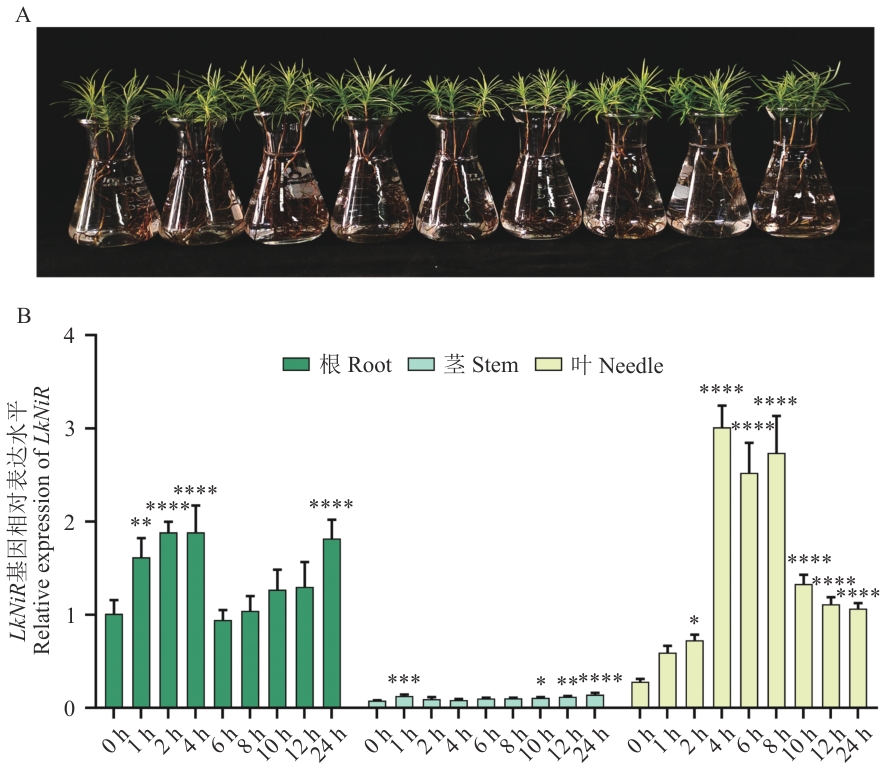
图4 LkNiR启动子响应亚硝酸盐胁迫的时空表达模式分析A:落叶松幼苗亚硝酸盐胁迫处理示意图;B:亚硝酸盐胁迫下LkNiR基因的时空表达模式分析
Fig. 4 Spatiotemporal expression pattern analysis of the LkNiR promoter in response to nitrite stressA: Schematic diagram of nitrite stress treatment on L. kaempferi seedlings. B: Spatiotemporal expression pattern analysis of the LkNiR gene under nitrite stress
| [1] | Chen GD, Wang L, Fabrice MR, et al. Physiological and nutritional responses of pear seedlings to nitrate concentrations [J]. Front Plant Sci, 2018, 9: 1679. |
| [2] | Du EZ, de Vries W. Links between nitrogen limitation and saturation in terrestrial ecosystems [J]. Glob Change Biol, 2025, 31(6): e70271. |
| [3] | Lan YH, Wang SQ, Zhang H, et al. Intercropping and nitrogen enhance eucalyptus productivity through the positive interaction between soil fertility factors and bacterial communities along with the maintenance of soil enzyme activities [J]. Land Degrad Dev, 2023, 34(8): 2403-2417. |
| [4] | Mattoo R, B M S. Microbial roles in the terrestrial and aquatic nitrogen cycle—implications in climate change [J]. FEMS Microbiol Lett, 2023, 370: fnad061. |
| [5] | 李思亮, 刘丛强, 肖化云. 地表环境氮循环过程中微生物作用及同位素分馏研究综述 [J]. 地质地球化学, 2002, 30(4): 40-45. |
| Li SL, Liu CQ, Xiao HY. Microbial effect on nitrogen cycle and nitrogen isotope fractionation on the Earth’s surface-a review [J]. Geology-geochemistry, 2002, 30(4): 40-45. | |
| [6] | Gao L, Smith AR, Geng BL, et al. Nitrogen uptake strategies of coexisting plant species in forest ecosystems of Northeast China: Implications for afforestation [J]. For Ecol Manag, 2025, 578: 122481. |
| [7] | Li ZH, Guan LK, Zhang CT, et al. Nitrogen assimilation genes in poplar: Potential targets for improving tree nitrogen use efficiency [J]. Ind Crops Prod, 2024, 216: 118705. |
| [8] | Wang X, Li J, Ge H, et al. Plant traits mediate foliar uptake of deposited nitrogen by mature woody plants [J]. Plant Cell Environ, 2024, 47(12): 4870-4885. |
| [9] | Zhang YJ, Si YL, Ju SB, et al. Synergistic effects of nitrogen deposition and phosphorus distribution patterns on root morphological and chemical traits, and nutrient efficiency in Chinese fir [J]. J Plant Ecol, 2025, 18(4): rtaf062. |
| [10] | 张庆芳, 李美玉, 王晓辉, 等. 微生物亚硝酸盐还原酶的研究进展 [J]. 微生物学通报, 2019, 46(11): 3148-3157. |
| Zhang QF, Li MY, Wang XH, et al. Research progress of microbial nitrite reductase [J]. Microbiol China, 2019, 46(11): 3148-3157. | |
| [11] | May Sandar Kyaing, 顾立江, 程红梅. 植物中硝酸还原酶和亚硝酸还原酶的作用 [J]. 生物技术进展, 2011, 1(3): 159-164. |
| Kyaing MS, Gu LJ, Cheng HM. The role of nitrate reductase and nitrite reductase in plant [J]. Curr Biotechnol, 2011, 1(3): 159-164. | |
| [12] | 郭晋艳, 郑晓瑜, 邹翠霞, 等. 植物非生物胁迫诱导启动子顺式元件及转录因子研究进展 [J]. 生物技术通报, 2011, 27(4): 16-20, 30. |
| Guo JY, Zheng XY, Zou CX, et al. Research progress of cis-elements of abiotic stress inducible promoters and associated transcription factors [J]. Biotechnol Bull, 2011, 27(4): 16-20, 30. | |
| [13] | 张超, 邓勇, 黄思齐, 等. 红麻亚硝酸还原酶基因HcNiR的克隆与表达分析 [J]. 福建农业学报, 2022, 37(5): 600-608. |
| Zhang C, Deng Y, Huang SQ, et al. Cloning and expression of nitrite reductase gene HcNiR in kenaf [J]. Fujian J Agric Sci, 2022, 37(5): 600-608. | |
| [14] | 张芸香, 吕世琪, 刘泰瑞, 等. 关帝山3个典型森林群落优势种的氮素利用策略差异 [J]. 林业科学, 2024, 60(2): 12-20. |
| Zhang YX, Lü SQ, Liu TR, et al. Differentiation of nitrogen use strategies of three typical forest community dominant species in Guandishan forest region [J]. Sci Silvae Sin, 2024, 60(2): 12-20. | |
| [15] | Sun C, Xie YH, Li Z, et al. The Larix kaempferi genome reveals new insights into wood properties [J]. J Integr Plant Biol, 2022, 64(7): 1364-1373. |
| [16] | Liu Z, Ren H, Zhang S, et al. Effects of long-term nitrogen addition on root nitrogen acquisition strategy: Insights from a 19-year experiment in two temperate tree species [J]. For Ecol Manag, 2024, 570: 122220. |
| [17] | Gao CC, Chen C, Liu N, et al. Genetic diversity and association analysis of traits related to water-use efficiency and nitrogen-use efficiency of Populus deltoides based on SSR markers [J]. Int J Mol Sci, 2024, 25(21): 11515. |
| [18] | Qin D, Wu R, Niu L, et al. Optimizing nitrogen use efficiency in forest plantations: mechanistic insights from Arabidopsis, crops, and natural forestry ecosystems [J]. For Res, 2025, 5: e029. |
| [19] | Lu JY, Sun N, Tian M, et al. Fluorescent Larix hairy root construction and its application to gene function in larch [J]. Plant Cell Tiss Organ Cult, 2025, 161: 23. |
| [20] | Kasten D, Mithöfer A, Georgii E, et al. Nitrite is the driver, phytohormones are modulators while NO and H2O2 act as promoters of NO2-induced cell death [J]. J Exp Bot, 2016, 67(22): 6337-6349. |
| [21] | Li XW, Zhang CL, Zhang BB, et al. Underappreciated role of canopy nitrogen deposition for forest productivity [J]. Proc Natl Acad Sci U S A, 2025, 122(34): e2508925122. |
| [22] | Kraus A, Spät P, Timm S, et al. Protein NirP1 regulates nitrite reductase and nitrite excretion in cyanobacteria [J]. Nat Commun, 2024, 15: 1911. |
| [23] | Han X, Wu K, Fu XD, et al. Improving coordination of plant growth and nitrogen metabolism for sustainable agriculture [J]. aBIOTECH, 2020, 1(4): 255-275. |
| [24] | Marchive C, Roudier F, Castaings L, et al. Nuclear retention of the transcription factor NLP7 orchestrates the early response to nitrate in plants [J]. Nat Commun, 2013, 4: 1713. |
| [25] | Yu J, Xuan W, Tian YL, et al. Enhanced OsNLP4-OsNiR cascade confers nitrogen use efficiency by promoting tiller number in rice [J]. Plant Biotechnol J, 2021, 19(1): 167-176. |
| [26] | Ge M, Wang YC, Liu YH, et al. The NIN-like protein 5 (ZmNLP5) transcription factor is involved in modulating the nitrogen response in maize [J]. Plant J, 2020, 102(2): 353-368. |
| [27] | Wei M, Zhang MQ, Sun JL, et al. PuHox52 promotes coordinated uptake of nitrate, phosphate, and iron under nitrogen deficiency in Populus ussuriensis [J]. J Integr Plant Biol, 2023, 65(3): 791-809. |
| [28] | Konishi M, Yanagisawa S. Identification of a nitrate-responsive cis-element in the Arabidopsis NIR1 promoter defines the presence of multiple cis-regulatory elements for nitrogen response [J]. Plant J, 2010, 63(2): 269-282. |
| [29] | 曹雄军, 卢晓鹏, 熊江, 等. 枳NLP转录因子响应干旱胁迫并与NRE顺式作用元件互作 [J]. 中国农业科学, 2018, 51(17): 3370-3378. |
| Cao XJ, Lu XP, Xiong J, et al. The Poncirus trifoliata (L.) Raf.NIN-like protein transcription factors responses to drought stress and bind the nitrate-responsive cis-element [J]. Sci Agric Sin, 2018, 51(17): 3370-3378. | |
| [30] | Konishi M, Yanagisawa S. Roles of the transcriptional regulation mediated by the nitrate-responsive cis-element in higher plants [J]. Biochem Biophys Res Commun, 2011, 411(4): 708-713. |
| [31] | Warning HO, Hachtel W. Functional analysis of a nitrite reductase promoter from birch in transgenic tobacco [J]. Plant Sci, 2000, 155(2): 141-151. |
| [32] | Sander L, Jensen PE, Back LF, et al. Structure and expression of a nitrite reductase gene from bean (Phaseolus vulgaris) and promoter analysis in transgenic tobacco [J]. Plant Mol Biol, 1995, 27(1): 165-177. |
| [33] | Zhang CY, Ye ZL, Qi LW, et al. Screening and functional evaluation of four Larix kaempferi promoters [J]. Plants, 2024, 13(19): 2777. |
| [1] | 谭澍, 沈红建, 高晓磊, 尹倩, 邹锋. 油茶MYB转录因子家族鉴定及CoMYB107基因在雄蕊发育中的功能分析[J]. 生物技术通报, 2026, 42(9): 196-209. |
| [2] | 袁舒琪, 张艳芳, 聂雨杉, 李娜, 索宁宁, 谭桂莲, 霍秀文. 山药HXKs鉴定及DoHXK3互作蛋白验证[J]. 生物技术通报, 2026, 42(9): 306-315. |
| [3] | 董向向, 侯威威, 缪百灵, 陈娟娟, 李亮杰, 翟敏, 朱庆松, 刘松虎. 过表达森林草莓FvBBX22促进拟南芥花青素合成和延迟开花时间[J]. 生物技术通报, 2026, 42(9): 231-237. |
| [4] | 聂雨杉, 张艳芳, 袁舒琪, 李娜, 索宁宁, 谭桂莲, 霍秀文. 山药AGPL基因家族鉴定及DoAGPL1互作蛋白筛选[J]. 生物技术通报, 2026, 42(9): 316-326. |
| [5] | 吕正, 连如赢, 刘怡德, 刘易科, 宁强, 王书平. 小麦HD-Zip基因家族的鉴定及对禾谷镰刀菌的响应[J]. 生物技术通报, 2026, 42(8): 123-132. |
| [6] | 陈萃, 兰丽霞, 苏梦雨, 翁年东, 张震. 苹果蛋白磷酸酶基因MdPP2C24的克隆及功能鉴定[J]. 生物技术通报, 2026, 42(8): 153-161. |
| [7] | 秦娟, 卢蔚雯, 李佳徽, 李晨, 李斌, 王治业. 红花2个G6PDH基因的克隆与表达特征分析[J]. 生物技术通报, 2026, 42(8): 217-228. |
| [8] | 阎晓光, 杜艳伟, 马志远, 王彬, 王国梁, 胡丹珠. 玉米ZmDIR基因家族的全基因组鉴定与表达模式分析[J]. 生物技术通报, 2026, 42(7): 126-137. |
| [9] | 李灿妮, 潘炜松, 吴泰茹, 吴川, 曾宝强, 李伟展. 胚乳生物反应器表达重组蛋白的研究进展[J]. 生物技术通报, 2026, 42(7): 67-80. |
| [10] | 周韬, 李亚强, 何慧娟, 虎海防, 陈同森, 潘越, 王天斌. 发根农杆菌介导文冠果(Xanthoceras sorbifolium)毛状根遗传转化体系的建立[J]. 生物技术通报, 2026, 42(7): 97-104. |
| [11] | 段雅馨, 李成晨, 潘玉玲, 王丽, 安康, 李小波, 祝光涛, 刘计涛. 马铃薯LEA_2基因家族鉴定及响应低温与激素功能分析[J]. 生物技术通报, 2026, 42(6): 40-52. |
| [12] | 孟洪玉, 刘亚楠, 武峻新, 申琼. 南瓜NAC转录因子基因家族鉴定及生物信息学分析[J]. 生物技术通报, 2026, 42(6): 237-249. |
| [13] | 沈晨, 车延年, 丁中平, 王祥文, 葛玉建, 符东青, 周亚星乔, 李瑞梅. 木薯采后生理变质相关基因MeGLYI-13上游转录因子的筛选[J]. 生物技术通报, 2026, 42(6): 98-106. |
| [14] | 张雅宁, 毛春力, 胡志勇, 杨丹, 吴佳海, 王碧娴, 黄琳凯. 象草Dof转录因子的全基因组分析及其对低温胁迫的响应[J]. 生物技术通报, 2026, 42(6): 267-278. |
| [15] | 金旋, 向芬, 戴翠婷, 杨辉, 李赛君, 刘红艳, 钱思维, 蔺万煌, 李维. 茶树CsTDIFL基因的克隆、表达特性分析及其对氨基酸合成的调控[J]. 生物技术通报, 2026, 42(5): 323-331. |
| 阅读次数 | ||||||
|
全文 |
|
|||||
|
摘要 |
|
|||||
