







生物技术通报 ›› 2026, Vol. 42 ›› Issue (9): 231-237.doi: 10.13560/j.cnki.biotech.bull.1985.2026-0204
• 植物发育生物学专题 • 上一篇
董向向, 侯威威, 缪百灵, 陈娟娟, 李亮杰, 翟敏, 朱庆松, 刘松虎( )
)
收稿日期:2026-02-10
出版日期:2026-09-26
发布日期:2026-09-16
通讯作者:
刘松虎2005190017@xyafu.edu.cn基金资助:
DONG Xiang-xiang, HOU Wei-wei, MIAO Bai-ling, CHEN Juan-juan, LI Liang-jie, ZHAI Min, ZHU Qing-song, LIU Song-hu()
Received:2026-02-10
Published:2026-09-26
Online:2026-09-16
摘要:
目的 BBX转录因子在植物生长发育过程中发挥着重要作用,探究森林草莓FvBBX22的生物学功能,为草莓分子育种提供基因资源。 方法 以森林草莓‘Ruegen’为试验材料,通过RT-PCR技术克隆出FvBBX22基因,并利用生物信息学方法分析其蛋白的理化性质、结构特征和系统进化树;构建FvBBX22基因的过表达载体,并通过花序侵染法获得转基因拟南芥;观察转基因拟南芥的开花表型和测定叶片花青素含量,通过RT-qPCR技术检测花青素合成和开花途径中相关基因的表达水平,以及分析FvBBX22基因在森林草莓中的组织特异性。 结果 FvBBX22基因CDS全长为864 bp,编码287个氨基酸,含有2个B-box保守结构域,属于第Ⅳ亚组成员。系统进化树分析发现,BBX22蛋白在森林草莓和蔷薇科的尖齿黑莓之间的亲缘关系较近。组织特异性结果显示,FvBBX22基因在森林草莓各个组织中均有表达,其中在茎中表达量最高,其次是叶片。在过表达FvBBX22的拟南芥中,叶片呈现浅紫色,叶片花青素含量显著高于野生型拟南芥,检测花青素合成通路中相关基因的表达水平发现,AtCHS、AtCHI、AtF3H、AtDFR、AtANS和AtUF3GT基因的表达水平显著升高。然而,转基因拟南芥的开花时间延迟,检测开花途径中相关基因的表达水平发现,AtCO、AtFT、AtFUL和AtLFY基因的表达量显著降低。 结论 森林草莓FvBBX22能够促进拟南芥花青素的积累,并能延迟开花时间。
董向向, 侯威威, 缪百灵, 陈娟娟, 李亮杰, 翟敏, 朱庆松, 刘松虎. 过表达森林草莓FvBBX22促进拟南芥花青素合成和延迟开花时间[J]. 生物技术通报, 2026, 42(9): 231-237.
DONG Xiang-xiang, HOU Wei-wei, MIAO Bai-ling, CHEN Juan-juan, LI Liang-jie, ZHAI Min, ZHU Qing-song, LIU Song-hu. Overexpression of FvBBX22 from Fragaria Vesca Promotes Anthocyanin Synthesis and Delays Flowering Time in Arabidopsis thaliana[J]. Biotechnology Bulletin, 2026, 42(9): 231-237.
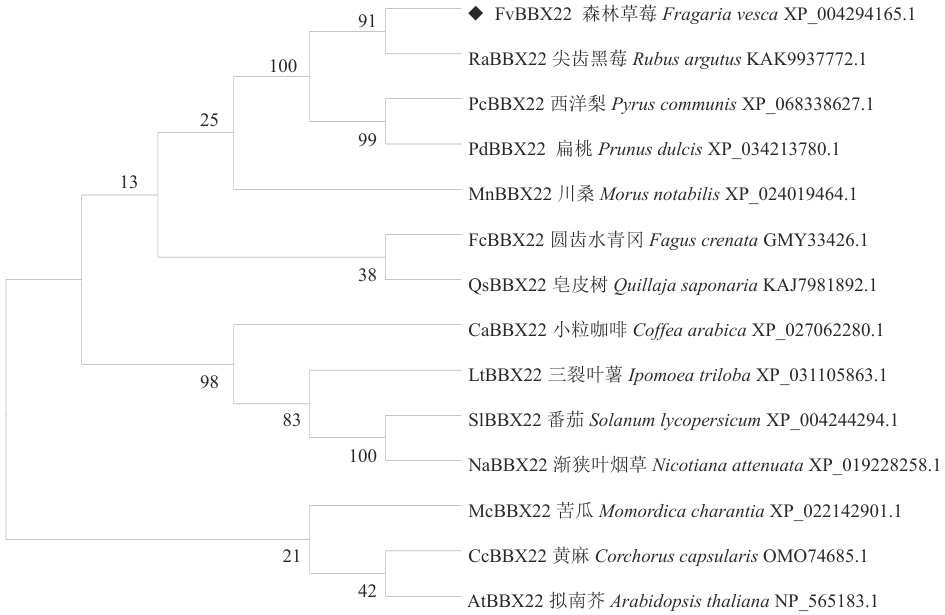
图1 不同物种BBX22蛋白的系统进化分析
Fig. 1 Phylogenetic analysis of BBX22 proteins from different species
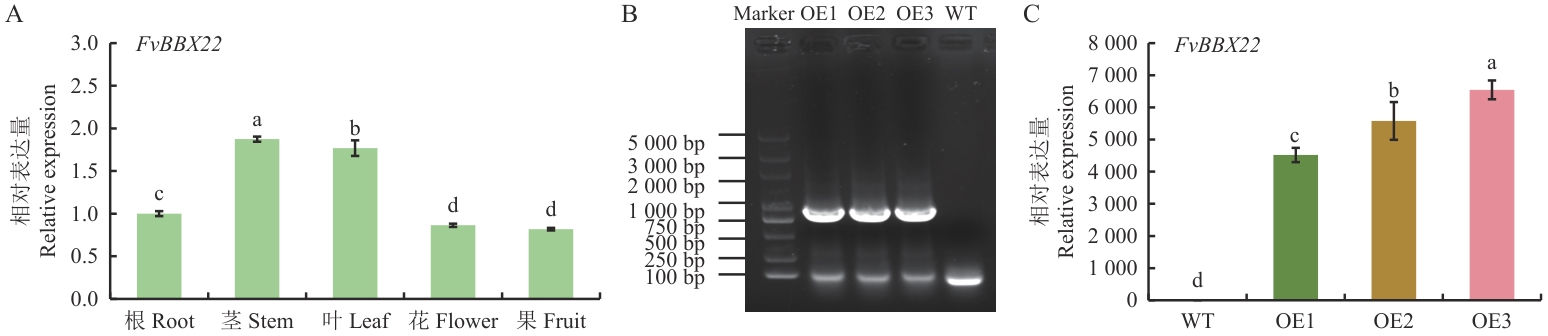
图2 FvBBX22在不同组织的表达分析(A)、过表达FvBBX22拟南芥的DNA水平鉴定(B)和基因表达水平分析(C)不同小写字母表示差异显著(P<0.05)。下同
Fig. 2 Expression analysis of FvBBX22 in different tissues (A), DNA-level identification (B) and gene expression level analysis (C) of A. thaliana overexpressing FvBBX22Different lowercase letters indicate significant differences (P<0.05). The same below
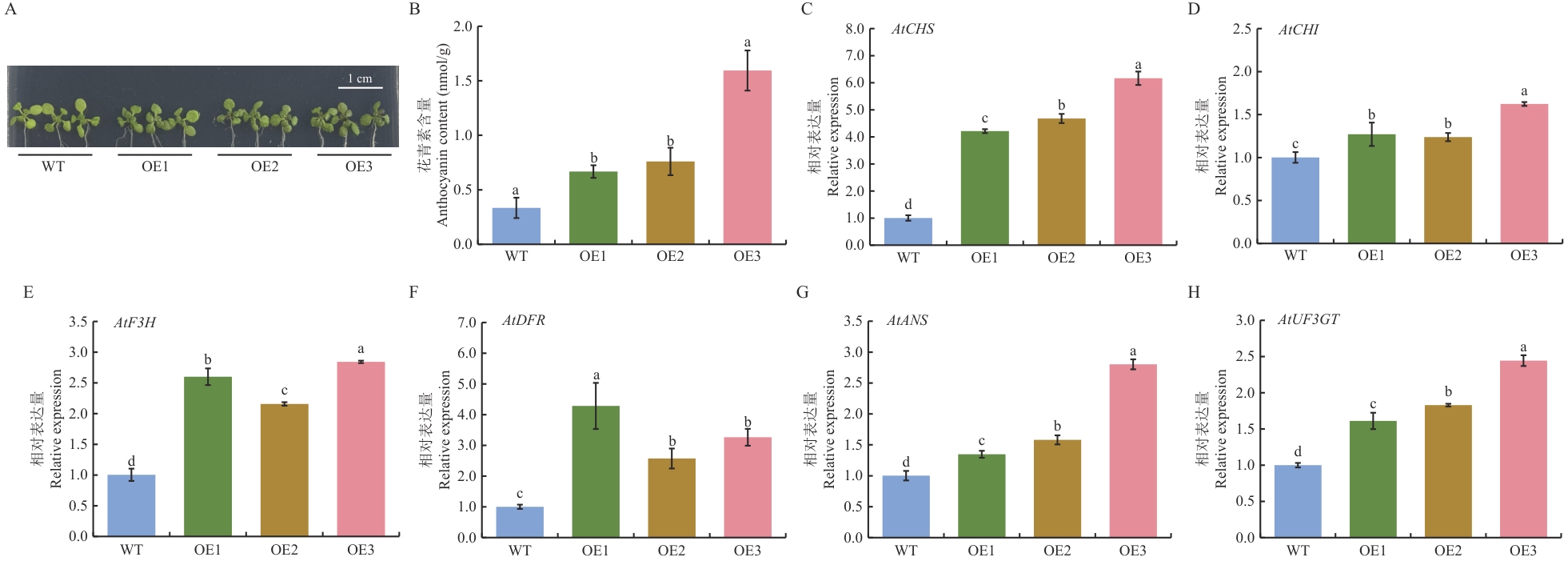
图3 过表达FvBBX22拟南芥对花青素含量的影响及花青素合成相关基因的表达水平分析A:叶片表型;B:叶片花青素含量的测定;C‒H:花青素合成相关基因的表达水平
Fig. 3 Effects of FvBBX22 overexpression in A. thaliana on anthocyanin content and expression levels of anthocyanin-synthesis-related genesA: Leaf phenotype. B: Determination of anthocyanin content in leaves. C‒H: Expression levels of anthocyanin synthesis related genes
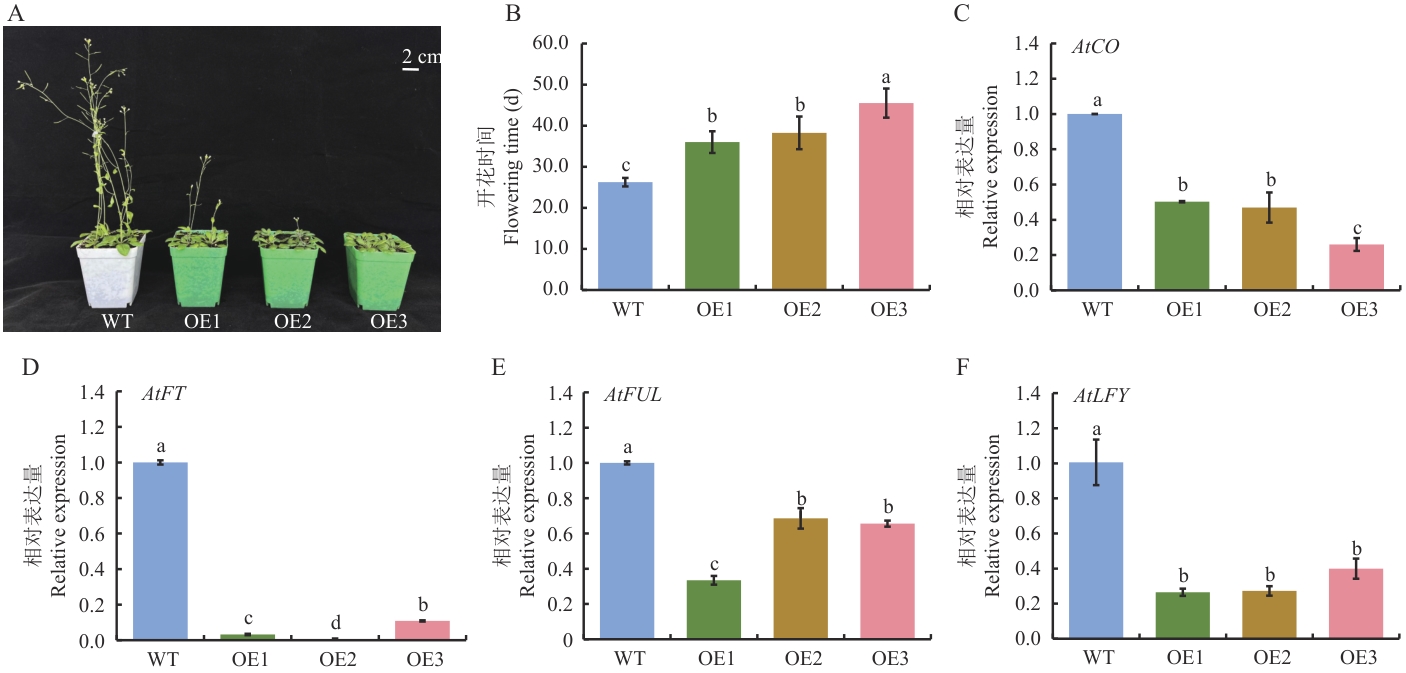
图4 过表达FvBBX22拟南芥的开花表型以及开花相关基因的表达水平分析A:开花表型;B:开花时间统计;C‒F:开花相关基因的表达水平
Fig. 4 Flowering phenotype and expression analysis of flowering-related genes in A. thaliana overexpressing FvBBX22A: Flowering phenotype. B: Statistics of flowering time. C‒F: Expression levels of flowering-related genes
| [1] | 卢东升, 刘汉光. 信阳草莓果栖真菌及其多样性研究 [J]. 信阳师范学院学报: 自然科学版, 2017, 30(3): 374-378. |
| Lu DS, Liu HG. Studies on the fruit fungi and their diversity of Fragaria ananassa in Xinyang [J]. J Xinyang Norm Univ Nat Sci Ed, 2017, 30(3): 374-378. | |
| [2] | 宋艳红, 陈亚铎, 张晓玉, 等. 森林草莓FvbHLH130转录因子调控植株提前开花 [J]. 园艺学报, 2023, 50(2): 295-306. |
| Song YH, Chen YD, Zhang XY, et al. The transcription factor FvbHLH130 activates flowering in Fragaria vesca [J]. Acta Hortic Sin, 2023, 50(2): 295-306. | |
| [3] | 焦宏波. FvCSN5在草莓花青苷积累中的调节作用研究 [D]. 沈阳: 沈阳农业大学, 2024. |
| Jiao HB. Study on the regulatory role of FvCSN5 in the accumulation of anthocyanin in strawberry [D]. Shenyang: Shenyang Agricultural University, 2024. | |
| [4] | Gangappa SN, Botto JF. The BBX family of plant transcription factors [J]. Trends Plant Sci, 2014, 19(7): 460-470. |
| [5] | Song ZQ, Bian YT, Liu JJ, et al. B-box proteins: Pivotal players in light-mediated development in plants [J]. JIPB, 2020, 62(9): 1293-1309. |
| [6] | Tiwari SB, Shen Y, Chang HC, et al. The flowering time regulator CONSTANS is recruited to the FLOWERING LOCUS T promoter via a unique cis-element [J]. New Phytol, 2010, 187(1): 57-66. |
| [7] | Yang CL, Zhang SW, Zou QJ, et al. CiBBX19 negatively regulates the flowering time of Chrysanthemum indicum by recruiting CiBBX5 to inhibit the expression of CiFTL3 [J]. Plant Physiol Biochem, 2025, 227: 110115. |
| [8] | 李群. 玉米BBX6和BBX7调控开花时间的分子机制研究 [D]. 泰安: 山东农业大学, 2023. |
| Li Q. Molecular mechanism of maize BBX6 and BBX7 in regulating flowering time [D]. Tai’an: Shandong Agricultural University, 2023. | |
| [9] | 叶洋. PtBBX8和PtBBX38在开花调控和干旱胁迫响应中的功能研究 [D]. 杨凌: 西北农林科技大学, 2022. |
| Ye Y. Functional studies of PtBBX8 and PtBBX38 in flowering regulation and drought stress response [D]. Yangling: Northwest A & F University, 2022. | |
| [10] | Gao CS, Yuan JZ, Zhong WY, et al. BBX32a and BBX32b regulate flowering time in soybean under long-day conditions [J]. Plant Cell Environ, 2026, 49(3): 1249-1259. |
| [11] | Luo D, Xiong C, Lin AH, et al. SlBBX20 interacts with the COP9 signalosome subunit SlCSN5-2 to regulate anthocyanin biosynthesis by activating SlDFR expression in tomato [J]. Hortic Res, 2021, 8(1): 163. |
| [12] | Gao ZH, Sun YB, Zhu ZM, et al. Transcription factors LvBBX24 and LvbZIP44 coordinated anthocyanin accumulation in response to light in lily petals [J]. Hortic Res, 2024, 11(10): uhae211. |
| [13] | Wang YY, Xiao YQ, Sun YT, et al. Two B-box proteins, PavBBX6/9, positively regulate light-induced anthocyanin accumulation in sweet cherry [J]. Plant Physiol, 2023, 192(3): 2030-2048. |
| [14] | Fu JL, Liao L, Jin JJ, et al. A transcriptional cascade involving BBX22 and HY5 finely regulates both plant height and fruit pigmentation in citrus [J]. JIPB, 2024, 66(8): 1752-1768. |
| [15] | 叶云天, 娄可飞, 王熙然, 等. 森林草莓B-box基因家族全基因组序列鉴定与表达分析 [J]. 分子植物育种, 2016, 14(4): 827-834. |
| Ye YT, Lou KF, Wang XR, et al. Genome-wide identification and expression investigation of the B-box gene family in Fragaria vesca [J]. Mol Plant Breed, 2016, 14(4): 827-834. | |
| [16] | 董向向, 缪百灵, 许贺娟, 等. 森林草莓FveBBX20基因的生物信息学分析及开花调控功能 [J]. 生物技术通报, 2025(9): 115-123. |
| Dong XX, Miao BL, Xu HJ, et al. Bioinformatics analysis and flowering regulation function of FveBBX20 gene in woodland strawberry [J]. Biotechnol Bull, 2025(9): 115-123. | |
| [17] | 缪百灵, 汪园园, 侯威威, 等. 异源过表达森林草莓FveBBX32负调控拟南芥的叶绿素含量和开花时间 [J]. 生物技术通报, 2025, 41(11): 293-300. |
| Miao BL, Wang YY, Hou WW, et al. Hetero-overexpression of Fragaria vesca FveBBX32 negatively regulates the chlorophyll content and flowering time in Arabidopsis thaliana [J]. Biotechnol Bull, 2025, 41(11): 293-300. | |
| [18] | 吴旻, 都洁, 胡彦如. ERF-Ⅶ转录因子RAP2.12调控淹水诱导拟南芥幼苗花青素合成 [J]. 广西植物, 2025, 45(9): 1654-1667. |
| Wu M, Du J, Hu YR. ERF-Ⅶtranscription factor RAP2.12 regulates submergence-induced anthocyanin biosynthesis in Arabidopsis thaliana seedlings [J]. Guihaia, 2025, 45(9): 1654-1667. | |
| [19] | He WZ, Liu H, Wu Z, et al. The AaBBX21-AaHY5 module mediates light-regulated artemisinin biosynthesis in Artemisia annua L [J]. JIPB, 2024, 66(8): 1735-1751. |
| [20] | Khanna R, Kronmiller B, Maszle DR, et al. The Arabidopsis B-box zinc finger family [J]. Plant Cell, 2009, 21(11): 3416-3420. |
| [21] | Job N, Yadukrishnan P, Bursch K, et al. Two B-box proteins regulate photomorphogenesis by oppositely modulating HY5 through their diverse C-terminal domains [J]. Plant Physiol, 2018, 176(4): 2963-2976. |
| [22] | 刘鑫, 王嘉雯, 李进伟, 等. 兰州百合三个LdBBXs基因的克隆与表达分析 [J]. 生物技术通报, 2025, 41(5): 186-196. |
| Liu X, Wang JW, Li JW, et al. Cloning and expression analysis of three LdBBXs in Lilium davidii var. willmottiae [J]. Biotechnol Bull, 2025, 41(5): 186-196. | |
| [23] | Yang M, Song CH, Lin YX, et al. FaTRAB1, a bZIP transcription factor, enhances anthocyanin biosynthesis in strawberry leaves via tissue-specific regulation [J]. PLoS Genet, 2025, 21(9): e1011888. |
| [24] | 李小龙. 草莓B-box转录因子FaBBX21调控花青素苷合成的分子机制研究 [D]. 雅安: 四川农业大学, 2022. |
| Li XL. Research on the molecular mechanism of a strawberry B-box transcription factor FaBBX21 regulating anthocyanin synthesis [D]. Ya’an: Sichuan Agricultural University, 2022. | |
| [25] | Chang CJ, Li YH, Chen LT, et al. LZF1, a HY5-regulated transcriptional factor, functions in Arabidopsis de-etiolation [J]. Plant J, 2008, 54(2): 205-219. |
| [26] | Zhang B, Yang HJ, Qu D, et al. The MdBBX22-miR858-MdMYB9/11/12 module regulates proanthocyanidin biosynthesis in apple peel [J]. Plant Biotechnol J, 2022, 20(9): 1683-1700. |
| [27] | Zhang ST, Jiao ZB, Liu ZX, et al. Multiomics analysis revealed the role of LsBBX22-LsHY5a/b module in promoting UV-B-mediated anthocyanin accumulation in lettuce [J]. J Agric Food Chem, 2026, 74(1): 1788-1803. |
| [28] | 胡彦如, 黄兴连, 叶静文. 植物花青素合成及其调控因素研究进展 [J]. 生命科学研究, 2024, 28(6): 493-502. |
| Hu YR, Huang XL, Ye JW. Research progress of anthocyanin synthesis and regulatory factors in plants [J]. Life Sci Res, 2024, 28(6): 493-502. | |
| [29] | 李鹏飞, 王爱凡, 黄佳慧, 等. 薰衣草花青素合成相关基因LaCHS的克隆与功能分析 [J]. 浙江农林大学学报, 2025, 42(5): 1048-1058. |
| Li PF, Wang AF, Huang JH, et al. Cloning and functional analysis of LaCHS gene related to anthocyanin biosynthesis in Lavandula angustifolia [J]. J Zhejiang A F Univ, 2025, 42(5): 1048-1058. | |
| [30] | 衡双平, 崔梦迪, 李晓琳, 等. 芥菜紫色叶片相关分子标记的开发和应用 [J]. 信阳师范学院学报: 自然科学版, 2024, 37(3): 360-365. |
| Heng SP, Cui MD, Li XL, et al. Development and application of molecular markers related to purple leaf in Brassica juncea [J]. J Xinyang Norm Univ Nat Sci Ed, 2024, 37(3): 360-365. | |
| [31] | Xu PB, Li MB, Ma C, et al. Loss-of-function mutation in anthocyanidin reductase activates the anthocyanin synthesis pathway in strawberry [J]. Mol Hortic, 2024, 4(1): 33. |
| [32] | Wang X, Chen XP, Luo SX, et al. Discovery of a DFR gene that controls anthocyanin accumulation in the spiny Solanum group: roles of a natural promoter variant and alternative splicing [J]. Plant J, 2022, 111(4): 1096-1109. |
| [33] | Lv XC, Zeng XL, Hu HM, et al. Structural insights into the multivalent binding of the Arabidopsis FLOWERING LOCUS T promoter by the CO-NF-Y master transcription factor complex [J]. Plant Cell, 2021, 33(4): 1182-1195. |
| [34] | Kurokura T, Samad S, Koskela E, et al. Fragaria vesca CONSTANS controls photoperiodic flowering and vegetative development [J]. J Exp Bot, 2017, 68(17): 4839-4850. |
| [35] | Cheng XF, Wang ZY. Overexpression of COL9, a CONSTANS-LIKE gene, delays flowering by reducing expression of CO and FT in Arabidopsis thaliana [J]. Plant J, 2005, 43(5): 758-768. |
| [36] | Wang LJ, Sun J, Ren LP, et al. CmBBX8 accelerates flowering by targeting CmFTL1 directly in summer chrysanthemum [J]. Plant Biotechnol J, 2020, 18(7): 1562-1572. |
| [37] | Xia LM, He XH, Hu WL, et al. Overexpression of the mango MiGF6A and MiGF6B genes promotes early flowering in transgenic Arabidopsis plants [J]. Sci Hortic, 2023, 318: 112074. |
| [1] | 郑淑雅, 苏玉婷, 何玉美, 赵盼, 周心怡, 刘冉, 刘平丽, 郭惠红. 杨树PagRAX2_16G及其启动子的克隆与功能分析[J]. 生物技术通报, 2026, 42(9): 186-195. |
| [2] | 谭澍, 沈红建, 高晓磊, 尹倩, 邹锋. 油茶MYB转录因子家族鉴定及CoMYB107基因在雄蕊发育中的功能分析[J]. 生物技术通报, 2026, 42(9): 196-209. |
| [3] | 桑志鹏, 侯栋, 王慧婷, 岳宏忠, 李亚莉, 颉建明, 路雯, 许照泰. 黄瓜CsHXKs基因家族鉴定及CsHKL1.2调控花器官糖积累[J]. 生物技术通报, 2026, 42(9): 157-168. |
| [4] | 张静, 李圆圆, 王燕, 江雅洁, 杨寒冰, 柴文臣, 霍辰思, 罗丹, 阎世江. 青花菜BoFLC3的克隆与开花调控机制研究[J]. 生物技术通报, 2026, 42(9): 169-177. |
| [5] | 吕正, 连如赢, 刘怡德, 刘易科, 宁强, 王书平. 小麦HD-Zip基因家族的鉴定及对禾谷镰刀菌的响应[J]. 生物技术通报, 2026, 42(8): 123-132. |
| [6] | 陈萃, 兰丽霞, 苏梦雨, 翁年东, 张震. 苹果蛋白磷酸酶基因MdPP2C24的克隆及功能鉴定[J]. 生物技术通报, 2026, 42(8): 153-161. |
| [7] | 秦娟, 卢蔚雯, 李佳徽, 李晨, 李斌, 王治业. 红花2个G6PDH基因的克隆与表达特征分析[J]. 生物技术通报, 2026, 42(8): 217-228. |
| [8] | 李淑婷, 王影, 丁家豪, 胡荣芳, 李琛, 宋亚楠, 薛金爱. 油莎豆FAT家族全基因组鉴定及CeFATA的功能分析[J]. 生物技术通报, 2026, 42(8): 162-172. |
| [9] | 张仲文, 王卫民, 肖志亮, 史久长, 郝贤伟, 王威, 谢鹏岗, 许佳丹, 赵炯平, 杨爱国. NtPLA2A介导激素信号通路增强烟草青枯病抗性的机制[J]. 生物技术通报, 2026, 42(8): 207-216. |
| [10] | 辛晴, 郑永杰, 李雨华, 涂白连, 刘新亮, 张月婷, 伍艳芳. 樟树MYC转录因子的全基因组鉴定与表达分析[J]. 生物技术通报, 2026, 42(7): 214-225. |
| [11] | 赵静玮, 常娜, 金宵溦, 张立全. 黄花苜蓿MfWRKY22的克隆及抗逆性功能分析[J]. 生物技术通报, 2026, 42(7): 236-245. |
| [12] | 黄旭升, 周雅莉, 贾峥嵘, 沈珊, 陈锦钗, 周广立, 李鑫鑫, 王计平, 李润植, 贾小云. 紫苏ARF转录因子家族全基因组鉴定及其在非生物胁迫响应中的功能分析[J]. 生物技术通报, 2026, 42(7): 148-162. |
| [13] | 阎晓光, 杜艳伟, 马志远, 王彬, 王国梁, 胡丹珠. 玉米ZmDIR基因家族的全基因组鉴定与表达模式分析[J]. 生物技术通报, 2026, 42(7): 126-137. |
| [14] | 张雅宁, 毛春力, 胡志勇, 杨丹, 吴佳海, 王碧娴, 黄琳凯. 象草Dof转录因子的全基因组分析及其对低温胁迫的响应[J]. 生物技术通报, 2026, 42(6): 267-278. |
| [15] | 段雅馨, 李成晨, 潘玉玲, 王丽, 安康, 李小波, 祝光涛, 刘计涛. 马铃薯LEA_2基因家族鉴定及响应低温与激素功能分析[J]. 生物技术通报, 2026, 42(6): 40-52. |
| 阅读次数 | ||||||
|
全文 |
|
|||||
|
摘要 |
|
|||||
