







生物技术通报 ›› 2026, Vol. 42 ›› Issue (7): 214-225.doi: 10.13560/j.cnki.biotech.bull.1985.2025-0889
• 研究报告 • 上一篇
辛晴1,2, 郑永杰2, 李雨华2, 涂白连2, 刘新亮2, 张月婷2, 伍艳芳1,2( )
)
收稿日期:2025-08-18
出版日期:2026-07-26
发布日期:2026-07-20
通讯作者:
伍艳芳yanfangwu2012@163.com基金资助:
XIN Qing1,2, ZHENG Yong-jie2, LI Yu-hua2, TU Bai-lian2, LIU Xin-liang2, ZHANG Yue-ting2, WU Yan-fang1,2()
Received:2025-08-18
Published:2026-07-26
Online:2026-07-20
摘要:
目的 MYC转录因子是茉莉酸(JA)信号通路的核心调节因子,在调控植物生长发育和次生代谢过程中发挥重要作用。鉴定和分析樟树中的MYC转录因子,为研究萜类等次生代谢产物合成以及生长发育提供依据。 方法 采用生物信息学方法,对CcMYC家族进行全基因组鉴定,分析其染色体定位、理化性质、亚细胞定位、家族进化关系、基因结构、启动子和PPI网络,并结合实时荧光定量PCR分析CcMYC基因家族在樟树6种化学型中的表达模式。 结果 CcMYC1-CcMYC12不均匀地分布在10条染色体上。CcMYC家族编码蛋白含629个氨基酸,平均分子质量69.64 kD,理论等电点5.15-6.69,二级结构以α-螺旋和无规则卷曲为主。蛋白的亚细胞定位结果显示,CcMYC12主要定位于细胞核。系统进化分析结果表明,CcMYC基因分属于不同的3个组;种间共线性分析表明,CcMYC基因存在片段重复事件,CcMYC1、CcMYC4和CcMYC5在拟南芥、水稻和毛果杨中均存在共线基因;启动子顺式作用元件分析表明,CcMYC基因可能受到光照、多种植物激素以及防御与胁迫的诱导。蛋白互作分析揭示,CcMYC3、CcMYC7、CcMYC8、CcMYC11可能在调控樟树类黄酮、萜类等次生代谢物质合成积累中发挥重要作用。 结论 从樟树基因组中共鉴定出12个MYC家族成员,CcMYC1、CcMYC8在右旋龙脑型和柠檬醛型中高表达,CcMYC11、CcMYC12在芳樟醇型中高表达,它们可能在不同化学型樟树精油主要成分合成与萜类等次生代谢积累中发挥重要作用。
辛晴, 郑永杰, 李雨华, 涂白连, 刘新亮, 张月婷, 伍艳芳. 樟树MYC转录因子的全基因组鉴定与表达分析[J]. 生物技术通报, 2026, 42(7): 214-225.
XIN Qing, ZHENG Yong-jie, LI Yu-hua, TU Bai-lian, LIU Xin-liang, ZHANG Yue-ting, WU Yan-fang. Genome-wide Identification and Expression Analysis of MYC Transcription Factors in Cinnamomum camphora[J]. Biotechnology Bulletin, 2026, 42(7): 214-225.
基因名称 Gene name | α-螺旋 Alpha helix (%) | β-转角 Beta turn (%) | 扩展链 Extended strand (%) | 无规则卷曲 Random coil (%) |
|---|---|---|---|---|
| CcMYC1 | 197(20.10) | 2(0.30) | 41(6.06) | 437(64.55) |
| CcMYC2 | 186(26.42) | 9(1.28) | 42(5.97) | 467(66.34) |
| CcMYC3 | 169(32.63) | 1(1.93) | 52(10.04) | 287(55.41) |
| CcMYC4 | 191(28.81) | 1(1.96) | 43(6.49) | 416(62.75) |
| CcMYC5 | 182(28.53) | 6(0.94) | 44(6.90) | 406(63.64) |
| CcMYC6 | 192(30.48) | 2(0.32) | 46(7.30) | 390(61.90) |
| CcMYC7 | 151(26.73) | 2(0.35) | 37(6.55) | 375(66.37) |
| CcMYC8 | 146(30.61) | 8(1.68) | 46(9.64) | 277(58.07) |
| CcMYC9 | 180(29.70) | 4(0.66) | 49(8.09) | 373(61.55) |
| CcMYC10 | 206(30.61) | 7(1.04) | 57(8.47) | 403(59.88) |
| CcMYC11 | 233(32.41) | 9(1.25) | 51(7.09) | 426(59.25) |
| CcMYC12 | 217(33.28) | 7(1.07) | 41(6.29) | 387(59.36) |
表1 樟树MYC基因家族二级蛋白结构
Table 1 Secondary structure of MYC gene family proteins in licorice
基因名称 Gene name | α-螺旋 Alpha helix (%) | β-转角 Beta turn (%) | 扩展链 Extended strand (%) | 无规则卷曲 Random coil (%) |
|---|---|---|---|---|
| CcMYC1 | 197(20.10) | 2(0.30) | 41(6.06) | 437(64.55) |
| CcMYC2 | 186(26.42) | 9(1.28) | 42(5.97) | 467(66.34) |
| CcMYC3 | 169(32.63) | 1(1.93) | 52(10.04) | 287(55.41) |
| CcMYC4 | 191(28.81) | 1(1.96) | 43(6.49) | 416(62.75) |
| CcMYC5 | 182(28.53) | 6(0.94) | 44(6.90) | 406(63.64) |
| CcMYC6 | 192(30.48) | 2(0.32) | 46(7.30) | 390(61.90) |
| CcMYC7 | 151(26.73) | 2(0.35) | 37(6.55) | 375(66.37) |
| CcMYC8 | 146(30.61) | 8(1.68) | 46(9.64) | 277(58.07) |
| CcMYC9 | 180(29.70) | 4(0.66) | 49(8.09) | 373(61.55) |
| CcMYC10 | 206(30.61) | 7(1.04) | 57(8.47) | 403(59.88) |
| CcMYC11 | 233(32.41) | 9(1.25) | 51(7.09) | 426(59.25) |
| CcMYC12 | 217(33.28) | 7(1.07) | 41(6.29) | 387(59.36) |
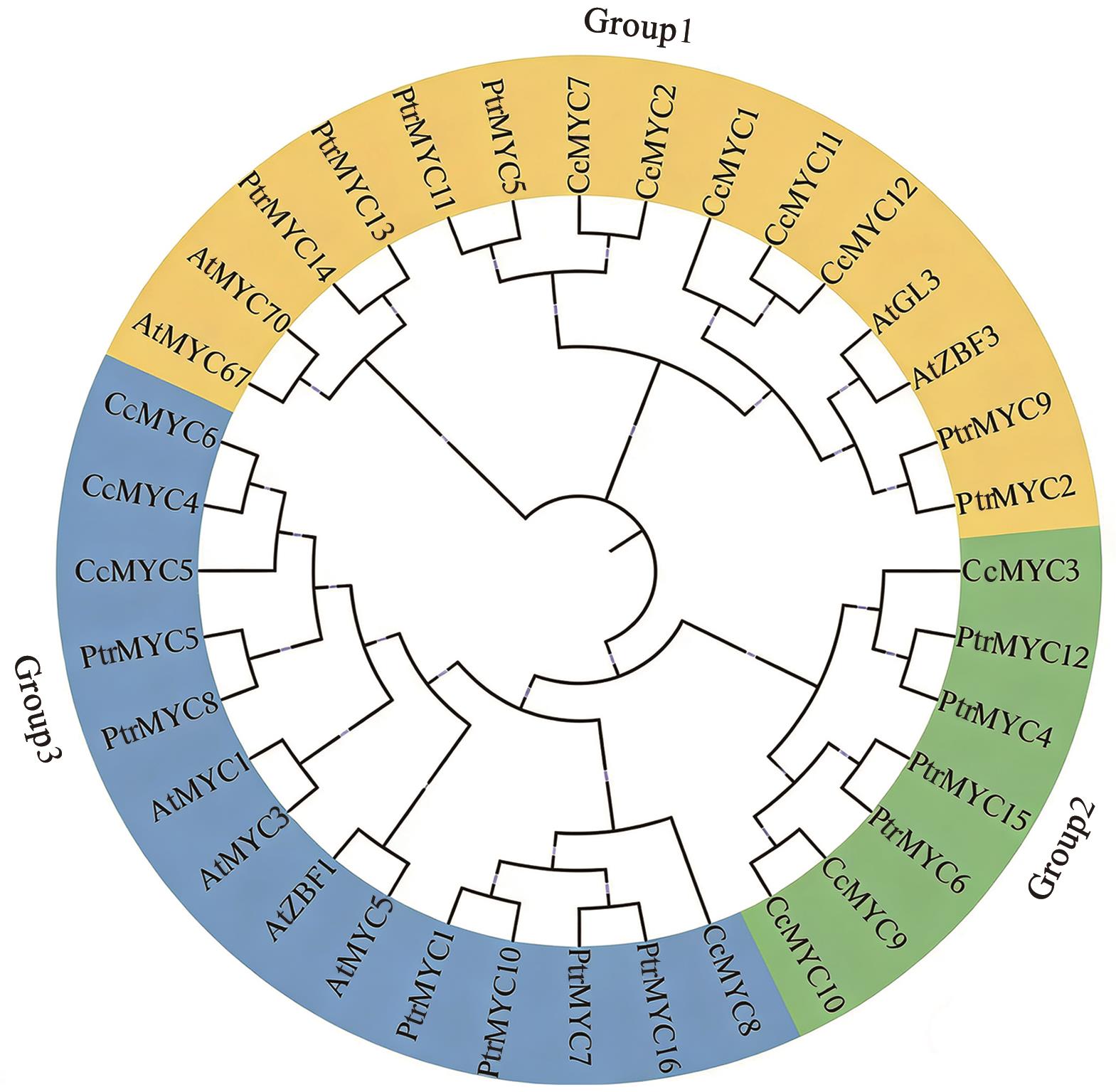
图1 樟树与拟南芥、毛果杨MYC转录因子进化分析
Fig. 1 Phylogenetic analysis of the MYCtranscription factor in C. camphora, A. thaliana, and P. trichocarpa
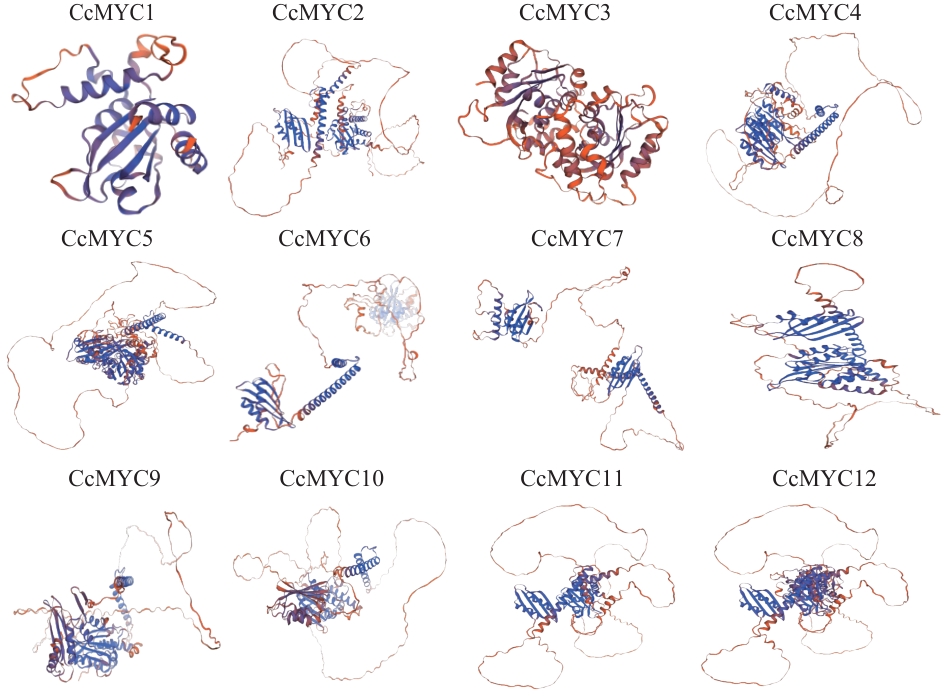
图2 樟树MYC蛋白三级结构预测
Fig. 2 Tertiary structure prediction of licorice MYC protein
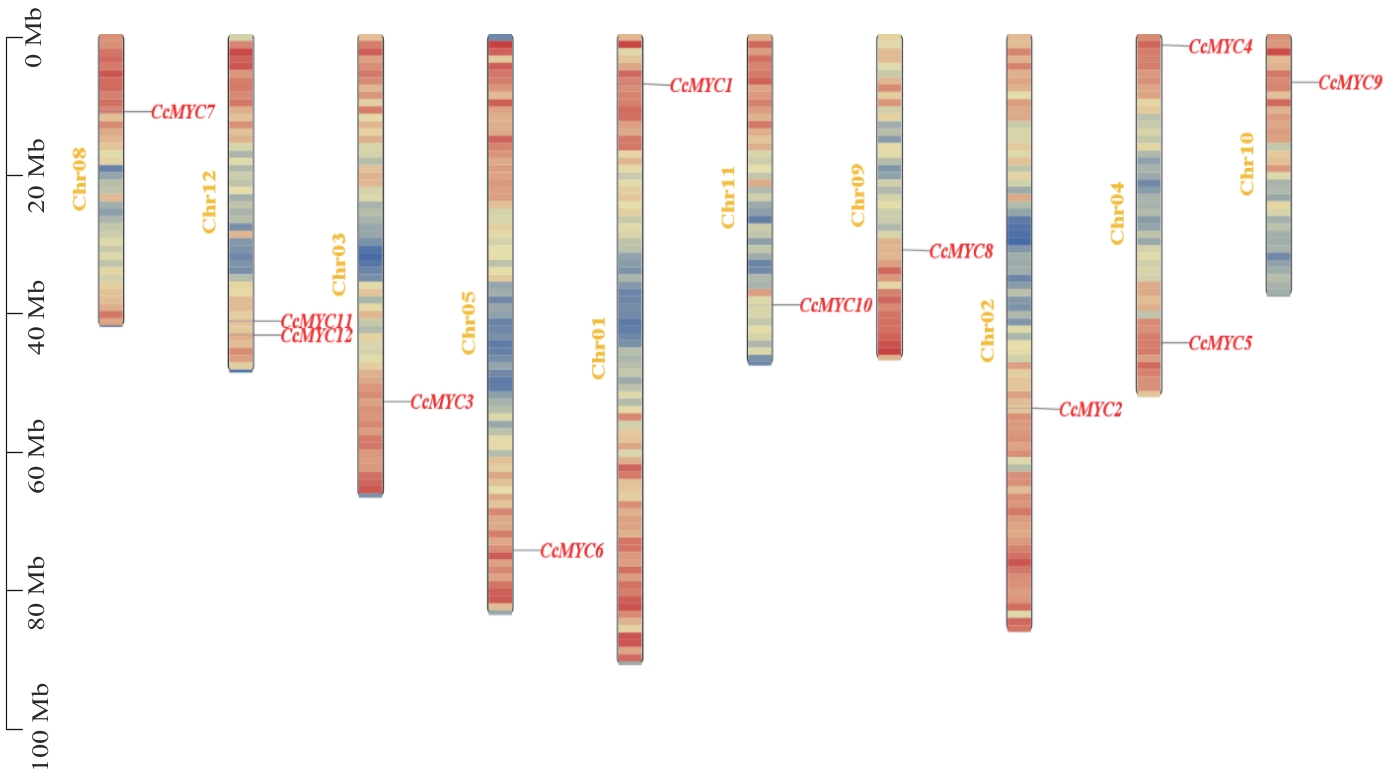
图3 樟树MYC成员染色体定位分析
Fig. 3 Chromosomal localization analysis of MYC family members in C. camphora
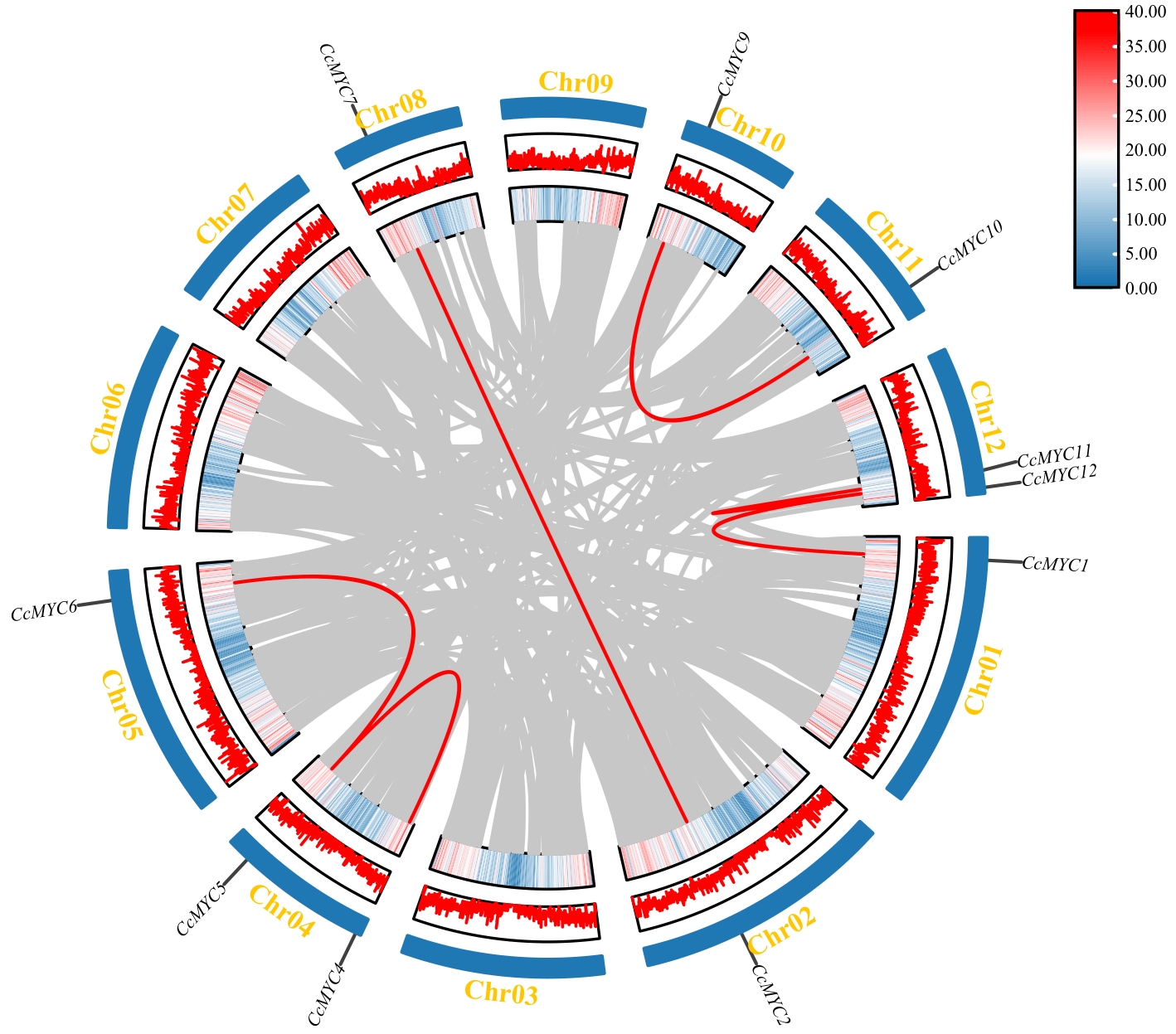
图4 樟树MYC基因家族共线性分析
Fig. 4 Collinearity analysis of MYC gene family in C. camphora
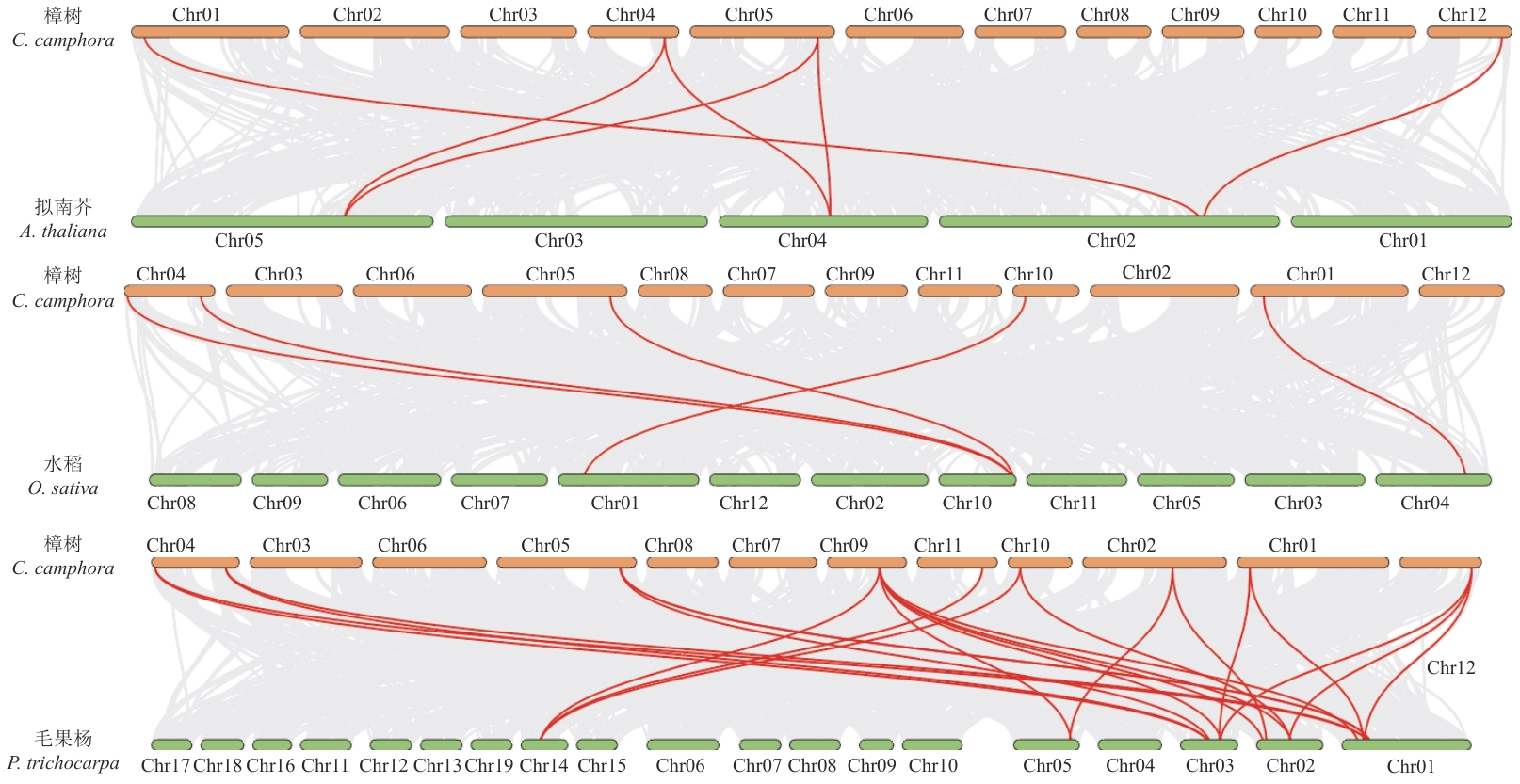
图5 樟树与拟南芥、水稻MYC基因家族的共线性分析
Fig. 5 Collinearity analysis of MYC gene family among C. camphora, A. thaliana and O. sativa
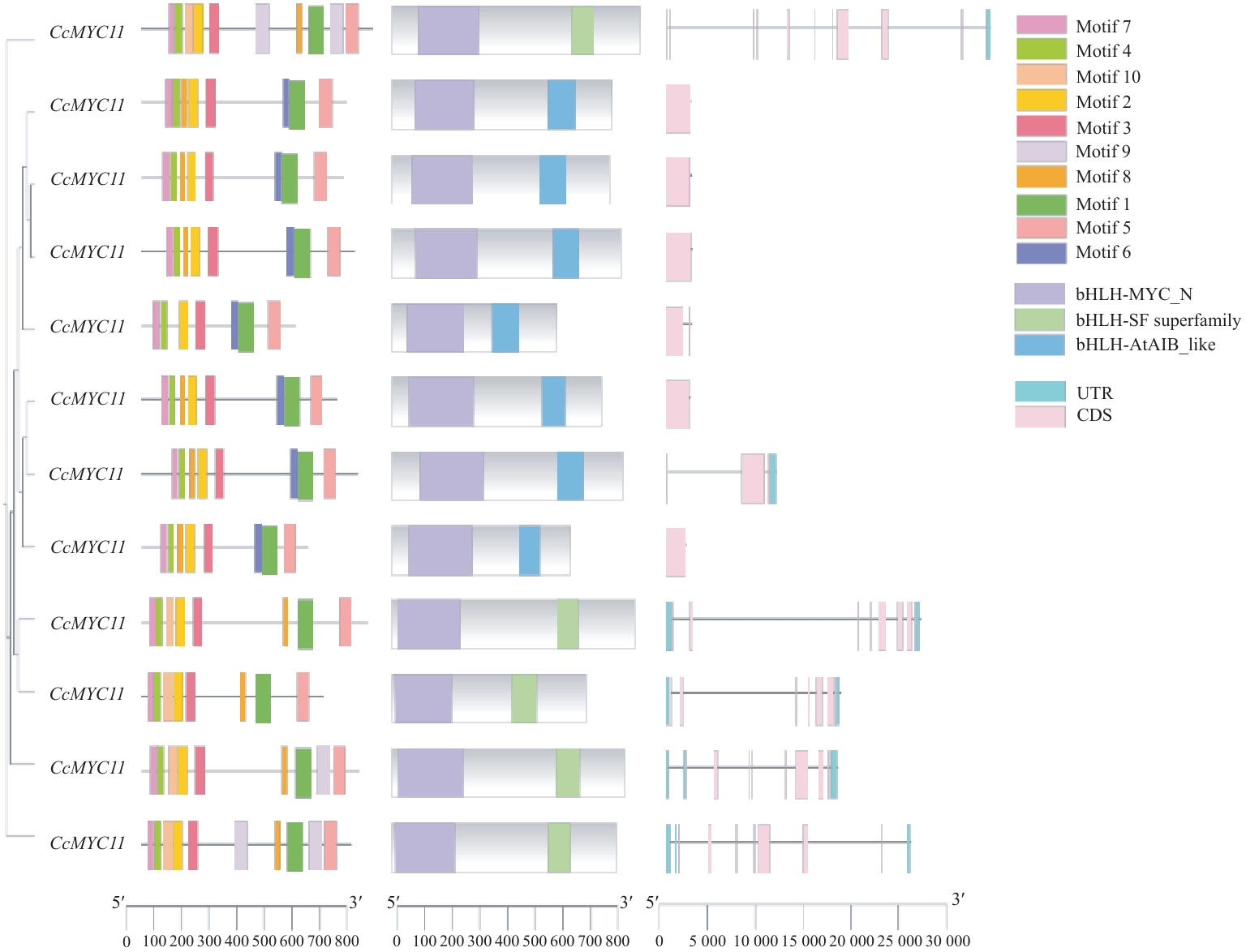
图6 樟树MYC基因家族的保守基序、保守结构域与基因结构分析
Fig. 6 Conserved motifs, conserved domains, and gene structure analysis of MYC genes family in C. camphora
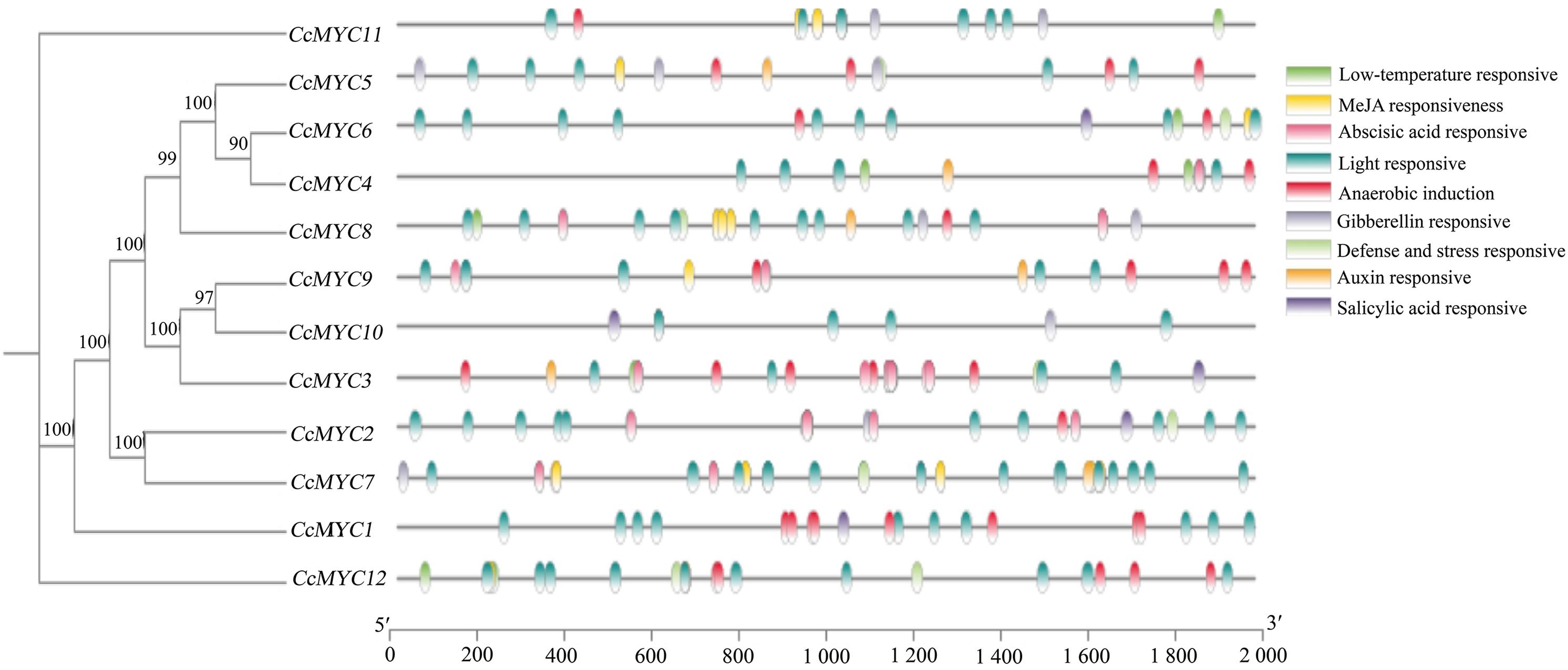
图7 樟树MYC基因家族启动子顺式原件预测
Fig.7 Prediction of cis-elements of the MYC gene family promoter in C. camphora
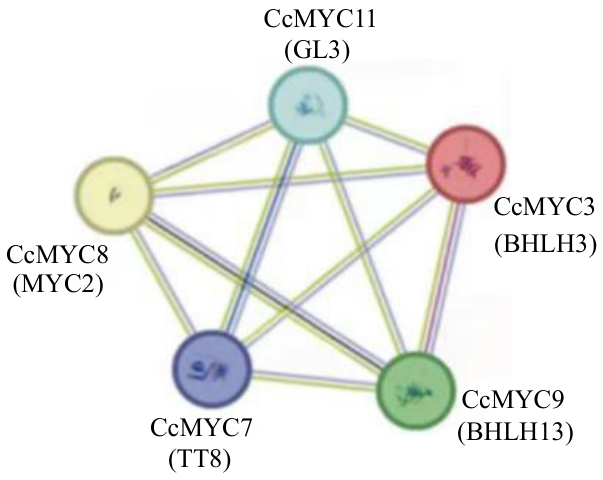
图8 拟南芥与樟树MYC蛋白相互作用网络分析
Fig. 8 Protein interaction network of orthologous MYC proteins in A. thaliana and C. camphora
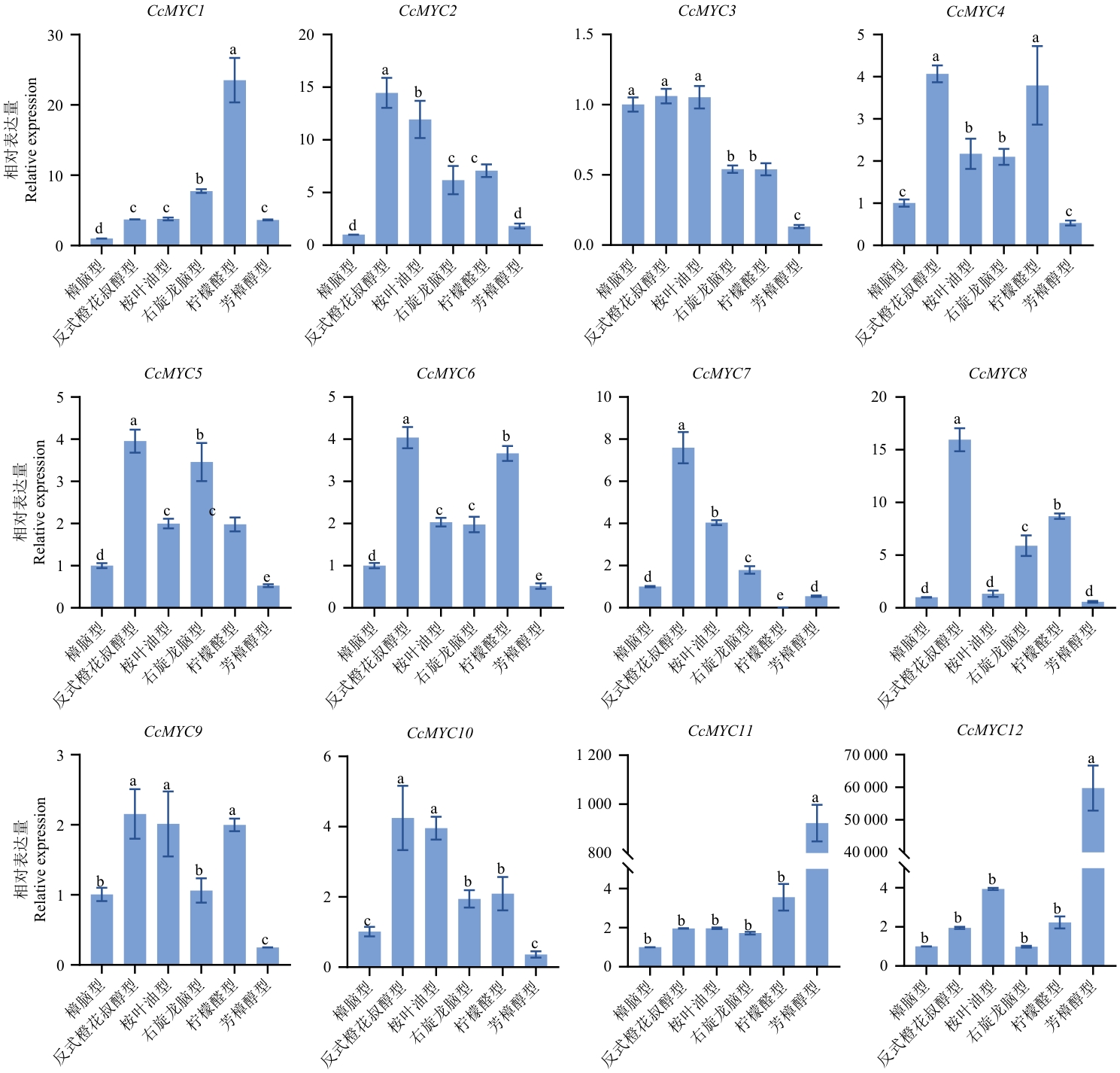
图9 樟树MYC基因在6种化学型中的表达量不同小写字母代表差异显著(P<0.05)
Fig. 9 Expressions of the MYC gene in six chemotypes of C. camphoraDifferent lowercase letters denote statistically significant differences (P<0.05)
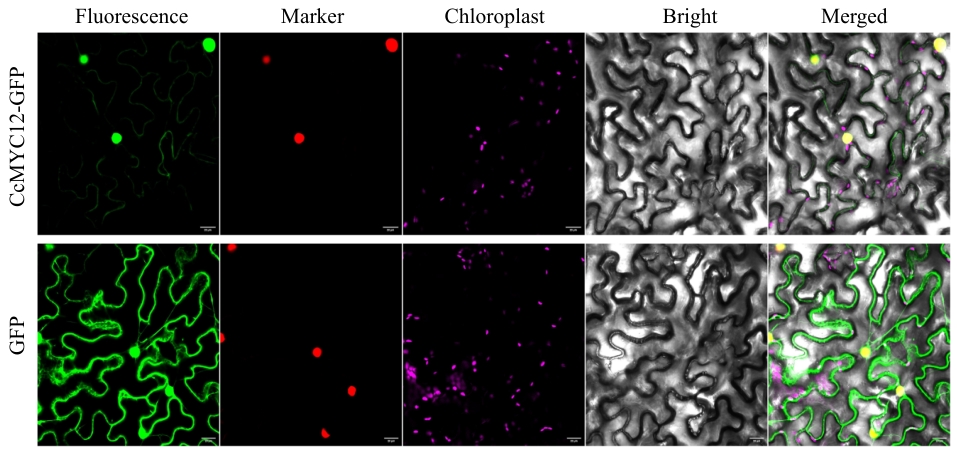
图10 CcMYC12亚细胞定位
Fig. 10 Subcellular localization of CcMYC12
| [1] | Li JZ, Li GL, Zhu CS, et al. Genome-wide identification and expression analysis of bHLH-MYC family genes from mustard that may be important in trichome formation [J]. Plants, 2025, 14(2): 268. |
| [2] | 周生财, 林仕雄, 宋敏燕, 等. 樟树bHLH基因家族鉴定及其在两个化学型中的表达分析 [J]. 分子植物育种, 2025, 23(9): 2948-2959. |
| Zhou SC, Lin SX, Song MY, et al. Identification of the bHLH gene family in Cinnamomum camphora and its expression analysis in two chemotypes [J]. Mol Plant Breed, 2025, 23(9): 2948-2959. | |
| [3] | Li ZW, Huang YS, Shen ZW, et al. Advances in functional studies of plant MYC transcription factors [J]. Theor Appl Genet, 2024, 137(8): 195. |
| [4] | Fernández-Calvo P, Chini A, Fernández-Barbero G, et al. The Arabidopsis bHLH transcription factors MYC3 and MYC4 are targets of JAZ repressors and act additively with MYC2 in the activation of jasmonate responses [J]. Plant Cell, 2011, 23(2): 701-715. |
| [5] | Chen SK, Zhao HY, Luo TL, et al. Characteristics and expression pattern of myc genes in Triticum aestivum, Oryza sativa, and Brachypodium distachyon [J]. Plants, 2019, 8(8): 274. |
| [6] | 马红霞, 欧阳旭, 程淋渊, 等. 甘草MYC基因家族鉴定及表达特异性分析 [J]. 农业生物技术学报, 2025, 33(8): 1711-1731. |
| Ma HX, Ouyang X, Cheng LY, et al. Identification and expression specificity analysis of the MYC gene family in licorice (Glycyrrhiza sp.) [J]. J Agric Biotechnol, 2025, 33(8): 1711-1731. | |
| [7] | 胡梦璇, 宋学勤, 刘颖丽, 等. 杨树MYC基因家族成员表达模式研究 [J]. 林业科学研究, 2023, 36(3): 32-40. |
| Hu MX, Song XQ, Liu YL, et al. Analysis of expression patterns of MYC family members in Populus [J]. For Res, 2023, 36(3): 32-40. | |
| [8] | 马少杰, 郭海洋, 尹江, 等. 毛果杨MYC基因家族生物信息学及转录组表达分析 [J/OL]. 分子植物育种, 2024: 1-18. . |
| Ma SJ, Guo HY, Yin J, et al. Bioinformatics and transcriptome expression analysis of MYC gene family in Populus trichocarpa [J/OL]. Mol Plant Breed, 2024: 1-18. . | |
| [9] | Hong GJ, Xue XY, Mao YB, et al. Arabidopsis MYC2 interacts with DELLA proteins in regulating sesquiterpene synthase gene expression [J]. Plant Cell, 2012, 24(6): 2635-2648. |
| [10] | Zong Y, Xi XY, Li SM, et al. Allelic variation and transcriptional isoforms of wheat TaMYC1 gene regulating anthocyanin synthesis in pericarp [J]. Front Plant Sci, 2017, 8: 1645. |
| [11] | Shoeva OY, Mock HP, Kukoeva TV, et al. Regulation of the flavonoid biosynthesis pathway genes in purple and black grains of Hordeum vulgare [J]. PLoS One, 2016, 11(10): e0163782. |
| [12] | Shen Q, Lu X, Yan TX, et al. The jasmonate-responsive AaMYC2 transcription factor positively regulates artemisinin biosynthesis in Artemisia annua [J]. New Phytol, 2016, 210(4): 1269-1281. |
| [13] | Zhang M, Jin XF, Chen Y, et al. TcMYC2, a basic helix-loop-helix transcription factor, transduces JA-signals and regulates taxol biosynthesis in Taxus chinensis [J]. Front Plant Sci, 2018, 9: 863. |
| [14] | Kumar S, Kumari R, Mishra S. Pharmacological properties and their medicinal uses of Cinnamomum: a review [J]. J Pharm Pharmacol, 2019, 71(12): 1735-1761. |
| [15] | Lee SH, Kim DS, Park SH, et al. Phytochemistry and applications of Cinnamomum camphora essential oils [J]. Molecules, 2022, 27(9): 2695. |
| [16] | 郑永杰. 樟属植物系统发育及其萜类化学型多样性分子基础研究 [D]. 北京: 中国林业科学研究院, 2022. |
| Zheng YJ. Cinnamomum phylogeny and molecular basis investigation of the terpene chemotypes diversity [D]. Beijing: Chinese Academy of Forestry, 2022. | |
| [17] | Dong YM, Zhang WY, Li JR, et al. The transcription factor LaMYC4 from lavender regulates volatile Terpenoid biosynthesis [J]. BMC Plant Biol, 2022, 22: 289. |
| [18] | Wang XD, Xu CY, Zheng YJ, et al. Chromosome-level genome assembly and resequencing of camphor tree (Cinnamomum camphora) provides insight into phylogeny and diversification of terpenoid and triglyceride biosynthesis of Cinnamomum [J]. Hortic Res, 2022, 9: uhac216. |
| [19] | Yang J, Duan GH, Li CQ, et al. The crosstalks between jasmonic acid and other plant hormone signaling highlight the involvement of jasmonic acid as a core component in plant response to biotic and abiotic stresses [J]. Front Plant Sci, 2019, 10: 1349. |
| [20] | Srivastava AK, Dutta S, Chattopadhyay S. MYC2 regulates ARR16, a component of cytokinin signaling pathways, in Arabidopsis seedling development [J]. Plant Direct, 2019, 3(11): e00177. |
| [21] | 郝立冬, 郭海滨, 李明, 等. 玉米MYC基因家族的结构特点和表达模式分析 [J]. 基因组学与应用生物学, 2021, 40(4): 1748-1753. |
| Hao LD, Guo HB, Li M, et al. Analysis of characteristics and expression pattern of maize MYC gene family [J]. Genom Appl Biol, 2021, 40(4): 1748-1753. | |
| [22] | 周家豪, 张冀芳, 邓勇, 等. 甜橙MYC转录因子家族鉴定与全基因组生物信息学分析 [J]. 中国麻业科学, 2025, 47(2): 65-75, 101. |
| Zhou JH, Zhang JF, Deng Y, et al. Identification and bioinformatics analysis of sweet orange transcription factor MYC family [J]. Plant Fiber Sci China, 2025, 47(2): 65-75, 101. | |
| [23] | Ren YJ, Zou WH, Feng JF, et al. Characterization of the sugarcane MYC gene family and the negative regulatory role of ShMYC4 in response to pathogen stress [J]. Ind Crops Prod, 2022, 176: 114292. |
| [24] | Liang JX, Fang YY, An C, et al. Genome-wide identification and expression analysis of the bHLH gene family in passion fruit (Passiflora edulis) and its response to abiotic stress [J]. Int J Biol Macromol, 2023, 225: 389-403. |
| [25] | 段龙飞, 李文燕, 黄文洁, 等. 植物转录因子MYC基因家族的生物信息学分析 [J]. 分子植物育种, 2026, 24(3): 778-788. |
| Duan LF, Li WY, Huang WJ, et al. Bioinformatics analysis of plant transcription factors MYC gene family [J]. Mol Plant Breed, 2026, 24(3): 778-788. | |
| [26] | Feng ZX, Sun L, Dong MM, et al. Identification and functional characterization of CsMYCs in cucumber glandular trichome development [J]. Int J Mol Sci, 2023, 24(7): 6435. |
| [27] | Ohta M, Sato A, Na RH, et al. MYC-type transcription factors, MYC67 and MYC70, interact with ICE1 and negatively regulate cold tolerance in Arabidopsis [J]. Sci Rep, 2018, 8: 11622. |
| [28] | Xu WJ, Grain D, Le Gourrierec J, et al. Regulation of flavonoid biosynthesis involves an unexpected complex transcriptional regulation of TT8 expression, in Arabidopsis [J]. New Phytol, 2013, 198(1): 59-70. |
| [29] | Bailey PC, Martin C, Toledo-Ortiz G, et al. Update on the basic helix-loop-helix transcription factor gene family in Arabidopsis thaliana [J]. Plant Cell, 2003, 15(11): 2497-2502. |
| [30] | Gao F, Dubos C. The Arabidopsis bHLH transcription factor family [J]. Trends Plant Sci, 2024, 29(6): 668-680. |
| [31] | Payne CT, Zhang F, Lloyd AM. GL3 encodes a bHLH protein that regulates trichome development in Arabidopsis through interaction with GL1 and TTG1 [J]. Genetics, 2000, 156(3): 1349-1362. |
| [32] | Hernandez-Garcia CM, Finer JJ. Identification and validation of promoters and cis-acting regulatory elements [J]. Plant Sci, 2014, 217: 109-119. |
| [33] | Liu JH, Peng T, Dai WS. Critical cis-acting elements and interacting transcription factors: key players associated with abiotic stress responses in plants [J]. Plant Mol Biol Rep, 2014, 32(2): 303-317. |
| [34] | Mahajan M, Kuiry R, Pal PK. Understanding the consequence of environmental stress for accumulation of secondary metabolites in medicinal and aromatic plants [J]. J Appl Res Med Aromat Plants, 2020, 18: 100255. |
| [35] | 张济萌. 茉莉酸甲酯对冬凌草次生代谢的调控机理研究 [D]. 郑州: 郑州大学, 2021. |
| Zhang JM. Regulation mechanism of methyl jasmonate on secondary metabolism of Isodon rubescens [D]. Zhengzhou: Zhengzhou University, 2021. | |
| [36] | 秦娟, 卢蔚雯, 李斌, 等. 红花WRKY基因家族全基因组鉴定及其表达分析 [J]. 农业生物技术学报, 2025, 33(9): 1907-1920. |
| Qin J, Lu WW, Li B, et al. Genome wide identification and expression analysis of the WRKY gene family in safflower (Carthamus tinctorius) [J]. J Agric Biotechnol, 2025, 33(9): 1907-1920. | |
| [37] | 匡雪君. 二萜类化合物紫杉醇和丹参酮的生物合成与调控研究 [D]. 北京: 北京协和医学院, 2020. |
| Kuang XJ. Studies on the biosynthesis and regulation of diterpenoids, taxol and tanshinones [D]. Beijing: Peking Union Medical College, 2020. |
| [1] | 黄旭升, 周雅莉, 贾峥嵘, 沈珊, 陈锦钗, 周广立, 李鑫鑫, 王计平, 李润植, 贾小云. 紫苏ARF转录因子家族全基因组鉴定及其在非生物胁迫响应中的功能分析[J]. 生物技术通报, 2026, 42(7): 148-162. |
| [2] | 阎晓光, 杜艳伟, 马志远, 王彬, 王国梁, 胡丹珠. 玉米ZmDIR基因家族的全基因组鉴定与表达模式分析[J]. 生物技术通报, 2026, 42(7): 126-137. |
| [3] | 李旭龙, 徐世强, 张龙, 李静宇, 何伟贤, 陈立凯, 王继华. 巴戟天萜烯合成酶基因家族鉴定、进化及表达模式分析[J]. 生物技术通报, 2026, 42(6): 314-325. |
| [4] | 金旋, 向芬, 戴翠婷, 杨辉, 李赛君, 刘红艳, 钱思维, 蔺万煌, 李维. 茶树CsTDIFL基因的克隆、表达特性分析及其对氨基酸合成的调控[J]. 生物技术通报, 2026, 42(5): 323-331. |
| [5] | 郭苗, 许家佳, 孙天国, 蔡璨, 曹婉笛, 包纪星, 沙伟, 张梅娟, 彭疑芳, 马天意. 过表达砂藓RcOLEO1基因增强拟南芥的耐旱性及耐高温性[J]. 生物技术通报, 2026, 42(5): 312-322. |
| [6] | 刘林娅, 刘欢艳, 梁鑫钰, 宋姝熠, 何斌, 王绪英, 黄亚成. ‘红阳’猕猴桃BGAL基因家族的全基因组鉴定与表达分析[J]. 生物技术通报, 2026, 42(3): 312-323. |
| [7] | 庄娜, 贺红利, 张兴政. 蒺藜苜蓿SMXL基因家族全基因组鉴定及表达分析[J]. 生物技术通报, 2026, 42(2): 250-266. |
| [8] | 吕呈聪, 衡蒙, 陈思琪, 金雪花. 彩色马蹄莲花青素苷转运相关ZhGSTF的克隆及功能分析[J]. 生物技术通报, 2026, 42(1): 161-169. |
| [9] | 杨娟, 冯慧, 吉乃喆, 孙丽萍, 王赟, 张佳楠, 赵世伟. 月季AP2/ERF转录因子RcERF4和RcRAP2-12的克隆及功能分析[J]. 生物技术通报, 2026, 42(1): 150-160. |
| [10] | 吴翠翠, 陈登科, 兰刚, 夏芝, 李朋波. 花生转录因子AhHDZ70的生物信息学分析及耐盐耐旱性研究[J]. 生物技术通报, 2026, 42(1): 198-207. |
| [11] | 程婷婷, 刘俊, 王利丽, 练从龙, 魏文君, 郭辉, 吴尧琳, 杨晶凡, 兰金旭, 陈随清. 杜仲查尔酮异构酶基因家族全基因组鉴定及其表达模式分析[J]. 生物技术通报, 2025, 41(9): 242-255. |
| [12] | 徐小萍, 杨成龙, 和兴, 郭文杰, 吴健, 方少忠. 百合LoAPS1克隆及其在休眠解除过程的功能分析[J]. 生物技术通报, 2025, 41(9): 195-206. |
| [13] | 董向向, 缪百灵, 许贺娟, 陈娟娟, 李亮杰, 龚守富, 朱庆松. 森林草莓FveBBX20基因的生物信息学分析及开花调控功能[J]. 生物技术通报, 2025, 41(9): 115-123. |
| [14] | 李珊, 马登辉, 马红义, 姚文孔, 尹晓. 葡萄SKP1基因家族鉴定与表达分析[J]. 生物技术通报, 2025, 41(9): 147-158. |
| [15] | 巩慧玲, 邢玉洁, 马俊贤, 蔡霞, 冯再平. 马铃薯LAC基因家族的鉴定及盐胁迫下表达分析[J]. 生物技术通报, 2025, 41(9): 82-93. |
| 阅读次数 | ||||||
|
全文 |
|
|||||
|
摘要 |
|
|||||
