







Biotechnology Bulletin ›› 2025, Vol. 41 ›› Issue (5): 119-128.doi: 10.13560/j.cnki.biotech.bull.1985.2024-1171
SONG Hui-yang( ), SU Bao-jie, LI Jing-hao, MEI Chao, SONG Qian-na, CUI Fu-zhu(), FENG Rui-yun()
Received:2024-12-05
Online:2025-05-26
Published:2025-06-05
Contact:
CUI Fu-zhu, FENG Rui-yun
E-mail:1370274696@qq.com;cuifuz@sina.com;fengruiyun1970@163.com
SONG Hui-yang, SU Bao-jie, LI Jing-hao, MEI Chao, SONG Qian-na, CUI Fu-zhu, FENG Rui-yun. Cloning and Functional Analysis of the StAS2-15 Gene in Potato under Salt Stress[J]. Biotechnology Bulletin, 2025, 41(5): 119-128.
引物名称 Primer name | 引物序列 Sequence(5'-3') |
|---|---|
| Actin-F | GGGATGGAGAAGTTTGGTGGTGG |
| Actin-R | CTTCGACCAAGGGATGGTGTAGC |
| StAS2-15-F | CGTCTCCGAGATCCAGTCTA |
| StAS2-15-R | GGTACTAGCAATGCCTCC |
| ABF4-F | CTTCTGCACATACAAGGATATTCAA |
| ABF4-R | TGCCTAGCCAAAGGGAAATCA |
| MYB2-F | ATGACATGGACCTCCGACGA |
| MYB2-R | CGTTCGCTTTAGACCAGCAC |
| SnRK2s-F | TTGCTGTAGAGAAGGTGGGT |
| SnRK2s-R | GTCCTACTGTCACTGCCGTC |
| DREB2A-F | CACAGAAGAAAAGAGAAATGGCT |
| DREB2A-R | TCCACTATAATCCAACGGCAGA |
| ABI3-F | TGCTGACATGAAGTGTGGCA |
| ABI3-R | TTTTGCCCTCCGACTTTGGT |
| ABI5-F | TAAAACAGGCCCTGGCGGAG |
| ABI5-R | TTGCGCCTTTGTTTGAGCTT |
Table 1 Primer sequences for fluorescence quantification
引物名称 Primer name | 引物序列 Sequence(5'-3') |
|---|---|
| Actin-F | GGGATGGAGAAGTTTGGTGGTGG |
| Actin-R | CTTCGACCAAGGGATGGTGTAGC |
| StAS2-15-F | CGTCTCCGAGATCCAGTCTA |
| StAS2-15-R | GGTACTAGCAATGCCTCC |
| ABF4-F | CTTCTGCACATACAAGGATATTCAA |
| ABF4-R | TGCCTAGCCAAAGGGAAATCA |
| MYB2-F | ATGACATGGACCTCCGACGA |
| MYB2-R | CGTTCGCTTTAGACCAGCAC |
| SnRK2s-F | TTGCTGTAGAGAAGGTGGGT |
| SnRK2s-R | GTCCTACTGTCACTGCCGTC |
| DREB2A-F | CACAGAAGAAAAGAGAAATGGCT |
| DREB2A-R | TCCACTATAATCCAACGGCAGA |
| ABI3-F | TGCTGACATGAAGTGTGGCA |
| ABI3-R | TTTTGCCCTCCGACTTTGGT |
| ABI5-F | TAAAACAGGCCCTGGCGGAG |
| ABI5-R | TTGCGCCTTTGTTTGAGCTT |

Fig. 1 Construction of potato StAS2-15 overexpression vector and gene expression analysisA: 1 refers to the plasmid containing the gene of interest StAS2-15; 2 refers to HindIII-Sac I digest plasmid; M refers to DNA marker. B: DES refers to wild type; P refers to the plasmid containing the gene of interest StAS2-15; 1-3 refers to overexpression-positive plants. C: OEs refer to overexpressed positive plants. Significant differences were determined by Duncan's new complex polarity difference method. Different letters showed significant differences (P<0.05). Error bars indicate standard deviations obtained from 3 independent biological experiments; Actin was used as the internal reference gene to standardize the relative expression of the target gene. The same below

Fig. 2 Screening protocol of potato StAS2-15 overexpressing positive plantA: Pre-culture of stem segments. B: Agrobacterium infection. C: Callus formation. D: callus emergence. E: Transfer seedlings into culture flasks

Fig. 3 Physiological indices of tissue culture seedlings after 20 d of salt stress
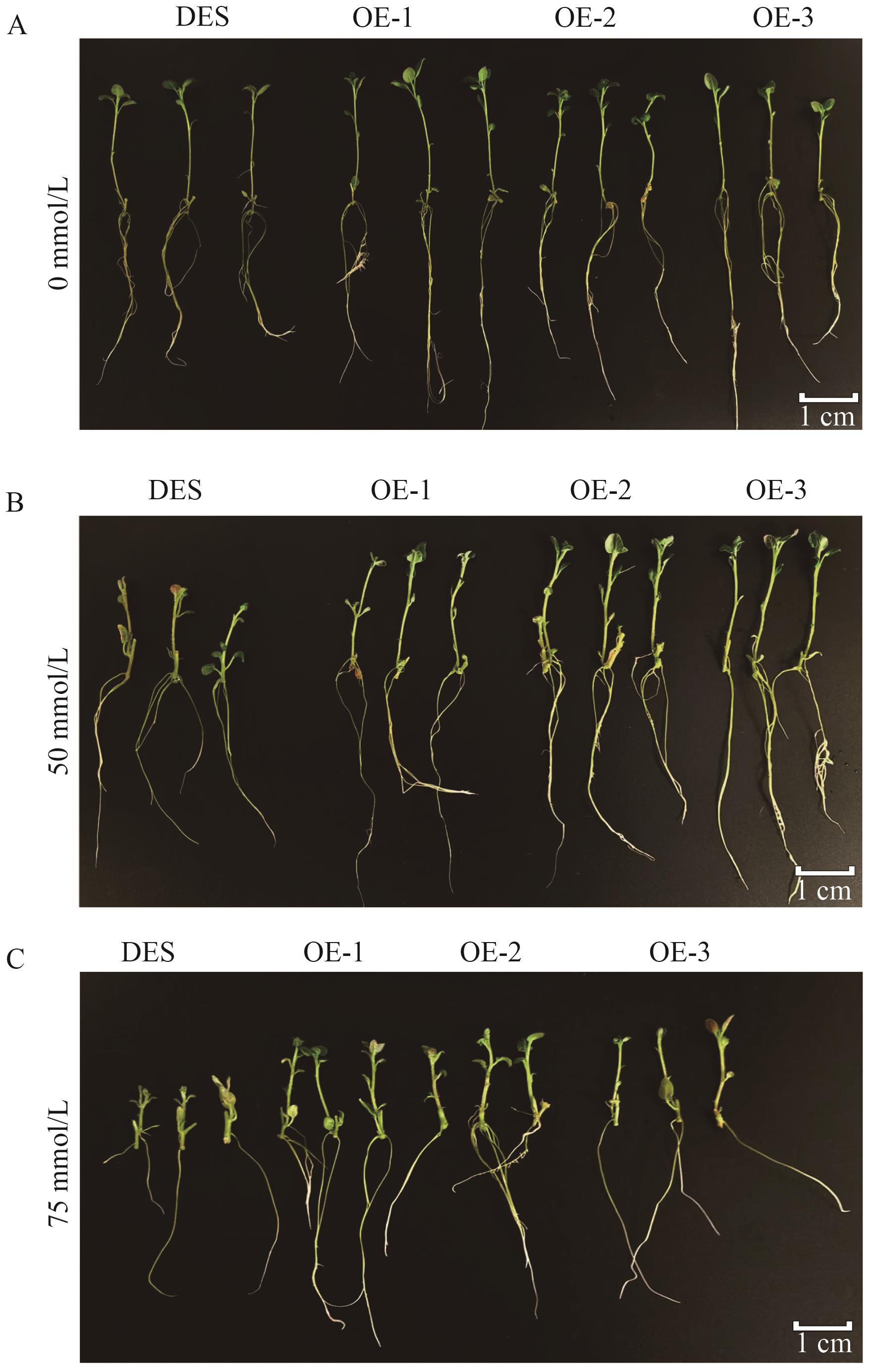
Fig. 4 Growth state of tissue culture seedlings after 20 d of salt stressDES: Wild type. OEs: Overexpressed positive plants

Fig. 5 Variations in antioxidant indexes in plants under different sodium chloride concentrations

Fig. 6 Expression analysis of salt stress-related genes in potato StAS2-15 overexpressing positive plants
| 1 | 黄凤玲, 张琳, 李先德, 等. 中国马铃薯产业发展现状及对策 [J]. 农业展望, 2017, 13(1): 25-31. |
| Huang FL, Zhang L, Li XD, et al. Development situation and countermeasures of China's potato industry [J]. Agric Outlook, 2017, 13(1): 25-31. | |
| 2 | 王希卓, 朱旭, 孙洁, 等. 我国马铃薯主粮化发展形势分析 [J]. 农产品加工, 2015(3): 52-55. |
| Wang XZ, Zhu X, Sun J, et al. The potato staple foods development situation analysis in China [J]. Farm Prod Process, 2015(3): 52-55. | |
| 3 | Hu C, He Y, Zhang WN, et al. Potato proteins for technical applications: nutrition, isolation, modification and functional properties-A review [J]. Innov Food Sci Emerg Technol, 2024, 91: 103533. |
| 4 | Liu XW, Sun HN, Mu TH, et al. Exploring the potential of potato products: puree and cellulose nanofibers, to improve the nutritional value of mayonnaise [J]. Food Chem, 2024, 437: 137864. |
| 5 | 谢从华, 柳俊. 中国马铃薯从济荒作物到主粮之变迁 [J]. 华中农业大学学报, 2021, 40(4): 8-15. |
| Xie CH, Liu J. Transition of potato from a famine relief crop to staple food in China [J]. J Huazhong Agric Univ, 2021, 40(4): 8-15. | |
| 6 | 赵映琴. 转拟南芥AtNHX1基因马铃薯耐盐性的田间鉴定 [D]. 兰州: 甘肃农业大学, 2009. |
| Zhao YQ. Field identification of salt tolerance of transgenic potato with Arabidopsis AtNHX1 gene [D]. Lanzhou: Gansu Agricultural University, 2009. | |
| 7 | Latchman DS. Transcription factors: an overview [J]. Int J Biochem Cell Biol, 1997, 29(12): 1305-1312. |
| 8 | Yoon Y, Seo DH, Shin H, et al. The role of stress-responsive transcription factors in modulating abiotic stress tolerance in plants [J]. Agronomy, 2020, 10(6): 788. |
| 9 | 吴乃虎, 刁丰秋. 植物转录因子与发育调控 [J]. 科学通报, 1998, 43(20): 2133-2139. |
| Wu NH, Diao FQ. Plant transcription factors and development regulation [J]. Chin Sci Bull, 1998, 43(20): 2133-2139. | |
| 10 | 刘强, 张贵友, 陈受宜. 植物转录因子的结构与调控作用 [J]. 科学通报, 2000, 45(14): 1465-1474. |
| Liu Q, Zhang GY, Chen SY. Structure and regulation of plant transcription factors [J]. Chin Sci Bull, 2000, 45(14): 1465-1474. | |
| 11 | Roy SJ, Negrão S, Tester M. Salt resistant crop plants [J]. Curr Opin Biotechnol, 2014, 26: 115-124. |
| 12 | Upadhyaya G, Sethi V, Modak A, et al. ALOG/LSHs, a novel class of transcription factors: Evolutionarily conserved regulators of plant growth and development [J]. J Exp Bot, 2024: erae409. |
| 13 | Iwakawa H, Ueno Y, Semiarti E, et al. The ASYMMETRIC LEAVES2 gene of Arabidopsis thaliana, required for formation of a symmetric flat leaf Lamina, encodes a member of a novel family of proteins characterized by cysteine repeats and a leucine zipper [J]. Plant Cell Physiol, 2002, 43(5): 467-478. |
| 14 | Bortiri E, Chuck G, Vollbrecht E, et al. ramosa2 encodes a lateral organ boundary domain protein that determines the fate of stem cells in branch meristems of maize [J]. Plant Cell, 2006, 18(3): 574-585. |
| 15 | Guo B, Wang J, Lin S, et al. A genome-wide analysis of the ASYMMETRIC LEAVES2/LATERAL ORGAN BOUNDARIES (AS2/LOB) gene family in barley (Hordeum vulgare L.)[J]. Journal of Zhejiang University-Science B, 2016, 17(10): 763-774. |
| 16 | Lu Q, Shao FJ, MacMillan C, et al. Genomewide analysis of the lateral organ boundaries domain gene family in Eucalyptus grandis reveals members that differentially impact secondary growth [J]. Plant Biotechnol J, 2018, 16(1): 124-136. |
| 17 | Liu JC, Sheng LH, Xu YQ, et al. WOX11 and 12 are involved in the first-step cell fate transition during de novo root organogenesis in Arabidopsis [J]. Plant Cell, 2014, 26(3): 1081-1093. |
| 18 | Matsumura Y, Iwakawa H, Machida Y, et al. Characterization of genes in the asymmetric leaves2/lateral organ boundaries (As2/lob) family in Arabidopsis thaliana, and functional and molecular comparisons between As2 and other family members [J]. Plant J, 2009, 58(3): 525-537. |
| 19 | 熊静. 玉米LBD转录因子Ⅱ类成员ZmLBD5和ZmLBD33在干旱胁迫中的功能研究 [D]. 雅安: 四川农业大学, 2021. |
| Xiong J. Function of ZmLBD5 and ZmLBD33, members of maize LBD transcription factor Ⅱ, in drought stress [D]. Ya’an: Sichuan Agricultural University, 2021. | |
| 20 | 雷彪, 曲瑞芳, 任超, 等. 谷子LBD基因家族的鉴定及其对逆境胁迫的响应 [J]. 植物生理学报, 2023, 59(3): 527-542. |
| Lei B, Qu RF, Ren C, et al. Identification of SiLBDs gene family in foxtail millet and its participation in stress response [J]. Plant Physiol J, 2023, 59(3): 527-542. | |
| 21 | Lin WC, Shuai B, Springer PS. The Arabidopsis lateral organ boundaries-domain gene asymmetric leaves2 functions in the repression of Knox gene expression and in adaxial-abaxial patterning [J]. Plant Cell, 2003, 15(10): 2241-2252. |
| 22 | Ori N, Eshed Y, Chuck G, et al. Mechanisms that control Knox gene expression in the Arabidopsis shoot [J]. Development, 2000, 127(24): 5523-5532. |
| 23 | Meng LS, Liu HL, Cui XH, et al. ASYMMETRIC LEAVES2-LIKE38 gene, a Member of AS2/LOB family of Arabidopsis, causes leaf dorsoventral alternation in transgenic cockscomb plants [J]. Acta Physiol Plant, 2009, 31(6): 1301-1306. |
| 24 | Feng XJ, Xiong J, Zhang WX, et al. ZmLBD5, a class-II LBD gene, negatively regulates drought tolerance by impairing abscisic acid synthesis [J]. Plant J, 2022, 112(6): 1364-1376. |
| 25 | 李爱宏, 张亚芳, 戴正元, 等. LBD基因家族在高等植物中的研究进展 [J]. 分子植物育种, 2006, 4(3): 301-308. |
| Li AH, Zhang YF, Dai ZY, et al. Progress of LBD gene family in higher plants [J]. Mol Plant Breed, 2006, 4(3): 301-308. | |
| 26 | Xu B, Li ZY, Zhu Y, et al. Arabidopsis genes AS1 AS2 and JAG negatively regulate boundary-specifying genes to promote sepal and petal development [J]. Plant Physiol, 2008, 146(2): 566-575. |
| 27 | Fan MZ, Xu CY, Xu K, et al. Lateral organ boundaries domain transcription factors direct callus formation in Arabidopsis regeneration [J]. Cell Res, 2012, 22(7): 1169-1180. |
| 28 | Okushima Y, Fukaki H, Onoda M, et al. ARF7 and ARF19 regulate lateral root formation via direct activation of LBD/ASL genes in Arabidopsis [J]. Plant Cell, 2007, 19(1): 118-130. |
| 29 | Taramino G, Sauer M, Stauffer JL Jr, et al. The maize (Zea mays L.) RTCS gene encodes a LOB domain protein that is a key regulator of embryonic seminal and post-embryonic shoot-borne root initiation [J]. Plant J, 2007, 50(4): 649-659. |
| 30 | 石玉, 沈诗雅, 张倩茹, 等. LBD基因家族研究进展 [J]. 中国细胞生物学学报, 2019, 41(4): 738-745. |
| Shi Y, Shen SY, Zhang QR, et al. The research progress of LBD gene family [J]. Chin J Cell Biol, 2019, 41(4): 738-745. | |
| 31 | Jiang QW, Wu XY, Zhang XY, et al. Genome-wide identification and expression analysis of AS2 genes in Brassica rapa reveal their potential roles in abiotic stress [J]. Int J Mol Sci, 2023, 24(13): 10534. |
| 32 | Machida Y, Suzuki T, Sasabe M, et al. Arabidopsis ASYMMETRIC LEAVES2 (AS2): roles in plant morphogenesis, cell division, and pathogenesis [J]. J Plant Res, 2022, 135(1): 3-14. |
| 33 | 张菊, 陈璨, 罗蕾, 等. AS1/AS2基因在叶形态建成中的作用研究进展 [J]. 植物遗传资源学报, 2022, 23(6): 1604-1612. |
| Zhang J, Chen C, Luo L, et al. Research progress in the role of AS1/AS2 genes in leaf morphogenesis [J]. J Plant Genet Resour, 2022, 23(6): 1604-1612. | |
| 34 | Dong RR, Yuan YQ, Liu ZQ, et al. ASYMMETRIC LEAVES 2 and ASYMMETRIC LEAVES 2-LIKE are partially redundant genes and essential for fruit development in tomato [J]. Plant J, 2023, 114(6): 1285-1300. |
| 35 | Meena RP, Ghosh G, Vishwakarma H, et al. Expression of a Pennisetum glaucum gene DREB2A confers enhanced heat, drought and salinity tolerance in transgenic Arabidopsis [J]. Mol Biol Rep, 2022, 49(8): 7347-7358. |
| 36 | Chen HL, Liu LP, Wang LX, et al. VrDREB2A, a DREB-binding transcription factor from Vigna radiata, increased drought and high-salt tolerance in transgenic Arabidopsis thaliana [J]. J Plant Res, 2016, 129(2): 263-273. |
| 37 | Liu HX, Wang X, Zhu XL, et al. Meta-analysis of SnRK2 gene overexpression in response to drought and salt stress [J]. Physiol Plant, 2024, 176(6): e14578. |
| 38 | Yang A, Dai XY, Zhang WH. A R2R3-type MYB gene, OsMYB2, is involved in salt, cold, and dehydration tolerance in rice [J]. J Exp Bot, 2012, 63(7): 2541-2556. |
| 39 | Shkolnik-Inbar D, Adler G, Bar-Zvi D. ABI4 downregulates expression of the sodium transporter HKT1;1 in Arabidopsis roots and affects salt tolerance [J]. Plant J, 2013, 73(6): 993-1005. |
| 40 | Chang HC, Tsai MC, Wu SS, et al. Regulation of ABI5 expression by ABF3 during salt stress responses in Arabidopsis thaliana [J]. Bot Stud, 2019, 60(1): 16. |
| 41 | Fu MJ, Kang HK, Son SH, et al. A subset of Arabidopsis RAV transcription factors modulates drought and salt stress responses independent of ABA [J]. Plant Cell Physiol, 2014, 55(11): 1892-1904. |
| 42 | Yi J, Zhao DM, Chu JF, et al. AtDPG1 is involved in the salt stress response of Arabidopsis seedling through ABI4 [J]. Plant Sci, 2019, 287: 110180. |
| 43 | Han ZL, Shang XW, Shao LX, et al. Meta-analysis of the effect of expression of MYB transcription factor genes on abiotic stress [J]. PeerJ, 2021, 9: e11268. |
| 44 | Bai JP, Mao J, Yang HY, et al. Sucrose non-ferment 1 related protein kinase 2 (SnRK2) genes could mediate the stress responses in potato (Solanum tuberosum L.) [J]. BMC Genet, 2017, 18(1): 41. |
| 45 | Sengupta S, Ray A, Mandal D, et al. ABI3 mediated repression of RAV1 gene expression promotes efficient dehydration stress response in Arabidopsis thaliana [J]. Biochim Biophys Acta Gene Regul Mech, 2020, 1863(9): 194582. |
| 46 | 刘洋, 郑洋洋, 宫超, 等. 番茄AS2基因家族的系统进化分析 [J]. 基因组学与应用生物学, 2018, 37(9): 3958-3965. |
| Liu Y, Zheng YY, Gong C, et al. Phylogenetic analysis of the AS2 gene family in tomato [J]. Genom Appl Biol, 2018, 37(9): 3958-3965. | |
| 47 | 梅超, 刘玉卫, 孙蕾, 等. 马铃薯AS2基因家族的鉴定与逆境胁迫表达 [J]. 应用与环境生物学报, 2020, 26(6): 1498-1507. |
| Mei C, Liu YW, Sun L, et al. Identification and expression analysis of the AS2 gene family under abiotic stress in Solanum tuberosum L [J]. Chin J Appl Environ Biol, 2020, 26(6): 1498-1507. | |
| 48 | 杨阳, 唐宁, 李正国. 番茄SlSnRK2s基因表达在促进叶片衰老中的作用 [J]. 热带作物学报, 2014, 35(5): 950-956. |
| Yang Y, Tang N, Li ZG. The role of SlSnRK2s expression in promoting the leaf senescence in tomato [J]. Chin J Trop Crops, 2014, 35(5): 950-956. | |
| 49 | 关淑艳, 焦鹏, 蒋振忠, 等. MYB转录因子在植物非生物胁迫中的研究进展 [J]. 吉林农业大学学报, 2019, 41(3): 253-260. |
| Guan SY, Jiao P, Jiang ZZ, et al. Research progress of MYB transcription factors in plant abiotic stress [J]. J Jilin Agric Univ, 2019, 41(3): 253-260. |
| [1] | WEN Bo-lin, WAN Min, HU Jian-jun, WANG Ke-xiu, JING Sheng-lin, WANG Xin-yue, ZHU Bo, TANG Ming-xia, LI Bing, HE Wei, ZENG Zi-xian. Establishment of Genetic Transformation and Gene Editing System for a Potato Cultivar Chuanyu 50 [J]. Biotechnology Bulletin, 2025, 41(4): 88-97. |
| [2] | LIU Tao, WANG Zhi-qi, WU Wen-bo, SHI Wen-ting, WANG Chao-nan, DU Chong, YANG Zhong-min. Identification and Expression Analysis of the GRAM Gene Family in Potato [J]. Biotechnology Bulletin, 2025, 41(4): 145-155. |
| [3] | ZHANG Yi-xuan, MA Yu, WANG Tong-tong, SHENG Su-ao, SONG Jia-feng, LYU Zhao-yan, ZHU Xiao-biao, HOU Hua-lan. Genome-wide Identification and Expression Profiles of DIR Gene Family in Potato [J]. Biotechnology Bulletin, 2025, 41(3): 123-136. |
| [4] | YU Ting, HUANG Dan-dan, ZHU Yan-hui, YANG Mei-hong, AI Ju, GAO Dong-li. Screening and Interaction Verification of Transcription Factors Stpatatin 05 Gene in Potato [J]. Biotechnology Bulletin, 2025, 41(3): 137-145. |
| [5] | QIN Yue, YANG Yan, ZHANG Lei, LU Li-li, LI Xian-ping, JIANG Wei. Identification and Comparative Analysis of the StGAox Genes in Diploid and Tetraploid Potatoes [J]. Biotechnology Bulletin, 2025, 41(3): 146-160. |
| [6] | DU Pin-ting, WU Guo-jiang, WANG Zhen-guo, LI Yan, ZHOU Wei, ZHOU Ya-xing. Identification and Expression Analysis of CPP Gene Family in Sorghum [J]. Biotechnology Bulletin, 2025, 41(1): 132-142. |
| [7] | LI Cai-xia, LI Yi, MU Hong-xiu, LIN Jun-xuan, BAI Long-qiang, SUN Mei-hua, MIAO Yan-xiu. Identification and Bioinformatics Analysis of the bHLH Transcription Factor Family in Cucurbita moschata Duch. [J]. Biotechnology Bulletin, 2025, 41(1): 186-197. |
| [8] | YUAN Liu-jiao, HUANG Wen-lin, CHEN Chong-zhi, LIANG Min, HUANG Zi-qi, CHEN Xue-xue, CHEN Ri-Meng, WANG Li-yun. Effects of Salt Stress on Physiological Characteristics, Ultrastructure and Medicinal Components of Pogostemon cablin Leaves [J]. Biotechnology Bulletin, 2025, 41(1): 230-239. |
| [9] | SHEN Peng, GAO Ya-Bin, DING Hong. Identification and Expression Analysis of SAT Gene Family in Potato(Solanum tuberosum L.) [J]. Biotechnology Bulletin, 2024, 40(9): 64-73. |
| [10] | SONG Bing-fang, LIU Ning, CHENG Xin-yan, XU Xiao-bin, TIAN Wen-mao, GAO Yue, BI Yang, WANG Yi. Identification of Potato G6PDH Gene Family and Its Expression Analysis in Damaged Tubers [J]. Biotechnology Bulletin, 2024, 40(9): 104-112. |
| [11] | WANG Chao, BAI Ru-qian, GUAN Jun-mei, LUO Ji-lin, HE Xue-jiao, CHI Shao-yi, MA Ling. Promotion of StHY5 in the Synthesis of SGAs during Tuber Turning-green of Potato [J]. Biotechnology Bulletin, 2024, 40(9): 113-122. |
| [12] | XIA Shi-xuan, GENG Ze-dong, ZHU Guang-tao, ZHANG Chun-zhi, LI Da-wei. Quick Detection of Potato Pollen Viability Based on Deep Learning [J]. Biotechnology Bulletin, 2024, 40(9): 123-130. |
| [13] | MAO Xiang-hong, LU Yao, FAN Xiang-bin, DU Pei-bing, BAI Xiao-dong. Genetic Diversity Analysis of Potato Varieties Based on SSR Fluorescent Marker Capillary Electrophoresis and Construction of Molecular Identity Card [J]. Biotechnology Bulletin, 2024, 40(9): 131-140. |
| [14] | YUAN Lan, HUANG Ya-nan, ZHANG Bei-ni, XIONG Yu-meng, WANG Hong-yang. High-throughput Sample Preparation Method for the Identification of Potato Ploidy Using Flow Cytometry [J]. Biotechnology Bulletin, 2024, 40(9): 141-147. |
| [15] | SONG Qian-na, DUAN Yong-hong, FENG Rui-yun. Establishment of CRISPR/Cas9-mediated Highly Efficient Gene Editing System in Microtubers of Potatoes [J]. Biotechnology Bulletin, 2024, 40(9): 33-41. |
| Viewed | ||||||
|
Full text |
|
|||||
|
Abstract |
|
|||||
