







Biotechnology Bulletin ›› 2025, Vol. 41 ›› Issue (8): 289-299.doi: 10.13560/j.cnki.biotech.bull.1985.2025-0107
LI De-hai1,2( ), YIN Li1,2, ZHOU Cai-xue1,2, WANG Ze-tong1,2, SUN Chang-yan3
Received:2025-01-26
Online:2025-08-26
Published:2025-08-14
Contact:
LI De-hai
E-mail:lidehaineau@163.com
LI De-hai, YIN Li, ZHOU Cai-xue, WANG Ze-tong, SUN Chang-yan. Screening, Identification and Preservation of Lactic Acid Bacteria Inhibiting the Growth of Rot-causing Fungus Lonicera caerulea L.[J]. Biotechnology Bulletin, 2025, 41(8): 289-299.
乳酸菌 Lactic acid bacteria | 链格孢霉 A. alternata | 小孢根霉 R. microspora |
|---|---|---|
| P-1 | - | - |
| P-2 | +++ | ++ |
| P-3 | - | - |
| P-4 | ++ | ++ |
| P-5 | ++ | +++ |
| P-6 | +++ | - |
| P-7 | - | + |
| P-8 | - | - |
| P-9 | ++ | + |
| P-10 | + | - |
| P-11 | + | - |
| J-12 | +++ | ++ |
| J-13 | ++ | +++ |
| J-14 | - | - |
| J-15 | - | ++ |
| J-16 | ++ | - |
| J-17 | + | - |
| J-18 | - | - |
| J-19 | ++ | ++ |
| J-20 | + | - |
| J-21 | ++ | ++ |
| J-22 | - | - |
Table 1 Antifungal activities of lactic acid bacteria against Alternaria alternata and Rhizoctonia microspora
乳酸菌 Lactic acid bacteria | 链格孢霉 A. alternata | 小孢根霉 R. microspora |
|---|---|---|
| P-1 | - | - |
| P-2 | +++ | ++ |
| P-3 | - | - |
| P-4 | ++ | ++ |
| P-5 | ++ | +++ |
| P-6 | +++ | - |
| P-7 | - | + |
| P-8 | - | - |
| P-9 | ++ | + |
| P-10 | + | - |
| P-11 | + | - |
| J-12 | +++ | ++ |
| J-13 | ++ | +++ |
| J-14 | - | - |
| J-15 | - | ++ |
| J-16 | ++ | - |
| J-17 | + | - |
| J-18 | - | - |
| J-19 | ++ | ++ |
| J-20 | + | - |
| J-21 | ++ | ++ |
| J-22 | - | - |

Fig. 1 Screening of antifungal activities of cell-free supernatants from different lactic acid bacteria against R. microspora (A) and A. alternata (B)

Fig. 2 Agarose gel electrophoresis of 16S rRNA PCR products of strain P-2 (A) and phylogenetic tree (B)
| 抗生素 Antibiotic | 抑菌直径 Inhibitory diameter (mm) | P-2抑菌直径 P-2 inhibitory diameter (mm) | 结果 Result | ||
|---|---|---|---|---|---|
| 敏感 Susceptible (S) | 中介 Intermediary (I) | 耐受 Resistance (R) | |||
| 四环素 Tetracycline | ≥19 | 15-18 | ≤14 | 24.43±1.39e | S |
| 氯霉素 Chloramphenicol | ≥18 | 13-17 | ≤12 | 40.83±0.67b | S |
| 氨苄西林 Ampicillin | ≥17 | 14-16 | ≤13 | 32.97±0.73c | S |
| 万古霉素 Vancomycin | ≥17 | 15-16 | ≤14 | 15.50±0.12f | I |
| 庆大霉素 Gentamicin | ≥15 | 13-14 | ≤12 | 0.00±0.00g | R |
| 卡那霉素 Kanamycin | ≥18 | 14-17 | ≤13 | 0.00±0.00g | R |
| 链霉素 Streptomycin | ≥15 | 12-14 | ≤11 | 0.00±0.00g | R |
| 红霉素 Erythromycin | ≥23 | 14-22 | ≤13 | 29.50±0.70d | S |
| 克林霉素 Clindamycin | ≥21 | 15-20 | ≤14 | 42.97±0.58a | S |
Table 2 Judgment criteria and results of antibiotic sensitivity of Pediococcus acidilactici P-2
| 抗生素 Antibiotic | 抑菌直径 Inhibitory diameter (mm) | P-2抑菌直径 P-2 inhibitory diameter (mm) | 结果 Result | ||
|---|---|---|---|---|---|
| 敏感 Susceptible (S) | 中介 Intermediary (I) | 耐受 Resistance (R) | |||
| 四环素 Tetracycline | ≥19 | 15-18 | ≤14 | 24.43±1.39e | S |
| 氯霉素 Chloramphenicol | ≥18 | 13-17 | ≤12 | 40.83±0.67b | S |
| 氨苄西林 Ampicillin | ≥17 | 14-16 | ≤13 | 32.97±0.73c | S |
| 万古霉素 Vancomycin | ≥17 | 15-16 | ≤14 | 15.50±0.12f | I |
| 庆大霉素 Gentamicin | ≥15 | 13-14 | ≤12 | 0.00±0.00g | R |
| 卡那霉素 Kanamycin | ≥18 | 14-17 | ≤13 | 0.00±0.00g | R |
| 链霉素 Streptomycin | ≥15 | 12-14 | ≤11 | 0.00±0.00g | R |
| 红霉素 Erythromycin | ≥23 | 14-22 | ≤13 | 29.50±0.70d | S |
| 克林霉素 Clindamycin | ≥21 | 15-20 | ≤14 | 42.97±0.58a | S |

Fig. 3 Inhibition effects of CFS of Pediococcus acidilactici P-2 treated at different temperatures on R. microsporus (A) and A. alternata (B)

Fig. 4 Inhibitory effect of CFS of Pediococcus acidilactici P-2 treated with different enzymes on R. microsporus (A) and A. alternata (B)

Fig. 5 Inhibition effect of CFS of P. acidilactici P-2 under different pH conditions on R. microsporus (A) and A. alternata (B)

Fig. 6 Minimum inhibitory concentration (MIC) of CFS from P. acidilactici P-2 against R. microsporus (A) and A. alternata (B)
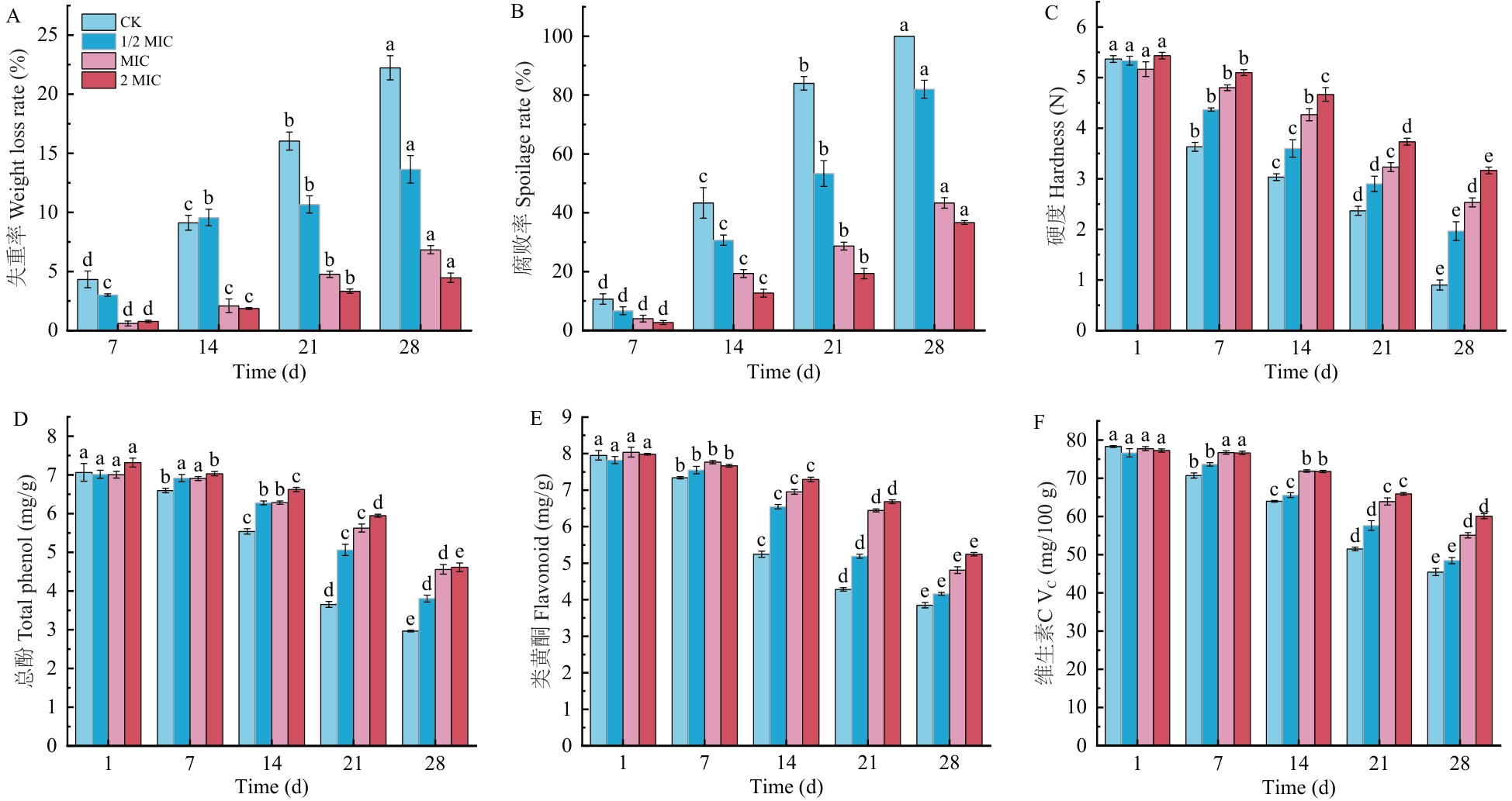
Fig. 7 Influences of different concentrations of Pediococcus acidilactici P-2 CFS on the weight loss rate, spoilage rate, hardness, total phenolic content, flavonoid content and vitamin C content of Lonicera caerulea L.Different letters indicate significant differences in different treatment methods (P<0.05). The same below
处理组 Processing group | 时间 Time (d) | 外观 Appearance (Scores) | 质地 Texture (Scores) | 味道 Taste (Scores) | 整体可接受性 Overall acceptability (Scores) |
|---|---|---|---|---|---|
| CK | 1 | 4.20±0.00a | 4.80±0.45a | 4.60±0.55a | 5.00±0.00a |
| 7 | 4.00±0.00a | 1.80±0.84b | 1.60±0.55b | 2.20±0.45b | |
| 14 | - | 1.20±0.45b | - | - | |
| 21 | - | 0.20±0.45c | - | - | |
| 28 | - | - | - | - | |
| 1/2 MIC | 1 | 4.60±0.55a | 5.00±0.00a | 4.80±0.45a | 4.60±0.55a |
| 7 | 4.20±0.84a | 4.00±0.71b | 3.20±1.64a | 4.40±0.89a | |
| 14 | 3.20±1.30ab | 2.40±0.55c | 1.20±0.84b | 2.80±0.84b | |
| 21 | 1.60±1.14bc | 0.80±0.45d | 0.20±0.45b | 1.20±0.84c | |
| 28 | 0.2±0.45c | 0.20±0.45d | - | 0.40±0.89c | |
| MIC | 1 | 4.60±0.55a | 4.80±0.45a | 4.60±0.55a | 4.80±0.45a |
| 7 | 4.20±0.45ab | 3.60±0.55a | 3.20±0.45b | 3.80±0.45a | |
| 14 | 3.40±0.55b | 2.00±1.00b | 1.20±0.84c | 2.40±0.55b | |
| 21 | 2.20±0.84c | 1.40±1.14b | 0.40±0.55cd | 1.00±1.00c | |
| 28 | 0.40±0.55d | 0.60±0.55b | - | 0.20±0.45c | |
| 2 MIC | 1 | 4.60±0.55a | 4.8±0.45a | 4.60±0.55a | 5.00±0a |
| 7 | 4.40±0.55a | 4.00±0.71a | 3.80±0.45a | 4.20±0.45a | |
| 14 | 3.60±0.55a | 2.00±1.00b | 1.80±0.84b | 2.80±0.45b | |
| 21 | 2.20±0.84b | 1.40±1.14b | 1.00±0.71bc | 1.40±0.89c | |
| 28 | 0.60±0.5c | 0.80±0.45b | - | 1.00±0.71c |
Table 3 Sensory evaluation of L. caerulea L. during storage
处理组 Processing group | 时间 Time (d) | 外观 Appearance (Scores) | 质地 Texture (Scores) | 味道 Taste (Scores) | 整体可接受性 Overall acceptability (Scores) |
|---|---|---|---|---|---|
| CK | 1 | 4.20±0.00a | 4.80±0.45a | 4.60±0.55a | 5.00±0.00a |
| 7 | 4.00±0.00a | 1.80±0.84b | 1.60±0.55b | 2.20±0.45b | |
| 14 | - | 1.20±0.45b | - | - | |
| 21 | - | 0.20±0.45c | - | - | |
| 28 | - | - | - | - | |
| 1/2 MIC | 1 | 4.60±0.55a | 5.00±0.00a | 4.80±0.45a | 4.60±0.55a |
| 7 | 4.20±0.84a | 4.00±0.71b | 3.20±1.64a | 4.40±0.89a | |
| 14 | 3.20±1.30ab | 2.40±0.55c | 1.20±0.84b | 2.80±0.84b | |
| 21 | 1.60±1.14bc | 0.80±0.45d | 0.20±0.45b | 1.20±0.84c | |
| 28 | 0.2±0.45c | 0.20±0.45d | - | 0.40±0.89c | |
| MIC | 1 | 4.60±0.55a | 4.80±0.45a | 4.60±0.55a | 4.80±0.45a |
| 7 | 4.20±0.45ab | 3.60±0.55a | 3.20±0.45b | 3.80±0.45a | |
| 14 | 3.40±0.55b | 2.00±1.00b | 1.20±0.84c | 2.40±0.55b | |
| 21 | 2.20±0.84c | 1.40±1.14b | 0.40±0.55cd | 1.00±1.00c | |
| 28 | 0.40±0.55d | 0.60±0.55b | - | 0.20±0.45c | |
| 2 MIC | 1 | 4.60±0.55a | 4.8±0.45a | 4.60±0.55a | 5.00±0a |
| 7 | 4.40±0.55a | 4.00±0.71a | 3.80±0.45a | 4.20±0.45a | |
| 14 | 3.60±0.55a | 2.00±1.00b | 1.80±0.84b | 2.80±0.45b | |
| 21 | 2.20±0.84b | 1.40±1.14b | 1.00±0.71bc | 1.40±0.89c | |
| 28 | 0.60±0.5c | 0.80±0.45b | - | 1.00±0.71c |
| [1] | Auzanneau N, Weber P, Kosińska-Cagnazzo A, et al. Bioactive compounds and antioxidant capacity of Lonicera caerulea berries: Comparison of seven cultivars over three harvesting years [J]. J Food Compos Anal, 2018, 66: 81-89. |
| [2] | Dong HY, Xu Y, Zhang QQ, et al. Activity and safety evaluation of natural preservatives [J]. Food Res Int, 2024, 190: 114548. |
| [3] | Fan LL, Lin L, Zhang Y, et al. Component characteristics and reactive oxygen species scavenging activity of anthocyanins from fruits of Lonicera caerulea L [J]. Food Chem, 2023, 403: 134391. |
| [4] | 李山, 张彦龙, 曾伟民, 等. 蓝靛果果渣花色苷胶束的制备及其稳定性研究 [J]. 食品工业科技, 2024, 45(2): 21-29. |
| Li S, Zhang YL, Zeng WM, et al. Study on preparation and stability of anthocyanin micelles from Lonicera edulis pomace [J]. Sci Technol Food Ind, 2024, 45(2): 21-29. | |
| [5] | 周静. 寒地浆果 香飘四季 [N]. 黑龙江日报, 2024-10-15(5). |
| Zhou J. The sweet flavor of berries in cold land [N]. Heilongjiang Daily, 2024-10-15(5). | |
| [6] | 张星, 毕金峰, 陈芹芹, 等. 蓝莓-蓝靛果复合冻干粉贮藏期品质及加工特性 [J]. 食品科学, 2022, 43(17): 240-247. |
| Zhang X, Bi JF, Chen QQ, et al. Quality and processing characteristics of a mixed freeze-dried powder of blueberry and blue honeysuckle berries during storage [J]. Food Sci, 2022, 43(17): 240-247. | |
| [7] | Chen J, Fu CL, Wang HY, et al. Combination transcriptomic and metabolomic reveal deterioration of the blue honeysuckle (Lonicera caerulea L.) fruit and candidate genes regulating metabolism in the post-harvest stage [J]. Int J Biol Macromol, 2025, 284: 138074. |
| [8] | 李次力. 蓝靛果的壳聚糖涂膜保鲜研究 [J]. 食品科学, 2008, 29(7): 457-461. |
| Li CL. Study on chitosan coating preservation of Lonicera edulis [J]. Food Sci, 2008, 29(7): 457-461. | |
| [9] | 赵倩, 张鹏, 贾晓昱, 等. 不同采收期对1-MCP处理后蓝靛果贮藏品质的影响 [J]. 包装工程, 2023, 44(11): 78-86. |
| Zhao Q, Zhang P, Jia XY, et al. Effects of different harvest periods on the storage quality of Lonicera caerulea L. after 1-MCP treatment [J]. Packag Eng, 2023, 44(11): 78-86. | |
| [10] | Adithi G, Divyashree S, Shruthi B, et al. Evaluation of Limosilactobacillus fermentum MYSAGAM1 isolated from herbal Amla juice as a probiotic candidate with antifungal characteristics against Fusarium equiseti [J]. Food Biosci, 2024, 58: 103843. |
| [11] | 陈思宇, 金建, 赵世琳. 物理技术在果蔬保鲜中的应用研究进展 [J]. 食品研究与开发, 2023, 44(21): 167-172. |
| Chen SY, Jin J, Zhao SL. Progress in application of physical technology in preservation of fruits and vegetables [J]. Food Res Dev, 2023, 44(21): 167-172. | |
| [12] | 李江阔, 高静, 张鹏, 等. 微环境气调对蓝果忍冬贮藏品质和抗氧化酶的影响 [J]. 食品与发酵工业, 2021, 47(6): 152-159. |
| Li JK, Gao J, Zhang P, et al. Micro-environmental modified atmosphere on storage quality and antioxidant enzymes of blue honeysuckle fruits [J]. Food Ferment Ind, 2021, 47(6): 152-159. | |
| [13] | Deng XZ, Wei YY, Jiang S, et al. Recent advances in the application of tea tree oil in the storage of fruit and vegetables [J]. Postharvest Biol Technol, 2025, 219: 113260. |
| [14] | Abouloifa H, Gaamouche S, Ghabbour N, et al. Lactic acid bacteria from Moroccan traditional foods: Techno-functional, health-promoting, nutraceutical value and application as a starter and bio-preservative agent in the food products [J]. Bioresour Technol Rep, 2024, 27: 101941. |
| [15] | Hernández Figueroa RH, López-Malo A, Mani-López E. Antimicrobial activity and applications of fermentates from lactic acid bacteria-a review [J]. Sustainable Food Technol, 2024, 2(2): 292-306. |
| [16] | Wang Q, Zhang F, Zhang YH, et al. A novel strain Lactiplantibacillus plantarum LPP95 isolated from Chinese pickles: Antifungal effect, mechanism, and potential application in yogurt [J]. Food Biosci, 2024, 58: 103640. |
| [17] | Wang L, Jiang SS, Zhou CX, et al. Exploring novel preservation strategies for blue honeysuckle through high-throughput sequencing and bioinformatics analysis [J]. Postharvest Biol Technol, 2025, 219: 113251. |
| [18] | Jiang SS, Wang L, Li DH, et al. The purification of dominant spoilage fungi on Lonicera Caeruleum and the inhibitory effects of composite essential oils against these fungi [J]. Food Biosci, 2023, 53: 102839. |
| [19] | Souza LV, Rodrigues da Silva R, Falqueto A, et al. Evaluation of antifungal activity of lactic acid bacteria against fungi in simulated cheese matrix [J]. LWT, 2023, 182: 114773. |
| [20] | Riolo M, Luz C, Santilli E, et al. Antifungal activity of selected lactic acid bacteria from olive drupes [J]. Food Biosci, 2023, 52: 102422. |
| [21] | de Vasconcelos Medeiros GKV, Martins ACS, Vasconcelos MG, et al. Cereus jamacaru DC. (mandacaru) fruit as a source of lactic acid bacteria with in vitro probiotic-related characteristics and its protective effects on Pediococcus pentosaceus during lyophilization and refrigeration storage [J]. Int J Food Microbiol, 2024, 417: 110695. |
| [22] | 訾静, 王琰, 李亮亮, 等. 林麝肠道中乳酸菌的分离筛选及益生特性 [J]. 食品科学, 2024, 45(8): 79-86. |
| Zi J, Wang Y, Li LL, et al. Isolation and screening of lactic acid bacteria from the gut of forest musk deer for probiotic properties [J]. Food Sci, 2024, 45(8): 79-86. | |
| [23] | 王晓宇, 吴梦娜, 于巧如, 等. 植物乳杆菌ST3.5的分离鉴定及其对霉菌的抑制作用 [J]. 食品工业科技, 2023, 44(13): 141-149. |
| Wang XY, Wu MN, Yu QR, et al. Isolation and identification of lactiplantibacillus plantarum ST3.5 and its inhibitory effect on mold [J]. Sci Technol Food Ind, 2023, 44(13): 141-149. | |
| [24] | Ma MG, Li A, Feng J, et al. Antifungal mechanism of Lactiplantibacillus plantarum P10 against Aspergillus niger and its in situ biopreservative application in Chinese steamed bread [J]. Food Chem, 2024, 449: 139181. |
| [25] | Shu C, Sun XX, Cao JK, et al. Antifungal efficiency and mechanisms of ethyl ferulate against postharvest pathogens [J]. Int J Food Microbiol, 2024, 417: 110710. |
| [26] | 刘艺璇, 岳红, 司欣雨, 等. 拮抗菌复合保鲜纸的制备及其对苹果保鲜中的应用 [J]. 食品工业科技, 2025, 46(6): 342-351. |
| Liu YX, Yue H, Si XY, et al. Preparation of composite preservation paper containing antagonistic fungi and its application on apple preservation [J]. Sci Technol Food Ind, 2025, 46(6): 342-351. | |
| [27] | 王成炜, 袁宇尧, 张政, 等. 基于计算流体动力学的二氧化硫压差熏蒸模型在鲜食葡萄保鲜中的应用研究 [J]. 食品与发酵工业, 2025, 51(2): 118-125. |
| Wang CW, Yuan YY, Zhang Z, et al. Application research of sulfur dioxide differential pressure fumigation model based on computational fluid dynamics in table grape preservation [J]. Food Ferment Ind, 2025, 51(2): 118-125. | |
| [28] | 曹建康, 姜微波, 赵玉梅. 果蔬采后生理生化实验指导 [M]. 北京: 中国轻工业出版社, 2007: 176. |
| Cao JK, Jiang WB, Zhao YM. Guidance on postharvest physiological and biochemical experiments of fruits and vegetables [M]. Beijing: China Light Industry Press, 2007: 176. | |
| [29] | 李军. 钼蓝比色法测定还原型维生素C [J]. 食品科学, 2000, 21(8): 42-45. |
| Li J. Study on molybdenum blue method of L-VC test by spectrometry [J]. Food Sci, 2000, 21(8): 42-45. | |
| [30] | 史洁莹, 牟燕萍, 陆周欣, 等. 壳聚糖-植物精油纳米乳液保鲜垫的制备及其在蓝莓保鲜中的应用 [J/OL]. 食品工业科技, 2024. . |
| Shi JY, Mou YP, Lu ZX, et al. Preparation and application of chitosan-essential oil nanoemulsion preservation pads for blueberry preservation [J/OL]. Sci Technol Food Ind, 2024. . | |
| [31] | Sharma AK, Sati DM, Murti Y, et al. A comprehensive review on Chinese honeysuckle (Qusqualis indica): a Traditional Chinese plant [J]. Toxicol Rep, 2024, 13: 101768. |
| [32] | Islam S, Biswas S, Jabin T, et al. Probiotic potential of Lactobacillus plantarum DMR14 for preserving and extending shelf life of fruits and fruit juice [J]. Heliyon, 2023, 9(6): e17382. |
| [33] | Liang NY, Zhao Z, Curtis JM, et al. Antifungal cultures and metabolites of lactic acid bacteria for use in dairy fermentations [J]. Int J Food Microbiol, 2022, 383: 109938. |
| [34] | Liu AP, Xu RX, Zhang S, et al. Antifungal mechanisms and application of lactic acid bacteria in bakery products: a review [J]. Front Microbiol, 2022, 13: 924398. |
| [35] | Abouloifa H, Rokni Y, Hasnaoui I, et al. Characterization of antimicrobial compounds obtained from the potential probiotic Lactiplantibacillus plantarum S61 and their application as a biopreservative agent [J]. Braz J Microbiol, 2022, 53(3): 1501-1513. |
| [36] | Chen X, Wei ZR, Feng ZQ, et al. Large-scale fermentation of Lactiplantibacillus pentosus 292 for the production of lactic acid and the storage strategy based on molasses as a preservative [J]. BMC Microbiol, 2025, 25(1): 125. |
| [37] | Li NY, Cheng YF, Li Z, et al. An alginate-based edible coating containing lactic acid bacteria extends the shelf life of fresh strawberry (Fragaria × Ananassa Duch.) [J]. Int J Biol Macromol, 2024, 274: 133273. |
| [38] | 王璐. 采后蓝靛果菌群分析及乳酸菌无细胞上清液对其致腐菌抑制作用 [D]. 哈尔滨: 东北林业大学, 2024. |
| Wang L. Analysis of the flora of postharvest Lonicera edulis and the inhibitory effect of cell-free supernatant of lactic acid bacteria on its rot-causing bacteria [D]. Harbin: Northeast Forestry University, 2024. |
| [1] | LIU Jia, REN Yi-shang, JING Xiao-yan, XU La. Applications and Prospects of Raman Spectroscopy-based “Screen-First, Culture-Second” Strategy in Functional Microbial Resource Exploration [J]. Biotechnology Bulletin, 2026, 42(5): 1-13. |
| [2] | CHEN Yong-qi, LI Zhi-wen, LI Xin, YUAN Ruo-xi, WANG Chun-xu, HAN Yi-qiang, GAO Ya-mei. Isolation and Function Study of Actinomycetes from Rhizosphere Soil of Soybean in the Black Soil Region [J]. Biotechnology Bulletin, 2025, 41(5): 255-266. |
| [3] | LIU Li, WANG Hui, GUAN Tian-shu, LI Bai-hong, YU Shu-yi. Screening the Interacting Protein of Abscisic Acid Receptor VvPYL4 and the Gene Expression of the Interacting Protein in Grape [J]. Biotechnology Bulletin, 2025, 41(4): 188-197. |
| [4] | SONG Jia-yi, SU Yun-li, ZHENG Xing-yan, XIA Wen-nian, YANG Dong-mei, HU Hui-zhen. Identification of the Snapdragon Expansin Gene Family and Screening of Its Genes Related to Resistance to Sclerotinia sclerotiorum [J]. Biotechnology Bulletin, 2025, 41(4): 227-242. |
| [5] | LIU Shuang, JIANG Zhou, ZHAO Shuai, ZHAO Lei-zhen, HUANG Feng, ZHOU Jia, QU Jian-hang. Screening, Identification, and Fermentation Optimization of a Protease-producing Bacterial Strain [J]. Biotechnology Bulletin, 2025, 41(4): 335-344. |
| [6] | DU Wei, LI Zhi-min, XING Yan-ming, LIU Pu-lin, MIAO Li-hong. Screening and Identification of a Bacillus licheniformis Strain with High Electro-transfection Efficiency and Elevated Biomass [J]. Biotechnology Bulletin, 2024, 40(9): 181-189. |
| [7] | XING Li-nan, ZHANG Yan-fang, GE Ming-ran, ZHAO Ling-min, CHEN Yan, HUO Xiu-wen. Analysis of DoWRKY40 Gene Expression Characteristics and Screening of Interacting Proteins in Yam [J]. Biotechnology Bulletin, 2024, 40(8): 118-128. |
| [8] | SHAO Chang-xuan, ZHANG Shao-hua, DENG Hao-ran, YU Wei-kang, ZHU Yong-jie, SHAN An-shan. Database-aided Design of Antimicrobial Peptides [J]. Biotechnology Bulletin, 2024, 40(12): 12-19. |
| [9] | PI Yi-fei, SONG Xin-hui, WANG Xi-lin, LI Jin-jin, SUN Chang-bin, XU Wei. High-throughput Screening System for Functional R-loop Loci Based on R-loop Targeted Editing Technology [J]. Biotechnology Bulletin, 2024, 40(10): 181-190. |
| [10] | LIU Xing-yu, LI Jie, ZHU Long-jiao, LI Xiang-yang, XU Wen-tao. Aptamer of Pseudomonas aeruginosa: Acquiring and Application [J]. Biotechnology Bulletin, 2024, 40(1): 186-193. |
| [11] | HUANG Xiao-long, SUN Gui-lian, MA Dan-dan, YAN Hui-qing. Construction of Yeast One-hybrid Library and Screening of Factors Regulating LAZY1 Expression in Rice [J]. Biotechnology Bulletin, 2023, 39(9): 126-135. |
| [12] | WEN Xiao-lei, LI Jian-yuan, LI Na, ZHANG Na, YANG Wen-xiang. Construction and Utilization of Yeast Two-hybrid cDNA Library of Wheat Interacted by Puccinia triticina [J]. Biotechnology Bulletin, 2023, 39(9): 136-146. |
| [13] | WU Qiao-yin, SHI You-zhi, LI Lin-lin, PENG Zheng, TAN Zai-yu, LIU Li-ping, ZHANG Juan, PAN Yong. In Situ Screening of Carotenoid Degrading Strains and the Application in Improving Quality and Aroma of Cigar [J]. Biotechnology Bulletin, 2023, 39(9): 192-201. |
| [14] | JIANG Hai-rong, CUI Ruo-qi, WANG Yue BAI, Miao ZHANG, Ming-lu , REN Lian-hai. Isolation, Identification and Degradation Characteristics of Functional Bacteria for NH3 and H2S Degradation [J]. Biotechnology Bulletin, 2023, 39(9): 246-254. |
| [15] | XUE Ning, WANG Jin, LI Shi-xin, LIU Ye, CHENG Hai-jiao, ZHANG Yue, MAO Yu-feng, WANG Meng. Construction of L-phenylalanine High-producing Corynebacterium glutamicum Engineered Strains via Multi-gene Simultaneous Regulation Combined with High-throughput Screening [J]. Biotechnology Bulletin, 2023, 39(9): 268-280. |
| Viewed | ||||||
|
Full text |
|
|||||
|
Abstract |
|
|||||
