







Biotechnology Bulletin ›› 2026, Vol. 42 ›› Issue (5): 174-184.doi: 10.13560/j.cnki.biotech.bull.1985.2025-0847
ZHANG Ying-ying( ), WU Zhi-tao, CHANG Hao, XU Zhi-peng, YANG Xiao-long, YANG Ke-ze, WEI Yu-jie()
Received:2025-08-04
Online:2026-05-26
Published:2026-06-10
Contact:
WEI Yu-jie
E-mail:495285884@qq.com;gswwwyj67@163.com
ZHANG Ying-ying, WU Zhi-tao, CHANG Hao, XU Zhi-peng, YANG Xiao-long, YANG Ke-ze, WEI Yu-jie. Effects of Continuous Cropping Years on Rhizosphere Soil Properties and Microbial Community Structure of Astragalus membranaceus var. mongholicus[J]. Biotechnology Bulletin, 2026, 42(5): 174-184.
| 指标 Index | CK | Y1 | Y3 | Y5 |
|---|---|---|---|---|
| pH | 8.09±0.03ab | 8.20±0.03a | 7.97±0.10bc | 7.85±0.01c |
| 电导率 Electrical conductivity (μs/cm) | 185.30±26.59a | 144.87±11.50a | 225.70±61.68a | 243.67±9.17a |
| 有机质 Organic matter (g/kg) | 48.20±1.24ab | 44.81±1.65b | 51.14±0.77a | 48.37±1.94ab |
| 全氮 Total nitrogen (g/kg) | 2.56±0.06a | 2.37±0.09ab | 2.47±0.06ab | 2.29±0.02b |
| 碱解氮 Available nitrogen (mg/kg) | 436.17±60.89ab | 423.78±18.17bc | 543.41±26.82a | 316.67±13.45c |
| 有效磷 Available phosphorus (mg/kg) | 32.50±5.77b | 28.42±1.18b | 29.50±5.13b | 55.83±2.26a |
| 速效钾 Available phosphorus (mg/kg) | 100.67±3.84b | 90.00±5.51b | 118.00±15.10ab | 131.67±1.67a |
| 脲酶 Urease activity (μg NH4+-N·g-1 DW·d-1) | 4.09±0.18a | 3.70±0.19a | 4.07±0.04a | 2.70±0.14b |
| 蔗糖酶 Invertasc (mg reducing sugar·g-1 DW·d-1) | 77.64±1.21a | 62.76±3.15b | 69.49±1.20ab | 60.54±5.26b |
| 碱性磷酸酶 Alkaline phosphatase (μmol phenol·g-1 DW·d-1) | 2.71±0.14a | 2.65±0.15a | 2.74±0.04a | 2.16±0.07b |
| 过氧化氢酶 Catalase (μmol H2O2 degraded-1 DW·d-1 ) | 0.07±0.00b | 0.1±0.01ab | 0.08±0.00b | 0.12±0.01a |
Table 1 Effects of different continuous cropping years on chemical properties and enzyme activities of rhizosphere soil of Astragalus membranaceus var. mongholicus
| 指标 Index | CK | Y1 | Y3 | Y5 |
|---|---|---|---|---|
| pH | 8.09±0.03ab | 8.20±0.03a | 7.97±0.10bc | 7.85±0.01c |
| 电导率 Electrical conductivity (μs/cm) | 185.30±26.59a | 144.87±11.50a | 225.70±61.68a | 243.67±9.17a |
| 有机质 Organic matter (g/kg) | 48.20±1.24ab | 44.81±1.65b | 51.14±0.77a | 48.37±1.94ab |
| 全氮 Total nitrogen (g/kg) | 2.56±0.06a | 2.37±0.09ab | 2.47±0.06ab | 2.29±0.02b |
| 碱解氮 Available nitrogen (mg/kg) | 436.17±60.89ab | 423.78±18.17bc | 543.41±26.82a | 316.67±13.45c |
| 有效磷 Available phosphorus (mg/kg) | 32.50±5.77b | 28.42±1.18b | 29.50±5.13b | 55.83±2.26a |
| 速效钾 Available phosphorus (mg/kg) | 100.67±3.84b | 90.00±5.51b | 118.00±15.10ab | 131.67±1.67a |
| 脲酶 Urease activity (μg NH4+-N·g-1 DW·d-1) | 4.09±0.18a | 3.70±0.19a | 4.07±0.04a | 2.70±0.14b |
| 蔗糖酶 Invertasc (mg reducing sugar·g-1 DW·d-1) | 77.64±1.21a | 62.76±3.15b | 69.49±1.20ab | 60.54±5.26b |
| 碱性磷酸酶 Alkaline phosphatase (μmol phenol·g-1 DW·d-1) | 2.71±0.14a | 2.65±0.15a | 2.74±0.04a | 2.16±0.07b |
| 过氧化氢酶 Catalase (μmol H2O2 degraded-1 DW·d-1 ) | 0.07±0.00b | 0.1±0.01ab | 0.08±0.00b | 0.12±0.01a |
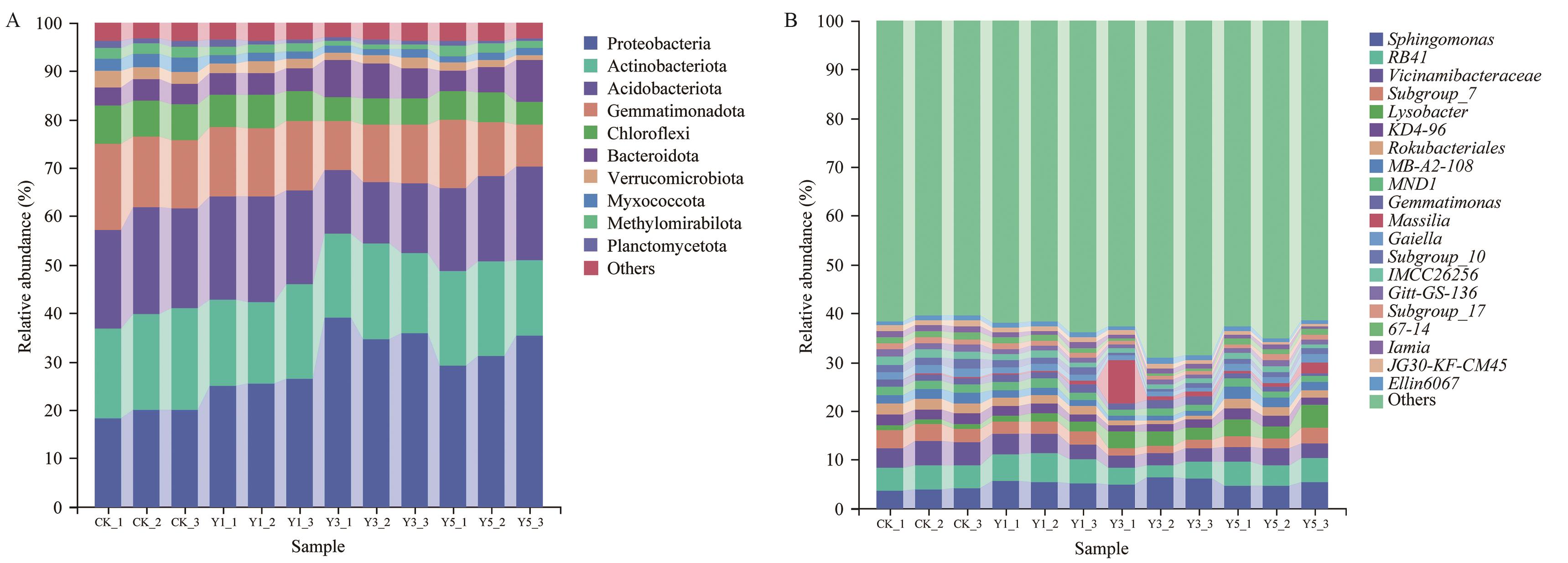
Fig. 1 Community composition of soil bacterial phyla and genera in the rhizosphere of A. membranaceus var. mongholicus under different continuous cropping yearsA: Taxonomic composition of bacterial communities in soils at the phylum level. B: Taxonomic composition of bacterial communities in soils at the genus level
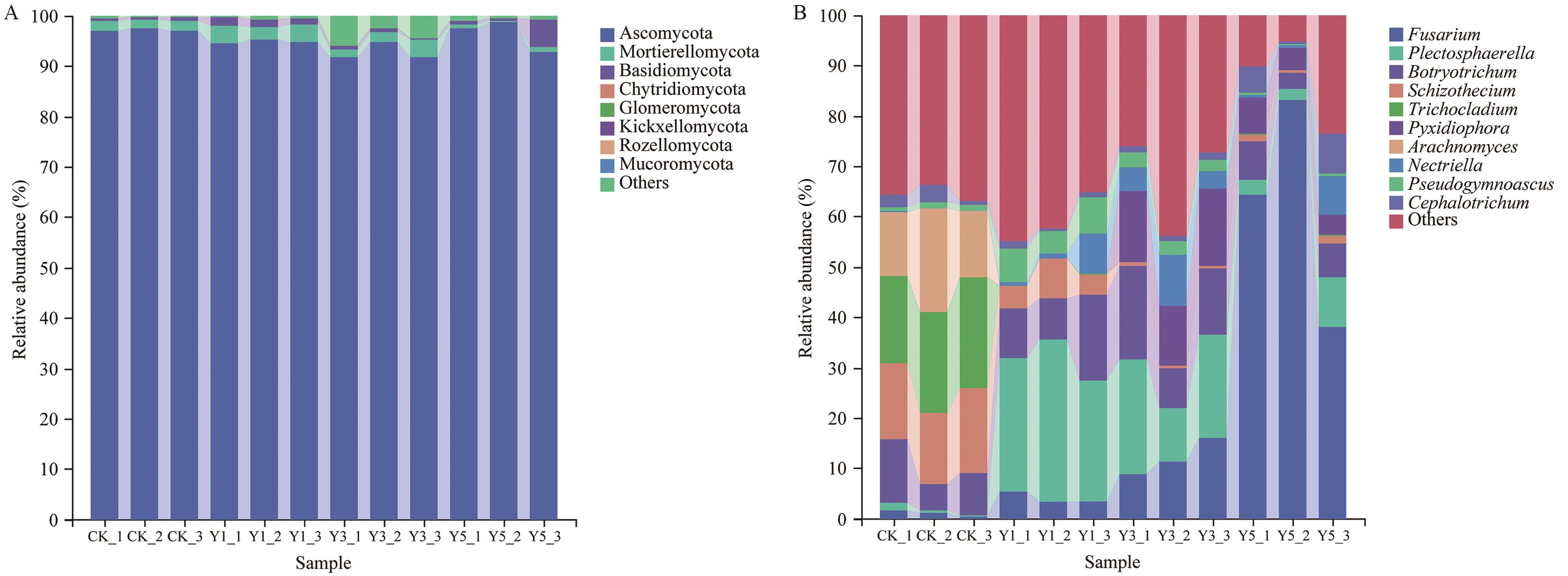
Fig. 2 Community composition of soil fungi phyla and genera in the rhizosphere of A. membranaceus var. mongholicus under different planting yearsA: Taxonomic composition of fungi communities in soils at the phylum level. B: Taxonomic composition of fungi communities in soils at the genus level
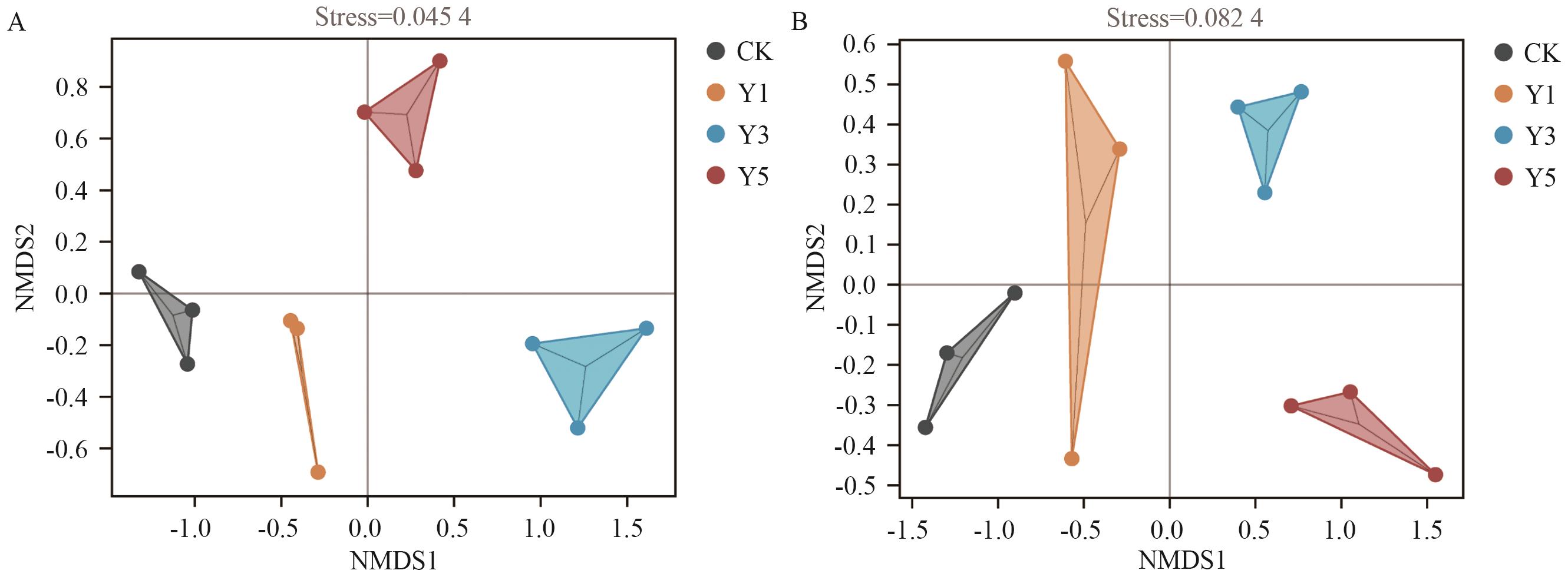
Fig. 3 NMDS analysis of soil microbial communityA: NMDS analysis of the soil bacterial community. B: NMDS analysis of the soil fungal community
| 类别Classification | 处理Treatment | 节点数Total nods | 边数Total links | 平均度Average degree | 网络直径Network diameter | 模块化Modularity | 平均聚类系数Average clustering coefficient | 正相关Positivity | 负相关Negative |
|---|---|---|---|---|---|---|---|---|---|
| 细菌 Bacteria | CK | 305 | 470 | 1.57 | 10 | 0.962 | 0.326 | 53.37 | 46.63 |
| Y1 | 300 | 520 | 1.91 | 10 | 0.937 | 0.338 | 54.02 | 45.98 | |
| Y3 | 308 | 533 | 1.78 | 15 | 0.917 | 0.295 | 54.41 | 45.59 | |
| Y5 | 300 | 488 | 1.63 | 7 | 0.906 | 0.331 | 46.52 | 53.48 | |
| 真菌 Fungus | CK | 241 | 3 167 | 26.82 | 13 | 0.75 | 0.91 | 87.81 | 12.19 |
| Y1 | 241 | 3 639 | 30.199 | 19 | 0.727 | 0.87 | 89.2 | 10.8 | |
| Y3 | 238 | 3 890 | 32.282 | 24 | 0.694 | 0.876 | 91.31 | 8.69 | |
| Y5 | 154 | 1 105 | 14.351 | 13 | 0.577 | 0.951 | 93.47 | 6.43 |
Table 2 Network topology of rhizosphere bacterial and fungal communities in A. mongholicus var. mongholicus under different continuous cropping years
| 类别Classification | 处理Treatment | 节点数Total nods | 边数Total links | 平均度Average degree | 网络直径Network diameter | 模块化Modularity | 平均聚类系数Average clustering coefficient | 正相关Positivity | 负相关Negative |
|---|---|---|---|---|---|---|---|---|---|
| 细菌 Bacteria | CK | 305 | 470 | 1.57 | 10 | 0.962 | 0.326 | 53.37 | 46.63 |
| Y1 | 300 | 520 | 1.91 | 10 | 0.937 | 0.338 | 54.02 | 45.98 | |
| Y3 | 308 | 533 | 1.78 | 15 | 0.917 | 0.295 | 54.41 | 45.59 | |
| Y5 | 300 | 488 | 1.63 | 7 | 0.906 | 0.331 | 46.52 | 53.48 | |
| 真菌 Fungus | CK | 241 | 3 167 | 26.82 | 13 | 0.75 | 0.91 | 87.81 | 12.19 |
| Y1 | 241 | 3 639 | 30.199 | 19 | 0.727 | 0.87 | 89.2 | 10.8 | |
| Y3 | 238 | 3 890 | 32.282 | 24 | 0.694 | 0.876 | 91.31 | 8.69 | |
| Y5 | 154 | 1 105 | 14.351 | 13 | 0.577 | 0.951 | 93.47 | 6.43 |
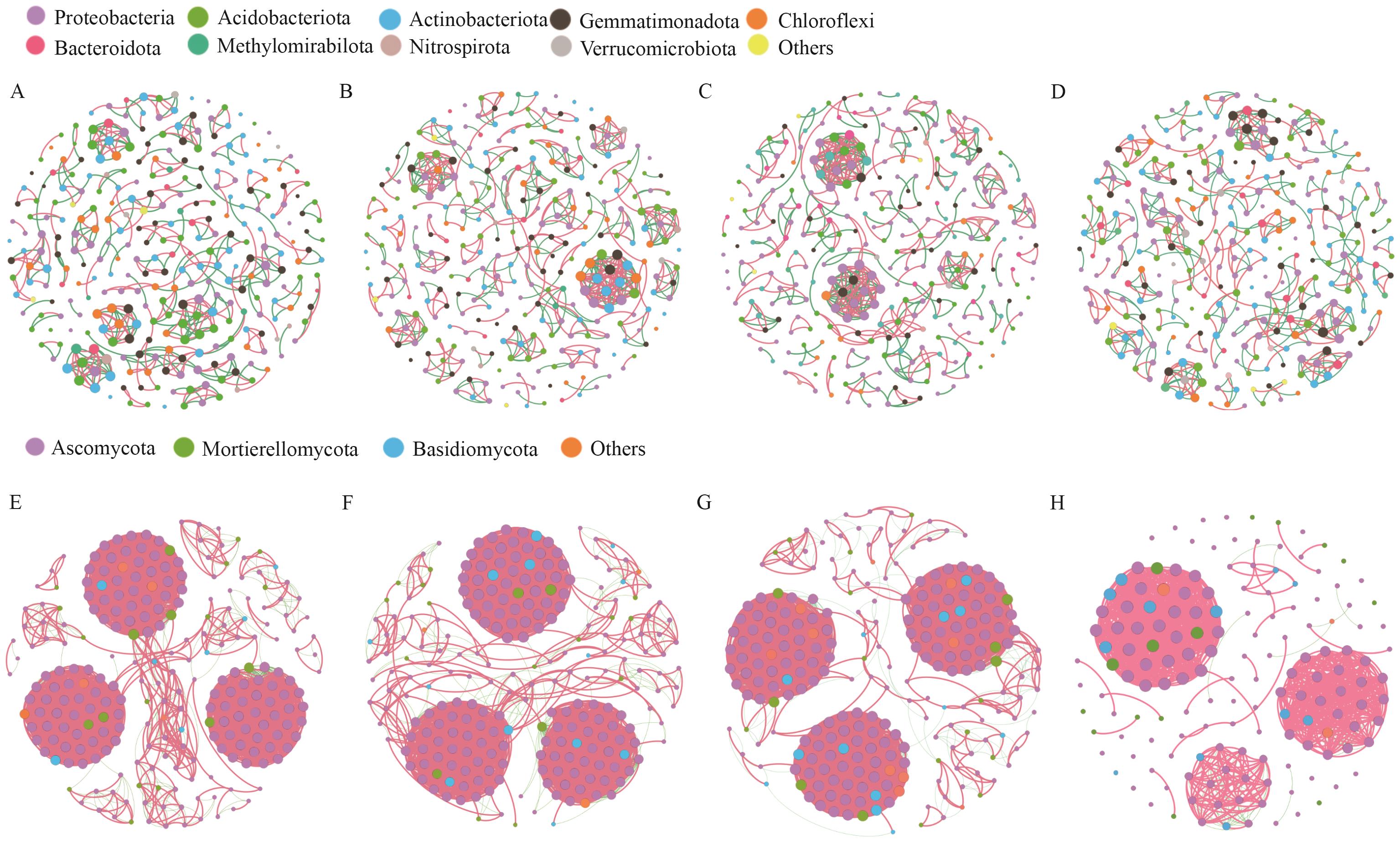
Fig. 4 Ecological network analysis of microbial communities around rhizosphere soil of A. membranaceus var. mongholicus with different continuous cropping yearsA, B, C, and D refer to the soil bacterial microbial networks for 0, 1, 3, and 5 years of cultivation, respectively. E, F, G, and H refer to the soil fungal microbial networks for 0, 1, 3, and 5 years of cultivation, respectively
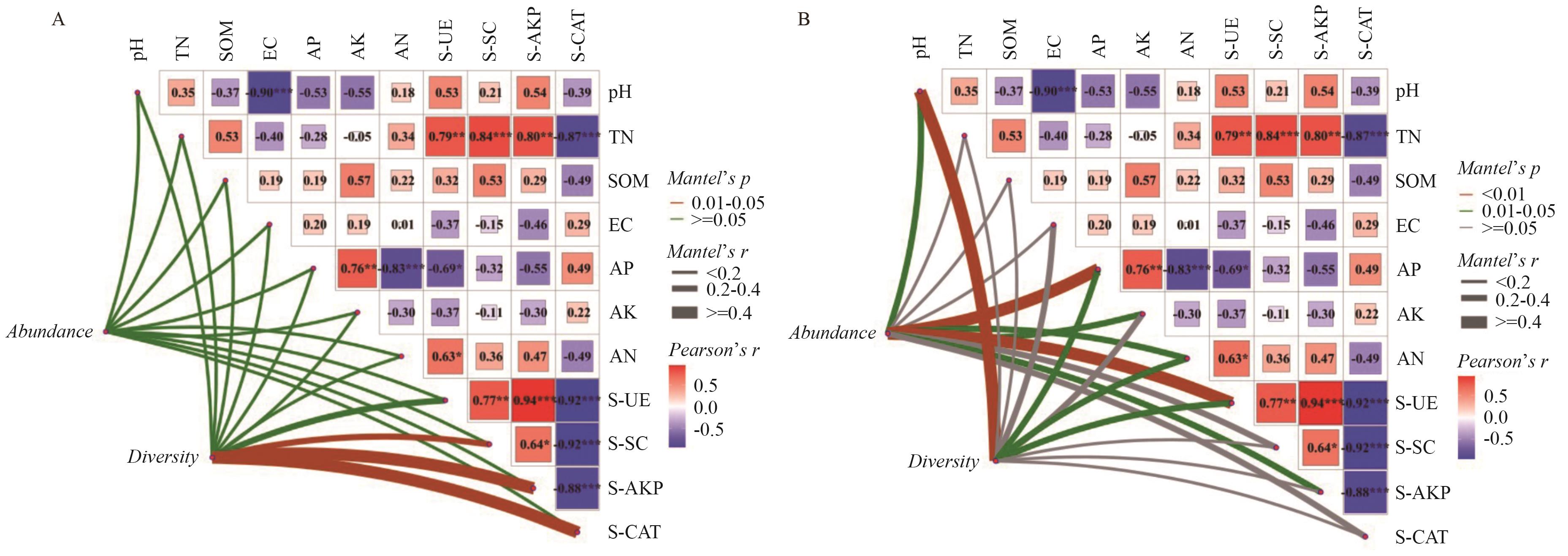
Fig. 5 Mental analysis of rhizosphere soil microorganisms and environmental factors of A. membranaceus var. mongholicus with different continuous cropping yearsA: Mental analysis of the bacterial community. B: Mental analysis of the fungal community
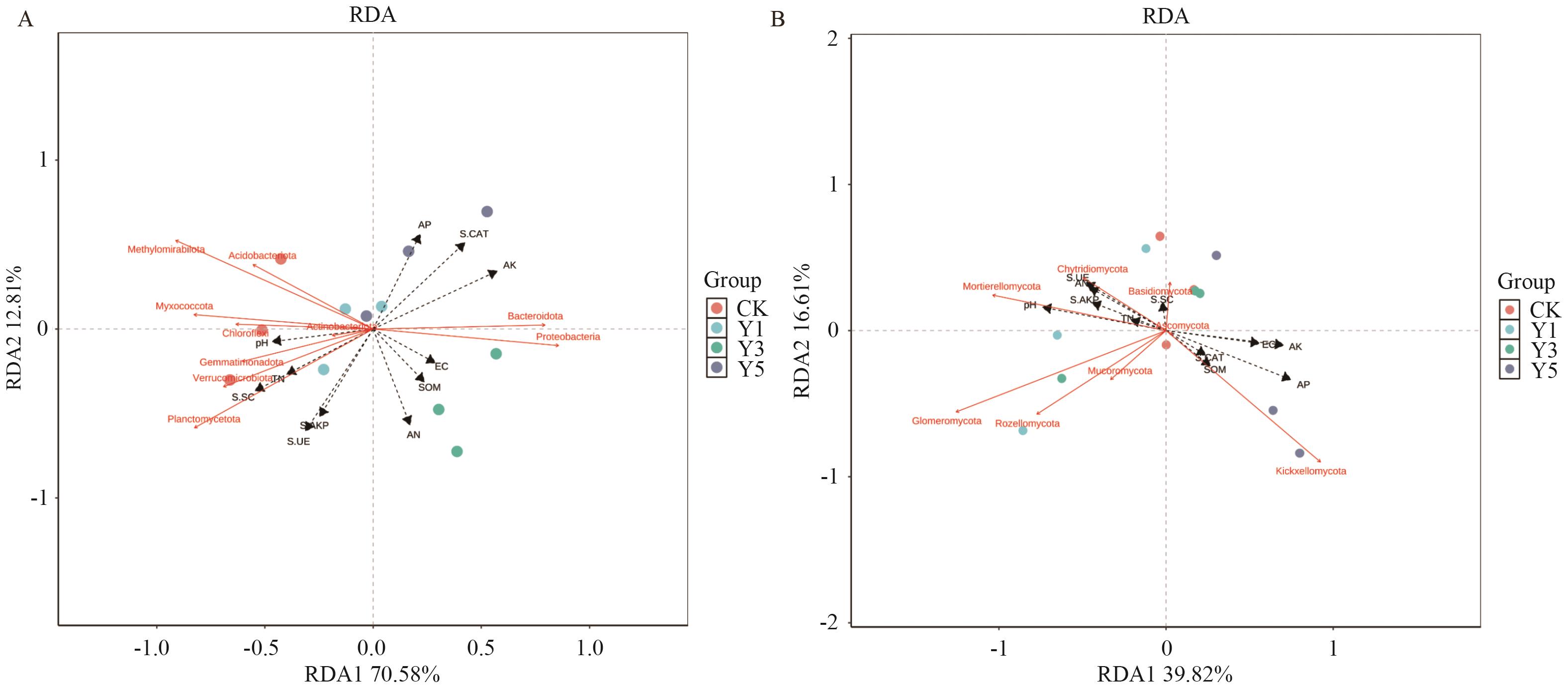
Fig. 6 RDA analysis of soil physical and chemical properties and microbial communityA: RDA analysis of the bacterial community. B: RDA analysis of the fungal community
| [1] | 马莹莹, 关一鸣, 王秋霞, 等. 黄芪主要病害及防治措施研究进展 [J]. 特产研究, 2019, 41(4): 101-107. |
| Ma YY, Guan YM, Wang QX, et al. Research progress on main diseases and control measures of Astragalus membranaceus [J]. Spec Wild Econ Anim Plant Res, 2019, 41(4): 101-107. | |
| [2] | 郭文芳, 李旻辉, 伊乐泰, 等. 蒙古黄芪种植技术研究进展 [J]. 农学学报, 2019, 9(3): 36-43. |
| Guo WF, Li MH, Yi LT, et al. Planting techniques of Astragalus membranaceus (Fisch.) bge. var. mongholicus (Bge.) Hsiao: a review [J]. J Agric, 2019, 9(3): 36-43. | |
| [3] | 陈玉武, 张海星, 高晓昱, 等. 陇药种植产业发展现状及对策研究 [J]. 中国药学杂志, 2020, 55(6): 486-490. |
| Chen YW, Zhang HX, Gao XY, et al. Development status of Gansu Chinese materia medica planting industry and countermeasures for the existing problems [J]. Chin Pharm J, 2020, 55(6): 486-490. | |
| [4] | 陈垣, 朱蕾, 郭凤霞, 等. 甘肃渭源蒙古黄芪根腐病病原菌的分离与鉴定 [J]. 植物病理学报, 2011, 41(4): 428-431. |
| Chen Y, Zhu L, Guo FX, et al. Isolation and identification of the pathogens causing Astragalus membranaceus var. mongholicus root rot in Weiyuan of Gansu Province [J]. Acta Phytopathol Sin, 2011, 41(4): 428-431. | |
| [5] | 李志军, 孙德智, 贾俊英, 等. 不同栽培方式对蒙古黄芪药效品质及土壤微生态的影响 [J]. 时珍国医国药, 2024, 35(1): 197-200. |
| Li ZJ, Sun DZ, Jia JY, et al. Effects of different cultivation methods on pharmacological quality and soil microecology of Astragalus mongholicus [J]. Lishizhen Med Mater Med Res, 2024, 35(1): 197-200. | |
| [6] | 彭政, 郭秀芝, 徐扬, 等. 药用植物与根际微生物互作的研究进展与展望 [J]. 中国中药杂志, 2020, 45(9): 2023-2030. |
| Peng Z, Guo XZ, Xu Y, et al. Advances in interaction between medicinal plants and rhizosphere microorganisms [J]. China J Chin Mater Med, 2020, 45(9): 2023-2030. | |
| [7] | 周冬宇, 李杨, 邢咏梅, 等. 药用植物微生物组及其与药用植物次生代谢产物的关系 [J]. 微生物学通报, 2022, 49(9): 3989-4003. |
| Zhou DY, Li Y, Xing YM, et al. Microbiome of medicinal plants and its effect on medicinal plant secondary metabolites: a review [J]. Microbiol China, 2022, 49(9): 3989-4003. | |
| [8] | 程龙媛, 张国卉, 孙燕, 等. 药用植物-内生菌-根际微生物互作研究进展 [J]. 中草药, 2024, 55(15): 5264-5273. |
| Cheng LY, Zhang GH, Sun Y, et al. Research progress on tripartite interaction of medicinal plants-endophytic fungi-rhizosphere microbes [J]. Chin Tradit Herb Drugs, 2024, 55(15): 5264-5273. | |
| [9] | Vorholt JA, Vogel C, Carlström CI, et al. Establishing causality: opportunities of synthetic communities for plant microbiome research [J]. Cell Host Microbe, 2017, 22(2): 142-155. |
| [10] | 郭晗玥, 王东升, 阮杨, 等. 西瓜连作根际土壤微生物群落演替特征 [J]. 中国农业科学, 2023, 56(21): 4245-4258. |
| Guo HY, Wang DS, Ruan Y, et al. Characteristics and succession of rhizosphere soil microbial communities in continuous cropping watermelon [J]. Sci Agric Sin, 2023, 56(21): 4245-4258. | |
| [11] | 杨阳, 李海亮, 马凯丽, 等. 连作对党参根际土壤理化性质、微生物活性及群落特征的影响 [J]. 环境科学, 2023, 44(11): 6387-6398. |
| Yang Y, Li HL, Ma KL, et al. Effect of continuous cropping on the physicochemical properties, microbial activity, and community characteristics of the rhizosphere soil of Codonopsis pilosula [J]. Environ Sci, 2023, 44(11): 6387-6398. | |
| [12] | 鲍士旦.土壤农化分析(第三版)[M]. 北京:中国农业出版社, 2000. |
| Bao SD. Soil agrochemical analysis (3rd Edition) [M]. Beijing: China Agricultural Press, 2000. | |
| [13] | Bokulich NA, Kaehler BD, Rideout JR, et al. Optimizing taxonomic classification of marker-gene amplicon sequences with QIIME 2's q2-feature-classifier plugin [J]. Microbiome, 2018, 6(1): 90. |
| [14] | 李璐, 程晓钰, 刘晓燕, 等. 湖北和尚洞固氮微生物群落的生境特异性及网络分析 [J]. 微生物学报, 2023, 63(6): 2120-2135. |
| Li L, Cheng XY, Liu XY, et al. Habitat specificity and network analysis of nitrogen-fixing bacteria in the Heshang Cave, Hubei Province [J]. Acta Microbiol Sin, 2023, 63(6): 2120-2135. | |
| [15] | Zhao ML, Zhao J, Yuan J, et al. Root exudates drive soil-microbe-nutrient feedbacks in response to plant growth [J]. Plant Cell Environ, 2021, 44(2): 613-628. |
| [16] | Shi GY, Sun HQ, Calderón-Urrea A, et al. Bacterial communities as indicators of soil health under a continuous cropping system [J]. Land Degrad Dev, 2021, 32(7): 2393-2408. |
| [17] | 王雨欣, 徐浩然, 张鹏, 等. 黄连与根际微生物互作关系及机制的研究进展 [J]. 中草药, 2025, 56(11): 4158-4164. |
| Wang YX, Xu HR, Zhang P, et al. Research progress on interaction and mechanism between Coptis chinensis and rhizosphere microorganisms [J]. Chin Tradit Herb Drugs, 2025, 56(11): 4158-4164. | |
| [18] | 周冰谦, 赵恒强, 王晓, 等. 不同连作年限山地丹参根际土壤细菌群落结构变化及其多样性分析 [J]. 中华中医药杂志, 2019, 34(9): 3980-3985. |
| Zhou BQ, Zhao HQ, Wang X, et al. Diversity analysis and characteristic of bacterial community in rhizosphere soil of Salvia miltiorrhiza Bge. in different continuous cropping years [J]. China J Tradit Chin Med Pharm, 2019, 34(9): 3980-3985. | |
| [19] | 吴林坤, 黄伟民, 王娟英, 等. 不同连作年限野生地黄根际土壤微生物群落多样性分析 [J]. 作物学报, 2015, 41(2): 308-317. |
| Wu LK, Huang WM, Wang JY, et al. Diversity analysis of rhizosphere microflora of wild R. glutinosa grown in monocropping for different years [J]. Acta Agron Sin, 2015, 41(2): 308-317. | |
| [20] | 李莹, 刘兰英, 姜宇杰, 等. 辣椒连作对土壤细菌群落的影响 [J]. 微生物学报, 2023, 63(1): 297-318. |
| Li Y, Liu LY, Jiang YJ, et al. Effect of pepper continuous cropping on soil bacterial community [J]. Acta Microbiol Sin, 2023, 63(1): 297-318. | |
| [21] | Fierer N, Bradford MA, Jackson RB. Toward an ecological classification of soil bacteria [J]. Ecology, 2007, 88(6): 1354-1364. |
| [22] | 王光华, 刘俊杰, 于镇华, 等. 土壤酸杆菌门细菌生态学研究进展 [J]. 生物技术通报, 2016, 32(2): 14-20. |
| Wang GH, Liu JJ, Yu ZH, et al. Research progress of Acidobacteria ecology in soils [J]. Biotechnol Bull, 2016, 32(2): 14-20. | |
| [23] | 丛微, 喻海茫, 于晶晶, 等. 人参种植对林地土壤细菌群落结构和代谢功能的影响 [J]. 生态学报, 2021, 41(1): 162-171. |
| Cong W, Yu HM, Yu JJ, et al. Effects of Ginseng cultivation on soil microbial community structure and metabolic functions in forest land [J]. Acta Ecol Sin, 2021, 41(1): 162-171. | |
| [24] | 张仲富, 喻庆国, 王行, 等. 植物群落和土壤理化性质对碧塔海湿地土壤细菌群落的影响 [J]. 应用生态学报, 2021, 32(6): 2199-2208. |
| Zhang ZF, Yu QG, Wang H, et al. Effects of plant community and soil properties on soil bacterial community in Bitahai Wetland, Southwest China [J]. Chin J Appl Ecol, 2021, 32(6): 2199-2208. | |
| [25] | 胡杰, 何晓红, 李大平, 等. 鞘氨醇单胞菌研究进展 [J]. 应用与环境生物学报, 2007, 13(3): 431-437. |
| Hu J, He XH, Li DP, et al. Progress in research of Sphingomonas [J]. Chin J Appl Environ Biol, 2007, 13(3): 431-437. | |
| [26] | 李华伟, 罗文彬, 许国春, 等. 基于高通量测序的福建北部马铃薯晚疫病株根际土壤细菌群落分析 [J]. 微生物学通报, 2022, 49(3): 1017-1029. |
| Li HW, Luo WB, Xu GC, et al. High-throughput sequencing of bacterial community in the rhizosphere soil of potato infected by late blight in northern Fujian Province [J]. Microbiol China, 2022, 49(3): 1017-1029. | |
| [27] | 郑立伟, 赵阳阳, 王一冰, 等. 不同连作年限甜瓜种植土壤性质和微生物多样性 [J]. 微生物学通报, 2022, 49(1): 101-114. |
| Zheng LW, Zhao YY, Wang YB, et al. Soil properties and microbial diversity in the muskmelon fields after continuous cropping for different years [J]. Microbiol China, 2022, 49(1): 101-114. | |
| [28] | 胡朋举. 花生果腐病发生的土壤微生态变化及其防控 [D]. 秦皇岛: 河北科技师范学院, 2022. |
| Hu PJ. Soil microecological changes of peanut pod rot and its prevention and control [D]. Qinhuangdao: Hebei Normal University of Science & Technology, 2022. | |
| [29] | 苗翠苹. 三七根际土壤微生物的群落特征 [D]. 昆明: 云南大学, 2015. |
| Miao CP. Microbial community characteristics in rhizosphere soil of Panax notoginseng [D]. Kunming: Yunnan University, 2015. | |
| [30] | 王豪吉, 官会林, 周瑞春, 等. 健康与根腐豌豆根际土壤微生物群落组成特征与影响因素 [J]. 植物保护, 2025, 51(3): 135-143. |
| Wang HJ, Guan HL, Zhou RC, et al. Characteristics and influencing factors of microbial community composition in the rhizosphere soil of healthy and root-rot peas [J]. Plant Prot, 2025, 51(3): 135-143. | |
| [31] | 王小国. 根茎类药用植物连作障碍研究进展 [J]. 黑龙江农业科学, 2024(3): 110-115, 128. |
| Wang XG. Research progress on continuous cropping obstacle of rhizome medicinal plants [J]. Heilongjiang Agric Sci, 2024(3): 110-115, 128. | |
| [32] | 林春英, 李希来, 张玉欣, 等. 黄河源区高寒沼泽湿地土壤微生物群落结构对不同退化的响应 [J]. 环境科学, 2021, 42(8): 3971-3984. |
| Lin CY, Li XL, Zhang YX, et al. Responses of different degradation stages of alpine wetland on soil microbial community in the Yellow River source zone [J]. Environ Sci, 2021, 42(8): 3971-3984. |
| [1] | LIAO Yan-ting, WANG Can-qin, WEI Jiao-jun, ZHAO Cheng-gang, HUANG Shi-lyu, LUO Yang-lan, YAN Yong. Changes in Soil Physicochemical Properties and Microbial Communities under Continuous Cropping of Morchella and Their Associated Mechanisms [J]. Biotechnology Bulletin, 2026, 42(5): 134-146. |
| [2] | ZHAO Chun-duo, LI Yu-e, LIU You-jie, WANG Xin-hang, ZHAO Wei, HUANG Yong-cheng, LI Hu-lin, JI Wen-xiu. Effects of Rotating Cropping and Continuous Cropping on Soil Nutrients, Enzyme Activities and Microbial Community Structure of Rhizosphere Soil in Tobacco [J]. Biotechnology Bulletin, 2025, 41(4): 312-322. |
| [3] | SONG Fen-fen, DUAN Yan-xue, SANG Yu, WANG Ji-peng, PENG Rui, SUN Nian-xi, LI Yong. Characteristics of the Mycosphere Microbial Community in Diseased and Healthy Morchella spp.Soil [J]. Biotechnology Bulletin, 2025, 41(4): 323-334. |
| [4] | LI Xue, LI Rong-ou, KONG Mei-yi, HUANG Lei. The Growth Promoting Effect of Bacillus amyloliquefaciens SQ-2 on Rice [J]. Biotechnology Bulletin, 2024, 40(2): 109-119. |
| [5] | ZHAO Lin-yan, XU Wu-mei, WANG Hao-ji, WANG Kun-yan, WEI Fu-gang, YANG Shao-zhou, GUAN Hui-lin. Effects of Applying Biochar on the Rhizosphere Fungal Community and Survival Rate of Panax notoginseng Under Continuous Cropping [J]. Biotechnology Bulletin, 2023, 39(7): 219-227. |
| [6] | SUN Hai-hang, GUAN Hui-lin, WANG Xu, WANG Tong, LI Hong-lin, PENG Wen-jie, LIU Bo-zhen, FAN Fang-ling. Effects of Biochar on the Soil Properties and Fungal Community Structure under Continuous Cropping of Panax notoginseng [J]. Biotechnology Bulletin, 2023, 39(2): 221-231. |
| [7] | ZHAO Zhong-juan, YANG Kai, HU Jin-dong, WEI Yan-li, LI Ling, XU Wei-sheng, LI Ji-shun. Effects of Trichoderma harzianum ST02 on the Growth of Peppermint and Physicochemical Properties of Root Zone Soil Under Salt Stress [J]. Biotechnology Bulletin, 2022, 38(7): 224-235. |
| [8] | ZHAO Lin-yan, GUAN Hui-lin, XIANG Ping, LI Ze-cheng, BAI Yu-long, SONG Hong-chuan, SUN Shi-zhong, XU Wu-mei. Composition Features of Microbial Community in the Rhizospheric Soil of Bletilla striata with Root Rot [J]. Biotechnology Bulletin, 2022, 38(2): 67-74. |
| [9] | LIU Tian-hai, YANG Shu-qin, LIU Fu-peng, MIAO Ren-yun, YU Yang, WU Xiang, TANG Jie, WANG Yong, PENG Wei-hong, TAN Hao. Effects of Organic Fertilizers Fermented with Wheat Straw and Chicken Manure on the Continuous Cultivation of Morchella sextelata [J]. Biotechnology Bulletin, 2022, 38(12): 263-273. |
| [10] | WU Qi-man, TIAN Shi-han, LI Yun-ye, PAN Ying-jie, ZHANG Ying. Effects of Microbial Fertilizer on Cucumis sativus L. Growth,Yield and Quality [J]. Biotechnology Bulletin, 2022, 38(1): 125-131. |
| [11] | YUAN Yuan, HUANG Hai-chen, LI Lin, LIU Guo-hui, FU Jun-sheng, WU Xiao-ping. Effect of Lime on Preventing and Controlling Continuous Cropping Obstacle of Ganoderma lingzhi and Analysis of Its Microbial Community [J]. Biotechnology Bulletin, 2021, 37(4): 70-84. |
| [12] | HONG Jie, KANG Jian-yi, LIU Yi-qian, GAO Xiu-zhi, YI Xin-xin. Effects of Continuous Cropping of Lettuce and Rotation of Lettuce-Spinach on Soil Bacterial Community Structure [J]. Biotechnology Bulletin, 2019, 35(8): 17-26. |
| [13] | YIN Ji-zhong, LI Liang, JIE Wei-guang, CAI Bai-yan. Effects of Continuous Cropping on Bacterial Flora Structure in Soybean Rhizosphere Soil [J]. Biotechnology Bulletin, 2018, 34(1): 230-238. |
| Viewed | ||||||
|
Full text |
|
|||||
|
Abstract |
|
|||||
