







Biotechnology Bulletin ›› 2026, Vol. 42 ›› Issue (7): 97-104.doi: 10.13560/j.cnki.biotech.bull.1985.2025-1162
Previous Articles Next Articles
ZHOU Tao, LI Ya-qiang, HE Hui-juan, HU Hai-fang, CHEN Tong-seng, PAN Yue( ), WANG Tian-bin()
Received:2025-10-30
Online:2026-07-26
Published:2026-07-20
Contact:
PAN Yue, WANG Tian-bin
E-mail:18690187637@163.com;603019783@qq.com
ZHOU Tao, LI Ya-qiang, HE Hui-juan, HU Hai-fang, CHEN Tong-seng, PAN Yue, WANG Tian-bin. Establishment of Hairy Root Genetic Transformation System in Xanthoceras sorbifolium Mediated by Agrobacterium rhizogenes[J]. Biotechnology Bulletin, 2026, 42(7): 97-104.
| 引物名称 Primer name | 引物序列 Primer sequence (5′-3′) | 用途 Usage |
|---|---|---|
RUBY-PF RUBY-PR | AGACACTCCGCCTCCATCC | RUBY基因片段扩增 |
| TTCTACATCACCTGCCTGCTT | ||
RUBY-RT-PF RUBY-RT-PR | ACGCATGAAGGTGAAGAAACA | RUBY基因表达检测 |
| CCATCCGCAGTGGGTGAG | ||
| XsPDS3-T1 | TTTCGAGGGAGTGAATCCATGGG | 靶点序列 |
F2-tgRNA1-T1 R2-tgRNA1-T1 | tgcagTTTCGAGGGAGTGAATCCAT | 基因编辑载体构建 |
| aaacATGGATTCACTCCCTCGAAAC | ||
T1-PF T1-PR | GTCGGAGATGATGGTGATGAAT | 靶点片段扩增 |
| AGTCCAGGCAAACAACCTGATA |
Table 1 Primer sequences
| 引物名称 Primer name | 引物序列 Primer sequence (5′-3′) | 用途 Usage |
|---|---|---|
RUBY-PF RUBY-PR | AGACACTCCGCCTCCATCC | RUBY基因片段扩增 |
| TTCTACATCACCTGCCTGCTT | ||
RUBY-RT-PF RUBY-RT-PR | ACGCATGAAGGTGAAGAAACA | RUBY基因表达检测 |
| CCATCCGCAGTGGGTGAG | ||
| XsPDS3-T1 | TTTCGAGGGAGTGAATCCATGGG | 靶点序列 |
F2-tgRNA1-T1 R2-tgRNA1-T1 | tgcagTTTCGAGGGAGTGAATCCAT | 基因编辑载体构建 |
| aaacATGGATTCACTCCCTCGAAAC | ||
T1-PF T1-PR | GTCGGAGATGATGGTGATGAAT | 靶点片段扩增 |
| AGTCCAGGCAAACAACCTGATA |
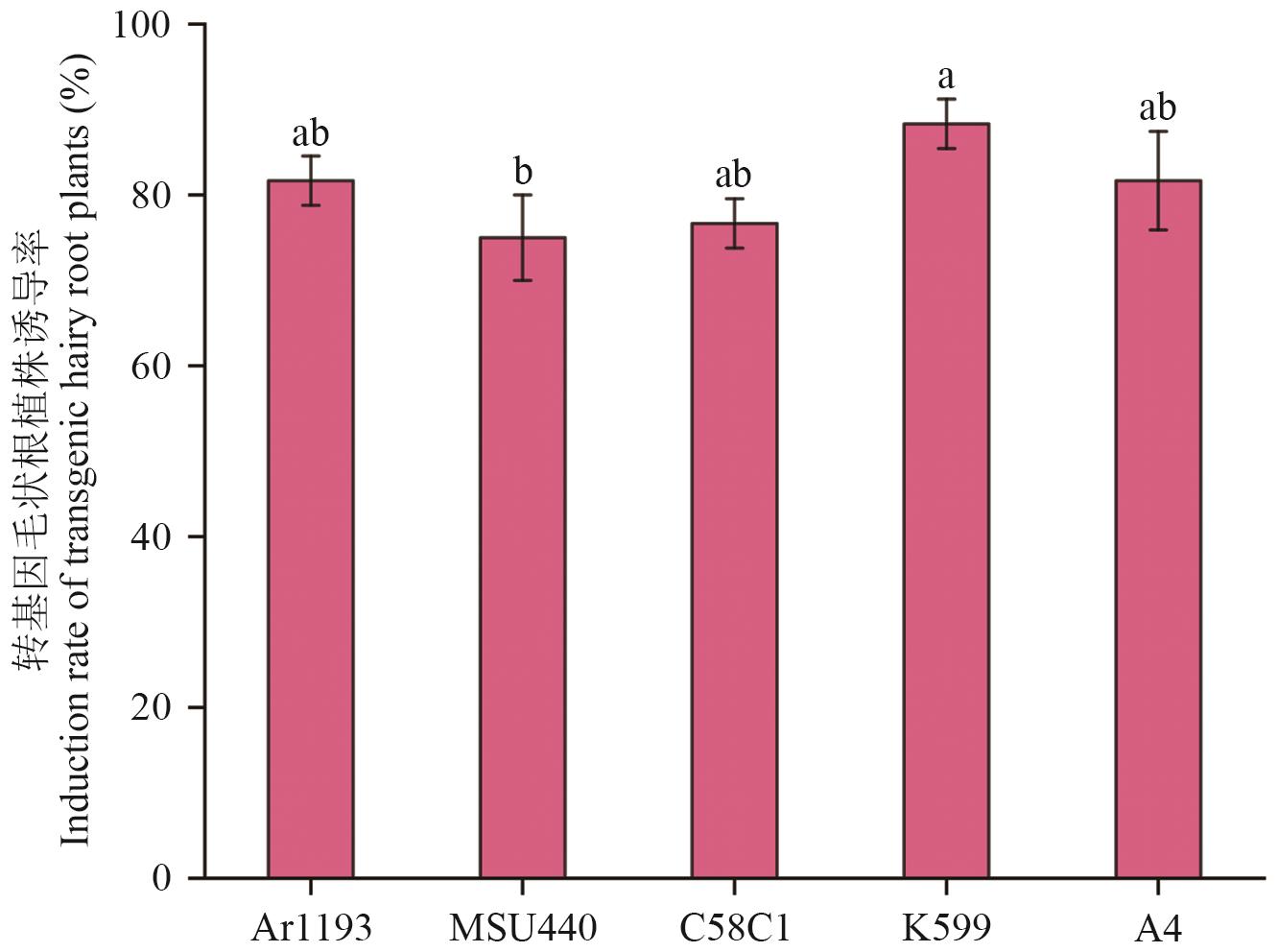
Fig. 1 Influence of Agrobacterium strain types on the transformation efficiency of hairy roots in X. sorbifoliumDifferent letters indicate significant difference (P<0.05). The same below

Fig. 2 Process of hairy root transformation technology for X. sorbifolium
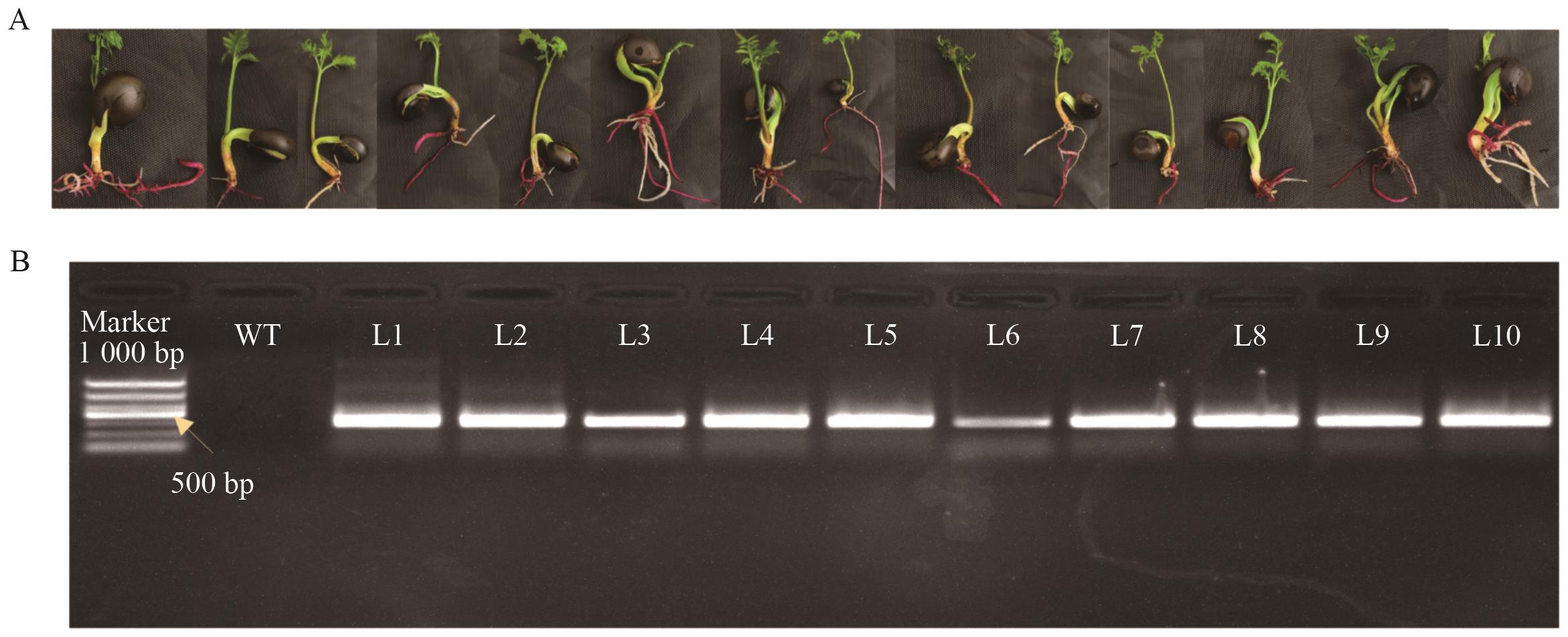
Fig. 3 Phenotype and PCR detection of red transgenic roots in X. sorbifoliumA: Transforming the RUBY gene to produce a red transgenic hairy root phenotype. B: PCR amplification and electrophoresis identification of RUBY gene
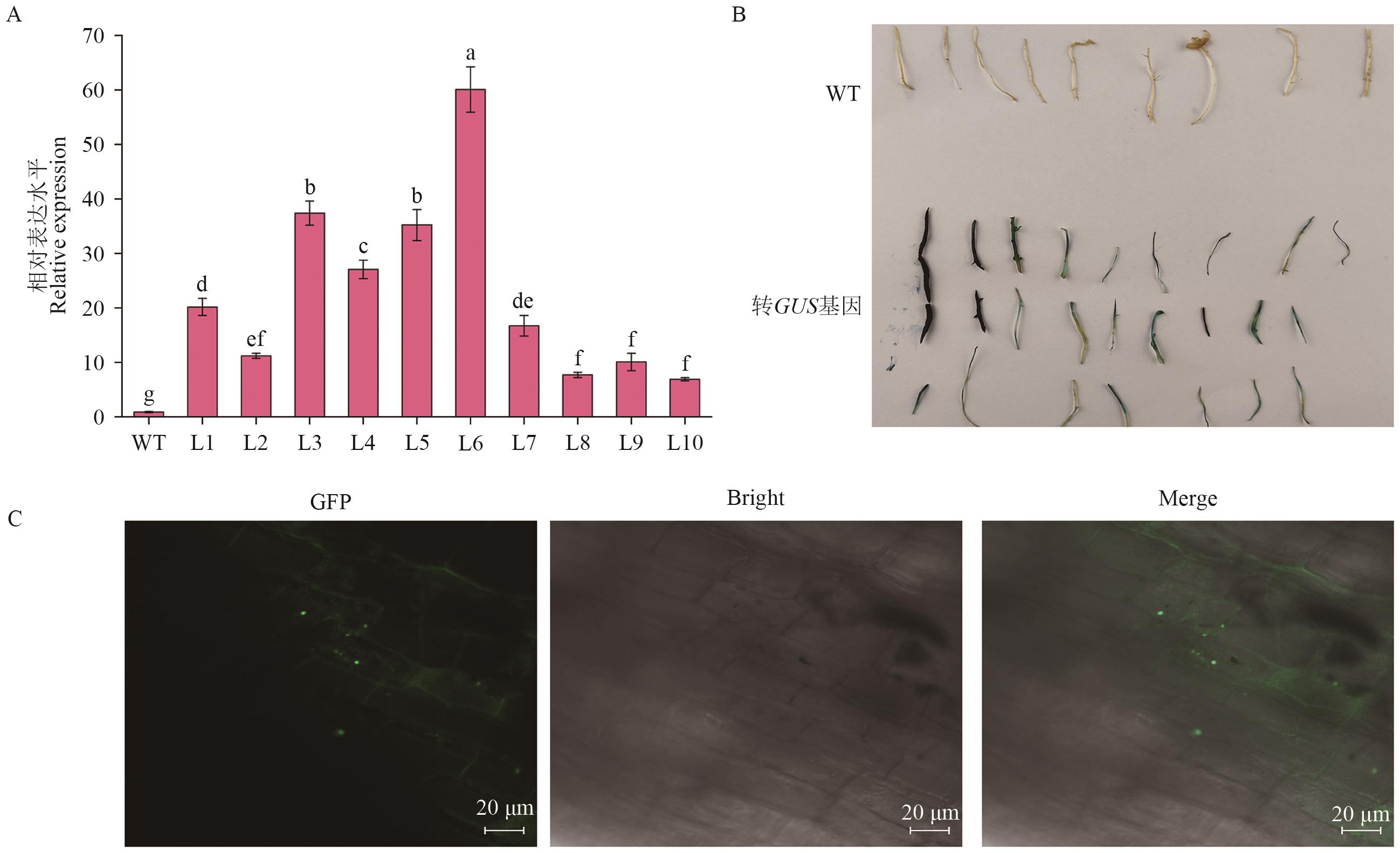
Fig. 4 Transgenic expression detection of red transgenic roots of X. sorbifoliumA: Detection of RT-qPCR expression level. B: Detection of GUS staining. C: Detection of GFP fluorescence signal
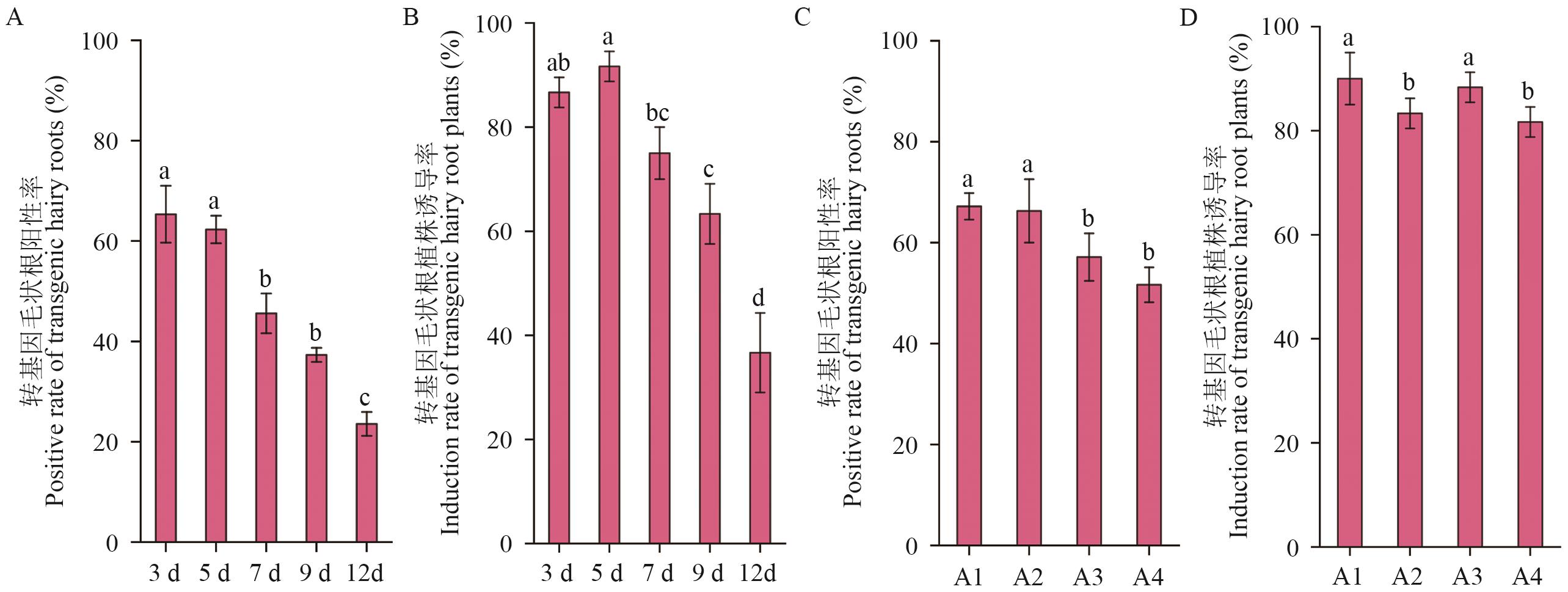
Fig. 5 Optimization of induction efficiency of transgenic hairy rootsA: Positive rate of transgenic hairy roots at different seedling germination times. B: Induction efficiency of transgenic hairy root at different seedling germination times. C: Positive rate of transgenic hairy roots across different varieties. D: Induction efficiency of transgenic hairy root across different varieties
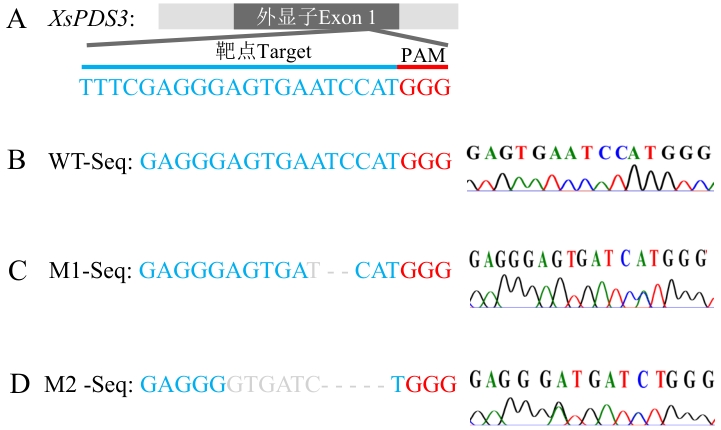
Fig. 6 CRISPR-Cas9 gene editing of X. sorbifolium hairy rootsA: The gene structure and selected targets of XsPDS3, with blue characters for sgRNA and red characters for PAM sequences. B: WT is wild-type sequencing result. C: Sequencing results of M1 as the target gene mutation type 1. D: M2 is the sequencing result of target sequence mutation type 2
| [1] | 敖妍, 韩墨, 赵磊磊, 等. 主要分布区文冠果类型的划分 [J]. 西北林学院学报, 2015, 30(3): 100-106, 119. |
| Ao Y, Han M, Zhao LL, et al. Type classification of Xanthoceras sorbifolia in main distribution areas [J]. J Northwest For Univ, 2015, 30(3): 100-106, 119. | |
| [2] | 杨丽. 文冠果研究进展概述 [J]. 中国药物经济学, 2025, 20(8): 113-117. |
| Yang L. Overview of the progress in Xanthoceras sorbifolium bunge [J]. China J Pharm Econ, 2025, 20(8): 113-117. | |
| [3] | 许佳敏, 佟祎鑫, 王菊花, 等. 文冠果油的营养成分及功能活性研究进展 [J]. 中国油脂, 2022, 47(10): 77-80, 81, 82. |
| Xu JM, Tong YX, Wang JH, et al. Research progress on nutritional ingredients and functional activities of Xanthoceras sorbifolia Bunge oil [J]. China Oils Fats, 2022, 47(10): 77-80, 81, 82. | |
| [4] | 梁子龙, 陆健康, 张春兰, 等. 文冠果食药资源的开发与应用研究进展 [J]. 食品安全质量检测学报, 2024, 15(5): 157-164. |
| Liang ZL, Lu JK, Zhang CL, et al. Research progress in the development and application of Xanthoceras sorbifolia Bung’s food and drug resources [J]. J Food Saf Qual, 2024, 15(5): 157-164. | |
| [5] | Bi QX, Zhao Y, Du W, et al. Pseudomolecule-level assembly of the Chinese oil tree yellowhorn (Xanthoceras sorbifolium) genome [J]. Gigascience, 2019, 8(6): giz070. |
| [6] | Zhao ZQ, Liang CJ, Zhang W, et al. Genome-wide association analysis identifies a candidate gene controlling seed size and yield in Xanthoceras sorbifolium Bunge [J]. Hortic Res, 2024, 11(1): uhad243. |
| [7] | Xing QQ, He HJ, Wang ZJ, et al. Genome-wide characterization of FAD gene family in Xanthoceras sorbifolium Bunge and germplasm assessment [J]. PLoS One, 2025, 20(3): e0318900. |
| [8] | Liu Y, Chen YJ, Ren ZZ, et al. Two haplotype-resolved telomere-to-telomere genome assemblies of Xanthoceras sorbifolium [J]. Sci Data, 2025, 12: 791. |
| [9] | Zhou QY, Cai Q. The superoxide dismutase genes might be required for appropriate development of the ovule after fertilization in Xanthoceras sorbifolium [J]. Plant Cell Rep, 2018, 37(5): 727-739. |
| [10] | Li LK, Liang CJ, Zhang W, et al. 3-ketoacyl-CoA synthase 7 from Xanthoceras sorbifolium seeds is a crucial regulatory enzyme for nervonic acid biosynthesis [J]. Plant Sci, 2024, 347: 112184. |
| [11] | Mehrotra S, Srivastava V, Rahman LU, et al. Hairy root biotechnology—indicative timeline to understand missing links and future outlook [J]. Protoplasma, 2015, 252(5): 1189-1201. |
| [12] | Fan YL, Zhang XH, Zhong LJ, et al. One-step generation of composite soybean plants with transgenic roots by Agrobacterium rhizogenes-mediated transformation [J]. BMC Plant Biol, 2020, 20: 208. |
| [13] | 宋倩娜, 宋陆帅, 段永红, 等. 马铃薯CRISPR/Cas9介导的毛状根高效基因编辑体系的建立 [J]. 园艺学报, 2025, 52(7): 1758-1768. |
| Song QN, Song LS, Duan YH, et al. Establishment a system to obtain CRISPR/Cas9 genome editing plants based on hairy root transformation in potatoes [J]. Acta Hortic Sin, 2025, 52(7): 1758-1768. | |
| [14] | 李函, 赵雅琦, 朱仕心, 等. 发根农杆菌介导的红麻毛状根诱导体系的建立 [J]. 福建农林大学学报: 自然科学版, 2026, 55(3): 301-308. |
| Li H, Zhao YQ, Zhu SX, et al. Establishment of a hairy root induction system in kenaf mediated by Agrobacterium rhizogenes [J]. J Fujian Agric for Univ Nat Sci Ed, 2026, 55(3): 301-308. | |
| [15] | Liu L, Qu JH, Wang CY, et al. An efficient genetic transformation system mediated by Rhizobium rhizogenes in fruit trees based on the transgenic hairy root to shoot conversion [J]. Plant Biotechnol J, 2024, 22(8): 2093-2103. |
| [16] | Ramasamy M, Dominguez MM, Irigoyen S, et al. Rhizobium rhizogenes-mediated hairy root induction and plant regeneration for bioengineering Citrus [J]. Plant Biotechnol J, 2023, 21(9): 1728-1730. |
| [17] | Cao XS, Xie HT, Song ML, et al. Cut-dip-budding delivery system enables genetic modifications in plants without tissue culture [J]. Innovation, 2023, 4(1): 100345. |
| [18] | Fan D, Liu TT, Li CF, et al. Efficient CRISPR/Cas9-mediated targeted mutagenesis in Populus in the first generation [J]. Sci Rep, 2015, 5: 12217. |
| [19] | Lin CS, Hsu CT, Yang LH, et al. Application of protoplast technology to CRISPR/Cas9 mutagenesis: from single-cell mutation detection to mutant plant regeneration [J]. Plant Biotechnol J, 2018, 16(7): 1295-1310. |
| [20] | Nakayasu M, Akiyama R, Lee HJ, et al. Generation of α-solanine-free hairy roots of potato by CRISPR/Cas9 mediated genome editing of the St16DOX gene [J]. Plant Physiol Biochem, 2018, 131: 70-77. |
| [21] | 陶娜, 李茂兴, 郭华春. 发根农杆菌介导的甘薯遗传转化体系优化 [J]. 生物技术通报, 2023, 39(10): 175-183. |
| Tao N, Li MX, Guo HC. Optimization of sweet potato genetic transformation system mediated by Agrobacterium rhizogenes [J]. Biotechnol Bull, 2023, 39(10): 175-183. | |
| [22] | 屈阿艳, 曹佳琰, 王惠玉, 等. 发根农杆菌介导的叶用莴苣毛状根转化体系的建立 [J]. 北京农学院学报, 2025, 40(2): 21-27. |
| Qu AY, Cao JY, Wang HY, et al. Establishment of a system for Agrobacterium rhizogenes-mediated hairy root transformation of leaf lettuce [J]. J Beijing Univ Agric, 2025, 40(2): 21-27. | |
| [23] | 刘宁, 王悦, 曲云, 等. 四种发根农杆菌对波斯菊不同外植体的诱导探究 [J/OL]. 分子植物育种, 2023: 1-9. (2023-12-25). . |
| Liu N, Wang Y, Qu Y, et al. Induction of different explants of Cosmos by four Agrobacterium rhizogenes [J/OL]. Mol Plant Breed, 2023: 1-9. (2023-12-25). . | |
| [24] | 谢晓婷, 黄巧宇, 温广超, 等. 非组培依赖的发根农杆菌介导的薄壳山核桃转化体系构建 [J]. 果树学报, 2022, 39(1): 131-140. |
| Xie XT, Huang QY, Wen GC, et al. Construction of Agrobacterium rhizogenes-mediated transformation system of Carya illinoinensis without dependence on tissue culture [J]. J Fruit Sci, 2022, 39(1): 131-140. | |
| [25] | 曹庆丰. 发根农杆菌K599侵染黄瓜形成转基因毛状根的初步研究及orf14基因的克隆 [D]. 杭州: 杭州师范大学, 2012. |
| Cao QF. Preliminary analysis on transgeneic hairy root induced from cucumber by Agrobacterium rhizogenes K599 and cloning of Orf14 gene [D]. Hangzhou: Hangzhou Normal University, 2012. | |
| [26] | 豆硕, 丁若羲, 孙星, 等. 一种可视化筛选转基因通用载体pCamRUBY的构建和应用研究 [J]. 生物技术通报, 2025, 41(12): 66-73. |
| Dou S, Ding RX, Sun X, et al. Construction and application study of a general vector pCamRUBY for visual screening of transgenes [J]. Biotechnol Bull, 2025, 41(12): 66-73. | |
| [27] | 王晨雨, 刘孟军, 王立新, 等. CRISPR/Cas9技术研究进展及其在园艺植物中的应用进展 [J]. 园艺学报, 2024, 51(7): 1439-1454. |
| Wang CY, Liu MJ, Wang LX, et al. Research progress of CRISPR/Cas9 technology and its application in horticultural plants [J]. Acta Hortic Sin, 2024, 51(7): 1439-1454. | |
| [28] | Pacesa M, Pelea O, Jinek M. Past, present, and future of CRISPR genome editing technologies [J]. Cell, 2024, 187(5): 1076-1100. |
| [29] | 邹凯. 植物毛状根研究及应用 [J]. 生物技术进展, 2024, 14(3): 341-348. |
| Zou K. Research and application of plant hairy root [J]. Curr Biotechnol, 2024, 14(3): 341-348. | |
| [30] | He YB, Zhang T, Sun H, et al. A reporter for noninvasively monitoring gene expression and plant transformation [J]. Hortic Res, 2020, 7: 152. |
| [31] | 王艺林, 刘贤德, 边彪, 等. 干旱荒漠区文冠果扦插繁殖技术研究 [J]. 安徽农业科学, 2014, 42(32): 11363-11365. |
| Wang YL, Liu XD, Bian B, et al. Study on cutting propagation technology of Xanthoceras sorbifolia bunge in arid desert area [J]. J Anhui Agric Sci, 2014, 42(32): 11363-11365. | |
| [32] | 莫保儒, 王多锋, 戚建莉, 等. 文冠果不同营养器官扦插繁殖试验研究 [J]. 甘肃林业科技, 2014, 39(1): 18-21, 55. |
| Mo BR, Wang DF, Qi JL, et al. Study on the experiment of cutting propagation in different vegetative organs for Xanthoceras sorbifolia [J]. J Gansu For Sci Technol, 2014, 39(1): 18-21, 55. |
| [1] | ZHAO Wen-juan, LI Hui, YANG Xue-ying, WANG Zhao-lu, ZHU Jian-bo. Establishment of a Genetic Transformation System for Potato ‘Xinjiang No. 2’ [J]. Biotechnology Bulletin, 2026, 42(6): 87-97. |
| [2] | ZONG Jian-wei, DENG Hai-fang, CAI Yuan-yuan, CHANG Ya-wen, ZHU Ya-qi, YANG Yu-hua. Coupling Effect of AM Fungi on the Root Morphology and Leaf Structure of Xanthoceras sorbifolium Bunge under Drought Stress [J]. Biotechnology Bulletin, 2025, 41(6): 167-178. |
| [3] | SONG Hui-yang, SU Bao-jie, LI Jing-hao, MEI Chao, SONG Qian-na, CUI Fu-zhu, FENG Rui-yun. Cloning and Functional Analysis of the StAS2-15 Gene in Potato under Salt Stress [J]. Biotechnology Bulletin, 2025, 41(5): 119-128. |
| [4] | ZHANG Xiu-min, MA Shao-ying, YANG Jie, BAO Jin-yu, ZHANG Xiao-ling, TIAN Peng, LU Ya-qi, LI Sheng. Optimization of Hairy Roots Culture System of Broccoli Aiming at the Yield of Secondary Metabolites [J]. Biotechnology Bulletin, 2021, 37(8): 75-84. |
| [5] | CHEN Wan-qi, ZHANG Hong, WANG Jin-feng, CHEN Jun-jie, LIN Xiao-wen, LUO Jie-hua, XU Yuan, CHEN Yan-fang, LU Xing-yan. Optimal Cultivation of Rabdosia rubescens Hairy Roots and the Inhibition Test of Its Extract on Tumor Cell Growth [J]. Biotechnology Bulletin, 2018, 34(10): 122-128. |
| [6] | Li Wei, Zhai Yujia, Li Pengcheng, Wang Changlu. Optimization of Agrobacterium-mediated Transformation in Castor(Ricinus communis L.) [J]. Biotechnology Bulletin, 2015, 31(5): 140-145. |
| [7] | Zhang Huan, Zheng Jia, Kan Dandan, Fan Jinping,. Establishment of Agrobacterium-mediated Asiatic Lily‘Cedeazzle’Transformation System and Transfer of GsZFP1 Genes [J]. Biotechnology Bulletin, 2014, 0(2): 91-96. |
| [8] | Guo Wei, Wang Lei, Wu Hongqing, Bai Ling, Zhang Weimin. Transformation System of Cordyceps cardinalis Strain C033 Mediated by Agrobacterium tumefaciens [J]. Biotechnology Bulletin, 2013, 0(5): 149-154. |
| Viewed | ||||||
|
Full text |
|
|||||
|
Abstract |
|
|||||
