






Biotechnology Bulletin ›› 2026, Vol. 42 ›› Issue (11): 103-112.doi: 10.13560/j.cnki.biotech.bull.1985.2026-0347
LI Ya-qian, FENG Long-zhe, SUN Nan, ZHANG Yi-jie, ZHANG Hao, YANG Ya-qi, ZHANG Xin-yu, YUE Ai-qin, DU Wei-jun, WANG Min( )
Received:2026-03-27
Online:2026-11-26
Published:2026-11-03
Contact:
WANG Min
E-mail:wangmin3502@126.com
LI Ya-qian, FENG Long-zhe, SUN Nan, ZHANG Yi-jie, ZHANG Hao, YANG Ya-qi, ZHANG Xin-yu, YUE Ai-qin, DU Wei-jun, WANG Min. QTL Mapping for Seed Coat Color in Soybean[J]. Biotechnology Bulletin, 2026, 42(11): 103-112.
性状 Trait | 年份 Year | 亲本 Parents | 群体 Population | |||||||
|---|---|---|---|---|---|---|---|---|---|---|
晋大53 Jinda53 | 平南 Pingnan | 显著性 Significance | 均值±标准差 Mean±SD | 变幅 Range | 变异系数 CV(%) | 峰度 Kurtosis | 偏度 Skewness | 广义遗传率 H2(%) | ||
| 光泽度 L* | 2017 | 57.25±2.72 | 25.79±1.42 | ** | 31.45±13.26 | 12.08-86.76 | 42 | 2.09 | 1.14 | 0.99 |
| 2019 | 47.54±1.50 | 21.57±1.56 | ** | 28.04±9.60 | 12.91-51.77 | 34 | -0.72 | 0.25 | ||
| 红绿值 a* | 2017 | 10.07±0.83 | 1.38±0.278 | ** | 5.93±5.74 | -6.34-21.26 | 97 | -0.40 | 0.46 | 0.98 |
| 2019 | 10.02±0.50 | 3.06±0.50 | ** | 6.12±4.56 | -1.56-17.79 | 75 | -0.81 | 0.39 | ||
| 黄蓝值 b* | 2017 | 29.67±2.52 | 6.4±0.82 | ** | 15.80±10.07 | 0.85-34.27 | 64 | -1.40 | -0.05 | 0.99 |
| 2019 | 27.85±1.52 | 3.43±0.50 | ** | 14.07±9.71 | -1.21-32.31 | 69 | -1.36 | -0.12 | ||
Table 1 Basic statistical characteristics of soybean seed coat color in parental lines and the population
性状 Trait | 年份 Year | 亲本 Parents | 群体 Population | |||||||
|---|---|---|---|---|---|---|---|---|---|---|
晋大53 Jinda53 | 平南 Pingnan | 显著性 Significance | 均值±标准差 Mean±SD | 变幅 Range | 变异系数 CV(%) | 峰度 Kurtosis | 偏度 Skewness | 广义遗传率 H2(%) | ||
| 光泽度 L* | 2017 | 57.25±2.72 | 25.79±1.42 | ** | 31.45±13.26 | 12.08-86.76 | 42 | 2.09 | 1.14 | 0.99 |
| 2019 | 47.54±1.50 | 21.57±1.56 | ** | 28.04±9.60 | 12.91-51.77 | 34 | -0.72 | 0.25 | ||
| 红绿值 a* | 2017 | 10.07±0.83 | 1.38±0.278 | ** | 5.93±5.74 | -6.34-21.26 | 97 | -0.40 | 0.46 | 0.98 |
| 2019 | 10.02±0.50 | 3.06±0.50 | ** | 6.12±4.56 | -1.56-17.79 | 75 | -0.81 | 0.39 | ||
| 黄蓝值 b* | 2017 | 29.67±2.52 | 6.4±0.82 | ** | 15.80±10.07 | 0.85-34.27 | 64 | -1.40 | -0.05 | 0.99 |
| 2019 | 27.85±1.52 | 3.43±0.50 | ** | 14.07±9.71 | -1.21-32.31 | 69 | -1.36 | -0.12 | ||
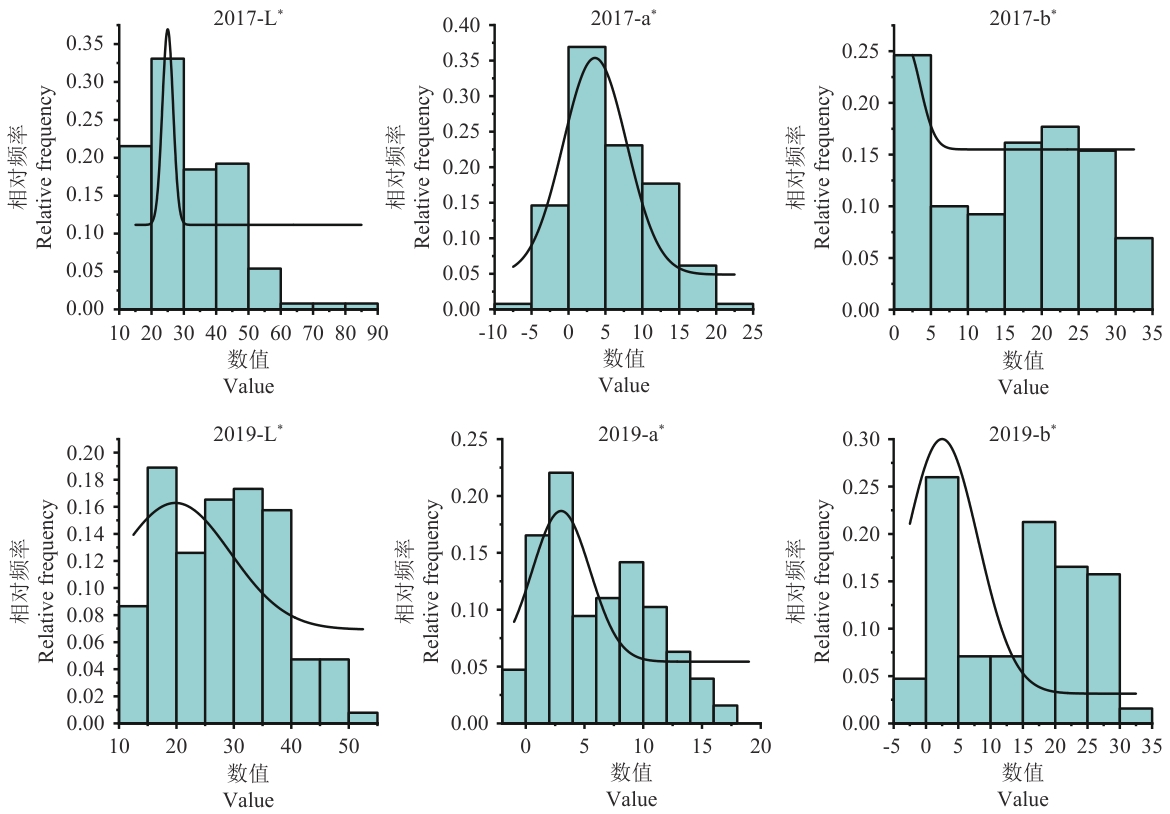
Fig. 1 Histogram of frequency distribution of soybean seed coat color index
年份 Year | 性状 Trait | 光泽度 L* | 红绿值 a* |
|---|---|---|---|
| 2017 | 红绿值 a* | 0.383** | |
| 蓝绿值 b* | 0.778** | 0.586** | |
| 2019 | 红绿值 a* | 0.502** | |
| 蓝绿值 b* | 0.949** | 0.629** |
Table 2 Correlation analysis of soybean seed coat color related traits in RIL population
年份 Year | 性状 Trait | 光泽度 L* | 红绿值 a* |
|---|---|---|---|
| 2017 | 红绿值 a* | 0.383** | |
| 蓝绿值 b* | 0.778** | 0.586** | |
| 2019 | 红绿值 a* | 0.502** | |
| 蓝绿值 b* | 0.949** | 0.629** |
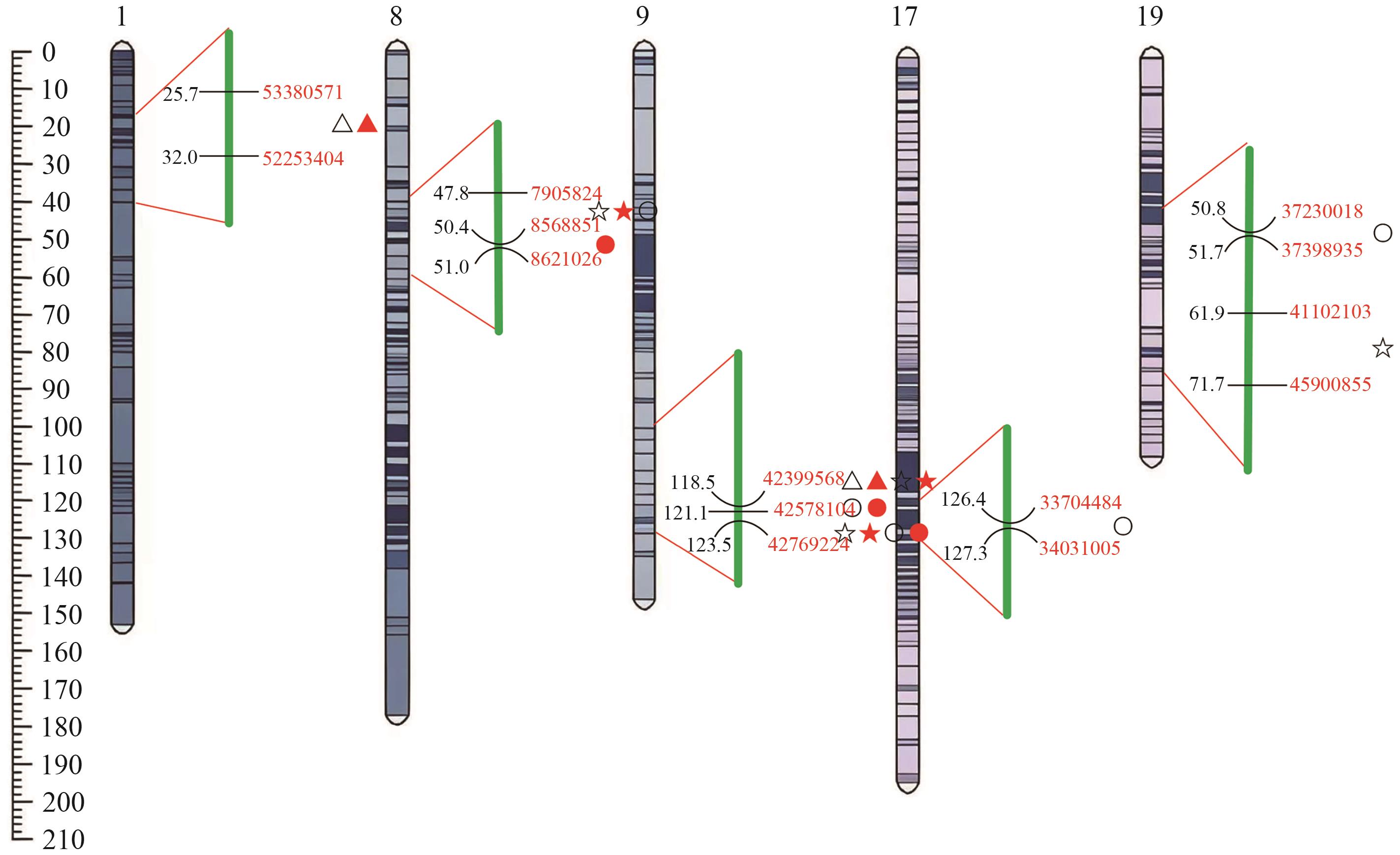
Fig. 2 Positions of QTL related to seed coat color index on the genetic map in soybean☆:L* related QTL in 2017, △: a* related QTL in 2017, 〇: b* related QTL in 2017; ★:L* related QTL in 2019, ▲: a* related QTL in 2019, ●: b* related QTL in 2019
性状 Trait | QTL | 位置 Position (cM) | 位置区间 Location interval (cM) | 物理距离 Physical distance (bp) | 2017 | 2019 | ||||
|---|---|---|---|---|---|---|---|---|---|---|
| LOD | PVE (%) | Add | LOD | PVE (%) | Add | |||||
| 光泽度 L* | qL-8 | 50 | 47.824‒50.404 | 7 905 824‒8 568 851 | 10.827 | 30.529 | -6.952 | 15.312 | 39.077 | -5.719 |
| qL-9 | 123 | 118.478‒123.476 | 42 399 568‒42 769 224 | 4.611 | 10.739 | -4.138 | 5.913 | 12.806 | -3.284 | |
| qL-19 | 71 | 61.93‒71.689 | 41 102 103‒45 900 855 | 2.926 | 6.580 | -3.224 | ||||
| 红绿值 a* | qa-1 | 32 | 25.748‒32.014 | 53 380 571‒52 253 404 | 3.024 | 6.980 | -1.548 | 5.933 | 13.106 | -1.662 |
| qa-9 | 121 | 118.478‒121.095 | 42 399 568‒42 578 104 | 13.459 | 35.021 | -3.490 | 12.192 | 30.376 | -2.546 | |
| 蓝黄值 b* | qb-8-1 | 50 | 47.824‒50.404 | 7 905 824‒8 568 851 | 23.403 | 45.822 | -6.574 | |||
| qb-8-2 | 51 | 50.404‒51.033 | 8 568 851‒8 621 026 | 13.087 | 31.555 | -5.088 | ||||
| qb-9 | 123 | 118.478‒123.476 | 42 399 568‒42 769 224 | 10.129 | 15.674 | -3.860 | 9.585 | 22.246 | -4.289 | |
| qb-17 | 127 | 126.428‒127.29 | 33 704 484‒34 031 005 | 2.556 | 3.257 | -1.747 | ||||
| qb-19 | 51 | 50.841‒51.66 | 37 230 018‒37 398 935 | 3.244 | 4.201 | -2.008 | ||||
Table 3 QTL analysis of soybean seed color index
性状 Trait | QTL | 位置 Position (cM) | 位置区间 Location interval (cM) | 物理距离 Physical distance (bp) | 2017 | 2019 | ||||
|---|---|---|---|---|---|---|---|---|---|---|
| LOD | PVE (%) | Add | LOD | PVE (%) | Add | |||||
| 光泽度 L* | qL-8 | 50 | 47.824‒50.404 | 7 905 824‒8 568 851 | 10.827 | 30.529 | -6.952 | 15.312 | 39.077 | -5.719 |
| qL-9 | 123 | 118.478‒123.476 | 42 399 568‒42 769 224 | 4.611 | 10.739 | -4.138 | 5.913 | 12.806 | -3.284 | |
| qL-19 | 71 | 61.93‒71.689 | 41 102 103‒45 900 855 | 2.926 | 6.580 | -3.224 | ||||
| 红绿值 a* | qa-1 | 32 | 25.748‒32.014 | 53 380 571‒52 253 404 | 3.024 | 6.980 | -1.548 | 5.933 | 13.106 | -1.662 |
| qa-9 | 121 | 118.478‒121.095 | 42 399 568‒42 578 104 | 13.459 | 35.021 | -3.490 | 12.192 | 30.376 | -2.546 | |
| 蓝黄值 b* | qb-8-1 | 50 | 47.824‒50.404 | 7 905 824‒8 568 851 | 23.403 | 45.822 | -6.574 | |||
| qb-8-2 | 51 | 50.404‒51.033 | 8 568 851‒8 621 026 | 13.087 | 31.555 | -5.088 | ||||
| qb-9 | 123 | 118.478‒123.476 | 42 399 568‒42 769 224 | 10.129 | 15.674 | -3.860 | 9.585 | 22.246 | -4.289 | |
| qb-17 | 127 | 126.428‒127.29 | 33 704 484‒34 031 005 | 2.556 | 3.257 | -1.747 | ||||
| qb-19 | 51 | 50.841‒51.66 | 37 230 018‒37 398 935 | 3.244 | 4.201 | -2.008 | ||||
基因名称 Gene name | 染色体位置 Chromosome location (bp) | 注释描述 Annotation description | 已报道基因 Reported gene | 参考文献 Reference |
|---|---|---|---|---|
Glyma.08g103900. Wm82.a2.v1 | 7 970 507‒7 974 378 | Flavonoid 3',5'-methyltransferase | ||
Glyma.08g104100. Wm82.a2.v1 | 7 993 317‒7 995 690 | Flavonol biosynthesis | ||
| Flavonoid biosynthesis (in equisetum) | ||||
| Leucopelargonidin and leucocyanidin biosynthesis | ||||
| Flavonoid 3'-monooxygenase | ||||
Glyma.08g109200. Wm82.a2.v1 | 8 384 742‒8 386 542 | Flavonoid biosynthetic process | CHS4 | [ |
Glyma.08g109300. Wm82.a2.v1 | 8 387 509‒8 391 327 | Flavonoid biosynthesis (in equisetum) | ||
| Flavonoid biosynthesis | ||||
Glyma.08g109400. Wm82.a2.v1 | 8 391 364‒8 394 840 | Flavonoid biosynthetic process | ||
| Flavonoid biosynthesis (in equisetum) | ||||
| Flavonoid biosynthesis | ||||
Glyma.08g109500. Wm82.a2.v1 | 8 397 944‒8 399 751 | Flavonoid biosynthesis (in equisetum) | CHS1 | [ |
| Flavonoid biosynthesis | ||||
Glyma.08g110300. Wm82.a2.v1 | 8 475 793‒8 477 410 | Flavonoid biosynthetic process | ||
| Flavonoid biosynthesis (in equisetum) | CHS3 | [ | ||
| Flavonoid biosynthesis | ||||
Glyma.08g110400. Wm82.a2.v1 | 8 478 834‒8 480 215 | Flavonoid biosynthesis (in equisetum) | ||
| Flavonoid biosynthesis | ||||
Glyma.08g110500. Wm82.a2.v1 | 8 504 479‒8 506 020 | Flavonoid biosynthesis (in equisetum) | ||
| Flavonoid biosynthesis | ||||
Glyma.08g110700. Wm82.a2.v1 | 8 513 952‒8 515 719 | Flavonoid biosynthesis (in equisetum) | ||
| Flavonoid biosynthesis | ||||
Glyma.08g110900. Wm82.a2.v1 | 8 517 799‒8 519 303 | Flavonoid biosynthesis (in equisetum) | ||
| Flavonoid biosynthesis |
Table 4 Genes located on chromosome 8 and their annotations
基因名称 Gene name | 染色体位置 Chromosome location (bp) | 注释描述 Annotation description | 已报道基因 Reported gene | 参考文献 Reference |
|---|---|---|---|---|
Glyma.08g103900. Wm82.a2.v1 | 7 970 507‒7 974 378 | Flavonoid 3',5'-methyltransferase | ||
Glyma.08g104100. Wm82.a2.v1 | 7 993 317‒7 995 690 | Flavonol biosynthesis | ||
| Flavonoid biosynthesis (in equisetum) | ||||
| Leucopelargonidin and leucocyanidin biosynthesis | ||||
| Flavonoid 3'-monooxygenase | ||||
Glyma.08g109200. Wm82.a2.v1 | 8 384 742‒8 386 542 | Flavonoid biosynthetic process | CHS4 | [ |
Glyma.08g109300. Wm82.a2.v1 | 8 387 509‒8 391 327 | Flavonoid biosynthesis (in equisetum) | ||
| Flavonoid biosynthesis | ||||
Glyma.08g109400. Wm82.a2.v1 | 8 391 364‒8 394 840 | Flavonoid biosynthetic process | ||
| Flavonoid biosynthesis (in equisetum) | ||||
| Flavonoid biosynthesis | ||||
Glyma.08g109500. Wm82.a2.v1 | 8 397 944‒8 399 751 | Flavonoid biosynthesis (in equisetum) | CHS1 | [ |
| Flavonoid biosynthesis | ||||
Glyma.08g110300. Wm82.a2.v1 | 8 475 793‒8 477 410 | Flavonoid biosynthetic process | ||
| Flavonoid biosynthesis (in equisetum) | CHS3 | [ | ||
| Flavonoid biosynthesis | ||||
Glyma.08g110400. Wm82.a2.v1 | 8 478 834‒8 480 215 | Flavonoid biosynthesis (in equisetum) | ||
| Flavonoid biosynthesis | ||||
Glyma.08g110500. Wm82.a2.v1 | 8 504 479‒8 506 020 | Flavonoid biosynthesis (in equisetum) | ||
| Flavonoid biosynthesis | ||||
Glyma.08g110700. Wm82.a2.v1 | 8 513 952‒8 515 719 | Flavonoid biosynthesis (in equisetum) | ||
| Flavonoid biosynthesis | ||||
Glyma.08g110900. Wm82.a2.v1 | 8 517 799‒8 519 303 | Flavonoid biosynthesis (in equisetum) | ||
| Flavonoid biosynthesis |
基因名称 Gene name | 染色体位置 Chromosome location (bp) | 注释描述 Annotation description |
|---|---|---|
Glyma.09G190700. Wm82.a2.v1 | 41 541 780‒41 545 610 | Leucocyanidin biosynthesis |
Glyma.09G191200. Wm82.a2.v1 | 41 587 926‒41 592 094 | Flavonol biosynthesis Flavonoid short-chain dehydrogenase |
Glyma.09G191700. Wm82.a2.v1 | 41 642 568‒41 650 351 | Flavonoid biosynthetic process |
Glyma.09G193200. Wm82.a2.v1 | 41 775 058‒41 777 851 | Flavonol biosynthesis |
Glyma.09G194300. Wm82.a2.v1 | 41 867 600‒41 868 959 | Flavonoid biosynthetic process |
Glyma.09G194500. Wm82.a2.v1 | 41 877 781‒41 882 626 | Leucocyanidin biosynthesis |
Table 5 Genes located on chromosome 9 and their annotations
基因名称 Gene name | 染色体位置 Chromosome location (bp) | 注释描述 Annotation description |
|---|---|---|
Glyma.09G190700. Wm82.a2.v1 | 41 541 780‒41 545 610 | Leucocyanidin biosynthesis |
Glyma.09G191200. Wm82.a2.v1 | 41 587 926‒41 592 094 | Flavonol biosynthesis Flavonoid short-chain dehydrogenase |
Glyma.09G191700. Wm82.a2.v1 | 41 642 568‒41 650 351 | Flavonoid biosynthetic process |
Glyma.09G193200. Wm82.a2.v1 | 41 775 058‒41 777 851 | Flavonol biosynthesis |
Glyma.09G194300. Wm82.a2.v1 | 41 867 600‒41 868 959 | Flavonoid biosynthetic process |
Glyma.09G194500. Wm82.a2.v1 | 41 877 781‒41 882 626 | Leucocyanidin biosynthesis |
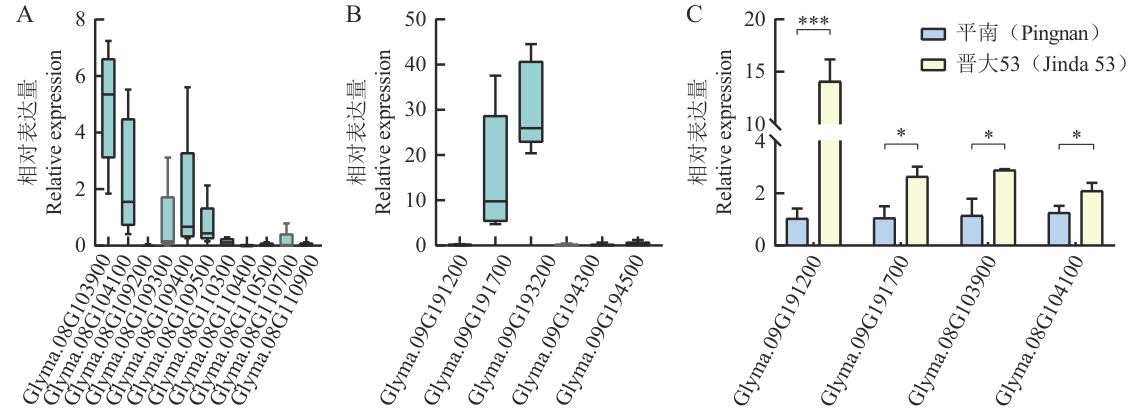
Fig. 3 Relative expression levels of candidate genes in soybean seeds and both parentsA: The relative expression level of the candidate gene on chromosome 8 in soybean seeds. B: The relative expression level of the candidate gene on chromosome 9 in soybean seeds. C: Expression analysis of candidate genes in the parents. Data are presented as mean ± variance, significant differences between Pingnan and Jinda 53 were assessed by t-test, * indicating P<0.05 and *** indicating P<0.001
基因名称 Gene name | 单碱基 Single base | 变异亲本 Variant parent |
|---|---|---|
| Glyma.08G103900 | A/T | 平南 |
| Glyma.08G104100 | T/C, G/A | 平南,平南 |
| Glyma.09G191200 | G/T, A/G | 平南,平南 |
| Glyma.09G191700 | A/T | 平南 |
Table 6 Different types of SNP differences between the parents for candidate genes
基因名称 Gene name | 单碱基 Single base | 变异亲本 Variant parent |
|---|---|---|
| Glyma.08G103900 | A/T | 平南 |
| Glyma.08G104100 | T/C, G/A | 平南,平南 |
| Glyma.09G191200 | G/T, A/G | 平南,平南 |
| Glyma.09G191700 | A/T | 平南 |
| [1] | Qutob D, Ma FS, Peterson CA, et al. Structural and permeability properties of the soybean seed coat [J]. Botany, 2008, 86(3): 219-227. |
| [2] | Le BH, Wagmaister JA, Kawashima T, et al. Using genomics to study legume seed development [J]. Plant Physiol, 2007, 144(2): 562-574. |
| [3] | 丁然. 基于随机森林大豆籽粒外观品质识别系统的设计与实现 [D]. 哈尔滨: 东北农业大学, 2015. |
| Ding R. Design and implementation of soybean grain appearance quality distinguish system based on random forests [D]. Harbin: Northeast Agricultural University, 2015. | |
| [4] | 赵团结, 盖钧镒. 栽培大豆起源与演化研究进展 [J]. 中国农业科学, 2004, 37(7): 954-962. |
| Zhao TJ, Gai JY. The origin and evolution of cultivated soybean Glycine max (L.) merr. [J]. Sci Agric Sin, 2004, 37(7): 954-962. | |
| [5] | 吴谷丰, 张晓燕, 黄璐, 等. 不同种皮颜色大豆籽粒和芽菜营养品质与抗氧化活性分析 [J]. 江苏农业学报, 2026, 42(1): 186-198. |
| Wu GF, Zhang XY, Huang L, et al. Analysis of nutritional quality and antioxidant activity in soybean seeds and sprouts with different seed coat colors [J]. Jiangsu J Agric Sci, 2026, 42(1): 186-198. | |
| [6] | 吴采玉, 文春雨, 黄丽萍, 等. 不同颜色大豆种皮成分及抗氧化性分析 [J]. 大豆科学, 2023, 42(5): 554-564. |
| Wu CY, Wen CY, Huang LP, et al. Analysis of seed coat composition and antioxidant activity of soybean with different colors [J]. Soybean Sci, 2023, 42(5): 554-564. | |
| [7] | 邱红梅, 陈亮, 侯云龙, 等. 大豆种子颜色遗传调控机制研究进展 [J]. 作物学报, 2021, 47(12): 2299-2313. |
| Qiu HM, Chen L, Hou YL, et al. Research progress on genetic regulatory mechanism of seed color in soybean (Glycine max) [J]. Acta Agron Sin, 2021, 47(12): 2299-2313. | |
| [8] | Cho YB, Jones SI, Vodkin LO. Mutations in Argonaute5 illuminate epistatic interactions of the K1 and I loci leading to saddle seed color patterns in Glycine max [J]. Plant Cell, 2017, 29(4): 708-725. |
| [9] | Endrizzi J E, Turcotte E L, Kohel R J. Qualitative genetics, cytology, and cytogenetics [J]. Cotton Agronomy Monograph, 1984, 419(5): 137-214. |
| [10] | Bernard R L, Weiss M G. Qualitative genetics, in soybean: improvement, production and uses [J]. Plant Mol Biology, 1973, 56(1): 117-149. |
| [11] | Dashiell K. SOYBEANS: improvement, production, and uses. third edition [J]. Agric Syst, 2005, 83(1): 110-111. |
| [12] | Nicholas CD, Lindstrom JT, Vodkin LO. Variation of proline rich cell wall proteins in soybean lines with anthocyanin mutations [J]. Plant Mol Biol, 1993, 21(1): 145-156. |
| [13] | Clough SJ, Tuteja JH, Li M, et al. Features of a 103-kb gene-rich region in soybean include an inverted perfect repeat cluster of CHS genes comprising the I locus [J]. Genome, 2004, 47(5): 819-831. |
| [14] | Tuteja JH, Clough SJ, Chan WC, et al. Tissue-specific gene silencing mediated by a naturally occurring Chalcone synthase gene cluster in Glycine max [J]. Plant Cell, 2004, 16(4): 819-835. |
| [15] | Toda K, Yang DJ, Yamanaka N, et al. A single-base deletion in soybean flavonoid 3′-hydroxylase gene is associated with gray pubescence color [J]. Plant Mol Biol, 2002, 50(2): 187-196. |
| [16] | Buzzell RI, Buttery BR, MacTavish DC. Biochemical genetics of black pigmentation of soybean seed [J]. J Hered, 1987, 78(1): 53-54. |
| [17] | Todd JJ, Vodkin LO. Pigmented soybean (Glycine max) seed coats accumulate proanthocyanidins during development [J]. Plant Physiol, 1993, 102(2): 663-670. |
| [18] | Lee JH, Kang NS, Shin SO, et al. Characterisation of anthocyanins in the black soybean (Glycine max L.) by HPLC-DAD-ESI/MS analysis [J]. Food Chem, 2009, 112(1): 226-231. |
| [19] | 曹杰, 谷勇哲, 洪慧龙, 等. 大豆红色种皮的色素鉴定和基因定位 [J]. 中国农业科学, 2023, 56(14): 2643-2659. |
| Cao J, Gu YZ, Hong HL, et al. Pigment identification and gene mapping in red seed coat of soybean [J]. Sci Agric Sin, 2023, 56(14): 2643-2659. | |
| [20] | 董全中, 蒋炳军, 张勇, 等. 大豆褐色种皮遗传分析及基因定位 [J]. 大豆科学, 2020, 39(3): 361-369. |
| Dong QZ, Jiang BJ, Zhang Y, et al. Inheritance analysis and gene mapping of brown seed coat in soybean [J]. Soybean Sci, 2020, 39(3): 361-369. | |
| [21] | Zhang DJ, Sun LJ, Li S, et al. Elevation of soybean seed oil content through selection for seed coat shininess [J]. Nat Plants, 2018, 4(1): 30-35. |
| [22] | Kim SL, Chi HY, Son JR, et al. Physicochemical characteristics of soybean seed coat and their relationship to seed lustre. Korean J Crop Sci, 2005, 50(spe): 123-131. |
| [23] | Wang WB, Liu MF, Wang YF, et al. Characterizing two inter-specific Bin maps for the exploration of the QTLs/genes that confer three soybean evolutionary traits [J]. Front Plant Sci, 2016, 7: 1248. |
| [24] | de Oliveira VR, Souza NOS, da Silva Arantes M, et al. Artificial intelligence applied to the classification of greenish seeds and prediction of physiological quality in soybean [J]. Ciênc Agrotec, 2024, 48: e003624. |
| [25] | Sofi P, Khalid R, Shafi S, et al. A low cost and high throughput spectroscopic method for quantification of seed coat colour differences in plain seeded bean (Phaseolus vulgaris L.) germplasm from Western Himalayan Kashmir [M]. Durham:Research Square, 2022. |
| [26] | Sinnecker P, Gomes MSO, Arêas JAG, et al. Relationship between color (instrumental and visual) and chlorophyll contents in soybean seeds during ripening [J]. J Agric Food Chem, 2002, 50(14): 3961-3966. |
| [27] | 王存虎, 许潇, 许锐能, 等. 基于CIELAB的大豆种皮颜色全基因组关联分析 [J]. 大豆科学, 2024, 43(6): 674-682. |
| Wang CH, Xu X, Xu RN, et al. Genome-wide association study of soybean seed coat color based on CIELAB [J]. Soybean Sci, 2024, 43(6): 674-682. | |
| [28] | Sun XW, Liu DY, Zhang XF, et al. SLAF-seq: an efficient method of large-scale de novo SNP discovery and genotyping using high-throughput sequencing [J]. PLoS One, 2013, 8(3): e58700. |
| [29] | Liu DY, Ma CX, Hong WG, et al. Construction and analysis of high-density linkage map using high-throughput sequencing data [J]. PLoS One, 2014, 9(6): e98855. |
| [30] | 陈奕博, 杨万明, 岳爱琴, 等. 基于SLAF标记的大豆遗传图谱构建及苗期耐盐性QTL定位 [J]. 生物技术通报, 2023, 39(2): 70-79. |
| Chen YB, Yang WM, Yue AQ, et al. Construction of soybean genetic map based on SLAF markers and QTL mapping analysis of salt tolerance at seedling stage [J]. Biotechnol Bull, 2023, 39(2): 70-79. | |
| [31] | Cho MH, Park HL, Park JH, et al. Characterization of regiospecific flavonoid 3′/5′-O-methyltransferase from tomato and its application in flavonoid biotransformation [J]. J Korean Soc Appl Biol Chem, 2012, 55(6): 749-755. |
| [32] | 白新祥, 胡可, 戴思兰, 等. 不同花色菊花品种花色素成分的初步分析 [J]. 北京林业大学学报, 2006, 28(5): 84-89. |
| Bai XX, Hu K, Dai SL, et al. Components of flower pigments in the petals of different color Chrysanthemum morifolium Ramat.cultivars [J]. J Beijing For Univ, 2006, 28(5): 84-89. | |
| [33] | 宋健, 熊亚俊, 陈伊洁, 等. 大豆巢式关联作图(NAM)群体构建及花色和种皮色遗传分析 [J]. 作物学报, 2024, 50(3): 556-575. |
| Song J, Xiong YJ, Chen YJ, et al. Genetic analysis of seed coat and flower color based on a soybean nested association mapping population [J]. Acta Agron Sin, 2024, 50(3): 556-575. | |
| [34] | Song J, Xu RX, Guo QY, et al. An omics strategy increasingly improves the discovery of genetic loci and genes for seed-coat color formation in soybean [J]. Mol Breeding, 2023, 43(9): 71. |
| [35] | Yuhazu M, Higuchi Y, Kanazawa A, et al. Large deletions including inverted repeats of the pseudo CHS gene in seed-coat-pigmented mutants derived from Japanese yellow soybean cultivars [J]. Breed Sci, 2025, 75(4): 334-338. |
| [36] | Gillman JD, Tetlow A, Lee JD, et al. Loss-of-function mutations affecting a specific Glycine max R2R3 MYB transcription factor result in brown hilum and brown seed coats [J]. BMC Plant Biol, 2011, 11(1): 155. |
| [37] | Vuong TD, Sonah H, Meinhardt CG, et al. Genetic architecture of cyst nematode resistance revealed by genome-wide association study in soybean [J]. BMC Genom, 2015, 16: 593. |
| [38] | Zhou ZK, Jiang Y, Wang Z, et al. Resequencing 302 wild and cultivated accessions identifies genes related to domestication and improvement in soybean [J]. Nat Biotechnol, 2015, 33(4): 408-414. |
| [39] | Wang C, Fu PC, Sun TT, et al. Identifying candidate genes related to soybean (Glycine max) seed coat color via RNA-seq and coexpression network analysis [J]. Genes, 2025, 16(1): 44. |
| [1] | ZHAO Xiong-wei, SHAO Li-tao, LI Meng-qing, LIANG Yi-xuan, ZHANG Jie-ru, CAO Yan-hua. Identification of Lysine Synthesis Pathway Genes and Analysis of the Regulation of AK Gene Variations in Foxtail Millet [J]. Biotechnology Bulletin, 2026, 42(9): 107-119. |
| [2] | OU Qi, FENG Yao, WEI Liu-ting, ZHUANG Zhan-wei, ZHAO Yun-xiang, CHEN Fu-mei. Application Status of Genome-wide Association Study (GWAS) in the Study of Reproductive Traits in Sow [J]. Biotechnology Bulletin, 2026, 42(4): 65-71. |
| [3] | XU Meng-ge, SONG Huo-yan, LUO Jia, SU Yi, ZHOU Hui-wen, WANG Can, KONG Ke-ke. Expression Analysis and Interaction Protein Screening of GmRLK19 in Soybean [J]. Biotechnology Bulletin, 2026, 42(4): 92-100. |
| [4] | SU Yan-zhu, LI Da, ZHANG Ai-ai, LIU Yong-guang, ZHANG Xiu-rong, XUE Qi-qin. Identification and Expression Analysis of CAD Gene Family in Soybean(Glycine max (L.) Merr.) [J]. Biotechnology Bulletin, 2026, 42(4): 101-113. |
| [5] | YIN Shi-qing, TIAN Tai, HUANG Feng-ting, FENG Long-qiang, WANG Hao, ZHANG Jing, HE Wen, CHEN Qing, WANG Xiao-rong, WANG Yan. Advances in Regulatory Mechanism of Fruit Firmness in Fruit Crops [J]. Biotechnology Bulletin, 2026, 42(3): 213-229. |
| [6] | WANG Shang-feng, CHENG Bin, WANG Ruo-ruo, DING Yan-qing, XU Jian-xia, CAO Ning, GAO Xu, LI Wen-zhen, ZHANG Li-yi. Gene Mapping of Sorghum Flowering Time and Prediction of Candidate Genes Based on BSA-seq [J]. Biotechnology Bulletin, 2026, 42(2): 197-206. |
| [7] | ZHANG Yue, DAI Yue-hua, ZHANG Ying-ying, LI Ao-hui, LI Chu-hui, XUE Jin-ai, QIN Hui-bin, CHEN Yan, NIE Meng-en, ZHANG Hai-ping. Cloning and Functional Analysis of the Soybean Enoyl-CoA Reductase ECR14 Gene [J]. Biotechnology Bulletin, 2026, 42(1): 95-104. |
| [8] | LI Ya-tao, ZHANG Zhi-peng, ZHAO Meng-yao, LYU Zhen, GAN Tian, WEI Hao, WU Shu-feng, MA Yu-chao. Whole Genome Analysis of Bradyrhizobium sp. Bd1 and the Negative Regulating Function of TetR3 during Cell Growth and Nodulation [J]. Biotechnology Bulletin, 2025, 41(9): 289-301. |
| [9] | WU Xia-ming, ZHOU Chen-ping, YANG Min, XU Ze, KUANG Rui-bin, LIU Chuan-he, HE Han, WEI Yue-rong. Gene Mapping of Plant Height in Papaya Based on BSA-seq [J]. Biotechnology Bulletin, 2025, 41(9): 54-61. |
| [10] | HUANG Guo-dong, DENG Yu-xing, CHENG Hong-wei, DAN Yan-nan, ZHOU Hui-wen, WU Lan-hua. Genome-wide Identification and Expression Analysis of the ZIP Gene Family in Soybean [J]. Biotechnology Bulletin, 2025, 41(9): 71-81. |
| [11] | LIU Ze-zhou, DUAN Nai-bin, YUE Li-xin, WANG Qing-hua, YAO Xing-hao, GAO Li-min, KONG Su-ping. Analysis of Wax Components and Screening of Wax-deficient Gene Ggl-1 in Garlic (Allium sativum L.) [J]. Biotechnology Bulletin, 2025, 41(9): 219-231. |
| [12] | GUAN Zhi-hao, SHAN Zhi-yi, XIONG He, ZHAO Rui-xue. Computational Literature-based Knowledge Discovery for Soybean Coupling Traits [J]. Biotechnology Bulletin, 2025, 41(9): 345-356. |
| [13] | ZHAI Ying, JI Jun-jie, CHEN Jiong-xin, YU Hai-wei, LI Shan-shan, ZHAO Yan, MA Tian-yi. Heterologous Overexpression of Soybean GmNF-YB24 Improves the Resistance of Transgenic Tobacco to Drought [J]. Biotechnology Bulletin, 2025, 41(8): 137-145. |
| [14] | ZHU Li-juan, ZHANG Kai, WEN Xiao-lei, CHU Jia-hao, SHI Feng-yu, WANG Yan-li. Mining the Core Genes Being Tolerant to Cadmium in Wild Soybean by WGCNA [J]. Biotechnology Bulletin, 2025, 41(8): 124-136. |
| [15] | NIU Jing-ping, ZHAO Jing, GUO Qian, WANG Shu-hong, ZHAO Jin-zhong, DU Wei-jun, YIN Cong-cong, YUE Ai-qin. Identification and Induced Expression Analysis of Transcription Factors NAC in Soybean Resistance to Soybean Mosaic Virus Based on WGCNA [J]. Biotechnology Bulletin, 2025, 41(7): 95-105. |
| Viewed | ||||||
|
Full text |
|
|||||
|
Abstract |
|
|||||
