







Biotechnology Bulletin ›› 2026, Vol. 42 ›› Issue (11): 283-296.doi: 10.13560/j.cnki.biotech.bull.1985.2026-0567
GUI Yuan1, YANG Ting-fei1, WANG Feng-qing1, LIU Jun2, LIU Gen-qiao1, LI Zhong-xuan1, LIAO Yu-ting1, WANG Chuan1, LI Li1( ), ZHOU Zheng-fu3()
Received:2026-05-19
Online:2026-11-26
Published:2026-11-03
Contact:
LI Li, ZHOU Zheng-fu
E-mail:li_li821008@163.com;zhouzhengfu@caas.cn
GUI Yuan, YANG Ting-fei, WANG Feng-qing, LIU Jun, LIU Gen-qiao, LI Zhong-xuan, LIAO Yu-ting, WANG Chuan, LI Li, ZHOU Zheng-fu. Raw Material Quality Analysis of Single‑cell Protein Production from Baijiu Distiller’s Grains via Dual‑strain Fermentation Based on Metabolomics[J]. Biotechnology Bulletin, 2026, 42(11): 283-296.
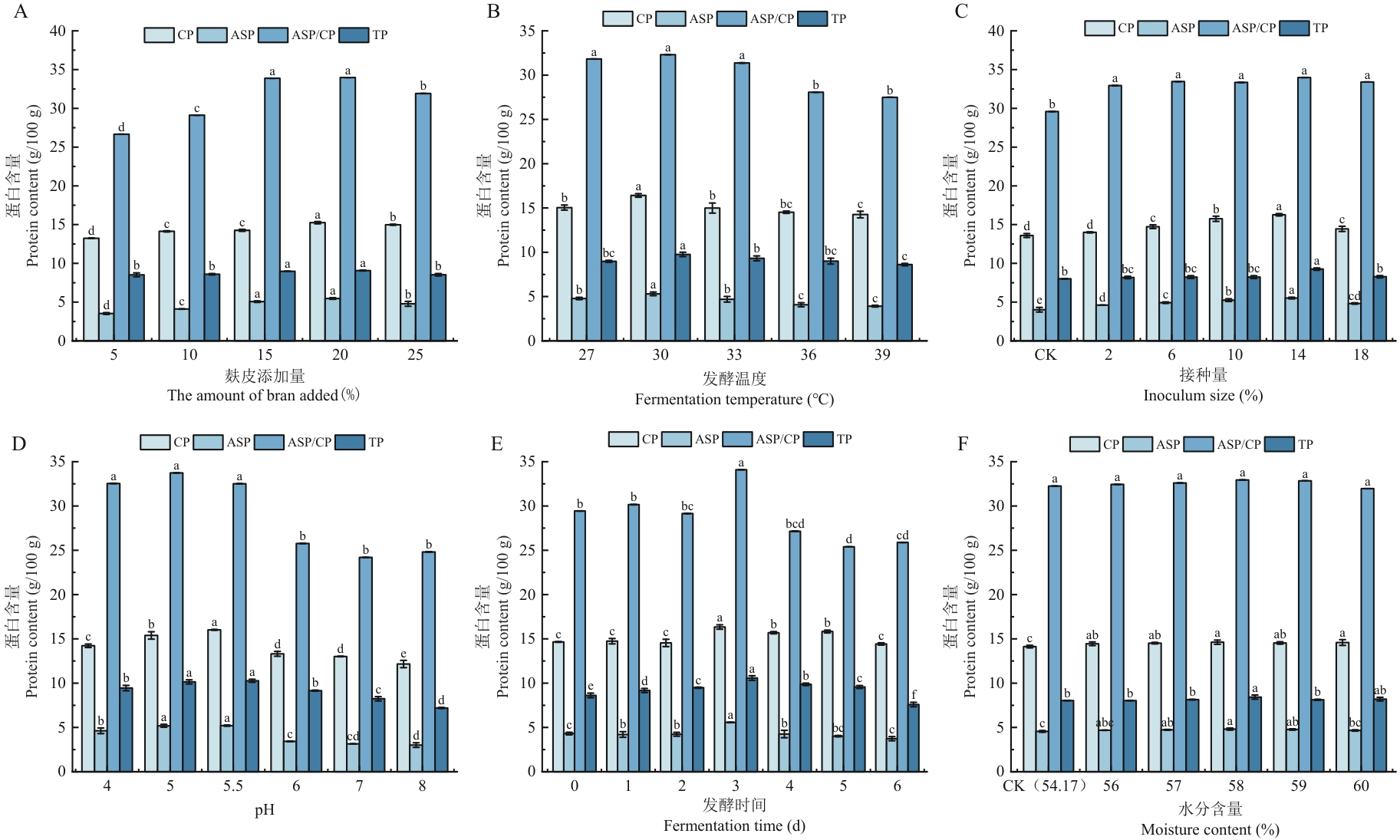
Fig. 1 Effect of different factors on the protein content in solid-state fermentation of distiller's grainsA: Addition amount of wheat bran. B: Fermentation temperature. C: Inoculation amount. D: Initial pH. E: Fermentation time. F: Moisture content. CP: Crude protein; ASP: acid soluble protein; TP: true protein. Different lowercase letters indicate significant difference (P<0.05). The same below
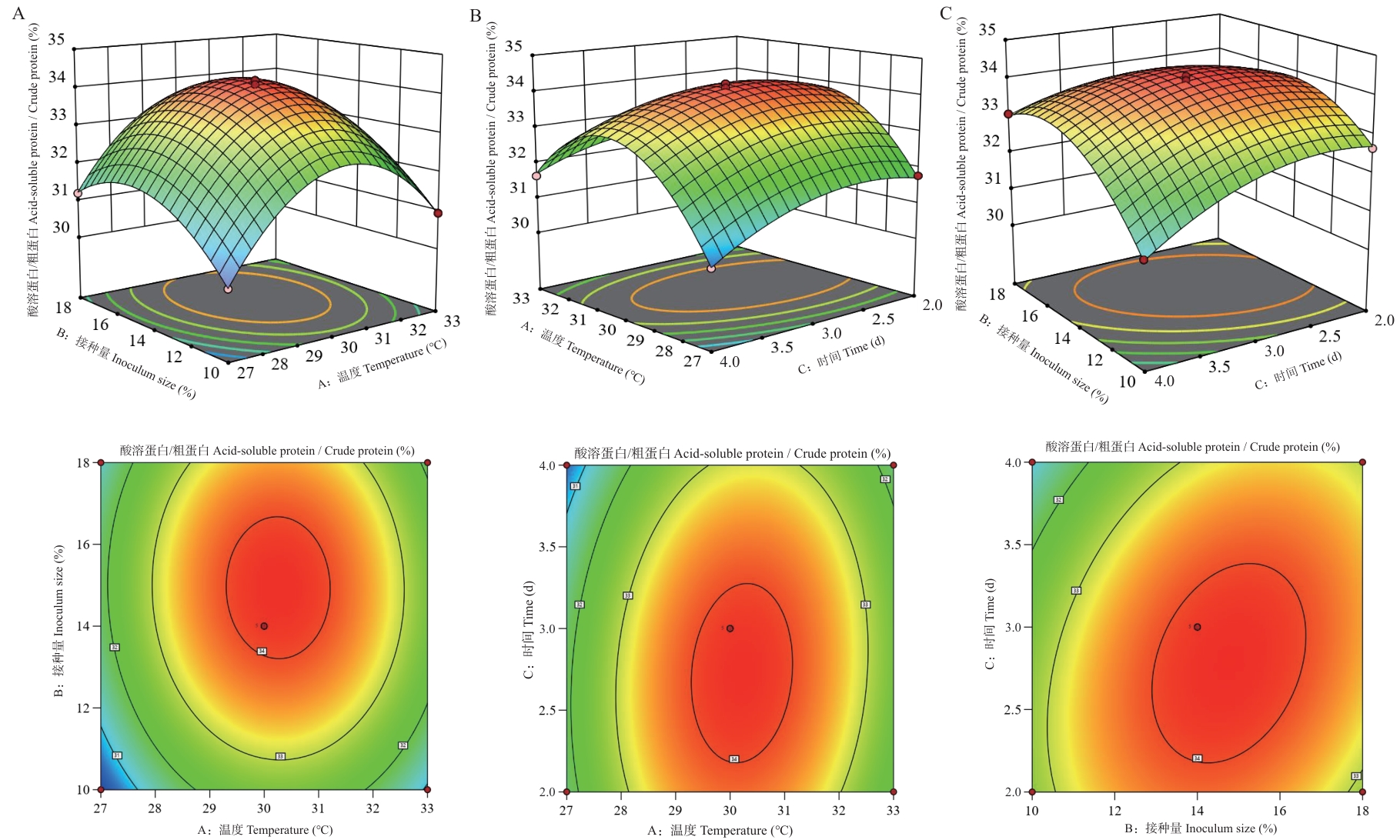
Fig. 2 Effect of interaction among various factors on ASP/CP content
水平 Level | 发酵温度(A) Fermentation temperature (℃) | 接种量(B) Inoculation amount(%) | 发酵时间(C) Fermentation time (d) |
|---|---|---|---|
| -1 | 27 | 10 | 2 |
| 0 | 30 | 14 | 3 |
| 1 | 33 | 18 | 4 |
Table 1 Factors and levels of response surface experiments
水平 Level | 发酵温度(A) Fermentation temperature (℃) | 接种量(B) Inoculation amount(%) | 发酵时间(C) Fermentation time (d) |
|---|---|---|---|
| -1 | 27 | 10 | 2 |
| 0 | 30 | 14 | 3 |
| 1 | 33 | 18 | 4 |
试验编号 Test number | 发酵温度(A) Fermentation temperature (℃) | 接种量(B) Inoculation amount (%) | 发酵时间(C) Fermentation time (d) | 酸溶蛋白/粗蛋白 ASP/CP (%) | 真蛋白 TP (g/100 g) |
|---|---|---|---|---|---|
| 1 | 27 | 10 | 3 | 30.09 | 10.70 |
| 2 | 33 | 10 | 3 | 30.93 | 9.81 |
| 3 | 27 | 18 | 3 | 31.19 | 10.55 |
| 4 | 33 | 18 | 3 | 31.86 | 9.90 |
| 5 | 27 | 14 | 2 | 31.77 | 10.59 |
| 6 | 33 | 14 | 2 | 31.97 | 9.22 |
| 7 | 27 | 14 | 4 | 30.47 | 10.00 |
| 8 | 33 | 14 | 4 | 31.62 | 9.32 |
| 9 | 30 | 10 | 2 | 32.65 | 10.58 |
| 10 | 30 | 18 | 2 | 32.79 | 10.61 |
| 11 | 30 | 10 | 4 | 31.09 | 10.40 |
| 12 | 30 | 18 | 4 | 33.05 | 10.06 |
| 13 | 30 | 14 | 3 | 33.95 | 11.06 |
| 14 | 30 | 14 | 3 | 34.26 | 11.20 |
| 15 | 30 | 14 | 3 | 34.27 | 10.98 |
| 16 | 30 | 14 | 3 | 34.02 | 11.00 |
| 17 | 30 | 14 | 3 | 34.16 | 11.05 |
Table 2 Results of response surface methodology experiment
试验编号 Test number | 发酵温度(A) Fermentation temperature (℃) | 接种量(B) Inoculation amount (%) | 发酵时间(C) Fermentation time (d) | 酸溶蛋白/粗蛋白 ASP/CP (%) | 真蛋白 TP (g/100 g) |
|---|---|---|---|---|---|
| 1 | 27 | 10 | 3 | 30.09 | 10.70 |
| 2 | 33 | 10 | 3 | 30.93 | 9.81 |
| 3 | 27 | 18 | 3 | 31.19 | 10.55 |
| 4 | 33 | 18 | 3 | 31.86 | 9.90 |
| 5 | 27 | 14 | 2 | 31.77 | 10.59 |
| 6 | 33 | 14 | 2 | 31.97 | 9.22 |
| 7 | 27 | 14 | 4 | 30.47 | 10.00 |
| 8 | 33 | 14 | 4 | 31.62 | 9.32 |
| 9 | 30 | 10 | 2 | 32.65 | 10.58 |
| 10 | 30 | 18 | 2 | 32.79 | 10.61 |
| 11 | 30 | 10 | 4 | 31.09 | 10.40 |
| 12 | 30 | 18 | 4 | 33.05 | 10.06 |
| 13 | 30 | 14 | 3 | 33.95 | 11.06 |
| 14 | 30 | 14 | 3 | 34.26 | 11.20 |
| 15 | 30 | 14 | 3 | 34.27 | 10.98 |
| 16 | 30 | 14 | 3 | 34.02 | 11.00 |
| 17 | 30 | 14 | 3 | 34.16 | 11.05 |
方差来源 Variance source | 平方和 Sum of squares | 自由度 Degrees of freedom | 均方 Mean square | F值 F-value | P值 P-value | 显著性 Significance |
|---|---|---|---|---|---|---|
| 模型 | 31.42 | 9 | 3.49 | 245.78 | <0.000 1 | ** |
| A-温度 (℃) | 1.02 | 1 | 1.02 | 72.15 | <0.000 1 | ** |
| B-接种量 (%) | 2.13 | 1 | 2.13 | 149.62 | <0.000 1 | ** |
| C-时间 (d) | 1.10 | 1 | 1.10 | 77.12 | <0.000 1 | ** |
| AB | 0.007 9 | 1 | 0.007 9 | 0.553 1 | 0.481 3 | ns |
| AC | 0.228 2 | 1 | 0.228 2 | 16.07 | 0.005 1 | ** |
| BC | 0.832 6 | 1 | 0.832 6 | 58.62 | 0.000 1 | ** |
| A² | 17.24 | 1 | 17.24 | 1 213.61 | <0.000 1 | ** |
| B² | 4.98 | 1 | 4.98 | 350.89 | <0.000 1 | ** |
| C² | 1.76 | 1 | 1.76 | 123.91 | <0.000 1 | ** |
| 残差 | 0.099 4 | 7 | 0.014 2 | |||
| 失拟误差 | 0.017 8 | 3 | 0.005 9 | 0.290 7 | 0.831 0 | ns |
| 纯误差 | 0.081 6 | 4 | 0.020 4 | |||
| 总误差 | 31.52 | 16 | ||||
| R2:0.996 8, R2Adj:0.970 6, R2Pre:0.986 8 | ||||||
Table 3 Results of variance analysis of the regression model of ASP/CP
方差来源 Variance source | 平方和 Sum of squares | 自由度 Degrees of freedom | 均方 Mean square | F值 F-value | P值 P-value | 显著性 Significance |
|---|---|---|---|---|---|---|
| 模型 | 31.42 | 9 | 3.49 | 245.78 | <0.000 1 | ** |
| A-温度 (℃) | 1.02 | 1 | 1.02 | 72.15 | <0.000 1 | ** |
| B-接种量 (%) | 2.13 | 1 | 2.13 | 149.62 | <0.000 1 | ** |
| C-时间 (d) | 1.10 | 1 | 1.10 | 77.12 | <0.000 1 | ** |
| AB | 0.007 9 | 1 | 0.007 9 | 0.553 1 | 0.481 3 | ns |
| AC | 0.228 2 | 1 | 0.228 2 | 16.07 | 0.005 1 | ** |
| BC | 0.832 6 | 1 | 0.832 6 | 58.62 | 0.000 1 | ** |
| A² | 17.24 | 1 | 17.24 | 1 213.61 | <0.000 1 | ** |
| B² | 4.98 | 1 | 4.98 | 350.89 | <0.000 1 | ** |
| C² | 1.76 | 1 | 1.76 | 123.91 | <0.000 1 | ** |
| 残差 | 0.099 4 | 7 | 0.014 2 | |||
| 失拟误差 | 0.017 8 | 3 | 0.005 9 | 0.290 7 | 0.831 0 | ns |
| 纯误差 | 0.081 6 | 4 | 0.020 4 | |||
| 总误差 | 31.52 | 16 | ||||
| R2:0.996 8, R2Adj:0.970 6, R2Pre:0.986 8 | ||||||
方差来源 Variance source | 平方和 Sum of squares | 自由度 Degrees of freedom | 均方 Mean square | F值 F-value | P值 P-value | 显著性 Significance |
|---|---|---|---|---|---|---|
| 模型 | 5.78 | 9 | 0.642 6 | 59.75 | <0.000 1 | ** |
| A-温度 (℃) | 1.61 | 1 | 1.61 | 150.13 | <0.000 1 | ** |
| B-接种量 (%) | 0.016 0 | 1 | 0.016 0 | 1.49 | 0.261 9 | ns |
| C-时间 (d) | 0.187 9 | 1 | 0.187 9 | 17.47 | 0.004 1 | ** |
| AB | 0.014 1 | 1 | 0.014 1 | 1.31 | 0.289 4 | ns |
| AC | 0.116 6 | 1 | 0.116 6 | 10.84 | 0.013 2 | * |
| BC | 0.033 3 | 1 | 0.033 3 | 3.10 | 0.121 7 | ns |
| A² | 2.21 | 1 | 2.21 | 205.59 | <0.000 1 | ** |
| B² | 0.036 9 | 1 | 0.036 9 | 3.43 | 0.106 4 | ns |
| C² | 1.29 | 1 | 1.29 | 119.70 | <0.000 1 | ** |
| 残差 | 0.075 3 | 7 | 0.010 8 | |||
| 失拟误差 | 0.047 0 | 3 | 0.015 7 | 2.22 | 0.228 4 | ns |
| 纯误差 | 0.028 3 | 4 | 0.007 1 | |||
| 总误差 | 5.86 | 16 | ||||
| R2:0.987 2, R2Adj:0.970 6, R2Pre:0.864 0 | ||||||
Table 4 ANOVA results of the regression model for TP content
方差来源 Variance source | 平方和 Sum of squares | 自由度 Degrees of freedom | 均方 Mean square | F值 F-value | P值 P-value | 显著性 Significance |
|---|---|---|---|---|---|---|
| 模型 | 5.78 | 9 | 0.642 6 | 59.75 | <0.000 1 | ** |
| A-温度 (℃) | 1.61 | 1 | 1.61 | 150.13 | <0.000 1 | ** |
| B-接种量 (%) | 0.016 0 | 1 | 0.016 0 | 1.49 | 0.261 9 | ns |
| C-时间 (d) | 0.187 9 | 1 | 0.187 9 | 17.47 | 0.004 1 | ** |
| AB | 0.014 1 | 1 | 0.014 1 | 1.31 | 0.289 4 | ns |
| AC | 0.116 6 | 1 | 0.116 6 | 10.84 | 0.013 2 | * |
| BC | 0.033 3 | 1 | 0.033 3 | 3.10 | 0.121 7 | ns |
| A² | 2.21 | 1 | 2.21 | 205.59 | <0.000 1 | ** |
| B² | 0.036 9 | 1 | 0.036 9 | 3.43 | 0.106 4 | ns |
| C² | 1.29 | 1 | 1.29 | 119.70 | <0.000 1 | ** |
| 残差 | 0.075 3 | 7 | 0.010 8 | |||
| 失拟误差 | 0.047 0 | 3 | 0.015 7 | 2.22 | 0.228 4 | ns |
| 纯误差 | 0.028 3 | 4 | 0.007 1 | |||
| 总误差 | 5.86 | 16 | ||||
| R2:0.987 2, R2Adj:0.970 6, R2Pre:0.864 0 | ||||||
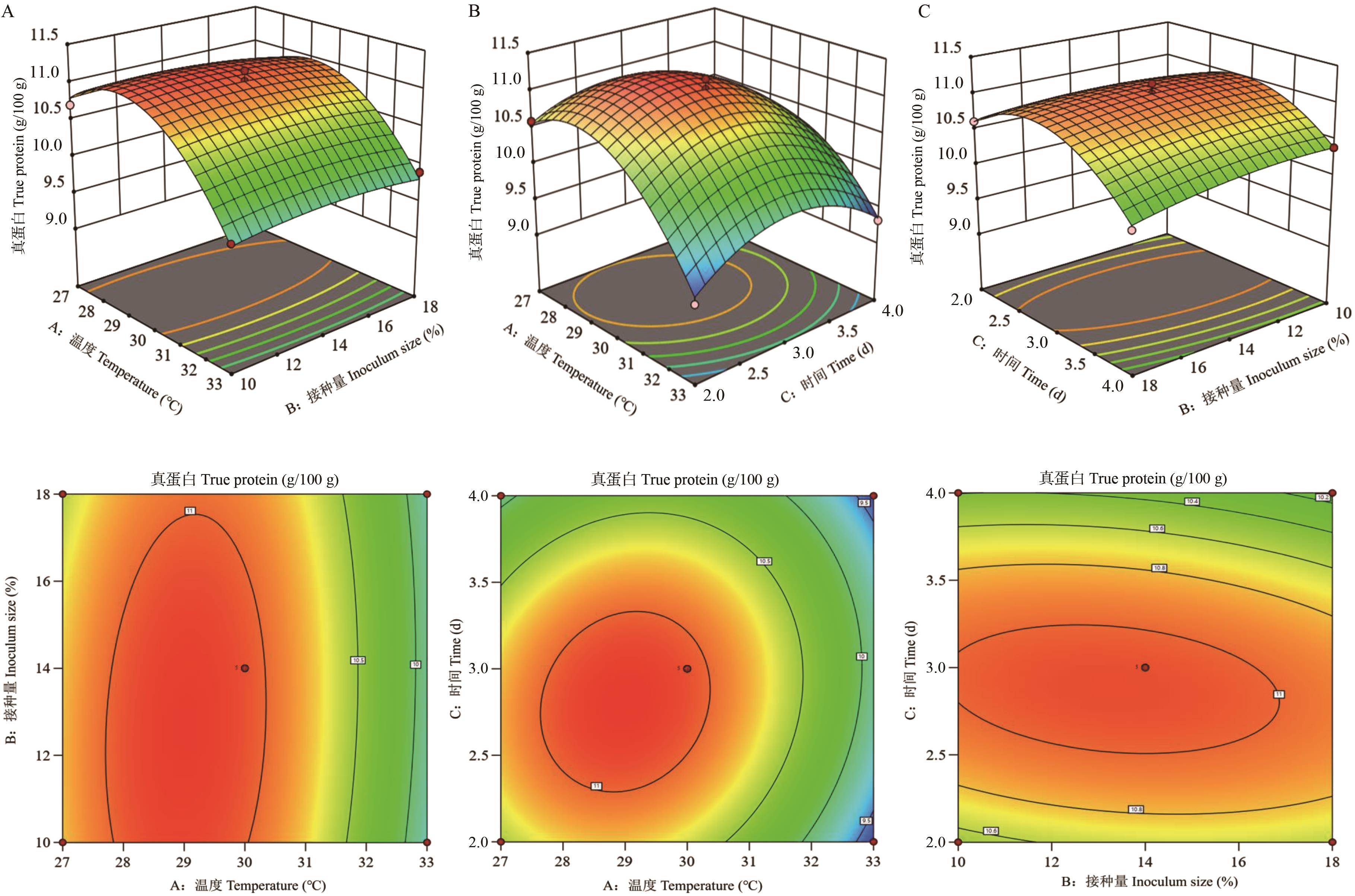
Fig. 3 Effect of interaction among various factors on TP content
组别 Group | 粗蛋白 CP(g/100 g) | 酸溶蛋白 ASP(g/100 g) | 酸溶蛋白/粗蛋白 ASP/CP(%) | 真蛋白 TP(g/100 g) | 总酸 Total acid (g/kg) | 粗脂肪 Ether extract(%) | 含水量 Water content(%) |
|---|---|---|---|---|---|---|---|
| 空白原料 | 14.60±0.25a | 4.31±0.15a | 29.50±0.01a | 8.56±0.05a | 12.49±0.31a | 2.87±0.01a | 52.54±0.01a |
| 发酵酒糟 | 17.03±0.06b | 5.82±0.11b | 34.18±0.01b | 11.07±0.08b | 11.80±0.27b | 3.56±0.01a | 57.41±0.01b |
Table 5 Changes in nutritional indicators of distiller's grains before and after fermentation
组别 Group | 粗蛋白 CP(g/100 g) | 酸溶蛋白 ASP(g/100 g) | 酸溶蛋白/粗蛋白 ASP/CP(%) | 真蛋白 TP(g/100 g) | 总酸 Total acid (g/kg) | 粗脂肪 Ether extract(%) | 含水量 Water content(%) |
|---|---|---|---|---|---|---|---|
| 空白原料 | 14.60±0.25a | 4.31±0.15a | 29.50±0.01a | 8.56±0.05a | 12.49±0.31a | 2.87±0.01a | 52.54±0.01a |
| 发酵酒糟 | 17.03±0.06b | 5.82±0.11b | 34.18±0.01b | 11.07±0.08b | 11.80±0.27b | 3.56±0.01a | 57.41±0.01b |
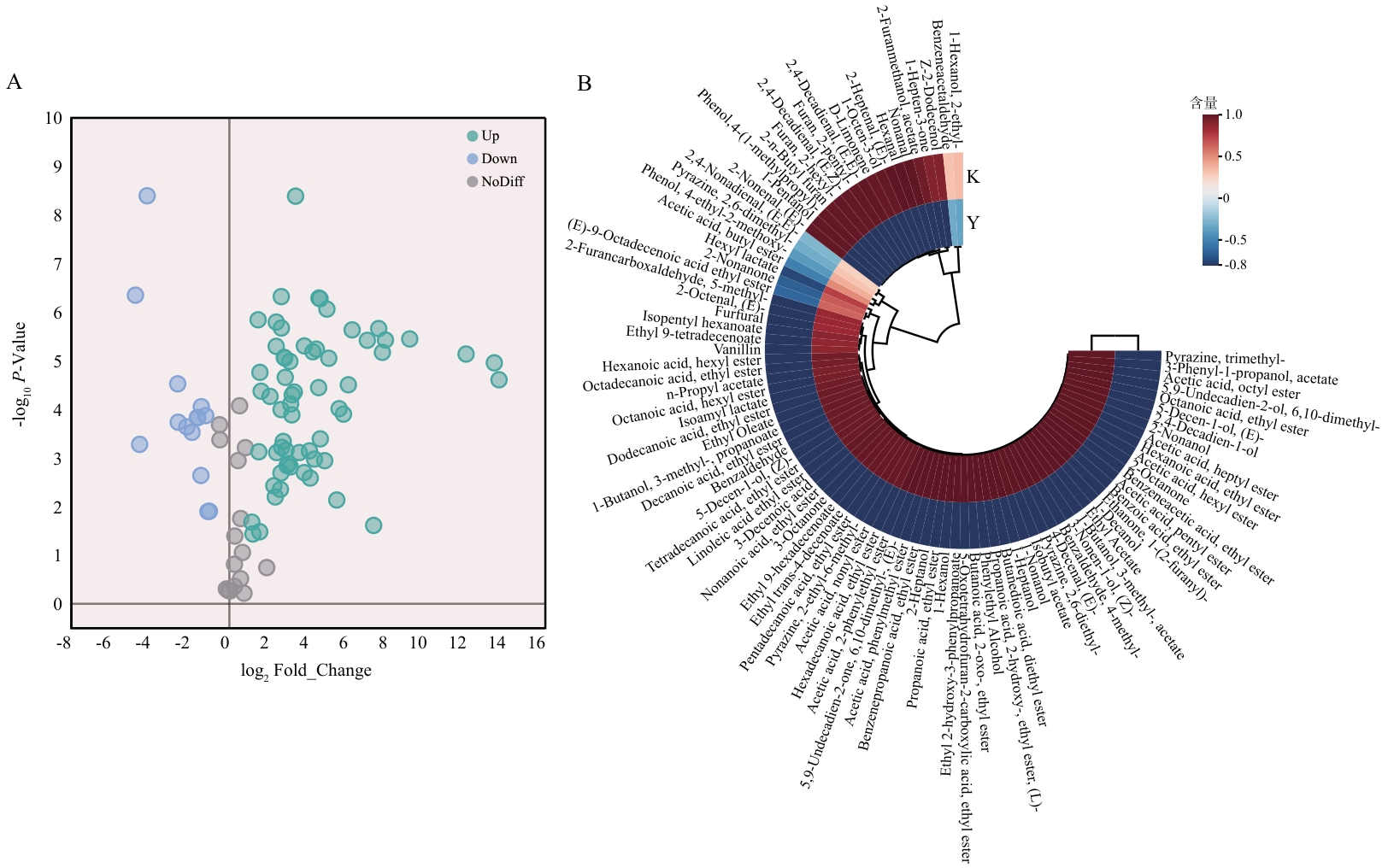
Fig. 4 Volcanic map (A) and circular hierarchical clustering heat map (B) for screening differential flavor substances between blank raw materials and fermented distiller's grainsK: Blank raw materials; Y: fermented distiller’s grains. The same below
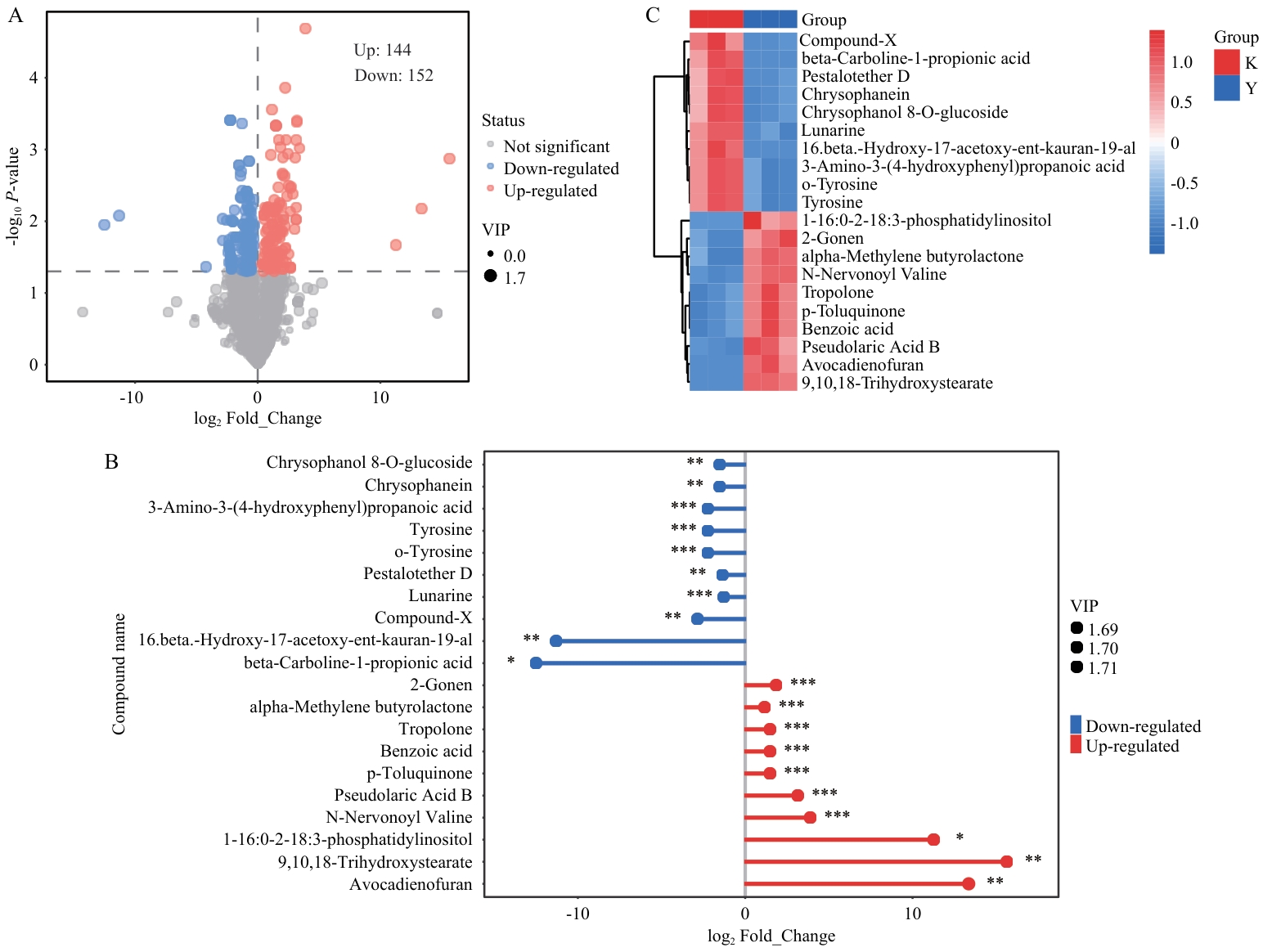
Fig. 5 Volcano plot (A), matchstick plot (B) and hierarchical clustering heat map (C) of differential metabolites between blank raw material and fermented distiller's grainsNote: Compound-X: (1S,6S,9S,10R,14R,17S,19S)-12-ethyl-9,19-dihydroxy-17-methoxy-14-methyl-5-oxa-12-azahexacyclo [8.7.2.1~2,6~.0~1,11~.0~3,9~.0~14,18~] icosan-4-one
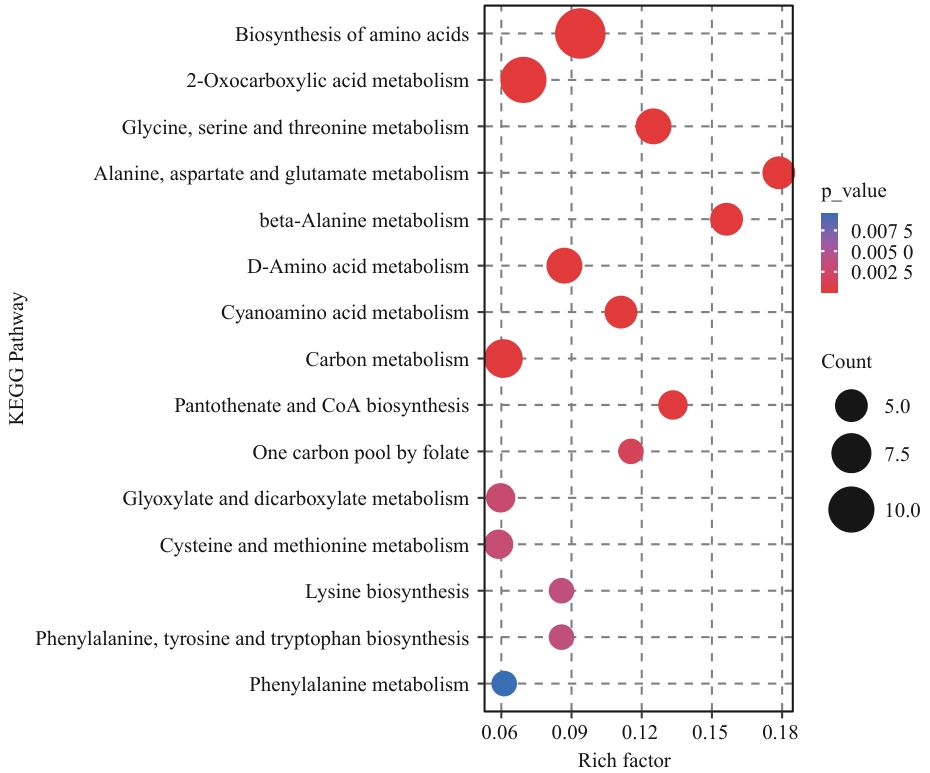
Fig. 6 KEGG enrichment plots of differential metabolites between blank raw materials and fermented distiller's grains
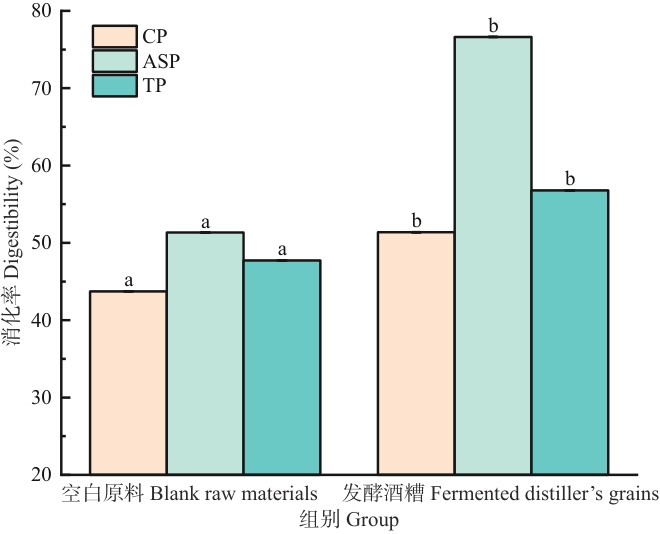
Fig. 7 In vitro digestibility of individual protein fractions in blank raw material and fermented distiller's grains after simulated digestion
| [1] | Liu L, Rong WH, Du X, et al. Integrating experimental and computational analyses of yeast protein profiles for optimizing the production of high-quality microbial proteins [J]. Appl Biochem Biotechnol, 2024, 196(12): 8741-8762. |
| [2] | 黄志东, 张翘楚, 李惠惠, 等. 菌体蛋白作为饲料蛋白原料的研究进展 [J]. 饲料工业, 2023, 44(10): 16-21. |
| Huang ZD, Zhang QC, Li HH, et al. Research progress of bacterial protein as feed protein raw material [J]. Feed Ind, 2023, 44(10): 16-21. | |
| [3] | 唐哲仁, 高勇, 师雄, 等. 白酒酒糟资源化利用技术研究进展 [J]. 中国酿造, 2024, 43(8): 13-19. |
| Tang ZR, Gao Y, Shi X, et al. Research progress on resource utilization techniques of Chinese Baijiu distiller’s grains [J]. China Brew, 2024, 43(8): 13-19. | |
| [4] | Liang ZQ, Wang Z, Shen XJ, et al. Utilization of synthetic microbial community in solid-state fermentation (SMC-SSF) for converting Chinese distiller grains into protein feed [J]. Chem Biol Technol Agric, 2025, 12: 104. |
| [5] | Qiao L, Wang K, Xin X, et al. Upcycling of Chinese Nong-flavor Baijiu distiller’s grains through solid-state fermentation by microbial-enzyme synergy [J]. Fermentation, 2026, 12(1): 13. |
| [6] | 时伟, 张熙琳, 郑红梅, 等. 混菌固态发酵清香型白酒糟制备蛋白饲料的研究 [J]. 饲料研究, 2024, 47(4): 79-84. |
| Shi W, Zhang XL, Zheng HM, et al. Research on mixed solid-state fermentation of pure flavor distiller’s grains for protein feed production [J]. Feed Res, 2024, 47(4): 79-84. | |
| [7] | Xu ZX, Ying C, Bai PX, et al. Microbial dynamics, metabolite profiles, and chemical composition in Saccharomyces cerevisiae and Kluyveromyces marxianus co-culture during solid-state fermentation [J]. Food Biosci, 2025, 64: 105849. |
| [8] | Wang C, Wei SY, Jin ML, et al. Integrated microbiomic and metabolomic dynamics of fermented corn and soybean by-product mixed substrate [J]. Front Nutr, 2022, 9: 831243. |
| [9] | Hu SQ, Zeng YT, Liu HQ, et al. Systematic profiling and bioactivity evaluation of Jiuzao from light flavor Baijiu: a by-product rich in bioactive compounds [J]. Food Chem, 2025, 494: 146229. |
| [10] | 中华人民共和国国家卫生健康委员会, 国家市场监督管理总局. 食品安全国家标准 食品中蛋白质的测定: [S]. 北京: 中国标准出版社, 2025. |
| National Health Commission of the People’s Republic of China, State Administration for Market Regulation. National Food Safety Standard Determination of Protein in Food: [S]. Beijing: Standards Press of China, 2025. | |
| [11] | 中华人民共和国农业农村部. 饲料原料中酸溶蛋白测定: [S]. 北京: 中国农业出版社, 2020.Determination of acid-soluble protein in feed ingredients: [S]. Beijing: China Agriculture Press, 2020. |
| [12] | 王妍, 郑猛虎, 崔欣雨, 等. 微生物固态发酵工艺对红薯淀粉渣真蛋白含量的影响 [J]. 饲料工业, 2022, 43(9): 35-40. |
| Wang Y, Zheng MH, Cui XY, et al. Effect of microbial solid state fermentation process on the true protein content of sweet potato starch residue [J]. Feed Ind, 2022, 43(9): 35-40. | |
| [13] | 国家卫生健康委员会, 国家市场监督管理总局. 食品安全国家标准 食品中总酸的测定: [S]. 北京: 中国标准出版社, 2021. |
| National Health Commission of the People’s Republic of China, State Administration for Market Regulation. National Food Safety Standard Determination of Total Acids in Food: [S]. Beijing: Standards Press of China, 2021. | |
| [14] | 国家质量监督检验检疫总局, 中国国家标准化管理委员会. 饲料卫生标准: [S]. 北京: 中国标准出版社, 2017. |
| General Administration of Quality Supervision, Inspection and Quarantine of the People’s Republic of China, Standardization Administration of the People’s Republic of China. Hygienical standard for feeds: [S]. Beijing: Standards Press of China, 2017. | |
| [15] | Babič K, Strojnik L, Ćirić A, et al. Optimization and validation of an HS-SPME/GC-MS method for determining volatile organic compounds in dry-cured ham [J]. Front Nutr, 2024, 11: 1342417. |
| [16] | Deng J, He CJ, Wei CH, et al. Characterization of fermentation parameters, volatile compounds and microbial community structure of fermented grains in the upper and lower layers during strong-flavor Baijiu fermentation [J]. Bioresour Bioprocess, 2025, 12: 105. |
| [17] | Xu J, Zhang T, Chen HT, et al. Study on the fermented grain characteristics and volatile flavor substances during the tuqu fermentation of Hunan light-flavor Baijiu [J]. Foods, 2024, 13(6): 899. |
| [18] | Doppler M, Kluger B, Bueschl C, et al. Stable isotope-assisted evaluation of different extraction solvents for untargeted metabolomics of plants [J]. Int J Mol Sci, 2016, 17(7): 1017. |
| [19] | Dunn WB, Broadhurst D, Begley P, et al. Procedures for large-scale metabolic profiling of serum and plasma using gas chromatography and liquid chromatography coupled to mass spectrometry [J]. Nat Protoc, 2011, 6(7): 1060-1083. |
| [20] | Want EJ, Wilson ID, Gika H, et al. Global metabolic profiling procedures for urine using UPLC-MS [J]. Nat Protoc, 2010, 5(6): 1005-1018. |
| [21] | Zhu XF, Wang LY, Zhang Z, et al. Combination of fiber-degrading enzymatic hydrolysis and lactobacilli fermentation enhances utilization of fiber and protein in rapeseed meal as revealed in simulated pig digestion and fermentation in vitro [J]. Anim Feed Sci Technol, 2021, 278: 115001. |
| [22] | Schützhold V, Hahn J, Tummler K, et al. Computational modeling of lipid metabolism in yeast [J]. Front Mol Biosci, 2016, 3: 57. |
| [23] | Du F, Xu Q, Li X, et al. Author Correction: Regulating triacylglycerol cycling for high-efficiency production of polyunsaturated fatty acids and derivatives [J]. Nat Commun, 2025, 16: 10314. |
| [24] | He MX, Peng Q, Xu XQ, et al. Antioxidant capacities and non-volatile metabolites changes after solid-state fermentation of soybean using oyster mushroom (Pleurotus ostreatus) Mycelium [J]. Front Nutr, 2024, 11: 1509341. |
| [25] | Li T, Deng MS, Li S, et al. Revealing differences in flavor compounds during plum wine fermentation using single and mixed yeast strains through metabolomic analysis [J]. Food Chem X, 2025, 25: 102100. |
| [26] | Xie J, Zhang JF, Chen XY. Aloe-emodin: from pharmacological mechanisms to clinical applications and future perspectives [J]. Front Pharmacol, 2026, 16: 1741679. |
| [27] | Wang DP, Wang XH, Yu XJ, et al. Pharmacokinetics of anthraquinones from medicinal plants [J]. Front Pharmacol, 2021, 12: 638993. |
| [28] | Zhang YJ, Xie YX, Ma J, et al. Mechanisms of anti-nutritional factor degradation and quality enhancement in soybean meal via Rpf-mediated microbiota synergy and Bacillus reinforcement during solid-state fermentation [J]. Front Anim Sci, 2025, 6: 1707154. |
| [29] | Chi ZH, Feng Y, Wei XK, et al. A co-fermentation technology based on small peptide production and protein structure modification increases the edible value of corn gluten meal [J]. LWT, 2024, 198: 116054. |
| [30] | Huang YY, Meng K, Liu GH, et al. Whole genome sequencing and extracellular metabolite profiling of lactiplantibacillus plantarum FRT4: insights into probiotic functionality [J]. Biology, 2025, 14(9): 1167. |
| [31] | 司维江, 刘建忠, 黄德利, 等. 白酒糟饲料化利用菌种的筛选及工艺优化 [J]. 饲料研究, 2022, 45(8): 67-72. |
| Si WJ, Liu JZ, Huang DL, et al. Screening and process optimization of bacteria for fodder utilization of distiller’s grains [J]. Feed Res, 2022, 45(8): 67-72. | |
| [32] | Chen K, Deng XR, Jiang DH, et al. Efficient conversion of distillers grains as feed ingredient by synergy of probiotics and enzymes [J]. Front Microbiol, 2024, 15: 1403011. |
| [33] | 周永秀, 卢开华, 刘秦明, 等. 咖啡风味成分研究进展 [J]. 食品科学, 2025, 46(10): 387-396. |
| Zhou YX, Lu KH, Liu QM, et al. Research progress on coffee flavor components [J]. Food Sci, 2025, 46(10): 387-396. | |
| [34] | Liu YL, Cao YT, Yohannes WK, et al. Antioxidant effect of yeast on lipid oxidation in salami sausage [J]. Front Microbiol, 2023, 13: 1113848. |
| [35] | 陆思檬. 饲用发酵白酒糟工艺优化及其对蛋鸡的影响 [D]. 太原: 山西大学, 2022. |
| Lu SM. Technology optimization of fermentation distiller’s grains feedstuff and its effect on laying hens [D]. Taiyuan: Shanxi University, 2022. | |
| [36] | 张硕清, 汝昕潼, 穆永强, 等. 白酒糟与玉米油渣协同固态发酵工艺优化及体外营养价值评定 [J]. 中国粮油学报, 2026, 41(1): 170-178. |
| Zhang SQ, Ru XT, Mu YQ, et al. Process optimization and in vitro nutritional value evaluation of solid-state co-fermentation of distiller’s grains and corn oil residue [J]. J Chin Cereals Oils Assoc, 2026, 41(1): 170-178. | |
| [37] | Zhang L, Shen XJ, Wang Z, et al. Production of high-nutrient protein sources by pre-secondary solid-state fermentation of functional microbiota (Pre-Sec-SSF-FM) from dehulled Chinese distillers grains [J]. J Biotechnol, 2026, 410: 23-32. |
| [38] | Jia R, Lu SM, Li T, et al. Production technology of fermented distiller’s grains and its effect on production performance and egg quality of laying hens [J]. Fermentation, 2025, 11(9): 492. |
| [39] | Adeldruvefors U, Schnurer J. Mold-inhibitory activity of different yeast species during airtight storage of wheat grain [J]. FEMS Yeast Res, 2005, 5(4-5): 373-378. |
| [1] | YOU Xin, WANG Xi, ZHANG Xin-yu, WEI Xu-ying, CHENG Hua, CAI Jun-huo. Analysis of Response of Lycoris radiata Leaves to Heat Stress Revealed by Untargeted Metabolomics [J]. Biotechnology Bulletin, 2026, 42(7): 173-181. |
| [2] | ZHANG Chu-shu, CAO Shi-ning, WANG Fa-ming, ZHOU Hai-xiang, HU Xiao-jun, TANG Yue-yi, ZHOU Xiao-yan, WANG Mian, CHEN Jing, ZHANG Jian-cheng. Analysis of Metabolite Characteristics during Lactic Acid Bacteria Fermentation of Peanut Skin Extract [J]. Biotechnology Bulletin, 2026, 42(5): 340-352. |
| [3] | YANG Xing-sheng, Wu Shao-long, FENG Kai, WANG Shang, PENG Xi, ZHAO Bo, LIU Ming-qian, GU Song-song, HE Qing, LI Chun-ge, Hu Qiu-long, DENG Ye. Progress in High-resolution Mass Spectrometry‑based Approaches for Microbial Meta‑metabolomics [J]. Biotechnology Bulletin, 2026, 42(5): 5-15. |
| [4] | WANG Ya-nan, WEI Li-min, WANG Feng, CHAO Zhe, REN Yu-wei, LIU Hai-long, HUANG Li-li, SUN Rui-ping. A Comparative Study of Metabolomics-based Screening of Differential Metabolites for Fat Deposition in Wuzhishan and DLY Pigs [J]. Biotechnology Bulletin, 2026, 42(2): 325-337. |
| [5] | LEI Zi-ying, WU Yan-hui, ZHAO Sheng-ting, ZHANG Yu, WANG Jia-lei, HE Run-li, LIU Jian-xia, WANG Rui-jun. Integrated Transcriptomic and Metabolomic Analysis Reveals the Mechanism Underlying Trichome Formation on the Stem Epidermis of A. mongholicus and Its Impact on Bioactive Compound Accumulation [J]. Biotechnology Bulletin, 2026, 42(11): 210-221. |
| [6] | YUE Jian-hua, FANG Ting-ting, CHEN Guan-qun, SHEN Xiao-hui. ApGA20ox1 Positively Regulates Flowering of Agapanthus praecox via the Gibberellin Metabolic Pathway [J]. Biotechnology Bulletin, 2026, 42(11): 186-195. |
| [7] | LIU Yu-shi, LI Zhen, ZOU Yu-chen, TANG Wei-wei, LI Bin. Advances in Spatial Metabolomics in Medicinal Plants [J]. Biotechnology Bulletin, 2025, 41(9): 22-31. |
| [8] | LIU Jian-guo, LIU Ge-er, GUO Ying-xin, WANG Bin, WANG Yu-kun, LU Jin-feng, HUANG Wen-ting, ZHU Yun-na. Integrate Transcriptomic and Metabolomic Analysis of Fruits Quality Differences between ‘Guiyou No. 1’ and ‘Shatianyou’ Pomelo (Citrus maxima) [J]. Biotechnology Bulletin, 2025, 41(9): 168-181. |
| [9] | ZHANG Ya-qi, WANG Qin-qin, SHEN Xia, LI Xu-miao, GAO Min, LI Jun, LI Chen, WANG Hui. Metabolite Early Warning Model for the Risk of Early Progression in Esophageal Squamous Cell Carcinoma [J]. Biotechnology Bulletin, 2025, 41(9): 335-344. |
| [10] | JIANG Tian-wei, MA Pei-jie, LI Ya-jiao, CHEN Cai-jun, LIU Xiao-xia, WANG Xiao-li. Metabolic Response Analysis of Brachypodium distachyon to Photoperiods [J]. Biotechnology Bulletin, 2025, 41(7): 237-247. |
| [11] | ZHANG Xiao-dan, YIN Zheng, LIU Qing-chen, LI Xue-mei, LIU Xiao-hua, LIANG Mei-xia. Integrated Metabolomic and Transcriptomic Analysis Reveals the Mechanism of Prunus davidiana Response to Freezing Stress [J]. Biotechnology Bulletin, 2025, 41(12): 225-239. |
| [12] | LUO Yi-fei, XU Ya, LU Si-qi, GAO Yuan-yuan, GOU Zhan, FANG Hong, SHANG Yi, TENG Lin-lin. Analysis of Volatile Components in Solanum tuberosum L. Plants Infected with Phytophthora infestans [J]. Biotechnology Bulletin, 2025, 41(11): 247-260. |
| [13] | BAI Fan, ZHOU Yong-jin. Yeast Single-cell Proteins Promote the Development and Application of Food Industry [J]. Biotechnology Bulletin, 2025, 41(11): 14-21. |
| [14] | HAN Le-le, SONG Wen-di, BIAN Jia-shen, LI Yang, YANG Shuang-sheng, CHEN Zi-yi, LI Xiao-wei. Revealing the Flavonoid Biosynthesis of Soybean GmERD15c under Salt Stress by Combined Analysis of Transcriptome and Metabolome [J]. Biotechnology Bulletin, 2024, 40(10): 243-252. |
| [15] | JIANG Yu-shan, LAN Qian, WANG Fang, JIANG Liang, PEI Cheng-cheng. Characterization of a Quinoa Mutant Affecting Tyrosine Metabolism [J]. Biotechnology Bulletin, 2024, 40(10): 253-261. |
| Viewed | ||||||
|
Full text |
|
|||||
|
Abstract |
|
|||||
