







Biotechnology Bulletin ›› 2026, Vol. 42 ›› Issue (6): 326-339.doi: 10.13560/j.cnki.biotech.bull.1985.2025-1077
KONG Bing-bing1( ), WANG Qing1, JIANG Biao1, HAN Li-zhen1,2()
Received:2025-10-10
Online:2026-06-26
Published:2026-07-11
Contact:
HAN Li-zhen
E-mail:1148689145@qq.com;lzhan1@gzu.edu.cn
KONG Bing-bing, WANG Qing, JIANG Biao, HAN Li-zhen. Effects of PGPR Co-fermented Broth Nursery Substrate on the Pepper Seedling[J]. Biotechnology Bulletin, 2026, 42(6): 326-339.
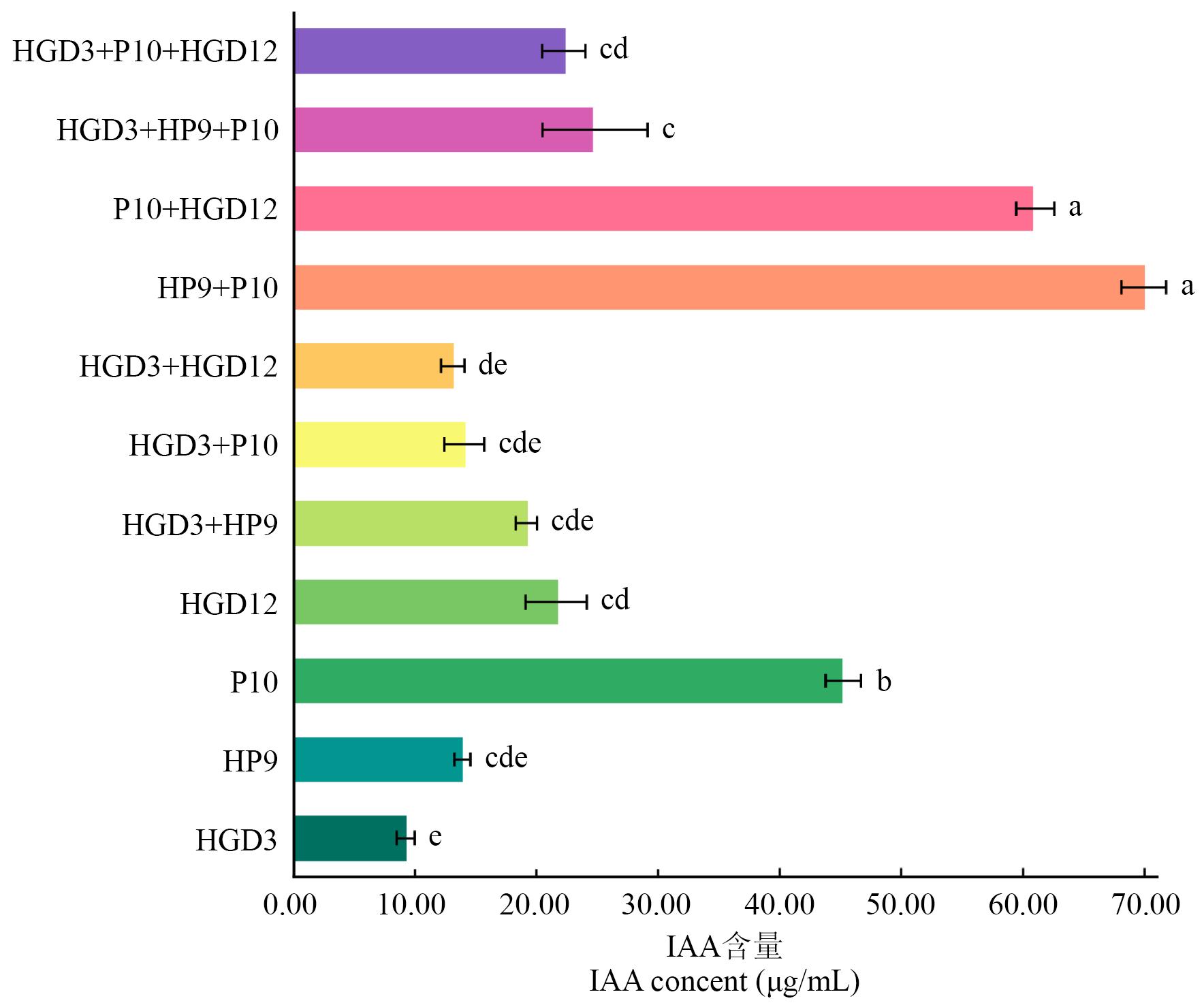
Fig. 1 IAA content in the co-fermented broth of different PGPR strainsLowercase letters indicate significant differences between treatment groups (P0.05)
指标 Index | 萌发率 Germination rate (%) | 发芽势 Germination force (%) | 发芽指数 Germination index (%) | 活力指数 Vitality index | 根长 Root length (mm) | 茎粗 Stem thick (mm) | 鲜重 Fresh weight (mg) | 子叶展开率 Leaf expansion rate (%) |
|---|---|---|---|---|---|---|---|---|
| CK | 78.89±4.78b | 27.78±4.81c | 56.74±3.11c | 104.89±10.35c | 13.53±0.25bc | 8.60±1.05c | 184.67±11.50b | 18.13±2.25b |
| HP9+P10 | 92.72±2.11a | 36.16±11.41b | 77.48±4.71a | 131.99±4.03ab | 12.70±2.19c | 9.30±0.98b | 170.67±9.02c | 19.82±0.77b |
| P10+HGD12 | 91.69±1.81a | 39.39±2.53a | 71.20±2.25b | 141.22±4.89a | 16.60±1.35a | 10.07±0.57a | 198.33±2.52a | 26.22±1.83a |
Table 1 Effects on the germination of pepper seed soaked with co-fermented brothof different PGPR strains
指标 Index | 萌发率 Germination rate (%) | 发芽势 Germination force (%) | 发芽指数 Germination index (%) | 活力指数 Vitality index | 根长 Root length (mm) | 茎粗 Stem thick (mm) | 鲜重 Fresh weight (mg) | 子叶展开率 Leaf expansion rate (%) |
|---|---|---|---|---|---|---|---|---|
| CK | 78.89±4.78b | 27.78±4.81c | 56.74±3.11c | 104.89±10.35c | 13.53±0.25bc | 8.60±1.05c | 184.67±11.50b | 18.13±2.25b |
| HP9+P10 | 92.72±2.11a | 36.16±11.41b | 77.48±4.71a | 131.99±4.03ab | 12.70±2.19c | 9.30±0.98b | 170.67±9.02c | 19.82±0.77b |
| P10+HGD12 | 91.69±1.81a | 39.39±2.53a | 71.20±2.25b | 141.22±4.89a | 16.60±1.35a | 10.07±0.57a | 198.33±2.52a | 26.22±1.83a |
指标 Index | 萌发率 Germination rate (%) | 成活率 Survival rate (%) | 叶片数 Leaf number | 叶面积 Leaf area (cm2) | 株高 Plant height (cm) | 茎粗 Stem diameter (cm) | 根长 Root length (cm) | 鲜重 Fresh weight (g) | 干重 Dry weight (g) | 壮苗指数 Strong seedling index | 叶绿素(SPAD值) Chlorophyll (SPAD) |
|---|---|---|---|---|---|---|---|---|---|---|---|
| CK | 65.28±4.81c | 62.50±8.33c | 4.50±0.55b | 6.89±1.92b | 3.42±0.80b | 1.33±0.17b | 10.13±1.18ab | 0.45±0.12b | 0.04±0.02b | 0.02±0.01b | 16.64±1.55c |
| HP9+P10 | 72.22±12.03b | 75.00±14.43b | 4.83±0.41b | 6.31±1.67b | 3.27±0.20b | 1.28±0.07b | 8.80±1.93c | 0.40±0.06b | 0.04±0.01b | 0.01±0.00b | 19.28±1.09b |
| P10+HGD12 | 93.06±4.81a | 83.33±4.17a | 7.33±0.52a | 16.99±2.90a | 6.55±0.49a | 2.20±0.13a | 11.10±2.55a | 1.37±0.11a | 0.15±0.02a | 0.05±0.01a | 32.51±1.25a |
Table 2 Effects of different bio-nursery substrates on pepper seedling in hole tray
指标 Index | 萌发率 Germination rate (%) | 成活率 Survival rate (%) | 叶片数 Leaf number | 叶面积 Leaf area (cm2) | 株高 Plant height (cm) | 茎粗 Stem diameter (cm) | 根长 Root length (cm) | 鲜重 Fresh weight (g) | 干重 Dry weight (g) | 壮苗指数 Strong seedling index | 叶绿素(SPAD值) Chlorophyll (SPAD) |
|---|---|---|---|---|---|---|---|---|---|---|---|
| CK | 65.28±4.81c | 62.50±8.33c | 4.50±0.55b | 6.89±1.92b | 3.42±0.80b | 1.33±0.17b | 10.13±1.18ab | 0.45±0.12b | 0.04±0.02b | 0.02±0.01b | 16.64±1.55c |
| HP9+P10 | 72.22±12.03b | 75.00±14.43b | 4.83±0.41b | 6.31±1.67b | 3.27±0.20b | 1.28±0.07b | 8.80±1.93c | 0.40±0.06b | 0.04±0.01b | 0.01±0.00b | 19.28±1.09b |
| P10+HGD12 | 93.06±4.81a | 83.33±4.17a | 7.33±0.52a | 16.99±2.90a | 6.55±0.49a | 2.20±0.13a | 11.10±2.55a | 1.37±0.11a | 0.15±0.02a | 0.05±0.01a | 32.51±1.25a |
不同处理 Different treatment | 添加比例 Addition ratio (%) | 株高 Plant height (cm) | 茎粗 Stem diameter (mm) | 鲜重 Plant weight (g) | 干重 Dry weight (g) | 叶片数 Leaf number | 叶面积 Leaf area (cm2) | 叶绿素SPADC hlorophyll (SPAD) |
|---|---|---|---|---|---|---|---|---|
| CK | 12.48±0.85fg | 2.49±0.12gh | 2.01±0.25ghi | 0.18±0.02h | 7.67±0.98fg | 23.48±3.59f | 31.12±1.33k | |
| LB | 5 | 12.44±1.30fg | 2.64±0.27defh | 2.25±0.13fg | 0.20±0.03gh | 7.75±1.22defg | 28.35±2.45de | 32.74±1.70j |
| 10 | 12.22±1.11fg | 2.35±0.19hi | 1.91±0.35ghij | 0.18±0.04h | 7.25±0.87gh | 22.54±3.17f | 33.19±1.71ij | |
| 15 | 12.36±0.65fg | 2.32±0.17i | 1.75±0.15ij | 0.17±0.03h | 6.88±0.60h | 22.07±2.88f | 34.99±2.20fgh | |
| 20 | 10.79±0.78h | 2.56±0.24g | 1.89±0.34hij | 0.16±0.03h | 7.71±0.84efg | 21.20±1.75f | 35.43±1.32defgh | |
| 25 | 8.22±1.42i | 2.34±0.15hi | 1.62±0.33j | 0.16±0.04h | 7.38±0.69gh | 21.95±3.94f | 34.49±2.03ghi | |
| P10 | 5 | 16.42±0.28b | 2.73±0.05cdef | 2.78±0.08cd | 0.26±0.01def | 8.58±0.34bcd | 28.88±0.68cde | 34.48±0.33ghi |
| 10 | 14.76±0.22de | 2.62±0.02efg | 2.60±0.07de | 0.25±0.01def | 8.42±0.19cdef | 33.35±1.06ab | 34.05±0.36hi | |
| 15 | 14.89±0.32de | 2.80±0.05bcd | 2.88±0.13cd | 0.29±0.01cde | 8.92±0.23abc | 33.26±1.16ab | 35.11±0.3efgh | |
| 20 | 14.88±0.71de | 2.85±0.08bc | 2.74±0.14cde | 0.30±0.02bcd | 8.58±0.26bcd | 35.48±1.59a | 35.74±0.32cdefg | |
| 25 | 14.56±0.32e | 2.60±0.04fg | 2.80±0.16cd | 0.27±0.02def | 8.50±0.26cde | 34.14±1.04ab | 35.86±0.36cdefg | |
| HGD12 | 5 | 14.68±0.47de | 2.77±0.06bcdef | 2.79±0.11cd | 0.27±0.01def | 8.92±0.23abc | 32.52±1.27abc | 34.58±0.26gh |
| 10 | 15.5±0.33bcde | 2.76±0.04bcdef | 2.95±0.15cd | 0.28±0.02def | 8.75±0.28abc | 32.33±1.43abcd | 36.89±0.73abc | |
| 15 | 15.23±0.38cde | 2.78±0.04bcde | 2.87±0.17cd | 0.26±0.01def | 8.25±0.25cdef | 31.76±1.21abcd | 35.89±0.62cdefg | |
| 20 | 13.21±0.30f | 2.77±0.06bcdef | 2.40±0.10ef | 0.24±0.01fg | 8.42±0.29cdef | 27.84±1.26e | 36.39±0.37cdef | |
| 25 | 11.75±0.36gh | 2.61±0.05efg | 2.17±0.09fgh | 0.24±0.01ef | 8.50±0.29cde | 27.40±0.88e | 36.48±0.37bcde | |
| P10+HGD12 | 5 | 17.88±2.35a | 3.02±0.20a | 3.11±0.62bc | 0.34±0.09ab | 9.50±1.24a | 32.08±6.49abcd | 36.55±1.20bcd |
| 10 | 17.79±1.46a | 3.03±0.28a | 3.52±0.38a | 0.36±0.04a | 9.46±0.66a | 35.32±4.27a | 36.35±1.53cdef | |
| 15 | 16.12±1.22bc | 3.05±0.21ab | 3.31±0.45ab | 0.35±0.04a | 9.38±0.51ab | 35.09±5.49a | 36.67±1.59bcd | |
| 20 | 15.78±1.10bcd | 2.88±0.16abc | 2.82±0.12cd | 0.32±0.07abc | 8.58±0.90bcd | 30.98±5.26bcde | 37.82±1.01ab | |
| 25 | 12.64±0.79fg | 2.81±0.13bcd | 2.65±0.39de | 0.27±0.04def | 8.75±0.75abc | 30.68±6.12bcde | 38.01±1.14a |
Table 3 Effects of different proportion of P10+HGD12 co-fermented broth on pepper seedling cultivation in hole tray
不同处理 Different treatment | 添加比例 Addition ratio (%) | 株高 Plant height (cm) | 茎粗 Stem diameter (mm) | 鲜重 Plant weight (g) | 干重 Dry weight (g) | 叶片数 Leaf number | 叶面积 Leaf area (cm2) | 叶绿素SPADC hlorophyll (SPAD) |
|---|---|---|---|---|---|---|---|---|
| CK | 12.48±0.85fg | 2.49±0.12gh | 2.01±0.25ghi | 0.18±0.02h | 7.67±0.98fg | 23.48±3.59f | 31.12±1.33k | |
| LB | 5 | 12.44±1.30fg | 2.64±0.27defh | 2.25±0.13fg | 0.20±0.03gh | 7.75±1.22defg | 28.35±2.45de | 32.74±1.70j |
| 10 | 12.22±1.11fg | 2.35±0.19hi | 1.91±0.35ghij | 0.18±0.04h | 7.25±0.87gh | 22.54±3.17f | 33.19±1.71ij | |
| 15 | 12.36±0.65fg | 2.32±0.17i | 1.75±0.15ij | 0.17±0.03h | 6.88±0.60h | 22.07±2.88f | 34.99±2.20fgh | |
| 20 | 10.79±0.78h | 2.56±0.24g | 1.89±0.34hij | 0.16±0.03h | 7.71±0.84efg | 21.20±1.75f | 35.43±1.32defgh | |
| 25 | 8.22±1.42i | 2.34±0.15hi | 1.62±0.33j | 0.16±0.04h | 7.38±0.69gh | 21.95±3.94f | 34.49±2.03ghi | |
| P10 | 5 | 16.42±0.28b | 2.73±0.05cdef | 2.78±0.08cd | 0.26±0.01def | 8.58±0.34bcd | 28.88±0.68cde | 34.48±0.33ghi |
| 10 | 14.76±0.22de | 2.62±0.02efg | 2.60±0.07de | 0.25±0.01def | 8.42±0.19cdef | 33.35±1.06ab | 34.05±0.36hi | |
| 15 | 14.89±0.32de | 2.80±0.05bcd | 2.88±0.13cd | 0.29±0.01cde | 8.92±0.23abc | 33.26±1.16ab | 35.11±0.3efgh | |
| 20 | 14.88±0.71de | 2.85±0.08bc | 2.74±0.14cde | 0.30±0.02bcd | 8.58±0.26bcd | 35.48±1.59a | 35.74±0.32cdefg | |
| 25 | 14.56±0.32e | 2.60±0.04fg | 2.80±0.16cd | 0.27±0.02def | 8.50±0.26cde | 34.14±1.04ab | 35.86±0.36cdefg | |
| HGD12 | 5 | 14.68±0.47de | 2.77±0.06bcdef | 2.79±0.11cd | 0.27±0.01def | 8.92±0.23abc | 32.52±1.27abc | 34.58±0.26gh |
| 10 | 15.5±0.33bcde | 2.76±0.04bcdef | 2.95±0.15cd | 0.28±0.02def | 8.75±0.28abc | 32.33±1.43abcd | 36.89±0.73abc | |
| 15 | 15.23±0.38cde | 2.78±0.04bcde | 2.87±0.17cd | 0.26±0.01def | 8.25±0.25cdef | 31.76±1.21abcd | 35.89±0.62cdefg | |
| 20 | 13.21±0.30f | 2.77±0.06bcdef | 2.40±0.10ef | 0.24±0.01fg | 8.42±0.29cdef | 27.84±1.26e | 36.39±0.37cdef | |
| 25 | 11.75±0.36gh | 2.61±0.05efg | 2.17±0.09fgh | 0.24±0.01ef | 8.50±0.29cde | 27.40±0.88e | 36.48±0.37bcde | |
| P10+HGD12 | 5 | 17.88±2.35a | 3.02±0.20a | 3.11±0.62bc | 0.34±0.09ab | 9.50±1.24a | 32.08±6.49abcd | 36.55±1.20bcd |
| 10 | 17.79±1.46a | 3.03±0.28a | 3.52±0.38a | 0.36±0.04a | 9.46±0.66a | 35.32±4.27a | 36.35±1.53cdef | |
| 15 | 16.12±1.22bc | 3.05±0.21ab | 3.31±0.45ab | 0.35±0.04a | 9.38±0.51ab | 35.09±5.49a | 36.67±1.59bcd | |
| 20 | 15.78±1.10bcd | 2.88±0.16abc | 2.82±0.12cd | 0.32±0.07abc | 8.58±0.90bcd | 30.98±5.26bcde | 37.82±1.01ab | |
| 25 | 12.64±0.79fg | 2.81±0.13bcd | 2.65±0.39de | 0.27±0.04def | 8.75±0.75abc | 30.68±6.12bcde | 38.01±1.14a |

Fig. 2 Growth of pepper seedlings on the bio-nursery substrate using hole trayA: Seedling growth on substrates with different concentration of co-fermented broth. B: Seedling on substrates treated with fermented broth from different strains at a 15% inoculation ratio. 5%, 10%, 15%, 20% and 25% refers to the treatment group with different concentrations of P10+HGD12. CK-H2O and CK-LB is the control with water and the control with 15% LB, respectively. P10+HGD12, P10 and HGD12 refers to the treatment group with 15% P10+HGD12 co-fermented broth, P10 broth and HGD12 broth, respectively
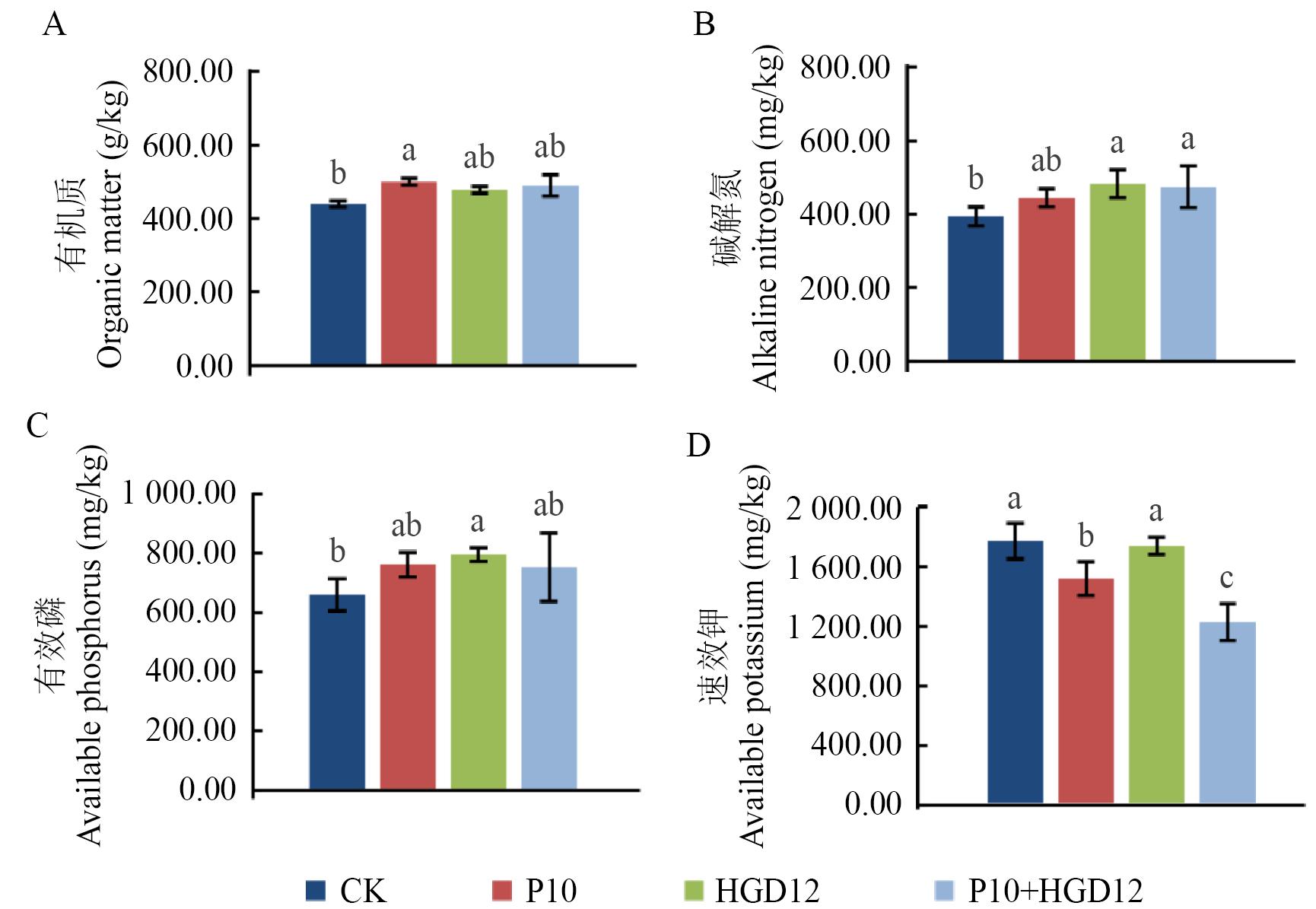
Fig. 3 Nutrient content of nursery substrate under different treatmentsP10, HGD12, and P10+HGD12 indicates the 15% proportion of fermented broth added to the nursery substrate, respectively; CK is the control with water. Lowercase letter indicates the significant differences of each index between these four treatments (P0.05), respectively
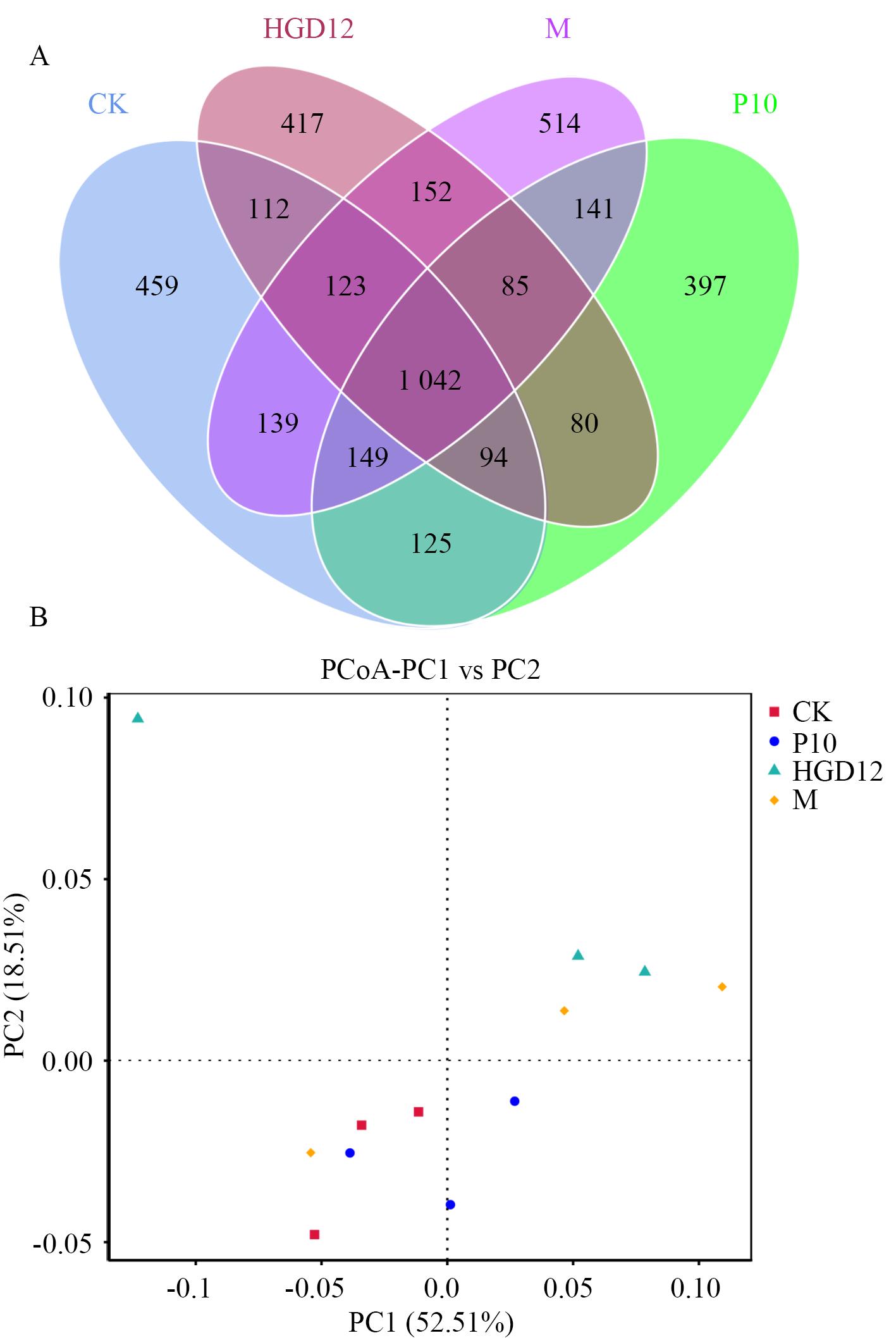
Fig. 4 Venn diagram (A) and PCoA analysis (B) of bacterial ASVs under different treatment substratesCK: Control. P10, HGD12 refers to the treatment of P10 and HGD12 strain, respectively. M: Treatment of P10+HGD12 co-fermented broth. The same below
| 多样性指数 Diversity index | Observed OTUs | Chao1 | Pielou | Shannon | Simpson | Coverage (%) |
|---|---|---|---|---|---|---|
| CK | 1 390.33±38.07a | 1 395.60±37.93a | 0.84±0.01a | 8.77±0.04a | 0.99±0.00a | 99.99 |
| P10 | 1 280.67±74.19bc | 1 283.94±75.44bc | 0.84±0.01a | 8.64±0.20a | 0.99±0.00a | 100.00 |
| HGD12 | 1 234.33±27.39c | 1 238.43±28.19c | 0.82±0.02a | 8.47±0.15a | 0.99±0.00a | 99.99 |
| P10+HGD12 | 1 377.00±37.40ab | 1 384.05±44.98ab | 0.83±0.01a | 8.63±0.17a | 0.99±0.00a | 99.99 |
Table 4 Alpha diversity index of bacterial community in the substrate of each treatment
| 多样性指数 Diversity index | Observed OTUs | Chao1 | Pielou | Shannon | Simpson | Coverage (%) |
|---|---|---|---|---|---|---|
| CK | 1 390.33±38.07a | 1 395.60±37.93a | 0.84±0.01a | 8.77±0.04a | 0.99±0.00a | 99.99 |
| P10 | 1 280.67±74.19bc | 1 283.94±75.44bc | 0.84±0.01a | 8.64±0.20a | 0.99±0.00a | 100.00 |
| HGD12 | 1 234.33±27.39c | 1 238.43±28.19c | 0.82±0.02a | 8.47±0.15a | 0.99±0.00a | 99.99 |
| P10+HGD12 | 1 377.00±37.40ab | 1 384.05±44.98ab | 0.83±0.01a | 8.63±0.17a | 0.99±0.00a | 99.99 |
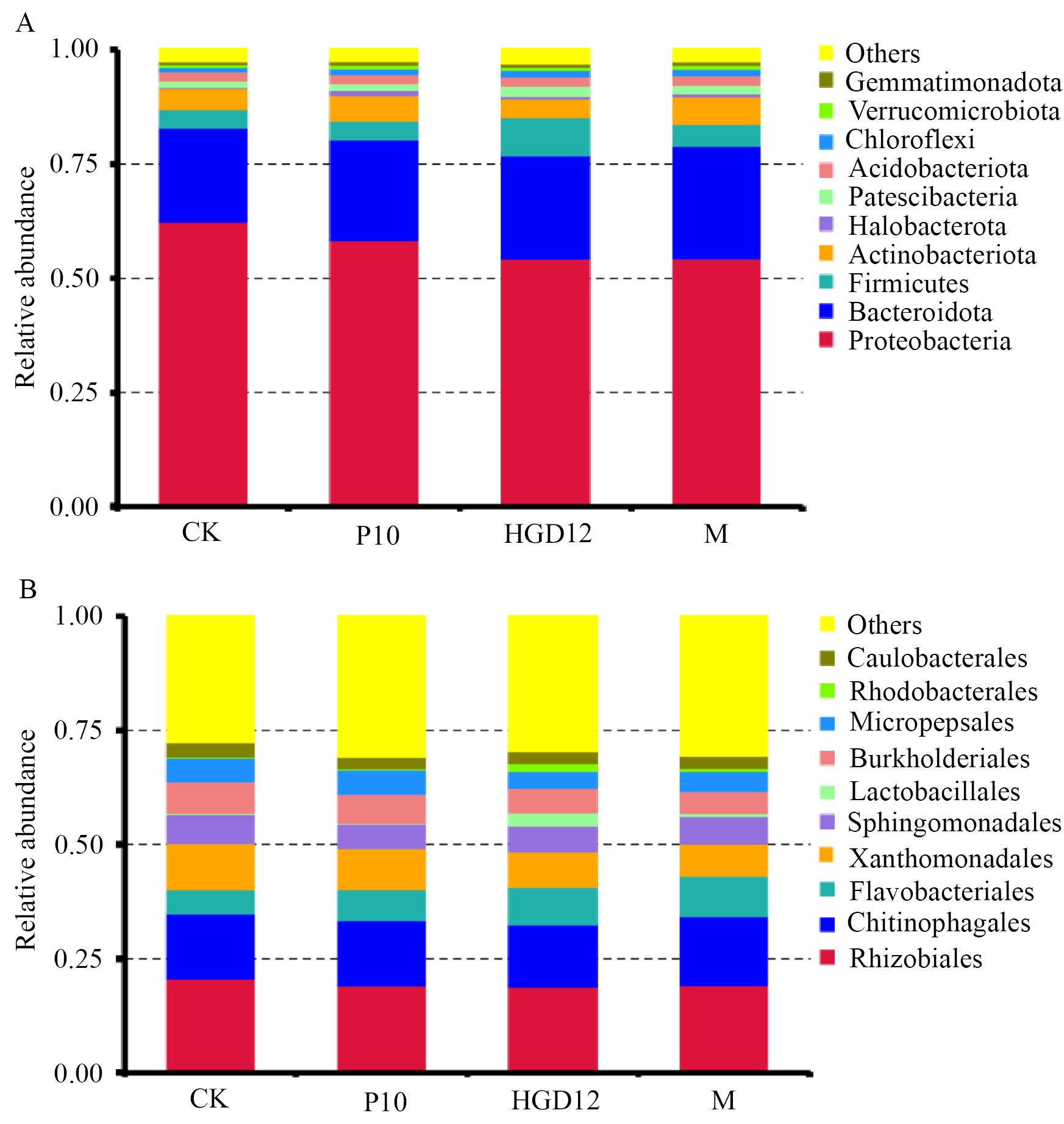
Fig. 5 The top 10 bacterial community in the abundance ranking of different treatmentsA: Phylum level. B: Order level
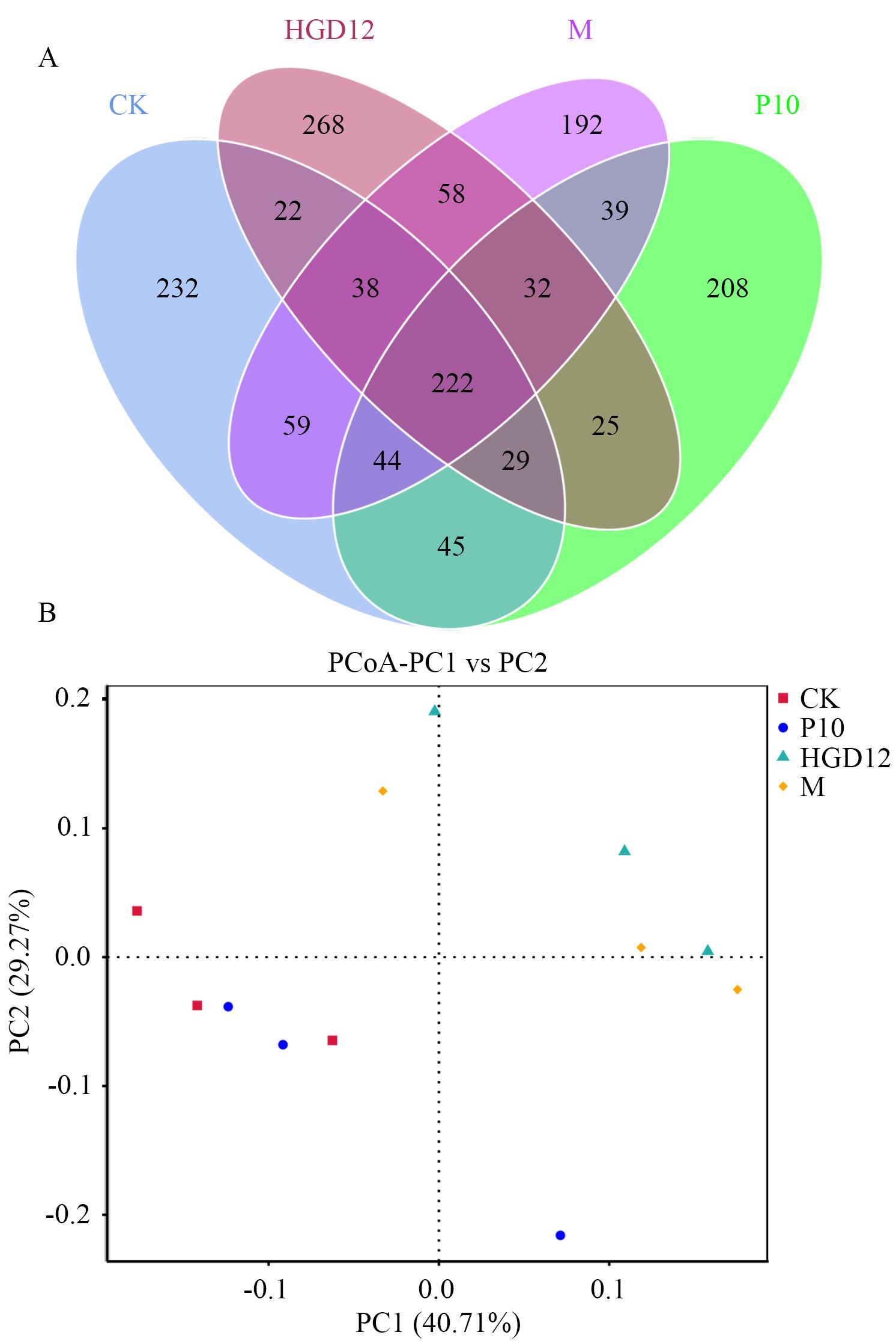
Fig. 6 Venn diagram (A) and PCoA analysis (B) of fungal ASVs under different treatment substrates
| 多样性指数 Diversity index | Observed OTUs | Chao1 | Pielou | Shannon | Simpson | Coverage (%) |
|---|---|---|---|---|---|---|
| CK | 385.33±23.46a | 387.64±22.99a | 0.63±0.01a | 5.41±0.15a | 0.94±0.01a | 100 |
| P10 | 355.33±70.15a | 355.84±70.82a | 0.59±0.03a | 5.03±0.25a | 0.92±0.01ab | 100 |
| HGD12 | 374.67±84.63a | 374.94±84.84a | 0.58±0.03a | 4.94±0.25a | 0.88±0.01b | 100 |
| P10+HGD12 | 373.67±22.81a | 373.90±22.68a | 0.59±0.04a | 5.03±0.18a | 0.9±0.01b | 100 |
Table 5 Alpha diversity index of fungal community in the substrate of each treatment
| 多样性指数 Diversity index | Observed OTUs | Chao1 | Pielou | Shannon | Simpson | Coverage (%) |
|---|---|---|---|---|---|---|
| CK | 385.33±23.46a | 387.64±22.99a | 0.63±0.01a | 5.41±0.15a | 0.94±0.01a | 100 |
| P10 | 355.33±70.15a | 355.84±70.82a | 0.59±0.03a | 5.03±0.25a | 0.92±0.01ab | 100 |
| HGD12 | 374.67±84.63a | 374.94±84.84a | 0.58±0.03a | 4.94±0.25a | 0.88±0.01b | 100 |
| P10+HGD12 | 373.67±22.81a | 373.90±22.68a | 0.59±0.04a | 5.03±0.18a | 0.9±0.01b | 100 |
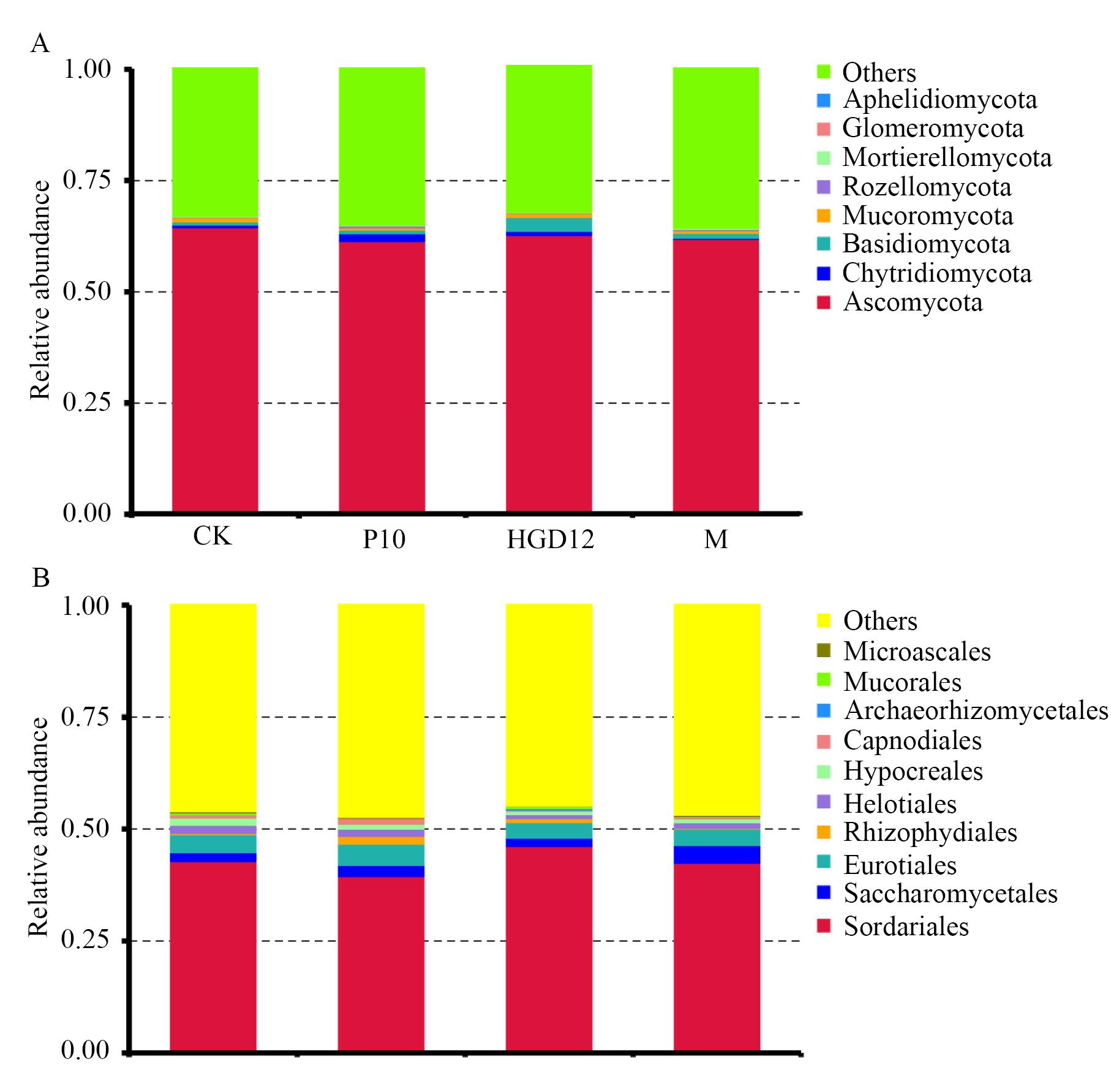
Fig. 7 Top 10 fungal community by abundance in substrate community under different treatments
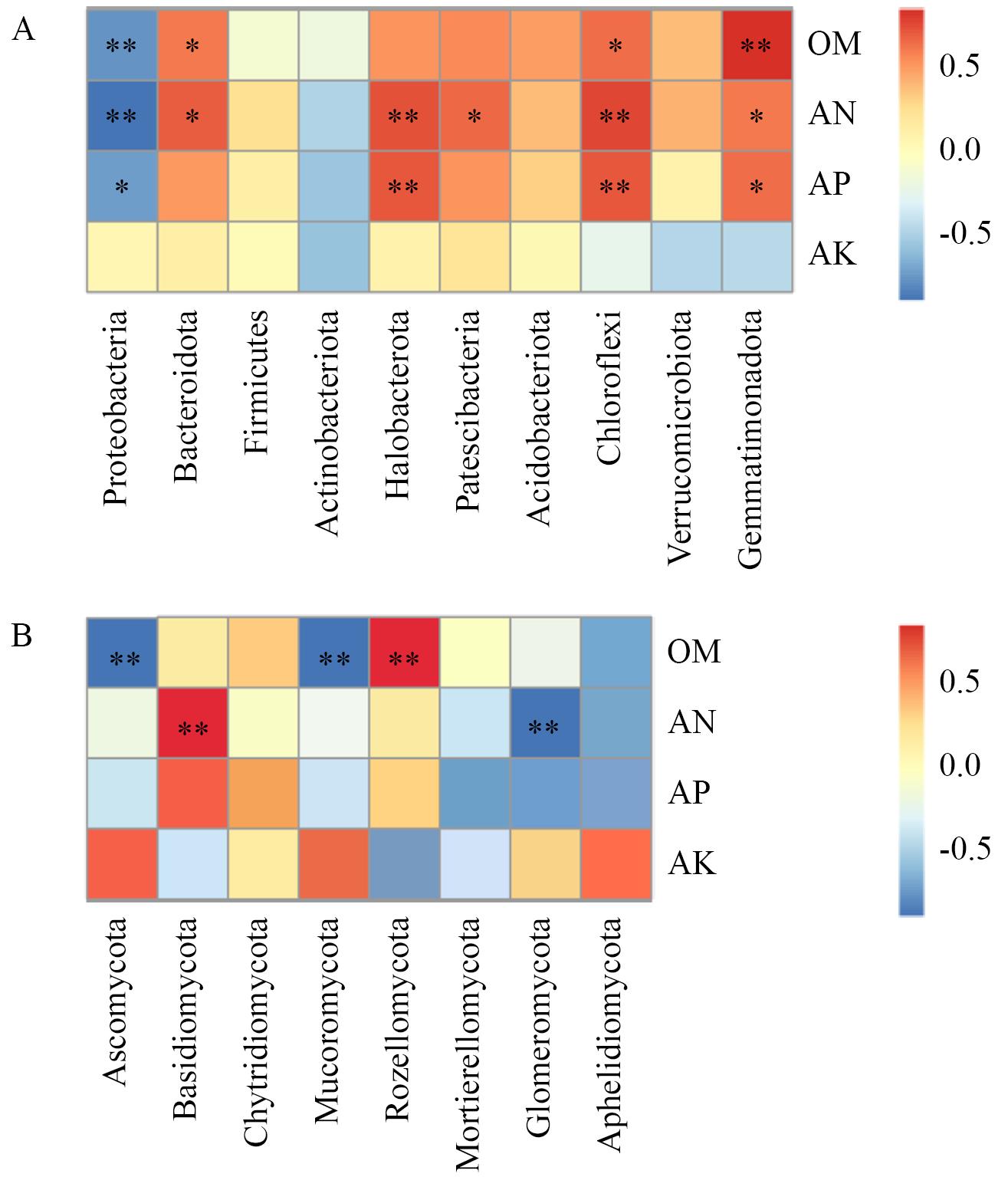
Fig. 8 Spearman analysis of environmental factors and microbial phylum at different treatmentsA: Bacterial. B: Fungal. OM, AN, AP and AK refers to organic matter, alkaline-hydrolyzed nitrogen, available phosphorus and available potassium, respectively. * P0.05, ** P0.01
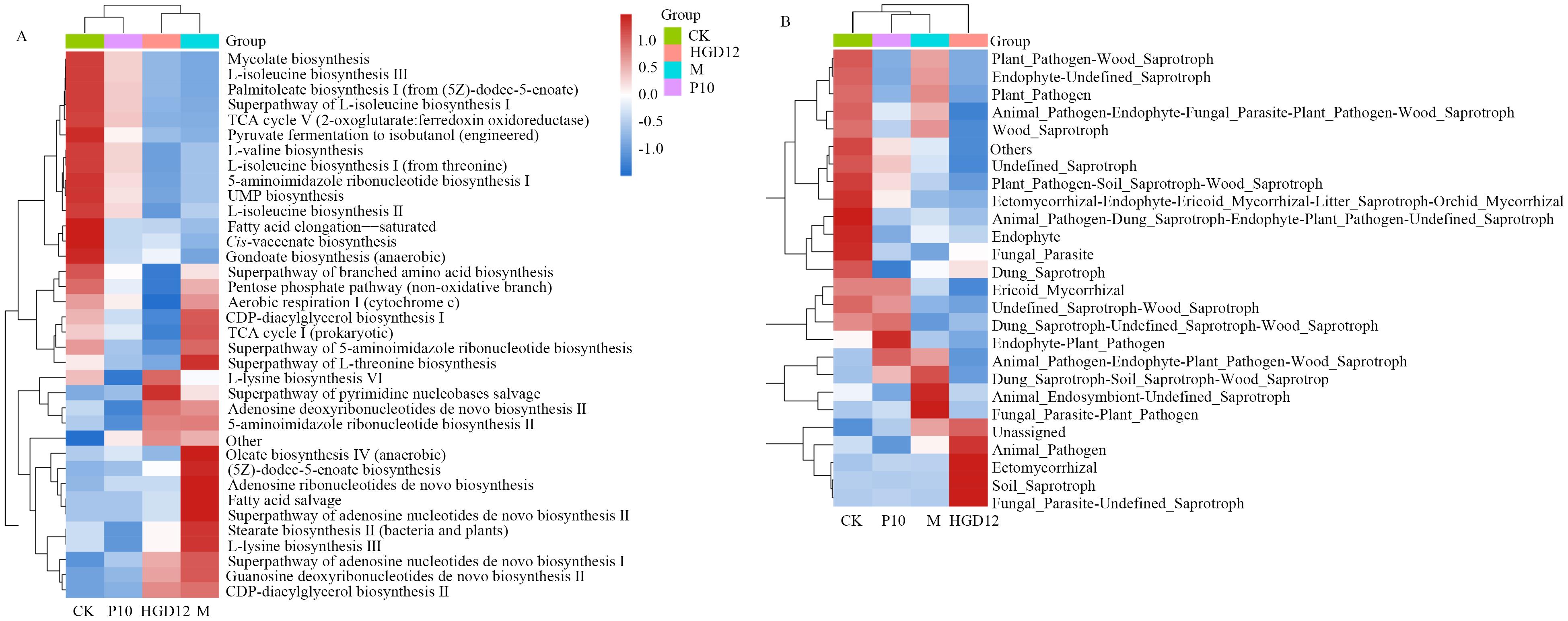
Fig. 9 Cluster heatmap of functional annotation of rhizosphere microbial communitiesA: Bacterial community. B: Fungal community. The corresponding values in the heatmap are the Z values obtained by standardizing the relative abundance of each row of functional information, with red indicating high abundance and blue indicating low abundance
| [1] | 邹学校, 胡博文, 熊程, 等. 中国辣椒育种60年回顾与展望 [J]. 园艺学报, 2022, 49(10): 2099-2118. |
| Zou XX, Hu BW, Xiong C, et al. Review and prospects of pepper breeding for the past 60 years in China [J]. Acta Hortic Sin, 2022, 49(10): 2099-2118. | |
| [2] | Folta KM. Breeding new varieties for controlled environments [J]. Plant Biol, 2019, 21(S1): 6-12. |
| [3] | Sarangi SK, Maji B, Singh S, et al. Improved nursery management further enhances the productivity of stress-tolerant rice varieties in coastal rainfed Lowlands [J]. Field Crops Res, 2015, 174: 61-70. |
| [4] | Zhang AA, Shang QM. Transcriptome analysis of early lateral root formation in tomato [J]. Plants, 2024, 13(12): 1620. |
| [5] | Liu Y, Ren XX, Jeong BR. Night temperature affects the growth, metabolism, and photosynthetic gene expression in Astragalus membranaceus and Codonopsis lanceolata plug seedlings [J]. Plants, 2019, 8(10): 407. |
| [6] | Park EW, Hwang JH, Hwang HS, et al. Effect of temperature and seedling cultivation period on the quality of plug seedlings of four medicinal plant [J]. Hortic Environ Biotechnol, 2025, 66(2): 319-330. |
| [7] | Epelbaum A, Pearce CM, Yuan S, et al. Effects of stocking density and substratum on the survival, growth, burrowing behaviour and shell morphology of juvenile basket cockle, Clinocardium nuttallii: implications for nursery seed production and field outplanting [J]. Aquac Res, 2011, 42(7): 975-986. |
| [8] | Wu YQ, Chen RZ, Wang FL, et al. Enhanced seedling growth effect of cocopeat by supplementation with earthworm manure as nutrient amendment [J]. Pol J Environ Stud, 2025, 34(4): 3853-3861. |
| [9] | Álvarez-Pérez JM, González-García S, Cobos R, et al. Use of endophytic and rhizosphere Actinobacteria from grapevine plants to reduce nursery fungal graft infections that lead to young grapevine decline [J]. Appl Environ Microbiol, 2017, 83(24): e01564-17. |
| [10] | Li XW, Xia HT, Wang JW, et al. Nutrient uptake and assimilation in fragrant rosewood (Dalbergia odorifera T.C. Chen) seedlings in growing media with un-composted spent mushroom residue [J]. PLoS One, 2021, 16(4): e0249534. |
| [11] | 李瑞敏, 商美妮, 李荣, 等. 木霉生物育苗基质中功能菌数量对辣椒促生效应的影响 [J]. 南京农业大学学报, 2021, 44(5): 869-875. |
| Li RM, Shang MN, Li R, et al. Effects of the amount of Trcichoderma in the bio-nursey substrates on the growth promotion of pepper [J]. J Nanjing Agric Univ, 2021, 44(5): 869-875. | |
| [12] | Prodhan MY, Rahman MB, Rahman A, et al. Characterization of growth-promoting activities of consortia of chlorpyrifos mineralizing endophytic bacteria naturally harboring in rice plants-a potential bio-stimulant to develop a safe and sustainable agriculture [J]. Microorganisms, 2023, 11(7): 1821. |
| [13] | Shahid MA, Balal RM, Khan N, et al. Selenium impedes cadmium and arsenic toxicity in potato by modulating carbohydrate and nitrogen metabolism [J]. Ecotoxicol Environ Saf, 2019, 180: 588-599. |
| [14] | 戚秀秀, 魏畅, 刘晓丹, 等. 根际促生菌应用于基质对水稻幼苗生长的影响 [J]. 土壤, 2020, 52(5): 1025-1032. |
| Qi XX, Wei C, Liu XD, et al. Effects of plant growth-promoting rhizobacteria added in seedling substrate on rice growth [J]. Soils, 2020, 52(5): 1025-1032. | |
| [15] | 牛文研, 李小杰, 宋守晔, 等. 两株根际促生细菌的筛选鉴定及其对烟草的促生作用 [J]. 中国烟草科学, 2024, 45(6): 46-54. |
| Niu WY, Li XJ, Song SY, et al. Screening and identification of two plant growth-promoting rhizobacteria and the effects of growth promoting on tobacco [J]. Chin Tob Sci, 2024, 45(6): 46-54. | |
| [16] | Zhang X, Peng JX, Hao XD, et al. Serratia marcescens LYGN1 reforms the rhizosphere microbial community and promotes cucumber and pepper growth in plug seedling cultivation [J]. Plants, 2024, 13(5): 592. |
| [17] | 张慧, 卢文才, 王冬, 等. 一株高产吲哚乙酸的Bacillus cereus YT2-1C的鉴定及促生作用 [J]. 生物技术通报, 2025, 41(5): 300-309. |
| Zhang H, Lu WC, Wang D, et al. Identification of Bacillus cereus YT2-1C with high indoleacetic acid yield and its growth-promoting effect [J]. Biotechnol Bull, 2025, 41(5): 300-309. | |
| [18] | 马连杰, 卢文才, 刘倩, 等. 四株高产吲哚乙酸菌株的筛选鉴定及促生应用研究 [J]. 中国土壤与肥料, 2025(5): 222-230. |
| Ma LJ, Lu WC, Liu Q, et al. Screening, identification and growth-promoting application research of four high IAA-producing strains [J]. Soil Fertil Sci China, 2025(5): 222-230. | |
| [19] | Nikolić I, Berić T, Dimkić I, et al. Biological control of Pseudomonas syringae pv. aptata on sugar beet with Bacillus pumilus SS-10.7 and Bacillus amyloliquefaciens (SS-12.6 and SS-38.4) strains [J]. J Appl Microbiol, 2019, 126(1): 165-176. |
| [20] | 李静, 操一凡, 丁佳兴, 等. 含复合菌群生物育苗基质的研制及其育苗效果 [J]. 南京农业大学学报, 2018, 41(4): 676-684. |
| Li J, Cao YF, Ding JX, et al. Development of bio-nursery substrates containing PGPR flora and evaluation of their seedlings growth promoting effect [J]. J Nanjing Agric Univ, 2018, 41(4): 676-684. | |
| [21] | Sibponkrung S, Kondo T, Tanaka K, et al. Co-inoculation of Bacillus velezensis strain S141 and Bradyrhizobium strains promotes nodule growth and nitrogen fixation [J]. Microorganisms, 2020, 8(5): 678. |
| [22] | Han YJ, Tian L, Luo Y, et al. Inoculation with PGPR co-fermented broths promotes growth, yields, and quality of pepper by increasing soil nutrients and changing soil bacterial community [J]. J Appl Microbiol, 2024, 135(11): lxae289. |
| [23] | 黄文茂, 易伦, 彭思云, 等. PGPR复合菌剂对辣椒生长及根际 土壤微生物结构的影响 [J]. 中国土壤与肥料, 2020(1): 195-201. |
| Huang WM, Yi L, Peng SY, et al. Effect of PGPR compound bacterial agents on growth of chilli and changes of soil microbial structure [J]. Soil Fertil Sci China, 2020(1): 195-201. | |
| [24] | 黄文茂, 詹永发, 王欢, 等. PGPR菌剂对辣椒的促生效应及根际土壤细菌的响应研究 [J]. 中国土壤与肥料, 2020(5): 152-160. |
| Huang WM, Zhan YF, Wang H, et al. Growth-promoting effects of PGPR microbial agent on chilli and response of rhizosphere soil bacteria [J]. Soil Fertil Sci China, 2020(5): 152-160. | |
| [25] | Han DD, Wang LY, Luo YP. Isolation, identification, and the growth promoting effects of two antagonistic actinomycete strains from the rhizosphere of Mikania micrantha Kunth [J]. Microbiol Res, 2018, 208: 1-11. |
| [26] | Wang AN, Zhang YF, Wang GL, et al. Soil physicochemical properties and microorganisms jointly regulate the variations of soil carbon and nitrogen cycles along vegetation restoration on the Loess Plateau, China [J]. Plant Soil, 2024, 494(1): 413-436. |
| [27] | 郭宇泽, 丁雪敏, 姚岚, 等. 马西利亚菌B260的分离鉴定及促进育苗的效果 [J]. 生物技术通报, 2019, 35(9): 144-149. |
| Guo YZ, Ding XM, Yao L, et al. Isolation and identification of Massilia sp. B260 and its effect on seedling raising [J]. Biotechnol Bull, 2019, 35(9): 144-149. | |
| [28] | Tang A, Haruna AO, Majid NMA, et al. Effects of selected functional bacteria on maize growth and nutrient use efficiency [J]. Microorganisms, 2020, 8(6): 854. |
| [29] | Karuppiah V, Sun JN, Li TT, et al. Co-cultivation of Trichoderma asperellum GDFS1009 and Bacillus amyloliquefaciens 1841 causes differential gene expression and improvement in the wheat growth and biocontrol activity [J]. Front Microbiol, 2019, 10: 1068. |
| [30] | 韩丽珍, 周静, 王欢. 两株对花生促生的芽孢杆菌的鉴定及溶磷特性研究 [J]. 基因组学与应用生物学, 2019, 38(9): 4066-4076. |
| Han LZ, Zhou J, Wang H. Identification and phosphorus-dissolving characteristics of two Bacillus strains promoted on peanut growth [J]. Genom Appl Biol, 2019, 38(9): 4066-4076. | |
| [31] | Han LZ, Zhang H, Xu Y, et al. Biological characteristics and salt-tolerant plant growth-promoting effects of an ACC deaminase-producing Burkholderia pyrrocinia strain isolated from the tea rhizosphere [J]. Arch Microbiol, 2021, 203(5): 2279-2290. |
| [32] | Bagheri N, Ahmadzadeh M, Mariotte P, et al. Behavior and interactions of the plant growth-promoting bacteria Azospirillum oryzae NBT506 and Bacillus velezensis UTB96 in a co-culture system [J]. World J Microbiol Biotechnol, 2022, 38(6): 101. |
| [33] | Qiu LP, Kong WB, Zhu HS, et al. Halophytes increase rhizosphere microbial diversity, network complexity and function in inland saline ecosystem [J]. Sci Total Environ, 2022, 831: 154944. |
| [34] | Guo P, Li C, Liu J, et al. Predation has a significant impact on the complexity and stability of microbial food webs in subalpine lakes [J]. Microbiol Spectr, 2023, 11(6): e0241123. |
| [35] | Kruczyńska A, Kuźniar A, Podlewski J, et al. Bacteroidota structure in the face of varying agricultural practices as an important indicator of soil quality-a culture independent approach [J]. Agric Ecosyst Environ, 2023, 342: 108252. |
| [36] | Carrión VJ, Perez-Jaramillo J, Cordovez V, et al. Pathogen-induced activation of disease-suppressive functions in the endophytic root microbiome [J]. Science, 2019, 366(6465): 606-612. |
| [37] | Mujakić I, Cabello-Yeves PJ, Villena-Alemany C, et al. Multi-environment ecogenomics analysis of the cosmopolitan Phylum Gemmatimonadota [J]. Microbiol Spectr, 2023, 11(5) |
| [38] | Venkatachalam S, Jabir T, Vipindas PV, et al. Ecological significance of Candidatus ARS69 and Gemmatimonadota in the Arctic glacier foreland ecosystems [J]. Appl Microbiol Biotechnol, 2024, 108(1): 128. |
| [39] | Daims H, Lücker S, Wagner M. A new perspective on microbes formerly known as nitrite-oxidizing bacteria [J]. Trends Microbiol, 2016, 24(9): 699-712. |
| [40] | Ju WL, Jin XL, Liu L, et al. Rhizobacteria inoculation benefits nutrient availability for phytostabilization in copper contaminated soil: Drivers from bacterial community structures in rhizosphere [J]. Appl Soil Ecol, 2020, 150: 103450. |
| [41] | 姚佳妮, 代金霞, 刘爽, 等. 基于宏转录组的宁夏荒漠灌丛根际土壤微生物群落组成和功能多样性 [J]. 草业科学, 2025, 42(6): 1331-1342. |
| Yao JN, Dai JX, Liu S, et al. Macrotranscriptome-based rhizosphere soil microbial community composition and functional diversity in the desert shrublands of Ningxia [J]. Pratacultural Sci, 2025, 42(6): 1331-1342. | |
| [42] | Zhang X, Song X, Wang TT, et al. The responses to long-term nitrogen addition of soil bacterial, fungal, and archaeal communities in a desert ecosystem [J]. Front Microbiol, 2022, 13: 1015588. |
| [43] | Goldenberg-Vilar A, Morán-Luis M, Vieites DR, et al. Biogeographical distribution of river microbial communities in Atlantic Catchments [J]. Environ Microbiol Rep, 2025, 17(1): e70065. |
| [44] | Zeilinger S, Gupta VK, Dahms TES, et al. Friends or foes emerging insights from fungal interactions with plants [J]. FEMS Microbiol Rev, 2016, 40(2): 182-207. |
| [45] | Peterson D, Li T, Calvo AM, et al. Categorization of orthologous gene clusters in 92 ascomycota genomes reveals functions important for phytopathogenicity [J]. J Fungi, 2021, 7(5): 337. |
| [46] | Wang QF, Zhou DP, Chu CB, et al. Responses of arbuscular mycorrhizal fungi to rice-upland crop rotations in an 8-year paddy ecosystem [J]. Soil Sci Soc Am J, 2023, 87(3): 516-527. |
| [47] | 项小燕, 阮思睿, 张颖, 等. 大别山五针松根际微生物和内生菌群落特征及功能多样性 [J]. 广西植物, 2025, 45(1): 31-43. |
| Xiang XY, Ruan SR, Zhang Y, et al. Community characteristics and functional diversity of the rhizosphere microorganism and endophyte from Pinus dabeshanensis [J]. Guihaia, 2025, 45(1): 31-43. | |
| [48] | Fang K, Xu GC, Chen X, et al. Distribution pattern and assembly process of fungal communities along altitude gradient in sediments of the Yellow River Basin [J]. J Fungi, 2025, 11(3): 214. |
| [49] | Li MY, Wang JL, Yao T, et al. Bacterial diversity and community structure in the rhizosphere of four halophytes [J]. Curr Microbiol, 2021, 78(7): 2720-2732. |
| [50] | Nakei MD, Venkataramana PB, Ndakidemi PA. Evaluating Rhizobium and Bradyrhizobium species as potential biocontrol agents for root rot fungi in soybean seedlings [J]. Technol Agron, 2024, 4(1) : e010. |
| [51] | 韩配配, 秦璐, 李银水, 等. 不同营养元素缺乏对甘蓝型油菜苗期生长和根系形态的影响 [J]. 中国油料作物学报, 2016, 38(1): 88-97. |
| Han PP, Qin L, Li YS, et al. Effects of different nutrient deficiencies on growth and root morphological changes of rapeseed seedlings (Brassica napus L.) [J]. Chin J Oil Crop Sci, 2016, 38(1): 88-97. |
| [1] | LI Qiong-yao, BAO Rui, LEI Hai-tao, YANG Yuan-xu, HAN Li-zhen. The Effect of Stress-resistant and Growth-promoting Bacteria Pseudomonas putida on Pepper Seed Germination and Seedling Growth [J]. Biotechnology Bulletin, 2026, 42(5): 257-271. |
| [2] | PEI Hong-xia, WANG Lu-yao, LI Sheng-mei, GAO Jing-xia. Genetic Diversity of 220 Pepper Germplasm Resources Using SCoT, SRAP, and SSR Molecular Markers [J]. Biotechnology Bulletin, 2025, 41(8): 165-174. |
| [3] | DUAN Min-jie, LI Yi-fei, WANG Chun-ping, HUANG Ren-zhong, HUANG Qi-zhong, ZHANG Shi-cai. Association Analysis and Fingerprint Map Construction of Fruit Color Traits in Pepper via SSR Markers [J]. Biotechnology Bulletin, 2025, 41(7): 81-94. |
| [4] | PENG Shao-zhi, WANG Deng-ke, ZHANG Xiang, DAI Xiong-ze, XU Hao, ZOU Xue-xiao. Cloning, Expression Characteristics and Functional Verification of the Pepper CaFD1 Gene [J]. Biotechnology Bulletin, 2025, 41(5): 153-164. |
| [5] | WANG Tian-tian, CHANG Xue-rui, HUANG Wan-yang, HUANG Jia-xin, MIAO Ru-yi, LIANG Yan-ping, WANG Jing. Identification and Analysis of GASA Gene Family in Pepper (Capsicum annuum L.) [J]. Biotechnology Bulletin, 2025, 41(4): 166-175. |
| [6] | MA Yao-wu, ZHANG Qi-yu, YANG Miao, JIANG Cheng, ZHANG Zhen-yu, ZHANG Yi-lin, LI Meng-sha, XU Jia-yang, ZHANG Bin, CUI Guang-zhou, JIANG Ying. Screening, Indentification and Promotion Performance Investigation of Tobacco Growth-promoting Rhizobacteria [J]. Biotechnology Bulletin, 2025, 41(3): 271-281. |
| [7] | LIU Qian, MA Lian-jie, ZHANG Hui, WANG Dong, FAN Mao, LIAO Dun-xiu, ZHAO Zheng-wu, LU Wen-cai. Screening, Identification and Control Effects of Biocontrol Strain TN2 against Pepper Anthracnose [J]. Biotechnology Bulletin, 2025, 41(1): 287-297. |
| [8] | WU Hui-qin, WANG Yan-hong, LIU Han, SI Zheng, LIU Xue-qing, WANG Jing, YANG Yi, CHENG Yan. Identification and Expression Analysis of UGT Gene Family in Pepper [J]. Biotechnology Bulletin, 2024, 40(9): 198-211. |
| [9] | SUN Ya-nan, WANG Chun-xue, WANG Xin, DU Bing-hai, LIU Kai, WANG Cheng-qiang. Biocontrol Characteristics of Bacillus atrophaeus CNY01 and Its Salt-resistant and Growth-promoting Effect on Maize Seedling [J]. Biotechnology Bulletin, 2024, 40(5): 248-260. |
| [10] | MAO Li-jie, LIANG Xiao, LIU Ying, WU Chun-ling, HAN Xiao-yan, CHEN Qing. Mechanism of CMV Intervention in Peach Aphid Population Growth by Influencing the Expression of Effector MpC002 [J]. Biotechnology Bulletin, 2024, 40(4): 271-277. |
| [11] | LI Bai-xue, LI Jin-ling, CHEN Chun-lin, DU Qing-jie, LI Meng, WANG Ji-qing, MA Yong-bin, XIAO Huai-juan. Cloning and Expression Analysis of CabZIP42 Gene in Pepper [J]. Biotechnology Bulletin, 2024, 40(12): 93-101. |
| [12] | LI Xi, BIAN Zi-jun, NING Zhou-shen, LIU Hong-yu, ZENG Bing, DONG Wei. Studies on the Growth-promoting Effect of Bacillus Strain from Rhizosphere in Ionic Rare Earth Ores [J]. Biotechnology Bulletin, 2024, 40(11): 259-268. |
| [13] | CHANG Lu-yin, WANG Zhong-hua, LI Feng-min, GAO Zi-yuan, ZHANG Hui-hong, WANG Yi, LI Fang, HAN Yan-lai, JIANG Ying. Screening Multi-functional Rhizobacteria from Maize Rhizosphere and Their Ehancing Effects on Winter Wheat-Summer Maize Rotation System [J]. Biotechnology Bulletin, 2024, 40(1): 231-242. |
| [14] | WANG Bin, YUAN Xiao, JIANG Yuan-yuan, WANG Yu-kun, XIAO Yan-hui, HE Jin-ming. Cloning of bHLH96 Gene and Its Roles in Regulating the Biosynthesis of Peppermint Terpenes [J]. Biotechnology Bulletin, 2024, 40(1): 281-293. |
| [15] | ZHAO Zhi-xiang, WANG Dian-dong, ZHOU Ya-lin, WANG Pei, YAN Wan-rong, YAN Bei, LUO Lu-yun, ZHANG Zhuo. Control of Pepper Fusarium Wilt by Bacillus subtilis Ya-1 and Its Effect on Rhizosphere Fungal Microbial Community [J]. Biotechnology Bulletin, 2023, 39(9): 213-224. |
| Viewed | ||||||
|
Full text |
|
|||||
|
Abstract |
|
|||||
