







Biotechnology Bulletin ›› 2025, Vol. 41 ›› Issue (5): 208-217.doi: 10.13560/j.cnki.biotech.bull.1985.2024-1127
ZAN Shu-wen( ), XIE Huan-huan, ZHANG Yu-qin, WANG Wen-Juan, ZHANG Peng-fei, LIANG Jin-jun(), WEN Peng-fei()
Received:2024-11-21
Online:2025-05-26
Published:2025-06-05
Contact:
LIANG Jin-jun, WEN Peng-fei
E-mail:zsw15534249628@163.com;liangjinjun1989@163.com;wenpengfei@126.com
ZAN Shu-wen, XIE Huan-huan, ZHANG Yu-qin, WANG Wen-Juan, ZHANG Peng-fei, LIANG Jin-jun, WEN Peng-fei. VvAGAMOUS Regulates Carpel Development through VvCRABS CLAW in Grape[J]. Biotechnology Bulletin, 2025, 41(5): 208-217.

Fig. 1 Anatomical structure of grape ‘Musct Hambourg’ at different developmental stagesA: 0‒1 cm; B: 1-2 cm; C: 2-3 cm; D: 3-4 cm; E: 4‒5 cm. s: Sepals; f: flower caps; st: stamens; c: carpels; o: ovules. Scale bar=100 μm

Fig. 2 Expressions of VvAG and VvCRC in different inflorescence development stagesDifferent lowercase letters indicate significant differences of each gene at the 0.05 level during the five periods of inflorescence development

Fig. 3 Amplified results of VvAG (A)and VvCRC (B)A: 1-2: PCR amplification bands of VvAG gene; B: 1-2: PCR amplification bands of VvCRC gene. M: DL2000 marker

Fig. 4 A Multiple alignment of homologous amino acid sequences of VvAG and VvCRCA: Multiple alignment of homologous amino acid sequences of VvAG.B: Multiple alignment of homologous amino acid sequences of VvCRC. Black: 100% homology. Purple: Homology≥75%. Blue: Homology≥50%

Fig. 5 Phylogenetic tree of VvAG (A) and VvCRC (B) homologous proteins from different specie

Fig. 6 Subcellular localization results of VvAG and VvCRC
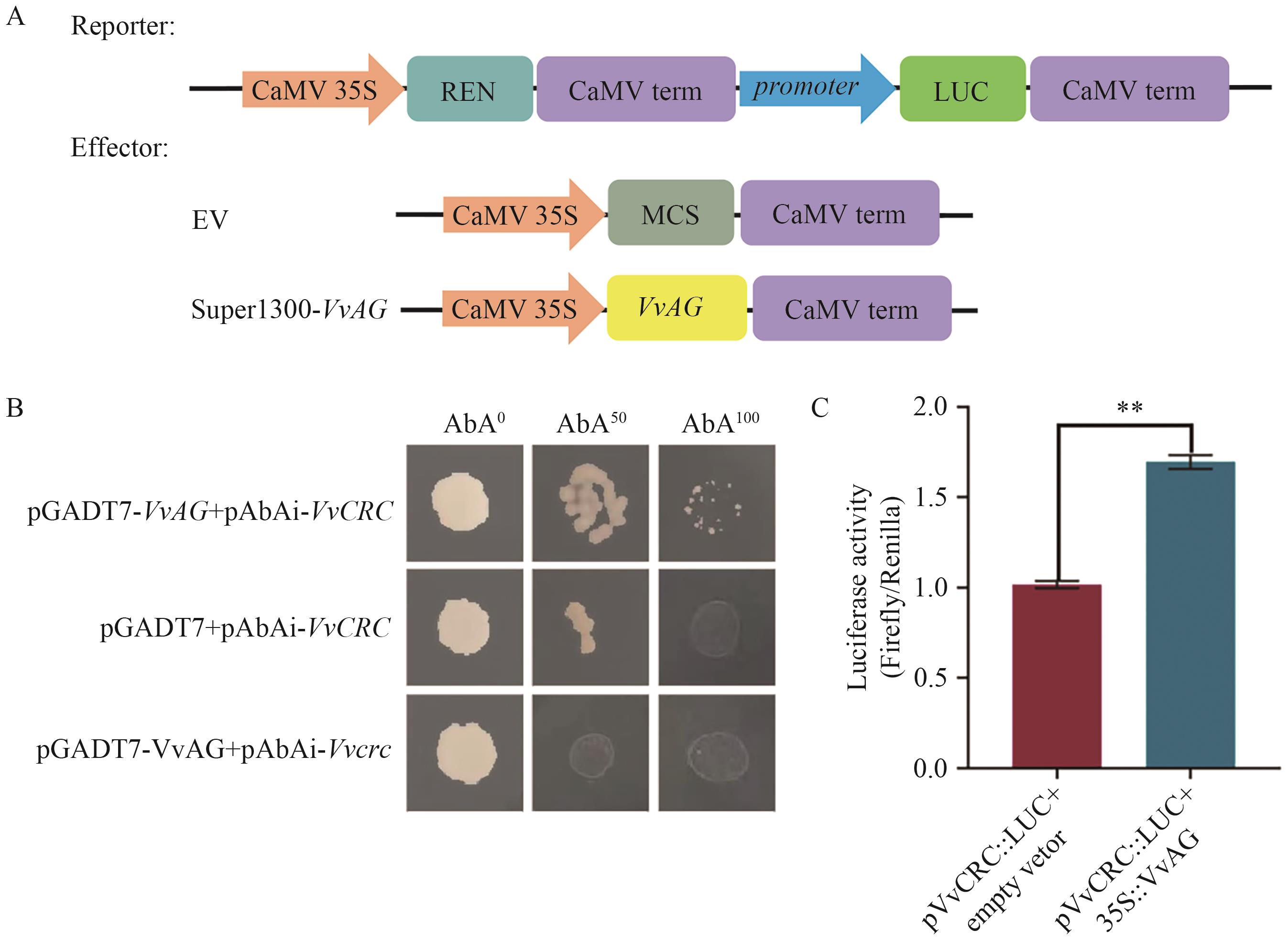
Fig. 7 Analysis of the regulatory role of VvAG on the VvCRC promoterA: Schematic diagram of the vector for the dual luciferase assay. B: Y1H validation of the interaction between VvAG and the VvCRC promoter. C: LUC assay to validate the effect of VvAG on VvCRC promoter activity. Asterisks indicate significant differences (* P<0.05, ** P<0.01, t-test used)

Fig. 8 Model diagram of VvAG regulation of grape carpel development through VvCRC
| 1 | 任晓琴, 文昊, 薛晓琦, 等. 基于主成分分析的10个葡萄品种果实营养元素比较 [J]. 天津农学院学报, 2022, 29(4): 13-16. |
| Ren XQ, Wen H, Xue XQ, et al. Comparison of nutrient elements in 10 different varieties of grape fruits based on principal component analysis [J]. J Tianjin Agric Univ, 2022, 29(4): 13-16. | |
| 2 | Wang L, Sun XL, Weiszmann J, et al. System-level and granger network analysis of integrated proteomic and metabolomic dynamics identifies key points of grape berry development at the interface of primary and secondary metabolism [J]. Front Plant Sci, 2017, 8: 1066. |
| 3 | Dilcher D. Toward a new synthesis: major evolutionary trends in the angiosperm fossil record [J]. Proc Natl Acad Sci U S A, 2000, 97(13): 7030-7036. |
| 4 | Pfannebecker KC, Lange M, Rupp O, et al. An evolutionary framework for carpel developmental control genes [J]. Mol Biol Evol, 2017, 34(2): 330-348. |
| 5 | 王慧玲, 闫爱玲, 王晓玥, 等. 葡萄果粒质量相关性状全基因组关联分析 [J]. 中国农业科学, 2023, 56(8): 1561-1573. |
| Wang HL, Yan AL, Wang XY, et al. Genome-wide association studies for grape berry weight related traits [J]. Sci Agric Sin, 2023, 56(8): 1561-1573. | |
| 6 | 邢佳毅. '香妃'葡萄2心皮和3心皮子房发育过程中VvYABBY5基因表达的研究 [D]. 北京: 中国农业大学, 2016. |
| Xing JY. Study on the expression of VvYABBY5 gene during the development of 2-carpel and 3-carpel ovaries of 'Xiangfei' grape [D]. Beijing: China Agricultural University, 2016. | |
| 7 | Ferrándiz C, Fourquin C, Prunet N, et al. Carpel development [M]//Advances in Botanical Research. Amsterdam: Elsevier, 2010: 1-73. |
| 8 | Coen ES, Meyerowitz EM. The war of the whorls: genetic interactions controlling flower development [J]. Nature, 1991, 353(6339): 31-37. |
| 9 | Pelaz S, Ditta GS, Baumann E, et al. B and C floral organ identity functions require SEPALLATA MADS-box genes [J]. Nature, 2000, 405(6783): 200-203. |
| 10 | Yanofsky MF, Ma H, Bowman JL, et al. The protein encoded by the Arabidopsis homeotic gene agamous resembles transcription factors [J]. Nature, 1990, 346(6279): 35-39. |
| 11 | Wang HH, Lu YN, Zhang TX, et al. The double flower variant of yellowhorn is due to a LINE1 transposon-mediated insertion [J]. Plant Physiol, 2023, 191(2): 1122-1137. |
| 12 | Lan JQ, Wang N, Wang YT, et al. Arabidopsis TCP4 transcription factor inhibits high temperature-induced homeotic conversion of ovules [J]. Nat Commun, 2023, 14(1): 5673. |
| 13 | Yao JL, Kang CY, Gu C, et al. The roles of floral organ genes in regulating Rosaceae fruit development [J]. Front Plant Sci, 2022, 12: 644424. |
| 14 | Pelayo MA, Morishita F, Sawada H, et al. AGAMOUS regulates various target genes via cell cycle-coupled H3K27me3 dilution in floral meristems and stamens [J]. Plant Cell, 2023, 35(8): 2821-2847. |
| 15 | Pnueli L, Hareven D, Rounsley SD, et al. Isolation of the tomato AGAMOUS gene TAG1 and analysis of its homeotic role in transgenic plants [J]. Plant Cell, 1994, 6(2): 163-173. |
| 16 | Liang JJ, Guan PY, Liu ZH, et al. The VvSUPERMAN-like gene is differentially expressed between bicarpellate and tricarpellate florets of Vitis vinifera L. cv. 'Xiangfei' and its heterologous expression reduces carpel number in tomato [J]. Plant Cell Physiol, 2020, 61(10): 1760-1774. |
| 17 | Wang Y, Liu ZH, Wu J, et al. MADS-Box protein complex VvAG2, VvSEP3 and VvAGL11 regulates the formation of ovules in Vitis vinifera L. cv. 'Xiangfei' [J]. Genes, 2021, 12(5): 647. |
| 18 | Gross T, Broholm S, Becker A. CRABS CLAW acts as a bifunctional transcription factor in flower development [J]. Front Plant Sci, 2018, 9: 835. |
| 19 | Gómez-Mena C, de Folter S, Costa MMR, et al. Transcriptional program controlled by the floral homeotic gene AGAMOUS during early organogenesis [J]. Development, 2005, 132(3): 429-438. |
| 20 | Ng KH, Yu H, Ito T. AGAMOUS controls GIANT KILLER, a multifunctional chromatin modifier in reproductive organ patterning and differentiation [J]. PLoS Biol, 2009, 7(11): e1000251. |
| 21 | Alvarez J, Smyth DR. CRABS CLAW and SPATULA two Arabidopsis genes that control carpel development in parallel with AGAMOUS [J]. Development, 1999, 126(11): 2377-2386. |
| 22 | Breuil-Broyer S, Trehin C, Morel P, et al. Analysis of the Arabidopsis superman allelic series and the interactions with other genes demonstrate developmental robustness and joint specification of male-female boundary, flower meristem termination and carpel compartmentalization [J]. Ann Bot, 2016, 117(5): 905-923. |
| 23 | Wang YT, Wang N, Lan JQ, et al. Arabidopsis transcription factor TCP4 controls the identity of the apical gynoecium [J]. Plant Cell, 2024, 36(7): 2668-2688. |
| 24 | Castañeda L, Giménez E, Pineda B, et al. Tomato CRABS CLAW paralogues interact with chromatin remodelling factors to mediate carpel development and floral determinacy [J]. New Phytol, 2022, 234(3): 1059-1074. |
| 25 | Yamaguchi T, Nagasawa N, Kawasaki S, et al. The YABBY gene DROOPING LEAF regulates carpel specification and midrib development in Oryza sativa [J]. Plant Cell, 2004, 16(2): 500-509. |
| 26 | Ohmori Y, Toriba T, Nakamura H, et al. Temporal and spatial regulation of DROOPING LEAF gene expression that promotes midrib formation in rice [J]. Plant J, 2011, 65(1): 77-86. |
| 27 | Strable J, Vollbrecht E. Maize YABBY genes drooping leaf1 and drooping leaf2 regulate floret development and floral meristem determinacy [J]. Development, 2019, 146(6): dev171181. |
| 28 | Che G, Pan YP, Liu XF, et al. Natural variation in CRABS CLAW contributes to fruit length divergence in cucumber [J]. Plant Cell, 2023, 35(2): 738-755. |
| 29 | Che G, Song WY, Zhang XL. Gene network associates with CsCRC regulating fruit elongation in cucumber [J]. Veg Res, 2023, 3(1): 1-4. |
| 30 | 卢龙. 赤霉素诱导葡萄单性结实与促进坐果分子机制的研究 [D]. 北京: 中国农业大学, 2016. |
| Lu L. Study on molecular mechanism of gibberellin inducing parthenocarpy and promoting fruit setting of grape [D]. Beijing: China Agricultural University, 2016. | |
| 31 | 牛铁泉, 董燕梅, 刘海霞, 等. 葡萄果实MYBA1与UFGT、DFR的作用机制 [J]. 中国农业科学, 2018, 51(12): 2368-2377. |
| Niu TQ, Dong YM, Liu HX, et al. The regulations of the MYBA1 in UFGT and DFR from the grape berries [J]. Sci Agric Sin, 2018, 51(12): 2368-2377. | |
| 32 | 高志红, 张玉明, 王珊, 等. 植物花发育调控基因AGAMOUS的研究进展 [J]. 西北植物学报, 2008, 28(3): 638-644. |
| Gao ZH, Zhang YM, Wang S, et al. Research progress in floral organ identity gene AGAMOUS [J]. Acta Bot Boreali Occidentalia Sin, 2008, 28(3): 638-644. | |
| 33 | Mouradov A, Glassick TV, Hamdorf BA, et al. Family of MADS-box genes expressed early in male and female reproductive structures of Monterey pine [J]. Plant Physiol, 1998, 117(1): 55-62. |
| 34 | Lee JY, Baum SF, Oh SH, et al. Recruitment of CRABS CLAW to promote nectary development within the eudicot clade [J]. Development, 2005, 132(22): 5021-5032. |
| 35 | 夏胜应. 春兰AGAMOUS同源基因的克隆及表达分析 [J]. 分子植物育种, 2020, 18(7): 2146-2151. |
| Xia SY. Cloning and expression analysis of AGAMOUS homologous genes from Cymbidium goeringii [J]. Mol Plant Breed, 2020, 18(7): 2146-2151. | |
| 36 | 张志国, 丁寒雪, 蒋成娣, 等. 重瓣萱草AGAMOUS基因的克隆与表达分析 [J]. 江苏农业科学, 2022, 50(23): 40-48. |
| Zhang ZG, Ding HX, Jiang CD, et al. Cloning and expression analysis of AGAMOUS homologous genes from double-flower daylily [J]. Jiangsu Agric Sci, 2022, 50(23): 40-48. | |
| 37 | 周晓婴, 付三雄, 陈松, 等. 甘蓝型油菜 CRABS CLAW 基因克隆及其 RNA 干扰载体的构建 [J]. 江苏农业学报, 2015, 31(4): 737-742. |
| Zhou XY, Fu SX, Chen S, et al. Cloning of CRABS CLAW gene from Brassica napus and construction of its RNA interference vector [J]. Jiangsu J Agric Sci, 2015, 31(4): 737-742. | |
| 38 | Gong PC, Song CJ, Liu HY, et al. Physalis floridana CRABS CLAW mediates neofunctionalization of GLOBOSA genes in carpel development [J]. J Exp Bot, 2021, 72(20): 6882-6903. |
| 39 | Gross T, Becker A. Transcription factor action orchestrates the complex expression pattern of CRABS CLAW in Arabidopsis [J]. Genes, 2021, 12(11): 1663. |
| [1] | LIU Tong-tong, LI Xiao-hui, YANG Jun-long, CHEN Wang, YU Meng, WANG Chao-fan, WANG Feng-ru, KE Shao-ying. Functional Study on ZmSTART1 Regulation of Maize Vascular Bundle Formation [J]. Biotechnology Bulletin, 2025, 41(4): 115-122. |
| [2] | LIU Li, WANG Hui, GUAN Tian-shu, LI Bai-hong, YU Shu-yi. Screening the Interacting Protein of Abscisic Acid Receptor VvPYL4 and the Gene Expression of the Interacting Protein in Grape [J]. Biotechnology Bulletin, 2025, 41(4): 188-197. |
| [3] | YU Ting, HUANG Dan-dan, ZHU Yan-hui, YANG Mei-hong, AI Ju, GAO Dong-li. Screening and Interaction Verification of Transcription Factors Stpatatin 05 Gene in Potato [J]. Biotechnology Bulletin, 2025, 41(3): 137-145. |
| [4] | WANG Bin, LIN Wei, XIAO Yan-hui, YUAN Xiao. Research Progress in the Roles of Plant Glycine-rich Protein Family [J]. Biotechnology Bulletin, 2025, 41(2): 1-17. |
| [5] | YAN Wei, CHEN Hui-ting, YE Qing, LIU Guang-chao, LIU Xin, HOU Li-xia. Identification of the Grape HCT Gene Family and Their Responses to Low-temperature Stress [J]. Biotechnology Bulletin, 2025, 41(2): 175-186. |
| [6] | XING Li-nan, ZHANG Yan-fang, GE Ming-ran, ZHAO Ling-min, CHEN Yan, HUO Xiu-wen. Analysis of DoWRKY40 Gene Expression Characteristics and Screening of Interacting Proteins in Yam [J]. Biotechnology Bulletin, 2024, 40(8): 118-128. |
| [7] | CHE Jian-mei, LAI Gong-ti, LI Si-yu, GUO Ao-lin, CHEN Bing-xing, CHEN Xing, LIU Bo, LAI Cheng-chun. Effects of Compound Microbial Agent on the Growth, Quality and Rhizosphere Environment of Grape [J]. Biotechnology Bulletin, 2024, 40(8): 264-274. |
| [8] | WU Ding-jie, CHEN Ying-ying, XU Jing, LIU Yuan, ZHANG Hang, LI Rui-li. Research Progress in Plant Gibberellin Oxidase and Its Functions [J]. Biotechnology Bulletin, 2024, 40(7): 43-54. |
| [9] | HU Ya-dan, WU Guo-qiang, LIU Chen, WEI Ming. Roles of MYB Transcription Factor in Regulating the Responses of Plants to Stress [J]. Biotechnology Bulletin, 2024, 40(6): 5-22. |
| [10] | CHEN Ying-ying, WU Ding-jie, LIU Yuan, ZHANG Hang, LIU Yan-jiao, WANG Jing-yu, LI Rui-li. Recent Advances in 14-3-3 Proteins and Their Functions in Plant [J]. Biotechnology Bulletin, 2024, 40(4): 12-22. |
| [11] | GONG Li-li, YU Hua, YANG Jie, CHEN Tian-chi, ZHAO Shuang-ying, WU Yue-yan. Identification and Analysis of Grape(Vitis vinifera L.)CYP707A Gene Family and Functional Verification to Fruit Ripening [J]. Biotechnology Bulletin, 2024, 40(2): 160-171. |
| [12] | FU Wei, WEI Su-yun, CHEN Ying-nan. Research Progress in the Dynamic QTL Analysis of Plant Growth and Development [J]. Biotechnology Bulletin, 2024, 40(2): 9-19. |
| [13] | HOU Ying-xiang, FEI Si-tian, SONG Song-quan, LUO Yong, ZHANG Chao. Research Progress in MADS-box Family in Rice [J]. Biotechnology Bulletin, 2024, 40(11): 103-112. |
| [14] | GENG Ruo-han, WANG Bing-he, XU Chang-wen, QIAN Hong-ping, LIN Jin-xing, CUI Ya-ning. Research Progress in the Regulation of Protein Post-translational Modification in Plant Vesicle Transport [J]. Biotechnology Bulletin, 2024, 40(10): 139-148. |
| [15] | CHEN Meng-jiao, LI Yang-yang, WU Qian. Research Advances in Plant Growth and Stress Response Regulation Mediated by Glutamate Receptor-like Proteins [J]. Biotechnology Bulletin, 2024, 40(10): 62-75. |
| Viewed | ||||||
|
Full text |
|
|||||
|
Abstract |
|
|||||
