







Biotechnology Bulletin ›› 2026, Vol. 42 ›› Issue (9): 120-127.doi: 10.13560/j.cnki.biotech.bull.1985.2026-0021
FU Cai-xia, ZHANG Rui-hua, ZHU Yun-jun, LI Jing, YANG Ke( ), WANG Xuan-peng()
Received:2026-01-08
Online:2026-09-26
Published:2026-09-16
Contact:
YANG Ke, WANG Xuan-peng
E-mail:yangke@jinglab.org;996362@hainanu.edu.cn
FU Cai-xia, ZHANG Rui-hua, ZHU Yun-jun, LI Jing, YANG Ke, WANG Xuan-peng. Construction and Validation of the pOp6/LhG4AtO Expression System in the Embryo and Endosperm of Arabidopsis Seed[J]. Biotechnology Bulletin, 2026, 42(9): 120-127.
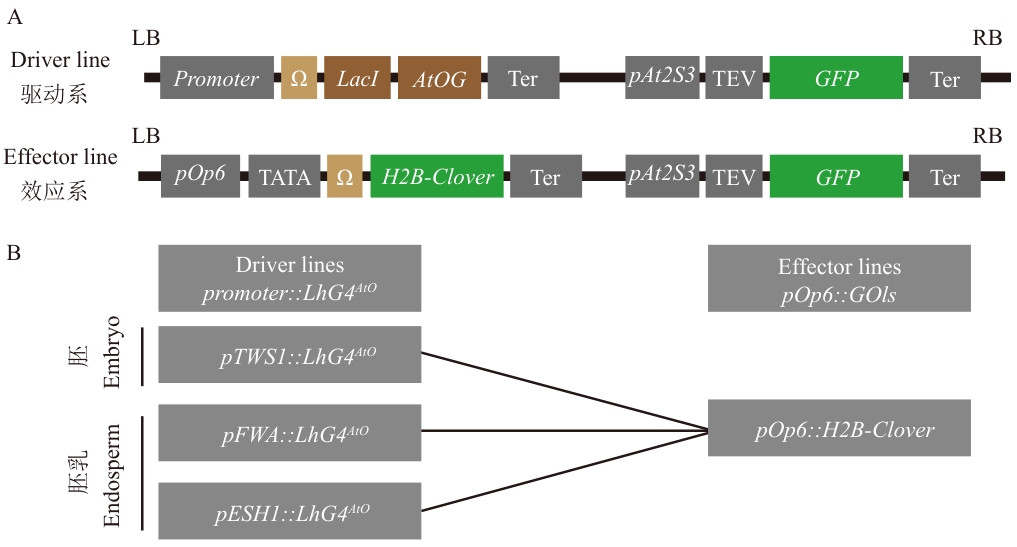
Fig. 1 Vector design and hybrid combination of pOp6/LhG4AtOA: Design of pop6/LhG4Ato vector structure. Promoter: promoter. Ω: Omega, translation enhancement element. Ter: Terminator. TEV: Translation enhancer of tobacco etch virus. pAt2S3: Seed storage albumingene SESA3 promoter. B: Crossing combinations between driver lines and effector lines in the pop6/LhG4Ato system
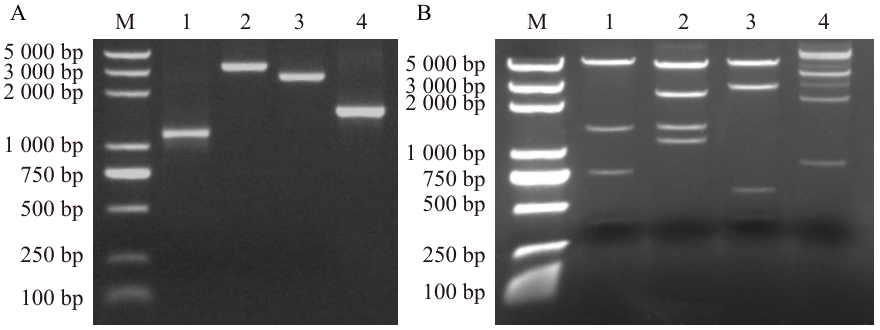
Fig. 2 Cloning of embryo and endosperm promoter fragments and identification of binary vector digestionA: Cloning of tissue-specific promoter (M: 2 000 DNA marker. 1-4: Cloned fragments were, pTWS1, pFWA, pESH1, H2B-Clover). B: Restriction enzyme digestion identification of recombinant plasmid (M: 2 000 DNA marker. 1-4: Plasmids were pTWS1::LhG4AtO, pFWA::LhG4AtO, pESH1::LhG4AtO, pOp6::H2B-Clover, respectively)
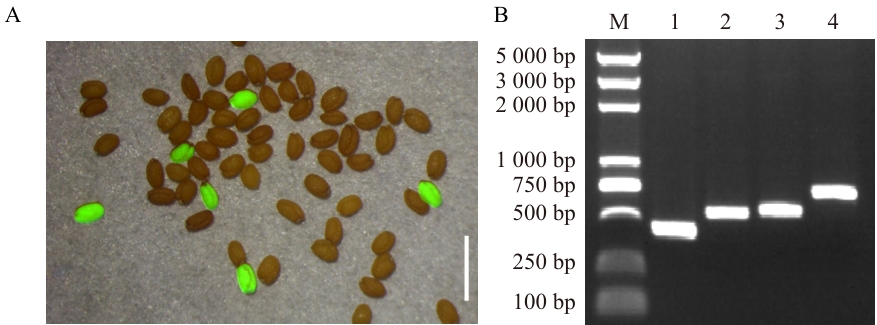
Fig. 3 Screening and identification of transgenic materialsA: Screening of transgenic positive seeds. Scale bar=1 mm. B: Detection of positive identification of transgenic lines by agarose gel electrophoresis (M: 2 000 DNA marker. 1-4: The fragments were pTWS1::LhG4AtO, pFWA::LhG4AtO, pESH1::LhG4AtO, pOp6::H2B-Clover, respectively)
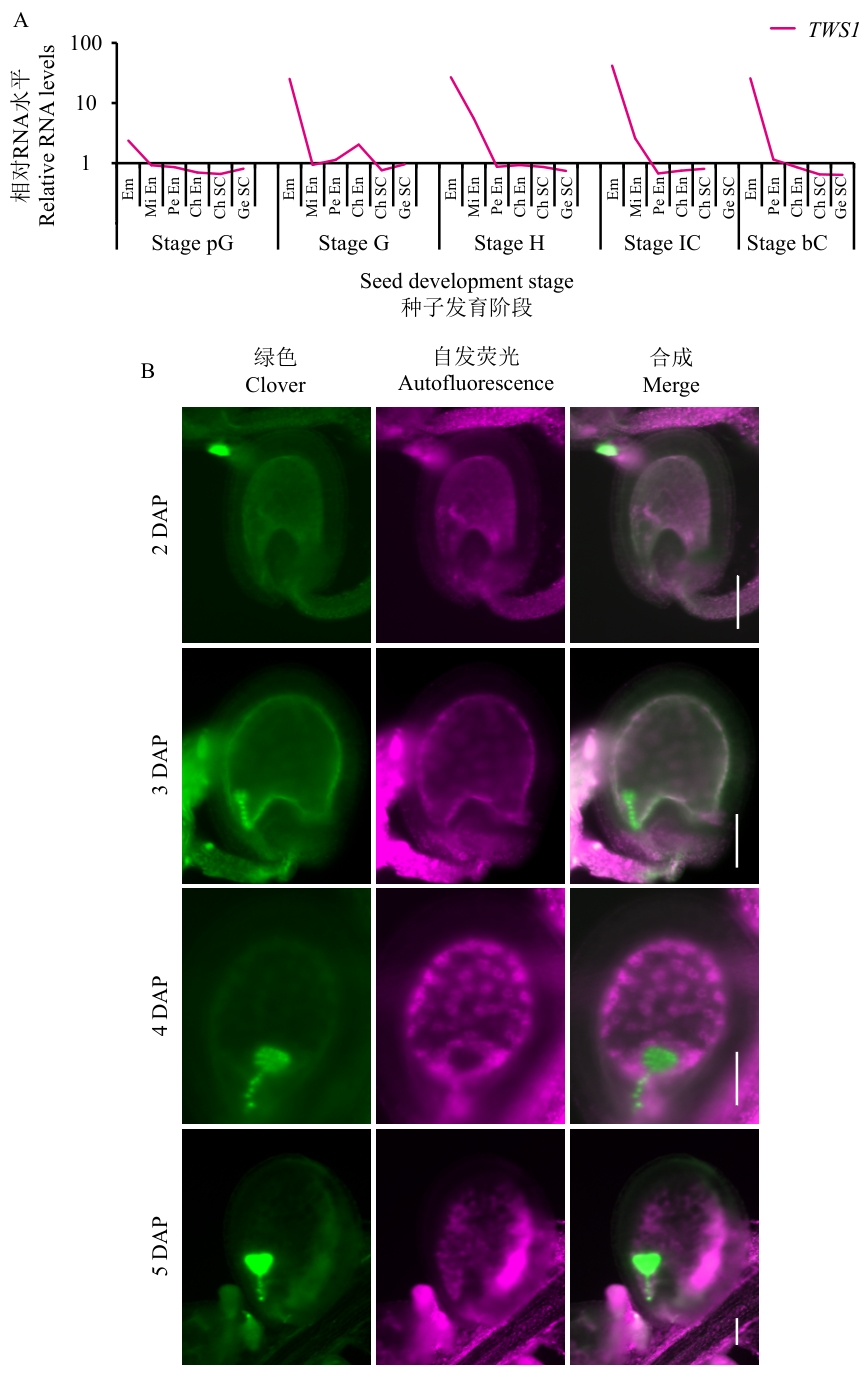
Fig. 4 Relative expression of TWS1 at different developmental stages of seeds and the expression of H2B-Clover reporter gene driven by TWS1A: Expression pattern of TWS1 in seed development stage (NCBI GEO; accession number GSE12404). Stage pG: Pre-globular stage. Stage G: Globular stage. Stage H: Heart stage. Stage IC: Linage cotyledon stage. Stage bC: Bent cotyledon stage. Em: Embryo. Mi En: Micropylar endosperm. Pe En: Peripheral endosperm. Ch En: Chalazal endosperm. Ch SC: Chalazal seed coat. Ge SC: General seed coat. The Y-axis value is a logarithmic scale value based on 10. The same below. B: Fluorescence expression of the TWS1 driven effector line in F1 hybrid seeds at 2‒5 d after pollination. The nuclear-localized green fluorescent signal in the embryo indicates the TWS1 driven target signal, whereas the autofluorescence of plastids in the seed coat and endosperm appears as a red fluorescent signal. DAP is days after pollination. Scale bar, 50 μm. The same below
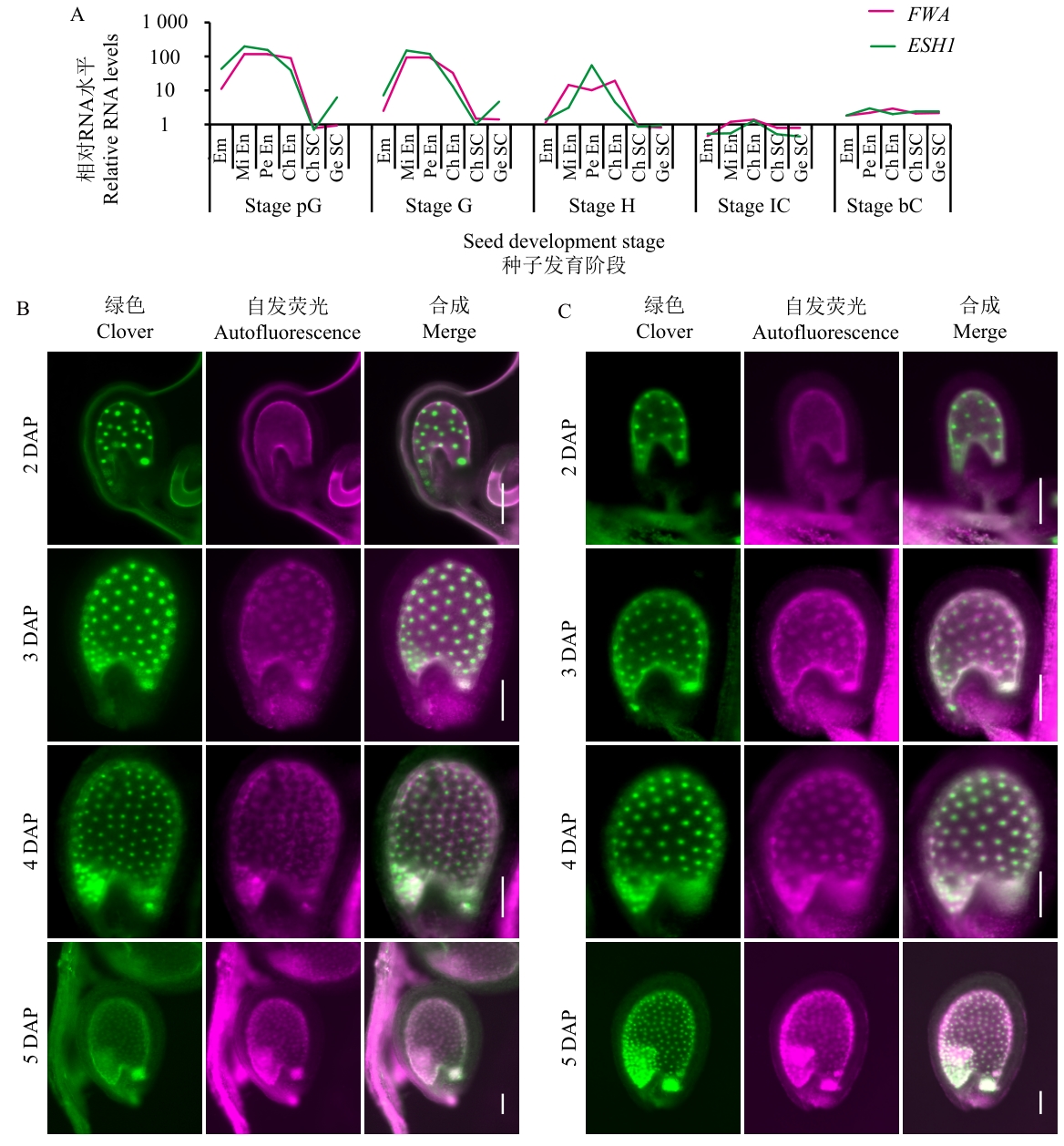
Fig. 5 Expression pattern analysis of FWA and ESH1 genes at different developmental stages of seeds and the expression of H2B-Clover reporter gene driven by themA: Expression patterns of FWA and ESH1 during seed development (NCBI GEO; accession number GSE12404). B‒C: Fluorescence expression of the FWA and ESH1 effector lines in F1 hybrid seeds at 2‒5 d after pollination, respectively. The nuclear-localized green fluorescent signal in the endosperm represents the target signal driven by FWA and ESH1, whereas the autofluorescence of plastids in the seed coat, embryo, and endosperm appears as a red fluorescent signal. Scale bar, 50 μm
| [1] | Pankaj R, Lima RB, Figueiredo DD. Hormonal regulation and crosstalk during early endosperm and seed coat development [J]. Plant Reprod, 2025, 38: 5. |
| [2] | Wang W, Xiong HX, Sun KT, et al. New insights into cell-cell communications during seed development in flowering plants [J]. J Integr Plant Biol, 2022, 64(2): 215-229. |
| [3] | Ingram GC. Family life at close quarters: communication and constraint in angiosperm seed development [J]. Protoplasma, 2010, 247(3/4): 195-214. |
| [4] | Doll NM, Ingram GC. Embryo-endosperm interactions [J]. Annu Rev Plant Biol, 2022, 73: 293-321. |
| [5] | Paolo D, Rotasperti L, Schnittger A, et al. The Arabidopsis MADS-domain transcription factor SEEDSTICK controls seed size via direct activation of E2Fa [J]. Plants, 2021, 10(2): 192. |
| [6] | Ali MF, Shin JM, Fatema U, et al. Cellular dynamics of coenocytic endosperm development in Arabidopsis thaliana [J]. Nat Plants, 2023, 9(2): 330-342. |
| [7] | Samakovli D, Tichá T, Vavrdová T, et al. HEAT SHOCK PROTEIN 90 proteins and YODA regulate main body axis formation during early embryogenesis [J]. Plant Physiol, 2021, 186(3): 1526-1544. |
| [8] | Tao Z, Hu HM, Luo X, et al. Embryonic resetting of the parental vernalized state by two B3 domain transcription factors in Arabidopsis [J]. Nat Plants, 2019, 5(4): 424-435. |
| [9] | Lloyd JPB, Khan A, Lister R. The switch-liker’s guide to plant synthetic gene circuits [J]. Plant J, 2025, 121(5): e70090. |
| [10] | Benfey PN, Chua NH. The cauliflower mosaic virus 35S promoter: combinatorial regulation of transcription in plants [J]. Science, 1990, 250(4983): 959-966. |
| [11] | Oh Y, Nagalakshmi U, Dahlbeck D, et al. Heritable virus-induced germline editing in tomato [J]. Plant J, 2025, 122: e70115. |
| [12] | Nishihara M, Hirabuchi A, Teshima T, et al. Flower color modification in Torenia fournieri by genetic engineering of betacyanin pigments [J]. BMC Plant Biol, 2024, 24: 614. |
| [13] | Ali ME, Waliullah S. A Core35S promoter of cauliflower mosaic virus drives more efficient replication of turnip crinkle virus [J]. Plants, 2021, 10(8): 1700. |
| [14] | Samalova M, Brzobohaty B, Moore I. pOp6/LhGR: a stringently regulated and highly responsive dexamethasone-inducible gene expression system for tobacco [J]. Plant J, 2005, 41(6): 919-935. |
| [15] | Jia HG, Van Loock B, Liao MJ, et al. Combination of the ALCR/AlcA ethanol switch and GAL4/VP16-UAS enhancer trap system enables spatial and temporal control of transgene expression in Arabidopsis [J]. Plant Biotechnol J, 2007, 5(4): 477-482. |
| [16] | Fu C, Robbins N, Cowen LE. Adaptation of the tetracycline-repressible system for modulating the expression of essential genes in Cryptococcus neoformans [J]. mSphere, 2025, 10(5): e01018-e01024. |
| [17] | Moore I, Gälweiler L, Grosskopf D, et al. A transcription activation system for regulated gene expression in transgenic plants [J]. Proc Natl Acad Sci U S A, 1998, 95(1): 376-381. |
| [18] | Craft J, Samalova M, Baroux C, et al. New pOp/LhG4 vectors for stringent glucocorticoid-dependent transgene expression in Arabidopsis [J]. Plant J, 2005, 41(6): 899-918. |
| [19] | Schürholz AK, López-Salmerón V, Li ZN, et al. A comprehensive toolkit for inducible, cell type-specific gene expression in Arabidopsis [J]. Plant Physiol, 2018, 178(1): 40-53. |
| [20] | Rutherford S, Brandizzi F, Townley H, et al. Improved transcriptional activators and their use in mis-expression traps in Arabidopsis [J]. Plant J, 2005, 43(5): 769-788. |
| [21] | López-Salmerón V, Schürholz AK, Li ZN, et al. Inducible, cell type-specific expression in Arabidopsis thaliana through LhGR-mediated Trans-activation [J]. JoVE, 2019(146): e59394. |
| [22] | Zerin T, Greb T, Wolf S. Inducible, tissue-specific gene expression in Arabidopsis using GR-LhG4-mediated trans-activation [M]//Kaufmann K, Vandepoele K. Plant Gene Regulatory Networks: Methods and Protocols. New York, Springer US, 2023: 13-25. |
| [23] | Fiume E, Guyon V, Remoué C, et al. TWS1, a novel small protein, regulates various aspects of seed and plant development [J]. Plant Physiol, 2016, 172(3): 1732-1745. |
| [24] | Doll NM, Royek S, Fujita S, et al. A two-way molecular dialogue between embryo and endosperm is required for seed development [J]. Science, 2020, 367(6476): 431-435. |
| [25] | Kinoshita T, Miura A, Choi Y, et al. One-way control of FWA imprinting in Arabidopsis endosperm by DNA methylation [J]. Science, 2004, 303(5657): 521-523. |
| [26] | Yang K, Tang YL, Li Y, et al. Two imprinted genes primed by DEMETER in the central cell and activated by WRKY10 in the endosperm [J]. J Genet Genom, 2024, 51(8): 855-865. |
| [27] | Li N, Li YH. Signaling pathways of seed size control in plants [J]. Curr Opin Plant Biol, 2016, 33: 23-32. |
| [28] | Phillips AR, Evans MMS. Maternal regulation of seed growth and patterning in flowering plants [M]//Maternal Effect Genes in Development. Amsterdam: Elsevier, 2020: 257-282. |
| [29] | Belmonte MF, Kirkbride RC, Stone SL, et al. Comprehensive developmental profiles of gene activity in regions and subregions of the Arabidopsis seed [J]. Proc Natl Acad Sci U S A, 2013, 110(5): E435-E444. |
| [30] | Mahas A, Aman R, Mahfouz M. CRISPR-Cas13d mediates robust RNA virus interference in plants [J]. Genome Biol, 2019, 20: 263. |
| [1] | LI Can-ni, PAN Wei-song, WU Tai-ru, WU Chuan, Keung Eric Tsang Po, LI Wei-zhan. Research Progress in the Expression of Recombinant Proteins in Endosperm Bioreactors [J]. Biotechnology Bulletin, 2026, 42(7): 67-80. |
| [2] | WAN Rui-heng, LI Xiao-yan, LI Ying-ying, GUO Yang, LIU Ying-hong, ZHANG Jun-jie, HU Yu-feng, LI Yang-ping, HUANG Yu-bi, LIU Han-mei. Development of a YOLOv10-based System for the Starch Granules Recognition and Size Analysis of Maize Kernels [J]. Biotechnology Bulletin, 2026, 42(6): 208-217. |
| [3] | MENG Hong-yu, LIU Ya-nan, WU Jun-xin, SHEN Qiong. Identification and Analysis of the NAC Transcription Factors Gene Family in Cucurbita moschata Duch. [J]. Biotechnology Bulletin, 2026, 42(6): 237-249. |
| [4] | CHEN Deng-ke, LAN Gang, XIA Zhi, HOU Bao-guo, YANG Liu-liu, CAO Cai-rong, LI Peng-bo, WU Cui-cui. Identification of ZF-HD Gene Family in Arachis hypogaea and Analysis in Response to Abiotic Stress [J]. Biotechnology Bulletin, 2026, 42(4): 114-128. |
| [5] | WANG Cheng-cheng, HUANG Tian-yu, ZHANG Qing, SHI Lai-quan, FANG Hui-min, ZHANG Long. Phenotypic Analysis and Genetic Mapping of a Rice Floury Endosperm Mutant [J]. Biotechnology Bulletin, 2026, 42(2): 169-177. |
| [6] | WANG Tao, HU She-wei, ZHANG Yu, DENG Wen-wen, SHANG Chun-yuan, WANG Wan-yi. Research Progress in Starch Biosynthesis and Regulatory Factors in Maize Kernel [J]. Biotechnology Bulletin, 2025, 41(3): 1-13. |
| [7] | ZHANG Huan-huan, MU Xiao-ya, ZHOU Jing-yi, LYU Gao-pei, XIAO Nan, LI Min, HAO Yao-shan, WU Shen-jie. An Efficient Genetic Transformation System for High-frequency Embryogenic Broomcorn Millet Line [J]. Biotechnology Bulletin, 2025, 41(10): 164-174. |
| [8] | TIAN Xu-rui, HUO Xin-yi, GUO Yun-han, XIANG Lin, CHAN Zhu-long, WANG Yan-ping. Expression and Functional Analysis of Gene LoSAUR10 from Lilium Oriental Hybrids [J]. Biotechnology Bulletin, 2025, 41(1): 221-229. |
| [9] | ALIYA Waili, CHEN Yong-kun, KELAREMU Kelimujiang, WANG Bao-qing, CHEN Ling-na. Phylogenetic Evolution and Expression Analysis of SPL Gene Family in Juglans regia [J]. Biotechnology Bulletin, 2024, 40(6): 180-189. |
| [10] | GAO Deng-ke, MA Bai-rong, GUO Yi-ying, LIU Wei, LIU Tian, JIN Ya-ping, JIANG Zhou, CHEN Hua-tao. Establishment of Quaking Knockout Mouse Embryonic Fibroblast Cell Line Using CRISPR/Cas9 Technology [J]. Biotechnology Bulletin, 2024, 40(2): 65-72. |
| [11] | JIANG Min-xuan, LI Kang, LUO Liang, LIU Jian-xiang, LU Hai-ping. Advances on the Expressions of Foreign Proteins in Plants [J]. Biotechnology Bulletin, 2023, 39(11): 110-122. |
| [12] | LI Yu, CHEN Gang, MA Qian, KUANG Jie-hua, CHEN You-ming. Cloning of nanos1 Gene of Rachycentron canadum and Its Expression Analysis in the Embryonic and Gonadal Development [J]. Biotechnology Bulletin, 2022, 38(5): 175-182. |
| [13] | ZHANG Chen, ZUO Qi-sheng, ZOU Yi-chen, ZHAO Juan-juan, ZHANG Ya-ni, LI Bi-chun. Study on the Function of Glycolysis in Inducing Chicken PGCLC in vitro Formation [J]. Biotechnology Bulletin, 2021, 37(6): 163-170. |
| [14] | WU Li-fang, WEI Xiao-mei, LU Wei-dong. Embryonic Callus Induction of Sophora davidii and Their Somatic Embryogenesis and Germination [J]. Biotechnology Bulletin, 2019, 35(4): 13-19. |
| [15] | FANG Luo, WU Xiao-qin. Suspension Culture of Somatic Cells of Pinus elliottii Against Brown Spot Needle Blight of Pine [J]. Biotechnology Bulletin, 2019, 35(3): 13-18. |
| Viewed | ||||||
|
Full text |
|
|||||
|
Abstract |
|
|||||
