







生物技术通报 ›› 2026, Vol. 42 ›› Issue (8): 276-286.doi: 10.13560/j.cnki.biotech.bull.1985.2025-1174
• 研究报告 • 上一篇
迪丽拜尔·吐尔逊1, 祖丽胡玛尔·亚库普2, 包慧芳2, 詹发强2, 杨蓉2, 史应武2, 杨红梅2, 楚敏2, 房世杰1, 王宁2( )
)
收稿日期:2025-10-30
出版日期:2026-08-26
发布日期:2026-08-17
通讯作者:
王宁wangning@xaas.ac.cn基金资助:
TUERXUN Di-li-bai-er1, YAKUPU Zu-li-hu-ma-er2, BAO Hui-fang2, ZHAN Fa-qiang2, YANG Rong2, SHI Ying-wu2, YANG Hong-mei2, CHU Min2, FANG Shi-jie1, WANG Ning2()
Received:2025-10-30
Published:2026-08-26
Online:2026-08-17
摘要:
目的 从番茄根际分离出菌株GNLJ-7,通过全基因组测序技术解析其功能,为开发绿色促生生防菌剂提供优良菌种与理论支撑。 方法 通过皿内种子萌发及盆栽实验验证GNLJ-7对番茄生长及杂草分枝列当寄生的影响;检测平板测定其溶磷、固氮和产铁载体能力;采用16S rRNA和全基因组学测序,明确菌株GNLJ-7的分类学地位,利用PacBio和Illumina双平台测序技术完成全基因组测序,并通过COG、KEGG、GO等数据库进行基因功能注释与次级代谢产物合成基因簇和主要代谢通路的预测。 结果 经鉴定菌株GNLJ-7为海鞘戈登氏菌(Gordonia didemni)。盆栽实验表明,该菌株能显著促进番茄根系发育,使根长和根重分别增加26%和47%,并有效抑制分枝列当种子的萌发与寄生,在菌剂浓度为1.0×10² CFU/mL时,对列当种子萌发的抑制率达到86.47%。功能验证显示其具有固氮、溶磷和产铁载体的能力。基因组中鉴定到与吲哚-3-乙酸(IAA)合成(trpA/B/C/D/E/F/S)、溶磷(phoA、phoD)、铁载体合成(pksD/E/F)及固氮(nifH、nifA)相关的关键基因,并预测到10个次级代谢产物生物合成基因簇和与促生生防功能相关的代谢通路。 结论 菌株G. didemni GNLJ-7能够显著促进番茄根系生长并抑制分枝列当寄生。其基因组中存在的固氮(nifH、nifA)、溶磷(phoA、phoD)、铁载体合成(pksD/E/F)及IAA合成(trpA/B/C/D/E/F/S)相关基因,共同构成了其发挥促生和生物防治作用的分子基础。
迪丽拜尔·吐尔逊, 祖丽胡玛尔·亚库普, 包慧芳, 詹发强, 杨蓉, 史应武, 杨红梅, 楚敏, 房世杰, 王宁. 番茄根际放线菌GNLJ-7菌株的生物功能及全基因组分析[J]. 生物技术通报, 2026, 42(8): 276-286.
TUERXUN Di-li-bai-er, YAKUPU Zu-li-hu-ma-er, BAO Hui-fang, ZHAN Fa-qiang, YANG Rong, SHI Ying-wu, YANG Hong-mei, CHU Min, FANG Shi-jie, WANG Ning. Biological Function and Whole-genome Analysis of Actinobacteria Strain GNLJ-7 Isolated from Tomato Rhizosphere[J]. Biotechnology Bulletin, 2026, 42(8): 276-286.
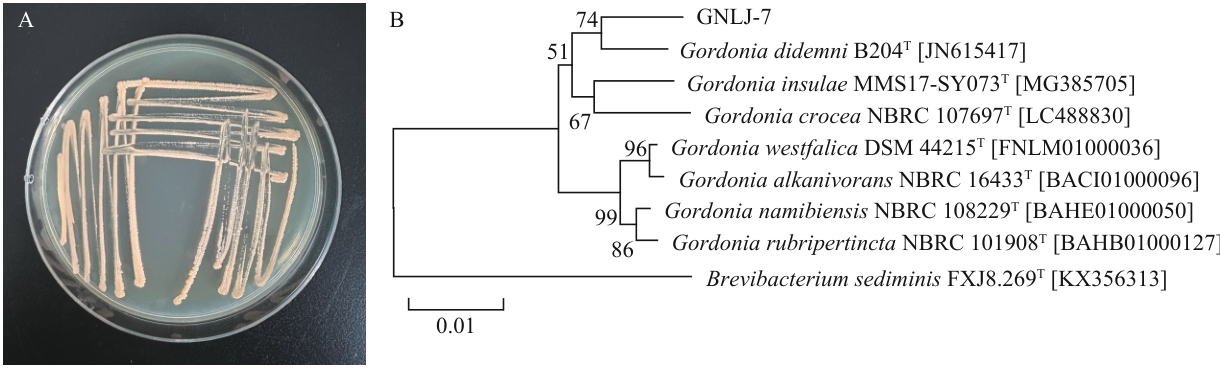
图1 菌株GNLJ-7菌落形态(A)和系统进化树(B)
Fig. 1 Colony morphology (A) and phylogenetic tree (B) of the strain GNLJ-7
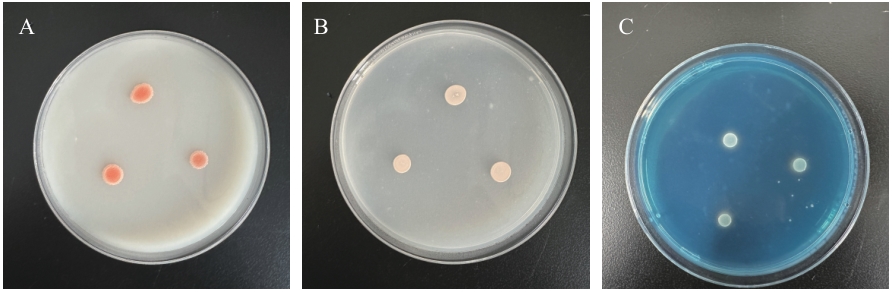
图2 菌株GNLJ-7的促生功能定性测定A:固氮能力;B:解磷能力;C:产铁载体能力
Fig. 2 Qualitative determination of the growth-promoting function of strain GNLJ-7A: Nitrogen fixation ability. B: Phosphate solubilization ability. C: Siderophore production ability
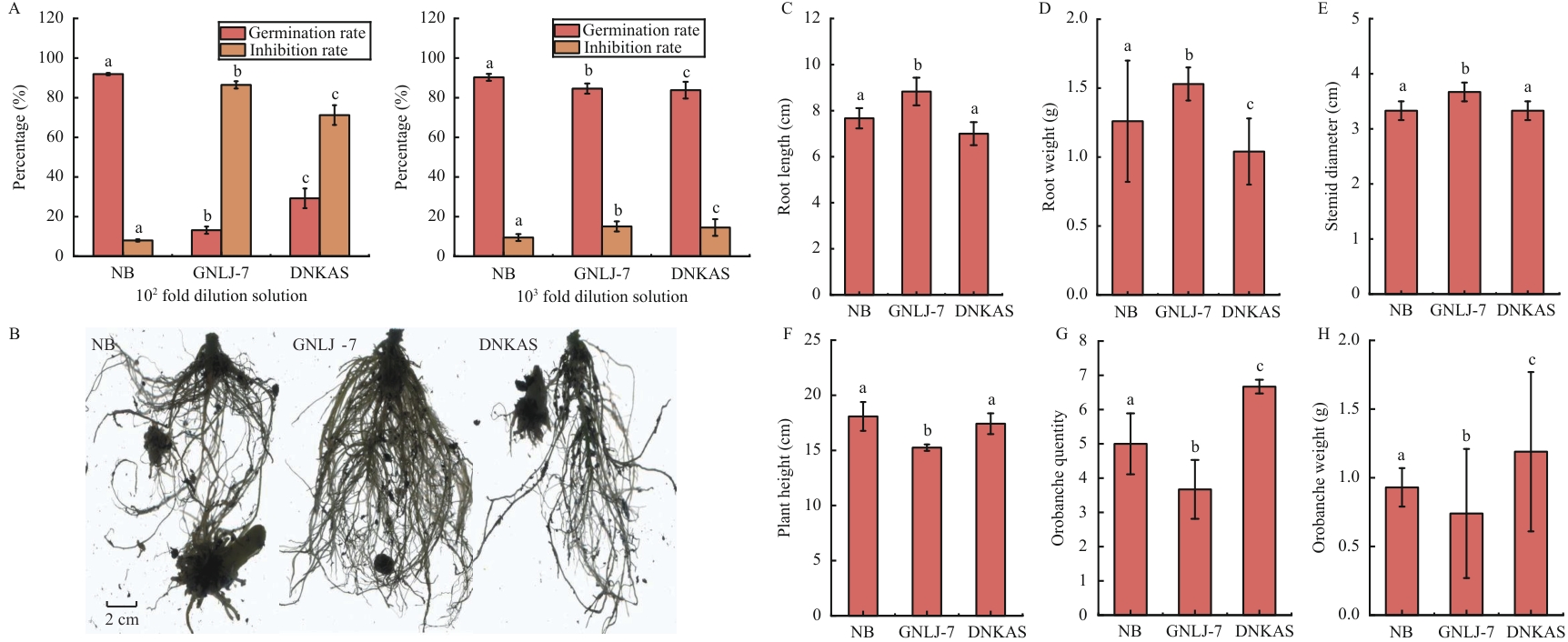
图3 菌株GNLJ-7对番茄的促生和生防效应及综合能力评价A:列当种子抑制率及萌发率;B:不同处理下的番茄根部形态;C:根长;D:根重;E:茎粗;F:株高;G:列当数;H:列当重量;NB为营养肉汤对照组,GNLJ-7为供试菌株,DNKAS为对照菌株。不同字母表示差异显著(P<0.05)
Fig. 3 Evaluation of growth-promoting, biocontrol effects and comprehensive capabilities of strain GNLJ-7 on tomatoA: Orobanche seed inhibition rate and germination rate. B: Tomato root morphology under different treatments. C: Root length. D: Root weight. E: Stem diameter. F: Plant height. G: Orobanche quantity. H: Orobanche weight. NB represents the nutrient broth control group, GNLJ-7 represents the tested strain, and DNKAS represents the control strain. Different letters indicate significant differences (P<0.05)
| 菌株GNLJ-7特征 Characteristics of strain GNLJ-7 | 数值 Value |
|---|---|
| Genome size (bp) | 4 073 730 |
| GC content (%) | 46.44 |
| Chromosome | 1 |
| Plasmid | 1 |
| tRNA | 86 |
| rRNA (5S, 16S, 23S) | 27 (9, 9, 9) |
| Protein-coding genes (CDS) | 3 971 |
| Genomic islands (GIs) | 10 |
| Secondary metabolite gene clusters | 10 |
| Genes assigned to NR | 3 962 |
| Genes assigned to COGs | 3 148 |
| Genes assigned to KEGG | 2 894 |
| Genes assigned to GO | 2 626 |
| Genes assigned to Pfam | 3 459 |
| Genes assigned to Swiss-Prot | 3 597 |
表1 菌株GNLJ-7的基因组信息
Table 1 Genome characteristics of strain GNLJ-7
| 菌株GNLJ-7特征 Characteristics of strain GNLJ-7 | 数值 Value |
|---|---|
| Genome size (bp) | 4 073 730 |
| GC content (%) | 46.44 |
| Chromosome | 1 |
| Plasmid | 1 |
| tRNA | 86 |
| rRNA (5S, 16S, 23S) | 27 (9, 9, 9) |
| Protein-coding genes (CDS) | 3 971 |
| Genomic islands (GIs) | 10 |
| Secondary metabolite gene clusters | 10 |
| Genes assigned to NR | 3 962 |
| Genes assigned to COGs | 3 148 |
| Genes assigned to KEGG | 2 894 |
| Genes assigned to GO | 2 626 |
| Genes assigned to Pfam | 3 459 |
| Genes assigned to Swiss-Prot | 3 597 |
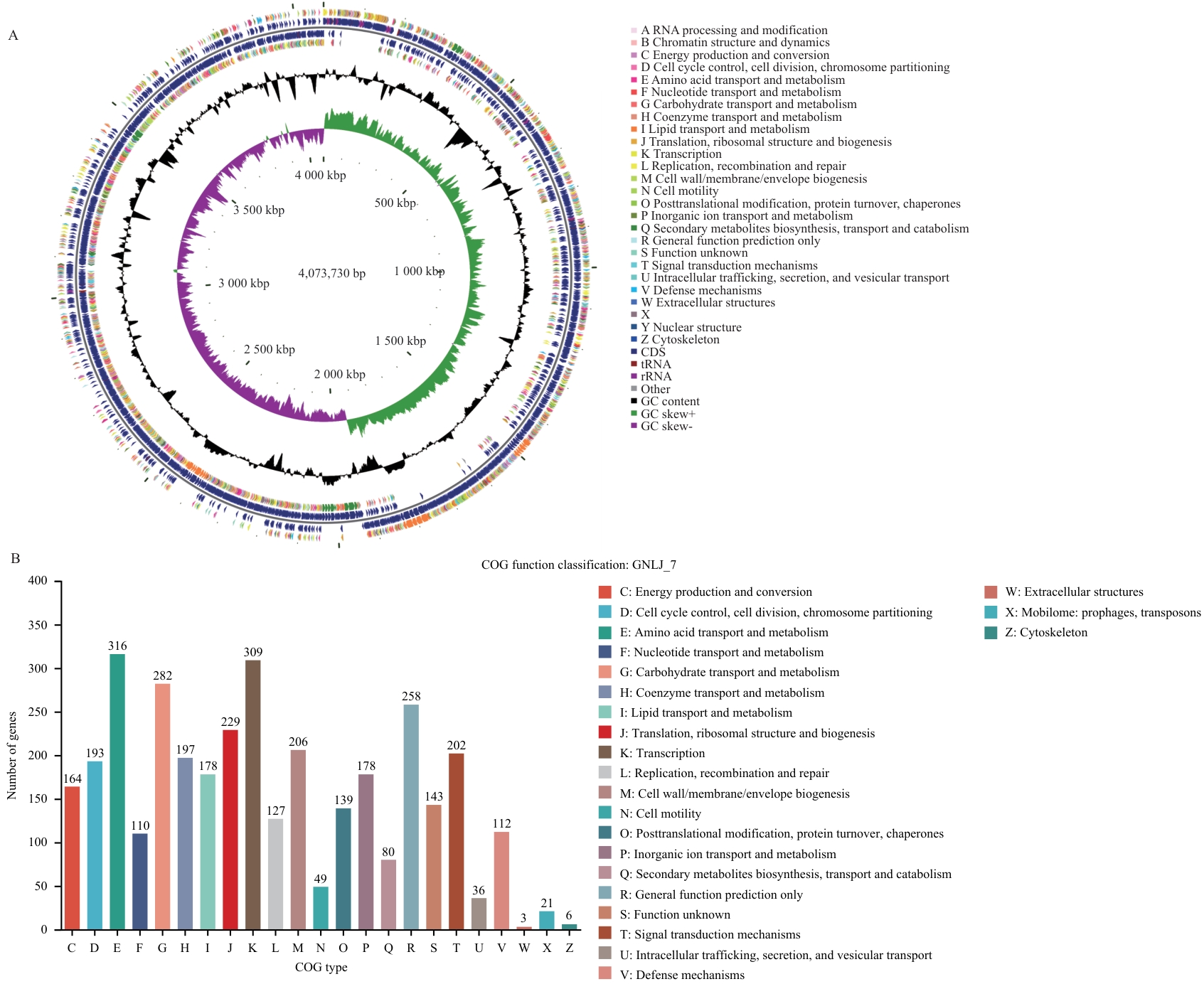
图4 菌株GNLJ-7基因组图谱(A)及COG功能注释(B)
Fig. 4 Genomic mapping (A) and COG functional annotation (B) of strain GNLJ-7
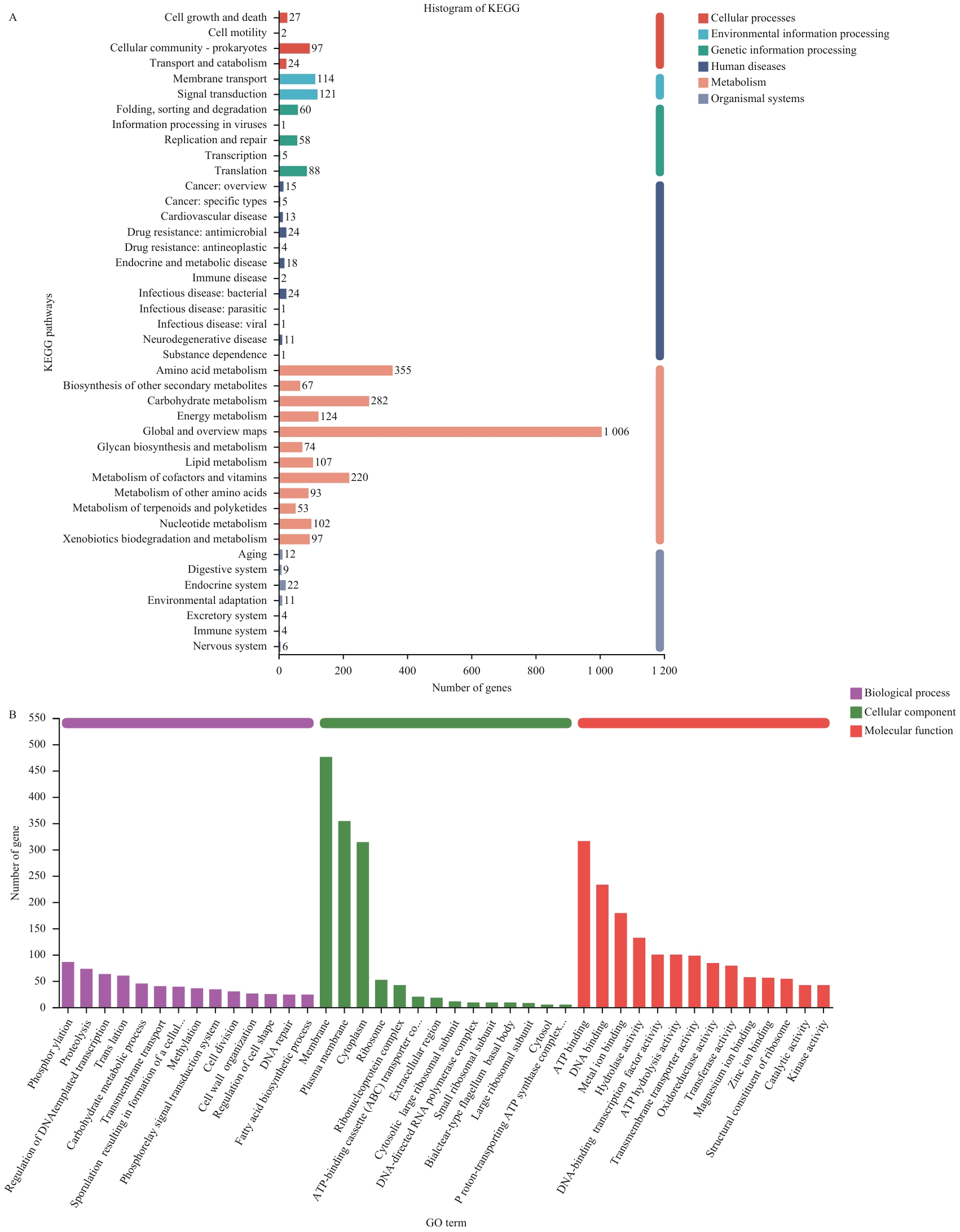
图5 菌株GNLJ-7基因组功能注释及通路注释A:KEGG通路注释;B:基因组GO功能注释
Fig. 5 Genome functional and pathway annotation of strain GNLJ-7A: KEGG pathway annotation. B: Genomic GO functional annotation
| 促生特性 PGP traits | 基因 Gene |
|---|---|
| 吲哚-3-乙酸 Indole-3-acetic acid (IAA) | trpA, trpB, trpC, trpD, trpE, trpF,trpS |
| 铁载体 Siderophore | pksD, pksE, pksF |
| 解磷 Phosphate solubilization | phoD, phoA, pyk, gltA, gltB, gltC,gltX, gltP |
| 固氮 Nitrogen fixation | nifA, nifH |
表2 预测GNLJ-7基因组中与PGP相关的基因
Table 2 Predicted genes associated with PGP in GNLJ-7 genome
| 促生特性 PGP traits | 基因 Gene |
|---|---|
| 吲哚-3-乙酸 Indole-3-acetic acid (IAA) | trpA, trpB, trpC, trpD, trpE, trpF,trpS |
| 铁载体 Siderophore | pksD, pksE, pksF |
| 解磷 Phosphate solubilization | phoD, phoA, pyk, gltA, gltB, gltC,gltX, gltP |
| 固氮 Nitrogen fixation | nifA, nifH |
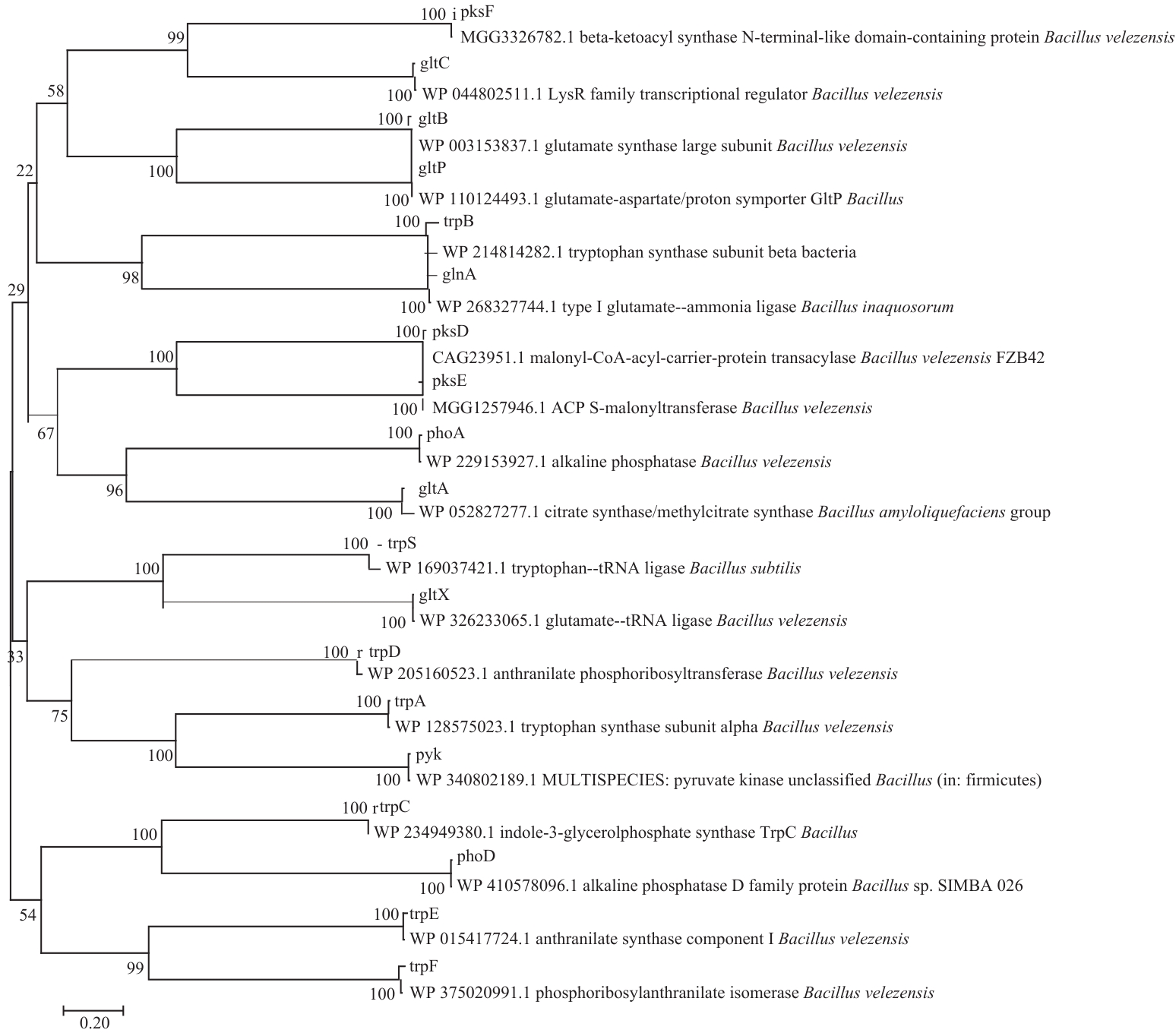
图6 GNLJ-7基因组中19个预测蛋白与已报道的植物促生菌相关蛋白之间的进化关系
Fig. 6 The evolutionary relationship between 19 predicted proteins in the Gordonia didemni GNLJ-7 genome and the reported proteins from PGPRs
| 基因簇 Gene cluster | 基因组位置 Genomic location | 合成类型 Composite type | 相似度 Similarity (%) |
|---|---|---|---|
| Cluster1 | 314 582‒379 637 | Surfactin | 82 |
| Cluster5 | 1 438 110‒1 525 944 | transAT-PKS macrolactin | 100 |
| Cluster6 | 1 748 067‒1 843 852 | transAT-PKS bacillaene | 100 |
| Cluster7 | 1 922 536‒2 057 216 | NRPS fengycin | 100 |
表3 菌株GNLJ-7中与抑草活性相关的次级代谢产物合成基因簇
Table 3 Secondary metabolite synthesis gene clusters related to grass inhibition activity in strain GNLJ-7
| 基因簇 Gene cluster | 基因组位置 Genomic location | 合成类型 Composite type | 相似度 Similarity (%) |
|---|---|---|---|
| Cluster1 | 314 582‒379 637 | Surfactin | 82 |
| Cluster5 | 1 438 110‒1 525 944 | transAT-PKS macrolactin | 100 |
| Cluster6 | 1 748 067‒1 843 852 | transAT-PKS bacillaene | 100 |
| Cluster7 | 1 922 536‒2 057 216 | NRPS fengycin | 100 |
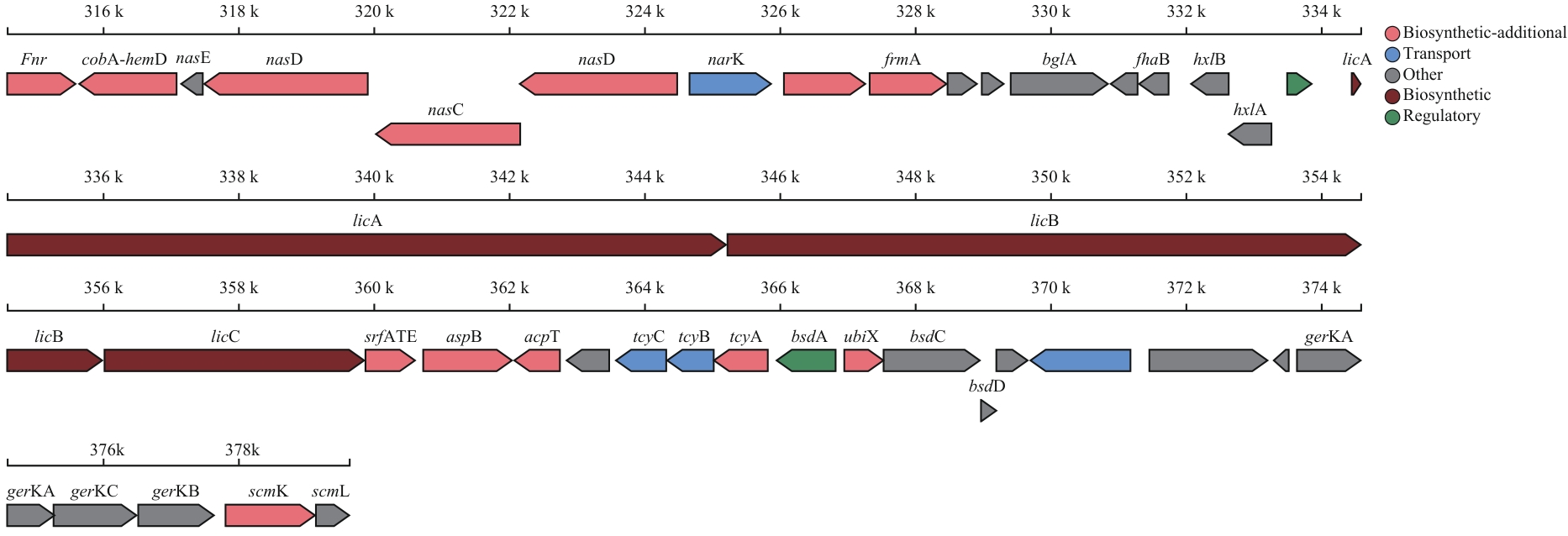
图7 GNLJ-7表面活性素合成基因簇图谱
Fig. 7 Mapping of surfactin gene clusters in the GNLJ-7 genome
| [1] | 中华人民共和国农业农村部. 中华人民共和国农业农村部公告 第351号 [EB/OL]. (2020-11-04) [2026-03-22]. . |
| Ministry of Agriculture and Rural Affairs of the People’s Republic of China. Announcement No. 351 of the Ministry of Agriculture and Rural Affairs of the People’s Republic of China [EB/OL]. (2020-11-04) [2026-03-23]. . | |
| [2] | Zhao NN, Zhong MN, Grey TL, et al. Further investigations on the occurrence patterns of multiple broomrape species in Xinjiang China [J]. Crop Prot, 2025, 197: 107287. |
| [3] | Mutuku JM, Cui SK, Yoshida S, et al. Orobanchaceae parasite-host interactions [J]. New Phytol, 2021, 230(1): 46-59. |
| [4] | Jamil M, Kountche BA, Al-Babili S. Current progress in Striga management [J]. Plant Physiol, 2021, 185(4): 1339-1352. |
| [5] | Pongpamorn P, Zwart M, Bouwmeester HJ. The role of soil microbiota in the control of parasitic weeds [J]. Plant Cell Physiol, 2025: pcaf125. |
| [6] | Lenard G M, Williams O A, Rasche F. Tripartite interaction between Striga spp., cereals, and plant root-associated microorganisms: a review [J]. CABI Rev, 2020: PAVSNNR202015005. |
| [7] | Yu K, Pieterse CMJ, Bakker PAHM, et al. Beneficial microbes going underground of root immunity [J]. Plant Cell Environ, 2019, 42(10): 2860-2870. |
| [8] | Du JF, Li Y, Yin ZY, et al. High-throughput customization of plant microbiomes for sustainable agriculture [J]. Front Plant Sci, 2020, 11: 569742. |
| [9] | Osman NY, Hamdani MS, Oslan SN, et al. Biological control strategies of purple witchweed, Striga hermonthica: a review [J]. Pertanika J Trop Agric Sci, 2022, 46(1): 177-195. |
| [10] | 陈杰, 马永清, 薛泉宏. 利用微生物防除根寄生杂草列当 [J]. 中国生态农业学报, 2018, 26(1): 49-56. |
| Chen J, Ma YQ, Xue QH. Use of microorganisms in controlling parasitic root weed Orobanche spp. [J]. Chin J Eco Agric, 2018, 26(1): 49-56. | |
| [11] | Goudjal Y, Toumatia O, Sabaou N, et al. Endophytic actinomycetes from spontaneous plants of Algerian Sahara: indole-3-acetic acid production and tomato plants growth promoting activity [J]. World J Microbiol Biotechnol, 2013, 29(10): 1821-1829. |
| [12] | Salwan R, Sharma V. Molecular and biotechnological aspects of secondary metabolites in Actinobacteria [J]. Microbiol Res, 2020, 231: 126374. |
| [13] | Vesuna AP, Nerurkar AS. Biocontrol impact of AHL degrading Actinobacteria on quorum sensing regulated virulence of phytopathogen Pectobacterium carotovorum subsp. carotovorum BR1 [J]. Plant Soil, 2020, 453(1/2): 371-388. |
| [14] | Bouwmeester HJ, Roux C, Lopez-Raez JA, et al. Rhizosphere communication of plants, parasitic plants and AM fungi [J]. Trends Plant Sci, 2007, 12(5): 224-230. |
| [15] | 李福艳, 刘晓玉, 颜静婷, 等. 三株产吲哚乙酸根际促生芽孢杆菌的筛选鉴定及其促生作用 [J]. 浙江农业学报, 2021, 33(5): 873-884. |
| Li FY, Liu XY, Yan JT, et al. Isolation and identification of three indole-3-acetic acid producing plant-growth-promoting rhizosphere Bacillus sp. and their growth-promoting effects [J]. Acta Agric Zhejiangensis, 2021, 33(5): 873-884. | |
| [16] | de Andrade LA, Santos CHB, Frezarin ET, et al. Plant growth-promoting rhizobacteria for sustainable agricultural production [J]. Microorganisms, 2023, 11(4): 1088. |
| [17] | Conrath U, Beckers GJM, Flors V, et al. Priming: getting ready for battle [J]. Mol Plant Microbe Interact, 2006, 19(10): 1062-1071. |
| [18] | Shayanowako AIT, Shimelis H, Laing MD, et al. Striga resistance and compatibility of maize genotypes to a biocontrol agent, Fusarium oxysporum f. sp. strigea [J]. J Crop Improv, 2020, 34(4): 437-454. |
| [19] | Nzioki HS, Oyosi F, Morris CE, et al. Striga biocontrol on a toothpick: a readily deployable and inexpensive method for smallholder farmers [J]. Front Plant Sci, 2016, 7: 1121. |
| [20] | Baker CS, Sands DC, Nzioki HS. The Toothpick Project: commercialization of a virulence-selected fungal bioherbicide for Striga hermonthica (witchweed) biocontrol in Kenya [J]. Pest Manag Sci, 2024, 80(1): 65-71. |
| [21] | Sánchez-Suárez J, Díaz L, Coy-Barrera E, et al. Specialized metabolism of Gordonia genus: an integrated survey on chemodiversity combined with a comparative genomics-based analysis [J]. BioTech, 2022, 11(4): 53. |
| [22] | Liu HW, Brettell LE, Qiu ZG, et al. Microbiome-mediated stress resistance in plants [J]. Trends Plant Sci, 2020, 25(8): 733-743. |
| [23] | Alori ET, Dare MO, Babalola OO. Microbial inoculants for soil quality and plant health [M]//Lichtfouse E. Sustainable Agriculture Reviews. Cham: Springer International Publishing, 2017: 281-307. |
| [24] | Nair KP. Phosphate solubilizing microorganisms and their role in sustainable agriculture [M]//Intelligent Soil Management for Sustainable Agriculture: The Nutrient Buffer Power Concept. Cham: Springer International Publishing, 2019: 245-266. |
| [25] | Saha M, Sarkar S, Sarkar B, et al. Microbial siderophores and their potential applications: a review [J]. Environ Sci Pollut Res, 2016, 23(5): 3984-3999. |
| [26] | Dheeman S, Maheshwari DK. Ecology of nitrogen-fixing bacteria for sustainable development of non-legume crops [M]//Maheshwari DK, Dobhal R, Dheeman S. Nitrogen Fixing Bacteria: Sustainable Growth of Non-legumes. Singapore: Springer Nature Singapore, 2022: 301-315. |
| [27] | Pérez-García LA, Sáenz-Mata J, Fortis-Hernández M, et al. Plant-growth-promoting rhizobacteria improve germination and bioactive compounds in cucumber seedlings [J]. Agronomy, 2023, 13(2): 315. |
| [28] | Polli EG, Alves GS, Gizotti de Moraes J, et al. Influence of surfactant-humectant adjuvants on physical properties, droplet size, and efficacy of glufosinate formulations [J]. Agrosystems Geosci & Env, 2022, 5: e20230. |
| [29] | Mirgorodskaya АB, Kushnazarova RА, Lukashenko SS, et al. Carbamate-bearing surfactants as effective adjuvants promoted the penetration of the herbicide into the plant [J]. Colloids Surf A Physicochem Eng Aspects, 2020, 586: 124252. |
| [30] | Fazle Rabbee M, Baek KH. Antimicrobial activities of lipopeptides and polyketides of Bacillus velezensis for agricultural applications [J]. Molecules, 2020, 25(21): 4973. |
| [31] | Golovatskaya IF, Boyko EV. Melatonin and the transmission of light and auxin signals in plants [M]//Baluška F, Mukherjee S, Ramakrishna A. Neurotransmitters in Plant Signaling and Communication. Cham: Springer International Publishing, 2020: 189-211. |
| [32] | Moormann J, Heinemann B, Hildebrandt TM. News about amino acid metabolism in plant-microbe interactions [J]. Trends Biochem Sci, 2022, 47(10): 839-850. |
| [1] | 高飞, 张宇曦, 穆頔, 陈峥, 陈洪艳. 鼠源罗伊氏黏液乳杆菌的分离鉴定及全基因组测序分析[J]. 生物技术通报, 2026, 42(7): 315-327. |
| [2] | 丁洪霞, 高贵文, 黄玉兰, 赵蕊, 黄奕博, 冯和鑫, 龙莎. 一株中药渣源溶磷菌的全基因组分析及功能验证[J]. 生物技术通报, 2026, 42(7): 304-314. |
| [3] | 孔兵兵, 王清, 蒋标, 韩丽珍. 根际促生菌共发酵菌液育苗基质对辣椒育苗的影响[J]. 生物技术通报, 2026, 42(6): 326-339. |
| [4] | 陈仔龙, 张超, 郝宛婷, 宋贤威, 陈雨婷, 陈欣怡, 高明原, 朱易春. 零价铁对厌氧氨氧化系统的影响及累积作用机制[J]. 生物技术通报, 2026, 42(5): 248-256. |
| [5] | 岳源怡, 黄世雄, 刘坤平, 冯书珍. 有机-无机配施对喀斯特旱地土壤硫循环功能微生物群落的影响[J]. 生物技术通报, 2026, 42(5): 222-233. |
| [6] | 李琼瑶, 鲍瑞, 雷海涛, 杨苑姁, 韩丽珍. 抗逆促生菌恶臭假单胞菌对辣椒种子萌发及幼苗生长的影响[J]. 生物技术通报, 2026, 42(5): 257-271. |
| [7] | 朱志炎, 宋芷薇, 何珊, 张德清, 何勇, 田志宏. 烟草靶斑病拮抗菌的鉴定及其防治特性[J]. 生物技术通报, 2026, 42(4): 310-320. |
| [8] | 陈仔龙, 张超, 郝宛婷, 宋贤威, 陈欣怡, 卢璐, 李鹏飞, 朱易春. 回流比对厌氧氨氧化系统的影响及作用机制研究[J]. 生物技术通报, 2026, 42(2): 102-112. |
| [9] | 张蔓, 党静波, 蒋媛, 位杰, 邢杰, 王哲, 孙黎. 梨火疫病生防菌的筛选、鉴定及防效测定[J]. 生物技术通报, 2026, 42(1): 279-293. |
| [10] | 吕镇, 甘恬, 霍思羽, 赵晨笛, 赵梦瑶, 李亚涛, 马玉超, 耿玉清. 产Surfactin贝莱斯芽胞杆菌C5A-1的鉴定和所产Surfactin对植物的促生效果[J]. 生物技术通报, 2025, 41(9): 265-276. |
| [11] | 李亚涛, 张志鹏, 赵梦瑶, 吕镇, 甘恬, 魏浩, 吴书凤, 马玉超. 根瘤菌Bd1的全基因组分析及TetR3对细胞生长和结瘤的负调控功能[J]. 生物技术通报, 2025, 41(9): 289-301. |
| [12] | 贾雪, 隋丽, 邹晓威, 路杨, 张正坤, 李启云. 真菌病毒BbOCuV1对寄主球孢白僵菌生长发育和亚洲玉米螟致病力的影响[J]. 生物技术通报, 2025, 41(7): 312-325. |
| [13] | 张慧, 卢文才, 王冬, 刘倩, 马连杰. 一株高产吲哚乙酸的Bacillus cereus YT2-1C的鉴定及促生作用[J]. 生物技术通报, 2025, 41(5): 300-309. |
| [14] | 张吉昌, 许云凤, 蒋凌雁. 柱花草内生细菌ZW21发酵条件优化及其抑菌物质稳定性测定[J]. 生物技术通报, 2025, 41(5): 280-289. |
| [15] | 吴泽银, 黄晨阳, 赵梦然, 张利姣, 姚方杰. 短柄白黄侧耳CCMSSC 04611基因组特异性分析[J]. 生物技术通报, 2025, 41(5): 320-332. |
| 阅读次数 | ||||||
|
全文 |
|
|||||
|
摘要 |
|
|||||
