







生物技术通报 ›› 2026, Vol. 42 ›› Issue (1): 279-293.doi: 10.13560/j.cnki.biotech.bull.1985.2025-0862
张蔓1( ), 党静波1, 蒋媛2, 位杰2, 邢杰1, 王哲1, 孙黎1()
收稿日期:2025-08-09
出版日期:2026-01-26
发布日期:2026-02-04
通讯作者:
孙黎,女,博士,教授,研究方向 :植物与微生物互作;E-mail: sunlishz@126.com作者简介:张蔓,女,硕士研究生,研究方向 :植物与微生物互作;E-mail: 13734136860@163.com
基金资助:
ZHANG Man1(), DANG Jing-bo1, JIANG Yuan2, WEI Jie2, XING Jie1, WANG Zhe1, SUN Li1()
Received:2025-08-09
Published:2026-01-26
Online:2026-02-04
摘要:
目的 梨火疫病是由解淀粉欧文氏菌(Erwinia amylovora)侵染引起的细菌性病害,对梨和苹果产业构成重大威胁。从山梨(Crataegus cuneata)以及新疆野苹果(Malus sieversii)的枝条内筛选出对E. amylovora具有较强拮抗作用的菌株,为E. amylovora的生物防治提供菌种资源。 方法 采用平板对峙法筛选对E. amylovora具有拮抗效果的菌株,结合生理生化反应、16S rDNA和rpoB基因测序对拮抗菌进行鉴定,确定其分类地位;通过甲醇抽提法获得拮抗菌KX1对E. amylovora具有抑制作用的体外抑菌物质;利用薄层层析(TLC)对活性成分进行分离;采用液相色谱-质谱联用(LC-MS)技术对上清液中脂肽类物质进行鉴定;对菌株KX1的全基因组数据进行生物信息学分析,探究其次级代谢产物基因簇;对库尔勒香梨(Pyrus sinkiangensis Yü)离体叶片、枝条和幼果进行温室防效测定。 结果 分离得到7株对E. amylovora具有较强拮抗作用的菌株,其中KX1的拮抗效果最强,结合生理生化特性、16S rDNA以及rpoB基因序列分析,菌株KX1被鉴定为贝莱斯芽胞杆菌(Bacillus velezensis)。菌株KX1的甲醇提取物中含有脂肽类物质,TLC及LC-MS分析表明脂肽类物质主要是表面活性素(surfactin)。脂肽粗提物在不同温度、pH以及储存时间处理后均能保持抑菌活性。菌株KX1的基因组大小为4.1 Mb,GC含量为46.33%。antiSMASH预测到1个次级代谢产物基因簇与丰原素相关的基因簇同源性为80%。温室防效测定结果表明,接种菌株KX1后,库尔勒香梨的幼果、叶片及枝条在保护性试验中的病情指数均显著降低,其防效分别为100%、55.33%和70.65%,且保护性防效优于治疗性防效。 结论 贝莱斯芽胞杆菌KX1能有效抑制E. amylovora的活性,具有一定的生防潜力。
张蔓, 党静波, 蒋媛, 位杰, 邢杰, 王哲, 孙黎. 梨火疫病生防菌的筛选、鉴定及防效测定[J]. 生物技术通报, 2026, 42(1): 279-293.
ZHANG Man, DANG Jing-bo, JIANG Yuan, WEI Jie, XING Jie, WANG Zhe, SUN Li. Screening, Identification and Efficacy Determination of Biocontrol Bacteria against Pear Fire Blight[J]. Biotechnology Bulletin, 2026, 42(1): 279-293.
项目 Item | 引物名称Primer name | 引物序列 Primer sequence (5′-3′) | 目的片段大小 Length of target fragment (bp) |
|---|---|---|---|
| 16S rDNA[ | 27F 1492R | AGTTTGATCMTGGCTCAG GGTTACCTTGTTACGACTT | 1 500 |
| rpoB[ | 2292F 3354R | AGGTCAACTAGTTCAGTATGGAC AAGAACCGTAACCGGCAACTT | 500 |
枯草杆菌蛋白酶 Subtilisin | Qk1F Qk1R | CTTAAACGTCAGAGGCGGAG ATTGTGCAGCTGCTTGTACG | 704 |
表面活性素 Surfactin | srfAAF srfAA R | GAAAGAGCGGCTGCTGAAAC CCCAATATTGCCGCAATGAC | 273 |
丰原素 Fengycin | fenDF fenDR | CCTGCAGAAGGAGAAGTGAAG TGCTCATCGTCTTCCGTTTC | 293 |
伊枯草菌素 Iturin | ituCF ituCR | TTCACTTTTGATCTGGCGAT CGTCCGGTACATTTTCAC | 575 |
枯草菌素 Subtilin | spasF spasR | GGTTTGTTGGATGGAGCTGT GCAAGGAGTCAGAGCAAGGT | 375 |
假定蛋白 Yndj | yndjF yndjR | CAGAGCGACAGCAATCACAT TGAATTTCGGTCCGCTTATC | 212 |
表1 实验中所使用的引物列表
Table 1 List of primers used in this study
项目 Item | 引物名称Primer name | 引物序列 Primer sequence (5′-3′) | 目的片段大小 Length of target fragment (bp) |
|---|---|---|---|
| 16S rDNA[ | 27F 1492R | AGTTTGATCMTGGCTCAG GGTTACCTTGTTACGACTT | 1 500 |
| rpoB[ | 2292F 3354R | AGGTCAACTAGTTCAGTATGGAC AAGAACCGTAACCGGCAACTT | 500 |
枯草杆菌蛋白酶 Subtilisin | Qk1F Qk1R | CTTAAACGTCAGAGGCGGAG ATTGTGCAGCTGCTTGTACG | 704 |
表面活性素 Surfactin | srfAAF srfAA R | GAAAGAGCGGCTGCTGAAAC CCCAATATTGCCGCAATGAC | 273 |
丰原素 Fengycin | fenDF fenDR | CCTGCAGAAGGAGAAGTGAAG TGCTCATCGTCTTCCGTTTC | 293 |
伊枯草菌素 Iturin | ituCF ituCR | TTCACTTTTGATCTGGCGAT CGTCCGGTACATTTTCAC | 575 |
枯草菌素 Subtilin | spasF spasR | GGTTTGTTGGATGGAGCTGT GCAAGGAGTCAGAGCAAGGT | 375 |
假定蛋白 Yndj | yndjF yndjR | CAGAGCGACAGCAATCACAT TGAATTTCGGTCCGCTTATC | 212 |
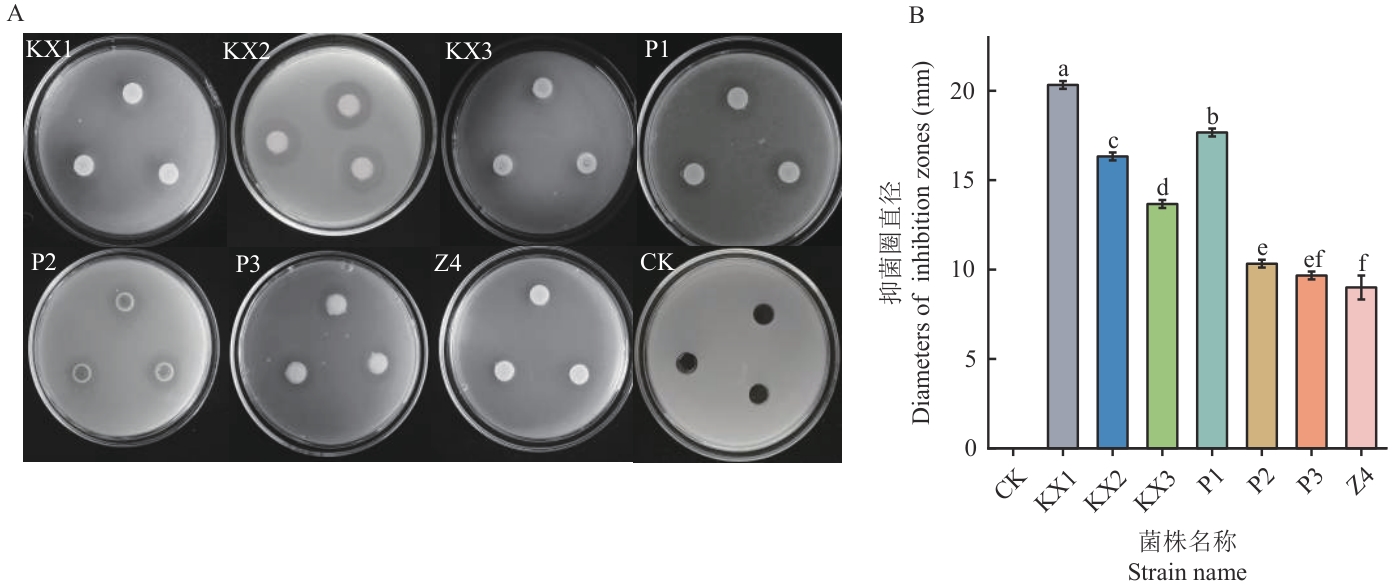
图1 拮抗菌筛选及对E. amylovora C1的抑制效果A:7株菌对E. amylovora C1的拮抗作用;B:7株菌的抑菌圈直径。不同字母代表差异显著(P<0.05),下同
Fig. 1 Screening of antagonistic bacteria and the inhibitory effect against E. amylovora C1A: Antagonism of seven strains against E. amylovora C1. B: Diameters of inhibition zones of seven strains. Different letters indicate significant different (P<0.05). The same below
| 菌株Strain | 形状Shape | 菌落颜色Color of colony | 能动性Motility | 革兰氏染色Gram staining | 淀粉水解Starch hydrolysis | V-P试验V-P test | MR试验MR test | 硝酸盐还原试验Nitrate reduction test | 靛基质试验Indole test | 接触酶试验Catalase test |
|---|---|---|---|---|---|---|---|---|---|---|
| KX1 | 杆状Rod | 白色White | + | + | + | - | + | - | - | + |
| KX2 | 杆状Rod | 白色White | + | + | + | - | + | - | - | + |
| KX3 | 杆状Rod | 白色White | + | + | + | + | - | - | - | + |
| P1 | 杆状Rod | 白色White | + | + | + | - | + | - | - | + |
| P2 | 杆状Rod | 白色White | + | + | + | - | + | - | - | + |
| P3 | 杆状Rod | 白色White | + | + | + | - | + | - | - | + |
| Z4 | 杆状Rod | 白色White | + | + | + | + | - | - | - | + |
表2 拮抗菌的生理生化特性
Table 2 Physiological and biochemical characteristics of antagonistic bacteria
| 菌株Strain | 形状Shape | 菌落颜色Color of colony | 能动性Motility | 革兰氏染色Gram staining | 淀粉水解Starch hydrolysis | V-P试验V-P test | MR试验MR test | 硝酸盐还原试验Nitrate reduction test | 靛基质试验Indole test | 接触酶试验Catalase test |
|---|---|---|---|---|---|---|---|---|---|---|
| KX1 | 杆状Rod | 白色White | + | + | + | - | + | - | - | + |
| KX2 | 杆状Rod | 白色White | + | + | + | - | + | - | - | + |
| KX3 | 杆状Rod | 白色White | + | + | + | + | - | - | - | + |
| P1 | 杆状Rod | 白色White | + | + | + | - | + | - | - | + |
| P2 | 杆状Rod | 白色White | + | + | + | - | + | - | - | + |
| P3 | 杆状Rod | 白色White | + | + | + | - | + | - | - | + |
| Z4 | 杆状Rod | 白色White | + | + | + | + | - | - | - | + |
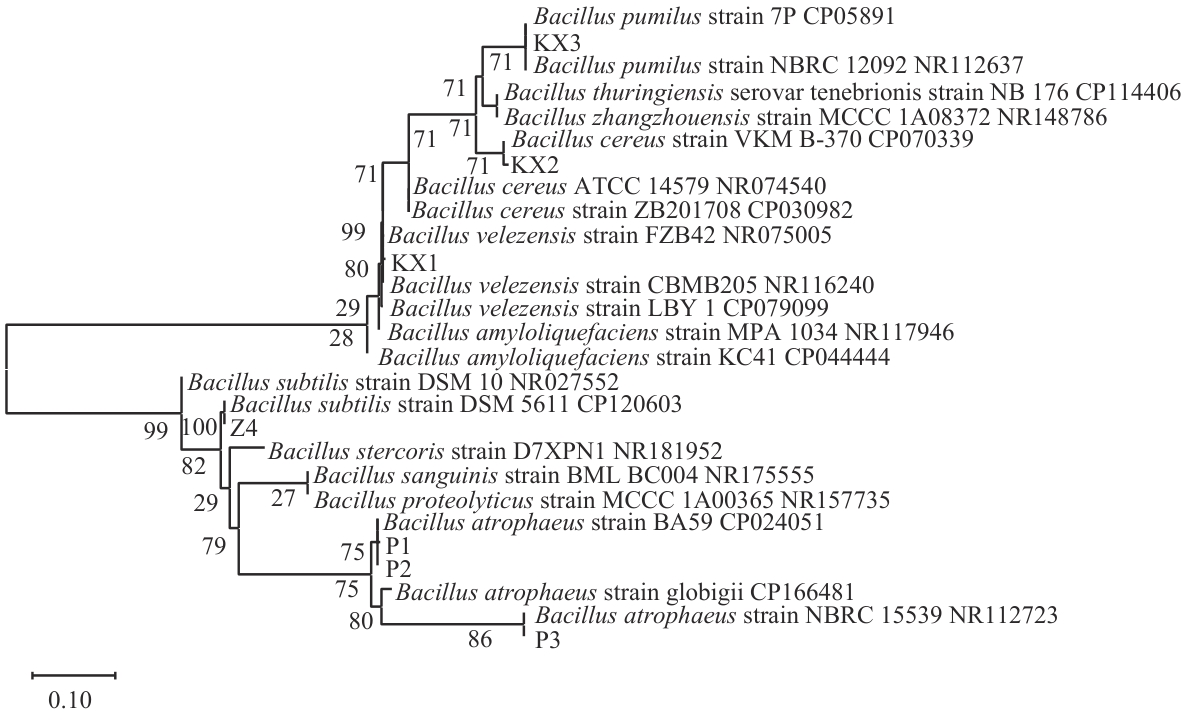
图2 基于16S rDNA与rpoB基因的7株拮抗菌系统发育树
Fig. 2 Phylogenetic tree construction of 7 antagonistic strains based on 16S rDNA and rpoB genes
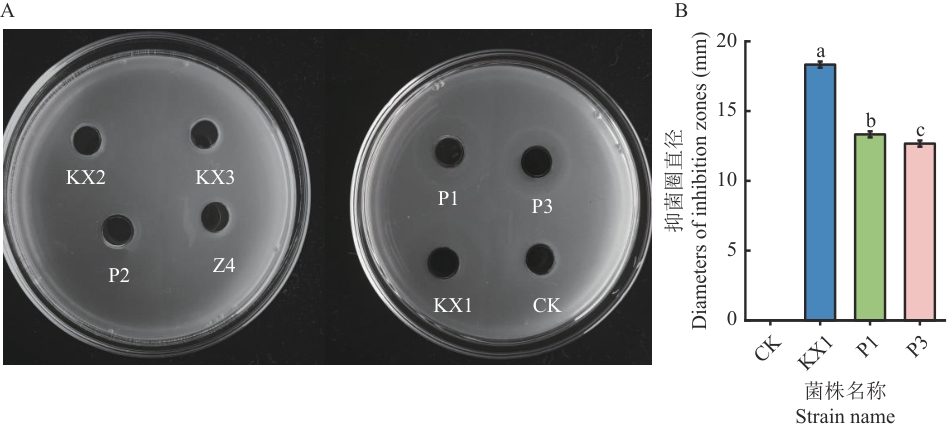
图3 7株拮抗菌上清液对E. amylovora C1的抑菌效果A:7株拮抗菌上清液对E. amylovora C1的拮抗作用;B:7株拮抗菌上清液的抑菌圈直径
Fig. 3 Antibacterial effects of seven antagonistic supernatants against E. amylovora C1A: Antagonistic activities of supernatants from 7 antagonistic strains against E. amylovora C1. B: Diameters of inhibition zones of 7 antagonistic supernatants
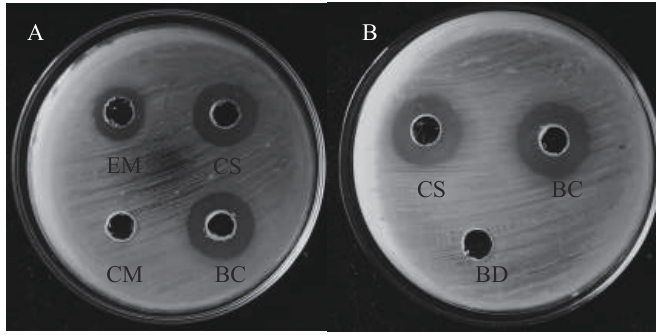
图4 菌株KX1的粗提物对E. amylovora C1的拮抗效果EM:甲醇提取物;CS:无细胞上清液;CM:甲醇对照;BC:菌液;BD:细胞破碎滤液
Fig. 4 Antagonistic effects of crude extract from strain KX1 against E. amylovora C1EM: Extracted with methanol; CS: cell-free supernatant; CM: methanol control; BC: bacterial solution; BD: cell disruption
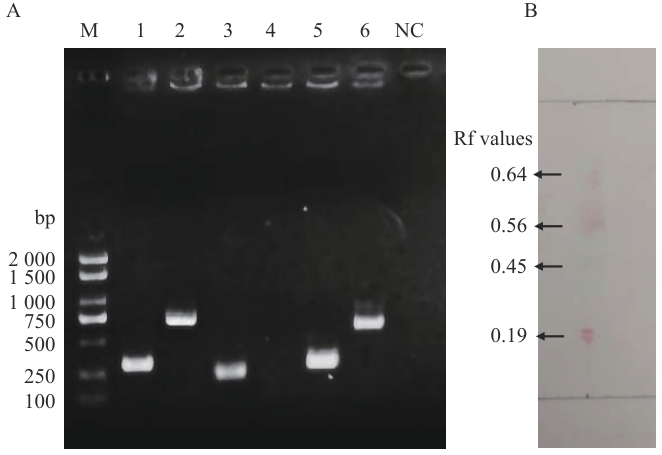
图5 菌株KX1粗提物的鉴定A: 菌株KX1粗提物的功能基因扩增结果;B: 菌株KX1粗提物的薄层层析结果。M: DL2000 plus DNA marker; NC:阴性对照;1、2、3、4、5、6分别代表抗生素合成相关基因fenD、Qk1、yndJ、spas、srfAA和ituC
Fig. 5 Identification of KX1 crude extractA: Results of functional gene amplification of strain KX1 crude extract. B: TLC results of crude extract. M: DL 2000 plus DNA marker. NC: Negative control; 1, 2, 3, 4, 5, 6 indicate genes related to antibiotic synthesis fenD, Qk1, yndJ, spas, srfAA, and ituC, respectively
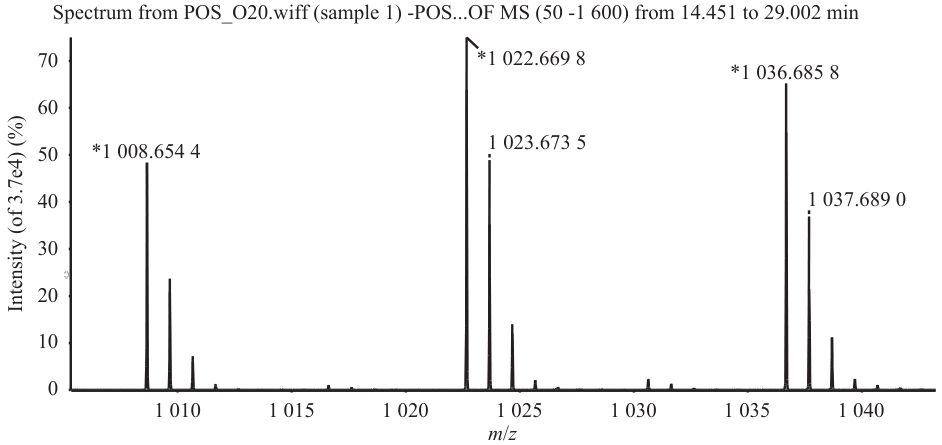
图6 菌株KX1脂肽的LC-MS分析
Fig. 6 LC-MS analysis of lipopeptides from strain KX1
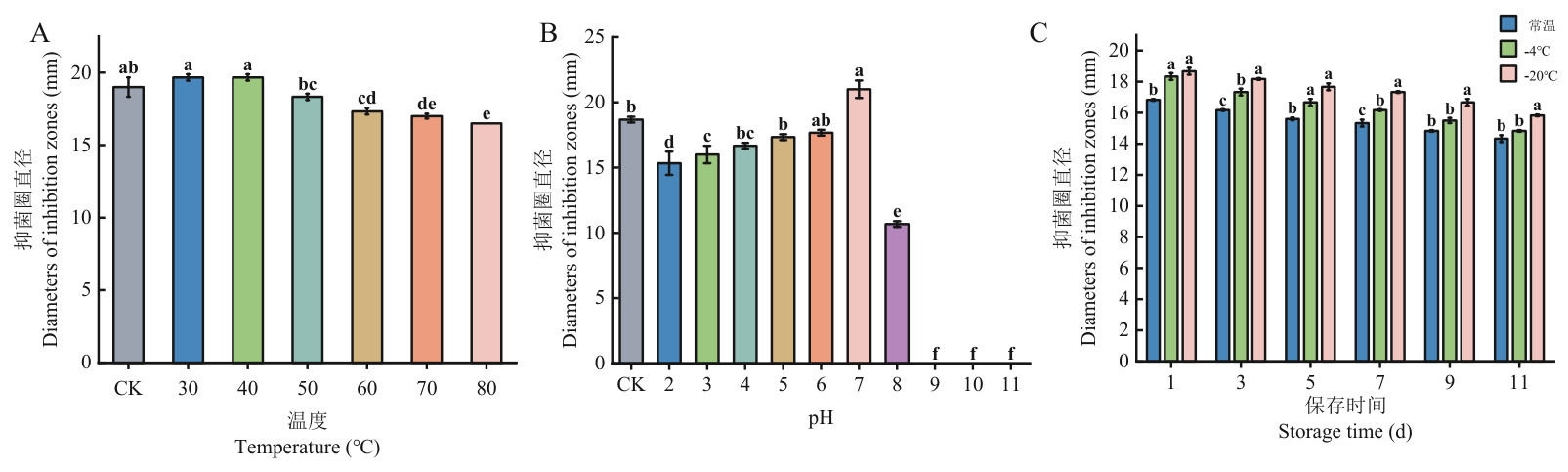
图7 菌株KX1粗提物的稳定性A:不同温度处理下KX1粗提物对E. amylovora C1的抑制效果;B:不同pH处理下KX1粗提物对E. amylovora C1的抑制效果;C:KX1粗提物在储存不同天数后对E. amylovora C1的抑制效果,相同字母的数值之间无显著差异(P>0.05)
Fig. 7 Stability of strain KX1 crude extractA: Inhibition effect of strain KX1crude extract on E. amylovora C1under different temperature treatment. B: Inhibition effect of KX1 crude extract on E. amylovora C1 under different pH treatment. C: Inhibition effect of KX1crude extract on E. amylovora C1 under different storage days. There is no significant difference between values of the same letter (P>0.05)
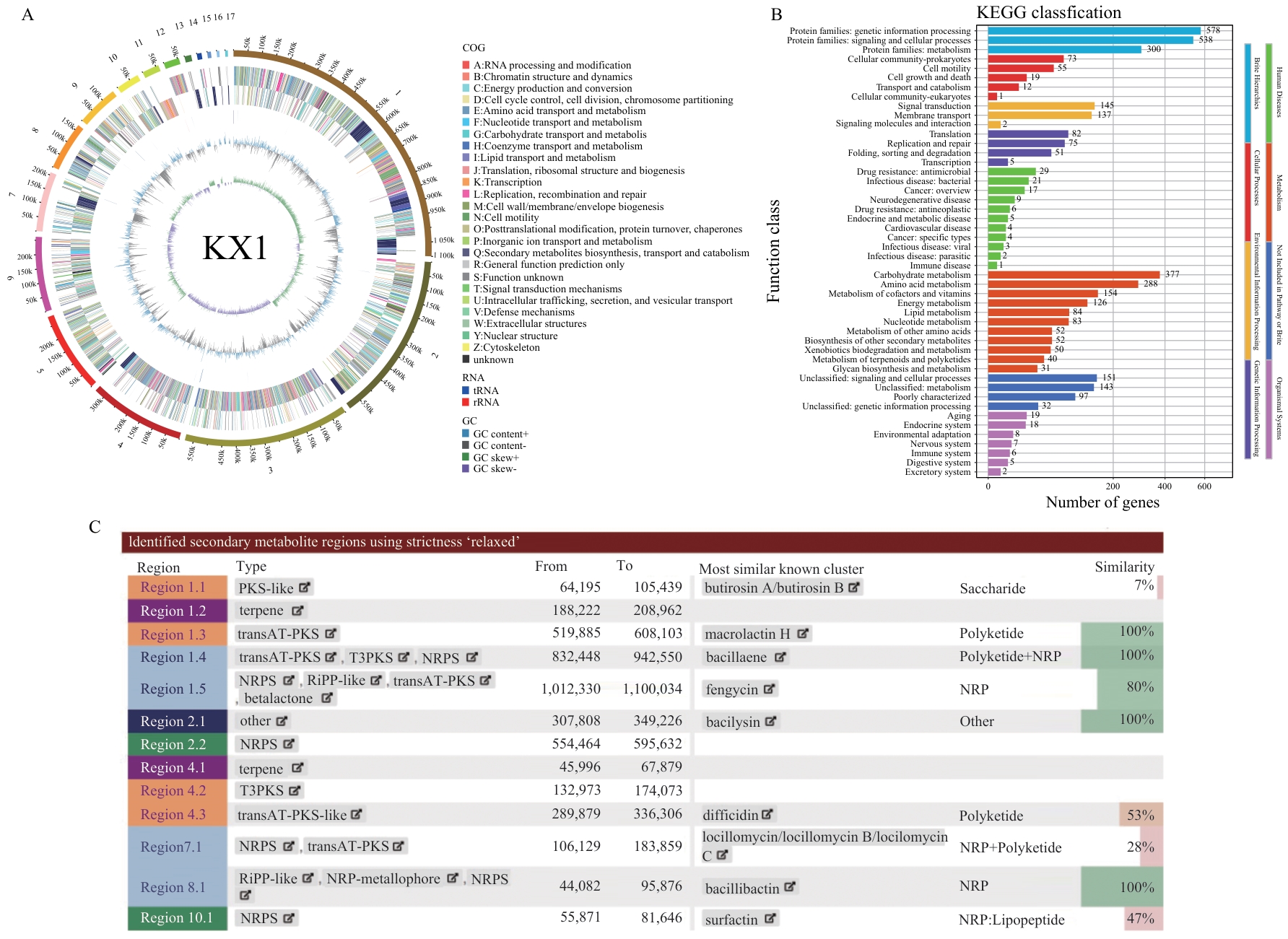
图8 菌株KX1的全基因组序列分析A:菌株KX1的基因组圈图,基因组圈图显示了DNA的正向CDS、反向序列、rRNA和tRNA、GC偏斜图和GC比值图;B: 菌株KX1的KEGG功能注释分类;C:菌株KX1次生代谢产物合成基因簇预测
Fig. 8 Whole genome sequence analysis of strain KX1A: Circular genome circle map of strain KX1, the circular map showed CDS of DNA in the forward direction, sequence in the reverse direction, rRNA and tRNA, GC skew graph, and GC ratio graph; B: KEGG function classification of strain KX1; C: putative gene clusters in biosynthesis of secondary metabolites of strain KX1
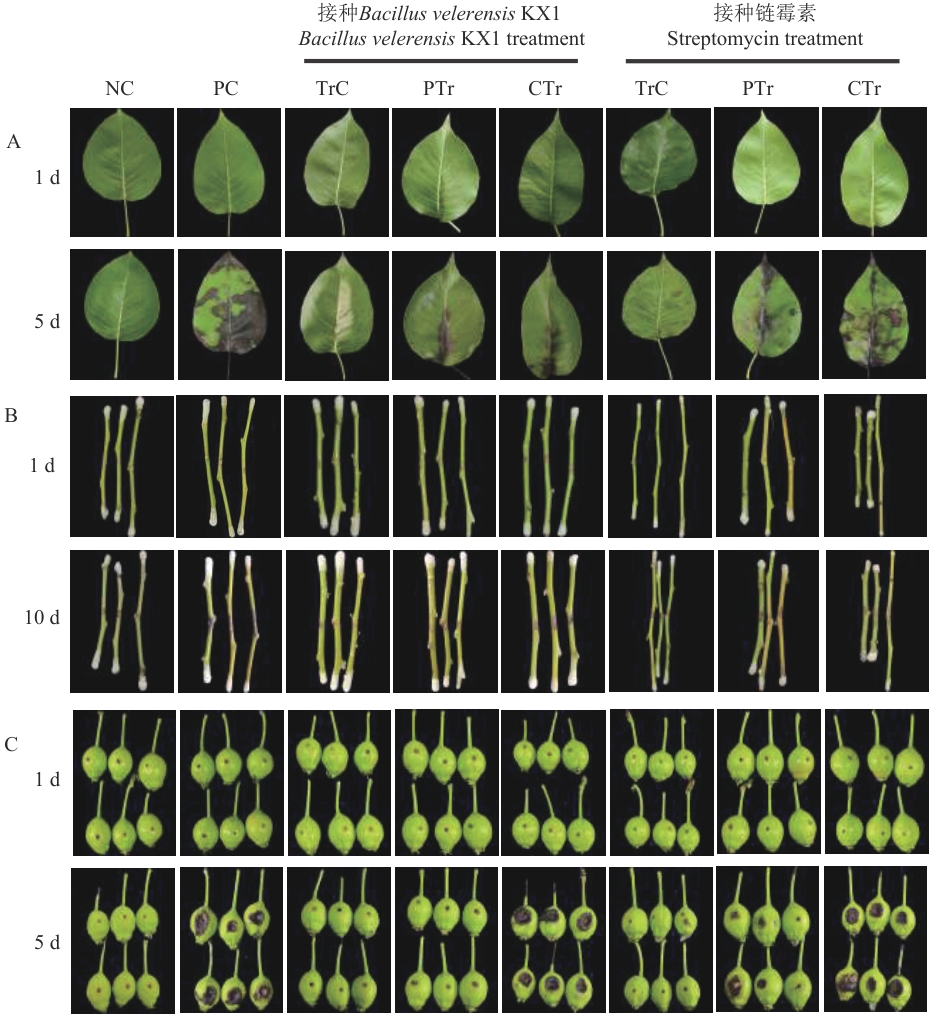
图9 B. velerensis KX1对库尔勒香梨叶片(A)、枝条(B)和幼果(C)上E. amylovora C1的防治效果NC: 阴性对照;PC:阳性对照;TrC:处理对照;PTr:保护性处理;CTr:治疗性处理,下同
Fig. 9 Effects of B. velerensis KX1 on control of E. amylovora C1 in Pyrus sinkiangensis Yü leaves (A), twigs (B), and immature fruits (C)NC: Negative control; PC: positive control; TrC: treatment control; PTr: protective treatment; CTr: curative treatment. The same below
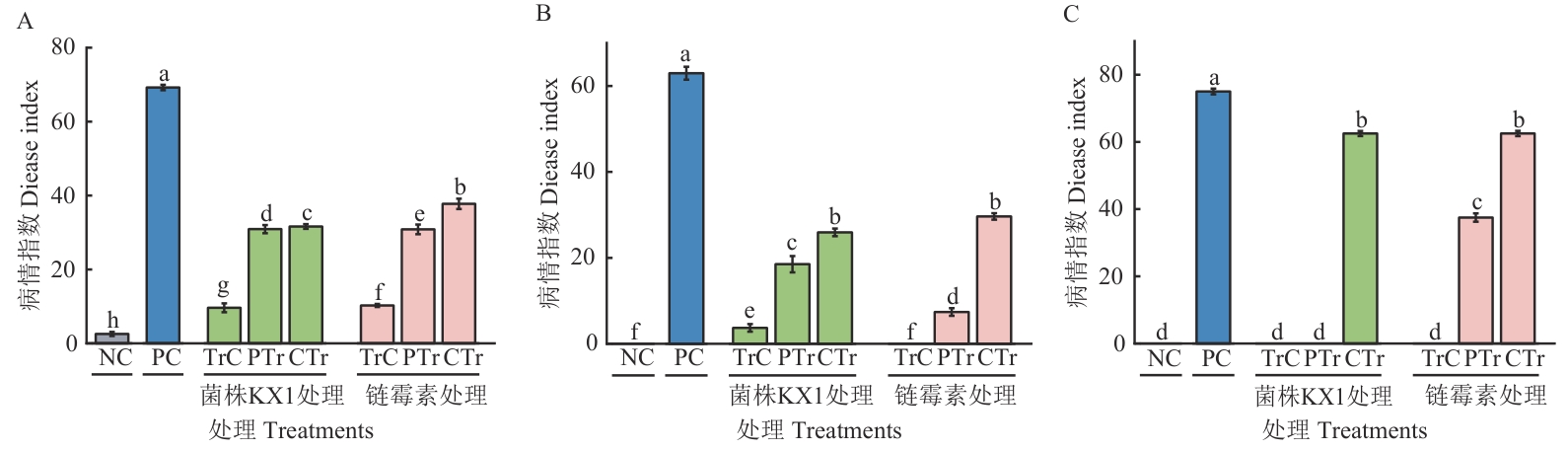
图10 B. velerensis KX1处理的库尔勒香梨叶片(A)、枝条(B)和幼果(C)中E. amylovora C1的病情指数
Fig. 10 Disease index of E. amylovora C1 in Pyrus sinkiangensis Yü leaves (A), twigs (B) and immature fruits (C)
处理 Treatment | 叶片 Leaves | 枝条 Twigs | 幼果 Fruit | ||||
|---|---|---|---|---|---|---|---|
病情指数 Disease index | 防病效果 Control efficacy (%) | 病情指数 Disease index | 防病效果 Control efficacy (%) | 病情指数 Disease index | 防病效果 Control efficacy (%) | ||
| 阴性对照 Negative control | 2.56±0.56h | 0.00±0.00f | 0.00±0.00d | ||||
| 阳性对照 Positive control | 69.23±0.74a | 62.96±1.5a | 75.00±0.85a | ||||
| KX1处理 Treatments by KX1 | TrC | 9.64±1.2g | 3.70±0.88e | 0.00±0.00d | |||
| PTr | 30.92±1.1d | 55.33±1.36a | 18.52±1.9c | 70.65±2.11b | 0.00±0.00d | 100a | |
| CTr | 31.62±0.64c | 54.33±2.02a | 25.93±0.89b | 58.82±6.01c | 62.50±0.75b | 16.67±7.12c | |
链霉素处理 Treatments by streptomycin | TrC | 10.26±0.41f | 0.00±0.00f | 0.00±0.00d | |||
| PTr | 30.85±1.3e | 55.44±3.33a | 7.40±0.89d | 88.25±4.70a | 37.50±1.25c | 40.00±9.46b | |
| CTr | 37.76±1.4b | 45.46±3.01b | 29.63±0.75b | 52.94±3.33b | 62.50±0.79b | 16.67±8.24c | |
表3 B. velerensis KX1对梨火疫病的防治效果
Table 3 Efficacy of B. velerensis KX1 on fire blight disease
处理 Treatment | 叶片 Leaves | 枝条 Twigs | 幼果 Fruit | ||||
|---|---|---|---|---|---|---|---|
病情指数 Disease index | 防病效果 Control efficacy (%) | 病情指数 Disease index | 防病效果 Control efficacy (%) | 病情指数 Disease index | 防病效果 Control efficacy (%) | ||
| 阴性对照 Negative control | 2.56±0.56h | 0.00±0.00f | 0.00±0.00d | ||||
| 阳性对照 Positive control | 69.23±0.74a | 62.96±1.5a | 75.00±0.85a | ||||
| KX1处理 Treatments by KX1 | TrC | 9.64±1.2g | 3.70±0.88e | 0.00±0.00d | |||
| PTr | 30.92±1.1d | 55.33±1.36a | 18.52±1.9c | 70.65±2.11b | 0.00±0.00d | 100a | |
| CTr | 31.62±0.64c | 54.33±2.02a | 25.93±0.89b | 58.82±6.01c | 62.50±0.75b | 16.67±7.12c | |
链霉素处理 Treatments by streptomycin | TrC | 10.26±0.41f | 0.00±0.00f | 0.00±0.00d | |||
| PTr | 30.85±1.3e | 55.44±3.33a | 7.40±0.89d | 88.25±4.70a | 37.50±1.25c | 40.00±9.46b | |
| CTr | 37.76±1.4b | 45.46±3.01b | 29.63±0.75b | 52.94±3.33b | 62.50±0.79b | 16.67±8.24c | |
| [1] | Klee SM, Sinn JP, McNellis TW. The apple fruitlet model system for fire blight disease [M]//Plant Innate Immunity. New York, NY: Springer New York, 2019: 187-198. |
| [2] | 杨金花, 徐叶挺, 张校立. 梨火疫病研究进展 [J]. 分子植物育种, 2022, 20(3): 1003-1013. |
| Yang JH, Xu YT, Zhang XL. Advances of fire blight in pear [J]. Mol Plant Breed, 2022, 20(3): 1003-1013. | |
| [3] | Slack SM, Zeng Q, Outwater CA, et al. Microbiological examination of Erwinia amylovora exopolysaccharide ooze [J]. Phytopathology, 2017, 107(4): 403-411. |
| [4] | Thomson SV. The role of the stigma in fire blight infections [J]. Phytopathology, 1986, 76(5): 476. |
| [5] | Koczan JM, Lenneman BR, McGrath MJ, et al. Cell surface attachment structures contribute to biofilm formation and xylem colonization by Erwinia amylovora [J]. Appl Environ Microbiol, 2011, 77(19): 7031-7039. |
| [6] | Sun WB, Gong PJ, Zhao YC, et al. Current situation of fire blight in China [J]. Phytopathology, 2023, 113(12): 2143-2151. |
| [7] | 刘凤权, 明亮, 赵延存, 等. 中国梨火疫病发生与防控进展 [J]. 落叶果树, 2023, 55(6): 1-7. |
| Liu FQ, Ming L, Zhao YC, et al. Progress in the occurrence and control of pear fire blight in China [J]. Deciduous Fruits, 2023, 55(6): 1-7. | |
| [8] | Ryu DK, Adhikari M, Choi DH, et al. Copper-based compounds against Erwinia amylovora: response parameter analysis and suppression of fire blight in apple [J]. Plant Pathol J, 2023, 39(1): 52-61. |
| [9] | McManus PS, Stockwell VO, Sundin GW, et al. Antibiotic use in plant agriculture [J]. Annu Rev Phytopathol, 2002, 40: 443-465. |
| [10] | Mikiciński A, Puławska J, Molzhigitova A, et al. Bacterial species recognized for the first time for its biocontrol activity against fire blight (Erwinia amylovora) [J]. Eur J Plant Pathol, 2020, 156(1): 257-272. |
| [11] | Din IU, Hu LN, Jiang Y, et al. Bacterial lipopeptides are effective against pear fire blight [J]. Microorganisms, 2024, 12(5): 896. |
| [12] | Halbwirth H, Fischer TC, Roemmelt S, et al. Induction of antimicrobial 3-deoxyflavonoids in pome fruit trees controls fire blight [J]. Z Für Naturforschung C, 2003, 58(11/12): 765-770. |
| [13] | Lee J, Jung WK, Ahsan SM, et al. Identification of Pantoea ananatis strain BCA19 as a potential biological control agent against Erwinia amylovora [J]. Front Microbiol, 2024, 15: 1493430. |
| [14] | Nguyen LTT, Park AR, Van Le V, et al. Exploration of a multifunctional biocontrol agent Streptomyces sp. JCK-8055 for the management of apple fire blight [J]. Appl Microbiol Biotechnol, 2024, 108(1): 49. |
| [15] | Johnson KB, Stockwell VO. Management of fire blight: a case study in microbial ecology [J]. Annu Rev Phytopathol, 1998, 36: 227-248. |
| [16] | Mechan Llontop ME, Hurley K, Tian L, et al. Exploring rain as source of biological control agents for fire blight on apple [J]. Front Microbiol. 2020, 11: 199. |
| [17] | Kim IY, Lew B, Zhao YF, et al. Biocontrol of fire blight via microcapsule-mediated delivery of the bacterial antagonist Pantoea agglomerans E325 to apple blossoms [J]. BioControl, 2022, 67(4): 433-442. |
| [18] | Ghimire B, Orellana R, Chowdhury SR, et al. Assessing biofungicides and host resistance against Rhizoctonia large patch in zoysia grass [J]. Pathogens, 2024, 13(10): 864. |
| [19] | 白雪莹, 韩剑, 孙博源, 等. 梨火疫病和梨腐烂病生防潜力粘细菌的筛选鉴定及室内防效评价 [J]. 中国生物防治学报, 2023, 39(6): 1384-1397. |
| Bai XY, Han J, Sun BY, et al. Screening and identification of biocontrol potential myxobacteria strains against fire blight and pear canker diseases and evaluation of indoor control efficacy [J]. Chin J Biol Control, 2023, 39(6): 1384-1397. | |
| [20] | 江星彤, 柏晓玉, 冯玉莲, 等. 极端耐旱链霉菌D67对梨火疫病原菌毒力因子的抑制作用 [J]. 微生物学通报, 2025, 52(7): 3165-3175. |
| Jiang XT, Bai XY, Feng YL, et al. Inhibitory effects of extreme drought-resistant Streptomyces D67 on the virulence factors of Erwinia amylovora [J]. Microbiol China, 2025, 52(7): 3165-3175. | |
| [21] | 林胜楠, 吴梓菲, 王宁, 等. 梨火疫病生防菌的筛选及抑菌机理初探 [J]. 西北农业学报, 2025, 34(7): 1346-1355. |
| Lin SN, Wu ZF, Wang N, et al. Screening of biocontrol bacteria against fire blight and preliminary study on its biocontrol mechanism [J]. Acta Agric Boreali Occidentalis Sin, 2025, 34(7): 1346-1355. | |
| [22] | Sundin GW, Wang N. Antibiotic resistance in plant-pathogenic bacteria [J]. Annu Rev Phytopathol, 2018, 56: 161-180. |
| [23] | Sundin GW, Werner NA, Yoder KS, et al. Field evaluation of biological control of fire blight in the eastern United States [J]. Plant Dis, 2009, 93(4): 386-394. |
| [24] | Quan Zeng JP. Early events in fire blight infection and pathogenesis of Erwinia amylovora [J]. J Plant Pathol, 2021, 103: S13-S24. |
| [25] | Ngugi HK, Lehman BL, Madden LV. Multiple treatment meta-analysis of products evaluated for control of fire blight in the eastern United States [J]. Phytopathology, 2011, 101(5): 512-522. |
| [26] | 车建美, 郑雪芳, 王阶平, 等. 一株产纤维素酶菌株的筛选、鉴定及全基因组分析 [J]. 生物技术通报, 2025, 41(3): 294-307. |
| Che JM, Zheng XF, Wang JP, et al. Screening, identification and whole genome analysis of a cellulase producing strain [J]. Biotechnol Bull, 2025, 41(3): 294-307. | |
| [27] | Anon. Diagnostics PM 7/20 (2) Erwinia amylovora [J]. EPPO Bull, 2013, 43(1): 21-45 |
| [28] | 马云涛, 胡丽娜, 孙文婧, 等. 梨火疫病拮抗菌JK2的筛选鉴定及发酵条件优化 [J]. 生物技术通报, 2024, 40(11): 202-213. |
| Ma YT, Hu LN, Sun WJ, et al. Screening and identification of antagonistic bacterium JK2 against fire blight disease and the optimization of its fermentation conditions [J]. Biotechnol Bull, 2024, 40(11): 202-213. | |
| [29] | 方中达. 植病研究方法 [M]. 3版. 北京: 中国农业出版社, 1998. |
| Fang ZD. Research methods of plant diseases [M]. 3rd ed. Beijing: China Agriculture Press, 1998. | |
| [30] | Krieg NR, Staley JT, Brown DR, et al. Bergey’s manual® of systematic bacteriololgy[M]. USA: The Williams &Wilkins Co, 1986. |
| [31] | 东秀珠, 蔡妙英. 常见细菌系统鉴定手册 [M]. 北京: 科学出版社, 2001. |
| Dong XZ, Cai MY. Handbook of identification of common bacterial systems [M]. Beijing: Science Press, 2001. | |
| [32] | Turner S, Pryer KM, Miao VPW, et al. Investigating deep phylogenetic relationships among cyanobacteria and plastids by small subunit rRNA sequence analysis [J]. J Eukaryot Microbiol, 1999, 46(4): 327-338. |
| [33] | Case RJ, Boucher Y, Dahllöf I, et al. Use of 16S rRNA and rpoB Genes as molecular markers for microbial ecology studies [J]. Appl Environ Microbiol, 2007, 73(1): 278-288. |
| [34] | Ki JS, Zhang W, Qian PY. Discovery of marine Bacillus species by 16S rRNA and rpoB comparisons and their usefulness for species identification [J]. J Microbiol Meth, 2009, 77(1): 48-57. |
| [35] | Joshi R, McSpadden Gardener BB. Identification and characterization of novel genetic markers associated with biological control activities in Bacillus subtilis [J]. Phytopathology® , 2006, 96(2): 145-154. |
| [36] | Chen XH, Scholz R, Borriss M, et al. Difficidin and bacilysin produced by plant-associated Bacillus amyloliquefaciens are efficient in controlling fire blight disease [J]. J Biotechnol, 2009, 140(1/2): 38-44. |
| [37] | Cui Z, Hu L, Zeng L, Meng W, et al. Isolation and characterization of Priestia megaterium KD7 for the biological control of pear fire blight [J]. Front Microbiol. 2023, 14:1099664. |
| [38] | Medhioub I, Cheffi M, Tounsi S, et al. Study of Bacillus velezensis OEE1 potentialities in the biocontrol against Erwinia amylovora, causal agent of fire blight disease of rosaceous plants [J]. Biol Control, 2022, 167: 104842. |
| [39] | 李晓妹, 韩丽丽, 何亚南, 等. 20个苹果品种(类型)对梨火疫病菌的抗病性评价 [J]. 植物检疫, 2022, 36(4): 6-12. |
| Li XM, Han LL, He YN, et al. Evaluation of resistance of 20 apple varieties (types) to Pyrus Pyricularia [J]. Plant Quar, 2022, 36(4): 6-12. | |
| [40] | Stockwell VO, Johnson KB, Sugar D, et al. Mechanistically compatible mixtures of bacterial antagonists improve biological control of fire blight of pear [J]. Phytopathology, 2011, 101(1): 113-123. |
| [41] | 刘思慧, 明珂, 陈国庆, 等. 一种抗稻曲病菌的摩氏假单胞菌JP2-207及其抗性机制初探 [J]. 中国稻米, 2024, 30(2): 13-17. |
| Liu SH, Ming K, Chen GQ, et al. A preliminary study on the mechanism of Pseudomonas mosselii JP2-207 against rice false smut fungus Ustilaginoidea virens [J]. China Rice, 2024, 30(2): 13-17. | |
| [42] | Wang J, Xie XY, Li B, et al. Complete genome analysis and antimicrobial mechanism of Bacillus velezensis GX0002980 reveals its biocontrol potential against mango anthracnose disease [J]. Microbiol Spectr, 2025, 13(6): e02685-24. |
| [43] | Tola SD, Muleta D, Assefa F, et al. Characterization and identification of hot pepper-associated endospore-forming bacteria with potential applications as biofertilizers and in biocontrol of pepper wilt pathogens [J]. BMC Microbiol, 2025, 25(1): 198. |
| [44] | Ongena M, Jacques P. Bacillus lipopeptides: versatile weapons for plant disease biocontrol [J]. Trends Microbiol, 2008, 16(3): 115-125. |
| [45] | 贺旭, 韩剑, 盛强, 等. 梨火疫病拮抗细菌FX1及其抑菌物质的防病作用 [J]. 园艺学报, 2023, 50(5): 1118-1129. |
| He X, Han J, Sheng Q, et al. Screening of antagonistic bacterium FX1 against Erwinia amylovora and its control effect of the antibacterial substances on fire blight [J]. Acta Hortic Sin, 2023, 50(5): 1118-1129. | |
| [46] | 杨瑞先, 刘萍, 王祖华, 等. 牡丹根腐病原菌拮抗细菌抑菌活性物质分析 [J]. 生物技术通报, 2022, 38(2): 57-66. |
| Yang RX, Liu P, Wang ZH, et al. Analysis of antimicrobial active metabolites from antagonistic strains against Fusarium solani [J]. Biotechnol Bull, 2022, 38(2): 57-66. | |
| [47] | 付克剑, 苏友波, 崔永和, 等. 荧光假单胞菌YG-1对烟草根黑腐病菌的体外拮抗 [J]. 中国烟草科学, 2024, 45(1): 39-47. |
| Fu KJ, Su YB, Cui YH, et al. In vitro antagonism of Pseudomonas fluorescens YG-1 against Thielaviopsis basicola [J]. Chin Tob Sci, 2024, 45(1): 39-47. | |
| [48] | 张雯, 卞丹, 沈燕秋, 等. 枯草芽胞杆菌抑菌活性物质鉴定、抑菌特性及发酵条件优化 [J]. 中国食品学报, 2017, 17(12): 105-115. |
| Zhang W, Bian D, Shen YQ, et al. Identification and characterization of antibacterial metabolites and optimization of cultural conditions for Bacillus subtilis [J]. J Chin Inst Food Sci Technol, 2017, 17(12): 105-115. | |
| [49] | Soussi S, Essid R, Hardouin J, et al. Utilization of grape seed flour for antimicrobial lipopeptide production by Bacillus amyloliquefaciens C5 strain [J]. Appl Biochem Biotechnol, 2019, 187(4): 1460-1474. |
| [50] | 周池, 周诗晶, 陶禹, 等. 贝莱斯芽胞杆菌XY40-1: 全基因组特征分析及对辣椒疫病的生物防治效果评价 [J]. 微生物学报, 2024, 64(12): 4882-4901. |
| Zhou C, Zhou SJ, Tao Y, et al. Bacillus velezensis XY40-1: whole genomic characteristics and biocontrol effects on pepper Phytophthora blight [J]. Acta Microbiol Sin, 2024, 64(12): 4882-4901. | |
| [51] | 张雨薇, 唐培培, 刘子琦, 等. 一株抑制烟草疫霉的耐受盐芽胞杆菌(Bacillus halotolerans)的分离、鉴定及全基因组测序分析 [J]. 微生物学通报, 2025, 52(4): 1760-1774. |
| Zhang YW, Tang PP, Liu ZQ, et al. Isolation, identification, and whole genome sequencing of a Bacillus halotolerans strain inhibiting Phytophthora nicotianae [J]. Microbiol China, 2025, 52(4): 1760-1774. | |
| [52] | Fazle Rabbee M, Baek KH. Antimicrobial activities of lipopeptides and polyketides of Bacillus velezensis for agricultural applications [J]. Molecules, 2020, 25(21): 4973. |
| [53] | Hamley IW. Lipopeptides: from self-assembly to bioactivity [J]. Chem Commun, 2015, 51(41): 8574-8583. |
| [54] | 刘振亚, 苏宣乐, 唐丽, 等. 梨火疫病抗性评价体系的建立及其种质资源抗性鉴定 [J]. 福建农业学报, 2024, 39(5): 609-614. |
| Liu ZY, Su XL, Tang L, et al. An evaluation protocol for fire blight resistance of pear cultivars [J]. Fujian J Agric Sci, 2024, 39(5): 609-614. | |
| [55] | Farkas Á, Mihalik E, Dorgai L, et al. Floral traits affecting fire blight infection and management [J]. Trees, 2012, 26(1): 47-66. |
| [1] | 吕镇, 甘恬, 霍思羽, 赵晨笛, 赵梦瑶, 李亚涛, 马玉超, 耿玉清. 产Surfactin贝莱斯芽胞杆菌C5A-1的鉴定和所产Surfactin对植物的促生效果[J]. 生物技术通报, 2025, 41(9): 265-276. |
| [2] | 石艳华, 李朔, 高玉珠, 郑保坤, 朱杰华, 张岱, 杨志辉. 贝莱斯芽胞杆菌NZ-4挥发性有机物的促生作用及其活性成分分析[J]. 生物技术通报, 2025, 41(8): 300-310. |
| [3] | 张津浩, 邓辉, 张清壮, 陶禹, 周池, 李鑫. 贝莱斯芽胞杆菌XY40-1对百合球茎生长、品质及镉含量的调控作用[J]. 生物技术通报, 2025, 41(7): 281-291. |
| [4] | 贾雪, 隋丽, 邹晓威, 路杨, 张正坤, 李启云. 真菌病毒BbOCuV1对寄主球孢白僵菌生长发育和亚洲玉米螟致病力的影响[J]. 生物技术通报, 2025, 41(7): 312-325. |
| [5] | 张吉昌, 许云凤, 蒋凌雁. 柱花草内生细菌ZW21发酵条件优化及其抑菌物质稳定性测定[J]. 生物技术通报, 2025, 41(5): 280-289. |
| [6] | 陈永旗, 李志文, 李鑫, 原若曦, 王春旭, 韩毅强, 高亚梅. 黑土区大豆根际土壤放线菌的分离与功能研究[J]. 生物技术通报, 2025, 41(5): 255-266. |
| [7] | 罗明凯, 张豪杰, 石晖琴, 李亚楠, 封瑞超, 沈硕. 三株马铃薯炭疽病生防菌的分离鉴定及其高抑菌活性培养物发酵参数优化[J]. 生物技术通报, 2025, 41(12): 313-327. |
| [8] | 吴琼, 陈德勇, 朱鹤, 王丹, 张晓军, 陈捷胤. 洋葱伯克霍尔德氏菌KRS634对棉花红腐病的生防效果[J]. 生物技术通报, 2025, 41(12): 294-303. |
| [9] | 吕济敏, 刘巍, 孙敏, 李洪顺, 彭振兴, 邱鹏飞, 朱其立. 马铃薯早疫病拮抗菌的筛选鉴定和发酵条件优化[J]. 生物技术通报, 2025, 41(10): 175-185. |
| [10] | 慕雪男, 吴桐, 郑子薇, 张越, 王志刚, 徐伟慧. 一株番茄青枯病生防细菌的筛选、鉴定及其生防潜力分析[J]. 生物技术通报, 2025, 41(1): 276-286. |
| [11] | 刘倩, 马连杰, 张慧, 王冬, 范茂, 廖敦秀, 赵正武, 卢文才. 辣椒炭疽病生防菌株TN2的筛选鉴定与抑菌效果[J]. 生物技术通报, 2025, 41(1): 287-297. |
| [12] | 王美玲, 耿丽丽, 房瑜, 束长龙, 张杰. 苏云金芽胞杆菌4BM1菌株对油菜菌核病的防治潜力[J]. 生物技术通报, 2024, 40(9): 260-269. |
| [13] | 王芳, 于璐, 齐泽铮, 周长军, 于吉东. 大豆镰刀菌根腐病拮抗菌的筛选及生防效果[J]. 生物技术通报, 2024, 40(7): 216-225. |
| [14] | 范宗强, 冯靖涵, 郑丽雪, 王硕, 彭向前, 陈芳. 枯草芽孢杆菌B579对黄瓜枯萎病的防治及其诱导抗性研究[J]. 生物技术通报, 2024, 40(7): 226-234. |
| [15] | 徐伟芳, 李贺宇, 张慧, 何仔昂, 高文恒, 谢紫洋, 王传文, 尹登科. 生防细菌HX0037对栝楼炭疽病的防病能力及其机制[J]. 生物技术通报, 2024, 40(4): 228-241. |
| 阅读次数 | ||||||
|
全文 |
|
|||||
|
摘要 |
|
|||||
