







生物技术通报 ›› 2026, Vol. 42 ›› Issue (9): 93-106.doi: 10.13560/j.cnki.biotech.bull.1985.2026-0023
任琼, 钟娇, 段玉, 秦童( ), 康振辉()
收稿日期:2026-01-08
出版日期:2026-09-26
发布日期:2026-09-16
通讯作者:
康振辉zhKang85@126.com基金资助:
REN Qiong, ZHONG Jiao, DUAN Yu, QIN Tong(), KANG Zhen-hui()
Received:2026-01-08
Published:2026-09-26
Online:2026-09-16
摘要:
目的 DnaJ型锌指蛋白分子伴侣在水稻中的功能尚不完全清楚。探究OsDJA10基因(LOC_Os08g36140)敲除株系(KO)白化和RNA干扰株系(RNAi)黄化表型的分子机制,评估其过表达株系(OE)的高光耐受性,为水稻抗逆品种培育提供理论参考。 方法 利用CRISPR/Cas9基因编辑技术、RNAi技术和农杆菌介导转化法分别获得敲除、敲低和过表达株系,通过测定光合色素、叶绿素荧光、叶绿体超微结构、抗氧化酶活性、叶片和根系相对含水量、相对电导率、生长性状等生理指标,并结合亚细胞定位、RT-qPCR和转录组学分析,解析OsDJA10基因的生物学功能。 结果 OsDJA10敲除株系幼苗期表现为白化致死表型,几乎不合成植物色素,缺乏成熟叶绿体和类囊体垛叠,叶绿体结构与发育相关基因表达显著下调,差异表达基因显著富集在光合作用通路。RNAi植株叶片黄化,光合色素含量显著低于野生型中花11、Fv/Fm和NPQ显著下调,叶绿体个数显著减少、体积显著变小且重塑类囊体垛叠,叶绿体结构与发育相关基因表达均下调。过表达株系株高、穗长及剑叶长显著降低,未对产量产生积极影响,对高光胁迫的耐受性显著高于野生型中花11。 结论 OsDJA10基因通过影响光合基因转录和光合器官稳定性,正调控水稻叶绿体发育,同时增强高光胁迫耐受性。
任琼, 钟娇, 段玉, 秦童, 康振辉. 水稻DnaJ型锌指蛋白OsDJA10正调控叶绿体发育[J]. 生物技术通报, 2026, 42(9): 93-106.
REN Qiong, ZHONG Jiao, DUAN Yu, QIN Tong, KANG Zhen-hui. DnaJ-type Zinc Finger Protein OsDJA10 Positively Regulates Chloroplast Development in Rice[J]. Biotechnology Bulletin, 2026, 42(9): 93-106.
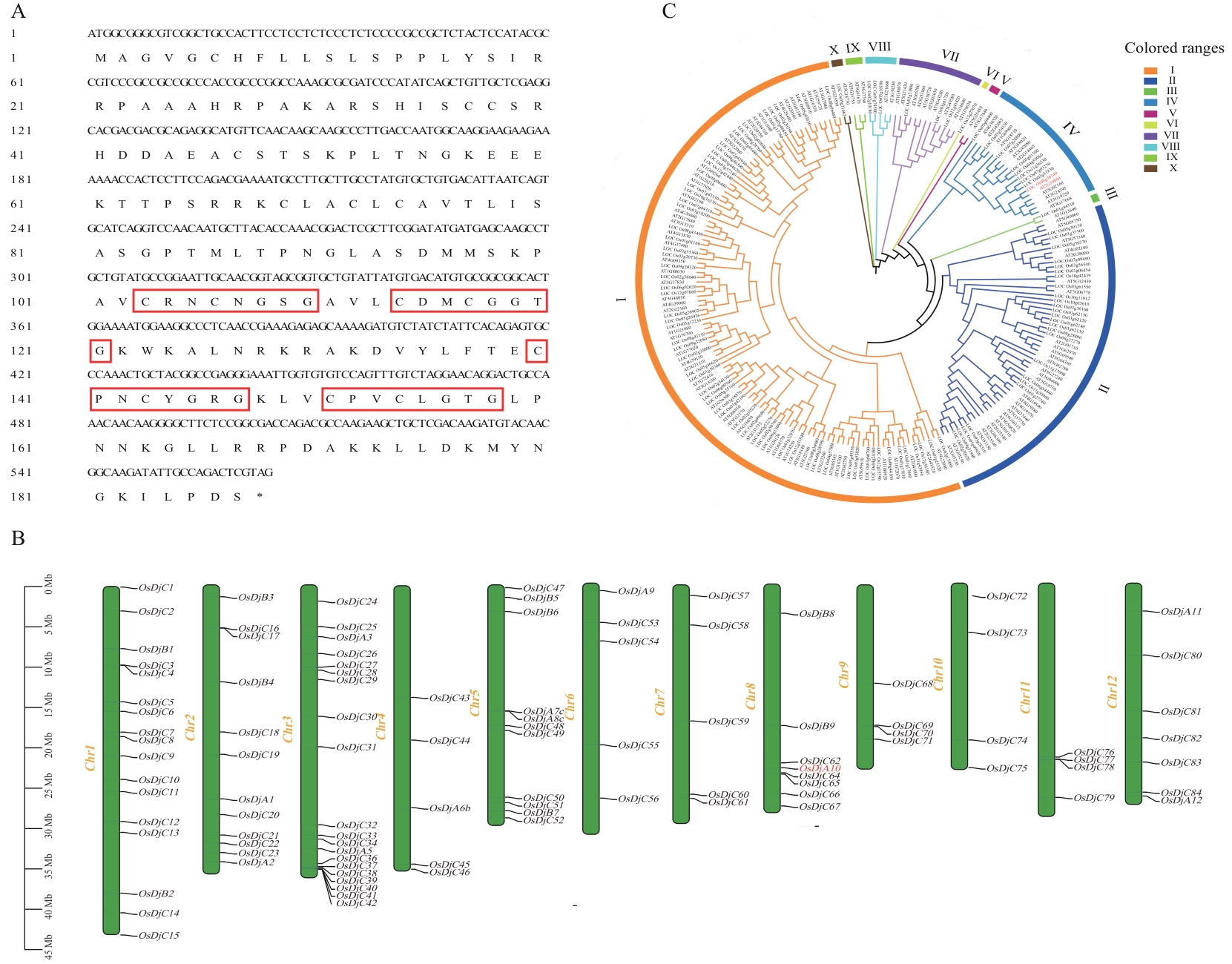
图1 OsDJA10基因的鉴定A:LOC_Os08g36140的CDS编码序列和氨基酸序列,图中红色框代表DnaJ型“CxxCxGxG”锌指结构域的保守基序;B:水稻DnaJ基因的染色体定位,图中红色字母代表OsDJA10的染色体位置;C:水稻和拟南芥的DnaJ家族系统进化树
Fig. 1 Identification of OsDJA10A: The coding sequence and amino acid sequence of LOC_Os08g36140. The red box indicates the conserved motif of the DnaJ-type “CxxCxGxG” zinc finger domain. B: Chromosomal localization of the rice DnaJ gene. The red letters denote the chromosomal position of OsDJA10. C: Phylogenetic tree of the DnaJ family in rice and Arabidopsis
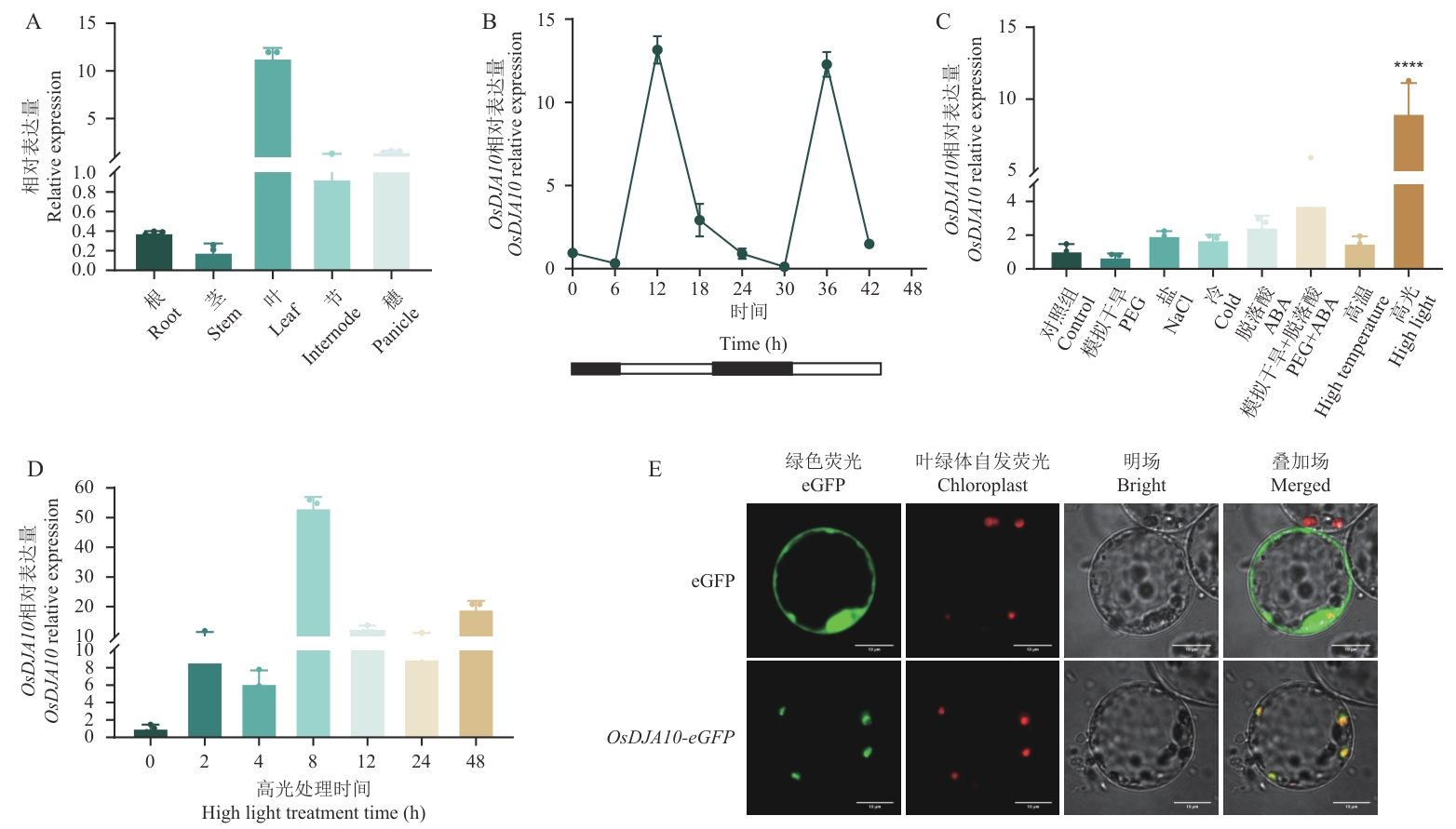
图2 OsDJA10的表达模式和亚细胞定位A:OsDJA10在水稻不同组织中的表达;B:OsDJA10的节律表达;C:OsDJA10在不同胁迫处理下的表达量,冷:4 ℃,高温:42 ℃;D:OsDJA10在高光胁迫下不同时间点的表达水平;E:OsDJA10在水稻原生质体中的亚细胞定位;绿色荧光表示GFP信号,红色荧光表示叶绿体自发荧光;Bright:明场。数据以平均值±SD表示,n=3。比例尺= 10 μm。数据采用t检验。**** P< 0.000 1,下同
Fig. 2 Expression pattern and subcellular localization of OsDJA10A: Expression of OsDJA10 in different tissues of rice. B: Circadian expression of OsDJA10. C: Expression analysis of OsDJA10 under different stress conditions. Cold stress: 4 ℃; high temperature: 42 ℃. D: Expression of OsDJA10 at different time points under high light stress. E: Subcellular localization of OsDJA10 in rice protoplasts. Green fluorescence indicates GFP signal, red fluorescence indicates chloroplast autofluorescence. Bright: Bright field. Data are presented as mean ± SD. n=3. Scale bar = 10 μm. Data were analyzed using t-tests. **** P < 0.000 1. The same below
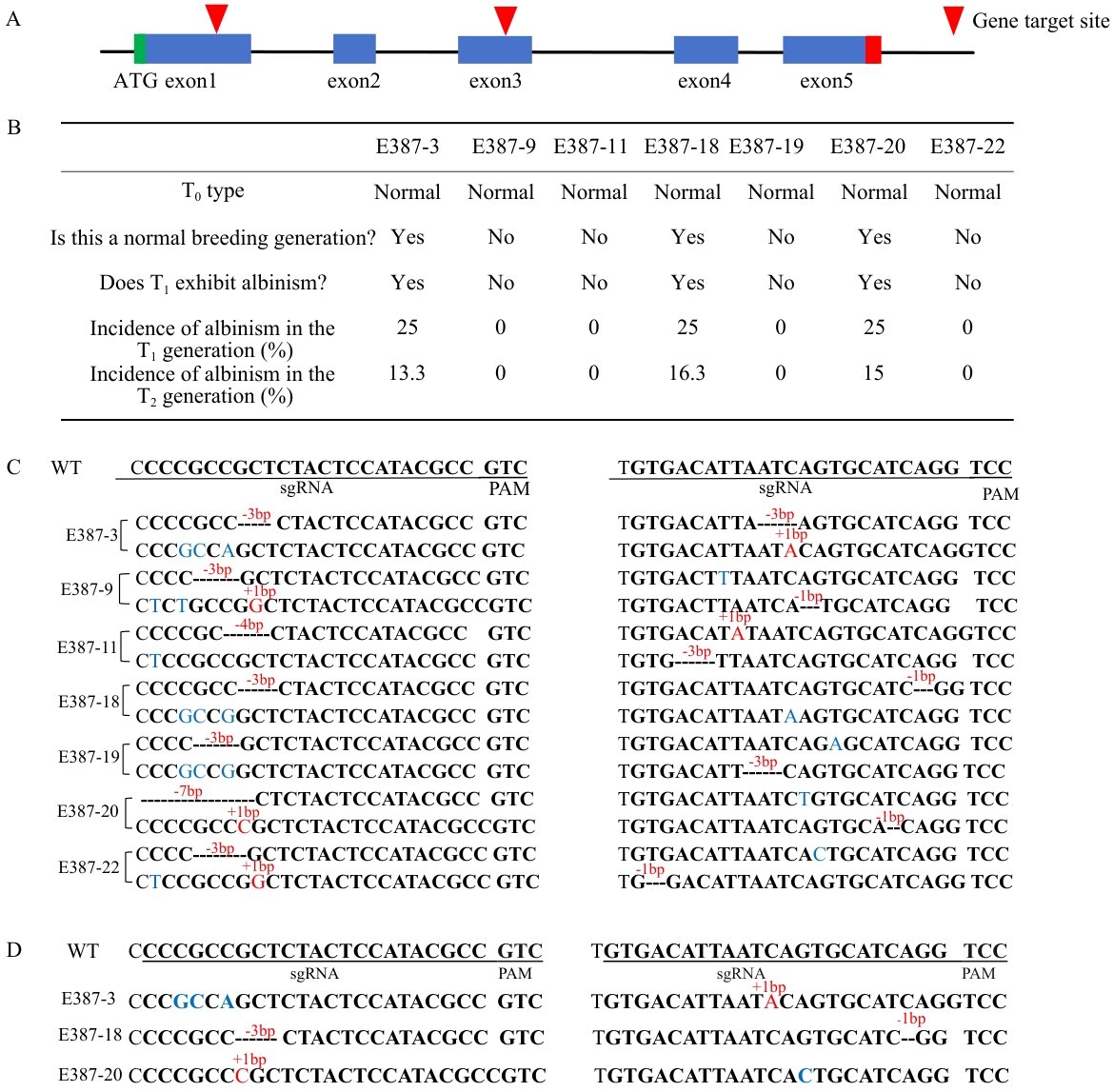
图3 OsDJA10敲除突变体的分析鉴定A:OsDJA10的sgRNA靶点位置,蓝色方框代表外显子,绿色方框代表起始密码子,红色方框代表终止密码子;B:株系中各CRISPR/Cas9基因组编辑频率汇总;C:CRISPR/Cas9编辑T0代的序列对比图;D:CRISPR/Cas9编辑T1代的序列对比图。图中划线序列代表sgRNA和PAM序列,蓝色字体代表碱基替换,虚线代表缺失碱基,红色字体代表插入碱基序列
Fig. 3 Analysis and identification of OsDJA10 knockout mutantsA: sgRNA target site location for OsDJA10. The blue boxes represent exons, the green boxes represent start codons, and the red boxes represent stop codons. B: Summary of CRISPR/Cas9 genome editing frequencies across strains. C: Sequence alignment of CRISPR/Cas9-edited T0 generation. D: Sequence alignment of CRISPR/Cas9-edited T1 generation. Underlined sequences denote sgRNA and PAM sequences; blue letters indicate base substitutions, dashed lines represent deleted bases, and red letters indicate inserted nucleotide sequences
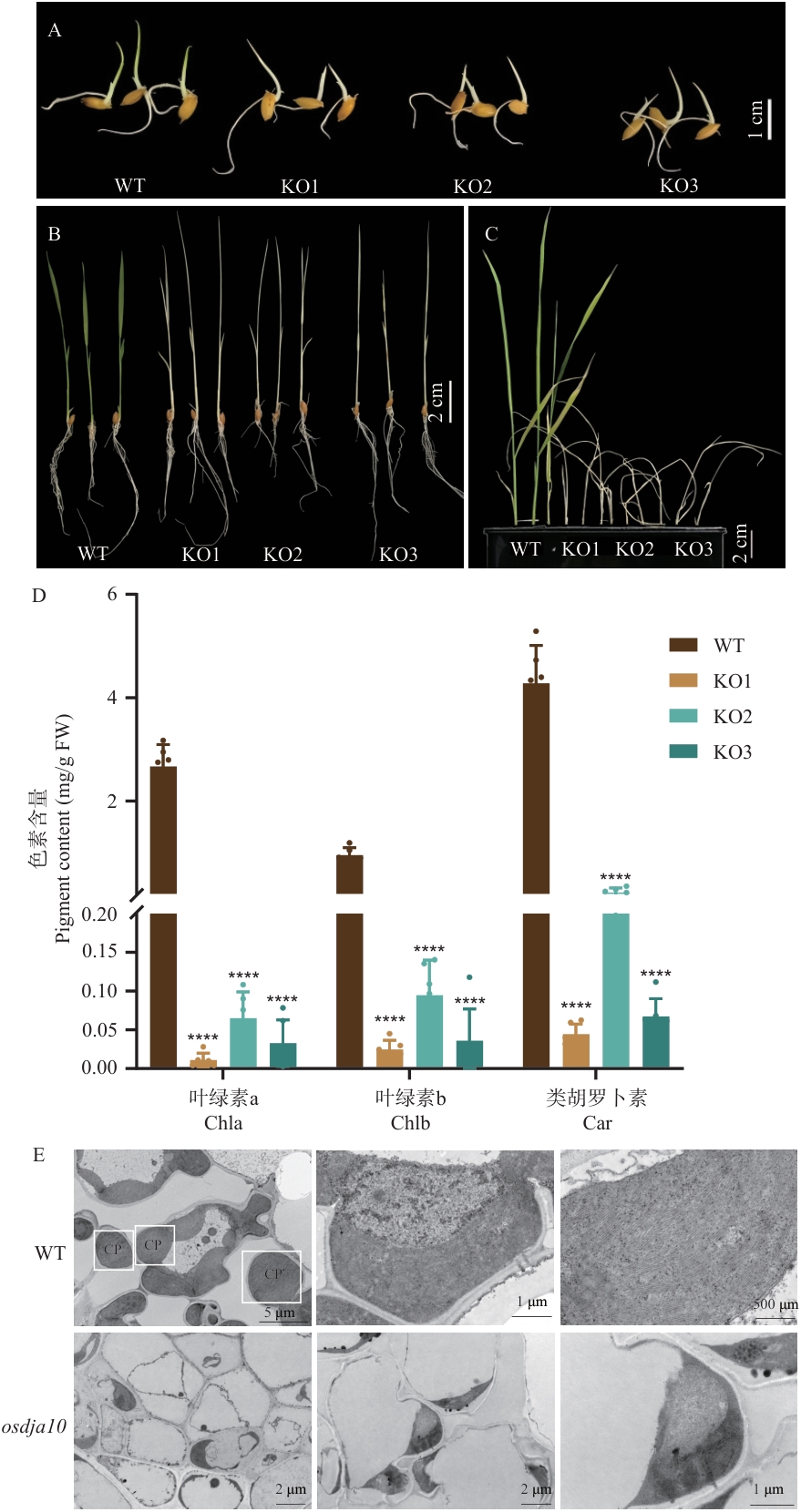
图4 OsDJA10纯合突变体显示白化表型A:水稻种子萌发后3 d的表型;标尺为1 cm,KO1、KO2和KO3分别为阳性编辑株系E387-3、E387-18和E387-20;B:水稻种子萌发后9 d的表型,标尺为2 cm;C:生长周期为21 d,标尺为2 cm;D:Chl a、Chl b和Car含量测定;E:叶绿体超微结构,CP:叶绿体。数据为6个生物学重复的均值±SD。数据采用t检验
Fig. 4 Homozygous mutant of OsDJA10 displays an albino phenotypeA: Phenotype of rice seeds 3 days after germination, scale bar = 1 cm; KO1, KO2, and KO3 represent positive edit lines E387-3, E387-18, and E387-20, respectively. B: Phenotype of rice seeds 9 days after germination, scale bar = 2 cm. C: Growth cycle at 21 days post-germination, scale bar = 2 cm. D: Chl a, Chl b, and Car content measurements. E: Chloroplast ultrastructure. CP: Chloroplast. Data represent the mean ± SD of six biological replicates. All data were analyzed using Student’s t-test
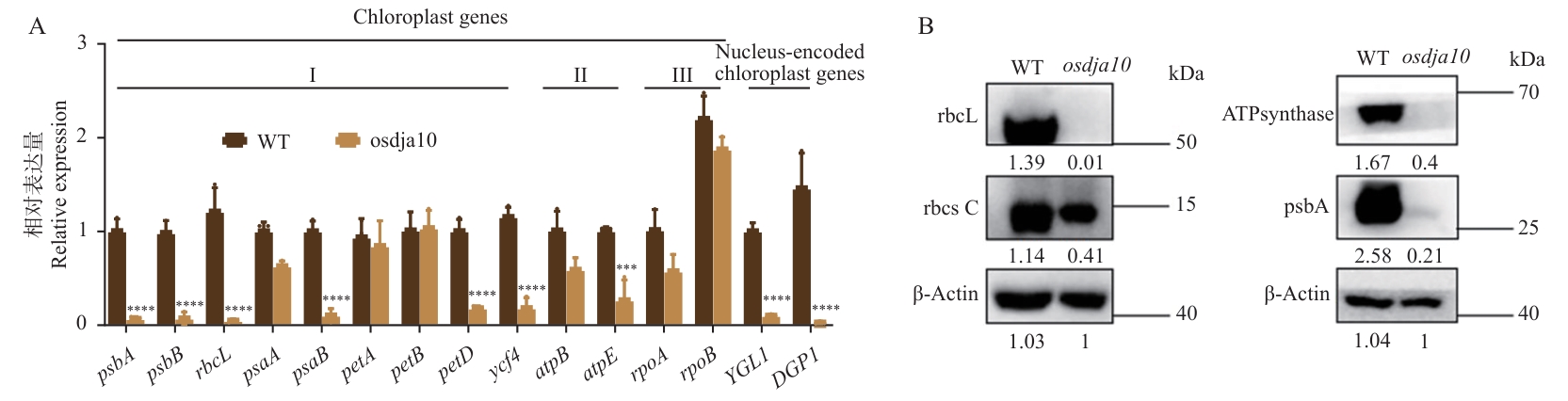
图5 叶绿体相关基因表达及蛋白水平分析A:WT和OSDJA10叶绿体基因和核编码的叶绿体基因的RT-qPCR分析;I类代表PEP依赖基因;II类代表PEP和NEP依赖基因;III类代表NEP依赖基因;B:Western blot分析WT和osdja10幼苗的叶绿体编码蛋白,以β-actin作为内参蛋白;数据为3个生物重复的均值±SD;所有数据采用t检验;***P<0.001,下同
Fig. 5 Analysis of chloroplast-associated gene expression and protein levelsA: RT-qPCR analysis of chloroplast-encoded genes and nucleus-encoded chloroplast genes in WT and OsDJA10. Class I: PEP-dependent genes; Class II: PEP- and NEP-dependent genes; Class III: NEP-dependent genes. B: Western blot analysis of chloroplast-encoded proteins in WT and osdja10 seedlings, with β-actin as the internal control protein. Data represent the mean ± SD of three biological replicates. All data were analyzed using Student’s t-test. ***P < 0.001. The same below
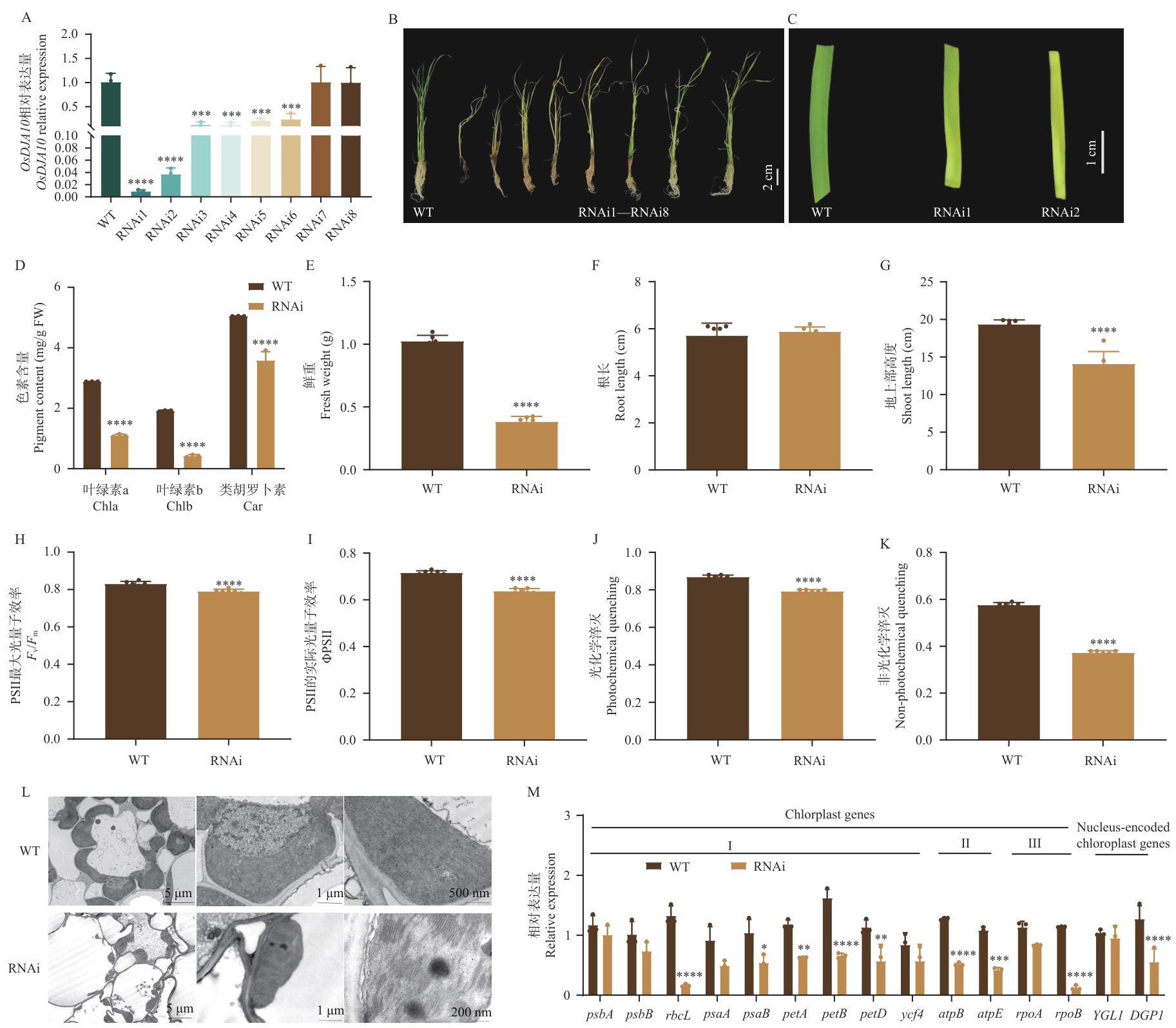
图6 OsDJA10敲低赋予水稻黄绿色表型A:RT-qPCR分析SiRNAi1-i8的干扰水平,数据为3个生物重复的均值±SD,数据采用单因素方差分析;B:WT和RNAi株系的表型,Bar=2 cm;C:WT和RNAi株系的叶片表型对比,Bar=1 cm;D:Chla、Chlb和Car含量;E:鲜重;F:根长;G:地上部高度;H:PSII最大光量子效率;I:PSII的实际光量子效率;J:光化学淬灭;K:非光化学淬灭;数据为6个生物学重复的均值±SD,数据采用单因素方差分析;L:叶绿体超微结构;M:叶绿体基因和核编码的叶绿体基因的RT-qPCR分析;I类代表PEP依赖基因;II类代表PEP和NEP依赖基因;III类代表NEP依赖基因;数据为6个生物重复的均值±SD。所有数据均采用t检验,*P <0.05,**P<0.01,下同
Fig. 6 Knockdown of OsDJA10 confers a yellowish-green phenotype in riceA: RT-qPCR analysis of siRNAi1-i8 interference levels. Data represent the mean ± SD of three biological replicates analyzed by one-way ANOVA. B: Phenotype of WTand RNAi lines. Bar = 2 cm. C: Comparison of leaf phenotypes between WT and RNAi lines. Bar = 1 cm. D: Chla, Chlb, and Car content. E: Fresh weight. F: Root length. G: Above-ground height. H: Maximum quantum efficiency of PSII. I: Actual quantum efficiency of PSII. J: Photochemical quenching. K: Non-photochemical quenching. Data represent the mean ± SD of six biological replicates, analyzed by one-way ANOVA. L: Chloroplast ultrastructure. M: RT-qPCR analysis of chloroplast genes and nucleus-encoded chloroplast genes; class I represents PEP-dependent genes; class II represents PEP- and NEP-dependent genes; class III represents NEP-dependent genes. Data represent the mean ± SD from six biological replicates. All data were analyzed using Student’s t-test, *P <0.05,**P < 0.01. The same below
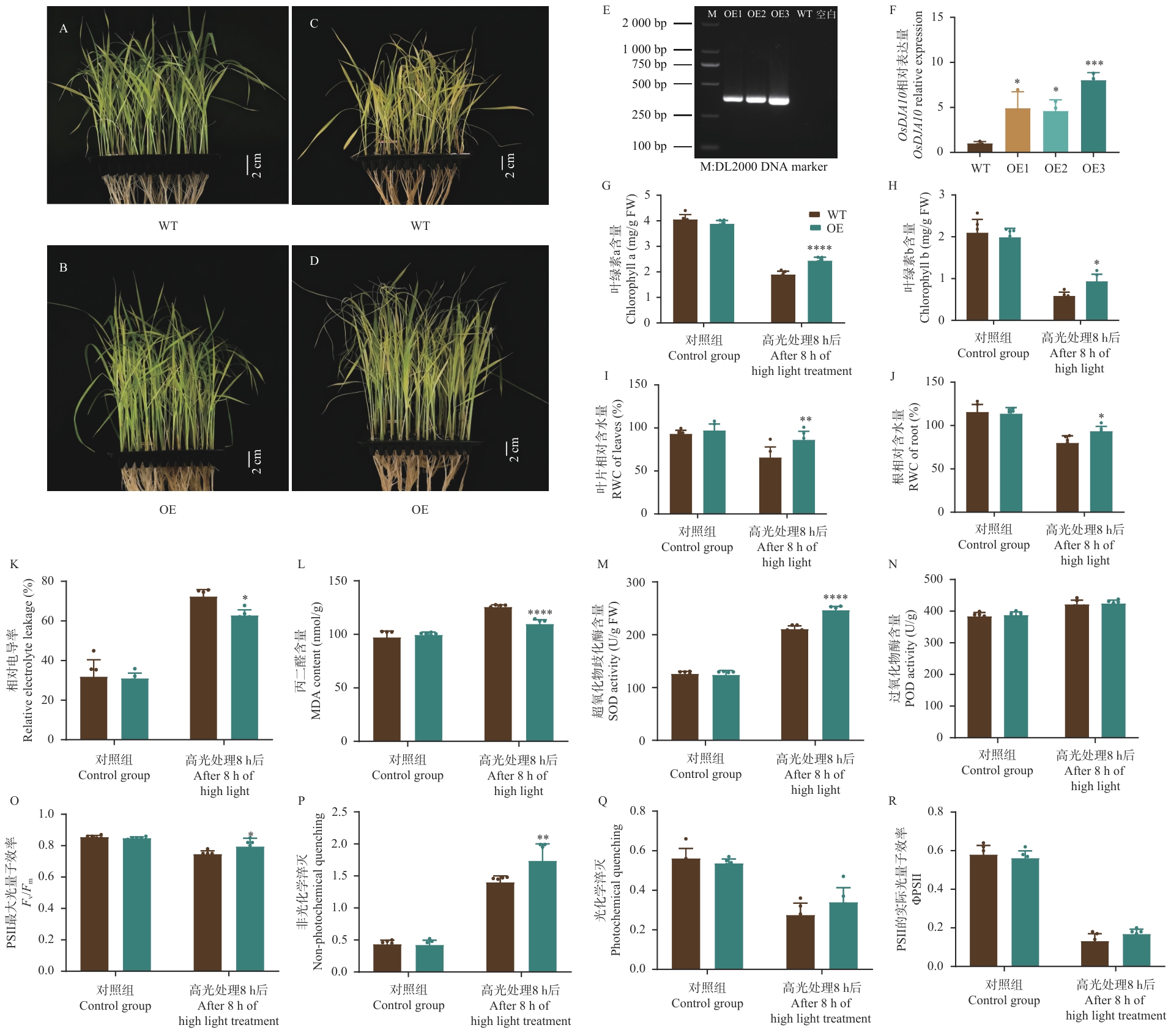
图7 OsDJA10过表达株系在高光胁迫下的表型及生理生化指标A‒D:正常(A、B)和2 d高光处理(C、D)条件下的表型;Bar=2 cm;E:OsDJA10过表达株系的基因组水平分子鉴定;F:OsDJA10过表达株系的转录水平分子鉴定;G‒R:8 h高光处理后WT和OE株系的生理生化指标;数据均为平均数±标准误,统计分析采用双因素方差分析
Fig. 7 Phenotypic and physiological and biochemical indicators of OsDJA10 overexpression lines under high light stressA-D: Phenotype under normal conditions (A, B) and 2 d high light treatment (C, D). Scale bar = 2 cm. E: Genomic-level molecular characterization of the OsDJA10 overexpressing line. F: Transcriptional-level molecular characterization of the OsDJA10 overexpressing line. G-R: Physiological and biochemical indicators of WT and OE lines after 8 h high light treatment. Data are presented as mean ± standard error (SE). Statistical analysis was performed using two-way ANOVA
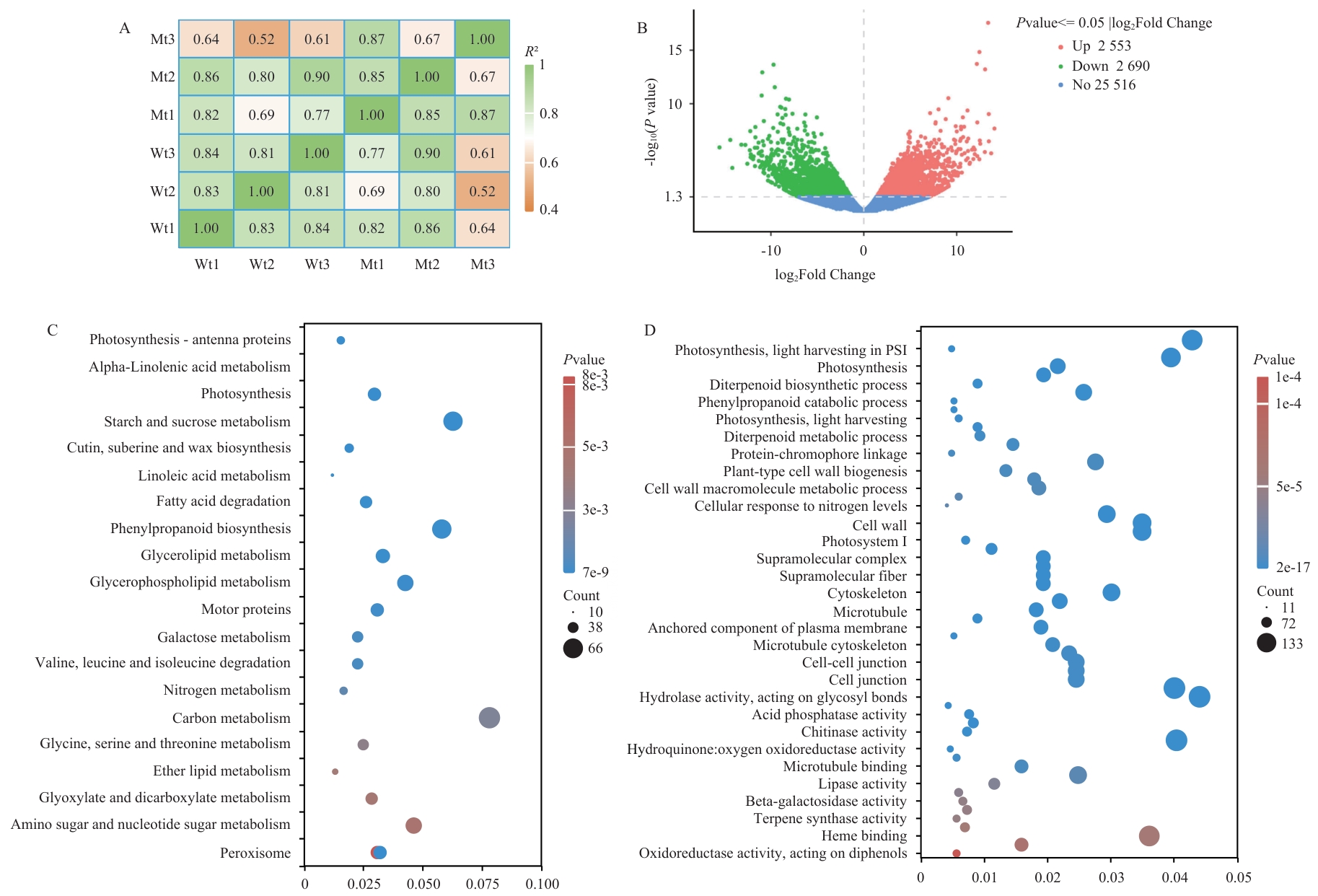
图8 WT和KO的转录组分析A:WT与KO基因表达水平的相关性,Wt1、Wt2、Wt3分别代表3株独立的野生型ZH11株系,Mt1、Mt2、Mt3分别代表白化突变体KO1、KO2、KO3;B:WT与KO之间差异表达基因(DEGs)的统计分析;C:KEGG通路富集分析;D:GO通路富集分析
Fig. 8 Transcriptome analysis of WT and KO plantsA: Correlation analysis of gene expression levels between WT and KO, Wt1, Wt2, and Wt3 represent three independent wild-type ZH11 lines, while Mt1, Mt2, and Mt3 represent the albino mutants KO1, KO2, and KO3 respectively. B: Statistical analysis of differentially expressed genes (DEGs) between WT and KO. C: KEGG pathway enrichment analysis. D: GO pathway enrichment analysis
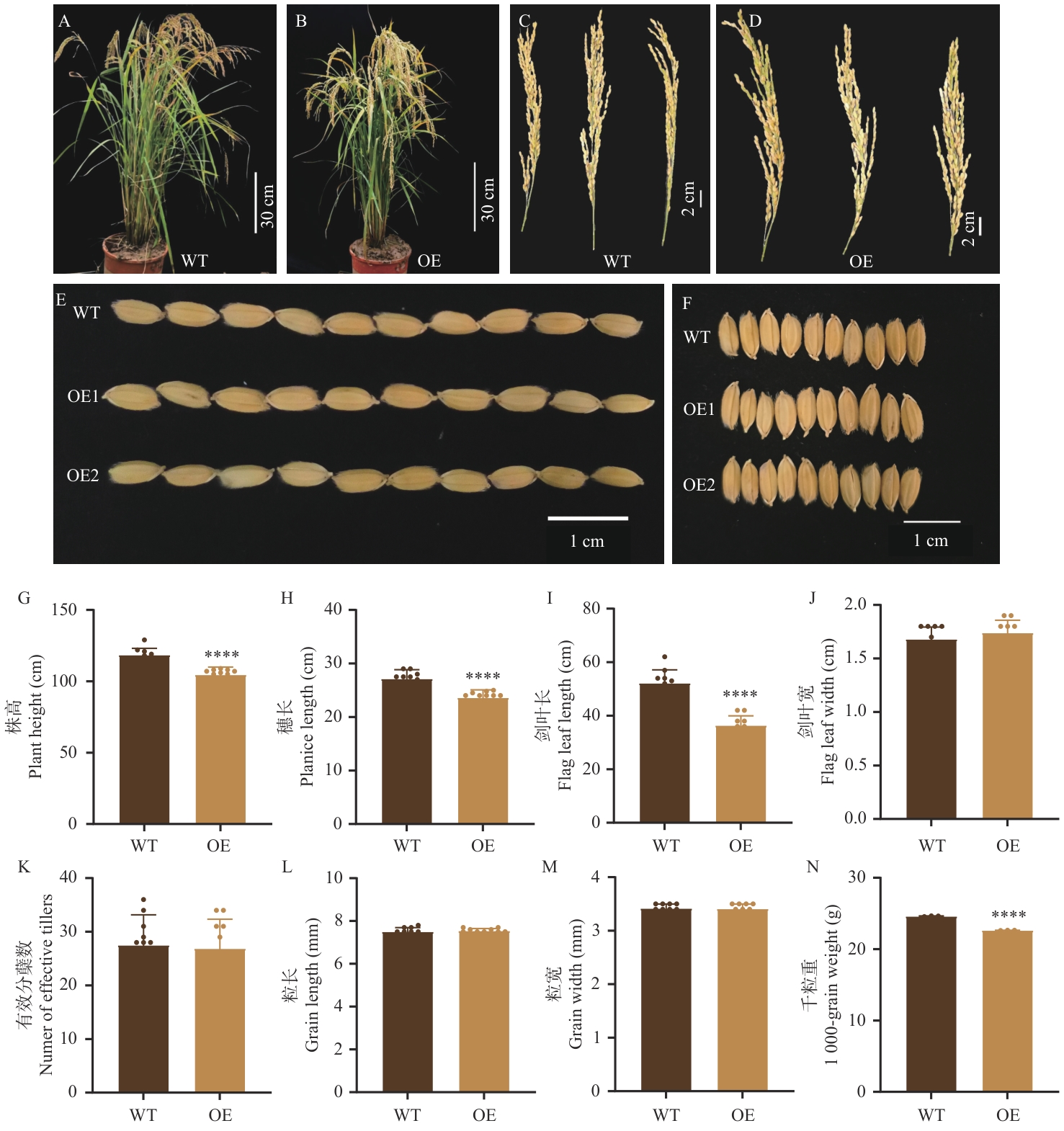
图9 OsDJA10过表达株系相关农艺性状A‒B:WT和OE株系成熟期的表型,Bar=30 cm;C‒D:WT和OE株系成熟期穗长的表型,Bar=2 cm;E:WT和OE的粒长表型,Bar=1 cm;F:WT和OE的粒宽表型,Bar=1 cm;G:株高;H:穗长;I:剑叶长;J:剑叶宽;K:分蘖数;L:粒长;M:粒宽;N:千粒重;数据表示为平均值±标准差;10次生物学重复;采用t检验进行统计分析
Fig. 9 Agronomic traits of OsDJA10 OE linesA‒B: Maturity-stage phenotypes of WT and OE lines, bar=30 cm. C‒D: Mature spike length phenotypes of WT and OE lines, bar=2 cm. E: Grain length phenotypes of WT and OE, bar=1 cm. F: Grain width phenotypes of WT and OE, bar=1 cm. G: Plant height. H: Spike length. I: Flag leaf length. J: Flag leaf width. K: Tillering number. L: Grain length. M: Grain width. N: Thousand-grain weight. Data are presented as mean ± standard deviation; ten biological replicates. Experimental data were analyzed using Student’s t-test
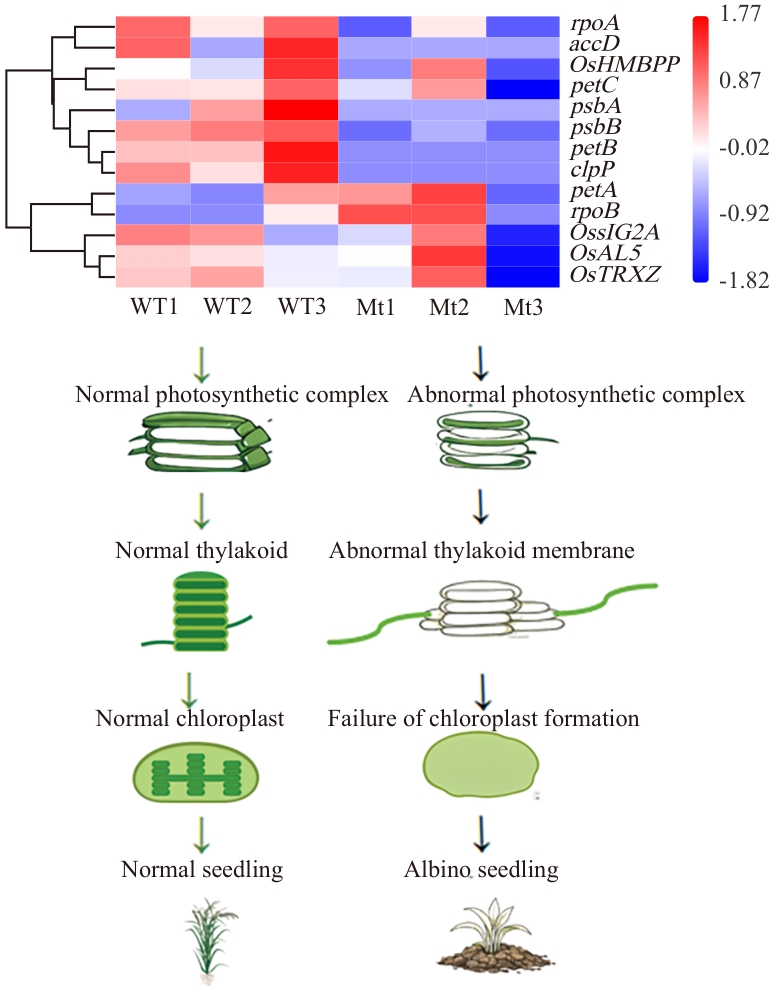
图10 OsDJA10参与叶绿体发育及白化形成的作用模型
Fig. 10 Model of OsDJA10 involvement in chloroplast development and albino formation
| [1] | Dubreuil C, Jin X, de Dios Barajas-López J, et al. Establishment of photosynthesis through chloroplast development is controlled by two distinct regulatory phases [J]. Plant Physiol, 2018, 176(2): 1199-1214. |
| [2] | Yang ZP, Liu MX, Ding SH, et al. Plastid deficient 1 is essential for the accumulation of plastid-encoded RNA polymerase core subunit β and chloroplast development in Arabidopsis [J]. Int J Mol Sci, 2021, 22(24): 13648. |
| [3] | Lv YS, Shao GN, Qiu JH, et al. White Leaf and Panicle 2, encoding a PEP-associated protein, is required for chloroplast biogenesis under heat stress in rice [J]. J Exp Bot, 2017, 68(18): 5147-5160. |
| [4] | Flannery SE, Hepworth C, Wood WHJ, et al. Developmental acclimation of the thylakoid proteome to light intensity in Arabidopsis [J]. Plant J, 2021, 105(1): 223-244. |
| [5] | Li Y, Gong K, Wang XY, et al. Heat shock transcription factors as central integrators of plant stress responses: from thermotolerance to multi-stress resilience [J]. Biology, 2025, 14(12): 1800. |
| [6] | Chiosis G, Digwal CS, Trepel JB, et al. Structural and functional complexity of HSP90 in cellular homeostasis and disease [J]. Nat Rev Mol Cell Biol, 2023, 24(11): 797-815. |
| [7] | Zheng SZ, Zhao WS, Liu ZM, et al. Establishment and maintenance of heat-stress memory in plants [J]. Int J Mol Sci, 2024, 25(16): 8976. |
| [8] | Wang GY, Wang XL, Li DL, et al. Comparative proteomics in tall fescue to reveal underlying mechanisms for improving Photosystem II thermotolerance during heat stress memory [J]. BMC Genom, 2024, 25: 683. |
| [9] | Daniell H, Jin SX, Zhu XG, et al. Green giant—a tiny chloroplast genome with mighty power to produce high-value proteins: history and phylogeny [J]. Plant Biotechnol J, 2021, 19(3): 430-447. |
| [10] | Stan G, Lorimer GH, Thirumalai D. Friends in need: How chaperonins recognize and remodel proteins that require folding assistance [J]. Front Mol Biosci, 2022, 9: 1071168. |
| [11] | Kampinga HH, Andreasson C, Barducci A, et al. Function, evolution, and structure of J-domain proteins [J]. Cell Stress Chaperones, 2019, 24(1): 7-15. |
| [12] | Qiu ZN, Chen DD, Teng LH, et al. OsWHY1 interacts with OsTRX z and is essential for early chloroplast development in rice [J]. Rice, 2022, 15: 50. |
| [13] | Zhang C, Wang LJ, Wang ZR, et al. OsPRDA1 interacts with OsFSD2 to promote chloroplast development by regulating chloroplast gene expression in rice [J]. Rice, 2025, 18: 14. |
| [14] | Ye SX, Tang YZ. TaZFP 23, a new Cys2/His2-type zinc-finger protein, is a regulator of wheat (Triticum aestivum L.) growth and abiotic stresses [J]. PeerJ, 2025, 13: e18956. |
| [15] | Sun T, Shi XW, Friso G, et al. A zinc finger motif-containing protein is essential for chloroplast RNA editing [J]. PLoS Genet, 2015, 11(3): e1005028. |
| [16] | Lin DZ, Pan QW, Wang XM, et al. Mutation of the rice AN1-type zinc-finger protein gene ASL4 causes chloroplast development defects and seedling lethality [J]. Plant Biol J, 2022, 24(1): 95-103. |
| [17] | Wang ZW, Zhu ZC, Li MH, et al. OsOZ1, a zinc finger motif-containing protein, is essential for chloroplast development through RNA editing and intron splicing in rice [J]. Plant Growth Regul, 2025, 105(2): 449-461. |
| [18] | Foyer CH, Hanke G. ROS production and signalling in chloroplasts: cornerstones and evolving concepts [J]. Plant J, 2022, 111(3): 642-661. |
| [19] | Ruban AV. Nonphotochemical chlorophyll fluorescence quenching: mechanism and effectiveness in protecting plants from photodamage [J]. Plant Physiol, 2016, 170(4): 1903-1916. |
| [20] | Liu JG, Chen YY, Zhu L, et al. OsFT coordinates photosynthetic stability and carotenoid metabolism to regulate tillering in rice [J]. J Adv Res, 2026, 82: 45-57. |
| [21] | Riaz M, Ali Q, Yan L. Calcium‒L-aspartate nanoparticles mitigate Boron toxicity in rice seedlings by modulating physiological, antioxidant, and cell wall mechanisms [J]. Sci Rep, 2025, 15: 42439. |
| [22] | Sarkar NK, Thapar U, Kundnani P, et al. Functional relevance of J-protein family of rice (Oryza sativa) [J]. Cell Stress Chaperones, 2013, 18(3): 321-331. |
| [23] | Liu X, Cao PH, Huang QQ, et al. Disruption of a rice chloroplast-targeted gene OsHMBPP causes a seedling-lethal albino phenotype [J]. Rice, 2020, 13: 51. |
| [24] | Das KR, Zaman F, Islam MM, et al. Physiological responses and yield performance of selected rice (Oryza sativa L.) genotypes under deficit moisture stress [J]. Saudi J Biol Sci, 2024, 31(4): 103961. |
| [25] | Zhu XJ, Mou CL, Zhang FL, et al. WSL9 encodes an HNH endonuclease domain-containing protein that is essential for early chloroplast development in rice [J]. Rice, 2020, 13: 45. |
| [26] | Gupta P, Hirschberg J. The genetic components of a natural color palette: a comprehensive list of carotenoid pathway mutations in plants [J]. Front Plant Sci, 2022, 12: 806184. |
| [27] | Zhang JJ, Chen T, Huang YC, et al. The pentatricopeptide repeat protein AL5 modulates early chloroplast development in rice [J]. Crop J, 2025, 13(5): 1386-1396. |
| [28] | Qiu ZN, Wen SY, Sun PN, et al. RAS a pentatricopeptide repeat protein, interacts with OsTRX z to regulate chloroplast gene transcription and RNA processing [J]. Plants, 2025, 14(2): 247. |
| [29] | Zhang JJ, Chen GK, Guan GH, et al. Chloroplast-localized protein, OsAL7, with two elongation factor thermostable domains is essential for normal chloroplast development and seedling longevity in Oryza sativa [J]. Plants, 2025, 14(11): 1634. |
| [30] | Yu Y, Zhou ZL, Pu HC, et al. OsSIG2A is required for chloroplast development in rice (Oryza sativa L.) at low temperature by regulating plastid genes expression [J]. Funct Plant Biol, 2019, 46(8): 766-776. |
| [31] | Wang YL, Wang YH, Ren YL, et al. white panicle2 encoding thioredoxin z, regulates plastid RNA editing by interacting with multiple organellar RNA editing factors in rice [J]. New Phytol, 2021, 229(5): 2693-2706. |
| [32] | Zhang M, Zeng YP, Peng R, et al. N6-methyladenosine RNA modification regulates photosynthesis during photodamage in plants [J]. Nat Commun, 2022, 13: 7441. |
| [33] | Duan FY, Li X, Wei Z, et al. Multi-omics analysis reveals distinct responses to light stress in photosynthesis and primary metabolism between maize and rice [J]. Plant Commun, 2025, 6(10): 101488. |
| [34] | Cui LL, Qiu JY, Li GT, et al. Overexpression of OsPLGG1b enhances rice tolerance to high-light and high-temperature stress through modulating photorespiration [J]. BMC Plant Biol, 2026, 26: 145. |
| [35] | Seo DH, Jang J, Park D, et al. PEP-ASSOCIATED PROTEIN 3 regulates rice tiller formation and grain yield by controlling chloroplast biogenesis [J]. Plant Physiol, 2024, 194(2): 805-818. |
| [36] | Yu XQ, Xie W, Ma L, et al. Kunpeng, birth of giant-grain rice germplasm [J]. Sci Bull, 2025, 70(19): 3125-3128. |
| [1] | 秦子璐, 孙海燕, 陈赢男. 植物表皮毛发育分子调控机制研究进展[J]. 生物技术通报, 2026, 42(9): 57-69. |
| [2] | 范丽金, 宋晓飞, 李晓丽, 闫立英, 谢洋. 基于转录组与代谢组解析黄瓜雌花花冠延迟开放的关键调控通路[J]. 生物技术通报, 2026, 42(9): 147-156. |
| [3] | 王鑫, 陈炜, 孙博. 植物花分生组织活性的调控机制[J]. 生物技术通报, 2026, 42(9): 1-13. |
| [4] | 谭澍, 沈红建, 高晓磊, 尹倩, 邹锋. 油茶MYB转录因子家族鉴定及CoMYB107基因在雄蕊发育中的功能分析[J]. 生物技术通报, 2026, 42(9): 196-209. |
| [5] | 宋文清, 陈智翔, 李雨倩, 王海龙, 邢国芳, 张杰伟. TIFY转录因子在植物生长发育和逆境胁迫响应中的作用[J]. 生物技术通报, 2026, 42(9): 70-81. |
| [6] | 陈宁一, 吴文彤, 赵国春, 贾黎明, 陈仲. 无患子SmHD-ZIP25和SmHD-ZIP29基因在花发育中的功能研究[J]. 生物技术通报, 2026, 42(9): 210-220. |
| [7] | 郑淑雅, 苏玉婷, 何玉美, 赵盼, 周心怡, 刘冉, 刘平丽, 郭惠红. 杨树PagRAX2_16G及其启动子的克隆与功能分析[J]. 生物技术通报, 2026, 42(9): 186-195. |
| [8] | 任文斌, 陈登科, 吴翠翠. 花生转录因子AhZHD9的生物信息学分析及耐盐性研究[J]. 生物技术通报, 2026, 42(9): 297-305. |
| [9] | 刘洋, 许作鹏, 张宏根, 刘巧泉, 汤述翥. 水稻质核互作雄性不育及育性恢复研究进展[J]. 生物技术通报, 2026, 42(9): 29-41. |
| [10] | 金曼, 龚奕杭, 潘文波, 罗培润, 高伟, 李平东, 唐晓艳. 基因编辑技术在创制抗除草剂水稻中的研究进展[J]. 生物技术通报, 2026, 42(8): 8-21. |
| [11] | 申瑞雪, 郭子卿, 庞星辰, 李志远, 丁炜, 董琦, 李森, 宋红霞. 转录组和代谢组联合解析‘泽州芹菜’露地越冬的机制[J]. 生物技术通报, 2026, 42(8): 251-262. |
| [12] | 刘柔知, 吴嘉琦, 吴辉烨, 袁婧怡, 程堂仁, 张启翔, 袁存权. 三种不同栽培类型菊花品种的叶绿体基因组特征对比分析[J]. 生物技术通报, 2026, 42(8): 239-250. |
| [13] | 杨群, 李京, 符德保, 许婷婷. OsbHLH069通过对LAX1-LAX2复合体的竞争性干扰负调控水稻穗发育[J]. 生物技术通报, 2026, 42(8): 113-122. |
| [14] | 汪志, 胡光明, 罗轩, 高磊, 叶丽霞, 黄穷, 肖涛, 张蕾. 革叶猕猴桃叶绿体基因组特征及系统发育分析[J]. 生物技术通报, 2026, 42(8): 173-187. |
| [15] | 宋子慧, 薛丽, 王森, 孙建昌, 韩冰, 崔迪, 韩龙植, 赵正武, 马小定. 基于全基因组关联分析挖掘水稻抗旱相关基因[J]. 生物技术通报, 2026, 42(8): 97-105. |
| 阅读次数 | ||||||
|
全文 |
|
|||||
|
摘要 |
|
|||||
