







生物技术通报 ›› 2026, Vol. 42 ›› Issue (9): 57-69.doi: 10.13560/j.cnki.biotech.bull.1985.2025-1037
秦子璐, 孙海燕, 陈赢男( )
)
收稿日期:2025-09-26
出版日期:2026-09-26
发布日期:2026-09-16
通讯作者:
陈赢男chenyingnan@njfu.edu.cn基金资助:
QIN Zi-lu, SUN Hai-yan, CHEN Ying-nan()
Received:2025-09-26
Published:2026-09-26
Online:2026-09-16
摘要:
植物表皮毛是植物表皮细胞分化形成的特化突起结构,作为植物长期适应环境的重要进化特征,其在抵御生物与非生物胁迫及形成棉纤维、茶叶次生代谢物等产物中具有关键作用。本文系统综述了草本植物(拟南芥、番茄、棉花及水稻)和木本植物(杨树、茶树及桃树)表皮毛发育分子调控机制的研究进展。在拟南芥中,MYB-bHLH-WD40(MBW)转录复合体构成调控表皮毛起始与形态建成的核心保守模块,通过正负反馈环路实现精准调控。番茄中则呈现出以HD-Zip转录因子为主导的、更为复杂的调控网络。在棉纤维发育过程中,R2R3 MYB等转录因子展现出关键作用及功能特异性分化。作为单子叶植物,水稻表皮毛发育形成了区别于双子叶植物的独特调控网络。杨树、茶树等木本植物仍存在部分保守MBW核心调控机制,而桃果实表皮毛发育则演化出不依赖完整MBW复合体的新路径。本文通过比较分析不同物种表皮毛调控网络的保守性与特异性,为揭示植物表皮毛发育的分子进化机制提供了理论依据,并为作物抗逆性与经济性状的分子育种改良提供潜在靶点。
秦子璐, 孙海燕, 陈赢男. 植物表皮毛发育分子调控机制研究进展[J]. 生物技术通报, 2026, 42(9): 57-69.
QIN Zi-lu, SUN Hai-yan, CHEN Ying-nan. Research Progress in the Molecular Regulatory Mechanism of Plant Trichome Development[J]. Biotechnology Bulletin, 2026, 42(9): 57-69.
植物 Plant | 基因家族 Gene family | 基因名称 Gene name | 转基因或突变体材料表型 Phenotype of transgenic or mutant materials | 互作蛋白 Interacting protein | 下游调控基因 Downstream regulatory gene | 参考文献 Reference |
|---|---|---|---|---|---|---|
拟南芥 Arabidopsis thaliana | R2R3 MYB | AtNOK | 野生型中nok突变体的表皮毛分支数量增加,过表达NOK分支数量减少; gl3-sst nok突变体中,过表达AtNOK导致额外的分支形成 | --- | --- | [ |
| R2R3 MYB | AtGL1 | gl1突变体叶片无毛; 过表达AtGL1叶片表皮毛减少 | AtGL3/AtEGL3; AtTTG1 | AtGL2 | [ | |
| R2R3 MYB | AtMYB23 | mby23突变体表皮毛分支减少; 过表达AtMYB23导致下胚轴产生异位表皮毛 | AtGL3/AtEGL3; AtTTG1 | AtGL2 | [ | |
| R2R3 MYB | AtMYB82 | AtGL1启动子驱动AtMYB82可以回补gl1突变体的表皮毛缺陷; 将AtMYB82与显性抑制结构域(SRDX)融合以抑制其功能,导致拟南芥仅叶缘残留少量表皮毛; 过表达N端截短型AtMYB82,导致拟南芥出现无毛叶片 | --- | --- | [ | |
| bHLH | AtGL3 | gl3突变体表皮毛分支减少 | AtGL1;AtTTG1 | AtGL2 | [ | |
| bHLH | AtEGL3 | egl3突变体表皮毛数量和分支减少; gl3 egl3双突变体完全无毛 | AtGL1;AtTTG1 | AtGL2 | [ | |
| WD40 | AtTTG1 | ttg1突变体叶片和茎无毛 | AtGL1; AtGL3/AtEGL3 | AtGL2 | [ | |
| HD-Zip | AtGL2 | gl2突变体表皮毛分支减少或畸形 | --- | --- | [ | |
| R3 MYB | AtCPC | cpc突变体表皮毛增加; 过表达AtCPC导致表皮毛减少 | AtGL3/AtEGL3; AtTTG1 | --- | [ | |
| R3 MYB | AtTRY | try突变体表皮毛成簇生长且分支增加; try cpc双突变体中出现更大的叶表皮毛簇 | AtGL3/AtEGL3; AtTTG1 | --- | [ | |
番茄 Solanum lycopersicum | HD-Zip | SlCD2 | 突变体中叶片VI型腺毛密度减少 | --- | --- | [ |
| HD-Zip | SlWo | SlWo的功能获得性突变体LA3186导致叶片I型毛状体密度增加; SlWo-RNAi则使叶片I型毛状体几乎消失; woW106R 显性负突变体的花药边缘连锁表皮毛数量减少; WoP635R 功能增强突变体的花药边缘连锁表皮毛数量显著增加 | SlCycB2 | --- | [ | |
| HD-Zip | SlHZ45 | 过表达SlHZ45增加了番茄叶片Ⅰ、Ⅳ、Ⅵ型腺体毛 | --- | --- | [ | |
| HD-Zip | SlLn | 过表达SlLn使叶片I、III、V型表皮毛密度增加; 敲除SlLn表皮毛密度明显降低 | SlWo; SlH | SlCycB2; SlCycB3 | [ | |
| HD-Zip | SlHD7/SlHD7L | cr-hd7/hd7l双敲除突变体的花药边缘连锁表皮毛几乎完全缺失 | --- | --- | [ | |
| C2H2 | SlH | 敲除SlH抑制叶片I型表皮毛形成 | SlWo;SlLn | --- | [ | |
| R2R3 MYB | SlMX1 | 过表达SlMX1叶表皮毛增加; SlMX1-RNAi株系叶片表皮毛减少 | --- | --- | [ | |
| MYB-like | SlGCR1/SlGCR2 | gcr1中叶片非腺毛转化为腺毛; gcr2无显著表型; gcr1/2双突变体叶片腺毛显著增多 | --- | SlLFS | [ | |
| bHLH | SlMYC1 | 敲低SlMYC1使叶片VI型腺毛密度降低;myc1纯合突变体和CRISPR-Cas9敲除株系,叶片Ⅵ型腺毛完全缺失 | [ | |||
| --- | SlHl | hl突变体叶片表皮毛严重弯曲、缩短 | --- | --- | [ | |
| --- | SlHl-2 | hl-2突变体叶片和茎杆表皮毛畸形; 过表达SlHl-2可恢复hl-2突变体的叶片表皮毛; CRISPR敲除或RNAi沉默SlHl-2导致野生型叶片表皮毛扭曲 | --- | --- | [ | |
| HD-Zip | SlHDZIV8 | 敲低SlHDZIV8使叶片表皮毛出现扭曲、密度降低 | --- | SlHl-2 | [ | |
| B-type cyclin | SlCycB2/SlCycB3 | 过表达SlCycB2会导致叶片几乎所有非腺毛和腺毛消失,仅残留异常Ⅲ型类似毛; SlCycB2-RNAi抑制其表达则促进叶片Ⅲ、Ⅴ型非腺毛显著增加; 同源基因SlCycB3与SlCycB2功能相似 | --- | --- | [ | |
棉 Gossypium | WD40 | GhTTG1;GhTTG3 | GhTTG1和GhTTG3能恢复拟南芥ttg1突变体的表皮毛;在拟南芥中过表达GhTTG1或GhTTG3使叶片表皮毛增加 | --- | --- | [ |
| R2R3 MYB | GhMYB25 | 在烟草中过表达GhMYB25表皮毛数量增加 | --- | --- | [ | |
| R2R3 MYB | GhMYB25-like | GhMYB25-like- RNAi使棉花种子几乎无纤维 | --- | GhMYB25; GhMYB109 | [ | |
| R2R3 MYB | GhMML4_D12 | VIGS沉默GhMML4_D12后长纤维减少 | --- | --- | [ | |
| R2R3 MYB | GhMML3 | 沉默GhMML3会导致短绒纤维缺失,长纤维产量也大幅减少 | --- | --- | [ | |
| R2R3 MYB | GaMYB2 | 在拟南芥中,AtGL1启动子驱动的GaMYB2可回补gl1突变体的表皮毛; 35S启动子驱动的GaMYB2使野生型和gl1突变体拟南芥种子产生表皮毛 | --- | --- | [ | |
| HD-Zip | GaHOX1 | AtGL2启动子驱动下可完全恢复拟南芥gl2-2突变体表皮毛; 35S启动子驱动时抑制野生型表皮毛发育,莲座叶表皮毛密度也降低 | --- | --- | [ | |
| R2R3 MYB | GhMYB212 | 敲除GhMYB212导致棉花纤维长度缩短 | --- | GhSWEET12 | [ | |
| R2R3 MYB | GhMYB109 | 反义抑制GhMYB109使纤维伸长受阻 | --- | GhACO1; GhACO2 | [ | |
| R2R3 MYB | GhMYB102 | 过表达GhMYB102会导致纤维变短、次生壁增厚 | --- | GhIRX10 | [ | |
| R2R3 MYB | GhMYB30 | 过表达GhMUR3会使纤维长度显著缩短,纤维细度增加; GhMUR3-RNAi会使纤维细度下降 | --- | GhMUR3 | [ | |
| HD-Zip | GhHOX3 | GhHOX3共抑制和RNAi株系纤维长度减少,共抑制株系长纤维完全消失,仅残留极短纤维; 过表达株系纤维长度增加 | --- | GhRDL1 | [ | |
水稻 Oryza sativa | WOX | OsWOX3B/LOC_Os05g02730 | 在有毛品种中通过RNAi抑制OsWOX3B表达后,叶片和颖壳均无毛; 将OsWOX3B基因由自身启动子驱动转入HMK后,转基因植株叶片恢复有毛表型; glr1突变体叶片和颖壳光滑无毛 | --- | --- | [ |
| --- | LOC_Os01g70100 | glr2突变体叶片的长毛、微毛和颖壳表皮毛缺失,但腺毛发育正常 | --- | --- | [ | |
| SBP-box | OsGLR3/OsSPL10 | glr3叶片和颖壳光滑无毛 | --- | OsSCR1 | [ | |
| GRAS | OsSCR1/2 | osscr1的长毛和微毛数量显著减少,腺毛发育正常,osscr2无明显变化; osscr1 osscr2双突变体几乎无长毛和微毛,腺毛数量减少; 过表达OsSCR1或OsSCR2,叶片3种表皮毛数量均显著增加; 将由自身启动子启动的OsSCR1或OsSCR2转入osscr1 osscr2双突变体,OsSCR1可完全恢复双突变体的表皮毛缺陷,OsSCR2仅能部分恢复 | --- | OsWOX3B | [ |
表1 草本植物表皮毛发育的分子调控机制
Table 1 Molecular regulatory mechanisms of trichome development in herbaceous plants
植物 Plant | 基因家族 Gene family | 基因名称 Gene name | 转基因或突变体材料表型 Phenotype of transgenic or mutant materials | 互作蛋白 Interacting protein | 下游调控基因 Downstream regulatory gene | 参考文献 Reference |
|---|---|---|---|---|---|---|
拟南芥 Arabidopsis thaliana | R2R3 MYB | AtNOK | 野生型中nok突变体的表皮毛分支数量增加,过表达NOK分支数量减少; gl3-sst nok突变体中,过表达AtNOK导致额外的分支形成 | --- | --- | [ |
| R2R3 MYB | AtGL1 | gl1突变体叶片无毛; 过表达AtGL1叶片表皮毛减少 | AtGL3/AtEGL3; AtTTG1 | AtGL2 | [ | |
| R2R3 MYB | AtMYB23 | mby23突变体表皮毛分支减少; 过表达AtMYB23导致下胚轴产生异位表皮毛 | AtGL3/AtEGL3; AtTTG1 | AtGL2 | [ | |
| R2R3 MYB | AtMYB82 | AtGL1启动子驱动AtMYB82可以回补gl1突变体的表皮毛缺陷; 将AtMYB82与显性抑制结构域(SRDX)融合以抑制其功能,导致拟南芥仅叶缘残留少量表皮毛; 过表达N端截短型AtMYB82,导致拟南芥出现无毛叶片 | --- | --- | [ | |
| bHLH | AtGL3 | gl3突变体表皮毛分支减少 | AtGL1;AtTTG1 | AtGL2 | [ | |
| bHLH | AtEGL3 | egl3突变体表皮毛数量和分支减少; gl3 egl3双突变体完全无毛 | AtGL1;AtTTG1 | AtGL2 | [ | |
| WD40 | AtTTG1 | ttg1突变体叶片和茎无毛 | AtGL1; AtGL3/AtEGL3 | AtGL2 | [ | |
| HD-Zip | AtGL2 | gl2突变体表皮毛分支减少或畸形 | --- | --- | [ | |
| R3 MYB | AtCPC | cpc突变体表皮毛增加; 过表达AtCPC导致表皮毛减少 | AtGL3/AtEGL3; AtTTG1 | --- | [ | |
| R3 MYB | AtTRY | try突变体表皮毛成簇生长且分支增加; try cpc双突变体中出现更大的叶表皮毛簇 | AtGL3/AtEGL3; AtTTG1 | --- | [ | |
番茄 Solanum lycopersicum | HD-Zip | SlCD2 | 突变体中叶片VI型腺毛密度减少 | --- | --- | [ |
| HD-Zip | SlWo | SlWo的功能获得性突变体LA3186导致叶片I型毛状体密度增加; SlWo-RNAi则使叶片I型毛状体几乎消失; woW106R 显性负突变体的花药边缘连锁表皮毛数量减少; WoP635R 功能增强突变体的花药边缘连锁表皮毛数量显著增加 | SlCycB2 | --- | [ | |
| HD-Zip | SlHZ45 | 过表达SlHZ45增加了番茄叶片Ⅰ、Ⅳ、Ⅵ型腺体毛 | --- | --- | [ | |
| HD-Zip | SlLn | 过表达SlLn使叶片I、III、V型表皮毛密度增加; 敲除SlLn表皮毛密度明显降低 | SlWo; SlH | SlCycB2; SlCycB3 | [ | |
| HD-Zip | SlHD7/SlHD7L | cr-hd7/hd7l双敲除突变体的花药边缘连锁表皮毛几乎完全缺失 | --- | --- | [ | |
| C2H2 | SlH | 敲除SlH抑制叶片I型表皮毛形成 | SlWo;SlLn | --- | [ | |
| R2R3 MYB | SlMX1 | 过表达SlMX1叶表皮毛增加; SlMX1-RNAi株系叶片表皮毛减少 | --- | --- | [ | |
| MYB-like | SlGCR1/SlGCR2 | gcr1中叶片非腺毛转化为腺毛; gcr2无显著表型; gcr1/2双突变体叶片腺毛显著增多 | --- | SlLFS | [ | |
| bHLH | SlMYC1 | 敲低SlMYC1使叶片VI型腺毛密度降低;myc1纯合突变体和CRISPR-Cas9敲除株系,叶片Ⅵ型腺毛完全缺失 | [ | |||
| --- | SlHl | hl突变体叶片表皮毛严重弯曲、缩短 | --- | --- | [ | |
| --- | SlHl-2 | hl-2突变体叶片和茎杆表皮毛畸形; 过表达SlHl-2可恢复hl-2突变体的叶片表皮毛; CRISPR敲除或RNAi沉默SlHl-2导致野生型叶片表皮毛扭曲 | --- | --- | [ | |
| HD-Zip | SlHDZIV8 | 敲低SlHDZIV8使叶片表皮毛出现扭曲、密度降低 | --- | SlHl-2 | [ | |
| B-type cyclin | SlCycB2/SlCycB3 | 过表达SlCycB2会导致叶片几乎所有非腺毛和腺毛消失,仅残留异常Ⅲ型类似毛; SlCycB2-RNAi抑制其表达则促进叶片Ⅲ、Ⅴ型非腺毛显著增加; 同源基因SlCycB3与SlCycB2功能相似 | --- | --- | [ | |
棉 Gossypium | WD40 | GhTTG1;GhTTG3 | GhTTG1和GhTTG3能恢复拟南芥ttg1突变体的表皮毛;在拟南芥中过表达GhTTG1或GhTTG3使叶片表皮毛增加 | --- | --- | [ |
| R2R3 MYB | GhMYB25 | 在烟草中过表达GhMYB25表皮毛数量增加 | --- | --- | [ | |
| R2R3 MYB | GhMYB25-like | GhMYB25-like- RNAi使棉花种子几乎无纤维 | --- | GhMYB25; GhMYB109 | [ | |
| R2R3 MYB | GhMML4_D12 | VIGS沉默GhMML4_D12后长纤维减少 | --- | --- | [ | |
| R2R3 MYB | GhMML3 | 沉默GhMML3会导致短绒纤维缺失,长纤维产量也大幅减少 | --- | --- | [ | |
| R2R3 MYB | GaMYB2 | 在拟南芥中,AtGL1启动子驱动的GaMYB2可回补gl1突变体的表皮毛; 35S启动子驱动的GaMYB2使野生型和gl1突变体拟南芥种子产生表皮毛 | --- | --- | [ | |
| HD-Zip | GaHOX1 | AtGL2启动子驱动下可完全恢复拟南芥gl2-2突变体表皮毛; 35S启动子驱动时抑制野生型表皮毛发育,莲座叶表皮毛密度也降低 | --- | --- | [ | |
| R2R3 MYB | GhMYB212 | 敲除GhMYB212导致棉花纤维长度缩短 | --- | GhSWEET12 | [ | |
| R2R3 MYB | GhMYB109 | 反义抑制GhMYB109使纤维伸长受阻 | --- | GhACO1; GhACO2 | [ | |
| R2R3 MYB | GhMYB102 | 过表达GhMYB102会导致纤维变短、次生壁增厚 | --- | GhIRX10 | [ | |
| R2R3 MYB | GhMYB30 | 过表达GhMUR3会使纤维长度显著缩短,纤维细度增加; GhMUR3-RNAi会使纤维细度下降 | --- | GhMUR3 | [ | |
| HD-Zip | GhHOX3 | GhHOX3共抑制和RNAi株系纤维长度减少,共抑制株系长纤维完全消失,仅残留极短纤维; 过表达株系纤维长度增加 | --- | GhRDL1 | [ | |
水稻 Oryza sativa | WOX | OsWOX3B/LOC_Os05g02730 | 在有毛品种中通过RNAi抑制OsWOX3B表达后,叶片和颖壳均无毛; 将OsWOX3B基因由自身启动子驱动转入HMK后,转基因植株叶片恢复有毛表型; glr1突变体叶片和颖壳光滑无毛 | --- | --- | [ |
| --- | LOC_Os01g70100 | glr2突变体叶片的长毛、微毛和颖壳表皮毛缺失,但腺毛发育正常 | --- | --- | [ | |
| SBP-box | OsGLR3/OsSPL10 | glr3叶片和颖壳光滑无毛 | --- | OsSCR1 | [ | |
| GRAS | OsSCR1/2 | osscr1的长毛和微毛数量显著减少,腺毛发育正常,osscr2无明显变化; osscr1 osscr2双突变体几乎无长毛和微毛,腺毛数量减少; 过表达OsSCR1或OsSCR2,叶片3种表皮毛数量均显著增加; 将由自身启动子启动的OsSCR1或OsSCR2转入osscr1 osscr2双突变体,OsSCR1可完全恢复双突变体的表皮毛缺陷,OsSCR2仅能部分恢复 | --- | OsWOX3B | [ |
植物 Plant | 基因家族 Gene family | 基因名称 Gene name | 转基因或突变体材料表型 Phenotype of transgenic or mutant materials | 互作蛋白 Interacting protein | 下游调控基因Downstream regulatory gene | 参考文献 Reference |
|---|---|---|---|---|---|---|
杨树 Populus | R2R3 MYB | PtaMYB186; PtaMYB138;PtaMYB38 | 过表达PtaMYB186表皮毛增加; 同时敲除PtaMYB186、PtaMYB138及PtaMYB38,产生无毛突变体 | --- | --- | [ |
| TCP | PtoTCP19 | miR319a通过靶向抑制PtoTCP19表达,增加叶片表皮毛密度 | PtoRGA; PtoGL1 | [ | ||
| MTA | PtrMTA | 过表达PtrMTA使杨树叶片表皮毛密度增加 | --- | --- | [ | |
| R2R3 MYB | PdeMIXTA04 | 在拟南芥gl1突变体中过表达PdeMIXTA04能回补表型; 在野生型中过表达表皮毛密度提高 | PdeMYC; PdeWD40 | --- | [ | |
| MADS-box | PtrAG; PtrSTK | PtrAG-RNAi使杨树雌花花器官形态异常; 当PtrAG和PtrSTK被RNAi共抑制时,种子和种毛完全缺失 | --- | --- | [ | |
茶树 Camellia sinensis | R2R3 MYB | CsMYB1 | 过表达CsMYB1可以回补拟南芥gl1突变体的表皮毛 | CsGL3; CsWD40 | CsGL2 | [ |
桃树 Prunus persica | R2R3 MYB | PpMYB25 | 在拟南芥中过表达PpMYB25叶片表皮毛增加 | --- | PpMYB26; PpHDG11 | [ |
表2 木本植物表皮毛发育的分子调控机制
Table 2 Molecular regulatory mechanisms of trichome development in woody plants
植物 Plant | 基因家族 Gene family | 基因名称 Gene name | 转基因或突变体材料表型 Phenotype of transgenic or mutant materials | 互作蛋白 Interacting protein | 下游调控基因Downstream regulatory gene | 参考文献 Reference |
|---|---|---|---|---|---|---|
杨树 Populus | R2R3 MYB | PtaMYB186; PtaMYB138;PtaMYB38 | 过表达PtaMYB186表皮毛增加; 同时敲除PtaMYB186、PtaMYB138及PtaMYB38,产生无毛突变体 | --- | --- | [ |
| TCP | PtoTCP19 | miR319a通过靶向抑制PtoTCP19表达,增加叶片表皮毛密度 | PtoRGA; PtoGL1 | [ | ||
| MTA | PtrMTA | 过表达PtrMTA使杨树叶片表皮毛密度增加 | --- | --- | [ | |
| R2R3 MYB | PdeMIXTA04 | 在拟南芥gl1突变体中过表达PdeMIXTA04能回补表型; 在野生型中过表达表皮毛密度提高 | PdeMYC; PdeWD40 | --- | [ | |
| MADS-box | PtrAG; PtrSTK | PtrAG-RNAi使杨树雌花花器官形态异常; 当PtrAG和PtrSTK被RNAi共抑制时,种子和种毛完全缺失 | --- | --- | [ | |
茶树 Camellia sinensis | R2R3 MYB | CsMYB1 | 过表达CsMYB1可以回补拟南芥gl1突变体的表皮毛 | CsGL3; CsWD40 | CsGL2 | [ |
桃树 Prunus persica | R2R3 MYB | PpMYB25 | 在拟南芥中过表达PpMYB25叶片表皮毛增加 | --- | PpMYB26; PpHDG11 | [ |
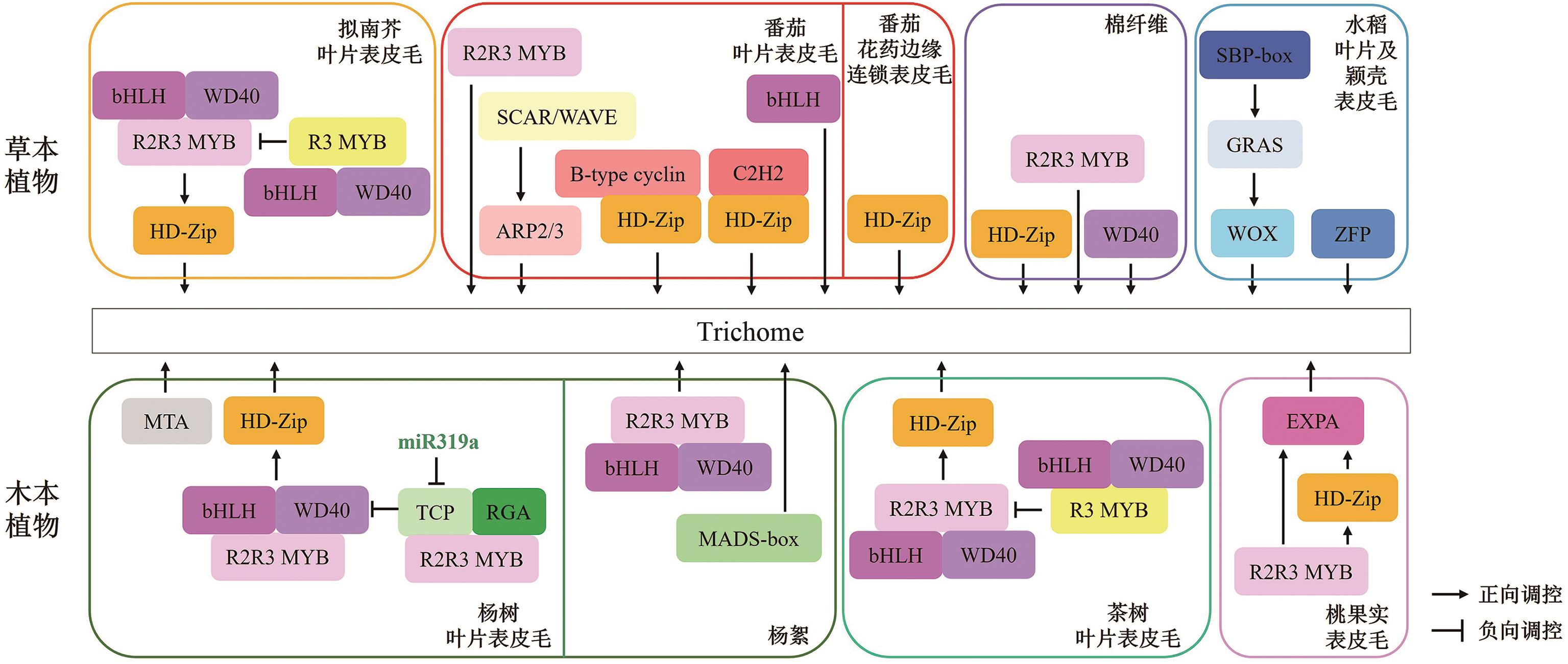
图1 植物表皮毛发育的分子调控机制
Fig. 1 Molecular regulatory mechanisms of trichome development in plants
| [1] | Hülskamp M. Plant trichomes: a model for cell differentiation [J]. Nat Rev Mol Cell Biol, 2004, 5(6): 471-480. |
| [2] | Huchelmann A, Boutry M, Hachez C. Plant glandular trichomes: natural cell factories of high biotechnological interest [J]. Plant Physiol, 2017, 175(1): 6-22. |
| [3] | Mauricio R. Costs of resistance to natural enemies in field populations of the annual plant Arabidopsis thaliana [J]. Am Nat, 1998, 151(1): 20-28. |
| [4] | Schellmann S, Hulskamp M. Epidermal differentiation: trichomes in Arabidopsis as a model system [J]. Int J Dev Biol, 2005, 49(5/6): 579-584. |
| [5] | Dubos C, Stracke R, Grotewold E, et al. MYB transcription factors in Arabidopsis [J]. Trends Plant Sci, 2010, 15(10): 573-581. |
| [6] | Jakoby MJ, Falkenhan D, Mader MT, et al. Transcriptional profiling of mature Arabidopsis trichomes reveals that NOECK encodes the MIXTA-like transcriptional regulator MYB106 [J]. Plant Physiol, 2008, 148(3): 1583-1602. |
| [7] | Gilding EK, Marks MD. Analysis of purified glabra3-shapeshifter trichomes reveals a role for NOECK in regulating early trichome morphogenic events [J]. Plant J, 2010, 64(2): 304-317. |
| [8] | Oppenheimer DG, Herman PL, Sivakumaran S, et al. A myb gene required for leaf trichome differentiation in Arabidopsis is expressed in stipules [J]. Cell, 1991, 67(3): 483-493. |
| [9] | Larkin JC, Oppenheimer DG, Lloyd AM, et al. Roles of the glabrous1 and transparent testa glabra genes in Arabidopsis trichome development [J]. Plant Cell, 1994, 6(8): 1065-1076. |
| [10] | Kirik V, Lee MM, Wester K, et al. Functional diversification of MYB23 and GL1 genes in trichome morphogenesis and initiation [J]. Development, 2005, 132(7): 1477-1485. |
| [11] | Liang G, He H, Li Y, et al. MYB82 functions in regulation of trichome development in Arabidopsis [J]. J Exp Bot, 2014, 65(12): 3215-3223. |
| [12] | Payne CT, Zhang F, Lloyd AM. GL3 encodes a bHLH protein that regulates trichome development in Arabidopsis through interaction with GL1 and TTG1 [J]. Genetics, 2000, 156(3): 1349-1362. |
| [13] | Pattanaik S, Patra B, Singh SK, et al. An overview of the gene regulatory network controlling trichome development in the model plant, Arabidopsis [J]. Front Plant Sci, 2014, 5: 259. |
| [14] | Zhang F, Gonzalez A, Zhao MZ, et al. A network of redundant bHLH proteins functions in all TTG1-dependent pathways of Arabidopsis [J]. Development, 2003, 130(20): 4859-4869. |
| [15] | Smith TF, Gaitatzes C, Saxena K, et al. The WD repeat: a common architecture for diverse functions [J]. Trends Biochem Sci, 1999, 24(5): 181-185. |
| [16] | Walker AR, Davison PA, Bolognesi-Winfield AC, et al. The TRANSPARENT TESTA GLABRA1 locus, which regulates trichome differentiation and anthocyanin biosynthesis in Arabidopsis, encodes a WD40 repeat protein [J]. Plant Cell, 1999, 11(7): 1337. |
| [17] | Di Cristina M, Sessa G, Dolan L, et al. The Arabidopsis Athb-10 (GLABRA2) is an HD-Zip protein required for regulation of root hair development [J]. Plant J, 1996, 10(3): 393-402. |
| [18] | Schellmann S, Schnittger A, Kirik V, et al. TRIPTYCHON and CAPRICE mediate lateral inhibition during trichome and root hair patterning in Arabidopsis [J]. EMBO J, 2002, 21(19): 5036-5046. |
| [19] | Simmons AT, Gurr GM. Trichomes of Lycopersicon species and their hybrids: effects on pests and natural enemies [J]. Agric For Entomol, 2006, 8(1): 1-11. |
| [20] | Wu ML, Bian XX, Huang BB, et al. HD-Zip proteins modify floral structures for self-pollination in tomato [J]. Science, 2024, 384(6691): 124-130. |
| [21] | Satya Swathi Nadakuduti MP. Pleiotropic phenotypes of the sticky peel mutant provide new insight into the role of CUTIN DEFICIENT2 in epidermal cell function in tomato [J]. Plant Physiol, 2012, 159(3): 945-960. |
| [22] | Changxian Yang HL. A regulatory gene induces trichome formation and embryo lethality in tomato [J]. Proc Natl Acad Sci U S A, 2011, 108(29): 11836-11841. |
| [23] | 刘金秋. 番茄SlHZ45基因在表皮毛发育中的角色 [D]. 哈尔滨: 东北农业大学, 2017. |
| Liu JQ. The role of SlHZ45 gene in the development of trichome in tomato [D]. Harbin: Northeast Agricultural University, 2017. | |
| [24] | Xie QM, Xiong C, Yang QH, et al. A novel regulatory complex mediated by Lanata (Ln) controls multicellular trichome formation in tomato [J]. New Phytol, 2022, 236(6): 2294-2310. |
| [25] | Chang J, Yu T, Yang QH, et al. Hair, encoding a single C2H2 zinc-finger protein, regulates multicellular trichome formation in tomato [J]. Plant J, 2018, 96(1): 90-102. |
| [26] | Ewas M, Gao YQ, Wang SC, et al. Manipulation of SlMXl for enhanced carotenoids accumulation and drought resistance in tomato [J]. Sci Bull, 2016, 61(18): 1413-1418. |
| [27] | Chang J, Wu SR, You T, et al. Spatiotemporal formation of glands in plants is modulated by MYB-like transcription factors [J]. Nat Commun, 2024, 15: 2303. |
| [28] | Xu JS, van Herwijnen ZO, Dräger DB, et al. SlMYC1 regulates type VI glandular trichome formation and terpene biosynthesis in tomato glandular cells [J]. Plant Cell, 2019, 30(12): 2988-3005. |
| [29] | Xie QM, Gao YN, Li J, et al. The HD-Zip IV transcription factor SlHDZIV8 controls multicellular trichome morphology by regulating the expression of Hairless-2 [J]. J Exp Bot, 2020, 71(22): 7132-7145. |
| [30] | Kang JH, Campos ML, Zemelis-Durfee S, et al. Molecular cloning of the tomato Hairless gene implicates actin dynamics in trichome-mediated defense and mechanical properties of stem tissue [J]. J Exp Bot, 2016, 67(18): 5313-5324. |
| [31] | Gao SH, Gao YN, Xiong C, et al. The tomato B-type cyclin gene, SlCycB2, plays key roles in reproductive organ development, trichome initiation, terpenoids biosynthesis and Prodenia litura defense [J]. Plant Sci, 2017, 262: 103-114. |
| [32] | Wifkins T, Arpat A, Sickler B. Cotton fiber genomics: developmental mechanisms[J]. Pflanzenschutz Nachrichten Bayer, 2005, 58(1): 119-139. |
| [33] | Humphries JA, Walker AR, Timmis JN, et al. Two WD-repeat genes from cotton are functional homologues of the Arabidopsis thaliana TRANSPARENT TESTA GLABRA1 (TTG1) gene [J]. Plant Mol Biol, 2005, 57(1): 67-81. |
| [34] | Wu YR, Machado AC, White RG, et al. Expression profiling identifies genes expressed early during lint fibre initiation in cotton [J]. Plant Cell Physiol, 2006, 47(1): 107-127. |
| [35] | Walford SA, Wu YR, Llewellyn DJ, et al. GhMYB25-like: a key factor in early cotton fibre development [J]. Plant J, 2011, 65(5): 785-797. |
| [36] | Wu HT, Tian Y, Wan Q, et al. Genetics and evolution of MIXTA genes regulating cotton lint fiber development [J]. New Phytol, 2018, 217(2): 883-895. |
| [37] | Wang S, Wang JW, Yu N, et al. Control of plant trichome development by a cotton fiber MYB gene [J]. Plant Cell, 2004, 16(9): 2323-2334. |
| [38] | Guan XY, Li QJ, Shan CM, et al. The HD-Zip IV gene GaHOX1 from cotton is a functional homologue of the Arabidopsis GLABRA2 [J]. Physiol Plant, 2008, 134(1): 174-182. |
| [39] | Sun WJ, Gao ZY, Wang J, et al. Cotton fiber elongation requires the transcription factor GhMYB212 to regulate sucrose transportation into expanding fibers [J]. New Phytol, 2019, 222(2): 864-881. |
| [40] | Pu L, Li Q, Fan XP, et al. The R2R3 MYB transcription factor GhMYB109 is required for cotton fiber development [J]. Genetics, 2008, 180(2): 811-820. |
| [41] | Wu AM, Shen T, Lu JH, et al. GhMYB102 affects cotton fibre elongation and secondary wall thickening by regulating GhIRX10 in cotton [J]. Plant Biotechnol J, 2025, 23(4): 1329-1344. |
| [42] | Wu AM, Lian BY, Hao PB, et al. GhMYB30-GhMUR3 affects fiber elongation and secondary wall thickening in cotton [J]. Plant J, 2024, 117(3): 694-712. |
| [43] | Shan CM, Shangguan XX, Zhao B, et al. Control of cotton fibre elongation by a homeodomain transcription factor GhHOX3 [J]. Nat Commun, 2014, 5: 5519. |
| [44] | Wang YP, Chen WL, Qin P, et al. Characterization and fine mapping of GLABROUS RICE 2 in rice [J]. J Genet Genom, 2013, 40(11): 579-582. |
| [45] | Zhang HL, Wu K, Wang YF, et al. A WUSCHEL-like homeobox gene, OsWOX3B responses to NUDA/GL-1 locus in rice [J]. Rice, 2012, 5(1): 30. |
| [46] | Li JJ, Yuan YD, Lu ZF, et al. Glabrous Rice 1, encoding a homeodomain protein, regulates trichome development in rice [J]. Rice, 2012, 5(1): 32. |
| [47] | An LJ, Zhou ZJ, Su S, et al. GLABROUS INFLORESCENCE STEMS (GIS) is required for trichome branching through gibberellic acid signaling in Arabidopsis [J]. Plant Cell Physiol, 2012, 53(2): 457-469. |
| [48] | Zhou ZJ, An LJ, Sun LL, et al. ZFP5 encodes a functionally equivalent GIS protein to control trichome initiation [J]. Plant Signal Behav, 2012, 7(1): 28-30. |
| [49] | 宋海冰, 汪斌, 陈壬杰, 等. 水稻“光身”突变体glr3的遗传分析及基因定位 [J]. 遗传, 2016, 38(11): 1011-1018. |
| Song HB, Wang B, Chen RJ, et al. Genetic analysis and gene mapping of the glabrous leaf and hull mutant glr3 in rice (Oryza sativa L.) [J]. Hereditas, 2016, 38(11): 1011-1018. | |
| [50] | Lan T, Zheng YL, Su ZL, et al. OsSPL10, a SBP-box gene, plays a dual role in salt tolerance and trichome formation in rice (Oryza sativa L.) [J]. Genes|genomes|genetics, 2019, 9(12): 4107-4114. |
| [51] | An YH, Ma XT, Luo TX, et al. OsSCR coordinates with OsSPL10 and OsWOX3B to promote epidermal hair development in rice [J]. J Integr Plant Biol, 2025, 67(10): 2578-2593. |
| [52] | 钟姗辰, 武舒, 王黎, 等. 植物毛状体研究进展 [J]. 分子植物育种, 2023, 21(21): 7215-7224. |
| Zhong SC, Wu S, Wang L, et al. Advances in molecular mechanisms of plant Trichomonas [J]. Mol Plant Breed, 2023, 21(21): 7215-7224. | |
| [53] | Plett JM, Wilkins O, Campbell MM, et al. Endogenous overexpression of Populus MYB186 increases trichome density, improves insect pest resistance, and impacts plant growth [J]. Plant J, 2010, 64(3): 419-432. |
| [54] | Bewg WP, Harding SA, Engle NL, et al. Multiplex knockout of trichome-regulating MYB duplicates in hybrid poplar using a single gRNA [J]. Plant Physiol, 2022, 189(2): 516-526. |
| [55] | Fan D, Ran LY, Hu J, et al. miR319a/TCP module and DELLA protein regulate trichome initiation synergistically and improve insect defenses in Populus tomentosa [J]. New Phytol, 2020, 227(3): 867-883. |
| [56] | 鲁良. 杨树RNA m6A甲基转移酶PtrMTA和PagFIP37基因的克隆及功能研究 [D]. 北京: 北京林业大学, 2020. |
| Lu L. Gene cloning and function analysis of RNA m6A methyltransferase PtrMTA and PagFIP37 in poplar [D]. Beijing: Beijing Forestry University, 2020. | |
| [57] | 王静澄. 毛白杨种毛形成中的蔗糖代谢与关键基因表达 [D]. 北京: 北京林业大学, 2010. |
| Wang JC. Sucrose metabolism and expression profiles of regulated genes during the occurring of seed hairs of Populus tomentosa [D]. Beijing: Beijing Forestry University, 2010. | |
| [58] | Zhou FW, Wu HT, Chen YN, et al. Function and molecular mechanism of a poplar placenta limited MIXTA gene in regulating differentiation of plant epidermal cells [J]. Int J Biol Macromol, 2023, 242: 124743. |
| [59] | Lu HW, Klocko AL, Brunner AM, et al. RNA interference suppression of AGAMOUS and SEEDSTICK alters floral organ identity and impairs floral organ determinacy, ovule differentiation, and seed-hair development in Populus [J]. New Phytol, 2019, 222(2): 923-937. |
| [60] | Li PH, Fu JM, Xu YJ, et al. CsMYB1 integrates the regulation of trichome development and catechins biosynthesis in tea plant domestication [J]. New Phytol, 2022, 234(3): 902-917. |
| [61] | Yang QR, Yang XP, Wang L, et al. Two R2R3-MYB genes cooperatively control trichome development and cuticular wax biosynthesis in Prunus persica . [J]. New Phytol, 2022, 234(1): 179-196. |
| [1] | 郑淑雅, 苏玉婷, 何玉美, 赵盼, 周心怡, 刘冉, 刘平丽, 郭惠红. 杨树PagRAX2_16G及其启动子的克隆与功能分析[J]. 生物技术通报, 2026, 42(9): 186-195. |
| [2] | 陈宁一, 吴文彤, 赵国春, 贾黎明, 陈仲. 无患子SmHD-ZIP25和SmHD-ZIP29基因在花发育中的功能研究[J]. 生物技术通报, 2026, 42(9): 210-220. |
| [3] | 任文斌, 陈登科, 吴翠翠. 花生转录因子AhZHD9的生物信息学分析及耐盐性研究[J]. 生物技术通报, 2026, 42(9): 297-305. |
| [4] | 李梦茹, 钱超楠, 阚思蔚, 刘国元, 张健, 陈艳红. 旱柳SmERF B2-8基因在响应淹水胁迫中的功能研究[J]. 生物技术通报, 2026, 42(7): 204-213. |
| [5] | 辛晴, 郑永杰, 李雨华, 涂白连, 刘新亮, 张月婷, 伍艳芳. 樟树MYC转录因子的全基因组鉴定与表达分析[J]. 生物技术通报, 2026, 42(7): 214-225. |
| [6] | 张雅宁, 毛春力, 胡志勇, 杨丹, 吴佳海, 王碧娴, 黄琳凯. 象草Dof转录因子的全基因组分析及其对低温胁迫的响应[J]. 生物技术通报, 2026, 42(6): 267-278. |
| [7] | 翟莹, 高双, 计俊杰, 于海伟, 赵艳, 马天意, 张梅娟, 李珊珊. 工业大麻转录因子CsMYB12抗旱功能的研究[J]. 生物技术通报, 2026, 42(6): 294-303. |
| [8] | 董亚瑞, 栗锦烨, 崔庆晗, 贾玉鑫. 马铃薯核心MADS-box转录因子进化特性与功能预测[J]. 生物技术通报, 2026, 42(6): 64-76. |
| [9] | 沈晨, 车延年, 丁中平, 王祥文, 葛玉建, 符东青, 周亚星乔, 李瑞梅. 木薯采后生理变质相关基因MeGLYI-13上游转录因子的筛选[J]. 生物技术通报, 2026, 42(6): 98-106. |
| [10] | 安飞飞, 罗秀芹, 蔡杰, 薛晶晶, 朱文丽. 木薯MeMYB106基因克隆及其在叶片花青素合成中的功能[J]. 生物技术通报, 2026, 42(6): 13-21. |
| [11] | 王江清, 张蝶, 王荟洁, 袁柱东, 付艳鸿, 黄娅楠, 王洪洋. 马铃薯AP2/ERF基因家族鉴定及响应致病疫霉胁迫的表达分析[J]. 生物技术通报, 2026, 42(6): 116-127. |
| [12] | 武小娟, 赵雪雯, 王沛捷, 聂虎帅, 李楠, 马宇, 杨恩泽, 马杰茹, 马艳红. 马铃薯GARP转录因子家族分析及StARR14-X1基因功能验证[J]. 生物技术通报, 2026, 42(6): 22-30. |
| [13] | 倪飞飞, 陈益存, 高暝, 张盛剿, 彭方有, 陈涛梅, 赵耘霄, 汪阳东. 山苍子TCP基因鉴定及其调控萜类合成的研究[J]. 生物技术通报, 2026, 42(4): 227-238. |
| [14] | 刘青媛, 吴洪启, 陈秀娥, 陈剑, 姜远泽, 何燕子, 喻奇伟, 刘仁祥. 转录因子NtMYB96a调控烟草耐旱性的功能研究[J]. 生物技术通报, 2026, 42(4): 239-250. |
| [15] | 王振泉, 钟毅, 马波, 吴静, 胡增辉. 牡丹PsMYB43调控芳樟醇合成的功能解析[J]. 生物技术通报, 2026, 42(4): 263-271. |
| 阅读次数 | ||||||
|
全文 |
|
|||||
|
摘要 |
|
|||||
