







生物技术通报 ›› 2026, Vol. 42 ›› Issue (9): 297-305.doi: 10.13560/j.cnki.biotech.bull.1985.2026-0315
• 研究报告 • 上一篇
任文斌1, 陈登科1,2, 吴翠翠1( )
)
收稿日期:2026-03-19
出版日期:2026-09-26
发布日期:2026-09-16
通讯作者:
吴翠翠wucuicui19821021@126.com基金资助:
REN Wen-bin1, CHEN Deng-ke1,2, WU Cui-cui1()
Received:2026-03-19
Published:2026-09-26
Online:2026-09-16
摘要:
目的 鉴定并解析花生ZHD转录因子AhZHD9的结构特征及其在盐胁迫响应中的功能,探讨其在植物抗盐调控中的潜在作用,为解析花生ZHD转录因子参与逆境响应的分子机制及作物抗盐分子育种提供理论依据。 方法 以花生AhZHD9基因为研究对象,通过生物信息学方法分析其蛋白结构特征、互作蛋白及启动子顺式作用元件,并进行亚细胞定位分析;利用RT-qPCR检测其在盐胁迫下的表达模式;构建AhZHD9过表达拟南芥,通过测定叶绿素和MDA含量及SOD、CAT和POD活性,以及植株表型评价其抗盐功能。 结果 AhZHD9蛋白含有典型的锌指结构域(ZF)和同源异型盒结构域(HD),属于ZHD转录因子家族成员。蛋白结构预测结果表明,AhZHD9呈现“结构域有序、调控区无序”的结构特征。蛋白互作预测结果显示,AhZHD9可能与含有bHLH、zf-CW、MBD、REF及Senescence_reg等结构域的蛋白发生互作。启动子分析表明,AhZHD9启动子中含有多种参与逆境胁迫响应和激素信号调控的顺式作用元件;亚细胞定位结果显示,该蛋白主要定位于细胞核。表达分析进一步发现,AhZHD9在盐胁迫条件下被显著诱导表达。功能验证结果表明,与野生型相比,AhZHD9过表达拟南芥在盐胁迫下具有更低的MDA含量和更高的叶绿素含量,同时SOD、CAT和POD活性也显著增强,且AhZHD9过表达拟南芥株系生长状态优于野生型,说明过表达AhZHD9能够增强植株抗氧化能力并减轻盐胁迫诱导的氧化损伤。 结论 AhZHD9是一个参与盐胁迫响应的ZHD转录因子,其过表达能够增强植物抗氧化防御能力并提高盐耐受性。
任文斌, 陈登科, 吴翠翠. 花生转录因子AhZHD9的生物信息学分析及耐盐性研究[J]. 生物技术通报, 2026, 42(9): 297-305.
REN Wen-bin, CHEN Deng-ke, WU Cui-cui. Bioinformatics Analysis and Salt Tolerance Study of the Peanut Transcription Factor AhZHD9[J]. Biotechnology Bulletin, 2026, 42(9): 297-305.

图1 AhZHD9编码区(CDS)克隆及结构分析A:花生青花6号叶片中扩增1 023 bp的AhZHD9编码序列;B:AhZHD9基因结构分析;C:AhZHD9蛋白保守结构域预测
Fig. 1 Cloning and structural analysis of the AhZHD9 CDSA: Amplification of the 1 023 bp coding sequence of AhZHD9 from leaves of peanut cultivar Qinghua 6. B: Gene structure analysis of AhZHD9. C: Conserved domain prediction of the AhZHD9 protein
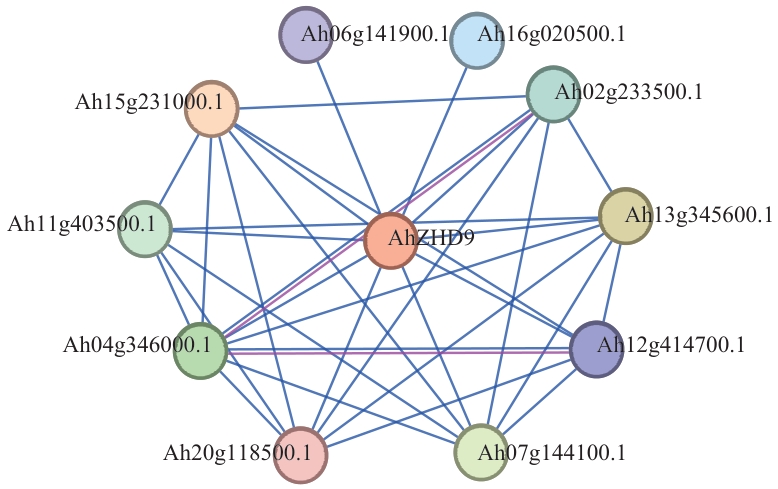
图2 AhZHD9蛋白互作网络分析
Fig. 2 Protein-protein interaction network analysis of AhZHD9
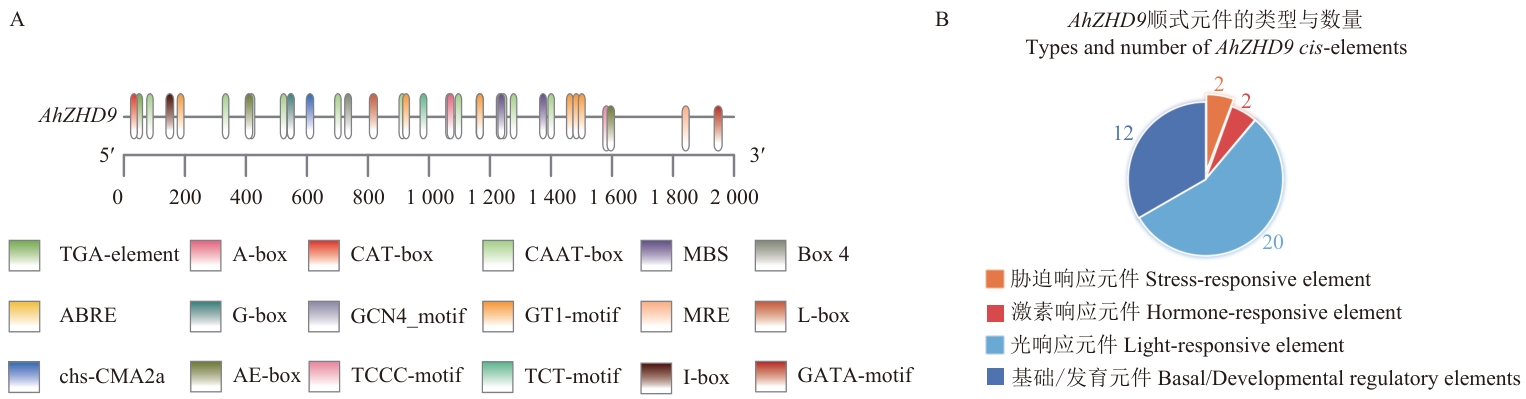
图3 AhZHD9启动子区顺式作用元件分析A:AhZHD9基因顺式作用元件分布;B:AhZHD9基因顺式作用元件类型与数量统计
Fig. 3 Analysis of cis-acting elements in the AhZHD9 promoter regionA: Distribution of cis-acting elements in AhZHD9 gene. B: Statistics of cis-acting element types and quantities in the AhZHD9 gene
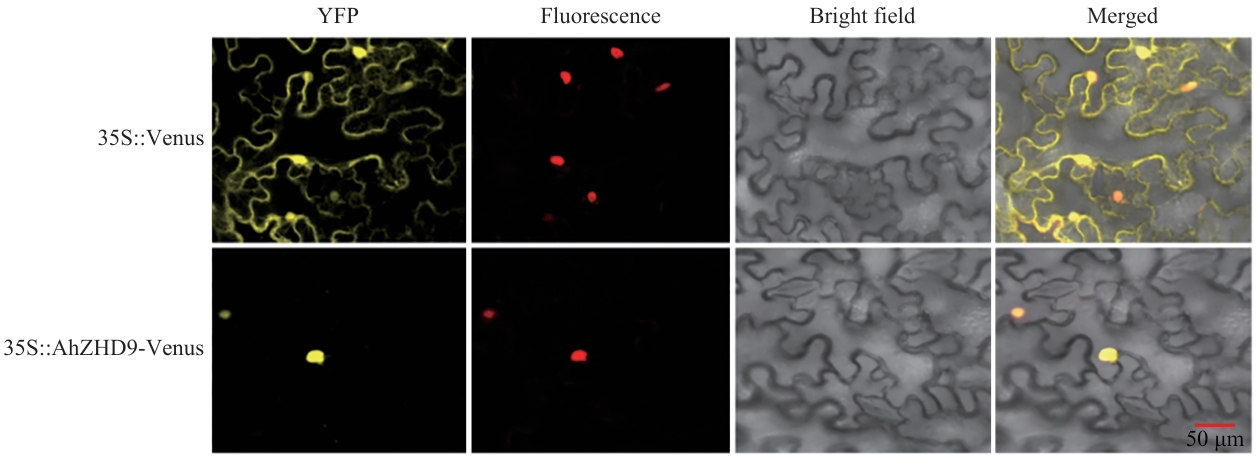
图4 AhZHD9的亚细胞定位Bright field为普通光学显微镜下获得的细胞整体结构图像;YFP表示黄色荧光信号;Fluorescence表示红色荧光信号;Merged为前三幅图像荧光信号叠加后的合并图像。比例尺:50 μm
Fig. 4 Subcellular localization of AhZHD9Bright field: Overall cellular structure observed under a light microscope. YFP: Yellow fluorescent signal. Fluorescence: Red fluorescent signal. Merged: Merged image of the three fluorescence signals above. Scale bar: 50 μm
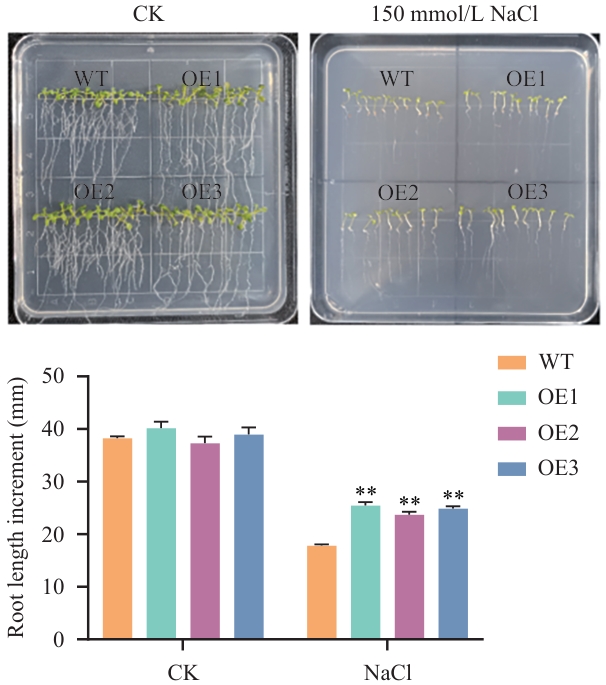
图5 AhZHD9过表达株系的盐胁迫根长实验*,**分别表示在0.05、0.01水平上差异显著;WT表示野生型拟南芥,OE表示AhZHD9过表达株系。下同
Fig. 5 Root length assay of AhZHD9-overexpressing lines under salt stress* and ** indicate significant differences at the levels of 0.05 and 0.01, respectively. WT indicates wild-type Arabidopsis plants, and OE indicates AhZHD9-overexpressing lines. The same below
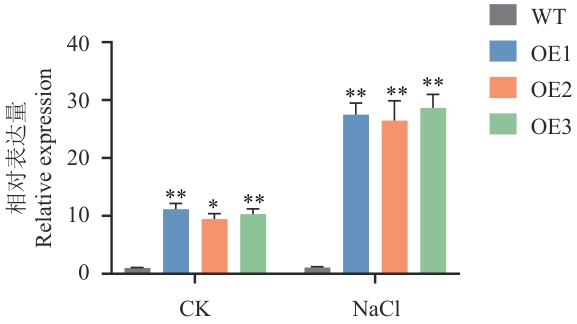
图6 AhZHD9过表达株系在盐胁迫下的相对表达量
Fig. 6 Relative expression analysis of AhZHD9-overexpressing lines under salt stress
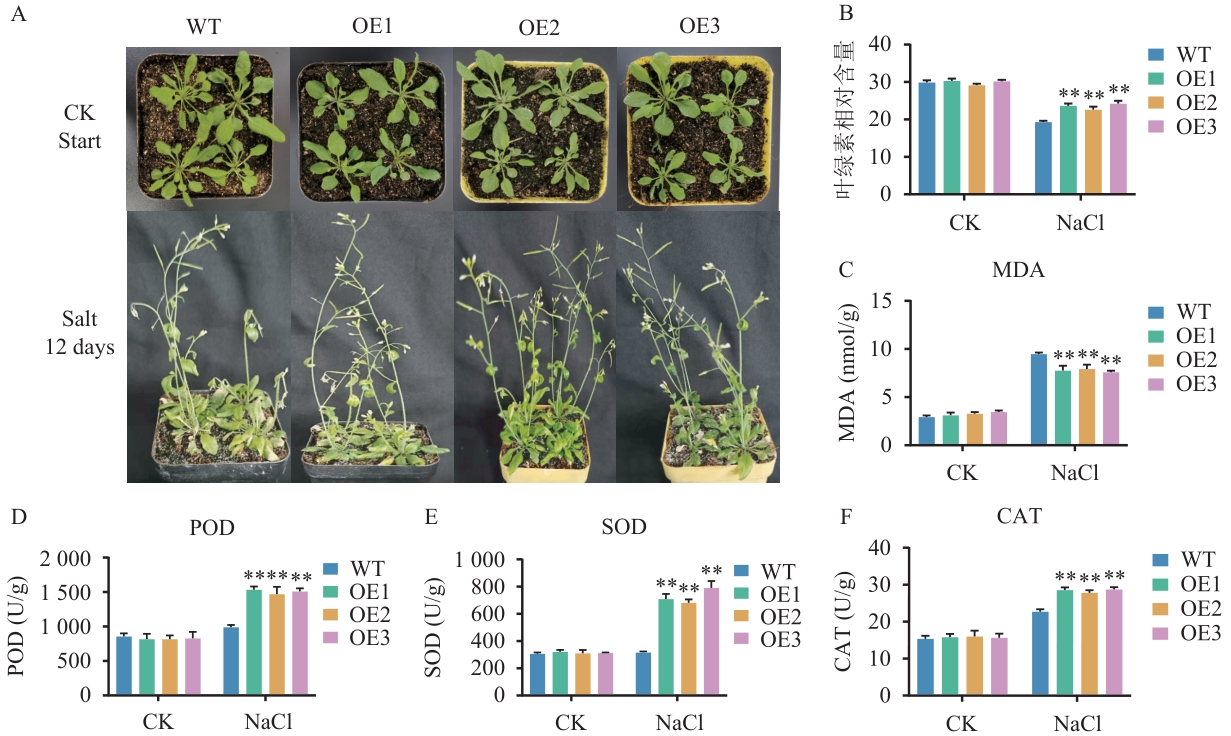
图7 AhZHD9过表达拟南芥在盐胁迫下的表型及生理指标分析A:盐胁迫处理前及处理12 d后的植株表型;B:叶绿素含量;C:丙二醛(MDA)含量;D:过氧化物酶(POD)活性;E:超氧化物歧化酶(SOD)活性;F:过氧化氢酶(CAT)活性
Fig. 7 Phenotypic and physiological analysis of AhZHD9-overexpressing Arabidopsis under salt stressA: Plant phenotype before salt treatment and after 12 d of salt stress. B: Chlorophyll content. C: Malondialdehyde (MDA) content. D: Peroxidase (POD) activity. E: Superoxide dismutase (SOD) activity. F: Catalase (CAT) activity
| [1] | 赵怀玉, 林鸿宣. 植物响应盐碱胁迫的分子机制 [J]. 土壤与作物, 2020, 9(2): 103-113. |
| Zhao HY, Lin HX. Molecular mechanism of plants in responses to salt and alkali stress [J]. Soils Crops, 2020, 9(2): 103-113. | |
| [2] | 陈娜, 邵勤, 李晓鹏. 番茄WRKY转录因子功能的研究进展 [J]. 江苏农业科学, 2023, 51(13): 6-17. |
| Chen N, Shao Q, Li XP. Research progress on WRKY transcription factors and their biological function in tomato (Solanum lycopersicum L.) [J]. Jiangsu Agric Sci, 2023, 51(13): 6-17. | |
| [3] | 陆海芹, 李娜, 蒋凯旋, 等. NAC转录因子调控植物生长发育和胁迫应答的研究进展 [J]. 植物生理学报, 2024, 60(2): 271-283. |
| Lu HQ, Li N, Jiang KX, et al. Research advances on NAC transcription factors regulating plant development and stress responses [J]. Plant Physiol J, 2024, 60(2): 271-283. | |
| [4] | Wang XH, Li YN, Chen Z, et al. MbWRKY50 confers cold and drought tolerance through upregulating antioxidant capacity associated with ROS scavenging [J]. J Plant Physiol, 2025, 310: 154526. |
| [5] | 关范圆, 郑语嫣, 米芯雨, 等. R2R3型MYB转录因子调控植物胁迫应答的研究进展 [J]. 植物医学, 2024, 3(3): 1-9. |
| Guan FY, Zheng YY, Mi XY, et al. Research advance of the functions of R2R3-MYB transcription factors in plant response to biotic and abiotic stresses [J]. Plant Health Med, 2024, 3(3): 1-9. | |
| [6] | 雷宇行. 忍冬耐盐相关bZIP转录因子的挖掘及功能验证 [D]. 长沙: 中南林业科技大学, 2025. |
| Lei Y X. Mining and functional validation of salt stress-related bZIP transcription factors in Lonicera japonica [D]. Changsha: Central South University of Forestry & Technology, 2025. | |
| [7] | Chen SY, Wang XY, Yu YY, et al. WRKY transcription factor RrWRKY56 negatively regulates salt and drought stress tolerance by suppressing RrUSP expression in Rosa rugosa [J]. BMC Plant Biol, 2025, 25: 1666. |
| [8] | Ma BJ, Wu ZG, Yan L, et al. RtNAC081 promotes salt tolerance and plant growth linked to brassinosteroid/abscisic acid signaling in Reaumuria trigyna [J]. Plant J, 2026, 125(5): e70728. |
| [9] | 朱志丹. 波棱瓜AP 2/ERF基因家族鉴定及盐胁迫下HpAP2/ERF144的功能分析 [D]. 成都: 成都大学, 2025.ZhuZD. Identification of the Herpetospermum pedunculosum AP 2/ERF gene family and function analysis of HpAP2/ERF144 under salt stress [D]. Chengdu: Chengdu University, 2025. |
| [10] | Tan QK, Irish VF. The Arabidopsis zinc finger-homeodomain genes encode proteins with unique biochemical properties that are coordinately expressed during floral development [J]. Plant Physiol, 2006, 140(3): 1095-1108. |
| [11] | Zheng XB, Wu Y, Wang H, et al. Genome-wide investigation of the zinc finger-homeodomain family genes reveals potential roles in apple fruit ripening [J]. Front Genet, 2022, 12: 783482. |
| [12] | 余金蔚, 闫菲, 陶增. 植物ZHD类转录因子研究进展 [J]. 植物生理学报, 2022, 58(9): 1639-1645. |
| Yu JW, Yan F, Tao Z. Research progress of ZHD transcription factor in plants [J]. Plant Physiol J, 2022, 58(9): 1639-1645. | |
| [13] | Su XN, Dong YT, Liao Y, et al. Genome-wide identification of the zinc finger-homeodomain (ZF-HD) gene family and their response to cold stress in Rosa chinensis [J]. Genes, 2026, 17(1): 90. |
| [14] | Yang N, Yang ZZ, Zhu ZJ, et al. Identification and expression analysis of ZF-HD transcription factor family and their expression profiles under abiotic and biotic stresses in mango (Mangifera indica) [J]. Physiol Mol Plant Pathol, 2025, 139: 102816. |
| [15] | Gao YM, Zhu LY, An MH, et al. Zinc finger-homeodomain transcriptional factors (ZHDs) in cucumber (Cucumis sativus L.): identification, evolution, expression profiles, and function under abiotic stresses [J]. Int J Mol Sci, 2024, 25(8): 4408. |
| [16] | 陈登科,兰刚,夏芝,等.花生ZF-HD基因家族的鉴定和非生物胁迫响应分析[J].生物技术通报, 2026, 42(4): 114-128. |
| Chen DK, Lan G, Xia Z, et al. Genome-wide identification and abiotic stress response analysis of the ZF-HD gene family in peanut (Arachis hypogaea L.) [J]. Biotechnol Bull, 2026, 42(4): 114-128. | |
| [17] | Chen CJ, Wu Y, Li JW, et al. TBtools-II: a “one for all, all for one” bioinformatics platform for biological big-data mining [J]. Mol Plant, 2023, 16(11): 1733-1742. |
| [18] | Meng EC, Goddard TD, Pettersen EF, et al. UCSF ChimeraX: Tools for structure building and analysis [J]. Protein Sci, 2023, 32(11): e4792. |
| [19] | Clough SJ, Bent AF. Floral dip: a simplified method for Agrobacterium-mediated transformation of Arabidopsis thaliana [J]. Plant J, 1998, 16(6): 735-743. |
| [20] | 路普. 棉花GPCR及MATE基因家族全基因组分析和非生物胁迫功能鉴定 [D]. 北京: 中国农业科学院, 2018. |
| Lu P. Genome wide analysis and functional characterization of GPCR and MATE gene families under abiotic stress in cotton [D]. Beijing: Chinese Academy of Agricultural Sciences, 2018. | |
| [21] | Chong SS, Dugast-Darzacq C, Liu Z, et al. Imaging dynamic and selective low-complexity domain interactions that control gene transcription [J]. Science, 2018, 361(6400): eaar2555. |
| [22] | Ferrie JJ, Karr JP, Tjian R, et al. “Structure”-function relationships in eukaryotic transcription factors: The role of intrinsically disordered regions in gene regulation [J]. Mol Cell, 2022, 82(21): 3970-3984. |
| [23] | 温馨. 紫花苜蓿MsDHN11基因耐旱功能分析 [D]. 兰州: 兰州大学, 2024. |
| Wen X. Drought tolerance functional analysis of MsDHN11 gene in alfalfa [D]. Lanzhou: Lanzhou University, 2024. | |
| [24] | He FH, Umehara T, Saito K, et al. Structural insight into the zinc finger CW domain as a histone modification reader [J]. Structure, 2010, 18(9): 1127-1139. |
| [25] | Zemach A, Grafi G. Characterization of Arabidopsis thaliana methyl-CpG-binding domain (MBD) proteins [J]. Plant J, 2003, 34(5): 565-572. |
| [26] | Pfaff C, Ehrnsberger HF, Flores-Tornero M, et al. ALY RNA-binding proteins are required for nucleocytosolic mRNA transport and modulate plant growth and development [J]. Plant Physiol, 2018, 177(1): 226-240. |
| [27] | Yao XZ, Chen HF, Ai AT, et al. The transcription factor CsS40 negatively regulates TCS1 expression and caffeine biosynthesis in connection to leaf senescence in Camellia sinensis [J]. Hortic Res, 2023, 10(9): uhad162. |
| [28] | Zi YQ, Zhang MJ, Yang XY, et al. Identification of the sweet orange (Citrus sinensis) bHLH gene family and the role of CsbHLH55 and CsbHLH87 in regulating salt stress [J]. Plant Genome, 2024, 17(3): e20502. |
| [29] | Ariyarathne MA, Wone BWM. Overexpression of the Selaginella lepidophylla bHLH transcription factor enhances water-use efficiency, growth, and development in Arabidopsis [J]. Plant Sci, 2022, 315: 111129. |
| [30] | Zhao XB, Wang Q, Yan CX, et al. The bHLH transcription factor AhbHLH121 improves salt tolerance in peanut [J]. Int J Biol Macromol, 2024, 256: 128492. |
| [31] | Li CJ, Wang Q, Wang QQ, et al. The bHLH transcription factor AhbHLH36 enhances salt tolerance via the activation of AhCAT in peanut [J]. Plant Sci, 2026, 362: 112753. |
| [32] | Rizwan HM, He JY, Nawaz M, et al. The members of zinc finger-homeodomain (ZF-HD) transcription factors are associated with abiotic stresses in soybean: insights from genomics and expression analysis [J]. BMC Plant Biol, 2025, 25: 56. |
| [33] | Zhang KP, Yan RQ, Feng XQ, et al. Genome-wide identification and expression analysis of ZF-HD family in sunflower (Helianthus annuus L.) under drought and salt stresses [J]. BMC Plant Biol, 2025, 25: 140. |
| [34] | Li QF, Ren YZ, Long JH, et al. Genome-wide identification of zinc finger-homeodomain (ZF-HD) gene family and expression analysis during abiotic stress in rye [J]. Genet Resour Crop Evol, 2025, 72(8): 9927-9943. |
| [35] | Bi WY, Xu HC, Liu T, et al. Genome-wide identification of the ZF-HD gene family in melon and functional characterization of CmZHD8 in salt stress tolerance [J]. Plants, 2026, 15(4): 550. |
| [36] | Chen XG, Lu XK, Shu N, et al. GhSOS1, a plasma membrane Na+/H+ antiporter gene from upland cotton, enhances salt tolerance in transgenic Arabidopsis thaliana [J]. PLoS One, 2017, 12(7): e0181450. |
| [37] | 张弘怡. 华北驼绒藜响应干旱和盐碱胁迫的分子机制及KaWRKY33/75基因的功能验证 [D]. 呼和浩特: 内蒙古大学, 2025. |
| Zhang HY. Molecular mechanism of K . arborescens responding to drought and saline-alkali stress and KaWRKY 33/75 gene functional verification [D]. Hohhot: Inner Mongolia University, 2025. | |
| [38] | 程珊, 王会伟, 陈晨, 等. 油莎豆MYB转录因子基因CeMYB154克隆及耐盐功能分析 [J]. 生物技术通报, 2025, 41(6): 218-228. |
| Cheng S, Wang HW, Chen C, et al. Cloning of MYB transcription factor gene CeMYB154 and analysis of salt tolerance function in Cyperus esculentus [J]. Biotechnol Bull, 2025, 41(6): 218-228. | |
| [39] | 甘洪萍. 葡萄VvMYB15转录因子响应盐胁迫的功能和分子机理研究 [D]. 泰安: 山东农业大学, 2025. |
| Gan HP. Function and molecular mechanisms of the VvMYB15 transcription factor in response to salt stress in grape [D]. Tai’an: Shandong Agricultural University, 2025. | |
| [40] | Yu ST, Wang CT, Wang Q, et al. Identification and analysis of SOD family genes in peanut (Arachis hypogaea L.) and their potential roles in stress responses [J]. Agronomy, 2023, 13(8): 1959. |
| [41] | Raza A, Sharif Y, Chen K, et al. Genome-wide characterization of ascorbate peroxidase gene family in peanut (Arachis hypogea L.) revealed their crucial role in growth and multiple stress tolerance [J]. Front Plant Sci, 2022, 13: 962182. |
| [1] | 桑志鹏, 侯栋, 王慧婷, 岳宏忠, 李亚莉, 颉建明, 路雯, 许照泰. 黄瓜CsHXKs基因家族鉴定及CsHKL1.2调控花器官糖积累[J]. 生物技术通报, 2026, 42(9): 157-168. |
| [2] | 董向向, 侯威威, 缪百灵, 陈娟娟, 李亮杰, 翟敏, 朱庆松, 刘松虎. 过表达森林草莓FvBBX22促进拟南芥花青素合成和延迟开花时间[J]. 生物技术通报, 2026, 42(9): 231-237. |
| [3] | 何婧婧, 朋毛拉专, 姚晓华, 姚有华, 吴昆仑, 崔永梅. 青稞HvNAC53的克隆及功能分析[J]. 生物技术通报, 2026, 42(8): 142-152. |
| [4] | 刘君良, 袁晓霞, 乔美玲, 杨冰洁, 于秀敏, 穆莎茉莉, 冀照君. 基因aotM与trmD调控根瘤菌盐碱耐受性、抗氧化酶活性及细胞膜氧化损伤[J]. 生物技术通报, 2026, 42(8): 323-330. |
| [5] | 秦娟, 卢蔚雯, 李佳徽, 李晨, 李斌, 王治业. 红花2个G6PDH基因的克隆与表达特征分析[J]. 生物技术通报, 2026, 42(8): 217-228. |
| [6] | 崔秀妍, 代春阳, 张谊婷, 田翔, 陈凌, 乔治军, 王海岗, 王君杰. 糜子伪响应调节蛋白PRR基因家族的鉴定及对光周期的响应[J]. 生物技术通报, 2026, 42(8): 133-141. |
| [7] | 李淑婷, 王影, 丁家豪, 胡荣芳, 李琛, 宋亚楠, 薛金爱. 油莎豆FAT家族全基因组鉴定及CeFATA的功能分析[J]. 生物技术通报, 2026, 42(8): 162-172. |
| [8] | 辛晴, 郑永杰, 李雨华, 涂白连, 刘新亮, 张月婷, 伍艳芳. 樟树MYC转录因子的全基因组鉴定与表达分析[J]. 生物技术通报, 2026, 42(7): 214-225. |
| [9] | 王鸿睿, 赵怡如, 饶书培, 陈金焕. 黑果枸杞 LrCYP78A5 基因在干旱与盐胁迫响应中的功能研究[J]. 生物技术通报, 2026, 42(7): 182-192. |
| [10] | 冉丹丹, 邰森林, 欧小宏, 周涛, 徐娇. 天麻尿苷二磷酸糖基转移酶基因家族鉴定与分析[J]. 生物技术通报, 2026, 42(7): 163-172. |
| [11] | 董亚茹, 修妤, 赵东晓, 朱红, 朱琳, 刘惠芬. 基于转录组的桑树GRAS基因家族鉴定及MnGRAS22盐胁迫响应分析[J]. 生物技术通报, 2026, 42(7): 193-203. |
| [12] | 阎晓光, 杜艳伟, 马志远, 王彬, 王国梁, 胡丹珠. 玉米ZmDIR基因家族的全基因组鉴定与表达模式分析[J]. 生物技术通报, 2026, 42(7): 126-137. |
| [13] | 黄旭升, 周雅莉, 贾峥嵘, 沈珊, 陈锦钗, 周广立, 李鑫鑫, 王计平, 李润植, 贾小云. 紫苏ARF转录因子家族全基因组鉴定及其在非生物胁迫响应中的功能分析[J]. 生物技术通报, 2026, 42(7): 148-162. |
| [14] | 王江清, 张蝶, 王荟洁, 袁柱东, 付艳鸿, 黄娅楠, 王洪洋. 马铃薯AP2/ERF基因家族鉴定及响应致病疫霉胁迫的表达分析[J]. 生物技术通报, 2026, 42(6): 116-127. |
| [15] | 熊仕发, 陈益存, 吴立文, 施翔, 张盛剿, 彭方有, 陈涛梅, 汪阳东. 白栎TCP基因家族的鉴定及功能分析[J]. 生物技术通报, 2026, 42(6): 258-266. |
| 阅读次数 | ||||||
|
全文 |
|
|||||
|
摘要 |
|
|||||
