







• 研究报告 • 下一篇
吴志国1,2,3, 张雪杨2, 徐金娜2, 于春倩1, 蔡文华1, 杨宗政1,2,3( )
)
收稿日期:2026-04-29
出版日期:2026-09-14
通讯作者:
杨宗政yzz320@tust.edu.cn基金资助:
WU Zhi-guo1,2,3, ZHANG Xue-yang2, XU Jin-na2, YU Chun-qian1, CAI Wen-hua1, YANG Zong-zheng1,2,3()
Received:2026-04-29
Published:2026-09-14
摘要:
目的 筛选高效降解1,2-二氯乙烷(1,2-DCA)的菌株并通过固定化技术进一步提升其性能,为后续生物修复的工程应用提供基础。 方法 对1,2-DCA污染土壤富集驯化,通过高通量测序技术考察富集液中微生物群落结构特征。从富集液中筛选分离1,2-DCA高效降解菌株,采用16S rRNA基因序列分析和生理生化特征分析对菌株进行鉴定,采用L9(34)正交实验优化聚乙烯醇(PVA)-海藻酸钠(SA)-秸秆生物炭复合载体的制备条件,对菌株进行固定化应用研究。 结果 在Ancylobacter sp.相对丰度较高的富集液中分离并初步鉴定了一株1,2-DCA高效降解菌株Ancylobacter sp. PY9,其最适生长条件为pH 6-7、30 ℃、NaCl 5 g/L。固定化最优条件为8% PVA、2% SA、1%秸秆生物炭和1% CaCl2(w/v),固定化PY9在高盐(30、40 g/L)、极端酸碱(pH=5、13)以及高温(50 ℃)/低温(10-20 ℃)条件下的降解效率均优于游离菌,固定化颗粒在循环利用5次后仍保持降解率在89%,稳定性良好。菌株PY9降解1,2-DCA符合一级反应动力学,游离态PY9可在8 h内完全降解300 mg/L的1,2-DCA,固定化PY9在500 mg/L高浓度1,2-DCA下降解率仍可达98%。 结论 在不同富集液群落中获得一株1,2-DCA高效降解菌株PY9,经优化的PVA-SA-秸秆生物炭复合固定化体系可显著提升菌株环境耐受性且对高浓度1,2-DCA具备高效降解能力,固定化颗粒重复利用性强。
吴志国, 张雪杨, 徐金娜, 于春倩, 蔡文华, 杨宗政. 1,2-DCA降解菌Ancylobacter sp. PY9的分离鉴定及固定化应用[J]. 生物技术通报, doi: 10.13560/j.cnki.biotech.bull.1985.2026-0485.
WU Zhi-guo, ZHANG Xue-yang, XU Jin-na, YU Chun-qian, CAI Wen-hua, YANG Zong-zheng. Isolation, Identification and Immobilization Application of 1,2-DCA Degrading Bacterium Ancylobacter sp. PY9[J]. Biotechnology Bulletin, doi: 10.13560/j.cnki.biotech.bull.1985.2026-0485.
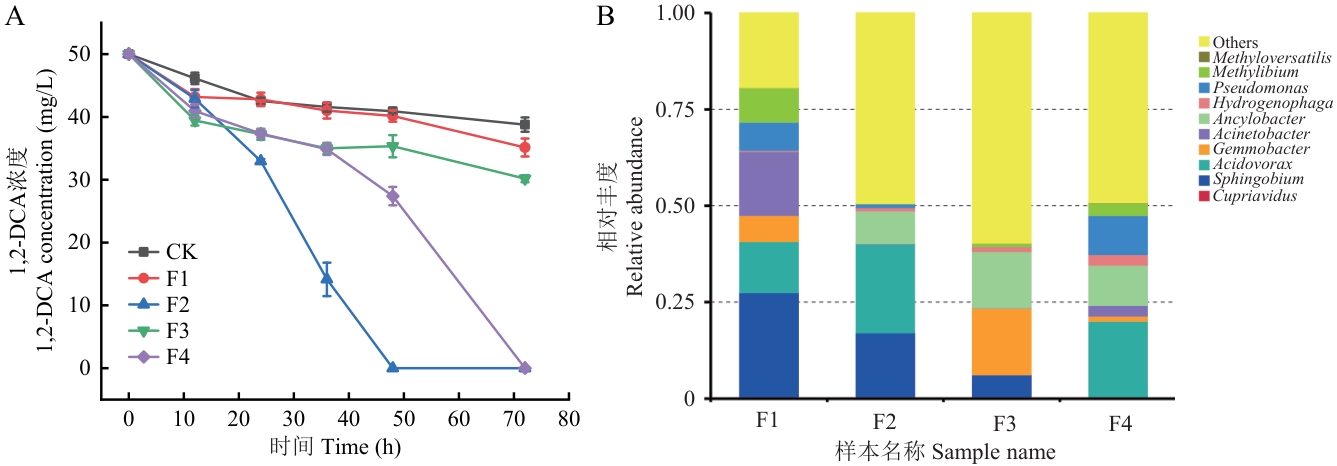
图1 1,2-DCA降解菌群的富集及降解特性A:四组富集液对1,2-DCA的降解效果;B:富集液物种丰度图
Fig. 1 Enrichment and degrading characteristics of 1,2-DCA degrading microbial consortiumA: Degradation efficiency of 1,2-DCA by four groups of enrichment cultures. B: Species abundance of the enrichment cultures
| 样本 Sample | Chao1 | Shannon | Simpson | Goods_coverage |
|---|---|---|---|---|
| F1 | 136.714 | 4.013 | 0.855 | 1.000 |
| F2 | 138.000 | 3.478 | 0.861 | 1.000 |
| F3 | 207.500 | 3.541 | 0.872 | 0.999 |
| F4 | 136.789 | 3.364 | 0.814 | 1.000 |
表1 富集液的α多样性指数
Table 1 α-diversity indices of enrichment cultures
| 样本 Sample | Chao1 | Shannon | Simpson | Goods_coverage |
|---|---|---|---|---|
| F1 | 136.714 | 4.013 | 0.855 | 1.000 |
| F2 | 138.000 | 3.478 | 0.861 | 1.000 |
| F3 | 207.500 | 3.541 | 0.872 | 0.999 |
| F4 | 136.789 | 3.364 | 0.814 | 1.000 |
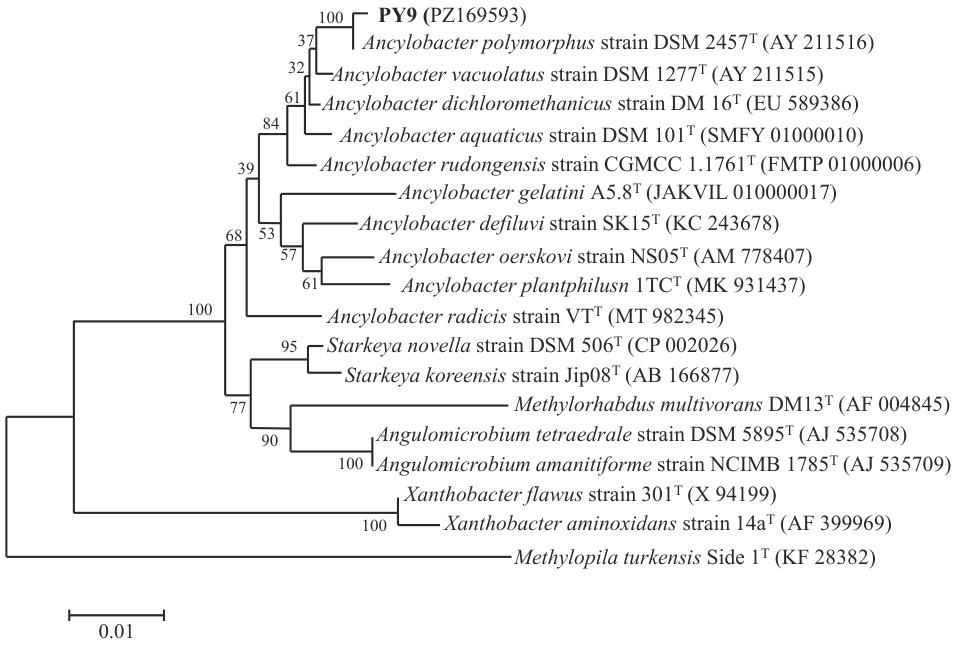
图2 菌株PY9系统发育树
Fig. 2 Phylogenetic tree of strain PY9
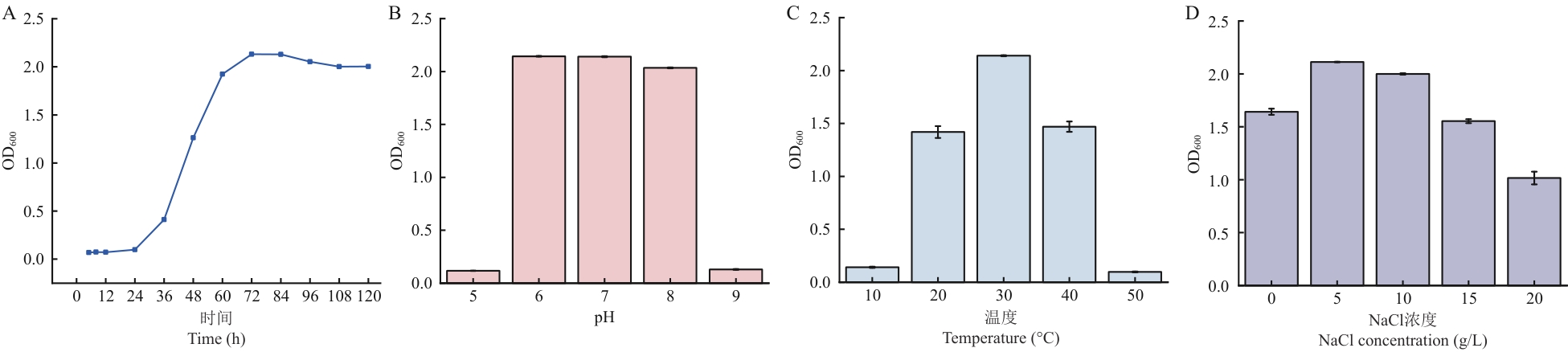
图3 菌株PY9的生长特性A:菌株PY9的生长曲线;B:pH对菌株PY9生长的影响;C:温度对菌株PY9生长的影响;D:NaCl浓度对菌株PY9生长的影响
Fig. 3 Growth characteristics of strain PY9A: Growth curve of strain PY9. B: Effects of pH on the growth of strain PY9. C: Effects of temperature on the growth of strain PY9. D: Effects of NaCl concentration on the growth of strain PY9
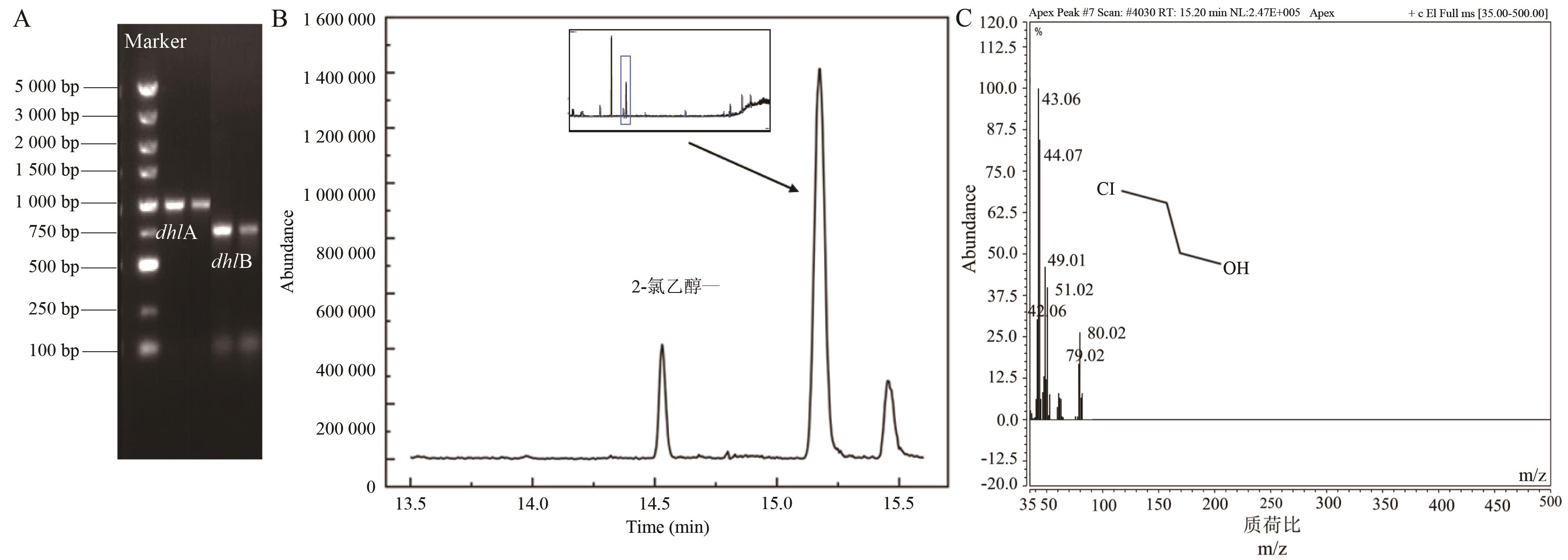
图4 菌株PY9关键降解基因扩增及1,2-DCA降解中间产物分析A:dhlA、dhlB基因电泳图;B:1,2-DCA生物降解培养液的气相色谱图;C:15.2 min色谱峰对应的质谱碎片图
Fig. 4 Amplification of key degrading genes and analysis of 1,2-DCA degrading intermediates in strain PY9A: Electrophoretogram of dhlA and dhlB genes. B: GC-MS results of 1,2-DCA biodegradation medium. C: EI fragment spectrum of the 15.2 min chromatographic peak
颗粒编号 Bead No. | 球形度 Sphericity | 机械强度 Mechanical strength | 传质性能 Mass transfer performance (%) | 含水率 Water content (%) | 降解率 Degradation rate (%) | 溶胀率 Swelling ratio (%) |
|---|---|---|---|---|---|---|
| 1 | + | ++ | 49.80 | 85.00 | 66.59 | 2.33 |
| 2 | ++ | ++ | 64.28 | 86.00 | 65.61 | 3.39 |
| 3 | +++ | ++ | 64.45 | 86.50 | 66.52 | 3.19 |
| 4 | + | ++ | 58.04 | 88.50 | 63.15 | 4.48 |
| 5 | +++ | +++ | 69.62 | 83.00 | 62.50 | 1.38 |
| 6 | + | + | 57.58 | 90.50 | 64.50 | 3.53 |
| 7 | ++ | ++ | 51.33 | 85.50 | 62.04 | 1.45 |
| 8 | ++ | ++ | 45.49 | 86.00 | 59.03 | 2.71 |
| 9 | + | +++ | 65.13 | 86.00 | 53.46 | 1.96 |
表2 固定化颗粒基本特性
Table 2 Characteristics of the immobilized beads
颗粒编号 Bead No. | 球形度 Sphericity | 机械强度 Mechanical strength | 传质性能 Mass transfer performance (%) | 含水率 Water content (%) | 降解率 Degradation rate (%) | 溶胀率 Swelling ratio (%) |
|---|---|---|---|---|---|---|
| 1 | + | ++ | 49.80 | 85.00 | 66.59 | 2.33 |
| 2 | ++ | ++ | 64.28 | 86.00 | 65.61 | 3.39 |
| 3 | +++ | ++ | 64.45 | 86.50 | 66.52 | 3.19 |
| 4 | + | ++ | 58.04 | 88.50 | 63.15 | 4.48 |
| 5 | +++ | +++ | 69.62 | 83.00 | 62.50 | 1.38 |
| 6 | + | + | 57.58 | 90.50 | 64.50 | 3.53 |
| 7 | ++ | ++ | 51.33 | 85.50 | 62.04 | 1.45 |
| 8 | ++ | ++ | 45.49 | 86.00 | 59.03 | 2.71 |
| 9 | + | +++ | 65.13 | 86.00 | 53.46 | 1.96 |
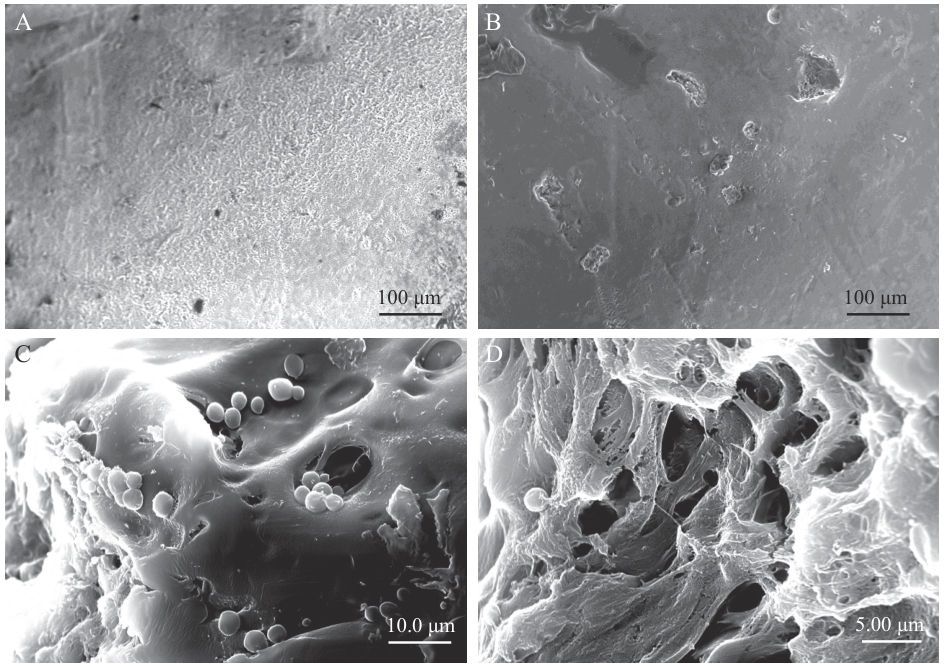
图5 固定化颗粒SEM图A:未加生物炭颗粒表面;B:添加生物炭颗粒表面;C、D:添加生物炭颗粒内部
Fig. 5 SEM image of immobilized particlesA: Surface without biochar particles. B: Surface with biochar particles. C, D: Interior with biochar particles

图6 固定化与游离态PY9对1,2-DCA的降解特性A:不同处理体系的降解效果;B:pH对菌株PY9降解的影响;C:温度对菌株PY9降解的影响;D:NaCl浓度对菌株PY9降解的影响
Fig. 6 Degradation characteristics of 1,2-DCA by immobilized and free PY9A: Degradation efficiency of different treatment systems. B: Effect of pH on degradation by strain PY9. C: Effect of temperature on degradation by strain PY9. D: Effect of NaCl concentration on degradation by strain PY9
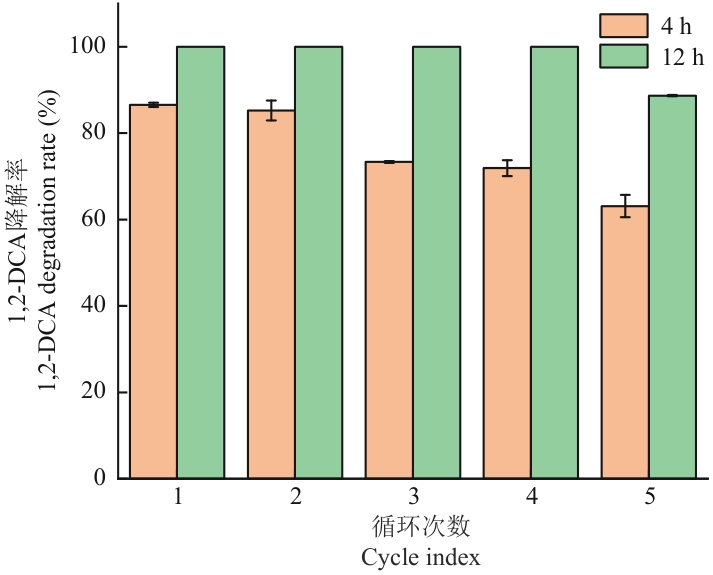
图7 固定化颗粒循环利用性
Fig. 7 Reusability of immobilized beads
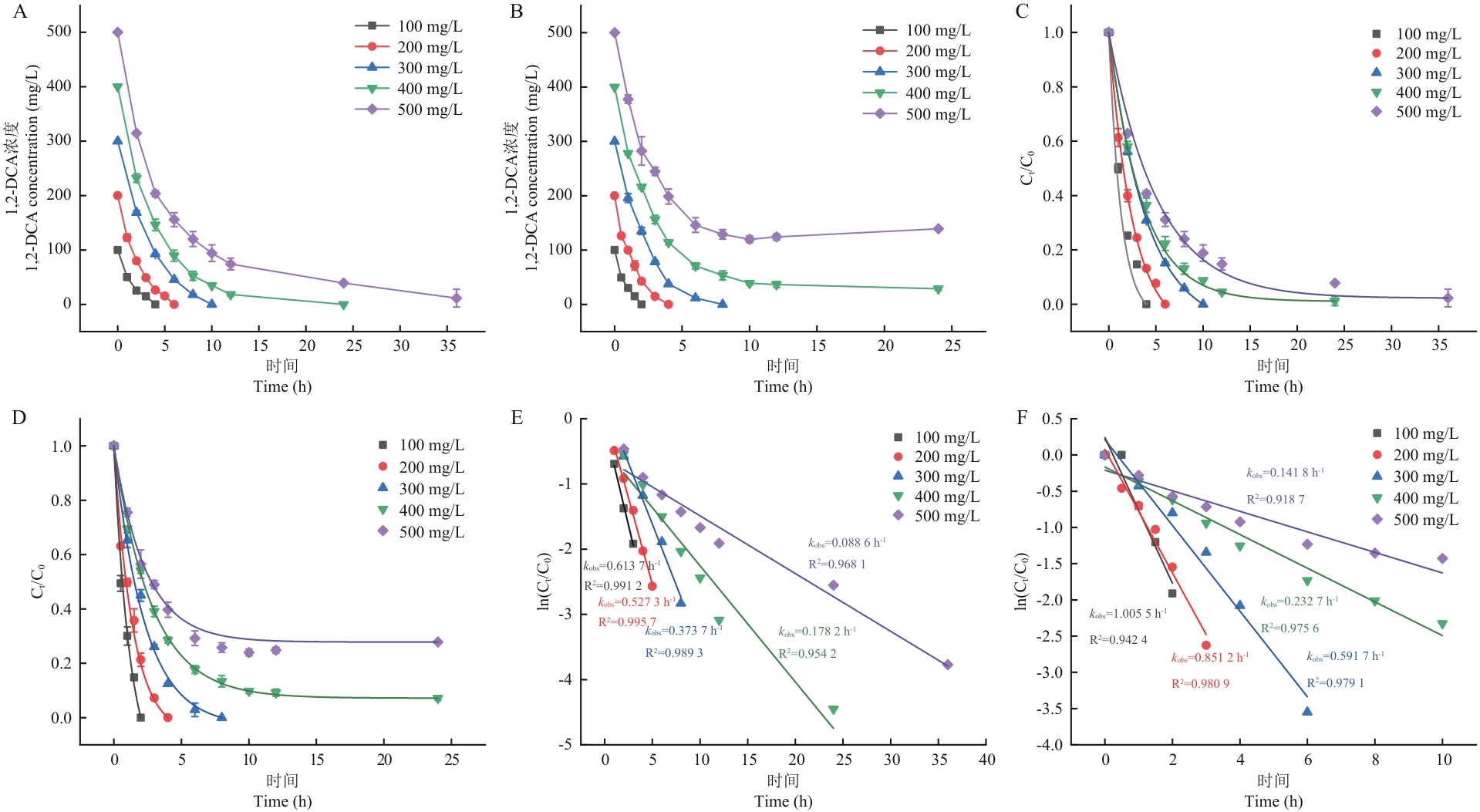
图8 固定化与游离态菌株PY9的1,2-DCA降解动力学A:固定化PY9对不同初始浓度1,2-DCA的降解曲线;B:游离态PY9对不同初始浓度1,2-DCA的降解曲线;C:固定化PY9的一级降解动力学;D:游离态PY9的一级降解动力学;E:固定化PY9的动力学拟合曲线;F:游离态PY9 动力学拟合曲线
Fig. 8 Degradation kinetics of 1,2-DCA by immobilized and free strain PY9A: Degradation curves of 1,2-DCA with different initial concentrations by immobilized PY9. B: Degradation curves of 1,2-DCA with different initial concentrations by free PY9. C: First-order degradation kinetics of immobilized PY9. D: First-order degradation kinetics of free PY9. E: Kinetic fitting curves of immobilized PY9. F: Kinetic fitting curves of free PY9
| Item | 初始浓度 Initial concentration (mg/L) | R2 | K (h-1) | t1/2 (h) |
|---|---|---|---|---|
固定化 PY9 Immobilized PY9 | 100 | 0.991 2 | 0.613 7 | 1.181 4 |
| 200 | 0.995 7 | 0.527 3 | 1.333 1 | |
| 300 | 0.989 3 | 0.373 7 | 1.677 5 | |
| 400 | 0.954 2 | 0.178 2 | 2.418 0 | |
| 500 | 0.968 1 | 0.088 6 | 3.116 8 | |
游离态PY9 Free PY9 | 100 | 0.942 4 | 1.005 5 | 0.687 7 |
| 200 | 0.980 9 | 0.851 2 | 0.854 3 | |
| 300 | 0.979 1 | 0.591 7 | 1.217 9 | |
| 400 | 0.975 6 | 0.232 7 | 2.151 2 | |
| 500 | 0.918 7 | 0.141 8 | 2.646 5 |
表3 固定化PY9和游离态PY9的降解拟合参数
Table 3 Degradation fitting parameters of immobilized and free PY9
| Item | 初始浓度 Initial concentration (mg/L) | R2 | K (h-1) | t1/2 (h) |
|---|---|---|---|---|
固定化 PY9 Immobilized PY9 | 100 | 0.991 2 | 0.613 7 | 1.181 4 |
| 200 | 0.995 7 | 0.527 3 | 1.333 1 | |
| 300 | 0.989 3 | 0.373 7 | 1.677 5 | |
| 400 | 0.954 2 | 0.178 2 | 2.418 0 | |
| 500 | 0.968 1 | 0.088 6 | 3.116 8 | |
游离态PY9 Free PY9 | 100 | 0.942 4 | 1.005 5 | 0.687 7 |
| 200 | 0.980 9 | 0.851 2 | 0.854 3 | |
| 300 | 0.979 1 | 0.591 7 | 1.217 9 | |
| 400 | 0.975 6 | 0.232 7 | 2.151 2 | |
| 500 | 0.918 7 | 0.141 8 | 2.646 5 |
菌株 Strain | 浓度 Concentration (mg/L) | 降解条件(pH/温度/摇床转速/接种量) Degradation conditions (pH/ temperature (℃)/ rotate speed (r/min)/ inoculum) | 时间 Time (h) | 降解率 Degradation rate (%) | 文献 Reference |
|---|---|---|---|---|---|
| Ancylobacter sp. PY9 | 300 | 7/ 30/ 180/ 初始OD600 0.058 | 8 | 100 | 本研究 |
| Ancylobacter sp. J3 | 300 | 7/ 30/ 180/ 菌体干重34.29 mg/L | 24 | 100 | [ |
| Ancylobacter sp. BL0 | 120 | 7/ 30/ 180/ 初始OD600 0.01 | 6 | 100 | [ |
| Ancylobacter sp. BL1 | 300 | 7/ 30/ 180/ 初始OD600 0.044 | 36 | 100 | [ |
| Ancylobacter sp. YN5 | 200 | 9/ 30/ 180/ 初始OD600 0.05 | 16 | 100 | [ |
| Starkeya sp. T-2 | 200 | 7/ 30/ 160/ 初始OD600 0.035 | 19 | 100 | [ |
| Klebsiella VA 8391 | 99 | 7.5/ 30/ 220/ 未描述 | 5 | 25 | [ |
| Pseudomonas sp. DCA1 | 247 | 7/ 25/ 剧烈振荡/ 初始OD600 0.13 | 5.5 | 100 | [ |
表4 不同1,2-DCA降解菌株的降解性能对比
Table 4 Degradation comparison of different 1,2-DCA degrading strains
菌株 Strain | 浓度 Concentration (mg/L) | 降解条件(pH/温度/摇床转速/接种量) Degradation conditions (pH/ temperature (℃)/ rotate speed (r/min)/ inoculum) | 时间 Time (h) | 降解率 Degradation rate (%) | 文献 Reference |
|---|---|---|---|---|---|
| Ancylobacter sp. PY9 | 300 | 7/ 30/ 180/ 初始OD600 0.058 | 8 | 100 | 本研究 |
| Ancylobacter sp. J3 | 300 | 7/ 30/ 180/ 菌体干重34.29 mg/L | 24 | 100 | [ |
| Ancylobacter sp. BL0 | 120 | 7/ 30/ 180/ 初始OD600 0.01 | 6 | 100 | [ |
| Ancylobacter sp. BL1 | 300 | 7/ 30/ 180/ 初始OD600 0.044 | 36 | 100 | [ |
| Ancylobacter sp. YN5 | 200 | 9/ 30/ 180/ 初始OD600 0.05 | 16 | 100 | [ |
| Starkeya sp. T-2 | 200 | 7/ 30/ 160/ 初始OD600 0.035 | 19 | 100 | [ |
| Klebsiella VA 8391 | 99 | 7.5/ 30/ 220/ 未描述 | 5 | 25 | [ |
| Pseudomonas sp. DCA1 | 247 | 7/ 25/ 剧烈振荡/ 初始OD600 0.13 | 5.5 | 100 | [ |
| [1] | Wu ZM, Yu X, Liu GP, et al. Sustained detoxification of 1,2-dichloroethane to ethylene by a symbiotic consortium containing Dehalococcoides species [J]. Environ Pollut, 2023, 325: 121443. |
| [2] | Deng YD, Zhang WH, Zuo ZH, et al. The complete degradation of 1,2-dichloroethane in Escherichia coli by metabolic engineering [J]. J Hazard Mater, 2024, 472: 134476. |
| [3] | Feng YZ, An JL, Tang GQ, et al. Characteristics and sources of volatile organic compounds in the Nanjing industrial area [J]. Atmosphere, 2022, 13(7): 1136. |
| [4] | 孔祥斌. 饱和含水层中1,2-二氯乙烷运移模拟及生物降解研究 [D]. 保定: 河北农业大学, 2013. |
| Kong XB. Transport and biodegradation of 1, 2-dichloroethane in laboratory aquifer columns [D]. Baoding: Hebei Agricultural University, 2013. | |
| [5] | Alshehri SM, Naushad M, Ahamad T, et al. Synthesis, characterization of curcumin based ecofriendly antimicrobial bio-adsorbent for the removal of phenol from aqueous medium [J]. Chem Eng J, 2014, 254: 181-189. |
| [6] | Feng JR, Ni HG. Effects of heavy metals and metalloids on the biodegradation of organic contaminants [J]. Environ Res, 2024, 246: 118069. |
| [7] | Kocamemi BA, Çeçen F. Biodegradation of 1,2-dichloroethane (1,2-DCA) by cometabolism in a nitrifying biofilm reactor [J]. Int Biodeterior Biodegradation, 2009, 63: 717-726. |
| [8] | Munro JE, Liew EF, Ly MA, et al. A new catabolic plasmid in Xanthobacter and Starkeya spp. from a 1,2-dichloroethane-contaminated site [J]. Appl Environ Microbiol, 2016, 82(17): 5298-5308. |
| [9] | 张志梅, 张彦猛, 谢东明, 等. 1,2-二氯乙烷降解菌群的富集及关键降解菌Ancylobacter sp. BL0的分离鉴定 [J]. 生物技术通报, 2024, 40(8): 288-298. |
| Zhang ZM, Zhang YM, Xie DM, et al. Enrichment of 1,2-dichloroethane degrading bacterial consortium, and isolation and identification of Ancylobacter sp. BL0 of a key degrading bacterial strain [J]. Biotechnol Bull, 2024, 40(8): 288-298. | |
| [10] | Jun LY, Yon LS, Mubarak NM, et al. An overview of immobilized enzyme technologies for dye and phenolic removal from wastewater [J]. J Environ Chem Eng, 2019, 7(2): 102961. |
| [11] | Cui JD, Jia SR. Organic-inorganic hybrid nanoflowers: a novel host platform for immobilizing biomolecules [J]. Coord Chem Rev, 2017, 352: 249-263. |
| [12] | Li BB, Gan L, Owens G, et al. New nano-biomaterials for the removal of malachite green from aqueous solution via a response surface methodology [J]. Water Res, 2018, 146: 55-66. |
| [13] | Zou B, Yan Y, Xia JJ, et al. Enhancing bio-catalytic activity and stability of lipase nanogel by functional ionic liquids modification [J]. Colloids Surf B Biointerfaces, 2020, 195: 111275. |
| [14] | Wu ZG, Wang L, Qin T, et al. Biodegradation of 1,2-dichloroethane by Ancylobacter sp. BL1 Degradation characteristics, catabolic genes, and bioaugmentation in contaminated soil [J]. Int Biodeterior Biodegrad, 2025, 203: 106123. |
| [15] | Wu ZG, Zuo ZH, Zhang XY, et al. Characterization of a novel 1,2-dichloroethane degrader Ancylobacter sp. J3 and use of its immobilized cells in the treatment of polluted groundwater [J]. J Hazard Mater, 2025, 493: 138346. |
| [16] | 杨宗政, 王浪, 唐立娜, 等. 1,2-二氯乙烷降解菌YN5的筛选鉴定与土壤修复 [J]. 生物学杂志, 2026, 43(1): 26-31. |
| Yang ZZ, Wang L, Tang LN, et al. Screening, identification, and soil remediation of a 1,2-dichloroethane degrading bacterium YN5 [J]. J Biol, 2026, 43(1): 26-31. | |
| [17] | 东秀珠, 蔡妙英. 常见细菌系统鉴定手册 [M]. 北京: 科学出版社, 2001. |
| Dong XZ, Cai MY. Handbook of identification of common bacterial systems [M]. Beijing: Science Press, 2001. | |
| [18] | 戴云飞, 杨泽玉, 陈颖, 等. 聚乙烯醇-海藻酸钠-活性炭固定化菌球处理二氯甲烷的研究 [J]. 环境科学学报, 2021, 41(2): 430-439. |
| Dai YF, Yang ZY, Chen Y, et al. Removel of DCM by microorganism cells immobilized into polyvinyl alcohol-alginate-activated carbon beads [J]. Acta Sci Circumstantiae, 2021, 41(2): 430-439. | |
| [19] | 苏鑫, 王诗涵, 刘佩武, 等. 微生物复合载体制备及包埋Halomonas sp. NH2B的硝化性能 [J]. 环境科学与技术, 2023, 46(11): 1-10. |
| Su X, Wang SH, Liu PW, et al. Preparation of microbial composite carrier and nitration performance of Halomonas sp. NH2B encapsulation [J]. Environ Sci Technol, 2023, 46(11): 1-10. | |
| [20] | 吴国杰. 固定化载体材料壳聚糖基水凝胶的研究 [D]. 西安: 西北工业大学, 2006. |
| Wu GJ. Study on the chitosan-based hydrogels as the carrier materials for immobilization [D]. Xi’an: Northwestern Polytechnical University, 2006. | |
| [21] | Geng X, Zhao JT, Zhang Z, et al. Aerobic degradation of hexachlorobenzene and pentachloronitrobenzene by Cupriavidus nantongensis HB4B5: Dechlorination mechanisms and bioremediation potential [J]. Environ Int, 2025, 203: 109761. |
| [22] | Liu YX, Zhang Q, Lv YK, et al. Pyridine degradation characteristics of a newly isolated bacterial strain and its application with a novel reactor for the further treatment in pyridine wastewater [J]. Process Biochem, 2020, 95: 64-70. |
| [23] | Sun S, Wang YR, Chen SQ, et al. Functionality, characterization and DEGs contribution by engineering isolate Pseudomonas P1 to elucidate the regulation mechanisms of p-chlorophenol-4-Chloroaniline bioremediation [J]. Chem Eng J, 2023, 468: 143798. |
| [24] | 陆鹏, 周慧, 袁梦. 菌株Cupriavidus sp. DT-1对液体和土壤中TCP的降解 [J]. 中国环境科学, 2021, 41(6): 2780-2787. |
| Lu P, Zhou H, Yuan M. Biodegradation of 3, 5, 6-trichloro-2-pyridinol by Cupriavidus sp DT-1 in liquid and soil environments [J]. China Environ Sci, 2021, 41(6): 2780-2787. | |
| [25] | 邢志林, 袁山林, 郭江枫, 等. 重庆工业园区土壤微生物群落结构及功能分析——以焦化厂土壤为例 [J]. 环境影响评价, 2020, 42(2): 74-78. |
| Xing ZL, Yuan SL, Guo JF, et al. Evaluation of microbial community structure and functional characteristics in industrial park soil—a case study of coking plant soil [J]. Environ Impact Assess, 2020, 42(2): 74-78. | |
| [26] | Bedics A, Táncsics A, Banerjee S, et al. A cidovorax benzenivorans sp. nov., a novel aromatic hydrocarbon-degrading bacterium isolated from a xylene-degrading enrichment culture [J]. Int J Syst Evol Microbiol, 2024, 74(1): 006219. |
| [27] | Cheng ZW, Chen JM, Chen DZ, et al. Biodegradation of methyl tert-butyl ether in a bioreactor using immobilized Methylibium petroleiphilum PM1 cells [J]. Water Air Soil Pollut, 2011, 214(1-4): 59-72. |
| [28] | 王小春, 陈东之, 金小君, 等. 1株1,2-二氯乙烷降解菌的分离及降解特性研究 [J]. 环境科学, 2012, 33(10): 3620-3626. |
| Wang XC, Chen DZ, Jin XJ, et al. Isolation, degradation characteristics of a 1,2-dichloroethane-degrading strain [J]. Chin J Environ Sci, 2012, 33(10): 3620-3626. | |
| [29] | Mileva A, Sapundzhiev T, Beschkov V. Modeling 1,2-dichloroethane biodegradation by Klebsiella oxytoca va 8391 immobilized on granulated activated carbon [J]. Bioprocess Biosyst Eng, 2008, 31(2): 75-85. |
| [30] | Hage JC, Hartmans S. Monooxygenase-mediated 1,2-dichloroethane degradation by Pseudomonas sp. strain DCA1 [J]. Appl Environ Microbiol, 1999, 65(6): 2466-2470. |
| [31] | 李文章, 胡亚茹, 李法云, 等. 铁改性生物炭-凹凸棒石载体固定化菌剂制备及其对氯苯污染土壤修复作用 [J]. 生态环境学报, 2024, 33(11): 1782-1791. |
| Li WZ, Hu YR, Li FY, et al. Preparation of iron modified biochar-attapulgite carrier immobilized bacterial agent and its remediation for soil contaminated by chlorobenzene [J]. Ecol Environ Sci, 2024, 33(11): 1782-1791. | |
| [32] | 杨宗政, 许文帅, 吴志国, 等. 微生物固定化及其在环境污染治理中的应用研究进展 [J]. 微生物学通报, 2020, 47(12): 4278-4292. |
| Yang ZZ, Xu WS, Wu ZG, et al. Microbial immobilization in environmental pollution treatment:a review [J]. Microbiol China, 2020, 47(12): 4278-4292. | |
| [33] | 张静, 周南, 张盼月, 等. 固定化微生物技术在多环芳烃污染土壤修复中的应用 [J]. 环境工程技术学报, 2024, 14(5): 1617-1626. |
| Zhang J, Zhou N, Zhang PY, et al. Application of immobilized microbial technology in polycyclic aromatic hydrocarbon-contaminated soil remediation [J]. J Environ Eng Technol, 2024, 14(5): 1617-1626. | |
| [34] | Wu ZG, Liu YL, Liu HM, et al. Characterization of the nitrobenzene-degrading strain Pseudomonas sp. a3 and use of its immobilized cells in the treatment of mixed aromatics wastewater [J]. World J Microbiol Biotechnol, 2012, 28(8): 2679-2687. |
| [35] | Zhang BY, Ni YX, Liu JW, et al. Bead-immobilized Pseudomonas stutzeri Y2 prolongs functions to degrade s-triazine herbicides in industrial wastewater and maize fields [J]. Sci Total Environ, 2020, 731: 139183. |
| [36] | 张太平, 肖嘉慧, 胡凤洁. 生物炭固定化微生物技术在去除水中污染物的应用研究进展 [J]. 生态环境学报, 2021, 30(5): 1084-1093. |
| Zhang TP, Xiao JH, Hu FJ. Research progress in the removal of contaminants from water by immobilized microorganisms combined with biochar [J]. Ecol Environ Sci, 2021, 30(5): 1084-1093. | |
| [37] | 张永明, 张悦, 施汉昌, 等. 固定化梭形气芽孢杆菌在降解废水时微观形态的观察和比较 [J]. 环境科学, 2003, 24(3): 70-73. |
| Zhang YM, Zhang Y, Shi HC, et al. Observation and comparison on microstructure of immobilized aerobacillus fusiformis under wastewater treatment [J]. Chin J Environ Sci, 2003, 24(3): 70-73. |
| [1] | 弥春霞, 许澍, 王守现, 刘宇, 宋庆港, 宋爽. 糙皮侧耳覆土栽培对土壤中抗生素抗性基因的影响[J]. 生物技术通报, 2025, 41(6): 335-343. |
| [2] | 王争艳, 樊芳蕾, 叶天伟, 罗琼, 赵亚茹. 昆虫共生菌在降解塑料和农药中的应用研究[J]. 生物技术通报, 2025, 41(4): 33-46. |
| [3] | 张志梅, 张彦猛, 谢东明, 杨秀云, 王浪, 左梓涵, 吴志国. 1,2-二氯乙烷降解菌群的富集及关键降解菌Ancylobacter sp. BL0的分离鉴定[J]. 生物技术通报, 2024, 40(8): 288-298. |
| [4] | 徐汝悦, 王子霄, 沈禄, 吴蓉蓉, 姚芳婷, 谭中原, 刘恒蔚, 张文超. Cr(VI)的生物修复技术研究进展[J]. 生物技术通报, 2023, 39(6): 49-60. |
| [5] | 张华香, 徐晓婷, 郑云婷, 肖春桥. 溶磷微生物在钝化和植物修复重金属污染土壤中的作用[J]. 生物技术通报, 2023, 39(3): 52-58. |
| [6] | 杨宗政, 赵晓宇, 刘丹, 许文帅, 吴志国. Microbacterium sp. BD6在Cr(VI)污染农田土壤修复中的应用研究[J]. 生物技术通报, 2021, 37(10): 81-90. |
| [7] | 郭伟, 薛帅, 张哲超, 刁风伟, 胡杰, 张敏, 刘美淳, 丁胜利, 贾冰冰, 史中奇. 生物技术修复盐碱化草地研究进展[J]. 生物技术通报, 2020, 36(7): 200-208. |
| [8] | 岳丽晓, 李登云, 张晶晶, 仝雷. 一株敌草隆降解菌的分离及其应用潜能探索[J]. 生物技术通报, 2020, 36(6): 110-119. |
| [9] | 张永敏, 王天慧, 王萍. 沉积物中菲高效降解菌群的筛选鉴定及降解特性[J]. 生物技术通报, 2020, 36(6): 128-135. |
| [10] | 吴学玲, 周翔宇, 吴晓燕, 罗奎, 顾怡超, 周晗, 廖婉晴, 曾伟民. 四环素降解菌共培养体系构建及废水修复的群落分析[J]. 生物技术通报, 2020, 36(10): 116-126. |
| [11] | 望子龙 ,罗学刚 ,司慧 ,王焯. 锰、砷对地衣芽孢杆菌铀富集的影响[J]. 生物技术通报, 2018, 34(6): 164-171. |
| [12] | 张广志, 王加宁, 吴晓青, 周方园, 张新建, 赵晓燕, 谢雪迎, 周红姿. 设施番茄根围土样中木霉菌多样性及功能活性分析[J]. 生物技术通报, 2018, 34(4): 179-185. |
| [13] | 华涛, 李胜男, 邸志珲, 周博, 曾文炉, 周启星, 李凤祥. 微生物降解石油污染物机制研究进展[J]. 生物技术通报, 2018, 34(10): 26-34. |
| [14] | 郝大程, 周建强, 韩君. 土壤重金属和有机污染物的微生物修复:生物强化和生物刺激[J]. 生物技术通报, 2017, 33(10): 9-17. |
| [15] | 郭萍, 李红娜, 李峰, 叶婧. 石油污染微生物修复技术研究进展[J]. 生物技术通报, 2017, 33(10): 18-25. |
| 阅读次数 | ||||||
|
全文 |
|
|||||
|
摘要 |
|
|||||
