







• 综述与专论 • 下一篇
孙冠男1,2,3, 魏艺芸1,2,3, 何文涛1,3, 刘娇1,3( ), 郑平1,2,3()
收稿日期:2026-06-11
出版日期:2026-09-14
通讯作者:
刘娇liu_j@tib.cas.cn基金资助:
SUN Guan-nan1,2,3, WEI Yi-yun1,2,3, HE Wen-tao1,3, LIU Jiao1,3(), ZHENG Ping1,2,3()
Received:2026-06-11
Published:2026-09-14
摘要:
解析蛋白质序列变异与结构和功能的关联是生命科学领域的关键科学问题。深度突变扫描(deep mutational scanning, DMS)技术是全景解析蛋白质突变效应的核心手段,为解决这一科学难题提供了关键技术支撑。该技术针对目标蛋白编码基因的全序列构建大规模突变文库,依托高通量筛选结合深度测序完成海量突变体的并行功能表征,最终量化突变效应并绘制蛋白质适应性景观。本文系统综述了DMS技术的前沿进展,重点对比了基于质粒和基因组原位编辑两类突变文库构建策略的原理、优缺点及适用范围;总结了生长富集筛选结合深度测序的高通量表型评估方法;梳理了其在蛋白质工程改造、微生物耐药突变鉴定、蛋白质语言模型测评与优化等领域的应用。同时针对文库构建与筛选体系的现存瓶颈,展望了新型基因组编辑工具、多元化表型筛选等有望推动技术发展的趋势。
孙冠男, 魏艺芸, 何文涛, 刘娇, 郑平. 深度突变扫描技术的发展及应用[J]. 生物技术通报, doi: 10.13560/j.cnki.biotech.bull.1985.2026-0659.
SUN Guan-nan, WEI Yi-yun, HE Wen-tao, LIU Jiao, ZHENG Ping. Development and Applications of Deep Mutational Scanning[J]. Biotechnology Bulletin, doi: 10.13560/j.cnki.biotech.bull.1985.2026-0659.
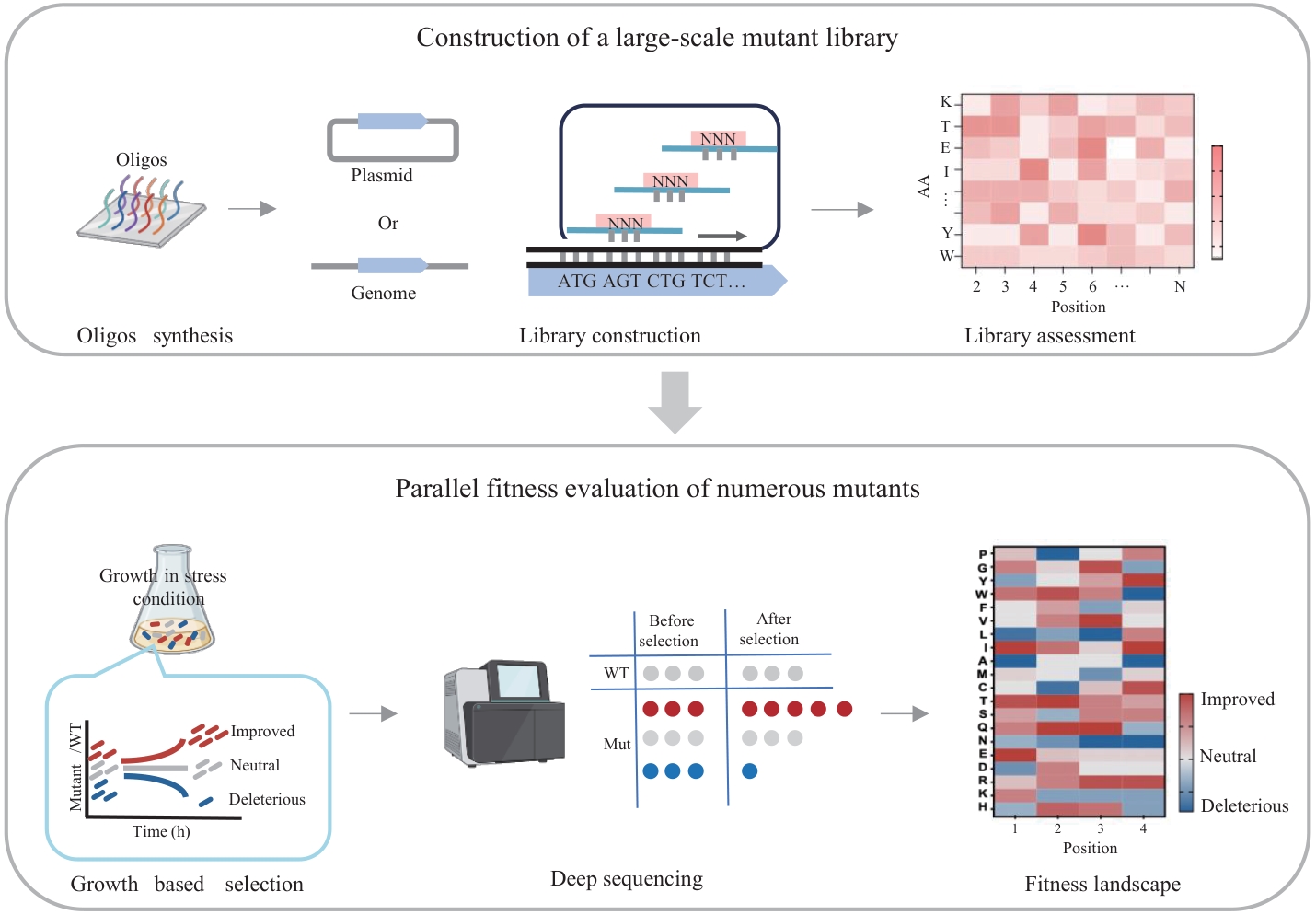
图1 深度突变扫描流程工作流程包括大规模突变体库的构建与突变文库并行功能评估两部分,其中大规模突变体库的构建分为质粒建库以及基因组原位建库;突变文库并行功能评估包括基于生长的高通量筛选、深度测序以及适应性景观绘制
Fig. 1 Deep mutational scanning workflowThe workflow consists of two main modules: construction of a large-scale mutant library and parallel fitness evaluation of numerous mutants. Large-scale mutant library construction is further divided into plasmid-based library construction and in situ genomic library construction. Parallel fitness evaluation of numerous mutants includes growth-based high-throughput screening, deep sequencing, and fitness landscape profiling
方法 Methods | 蛋白 Protein | 长度 Length (aa) | 突变方式 Mutant types | 覆盖度 Coverage(%) | 文献 Reference |
|---|---|---|---|---|---|
反向PCR技术 Inverse PCR | CcdB | 101 | NNK | 95.0 | [ |
| PTEN | 122 | NNK | 83.6 | [ | |
| Src | 158 | NNK | 87.7 | [ | |
| TPMT | 187 | NNK | 85.4 | [ | |
| Ras | 165 | NNK | 90.0 | [ | |
| BRCA1 | 237 | NNK | 96.5 | [ | |
盒式连接技术 Cassette ligation | Hsp90 | 231 | NNK | 98.0 | [ |
| APH3Ⅱ | 264 | NNK | 100.0 | [ | |
| ERK2 | 359 | NNK | 94.8 | [ | |
| Hp53 | 393 | NNK | 99.8 | [ | |
| Rubisco | 462 | NNK | 99.1 | [ | |
| SHP2 | 593 | NNK | 80 | [ | |
切刻突变技术 Nicking mutagenesis | AmiE | 71 | NNK | 100.0 | [ |
| PYR1 | 86 | NNK | 99 | [ | |
| UCA9 | 99 | NNK | 97.4 | [ | |
| ΦX174G | 172 | NNK | 99 | [ | |
| KRAS | 188 | NNK | 99.5 | [ | |
| TnpB | 408 | NNK | 95.7 | [ | |
| ΦX174F | 421 | NNK | 99 | [ |
表1 基于质粒构建突变扫描文库汇总
Table 1 Summary of plasmid-based methods for deep mutational scanning library construction
方法 Methods | 蛋白 Protein | 长度 Length (aa) | 突变方式 Mutant types | 覆盖度 Coverage(%) | 文献 Reference |
|---|---|---|---|---|---|
反向PCR技术 Inverse PCR | CcdB | 101 | NNK | 95.0 | [ |
| PTEN | 122 | NNK | 83.6 | [ | |
| Src | 158 | NNK | 87.7 | [ | |
| TPMT | 187 | NNK | 85.4 | [ | |
| Ras | 165 | NNK | 90.0 | [ | |
| BRCA1 | 237 | NNK | 96.5 | [ | |
盒式连接技术 Cassette ligation | Hsp90 | 231 | NNK | 98.0 | [ |
| APH3Ⅱ | 264 | NNK | 100.0 | [ | |
| ERK2 | 359 | NNK | 94.8 | [ | |
| Hp53 | 393 | NNK | 99.8 | [ | |
| Rubisco | 462 | NNK | 99.1 | [ | |
| SHP2 | 593 | NNK | 80 | [ | |
切刻突变技术 Nicking mutagenesis | AmiE | 71 | NNK | 100.0 | [ |
| PYR1 | 86 | NNK | 99 | [ | |
| UCA9 | 99 | NNK | 97.4 | [ | |
| ΦX174G | 172 | NNK | 99 | [ | |
| KRAS | 188 | NNK | 99.5 | [ | |
| TnpB | 408 | NNK | 95.7 | [ | |
| ΦX174F | 421 | NNK | 99 | [ |
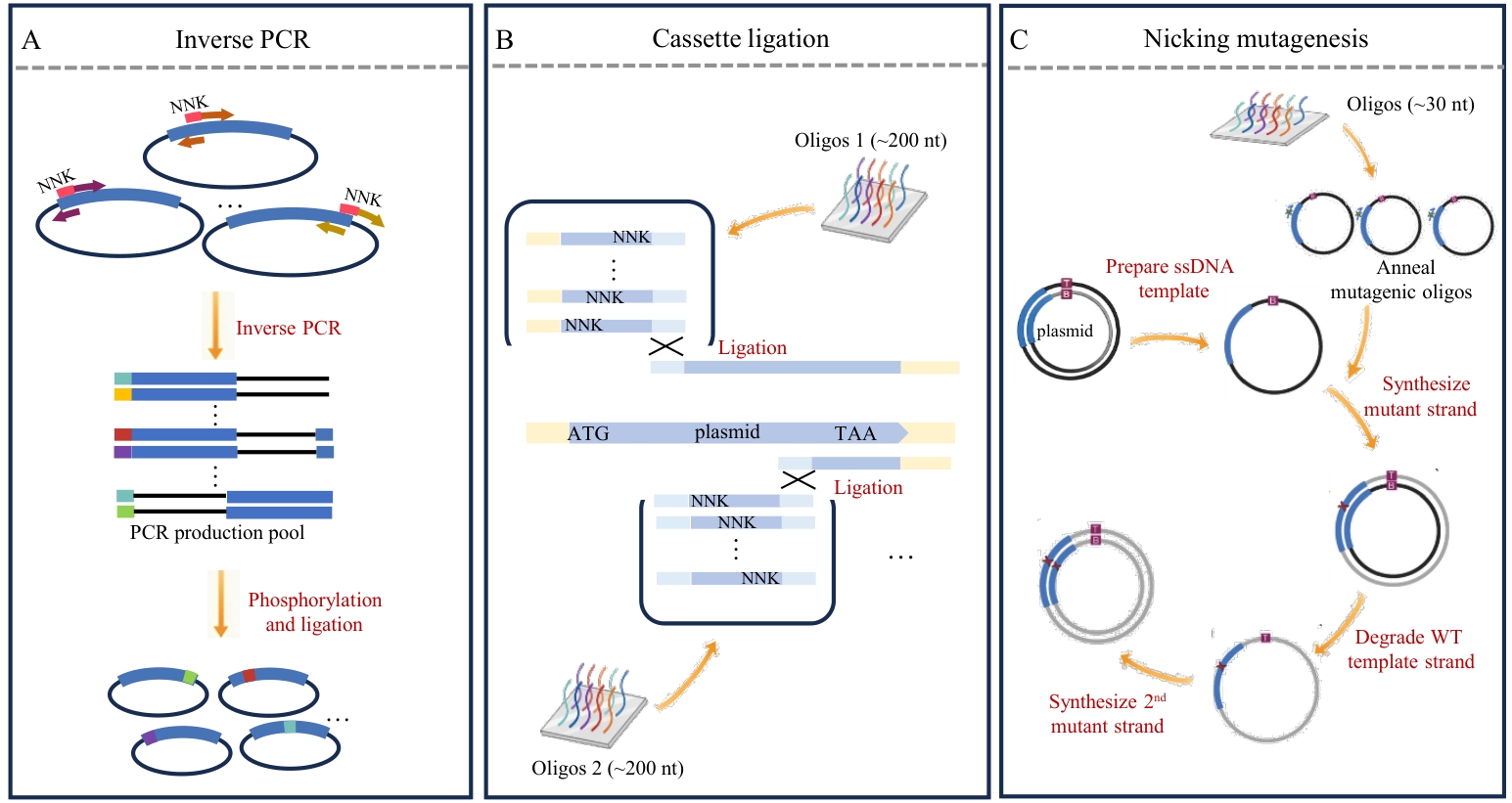
图2 质粒层面DMS文库构建技术A:反向PCR技术;B:盒式连接技术;C:切刻突变技术
Fig. 2 DMS library construction technology based on plasmidA: Inverse PCR; B: cassette ligation; C: nicking mutagenesis
方法 Methods | 蛋白 Protein | 长度 Length (aa) | 突变方式 Mutant types | 覆盖度 Coverage (%) | 文献 Reference |
|---|---|---|---|---|---|
| MAGE | InfA | 71 | NNN | 99.0 | [ |
| RpoB | 62 | NNK | 98.0 | [ | |
| RpoD | 234 | NNN | 99.0 | [ | |
| UgtP | 391 | NNK | -# | [ | |
| CRISPR | FolA | 157 | NNK | 97.0 | [ |
| FabZ | 151 | 20* | 84.0 | [ | |
| LpxC | 305 | 20* | 84.0 | [ | |
| MurA | 419 | 20* | 76.0 | [ |
表2 基于基因组突变扫描文库构建汇总
Table 2 Summary of genome methods for constructing deep mutational scanning libraries
方法 Methods | 蛋白 Protein | 长度 Length (aa) | 突变方式 Mutant types | 覆盖度 Coverage (%) | 文献 Reference |
|---|---|---|---|---|---|
| MAGE | InfA | 71 | NNN | 99.0 | [ |
| RpoB | 62 | NNK | 98.0 | [ | |
| RpoD | 234 | NNN | 99.0 | [ | |
| UgtP | 391 | NNK | -# | [ | |
| CRISPR | FolA | 157 | NNK | 97.0 | [ |
| FabZ | 151 | 20* | 84.0 | [ | |
| LpxC | 305 | 20* | 84.0 | [ | |
| MurA | 419 | 20* | 76.0 | [ |
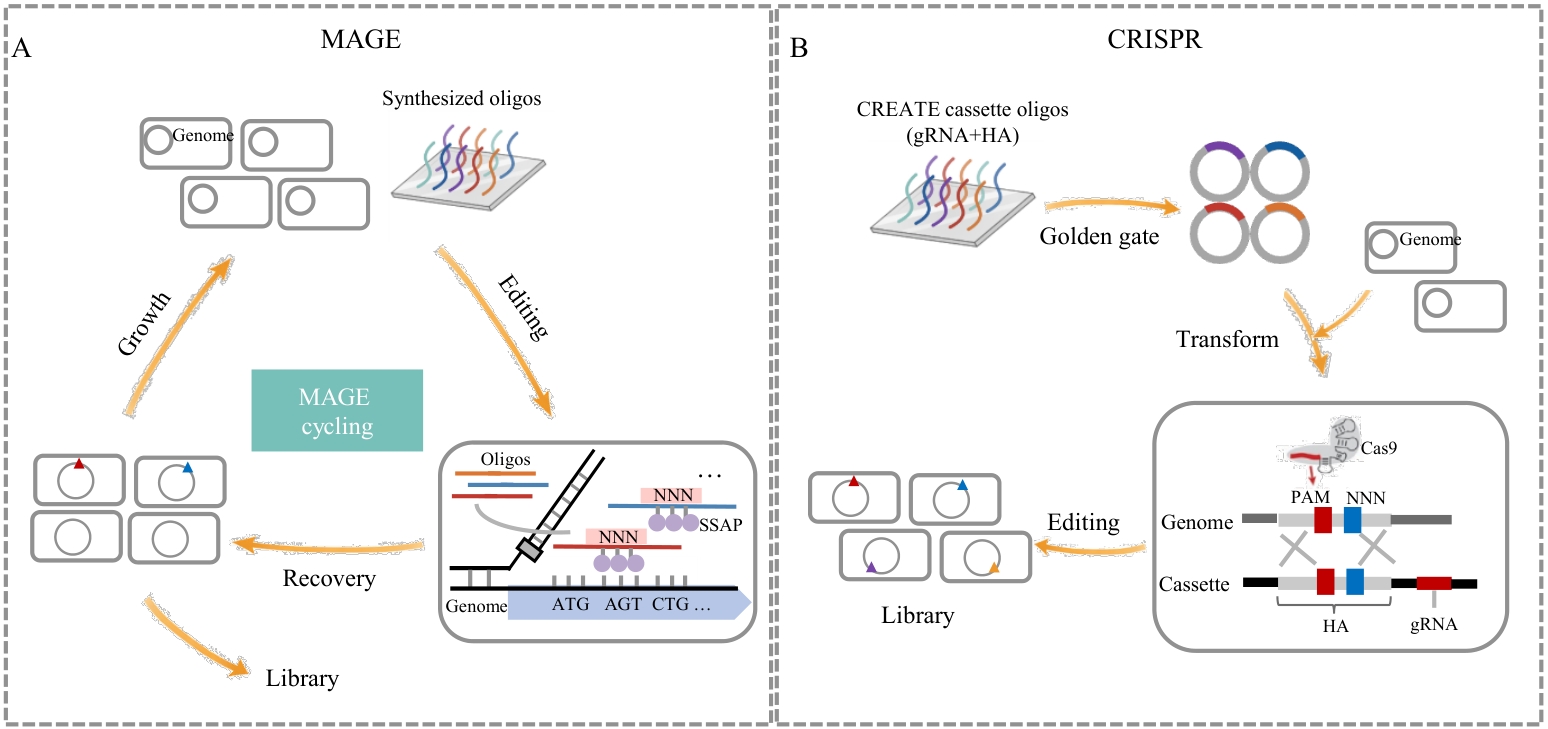
图3 基于基因组DMS文库构建技术
Fig. 3 Genome-level DMS library construction technology
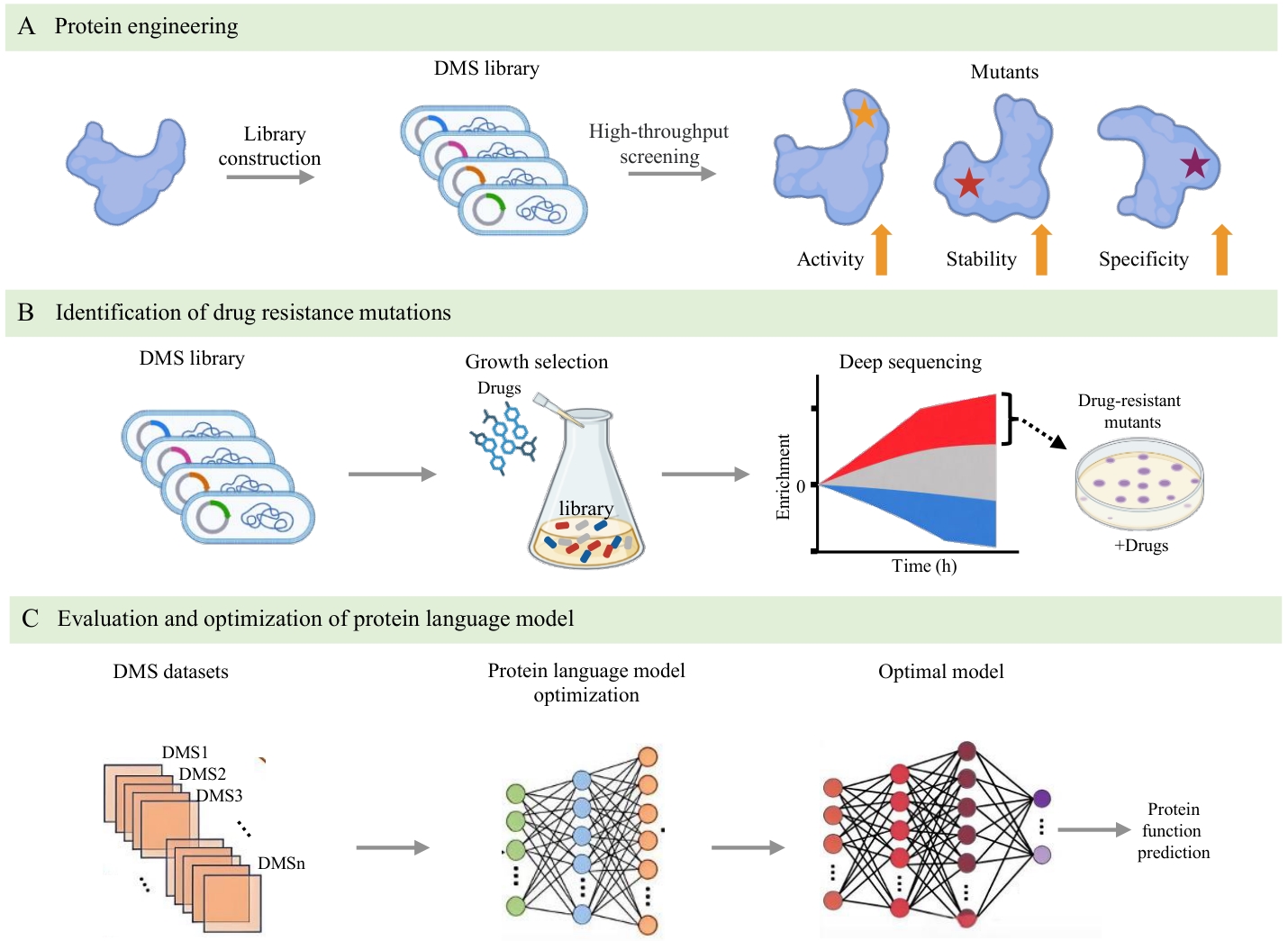
图4 深度突变扫描应用研究A:蛋白工程改造;B:耐药突变位点鉴定;C:蛋白质语言模型测评与优化
Fig. 4 Application of DMSA: Protein engineering modification. B: Identification of drug resistance mutations. C: Evaluation and optimization of protein language model
| [1] | Fowler DM, Fields S. Deep mutational scanning: a new style of protein science [J]. Nat Methods, 2014, 11(8): 801-807. |
| [2] | Araya CL, Fowler DM. Deep mutational scanning: assessing protein function on a massive scale [J]. Trends Biotechnol, 2011, 29(9): 435-442. |
| [3] | Wrenbeck EE, Klesmith JR, Stapleton JA, et al. Plasmid-based one-pot saturation mutagenesis [J]. Nat Methods, 2016, 13(11): 928-930. |
| [4] | Kitzman JO, Starita LM, Lo RS, et al. Massively parallel single-amino-acid mutagenesis (vol 12, pg 203, 2015) [J]. Nat Methods, 2017, 14(5): 540-1. |
| [5] | Matreyek KA, Starita LM, Stephany JJ, et al. Multiplex assessment of protein variant abundance by massively parallel sequencing [J]. Nat Genet, 2018, 50(6): 874-882. |
| [6] | Kemble H, Nghe P, Tenaillon O. Recent insights into the genotype-phenotype relationship from massively parallel genetic assays [J]. Evol Appl, 2019, 12(9): 1721-1742. |
| [7] | Kuiper BP, Prins RC, Billerbeck S. Oligo pools as an affordable source of synthetic DNA for cost-effective library construction in protein- and metabolic pathway engineering [J]. ChemBioChem, 2022, 23(7): e202100507. |
| [8] | Prywes N, Phillips NR, Oltrogge LM, et al. A map of the rubisco biochemical landscape [J]. Nature, 2025, 638(8051): 823-828. |
| [9] | Küng C, Protsenko O, Vanella R, et al. Deep mutational scanning reveals a de novo disulfide bond and combinatorial mutations for engineering thermostable myoglobin [J]. Protein Sci, 2025, 34(5): e70112. |
| [10] | Yang KB, Cameranesi M, Gowder M, et al. High-resolution landscape of an antibiotic binding site [J]. Nature, 2023, 622(7981): 180-187. |
| [11] | Filsinger GT, Mychack A, et al. A diverse single-stranded DNA-annealing protein library enables efficient genome editing across bacterial Phyla [J]. Proc Natl Acad Sci U S A, 2025, 122(17): e2414342122. |
| [12] | Gelman S, Fahlberg SA, Heinzelman P, et al. Neural networks to learn protein sequence-function relationships from deep mutational scanning data [J]. Proc Natl Acad Sci U S A, 2021, 118(48): e2104878118. |
| [13] | Wu ZX, Cai XJ, Zhang X, et al. Expression level is a major modifier of the fitness landscape of a protein coding gene [J]. Nat Ecol Evol, 2022, 6(1): 103-115. |
| [14] | Jiang ZY, van Vlimmeren AE, Karandur D, et al. Deep mutational scanning of the multi-domain phosphatase SHP2 reveals mechanisms of regulation and pathogenicity [J]. Nat Commun, 2025, 16: 5464. |
| [15] | Giacomelli AO, Yang XP, Lintner RE, et al. Mutational processes shape the landscape of TP53 mutations in human cancer [J]. Nat Genet, 2018, 50(10): 1381-1387. |
| [16] | Cozens C, Pinheiro VB. Darwin Assembly: fast, efficient, multi-site bespoke mutagenesis [J]. Nucleic Acids Res, 2018, 46(8): e51. |
| [17] | Medina-Cucurella AV, Steiner PJ, Faber MS, et al. User-defined single pot mutagenesis using unamplified oligo pools [J]. Protein Eng Des Sel, 2019, 32(1): 41-45. |
| [18] | Kirby MB, Medina-Cucurella AV, Baumer ZT, et al. Optimization of multi-site nicking mutagenesis for generation of large, user-defined combinatorial libraries [J]. Protein Eng Des Sel, 2021, 34: gzab017. |
| [19] | Jain PC, Varadarajan R. A rapid, efficient, and economical inverse polymerase chain reaction-based method for generating a site saturation mutant library [J]. Anal Biochem, 2014, 449: 90-98. |
| [20] | Ahler E, Register AC, Chakraborty S, et al. A combined approach reveals a regulatory mechanism coupling src's kinase activity, localization, and phosphotransferase-independent functions [J]. Mol Cell, 2019, 74(2): 393-408.e20. |
| [21] | Bandaru P, Kuriyan J, Ranganathan R. Deconstruction of the Ras switching cycle through saturation mutagenesis reveals hot-spots of allosteric activation [J]. Protein Sci, 2017, 26: 79. |
| [22] | Starita LM, Islam MM, Banerjee T, et al. A multiplex homology-directed DNA repair assay reveals the impact of more than 1, 000 BRCA1 missense substitution variants on protein function [J]. Am J Hum Genet, 2018, 103(4): 498-508. |
| [23] | Mishra P, Flynn JM, Starr TN, et al. Systematic mutant analyses elucidate general and client-specific aspects of Hsp90 function [J]. Cell Rep, 2016, 15(3): 588-598. |
| [24] | Melnikov A, Rogov P, Wang L, et al. Comprehensive mutational scanning of a kinase in vivo reveals substrate-dependent fitness landscapes [J]. Nucleic Acids Res, 2014, 42(14): e112. |
| [25] | Brenan L, Andreev A, Cohen O, et al. Phenotypic characterization of a comprehensive set of MAPK1/ERK2 missense mutants [J]. Cell Rep, 2016, 17(4): 1171-1183. |
| [26] | Faber MS, Van Leuven JT, Ederer MM, et al. Saturation mutagenesis genome engineering of infective ΦX174 Bacteriophage viaUnamplified oligo pools and golden gate assembly [J]. ACS Synth Biol, 2020, 9(1): 125-131. |
| [27] | Weng CC, Faure AJ, Escobedo A, et al. The energetic and allosteric landscape for KRAS inhibition [J]. Nature, 2024, 626(7999): 643-652. |
| [28] | Thornton BW, Weissman RF, Rodriguez JE, et al. Engineered TnpB genome editors for plants and human cells identified by ribonucleoprotein mutational scanning [J]. Nat Biotechnol, 2026. |
| [29] | Kelsic ED, Chung H, Cohen N, et al. RNA structural determinants of optimal codons revealed by MAGE-seq [J]. Cell Syst, 2016, 3(6): 563-571.e6. |
| [30] | Park J, Wang HH. Systematic dissection of σ70 sequence diversity and function in bacteria [J]. Cell Rep, 2021, 36(8): 109590. |
| [31] | Garst AD, Bassalo MC, Pines G, et al. Genome-wide mapping of mutations at single-nucleotide resolution for protein, metabolic and genome engineering [J]. Nat Biotechnol, 2017, 35(1): 48-55. |
| [32] | Dewachter L, Brooks AN, Noon K, et al. Deep mutational scanning of essential bacterial proteins can guide antibiotic development [J]. Nat Commun, 2023, 14: 241. |
| [33] | Wang HH, Kim H, Cong L, et al. Genome-scale promoter engineering by coselection MAGE [J]. Nat Methods, 2012, 9(6): 591-593. |
| [34] | Wang HH, Church GM. Multiplexed genome engineering and genotyping methods [M]//Synthetic Biology, Part B - Computer Aided Design and DNA Assembly. Amsterdam: Elsevier 2011: 409-426. |
| [35] | Wannier TM, Ciaccia PN, Ellington AD, et al. Recombineering and mage [J]. Nat Rev Meth Primers, 2021, 1: 7. |
| [36] | Zwart MP, Schenk MF, Hwang S, et al. Unraveling the causes of adaptive benefits of synonymous mutations in TEM-1 β-lactamase [J]. Heredity, 2018, 121(5): 406-421. |
| [37] | Wei HJ, Li XH. Deep mutational scanning: a versatile tool in systematically mapping genotypes to phenotypes [J]. Front Genet, 2023, 14: 1087267. |
| [38] | Dietrich JA, McKee AE, Keasling JD. High-throughput metabolic engineering: advances in small-molecule screening and selection [J]. Annu Rev Biochem, 2010, 79: 563-590. |
| [39] | Maes S, Deploey N, Peelman F, et al. Deep mutational scanning of proteins in mammalian cells [J]. Cell Rep Meth, 2023, 3(11): 100641. |
| [40] | Liu Y, Wang RY, Liu JH, et al. Base editor enables rational genome-scale functional screening for enhanced industrial phenotypes in Corynebacterium glutamicum [J]. Sci Adv, 2022, 8(35): eabq2157. |
| [41] | Rubin AF, Gelman H, Lucas N, et al. A statistical framework for analyzing deep mutational scanning data [J]. Genome Biol, 2017, 18: 150. |
| [42] | Faure AJ, Schmiedel JM, Baeza-Centurion P, et al. DiMSum: an error model and pipeline for analyzing deep mutational scanning data and diagnosing common experimental pathologies [J]. Genome Biol, 2020, 21: 207. |
| [43] | Stein A, Fowler DM, Hartmann-Petersen R, et al. Biophysical and mechanistic models for disease-causing protein variants [J]. Trends Biochem Sci, 2019, 44(7): 575-588. |
| [44] | Zhang N, Chen YT, Lu HY, et al. MutaBind2: predicting the impacts of single and multiple mutations on protein-protein interactions [J]. iScience, 2020, 23(3): 100939. |
| [45] | Park Y, Metzger BPH, Thornton JW. Epistatic drift causes gradual decay of predictability in protein evolution [J]. Science, 2022, 376(6595): 823-830. |
| [46] | Cao LX, Coventry B, Goreshnik I, et al. Design of protein-binding proteins from the target structure alone [J]. Nature, 2022, 605(7910): 551-560. |
| [47] | Faure AJ, Domingo J, Schmiedel JM, et al. Mapping the energetic and allosteric landscapes of protein binding domains [J]. Nature, 2022, 604(7904): 175-183. |
| [48] | Luo YN, Jiang GD, Yu TH, et al. ECNet is an evolutionary context-integrated deep learning framework for protein engineering [J]. Nat Commun, 2021, 12: 5743. |
| [49] | Brandes N, Goldman G, Wang CH, et al. Genome-wide prediction of disease variant effects with a deep protein language model [J]. Nat Genet, 2023, 55(9): 1512-1522. |
| [50] | Wrenbeck EE, Azouz LR, Whitehead TA. Single-mutation fitness landscapes for an enzyme on multiple substrates reveal specificity is globally encoded [J]. Nat Commun, 2017, 8: 15695. |
| [51] | Bédard C, Gagnon-Arsenault I, Boisvert J, et al. Most azole resistance mutations in the Candida albicans drug target confer cross-resistance without intrinsic fitness cost [J]. Nat Microbiol, 2024, 9(11): 3025-3040. |
| [52] | Lin ZM, Akin H, Rao R, et al. Evolutionary-scale prediction of atomic-level protein structure with a language model [J]. Science, 2023, 379(6637): 1123-1130. |
| [53] | Jiang KY, Yan ZQ, Di Bernardo M, et al. Rapid in silico directed evolution by a protein language model with EVOLVEpro [J]. Science, 2025, 387(6732): eadr6006. |
| [54] | Tran VQ, Nemeth M, Bartie LJ, et al. Rapid directed evolution guided by protein language models and epistatic interactions [J]. Science, 2026, 392(6798): eaea1820. |
| [55] | Simon AJ, Ellington AD, Finkelstein IJ. Retrons and their applications in genome engineering [J]. Nucleic Acids Res, 2019, 47(21): 11007-11019. |
| [56] | Sharon E, Chen SA, Khosla NM, et al. Functional genetic variants revealed by massively parallel precise genome editing [J]. Cell, 2018, 175(2): 544-557.e16. |
| [57] | Schubert MG, Goodman DB, Wannier TM, et al. High-throughput functional variant screens via in vivo production of single-stranded DNA [J]. Proc Natl Acad Sci U S A, 2021, 118(18): e2018181118. |
| [58] | Weinstein JY, Martí-Gómez C, Lipsh-Sokolik R, et al. Designed active-site library reveals thousands of functional GFP variants [J]. Nat Commun, 2023, 14: 2890. |
| [59] | Binder S, Schendzielorz G, Stäbler N, et al. A high-throughput approach to identify genomic variants of bacterial metabolite producers at the single-cell level [J]. Genome Biol, 2012, 13(5): R40. |
| [60] | Della Corte D, van Beek HL, Syberg F, et al. Engineering and application of a biosensor with focused ligand specificity [J]. Nat Commun, 2020, 11: 4851. |
| [1] | 田云, 孔辰, 杨冲, 刘统高, 高红瑞, 李佳慧, 马云, 蔡蓓. CRISPR高通量筛选技术及其在畜牧研究中的应用[J]. 生物技术通报, 2025, 41(12): 82-94. |
| [2] | 皮一飞, 宋新辉, 王淅琳, 李谨谨, 孙长斌, 徐炜. 基于R-loop靶向编辑技术的R-loop功能位点高通量筛选系统[J]. 生物技术通报, 2024, 40(10): 181-190. |
| [3] | 薛宁, 王瑾, 李世新, 刘叶, 程海娇, 张玥, 毛雨丰, 王猛. 多基因同步调控结合高通量筛选构建高产L-苯丙氨酸的谷氨酸棒杆菌工程菌株[J]. 生物技术通报, 2023, 39(9): 268-280. |
| [4] | 刘金升, 陈振娅, 霍毅欣, 郭淑元. FACS技术在酶定向进化中的应用[J]. 生物技术通报, 2023, 39(10): 93-106. |
| [5] | 朴君, 张璐婕, 朴敬爱, 周益军, 李硕. 利用小RNA深度测序技术检测灰飞虱病毒种类[J]. 生物技术通报, 2022, 38(2): 281-288. |
| [6] | 张雪, 谭玉萌, 蒋海霞, 杨广宇. 基于单细胞超高通量筛选的α-1,2-岩藻糖基转移酶定向进化[J]. 生物技术通报, 2022, 38(1): 289-298. |
| [7] | 马富强, 杨广宇. 基于液滴微流控技术的超高通量筛选体系及其在合成生物学中的应用[J]. 生物技术通报, 2017, 33(1): 83-92. |
| [8] | 张晶, 孙瑞秋, 唐延婷, 刘祥. 以MIF为靶标的抑制剂药物高通量筛选模型的建立和应用[J]. 生物技术通报, 2016, 32(9): 253-259. |
| [9] | 方月琴, 郭娟宁, 陆豪杰, 朱国强. 多功能M13KE噬菌体展示系统的建立[J]. 生物技术通报, 2014, 0(2): 143-147. |
| [10] | 王少杰 ,王廿 ,师迎春 ,胡晓艳3, 周涛. 应用深度测序技术鉴定平菇球形病毒[J]. 生物技术通报, 2014, 30(12): 86-91. |
| [11] | 李文茂, 贾东方, 许嵘. 基因组转录调控元件分析方法研究进展[J]. 生物技术通报, 2014, 30(10): 64-70. |
| [12] | 张玥;苏明波;周宇波;. 组蛋白去乙酰化酶6(HDAC6)抑制剂分子水平高通量筛选模型的建立[J]. , 2012, 0(08): 181-188. |
| [13] | 苏怡丹;伍宁丰;刘国安;. 蛋白质定向进化技术的研究进展[J]. , 2009, 0(11): 43-47. |
| [14] | 韩闯;杨盛昌. 高通量筛选技术及其应用[J]. , 2005, 0(02): 22-25. |
| [15] | 韩闯;杨盛昌. 高通量筛选技术及其应用[J]. , 2005, 0(02): 22-25. |
| 阅读次数 | ||||||
|
全文 |
|
|||||
|
摘要 |
|
|||||
