







生物技术通报 ›› 2025, Vol. 41 ›› Issue (4): 289-301.doi: 10.13560/j.cnki.biotech.bull.1985.2024-0823
• 研究报告 • 上一篇
夏馨媛1( ), 薛道晟1, 李鑫静1, 龙俊杰2, 陆开形1, 丁沃娜1, 李梦莎1()
收稿日期:2024-08-25
出版日期:2025-04-26
发布日期:2025-04-25
通讯作者:
李梦莎,女,博士,讲师,研究方向 :土壤生态学;E-mail: limonms@163.com作者简介:夏馨媛,女,研究方向 :生物技术;E-mail: Xiaxinyuan@163.com
基金资助:
XIA Xin-yuan1(), XUE Dao-sheng1, LI Xin-jing1, LONG Jun-jie2, LU Kai-xing1, DING Wo-na1, LI Meng-sha1()
Received:2024-08-25
Published:2025-04-26
Online:2025-04-25
摘要:
目的 筛选具备解磷及生长促进功能的菌种,提升土壤中有效磷的丰度,促进植物及其根系的健康生长与发育。 方法 从浙江省宁波市长期水稻-油菜轮作的土壤中筛选出一株能够在碱性环境下生长的解磷促生菌株,通过菌落形态、生理生化特征及16S rDNA序列进行鉴定,对其培养和解磷条件进行优化,然后通过盆栽试验验证其对油菜的促生效果,并采用高通量测序技术对油菜根际细菌群落结构进行分析。 结果 筛选出的菌株LM1-2解磷能力可达493.23 μg/mL,IAA的合成量为9.41 μg/mL,鉴定为中间克吕沃尔菌(Kluyvera intermedia)。摇瓶试验结果表明,菌株的最佳培养条件是初始pH为10、装液量为培养容器体积的30%、25℃培养7-9 d,最佳碳源、氮源、磷源分别为葡萄糖、胰蛋白胨、磷酸三钙,在最佳单因素优化条件下菌株的解磷能力最强可达587.03 μg/mL。油菜盆栽试验结果表明,与对照相比,接种菌株LM1-2的处理土壤速效磷含量增加了45.29%,油菜根系总长度、根直径、根分叉数和根交叉数分别显著增加了40.78%、18.97%、55.30%和87.82%,油菜植株的地上部鲜重和干重分别增重15.51%、26.82%。接种LM1-2改变了油菜根际细菌群落结构,显著提高了α多样性的Simpson指数,其中醋杆菌门(Acidobacteriota)是优势菌门,其相对丰度提高了23.66%。 结论 菌株LM1-2在解磷、油菜促生方面表现优良,在农业生产过程中有广阔的应用范围。
夏馨媛, 薛道晟, 李鑫静, 龙俊杰, 陆开形, 丁沃娜, 李梦莎. 稻油轮作土壤多功能促生菌的鉴定及其对油菜生长和根际细菌群落的影响[J]. 生物技术通报, 2025, 41(4): 289-301.
XIA Xin-yuan, XUE Dao-sheng, LI Xin-jing, LONG Jun-jie, LU Kai-xing, DING Wo-na, LI Meng-sha. Identification of Multi-function Growth-promoting Bacteria in Rice-oilseed Rape Rotation Soil and Its Effect on the Growth and Rhizosphere Bacterial Community of Oilseed Rape (Brassica napus)[J]. Biotechnology Bulletin, 2025, 41(4): 289-301.

图1 菌株LM1-2的菌落图(A)和革兰氏染色图(B)
Fig. 1 Colony diagram (A) and Gram staining diagram (B) of strain LM1-2
| 项目 Item | 结果 Result | 项目 Item | 结果 Result |
|---|---|---|---|
| 革兰氏染色 | - | V-P试验 | - |
| 好氧性试验 | 好氧 | 淀粉水解 | - |
| 接触酶试验 | + | 明胶液化 | + |
| 甲基红(M.R)试验 | + | 吲哚试验 | + |
表1 LM1-2菌株的生理生化特性
Table 1 Physiological characteristics of strain LM1-2
| 项目 Item | 结果 Result | 项目 Item | 结果 Result |
|---|---|---|---|
| 革兰氏染色 | - | V-P试验 | - |
| 好氧性试验 | 好氧 | 淀粉水解 | - |
| 接触酶试验 | + | 明胶液化 | + |
| 甲基红(M.R)试验 | + | 吲哚试验 | + |
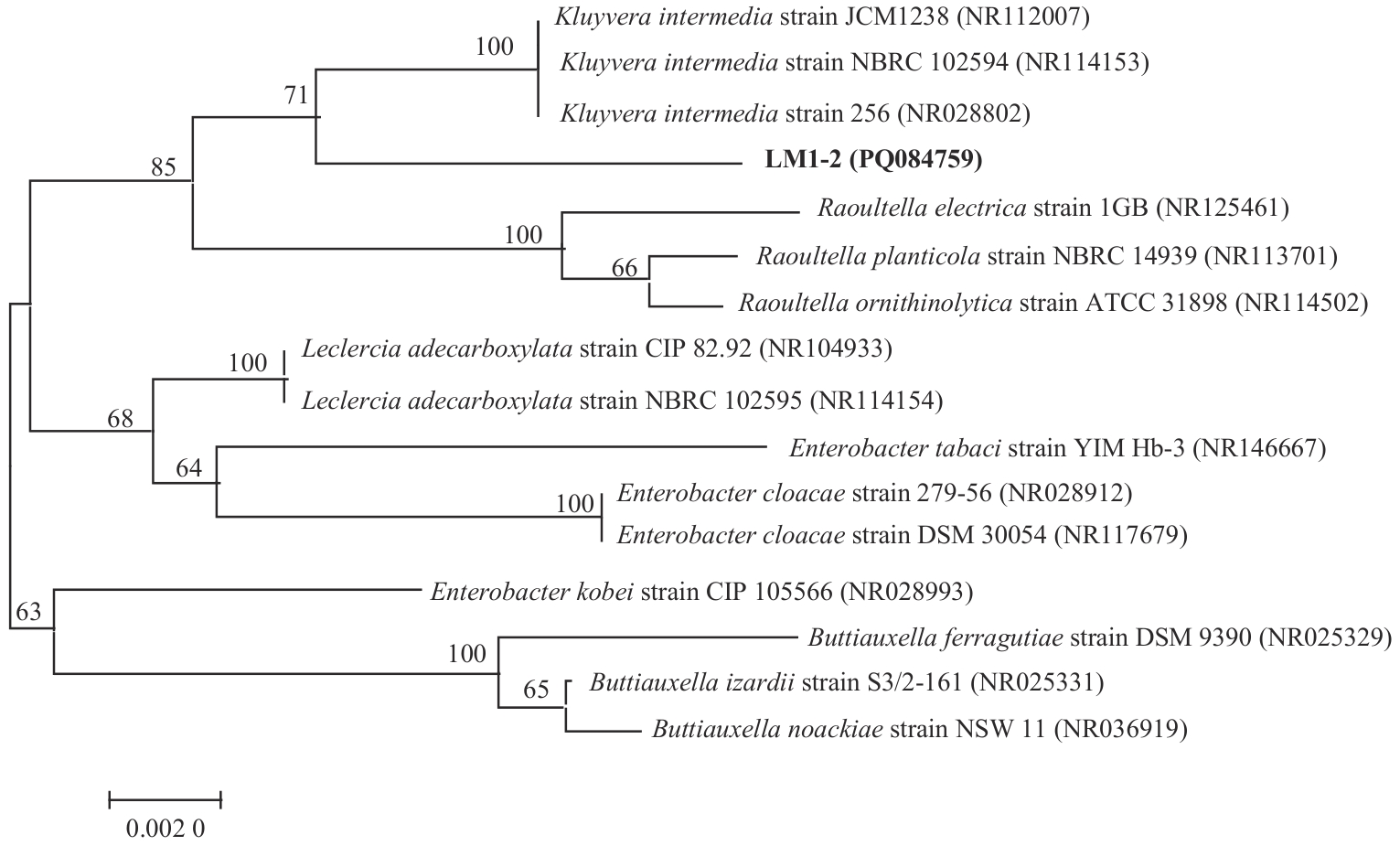
图2 菌株LM1-2 16S rDNA基因序列的系统发育树
Fig. 2 Phylogenetic tree of 16S rDNA gene sequence of strain LM1-2
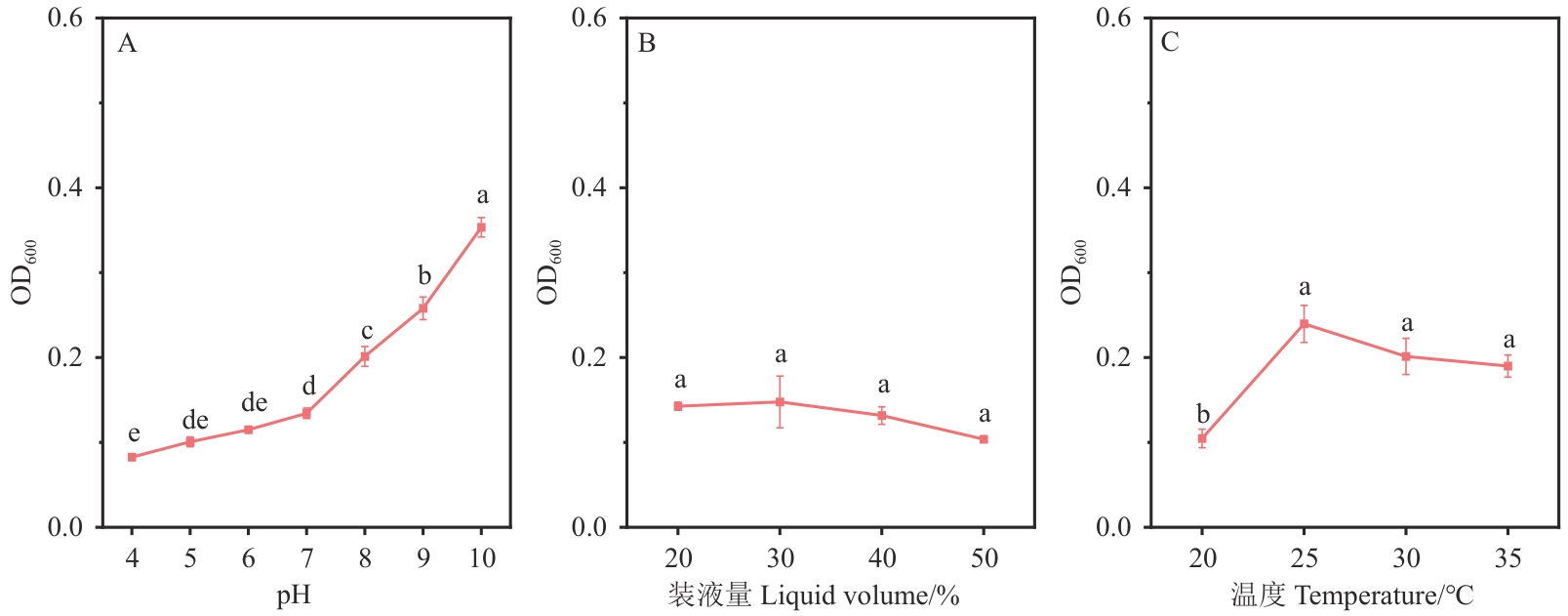
图3 不同培养条件对菌株LM1-2生长情况(OD600)的影响不同字母表示不同条件对LM1-2生长情况的影响(P<0.05)
Fig. 3 Effects of different culture conditions on the growth status (OD600) of strain LM1-2Different letters indicate the effects of different conditions on the growth status of LM1-2 (P<0.05)

图4 不同培养条件对菌株LM1-2解磷能力的影响不同字母表示不同条件对LM1-2解磷能力的影响(P<0.05)
Fig. 4 Effects of different culture conditions on the phosphorus solubilization ability of strain LM1-2Different letters indicate the effects of different conditions on the phosphate solubilization capacity of LM1-2 (P<0.05)
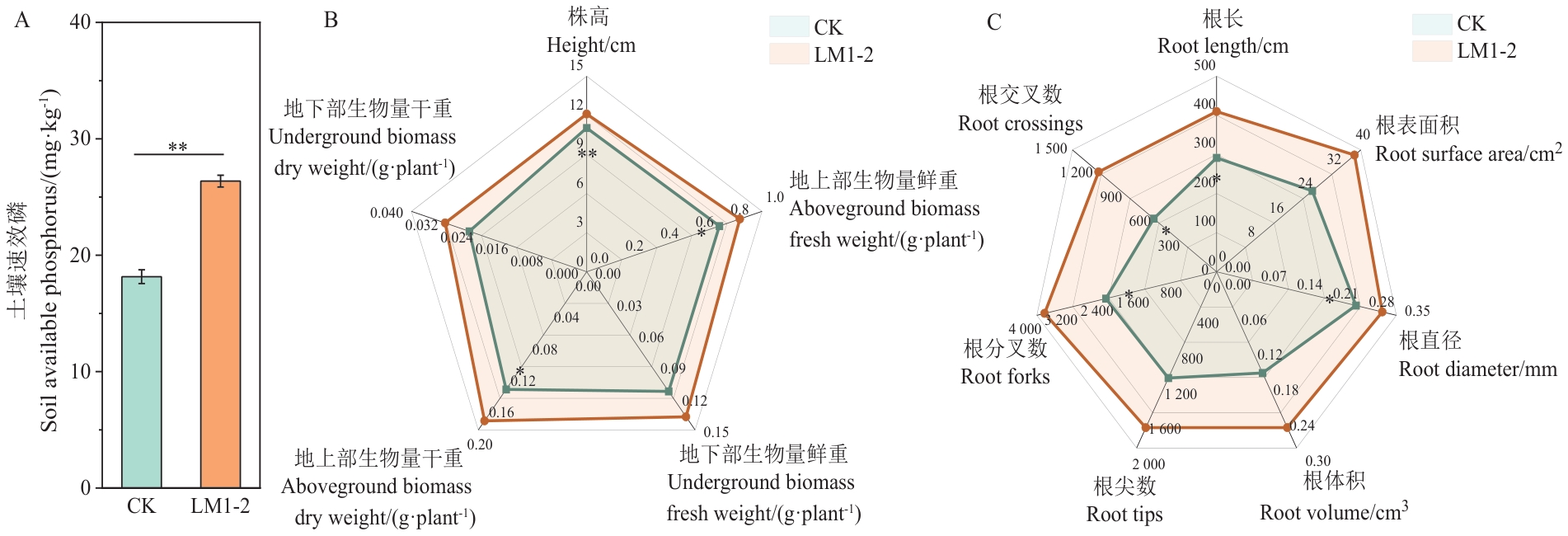
图5 LM1-2对油菜盆栽土壤速效磷(A)、植株(B)和根系(C)的影响*和**分别表示处理间在0.05和0.01水平差异显著
Fig. 5 Effects of LM1-2 on the soil available phosphorus (A), plants (B) and roots (C) of oilseed rapes in the pot experiment* and ** indicate significant differences between treatments at 0.05 and 0.01 levels, respectively
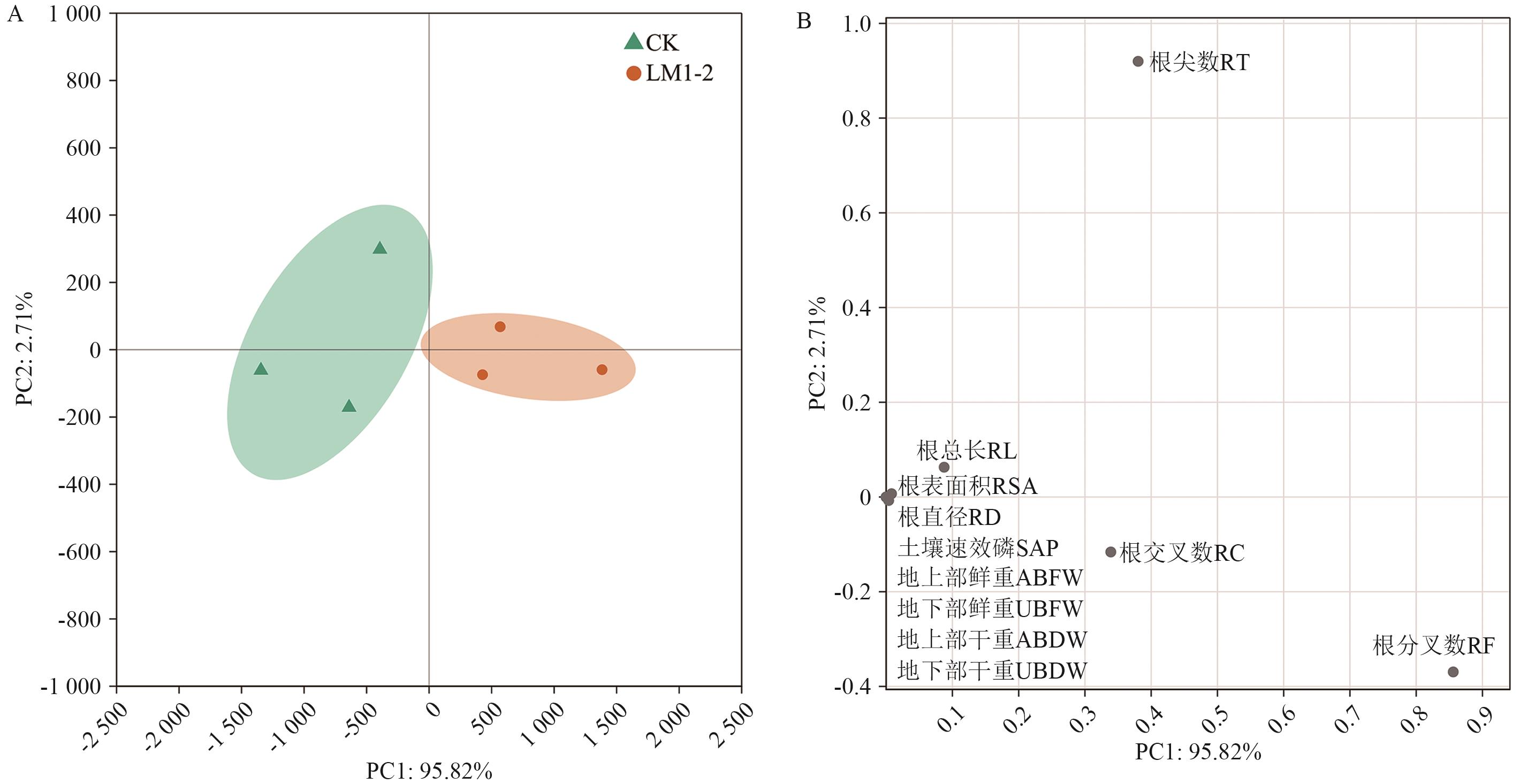
图6 LM1-2处理油菜盆栽幼苗各指标之间的主成分分析SAP:土壤速效磷;ABFW:地上部生物量鲜重;ABDW:地上部生物量干重;UBFW:地下部生物量鲜重;UBDW:地下部生物量干重;RL:根总长;RSA:根表面积;RD:根直径;RV: 根体积;RT:根尖数;RF:根分叉数;RC:根交叉数;下同
Fig. 6 Principal component analysis of various indicators among potted oilseed rape seedlings under LM1-2 treatmentSAP: Soil available phosphorus; ABFW: above-ground biomass fresh weight; ABDW: above-ground biomass dry weight; UBFW: underground biomass fresh weight; UBDW: underground biomass dry weight; RL: total root length; RSA: root surface area; RD: root diameter; RV: root volume; RT: number of root tips; RF: number of root forks; RC: number of root crossings. The same below

图7 LM1-2处理油菜盆栽幼苗各指标之间的相关性分析* P<0.05,** P<0.01,*** P<0.001
Fig. 7 Correlation analysis among various indicators of potted oilseed rape seedlings under LM1-2 treatment
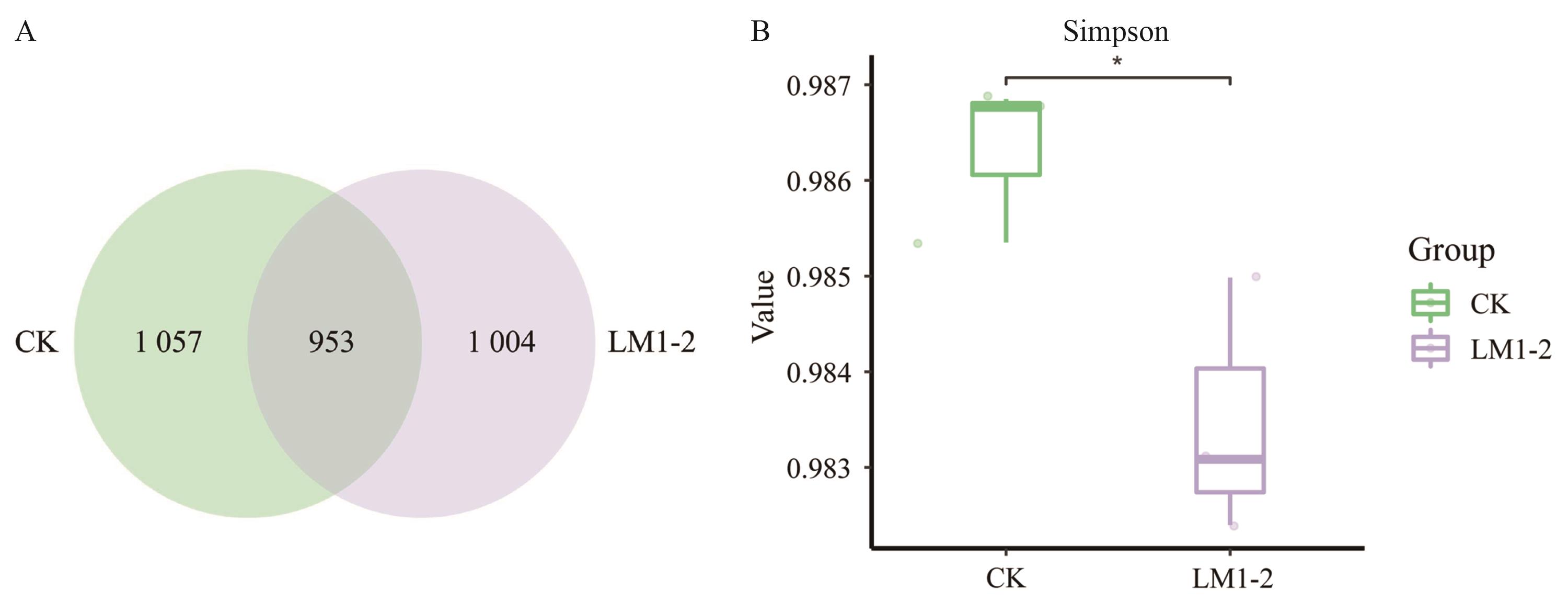
图8 LM1-2处理土壤细菌群落Veen图(A)和Simpson指数(B)*表示处理间在0.05水平差异显著
Fig. 8 Veen plot (A) and Simpson index (B) of soil bacterial community treated with LM1-2* indicates significant difference between treatments at 0.05 level
处理 Treatment | Ace指数 Ace index | Chao指数 Chao index | Shannon指数 Shannon index | Simpson指数 Simpson index | Coverage指数 Coverage index | PD whole tree指数 PD whole tree index |
|---|---|---|---|---|---|---|
| CK | 1 026.83±117.25a | 1 016.89±114.48a | 8.38±0.08a | 0.986±0.00a | 0.980±0.01a | 35.58±2.33a |
| LM1-2 | 986.38±51.42a | 975.28±50.20a | 8.23±0.11a | 0.983±0.00b | 0.980±0.00a | 35.01±1.29a |
表2 不同处理根际土壤细菌群落α多样性指数
Table 2 Alpha diversity indexes of rhizosphere soil bacterial communities under different treatments
处理 Treatment | Ace指数 Ace index | Chao指数 Chao index | Shannon指数 Shannon index | Simpson指数 Simpson index | Coverage指数 Coverage index | PD whole tree指数 PD whole tree index |
|---|---|---|---|---|---|---|
| CK | 1 026.83±117.25a | 1 016.89±114.48a | 8.38±0.08a | 0.986±0.00a | 0.980±0.01a | 35.58±2.33a |
| LM1-2 | 986.38±51.42a | 975.28±50.20a | 8.23±0.11a | 0.983±0.00b | 0.980±0.00a | 35.01±1.29a |
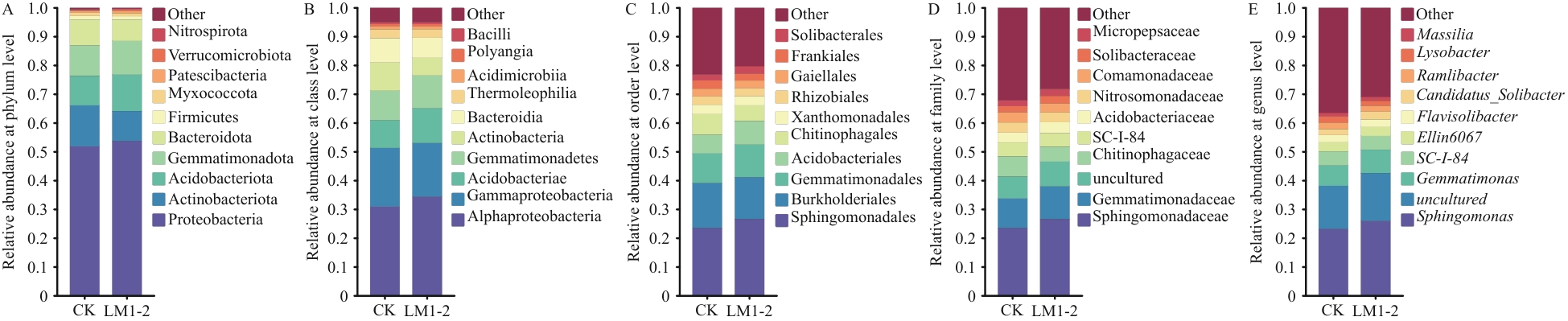
图9 油菜根际土壤细菌群落在门(A)、纲(B)、目(C)、科(D)和属(E)分类水平上的组成
Fig. 9 Composition of bacterial communities in the rhizosphere soil of oilseed rapes at the phylum (A), class (B), order (C), family (D) and genus (E) levels
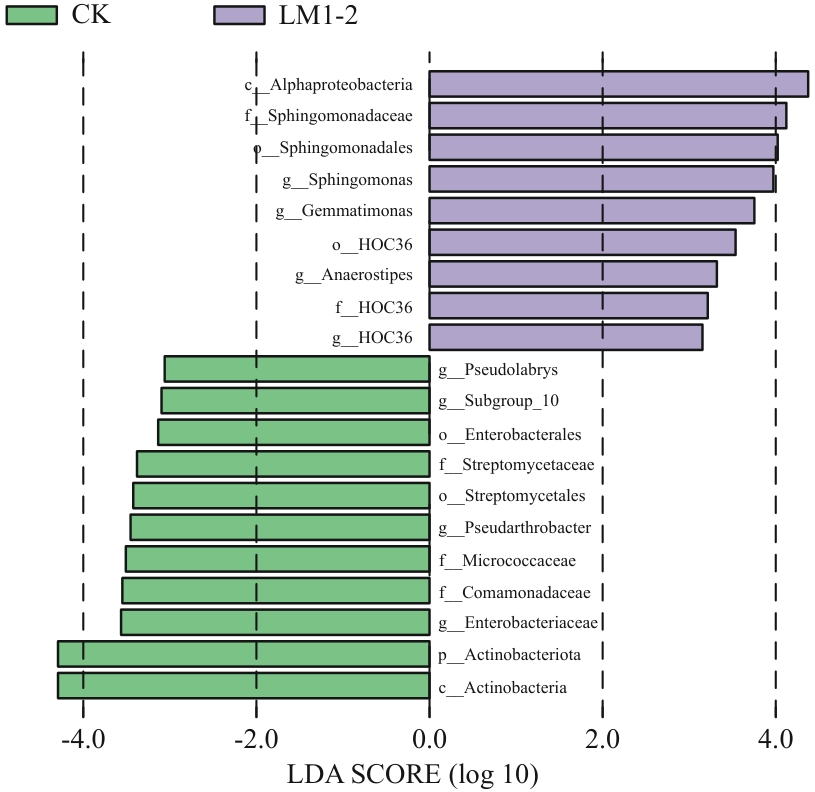
图10 LEfSe分析差异物种图
Fig. 10 LEfSe analysis of differential species
| 1 | 陈妍, 傅树豪, 郭碧芝. 水稻油菜轮作栽培模式探讨 [J]. 农业技术与装备, 2023, 8: 145-147. |
| Chen Y, Fu SH, Guo BZ. Discussion on the cultivation mode of rice and rapeseed rotation [J]. Agricultural Technology & Equipment, 2023, 8: 145-147. | |
| 2 | 徐一荻, 刘春花, 谢富, 等. 供磷水平对核桃实生苗生长生理特性及酶活性的影响 [J]. 西南林业大学学报: 自然科学, 2021, 41(5): 27-35. |
| Xu YD, Liu CH, Xie F, et al. Effects of phosphorus supply on the growth, physiological characteristics and enzyme activity of Juglans regia seedlings [J]. J Southwest For Univ Sci, 2021, 41(5): 27-35. | |
| 3 | Fujita M, Hasanuzzaman M, Hawrylak-Nowak B, et al. Plant nutrients and abiotic stress tolerance [M]. Singapore: Springer Nature, 2018. |
| 4 | Chen A, Arai Y. A review of the reactivity of phosphatase controlled by clays and clay minerals: implications for understanding phosphorus mineralization in soils [J]. Clays Clay Miner, 2023, 71(2): 119-142. |
| 5 | Zhou J, Zhang YF, Wu KB, et al. National estimates of environmental thresholds for upland soil phosphorus in China based on a meta-analysis [J]. Sci Total Environ, 2021, 780: 146677. |
| 6 | 闫金垚, 郭丽璇, 王昆昆, 等. 长江流域稻-油轮作区土壤磷库现状及环境风险分析 [J]. 土壤学报, 2023, 60(1): 247-257. |
| Yan JY, Guo LX, Wang KK, et al. Status of soil phosphorus pool and environmental risk assessment in rice-oilseed rape rotation area in the Yangtze River Basin [J]. Acta Pedol Sin, 2023, 60(1): 247-257. | |
| 7 | 陈凤, 王晓双, 甘国渝, 等. 长期施用磷肥对稻-油轮作土壤磷组分及微生物多样性的影响 [J]. 华中农业大学学报, 2021, 40(1): 168-178. |
| Chen F, Wang XS, Gan GY, et al. Effects of long-term application of phosphorus fertilizer on soil phosphorus fractions and microbial diversity in rice-rapeseed rotation [J]. J Huazhong Agric Univ, 2021, 40(1): 168-178. | |
| 8 | 刘英杰, 张丽红, 张宏, 等. 溶磷微生物在土壤磷循环中的作用研究进展 [J]. 微生物学通报, 2023, 50(8): 3671-3687. |
| Liu YJ, Zhang LH, Zhang H, et al. Role of phosphate solubilizing microorganisms in soil phosphorus cycle: a review [J]. Microbiol China, 2023, 50(8): 3671-3687. | |
| 9 | Liang JL, Liu J, Jia P, et al. Novel phosphate-solubilizing bacteria enhance soil phosphorus cycling following ecological restoration of land degraded by mining [J]. ISME J, 2020, 14(6): 1600-1613. |
| 10 | 陶冬雪, 高英志. 土壤解磷微生物促进植物磷素吸收策略研究进展 [J]. 生态学报, 2023, 43(11): 4390-4399. |
| Tao DX, Gao YZ. Advances on the strategies of soil phosphate solubilizing microorganisms to promote plant phosphorus uptake [J]. Acta Ecol Sin, 2023, 43(11): 4390-4399. | |
| 11 | 张昊鑫, 王中华, 牛兵, 等. 产IAA兼具溶磷解钾高效促生菌的筛选、鉴定及其广谱性应用 [J]. 生物技术通报, 2022, 38(5):100-111. |
| Zhang HX, Wang ZH, Niu B, et al. Screening, identification and broad-spectrum application of efficient IAA-producing bacteria dissolving phosphorus and potassium [J]. Biotechnology Bulletin, 2022, 38(5): 100-111. | |
| 12 | 许丽宁, 徐敬棋, 邵彩虹, 等. 再生稻根际促生菌的分离、筛选与鉴定 [J]. 南方农业学报, 2020, 51(4): 814-821. |
| Xu LN, Xu JQ, Shao CH, et al. Isolation, screening and identification of plant growthpromoting rhizobacteria from ratooning rice [J]. J South Agric, 2020, 51(4): 814-821. | |
| 13 | Liu J, Qi WY, Li Q, et al. Exogenous phosphorus-solubilizing bacteria changed the rhizosphere microbial community indirectly [J]. 3 Biotech, 2020, 10(4): 164. |
| 14 | 李正昀, 王舒, 张扬, 等. 施加解磷菌剂对油茶根际微生物和土壤酶活性的影响 [J]. 西北林学院学报, 2018, 33(1): 188-192. |
| Li ZY, Wang S, Zhang Y, et al. Effects of different phosphate-solubilizing bacteria on rhizosphere microorganism and enzyme activities of Camellia oleifera [J]. J Northwest For Univ, 2018, 33(1): 188-192. | |
| 15 | 杜雷, 陈钢, 王素萍, 等. 解磷菌剂对生菜根际土壤微生物数量和酶活性的影响 [J]. 湖北农业科学, 2019, 58(11): 70-74. |
| Du L, Chen G, Wang SP, et al. Effects of phosphate-solubilizing bacteria on rhizosphere microorganism and enzyme activities of lettuce [J]. Hubei Agric Sci, 2019, 58(11): 70-74. | |
| 16 | 马莹, 程莹莹, 石孝均, 等. 溶磷菌在磷素循环和生态农业中的作用与其生物肥料应用 [J]. 微生物学报, 2023, 63(12): 4502-4521. |
| Ma Y, Cheng YY, Shi XJ, et al. Phosphate-solubilizing bacteria: roles in phosphorus cycling and ecological agriculture and application as potential biofertilizers [J]. Acta Microbiol Sin, 2023, 63(12): 4502-4521. | |
| 17 | 赵小蓉, 林启美, 孙焱鑫, 等. 细菌解磷能力测定方法的研究 [J]. 微生物学通报, 2001, 28(1): 1-4. |
| Zhao XR, Lin QM, Sun YX, et al. The methods for quantifying capacity of bacteria in dissolving p compounds [J]. Microbiology, 2001, 28(1): 1-4. | |
| 18 | Libbert E, Manteuffel R. Interactions between plants and epiphytic bacteria regarding their auxin metabolism [J]. Physiol Plant, 1970, 23(1): 93-98. |
| 19 | Glickmann E, Dessaux Y. A critical examination of the specificity of the salkowski reagent for indolic compounds produced by phytopathogenic bacteria [J]. Appl Environ Microbiol, 1995, 61(2): 793-796. |
| 20 | 东秀珠, 蔡妙英. 常见细菌系统鉴定手册 [M]. 北京: 科学出版社, 2001. |
| Dong XZ, Cai MY. Handbook of identification of common bacterial systems [M]. Beijing: Science Press, 2001. | |
| 21 | Nossa CW, Oberdorf WE, Yang LY, et al. Design of 16S rRNA gene primers for 454 pyrosequencing of the human foregut microbiome [J]. World J Gastroenterol, 2010, 16(33): 4135-4144. |
| 22 | Callahan BJ, McMurdie PJ, Rosen MJ, et al. DADA2: High-resolution sample inference from Illumina amplicon data [J]. Nat Methods, 2016, 13(7): 581-583. |
| 23 | Bolyen E, Rideout JR, Dillon MR, et al. Reproducible, interactive, scalable and extensible microbiome data science using QIIME 2 [J]. Nat Biotechnol, 2019, 37(8): 852-857. |
| 24 | 宋雅荣, 常单娜, 周国朋, 等. 解磷细菌活化水稻土中低品位磷矿粉的效果与机制 [J]. 中国农业科学, 2024, 57(6): 1102-1116. |
| Song YR, Chang DN, Zhou GP, et al. Effect and mechanism of phosphate-solubilizing bacterial on activating of low-grade phosphate rock powder in red paddy soil [J]. Sci Agric Sin, 2024, 57(6): 1102-1116. | |
| 25 | 刘俊清, 金晓雪, 宋科稷, 等. 一株溶磷真菌的筛选及相关促生特性初探 [J]. 安徽大学学报: 自然科学版, 2023, 47(3): 90-97. |
| Liu JQ, Jin XX, Song KJ, et al. Screening and identification of a high-efficient phosphate-solubilizing fungus Penicillium decumbens and analysis of its phosphate-solubilizing characteristics [J]. J Anhui Univ Nat Sci, 2023, 47(3): 90-97. | |
| 26 | Boubekri K, Soumare A, Lyamlouli K, et al. Improving the efficiency of phosphate rocks combined with phosphate solubilizing Actinomycetota to increase wheat growth under alkaline and acidic soils [J]. Front Plant Sci, 2023, 14: 1154372. |
| 27 | 吴洋洋.促生长草甘膦降解菌筛选及其对油菜营养品质的影响研究[D]. 沈阳: 沈阳农业大学, 2023. |
| Wu YY. Screening of Growth-promoting Glyphosate-degrading Bacteria and Its Effect on the Nutritional Quality of Rape [D]. Shenyang: Shenyang Agricultural University, 2023. | |
| 28 | 吕俊, 王晓娅. 溶磷微生物及其对植物促生作用的研究进展 [J]. 中国土壤与肥料, 2023(1): 231-239. |
| Lü J, Wang XY. Research progress on phosphorus-solubilizing microorganisms and their effects on plant growth [J]. Soils Fertil Sci China, 2023(1): 231-239. | |
| 29 | 池景良, 郝敏, 王志学, 等. 解磷微生物研究及应用进展 [J]. 微生物学杂志, 2021, 41(1): 1-7. |
| Chi JL, Hao M, Wang ZX, et al. Advances in research and application of phosphorus-solubilizing microorganism [J]. J Microbiol, 2021, 41(1): 1-7. | |
| 30 | Gross A, Lin Y, Weber PK, et al. The role of soil redox conditions in microbial phosphorus cycling in humid tropical forests [J]. Ecology, 2020, 101(2): e02928. |
| 31 | 刘玲利, 卫迎, 刘洋, 等. 不同解磷菌群对复垦土壤磷素形态及油菜产量的影响 [J]. 华北农学报, 2017, 32(6): 229-234. |
| Liu LL, Wei Y, Liu Y, et al. Effects of different phosphorus-solubilizing flora on phosphorus forms and rape yield in reclaimed soil [J]. Acta Agric Boreali Sin, 2017, 32(6): 229-234. | |
| 32 | Valetti L, Iriarte L, Fabra A. Growth promotion of rapeseed (Brassica napus) associated with the inoculation of phosphate solubilizing bacteria [J]. Appl Soil Ecol, 2018, 132: 1-10. |
| 33 | 张亮, 盛浩, 谭丽, 等. 复合促生菌株筛选及其对油菜、黄瓜幼苗的促生效果[J]. 蔬菜, 2020, (6):15-19. |
| Zhang L, Sheng H, Tan L, et al. Screening of multifunctional PGPR and their promotion effects on rape and cucumber seedlings [J]. Vegetables, 2020, (6): 15-19. | |
| 34 | 张艺灿, 刘凤之, 王海波. 根际溶磷微生物促生机制研究进展 [J]. 中国土壤与肥料, 2020(2): 1-9. |
| Zhang YC, Liu FZ, Wang HB. Research progress on plant-growth-promoting mechanisms of phosphate-solubilizing rhizosphere microbes [J]. Soils Fertil Sci China, 2020(2): 1-9. | |
| 35 | 李欣欣, 赵静, 廖红. 吲哚乙酸、吲哚丁酸和萘乙酸对大豆幼根生长的影响 [J]. 植物生理学报, 2013, 49(6): 573-578. |
| Li XX, Zhao J, Liao H. Effects of indoleacetic acid, indolebutyric acid and naphthylacetic acid on soybean[Glycine max (L.) merr]root growth [J]. Plant Physiol J, 2013, 49(6): 573-578. | |
| 36 | 王志刚, 胡云龙, 徐伟慧, 等. 一株溶磷菌的分离鉴定及对西瓜根系的促生效应 [J]. 浙江农业学报, 2015, 27(5): 798-803. |
| Wang ZG, Hu YL, Xu WH, et al. Separation and identification of a phosphorus solubilizing bacteria and its promoting effect on watermelon root [J]. Acta Agric Zhejiangensis, 2015, 27(5): 798-803. | |
| 37 | Nagah A, El-Sheekh MM, Arief OM, et al. Endophytic Bacillus vallismortis and Bacillus tequilensis bacteria isolated from medicinal plants enhance phosphorus acquisition and fortify Brassica napus L. vegetative growth and metabolic content [J]. Front Plant Sci, 2024, 15: 1324538. |
| 38 | Hartmann M, Six J. Soil structure and microbiome functions in agroecosystems [J]. Nat Rev Earth Environ, 2023, 4: 4-18. |
| 39 | 姜焕焕. 耐盐碱解磷菌与磷石膏联用改良盐碱土的效果与机制 [D]. 哈尔滨: 哈尔滨工业大学, 2019. |
| Jiang HH. Saline-alkali soil remediation by the combined application of halotolerant phosphate solubilizing microorganism and rock phosphate [D]. Harbin: Harbin Institute of Technology, 2019. | |
| 40 | Kalam S, Basu A, Ahmad I, et al. Recent understanding of soil acidobacteria and their ecological significance: a critical review [J]. Front Microbiol, 2020, 11: 580024. |
| 41 | 秦利均, 杨永柱, 杨星勇. 土壤溶磷微生物溶磷、解磷机制研究进展 [J]. 生命科学研究, 2019, 23(1): 59-64, 86. |
| Qin LJ, Yang YZ, Yang XY. Advances in mechanisms of soil phosphorus solubilization and dissolution by phosphate solubilizing microorganisms [J]. Life Sci Res, 2019, 23(1): 59-64, 86. | |
| 42 | 王光华, 刘俊杰, 于镇华, 等. 土壤酸杆菌门细菌生态学研究进展 [J]. 生物技术通报, 2016, 32(2): 14-20. |
| Wang GH, Liu JJ, Yu ZH, et al. Research progress of acidobacteria ecology in soils [J]. Biotechnol Bull, 2016, 32(2): 14-20. | |
| 43 | Ganz HH, Karaoz U, Getz WM, et al. Diversity and structure of soil bacterial communities associated with vultures in an African savanna [J]. Ecosphere, 2012, 3(6): 1-18. |
| [1] | 王琛, 刘国梅, 陈畅, 张晋龙, 姚琳, 孙璇, 杜春芳. 白菜型油菜CCDs家族全基因组鉴定及表达分析[J]. 生物技术通报, 2025, 41(3): 161-170. |
| [2] | 刘文志, 贺丹, 李鹏, 傅应林, 张译心, 温华杰, 于文清. 多粘类芽胞杆菌新菌株X-11及其对番茄和水稻的促生效应[J]. 生物技术通报, 2024, 40(9): 249-259. |
| [3] | 温绍福, 江润海, 朱城强, 张梅, 余小琴, 杨杰惠, 杨小容, 侯秀丽. 铅污染土壤中解磷菌对玉米根际土壤性质和微生物群落结构的影响[J]. 生物技术通报, 2024, 40(9): 225-237. |
| [4] | 王美玲, 耿丽丽, 房瑜, 束长龙, 张杰. 苏云金芽胞杆菌4BM1菌株对油菜菌核病的防治潜力[J]. 生物技术通报, 2024, 40(9): 260-269. |
| [5] | 刘传和, 贺涵, 邵雪花, 何秀古. 不同覆盖处理对菠萝园土壤代谢物和细菌群落结构的影响[J]. 生物技术通报, 2024, 40(7): 247-258. |
| [6] | 刘蓉, 田闵玉, 李光泽, 谭成方, 阮颖, 刘春林. 甘蓝型油菜REVEILLE家族鉴定及诱导表达分析[J]. 生物技术通报, 2024, 40(6): 161-171. |
| [7] | 杨代毅, 樊杨, 屠焰, 徐志宇, 薛颖昊, 孙元丰, 王进, 郝小燕, 马涛. 不同处理对油菜秸秆养分、纤维结构和硫苷含量的影响[J]. 生物技术通报, 2024, 40(6): 172-179. |
| [8] | 周会汶, 吴兰花, 韩德鹏, 郑伟, 余跑兰, 吴杨, 肖小军. 甘蓝型油菜种子硫苷含量全基因组关联分析[J]. 生物技术通报, 2024, 40(1): 222-230. |
| [9] | 刘保财, 陈菁瑛, 张武君, 黄颖桢, 赵云青, 刘剑超, 危智诚. 多花黄精种子微根茎基因表达特征分析[J]. 生物技术通报, 2023, 39(8): 220-233. |
| [10] | 肖小军, 陈明, 韩德鹏, 余跑兰, 郑伟, 肖国滨, 周庆红, 周会汶. 甘蓝型油菜每角果粒数全基因组关联分析[J]. 生物技术通报, 2023, 39(3): 143-151. |
| [11] | 蔡梦鲜, 高作敏, 胡利娟, 冯群, 王洪程, 朱斌. 天然甘蓝型油菜C染色体组C1,C2缺体的创建及遗传分析[J]. 生物技术通报, 2023, 39(3): 81-88. |
| [12] | 支添添, 周舟, 陈纪鹏, 韩成云. 甘蓝型油菜酪氨酸代谢关键基因FAH的克隆、功能鉴定和表达分析[J]. 生物技术通报, 2023, 39(10): 115-127. |
| [13] | 李颖, 龙长梅, 蒋标, 韩丽珍. 两株PGPR菌株的花生定殖及对根际细菌群落结构的影响[J]. 生物技术通报, 2022, 38(9): 237-247. |
| [14] | 李萍, 郭发平, 田敏, 税阳, 徐娜娜, 白大嵩, 余德金, 张杰, 胡运高, 彭友林. 甾醇在调节植物生长发育中的研究进展[J]. 生物技术通报, 2022, 38(7): 90-98. |
| [15] | 林科运, 段钰晶, 王高升, 孙念礼, 方玉洁, 王幼平. 甘蓝型油菜BnNF-YA1的克隆和功能鉴定[J]. 生物技术通报, 2022, 38(4): 106-116. |
| 阅读次数 | ||||||
|
全文 |
|
|||||
|
摘要 |
|
|||||
