







生物技术通报 ›› 2025, Vol. 41 ›› Issue (8): 197-210.doi: 10.13560/j.cnki.biotech.bull.1985.2025-0094
• 研究报告 • 上一篇
曾丹1,2( ), 黄园1,2(), 王健1,2, 张艳1,2, 刘庆霞1,2, 谷荣辉3, 孙庆文1,2, 陈宏宇1,2
收稿日期:2025-01-21
出版日期:2025-08-26
发布日期:2025-08-14
通讯作者:
黄园,女,博士,讲师,研究方向 :中药资源与开发;E-mail: huangyuanhy2014@163.com作者简介:曾丹,女,研究方向 :中药资源与开发;E-mail: 2146488718@qq.com
基金资助:
ZENG Dan1,2(), HUANG Yuan1,2(), WANG Jian1,2, ZHANG Yan1,2, LIU Qing-xia1,2, GU Rong-hui3, SUN Qing-wen1,2, CHEN Hong-yu1,2
Received:2025-01-21
Published:2025-08-26
Online:2025-08-14
摘要:
目的 鉴定铁皮石斛(Dendrobium officinale)bZIP基因家族,通过生物信息学和基因表达分析,阐明DobZIP转录因子的生物学功能,为后续深入探究DobZIP转录因子的分子机制提供理论指导。 方法 基于IMP数据库中的铁皮石斛基因组数据鉴定出铁皮石斛bZIP基因家族成员,对该家族成员进行多项生物信息学分析,同时利用转录组数据和实时荧光定量PCR技术对DobZIP转录因子进行组织表达模式及非生物胁迫表达分析。 结果 共鉴定出54个DobZIP基因,DobZIP蛋白均无信号肽,仅有DobZIP54有跨膜结构域,亚细胞定位主要在细胞核中。DobZIP家族成员划分在10个亚家族,且同一亚家族成员含有相似的结构和基序;DobZIP不均匀地分布在18条染色体上,有两对基因间存在串联关系,种间存在多条共线性关系,与水稻的bZIP家族同源性较高。顺势作用元件分析表明,DobZIP家族成员均含有多个参与生长发育和响应逆境胁迫的顺式作用元件。基因表达模式分析显示,DobZIP家族成员存在组织表达特异性,且DobZIP4、DobZIP10、DobZIP28、DobZIP32、DobZIP37在不同程度上受低温、干旱和氯化钠胁迫的诱导。除DobZIP32和DobZIP37外,DobZIP4、DobZIP10、DobZIP28还受高温胁迫的诱导。 结论 铁皮石斛基因组中共鉴定出54个DobZIP基因,DobZIP具有组织表达特异性,且DobZIP4、DobZIP10、DobZIP28、DobZIP32、DobZIP37在低温、干旱和氯化钠胁迫下均受到不同程度的诱导。
曾丹, 黄园, 王健, 张艳, 刘庆霞, 谷荣辉, 孙庆文, 陈宏宇. 铁皮石斛bZIP转录因子家族全基因组鉴定及表达分析[J]. 生物技术通报, 2025, 41(8): 197-210.
ZENG Dan, HUANG Yuan, WANG Jian, ZHANG Yan, LIU Qing-xia, GU Rong-hui, SUN Qing-wen, CHEN Hong-yu. Genome-wide Identification and Expression Analysis of bZIP Transcription Factor Family in Dendrobium officinale[J]. Biotechnology Bulletin, 2025, 41(8): 197-210.
| 引物名称 Primer name | 引物序列Primer sequence(5'-3') |
|---|---|
| DobZIP4-F | GAATCCGTCGTCTGAGTC |
| DobZIP4-R | TGTCGCTGGTATGGTTATC |
| DobZIP10-F | AGAGGATAGCGATGAGGAT |
| DobZIP10-R | TGTGGCTGTGGATTCAAG |
| DobZIP28-F | GGTCTGTAAGTGATTCTCTGA |
| DobZIP28-R | CGCCTTCTTGATGTTCTCT |
| DobZIP32-F | TCTCAAGGTATGGAAGCATT |
| DobZIP32-R | AGATTGTCGTGTCGTTAGTA |
| DobZIP37-F | ACCAGAAGAAGAGGAAGAGA |
| DobZIP37-R | GGATTGATGAGGAGGAGTTC |
| DoActin-F | TCCCAAGGCAAACAGAGAAA |
| DoActin-R | GGCCACTAGCATATAGGGAAAG |
表1 定量PCR引物序列
Table 1 Primer sequences for quantitative PCR
| 引物名称 Primer name | 引物序列Primer sequence(5'-3') |
|---|---|
| DobZIP4-F | GAATCCGTCGTCTGAGTC |
| DobZIP4-R | TGTCGCTGGTATGGTTATC |
| DobZIP10-F | AGAGGATAGCGATGAGGAT |
| DobZIP10-R | TGTGGCTGTGGATTCAAG |
| DobZIP28-F | GGTCTGTAAGTGATTCTCTGA |
| DobZIP28-R | CGCCTTCTTGATGTTCTCT |
| DobZIP32-F | TCTCAAGGTATGGAAGCATT |
| DobZIP32-R | AGATTGTCGTGTCGTTAGTA |
| DobZIP37-F | ACCAGAAGAAGAGGAAGAGA |
| DobZIP37-R | GGATTGATGAGGAGGAGTTC |
| DoActin-F | TCCCAAGGCAAACAGAGAAA |
| DoActin-R | GGCCACTAGCATATAGGGAAAG |

图1 铁皮石斛和拟南芥bZIP基因家族系统进化树分析
Fig. 1 Phylogenetic tree analysis of bZIP gene family in D. officinale and Arabidopsis thaliana
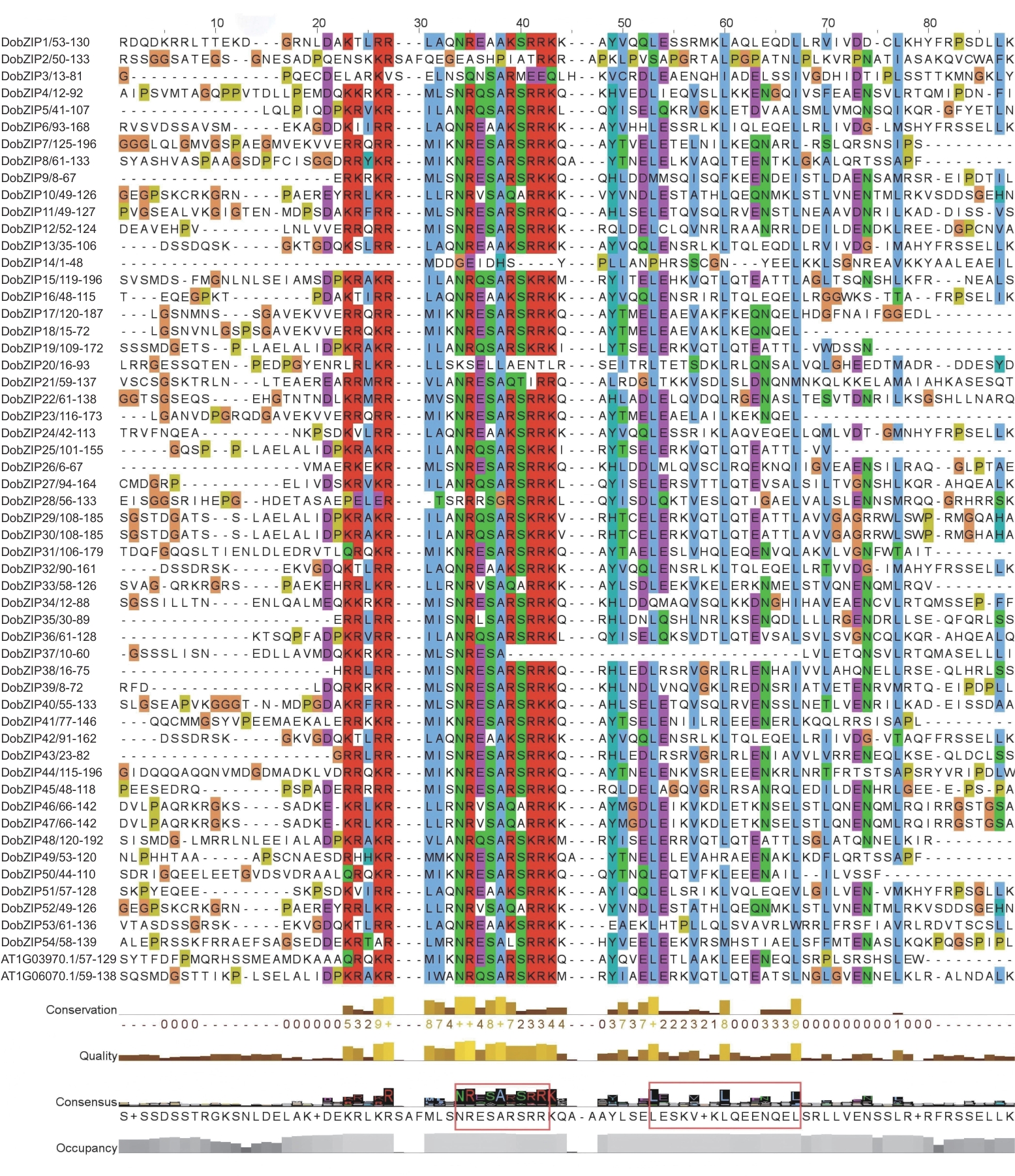
图2 铁皮石斛bZIP家族蛋白序列多重比对红色框内代表铁皮石斛bZIP家族蛋白保守结构域
Fig. 2 Multiple alignment of D. officinale bZIP family protein sequencesThe red box indicates the conserved domain of the bZIP family protein of D. officinale
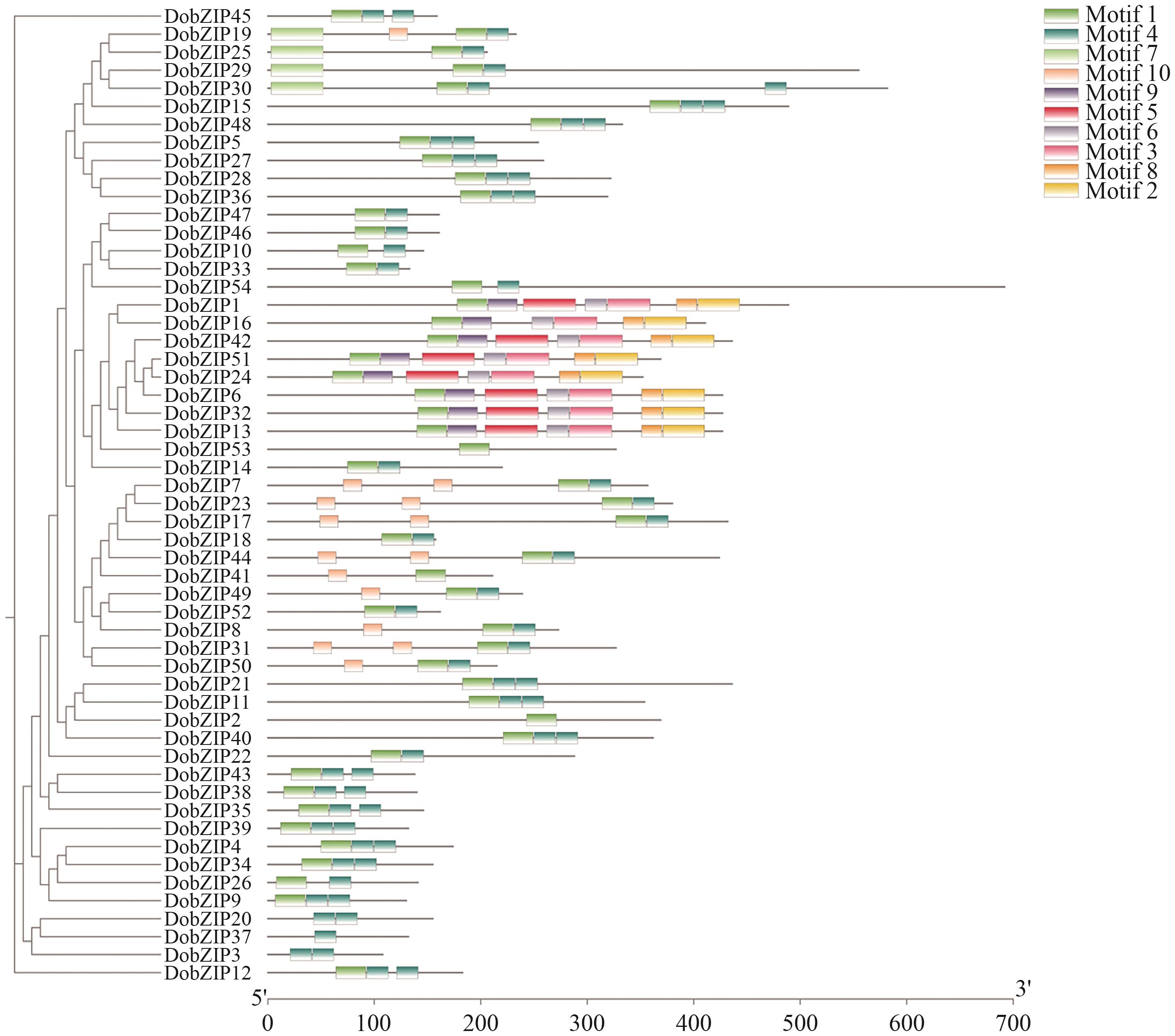
图3 铁皮石斛bZIP家族保守motif分析
Fig. 3 Conserved motif analysis of bZIP family in D.officinale
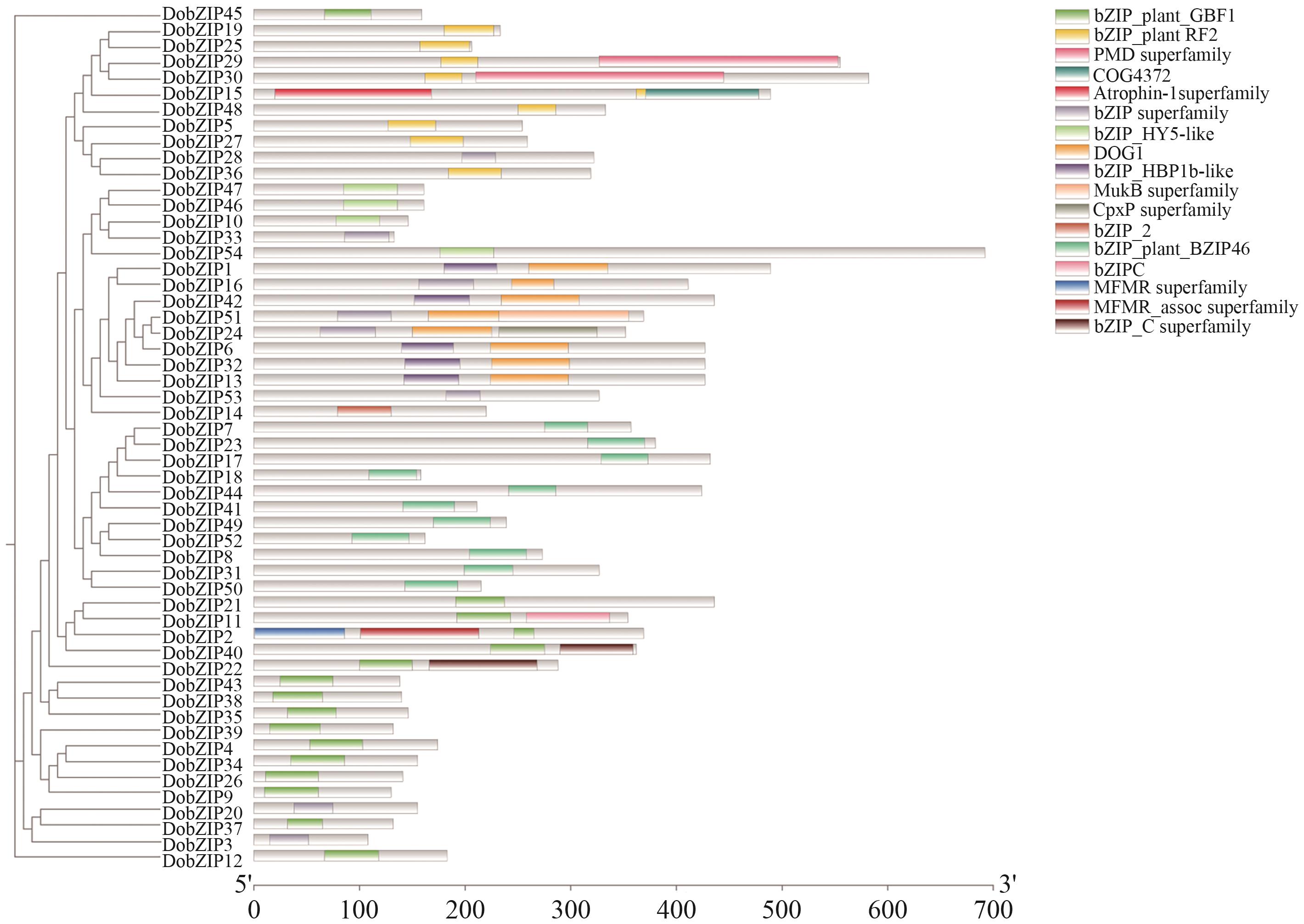
图4 铁皮石斛bZIP家族蛋白结构域分析
Fig. 4 Protein domain analysis of bZIP family in D.officinale

图5 铁皮石斛bZIP家族基因结构分析
Fig. 5 Gene structure analysis of bZIP family in D.officinale
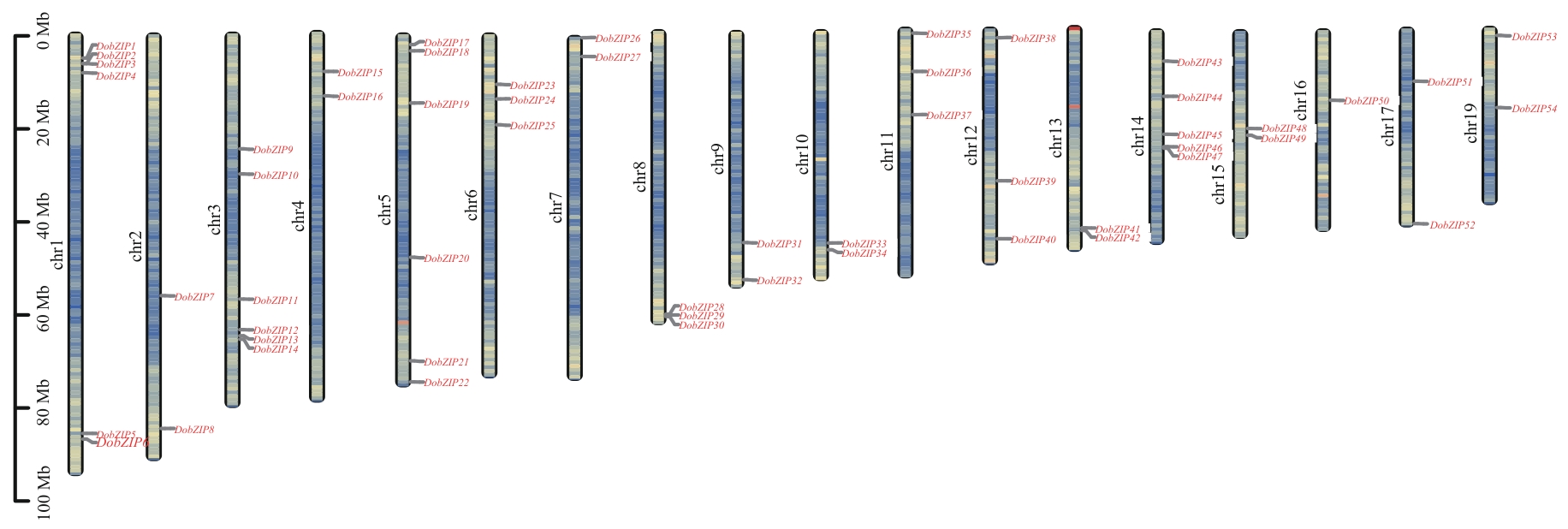
图6 铁皮石斛bZIP家族染色体定位分析
Fig. 6 Chromosome localization analysis of bZIP family in D. officinale
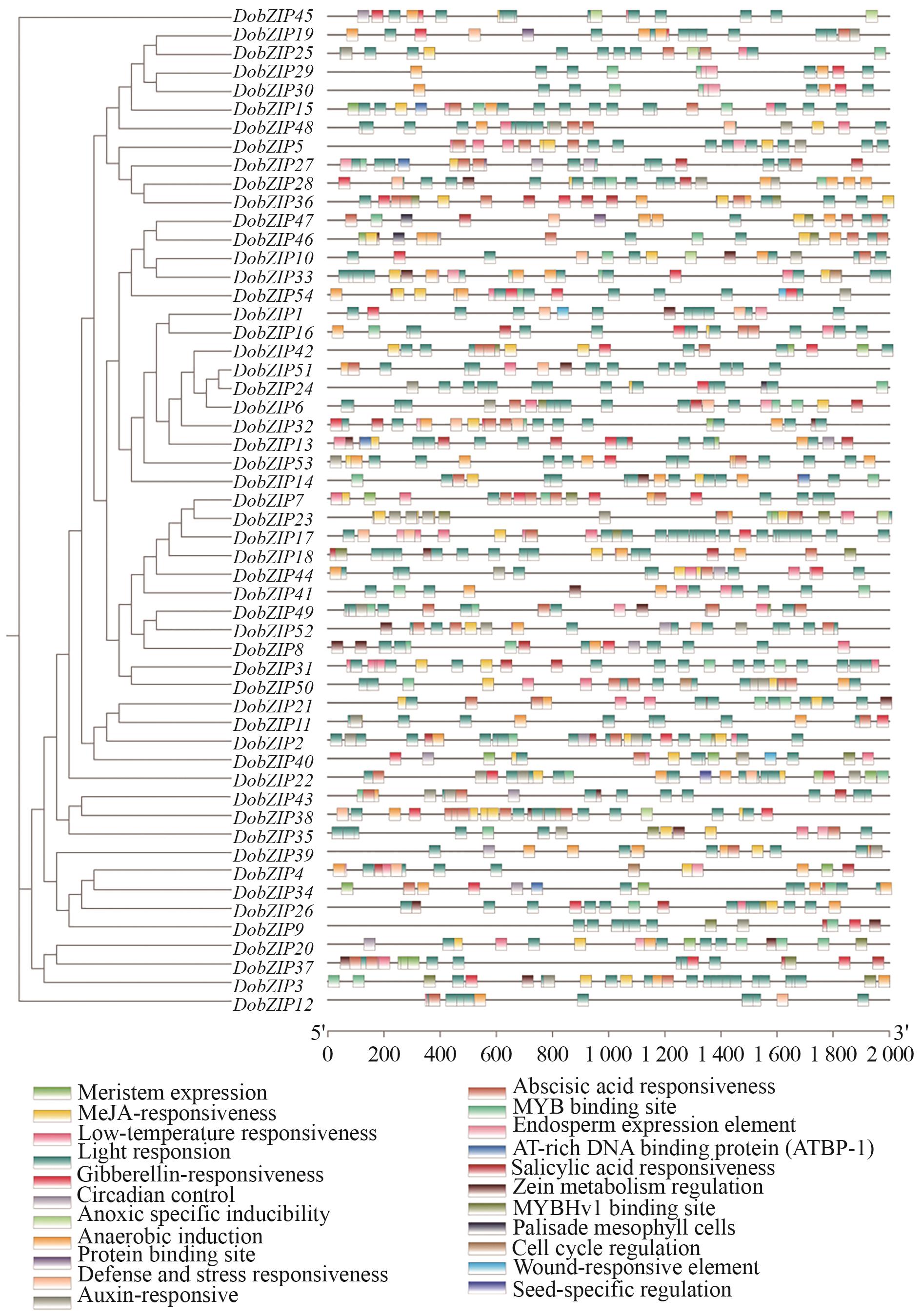
图7 铁皮石斛bZIP家族成员启动子顺式作用元件分析
Fig. 7 Promoter cis-acting elements analysis of bZIP members family in D. officinale

图8 铁皮石斛bZIP转录因子染色体分布和组内共线性分析
Fig. 8 Chromosomal distribution and collinearity analysis of bZIP transcription factors in D. officinale
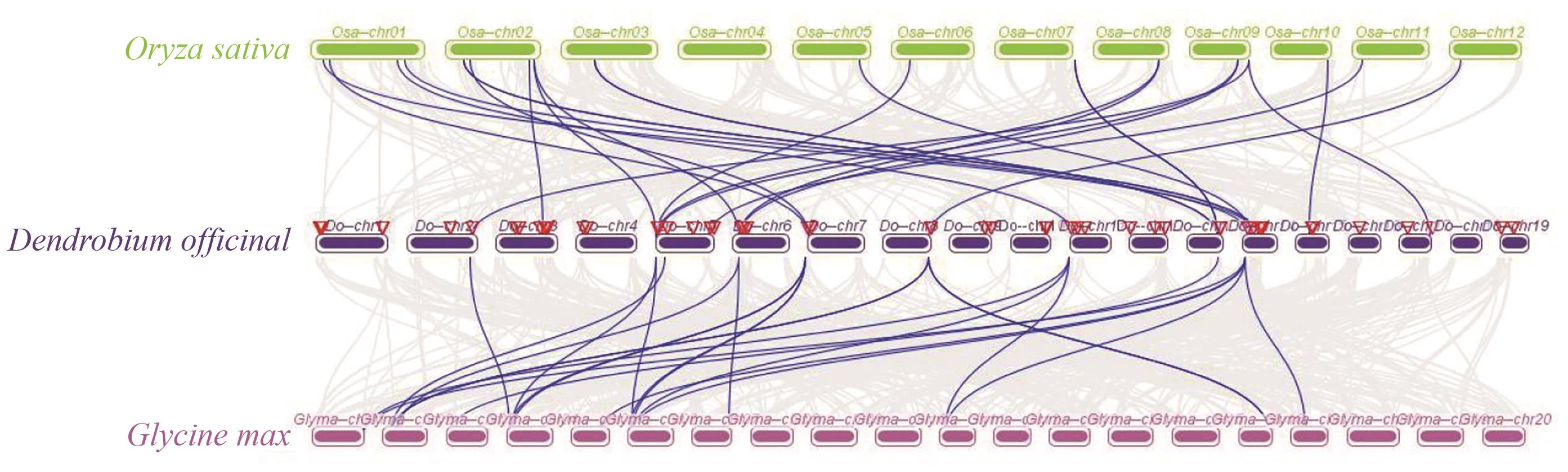
图9 铁皮石斛、水稻和大豆bZIP转录因子种间共线性分析
Fig. 9 Synteny analysis of bZIP transcription factors between D.officinale, Oryza sativa and Glycine max
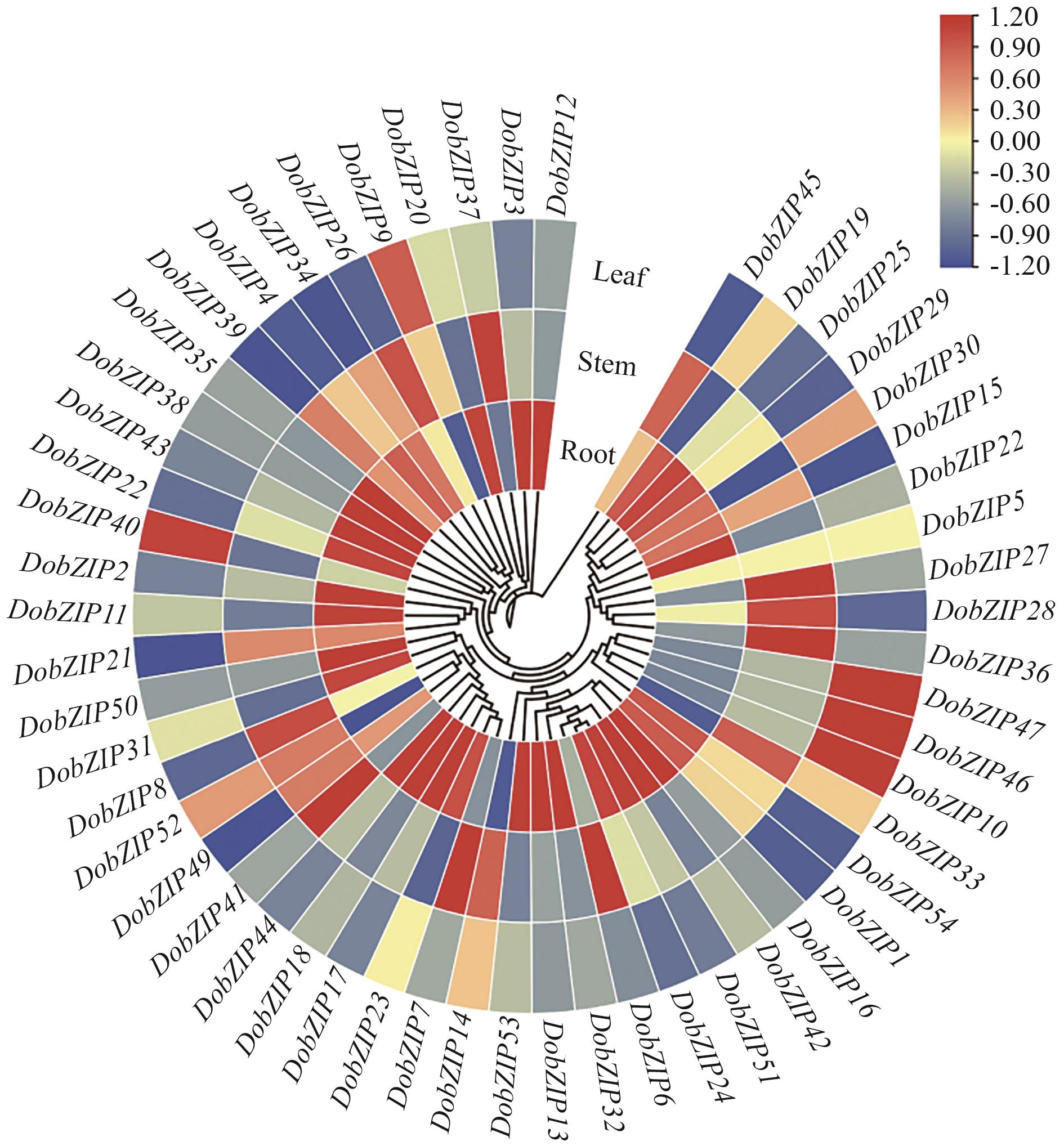
图10 DobZIP转录因子在铁皮石斛根、茎、叶中的表达模式分析
Fig. 10 Expression analysis of DobZIP transcription factorsin the roots, stems and leaves of D. officinale
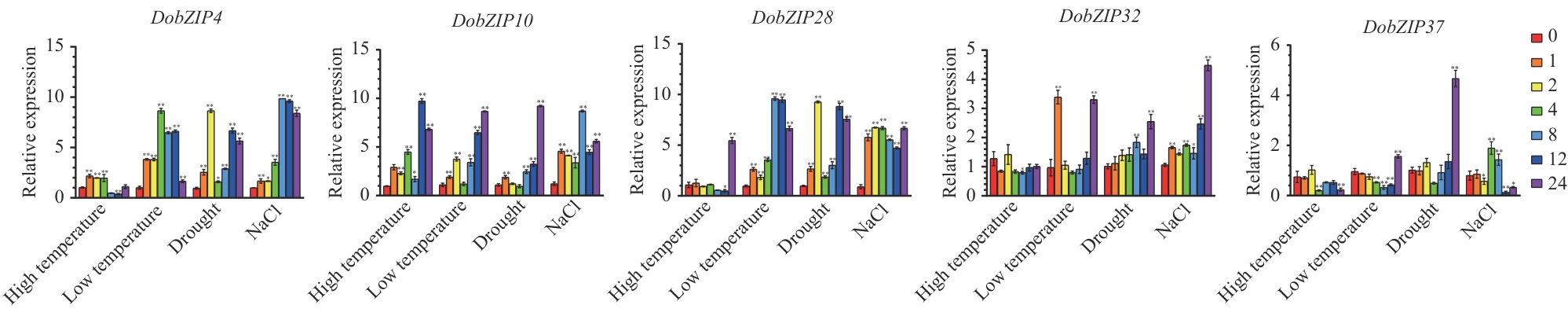
图11 胁迫处理下铁皮石斛5个bZIP转录因子相对表达规律分析*P<0.05,**P<0.01
Fig. 11 Relative expression analysis of five bZIP transcription factors under stress treatment in D.officinale
| [1] | 吉占和.中国植物志 [M].北京:科学出版社,1999. |
| Jie ZH. Flora of China [M]. Beijing: Science press, 1999. | |
| [2] | 包雪声, 顺庆生, 陈立钻, 等. 中国药用石斛图志 [M]. 上海: 复旦大学出版社, 2001. |
| Bao XS, Shun QS, Chen LZ, et al. Illustrated Flora of Chinese Medicinal Dendrobium [M]. Shanghai: Fudan University Press, 2001. | |
| [3] | 刘雪娜, 吴雪娇, 刘顺航, 等. 铁皮石斛的药理作用及其保健食品研发进展 [J].保鲜与加工, 2021, 21(10): 144-150. |
| Liu XN, Wu XJ, Liu SH, et al.Pharmacological effects of Dendrobium officinale and the development of its health foods [J]. Fresh Presservation and Processing, 2021, 21 (10): 144-150. | |
| [4] | 张红瑞, 理雅, 于白音, 等. 铁皮石斛DobHLH96基因克隆及表达分析 [J]. 江苏农业科学, 2023, 51(1): 63-70. |
| Zhang HR, Li Y, Yu BY, et al. Cloning and expression analysis of DobHLH96 gene from Dendrobium offocinale [J]. Jiangsu Agricultural Sciences. 2023, 51 (1): 63-70. | |
| [5] | 余文霞, 雷胄熙, 袁媛, 等. 铁皮石斛种质资源DNA身份证的构建及遗传相似性分析 [J]. 中国实验方剂学杂志, 2019, 25(1): 16-21. |
| Yu WX, Lei ZX, Yuan Y, et al. Establishment of DNA fingerprints and genetic similarities analysis of Dendrobium officinale [J]. Chin J Exp Tradit Med Formulae, 2019, 25(1): 16-21. | |
| [6] | 吴韵琴, 斯金平. 铁皮石斛产业现状及可持续发展的探讨 [J]. 中国中药杂志, 2010, 35(15): 2033-2037. |
| Wu YQ, Si JP. Present status and sustainable development of Dendrobium of ficinale industry [J]. China J Chin Mater Med, 2010, 35(15): 2033-2037. | |
| [7] | 张瑜, 徐志超, 季爱加, 等. bZIP转录因子调控植物次生代谢产物生物合成的研究进展 [J]. 植物科学学报, 2017, 35(1): 128-137. |
| Zhang Y, Xu ZC, Ji AJ, et al. Regulation of secondary metabolite biosynthesis by bZPI transcription factors in plants [J]. Plant Sci J, 2017, 35(1): 128-137. | |
| [8] | Lee SC, Choi HW, Hwang IS, et al. Functional roles of the pepper pathogen-induced bZIP transcription factor, CAbZIP1, in enhanced resistance to pathogen infection and environmental stresses [J]. Planta, 2006, 224(5): 1209-1225. |
| [9] | Song YH, Luo GB, Shen LS, et al. TubZIP28, a novel bZIP family transcription factor from Triticum urartu, and TabZIP28, its homologue from Triticum aestivum, enhance starch synthesis in wheat [J]. New Phytol, 2020, 226(5): 1384-1398. |
| [10] | Jakoby M, Weisshaar B, Dröge-Laser W, et al. bZIP transcription factors in Arabidopsis [J]. Trends Plant Sci, 2002, 7(3): 106-111. |
| [11] | Wei K, Chen J, Wang Y, et al. Genome-wide analysis of bZIP-encoding genes in maize [J]. DNA Res, 2012, 19(6): 463-476. |
| [12] | 郭纯, 宋桂梅, 闫艳, 等. 西洋参bZIP基因家族全基因组鉴定和表达分析 [J]. 生物技术通报, 2024, 40(4): 167-178. |
| Guo C, Song GM, Yan Y, et al. Genome wide identification and expression analysis of the bZIP gene family in Panax quinquefolius [J]. Biotechnol Bull, 2024, 40(4): 167-178. | |
| [13] | 李勇慧, 鲍星星, 段一珂, 等. 灵宝杜鹃bZIP家族全基因组鉴定及表达特征分析 [J].生物技术通报,2024,40(8):186-198. |
| Li YH, Bao XX, Duan YK, et al. Genome-Wide identification and expression features analysis of the bZIP family in Rhododendron henanense subsp.linghaoense [J]. Biotechnol Bull, 2024, 40 (8): 186-198. | |
| [14] | 邹华文, 郭凯, 张莹莹, 等. 玉米转录因子ZmbZIP77基因克隆及表达分析 [J]. 长江大学学报: 自然科学版, 2021, 18(2): 89-94. |
| Zhou HW, Guo K, Zhang YY, et al. Cloning and expression analysis of Maize transcription factor ZmbZIP77gene [J]. Journal of Yangtze University: Natural Science Edition, 2021, 18 (2): 89-94. | |
| [15] | Corrêa LGG, Riaño-Pachón DM, Schrago CG, et al. The role of bZIP transcription factors in green plant evolution: adaptive features emerging from four founder genes [J]. PLoS One, 2008, 3(8): e2944. |
| [16] | Silveira AB, Gauer L, Tomaz JP, et al. The Arabidopsis AtbZIP9 protein fused to the VP16 transcriptional activation domain alters leaf and vascular development [J]. Plant Sci, 2007, 172(6): 1148-1156. |
| [17] | Takahashi H, Kawakatsu T, Wakasa Y, et al. A rice transmembrane bZIP transcription factor, OsbZIP39, regulates the endoplasmic reticulum stress response [J]. Plant Cell Physiol, 2012, 53(1): 144-153. |
| [18] | Thalor SK, Berberich T, Lee SS, et al. Deregulation of sucrose-controlled translation of a bZIP-type transcription factor results in sucrose accumulation in leaves [J]. PLoS One, 2012, 7(3): e33111. |
| [19] | Yoshida T, Fujita Y, Maruyama K, et al. Four Arabidopsis AREB/ABF transcription factors function predominantly in gene expression downstream of SnRK2 kinases in abscisic acid signalling in response to osmotic stress [J]. Plant Cell Environ, 2015, 38(1): 35-49. |
| [20] | 王金英, 丁峰, 潘介春, 等. 植物bZIP转录因子家族的研究进展 [J]. 热带农业科学, 2019, 39(6): 39-45. |
| Wang JY, Ding F, Pan JC, et al. Research progress of bZIP lineage transcription factors in plant [J]. Chin J Trop Agric, 2019, 39(6): 39-45. | |
| [21] | 王健, 杨莎, 孙庆文, 等. 金钗石斛bHLH转录因子家族全基因组鉴定及表达分析 [J].生物技术通报,2024,40(6):203-218. |
| Wang J, Yang S, Sun QW, et al. Genome wide identification and ixpression analysis of bHLH iranscription factor family in Dendrobium nobile [J]. Biotechnol Bull, 2024, 40 (6): 203- 218. | |
| [22] | Building and Application of Database in IMP [J]. IMP & HIRFL Annual Report,2000: 153. |
| [23] | Jin JP, Tian F, Yang DC, et al. PlantTFDB 4.0: toward a central hub for transcription factors and regulatory interactions in plants [J]. Nucleic Acids Res, 2017, 45(D1): D1040-D1045. |
| [24] | Chen CJ, Chen H, Zhang Y, et al. TBtools: an integrative toolkit developed for interactive analyses of big biological data [J]. Mol Plant, 2020, 13(8): 1194-1202. |
| [25] | 杨莎, 孙庆文, 黄园, 等. 金钗石斛两个NCED基因克隆及逆境表达分析 [J]. 分子植物育种,2024:1-17. |
| Yang S, Sun QW, Huang Y, et al. Cloning and stress expression analysis of two NCED genes from Dendrobium nobile [J]. Molecular Plant Breeding, 2024: 1-17. | |
| [26] | 江林琪, 赵佳莹, 郑飞雄, 等. 铁皮石斛14-3-3基因家族鉴定及表达分析 [J]. 生物技术通报, 2024, 40(3): 229-241. |
| Jiang LQ, Zhao JY, Zhen FX, et al. Identification and xxpression analysis of 14-3-3 gene family in Dendrobium officinale [J]. Biotechnol Bull, 2024, 40 (3): 229-241. | |
| [27] | Bailey TL, Williams N, Misleh C, et al. MEME: discovering and analyzing DNA and protein sequence motifs [J]. Nucleic Acids Res, 2006, 34(Web Server issue): W369-W373. |
| [28] | Lescot M, Déhais P, Thijs G, et al. PlantCARE, a database of plant Cis-acting regulatory elements and a portal to tools for in silico analysis of promoter sequences [J]. Nucleic Acids Res, 2002, 30(1): 325-327. |
| [29] | 王新果, 赵丹丹, 黄红娟, 等. 刺萼龙葵延迟萌发基因DOG1的克隆及表达特性 [C]. 第十三届全国杂草科学大会,2017: 12. |
| Wang XG, Zhao DD, Huang HJ, et al. Cloning and expression characteristics of the delayed germination gene DOG1 from Solanum nigrum [C]. The Thirteenth National Conference on Weeds Science, 2017: 12. | |
| [30] | Zhao K, Chen S, Yao WJ, et al. Genome-wide analysis and expression profile of the bZIP gene family in poplar [J]. BMC Plant Biol, 2021, 21(1): 122. |
| [31] | Cannon SB, Mitra A, Baumgarten A, et al. The roles of segmental and tandem gene duplication in the evolution of large gene families in Arabidopsis thaliana [J]. BMC Plant Biol, 2004, 4: 10. |
| [32] | Farmer EE, Ryan CA. Octadecanoid precursors of jasmonic acid activate the synthesis of wound-inducible proteinase inhibitors [J]. Plant Cell, 1992, 4(2): 129-134. |
| [33] | 朱渊铭, 张培兰, 林宇清, 等. 香樟bZIP基因家族鉴定及表达分析 [J]. 扬州大学学报: 农业与生命科学版, 2024, 45(3): 44-54, 81. |
| Zhu YM, Zhang PL, Lin YQ, et al. Identification and Functional analysis of the bZIP gene family of Cinnamomum camphora [J]. Journal of Yangzhou University, Agricultural and Life Science Edition, 2024, 45 (3): 44-54, 81. | |
| [34] | 周宇, 陈传敏, 王健, 等. 薏苡bZIP基因家族全基因组鉴定与非生物胁迫表达分析 [J]. 热带作物学报, 2022, 43(10): 2006-2020. |
| Zhou Y, Chen CM, Wang J, et al. Genoma-Wide identification and expression analysis of bZIP gene family under abiotic stress in Coxi lacyma-jobi [J]. Chinese Journal of Tropical Crops, 2022, 43 (10): 2006-2020. | |
| [35] | Shen Q, Huang HY, Zhao Y, et al. The transcription factor Aabzip9 positively regulates the biosynthesis of artemisinin in Artemisia annua [J]. Front Plant Sci, 2019, 10: 1294. |
| [36] | Zhang FY, Fu XQ, Lv ZY, et al. A basic leucine zipper transcription factor, AabZIP1, connects abscisic acid signaling with artemisinin biosynthesis in Artemisia annua [J]. Mol Plant, 2015, 8(1): 163-175. |
| [37] | 马博涛, 伍国强, 魏明. bZIP转录因子在植物逆境胁迫响应和生长发育中的作用 [J]. 生物技术通报, 2024, 40(9): 148-160. |
| Ma BT, Wu GQ, Wei M. Roles of bZIP transcription factor in the respones to stresses,and growth and development in plants [J]. Biotechnol Bull, 2024, 40 (9): 148-160. | |
| [38] | 净易尧, 罗瑶, 史嘉周, 等. 远志bZIP基因家族的鉴定及表达分析 [J]. 中草药, 2024, 55(12): 4140 4149. |
| Jing YX, Luo Y, Shi JZ, et al. Identification and expression analysis of bZIP gene family in Polygala tenuifolia [J]. Chinese Traditional and Herbal Drugs, 2024, 55 (12): 4140-4149. | |
| [39] | 王星文, 吴端, 师玉华, 等. 黄花蒿bZIP转录因子基因家族及光调控表达模式分析 [J]. 世界科学技术-中医药现代化, 2021, 23(1): 20-32. |
| Wang XW, Wu D, Shi YH, et al. Analysis of the bZIP transcription factor gene family of Artemisia annua and light-regulated expression patterns[J]. World Science and Technology-Modernization of Traditional Chinese Medicine, 2021, 23 (1): 20-32. | |
| [40] | 万露露, 王中煊, 沈军, 等. 闽楠bZIP基因家族的鉴定与表达分析 [J]. 福建农林大学学报: 自然科学版, 2024, 53(2):2 21-228. |
| Wan LL, Wang ZX, Shen J, et al. Identification and expression analysis of bZIP gene family in Phoebe bournei [J]. Journal of Fujian Agriculture and Forestry University: Natural Science Edition, 2024, 53 (2): 221-228. | |
| [41] | Jin ZW, Xu W, Liu AZ. Genomic surveys and expression analysis of bZIP gene family in Castor bean (Ricinus communis L.) [J]. Planta, 2014, 239(2): 299-312. |
| [42] | Liao Y, Zou HF, Wei W, et al. Soybean GmbZIP44, GmbZIP62 and GmbZIP78 genes function as negative regulator of ABA signaling and confer salt and freezing tolerance in transgenic Arabidopsis [J]. Planta, 2008, 228(2): 225-240. |
| [43] | Bentsink L, Jowett J, Hanhart CJ, et al. Cloning of DOG1, a quantitative trait locus controlling seed dormancy in Arabidopsis [J]. Proc Natl Acad Sci USA, 2006, 103(45): 17042-17047. |
| [44] | 叶方婷, 潘鑫峰, 毛志君, 等. 睡莲转录因子bZIP家族的分子进化以及功能分析 [J]. 中国农业科学, 2021, 54(21): 4694-4708. |
| Ye FT, Pan XF, Mao ZJ, et al. Molecular evolution and function analysis of bZIP family in Nymphaea Colorate [J]. Agricultural Sciences in China, 2021, 54 (21): 4694-4708. | |
| [45] | Sarde SJ, Bouwmeester K, Venegas-Molina J, et al. Involvement of sweet pepper CaLOX2 in jasmonate-dependent induced defence against Western flower Thrips [J]. J Integr Plant Biol, 2019, 61(10): 1085-1098. |
| [46] | 吴耀荣, 谢旗. ABA与植物胁迫抗性 [J]. 植物学通报, 2006, 23(5): 511-518. |
| Wu YR, Xie Q. ABA and plant stress response [J]. Chin Bull Bot, 2006, 23(5): 511-518. | |
| [47] | Golldack D, Li C, Mohan H, et al. Tolerance to drought and salt stress in plants: Unraveling the signaling networks [J]. Front Plant Sci, 2014, 5: 151. |
| [48] | Gai WX, Ma X, Qiao YM, et al. Characterization of the bZIP transcription factor family in pepper (Capsicum annuum L.): CabZIP25 positively modulates the salt tolerance [J]. Front Plant Sci, 2020, 11: 139. |
| [49] | Yang Y, Yu TF, Ma J, et al. The soybean bZIP transcription factor gene GmbZIP2 confers drought and salt resistances in transgenic plants [J]. Int J Mol Sci, 2020, 21(2): 670. |
| [50] | Tang W, Page M, Fei YJ, et al. Overexpression of AtbZIP60deltaC gene alleviates salt-induced oxidative damage in transgenic cell cultures [J]. Plant Mol Biol Report, 2012, 30(5): 1183-1195. |
| [51] | Liu CT, Mao BG, Ou SJ, et al. OsbZIP71, a bZIP transcription factor, confers salinity and drought tolerance in rice [J]. Plant Mol Biol, 2014, 84(1/2): 19-36. |
| [52] | Li MY, Hwarari D, Li Y, et al. The bZIP transcription factors in Liriodendron chinense: Genome-wide recognition, characteristics and cold stress response [J]. Front Plant Sci, 2022, 13: 1035627. |
| [53] | Wiese AJ, Steinbachová L, Timofejeva L, et al. Arabidopsis bZIP18 and bZIP52 accumulate in nuclei following heat stress where they regulate the expression of a similar set of genes [J]. Int J Mol Sci, 2021, 22(2): 530. |
| [1] | 陈强, 于璎霏, 张颖, 张冲. 茉莉酸甲酯对薄皮甜瓜‘绿宝石’采后冷害的调控[J]. 生物技术通报, 2025, 41(9): 1-10. |
| [2] | 任睿斌, 司二静, 万广有, 汪军成, 姚立蓉, 张宏, 马小乐, 李葆春, 王化俊, 孟亚雄. 大麦条纹病菌GH17基因家族的鉴定及表达分析[J]. 生物技术通报, 2025, 41(8): 146-154. |
| [3] | 牛景萍, 赵婧, 郭茜, 王书宏, 赵晋忠, 杜维俊, 殷丛丛, 岳爱琴. 基于WGCNA鉴定大豆抗大豆花叶病毒NAC转录因子及其诱导表达分析[J]. 生物技术通报, 2025, 41(7): 95-105. |
| [4] | 韩燚, 侯昌林, 唐露, 孙璐, 谢晓东, 梁晨, 陈小强. 大麦HvERECTA基因的克隆及功能分析[J]. 生物技术通报, 2025, 41(7): 106-116. |
| [5] | 李霞, 张泽伟, 刘泽军, 王楠, 郭江波, 辛翠花, 张彤, 简磊. 马铃薯转录因子StMYB96的克隆及功能研究[J]. 生物技术通报, 2025, 41(7): 181-192. |
| [6] | 魏雨佳, 李岩, 康语涵, 弓晓楠, 杜敏, 涂岚, 石鹏, 于子涵, 孙彦, 张昆. 白颖苔草CrMYB4基因的克隆和表达分析[J]. 生物技术通报, 2025, 41(7): 248-260. |
| [7] | 李锐, 胡婷, 陈树溦, 王尧, 王计平. 紫苏PfMYB80转录因子正向调控花青素的生物合成[J]. 生物技术通报, 2025, 41(6): 243-255. |
| [8] | 郭涛, 艾丽皎, 邹世慧, 周玲, 李学梅. 山茶CjRAV1调控开花延迟的功能研究[J]. 生物技术通报, 2025, 41(6): 208-217. |
| [9] | 程珊, 王会伟, 陈晨, 朱雅婧, 李春鑫, 别海, 王树峰, 陈献功, 张向歌. 油莎豆MYB转录因子基因CeMYB154克隆及耐盐功能分析[J]. 生物技术通报, 2025, 41(6): 218-228. |
| [10] | 程慧娟, 王昕, 石小涛, 马东旭, 龚大春, 胡骏鹏, 谢智文. 转录因子CREA敲除对黑曲霉形态和分泌β-葡萄糖苷酶的影响[J]. 生物技术通报, 2025, 41(6): 344-354. |
| [11] | 李小欢, 陈相宇, 陶麒宇, 朱玲, 唐铭, 姚银安, 汪丽君. PtoMYB61对毛白杨木质素合成及耐盐性的影响[J]. 生物技术通报, 2025, 41(6): 284-296. |
| [12] | 赵婧, 郭茜, 李睿琦, 雷滢炀, 岳爱琴, 赵晋忠, 殷丛丛, 杜维俊, 牛景萍. 大豆GmGST基因簇基因序列分析及诱导表达分析[J]. 生物技术通报, 2025, 41(5): 129-140. |
| [13] | 罗嗣芳, 张祖铭, 谢丽芳, 郭紫晶, 陈兆星, 杨月华, 严翔, 张洪铭. 山金柑GATA基因家族全基因组鉴定及在果实发育中的表达分析[J]. 生物技术通报, 2025, 41(5): 218-230. |
| [14] | 杨春, 王晓倩, 王红军, 晁跃辉. 蒺藜苜蓿MtZHD4基因克隆、亚细胞定位及表达分析[J]. 生物技术通报, 2025, 41(5): 244-254. |
| [15] | 胡若群, 曾菁菁, 梁婉凤, 曹佳玉, 黄小苇, 梁晓英, 仇明月, 陈莹. 转录组和代谢组联合分析探究不同遮光条件下金线莲类胡萝卜素合成代谢机制[J]. 生物技术通报, 2025, 41(5): 231-243. |
| 阅读次数 | ||||||
|
全文 |
|
|||||
|
摘要 |
|
|||||
