







生物技术通报 ›› 2026, Vol. 42 ›› Issue (1): 31-41.doi: 10.13560/j.cnki.biotech.bull.1985.2025-0523
高峥( ), 尹柳祎, 孟令品, 王晓慧, 孙佳欣, 宋扬(), 温树波()
收稿日期:2025-05-22
出版日期:2026-01-26
发布日期:2026-02-04
通讯作者:
宋扬,女,博士,副教授,研究方向 :幼龄反刍动物营养调控与肠道健康;E-mail: yangsong@imun.edu.cn作者简介:高峥,男,硕士研究生,研究方向 :家畜传染病;E-mail: gzheng4955@gmail.com
基金资助:
GAO Zheng(), YIN Liu-yi, MENG Ling-pin, WANG Xiao-hui, SUN Jia-xin, SONG Yang(), WEN Shu-bo()
Received:2025-05-22
Published:2026-01-26
Online:2026-02-04
摘要:
牛病毒性腹泻病毒(bovine viral diarrhea virus, BVDV)是引发牛病毒性腹泻-黏膜病(bovine viral diarrhea-mucosal disease, BVD-MD)的主要病原体,其临床表现包括高热、口腔及消化道黏膜糜烂坏死、腹泻、妊娠奶牛流产、胎儿畸形、血小板及白细胞减少、犊牛免疫抑制等症状,这些病征不仅损害牛群健康,还可导致严重的经济损失,严重制约了养牛业的绿色健康发展。目前,主要的防控手段有疫苗接种和种群净化,但疫苗的保护效力受限,种群净化操作复杂且成本较高,在实际生产过程中难以实现。因此,开发安全高效的抗病毒药物作为补充策略十分必要。然而,至今尚无针对BVDV的特效治疗药物问世,显著制约了生产防控的成效。近年来,随着抗病毒药物研究的深入,天然植物提取物因其广泛存在于自然界、具有安全、高效及多靶点作用等优势,已成为抗病毒药物开发的重要潜力来源。本文系统综述了近年来抗BVDV植物提取物的研究进展,重点分析其作用靶点及机制,总结其通过中和病毒、抑制病毒复制、调节宿主免疫反应及缓解氧化应激等途径发挥抗BVDV活性的研究成果。这些研究成果为植物提取物进一步开发成为抗BVDV药物奠定了坚实的科学基础,充分地展示了其在抗病毒领域的独特优势。同时,本文还对天然植物提取物在抗BVDV药物研发中的应用前景进行了展望,并提出了相关研究建议。
高峥, 尹柳祎, 孟令品, 王晓慧, 孙佳欣, 宋扬, 温树波. 植物提取物抗牛病毒性腹泻病毒的研究进展[J]. 生物技术通报, 2026, 42(1): 31-41.
GAO Zheng, YIN Liu-yi, MENG Ling-pin, WANG Xiao-hui, SUN Jia-xin, SONG Yang, WEN Shu-bo. Research Advances in Plant Extracts with Antiviral Activity against Bovine Viral Diarrhea Virus[J]. Biotechnology Bulletin, 2026, 42(1): 31-41.
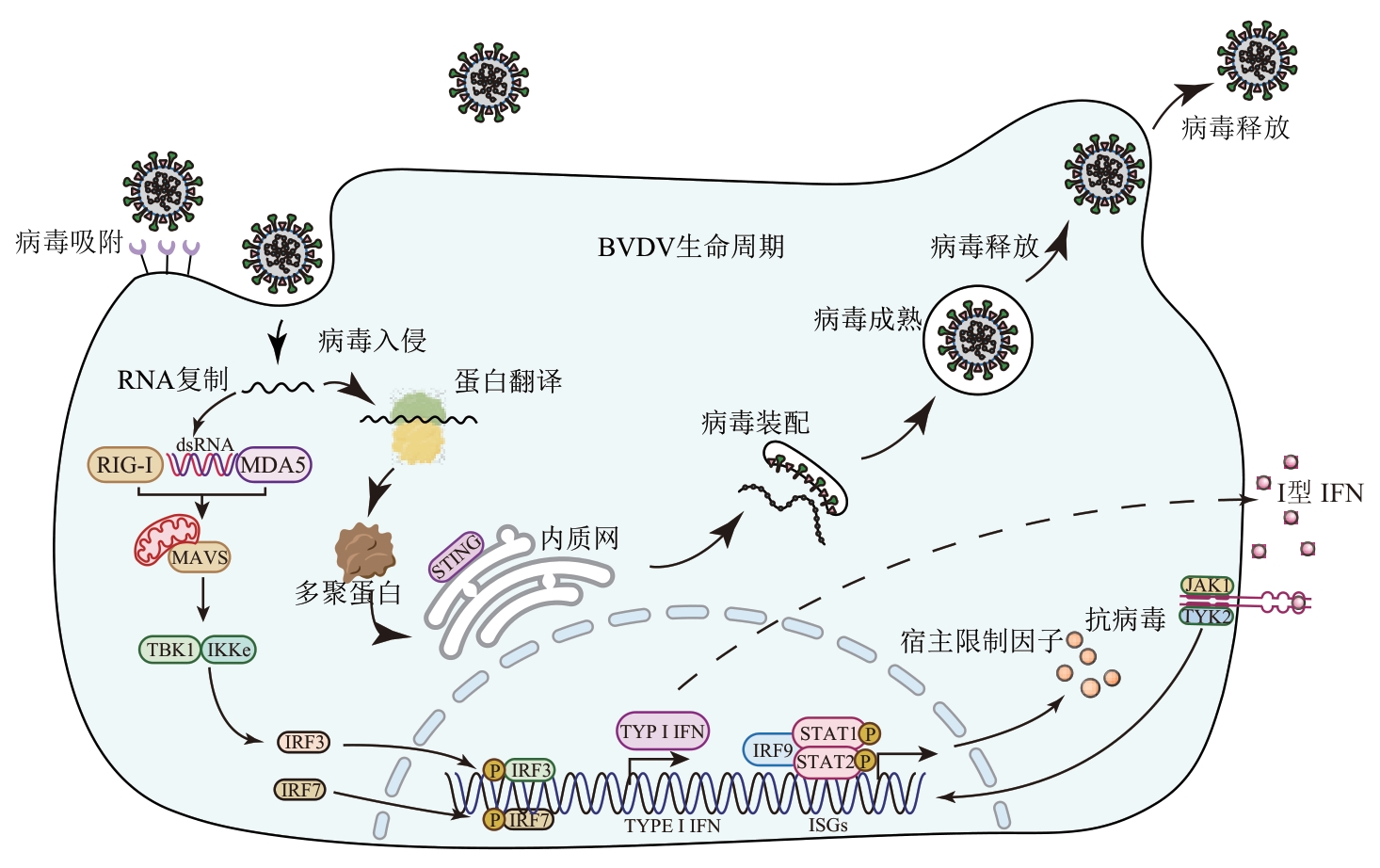
图1 BVDV感染宿主细胞机制图
Fig. 1 Mechanism of BVDV infection in host cells
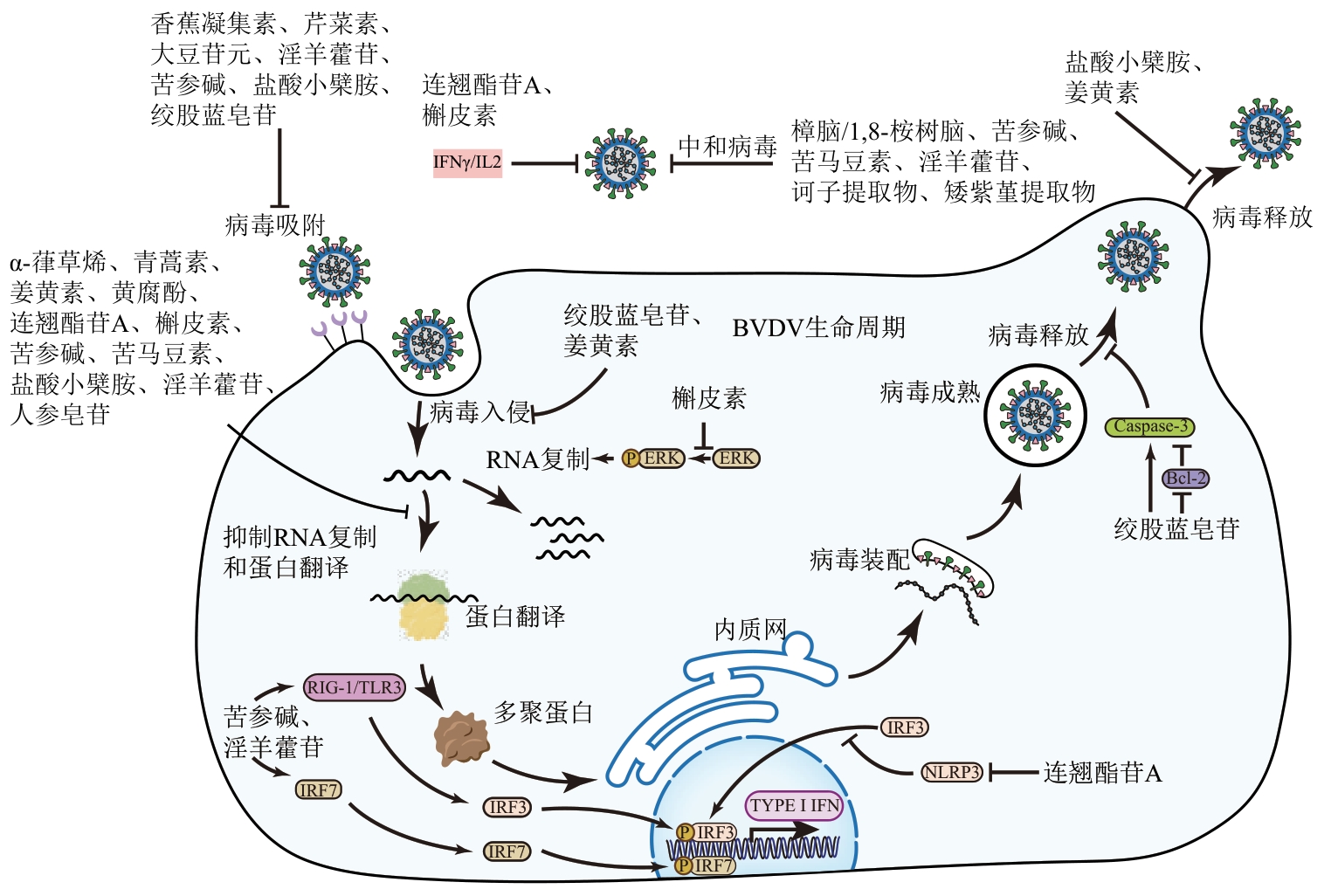
图2 植物提取物抗BVDV作用机制
Fig. 2 Action mechanism of plant extracts against BVDV
| 类别 Category | 提取物 Extract | 来源 Source | 作用靶点 Main target | 作用阶段 Stage of action | 抗病毒机制 Antiviral mechanism | 参考文献 Reference |
|---|---|---|---|---|---|---|
| 植物凝集素 | 香蕉凝集素 | 成熟香蕉果肉 | 包膜糖蛋白 | 感染前;感染后;中和病毒 | 结合糖蛋白阻止附着 | [ |
| 萜类植物提取物 | 罗勒 | 病毒包膜脂质 | 中和病毒 | 破坏包膜 | [ | |
| α-葎草烯 | 鼠尾草 | - | 可能为复制阶段 | 剂量依赖性降低病毒滴度 | [ | |
| 青蒿素 | 菊科植物 | 非结构蛋白5B NS5B | 复制阶段 | 抑制NS5B | [ | |
| 酚类植物提取物 | 姜黄素 | 姜黄 | 非结构蛋白5B NS5B | 全周期 | 抑制NS5B | [ |
| 黄腐酚 | 啤酒花 | - | 病毒感染中期 | 抑制RNA合成;减少E2表达;抑制CPE | [ | |
| 连翘酯苷A | 连翘 | NLRP3, TLR3/7, IRF3/7, IFN-α/β, JAK1, STAT1, p65, SOCS1, CD3⁺CD4⁺/CD3⁺CD8⁺T细胞, IFN-γ, IL-2 | 复制阶段 | 抑制BVDV复制;降低E2蛋白/mRNA;抑制NLRP3炎症体;增强IFN-I;下调TLR3/7、IRF3/7等;抑制IRF7核转位;促进CD4+/CD8+T细胞活化;增加IFN-γ/IL-2 | [ | |
| 黄酮类植物提取物 | 大豆苷元 | 大豆 | - | 附着阶段 | 阻断附着 | [ |
| 芹菜素 | 多种植物 | - | 附着;复制 | 阻断附着 | [ | |
| 槲皮素 | 多种植物 | Hsp70, ERK, IL-2, IFN-γ, Nrf2, HO-1, NQO1, ROS, MDA | 附着;复制 | 抑制Hsp70:阻断RNA复制;抗氧化:降低ROS/MDA;抑制ERK磷酸化;免疫调节:上调IFN-γ/IL-2 | [ | |
| 生物碱类植物提取物 | 苦参碱 | 苦参 | RIG-I, TLR3 | 附着;复制;杀灭病毒 | 灭活病毒;抑制吸附/复制 | [ |
| 苦马豆素 | 径直黄芪 | - | 复制阶段;灭活游离病毒 | 抑制病毒复制;直接灭活病毒 | [ | |
| 淫羊藿苷 | 淫羊藿 | RIG-I, TLR3 | 附着;复制;杀灭病毒 | 灭活病毒;抑制吸附/复制 | [ | |
| 盐酸小檗胺 | 小檗属 | LC3, ATG5, SQSTM1/p62, LAMP1 | 吸附/复制/释放 | 抑制E2/mRNA积累;抑制BVDV诱导自噬体-溶酶体融合 | [ | |
| 皂苷类植物提取物 | 人参皂苷 | 人参 | Rb2: Viral IRES, Rb3: - | 翻译;复制 | 抑制IRES介导翻译;抑制RNA复制 | [ |
| 绞股蓝皂苷 | 绞股蓝 | Claudin-1, Occludin, Caspase-3, Bcl-2 | 附着;内化;释放 | 降低Claudin-1/Occludin;阻断附着/内化;减少E2表达;激活凋亡:上调Caspase-3,下调Bcl-2 | [ |
表1 具有抗BVDV活性的植物提取物
Table 1 Plant extracts with anti-BVDV activity
| 类别 Category | 提取物 Extract | 来源 Source | 作用靶点 Main target | 作用阶段 Stage of action | 抗病毒机制 Antiviral mechanism | 参考文献 Reference |
|---|---|---|---|---|---|---|
| 植物凝集素 | 香蕉凝集素 | 成熟香蕉果肉 | 包膜糖蛋白 | 感染前;感染后;中和病毒 | 结合糖蛋白阻止附着 | [ |
| 萜类植物提取物 | 罗勒 | 病毒包膜脂质 | 中和病毒 | 破坏包膜 | [ | |
| α-葎草烯 | 鼠尾草 | - | 可能为复制阶段 | 剂量依赖性降低病毒滴度 | [ | |
| 青蒿素 | 菊科植物 | 非结构蛋白5B NS5B | 复制阶段 | 抑制NS5B | [ | |
| 酚类植物提取物 | 姜黄素 | 姜黄 | 非结构蛋白5B NS5B | 全周期 | 抑制NS5B | [ |
| 黄腐酚 | 啤酒花 | - | 病毒感染中期 | 抑制RNA合成;减少E2表达;抑制CPE | [ | |
| 连翘酯苷A | 连翘 | NLRP3, TLR3/7, IRF3/7, IFN-α/β, JAK1, STAT1, p65, SOCS1, CD3⁺CD4⁺/CD3⁺CD8⁺T细胞, IFN-γ, IL-2 | 复制阶段 | 抑制BVDV复制;降低E2蛋白/mRNA;抑制NLRP3炎症体;增强IFN-I;下调TLR3/7、IRF3/7等;抑制IRF7核转位;促进CD4+/CD8+T细胞活化;增加IFN-γ/IL-2 | [ | |
| 黄酮类植物提取物 | 大豆苷元 | 大豆 | - | 附着阶段 | 阻断附着 | [ |
| 芹菜素 | 多种植物 | - | 附着;复制 | 阻断附着 | [ | |
| 槲皮素 | 多种植物 | Hsp70, ERK, IL-2, IFN-γ, Nrf2, HO-1, NQO1, ROS, MDA | 附着;复制 | 抑制Hsp70:阻断RNA复制;抗氧化:降低ROS/MDA;抑制ERK磷酸化;免疫调节:上调IFN-γ/IL-2 | [ | |
| 生物碱类植物提取物 | 苦参碱 | 苦参 | RIG-I, TLR3 | 附着;复制;杀灭病毒 | 灭活病毒;抑制吸附/复制 | [ |
| 苦马豆素 | 径直黄芪 | - | 复制阶段;灭活游离病毒 | 抑制病毒复制;直接灭活病毒 | [ | |
| 淫羊藿苷 | 淫羊藿 | RIG-I, TLR3 | 附着;复制;杀灭病毒 | 灭活病毒;抑制吸附/复制 | [ | |
| 盐酸小檗胺 | 小檗属 | LC3, ATG5, SQSTM1/p62, LAMP1 | 吸附/复制/释放 | 抑制E2/mRNA积累;抑制BVDV诱导自噬体-溶酶体融合 | [ | |
| 皂苷类植物提取物 | 人参皂苷 | 人参 | Rb2: Viral IRES, Rb3: - | 翻译;复制 | 抑制IRES介导翻译;抑制RNA复制 | [ |
| 绞股蓝皂苷 | 绞股蓝 | Claudin-1, Occludin, Caspase-3, Bcl-2 | 附着;内化;释放 | 降低Claudin-1/Occludin;阻断附着/内化;减少E2表达;激活凋亡:上调Caspase-3,下调Bcl-2 | [ |
| [1] | 李佑民, 刘振润, 武银莲. 牛病毒性腹泻—粘膜病病毒株(长春184)的分离与鉴定 [J]. 兽医大学学报, 1983, 3(2): 113-120. |
| Li YM, Liu ZR, Wu YL. Isolation and identification of bovine viral diarrhea-mucosal disease virus strain Changchun 184 [J]. Chin J Vet Sci, 1983, 3(2): 113-120. | |
| [2] | Olafson P, Maccallum AD, Fox FH. An apparently new transmissible disease of cattle [J]. Cornell Vet, 1946, 36: 205-213. |
| [3] | Kuca T, Passler T, Newcomer BW, et al. Changes introduced in the open reading frame of bovine viral diarrhea virus during serial infection of pregnant swine [J]. Front Microbiol, 2020, 11: 1138. |
| [4] | Griebel PJ. BVDV vaccination in North America: risks versus benefits [J]. Anim Health Res Rev, 2015, 16(1): 27-32. |
| [5] | Palomares RA, Marley SM, Givens MD, et al. Bovine viral diarrhea virus fetal persistent infection after immunization with a contaminated modified-live virus vaccine [J]. Theriogenology, 2013, 79(8): 1184-1195. |
| [6] | Ficken MD, Ellsworth MA, Tucker CM, et al. Effects of modified-live bovine viral diarrhea virus vaccines containing either type 1 or types 1 and 2 BVDV on heifers and their offspring after challenge with noncytopathic type 2 BVDV during gestation [J]. Javma, 2006, 228(10): 1559-1564. |
| [7] | Newcomer BW, Walz PH, Givens MD, et al. Efficacy of bovine viral diarrhea virus vaccination to prevent reproductive disease: a meta-analysis [J]. Theriogenology, 2015, 83(3): 360-365.e1. |
| [8] | Sozzi E, Righi C, Boldini M, et al. Cross-reactivity antibody response after vaccination with modified live and killed bovine viral diarrhoea virus (BVD) vaccines [J]. Vaccines, 2020, 8(3): 374. |
| [9] | Wernike K, Michelitsch A, Aebischer A, et al. The occurrence of a commercial npro and erns double mutant BVDV-1 live-vaccine strain in newborn calves [J]. Viruses, 2018, 10(5): 274. |
| [10] | Taberner E, Gibert M, Montbrau C, et al. Efficacy of vaccination with the DIVENCE® vaccine against bovine viral diarrhea virus types 1 and 2 in terms of fetal protection [J]. Vet Med Res Rep, 2024, 15: 221-238. |
| [11] | Tapiolas M, Gibert M, Montbrau C, et al. Efficacy of a new multivalent vaccine for the control of bovine respiratory disease (BRD) in a randomized clinical trial in commercial fattening units [J]. Vaccines, 2024, 12(11): 1233. |
| [12] | Kadiroğlu B, Yeşilbağ K. Optimum processing conditions for a trivalent-inactivated bovine viral diarrhea virus (BVDV) vaccine using field strains and immunogenicity of candidate formulations with different adjuvants [J]. Vet Res Commun, 2024, 49(1): 37. |
| [13] | Hoyos-Jaramillo A, Palomares RA, Bittar JH, et al. Clinical status and endoscopy of the upper respiratory tract of dairy calves infected with Bovine viral diarrhea virus 2 and Bovine herpes virus 1 after vaccination and trace minerals injection [J]. Res Vet Sci, 2022, 152: 582-595. |
| [14] | Falkenberg SM, Dassanayake RP, Crawford L, et al. Response to bovine viral diarrhea virus in heifers vaccinated with a combination of multivalent modified live and inactivated viral vaccines [J]. Viruses, 2023, 15(3): 703. |
| [15] | Løken T, Nyberg O. Eradication of BVDV in cattle: the Norwegian Project [J]. Vet Rec, 2013, 172(25): 661. |
| [16] | Fernández GA, Castro EF, Rosas RA, et al. Design and optimization of quinazoline derivatives: new non-nucleoside inhibitors of bovine viral diarrhea virus [J]. Front Chem, 2020, 8: 590235. |
| [17] | Ben-Shabat S, Yarmolinsky L, Porat D, et al. Antiviral effect of phytochemicals from medicinal plants: Applications and drug delivery strategies [J]. Drug Deliv Transl Res, 2020, 10(2): 354-367. |
| [18] | Dhama K, Karthik K, Khandia R, et al. Medicinal and therapeutic potential of herbs and plant metabolites/extracts countering viral pathogens - current knowledge and future prospects [J]. Curr Drug Metab, 2018, 19(3): 236-263. |
| [19] | Callens N, Brügger B, Bonnafous P, et al. Morphology and molecular composition of purified bovine viral diarrhea virus envelope [J]. PLoS Pathog, 2016, 12(3): e1005476. |
| [20] | Deng ML, Ji SK, Fei WT, et al. Prevalence study and genetic typing of bovine viral diarrhea virus (BVDV) in four bovine species in China [J]. PLoS One, 2015, 10(4): e0121718. |
| [21] | Tautz N, Tews BA, Meyers G. The molecular biology of pestiviruses [J]. Adv Virus Res, 2015, 93: 47-160. |
| [22] | Chi SS, Chen S, Jia WJ, et al. Non-structural proteins of bovine viral diarrhea virus [J]. Virus Genes, 2022, 58(6): 491-500. |
| [23] | Deng ML, Chen N, Guidarini C, et al. Prevalence and genetic diversity of bovine viral diarrhea virus in dairy herds of China [J]. Vet Microbiol, 2020, 242: 108565. |
| [24] | King J, Pohlmann A, Dziadek K, et al. Cattle connection: molecular epidemiology of BVDV outbreaks via rapid nanopore whole-genome sequencing of clinical samples [J]. BMC Vet Res, 2021, 17(1): 242. |
| [25] | Gamlen T, Richards KH, Mankouri J, et al. Expression of the NS3 protease of cytopathogenic bovine viral diarrhea virus results in the induction of apoptosis but does not block activation of the beta interferon promoter [J]. J Gen Virol, 2010, 91(1): 133-144. |
| [26] | Bendfeldt S, Grummer B, Greiser-Wilke I. No caspase activation but overexpression of Bcl-2 in bovine cells infected with noncytopathic bovine virus diarrhoea virus [J]. Vet Microbiol, 2003, 96(4): 313-326. |
| [27] | Lambot M, Letesson JJ, Douart A, et al. Characterization of the immune response of cattle against non-cytopathic and cytopathic biotypes of bovine viral diarrhoea virus [J]. J Gen Virol, 1997, 78(5): 1041-1047. |
| [28] | Meyling A, Houe H, Jensen AM. Epidemiology of bovine virus diarrhoea virus: -EN—FR—ES - [J]. Rev Sci Tech OIE, 1990, 9(1): 75-93. |
| [29] | Gunn H. Role of fomites and flies in the transmission of bovine viral diarrhoea virus [J]. Vet Rec, 1993, 132(23): 584-585. |
| [30] | Niskanen R, Lindberg A. Transmission of bovine viral diarrhoea virus by unhygienic vaccination procedures, ambient air, and from contaminated pens [J]. Vet J, 2003, 165(2): 125-130. |
| [31] | Joe B. Pathogenesis of mucosal disease and molecular aspects of bovine virus diarrhoea virus [J]. Vet Microbiol, 1990, 23(1/2/3/4): 371-382. |
| [32] | Brownlie J, Clarke MC, Howard CJ, et al. Pathogenesis and epidemiology of bovine virus diarrhoea virus infection of cattle [J]. Ann Rech Vet, 1987, 18(2): 157-166. |
| [33] | Donis RO. Molecular biology of bovine viral diarrhea virus and its interactions with the host [J]. Vet Clin N Am Food Anim Pract, 1995, 11(3): 393-423. |
| [34] | Peterhans E, Jungi TW, Schweizer M. How the bovine viral diarrhea virus outwits the immune system [J]. Dtsch Tierarztl Wochenschr, 2006, 113(4): 124-129. |
| [35] | Ridpath JF. Immunology of BVDV vaccines [J]. Biologicals, 2013, 41(1): 14-19. |
| [36] | Tautz N, Meyers G, Thiel HJ. Pathogenesis of mucosal disease, a deadly disease of cattle caused by a pestivirus [J]. Clin Diagn Virol, 1998, 10(2/3): 121-127. |
| [37] | Tautz N, Kaiser A, Thiel HJ. NS3 serine protease of bovine viral diarrhea virus: characterization of active site residues, NS4A cofactor domain, and protease-cofactor interactions [J]. Virology, 2000, 273(2): 351-363. |
| [38] | Schweizer M, Mätzener P, Pfaffen G, et al. “Self” and “nonself” manipulation of interferon defense during persistent infection: bovine viral diarrhea virus resists alpha/beta interferon without blocking antiviral activity against unrelated viruses replicating in its host cells [J]. J Virol, 2006, 80(14): 6926-6935. |
| [39] | Hilton L, Moganeradj K, Zhang G, et al. The NPro product of bovine viral diarrhea virus inhibits DNA binding by interferon regulatory factor 3 and targets it for proteasomal degradation [J]. J Virol, 2006, 80(23): 11723-11732. |
| [40] | Lanyon SR, Hill FI, Reichel MP, et al. Bovine viral diarrhoea: Pathogenesis and diagnosis [J]. Vet J, 2014, 199(2): 201-209. |
| [41] | Grooms DL. Reproductive consequences of infection with bovine viral diarrhea virus [J]. Vet Clin N Am Food Anim Pract, 2004, 20(1): 5-19. |
| [42] | Liebler-Tenorio EM, Ridpath JF, Neill JD. Distribution of viral antigen and tissue lesions in persistent and acute infection with the homologous strain of noncytopathic bovine viral diarrhea virus [J]. J Vet Diagn Invest, 2004, 16(5): 388-396. |
| [43] | Montgomery DL. Distribution and cellular heterogeneity of bovine viral diarrhea viral antigen expression in the brain of persistently infected calves: a new perspective [J]. Vet Pathol, 2007, 44(5): 643-654. |
| [44] | Raya AI, Gomez-Villamandos JC, Sánchez-Cordón PJ, et al. Virus distribution and role of thymic macrophages during experimental infection with noncytopathogenic bovine viral diarrhea virus type 1 [J]. Vet Pathol, 2012, 49(5): 811-818. |
| [45] | Risalde MA, Molina V, Sánchez-Cordón PJ, et al. Pathogenic mechanisms implicated in the intravascular coagulation in the lungs of BVDV-infected calves challenged with BHV-1 [J]. Vet Res, 2013, 44(1): 20. |
| [46] | Wray C, Roeder PL. Effect of bovine virus diarrhoea—mucosal disease virus infection on Salmonella infection in calves [J]. Res Vet Sci, 1987, 42(2): 213-218. |
| [47] | Aggarwal V, Bala E, Kumar P, et al. Natural products as potential therapeutic agents for SARS-CoV-2: AMedicinal chemistry perspective [J]. Curr Top Med Chem, 2023, 23(17): 1664-1698. |
| [48] | Mitchell CA, Ramessar K, O'Keefe BR. Antiviral lectins: Selective inhibitors of viral entry [J]. Antivir Res, 2017, 142: 37-54. |
| [49] | Bellande K, Bono JJ, Savelli B, et al. Plant lectins and lectin receptor-like kinases: how do they sense the outside? [J]. Int J Mol Sci, 2017, 18(6): 1164. |
| [50] | de Camargo LJ, Picoli T, Fischer G, et al. Antiviral activity of native banana lectin against bovine viral diarrhea virus and bovine alphaherpesvirus type 1 [J]. Int J Biol Macromol, 2020, 157: 569-576. |
| [51] | Wani AR, Yadav K, Khursheed A, et al. An updated and comprehensive review of the antiviral potential of essential oils and their chemical constituents with special focus on their mechanism of action against various influenza and coronaviruses [J]. Microb Pathog, 2021, 152: 104620. |
| [52] | Kubiça TF, Alves SH, Weiblen R, et al. In vitro inhibition of the bovine viral diarrhoea virus by the essential oil of Ocimum basilicum (basil) and monoterpenes [J]. Braz J Microbiol, 2014, 45(1): 209-214. |
| [53] | Madeddu S, Marongiu A, Sanna G, et al. Bovine viral diarrhea virus (BVDV): a preliminary study on antiviral properties of some aromatic and medicinal plants [J]. Pathogens, 2021, 10(4): 403. |
| [54] | Chen NN, Jiang DJ, Shao BH, et al. Anti-BVDV activity of traditional Chinese medicine monomers targeting NS5B (RNA-dependent RNA polymerase) in vitro and in vivo [J]. Molecules, 2023, 28(8): 3413. |
| [55] | Chojnacka K, Skrzypczak D, Izydorczyk G, et al. Antiviral properties of polyphenols from plants [J]. Foods, 2021, 10(10): 2277. |
| [56] | Zhang N, Liu ZW, Han QY, et al. Inhibition of bovine viral diarrhea virus in vitro by xanthohumol: Comparisons with ribavirin and interferon-α and implications for the development of anti-hepatitis C virus agents [J]. Eur J Pharm Sci, 2009, 38(4): 332-340. |
| [57] | Yang GH, Wang JF, Wang SH, et al. Forsythiaside a improves the inhibitory efficiency of recombinant protein vaccines against bovine viral diarrhea virus infection [J]. Int J Mol Sci, 2022, 23(16): 9390. |
| [58] | 赵心怡. 连翘酯苷A调节IRF7的表达和抑制牛病毒性腹泻病毒的复制研究 [D]. 杭州: 浙江农林大学, 2022. |
| Zhao XY. Forsythoside a regulate IRF7 expression and suppress the replication of bovine viral diarrhea virus [D]. Hangzhou: Zhejiang A & F University, 2022. | |
| [59] | Roschek B, Fink RC, McMichael MD, et al. Elderberry flavonoids bind to and prevent H1N1 infection in vitro [J]. Phytochemistry, 2009, 70(10): 1255-1261. |
| [60] | Ahmad A, Kaleem M, Ahmed Z, et al. Therapeutic potential of flavonoids and their mechanism of action against microbial and viral infections—a review [J]. Food Res Int, 2015, 77: 221-235. |
| [61] | Chen NN, Liu Y, Bai TT, et al. Quercetin inhibits Hsp70 blocking of bovine viral diarrhea virus infection and replication in the early stage of virus infection [J]. Viruses, 2022, 14(11): 2365. |
| [62] | Cai DJ, Shen ZF, Tian B, et al. Matrine and icariin can inhibit bovine viral diarrhoea virus replication by promoting type I interferon response in vitro [J]. J Vet Res, 2024, 68(1): 35-44. |
| [63] | Fikatas A, Vervaeke P, Meyen E, et al. A novel series of indole alkaloid derivatives inhibit dengue and zika virus infection by interference with the viral replication complex [J]. Antimicrob Agents Chemother, 2021, 65(8): e02349-20. |
| [64] | Kaur P, Thiruchelvan M, Lee RCH, et al. Inhibition of chikungunya virus replication by harringtonine, a novel antiviral that suppresses viral protein expression [J]. Antimicrob Agents Chemother, 2013, 57(1): 155-167. |
| [65] | 郝宝成, 武凡琳, 邢小勇, 等. 苦马豆素抗牛病毒性腹泻病毒的研究 [J]. 中国农业科学, 2014, 47(1): 170-181. |
| Hao BC, Wu FL, Xing XY, et al. Study on inhibitory effect of the swainsonine from alkaloid of Astragalus strictus grah. ex bend on bovine viral diarrhea virus [J]. Sci Agric Sin, 2014, 47(1): 170-181. 170-181. | |
| [66] | Saeidnia S, Gohari A, Kurepaz-Mahmoodabadi M, et al. Phytochemistry and pharmacology of Berberis species [J]. Phcog Rev, 2014, 8(15): 8. |
| [67] | Brice Landry K, Tariq S, Malik A, et al. Berberis lyceum and Fumaria indica: in vitro cytotoxicity, antioxidant activity, and in silico screening of their selected phytochemicals as novel hepatitis C virus nonstructural protein 5A inhibitors [J]. J Biomol Struct Dyn, 2022, 40(17): 7829-7851. |
| [68] | Wang J, Yang GH, Zhang LL, et al. Berbamine hydrochloride inhibits bovine viral diarrhea virus replication via interfering in late-stage autophagy [J]. Virus Res, 2022, 321: 198905. |
| [69] | Sharma P, Tyagi A, Bhansali P, et al. Saponins: Extraction, bio-medicinal properties and way forward to anti-viral representatives [J]. Food Chem Toxicol, 2021, 150: 112075. |
| [70] | Tan B, Giangaspero M, Sun N, et al. Antiviral effect of ginsenoside Rb2 and Rb3 against bovine viral diarrhea virus and classical swine fever virus in vitro [J]. Front Vet Sci, 2021, 8: 764909. |
| [71] | Yang GH, Zhang JL, Wang SH, et al. Gypenoside inhibits bovine viral diarrhea virus replication by interfering with viral attachment and internalization and activating apoptosis of infected cells [J]. Viruses, 2021, 13(9): 1810. |
| [72] | 王丹阳, 张康, 王旭荣, 等. 诃子、矮紫堇、甘青乌头提取物对牛病毒性腹泻病毒的体外抑制作用 [J]. 畜牧兽医学报, 2018, 49(9): 2036-2043. |
| Wang DY, Zhang K, Wang XR, et al. Inhibitory effects of extracts from Terminalia chebula, Corydalis hendersonii, Aconitum tanguticum on bovine viral diarrhea virus in vitro [J]. Chin J Anim Vet Sci, 2018, 49(9): 2036-2043. |
| [1] | 王万顺, 付强, 魏玉荣, 胡新艳, 陈俊贞, 李泽宇, 史慧君. 慢病毒介导Occludin过表达影响BVDV感染BALB/c小鼠的研究[J]. 生物技术通报, 2022, 38(6): 291-298. |
| [2] | 李丹, 杜梦潭, 修明霞, 刘兴健, 张志芳, 李轶女. 羊α干扰素在家蚕中的表达及抗小反刍兽疫病毒活性测定[J]. 生物技术通报, 2022, 38(1): 187-193. |
| [3] | 付强, 陈俊贞, 郭妍婷, 姚刚, 冉多良, 史慧君. 应用CRISPR/Cas9技术敲除SERPINF2基因对牛病毒性腹泻病毒复制的影响[J]. 生物技术通报, 2021, 37(5): 267-272. |
| [4] | 付强, 郭妍婷, 陈俊贞, 王金泉, 史慧君. 牛病毒性腹泻病毒离子孔道蛋白p7多肽多克隆抗体的制备和鉴定[J]. 生物技术通报, 2021, 37(10): 137-142. |
| [5] | 刘兴健, 李皓洋, 胡小元, 张志芳, 易咏竹, 李轶女. 猪γ干扰素在家蚕中的表达和抗病毒活性检测[J]. 生物技术通报, 2016, 32(1): 144-148. |
| [6] | 李皓洋, 胡小元, 易咏竹, 杨鑫, 张志芳, 李轶女. 犬α干扰素在家蚕杆状病毒表达系统中的表达及其抗病毒活性的测定[J]. 生物技术通报, 2015, 31(6): 216-220. |
| [7] | 李田田, 杨灵, 易咏竹, 沈桂芳, 张志芳, 李轶女. 鸡α干扰素在家蚕中的表达及抗病毒活性测定[J]. 生物技术通报, 2014, 0(3): 171-176. |
| [8] | 陶冶. 用于治疗艾滋病和癌症的“分子闪光灯”[J]. , 1995, 0(04): 27-27. |
| [9] | S.BELK. 聚合酶链反应在兽医诊断病毒学中的应用[J]. , 1994, 0(06): 1-5. |
| [10] | 王璋瑜;. 短讯[J]. , 1992, 0(06): 30-31. |
| [11] | 李思经;. 艾滋病药物开发新协作[J]. , 1991, 0(02): 21-22. |
| [12] | . 淋巴因子和干扰素[J]. , 1989, 0(09): 103-105. |
| [13] | . 淋巴因子和干扰素[J]. , 1988, 0(12): 84-86. |
| [14] | . 淋巴因子和干扰素[J]. , 1988, 0(08): 89-92. |
| [15] | . 淋巴因子和干扰素[J]. , 1987, 0(02): 94-95. |
| 阅读次数 | ||||||
|
全文 |
|
|||||
|
摘要 |
|
|||||
