






生物技术通报 ›› 2026, Vol. 42 ›› Issue (10): 216-228.doi: 10.13560/j.cnki.biotech.bull.1985.2025-1253
• 研究报告 • 上一篇
范照睿1, 王佳敏2, 童凯1( ), 康振辉1()
收稿日期:2025-11-19
出版日期:2026-10-26
发布日期:2026-10-15
通讯作者:
康振辉zhkang85@126.com作者简介:第一联系人:同等贡献
基金资助:
FAN Zhao-rui1, WANG Jia-min2, TONG Kai1(), KANG Zhen-hui1()
Received:2025-11-19
Published:2026-10-26
Online:2026-10-15
摘要:
目的 分析川滇金丝桃(Hypericum forrestii)在内的金丝桃属物种叶绿体基因组结构、基因组成及系统发育关系,为物种鉴定和进化研究提供基因组学基础。 方法 采用高通量测序技术对川滇金丝桃叶绿体基因组进行测序与组装,并结合NCBI数据库获取的8种金丝桃属已发表叶绿体基因组数据,共计9个物种开展比较基因组学分析。利用相关生物信息学工具对叶绿体基因组进行基因注释,并进一步开展简单重复序列(SSR)分析、密码子使用偏好分析、IR边界结构比较以及核苷酸多样性分析,同时基于完整叶绿体基因组序列构建系统发育树。 结果 对9种金丝桃属植物的叶绿体基因组进行分析,结果表明,所有物种的基因组结构均呈典型的四分体环状结构,基因数在110-130个之间,符合已报道的金丝桃属叶绿体基因组特征。基因组长度范围为122 570-168 150 bp,GC含量为37.04%-38.14%。SSR分析表明,单核苷酸重复类型占主导,且以A/T碱基为主。密码子使用分析表明,A/U结尾的密码子使用偏好性明显。核苷酸多样性分析显示,LSC和SSC区域为主要的变异热点,尤其是trnH-psbA、rpoC2-rpoC1、ndhF-rpl32等基因间区。系统发育分析表明,金丝桃属为单系群,支持与川苔草科的亲缘关系。 结论 9种金丝桃属植物叶绿体基因组均呈典型四分体结构,IR区的动态变化是导致基因组长度差异的主要因素,LSC和SSC区的高变异热点区域可作为潜在的分子标记。系统发育分析支持金丝桃属为单系群,并与川苔草科具有较近亲缘关系。
范照睿, 王佳敏, 童凯, 康振辉. 九种金丝桃属植物叶绿体全基因组:基因组结构、比较分析和系统发育关系[J]. 生物技术通报, 2026, 42(10): 216-228.
FAN Zhao-rui, WANG Jia-min, TONG Kai, KANG Zhen-hui. Chloroplast Whole Genomes of Nine Hypericum Species: Genome Structure, Comparative Analysis, and Phylogenetic Relationships[J]. Biotechnology Bulletin, 2026, 42(10): 216-228.
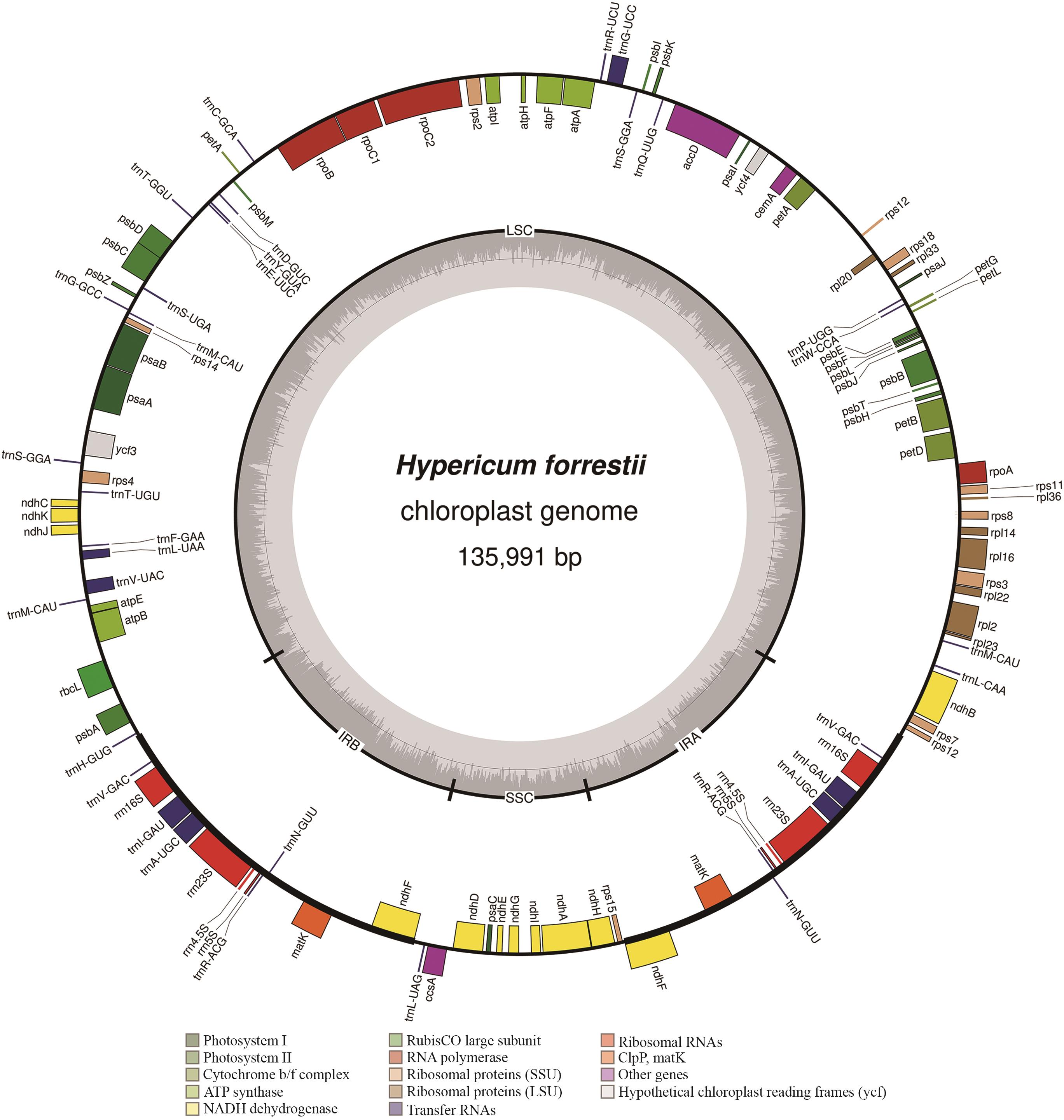
图1 川滇金丝桃叶绿体基因组图谱图中展示了4个基因组区域(大单拷贝区LSC、小单拷贝区SSC、反向重复区IRA和反向重复区IRB)。圆内的基因顺时针转录,圆外的基因逆时针转录。不同功能类别的基因用不同颜色标记。内圈显示GC含量(深灰色)和AT含量(浅灰色)
Fig. 1 Chloroplast genome map of Hypericum forrestiiThe figure shows four genomic regions: the Large Single-Copy region (LSC), the Small Single-Copy region (SSC), and the two Inverted Repeat regions (IRA and IRB). Genes located inside the circle are transcribed clockwise, while those outside are transcribed counter clockwise. Genes belonging to different functional categories are marked in different colors. The inner circle indicates the GC content (dark gray) and AT content (light gray)
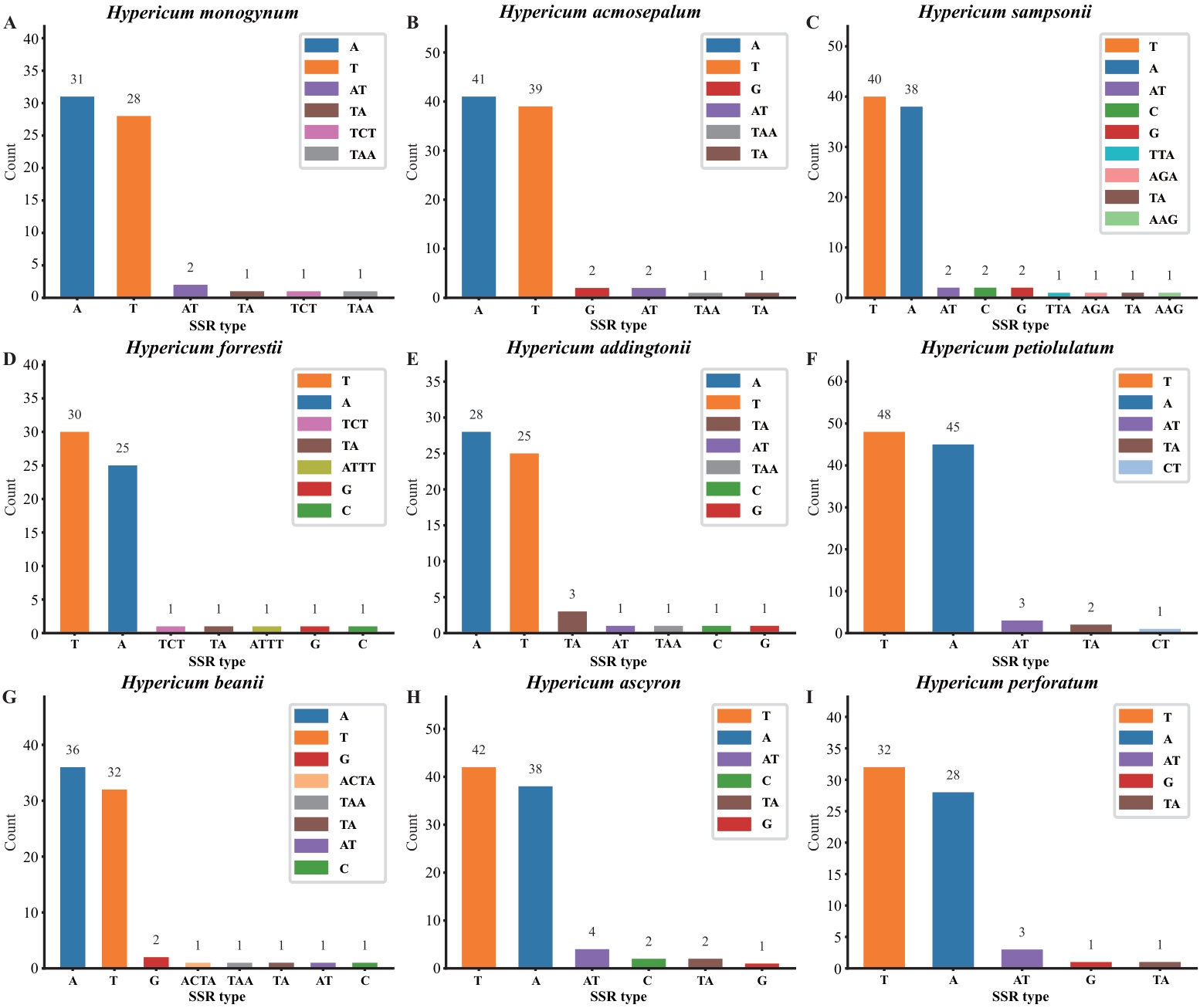
图2 9种金丝桃属植物叶绿体基因组的SSR位点分析A-I:在不同重复类型中识别出的SSR基序的频率
Fig. 2 Analysis of SSR loci in the chloroplast genomes of nine Hypericum speciesA-I: Frequency of SSR motifs identified in different repeat types
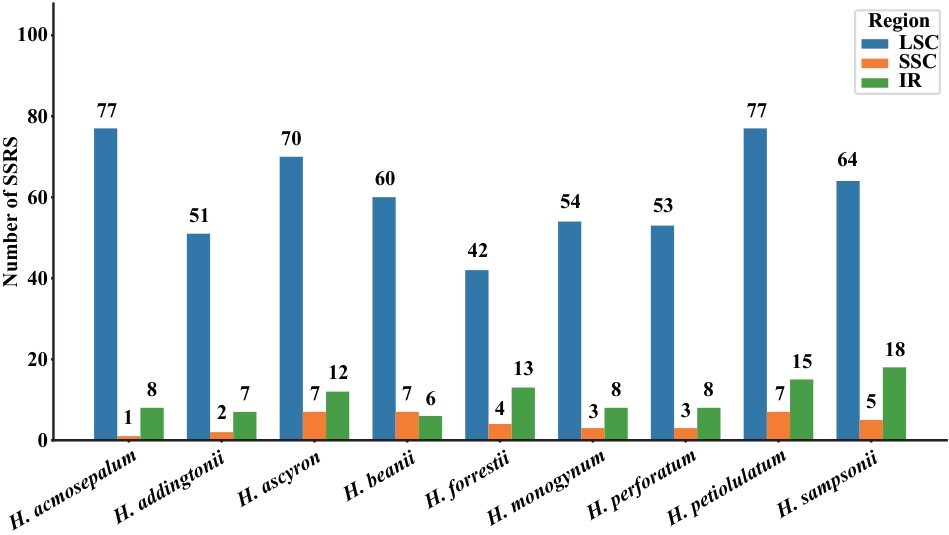
图3 SSR位点在LSC、SSC和IR区域内的重复类型频率
Fig. 3 Frequency of SSR repeat types in the LSC, SSC, and IR regions
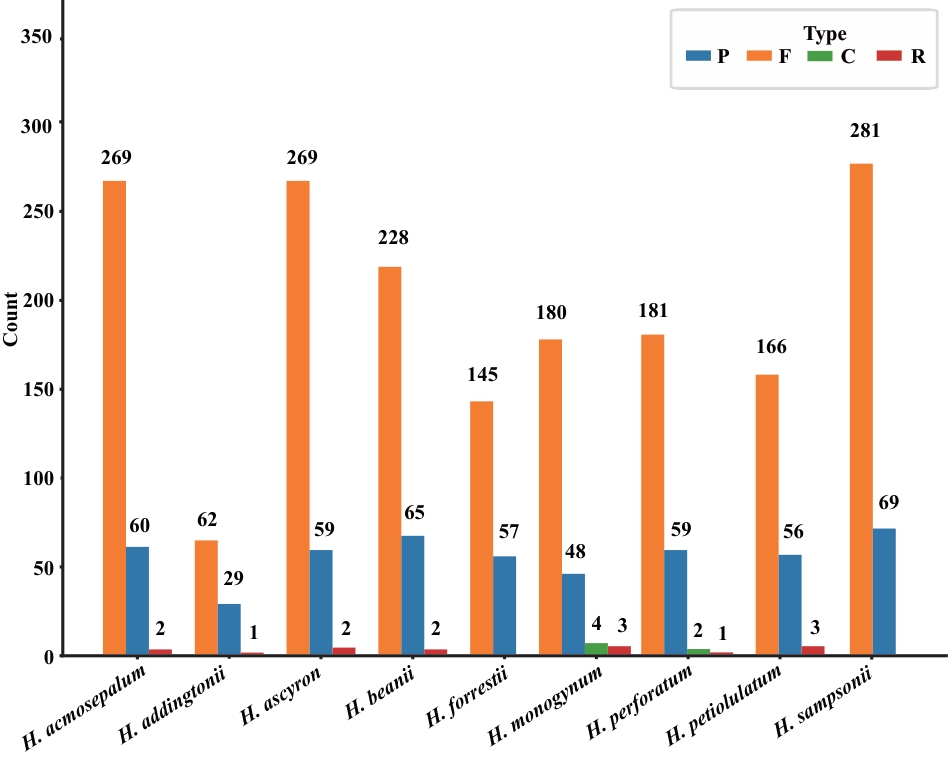
图4 9种金丝桃属植物的长重复序列数和类型图中蓝色条状P代表回文重复序列,橙色条状F代表正重复序列,绿色条状C代表互补重复序列,红色条状R代表反向重复序列
Fig. 4 Number and types of long repeat sequences in nine Hypericum speciesThe blue bars labeled P represent palindromic repeats, the orange bars labeled F represent forward repeats, the green bars labeled C represent complementary repeats, and the red bars labeled R represent reverse repeats
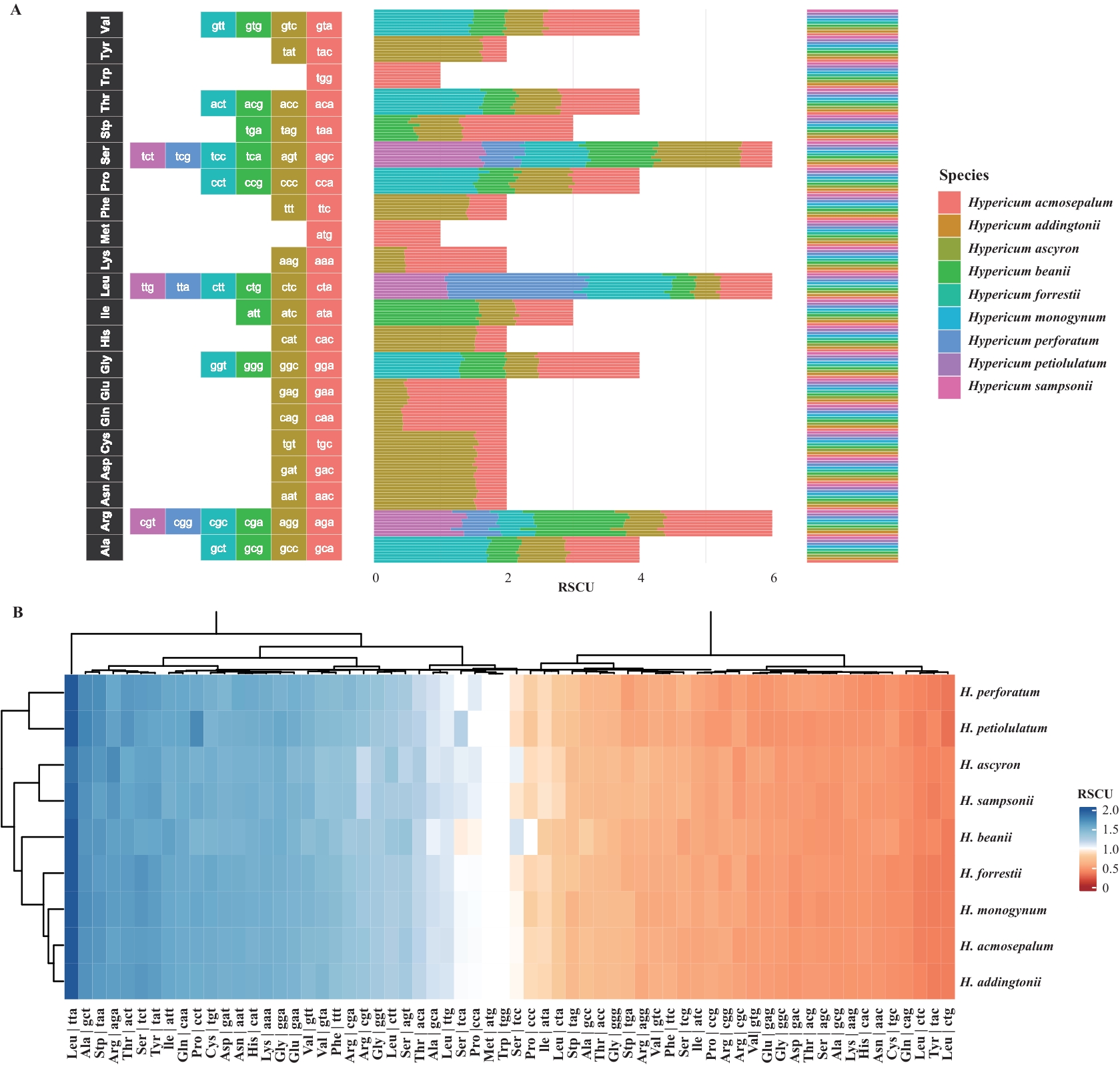
图5 金丝桃属植物的相对同义密码子使用度(RSCU)A:9种金丝桃属植物不同密码子RSCU柱状图;B:9种金丝桃属植物RSCU值的热图
Fig. 5 Relative synonymous codon usage (RSCU) in Hypericum speciesA: Bar chart of RSCU for different codons across nine Hypericum species. B: Heatmap of RSCU values for nine Hypericum species
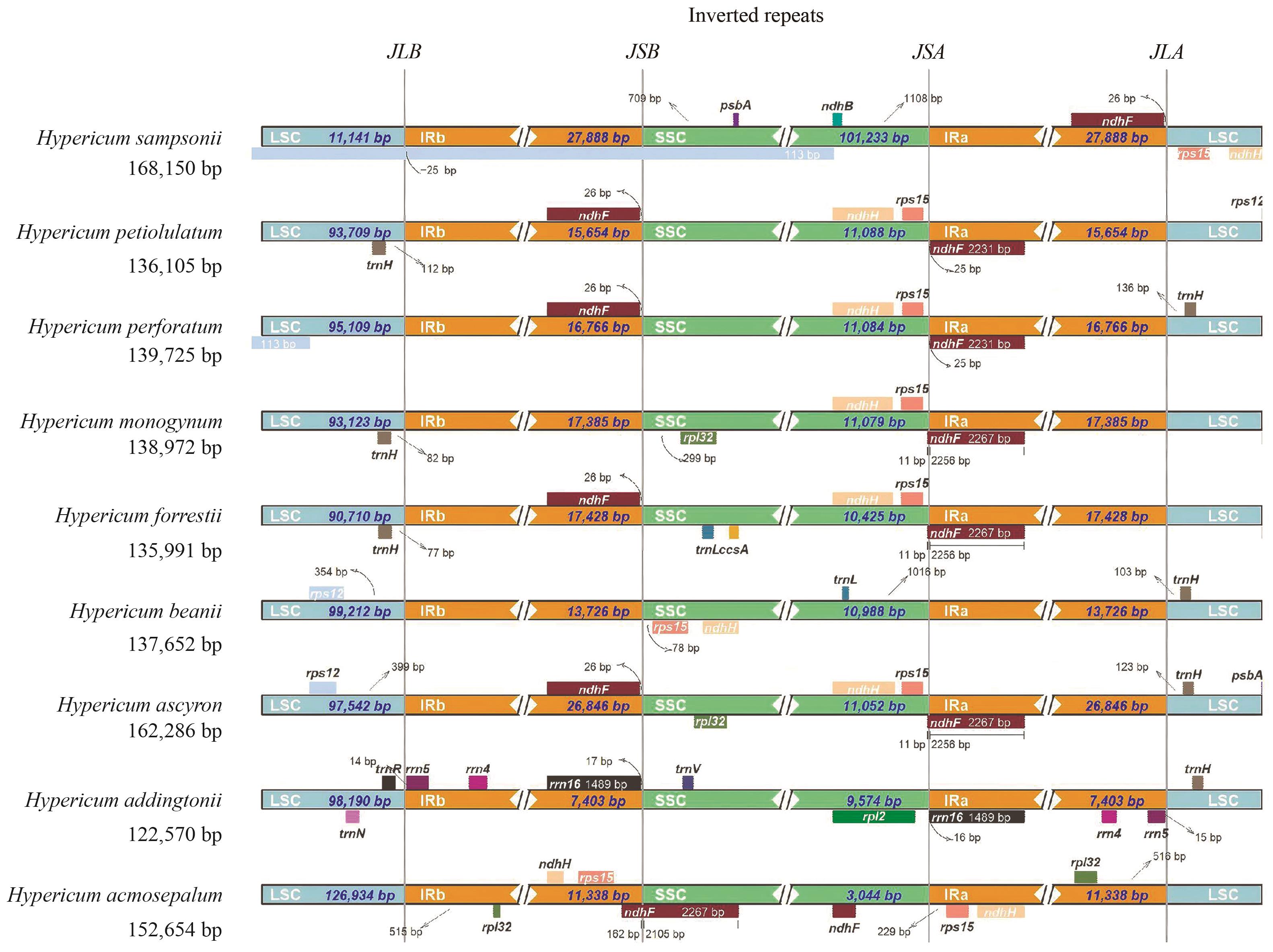
图6 9种金丝桃属叶绿体基因组中LSC、SSC和IR区域边界的比较
Fig. 6 Comparison of the boundaries of LSC, SSC, and IR regions in the chloroplast genomes of nine Hypericum species
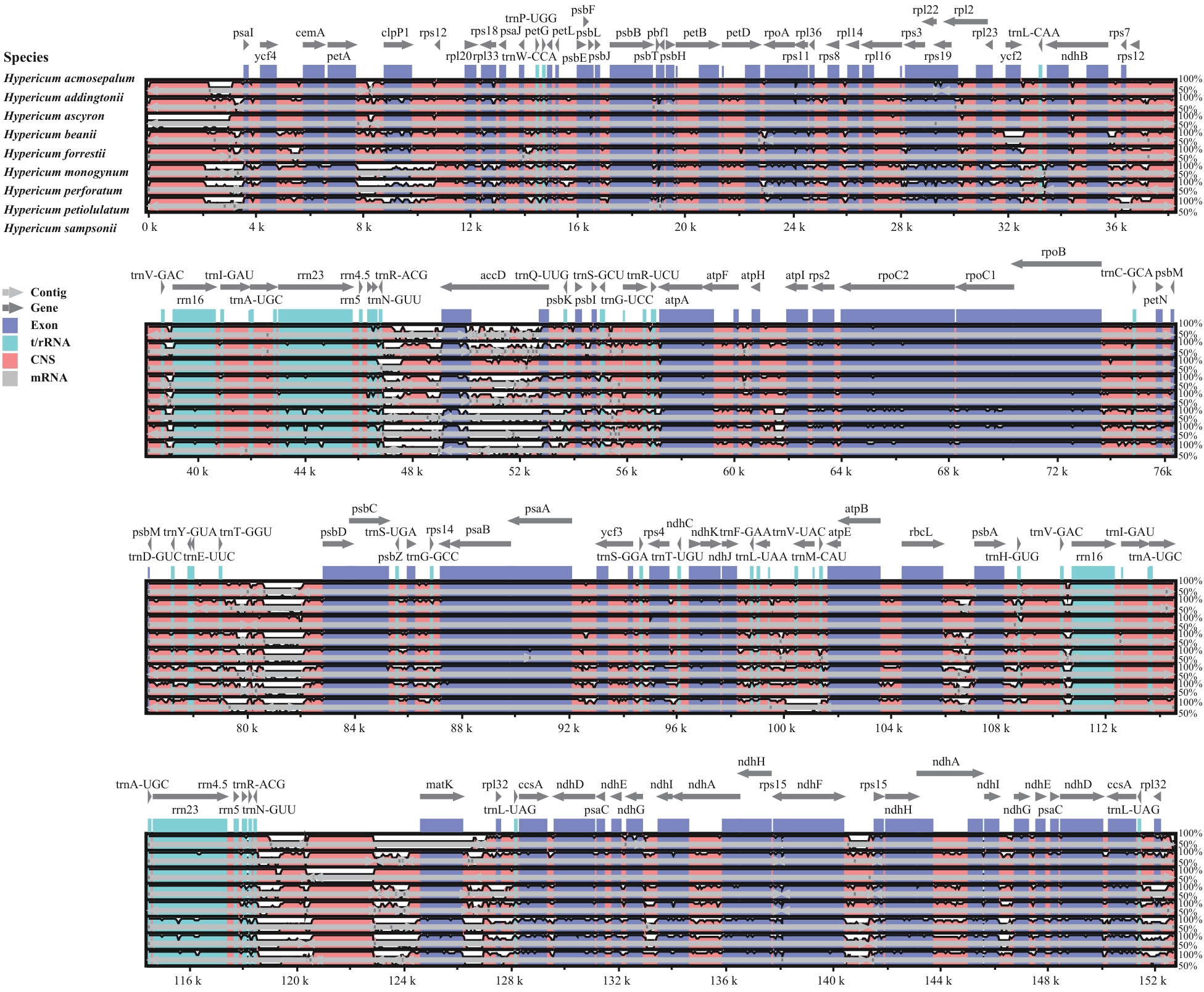
图7 9种金丝桃属叶绿体基因组序列特征比较图谱x轴代表核苷酸序列,y轴代表序列同源性百分比,范围50%-100%。曲线下方突出显示了保守区域,红色区域为“保守非编码序列”(CNS),深蓝色区域为外显子,浅蓝色区域为tRNA或rRNA
Fig. 7 Comparative map of sequence features of the chloroplast genomes of nine Hypericum speciesThe x-axis represents the nucleotide sequence, and the y-axis represents the sequence homology percentage, ranging from 50% to 100%. Conserved regions are highlighted below the curve, with red indicating “Conserved Noncoding Sequences” (CNS), dark blue indicating exons, and light blue indicating tRNA or rRNA
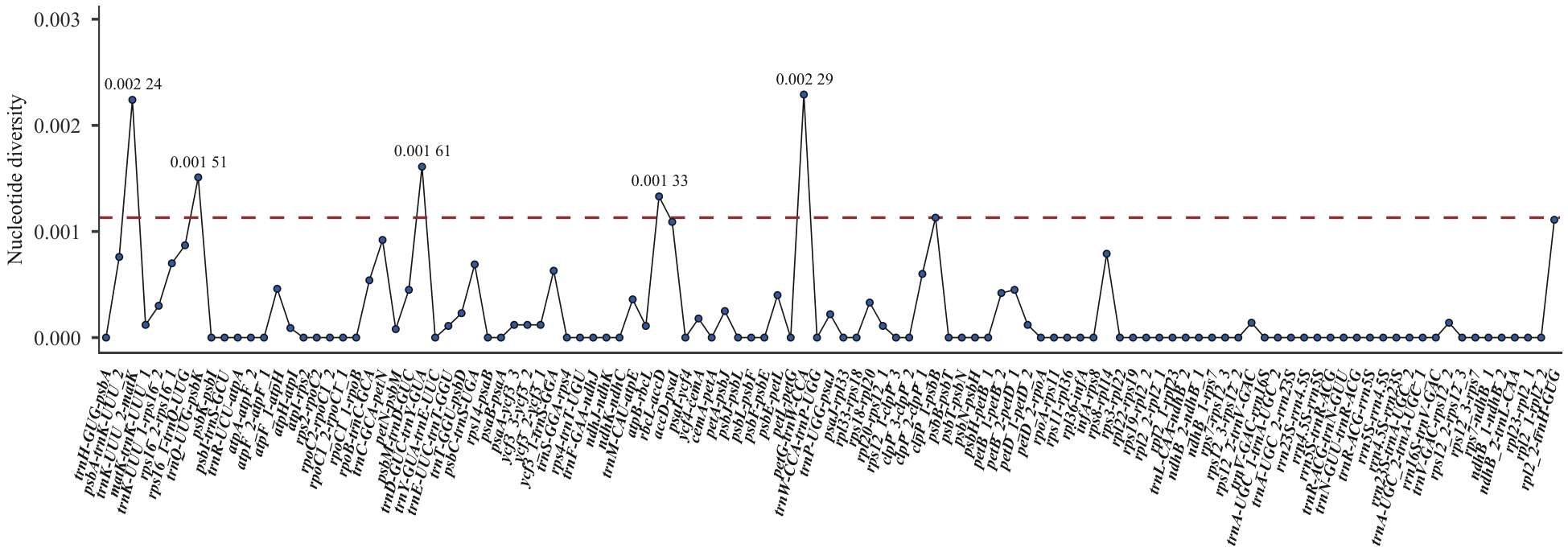
图8 9种金丝桃属植物的全叶绿体基因组滑动窗口分析x轴:窗口中点的位置;y轴:每个窗口的核苷酸多样性;红色虚线代表9种植物叶绿体基因组的平均核苷酸多样性水平
Fig. 8 Sliding window analysis of the complete chloroplast genomes of nine Hypericum speciesx-axis: midpoint position of each window; y-axis: nucleotide diversity of each window. The red dashed line represents the average nucleotide diversity across the complete chloroplast genomes of the nine Hypericum species
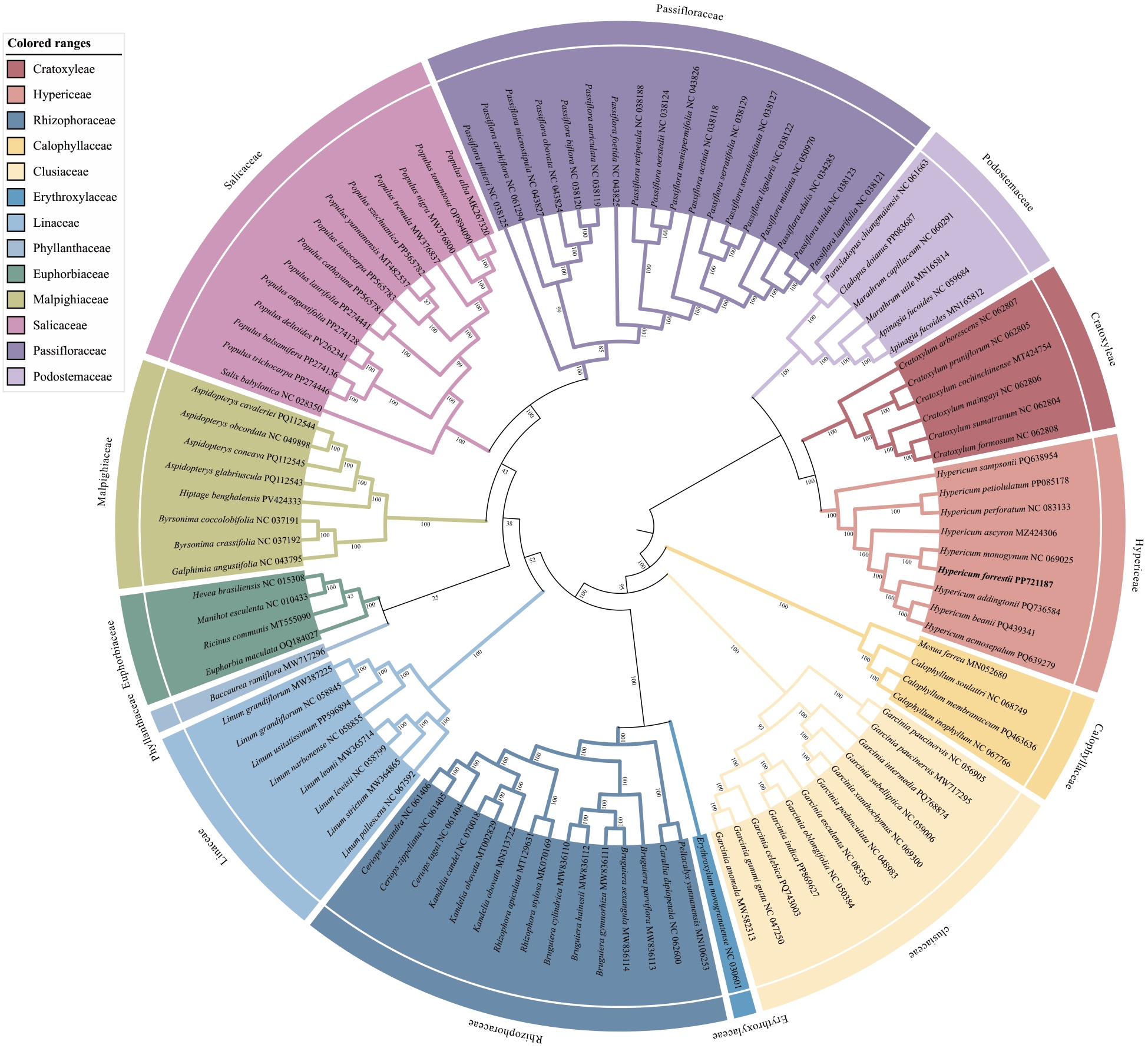
图9 基于最大似然法(ML)构建的金虎尾目植物叶绿体基因组系统发育树
Fig. 9 Maximum likelihood phylogenetic tree of Malpighiales based on chloroplast genomes
| [1] | Kladar N, Božin B, Bijelić K, et al. Biological activity of genus Hypericum Sect. Hypericum species——H. Tetrapterum, H. maculatum subsp. immaculatum, H. triquetrifolium [J]. Molecules, 2023, 28(17): 6218. |
| [2] | Apaydin EA, Maher AR, Shanman R, et al. A systematic review of St. John’s wort for major depressive disorder [J]. Syst Rev, 2016, 5: 148. |
| [3] | Barnes J, Anderson LA, Phillipson JD. St John’s wort (Hypericum perforatum L.): a review of its chemistry, pharmacology and clinical properties [J]. J Pharm Pharmacol, 2001, 53(5): 583-600. |
| [4] | Yan K, Lu X, Li WD, et al. Chloroplast genome diversity and molecular evolution in Hypericaceae: new insights from three Hypericum species [J]. Int J Mol Sci, 2025, 26(1): 323. |
| [5] | Khade YP, Mainkar P, Chandanshive A, et al. Harnessing chloroplast SSRs to decipher genetic diversity in underutilized Allium species [J]. Front Plant Sci, 2025, 16: 1645145. |
| [6] | Plunkett GM, Downie SR. Expansion and contraction of the chloroplast inverted repeat in Apiaceae subfamily apioideae [J]. Syst Bot, 2000, 25(4): 648. |
| [7] | Dong WP, Liu J, Yu J, et al. Highly variable chloroplast markers for evaluating plant phylogeny at low taxonomic levels and for DNA barcoding [J]. PLoS One, 2012, 7(4): e35071. |
| [8] | Cai LM, Xi ZX, Lemmon EM, et al. The perfect storm: gene tree estimation error, incomplete lineage sorting, and ancient gene flow explain the most recalcitrant ancient angiosperm clade, malpighiales [J]. Syst Biol, 2021, 70(3): 491-507. |
| [9] | Tokuoka T, Tobe H. Phylogenetic analyses of Malpighiales using plastid and nuclear DNA sequences, with particular reference to the embryology of Euphorbiaceae Sens. str [J]. J Plant Res, 2006, 119(6): 599-616. |
| [10] | Pahlich E, Gerlitz C. A rapid DNA isolation procedure for small quantities of fresh leaf tissue [J]. Phytochemistry, 1980, 19: 11-13. |
| [11] | Bolger AM, Lohse M, Usadel B. Trimmomatic: a flexible trimmer for Illumina sequence data [J]. Bioinformatics, 2014, 30(15): 2114-2120. |
| [12] | Bankevich A, Gurevich AA, Dvorkin M, et al. SPAdes: a new genome assembly algorithm and its applications to single-cell sequencing [J]. J Comput Biol, 2012, 19(5): 455-477. |
| [13] | Shi LC, Chen HM, Jiang M, et al. CPGAVAS2, an integrated plastome sequence annotator and analyzer [J]. Nucleic Acids Res, 2019, 47(W1): W65-W73. |
| [14] | Kearse M, Moir R, Wilson A, et al. Geneious Basic: an integrated and extendable desktop software platform for the organization and analysis of sequence data [J]. Bioinformatics, 2012, 28(12): 1647-1649. |
| [15] | Lohse M, Drechsel O, Kahlau S, et al. OrganellarGenomeDRAW—a suite of tools for generating physical maps of plastid and mitochondrial genomes and visualizing expression data sets [J]. Nucleic Acids Res, 2013, 41(W1): W575-W581. |
| [16] | Beier S, Thiel T, Münch T, et al. MISA-web: a web server for microsatellite prediction [J]. Bioinformatics, 2017, 33(16): 2583-2585. |
| [17] | Kurtz S. REPuter: the manifold applications of repeat analysis on a genomic scale [J]. Nucleic Acids Res, 2001, 29(22): 4633-4642. |
| [18] | Huang LJ, Yu HX, Wang Z, et al. CPStools: a package for analyzing chloroplast genome sequences [J]. iMetaOmics, 2024, 1(2): e25. |
| [19] | Maździarz M, Zając S, Paukszto Ł, et al. RSCUcaller: an R package for analyzing differences in relative synonymous codon usage (RSCU) [J]. BMC Bioinform, 2025, 26: 141. |
| [20] | Amiryousefi A, Hyvönen J, Poczai P. IRscope: an online program to visualize the junction sites of chloroplast genomes [J]. Bioinformatics, 2018, 34(17): 3030-3031. |
| [21] | Frazer KA, Pachter L, Poliakov A, et al. VISTA: computational tools for comparative genomics [J]. Nucleic Acids Res, 2004, 32: W273-W279. |
| [22] | Zhang D, Gao FL, Jakovlić I, et al. PhyloSuite: an integrated and scalable desktop platform for streamlined molecular sequence data management and evolutionary phylogenetics studies [J]. Mol Ecol Resour, 2020, 20(1): 348-355. |
| [23] | Katoh K, Standley DM. MAFFT multiple sequence alignment software version 7: improvements in performance and usability [J]. Mol Biol Evol, 2013, 30(4): 772-780. |
| [24] | Castresana J. Selection of conserved blocks from multiple alignments for their use in phylogenetic analysis [J]. Mol Biol Evol, 2000, 17(4): 540-552. |
| [25] | Nguyen LT, Schmidt HA, von Haeseler A, et al. IQ-TREE: a fast and effective stochastic algorithm for estimating maximum-likelihood phylogenies [J]. Mol Biol Evol, 2015, 32(1): 268-274. |
| [26] | Letunic I, Bork P. Interactive Tree of Life (iTOL) v6: recent updates to the phylogenetic tree display and annotation tool [J]. Nucleic Acids Res, 2024, 52(W1): W78-W82. |
| [27] | Rozas J, Ferrer-Mata A, Sánchez-DelBarrio JC, et al. DnaSP 6: DNA sequence polymorphism analysis of large data sets [J]. Mol Biol Evol, 2017, 34(12): 3299-3302. |
| [28] | Cauz-Santos LA. Beyond conservation: the landscape of chloroplast genome rearrangements in angiosperms [J]. New Phytol, 2025, 247(6): 2571-2580. |
| [29] | Fu N, Ji MY, Rouard M, et al. Comparative plastome analysis of Musaceae and new insights into phylogenetic relationships [J]. BMC Genom, 2022, 23: 223. |
| [30] | Shen LW, Chen SQ, Liang M, et al. Comparative analysis of codon usage bias in chloroplast genomes of ten medicinal species of Rutaceae [J]. BMC Plant Biol, 2024, 24(1): 424. |
| [31] | Dekhkonov D, Asatulloev T, Yusupov Z, et al. Comparative chloroplast genome and phylogenetic analysis of Central Asian tulips [J]. Nord J Bot, 2025, 2025(7): e04460. |
| [32] | Li JX, Du Y, Xie L, et al. Comparative plastome genomics and phylogenetic relationships of the genus Trollius [J]. Front Plant Sci, 2023, 14: 1293091. |
| [33] | Meena RK, Negi N, Uniyal N, et al. Chloroplast-based DNA barcode analysis indicates high discriminatory potential of matK locus in Himalayan temperate bamboos [J]. 3 Biotech, 2020, 10(12): 534. |
| [34] | Fan YJ, Li CG, Ma C, et al. Holistic approach for plant species circumscription integrating standard barcodes, chloroplast genomes, single-copy nuclear genes and micro-morphological data: a case study in Epimedium (Berberidaceae) [J]. BMC Genom, 2025, 26: 931. |
| [35] | Andermann T, Torres Jiménez MF, Matos-Maraví P, et al. A guide to carrying out a phylogenomic target sequence capture project [J]. Front Genet, 2020, 10: 1407. |
| [36] | Trevisan B, Alcantara DMC, Machado DJ, et al. Genome skimming is a low-cost and robust strategy to assemble complete mitochondrial genomes from ethanol preserved specimens in biodiversity studies [J]. PeerJ, 2019, 7: e7543. |
| [37] | Antil S, Abraham JS, Sripoorna S, et al. DNA barcoding, an effective tool for species identification: a review [J]. Mol Biol Rep, 2023, 50(1): 761-775. |
| [38] | Wang WW, Schalamun M, Morales-Suarez A, et al. Assembly of chloroplast genomes with long- and short-read data: a comparison of approaches using Eucalyptus pauciflora as a test case [J]. BMC Genom, 2018, 19: 977. |
| [39] | Wu H, Li DZ, Ma PF. Unprecedented variation pattern of plastid genomes and the potential role in adaptive evolution in Poales [J]. BMC Biol, 2024, 22: 97. |
| [1] | 刘柔知, 吴嘉琦, 吴辉烨, 袁婧怡, 程堂仁, 张启翔, 袁存权. 三种不同栽培类型菊花品种的叶绿体基因组特征对比分析[J]. 生物技术通报, 2026, 42(8): 239-250. |
| [2] | 汪志, 胡光明, 罗轩, 高磊, 叶丽霞, 黄穷, 肖涛, 张蕾. 革叶猕猴桃叶绿体基因组特征及系统发育分析[J]. 生物技术通报, 2026, 42(8): 173-187. |
| [3] | 梁慧琪, 陈益存, 汪阳东, 赵耘霄, 高暝. 山苍子PAT1基因亚家族鉴定及其在嫁接愈合过程中的表达分析[J]. 生物技术通报, 2026, 42(5): 302-311. |
| [4] | 魏瑶, 张晶晶, 崔云晓, 刘钰, 刘海瑞. 忍冬属忍冬组植物叶绿体基因组进化分析[J]. 生物技术通报, 2025, 41(8): 276-288. |
| [5] | 安昌, 徐文波, 陆琳, 李登麟, 姚艺新, 林彦翔, 杨成梓, 秦源, 郑平. 不同产地珊瑚菜叶绿体基因组特征的差异性研究[J]. 生物技术通报, 2025, 41(6): 229-242. |
| [6] | 李斌, 苏香萍, 刘畅, 王玉兵, 张勇洪, 周超, 徐青. 玄参科植物叶绿体基因组特征及系统发育分析[J]. 生物技术通报, 2025, 41(3): 240-254. |
| [7] | 杨晨欣, 李梦秀, 姜唐, 张文娥, 潘学军. 美人蕉R2R3-MYB基因家族的鉴定及与花青素相关成员的表达分析[J]. 生物技术通报, 2025, 41(12): 201-213. |
| [8] | 苗昊翔, 张颖, 郭世鹏, 张健. 一株高产γ-氨基丁酸短乳杆菌TCCC13007全基因组测序及比较基因组分析[J]. 生物技术通报, 2025, 41(11): 166-176. |
| [9] | 胡衍铵, 代鑫吕, 钟娇艳, 李瑞民, 黄桂艳. 基于比较基因组学的柑橘耐黄龙病关键基因鉴定与功能解析[J]. 生物技术通报, 2025, 41(11): 282-292. |
| [10] | 秦文俊, 熊言杰, 赵冉, 马萧然, 叶霄萌, 宋江华. 甘蓝ARF基因家族的鉴定及其在非生物胁迫下的表达分析[J]. 生物技术通报, 2025, 41(10): 253-263. |
| [11] | 杨雨青, 谭娟, 汪芳, 彭顺利, 陈婕, 谭明燕, 吕美艳, 周富裕, 刘声传. 茶树叶绿体基因组的研究与应用进展[J]. 生物技术通报, 2024, 40(2): 20-30. |
| [12] | 尹明华, 余锾媛, 肖心怡, 王玉婷. 江西铅山红芽芋叶绿体基因组特征及系统发育分析[J]. 生物技术通报, 2023, 39(6): 233-247. |
| [13] | 刘雄伟, 刘畅, 曾宪法, 杨小英, 俸婷婷, 赵杰宏, 周英. 朱砂根叶绿体全基因组解析及系统发育分析[J]. 生物技术通报, 2023, 39(1): 232-242. |
| [14] | 钱方, 高作敏, 胡利娟, 王洪程. 海甘蓝(Crambe abyssinica)叶绿体基因组特征及其系统发育研究[J]. 生物技术通报, 2022, 38(6): 174-186. |
| [15] | 张泽颖, 范清锋, 邓云峰, 韦廷舟, 周正富, 周建, 王劲, 江世杰. 一株高产脂肪酶菌株WCO-9全基因组测序及比较基因组分析[J]. 生物技术通报, 2022, 38(10): 216-225. |
| 阅读次数 | ||||||
|
全文 |
|
|||||
|
摘要 |
|
|||||
