







生物技术通报 ›› 2026, Vol. 42 ›› Issue (11): 283-296.doi: 10.13560/j.cnki.biotech.bull.1985.2026-0567
• 研究报告 • 上一篇
桂元1, 杨婷妃1, 王风青1, 刘军2, 刘根侨1, 李仲玄1, 廖钰婷1, 王川1, 李丽1( ), 周正富3()
收稿日期:2026-05-19
出版日期:2026-11-26
发布日期:2026-11-03
通讯作者:
李丽li_li821008@163.com作者简介:第一联系人:同等贡献
基金资助:
GUI Yuan1, YANG Ting-fei1, WANG Feng-qing1, LIU Jun2, LIU Gen-qiao1, LI Zhong-xuan1, LIAO Yu-ting1, WANG Chuan1, LI Li1(), ZHOU Zheng-fu3()
Received:2026-05-19
Published:2026-11-26
Online:2026-11-03
摘要:
目的 研究产朊假丝酵母与酿酒酵母双菌固态发酵白酒糟制备单细胞蛋白(single-cell protein, SCP)的工艺条件,基于代谢组学分析发酵产物的代谢物谱变化,及其与蛋白品质、风味特性、安全性的关联。 方法 以浓香型白酒糟为底物,采用单因素与Box-Behnken试验设计优化发酵工艺,利用代谢组学分析双菌发酵与空白原料中挥发性及非挥发性代谢物差异,并结合营养成分测定、体外消化试验及霉菌毒素检测进行系统品质评价。 结果 最优发酵工艺为麸皮15%、温度30 ℃、接种量15%、水分58%、pH 5.5和发酵时间3 d,发酵后酸溶蛋白(acid-soluble protein, ASP)明显提升35.03%,粗蛋白(crude protein, CP)和真蛋白(true protein, TP)分别提升16.64%、29.32%。代谢组学共鉴定出9类92种挥发性风味物质,其中酯类含量大幅增加,已醛等不良风味物质显著下降;差异代谢物共筛选出296个,其中脂类及萜类衍生物显著上调,芳香族等氨基酸类及蒽醌类显著下调;KEGG富集显示谷氨酸等氨基酸生物合成、2-氧代羧酸代谢等4条通路被激活。体外消化率显著提升,霉菌毒素未检出,符合国标饲料卫生标准。 结论 产朊假丝酵母与酿酒酵母双菌固态发酵白酒糟的工艺能显著改善蛋白品质与风味特性,为白酒糟高值化利用提供了基于代谢组学的数据支撑与品质评价新视角。
桂元, 杨婷妃, 王风青, 刘军, 刘根侨, 李仲玄, 廖钰婷, 王川, 李丽, 周正富. 基于代谢组学解析白酒糟双菌发酵单细胞蛋白的原料品质[J]. 生物技术通报, 2026, 42(11): 283-296.
GUI Yuan, YANG Ting-fei, WANG Feng-qing, LIU Jun, LIU Gen-qiao, LI Zhong-xuan, LIAO Yu-ting, WANG Chuan, LI Li, ZHOU Zheng-fu. Raw Material Quality Analysis of Single‑cell Protein Production from Baijiu Distiller’s Grains via Dual‑strain Fermentation Based on Metabolomics[J]. Biotechnology Bulletin, 2026, 42(11): 283-296.
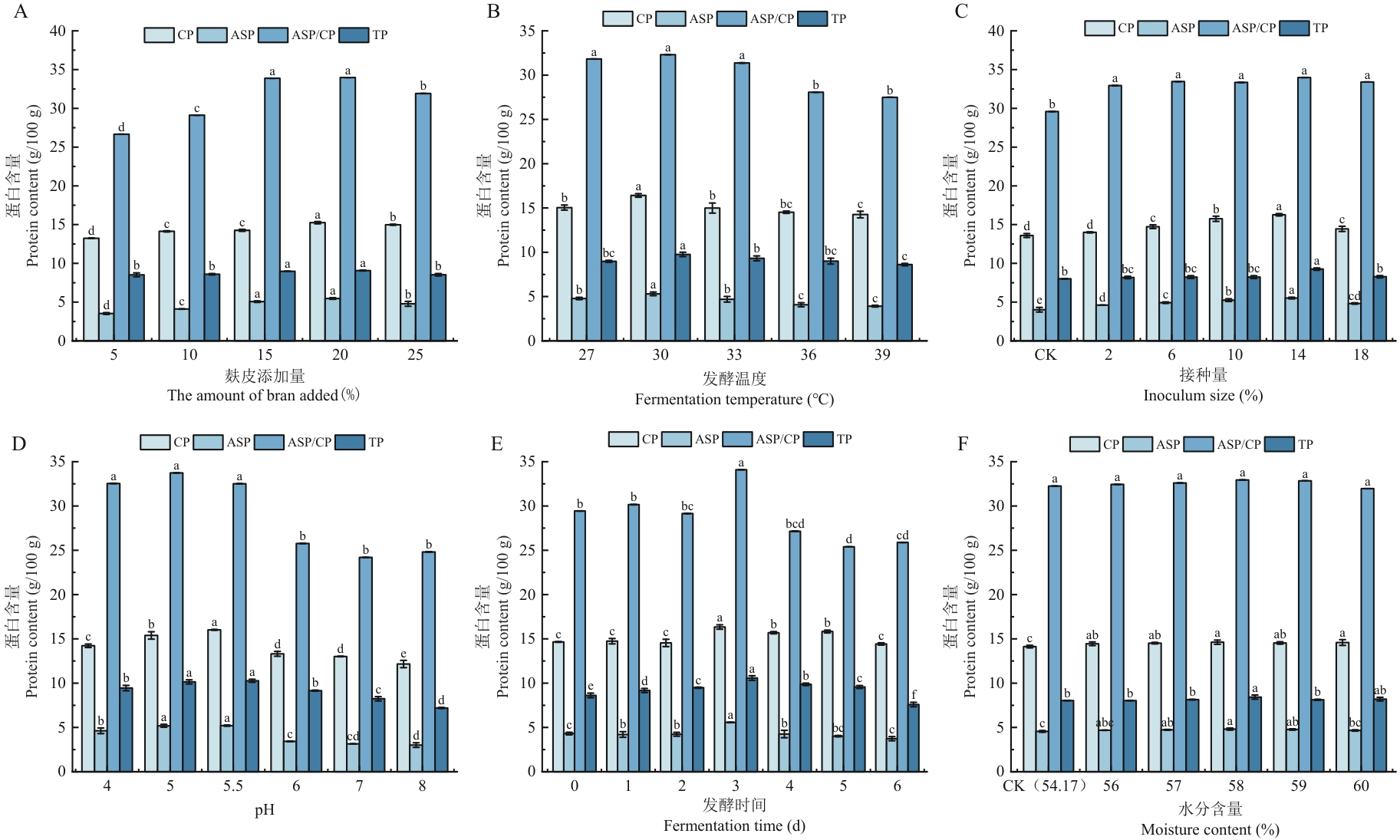
图1 不同因素对酒糟固态发酵蛋白含量的影响A:麸皮添加量;B:发酵温度;C:接种量;D:初始pH;E:发酵时间;F:水分含量。CP:粗蛋白;ASP:酸溶蛋白;TP:真蛋白。不同小写字母表示差异显著(P<0.05),下同
Fig. 1 Effect of different factors on the protein content in solid-state fermentation of distiller's grainsA: Addition amount of wheat bran. B: Fermentation temperature. C: Inoculation amount. D: Initial pH. E: Fermentation time. F: Moisture content. CP: Crude protein; ASP: acid soluble protein; TP: true protein. Different lowercase letters indicate significant difference (P<0.05). The same below
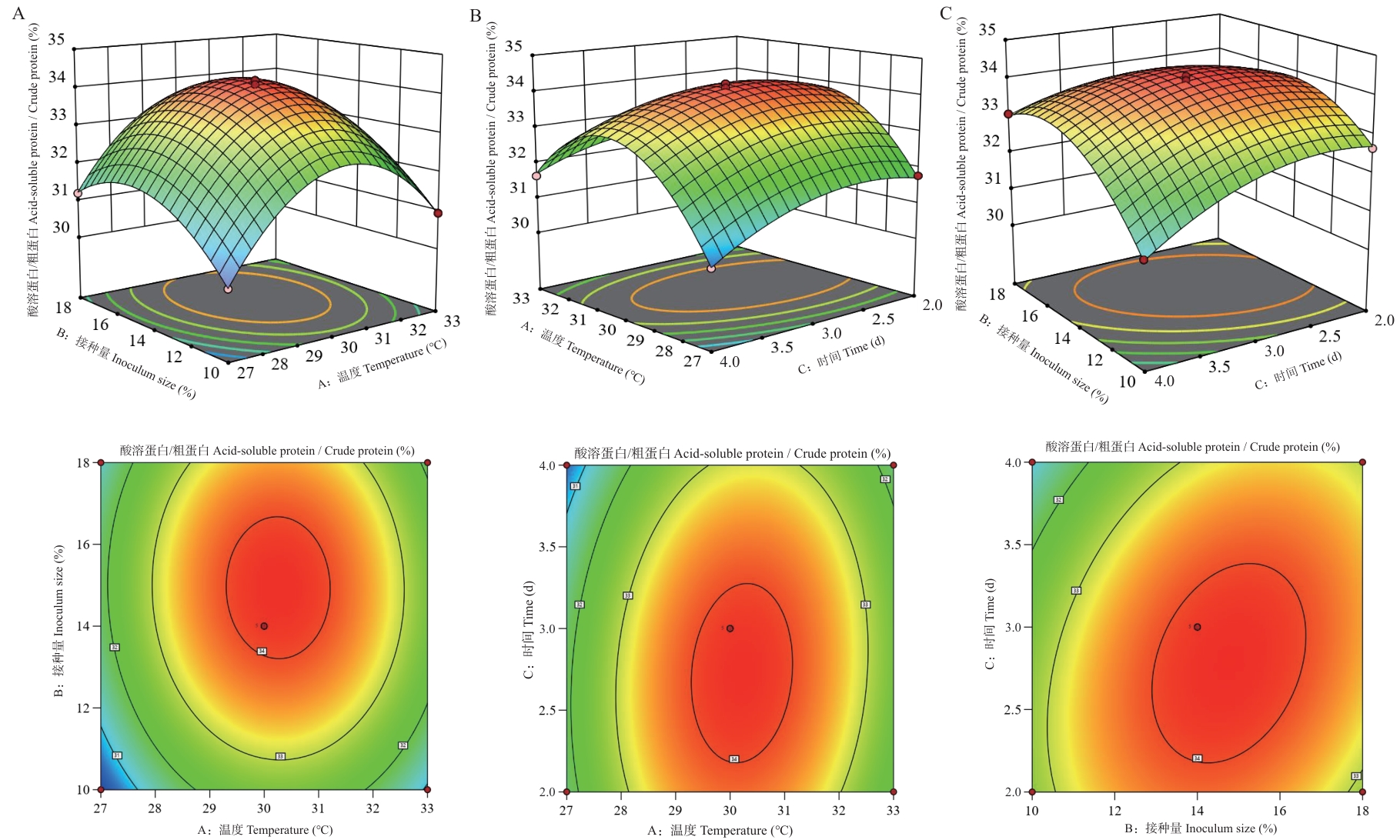
图2 各因素交互作用对ASP/CP含量的影响
Fig. 2 Effect of interaction among various factors on ASP/CP content
水平 Level | 发酵温度(A) Fermentation temperature (℃) | 接种量(B) Inoculation amount(%) | 发酵时间(C) Fermentation time (d) |
|---|---|---|---|
| -1 | 27 | 10 | 2 |
| 0 | 30 | 14 | 3 |
| 1 | 33 | 18 | 4 |
表1 响应面试验因素水平
Table 1 Factors and levels of response surface experiments
水平 Level | 发酵温度(A) Fermentation temperature (℃) | 接种量(B) Inoculation amount(%) | 发酵时间(C) Fermentation time (d) |
|---|---|---|---|
| -1 | 27 | 10 | 2 |
| 0 | 30 | 14 | 3 |
| 1 | 33 | 18 | 4 |
试验编号 Test number | 发酵温度(A) Fermentation temperature (℃) | 接种量(B) Inoculation amount (%) | 发酵时间(C) Fermentation time (d) | 酸溶蛋白/粗蛋白 ASP/CP (%) | 真蛋白 TP (g/100 g) |
|---|---|---|---|---|---|
| 1 | 27 | 10 | 3 | 30.09 | 10.70 |
| 2 | 33 | 10 | 3 | 30.93 | 9.81 |
| 3 | 27 | 18 | 3 | 31.19 | 10.55 |
| 4 | 33 | 18 | 3 | 31.86 | 9.90 |
| 5 | 27 | 14 | 2 | 31.77 | 10.59 |
| 6 | 33 | 14 | 2 | 31.97 | 9.22 |
| 7 | 27 | 14 | 4 | 30.47 | 10.00 |
| 8 | 33 | 14 | 4 | 31.62 | 9.32 |
| 9 | 30 | 10 | 2 | 32.65 | 10.58 |
| 10 | 30 | 18 | 2 | 32.79 | 10.61 |
| 11 | 30 | 10 | 4 | 31.09 | 10.40 |
| 12 | 30 | 18 | 4 | 33.05 | 10.06 |
| 13 | 30 | 14 | 3 | 33.95 | 11.06 |
| 14 | 30 | 14 | 3 | 34.26 | 11.20 |
| 15 | 30 | 14 | 3 | 34.27 | 10.98 |
| 16 | 30 | 14 | 3 | 34.02 | 11.00 |
| 17 | 30 | 14 | 3 | 34.16 | 11.05 |
表2 响应面试验结果
Table 2 Results of response surface methodology experiment
试验编号 Test number | 发酵温度(A) Fermentation temperature (℃) | 接种量(B) Inoculation amount (%) | 发酵时间(C) Fermentation time (d) | 酸溶蛋白/粗蛋白 ASP/CP (%) | 真蛋白 TP (g/100 g) |
|---|---|---|---|---|---|
| 1 | 27 | 10 | 3 | 30.09 | 10.70 |
| 2 | 33 | 10 | 3 | 30.93 | 9.81 |
| 3 | 27 | 18 | 3 | 31.19 | 10.55 |
| 4 | 33 | 18 | 3 | 31.86 | 9.90 |
| 5 | 27 | 14 | 2 | 31.77 | 10.59 |
| 6 | 33 | 14 | 2 | 31.97 | 9.22 |
| 7 | 27 | 14 | 4 | 30.47 | 10.00 |
| 8 | 33 | 14 | 4 | 31.62 | 9.32 |
| 9 | 30 | 10 | 2 | 32.65 | 10.58 |
| 10 | 30 | 18 | 2 | 32.79 | 10.61 |
| 11 | 30 | 10 | 4 | 31.09 | 10.40 |
| 12 | 30 | 18 | 4 | 33.05 | 10.06 |
| 13 | 30 | 14 | 3 | 33.95 | 11.06 |
| 14 | 30 | 14 | 3 | 34.26 | 11.20 |
| 15 | 30 | 14 | 3 | 34.27 | 10.98 |
| 16 | 30 | 14 | 3 | 34.02 | 11.00 |
| 17 | 30 | 14 | 3 | 34.16 | 11.05 |
方差来源 Variance source | 平方和 Sum of squares | 自由度 Degrees of freedom | 均方 Mean square | F值 F-value | P值 P-value | 显著性 Significance |
|---|---|---|---|---|---|---|
| 模型 | 31.42 | 9 | 3.49 | 245.78 | <0.000 1 | ** |
| A-温度 (℃) | 1.02 | 1 | 1.02 | 72.15 | <0.000 1 | ** |
| B-接种量 (%) | 2.13 | 1 | 2.13 | 149.62 | <0.000 1 | ** |
| C-时间 (d) | 1.10 | 1 | 1.10 | 77.12 | <0.000 1 | ** |
| AB | 0.007 9 | 1 | 0.007 9 | 0.553 1 | 0.481 3 | ns |
| AC | 0.228 2 | 1 | 0.228 2 | 16.07 | 0.005 1 | ** |
| BC | 0.832 6 | 1 | 0.832 6 | 58.62 | 0.000 1 | ** |
| A² | 17.24 | 1 | 17.24 | 1 213.61 | <0.000 1 | ** |
| B² | 4.98 | 1 | 4.98 | 350.89 | <0.000 1 | ** |
| C² | 1.76 | 1 | 1.76 | 123.91 | <0.000 1 | ** |
| 残差 | 0.099 4 | 7 | 0.014 2 | |||
| 失拟误差 | 0.017 8 | 3 | 0.005 9 | 0.290 7 | 0.831 0 | ns |
| 纯误差 | 0.081 6 | 4 | 0.020 4 | |||
| 总误差 | 31.52 | 16 | ||||
| R2:0.996 8, R2Adj:0.970 6, R2Pre:0.986 8 | ||||||
表3 ASP/CP的回归模型方差分析结果
Table 3 Results of variance analysis of the regression model of ASP/CP
方差来源 Variance source | 平方和 Sum of squares | 自由度 Degrees of freedom | 均方 Mean square | F值 F-value | P值 P-value | 显著性 Significance |
|---|---|---|---|---|---|---|
| 模型 | 31.42 | 9 | 3.49 | 245.78 | <0.000 1 | ** |
| A-温度 (℃) | 1.02 | 1 | 1.02 | 72.15 | <0.000 1 | ** |
| B-接种量 (%) | 2.13 | 1 | 2.13 | 149.62 | <0.000 1 | ** |
| C-时间 (d) | 1.10 | 1 | 1.10 | 77.12 | <0.000 1 | ** |
| AB | 0.007 9 | 1 | 0.007 9 | 0.553 1 | 0.481 3 | ns |
| AC | 0.228 2 | 1 | 0.228 2 | 16.07 | 0.005 1 | ** |
| BC | 0.832 6 | 1 | 0.832 6 | 58.62 | 0.000 1 | ** |
| A² | 17.24 | 1 | 17.24 | 1 213.61 | <0.000 1 | ** |
| B² | 4.98 | 1 | 4.98 | 350.89 | <0.000 1 | ** |
| C² | 1.76 | 1 | 1.76 | 123.91 | <0.000 1 | ** |
| 残差 | 0.099 4 | 7 | 0.014 2 | |||
| 失拟误差 | 0.017 8 | 3 | 0.005 9 | 0.290 7 | 0.831 0 | ns |
| 纯误差 | 0.081 6 | 4 | 0.020 4 | |||
| 总误差 | 31.52 | 16 | ||||
| R2:0.996 8, R2Adj:0.970 6, R2Pre:0.986 8 | ||||||
方差来源 Variance source | 平方和 Sum of squares | 自由度 Degrees of freedom | 均方 Mean square | F值 F-value | P值 P-value | 显著性 Significance |
|---|---|---|---|---|---|---|
| 模型 | 5.78 | 9 | 0.642 6 | 59.75 | <0.000 1 | ** |
| A-温度 (℃) | 1.61 | 1 | 1.61 | 150.13 | <0.000 1 | ** |
| B-接种量 (%) | 0.016 0 | 1 | 0.016 0 | 1.49 | 0.261 9 | ns |
| C-时间 (d) | 0.187 9 | 1 | 0.187 9 | 17.47 | 0.004 1 | ** |
| AB | 0.014 1 | 1 | 0.014 1 | 1.31 | 0.289 4 | ns |
| AC | 0.116 6 | 1 | 0.116 6 | 10.84 | 0.013 2 | * |
| BC | 0.033 3 | 1 | 0.033 3 | 3.10 | 0.121 7 | ns |
| A² | 2.21 | 1 | 2.21 | 205.59 | <0.000 1 | ** |
| B² | 0.036 9 | 1 | 0.036 9 | 3.43 | 0.106 4 | ns |
| C² | 1.29 | 1 | 1.29 | 119.70 | <0.000 1 | ** |
| 残差 | 0.075 3 | 7 | 0.010 8 | |||
| 失拟误差 | 0.047 0 | 3 | 0.015 7 | 2.22 | 0.228 4 | ns |
| 纯误差 | 0.028 3 | 4 | 0.007 1 | |||
| 总误差 | 5.86 | 16 | ||||
| R2:0.987 2, R2Adj:0.970 6, R2Pre:0.864 0 | ||||||
表4 TP含量的回归模型方差分析结果
Table 4 ANOVA results of the regression model for TP content
方差来源 Variance source | 平方和 Sum of squares | 自由度 Degrees of freedom | 均方 Mean square | F值 F-value | P值 P-value | 显著性 Significance |
|---|---|---|---|---|---|---|
| 模型 | 5.78 | 9 | 0.642 6 | 59.75 | <0.000 1 | ** |
| A-温度 (℃) | 1.61 | 1 | 1.61 | 150.13 | <0.000 1 | ** |
| B-接种量 (%) | 0.016 0 | 1 | 0.016 0 | 1.49 | 0.261 9 | ns |
| C-时间 (d) | 0.187 9 | 1 | 0.187 9 | 17.47 | 0.004 1 | ** |
| AB | 0.014 1 | 1 | 0.014 1 | 1.31 | 0.289 4 | ns |
| AC | 0.116 6 | 1 | 0.116 6 | 10.84 | 0.013 2 | * |
| BC | 0.033 3 | 1 | 0.033 3 | 3.10 | 0.121 7 | ns |
| A² | 2.21 | 1 | 2.21 | 205.59 | <0.000 1 | ** |
| B² | 0.036 9 | 1 | 0.036 9 | 3.43 | 0.106 4 | ns |
| C² | 1.29 | 1 | 1.29 | 119.70 | <0.000 1 | ** |
| 残差 | 0.075 3 | 7 | 0.010 8 | |||
| 失拟误差 | 0.047 0 | 3 | 0.015 7 | 2.22 | 0.228 4 | ns |
| 纯误差 | 0.028 3 | 4 | 0.007 1 | |||
| 总误差 | 5.86 | 16 | ||||
| R2:0.987 2, R2Adj:0.970 6, R2Pre:0.864 0 | ||||||
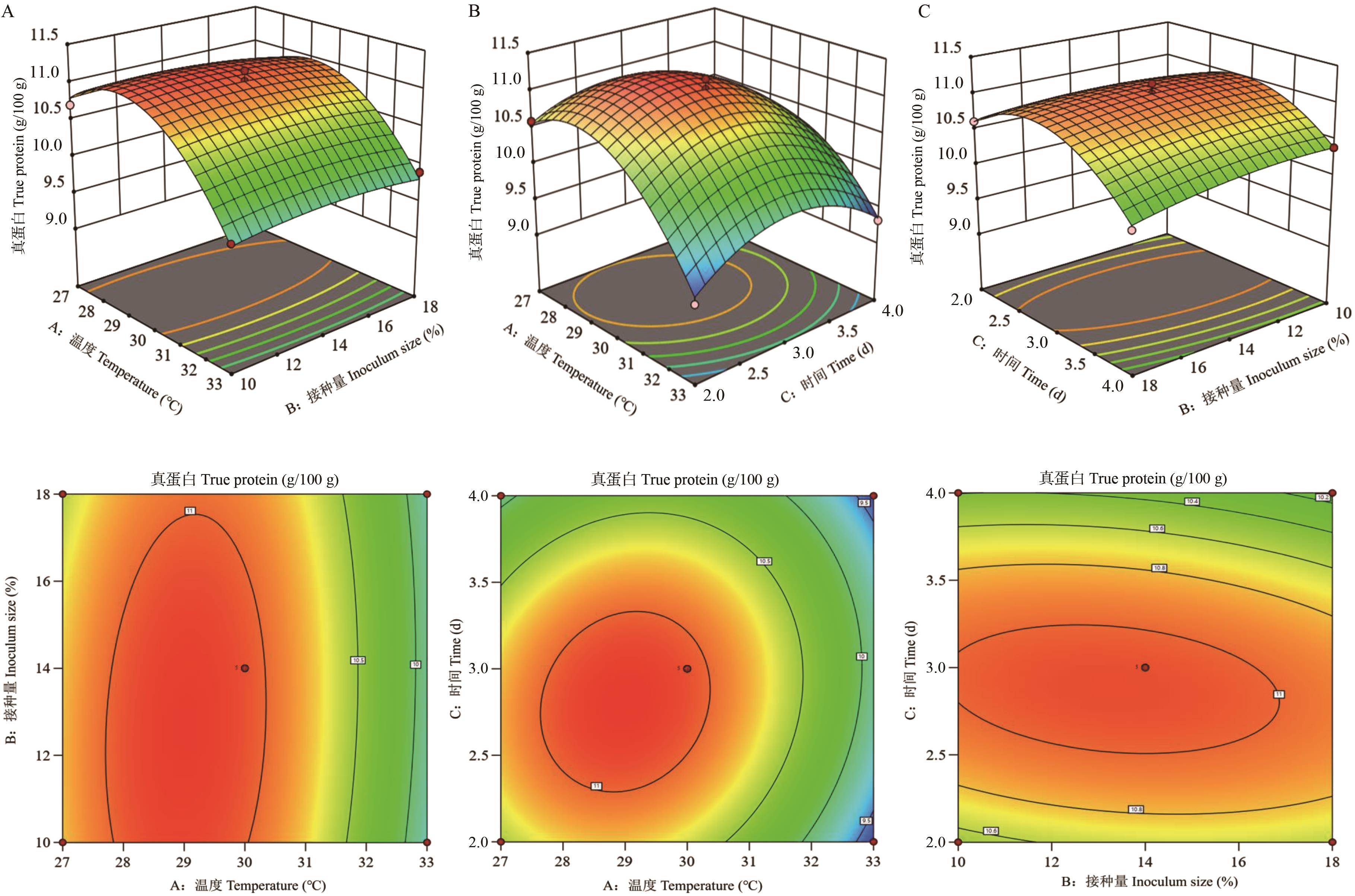
图3 各因素交互作用对TP含量的影响
Fig. 3 Effect of interaction among various factors on TP content
组别 Group | 粗蛋白 CP(g/100 g) | 酸溶蛋白 ASP(g/100 g) | 酸溶蛋白/粗蛋白 ASP/CP(%) | 真蛋白 TP(g/100 g) | 总酸 Total acid (g/kg) | 粗脂肪 Ether extract(%) | 含水量 Water content(%) |
|---|---|---|---|---|---|---|---|
| 空白原料 | 14.60±0.25a | 4.31±0.15a | 29.50±0.01a | 8.56±0.05a | 12.49±0.31a | 2.87±0.01a | 52.54±0.01a |
| 发酵酒糟 | 17.03±0.06b | 5.82±0.11b | 34.18±0.01b | 11.07±0.08b | 11.80±0.27b | 3.56±0.01a | 57.41±0.01b |
表5 酒糟发酵前后营养指标变化
Table 5 Changes in nutritional indicators of distiller's grains before and after fermentation
组别 Group | 粗蛋白 CP(g/100 g) | 酸溶蛋白 ASP(g/100 g) | 酸溶蛋白/粗蛋白 ASP/CP(%) | 真蛋白 TP(g/100 g) | 总酸 Total acid (g/kg) | 粗脂肪 Ether extract(%) | 含水量 Water content(%) |
|---|---|---|---|---|---|---|---|
| 空白原料 | 14.60±0.25a | 4.31±0.15a | 29.50±0.01a | 8.56±0.05a | 12.49±0.31a | 2.87±0.01a | 52.54±0.01a |
| 发酵酒糟 | 17.03±0.06b | 5.82±0.11b | 34.18±0.01b | 11.07±0.08b | 11.80±0.27b | 3.56±0.01a | 57.41±0.01b |
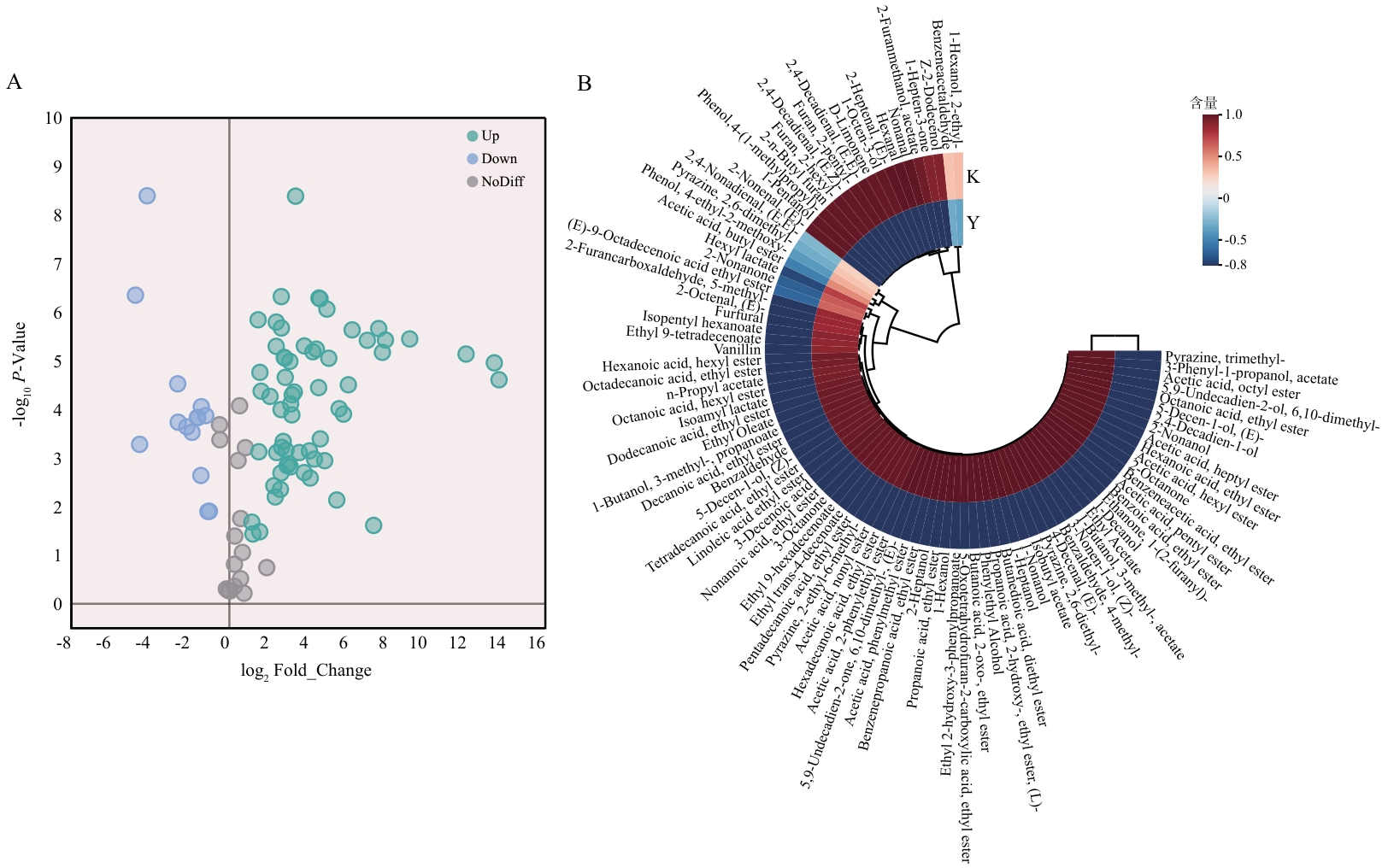
图4 空白原料和发酵酒糟的差异风味物质筛选火山图(A)与环形层次聚类热图(B)K:空白原料;Y:发酵酒槽。下同
Fig. 4 Volcanic map (A) and circular hierarchical clustering heat map (B) for screening differential flavor substances between blank raw materials and fermented distiller's grainsK: Blank raw materials; Y: fermented distiller’s grains. The same below
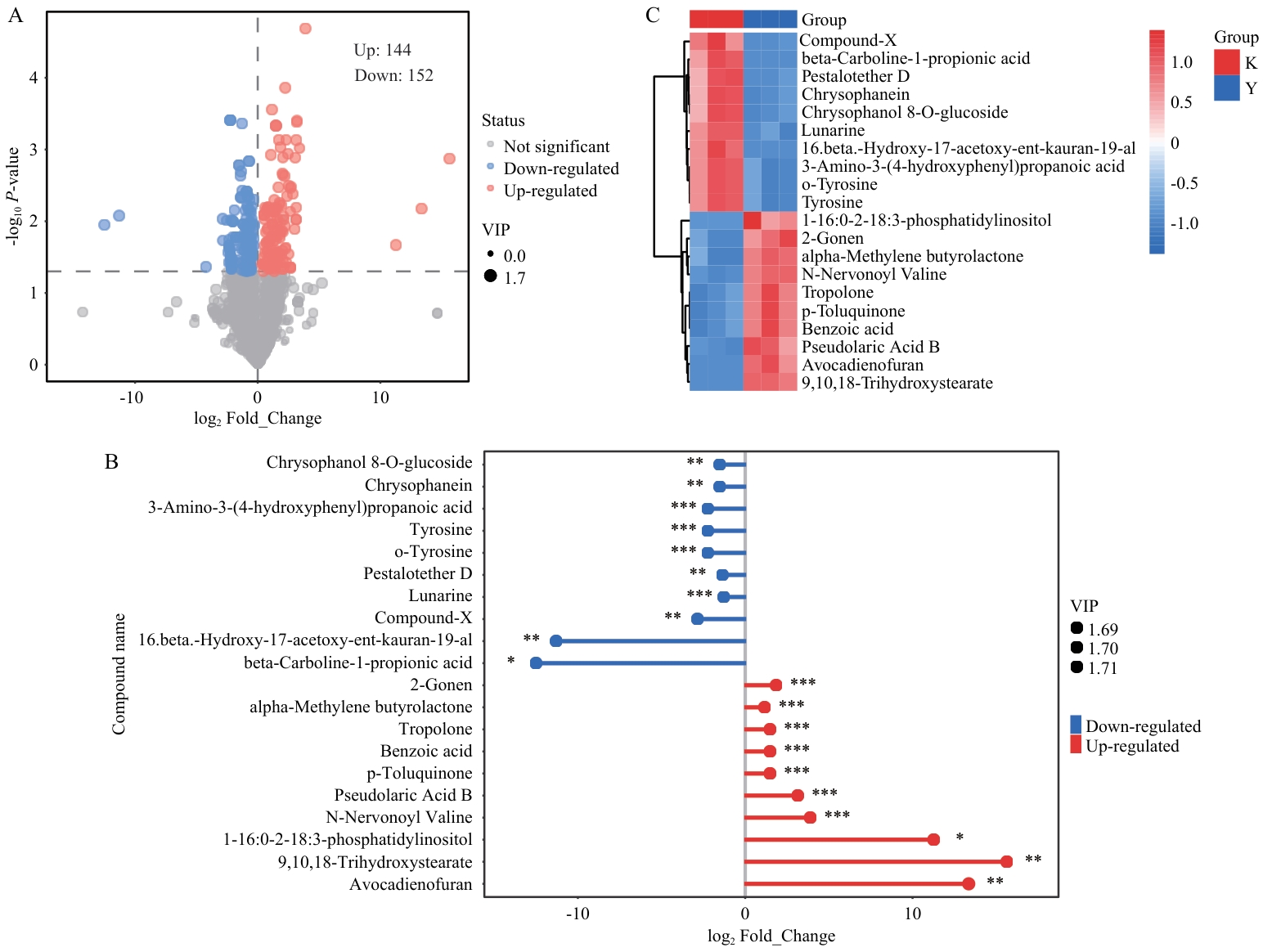
图5 空白原料和发酵酒糟的差异代谢物火山图(A)、火柴杆图(B)和层次聚类热图(C)
Fig. 5 Volcano plot (A), matchstick plot (B) and hierarchical clustering heat map (C) of differential metabolites between blank raw material and fermented distiller's grainsNote: Compound-X: (1S,6S,9S,10R,14R,17S,19S)-12-ethyl-9,19-dihydroxy-17-methoxy-14-methyl-5-oxa-12-azahexacyclo [8.7.2.1~2,6~.0~1,11~.0~3,9~.0~14,18~] icosan-4-one
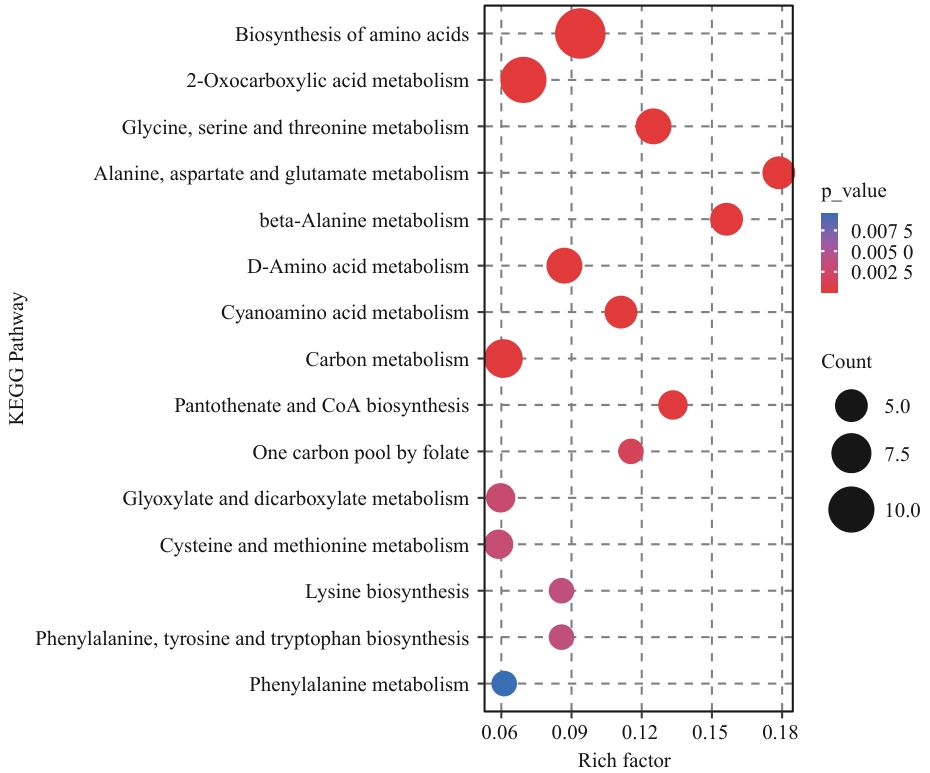
图6 空白原料和发酵酒糟的差异代谢物KEGG富集图
Fig. 6 KEGG enrichment plots of differential metabolites between blank raw materials and fermented distiller's grains
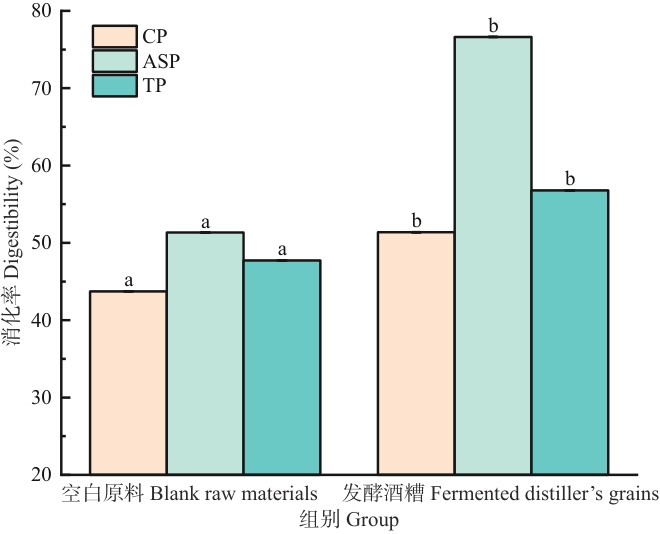
图7 空白原料与发酵酒糟体外模拟消化后各蛋白成分消化率
Fig. 7 In vitro digestibility of individual protein fractions in blank raw material and fermented distiller's grains after simulated digestion
| [1] | Liu L, Rong WH, Du X, et al. Integrating experimental and computational analyses of yeast protein profiles for optimizing the production of high-quality microbial proteins [J]. Appl Biochem Biotechnol, 2024, 196(12): 8741-8762. |
| [2] | 黄志东, 张翘楚, 李惠惠, 等. 菌体蛋白作为饲料蛋白原料的研究进展 [J]. 饲料工业, 2023, 44(10): 16-21. |
| Huang ZD, Zhang QC, Li HH, et al. Research progress of bacterial protein as feed protein raw material [J]. Feed Ind, 2023, 44(10): 16-21. | |
| [3] | 唐哲仁, 高勇, 师雄, 等. 白酒酒糟资源化利用技术研究进展 [J]. 中国酿造, 2024, 43(8): 13-19. |
| Tang ZR, Gao Y, Shi X, et al. Research progress on resource utilization techniques of Chinese Baijiu distiller’s grains [J]. China Brew, 2024, 43(8): 13-19. | |
| [4] | Liang ZQ, Wang Z, Shen XJ, et al. Utilization of synthetic microbial community in solid-state fermentation (SMC-SSF) for converting Chinese distiller grains into protein feed [J]. Chem Biol Technol Agric, 2025, 12: 104. |
| [5] | Qiao L, Wang K, Xin X, et al. Upcycling of Chinese Nong-flavor Baijiu distiller’s grains through solid-state fermentation by microbial-enzyme synergy [J]. Fermentation, 2026, 12(1): 13. |
| [6] | 时伟, 张熙琳, 郑红梅, 等. 混菌固态发酵清香型白酒糟制备蛋白饲料的研究 [J]. 饲料研究, 2024, 47(4): 79-84. |
| Shi W, Zhang XL, Zheng HM, et al. Research on mixed solid-state fermentation of pure flavor distiller’s grains for protein feed production [J]. Feed Res, 2024, 47(4): 79-84. | |
| [7] | Xu ZX, Ying C, Bai PX, et al. Microbial dynamics, metabolite profiles, and chemical composition in Saccharomyces cerevisiae and Kluyveromyces marxianus co-culture during solid-state fermentation [J]. Food Biosci, 2025, 64: 105849. |
| [8] | Wang C, Wei SY, Jin ML, et al. Integrated microbiomic and metabolomic dynamics of fermented corn and soybean by-product mixed substrate [J]. Front Nutr, 2022, 9: 831243. |
| [9] | Hu SQ, Zeng YT, Liu HQ, et al. Systematic profiling and bioactivity evaluation of Jiuzao from light flavor Baijiu: a by-product rich in bioactive compounds [J]. Food Chem, 2025, 494: 146229. |
| [10] | 中华人民共和国国家卫生健康委员会, 国家市场监督管理总局. 食品安全国家标准 食品中蛋白质的测定: [S]. 北京: 中国标准出版社, 2025. |
| National Health Commission of the People’s Republic of China, State Administration for Market Regulation. National Food Safety Standard Determination of Protein in Food: [S]. Beijing: Standards Press of China, 2025. | |
| [11] | 中华人民共和国农业农村部. 饲料原料中酸溶蛋白测定: [S]. 北京: 中国农业出版社, 2020.Determination of acid-soluble protein in feed ingredients: [S]. Beijing: China Agriculture Press, 2020. |
| [12] | 王妍, 郑猛虎, 崔欣雨, 等. 微生物固态发酵工艺对红薯淀粉渣真蛋白含量的影响 [J]. 饲料工业, 2022, 43(9): 35-40. |
| Wang Y, Zheng MH, Cui XY, et al. Effect of microbial solid state fermentation process on the true protein content of sweet potato starch residue [J]. Feed Ind, 2022, 43(9): 35-40. | |
| [13] | 国家卫生健康委员会, 国家市场监督管理总局. 食品安全国家标准 食品中总酸的测定: [S]. 北京: 中国标准出版社, 2021. |
| National Health Commission of the People’s Republic of China, State Administration for Market Regulation. National Food Safety Standard Determination of Total Acids in Food: [S]. Beijing: Standards Press of China, 2021. | |
| [14] | 国家质量监督检验检疫总局, 中国国家标准化管理委员会. 饲料卫生标准: [S]. 北京: 中国标准出版社, 2017. |
| General Administration of Quality Supervision, Inspection and Quarantine of the People’s Republic of China, Standardization Administration of the People’s Republic of China. Hygienical standard for feeds: [S]. Beijing: Standards Press of China, 2017. | |
| [15] | Babič K, Strojnik L, Ćirić A, et al. Optimization and validation of an HS-SPME/GC-MS method for determining volatile organic compounds in dry-cured ham [J]. Front Nutr, 2024, 11: 1342417. |
| [16] | Deng J, He CJ, Wei CH, et al. Characterization of fermentation parameters, volatile compounds and microbial community structure of fermented grains in the upper and lower layers during strong-flavor Baijiu fermentation [J]. Bioresour Bioprocess, 2025, 12: 105. |
| [17] | Xu J, Zhang T, Chen HT, et al. Study on the fermented grain characteristics and volatile flavor substances during the tuqu fermentation of Hunan light-flavor Baijiu [J]. Foods, 2024, 13(6): 899. |
| [18] | Doppler M, Kluger B, Bueschl C, et al. Stable isotope-assisted evaluation of different extraction solvents for untargeted metabolomics of plants [J]. Int J Mol Sci, 2016, 17(7): 1017. |
| [19] | Dunn WB, Broadhurst D, Begley P, et al. Procedures for large-scale metabolic profiling of serum and plasma using gas chromatography and liquid chromatography coupled to mass spectrometry [J]. Nat Protoc, 2011, 6(7): 1060-1083. |
| [20] | Want EJ, Wilson ID, Gika H, et al. Global metabolic profiling procedures for urine using UPLC-MS [J]. Nat Protoc, 2010, 5(6): 1005-1018. |
| [21] | Zhu XF, Wang LY, Zhang Z, et al. Combination of fiber-degrading enzymatic hydrolysis and lactobacilli fermentation enhances utilization of fiber and protein in rapeseed meal as revealed in simulated pig digestion and fermentation in vitro [J]. Anim Feed Sci Technol, 2021, 278: 115001. |
| [22] | Schützhold V, Hahn J, Tummler K, et al. Computational modeling of lipid metabolism in yeast [J]. Front Mol Biosci, 2016, 3: 57. |
| [23] | Du F, Xu Q, Li X, et al. Author Correction: Regulating triacylglycerol cycling for high-efficiency production of polyunsaturated fatty acids and derivatives [J]. Nat Commun, 2025, 16: 10314. |
| [24] | He MX, Peng Q, Xu XQ, et al. Antioxidant capacities and non-volatile metabolites changes after solid-state fermentation of soybean using oyster mushroom (Pleurotus ostreatus) Mycelium [J]. Front Nutr, 2024, 11: 1509341. |
| [25] | Li T, Deng MS, Li S, et al. Revealing differences in flavor compounds during plum wine fermentation using single and mixed yeast strains through metabolomic analysis [J]. Food Chem X, 2025, 25: 102100. |
| [26] | Xie J, Zhang JF, Chen XY. Aloe-emodin: from pharmacological mechanisms to clinical applications and future perspectives [J]. Front Pharmacol, 2026, 16: 1741679. |
| [27] | Wang DP, Wang XH, Yu XJ, et al. Pharmacokinetics of anthraquinones from medicinal plants [J]. Front Pharmacol, 2021, 12: 638993. |
| [28] | Zhang YJ, Xie YX, Ma J, et al. Mechanisms of anti-nutritional factor degradation and quality enhancement in soybean meal via Rpf-mediated microbiota synergy and Bacillus reinforcement during solid-state fermentation [J]. Front Anim Sci, 2025, 6: 1707154. |
| [29] | Chi ZH, Feng Y, Wei XK, et al. A co-fermentation technology based on small peptide production and protein structure modification increases the edible value of corn gluten meal [J]. LWT, 2024, 198: 116054. |
| [30] | Huang YY, Meng K, Liu GH, et al. Whole genome sequencing and extracellular metabolite profiling of lactiplantibacillus plantarum FRT4: insights into probiotic functionality [J]. Biology, 2025, 14(9): 1167. |
| [31] | 司维江, 刘建忠, 黄德利, 等. 白酒糟饲料化利用菌种的筛选及工艺优化 [J]. 饲料研究, 2022, 45(8): 67-72. |
| Si WJ, Liu JZ, Huang DL, et al. Screening and process optimization of bacteria for fodder utilization of distiller’s grains [J]. Feed Res, 2022, 45(8): 67-72. | |
| [32] | Chen K, Deng XR, Jiang DH, et al. Efficient conversion of distillers grains as feed ingredient by synergy of probiotics and enzymes [J]. Front Microbiol, 2024, 15: 1403011. |
| [33] | 周永秀, 卢开华, 刘秦明, 等. 咖啡风味成分研究进展 [J]. 食品科学, 2025, 46(10): 387-396. |
| Zhou YX, Lu KH, Liu QM, et al. Research progress on coffee flavor components [J]. Food Sci, 2025, 46(10): 387-396. | |
| [34] | Liu YL, Cao YT, Yohannes WK, et al. Antioxidant effect of yeast on lipid oxidation in salami sausage [J]. Front Microbiol, 2023, 13: 1113848. |
| [35] | 陆思檬. 饲用发酵白酒糟工艺优化及其对蛋鸡的影响 [D]. 太原: 山西大学, 2022. |
| Lu SM. Technology optimization of fermentation distiller’s grains feedstuff and its effect on laying hens [D]. Taiyuan: Shanxi University, 2022. | |
| [36] | 张硕清, 汝昕潼, 穆永强, 等. 白酒糟与玉米油渣协同固态发酵工艺优化及体外营养价值评定 [J]. 中国粮油学报, 2026, 41(1): 170-178. |
| Zhang SQ, Ru XT, Mu YQ, et al. Process optimization and in vitro nutritional value evaluation of solid-state co-fermentation of distiller’s grains and corn oil residue [J]. J Chin Cereals Oils Assoc, 2026, 41(1): 170-178. | |
| [37] | Zhang L, Shen XJ, Wang Z, et al. Production of high-nutrient protein sources by pre-secondary solid-state fermentation of functional microbiota (Pre-Sec-SSF-FM) from dehulled Chinese distillers grains [J]. J Biotechnol, 2026, 410: 23-32. |
| [38] | Jia R, Lu SM, Li T, et al. Production technology of fermented distiller’s grains and its effect on production performance and egg quality of laying hens [J]. Fermentation, 2025, 11(9): 492. |
| [39] | Adeldruvefors U, Schnurer J. Mold-inhibitory activity of different yeast species during airtight storage of wheat grain [J]. FEMS Yeast Res, 2005, 5(4-5): 373-378. |
| [1] | 游欣, 王淅, 张新妤, 魏绪英, 程华, 蔡军火. 基于非靶向代谢组解析红花石蒜叶片对高温胁迫的响应[J]. 生物技术通报, 2026, 42(7): 173-181. |
| [2] | 张初署, 曹世宁, 王发明, 周海翔, 胡晓君, 唐月异, 周晓燕, 王冕, 陈静, 张建成. 乳酸菌发酵花生衣提取物过程中的代谢物特征分析[J]. 生物技术通报, 2026, 42(5): 340-352. |
| [3] | 王雅南, 魏立民, 王峰, 晁哲, 任钰为, 刘海隆, 黄丽丽, 孙瑞萍. 基于代谢组学筛选五指山猪与杜长大猪脂肪沉积差异代谢物的比较研究[J]. 生物技术通报, 2026, 42(2): 325-337. |
| [4] | 刘语诗, 李镇, 邹宇琛, 汤维维, 李彬. 药用植物空间代谢组学研究进展[J]. 生物技术通报, 2025, 41(9): 22-31. |
| [5] | 张雅祺, 王芹芹, 沈夏, 李旭苗, 高敏, 李军, 李辰, 王慧. 食管鳞状细胞癌早期进展风险的代谢物预警模型[J]. 生物技术通报, 2025, 41(9): 335-344. |
| [6] | 蒋天威, 马培杰, 李亚娇, 陈才俊, 刘晓霞, 王小利. 二穗短柄草对光周期的代谢响应分析[J]. 生物技术通报, 2025, 41(7): 237-247. |
| [7] | 张晓丹, 尹铮, 刘清晨, 李雪梅, 刘晓华, 梁美霞. 基于代谢组和转录组联合解析山桃响应冻害机制[J]. 生物技术通报, 2025, 41(12): 225-239. |
| [8] | 罗宜菲, 徐娅, 卢斯琪, 高媛媛, 苟展, 方红, 尚轶, 滕林琳. 致病疫霉侵染前后马铃薯植株挥发性成分分析[J]. 生物技术通报, 2025, 41(11): 247-260. |
| [9] | 白帆, 周雍进. 酵母单细胞蛋白助力食品工业发展与应用[J]. 生物技术通报, 2025, 41(11): 14-21. |
| [10] | 虞昕磊, 何结望, 林国平, 李金海, 王大爱, 袁跃斌, 刘圣高, 李志豪, 陶德欣. 夏冬两季发酵雪茄烟叶的代谢组差异分析[J]. 生物技术通报, 2024, 40(6): 260-270. |
| [11] | 顾蕾, 张誉露, 唐尚睿, 于浩月, 李辰. 基于质谱的单细胞蛋白质组学技术的发展及应用[J]. 生物技术通报, 2024, 40(11): 125-141. |
| [12] | 许沛冬, 易剑锋, 陈迪, 陈浩, 谢丙炎, 赵文军. 组学技术在生防芽胞杆菌的应用进展[J]. 生物技术通报, 2024, 40(10): 208-220. |
| [13] | 韩乐乐, 宋文迪, 边嘉珅, 李阳, 杨双胜, 陈紫怡, 李晓薇. 转录组与代谢组联合分析揭示大豆GmERD15c参与盐胁迫下类黄酮的生物合成[J]. 生物技术通报, 2024, 40(10): 243-252. |
| [14] | 姜宇舢, 兰倩, 王芳, 姜亮, 裴成成. 一个影响酪氨酸代谢藜麦突变体的鉴定[J]. 生物技术通报, 2024, 40(10): 253-261. |
| [15] | 何诗瑜, 曾仲大, 李博岩. 空间分辨代谢组学在疾病诊断研究中的应用进展[J]. 生物技术通报, 2024, 40(1): 145-159. |
| 阅读次数 | ||||||
|
全文 |
|
|||||
|
摘要 |
|
|||||
