







生物技术通报 ›› 2026, Vol. 42 ›› Issue (6): 116-127.doi: 10.13560/j.cnki.biotech.bull.1985.2025-0798
• 薯类生物技术专题 • 上一篇
王江清1,2( ), 张蝶1,2, 王荟洁1,2, 袁柱东1,2, 付艳鸿1, 黄娅楠1, 王洪洋1()
收稿日期:2025-07-24
出版日期:2026-06-26
发布日期:2026-07-11
通讯作者:
王洪洋,男,博士,教授,研究方向 :马铃薯抗晚疫病分子遗传育种;E-mail: hongyang8318@ynnu.edu.cn作者简介:王江清,女,硕士研究生,研究方向 :马铃薯晚疫病防控;E-mail: 1363308380@qq.com基金资助:
WANG Jiang-qing1,2(), ZHANG Die1,2, WANG Hui-jie1,2, YUAN Zhu-dong1,2, FU Yan-hong1, HUANG Ya-nan1, WANG Hong-yang1()
Received:2025-07-24
Published:2026-06-26
Online:2026-07-11
摘要:
目的 对马铃薯全基因组中AP2/ERF转录因子家族基因进行鉴定,分析该家族基因在不同组织及致病疫霉(Phytophthora infestans)胁迫下的表达模式,为阐明AP2/ERF家族基因参与马铃薯响应致病疫霉胁迫提供依据。 方法 利用生物信息学方法系统鉴定马铃薯AP2/ERF家族成员,并分析其系统发育、染色体定位、基因结构、保守基序及共线性关系。结合转录组数据,分析该家族成员的组织表达特异性和响应致病疫霉胁迫的表达模式。对马铃薯进行致病疫霉不同时间段(0、24、48、72 h)侵染,采用RT-qPCR检测部分家族成员基因的差异表达变化。 结果 在马铃薯中共鉴定到179个AP2/ERF基因,聚类分为ERF、DREB、AP2、RAV和Soloist五个亚家族,不均匀分布于12条染色体上。不同亚家族基因之间的Motif、内含子和外显子分布差异显著。种内共线性分析表明AP2/ERF基因中有57对共线基因;物种间共线性显示AP2/ERF在水稻和拟南芥中分别存在69对和164对同源基因。组织表达分析显示AP2/ERF基因参与马铃薯营养及生殖生长,部分基因呈组织特异性高表达。致病疫霉胁迫下,大多数AP2/ERF基因被不同程度诱导表达。 结论 AP2/ERF转录因子基因家族参与马铃薯生长发育过程,且快速响应致病疫霉胁迫反应。
王江清, 张蝶, 王荟洁, 袁柱东, 付艳鸿, 黄娅楠, 王洪洋. 马铃薯AP2/ERF基因家族鉴定及响应致病疫霉胁迫的表达分析[J]. 生物技术通报, 2026, 42(6): 116-127.
WANG Jiang-qing, ZHANG Die, WANG Hui-jie, YUAN Zhu-dong, FU Yan-hong, HUANG Ya-nan, WANG Hong-yang. Identification of the AP2/ERF Gene Family in Potato and Expression Analysis in Response to Phytophthora infestans Stress[J]. Biotechnology Bulletin, 2026, 42(6): 116-127.
| 基因名称 Gene name | orwardprimer(5'-3') 上游引物 F | everseprimer(5'-3') 下游引物 R |
|---|---|---|
| StERF3 | CCCCATCACCACCTGCTAAG | ACTAGCAACGGGCATTTCCA |
| StERF13 | TATGAGATGCCCCGTTTGGG | CCACGGTCGACTCTGTTGAT |
| StERF101 | CTGAAGGGGAAACTGAGCCC | |
| StERF76 | ACGGATGAGGAAGTGGGGTA | AGCGGTATCGTAAGCACGAG |
| StERF74 | GGGGAAGTTCAGTCGAGCAA | |
| StERF55 | ||
| StERF116 | TAACTGCCGCCTGTCGTATG | |
| StERF32 | ||
| StERF123 | ||
| StEF1 | ATTGGAAACGGATATGCTCCA | TCCTTACCTGAACGCCTGTCA |
表1 RT-qPCR引物
Table 1 Primers for RT-qPCR
| 基因名称 Gene name | orwardprimer(5'-3') 上游引物 F | everseprimer(5'-3') 下游引物 R |
|---|---|---|
| StERF3 | CCCCATCACCACCTGCTAAG | ACTAGCAACGGGCATTTCCA |
| StERF13 | TATGAGATGCCCCGTTTGGG | CCACGGTCGACTCTGTTGAT |
| StERF101 | CTGAAGGGGAAACTGAGCCC | |
| StERF76 | ACGGATGAGGAAGTGGGGTA | AGCGGTATCGTAAGCACGAG |
| StERF74 | GGGGAAGTTCAGTCGAGCAA | |
| StERF55 | ||
| StERF116 | TAACTGCCGCCTGTCGTATG | |
| StERF32 | ||
| StERF123 | ||
| StEF1 | ATTGGAAACGGATATGCTCCA | TCCTTACCTGAACGCCTGTCA |
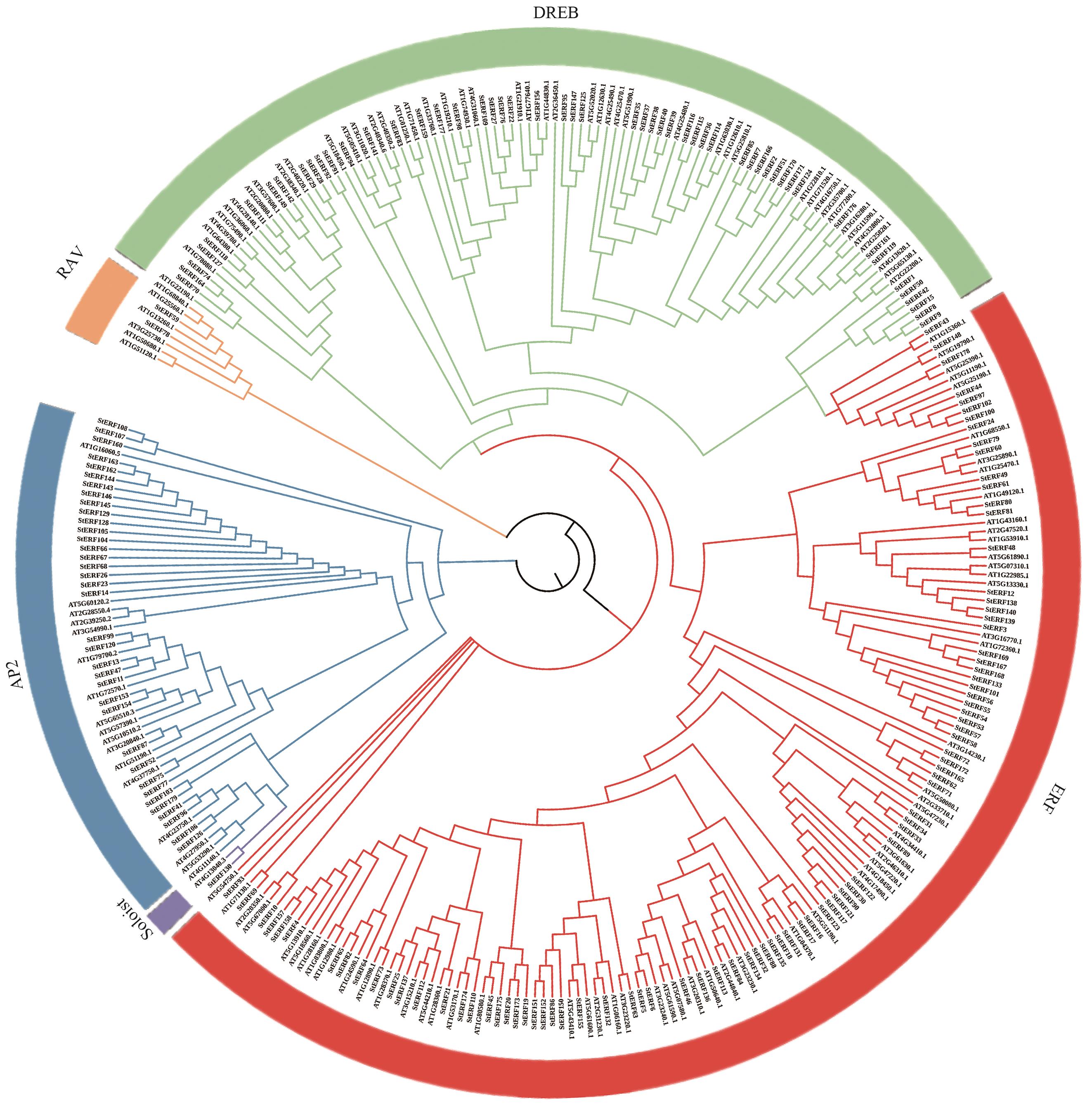
图1 马铃薯和拟南芥AP2/ERF家族系统进化树
Fig. 1 Phylogenetic tree of the AP2/ERF family in Solanum tuberosum and Arabidopsis thaliana
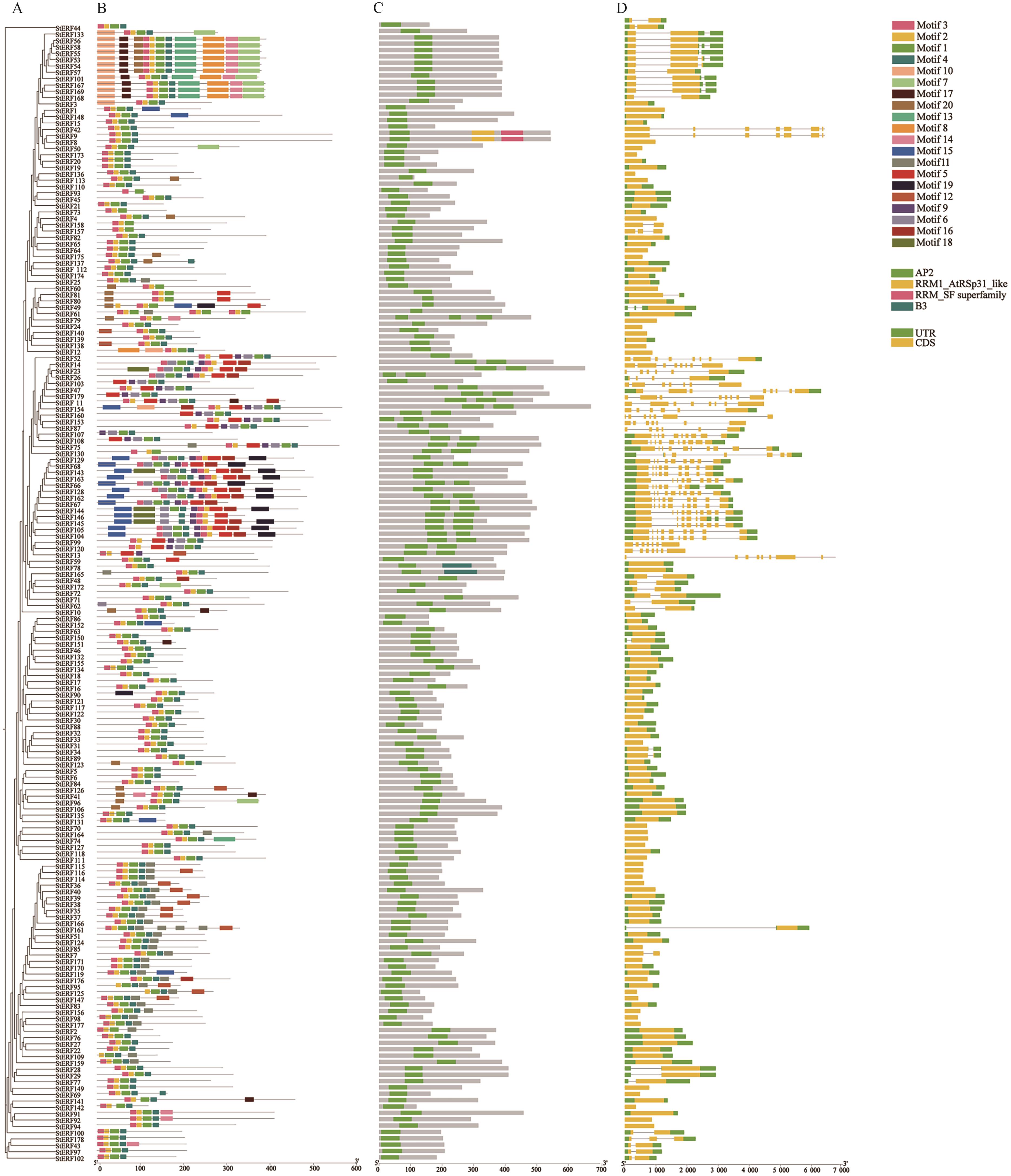
图2 AP2/ERF 基因家族的系统发育树(A)、保守基序(B)、保守结构域(C)、基因结构(D)D:绿色矩形表示非编码序列,黄色矩形表示外显子,黑线表示内含子
Fig. 2 Phylogenetic tree (A), conserved motif (B), conserved domain (C), and gene structure(D) of AP2/ERF gene familyD: The green rectangles indicate non-coding sequences, the yellow rectangles indicate exons, and the black lines represent introns
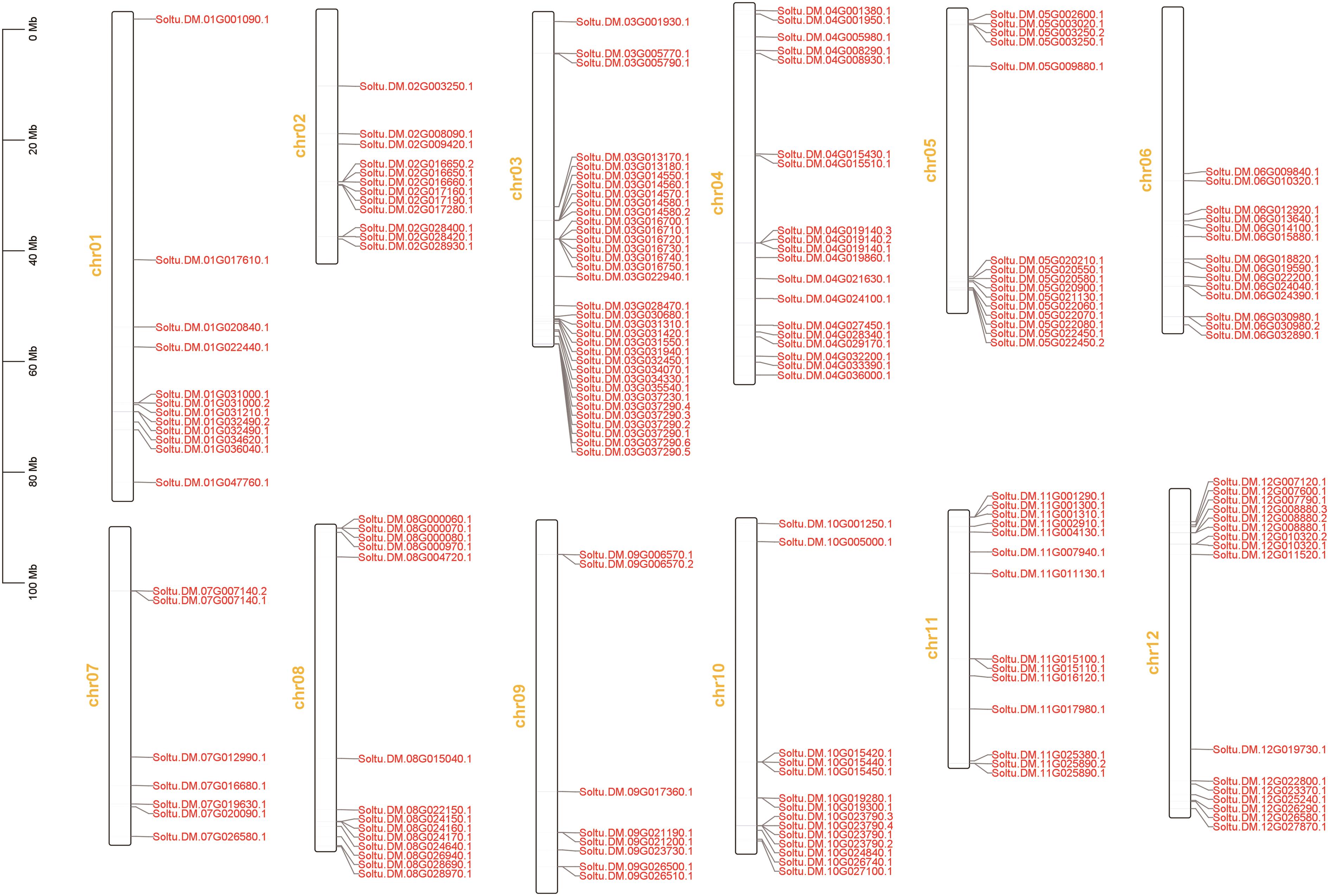
图3 马铃薯AP2/ERF 基因在染色体上的分布Chr01-Chr12表示1-12号染色体;黑线表示AP2/ERF 基因位于染色体的位置
Fig. 3 Distribution of potato AP2/ERF genes on chromosomesChr01-Chr12 refer to chromosome 1 to 12. The black lines indicate the chromosomal locations of the AP2/ERF genes
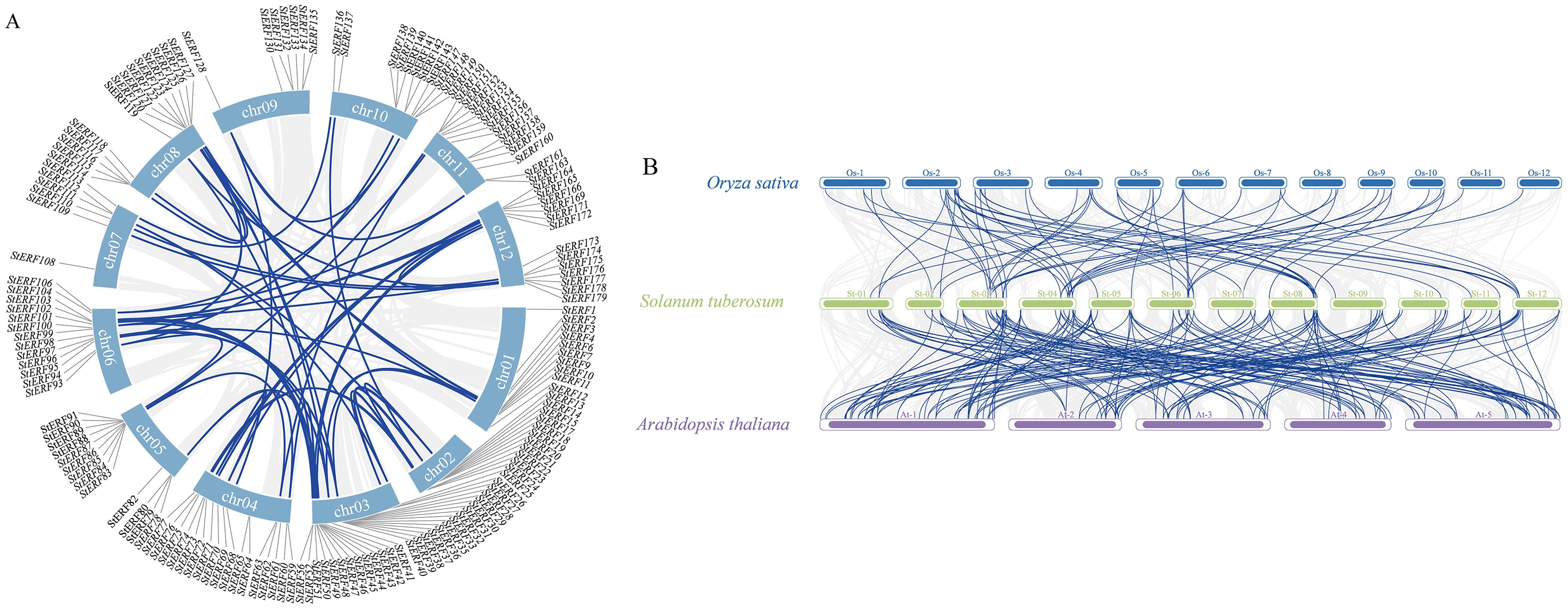
图4 马铃薯AP2/ERF 基因之间的共线性分析(A)以及马铃薯、水稻和拟南芥AP2/ERF基因共线性分析(B)
Fig. 4 Collinearity analysis between AP2/ERF genes of potato (A), and collinearity analysis of AP2/ERF genes in S. tuberosum, O. sativa and A. thaliana (B)
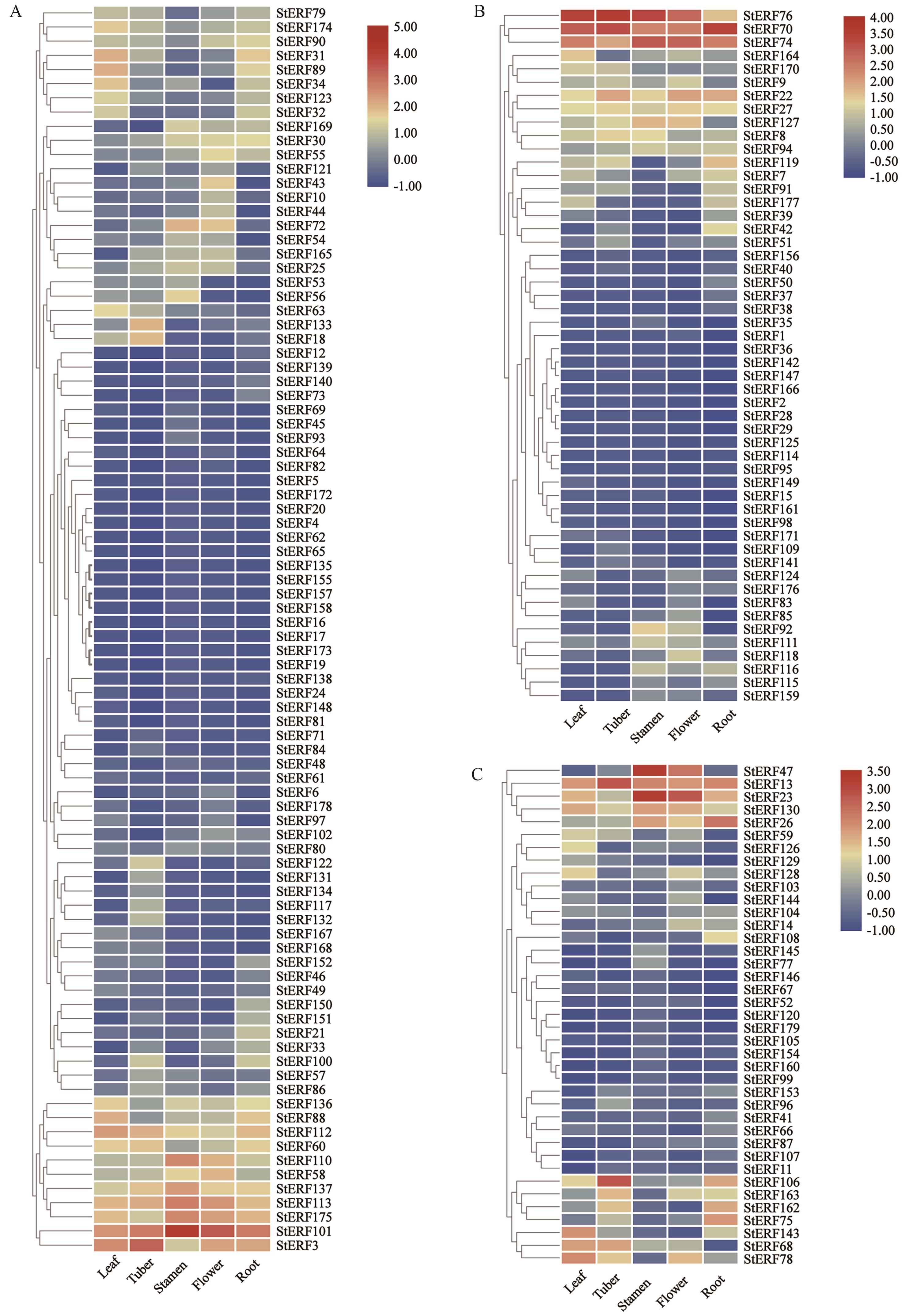
图5 马铃薯 AP2/ERF 家族基因的组织表达热图
Fig. 5 Tissue expression heat map of AP2/ERF family genes in S. tuberosum
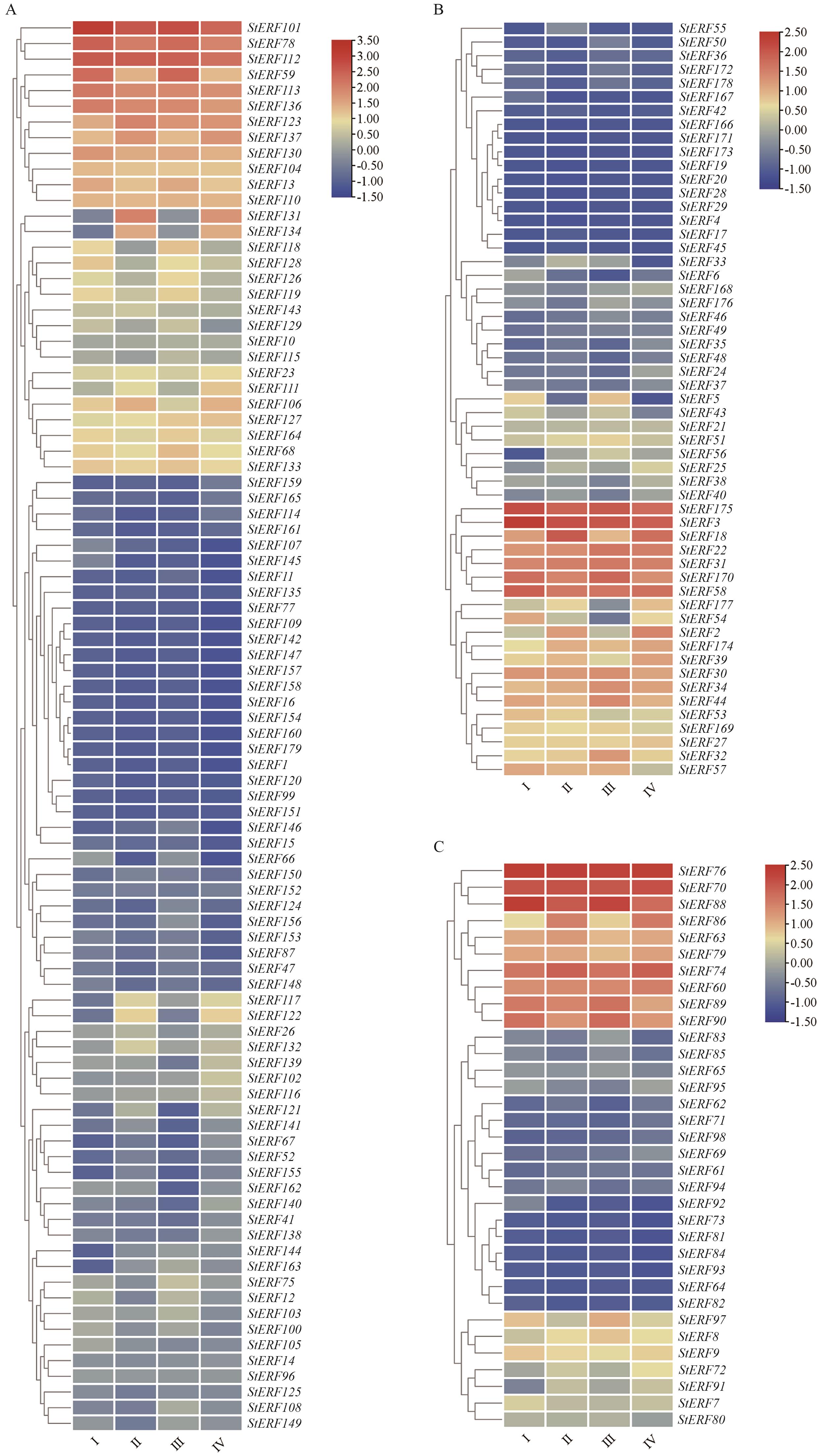
图6 致病疫霉感染马铃薯后AP2/ERF家族基因的表达热图Ⅰ:抗性马铃薯感染致病疫霉前表达量;Ⅱ:抗性马铃薯感染致病疫霉后1-2 d的表达量;Ⅲ:易感马铃薯感染致病疫霉前表达量;Ⅳ:易感马铃薯感染致病疫霉后1-2 d的表达量;基因的表达水平经过log₂(FPKM)转换后用于后续的可视化和分析
Fig. 6 Expression heat map of AP2/ERF family genes in S. tuberosum following P. infestans infectionⅠ: Expressions of resistant S. tuberosum before infection with P. infestans. Ⅱ: Expressions of resistant S. tuberosum at 1-2 d after infection with P. infestans. Ⅲ: Expressions of susceptible S. tuberosum before infection with P. infestans. Ⅳ: Expressions of susceptible potato at 1-2 d after infection with P. infestans. The expressions of genes were transformed to log₂(FPKM) values for subsequent visualization and analysis
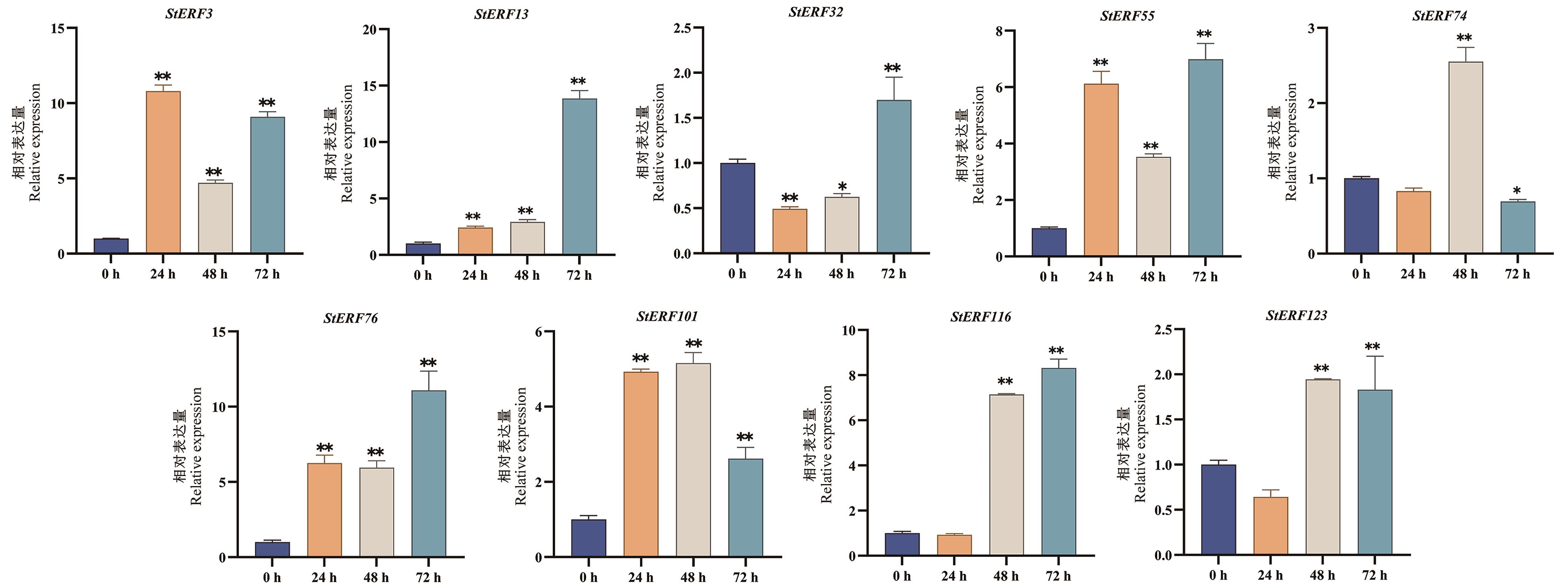
图7 9个AP2/ERF基因在致病疫霉处理不同时段的表达模式*P0.05,** P0.01(与0 h相比,t检验)
Fig. 7 Expression patterns of nine AP2/ERF genes at different time points after P. infestans infection*P0.05, ** P0.01 (compared with 0 h, Student’s t-test)
| [1] | David M Spooner MG. Systematics, diversity, genetics, and evolution of wild and cultivated potatoes [J]. Bot Rev, 80(4): 283-383. |
| [2] | 庞泽, 田国奎, 王海艳, 等. 我国马铃薯产业发展现状及展望 [J]. 中国瓜菜, 2023, 36(7): 148-154. |
| Pang Z, Tian GK, Wang HY, et al. Present situation and prospect of potato industry in China [J]. China Cucurbits Veg, 2023, 36(7): 148-154. | |
| [3] | Xu J, Li Y, Kaur L, et al. Functional food based on potato [J]. Foods, 2023, 12(11): 2145. |
| [4] | Li LX, Zhu TT, Wen LN, et al. Biofortification of potato nutrition [J]. J Adv Res, 2025, 75: 23-34. |
| [5] | Reyniers S, Ooms N, Gomand SV, et al. What makes starch from potato (Solanum tuberosum L.) tubers unique: a review [J]. Compr Rev Food Sci Food Saf, 2020, 19(5): 2588-2612. |
| [6] | Altemimi AB. Extraction and optimization of potato starch and its application as a stabilizer in yogurt manufacturing [J]. Foods, 2018, 7(2): 14. |
| [7] | 卢肖平. 马铃薯主粮化战略的意义、瓶颈与政策建议 [J]. 华中农业大学学报: 社会科学版, 2015(3): 1-7. |
| Lu XP. Strategy of potato as staple food: significance, bottlenecks and policy suggestions [J]. J Huazhong Agric Univ Soc Sci Ed, 2015(3): 1-7. | |
| [8] | 吴兴壮, 李利峰, 朱华. 马铃薯的综合利用研究概述及前景预测 [J]. 食品研究与开发, 2004, 25(2): 27-29. |
| Wu XZ, Li LF, Zhu H. Overview and prospect prediction of comprehensive utilization of potato [J]. Food Res Dev, 2004, 25(2): 27-29. | |
| [9] | 李洁, 闫硕, 张芳, 等. 近年来中国马铃薯晚疫病的时空演变特征及防控情况分析 [J]. 植物保护学报, 2021, 48(4): 703-711. |
| Li J, Yan S, Zhang F, et al. Analysis of spatio-temporal characteristics and control of potato late blight in recent years in China [J]. J Plant Prot, 2021, 48(4): 703-711. | |
| [10] | Kamoun S, Furzer O, Jones JDG, et al. The Top 10 oomycete pathogens in molecular plant pathology [J]. Mol Plant Pathol, 2015, 16(4): 413-434. |
| [11] | 马红梅. 西北地区部分马铃薯主栽品种晚疫病抗性鉴定和抗病基因组成分析 [D]. 杨凌: 西北农林科技大学, 2015. |
| Ma HM. Resistance genes analysis of main potato cultivars to Phytophthora infestans in northwestern China [D]. Yangling: Northwest A F University, 2015. | |
| [12] | 崔德周, 王丽丽, 陈祥龙, 等. 小麦ERF亚族转录因子参与逆境胁迫的研究进展 [J]. 山东农业科学, 2024, 56(2): 176-180. |
| Cui DZ, Wang LL, Chen XL, et al. Advances in research on function of wheat ERF transcription factor subfamily in stress response [J]. Shandong Agric Sci, 2024, 56(2): 176-180. | |
| [13] | Riechmann JH J L. Arabidopsis transcription factors: genome-wide comparative analysis among eukaryotes [J]. Science, 2000, 290(5499): 2105-2110. |
| [14] | Ma ZM, Hu LJ, Jiang WZ. Understanding AP2/ERF transcription factor responses and tolerance to various abiotic stresses in plants: a comprehensive review [J]. Int J Mol Sci, 2024, 25(2): 893. |
| [15] | Mariam C, Mariam S, Safa C, et al. Ectopic expression of StERF94 transcription factor in potato plants [J]. Plant Mol Biol, 2019, 37(60): 450-463. |
| [16] | Tezuka D, Kawamata A, Kato H, et al. The rice ethylene response factor OsERF83 positively regulates disease resistance to Magnaporthe oryzae [J]. Plant Physiol Biochem, 2019, 135: 263-271. |
| [17] | Zang ZY, Lv Y, Liu S, et al. A novel ERF transcription factor, ZmERF105, positively regulates maize resistance to Exserohilum turcicum [J]. Front Plant Sci, 2020, 11: 850. |
| [18] | Yang HH, Sun YG, Wang HX, et al. Genome-wide identification and functional analysis of the ERF2 gene family in response to disease resistance against Stemphylium lycopersici in tomato [J]. BMC Plant Biol, 2021, 21(1): 72. |
| [19] | Liu Q, Zhang GY, Chen SY. Structure and regulatory function of plant transcription factors [J]. Chin Sci Bull, 2001, 46(4): 271-278. |
| [20] | Magnani E, Sjölander K, Hake S. From endonucleases to transcription factors: evolution of the AP2 DNA binding domain in plants [J]. Plant Cell, 2004, 16(9): 2265-2277. |
| [21] | Van Montagu den Boer M. Control of Arabidopsis flower and seed development by the homeotic gene APETALA2 [J]. Plant Cell, 1994, 6(9): 1211-1225. |
| [22] | Ohme-Takagi M, Shinshi H. Ethylene-inducible DNA binding proteins that interact with an ethylene-responsive element [J]. Plant Cell, 1995, 7(2): 173-182. |
| [23] | Song XM, Li Y, Hou XL. Genome-wide analysis of the AP2/ERF transcription factor superfamily in Chinese cabbage (Brassica rapa ssp. pekinensis) [J]. BMC Genom, 2013, 14(1): 573. |
| [24] | Pham GM, Hamilton JP, Wood JC, et al. Construction of a chromosome-scale long-read reference genome assembly for potato [J]. Giga Science, 2020, 9(9): giaa100. |
| [25] | Charfeddine M, Saïdi MN, Charfeddine S, et al. Genome-wide analysis and expression profiling of the ERF transcription factor family in potato (Solanum tuberosum L.) [J]. Mol Biotechnol, 2015, 57(4): 348-358. |
| [26] | Cui LC, Feng KW, Wang MX, et al. Genome-wide identification, phylogeny and expression analysis of AP2/ERF transcription factors family in Brachypodium distachyon [J]. BMC Genom, 2016, 17(1): 636. |
| [27] | Zhu Q, Zhang JT, Gao XS, et al. The Arabidopsis AP2/ERF transcription factor RAP2.6 participates in ABA, salt and osmotic stress responses [J]. Gene, 2010, 457(1/2): 1-12. |
| [28] | Scarpeci TE, Frea VS, Zanor MI, et al. Overexpression of AtERF019 delays plant growth and senescence, and improves drought tolerance in Arabidopsis [J]. J Exp Bot, 2017, 68(3): 673-685. |
| [29] | Guillaume Blanc KHW. Widespread paleopolyploidy in model plant species inferred from age distributions of duplicate genes [J]. Plant Cell, 2004, 16(7): 1667-1678. |
| [30] | Lee DK, Jung H, Jang G, et al. Overexpression of the OsERF71 transcription factor alters rice root structure and drought resistance [J]. Plant Physiol, 2016, 172(1): 575-588. |
| [31] | Pei YG, Xue QH, Shu P, et al. Bifunctional transcription factors SlERF.H5 and H7 activate cell wall and repress gibberellin biosynthesis genes in tomato via a conserved motif [J]. Dev Cell, 2024, 59(10): 1345-1359.e6. |
| [32] | Ma N, Sun P, Li ZY, et al. Plant disease resistance outputs regulated by AP2/ERF transcription factor family [J]. Stress Biol, 2024, 4(1): 2. |
| [33] | Meng XZ, Xu J, He YX, et al. Phosphorylation of an ERF transcription factor by Arabidopsis MPK3/MPK6 regulates plant defense gene induction and fungal resistance [J]. Plant Cell, 2013, 25(3): 1126-1142. |
| [1] | 王冰冰, 朱迪, 杨生龙, 李艺林, 杨琪, 贺苗苗. 外源褪黑素对晚疫病胁迫下马铃薯抗病性的影响[J]. 生物技术通报, 2026, 42(6): 107-115. |
| [2] | 阳涛, 曾繁城, 曾宇笑, 陶瑞岩, 薛志红, 陶茜, 仲阳, 江帆, 熊兴耀, 程旭. 复合菌群的构建及其对马铃薯生长的影响[J]. 生物技术通报, 2026, 42(5): 89-100. |
| [3] | 金旋, 向芬, 戴翠婷, 杨辉, 李赛君, 刘红艳, 钱思维, 蔺万煌, 李维. 茶树CsTDIFL基因的克隆、表达特性分析及其对氨基酸合成的调控[J]. 生物技术通报, 2026, 42(5): 323-331. |
| [4] | 郭苗, 许家佳, 孙天国, 蔡璨, 曹婉笛, 包纪星, 沙伟, 张梅娟, 彭疑芳, 马天意. 过表达砂藓RcOLEO1基因增强拟南芥的耐旱性及耐高温性[J]. 生物技术通报, 2026, 42(5): 312-322. |
| [5] | 陈登科, 兰刚, 夏芝, 侯保国, 杨六六, 曹彩荣, 李朋波, 吴翠翠. 花生ZF-HD基因家族的鉴定和非生物胁迫响应分析[J]. 生物技术通报, 2026, 42(4): 114-128. |
| [6] | 刘林娅, 刘欢艳, 梁鑫钰, 宋姝熠, 何斌, 王绪英, 黄亚成. ‘红阳’猕猴桃BGAL基因家族的全基因组鉴定与表达分析[J]. 生物技术通报, 2026, 42(3): 312-323. |
| [7] | 张冬岭, 张寅生, 王建军, 叶飞宇, 卢子涵, 马晨晨, 柳华峰, 胡德升, 邓亚洲, 曹丽茹. 玉米HSFs转录因子家族在干旱胁迫下的表达特性及功能[J]. 生物技术通报, 2026, 42(2): 178-187. |
| [8] | 农韦优, 赵昌祖, 钱禛锋, 丁倩, 王誉洁, 陈疏影, 何丽莲, 李富生. 蔗茅EfBBX基因家族鉴定及冷胁迫下表达模式分析[J]. 生物技术通报, 2026, 42(2): 267-277. |
| [9] | 陈静欢, 房国楠, 朱文豪, 叶广继, 苏旺, 贺苗苗, 杨生龙, 周云. 马铃薯种质资源淀粉表征及相关基因表达分析[J]. 生物技术通报, 2026, 42(1): 170-183. |
| [10] | 吴翠翠, 陈登科, 兰刚, 夏芝, 李朋波. 花生转录因子AhHDZ70的生物信息学分析及耐盐耐旱性研究[J]. 生物技术通报, 2026, 42(1): 198-207. |
| [11] | 吕呈聪, 衡蒙, 陈思琪, 金雪花. 彩色马蹄莲花青素苷转运相关ZhGSTF的克隆及功能分析[J]. 生物技术通报, 2026, 42(1): 161-169. |
| [12] | 杨丹, 靳雅荣, 毛春力, 王碧娴, 张雅宁, 杨智怡, 周芷瑶, 杨锐鸣, 范恒睿, 黄琳凯, 严海东. 象草C2H2基因家族鉴定及表达分析[J]. 生物技术通报, 2026, 42(1): 251-261. |
| [13] | 任云儿, 伍国强, 成斌, 魏明. 甜菜BvATGs基因家族全基因组鉴定及盐胁迫下表达模式分析[J]. 生物技术通报, 2026, 42(1): 184-197. |
| [14] | 杨娟, 冯慧, 吉乃喆, 孙丽萍, 王赟, 张佳楠, 赵世伟. 月季AP2/ERF转录因子RcERF4和RcRAP2-12的克隆及功能分析[J]. 生物技术通报, 2026, 42(1): 150-160. |
| [15] | 程婷婷, 刘俊, 王利丽, 练从龙, 魏文君, 郭辉, 吴尧琳, 杨晶凡, 兰金旭, 陈随清. 杜仲查尔酮异构酶基因家族全基因组鉴定及其表达模式分析[J]. 生物技术通报, 2025, 41(9): 242-255. |
| 阅读次数 | ||||||
|
全文 |
|
|||||
|
摘要 |
|
|||||
