







生物技术通报 ›› 2026, Vol. 42 ›› Issue (8): 8-21.doi: 10.13560/j.cnki.biotech.bull.1985.2025-1321
金曼1, 龚奕杭2, 潘文波2, 罗培润1, 高伟2, 李平东1( ), 唐晓艳2,3()
收稿日期:2025-12-05
出版日期:2026-08-26
发布日期:2026-08-17
通讯作者:
李平东371470755@qq.com作者简介:第一联系人:同等贡献
基金资助:
JIN Man1, GONG Yi-hang2, PAN Wen-bo2, LUO Pei-run1, GAO Wei2, LI Ping-dong1(), TANG Xiao-yan2,3()
Received:2025-12-05
Published:2026-08-26
Online:2026-08-17
摘要:
杂草作为水稻生产过程中重要的制约因素之一,不仅显著降低水稻产量和品质,还增加田间管理成本。创制选育抗除草剂水稻品种,可有效拓宽除草剂的使用范围、延长施用时间窗口,是当前杂草高效治理的核心策略之一。基因编辑技术作为现代分子育种领域的核心技术,凭借其高效、精准、快速的靶向修饰能力,突破了传统育种技术周期长、定向性差、依赖种质资源等瓶颈,为抗除草剂作物的创制提供了革命性技术支撑与全新路径。本文系统综述了基因编辑技术在抗除草剂水稻育种领域的最新研究进展,概述了当前农作物研究中应用最广泛的三类编辑系统:CRISPR/Cas介导的非同源末端连接/同源定向修复、碱基编辑以及引导编辑的核心工作原理。重点阐述了上述三类编辑系统在水稻ALS、ACCase、EPSPS、GS、HPPD以及TubA2等除草剂靶标基因定向改良中的具体应用,系统梳理了基因编辑后水稻的突变类型、对应的抗除草剂类型及抗性水平。最后,结合当前抗除草剂水稻创制培育中面临的挑战,从基因编辑技术的进一步改良提升、抗除草剂新功能基因的挖掘与验证,以及环境安全与可持续发展等方面进行了展望,为后续抗除草剂水稻新品种的研究及应用提供参考。
金曼, 龚奕杭, 潘文波, 罗培润, 高伟, 李平东, 唐晓艳. 基因编辑技术在创制抗除草剂水稻中的研究进展[J]. 生物技术通报, 2026, 42(8): 8-21.
JIN Man, GONG Yi-hang, PAN Wen-bo, LUO Pei-run, GAO Wei, LI Ping-dong, TANG Xiao-yan. Research Progress in Herbicide-resistant Rice Created by Gene Editing[J]. Biotechnology Bulletin, 2026, 42(8): 8-21.
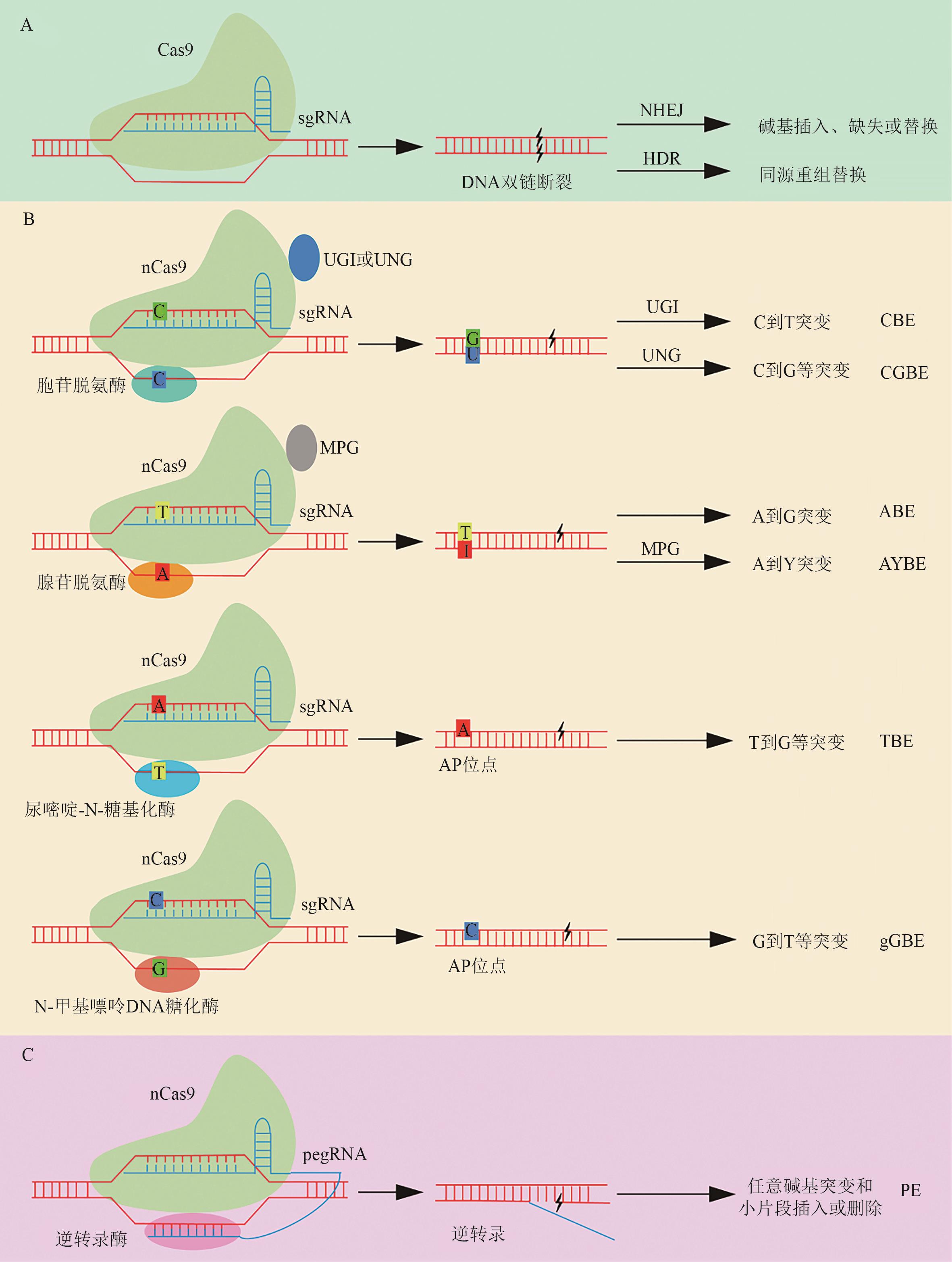
图1 基因编辑原理示意图A:CRISPR/Cas9工作原理示意图;B:碱基编辑器工作原理示意图;C:引导编辑系统工作原理示意图
Fig. 1 Schematic diagram of gene editing systemsA: Diagram of the CRISPR/Cas9 genome editing system. B: Diagram of base editors. C: Diagram of prime editors. gRNA: Single guide RNA. NHEJ: Non-homologous end joining. HDR: Homologous-directed repair. UGI: Uracil glycosylase inhibitor. UNG: Uracil N-glycosylase. CBE: Cytosine base editors. CGBE: Cytosine transversion base editors. MPG: N-methylpurine DNA glycosylase. ABE: Adenine base editors. AYBE: Adenine transversion base editors. AP: Apurinic/apyrimidinic. TBE: Glycosylase-based thymine base editors. gGBE: Glycosylase-based guanine base editors. pegRNA: Prime editing guide RNA. PE: Prime editing
编辑器类型 Editing class | 编辑载体 Editing tools | 突变位点 Mutation sites | 除草剂抗性 Herbicide resistance | 参考文献 Reference |
|---|---|---|---|---|
| NHEJ | pYLsgRNA-OsU3 | Gly628Trp | 甲咪唑烟酸,咪唑乙烟酸 | [ |
| HDR | pCXUN-Cas9, DNA donor | Trp548Leu, Ser627Ile | 双草醚 | [ |
| HDR | pZH-MMCas9, pPZ-mALS | Trp548Leu, Ser627Ile | 双草醚 | [ |
| HDR | Cas9-VirD2, DNAdonor | Trp548Leu | 双草醚 | [ |
| HDR | pCXUN-LbCpf1,RNA donor | Trp548Leu, Ser627Ile | 双草醚 | [ |
| HDR | LbCas12a, crRNA | Trp548Leu, Ser627Ile | 双草醚 | [ |
| CBE | pHUE411-BE3-sgRNA-nCas9 | Pro171Ser, Pro171Ala, Pro171Try, Pro171Phe | 烟嘧磺隆 | [ |
| Pro171Phe/Gly628Glu/Gly629Ser | 甲咪唑烟酸 | |||
| GBE | OsGTBE: nCas9-gMPGv6.3 | Pro171Thr/Asn/His/Arg | 氟唑磺隆 | [ |
| Gly628Trp/Val/Leu | 咪唑乙烟酸 | |||
| ABE | rBE49b (TadA9) | Ser627Gly | 咪唑啉酮 | [ |
| TadDE | TadDE | Arg190His, Gly628Glu, Gly629Ser, Gly628Glu/Gly629Ser | 双草醚 | [ |
| BEMGE | pUbi:rBE9, pUbi:rBE14 | Ala152Thr, Ala154Thr, Pro171Phe/Leu/Ser, Arg190His | 双草醚 | [ |
| PE | PE2, PE3 | Trp548Leu | 双草醚 | [ |
| PE | ePPE: nCas9-NC-RT pegRNA | Trp542Leu, Ser621Ile, Pro165Ser | 甲咪唑烟酸,烟嘧磺隆 | [ |
| PE | PE-P1,PE-P2 | Thr548Leu, Pro171Ser | 咪唑啉酮 | [ |
| PE | PE3-HS, PE3-AS, PE3-DS | Ser627Ile | 双草醚 | [ |
| PE | Sp-PE2, Sp-PE3, Sa-PE3 | Ser627Asn | 咪唑啉酮 | [ |
表1 利用基因编辑获得的抗乙酰乳酸合成酶(ALS)抑制剂类水稻
Table 1 Acetolactate synthase (ALS)-inhibiting herbicide-resistant rice generated by gene editing
编辑器类型 Editing class | 编辑载体 Editing tools | 突变位点 Mutation sites | 除草剂抗性 Herbicide resistance | 参考文献 Reference |
|---|---|---|---|---|
| NHEJ | pYLsgRNA-OsU3 | Gly628Trp | 甲咪唑烟酸,咪唑乙烟酸 | [ |
| HDR | pCXUN-Cas9, DNA donor | Trp548Leu, Ser627Ile | 双草醚 | [ |
| HDR | pZH-MMCas9, pPZ-mALS | Trp548Leu, Ser627Ile | 双草醚 | [ |
| HDR | Cas9-VirD2, DNAdonor | Trp548Leu | 双草醚 | [ |
| HDR | pCXUN-LbCpf1,RNA donor | Trp548Leu, Ser627Ile | 双草醚 | [ |
| HDR | LbCas12a, crRNA | Trp548Leu, Ser627Ile | 双草醚 | [ |
| CBE | pHUE411-BE3-sgRNA-nCas9 | Pro171Ser, Pro171Ala, Pro171Try, Pro171Phe | 烟嘧磺隆 | [ |
| Pro171Phe/Gly628Glu/Gly629Ser | 甲咪唑烟酸 | |||
| GBE | OsGTBE: nCas9-gMPGv6.3 | Pro171Thr/Asn/His/Arg | 氟唑磺隆 | [ |
| Gly628Trp/Val/Leu | 咪唑乙烟酸 | |||
| ABE | rBE49b (TadA9) | Ser627Gly | 咪唑啉酮 | [ |
| TadDE | TadDE | Arg190His, Gly628Glu, Gly629Ser, Gly628Glu/Gly629Ser | 双草醚 | [ |
| BEMGE | pUbi:rBE9, pUbi:rBE14 | Ala152Thr, Ala154Thr, Pro171Phe/Leu/Ser, Arg190His | 双草醚 | [ |
| PE | PE2, PE3 | Trp548Leu | 双草醚 | [ |
| PE | ePPE: nCas9-NC-RT pegRNA | Trp542Leu, Ser621Ile, Pro165Ser | 甲咪唑烟酸,烟嘧磺隆 | [ |
| PE | PE-P1,PE-P2 | Thr548Leu, Pro171Ser | 咪唑啉酮 | [ |
| PE | PE3-HS, PE3-AS, PE3-DS | Ser627Ile | 双草醚 | [ |
| PE | Sp-PE2, Sp-PE3, Sa-PE3 | Ser627Asn | 咪唑啉酮 | [ |
编辑器类型 Editing class | 编辑载体 Editing tools | 突变位点 Mutation sites | 除草剂抗性 Herbicide resistance | 参考文献 Reference |
|---|---|---|---|---|
| ABE | pHUE411-PABE-7-esgRNA | Cys2186Arg | 氟吡甲禾灵 | [ |
| ABE | rBE49b (TadA9) | Cys2186Lys | 氟吡甲禾灵 | [ |
| A/CBE | pHUC411-derived eBE3/eABE | Trp2125Ser, Ile1879Val, Cys2186Arg | 氟吡甲禾灵 | [ |
| A/C/DBE | (STEME-NG), APOBEC3A-ecTadA ecTadA7.10-pOsU3 | Trp2125Cys, Pro1927Phe, Ser1866Phe, Ala1884Pro | 氟吡甲禾灵 | [ |
| A/C/DBE | ACE5-nSpCas9 | Ile1879Leu, Ile1879Val, Trp2125Leu, Trp2125Gln, Trp2125Cys, Trp2125Cys/Arg2126Lys, Trp2125Ser, Trp2125Ser/Arg, Trp2125Ser/Gln, Trp2125Ser/2126Lys, Trp2125Cys/2126Lys/Gly2127Ser Cys2186His, Cys2186Arg, Gly2194Ser | 氟吡甲禾灵 | [ |
| A/C/DBE | (pH-MoBE), PlantBE-CODE-TadA9 CDA1 | Trp2125Cys, Ile2139Asn, Cys2186Arg | 氟吡甲禾灵 | [ |
| PE | (pPE2), SpCas9 derived eBE3 and eABE | Trp2125Cys | 氟吡甲禾灵 | [ |
| PE | PE-P1, PE-P2 | Asp2176Gly, Gly2201Ala | 氟吡甲禾灵 | [ |
| PE | (pPE2), SpCas9 derived eBE3 and eABE | Pro1927Tyr/Phe, Ile1879Ser/Thr/Leu/Val, Trp2097Leu/Gly, Ile2139Ser/Val/Asn, Asp2176Gly, Gly2194Ser | 氟吡甲禾灵 | [ |
表2 利用基因编辑获得的抗乙酰辅酶A羧化酶(ACCase)抑制剂类水稻
Table 2 Acetyl-CoA carboxylase (ACCase)-inhibiting herbicide-resistant rice generated by gene editing
编辑器类型 Editing class | 编辑载体 Editing tools | 突变位点 Mutation sites | 除草剂抗性 Herbicide resistance | 参考文献 Reference |
|---|---|---|---|---|
| ABE | pHUE411-PABE-7-esgRNA | Cys2186Arg | 氟吡甲禾灵 | [ |
| ABE | rBE49b (TadA9) | Cys2186Lys | 氟吡甲禾灵 | [ |
| A/CBE | pHUC411-derived eBE3/eABE | Trp2125Ser, Ile1879Val, Cys2186Arg | 氟吡甲禾灵 | [ |
| A/C/DBE | (STEME-NG), APOBEC3A-ecTadA ecTadA7.10-pOsU3 | Trp2125Cys, Pro1927Phe, Ser1866Phe, Ala1884Pro | 氟吡甲禾灵 | [ |
| A/C/DBE | ACE5-nSpCas9 | Ile1879Leu, Ile1879Val, Trp2125Leu, Trp2125Gln, Trp2125Cys, Trp2125Cys/Arg2126Lys, Trp2125Ser, Trp2125Ser/Arg, Trp2125Ser/Gln, Trp2125Ser/2126Lys, Trp2125Cys/2126Lys/Gly2127Ser Cys2186His, Cys2186Arg, Gly2194Ser | 氟吡甲禾灵 | [ |
| A/C/DBE | (pH-MoBE), PlantBE-CODE-TadA9 CDA1 | Trp2125Cys, Ile2139Asn, Cys2186Arg | 氟吡甲禾灵 | [ |
| PE | (pPE2), SpCas9 derived eBE3 and eABE | Trp2125Cys | 氟吡甲禾灵 | [ |
| PE | PE-P1, PE-P2 | Asp2176Gly, Gly2201Ala | 氟吡甲禾灵 | [ |
| PE | (pPE2), SpCas9 derived eBE3 and eABE | Pro1927Tyr/Phe, Ile1879Ser/Thr/Leu/Val, Trp2097Leu/Gly, Ile2139Ser/Val/Asn, Asp2176Gly, Gly2194Ser | 氟吡甲禾灵 | [ |
编辑器类型 Editing class | 编辑载体 Editing tools | 突变位点 Mutation sites | 参考文献 Reference |
|---|---|---|---|
| NHEJ-Crispr/Cas9 | pHUN411 | Thr173Ile, Pro177Ser | [ |
| HDR-Crispr/Cas9 | SpCas9: NICTK-1 pCRISPR-Cas9, HDR OsEPSPS template | Gly172Ala, Thr173Ile, Pro177Ser | [ |
| BE | STCBE-2: nCas9(D10A)-NG | Asp213Asn | [ |
| PE | pCXUN-Ubi-nCas9 NLS-PolyA E9 vector | Thr169Ile, Ala170Val, Pro173Ser | [ |
| PE | ePE5max | Thr173Ile, Ala174Val, Pro177Ser | [ |
| PE | PE3max | Thr173Ile, Ala174Val, Pro177Ser | [ |
表3 利用基因编辑获得的抗草甘膦水稻
Table 3 Glyphosate-resistant rice generated by gene editing
编辑器类型 Editing class | 编辑载体 Editing tools | 突变位点 Mutation sites | 参考文献 Reference |
|---|---|---|---|
| NHEJ-Crispr/Cas9 | pHUN411 | Thr173Ile, Pro177Ser | [ |
| HDR-Crispr/Cas9 | SpCas9: NICTK-1 pCRISPR-Cas9, HDR OsEPSPS template | Gly172Ala, Thr173Ile, Pro177Ser | [ |
| BE | STCBE-2: nCas9(D10A)-NG | Asp213Asn | [ |
| PE | pCXUN-Ubi-nCas9 NLS-PolyA E9 vector | Thr169Ile, Ala170Val, Pro173Ser | [ |
| PE | ePE5max | Thr173Ile, Ala174Val, Pro177Ser | [ |
| PE | PE3max | Thr173Ile, Ala174Val, Pro177Ser | [ |
靶标基因 Target genes | 编辑器类型 Editing class | 编辑载体 Editing tools | 突变位点 Mutation sites | 除草剂抗性 Herbicide resistance | 参考文献 References |
|---|---|---|---|---|---|
| OsGS1 | A/C/DBE | CRISPR/Sc++rBE73b | Glu131Gly | 草铵膦 | [ |
| A/C/DBE | (BEMGE), rBE5/22/49b/53 102sgRNAs | Ala63Val Pro64Ser,+Ala Phe,S59GT60A | 草铵膦 | [ | |
| ABE | rBE49b (TadA9) | His249Arg | 草铵膦 | [ | |
| OsARF18 | NHEJ | CRISPR-Cas9 | LOC_Os06g47150 | 草铵膦 | [ |
| OsSPL10 | NHEJ | CRISPR-Cas9 | LOC_Os06g44860 | 草铵膦 | [ |
| OsHPPD | NHEJ | CRISPR-Cas9 | Promoter replacement by 338 kb chromosome inversion | 硝磺草酮 | [ |
| OsHPPD | NHEJ | CRISPR-Cas9 and Cas12a | 3’ UTR, +1/-1 bp at position 2304 | 硝磺草酮 | [ |
| OsHIS | PE | twinPE/GRAND | OsHIS1 (+28 bp), | 硝磺草酮 | [ |
| OsDNR1 | NHEJ | CRISPR-Cas9 | LOC_Os01g08270 | 苯唑草酮、异噁唑草酮 | [ |
| OsTubA2 | ABE | rBE14/sgRNA | Met268Thr | 二甲戊灵、氟乐灵 | [ |
| ABE | rBE49b (TadA9) | Met268Thr | 二甲戊灵 | [ |
表4 利用基因编辑获得的抗其他类型除草剂水稻
Table 4 Other herbicides-resistant rice generated by gene editing
靶标基因 Target genes | 编辑器类型 Editing class | 编辑载体 Editing tools | 突变位点 Mutation sites | 除草剂抗性 Herbicide resistance | 参考文献 References |
|---|---|---|---|---|---|
| OsGS1 | A/C/DBE | CRISPR/Sc++rBE73b | Glu131Gly | 草铵膦 | [ |
| A/C/DBE | (BEMGE), rBE5/22/49b/53 102sgRNAs | Ala63Val Pro64Ser,+Ala Phe,S59GT60A | 草铵膦 | [ | |
| ABE | rBE49b (TadA9) | His249Arg | 草铵膦 | [ | |
| OsARF18 | NHEJ | CRISPR-Cas9 | LOC_Os06g47150 | 草铵膦 | [ |
| OsSPL10 | NHEJ | CRISPR-Cas9 | LOC_Os06g44860 | 草铵膦 | [ |
| OsHPPD | NHEJ | CRISPR-Cas9 | Promoter replacement by 338 kb chromosome inversion | 硝磺草酮 | [ |
| OsHPPD | NHEJ | CRISPR-Cas9 and Cas12a | 3’ UTR, +1/-1 bp at position 2304 | 硝磺草酮 | [ |
| OsHIS | PE | twinPE/GRAND | OsHIS1 (+28 bp), | 硝磺草酮 | [ |
| OsDNR1 | NHEJ | CRISPR-Cas9 | LOC_Os01g08270 | 苯唑草酮、异噁唑草酮 | [ |
| OsTubA2 | ABE | rBE14/sgRNA | Met268Thr | 二甲戊灵、氟乐灵 | [ |
| ABE | rBE49b (TadA9) | Met268Thr | 二甲戊灵 | [ |
| [1] | Wenefrida I, Utomo HS, Meche MM, et al. Inheritance of herbicide resistance in two germplasm lines of Clearfield* rice (Oryza sativa L.) [J]. Can J Plant Sci, 2007, 87(3): 659-669. |
| [2] | Chen L, Gu G, Wang CX, et al. Trp548Met mutation of acetolactate synthase in rice confers resistance to a broad spectrum of ALS-inhibiting herbicides [J]. Crop J, 2021, 9(4): 750-758. |
| [3] | Gaj T, Gersbach CA, Barbas CF. ZFN, TALEN, and CRISPR/Cas-based methods for genome engineering [J]. Trends Biotechnol, 2013, 31(7): 397-405. |
| [4] | Shan QW, Wang YP, Li J, et al. Targeted genome modification of crop plants using a CRISPR-Cas system [J]. Nat Biotechnol, 2013, 31(8): 686-688. |
| [5] | Mali P, Yang LH, Esvelt KM, et al. RNA-guided human genome engineering via Cas9 [J]. Science, 2013, 339(6121): 823-826. |
| [6] | Cong L, Ran FA, Cox D, et al. Multiplex genome engineering using CRISPR/cas systems [J]. Science, 2013, 339(6121): 819-823. |
| [7] | Wiedenheft B, Lander GC, Zhou KH, et al. Structures of the RNA-guided surveillance complex from a bacterial immune system [J]. Nature, 2011, 477(7365): 486-489. |
| [8] | Fichtner F, Urrea Castellanos R, Ülker B. Precision genetic modifications: a new era in molecular biology and crop improvement [J]. Planta, 2014, 239(4): 921-939. |
| [9] | Mladenov E, Iliakis G. Induction and repair of DNA double strand breaks: The increasing spectrum of non-homologous end joining pathways [J]. Mutat Res Fundam Mol Mech Mutagen, 2011, 711(1-2): 61-72. |
| [10] | Siebert R, Puchta H. Efficient repair of genomic double-strand breaks by homologous recombination between directly repeated sequences in the plant genome [J]. Plant Cell, 2002, 14(5): 1121-1131. |
| [11] | 宗媛, 高彩霞. 碱基编辑系统研究进展 [J]. 遗传, 2019, 41(9): 777-800. |
| Zong Y, Gao CX. Progress on base editing systems [J]. Hereditas, 2019, 41(9): 777-800. | |
| [12] | Kurt IC, Zhou RH, Iyer S, et al. CRISPR C-to-G base editors for inducing targeted DNA transversions in human cells [J]. Nat Biotechnol, 2021, 39(1): 41-46. |
| [13] | Tong HW, Wang XC, Liu YH, et al. Programmable A-to-Y base editing by fusing an adenine base editor with an N-methylpurine DNA glycosylase [J]. Nat Biotechnol, 2023, 41(8): 1080-1084. |
| [14] | Kuang YJ, Wu XM, Liu MJ, et al. Developing glycosylase-based T-to-G and C-to-K base editors in rice [J]. Plant Biotechnol J, 2025, 23(6): 2358-2360. |
| [15] | Liu L, Zhang ZM, Wang CY, et al. Developing guanine base editors for G-to-T editing in rice [J]. J Integr Plant Biol, 2024, 66(8): 1557-1560. |
| [16] | Li C, Zong Y, Jin S, et al. SWISS: multiplexed orthogonal genome editing in plants with a Cas9 nickase and engineered CRISPR RNA scaffolds [J]. Genome Biol, 2020, 21: 141. |
| [17] | Xie JK, Huang XY, Wang X, et al. ACBE, a new base editor for simultaneous C-to-T and A-to-G substitutions in mammalian systems [J]. BMC Biol, 2020, 18: 131. |
| [18] | Li C, Zhang R, Meng XB, et al. Targeted, random mutagenesis of plant genes with dual cytosine and adenine base editors [J]. Nat Biotechnol, 2020, 38(7): 875-882. |
| [19] | Zhang XH, Zhu BY, Chen L, et al. Dual base editor catalyzes both cytosine and adenine base conversions in human cells [J]. Nat Biotechnol, 2020, 38(7): 856-860. |
| [20] | Sakata RC, Ishiguro S, Mori H, et al. Base editors for simultaneous introduction of C-to-T and A-to-G mutations [J]. Nat Biotechnol, 2020, 38(7): 865-869. |
| [21] | Grünewald J, Zhou RH, Lareau CA, et al. A dual-deaminase CRISPR base editor enables concurrent adenine and cytosine editing [J]. Nat Biotechnol, 2020, 38(7): 861-864. |
| [22] | Fan TT, Cheng YH, Wu YC, et al. High performance TadA-8e derived cytosine and dual base editors with undetectable off-target effects in plants [J]. Nat Commun, 2024, 15: 5103. |
| [23] | 周苏淮, 李芳, 李娟, 等. 植物基因组精准编辑技术——引导编辑 [J]. 科学通报, 2025, 70(16): 2414-2422. |
| Zhou SH, Li F, Li J, et al. Plant genome precise editing technology-prime editing [J]. Chin Sci Bull, 2025, 70(16): 2414-2422. | |
| [24] | Chen PJ, Hussmann JA, Yan J, et al. Enhanced prime editing systems by manipulating cellular determinants of editing outcomes [J]. Cell, 2021, 184(22): 5635-5652.e29. |
| [25] | Ferreira da Silva J, Oliveira GP, Arasa-Verge EA, et al. Prime editing efficiency and fidelity are enhanced in the absence of mismatch repair [J]. Nat Commun, 2022, 13: 760. |
| [26] | Lin QP, Zong Y, Xue CX, et al. Prime genome editing in rice and wheat [J]. Nat Biotechnol, 2020, 38(5): 582-585. |
| [27] | Lu Y, Qiao DX, Wang JY, et al. Two highly efficient prime editing systems based on the Csy4 CRISPR Endonuclease [J]. Plant Biotechnol J, 2026, 24(2): 828-830. |
| [28] | Heap I. The international survey of herbicide resistant weeds [EB/OL]. . |
| [29] | Wang FQ, Xu Y, Li WQ, et al. Creating a novel herbicide-tolerance OsALS allele using CRISPR/Cas9-mediated gene editing [J]. Crop J, 2021, 9(2): 305-312. |
| [30] | Sun YW, Zhang X, Wu CY, et al. Engineering herbicide-resistant rice plants through CRISPR/Cas9-mediated homologous recombination of acetolactate synthase [J]. Mol Plant, 2016, 9(4): 628-631. |
| [31] | Endo M, Mikami M, Toki S. Biallelic gene targeting in rice [J]. Plant Physiol, 2016, 170(2): 667-677. |
| [32] | Ali Z, Shami A, Sedeek K, et al. Fusion of the Cas9 endonuclease and the VirD2 relaxase facilitates homology-directed repair for precise genome engineering in rice [J]. Commun Biol, 2020, 3: 44. |
| [33] | Li SY, Li JY, He YB, et al. Precise gene replacement in rice by RNA transcript-templated homologous recombination [J]. Nat Biotechnol, 2019, 37(4): 445-450. |
| [34] | Li SY, Li JY, Zhang JH, et al. Synthesis-dependent repair of Cpf1-induced double strand DNA breaks enables targeted gene replacement in rice [J]. J Exp Bot, 2018, 69(20): 4715-4721. |
| [35] | Li SY, Zhang YX, Xia LQ, et al. CRISPR-Cas12a enables efficient biallelic gene targeting in rice [J]. Plant Biotechnol J, 2020, 18(6): 1351-1353. |
| [36] | Zhang R, Chen S, Meng XB, et al. Generating broad-spectrum tolerance to ALS-inhibiting herbicides in rice by base editing [J]. Sci China Life Sci, 2021, 64(10): 1624-1633. |
| [37] | Tian YF, Li XB, Xie JY, et al. Targeted G-to-T base editing for generation of novel herbicide-resistance gene alleles in rice [J]. J Integr Plant Biol, 2024, 66(6): 1048-1051. |
| [38] | Yan DQ, Ren B, Liu L, et al. High-efficiency and multiplex adenine base editing in plants using new TadA variants [J]. Mol Plant, 2021, 14(5): 722-731. |
| [39] | Kuang YJ, Li SF, Ren B, et al. Base-editing-mediated artificial evolution of OsALS1 in planta to develop novel herbicide-tolerant rice germplasms [J]. Mol Plant, 2020, 13(4): 565-572. |
| [40] | Butt H, Rao GS, Sedeek K, et al. Engineering herbicide resistance via prime editing in rice [J]. Plant Biotechnol J, 2020, 18(12): 2370-2372. |
| [41] | Zong Y, Liu YJ, Xue CX, et al. An engineered prime editor with enhanced editing efficiency in plants [J]. Nat Biotechnol, 2022, 40(9): 1394-1402. |
| [42] | Xu W, Zhang CW, Yang YX, et al. Versatile nucleotides substitution in plant using an improved prime editing system [J]. Mol Plant, 2020, 13(5): 675-678. |
| [43] | Li HY, Zhu ZW, Li SY, et al. Multiplex precision gene editing by a surrogate prime editor in rice [J]. Mol Plant, 2022, 15(7): 1077-1080. |
| [44] | Hua K, Jiang YW, Tao XP, et al. Precision genome engineering in rice using prime editing system [J]. Plant Biotechnol J, 2020, 18(11): 2167-2169. |
| [45] | Jang S, Marjanovic J, Gornicki P. Resistance to herbicides caused by single amino acid mutations in acetyl-CoA carboxylase in resistant populations of grassy weeds [J]. New Phytol, 2013, 197(4): 1110-1116. |
| [46] | 王瑶, 王荣焕, 冯铃洋, 等. 作物抗ACCase抑制剂类除草剂研究进展 [J]. 生物技术通报, 2024, 40(8): 13-23. |
| Wang Y, Wang RH, Feng LY, et al. Research progress of crop resistance to ACCase-inhibitor-like herbicides [J]. Biotechnol Bull, 2024, 40(8): 13-23. | |
| [47] | Li C, Zong Y, Wang YP, et al. Expanded base editing in rice and wheat using a Cas9-adenosine deaminase fusion [J]. Genome Biol, 2018, 19: 59. |
| [48] | Liu XS, Qin RY, Li J, et al. A CRISPR-Cas9-mediated domain-specific base-editing screen enables functional assessment of ACCase variants in rice [J]. Plant Biotechnol J, 2020, 18(9): 1845-1847. |
| [49] | Wang HZ, He YX, Wang YY, et al. Base editing-mediated targeted evolution of ACCase for herbicide-resistant rice mutants [J]. J Integr Plant Biol, 2022, 64(11): 2029-2032. |
| [50] | Zhang A, Shan TF, Sun Y, et al. Directed evolution rice genes with randomly multiplexed sgRNAs assembly of base editors [J]. Plant Biotechnol J, 2023, 21(12): 2597-2610. |
| [51] | Xu RF, Li J, Liu XS, et al. Development of plant prime-editing systems for precise genome editing [J]. Plant Commun, 2020, 1(3): 100043. |
| [52] | Xu RF, Liu XS, Li J, et al. Identification of herbicide resistance OsACC1 mutations via in planta prime-editing-library screening in rice [J]. Nat Plants, 2021, 7(7): 888-892. |
| [53] | Duke SO, Powles SB. Glyphosate: a once-in-a-century herbicide [J]. Pest Manag Sci, 2008, 64(4): 319-325. |
| [54] | Dill GM. Glyphosate-resistant crops: history, status and future [J]. Pest Manag Sci, 2005, 61(3): 219-224. |
| [55] | Li J, Meng XB, Zong Y, et al. Gene replacements and insertions in rice by intron targeting using CRISPR-Cas9 [J]. Nat Plants, 2016, 2(10): 16139. |
| [56] | Sony SK, Kaul T, Abdel Motelb KF, et al. CRISPR/Cas9-mediated homology donor repair base editing confers glyphosate resistance to rice (Oryza sativa L.) [J]. Front Plant Sci, 2023, 14: 1122926. |
| [57] | Zhang C, Zhong X, Li SY, et al. Artificial evolution of OsEPSPS through an improved dual cytosine and adenine base editor generated a novel allele conferring rice glyphosate tolerance [J]. J Integr Plant Biol, 2023, 65(9): 2194-2203. |
| [58] | Perotti VE, Larran AS, Palmieri VE, et al. A novel triple amino acid substitution in the EPSPS found in a high-level glyphosate-resistant Amaranthus hybridus population from Argentina [J]. Pest Manag Sci, 2019, 75(5): 1242-1251. |
| [59] | Li HY, Li JY, Chen JL, et al. Precise modifications of both exogenous and endogenous genes in rice by prime editing [J]. Mol Plant, 2020, 13(5): 671-674. |
| [60] | Jiang YY, Chai YP, Qiao DX, et al. Optimized prime editing efficiently generates glyphosate-resistant rice plants carrying homozygous TAP-IVS mutation in EPSPS [J]. Mol Plant, 2022, 15(11): 1646-1649. |
| [61] | Gupta A, Liu B, Raza S, et al. Modularly assembled multiplex prime editors for simultaneous editing of agronomically important genes in rice [J]. Plant Commun, 2024, 5(2): 100741. |
| [62] | James D, Borphukan B, Fartyal D, et al. Concurrent overexpression of OsGS1;1 and OsGS2 genes in transgenic rice (Oryza sativa L.): impact on tolerance to abiotic stresses [J]. Front Plant Sci, 2018, 9: 786. |
| [63] | Avila-Garcia WV, Sanchez-Olguin E, Hulting AG, et al. Target-site mutation associated with glufosinate resistance in Italian ryegrass (Lolium perenne L. ssp. multiflorum) [J]. Pest Manag Sci, 2012, 68(9): 1248-1254. |
| [64] | Goodman H, DasSarma S, Tischer E, et al. Expression of wild type and mutant glutamine synthetase in foreign hosts: US5098838A [P].1992-03-24. |
| [65] | Ma GG, Kuang YJ, Lu ZW, et al. CRISPR/Sc++-mediated genome editing in rice [J]. J Integr Plant Biol, 2021, 63(9): 1606-1610. |
| [66] | Pornprom T, Prodmatee N, Chatchawankanphanich O. Glutamine synthetase mutation conferring target-site-based resistance to glufosinate in soybean cell selections [J]. Pest Manag Sci, 2009, 65(2): 216-222. |
| [67] | Ren B, Kuang YJ, Xu ZY, et al. Three novel alleles of OsGS1 developed by base-editing-mediated artificial evolution confer glufosinate tolerance in rice [J]. Crop J, 2023, 11(2): 661-665. |
| [68] | Ren Y, Liu BM, Jiang HR, et al. Precision editing of GLR1 confers glufosinate resistance without yield penalty in rice [J]. Plant Biotechnol J, 2023, 21(12): 2417-2419. |
| [69] | Xia JQ, He DY, Liang QY, et al. Loss of OsARF18 function confers glufosinate resistance in rice [J]. Mol Plant, 2023, 16(9): 1355-1358. |
| [70] | Xia JQ, Liang QY, He DY, et al. Knockout of OsSPL10 confers enhanced glufosinate resistance in rice [J]. Plant Commun, 2024, 5(2): 100731. |
| [71] | Moran GR. 4-hydroxyphenylpyruvate dioxygenase [J]. Arch Biochem Biophys, 2005, 433(1): 117-128. |
| [72] | Ndikuryayo F, Moosavi B, Yang WC, et al. 4-hydroxyphenylpyruvate dioxygenase inhibitors: from chemical biology to agrochemicals [J]. J Agric Food Chem, 2017, 65(39): 8523-8537. |
| [73] | Küpper A, Peter F, Zöllner P, et al. Tembotrione detoxification in 4-hydroxyphenylpyruvate dioxygenase (HPPD) inhibitor-resistant Palmer amaranth (Amaranthus palmeri S. Wats.) [J]. Pest Manag Sci, 2018, 74(10): 2325-2334. |
| [74] | Nakka S, Godar AS, Wani PS, et al. Physiological and molecular characterization of hydroxyphenylpyruvate dioxygenase (HPPD)-inhibitor resistance in palmer amaranth (Amaranthus palmeri S.Wats.) [J]. Front Plant Sci, 2017, 8: 555. |
| [75] | Lu Y, Wang JY, Chen B, et al. A donor-DNA-free CRISPR/Cas-based approach to gene knock-up in rice [J]. Nat Plants, 2021, 7(11): 1445-1452. |
| [76] | Wu YY, Xiao N, Cai Y, et al. CRISPR-Cas9-mediated editing of the OsHPPD 3′UTR confers enhanced resistance to HPPD-inhibiting herbicides in rice [J]. Plant Commun, 2023, 4(5): 100605. |
| [77] | Maeda H, Murata K, Sakuma N, et al. A rice gene that confers broad-spectrum resistance to β-triketone herbicides [J]. Science, 2019, 365(6451): 393-396. |
| [78] | Liu XX, Wang YY, Wang HZ, et al. Generating herbicide resistant and dwarf rice germplasms through precise sequence insertion or replacement [J]. Plant Biotechnol J, 2024, 22(2): 293-295. |
| [79] | Li Y, Ling XT, Zhang WT, et al. OsDNR1 as a key regulator of rice resistance to 4-hydroxyphenylpyruvate dioxygenase-inhibiting herbicides [J]. J Integr Plant Biol, 2025, 67(9): 2262-2264. |
| [80] | Chu ZZ, Chen JY, Nyporko A, et al. Novel α-tubulin mutations conferring resistance to dinitroaniline herbicides in Lolium rigidum [J]. Front Plant Sci, 2018, 9: 97. |
| [81] | Anthony RG, Hussey PJ. Double mutation in Eleusine indica α-tubulin increases the resistance of transgenic maize calli to dinitroaniline and phosphorothioamidate herbicides [J]. Plant J, 1999, 18(6): 669-674. |
| [82] | Yamamoto E, Zeng LH, Baird WV. A-tubulin missense mutations correlate with antimicrotubule drug resistance in Eleusine indica [J]. Plant Cell, 1998, 10(2): 297. |
| [83] | Délye C, Menchari Y, Michel S, et al. Molecular bases for sensitivity to tubulin-binding herbicides in green foxtail [J]. Plant Physiol, 2004, 136(4): 3920-3932. |
| [84] | Hashim S, Jan A, Sunohara Y, et al. Mutation of alpha-tubulin genes in trifluralin-resistant water foxtail (Alopecurus aequalis) [J]. Pest Manag Sci, 2012, 68(3): 422-429. |
| [85] | Chen JY, Yu Q, Owen M, et al. Dinitroaniline herbicide resistance in a multiple-resistant Lolium rigidum population [J]. Pest Manag Sci, 2018, 74(4): 925-932. |
| [86] | Fleet B, Malone J, Preston C, et al. Target-site point mutation conferring resistance to trifluralin in rigid ryegrass (Lolium rigidum) [J]. Weed Sci, 2018, 66(2): 246-253. |
| [87] | Liu L, Kuang YJ, Yan F, et al. Developing a novel artificial rice germplasm for dinitroaniline herbicide resistance by base editing of OsTubA2 [J]. Plant Biotechnol J, 2021, 19(1): 5-7. |
| [88] | Wang X, Pan WB, Sun C, et al. Creating large-scale genetic diversity in Arabidopsis via base editing-mediated deep artificial evolution [J]. Genome Biol, 2024, 25: 215. |
| [89] | Butt H, Ramirez JLM, Mahfouz M. Synthetic evolution of herbicide resistance using a T7 RNAP-based random DNA base editor [J]. Life Sci Alliance, 2022, 5(12): e202201538. |
| [90] | Yu Q, Powles S. Metabolism-based herbicide resistance and cross-resistance in crop weeds: a threat to herbicide sustainability and global crop production [J]. Plant Physiol, 2014, 166(3): 1106-1118. |
| [91] | Su XN, Li CY, Liu XS, et al. The role of OsBZR4 as a brassinosteroid-signaling component in mediating atrazine and isoproturon degradation in rice [J]. J Hazard Mater, 2024, 473: 134625. |
| [1] | 曾亚丹, 毕佳俊, 李兴龙, 常悦, 角德灵, 魏红江, 赵恒. Cas12a介导的猪细胞定点插入体系构建与效率评估[J]. 生物技术通报, 2026, 42(8): 72-80. |
| [2] | 杨群, 李京, 符德保, 许婷婷. OsbHLH069通过对LAX1-LAX2复合体的竞争性干扰负调控水稻穗发育[J]. 生物技术通报, 2026, 42(8): 113-122. |
| [3] | 陈义焰, 张冬儿, 张涛, 刘育灏, 唐杰, 盛夏冰, 胡远艺, 艾治勇, 李应将, 刘小林. 水稻OsSULTR2;2基因功能及调控苗期耐盐性分析[J]. 生物技术通报, 2026, 42(7): 116-125. |
| [4] | 彭彦, 安晨, 韶也, 毛毕刚, 张学文, 赵炳然. 植物重金属响应可视化系统的构建与验证[J]. 生物技术通报, 2026, 42(7): 105-115. |
| [5] | 殷亚龙, 张明洋, 王洁敏, 苗雪雪, 陈劲, 王伟平. 水稻非生物胁迫协同耐受机制研究进展[J]. 生物技术通报, 2026, 42(4): 26-37. |
| [6] | 胡秋玲, 陈灵, 黄嘉怡, 赵梓乔, 潘璐怡, 刘慧丽, 刘太波. 多胺调控果实发育的研究进展[J]. 生物技术通报, 2026, 42(3): 203-212. |
| [7] | 马世杰, 李铮, 李蔚, 郭仰东, 张娜. 光信号调控园艺作物果实发育的研究进展[J]. 生物技术通报, 2026, 42(3): 5-18. |
| [8] | 刘淼, 林涛, 贾乐松, 胡丰, 李涛, 李志万, 刘美芳, 郑方燕, 崔龙. 从野生到栽培:番茄果实色泽的演化与调控机制[J]. 生物技术通报, 2026, 42(3): 187-202. |
| [9] | 袁梦博, 赵光伟, 贺玉花, 黄祥, 徐永阳, 张健, 孔维虎, 田小琴, 户克云, 唐伶俐. CmCRC基因影响甜瓜性别分化的功能研究[J]. 生物技术通报, 2026, 42(3): 294-301. |
| [10] | 陈玲嫣, 李伟勋, 逄欣欣, 高翔, 焦绪瑶. 拟杆菌遗传操作工具箱:从传统方法到合成生物学前沿[J]. 生物技术通报, 2026, 42(2): 51-64. |
| [11] | 王程程, 黄天宇, 张晴, 史来权, 方慧敏, 张龙. 一个水稻粉质胚乳突变体的表型分析和基因定位[J]. 生物技术通报, 2026, 42(2): 169-177. |
| [12] | 杨跃琴, 邢英, 仲子荷, 田维军, 杨雪清, 王建旭. 甲基汞胁迫下水稻OsMATE34的表达及功能分析[J]. 生物技术通报, 2026, 42(1): 86-94. |
| [13] | 费思恬, 侯鹰翔, 李兰, 张超. 水稻赤霉素信号负调控因子SLR1的生物学功能及其调控网络[J]. 生物技术通报, 2026, 42(1): 13-30. |
| [14] | 王芳, 邵会茹, 吕林龙, 赵点, 胡振, 吕建珍, 姜亮. 植物和细菌TurboID邻近蛋白标记方法的建立[J]. 生物技术通报, 2025, 41(9): 44-53. |
| [15] | 邓美壁, 严浪, 詹志田, 朱敏, 和玉兵. RUBY辅助的水稻高效CRISPR基因编辑[J]. 生物技术通报, 2025, 41(8): 65-73. |
| 阅读次数 | ||||||
|
全文 |
|
|||||
|
摘要 |
|
|||||
