







生物技术通报 ›› 2026, Vol. 42 ›› Issue (9): 147-156.doi: 10.13560/j.cnki.biotech.bull.1985.2026-0024
• 植物发育生物学专题 • 上一篇
范丽金1,2,3, 宋晓飞2,3, 李晓丽1,2,3, 闫立英1,2,3( ), 谢洋1,2,3()
收稿日期:2026-01-08
出版日期:2026-09-26
发布日期:2026-09-16
通讯作者:
闫立英yanliying66@126.com基金资助:
FAN Li-jin1,2,3, SONG Xiao-fei2,3, LI Xiao-li1,2,3, YAN Li-ying1,2,3(), XIE Yang1,2,3()
Received:2026-01-08
Published:2026-09-26
Online:2026-09-16
摘要:
目的 探究生产中外源生长调节剂调控“顶花带刺”这一关键商品性状的分子机制,为进一步通过分子育种改良黄瓜鲜食品质提供理论依据。 方法 基于转录组与代谢组分析,比较不同发育阶段中蘸花与未蘸花处理下黄瓜雌花花冠的基因表达与代谢物变化,筛选出调控黄瓜雌花花冠延迟开放的关键基因与代谢产物,初步解析黄瓜雌花花冠经处理后延迟脱落的分子调控机制。 结果 在nDF_0d vs DF_0d、nDF_2d vs DF_2d和nDF_4d vs DF_4d 3个比较组中,分别鉴定到3 508、3 581和5 752个差异表达基因。这些基因在植物激素信号转导途径(csv04075)、苯丙烷生物合成途径(csv00940)及苯丙氨酸代谢途径(csv00360)中均显著富集,其中生长素相关基因,包括AUX28(Csa07g1708)、IAA14(Csa02g0970)、GH3.1(Csa06g2748)和ARF19(Csa02g0003)等可能在调控黄瓜花冠延迟开放中发挥关键作用。代谢组分析进一步表明,酚酸、阿魏酸衍生物和类黄酮等次生代谢物在相应处理中积累显著,尤其是苯丙素类和黄酮类化合物,与黄瓜花冠持续开放密切相关,这可能与它们在细胞壁弹性、抗氧化活性和激素调控中的作用有关。 结论 蘸花处理诱导的生长素主导响应,通过拮抗乙烯信号延迟黄瓜花冠开放;未蘸花处理则以乙烯为核心的调控路径促进黄瓜花冠脱落。
范丽金, 宋晓飞, 李晓丽, 闫立英, 谢洋. 基于转录组与代谢组解析黄瓜雌花花冠延迟开放的关键调控通路[J]. 生物技术通报, 2026, 42(9): 147-156.
FAN Li-jin, SONG Xiao-fei, LI Xiao-li, YAN Li-ying, XIE Yang. Integrated Transcriptome and Metabolome Analysis Reveals Key Regulatory Pathways Underlying Delayed Female Corolla Opening in Cucumber[J]. Biotechnology Bulletin, 2026, 42(9): 147-156.
化合物ID Compound_ID | 名字 Name | DF_0d | nDF_0d | DF_2d | nDF_2d | DF_4d | nDF_4d |
|---|---|---|---|---|---|---|---|
| Com_985_neg | 4',5,7-三甲氧基黄酮醇 4',5,7-Trimethoxyflavonol | 99 812 | 2 014 827 | 2 586 900 | 3 922 485 | 97 925 | 5 018 405 |
| Com_427_neg | 阿魏酸异丙酯 Isopropyl ferulate | 21 846 690 | 14 777 483 | 17 392 990 | 19 573 931 | 11 530 980 | 16 744 514 |
| Com_554_neg | 异阿魏酸 Isoferulic acid | 1 221 127 | 4 219 810 | 7 698 845 | 1 494 036 | 5 608 662 | 664 965 |
| Com_757_neg | 紫杉叶素 Taxifolin | 5 801 315 | 20 924 851 | 4 556 372 | 11 860 780 | 2 852 499 | 3 048 801 |
| Com_949_neg | 甲基麦冬酮 A Methylophiopogonone A | 10 963 630 | 12 663 286 | 301 010 | 39 368 378 | 568 404 | 17 869 891 |
| Com_4340_neg | 异香草素 Exoticin | 3 430 495 | 9 128 613 | 10 462 639 | 5 841 462 | 9 034 048 | 5 633 944 |
| Com_4335_neg | 山柰酚-7-O-葡萄糖醛酸苷 kaempferol 7-O-glucuronide | 1 015 134 | 468 478 | 6 944 203 | 5 443 416 | 2 904 047 | 6 374 979 |
| Com_4641_neg | 6-甲氧基山柰酚-3-(6''-乙酰葡萄糖苷) 6-Methoxykaempferol 3-(6''-acetylglucoside) | 193 070 843 | 353 025 210 | 134 610 782 | 314486278 | 86 323 233 | 134 778 258 |
| Com_4079_neg | 5,3',5'-三羟基-3,6,7,8,4'-五甲氧基黄酮 5,3',5'-Trihydroxy-3,6,7,8,4'-pentamethoxyflavone | 5 864 270 | 62 703 343 | 56 892 969 | 128 853 000 | 29 644 666 | 363 265 415 |
| Com_3031_neg | 胡麻黄素 Pedalitin | 14 778 991 | 29 971 631 | 9 555 536 | 25 735 469 | 5 751 055 | 11 617 497 |
| Com_1134_neg | 阿魏酸松柏酯 Coniferyl ferulate | 95 023 | 1 262 222 | 11 012 131 | 2 647 689 | 39 000 914 | 4 963 227 |
| Com_2320_neg | 咖啡酸-4-O-硫酸酯 Caffeic acid 4-O-sulfate | 7 765 051 | 3 391 782 | 562 561 | 2 040 834 | 1 733 624 | 3 814 649 |
| Com_4416_neg | 反式咖啡酸-[芹菜糖基-(1→6)-葡萄糖基]酯 trans-Caffeic acid [apiosyl-(1->6)-glucosyl] ester | 13 375 922 | 22 601 763 | 12 451 711 | 9 133 318 | 25 147 790 | 9 179 527 |
| Com_4640_neg | 3,3',5-三羟基-4'-甲氧基-6,7-亚甲二氧基黄酮-3-葡糖醛酸苷 3,3',5-Trihydroxy-4'-methoxy-6,7-methylenedioxyflavone 3-glucuronide | 28 411 607 | 21 071 365 | 57 485 453 | 71 630 275 | 30 797 856 | 61 048 706 |
| Com_4635_neg | 染料木素-8-C-葡萄糖苷-6″-O-丙二酸酯 Genistein 8-C-glucoside 6″-O-malonate | 6 040 661 | 25 638 724 | 9 716 662 | 43 509 690 | 14 019 377 | 20 772 415 |
| Com_3858_neg | 8-C-对羟基苄基山奈酚 9-8-C-p-Hydroxybenzylkaempferol | 5 899 335 | 176 884 | 6 459 625 | 8 099 458 | 880 644 | 17 677 543 |
| Com_3677_neg | 7,8,3',4',5'-五甲氧基异黄酮 7,8,3',4',5'-Pentamethoxyisoflavone | 6 222 719 | 10 991 494 | 265 441 | 1 086 138 | 2 494 967 | 554 146 |
| Com_4707_neg | 5,7-二羟基-8,3',4',5'-四甲氧基黄酮-6-C-葡萄糖苷 5,7-Dihydroxy-8,3',4',5'-tetramethoxyflavone 6-C-glucoside | 956 993 | 14 674 867 | 1 563 193 | 21 773 921 | 10 957 937 | 18 130 177 |
| Com_4474_neg | 表没食子儿茶素-3-O-阿魏酸酯 Epigallocatechin-3-O-ferulate | 288 455 | 2 801 330 | 10 936 700 | 3 029 505 | 44 030 371 | 10 394 177 |
| Com_3950_neg | 5,6,7,3',4',5'-六甲氧基黄酮 5,6,7,3',4',5'-Hexamethoxyflavone | 2 250 713 | 16 100 866 | 28 902 532 | 29 435 394 | 14 485 535 | 26 265 020 |
表1 负离子模式下不同阶段蘸花和未蘸花黄瓜花冠中鉴定出的苯丙素类相关代谢物
Table 1 Phenylpropanoid-related metabolites identified in dipped and non-dipped cucumber corollas at different stages under negative ion mode
化合物ID Compound_ID | 名字 Name | DF_0d | nDF_0d | DF_2d | nDF_2d | DF_4d | nDF_4d |
|---|---|---|---|---|---|---|---|
| Com_985_neg | 4',5,7-三甲氧基黄酮醇 4',5,7-Trimethoxyflavonol | 99 812 | 2 014 827 | 2 586 900 | 3 922 485 | 97 925 | 5 018 405 |
| Com_427_neg | 阿魏酸异丙酯 Isopropyl ferulate | 21 846 690 | 14 777 483 | 17 392 990 | 19 573 931 | 11 530 980 | 16 744 514 |
| Com_554_neg | 异阿魏酸 Isoferulic acid | 1 221 127 | 4 219 810 | 7 698 845 | 1 494 036 | 5 608 662 | 664 965 |
| Com_757_neg | 紫杉叶素 Taxifolin | 5 801 315 | 20 924 851 | 4 556 372 | 11 860 780 | 2 852 499 | 3 048 801 |
| Com_949_neg | 甲基麦冬酮 A Methylophiopogonone A | 10 963 630 | 12 663 286 | 301 010 | 39 368 378 | 568 404 | 17 869 891 |
| Com_4340_neg | 异香草素 Exoticin | 3 430 495 | 9 128 613 | 10 462 639 | 5 841 462 | 9 034 048 | 5 633 944 |
| Com_4335_neg | 山柰酚-7-O-葡萄糖醛酸苷 kaempferol 7-O-glucuronide | 1 015 134 | 468 478 | 6 944 203 | 5 443 416 | 2 904 047 | 6 374 979 |
| Com_4641_neg | 6-甲氧基山柰酚-3-(6''-乙酰葡萄糖苷) 6-Methoxykaempferol 3-(6''-acetylglucoside) | 193 070 843 | 353 025 210 | 134 610 782 | 314486278 | 86 323 233 | 134 778 258 |
| Com_4079_neg | 5,3',5'-三羟基-3,6,7,8,4'-五甲氧基黄酮 5,3',5'-Trihydroxy-3,6,7,8,4'-pentamethoxyflavone | 5 864 270 | 62 703 343 | 56 892 969 | 128 853 000 | 29 644 666 | 363 265 415 |
| Com_3031_neg | 胡麻黄素 Pedalitin | 14 778 991 | 29 971 631 | 9 555 536 | 25 735 469 | 5 751 055 | 11 617 497 |
| Com_1134_neg | 阿魏酸松柏酯 Coniferyl ferulate | 95 023 | 1 262 222 | 11 012 131 | 2 647 689 | 39 000 914 | 4 963 227 |
| Com_2320_neg | 咖啡酸-4-O-硫酸酯 Caffeic acid 4-O-sulfate | 7 765 051 | 3 391 782 | 562 561 | 2 040 834 | 1 733 624 | 3 814 649 |
| Com_4416_neg | 反式咖啡酸-[芹菜糖基-(1→6)-葡萄糖基]酯 trans-Caffeic acid [apiosyl-(1->6)-glucosyl] ester | 13 375 922 | 22 601 763 | 12 451 711 | 9 133 318 | 25 147 790 | 9 179 527 |
| Com_4640_neg | 3,3',5-三羟基-4'-甲氧基-6,7-亚甲二氧基黄酮-3-葡糖醛酸苷 3,3',5-Trihydroxy-4'-methoxy-6,7-methylenedioxyflavone 3-glucuronide | 28 411 607 | 21 071 365 | 57 485 453 | 71 630 275 | 30 797 856 | 61 048 706 |
| Com_4635_neg | 染料木素-8-C-葡萄糖苷-6″-O-丙二酸酯 Genistein 8-C-glucoside 6″-O-malonate | 6 040 661 | 25 638 724 | 9 716 662 | 43 509 690 | 14 019 377 | 20 772 415 |
| Com_3858_neg | 8-C-对羟基苄基山奈酚 9-8-C-p-Hydroxybenzylkaempferol | 5 899 335 | 176 884 | 6 459 625 | 8 099 458 | 880 644 | 17 677 543 |
| Com_3677_neg | 7,8,3',4',5'-五甲氧基异黄酮 7,8,3',4',5'-Pentamethoxyisoflavone | 6 222 719 | 10 991 494 | 265 441 | 1 086 138 | 2 494 967 | 554 146 |
| Com_4707_neg | 5,7-二羟基-8,3',4',5'-四甲氧基黄酮-6-C-葡萄糖苷 5,7-Dihydroxy-8,3',4',5'-tetramethoxyflavone 6-C-glucoside | 956 993 | 14 674 867 | 1 563 193 | 21 773 921 | 10 957 937 | 18 130 177 |
| Com_4474_neg | 表没食子儿茶素-3-O-阿魏酸酯 Epigallocatechin-3-O-ferulate | 288 455 | 2 801 330 | 10 936 700 | 3 029 505 | 44 030 371 | 10 394 177 |
| Com_3950_neg | 5,6,7,3',4',5'-六甲氧基黄酮 5,6,7,3',4',5'-Hexamethoxyflavone | 2 250 713 | 16 100 866 | 28 902 532 | 29 435 394 | 14 485 535 | 26 265 020 |
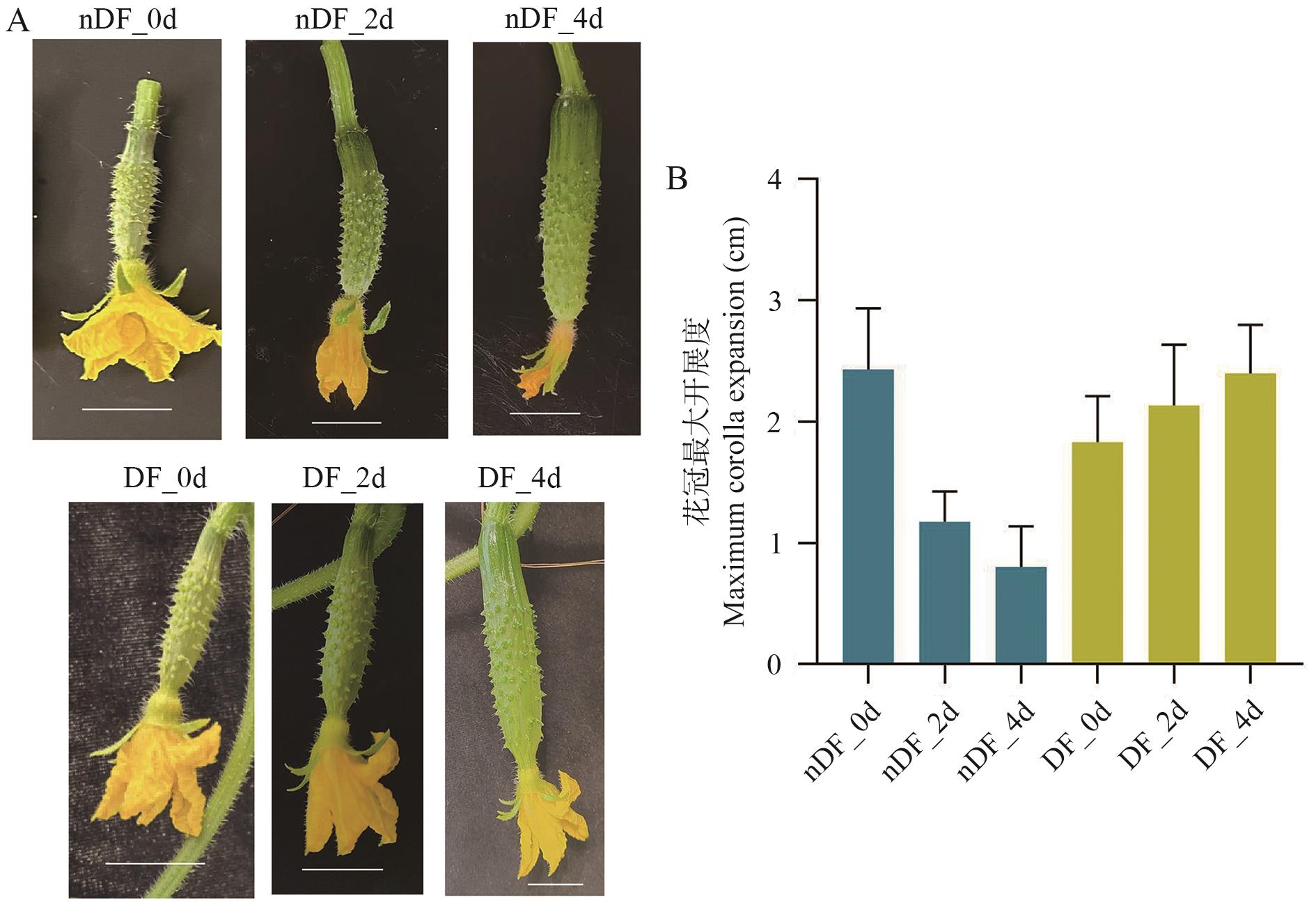
图1 不同阶段蘸花和未蘸花黄瓜花冠的形态差异nDF_0d、nDF_2d、nDF_4d表示未蘸花处理0、2和4 d,DF_0d、DF_2d、DF_4d表示蘸花处理0、2和4 d;比例尺为1 cm。下同
Fig. 1 Morphological differences between dipped and non-dipped cucumber corollas at different stagesnDF_0d, nDF_2d, and nDF_4d indicates 0, 2, and 4 d without flower dipping treatment, while DF_0d, DF_2d, and DF_4d represent 0, 2, and 4 d with flower dipping treatment. The scale is 1 cm. The same below
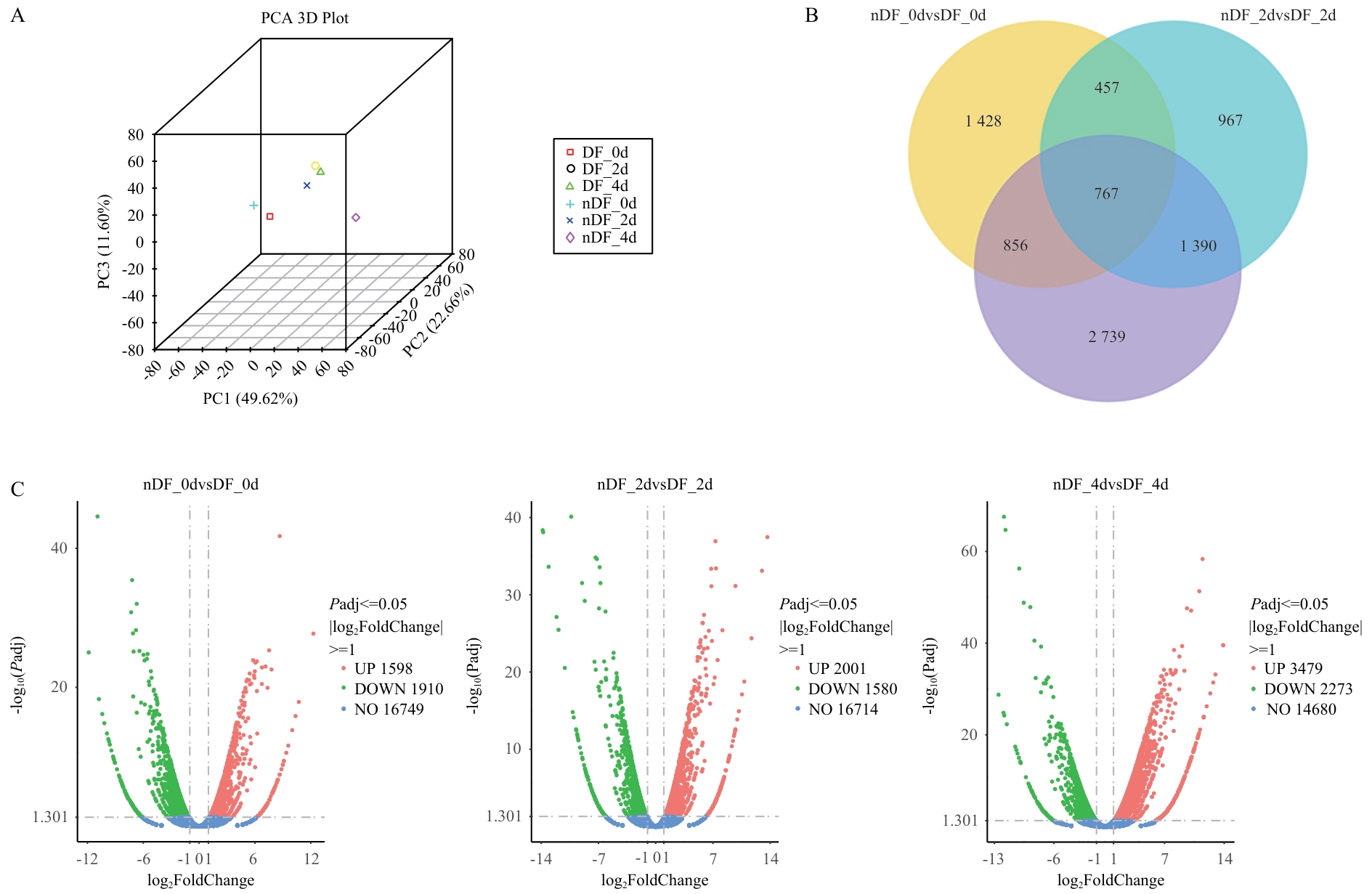
图2 不同发育阶段黄瓜蘸花处理与未蘸花处理花冠中差异表达基因的鉴定A:主成分分析;B:韦恩图;C:火山图分析
Fig. 2 Identification of differentially expressed genes between dipped and non-dipped cucumber corollas at different developmental stagesA: The principal component analysis. B: Venn diagram. C: Volcano plot analysis
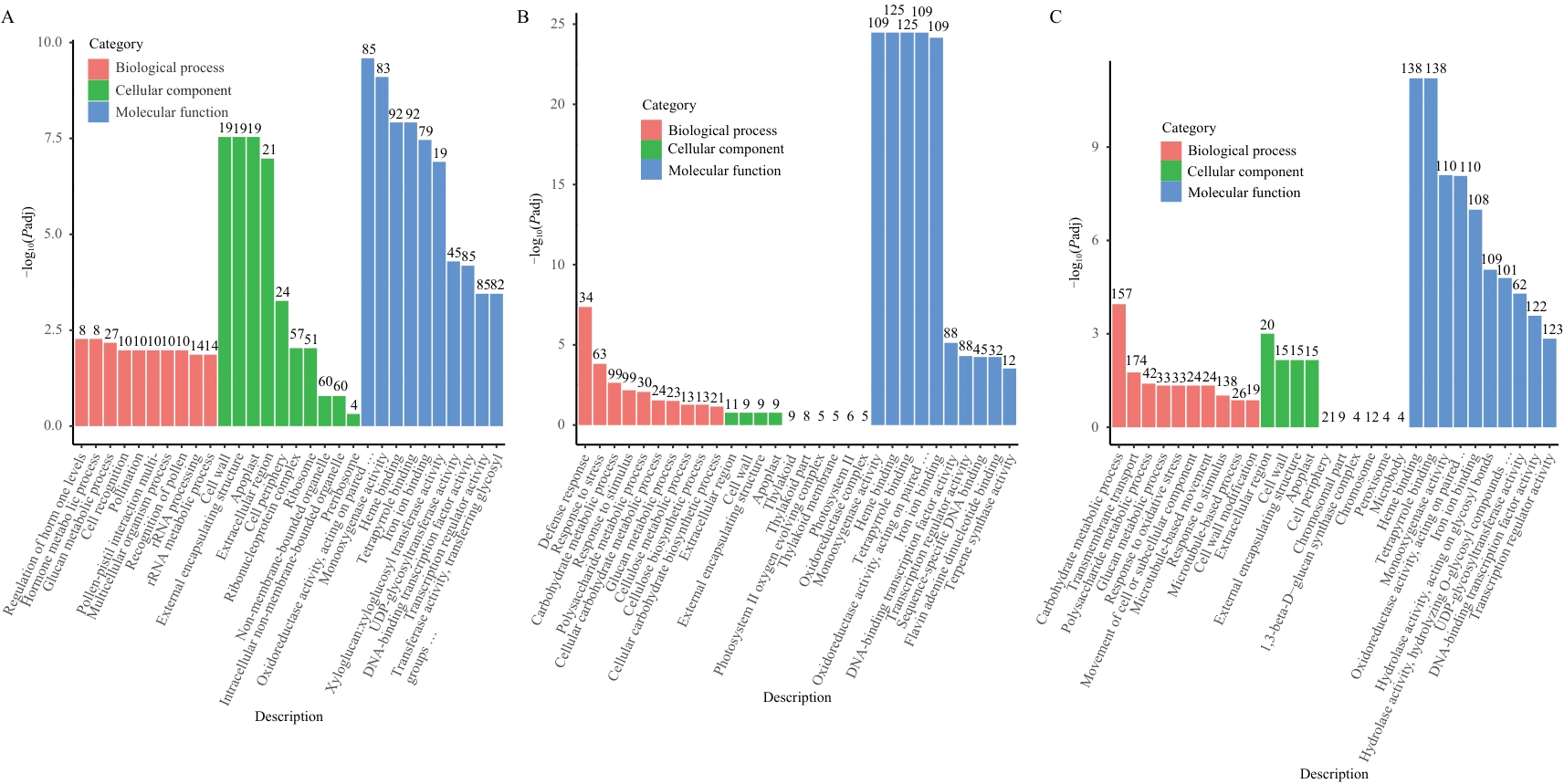
图3 不同发育阶段蘸花与未蘸花黄瓜花冠差异表达基因的GO富集分析A‒C:分别为nDF_0d与DF_0d、nDF_2d与DF_2d、nDF_4d与DF_4d差异表达基因的GO富集分析图
Fig. 3 GO enrichment analysis of differentially expressed genes between dipped and non-dipped cucumber corollas at different stagesA‒C: Represent the GO enrichment analysis of DEGs nDF_0d vs. DF_0d, nDF_2d vs. DF_2d, and nDF_4d vs. DF_4d
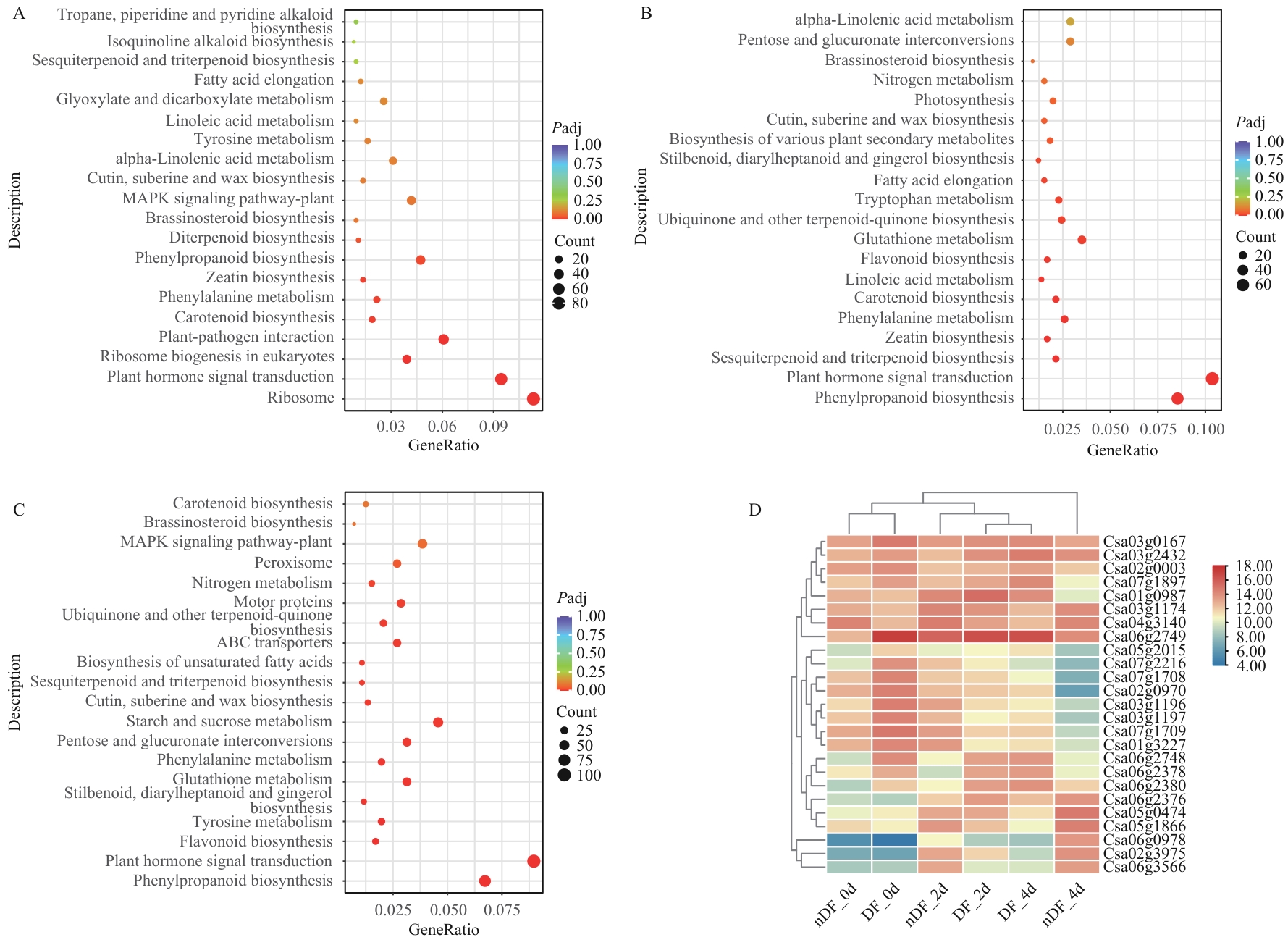
图4 不同发育阶段蘸花与未蘸花黄瓜花冠差异表达基因的KEGG富集分析A‒C:分别为nDF_0d与DF_0d(A)、nDF_2d与DF_2d(B)、nDF_4d与DF_4d(C)差异表达基因的KEGG显著性富集分析图;D:富集于植物激素信号转导(csv04075)、苯丙烷类生物合成(csv00940)和苯丙氨酸代谢(csv00360)的差异表达基因热图
Fig. 4 KEGG enrichment analysis of differentially expressed genes between dipped and non-dipped cucumber corollas at different stagesA‒C: KEGG significance enrichment analysis of DEGs nDF_0d vs. DF_0d (A), nDF_2d vs. DF_2d (B), and nDF_4d vs. DF_4d (C), respectively. D: Heatmap of DEGs enriched in plant hormone signal transduction (csv04075), phenylpropanoid biosynthesis (csv00940), and phenylalanine metabolism (csv00360)
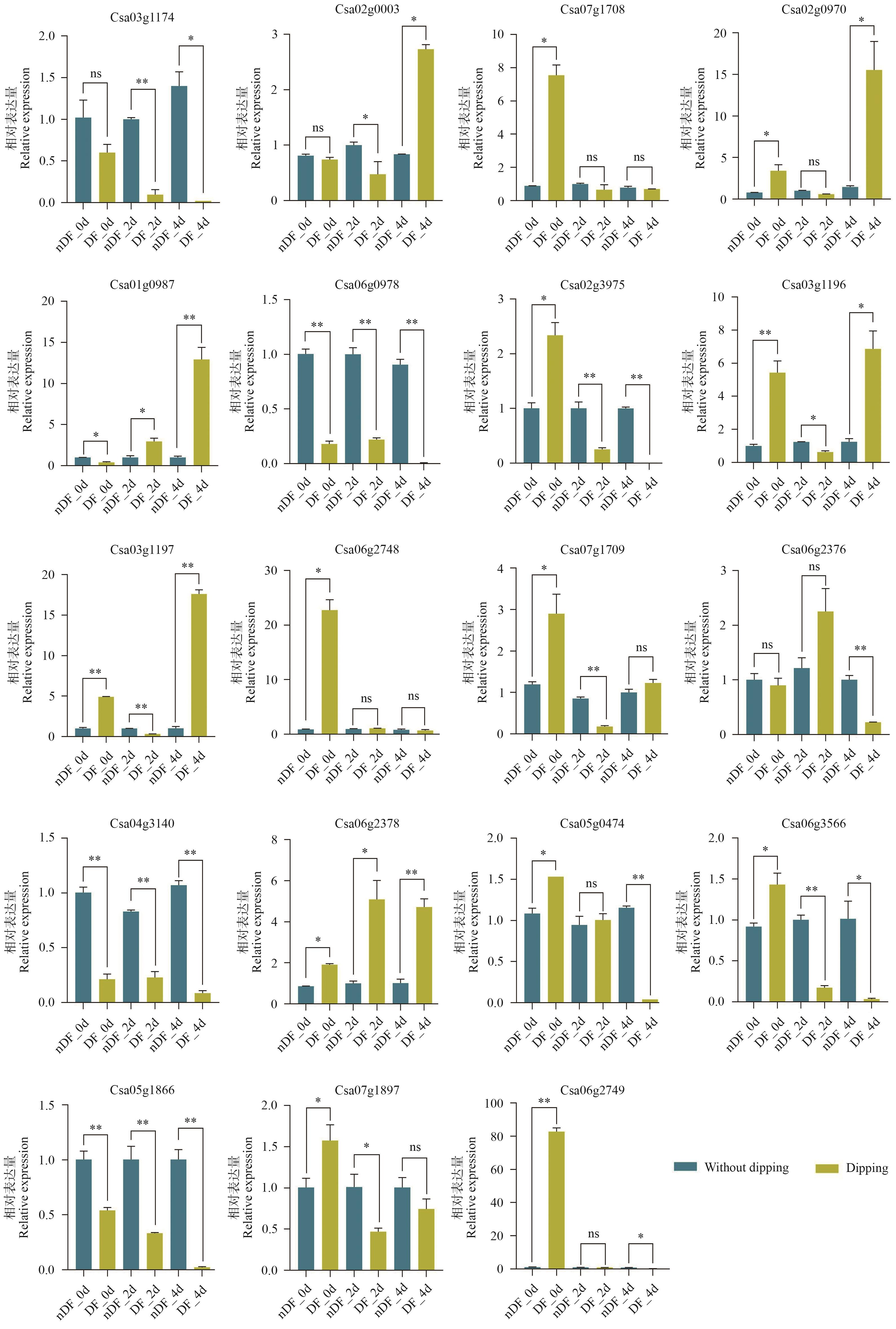
图5 黄瓜雌花花冠开放延迟相关DEGs表达水平的验证*P<0.05, **P<0.01, ns: no significant difference (P>0.05)
Fig. 5 Verification of the expressions of DEGs related to the delayed opening of female flower corollas in cucumber
| [1] | Fan SS, Ma WY, Shan N, et al. The transcription factor CsAPRR2 controls peel color by regulating the expression of SULFURTRANSFERASE14 in cucumber [J]. Plant Physiol, 2025, 198(2): kiaf249. |
| [2] | Zhao LJ, Fan PF, Wang YL, et al. ELONGATED HYPOTCOTYL5 and SPINE BASE SIZE1 together mediate light-regulated spine expansion in cucumber [J]. Plant Physiol, 2024, 195(1): 552-565. |
| [3] | Xu XW, Zhu Y, Yuan Y, et al. R2R3-MYB transcription factor CsMYB60 controls mature fruit skin color by regulating flavonoid accumulation in cucumber [J]. Plant J, 2024, 119(2): 796-813. |
| [4] | 闫立英. 黄瓜单性结实性生理和遗传分析及分子标记研究 [D]. 南京: 南京农业大学, 2009. |
| Yan LY. Studies on physiological and genetic analysis and molecular markers of parthenocarpy in cucumber [D]. Nanjing: Nanjing Agricultural University, 2009. | |
| [5] | 孟璐, 马涛, 岳新丽, 等. 植物生长延缓剂延迟黄花菜花期及对代谢产物的影响 [J]. 园艺学报, 2025, 52(4): 997-1006. |
| Meng L, Ma T, Yue XL, et al. Effects of plant growth retardants on the flowering period of Hemerocallis citrina and its metabolites [J]. Acta Hortic Sin, 2025, 52(4): 997-1006. | |
| [6] | 苏杭, 王琦, 李春梅, 等. 植物生长调节剂噻苯隆对甜瓜品质的影响 [J]. 中国农业科学, 2018, 51(16): 3095-3105. |
| Su H, Wang Q, Li CM, et al. Effects of plant growth regulators thidiazuron on melon quality [J]. Sci Agric Sin, 2018, 51(16): 3095-3105. | |
| [7] | Sun CZ, Li YQ, Zhao WS, et al. Integration of hormonal and nutritional cues orchestrates progressive Corolla opening[J]. Plant Physiol, 2016, 171(2): 1209-1229. |
| [8] | Nitsch JP. Plant hormones in the development of fruits [J]. Q Rev Biol, 1952, 27(1): 33-57. |
| [9] | Rudich J, Baker LR, Sell HM. Parthenocarpy in Cucumis sativus L. as affected by genetic parthenocarpy, thermo-photoperiod, and Femaleness1 [J]. J Amer Soc Hort Sci, 1977, 102(2): 225-228. |
| [10] | 路曼. 黄瓜超级子房雌花花冠蛋白质组学研究 [D]. 秦皇岛: 河北科技师范学院, 2016. |
| Lu M. Proteomic study on super ovary female corolla in cucumber (Cucumis sativus L.) [D]. Qinhuangdao: Hebei Normal University of Science & Technology, 2016. | |
| [11] | 雷明月. CsCLE3负调控黄瓜超级子房形成的功能研究 [D]. 秦皇岛: 河北科技师范学院, 2022. |
| Lei MY. Function of CsCLE3 negatively regulating the formation of cucumber superovary [D]. Qinhuangdao: Hebei Normal University of Science & Technology, 2022. | |
| [12] | Li XL, Cui HN, Song XF, et al. CsIPT1b and CsUGT85A2 delay female corolla opening in cucumber by regulating the content of cytokinins [J]. Hortic Plant J, 2023, 9(4): 754-762. |
| [13] | Song XF, Ge DF, Xie Y, et al. Genome-scale mRNA and miRNA transcriptomic insights into the regulatory mechanism of cucumber corolla opening [J]. J Integr Agric, 2022, 21(9): 2603-2614. |
| [14] | 刘文静, 宋晓飞, 范丽金, 等. 黄瓜果实可溶性固形物含量关键基因挖掘与分析 [J]. 植物遗传资源学报, 2025, 26(9): 1824-1831. |
| Liu WJ, Song XF, Fan LJ, et al. Identification and analysis of key genes regulating cucumber fruit soluble solids content [J]. J Plant Genet Resour, 2025, 26(9): 1824-1831. | |
| [15] | Zhao JY, Li YQ, Ding L, et al. Phloem transcriptome signatures underpin the physiological differentiation of the pedicel, stalk and fruit of cucumber (Cucumis sativus L.) [J]. Plant Cell Physiol, 2016, 57(1): 19-34. |
| [16] | Liu YN, Lou J, Liu GH, et al. A R2R3-MYB transcription factor LmMYB111 positively regulates chlorogenic acid and luteoloside biosynthesis in Lonicera macranthoides [J]. Plant Sci, 2025, 358: 112556. |
| [17] | Alexa A, Rahnenführer J, Lengauer T. Improved scoring of functional groups from gene expression data by decorrelating GO graph structure [J]. Bioinformatics, 2006, 22(13): 1600-1607. |
| [18] | Kanehisa M, Araki M, Goto S, et al. KEGG for linking genomes to life and the environment [J]. Nucleic Acids Res, 2008, 36(): D480-D484. |
| [19] | Deng YC, Wang JQ, Zhang AN, et al. Metabolomics mechanism and lignin response to laxogenin C, a natural regulator of plants growth [J]. Int J Mol Sci, 2022, 23(6): 2990. |
| [20] | Ahmad S, Lu CQ, Gao J, et al. Integrated proteomic, transcriptomic, and metabolomic profiling reveals that the gibberellin-abscisic acid hub runs flower development in the Chinese orchid Cymbidium sinense [J]. Hortic Res, 2024, 11(5): uhae073. |
| [21] | Want EJ, Masson P, Michopoulos F, et al. Global metabolic profiling of animal and human tissues via UPLC-MS [J]. Nat Protoc, 2013, 8(1): 17-32. |
| [22] | Yuan M, Breitkopf SB, Yang XM, et al. A positive/negative ion-switching, targeted mass spectrometry-based metabolomics platform for bodily fluids, cells, and fresh and fixed tissue [J]. Nat Protoc, 2012, 7(5): 872-881. |
| [23] | 张作标, 许春梅, 顾兴芳, 等. 不同蘸花剂对黄瓜果实生长及品质的影响 [J]. 中国蔬菜, 2016(5): 10-13. |
| Zhang ZB, Xu CM, Gu XF, et al. Effect of flower dipping agents on cucumber fruit growth and quality [J]. China Veg, 2016(5): 10-13. | |
| [24] | Xu MQ, Wang XC, Liu J, et al. Natural variation in the transcription factor REPLUMLESS contributes to both disease resistance and plant growth in Arabidopsis [J]. Plant Commun, 2022, 3(5): 100351. |
| [25] | Zhang M, Zhao YY, Nan TG, et al. Genome-wide analysis of Citrus medica ABC transporters reveals the regulation of fruit development by CmABCB19 and CmABCC10 [J]. Plant Physiol Biochem, 2024, 215: 109027. |
| [26] | Wu S, Tian LF, Guo SS, et al. OsLC1, a transaldolase, regulates cell patterning and leaf morphology through modulation of secondary metabolism [J]. Plant Biotechnol J, 2025, 23(5): 1751-1767. |
| [27] | Yang DL, Liu H, Li XJ, et al. A sucrose ferulate cycle linchpin for feruloylation of Arabinoxylans in plant commelinids [J]. Nat Plants, 2024, 10(9): 1389-1399. |
| [28] | Ma QH. Lignin biosynthesis and its diversified roles in disease resistance [J]. Genes, 2024, 15(3): 295. |
| [1] | 王鑫, 陈炜, 孙博. 植物花分生组织活性的调控机制[J]. 生物技术通报, 2026, 42(9): 1-13. |
| [2] | 秦少敏, 苗晗, 董邵云, 官健涛, 顾兴芳, 李森, 刘小萍, 张圣平. 黄瓜CAD家族基因介导木质素沉积调控叶柄夹角建成[J]. 生物技术通报, 2026, 42(9): 137-146. |
| [3] | 申瑞雪, 郭子卿, 庞星辰, 李志远, 丁炜, 董琦, 李森, 宋红霞. 转录组和代谢组联合解析‘泽州芹菜’露地越冬的机制[J]. 生物技术通报, 2026, 42(8): 251-262. |
| [4] | 刘佳, 孟宇, 荆晓艳. 单细胞拉曼光谱揭示聚球藻PCC7942对无机碳源的利用偏好性[J]. 生物技术通报, 2026, 42(8): 331-340. |
| [5] | 孙常胜, 尉万聪, 王一衡, 张桂霞, 兰青阔, 王永. 黄瓜耐盐种质筛选评价及分子机制研究进展[J]. 生物技术通报, 2026, 42(8): 35-46. |
| [6] | 王鸿睿, 赵怡如, 饶书培, 陈金焕. 黑果枸杞 LrCYP78A5 基因在干旱与盐胁迫响应中的功能研究[J]. 生物技术通报, 2026, 42(7): 182-192. |
| [7] | 黄旭升, 周雅莉, 贾峥嵘, 沈珊, 陈锦钗, 周广立, 李鑫鑫, 王计平, 李润植, 贾小云. 紫苏ARF转录因子家族全基因组鉴定及其在非生物胁迫响应中的功能分析[J]. 生物技术通报, 2026, 42(7): 148-162. |
| [8] | 董亚茹, 修妤, 赵东晓, 朱红, 朱琳, 刘惠芬. 基于转录组的桑树GRAS基因家族鉴定及MnGRAS22盐胁迫响应分析[J]. 生物技术通报, 2026, 42(7): 193-203. |
| [9] | 游欣, 王淅, 张新妤, 魏绪英, 程华, 蔡军火. 基于非靶向代谢组解析红花石蒜叶片对高温胁迫的响应[J]. 生物技术通报, 2026, 42(7): 173-181. |
| [10] | 危潇, 黎妍妍, 袁勤峰, 姚经武, 曹春霞, 黄大野. 一株分离自烟草根际的生防菌株鉴定及其生防潜力研究[J]. 生物技术通报, 2026, 42(7): 279-291. |
| [11] | 陈义焰, 张冬儿, 张涛, 刘育灏, 唐杰, 盛夏冰, 胡远艺, 艾治勇, 李应将, 刘小林. 水稻OsSULTR2;2基因功能及调控苗期耐盐性分析[J]. 生物技术通报, 2026, 42(7): 116-125. |
| [12] | 王家彬, 胡玥, 陈嘉杰, 王蒙, 何秀云, 李之勇, 李健, 王美娜. 紫纹兜兰不同部位的代谢组和转录组联合分析[J]. 生物技术通报, 2026, 42(6): 279-293. |
| [13] | 张初署, 曹世宁, 王发明, 周海翔, 胡晓君, 唐月异, 周晓燕, 王冕, 陈静, 张建成. 乳酸菌发酵花生衣提取物过程中的代谢物特征分析[J]. 生物技术通报, 2026, 42(5): 340-352. |
| [14] | 杨兴盛, 伍绍龙, 冯凯, 王尚, 彭玺, 赵博, 刘明倩, 顾松松, 何晴, 李春格, 胡秋龙, 邓晔. 基于高分辨率质谱的微生物宏代谢组解析方法研究进展[J]. 生物技术通报, 2026, 42(5): 5-15. |
| [15] | 王玉昆, 原远, 王斌, 朱云娜, 任晓强, 任飞, 叶红. 转录组和脂质代谢组联合分析不同紫苏α-亚麻酸合成调控差异[J]. 生物技术通报, 2026, 42(4): 129-140. |
| 阅读次数 | ||||||
|
全文 |
|
|||||
|
摘要 |
|
|||||
