







生物技术通报 ›› 2026, Vol. 42 ›› Issue (8): 35-46.doi: 10.13560/j.cnki.biotech.bull.1985.2025-1090
孙常胜1,2, 尉万聪2, 王一衡2, 张桂霞1, 兰青阔2, 王永2( )
)
收稿日期:2025-10-16
出版日期:2026-08-26
发布日期:2026-08-17
通讯作者:
王永wytaas@126.com基金资助:
SUN Chang-sheng1,2, YU Wan-cong2, WANG Yi-heng2, ZHANG Gui-xia1, LAN Qing-kuo2, WANG Yong2()
Received:2025-10-16
Published:2026-08-26
Online:2026-08-17
摘要:
盐胁迫是由土壤中Na⁺、Cl⁻等盐离子过量积累引起的非生物逆境胁迫,严重破坏植物离子稳态和水分吸收,并诱导活性氧(ROS)过量积累,从而抑制生长、降低作物产量与品质。随着设施农业的发展,土壤次生盐渍化问题日益突出,黄瓜(Cucumis sativus L.)对盐胁迫高度敏感,其耐盐种质筛选与分子调控机制研究成为提升设施蔬菜生产效益的重要方向。目前,黄瓜耐盐种质主要来源于栽培品种、地方品种及野生近缘种,通常基于生长、生理和生化指标,结合耐盐指数和隶属函数法等综合评价体系对其耐盐性进行鉴定。研究表明,黄瓜耐盐性是受多基因协同调控的数量性状,其形成依赖离子稳态维持、渗透调节与抗氧化防御等过程的协同作用。Na⁺外排与区隔化、K⁺稳态维持、渗透调节物质积累及抗氧化系统清除ROS是耐盐响应的核心环节,相关基因在信号转导与代谢调控中发挥重要作用。本文综述了黄瓜耐盐种质资源及其筛选评价方法,总结了耐盐性的主要分子调控机制,并结合多组学与高通量表型分析技术的发展,展望了黄瓜耐盐分子育种的研究方向,为高耐盐品种的选育提供理论依据与参考。
孙常胜, 尉万聪, 王一衡, 张桂霞, 兰青阔, 王永. 黄瓜耐盐种质筛选评价及分子机制研究进展[J]. 生物技术通报, 2026, 42(8): 35-46.
SUN Chang-sheng, YU Wan-cong, WANG Yi-heng, ZHANG Gui-xia, LAN Qing-kuo, WANG Yong. Advances in Salt Tolerance of Cucumber: From Germplasm Screening, Evaluation to Molecular Mechanism[J]. Biotechnology Bulletin, 2026, 42(8): 35-46.
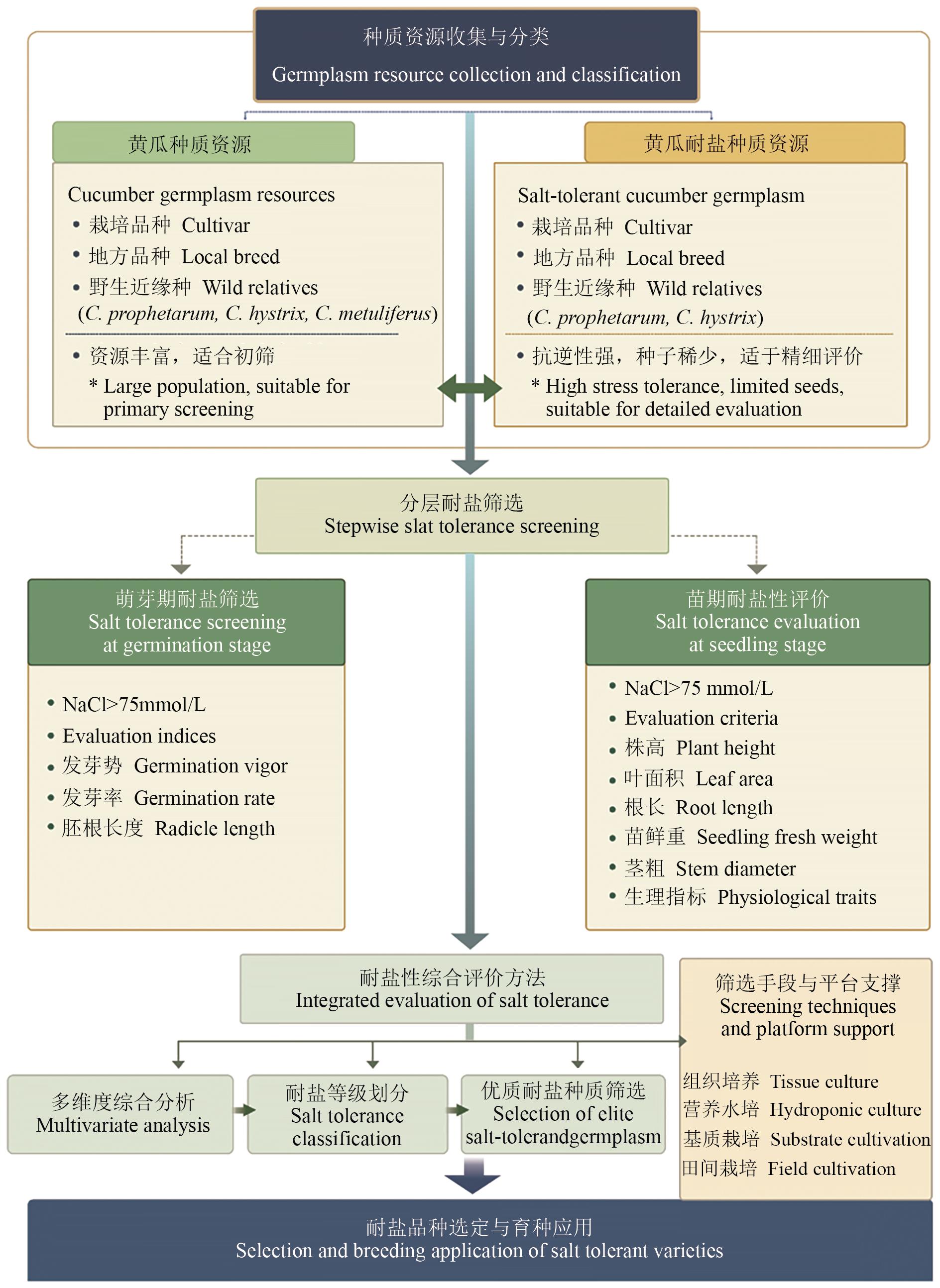
图1 黄瓜耐盐种质筛选与评价技术路线
Fig. 1 Technical route for screening and evaluating salt-tolerant cucumber germplasm
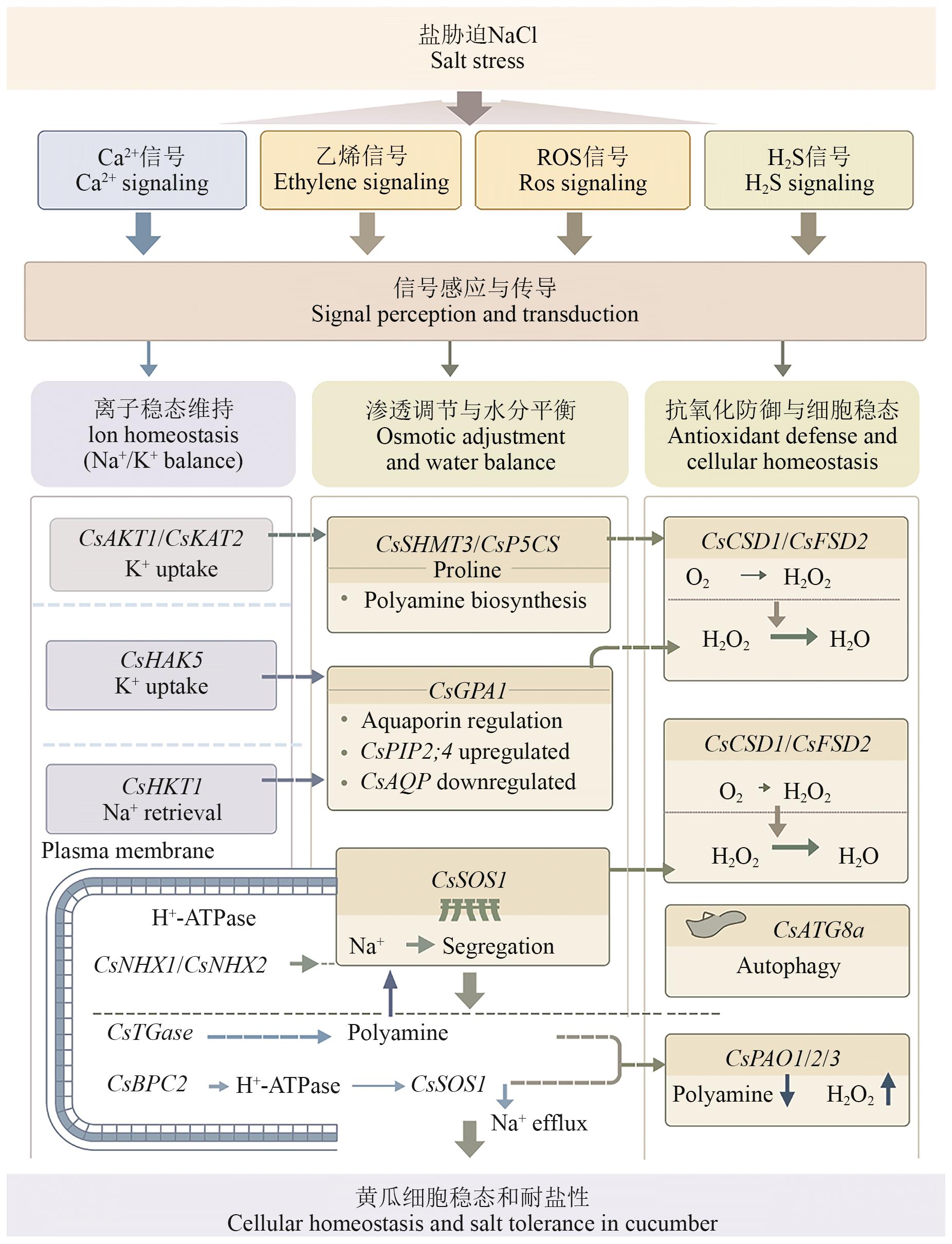
图2 黄瓜耐盐分子网络
Fig. 2 Cucumber salt-tolerance molecular network
基因名称 Gene name | 主要功能 Key features | 作用机制 Mechanism of action | 参考文献 Reference |
|---|---|---|---|
| CsKAT2 | 内向整流K⁺通道 | Na⁺敏感型钾通道,Na⁺积累致气孔调节障碍,盐胁迫下表达下降,限制光合作用 | [ |
| CsAKT1 | 钾离子通道 | 根部K⁺吸收通道,保障K⁺养分摄取;盐胁迫下H₂S等信号可上调其表达,维持K⁺/Na⁺平衡 | [ |
| CsBPC2 | GAGA结合转录因子 | 正调控H⁺-ATPase表达以维持离子稳态;突变体质膜/液泡H⁺-ATPase活性,Na⁺外排受阻、K⁺流失,盐敏感性增加 | [ |
| CsTGase | 谷氨酰胺转氨酶 | 蛋白质交联酶,调控多胺代谢和质子泵活性;促进Na⁺隔离与外排,提高耐盐能力 | [ |
| CsSHMT3 | 丝氨酸羟甲基转移酶 | 参与丝氨酸-甘氨酸转换;过表达提高脯氨酸含量和抗氧化酶活性,增强耐盐性 | [ |
| CsP5CS | 脯氨酸合成酶 | 脯氨酸合成限速酶;盐胁迫上调其表达以积累脯氨酸,缓解渗透胁迫;突变体表型变化不显著,提示可能存在替代途径 | [ |
| CsSAMDC3 | 腺苷甲硫氨酸脱羧酶 | 多胺合成关键酶;盐胁迫上调促进亚精胺和精胺积累,过表达增强耐盐,表明多胺兼具信号与保护作用 | [ |
| CsCSD1/CsFSD2 | 超氧化物歧化酶 | 抗氧化酶第一道防线,将O2-歧化为H₂O₂;盐胁迫上调其表达,降低ROS水平 | [ |
| CsCAT/CsPOD | 过氧化氢酶/过氧化物酶 | 分解H₂O₂的抗氧化酶;盐胁迫上调其表达,提高H₂O₂清除速率,减轻氧化损伤 | [ |
| CsTAU1 | 谷胱甘肽转移酶 | GSH依赖型抗氧化酶,参与解毒与硫氧还原反应;过表达增强GSH途径,缓解盐胁迫氧化损伤 | [ |
| CsPAL3/4/5/6 | 苯丙氨酸解氨酶 | 苯丙烷代谢途径起始酶,生成酚类、黄酮类等抗氧化物质;盐胁迫下多个PAL基因上调促进抗氧化产物积累 | [ |
| CsATG8a | 自噬相关基因 | 介导清除受损细胞器或蛋白质;盐胁迫上调其表达,增强自噬能力,维持细胞存活 | [ |
| CsPAO1/2/3 | 多胺氧化酶 | 调控多胺分解与H₂O₂生成;适度表达增强抗氧化能力,过度表达则ROS过量,引发氧化损伤 | [ |
表1 黄瓜耐盐性相关重要基因
Table 1 Important genes related to salt tolerance in cucumber
基因名称 Gene name | 主要功能 Key features | 作用机制 Mechanism of action | 参考文献 Reference |
|---|---|---|---|
| CsKAT2 | 内向整流K⁺通道 | Na⁺敏感型钾通道,Na⁺积累致气孔调节障碍,盐胁迫下表达下降,限制光合作用 | [ |
| CsAKT1 | 钾离子通道 | 根部K⁺吸收通道,保障K⁺养分摄取;盐胁迫下H₂S等信号可上调其表达,维持K⁺/Na⁺平衡 | [ |
| CsBPC2 | GAGA结合转录因子 | 正调控H⁺-ATPase表达以维持离子稳态;突变体质膜/液泡H⁺-ATPase活性,Na⁺外排受阻、K⁺流失,盐敏感性增加 | [ |
| CsTGase | 谷氨酰胺转氨酶 | 蛋白质交联酶,调控多胺代谢和质子泵活性;促进Na⁺隔离与外排,提高耐盐能力 | [ |
| CsSHMT3 | 丝氨酸羟甲基转移酶 | 参与丝氨酸-甘氨酸转换;过表达提高脯氨酸含量和抗氧化酶活性,增强耐盐性 | [ |
| CsP5CS | 脯氨酸合成酶 | 脯氨酸合成限速酶;盐胁迫上调其表达以积累脯氨酸,缓解渗透胁迫;突变体表型变化不显著,提示可能存在替代途径 | [ |
| CsSAMDC3 | 腺苷甲硫氨酸脱羧酶 | 多胺合成关键酶;盐胁迫上调促进亚精胺和精胺积累,过表达增强耐盐,表明多胺兼具信号与保护作用 | [ |
| CsCSD1/CsFSD2 | 超氧化物歧化酶 | 抗氧化酶第一道防线,将O2-歧化为H₂O₂;盐胁迫上调其表达,降低ROS水平 | [ |
| CsCAT/CsPOD | 过氧化氢酶/过氧化物酶 | 分解H₂O₂的抗氧化酶;盐胁迫上调其表达,提高H₂O₂清除速率,减轻氧化损伤 | [ |
| CsTAU1 | 谷胱甘肽转移酶 | GSH依赖型抗氧化酶,参与解毒与硫氧还原反应;过表达增强GSH途径,缓解盐胁迫氧化损伤 | [ |
| CsPAL3/4/5/6 | 苯丙氨酸解氨酶 | 苯丙烷代谢途径起始酶,生成酚类、黄酮类等抗氧化物质;盐胁迫下多个PAL基因上调促进抗氧化产物积累 | [ |
| CsATG8a | 自噬相关基因 | 介导清除受损细胞器或蛋白质;盐胁迫上调其表达,增强自噬能力,维持细胞存活 | [ |
| CsPAO1/2/3 | 多胺氧化酶 | 调控多胺分解与H₂O₂生成;适度表达增强抗氧化能力,过度表达则ROS过量,引发氧化损伤 | [ |
| [1] | Jia YX, Wu JL, Cheng MY, et al. Global transfer of salinization on irrigated land: Complex network and endogenous structure [J]. J Environ Manag, 2023, 336: 117592. |
| [2] | 邱海峰.中国有15亿亩盐碱地,是全球第三大盐碱地分布国家——唤醒“沉睡”的耕地后备资源[N].人民日报,2023-6-1(4). |
| Qiu HF. China has 1.5 billion mu of saline-alkali land, ranking third globally in saline-alkali land distribution—awakening this “dormant” reserve of arable land resources[N]. People’s Daily, 2023-6-1(4). | |
| [3] | 国务院新闻办公室.第三次全国国土调查主要数据成果新闻发布会 [EB]. . |
| The Information Office of the State Council. Press Conference on the Main Data Results of the Third National Land Survey [EB]. . | |
| [4] | Li HP, Ma HB, Zhang JL. Halo-tolerant plant growth-promoting bacteria-mediated plant salt resistance and microbiome-based solutions for sustainable agriculture in saline soils [J]. FEMS Microbiol Ecol, 2025, 101(5): fiaf037. |
| [5] | Liu YP, Xun WB, Chen L, et al. Rhizosphere microbes enhance plant salt tolerance: Toward crop production in saline soil [J]. Comput Struct Biotechnol J, 2022, 20: 6543-6551. |
| [6] | 陈思, 陈梅, 赖梦霞, 等. 发根农杆菌介导的黄瓜CsPIP2;4过表达复合植株获得及耐盐性鉴定 [J]. 河北农业大学学报, 2025, 48(3): 58-64. |
| Chen S, Chen M, Lai MX, et al. Obtaining composite plants with overexpression of CsPIP2;4 in cucumber mediated by Agrobacterium rhizogenes and identification of their salt tolerance [J]. J Hebei Agric Univ, 2025, 48(3): 58-64. | |
| [7] | Abbas F, Faried HN, Akhtar G, et al. Cucumber grafting on indigenous cucurbit landraces confers salt tolerance and improves fruit yield by enhancing morpho-physio-biochemical and ionic attributes [J]. Sci Rep, 2023, 13: 21697. |
| [8] | 冯永军, 陈为峰, 张蕾娜, 等. 设施园艺土壤的盐化与治理对策 [J]. 农业工程学报, 2001, 17(2): 111-114. |
| Feng YJ, Chen WF, Zhang LN, et al. Soil salinization and countermeasures in protected horticulture [J]. Trans Chin Soc Agric Eng, 2001, 17(2): 111-114. | |
| [9] | Davidi H. A historical survey of cucumber breeding in Israel [J]. Acta Hortic, 2009(830): 33-36. |
| [10] | Li LB, Du LD, Cao QW, et al. Salt tolerance evaluation of cucumber germplasm under sodium chloride stress [J]. Plants, 2023, 12(16): 2927. |
| [11] | Saker M, Gengaihi EI, Kamel, AM, et al. Influence of differentiation state, salt stress and methyl jasmonate on in vitro production of cucurbitacins from tissue cultures of ecballium elaterium and Cucumis prophetarum endemic to Egypt [J]. Medicinal Aromatic Plant Sci Biotech, 2010, 4(1): 28-32. |
| [12] | 曹齐卫, 杜连达, 杨宗辉, 等. 黄瓜耐盐种质资源的筛选与评价 [J]. 核农学报, 2022, 36(5): 865-875. |
| Cao QW, Du LD, Yang ZH, et al. Screening and evaluation of cucumber salt-tolerant germplasm [J]. J Nucl Agric Sci, 2022, 36(5): 865-875. | |
| [13] | 曹齐卫, 李利斌, 孔素萍, 等. 我国设施黄瓜新育成品种芽期耐盐性评价 [J]. 植物遗传资源学报, 2014, 15(3): 546-553. |
| Cao QW, Li LB, Kong SP, et al. Evaluation of salt tolerance of newly-bred greenhouse cucumber cultivars at germination stage [J]. J Plant Genet Resour, 2014, 15(3): 546-553. | |
| [14] | Abdul Aziz M, Masmoudi K. Insights into the transcriptomics of crop wild relatives to unravel the salinity stress adaptive mechanisms [J]. Int J Mol Sci, 2023, 24(12): 9813. |
| [15] | 董邵云, 苗晗, 薄凯亮, 等. 黄瓜近缘野生资源的研究进展 [J]. 植物遗传资源学报, 2020, 21(6): 1446-1460. |
| Dong SY, Miao H, Bo KL, et al. Research progress on wild relatives of cucumber [J]. J Plant Genet Resour, 2020, 21(6): 1446-1460. | |
| [16] | Abu Irmaileh BE, Mansour AN, Al Banna LS, et al. Comparative tolerances of two Cucumis species to salinity, Rhizoctonia solani and Meloidogyne incognita [J]. Plant Genet Res, 2014, 12(2): 178-184. |
| [17] | Al Khateeb W, Abu Serdane M, El-Oqlah A. Evaluation of in vitro salt tolerance in Cucumis prophetarum L., a crop wild relative [J]. Jordan J Agric Sci, 2016, 12(4): 1095-1113. |
| [18] | Qin XD, Zhang ZH, Lou QF, et al. Chromosome-scale genome assembly of Cucumis hystrix—a wild species interspecifically cross-compatible with cultivated cucumber [J]. Hortic Res, 2021, 8: 40. |
| [19] | Sigüenza C, Schochow M, Turini T, et al. Use of Cucumis metuliferus as a rootstock for melon to manage Meloidogyne incognita [J]. J Nematol, 2005, 37(3): 276-280. |
| [20] | Chen CY, Yu WC, Xu XR, et al. Research advancements in salt tolerance of Cucurbitaceae: from salt response to molecular mechanisms [J]. Int J Mol Sci, 2024, 25(16): 9051. |
| [21] | 苑博华. 几种试剂对盐胁迫下黄瓜种子萌发及幼苗生长的影响 [D]. 保定: 河北大学, 2006. |
| Yuan BH. Effects of different reagents on seed germination and seedling growth of cucumber under salt stress [D]. Baoding: Hebei University, 2006. | |
| [22] | 杨秀玲, 郁继华, 李雅佳, 等. NaCl胁迫对黄瓜种子萌发及幼苗生长的影响 [J]. 甘肃农业大学学报, 2004, 39(1): 6-9, 17. |
| Yang XL, Yu JH, Li YJ, et al. Effects of NaCl stress on seed germination and seedling growth of Cucumis sativus [J]. J Gansu Agric Univ, 2004, 39(1): 6-9, 17. | |
| [23] | 沈兰兴, 张小村, 孔凡美, 等. 耐盐黄瓜品种鉴定及萌芽期盐胁迫对黄瓜苗期耐盐性的影响 [J]. 肥料与健康, 2024, 51(4): 33-40, 70. |
| Shen LX, Zhang XC, Kong FM, et al. Identification of salt tolerant cucumber varieties and the effect of salt stress during germination stage on salt tolerance during cucumber seedling stage [J]. Fertil Health, 2024, 51(4): 33-40, 70. | |
| [24] | 赵文麟, 张新梅, 梁飞飞, 等. 钙离子及其抑制剂对盐胁迫下黄瓜幼苗形态建成的影响 [J]. 北方园艺, 2024(16): 1-8. |
| Zhao WL, Zhang XM, Liang FF, et al. Effects of calcium ions and their inhibitors on the morphogenesis of cucumber seedlings under salt stress [J]. North Hortic, 2024(16): 1-8. | |
| [25] | Munns R, Tester M. Mechanisms of salinity tolerance [J]. Annu Rev Plant Biol, 2008, 59: 651-681. |
| [26] | Blanco FF, Folegatti MV. Estimation of leaf area for greenhouse cucumber by linear measurements under salinity and grafting [J]. Sci Agric (Piracicaba, Braz), 2005, 62(4): 305-309. |
| [27] | 张金锦, 段增强, 李汛. 基于黄瓜种植的设施菜地土壤硝酸盐型次生盐渍化的分级研究 [J]. 土壤学报, 2012, 49(4): 673-680. |
| Zhang JJ, Duan ZQ, Li X. The classification study on NO 3 - -soil secondary salinization in cucumber-based greenhouse [J]. Acta Pedol Sin, 2012, 49(4): 673-680. | |
| [28] | 梁峥, 楚晓真, 黄文, 等. 不同营养液配方对阳台水培黄瓜的影响 [J]. 中国瓜菜, 2020, 33(4): 33-37. |
| Liang Z, Chu XZ, Huang W, et al. Effects of different nutrient solution on hydroponic cucumber on the balcony [J]. China Cucurbits Veg, 2020, 33(4): 33-37. | |
| [29] | 薛璐, 杨倩, 郭慧, 等. 黄瓜耐盐根际促生菌的筛选及评价 [J]. 中国瓜菜, 2021, 34(9): 26-32. |
| Xue L, Yang Q, Guo H, et al. Screening and evaluation of the salt-tolerant plant growth-promoting rhizobacteria on cucumber [J]. China Cucurbits Veg, 2021, 34(9): 26-32. | |
| [30] | Peyvast G, Olfati JA, Kharazi PR, et al. Effect of substrate on greenhouse cucumber production in soilless culture [J]. Acta Hortic, 2010(871): 429-436. |
| [31] | 潘俏, 张舒玥, 沈迪, 等. 黄瓜耐盐突变体材料的筛选与鉴定 [J]. 南京农业大学学报, 2018, 41(1): 64-70. |
| Pan Q, Zhang SY, Shen D, et al. Screening and identification of salt tolerant mutants of cucumber [J]. J Nanjing Agric Univ, 2018, 41(1): 64-70. | |
| [32] | Pieruschka R, Schurr U. Plant phenotyping: past, present, and future [J]. Plant Phenomics, 2019, 2019: 7507131. |
| [33] | Nguyen LQ, Shin J, Ryu S, et al. Innovative cucumber phenotyping: a smartphone-based and data-labeling-free model [J]. Electronics, 2023, 12(23): 4775. |
| [34] | Li Y, Yin Y, Yu HC, et al. Fast detection of water loss and hardness for cucumber using hyperspectral imaging technology [J]. Food Measure, 2022, 16(1): 76-84. |
| [35] | Yang S, Zheng LH, Gao WL, et al. An efficient processing approach for colored point cloud-based high-throughput seedling phenotyping [J]. Remote Sens, 2020, 12(10): 1540. |
| [36] | 张凤银, 程露露. 不同黄瓜品种在种子萌发期对NaCl盐胁迫的响应[J]. 植物学研究, 2018, 7(1): 86-92. |
| Zhang FY, Cheng LL. Response of different cucumber varieties to NaCl salt stress in seed germination stage [J]. Bot Res, 2018, 7(1): 86-92. | |
| [37] | Liu XX, Chang RZ, Guan RX, et al. Establishment of screening method for salt tolerant soybean at emergence stage and screening of tolerant germplasm [J]. Acta Agronom Sin, 2020, 46(1): 1-8. |
| [38] | Mulet JM, Porcel R, Yenush L. Modulation of potassium transport to increase abiotic stress tolerance in plants [J]. J Exp Bot, 2023, 74(19): 5989-6005. |
| [39] | Luo SL, Liu ZC, Wan ZL, et al. Foliar spraying of NaHS alleviates cucumber salt stress by maintaining N+/K+ balance and activating salt tolerance signaling pathways [J]. Plants, 2023, 12(13): 2450. |
| [40] | Chen TW, Gomez Pineda IM, Brand AM, et al. Determining ion toxicity in cucumber under salinity stress [J]. Agronomy, 2020, 10(5): 677. |
| [41] | Kabała K, Janicka-Russak M. Na+/H+ antiport activity in plasma membrane and tonoplast vesicles isolated from NaCl-treated cucumber roots [J]. Biologia Plant, 2012, 56(2): 377-382. |
| [42] | Peng YQ, Cao HS, Peng ZW, et al. Transcriptomic and functional characterization reveals CsHAK5;3 as a key player in K+ homeostasis in grafted cucumbers under saline conditions [J]. Plant Sci, 2023, 326: 111509. |
| [43] | Yu J, Yu JH, Liao WB, et al. Ethylene was involved in Ca2+-regulated Na+ homeostasis, Na+ transport and cell ultrastructure during adventitious rooting in cucumber explants under salt stress [J]. J Plant Biol, 2020, 63(4): 311-320. |
| [44] | Du HY, Dong QY, Liu HP, et al. Polyamines conjugated to plasma membrane functioned in enhancing the tolerance of cucumber seedlings to osmotic stress via elevating H+-ATPase activity [J]. Plant Physiol Biochem, 2022, 170: 64-74. |
| [45] | 赖梦霞, 杜长霞, 樊怀福. 黄瓜AQP基因家族的鉴定与生物信息学分析 [J]. 浙江农林大学学报, 2022, 39(2): 318-328. |
| Lai MX, Du CX, Fan HF. Identification and bioinformatics analysis of AQP gene family in Cucumis sativus [J]. J Zhejiang A F Univ, 2022, 39(2): 318-328. | |
| [46] | Yan Y, Sun MT, Li YS, et al. The CsGPA1-CsAQPs module is essential for salt tolerance of cucumber seedlings [J]. Plant Cell Rep, 2020, 39(10): 1301-1316. |
| [47] | Zhang XH, Zhang L, Ma C, et al. Exogenous strigolactones alleviate the photosynthetic inhibition and oxidative damage of cucumber seedlings under salt stress [J]. Sci Hortic, 2022, 297: 110962. |
| [48] | Amerian M, Palangi A, Gohari G, et al. Humic acid and grafting as sustainable agronomic practices for increased growth and secondary metabolism in cucumber subjected to salt stress [J]. Sci Rep, 2024, 14: 15883. |
| [49] | Yu Y, Zhang HN, Xing HY, et al. Regulation of growth and salt resistance in cucumber seedlings by hydrogen-rich water [J]. J Plant Growth Regul, 2023, 42(1): 134-153. |
| [50] | 蒋景龙, 沈季雪, 李丽. 外源H2O2对盐胁迫下黄瓜幼苗氧化胁迫及抗氧化系统的影响 [J]. 西北农业学报, 2019, 28(6): 998-1007. |
| Jiang JL, Shen JX, Li L. Effects of exogenous hydrogen peroxide on oxidative stress and antioxidant system in Cucumis sativus L. seedlings under salt stress [J]. Acta Agric Boreali Occidentalis Sin, 2019, 28(6): 998-1007. | |
| [51] | Sarwar M, Anjum S, Ali Q, et al. Triacontanol modulates salt stress tolerance in cucumber by altering the physiological and biochemical status of plant cells [J]. Sci Rep, 2021, 11: 24504. |
| [52] | Bai X, Liu PY, Zhu FY, et al. CsWRKY46 is involved in the regulation of cucumber salt stress by regulating abscisic acid and modulating cellular reactive oxygen species [J]. Horticulturae, 2025, 11(3): 251. |
| [53] | 韩月华, 杨悦, 李鹏飞, 等. 黄瓜自噬基因CsATG8a的克隆与功能分析 [J/OL]. 分子植物育种, 2022. . |
| Han YH, Yang Y, Li PF, et al. Cloning and functional analysis of the cucumber autophagy gene CsATG 8a [J/OL]. Mol Plant Breed, 2022. . | |
| [54] | Wu JQ, Zhu ML, Liu WK, et al. CsPAO2 improves salt tolerance of cucumber through the interaction with CsPSA3 by affecting photosynthesis and polyamine conversion [J]. Int J Mol Sci, 2022, 23(20): 12413. |
| [55] | Wu JQ, Liu WK, Jahan MS, et al. Characterization of polyamine oxidase genes in cucumber and roles of CsPAO3 in response to salt stress [J]. Environ Exp Bot, 2022, 194: 104696. |
| [56] | Wang LM, Zhao LN, Shah IH, et al. Na+ sensitivity of the KAT2-like channel is a common feature of cucurbits and depends on the S5-P-S6 segment [J]. Plant Cell Physiol, 2022, 63(2): 279-289. |
| [57] | Peng YQ, Chen LL, Zhu L, et al. CsAKT1 is a key gene for the CeO2 nanoparticle's improved cucumber salt tolerance: a validation from CRISPR-Cas9 lines [J]. Environ Sci: Nano, 2022, 9(12): 4367-4381. |
| [58] | Li SZ, Sun MT, Miao L, et al. Multifaceted regulatory functions of CsBPC2 in cucumber under salt stress conditions [J]. Hortic Res, 2023, 10(5): uhad051. |
| [59] | Zhong M, Wang Y, Shu S, et al. Ectopic expression of CsTGase enhances salt tolerance by regulating polyamine biosynthesis, antioxidant activities and Na+/K+ homeostasis in transgenic tobacco [J]. Plant Sci, 2020, 296: 110492. |
| [60] | Zhang ZH, Hou XM, Gao R, et al. CsSHMT3 gene enhances the growth and development in cucumber seedlings under salt stress [J]. Plant Mol Biol, 2024, 114(3): 52. |
| [61] | Madebo MP, Luo SM, Wang L, et al. Melatonin treatment induces chilling tolerance by regulating the contents of polyamine, γ-aminobutyric acid, and proline in cucumber fruit [J]. J Integr Agric, 2021, 20(11): 3060-3074. |
| [62] | Zhu ML, Chen GL, Wu JQ, et al. Identification of cucumber S-adenosylmethionine decarboxylase genes and functional analysis of CsSAMDC3 in salt tolerance [J]. Front Plant Sci, 2023, 14: 1076153. |
| [63] | 何鹏. 黄瓜SOD基因CsCSD1和CsFSD2的克隆及原核表达分析 [D]. 南昌: 江西农业大学, 2020. |
| He P. Cloning and prokaryotic expression ana lysis of two SOD genes CsCSD1 and CsFSD2 in cucumber [D]. Nanchang: Jiangxi Agricultural University, 2020. | |
| [64] | 杨子建, 周勇, 戈伶俐, 等. 黄瓜CsCAT3基因逆境胁迫表达及转拟南芥耐盐性分析 [J]. 分子植物育种, 2018, 16(3): 807-812. |
| Yang ZJ, Zhou Y, Ge LL, et al. Expression of cucumber CsCAT3 gene under stress and its salt tolerance in transgenic Arabidopsis thaliana [J]. Mol Plant Breed, 2018, 16(3): 807-812. | |
| [65] | Zhang F, Li DD, Sa RN, et al. Cloning and function analysis of the CsTAU1 in response to salt-alkali stress [J]. Genes, 2024, 15(5): 613. |
| [66] | Gu JN, Sohail H, Qiu L, et al. Genome-wide characterization and expression analysis of CsPALs in cucumber (Cucumis sativus L.) reveal their potential roles in abiotic stress and aphid stress tolerance [J]. Plants, 2024, 13(18): 2537. |
| [67] | Liu B, Guan DL, Zhai XL, et al. Selection footprints reflect genomic changes associated with breeding efforts in 56 cucumber inbred lines [J]. Hortic Res, 2019, 6: 127. |
| [68] | Shehata SA, Omar HS, Elfaidy AGS, et al. Grafting enhances drought tolerance by regulating stress-responsive gene expression and antioxidant enzyme activities in cucumbers [J]. BMC Plant Biol, 2022, 22: 408. |
| [69] | Peng YQ, Cui LJ, Wang Y, et al. Pumpkin CmoDREB2A enhances salt tolerance of grafted cucumber through interaction with CmoNAC1 to regulate H2O2 and ABA signaling and K+/Na+ homeostasis [J]. Hortic Res, 2024, 11(5): uhae057. |
| [70] | 张东萌, 宫松, 唐雷, 等. 盐渍土条件下砧木嫁接对黄瓜渗透调节物质的影响 [J]. 安徽农学通报, 2021, 27(12): 13-15. |
| Zhang DM, Gong S, Tang L, et al. Effects of rootstock grafting on cucumber osmotic adjustment substances under soil salt stress [J]. Anhui Agric Sci Bull, 2021, 27(12): 13-15. | |
| [71] | 聂圣贤. 黄瓜耐盐砧木筛选及其应用 [D]. 南宁: 广西大学, 2023. |
| Nie SX. Screening and application of salt tolerant cucumber rootstocks [D]. Nanning: Guangxi University, 2023. | |
| [72] | Simko I, Jia MY, Venkatesh J, et al. Genomics and marker-assisted improvement of vegetable crops [J]. Crit Rev Plant Sci, 2021, 40(4): 303-365. |
| [73] | Kere GM, Chen CY, Guo QW, et al. Genetics of salt tolerance in cucumber (Cucumis sativus L.) revealed by quantitative traits loci analysis[J]. Sci Lett, 2017, 5(1): 22-30. |
| [74] | Liu DR, Dong SY, Miao H, et al. A large-scale genomic association analysis identifies the candidate genes regulating salt tolerance in cucumber (Cucumis sativus L.) seedlings [J]. Int J Mol Sci, 2022, 23(15): 8260. |
| [75] | Kahveci E, Devran Z, Özkaynak E, et al. Genomic-assisted marker development suitable for CsCvy-1 selection in cucumber breeding [J]. Front Plant Sci, 2021, 12: 691576. |
| [76] | Liu DR, Dong SY, Bo KL, et al. Identification of QTLs controlling salt tolerance in cucumber (Cucumis sativus L.) seedlings [J]. Plants, 2021, 10(1): 85. |
| [77] | Zhu YX, Yang L, Liu N, et al. Genome-wide identification, structure characterization, and expression pattern profiling of aquaporin gene family in cucumber [J]. BMC Plant Biol, 2019, 19: 345. |
| [78] | Zhang F, Zhang JM, Li QF, et al. Exploring candidate genes and regulatory mechanisms for salt-alkali tolerance in cucumber [J]. Agronomy, 2024, 14(3): 543. |
| [79] | 薛伟. EMS诱变黄瓜突变体库构建及表型分析 [D]. 长春: 吉林农业大学, 2023. |
| Xue W. EMS mutagenic cucumber mutant construction and phenotypic analysis [D]. Changchun: Jilin Agricultural University, 2023. |
| [1] | 王建波, 李诗雅, 邢鹤炫, 周瑞金, 李桂荣, 王玲. 海藻糖-6-磷酸合成酶基因VvTPS10在葡萄耐盐和生长发育中的功能分析[J]. 生物技术通报, 2026, 42(8): 188-196. |
| [2] | 董亚茹, 修妤, 赵东晓, 朱红, 朱琳, 刘惠芬. 基于转录组的桑树GRAS基因家族鉴定及MnGRAS22盐胁迫响应分析[J]. 生物技术通报, 2026, 42(7): 193-203. |
| [3] | 张书翰, 任海伟, 陆栋, 罗光宏, 王永刚, 郭晓鹏. 微藻丙酮酸-乙酰辅酶A节点代谢流调控与高值产物合成强化策略[J]. 生物技术通报, 2026, 42(7): 34-47. |
| [4] | 陈义焰, 张冬儿, 张涛, 刘育灏, 唐杰, 盛夏冰, 胡远艺, 艾治勇, 李应将, 刘小林. 水稻OsSULTR2;2基因功能及调控苗期耐盐性分析[J]. 生物技术通报, 2026, 42(7): 116-125. |
| [5] | 魏丽娜, 蒋景龙, 邓茜茜, 李岩, 李丽, 邓家锐, 丁德宽. 基于表型性状与SSR标记的香橼种质资源遗传多样性分析[J]. 生物技术通报, 2026, 42(4): 202-215. |
| [6] | 罗威, 宫奥, 仲阳, 胡迪, 周洪源, 张泓欣, 艾菊, 罗有卫, 高冬丽. 黄瓜SEPALLATA2基因敲除对果实及疣状结构发育的多效性影响[J]. 生物技术通报, 2026, 42(3): 283-293. |
| [7] | 彭楚, 孙娟利, 郑蓓蓓, 张若西, 韩月彭, 赵云. 果实花色苷酶促降解机制研究进展[J]. 生物技术通报, 2026, 42(3): 133-144. |
| [8] | 王鹤瑶, 孙红梅. 园艺植物表皮毛功能及其形成机制研究进展[J]. 生物技术通报, 2026, 42(3): 242-254. |
| [9] | 刘娜, 曾宝珍, 贾兆星, 祝英方. 表观遗传调控番茄果实发育及成熟的研究进展[J]. 生物技术通报, 2026, 42(3): 37-47. |
| [10] | 赵艳侠, 李倩, 孙家波, 梁红敏, 李冰冰. 草莓果实品质形成的关键调控基因及分子网络解析[J]. 生物技术通报, 2026, 42(3): 111-132. |
| [11] | 陈静欢, 房国楠, 朱文豪, 叶广继, 苏旺, 贺苗苗, 杨生龙, 周云. 马铃薯种质资源淀粉表征及相关基因表达分析[J]. 生物技术通报, 2026, 42(1): 170-183. |
| [12] | 林佳怡, 陈强, 张磊, 刘宏鑫, 郑晓明, 逄洪波. 褪黑素在植物低温胁迫中的研究进展[J]. 生物技术通报, 2025, 41(7): 37-48. |
| [13] | 王斌, 李健荣, 占朝霞, 袁晓. CsGR-RBP3克隆及其在采后黄瓜耐冷性中的功能[J]. 生物技术通报, 2025, 41(6): 155-166. |
| [14] | 段永红, 杨欣, 于冠群, 夏俊俊, 宋陆帅, 白小东, 彭锁堂. 125份马铃薯种质资源遗传多样性及主成分分析[J]. 生物技术通报, 2025, 41(6): 130-143. |
| [15] | 李小欢, 陈相宇, 陶麒宇, 朱玲, 唐铭, 姚银安, 汪丽君. PtoMYB61对毛白杨木质素合成及耐盐性的影响[J]. 生物技术通报, 2025, 41(6): 284-296. |
| 阅读次数 | ||||||
|
全文 |
|
|||||
|
摘要 |
|
|||||
