







生物技术通报 ›› 2025, Vol. 41 ›› Issue (10): 87-97.doi: 10.13560/j.cnki.biotech.bull.1985.2025-0550
李波娣( ), 李志超, 朱国辉, 彭新湘, 张智胜()
收稿日期:2025-05-30
出版日期:2025-10-26
发布日期:2025-10-28
通讯作者:
张智胜,男,博士,副研究员,研究方向 :作物高光效与光呼吸调控机制;E-mail: zzsheng@scau.edu.cn作者简介:李波娣,女,博士,研究方向 :植物高光效机理及分子改良;E-mail: 1398327568@qq.com
基金资助:
LI Bo-di(), LI Zhi-chao, ZHU Guo-hui, PENG Xin-xiang, ZHANG Zhi-sheng()
Received:2025-05-30
Published:2025-10-26
Online:2025-10-28
摘要:
目的 验证植物叶绿体具有代谢乙醛酸生成CO2的能力。 方法 克隆了水稻的乙醇酸氧化酶1(OsGLO1)、乙醇酸氧化酶3(OsGLO3)与过氧化氢酶C(OsCATC)以及来源于大肠杆菌的过氧化氢酶(EcKAT)基因,并在其前端融合了叶绿体定位信号编码序列RC2;后续以不同的组合方式将GLO与CAT/KAT进行组合以构建不同多基因表达载体,并将其在水稻叶绿体中定向表达,从而催化叶绿体中的乙醇酸生成乙醛酸。 结果 转录水平、蛋白水平和酶活水平检测结果都表明上述目的基因可在水稻叶绿体中高效表达并行使正常的催化功能;但是获得的转基因水稻植株均呈现植株生长缓慢,分蘖数减少,光合速率下降等表型。 结论 仅在水稻叶绿体中将乙醇酸转化为乙醛酸不能提高水稻的光合固碳效率,水稻叶绿体可能没有催化乙醛酸生成CO2进入光合碳同化代谢的能力。
李波娣, 李志超, 朱国辉, 彭新湘, 张智胜. 叶绿体中过表达乙醇酸氧化酶对水稻光合作用与生长的影响[J]. 生物技术通报, 2025, 41(10): 87-97.
LI Bo-di, LI Zhi-chao, ZHU Guo-hui, PENG Xin-xiang, ZHANG Zhi-sheng. Expression of Glycolate Oxidase in Rice Chloroplasts and Its Effects on Photosynthesis and Growth[J]. Biotechnology Bulletin, 2025, 41(10): 87-97.
| 项目 Item | eating rate (℃/min) 升温速率 H | inal temperature (℃) 最终温度 F | 保持时间 Holding time (min) |
|---|---|---|---|
变化范围 Range of variation | - | 80.0 | 5.00 |
| 10.00 | 300.0 | 10.00 |
表1 GCMS法测定光呼吸相关代谢物时的柱温变化
Table 1 Variation of column temperature during the determination of photorespiration-related metabolites by GCMS method
| 项目 Item | eating rate (℃/min) 升温速率 H | inal temperature (℃) 最终温度 F | 保持时间 Holding time (min) |
|---|---|---|---|
变化范围 Range of variation | - | 80.0 | 5.00 |
| 10.00 | 300.0 | 10.00 |
| 组分 Component | 特征碎片离子大小 Characteristic fragment ion size | etention time (s) 保留时间 R |
|---|---|---|
| 乙醇酸 Glycollic acid | 177 | 7.455 |
| 丙氨酸 Alanine | 116 | 8.045 |
| 草酸 Oxalic acid | 219 | 8.740 |
| 甘氨酸 Glycine | 174 | 12.000 |
| 琥珀酸 Succinic acid | 147 | 12.140 |
| 甘油酸 Glyceric acid | 189 | 12.380 |
| 丝氨酸 Serine | 204 | 12.870 |
| 苹果酸 Malic acid | 117 | 14.743 |
| α-酮戊二酸 α-ketoglutarate | 198 | 15.910 |
| 核糖醇 Ribitol | 73 | 17.760 |
| 柠檬酸 Citric acid | 273 | 18.845 |
表2 光呼吸相关代谢物的保留时间及其特征碎片离子
Table 2 Retention times of photorespiration-related metabolites and their characteristic fragment ions
| 组分 Component | 特征碎片离子大小 Characteristic fragment ion size | etention time (s) 保留时间 R |
|---|---|---|
| 乙醇酸 Glycollic acid | 177 | 7.455 |
| 丙氨酸 Alanine | 116 | 8.045 |
| 草酸 Oxalic acid | 219 | 8.740 |
| 甘氨酸 Glycine | 174 | 12.000 |
| 琥珀酸 Succinic acid | 147 | 12.140 |
| 甘油酸 Glyceric acid | 189 | 12.380 |
| 丝氨酸 Serine | 204 | 12.870 |
| 苹果酸 Malic acid | 117 | 14.743 |
| α-酮戊二酸 α-ketoglutarate | 198 | 15.910 |
| 核糖醇 Ribitol | 73 | 17.760 |
| 柠檬酸 Citric acid | 273 | 18.845 |
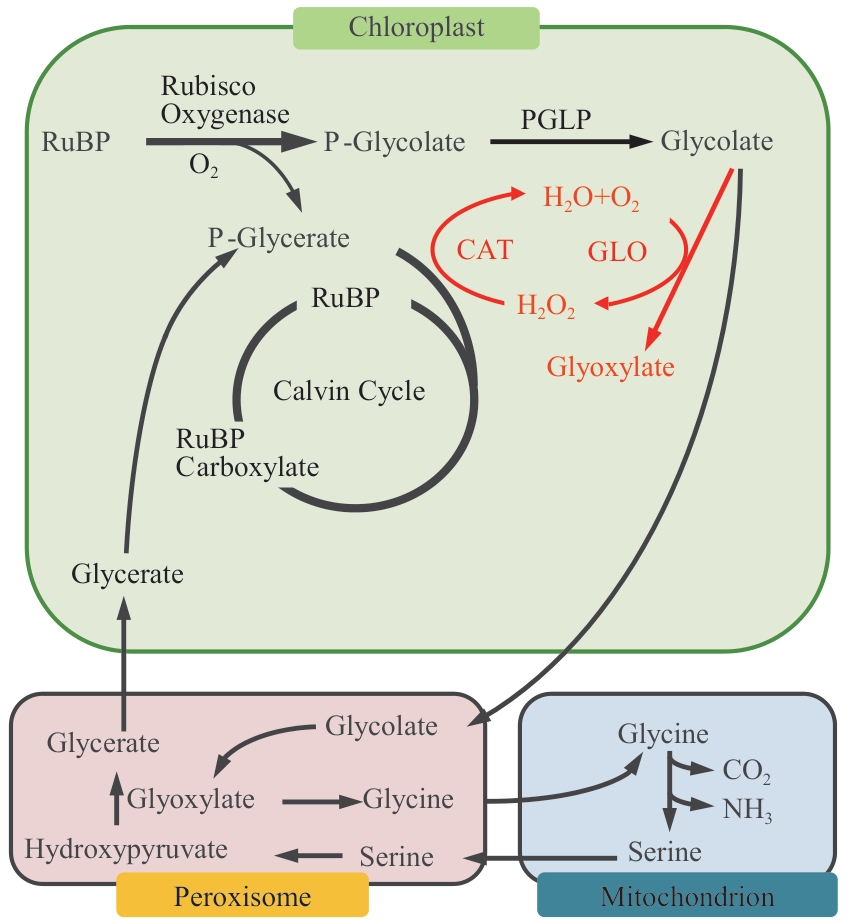
图1 水稻叶绿体光呼吸代谢改造GLO3-CAT途径示意图GLO:乙醇酸氧化酶3;CAT:过氧化氢酶
Fig. 1 Schematic diagram of GLO3-CAT pathway by the chloroplast photorespiratory metabolism in riceGLO: Glycolate oxidase 3. CAT: Catalase

图2 转基因水稻的获得及鉴定A:水稻遗传转化过程(a1:愈伤组织筛选;a2:预分化;a3:分化;a4:生根壮苗);B:转基因水稻目的基因的Western blot检测,GLO和CAT均使用His单克隆抗体进行检测,等蛋白上样;C‒E:转基因水稻目的基因转录水平检测(C:OsGLO1转录水平;D:OsGLO3转录水平;E:OsCATC转录水平);F:GLO活性;G:G1K-OE和G3C-OE的CAT活性;H:转基因水稻叶片的DAB染色;I:RbOH-b相对表达量;G1-OE:叶绿体GLO1过表达株系;G1K-OE:叶绿体GLO1-KAT过表达株系;G3-OE:叶绿体GLO3过表达株系;G3C-OE:叶绿体GLO3-CAT过表达株系;n=3,*P<0.05,**P<0.01,***P<0.001,t检验。下同
Fig. 2 Acquirement and identification of transgenic rice plantsA: Transfomation procedure of rice (a1: screening of callus; a2: pre-differentiation; a3: differentiation; a4: rooting and strenghening). B: Western blot analysis of transgenic plants, GLO and CAT were detected by His monoclonal antibody in Western blot analysis. C-E: mRNA levels of transgenic plants (C: mRNA levels of OsGLO1; D: mRNA levels of OsGLO3; E: mRNA levels of CAT). F: GLO activity. G: CAT activity of G1K-OE and G3C-OE transgenic plants. H: DAB-staining of transgenic rice leaves. I: Relative expression of RbOH-b. G1-OE: Overexpressed line of chloroplast GLO1. G1K-OE: Over expressed line of chloroplast GLO1-KAT. G3-OE: Overexpressed line of chloroplast GLO3. G3C-OE: Overexpressed line of chloroplast GLO3-CAT. n=, *P<0.05, **P<0.01, ***P<0.001, t-test. The same below

图3 转基因水稻的表型观察A:转基因水稻幼苗期表型观察;B:株高;C:最大根长;D:G1-OE与G1K-OE转基因水稻;E:剑叶长度;F:剑叶宽度;G:G3-OE与G3C-OE转基因水稻;H:株高;I:分蘖数;n=10
Fig. 3 Phenotypic observation of transgenic rice plantsA: Phenotypic observation of transgenic plants at seedling stage. B: Plant height. C: Maximum length of root. D: Transgenic rice plants of G1-OE and G1K-OE. E: Length of flag leaf. F: Width of flag leaf. G: Transgenic rice plants of G3-OE and G3C-OE. H: Plant height. I: Number of tillers. n=10
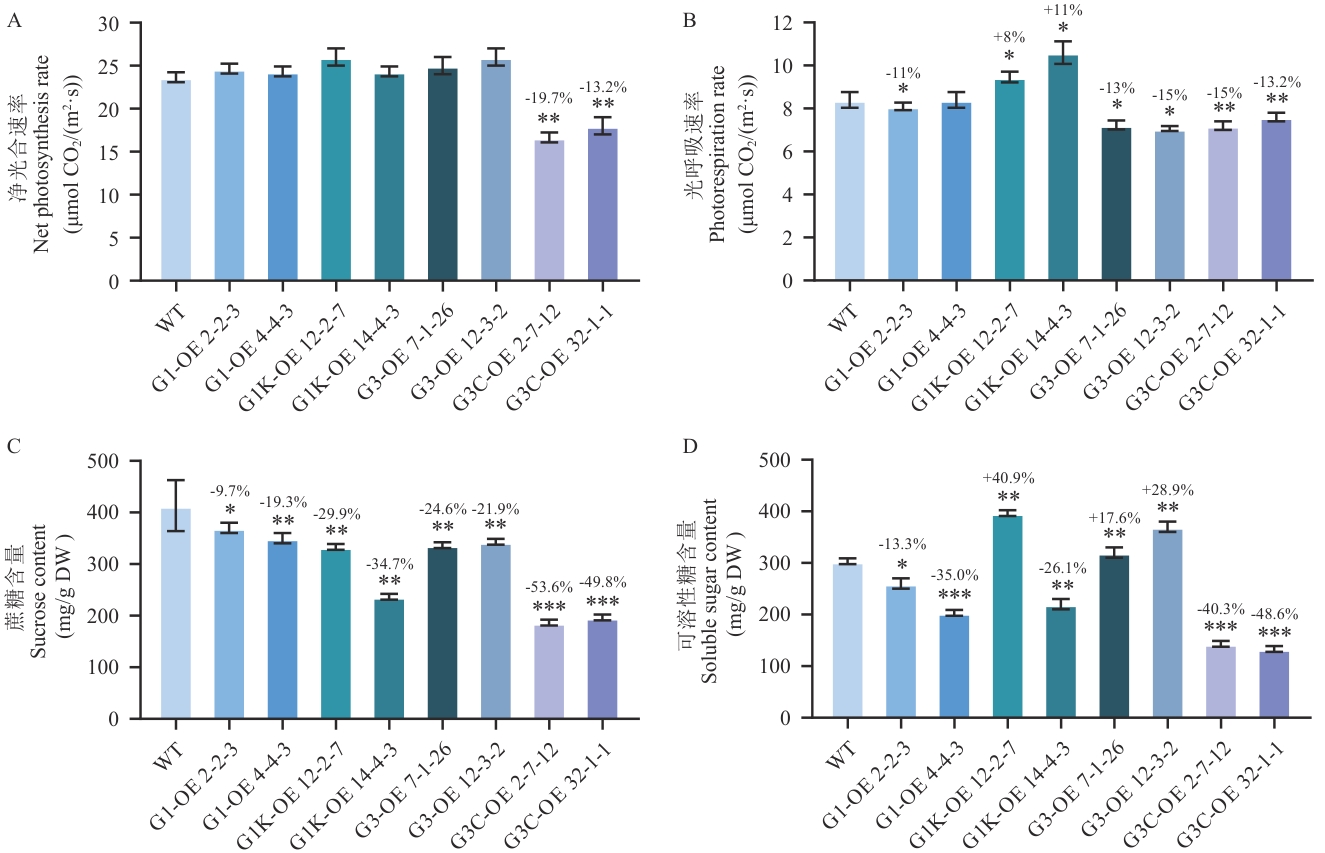
图4 转基因植株分蘖期叶片光合相关参数和碳水化合物含量测定A, B: n=10; C, D: n=3
Fig. 4 Analysis of the photosynthetic-related parameters and carbohydrate content in the leaves of transigenic plants at tillering stage
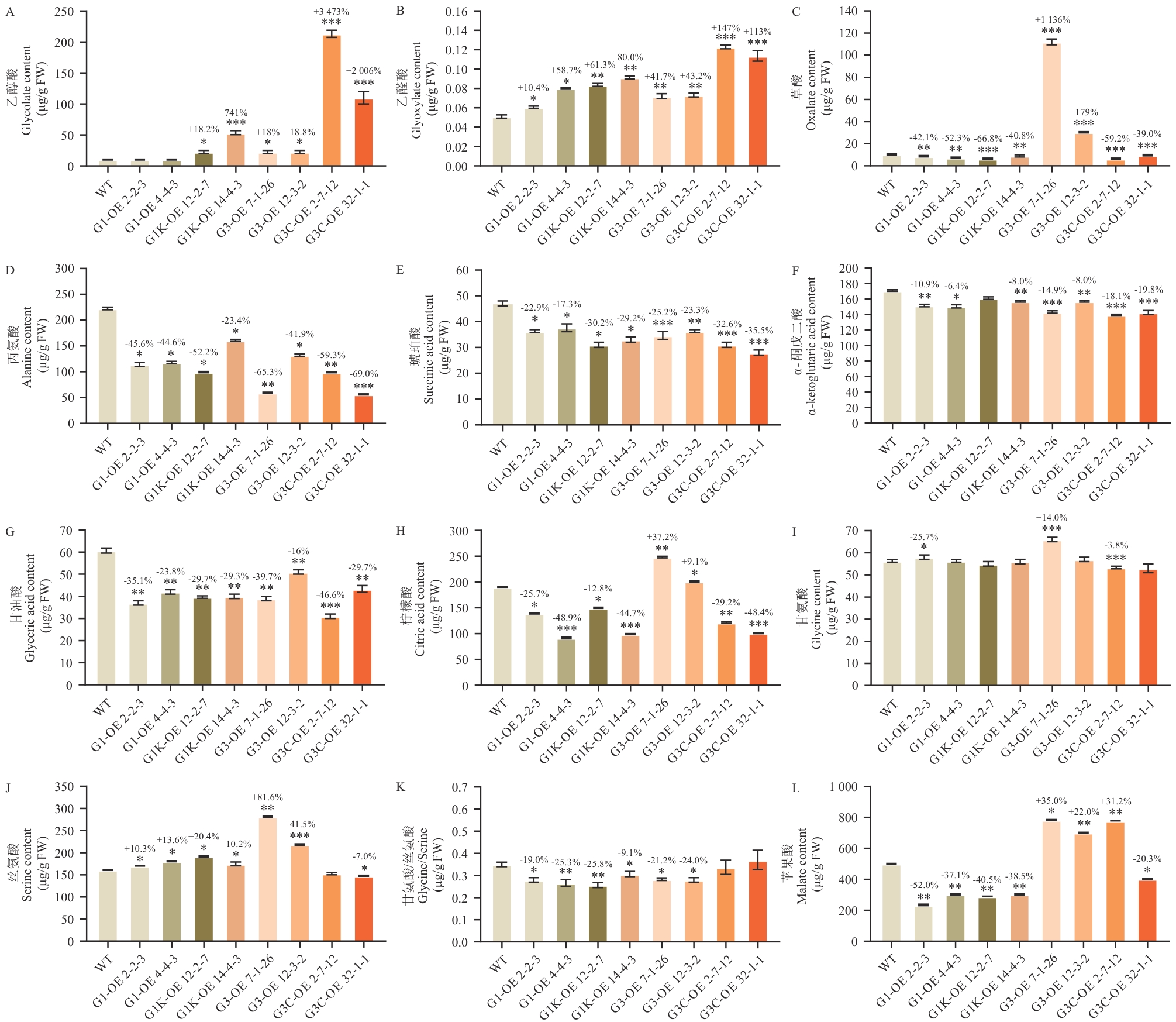
图5 GCGT转基因植株幼苗期叶片光呼吸相关代谢物含量的测定自然光下用木村B营养液水培至第4叶完全展开,取第2片叶,取样时间为13:00‒15:00,n=3
Fig. 5 Content determination of photorespiration metabolites of GCGT tansgenic plants leaves at seedling stageTake the second leaf after hydroponic with Kimura B nutrient solution under natural light until the fourth leaf fully spreads, and the sampling time is 13:00‒15:00, n=3
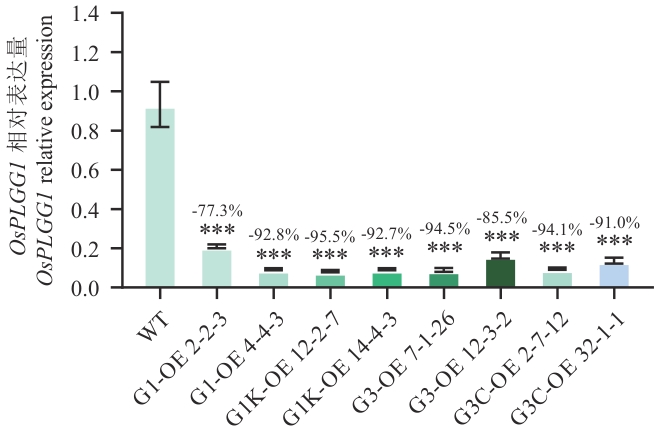
图6 转基因水稻PLGG1的转录水平分析
Fig. 6 Analysis of mRNA levels of PLGG1 in transgenic rice plants (n=3)
| [1] | Falcon WP, Naylor RL, Shankar ND. Rethinking global food demand for 2050 [J]. Popul Dev Rev, 2022, 48(4): 921-957. |
| [2] | Tian ZX, Wang JW, Li JY, et al. Designing future crops: challenges and strategies for sustainable agriculture [J]. Plant J, 2021, 105(5): 1165-1178. |
| [3] | Croce R, Carmo-Silva E, Cho YB, et al. Perspectives on improving photosynthesis to increase crop yield [J]. Plant Cell, 2024, 36(10): 3944-3973. |
| [4] | Zhu XG, Long SP, Ort DR. Improving photosynthetic efficiency for greater yield [J]. Annu Rev Plant Biol, 2010, 61: 235-261. |
| [5] | Jin KN, Chen GX, Yang YR, et al. Strategies for manipulating rubisco and creating photorespiratory bypass to boost C3 photosynthesis: prospects on modern crop improvement [J]. Plant Cell Environ, 2023, 46(2): 363-378. |
| [6] | 张智胜, 朱国辉, 彭新湘. 优化碳同化实现作物高光效研究进展 [J]. 华南农业大学学报, 2022, 43(6): 69-77. |
| Zhang ZS, Zhu GH, Peng XX. Advances in improvement of crop photosynthetic efficiency by optimizing the photosynthetic carbon assimilation [J]. J South China Agric Univ, 2022, 43(6): 69-77. | |
| [7] | Zhang ZS, Zhu GH, Peng XX. Photorespiration in plant adaptation to environmental changes [J]. Crop Environ, 2024, 3(4): 203-212. |
| [8] | 朱国辉, 张智胜, 彭新湘. 光呼吸演化、调控与遗传改良 [J]. 生命科学, 2024, 36(10): 1226-1239. |
| Zhu GH, Zhang ZS, Peng XX. Photorespiration evolution, regulation, and genetic improvement [J]. Chin Bull Life Sci, 2024, 36(10): 1226-1239. | |
| [9] | Ehlers I, Augusti A, Betson TR, et al. Detecting long-term metabolic shifts using isotopomers: CO2-driven suppression of photorespiration in C3 plants over the 20th century [J]. Proc Natl Acad Sci USA, 2015, 112(51): 15585-15590. |
| [10] | Chen GX, Li YN, Jin KN, et al. Synthetic photorespiratory bypass improves rice productivity by enhancing photosynthesis and nitrogen uptake [J]. Plant Cell, 2024, 37(1): koaf015. |
| [11] | Wang LM, Shen BR, Li BD, et al. A synthetic photorespiratory shortcut enhances photosynthesis to boost biomass and grain yield in rice [J]. Mol Plant, 2020, 13(12): 1802-1815. |
| [12] | Shen BR, Wang LM, Lin XL, et al. Engineering a new chloroplastic photorespiratory bypass to increase photosynthetic efficiency and productivity in rice [J]. Mol Plant, 2019, 12(2): 199-214. |
| [13] | South PF, Cavanagh AP, Liu HW, et al. Synthetic glycolate metabolism pathways stimulate crop growth and productivity in the field [J]. Science, 2019, 363(6422): eaat9077. |
| [14] | Kebeish R, Niessen M, Thiruveedhi K, et al. Chloroplastic photorespiratory bypass increases photosynthesis and biomass production in Arabidopsis thaliana [J]. Nat Biotechnol, 2007, 25(5): 593-599. |
| [15] | Nölke G, Houdelet M, Kreuzaler F, et al. The expression of a recombinant glycolate dehydrogenase polyprotein in potato (Solanum tuberosum) plastids strongly enhances photosynthesis and tuber yield [J]. Plant Biotechnol J, 2014, 12(6): 734-742. |
| [16] | Dalal J, Lopez H, Vasani NB, et al. A photorespiratory bypass increases plant growth and seed yield in biofuel crop Camelina sativa [J]. Biotechnol Biofuels, 2015, 8: 175. |
| [17] | Li BD, Huang AY, Wang LM, et al. Increased sugar content impairs pollen fertility and reduces seed-setting in high-photosynthetic-efficiency rice [J]. Crop J, 2024, 12(6): 1547-1558. |
| [18] | Shen BR, Zhu CH, Yao Z, et al. An optimized transit peptide for effective targeting of diverse foreign proteins into chloroplasts in rice [J]. Sci Rep, 2017, 7: 46231. |
| [19] | Xu Z, Guo WD, Mo BQ, et al. Mitogen-activated protein kinase 2 specifically regulates photorespiration in rice [J]. Plant Physiol, 2023, 193(2): 1381-1394. |
| [20] | Mo BQ, Chen XF, Yang JJ, et al. Engineering of photorespiration-dependent glycine betaine biosynthesis improves photosynthetic carbon fixation and panicle architecture in rice [J]. J Integr Plant Biol, 2025, 67(4): 979-992. |
| [21] | Oliver DJ, Zelitch I. Increasing photosynthesis by inhibiting photorespiration with glyoxylate [J]. Science, 1977, 196(4297): 1450-1451. |
| [22] | Li XY, Chen LR, Zeng XY, et al. Wounding induces a peroxisomal H2O2 decrease via glycolate oxidase-catalase switch dependent on glutamate receptor-like channel-supported Ca2+ signaling in plants [J]. Plant J, 2023, 116(5): 1325-1341. |
| [23] | Li XY, Liao MM, Huang JY, et al. Dynamic and fluctuating generation of hydrogen peroxide via photorespiratory metabolic channeling in plants [J]. Plant J, 2022, 112(6): 1429-1446. |
| [24] | Zhang ZS, Liang X, Lu L, et al. Two glyoxylate reductase isoforms are functionally redundant but required under high photorespiration conditions in rice [J]. BMC Plant Biol, 2020, 20(1): 357. |
| [25] | Lu YS, Li Y, Yang QS, et al. Suppression of glycolate oxidase causes glyoxylate accumulation that inhibits photosynthesis through deactivating rubisco in rice [J]. Physiol Plant, 2014, 150(3): 463-476. |
| [26] | Xu HW, Zhang JJ, Zeng JW, et al. Inducible antisense suppression of glycolate oxidase reveals its strong regulation over photosynthesis in rice [J]. J Exp Bot, 2009, 60(6): 1799-1809. |
| [27] | Mittler R, Zandalinas SI, Fichman Y, et al. Reactive oxygen species signalling in plant stress responses [J]. Nat Rev Mol Cell Biol, 2022, 23(10): 663-679. |
| [28] | Aroca A, García-Díaz I, García-Calderón M, et al. Photorespiration: regulation and new insights on the potential role of persulfidation [J]. J Exp Bot, 2023, 74(19): 6023-6039. |
| [1] | 王芳, 邵会茹, 吕林龙, 赵点, 胡振, 吕建珍, 姜亮. 植物和细菌TurboID邻近蛋白标记方法的建立[J]. 生物技术通报, 2025, 41(9): 44-53. |
| [2] | 邓美壁, 严浪, 詹志田, 朱敏, 和玉兵. RUBY辅助的水稻高效CRISPR基因编辑[J]. 生物技术通报, 2025, 41(8): 65-73. |
| [3] | 魏瑶, 张晶晶, 崔云晓, 刘钰, 刘海瑞. 忍冬属忍冬组植物叶绿体基因组进化分析[J]. 生物技术通报, 2025, 41(8): 276-288. |
| [4] | 程雪, 付颖, 柴晓娇, 王红艳, 邓欣. 谷子LHC基因家族鉴定及非生物胁迫表达分析[J]. 生物技术通报, 2025, 41(8): 102-114. |
| [5] | 侯鹰翔, 费思恬, 黎妮, 李兰, 宋松泉, 王伟平, 张超. 水稻miRNAs响应生物胁迫研究进展[J]. 生物技术通报, 2025, 41(7): 69-80. |
| [6] | 吴浩, 董伟峰, 贺子天, 李艳肖, 谢辉, 孙明哲, 沈阳, 孙晓丽. 水稻BXL基因家族的全基因组鉴定及表达分析[J]. 生物技术通报, 2025, 41(6): 87-98. |
| [7] | 安昌, 徐文波, 陆琳, 李登麟, 姚艺新, 林彦翔, 杨成梓, 秦源, 郑平. 不同产地珊瑚菜叶绿体基因组特征的差异性研究[J]. 生物技术通报, 2025, 41(6): 229-242. |
| [8] | 刘园园, 陈析丰, 钱前, 高振宇. 水稻穗发育调控的分子机制研究进展[J]. 生物技术通报, 2025, 41(5): 1-13. |
| [9] | 杜量衡, 唐黄磊, 张治国. 控制水稻光响应基因ELM1的图位克隆[J]. 生物技术通报, 2025, 41(5): 82-89. |
| [10] | 陈晓军, 惠建, 马洪文, 白海波, 钟楠, 李稼润, 樊云芳. 利用单碱基基因编辑技术创制OsALS抗除草剂水稻种质资源[J]. 生物技术通报, 2025, 41(4): 106-114. |
| [11] | 冯小康, 梁倩, 王学峰, 孙杰, 薛飞. 棉花SEC1复合体组分的鉴定与GhSCY1基因功能验证[J]. 生物技术通报, 2025, 41(3): 112-122. |
| [12] | 陆峰, 黄玉红, 林燕娜, 马富强. CO2还原用甲酸脱氢酶分子改造的研究进展[J]. 生物技术通报, 2025, 41(3): 14-24. |
| [13] | 李斌, 苏香萍, 刘畅, 王玉兵, 张勇洪, 周超, 徐青. 玄参科植物叶绿体基因组特征及系统发育分析[J]. 生物技术通报, 2025, 41(3): 240-254. |
| [14] | 王斌, 王玉昆, 肖艳辉. 丁香罗勒(Ocimum gratissimum)叶片响应镉胁迫的比较转录组学分析[J]. 生物技术通报, 2025, 41(3): 255-270. |
| [15] | 李欣芃, 张武汉, 张莉, 舒服, 何强, 郭杨, 邓华凤, 王悦, 孙平勇. γ射线诱变创制水稻突变体及其分子鉴定[J]. 生物技术通报, 2025, 41(3): 35-43. |
| 阅读次数 | ||||||
|
全文 |
|
|||||
|
摘要 |
|
|||||
