







生物技术通报 ›› 2026, Vol. 42 ›› Issue (11): 252-262.doi: 10.13560/j.cnki.biotech.bull.1985.2025-1351
• 研究报告 • 上一篇
李诗琪1,2, 武月园2, 张殿朋2, 郭远2, 刘宇2, 宋忠娟2, 王守现2( ), 宋爽2()
收稿日期:2025-12-11
出版日期:2026-11-26
发布日期:2026-11-03
通讯作者:
王守现wangshouxian@baafs.net.cn基金资助:
LI Shi-qi1,2, WU Yue-yuan2, ZHANG Dian-peng2, GUO Yuan2, LIU Yu2, SONG Zhong-juan2, WANG Shou-xian2(), SONG Shuang2()
Received:2025-12-11
Published:2026-11-26
Online:2026-11-03
摘要:
目的 大球盖菇(Stropharia rugosoannulata)栽培群体存在种质资源混杂、优异品种短缺的问题。解析不同地理来源栽培菌株的遗传多样性与表型变异特征,筛选优良种质,为大球盖菇品种改良提供科学依据。 方法 以67个不同地理来源的大球盖菇栽培菌株为材料,采用10条ISSR引物进行遗传多样性分析,同时测定10个农艺性状,结合相关性分析、主成分分析及聚类分析开展综合评价。 结果 10条ISSR引物共扩增出65条清晰条带,其中多态性条带51条,多态性位点百分率为55.56%-100%,Nei’s基因多样性指数平均值为0.27,香农多样性指数平均值为0.43。UPGMA聚类分析可划分为5个类群,遗传相似系数为0.43-0.96,主成分分析累计解释28%的遗传变异,核心类群菌株分布紧密,遗传背景高度相似。农艺性状中,菌盖硬度变异系数最大(124.03%),产量香农多样性指数最高(1.88);相关性分析显示产量与单朵重、菌盖直径等7个性状呈极显著正相关(P<0.01),菌丝锁状联合数量与所有农艺性状无显著相关性。主成分分析筛选出菌盖直径和菌柄直径为表型综合评价核心指标,前3个主成分累计贡献率达74.51%;综合得分排名前3的菌株为BIPP21340027、BIPP21340016和BIPP21340020,在产量和商品性状上协同优异。 结论 供试大球盖菇菌株具有遗传基础较窄、表型性状变异丰富的特征,筛选出菌盖直径、菌柄直径为表型评价核心指标,获得3份优良菌株,可为大球盖菇优异种质筛选、杂交亲本选配及新品种选育提供参考。
李诗琪, 武月园, 张殿朋, 郭远, 刘宇, 宋忠娟, 王守现, 宋爽. 基于ISSR分子标记和农艺性状的大球盖菇种质资源遗传多样性分析[J]. 生物技术通报, 2026, 42(11): 252-262.
LI Shi-qi, WU Yue-yuan, ZHANG Dian-peng, GUO Yuan, LIU Yu, SONG Zhong-juan, WANG Shou-xian, SONG Shuang. Genetic Diversity Analysis of Stropharia rugosoannulata Germplasm Resources Based on ISSR Markers and Agronomic Traits[J]. Biotechnology Bulletin, 2026, 42(11): 252-262.
| 菌株编号Strain number | 来源Origin | 菌株编号Strain number | 来源Origin | 菌株编号Strain number | 来源Origin | 菌株编号Strain number | 来源Origin |
|---|---|---|---|---|---|---|---|
| BIPP21340001 | 北京市海淀区 | BIPP21340023 | 北京市密云区 | BIPP21340040 | 北京市房山区 | BIPP21340061 | 山东省 |
| BIPP21340002 | 北京市通州区 | BIPP21340024 | 北京市密云区 | BIPP21340041 | 河北邢台临县 | BIPP21340062 | 山东省 |
| BIPP21340004 | 北京市房山区 | BIPP21340025 | 北京市房山区 | BIPP21340042 | 河北邢台临县 | BIPP21340063 | 山东省 |
| BIPP21340005 | 北京市房山区 | BIPP21340026 | 北京市房山区 | BIPP21340043 | 北京市房山区 | BIPP21340064 | 山东省 |
| BIPP21340008 | 北京市密云区 | BIPP21340027 | 北京市密云区 | BIPP21340044 | 陕西省安康市 | BIPP21340065 | 山东省 |
| BIPP21340010 | 北京市大兴区 | BIPP21340028 | 北京市房山区 | BIPP21340045 | 福建省 | BIPP21340066 | 新疆维吾尔自治区 |
| BIPP21340011 | 北京市大兴区 | BIPP21340029 | 北京市顺义区 | BIPP21340050 | 福建省 | BIPP21340067 | 新疆维吾尔自治区 |
| BIPP21340012 | 北京市房山区 | BIPP21340030 | 北京市平谷区 | BIPP21340051 | 山东省聊城市 | BIPP21340068 | 新疆维吾尔自治区 |
| BIPP21340013 | 北京市丰台区 | BIPP21340031 | 北京市平谷区 | BIPP21340052 | 北京市海淀区 | BIPP21340069 | 山东省 |
| BIPP21340015 | 北京市顺义区 | BIPP21340032 | 北京市丰台区 | BIPP21340053 | 四川省 | BIPP21340070 | 北京市海淀区 |
| BIPP21340016 | 北京市顺义区 | BIPP21340033 | 北京市大兴区 | BIPP21340054 | 四川省 | BIPP21340072 | 北京市海淀区 |
| BIPP21340017 | 北京市顺义区 | BIPP21340034 | 北京市海淀区 | BIPP21340055 | 山东省 | BIPP21340074 | 福建省 |
| BIPP21340018 | 北京市顺义区 | BIPP21340035 | 北京市海淀区 | BIPP21340056 | 山东省 | BIPP21340081 | 云南省 |
| BIPP21340019 | 北京市顺义区 | BIPP21340036 | 北京市房山区 | BIPP21340057 | 黑龙江省 | BIPP21340082 | 云南省 |
| BIPP21340020 | 北京市顺义区 | BIPP21340037 | 北京市房山区 | BIPP21340058 | 黑龙江省 | BIPP21340085 | 山东省 |
| BIPP21340021 | 北京市平谷区 | BIPP21340038 | 北京市房山区 | BIPP21340059 | 山东省 | BIPP21340090 | 黑龙江省 |
| BIPP21340022 | 北京市延庆区 | BIPP21340039 | 北京市海淀区 | BIPP21340060 | 山东省 |
表1 大球盖菇菌株编号及其来源
Table 1 Strain number and source of S. rugosoannulata
| 菌株编号Strain number | 来源Origin | 菌株编号Strain number | 来源Origin | 菌株编号Strain number | 来源Origin | 菌株编号Strain number | 来源Origin |
|---|---|---|---|---|---|---|---|
| BIPP21340001 | 北京市海淀区 | BIPP21340023 | 北京市密云区 | BIPP21340040 | 北京市房山区 | BIPP21340061 | 山东省 |
| BIPP21340002 | 北京市通州区 | BIPP21340024 | 北京市密云区 | BIPP21340041 | 河北邢台临县 | BIPP21340062 | 山东省 |
| BIPP21340004 | 北京市房山区 | BIPP21340025 | 北京市房山区 | BIPP21340042 | 河北邢台临县 | BIPP21340063 | 山东省 |
| BIPP21340005 | 北京市房山区 | BIPP21340026 | 北京市房山区 | BIPP21340043 | 北京市房山区 | BIPP21340064 | 山东省 |
| BIPP21340008 | 北京市密云区 | BIPP21340027 | 北京市密云区 | BIPP21340044 | 陕西省安康市 | BIPP21340065 | 山东省 |
| BIPP21340010 | 北京市大兴区 | BIPP21340028 | 北京市房山区 | BIPP21340045 | 福建省 | BIPP21340066 | 新疆维吾尔自治区 |
| BIPP21340011 | 北京市大兴区 | BIPP21340029 | 北京市顺义区 | BIPP21340050 | 福建省 | BIPP21340067 | 新疆维吾尔自治区 |
| BIPP21340012 | 北京市房山区 | BIPP21340030 | 北京市平谷区 | BIPP21340051 | 山东省聊城市 | BIPP21340068 | 新疆维吾尔自治区 |
| BIPP21340013 | 北京市丰台区 | BIPP21340031 | 北京市平谷区 | BIPP21340052 | 北京市海淀区 | BIPP21340069 | 山东省 |
| BIPP21340015 | 北京市顺义区 | BIPP21340032 | 北京市丰台区 | BIPP21340053 | 四川省 | BIPP21340070 | 北京市海淀区 |
| BIPP21340016 | 北京市顺义区 | BIPP21340033 | 北京市大兴区 | BIPP21340054 | 四川省 | BIPP21340072 | 北京市海淀区 |
| BIPP21340017 | 北京市顺义区 | BIPP21340034 | 北京市海淀区 | BIPP21340055 | 山东省 | BIPP21340074 | 福建省 |
| BIPP21340018 | 北京市顺义区 | BIPP21340035 | 北京市海淀区 | BIPP21340056 | 山东省 | BIPP21340081 | 云南省 |
| BIPP21340019 | 北京市顺义区 | BIPP21340036 | 北京市房山区 | BIPP21340057 | 黑龙江省 | BIPP21340082 | 云南省 |
| BIPP21340020 | 北京市顺义区 | BIPP21340037 | 北京市房山区 | BIPP21340058 | 黑龙江省 | BIPP21340085 | 山东省 |
| BIPP21340021 | 北京市平谷区 | BIPP21340038 | 北京市房山区 | BIPP21340059 | 山东省 | BIPP21340090 | 黑龙江省 |
| BIPP21340022 | 北京市延庆区 | BIPP21340039 | 北京市海淀区 | BIPP21340060 | 山东省 |
| 引物名称 Primer name | 引物序列 Primer sequence (5′-3′) |
|---|---|
| ISSR1 | CTCCTCCTCCTCSC |
| ISSR2 | BDBACAACAACAACAACA |
| ISSR4 | CACCACCACCACSC |
| ISSR5 | VDHTCGTCGTCGTCGTCG |
| ISSR6 | DHBCGACGACGACGACGA |
| ISSR12 | AGAGAGAGAGAGAGAGT |
| ISSR13 | GAGAGAGAGAGAGAGAC |
| ISSR15 | CACACACACACACACAG |
| ISSR17 | TGTGTGTGTGTGTGTGRC |
| ISSR18 | VHVGTGTGTGTGTGTGTGT |
表2 ISSR分子标记的引物及其序列
Table 2 Primer sequences of ISSR markers
| 引物名称 Primer name | 引物序列 Primer sequence (5′-3′) |
|---|---|
| ISSR1 | CTCCTCCTCCTCSC |
| ISSR2 | BDBACAACAACAACAACA |
| ISSR4 | CACCACCACCACSC |
| ISSR5 | VDHTCGTCGTCGTCGTCG |
| ISSR6 | DHBCGACGACGACGACGA |
| ISSR12 | AGAGAGAGAGAGAGAGT |
| ISSR13 | GAGAGAGAGAGAGAGAC |
| ISSR15 | CACACACACACACACAG |
| ISSR17 | TGTGTGTGTGTGTGTGRC |
| ISSR18 | VHVGTGTGTGTGTGTGTGT |
| 引物Primer | 扩增出的条带数 Number of amplified bands | 多态性条带数 Number of polymorphic bands | 多态位点百分率Percentage of polymorphic loci | 观测等位基因数 Observed number of alleles | 有效等位基因数 Effective number of alleles | Nei’s基因多样性指数 Nei’s gene diversity index | 香农多样性指数 Shannon diversity index(I) |
|---|---|---|---|---|---|---|---|
| ISSR1 | 9 | 8 | 88.89% | 1.89 | 1.59 | 0.34 | 0.67 |
| ISSR2 | 7 | 6 | 85.71% | 1.86 | 1.51 | 0.31 | 0.47 |
| ISSR4 | 6 | 4 | 66.67% | 1.67 | 1.29 | 0.18 | 0.29 |
| ISSR5 | 7 | 5 | 71.43% | 1.71 | 1.43 | 0.27 | 0.40 |
| ISSR6 | 9 | 5 | 55.56% | 1.56 | 1.22 | 0.15 | 0.23 |
| ISSR12 | 5 | 3 | 60.00% | 1.60 | 1.33 | 0.21 | 0.32 |
| ISSR13 | 7 | 7 | 100% | 2.00 | 1.83 | 0.45 | 0.64 |
| ISSR15 | 4 | 4 | 100% | 2.00 | 1.59 | 0.34 | 0.51 |
| ISSR17 | 6 | 6 | 100% | 2.00 | 1.59 | 0.36 | 0.55 |
| ISSR18 | 5 | 3 | 60.00% | 1.60 | 1.16 | 0.12 | 0.19 |
表3 基于10个ISSR引物扩增的67个大球盖菇菌株的遗传多态性
Table 3 Genetic polymorphism of 67 S. rugosoannulata strains based on amplification with 10 ISSR primers
| 引物Primer | 扩增出的条带数 Number of amplified bands | 多态性条带数 Number of polymorphic bands | 多态位点百分率Percentage of polymorphic loci | 观测等位基因数 Observed number of alleles | 有效等位基因数 Effective number of alleles | Nei’s基因多样性指数 Nei’s gene diversity index | 香农多样性指数 Shannon diversity index(I) |
|---|---|---|---|---|---|---|---|
| ISSR1 | 9 | 8 | 88.89% | 1.89 | 1.59 | 0.34 | 0.67 |
| ISSR2 | 7 | 6 | 85.71% | 1.86 | 1.51 | 0.31 | 0.47 |
| ISSR4 | 6 | 4 | 66.67% | 1.67 | 1.29 | 0.18 | 0.29 |
| ISSR5 | 7 | 5 | 71.43% | 1.71 | 1.43 | 0.27 | 0.40 |
| ISSR6 | 9 | 5 | 55.56% | 1.56 | 1.22 | 0.15 | 0.23 |
| ISSR12 | 5 | 3 | 60.00% | 1.60 | 1.33 | 0.21 | 0.32 |
| ISSR13 | 7 | 7 | 100% | 2.00 | 1.83 | 0.45 | 0.64 |
| ISSR15 | 4 | 4 | 100% | 2.00 | 1.59 | 0.34 | 0.51 |
| ISSR17 | 6 | 6 | 100% | 2.00 | 1.59 | 0.36 | 0.55 |
| ISSR18 | 5 | 3 | 60.00% | 1.60 | 1.16 | 0.12 | 0.19 |
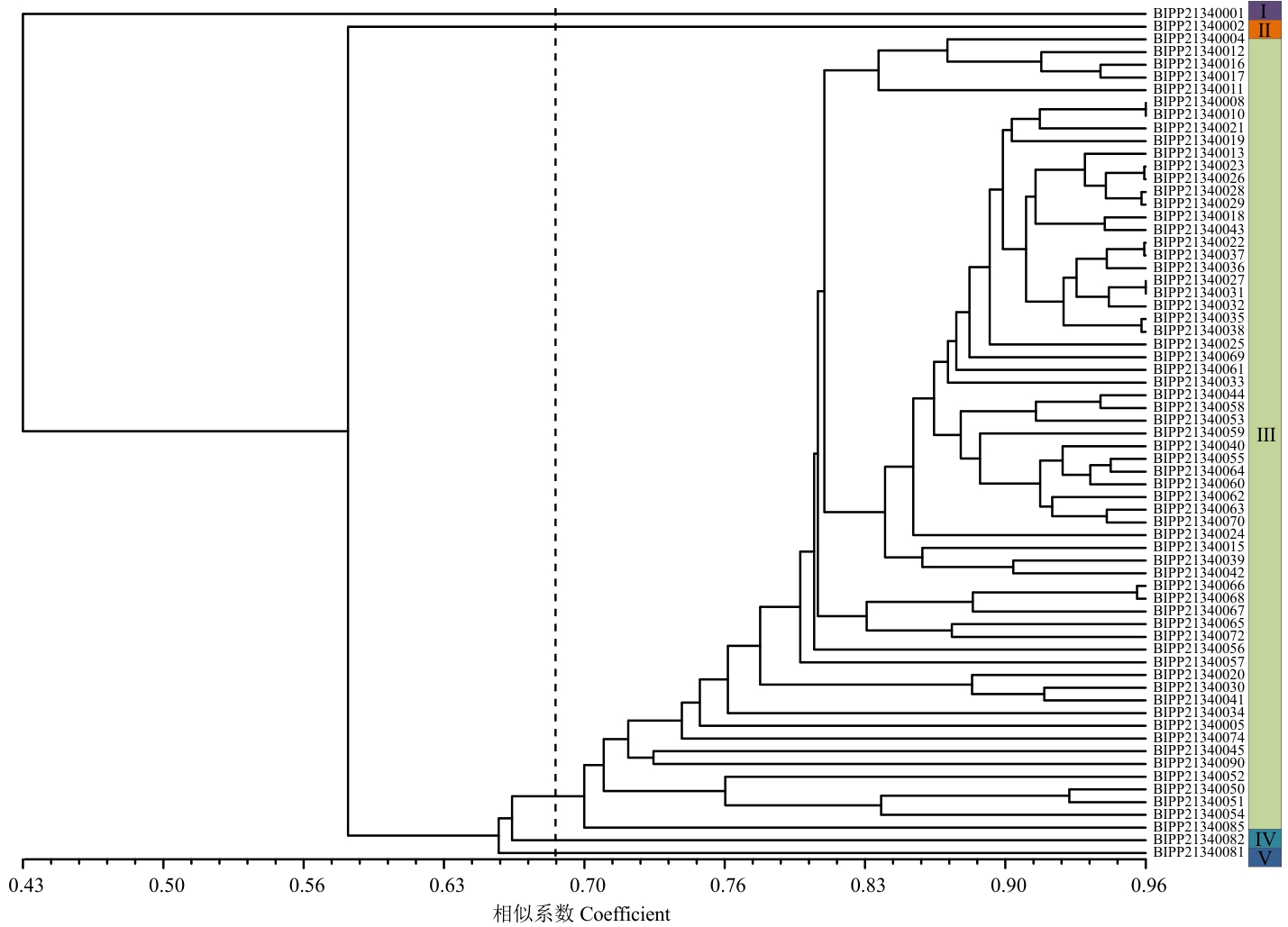
图1 基于ISSR分子标记对67个大球盖菇菌株进行UPGMA聚类分析
Fig. 1 UPGMA cluster analysis of 67 S. rugosoannulata strains based on ISSR markers
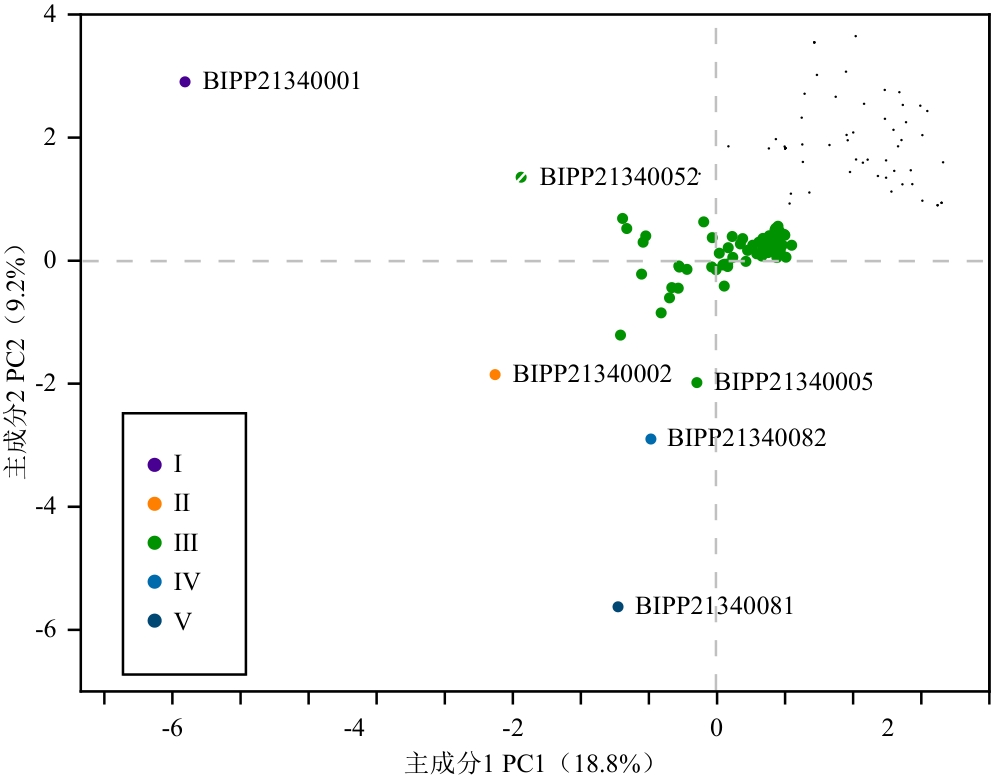
图2 基于ISSR分子标记绘制的大球盖菇菌株的主成分分析图
Fig. 2 Principal component analysis diagram of S. rugosoannulata strains based on ISSR markers
| 农艺性状Agronomic traits | 平均值±标准差Mean±SD (n=67) | 最大值Maximum | 最小值Minimum | 变异系数Coefficient of variation (CV) (%) | 香农多样性指数Shannon diversity index (I) |
|---|---|---|---|---|---|
| 菌丝生长速度 Mycelial growth rate (mm/d) | 3.83±1.36 | 8.51 | 1.16 | 35.51 | 1.67 |
| 菌丝锁状联合数量 Number of hyphal clamp connection | 19.40±11.13 | 56.00 | 0.00 | 57.37 | 1.45 |
| 产量 Yield (g) | 1 463.54±1 038.29 | 4 430.48 | 17.76 | 70.94 | 1.88 |
| 单朵重 Single fruiting body weight (g) | 29.92±10.01 | 60.04 | 8.22 | 33.46 | 1.06 |
| 菌盖直径 Pileus diameter (mm) | 34.57±10.40 | 48.63 | 9.97 | 30.08 | 1.33 |
| 菌盖厚度 Pileus thickness (mm) | 10.55±3.23 | 17.87 | 2.80 | 30.62 | 1.04 |
| 菌柄长度 Stipe length (mm) | 53.63±12.98 | 71.86 | 21.39 | 24.20 | 1.51 |
| 菌柄直径 Stipe diameter (mm) | 25.04±8.45 | 51.07 | 2.20 | 33.75 | 1.21 |
| 菌盖硬度 Pileus hardness (HB) | 1.29±1.60 | 11.88 | 0.28 | 124.03 | 1.13 |
| 菌柄硬度 Stipe hardness (HB) | 1.39±0.89 | 4.48 | 0.26 | 64.03 | 1.22 |
表4 大球盖菇菌株农艺性状的统计描述和遗传多样性指数
Table 4 Statistical description of agronomic traits and genetic diversity parameters of S. rugosoannulata strains
| 农艺性状Agronomic traits | 平均值±标准差Mean±SD (n=67) | 最大值Maximum | 最小值Minimum | 变异系数Coefficient of variation (CV) (%) | 香农多样性指数Shannon diversity index (I) |
|---|---|---|---|---|---|
| 菌丝生长速度 Mycelial growth rate (mm/d) | 3.83±1.36 | 8.51 | 1.16 | 35.51 | 1.67 |
| 菌丝锁状联合数量 Number of hyphal clamp connection | 19.40±11.13 | 56.00 | 0.00 | 57.37 | 1.45 |
| 产量 Yield (g) | 1 463.54±1 038.29 | 4 430.48 | 17.76 | 70.94 | 1.88 |
| 单朵重 Single fruiting body weight (g) | 29.92±10.01 | 60.04 | 8.22 | 33.46 | 1.06 |
| 菌盖直径 Pileus diameter (mm) | 34.57±10.40 | 48.63 | 9.97 | 30.08 | 1.33 |
| 菌盖厚度 Pileus thickness (mm) | 10.55±3.23 | 17.87 | 2.80 | 30.62 | 1.04 |
| 菌柄长度 Stipe length (mm) | 53.63±12.98 | 71.86 | 21.39 | 24.20 | 1.51 |
| 菌柄直径 Stipe diameter (mm) | 25.04±8.45 | 51.07 | 2.20 | 33.75 | 1.21 |
| 菌盖硬度 Pileus hardness (HB) | 1.29±1.60 | 11.88 | 0.28 | 124.03 | 1.13 |
| 菌柄硬度 Stipe hardness (HB) | 1.39±0.89 | 4.48 | 0.26 | 64.03 | 1.22 |
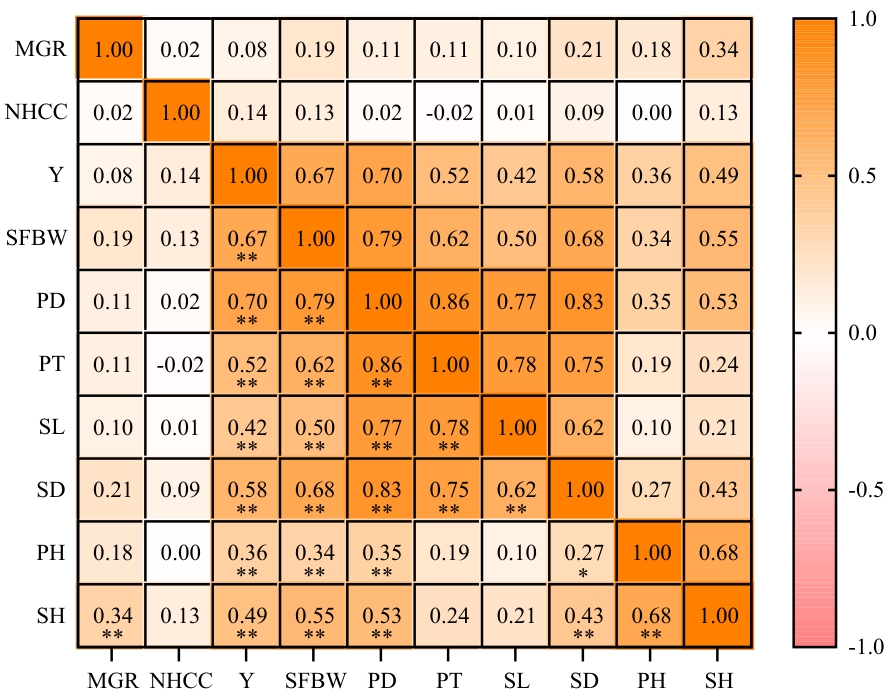
图3 大球盖菇菌株各农艺性状的相关性MGR:菌丝生长速度;NHCC:菌丝锁状联合数量;Y:产量;SFBW:单朵重;PD:菌盖直径;PT:菌盖厚度;SL:菌柄长度;SD:菌柄直径;PH:菌盖硬度;SH:菌柄硬度
Fig. 3 Correlation of agronomic traits of S. rugosoannulata strainsMGR: Mycelial growth rate; NHCC: number of hyphal clamp connection; Y: yield; SFBW: single fruiting body weight; PD: pileus diameter; PT: pileus thickness; SL: stipe length; SD: stipe diameter; PH: pileus hardness; SH: stipe hardness. *: P<0.05, **: P<0.01
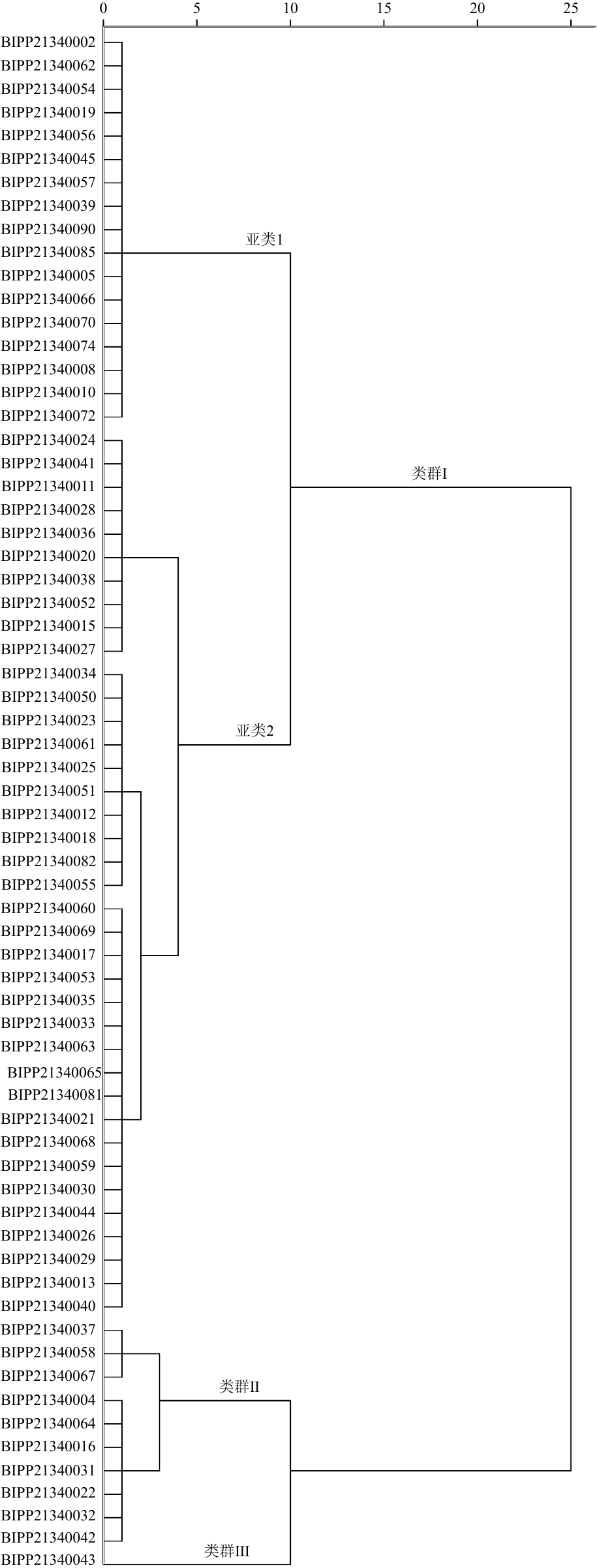
图4 基于大球盖菇菌株农艺性状的Q型聚类分析
Fig. 4 Q-cluster analysis based on agronomic traits of S. rugosoannulata strains
农艺性状 Agronomic traits | 主成分 Principal component | ||
|---|---|---|---|
| 1 | 2 | 3 | |
| 菌丝生长速度 Mycelial growth rate on PDA medium | 0.253 | 0.429 | -0.271 |
| 菌丝锁状联合数量 Number of hyphal clamp connection | 0.103 | 0.192 | 0.932 |
| 产量 Yield | 0.768 | 0.083 | 0.171 |
| 单朵重 Single fruiting body weight | 0.848 | 0.053 | 0.095 |
| 菌盖直径 Pileus diameter | 0.959 | -0.176 | -0.032 |
| 菌盖厚度 Pileus thickness | 0.828 | -0.408 | -0.085 |
| 菌柄长度 Stipe length | 0.736 | -0.454 | -0.058 |
| 菌柄直径 Stipe diameter | 0.860 | -0.147 | 0.018 |
| 菌盖硬度 Pileus hardness | 0.475 | 0.660 | -0.186 |
| 菌柄硬度 Stipe hardness | 0.636 | 0.657 | -0.036 |
| 特征值 Eigenvalue | 4.90 | 1.52 | 1.03 |
| 贡献率 Contribution rate (%) | 49.00 | 15.23 | 10.28 |
| 累计贡献率 Cumulative contribution rate (%) | 49.00 | 64.23 | 74.51 |
表5 大球盖菇菌株农艺性状的主成分分析
Table 5 Principal component analysis of agronomic traits of S. rugosoannulata strains
农艺性状 Agronomic traits | 主成分 Principal component | ||
|---|---|---|---|
| 1 | 2 | 3 | |
| 菌丝生长速度 Mycelial growth rate on PDA medium | 0.253 | 0.429 | -0.271 |
| 菌丝锁状联合数量 Number of hyphal clamp connection | 0.103 | 0.192 | 0.932 |
| 产量 Yield | 0.768 | 0.083 | 0.171 |
| 单朵重 Single fruiting body weight | 0.848 | 0.053 | 0.095 |
| 菌盖直径 Pileus diameter | 0.959 | -0.176 | -0.032 |
| 菌盖厚度 Pileus thickness | 0.828 | -0.408 | -0.085 |
| 菌柄长度 Stipe length | 0.736 | -0.454 | -0.058 |
| 菌柄直径 Stipe diameter | 0.860 | -0.147 | 0.018 |
| 菌盖硬度 Pileus hardness | 0.475 | 0.660 | -0.186 |
| 菌柄硬度 Stipe hardness | 0.636 | 0.657 | -0.036 |
| 特征值 Eigenvalue | 4.90 | 1.52 | 1.03 |
| 贡献率 Contribution rate (%) | 49.00 | 15.23 | 10.28 |
| 累计贡献率 Cumulative contribution rate (%) | 49.00 | 64.23 | 74.51 |
| 菌株 Strain | 综合得分 Comprehensive score | 排名 Ranking | 菌株 Strain | 综合得分 Comprehensive score | 排名 Ranking |
|---|---|---|---|---|---|
| BIPP21340027 | 1.35 | 1 | BIPP21340060 | 0.09 | 35 |
| BIPP21340016 | 1.18 | 2 | BIPP21340036 | 0.07 | 36 |
| BIPP21340020 | 1.17 | 3 | BIPP21340052 | 0.06 | 37 |
| BIPP21340041 | 1.06 | 4 | BIPP21340018 | 0.05 | 38 |
| BIPP21340011 | 0.97 | 5 | BIPP21340040 | 0.03 | 39 |
| BIPP21340015 | 0.81 | 6 | BIPP21340068 | 0.00 | 40 |
| BIPP21340031 | 0.80 | 7 | BIPP21340055 | -0.01 | 41 |
| BIPP21340032 | 0.79 | 8 | BIPP21340025 | -0.07 | 42 |
| BIPP21340004 | 0.77 | 9 | BIPP21340023 | -0.12 | 43 |
| BIPP21340029 | 0.72 | 10 | BIPP21340033 | -0.13 | 44 |
| BIPP21340038 | 0.64 | 11 | BIPP21340081 | -0.17 | 45 |
| BIPP21340013 | 0.61 | 12 | BIPP21340063 | -0.18 | 46 |
| BIPP21340043 | 0.58 | 13 | BIPP21340059 | -0.26 | 47 |
| BIPP21340030 | 0.57 | 14 | BIPP21340061 | -0.39 | 48 |
| BIPP21340037 | 0.56 | 15 | BIPP21340010 | -0.42 | 49 |
| BIPP21340028 | 0.55 | 16 | BIPP21340008 | -0.44 | 50 |
| BIPP21340021 | 0.53 | 17 | BIPP21340034 | -0.52 | 51 |
| BIPP21340069 | 0.50 | 18 | BIPP21340050 | -0.67 | 52 |
| BIPP21340058 | 0.46 | 19 | BIPP21340072 | -0.68 | 53 |
| BIPP21340051 | 0.41 | 20 | BIPP21340039 | -0.69 | 54 |
| BIPP21340067 | 0.39 | 21 | BIPP21340001 | -0.85 | 55 |
| BIPP21340022 | 0.38 | 22 | BIPP21340070 | -0.94 | 56 |
| BIPP21340044 | 0.37 | 23 | BIPP21340057 | -0.95 | 57 |
| BIPP21340035 | 0.36 | 24 | BIPP21340054 | -0.96 | 58 |
| BIPP21340065 | 0.32 | 25 | BIPP21340066 | -1.04 | 59 |
| BIPP21340042 | 0.32 | 26 | BIPP21340019 | -1.05 | 60 |
| BIPP21340026 | 0.31 | 27 | BIPP21340002 | -1.07 | 61 |
| BIPP21340053 | 0.27 | 28 | BIPP21340045 | -1.10 | 62 |
| BIPP21340017 | 0.26 | 29 | BIPP21340090 | -1.16 | 63 |
| BIPP21340074 | 0.22 | 30 | BIPP21340005 | -1.20 | 64 |
| BIPP21340064 | 0.17 | 31 | BIPP21340062 | -1.23 | 65 |
| BIPP21340012 | 0.17 | 32 | BIPP21340085 | -1.25 | 66 |
| BIPP21340082 | 0.14 | 33 | BIPP21340056 | -1.60 | 67 |
| BIPP21340024 | 0.13 | 34 |
表6 大球盖菇菌株农艺性状的综合得分和排名
Table 6 Comprehensive scores and rankings of agronomic traits of S. rugosoannulata strains
| 菌株 Strain | 综合得分 Comprehensive score | 排名 Ranking | 菌株 Strain | 综合得分 Comprehensive score | 排名 Ranking |
|---|---|---|---|---|---|
| BIPP21340027 | 1.35 | 1 | BIPP21340060 | 0.09 | 35 |
| BIPP21340016 | 1.18 | 2 | BIPP21340036 | 0.07 | 36 |
| BIPP21340020 | 1.17 | 3 | BIPP21340052 | 0.06 | 37 |
| BIPP21340041 | 1.06 | 4 | BIPP21340018 | 0.05 | 38 |
| BIPP21340011 | 0.97 | 5 | BIPP21340040 | 0.03 | 39 |
| BIPP21340015 | 0.81 | 6 | BIPP21340068 | 0.00 | 40 |
| BIPP21340031 | 0.80 | 7 | BIPP21340055 | -0.01 | 41 |
| BIPP21340032 | 0.79 | 8 | BIPP21340025 | -0.07 | 42 |
| BIPP21340004 | 0.77 | 9 | BIPP21340023 | -0.12 | 43 |
| BIPP21340029 | 0.72 | 10 | BIPP21340033 | -0.13 | 44 |
| BIPP21340038 | 0.64 | 11 | BIPP21340081 | -0.17 | 45 |
| BIPP21340013 | 0.61 | 12 | BIPP21340063 | -0.18 | 46 |
| BIPP21340043 | 0.58 | 13 | BIPP21340059 | -0.26 | 47 |
| BIPP21340030 | 0.57 | 14 | BIPP21340061 | -0.39 | 48 |
| BIPP21340037 | 0.56 | 15 | BIPP21340010 | -0.42 | 49 |
| BIPP21340028 | 0.55 | 16 | BIPP21340008 | -0.44 | 50 |
| BIPP21340021 | 0.53 | 17 | BIPP21340034 | -0.52 | 51 |
| BIPP21340069 | 0.50 | 18 | BIPP21340050 | -0.67 | 52 |
| BIPP21340058 | 0.46 | 19 | BIPP21340072 | -0.68 | 53 |
| BIPP21340051 | 0.41 | 20 | BIPP21340039 | -0.69 | 54 |
| BIPP21340067 | 0.39 | 21 | BIPP21340001 | -0.85 | 55 |
| BIPP21340022 | 0.38 | 22 | BIPP21340070 | -0.94 | 56 |
| BIPP21340044 | 0.37 | 23 | BIPP21340057 | -0.95 | 57 |
| BIPP21340035 | 0.36 | 24 | BIPP21340054 | -0.96 | 58 |
| BIPP21340065 | 0.32 | 25 | BIPP21340066 | -1.04 | 59 |
| BIPP21340042 | 0.32 | 26 | BIPP21340019 | -1.05 | 60 |
| BIPP21340026 | 0.31 | 27 | BIPP21340002 | -1.07 | 61 |
| BIPP21340053 | 0.27 | 28 | BIPP21340045 | -1.10 | 62 |
| BIPP21340017 | 0.26 | 29 | BIPP21340090 | -1.16 | 63 |
| BIPP21340074 | 0.22 | 30 | BIPP21340005 | -1.20 | 64 |
| BIPP21340064 | 0.17 | 31 | BIPP21340062 | -1.23 | 65 |
| BIPP21340012 | 0.17 | 32 | BIPP21340085 | -1.25 | 66 |
| BIPP21340082 | 0.14 | 33 | BIPP21340056 | -1.60 | 67 |
| BIPP21340024 | 0.13 | 34 |
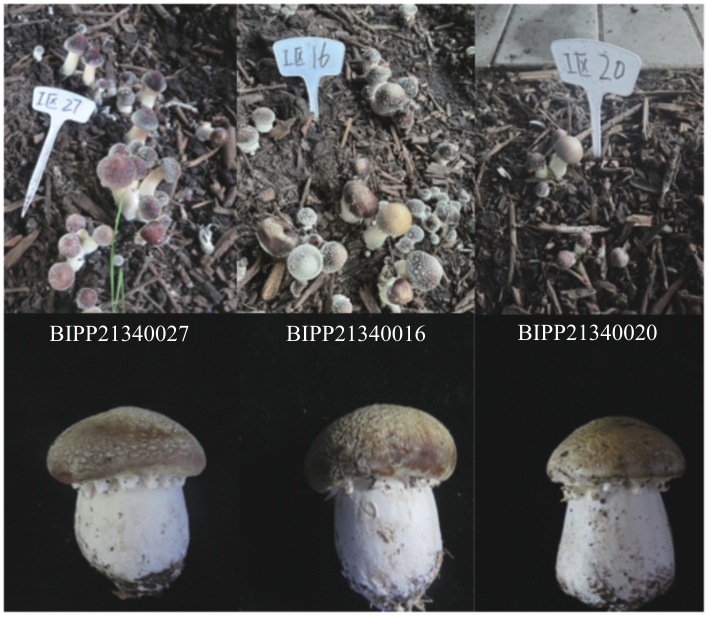
图5 筛选出的3个大球盖菇菌株出菇和子实体照片
Fig. 5 Fruiting and fruiting body photographs of the three selected S. rugosoannulata strains
| [32] | Liang XD, Wu J, Liu JL, et al. Correlation and regression analysis of Lentinula edodes yield and its constituent factors [J]. China Cucurbits Veg, 2024, 37(10): 56-62. |
| [33] | 曹雪莲, 陈影, 彭卫红, 等. 毛头鬼伞种质资源农艺性状遗传多样性分析及综合评价 [J]. 食用菌学报, 2022, 29(5): 53-64. |
| Cao XL, Chen Y, Peng WH, et al. Genetic diversity analysis and comprehensive evaluation of agronomic traits of Coprinus comatus germplasm resources [J]. Acta Edulis Fungi, 2022, 29(5): 53-64. | |
| [34] | 王瑞娟, 尚晓冬, 杨慧, 等. 不同保藏方法对金针菇“上研1号”栽培特性的影响 [J]. 食用菌学报, 2019, 26(1): 11-17. |
| Wang RJ, Shang XD, Yang H, et al. Effect of different preservation methods on the main cultivation characteristics of Flammulina velutipes “shangyan 1” [J]. Acta Edulis Fungi, 2019, 26(1): 11-17. | |
| [35] | 董锡文, 朱德旋, 杜春梅, 等. 4种维生素对黑木耳锁状联合菌丝形成的影响 [J]. 安徽农业科学, 2019, 47(5): 56-57, 61. |
| Dong XW, Zhu DX, Du CM, et al. The effects of four kinds of vitamin on the forming of hyphal clamp connection of aurieuzaria auricular [J]. J Anhui Agric Sci, 2019, 47(5): 56-57, 61. | |
| [1] | 罗信昌, 陈士瑜. 中国菇业大典 [M]. 北京: 清华大学出版社, 2010: 986-1003. |
| Luo XC, Chen SY. Collection of mushroom industry in China [M]. Beijing: Tsinghua University Press, 2010: 986-1003. | |
| [2] | 张颖. 大球盖菇北方棚内反季栽培技术 [J]. 中国林副特产, 2014(6): 54-55. |
| Zhang Y. Off-season cultivation techniques of Pleurotus ostreatus in northern greenhouse [J]. For Prod Speciality China, 2014(6): 54-55. | |
| [3] | Brodzinska Z., Lasota W. Chemical composition of cultivated mushrooms Part I. Stropharia rugoso-annulata Farlow ex Murr [J]. Bromatol. I Chem. Toksykol. 1981, 14, 229-238. |
| [4] | 中国预防医学科学院营养与食品卫生研究所. 食物成分表[M]. 北京: 人民卫生出版社, 2002: 52-53. |
| Institute of Nutrition and Food Safety, Chinese Academy of Preventive Medicine. Food Composition Table[M]. Beijing: People’s Medical Publishing House, 2002: 52-53. | |
| [5] | 王晓炜, 詹巍, 陶明煊, 等. 大球盖菇营养成分、抗氧化活性物质分析 [J]. 食用菌, 2007, 29(6): 62-63. |
| Wang XW, Zhan W, Tao MX, et al. Analysis of nutritional components and antioxidant active substances of Pleurotus ostreatus [J]. Edible Fungi, 2007, 29(6): 62-63. | |
| [6] | Liu YT, Sun J, Luo ZY, et al. Chemical composition of five wild edible mushrooms collected from Southwest China and their antihyperglycemic and antioxidant activity [J]. Food Chem Toxicol, 2012, 50(5): 1238-1244. |
| [7] | 李淑荣, 王丽, 倪淑君, 等. 大球盖菇不同部位氨基酸含量测定及营养评价 [J]. 食品研究与开发, 2017, 38(8): 95-99. |
| Li SR, Wang L, Ni SJ, et al. The amino acids content of different part of Stropharia rugoso-annulata and their nutrition evaluation [J]. Food Res Dev, 2017, 38(8): 95-99. | |
| [8] | Wei L, Jing BN, Li X, et al. Evaluation of nutritional ingredients, biologically active materials, and pharmacological activities of Stropharia rugosoannulata grown under the bamboo forest and in the greenhouse [J]. J Food Qual, 2021, 2021: 5478227. |
| [9] | Wu J, Fushimi K, Tokuyama S, et al. Functional-food constituents in the fruiting bodies of Stropharia rugosoannulata [J]. Biosci Biotechnol Biochem, 2011, 75(8): 1631-1634. |
| [10] | Yan QX, Huang MX, Sun P, et al. Steroids, fatty acids and ceramide from the mushroom Stropharia rugosoannulata Farlow apud Murrill [J]. Biochem Syst Ecol, 2020, 88: 103963. |
| [11] | 颜淑婉, 苏诗垂. 大球盖菇人工栽培研究简报 [J]. 江苏食用菌, 1995(3): 2. |
| Yan SW, Su SC. Brief report on artificial cultivation of Pleurotus ostreatus [J]. Jiangsu Edible Fungi, 1995(3): 2. | |
| [12] | Zhang Y, Ni JP, Yang J, et al. Citrus stand ages regulate the fraction alteration of soil organic carbon under a Citrus/Stropharua rugodo-annulata intercropping system in the Three Gorges Reservoir area, China [J]. Environ Sci Pollut Res, 2017, 24(22): 18363-18371. |
| [13] | 任纪帆, 朱静娴, 王庆佶, 等. 大球盖菇“山农球盖3号”品种的选育 [J]. 菌物学报, 2020, 39(6): 977-982. |
| Ren JF, Zhu JX, Wang QJ, et al. Breeding of Stropharia rugosoannulata “shannongqiugai No.3” [J]. Mycosystema, 2020, 39(6): 977-982. | |
| [14] | 宋爽, 刘宇, 武月园, 等. 野生白灵侧耳种质资源遗传多样性分析和评价 [J]. 食用菌学报, 2025, 32(3): 120-130. |
| Song S, Liu Y, Wu YY, et al. Genetic diversity analysis and evaluation of wild Pleurotus tuoliensis germplasm resources [J]. Acta Edulis Fungi, 2025, 32(3): 120-130. | |
| [15] | 陆欢, 尚晓冬, 宋春艳, 等. 基于ISSR标记和农艺性状的金顶侧耳种质资源遗传多样性分析 [J]. 食用菌学报, 2022, 29(6): 14-24. |
| Lu H, Shang XD, Song CY, et al. Genetic diversity analysis of Pleurotus citrinopilestu germplasm resources based on ISSR markers and agronomic traits [J]. Acta Edulis Fungi, 2022, 29(6): 14-24. | |
| [16] | Yan PS, Jiang JH, Li GF, et al. Mating system and DNA polymorphism of monokaryons with different mating type of Stropharia rugoso-annulata [J]. World J Microbiol Biotechnol, 2003, 19(7): 737-740. |
| [17] | 朱静娴, 李丽君, 赵淑芳, 等. 基于SRAP分子标记的23株大球盖菇遗传多样性和亲缘关系分析 [J]. 山东农业科学, 2018, 50(3): 22-28. |
| Zhu JX, Li LJ, Zhao SF, et al. Genetic diversity and phylogenetic relationship analysis of 23 Stropharia rugosoannulata strains based on SRAP molecular marker [J]. Shandong Agric Sci, 2018, 50(3): 22-28. | |
| [18] | 陈绪涛, 章炉军, 孙鹏, 等. 我国主栽皱环球盖菇菌株遗传多样性及栽培特性 [J]. 菌物学报, 2021, 40(12): 3081-3095. |
| Chen XT, Zhang LJ, Sun P, et al. Genetic diversity and cultivation characteristics of the main cultivars of Stropharia rugosoannulata in China [J]. Mycosystema, 2021, 40(12): 3081-3095. | |
| [19] | 曾宇宇. 大球盖菇核心种质库构建及其基质降解能力分析 [D]. 武汉: 华中农业大学, 2023. |
| Zeng YY. Establishment of core collections and analysis of substrate degradation ability of Stropharia rugosoannulata [D]. Wuhan: Huazhong Agricultural University, 2023. | |
| [20] | 鲍大鹏. 我国食用菌遗传学的发展及展望 [J]. 菌物学报, 2021, 40(4): 806-821. |
| Bao DP. Development and prospect of genetics of edible mushrooms in China [J]. Mycosystema, 2021, 40(4): 806-821. | |
| [21] | 仇律雯, 杨扬, 范亚明, 等. 国家东南区鲜食糯玉米品质及农艺性状与SSR标记遗传多样性分析 [J]. 江苏农业科学, 2022, 50(18): 130-135. |
| Qiu L, Yang Y, Fan YM, et al. Genetic diversity analysis of quality, agronomic traits and SSR markers of fresh waxy maize in Southeastern China [J]. Jiangsu Agric Sci, 2022, 50(18): 130-135. | |
| [22] | 赫卫, 张慧. 基于表型性状和SRAP标记的观赏用辣椒种质资源遗传多样性分析 [J]. 中国瓜菜, 2022, 35(1): 16-23. |
| He W, Zhang H. Analysis of genetic diversity of pepper germplasm resources for ornamental based on phenotypic traits and SRAP markers [J]. China Cucurbits Veg, 2022, 35(1): 16-23. | |
| [23] | 李辉玲, 张建文, 李守明. 基于SSR标记的新疆大蒜及其野生蒜种遗传多样性及聚类分析 [J]. 江苏农业科学, 2022, 50(18): 158-163. |
| Li HL, Zhang JW, Li SM. Genetic diversity and clustering analysis of Xinjiang garlic and wild garlic resources based on SSR markers [J]. Jiangsu Agric Sci, 2022, 50(18): 158-163. | |
| [24] | 陈兆贵, 张荃锋, 卢晓琪, 等. 基于ISSR分子标记的冬种马铃薯品种遗传多样性分析 [J]. 湖南农业科学, 2022(1): 8-11. |
| Chen ZG, Zhang QF, Lu XQ, et al. Genetic diversity analysis of winter potato varieties based on ISSR molecular markers [J]. Hunan Agric Sci, 2022(1): 8-11. | |
| [25] | Gong WB, Zeng YY, Li XR, et al. Molecular profiling of rice straw degradability discrepancy in Stropharia rugosoannulata core germplasm [J]. J Agric Food Chem, 2024, 72(45): 25379-25390. |
| [26] | 杨瑞恒, 吴莹莹, 宋春艳, 等. 基于公共数据库信息对中国野生香菇种质资源地理分布的再分析 [J]. 菌物学报, 2018, 37(3): 335-351. |
| Yang RH, Wu YY, Song CY, et al. Reanalysis of geographical distribution of wild Lentinula edodes in China based on the information from public databases [J]. Mycosystema, 2018, 37(3): 335-351. | |
| [27] | 刘天宇. 马尾松种子园亲本GBS-SNP开发及群体遗传多样性研究 [D]. 长沙: 中南林业科技大学, 2023. |
| Liu TY. Genetic diversity of parent in seed orchard of Pinus massoniana using SNP calling from genotyping by sequencing [D]. Changsha: Central South University of Forestry & Technology, 2023. | |
| [28] | Xiao Y, Cheng XJ, Liu J, et al. Population genomic analysis uncovers environmental stress-driven selection and adaptation of Lentinula edodes population in China [J]. Sci Rep, 2016, 6: 36789. |
| [29] | 宋莹, 刘俊杰, 刘岩岩, 等. 辽宁省主栽香菇菌株ISSR遗传差异性分析 [J]. 北方园艺, 2017(5): 82-85. |
| Song Y, Liu JJ, Liu YY, et al. ISSR analysis of genetic diversity of main cultivated strains of Lentinula edodes in Liaoning [J]. North Hortic, 2017(5): 82-85. | |
| [30] | 王洪秀, 章炉军, 孙鹏, 等. 对92个茶树菇菌株的遗传多样性分析和农艺性状的评价 [J]. 微生物学杂志, 2024, 44(2): 19-32. |
| Wang HX, Zhang LJ, Sun P, et al. Genetic diversity and agronomic traits evaluation of 92 tea tree mushroom (Agrocybe aegerita) strains [J]. J Microbiol, 2024, 44(2): 19-32. | |
| [31] | 刘芹, 孔维丽, 崔筱, 等. 基于模糊数学和聚类分析的香菇品种综合品质评价 [J]. 中国瓜菜, 2021, 34(11): 37-46. |
| Liu Q, Kong WL, Cui X, et al. Comprehensive quality evaluation of Lentinula edodes using fuzzy mathematics and cluster analysis [J]. China Cucurbits Veg, 2021, 34(11): 37-46. | |
| [32] | 梁雪迪, 吴杰, 刘金玲, 等. 香菇产量及其构成因素的相关性和回归分析 [J]. 中国瓜菜, 2024, 37(10): 56-62. |
| [1] | 杨东升, 牛誉驰, 卢倩倩, 樊敬镛, 刘雨雷, 刘权, 郭利平, 郝水源. 29份苏丹草种质材料的SSR指纹图谱构建及分析[J]. 生物技术通报, 2026, 42(6): 198-207. |
| [2] | 刘嘉欢, 曹德法, 于玟瑶, 邓红红, 谭伦东, 郭海, 黄光卉, 王均, 王迅, 汪志辉. 晚熟柑橘花粉直感效应及SCoT分子标记鉴定[J]. 生物技术通报, 2026, 42(6): 227-236. |
| [3] | 魏丽娜, 蒋景龙, 邓茜茜, 李岩, 李丽, 邓家锐, 丁德宽. 基于表型性状与SSR标记的香橼种质资源遗传多样性分析[J]. 生物技术通报, 2026, 42(4): 202-215. |
| [4] | 刘思文, 王博伟, 邢金杰, 王静, 李亚东, 孙海悦. 蓝莓全基因组SSR引物开发及遗传多样性分析[J]. 生物技术通报, 2026, 42(11): 134-144. |
| [5] | 卢瑶, 袁平平, 金鑫, 毛向红, 范向斌, 白小东. 基于SSR标记的马铃薯野生种和地方种遗传多样性分析和指纹图谱构建[J]. 生物技术通报, 2025, 41(9): 94-104. |
| [6] | 裴红霞, 汪露瑶, 李生梅, 高晶霞. 基于SCoT、SRAP和SSR分子标记的220份辣椒种质资源遗传多样性分析[J]. 生物技术通报, 2025, 41(8): 165-174. |
| [7] | 段敏杰, 李怡斐, 王春萍, 黄任中, 黄启中, 张世才. 辣椒果实颜色性状与SSR分子标记的关联分析及指纹图谱构建[J]. 生物技术通报, 2025, 41(7): 81-94. |
| [8] | 段永红, 杨欣, 于冠群, 夏俊俊, 宋陆帅, 白小东, 彭锁堂. 125份马铃薯种质资源遗传多样性及主成分分析[J]. 生物技术通报, 2025, 41(6): 130-143. |
| [9] | 于静, 于桂爽, 孙昊杰, 姜春姣, 苑广迪, 杨珍, 王志伟, 王超, 王传堂. 花生种用品质影响因素及相关标记研究[J]. 生物技术通报, 2025, 41(2): 284-294. |
| [10] | 贺涵, 刘传和, 喻梦凡, 袁梦萍, 魏岳荣, 杨敏, 邝瑞彬, 周陈平, 吴夏明, 徐泽. 基于重测序的菠萝基因组InDel标记的开发[J]. 生物技术通报, 2025, 41(2): 65-76. |
| [11] | 宋英培, 王灿, 周会汶, 孔可可, 许孟歌, 王瑞凯. 基于全基因组关联分析和遗传多样性的大豆裂荚性状解析[J]. 生物技术通报, 2025, 41(2): 97-106. |
| [12] | 杜雨晴, 蒋路园, 汪奕衡, 吴宸炜, 杨梦露, 刘旭升, 王晓君, 邱德有, 樊玮, 杨艳芳. 太行山地区南方红豆杉SSR遗传多样性分析[J]. 生物技术通报, 2025, 41(12): 214-224. |
| [13] | 毛向红, 卢瑶, 范向斌, 杜培兵, 白小东. 基于SSR荧光标记毛细管电泳的马铃薯品种遗传多样性分析及分子身份证构建[J]. 生物技术通报, 2024, 40(9): 131-140. |
| [14] | 刘文浩, 吴刘记, 徐芳. 小肽调控植物分生组织发育的机制及其在作物改良中的研究进展[J]. 生物技术通报, 2024, 40(7): 1-18. |
| [15] | 李思琪, 张文臣, 杨柳, 付庆新, 洪新, 张海旺. 基于SSR标记的文冠果遗传多样性分析及指纹图谱构建[J]. 生物技术通报, 2024, 40(5): 74-83. |
| 阅读次数 | ||||||
|
全文 |
|
|||||
|
摘要 |
|
|||||
