







Biotechnology Bulletin ›› 2025, Vol. 41 ›› Issue (3): 44-50.doi: 10.13560/j.cnki.biotech.bull.1985.2024-0915
Previous Articles Next Articles
HAN Meng-qiao1( ), WU Jiang2, LI Li-hua3, WANG Zhao-yi4, DENG Xi1, WEI Feng-jie5, REN Min1, SUN Yang-yang1(), LI Fu-xin5()
Received:2024-09-20
Online:2025-03-26
Published:2025-03-20
Contact:
SUN Yang-yang, LI Fu-xin
E-mail:hanmengqiao0502@163.com;sunyangyang@caas.cn;lfx4413@163.com
HAN Meng-qiao, WU Jiang, LI Li-hua, WANG Zhao-yi, DENG Xi, WEI Feng-jie, REN Min, SUN Yang-yang, LI Fu-xin. Establishment and Optimization of a Tobacco Chromosome Preparation System[J]. Biotechnology Bulletin, 2025, 41(3): 44-50.
取样时间 Sampling time | 根尖细胞观察情况 Observations on the chromosomes of root apical cells |
|---|---|
| 8∶30‒9∶30 | 分裂中期细胞数量最少,约占1.2% Minimum number of cells in mid-division, about 1.2% |
| 9∶30‒10∶30 | 分裂中期细胞数量上升,约占18.8% The number of cells rises in mid-division, about 18.8% |
| 10∶30‒11∶30 | 分裂中期细胞数量最多,约占35.2% Maximum number of cells in mid-division, about 35.2% |
| 11∶30‒12∶30 | 分裂中期细胞数量下降,约占27.8% Decrease in cell number during mid-division, about 27.8% |
| 12∶30‒13∶30 | 分裂中期细胞数量较少,约占1.6% Smaller number of cells in mid-division, about 1.6% |
| 13∶30‒14∶30 | 分裂中期细胞数量较少,约占10.8% Smaller number of cells in mid-division, about 10.8% |
| 14∶30‒15∶30 | 分裂中期细胞数量较少,约占6.4% Smaller number of cells in mid-division, about 6.4% |
| 15∶30‒16∶30 | 分裂中期细胞数量上升,约占19.2% The number of cells rises in mid-division, about 19.2% |
Table 1 Observations on root tip cells at different sampling times
取样时间 Sampling time | 根尖细胞观察情况 Observations on the chromosomes of root apical cells |
|---|---|
| 8∶30‒9∶30 | 分裂中期细胞数量最少,约占1.2% Minimum number of cells in mid-division, about 1.2% |
| 9∶30‒10∶30 | 分裂中期细胞数量上升,约占18.8% The number of cells rises in mid-division, about 18.8% |
| 10∶30‒11∶30 | 分裂中期细胞数量最多,约占35.2% Maximum number of cells in mid-division, about 35.2% |
| 11∶30‒12∶30 | 分裂中期细胞数量下降,约占27.8% Decrease in cell number during mid-division, about 27.8% |
| 12∶30‒13∶30 | 分裂中期细胞数量较少,约占1.6% Smaller number of cells in mid-division, about 1.6% |
| 13∶30‒14∶30 | 分裂中期细胞数量较少,约占10.8% Smaller number of cells in mid-division, about 10.8% |
| 14∶30‒15∶30 | 分裂中期细胞数量较少,约占6.4% Smaller number of cells in mid-division, about 6.4% |
| 15∶30‒16∶30 | 分裂中期细胞数量上升,约占19.2% The number of cells rises in mid-division, about 19.2% |

Fig. 1 Different chromosomes morphologies of root tip cells in different treatmentsA: CK; B: 20% essential balm treatment for 2 h; C: ice-water mixture 0℃ treatment for 48 h; D: N2O treatment for 70 min; E: N2O treatment for 60 min; F: N2O treatment for 50 min; G: N2O treatment for 40 min; H: N2O treatment for 30 min; I: N2O treatment for 20 min. Scale bar=50 μm
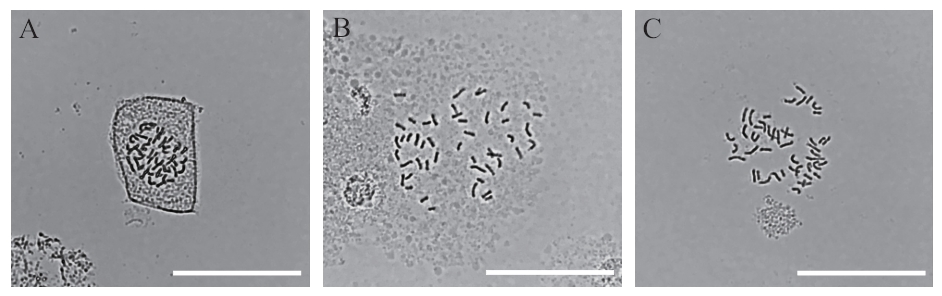
Fig. 2 Different states of root tip cells at different enzymolysis timesA: Enzymolysis 35 min. B: Enzymolysis 45 min. C: Enzymolysis 55 min. Scale bar=50 μm

Fig. 3 Preparation process of tobacco chromosome

Fig. 4 Chromosome samples from various tobacco germplasm resources prepared using an enzymatic digestion methodA: N. tomentosiformis; B: ZY100; C: L8; D: N. tomentosiformis DAPI image; E: ZY100 DAPI image; F: L8 DAPI image (A‒C: scale bar = 50 μm; D‒F: scale bar=5 μm)
| 1 | Bai D, Reeleder R, Brandie JE. Identification of two RAPD markers tightly linked with the Nicotiana debneyi gene for resistance to black root rot of tobacco [J]. Theor Appl Genet, 1995, 91(8): 1184-1189. |
| 2 | Valleau WD, Stokes GW, Johnson EM. Nine years' experience with the Nicotiana longiflora factor for resistance to Phytophthora parasitica var. nicotianae in the control of black shank [J]. Tobacco, 1960, 4: 92-94. |
| 3 | 陈晶鑫. 梅花染色体制片技术优化及基于荧光原位杂交的核型分析 [D]. 北京: 北京林业大学, 2013. |
| Chen JX. Optimization of plum blossom chromosome slicing technique and karyotype analysis based on fluorescence in situ hybridization [D]. Beijing: Beijing Forestry University, 2013. | |
| 4 | 钱双. 基于荧光原位杂交技术的野菊核型分析 [D]. 重庆: 西南大学, 2016. |
| Qian S. Karyotype analysis of Chrysanthemum indicum based on fluorescence in situ hybridization [D]. Chongqing: Southwest University, 2016. | |
| 5 | 杨亚飞, 刘沈徽, 黄东益, 等. 适于荧光原位杂交的大薯叶片染色体制片技术 [J]. 热带生物学报, 2020, 11(1): 100-104. |
| Yang YF, Liu SH, Huang DY, et al. Chromosome preparation of leaf cells of Dioscorea alata L. for FISH [J]. J Trop Biol, 2020, 11(1): 100-104. | |
| 6 | 杨垚, 张艳, 党江波, 等. 以子房为材料制备烟草染色体标本的方法 [J]. 中国烟草科学, 2019, 40(4): 56-61. |
| Yang Y, Zhang Y, Dang JB, et al. Study on Nicotiana chromosome specimen preparation using ovary [J]. Chin Tob Sci, 2019, 40(4): 56-61. | |
| 7 | Braz GT, Yu F, Zhao HN, et al. Preferential meiotic chromosome pairing among homologous chromosomes with cryptic sequence variation in tetraploid maize [J]. New Phytol, 2021, 229(6): 3294-3302. |
| 8 | McCaw M, Swyers N, Graham N, et al. Preparation of chromosomes from Zea mays [J]. Curr Protoc Plant Biol, 2016, 1(3): 501-509. |
| 9 | Wang K, Yu WC. Chromosome preparation in rice (Oryza sativa) [J]. Curr Protoc Plant Biol, 2016, 1(1): 67-77. |
| 10 | Schwarzacher T, Liu Q, Pat Heslop-Harrison JS. Plant cytogenetics: from chromosomes to cytogenomics [J]. Methods Mol Biol, 2023, 2672: 3-21. |
| 11 | Vrána J, Kubaláková M, Číhalíková J, et al. Preparation of sub-genomic fractions enriched for particular chromosomes in polyploid wheat [J]. Biol Plant, 2015, 59(3): 445-455. |
| 12 | 姚启伦, 李玉洁, 陈发波, 等. 玉米染色体滴片关键技术及其优化 [J]. 江苏农业学报, 2019, 35(2): 255-261. |
| Yao QL, Li YJ, Chen FB, et al. Key techniques and their selective preference of maize chromosomal dropping-slides [J]. Jiangsu J Agric Sci, 2019, 35(2): 255-261. | |
| 13 | 张小娟, 覃建兵. 小麦染色体标本制备方法的优化 [J]. 山西师范大学学报: 自然科学版, 2013, 27(2): 47-50. |
| Zhang XJ, Tan JB. The optimization of preparation method for wheat chromosome specimen [J]. J Shanxi Norm Univ Nat Sci Ed, 2013, 27(2): 47-50. | |
| 14 | 虢国成, 向洋. 大麦和玉米染色体去壁低渗法制片及其核型分析 [J]. 大麦与谷类科学, 2008, 25(2): 8-11. |
| Guo GC, Xiang Y. Method of chromosome flaking for barleyand & maize and its' karyotype analysis [J]. Barley Cereal Sci, 2008, 25(2): 8-11. | |
| 15 | 刘继琳, 刘彩霞, 郭佳静, 等. 甜玉米与糯玉米的染色体核型分析 [J]. 华南师范大学学报: 自然科学版, 2014, 46(6): 98-103. |
| Liu JL, Liu CX, Guojia J, et al. Chromosomal karyotype analysis of sweet corn and waxy corn [J]. J South China Norm Univ Nat Sci Ed, 2014, 46(6): 98-103. | |
| 16 | 丁鸿, 邱东萍, 陈少雄. 植物染色体标本的制备和染色体核型分析研究进展 [J]. 南方农业学报, 2012, 43(12): 1958-1962. |
| Ding H, Qiu DP, Chen SX. Research progress in plant chromosome samples preparation and karyotype analysis [J]. J South Agric, 2012, 43(12): 1958-1962. | |
| 17 | 杨清淮. 植物染色体倍性鉴定方法概述 [J]. 现代园艺, 2014(3): 12-13. |
| Yang QH. Summary of identification methods of plant chromosome ploidy [J]. Xiandai Hortic, 2014(3): 12-13. | |
| 18 | Han FP, Gao Z, Yu WC, et al. Minichromosome analysis of chromosome pairing, disjunction, and sister chromatid cohesion in maize [J]. Plant Cell, 2007, 19(12): 3853-3863. |
| 19 | Kato A, Lamb JC, Birchler JA. Chromosome painting using repetitive DNA sequences as probes for somatic chromosome identification in maize [J]. Proc Natl Acad Sci USA, 2004, 101(37): 13554-13559. |
| 20 | Wang J, Liu YL, Su HD, et al. Centromere structure and function analysis in wheat-rye translocation lines [J]. Plant J, 2017, 91(2): 199-207. |
| 21 | 李玉玺, 轩淑欣, 王彦华, 等. 大白菜适于FISH的染色体制片技术研究 [J]. 中国农学通报, 2011, 27(10): 284-288. |
| Li YX, Xuan SX, Wang YH, et al. Studies on the chromosome preparation for FISH in Chinese cabbage [J]. Chin Agric Sci Bull, 2011, 27(10): 284-288. | |
| 22 | Ren TH, Sun ZX, Ren ZL, et al. Development and molecular cytogenetic characterization of a novel wheat-rye T6RS.6AL translocation line from Secale cereale L. Qinling with resistance to stripe rust and powdery mildew [J]. Int J Mol Sci, 2022, 23(18): 10495. |
| 23 | Singh AK, Zhang P, Dong CM, et al. Development and molecular cytogenetic characterization of Thinopyrum bessarabicum introgression lines in hexaploid and tetraploid wheats [J]. Theor Appl Genet, 2020, 133(7): 2117-2130. |
| 24 | Idziak-Helmcke D, Warzecha T, Sowa M, et al. 3-D nucleus architecture in oat×maize addition lines [J]. Int J Mol Sci, 2020, 21(12): 4280. |
| 25 | 刘丹, 夏雪, 吴益梅, 等. 植物染色体制片效果影响因素的解析 [J]. 浙江农业科学, 2015, 56(10): 1654-1657. |
| Liu D, Xia X, Wu YM, et al. Analysis of factors affecting the effect of plant chromosome production [J]. J Zhejiang Agric Sci, 2015, 56(10): 1654-1657. | |
| 26 | 韩杰, 孔德仪, 彭方仁. 薄壳山核桃染色体制片技术的优化与核型分析 [J]. 分子植物育种, 2018, 16(16): 5240-5246. |
| Han J, Kong DY, Peng FR. Optimization of chromosome mounting technique and karyotype analysis of Carya illinoinensis [J]. Mol Plant Breed, 2018, 16(16): 5240-5246. | |
| 27 | 喻雪莲, 李兴锋, 张丽霞. 茶树染色体制片技术优化 [J/OL].分子植物育种,2024. . |
| Yu XL, Li XF, Zhang LX. Technical optimization of chromosome preparation in Camellia sinensis [J/OL]. Mol Plant Breed, 2024. . | |
| 28 | Kirov I, Divashuk M, Van Laere K, et al. An easy “SteamDrop” method for high quality plant chromosome preparation [J]. Mol Cytogenet, 2014, 7(1): 21. |
| 29 | Findley SD, Birchler JA, Stacey G. Metaphase chromosome preparation from soybean (Glycine max) root tips [J]. Curr Protoc Plant Biol, 2017, 2(1): 78-88. |
| 30 | Song XY, Song RR, Zhou JW, et al. Development and application of oligonucleotide-based chromosome painting for chromosome 4D of Triticum aestivum L. [J]. Chromosome Res, 2020, 28(2): 171-182. |
| 31 | Zhang SY, Zhu MQ, Shang Y, et al. Physical organization of repetitive sequences and chromosome diversity of barley revealed by fluorescence in situ hybridization (FISH) [J]. Genome, 2019, 62(5): 329-339. |
| 32 | 孙音, 李兆鹏, 房义福, 等. 大叶女贞染色体制片及核型分析[J]. 山东林业科技, 2019, 49(4): 1-5. |
| Sun Y, Li ZP, Fang YF, et al. Chromosome preparation and karyotype analysis of Ligustrum compactum [J]. J Shandong For Sci Technol, 2019, 49(4): 1-5. |
| [1] | MA Yao-wu, ZHANG Qi-yu, YANG Miao, JIANG Cheng, ZHANG Zhen-yu, ZHANG Yi-lin, LI Meng-sha, XU Jia-yang, ZHANG Bin, CUI Guang-zhou, JIANG Ying. Screening, Indentification and Promotion Performance Investigation of Tobacco Growth-promoting Rhizobacteria [J]. Biotechnology Bulletin, 2025, 41(3): 271-281. |
| [2] | XIANG Bo-ka, ZHOU Zuan-zuan, FENG Jia-hui, XIA Chen, LI Qi, CHEN Chun. Isolation and Identification of a Fungus from Moldy Tobacco Leaf and Study on Its Mold-causing Factors [J]. Biotechnology Bulletin, 2025, 41(2): 321-330. |
| [3] | ZHANG Man-yu, DONG Jia-cheng, GOU Fu-fan, GONG Chao-hui, LIU Qian, SUN Wen-liang, KONG zhen, HAO Jie, WANG Min, TIAN Chao-guang. Cloning, Expression, Characterization and Application of the Pectin Esterase MtCE12-1 from Myceliophthora thermophila [J]. Biotechnology Bulletin, 2024, 40(9): 291-300. |
| [4] | YU Xin-lei, HE Jie-wang, LIN Guo-ping, LI Jin-hai, WANG Da-ai, YUAN Yue-bin, LIU Sheng-gao, LI Zhi-hao, TAO De-xin. Metabolome Difference Analysis of Fermented Cigar Tobacco Leaves in Summer and Winter [J]. Biotechnology Bulletin, 2024, 40(6): 260-270. |
| [5] | KONG Xiao-ping, CHEN Li-wen, LIU Si-si, YAN Xiang-ping. Genome-wide Association Study of Bolting Related Traits in Carrot [J]. Biotechnology Bulletin, 2024, 40(5): 120-130. |
| [6] | WANG Hao-jie, CHANG Dong, LI Jun-ying, MENG Hao-guang, JIANG Shi-jun, ZHOU Shuo-ye, CUI Jiang-kuan. Analysis of Microbial Community Changes and Stress-resistant Enzyme Activities of Flue-cured Tobacco Three-stage Seedling Raising in Different Habitats [J]. Biotechnology Bulletin, 2024, 40(4): 242-254. |
| [7] | LI Can, JIANG Xiang-ning, GAI Ying. Cloning of the LkF3H2 Gene in Larix kaempferi and Its Function in Regulating Flavonoid Metabolism [J]. Biotechnology Bulletin, 2024, 40(2): 245-252. |
| [8] | ZENG Hong-yun, XU Lin-bing, WU Yuan-li, HUANG Bing-zhi. Identification of Banana Hybrid and Selfing Offspring Based on Internal Transcribed Spacer(ITS)Sanger Sequencing [J]. Biotechnology Bulletin, 2024, 40(12): 53-60. |
| [9] | WU Qiao-yin, SHI You-zhi, LI Lin-lin, PENG Zheng, TAN Zai-yu, LIU Li-ping, ZHANG Juan, PAN Yong. In Situ Screening of Carotenoid Degrading Strains and the Application in Improving Quality and Aroma of Cigar [J]. Biotechnology Bulletin, 2023, 39(9): 192-201. |
| [10] | YANG Zhi-xiao, HOU Qian, LIU Guo-quan, LU Zhi-gang, CAO Yi, GOU Jian-yu, WANG Yi, LIN Ying-chao. Responses of Rubisco and Rubisco Activase in Different Resistant Tobacco Strains to Brown Spot Stress [J]. Biotechnology Bulletin, 2023, 39(9): 202-212. |
| [11] | LIU Zhen-yin, DUAN Zhi-zhen, PENG Ting, WANG Tong-xin, WANG Jian. Establishment and Optimization of Virus-induced Gene Silencing System in Bougainvillea peruviana ‘Thimma’ [J]. Biotechnology Bulletin, 2023, 39(7): 123-130. |
| [12] | LI Wen-chen, LIU Xin, KANG Yue, LI Wei, QI Ze-zheng, YU Lu, WANG Fang. Optimization and Application of Tobacco Rattle Virus-induced Gene Silencing System in Soybean [J]. Biotechnology Bulletin, 2023, 39(7): 143-150. |
| [13] | ZHANG Lu-yang, HAN Wen-long, XU Xiao-wen, YAO Jian, LI Fang-fang, TIAN Xiao-yuan, ZHANG Zhi-qiang. Identification and Expression Analysis of the Tobacco TCP Gene Family [J]. Biotechnology Bulletin, 2023, 39(6): 248-258. |
| [14] | SHEN Yun-xin, SHI Zhu-feng, ZHOU Xu-dong, LI Ming-gang, ZHANG Qing, FENG Lu-yao, CHEN Qi-bin, YANG Pei-wen. Isolation, Identification and Bio-activity of Three Bacillus Strains with Biocontrol Function [J]. Biotechnology Bulletin, 2023, 39(3): 267-277. |
| [15] | CAI Meng-xian, GAO Zuo-min, HU Li-juan, FENG Qun, WANG Hong-cheng, ZHU Bin. Development and Genetic Analysis of Two Nullisomic Lines(NC1 and NC2)in Natural Brassica napus [J]. Biotechnology Bulletin, 2023, 39(3): 81-88. |
| Viewed | ||||||
|
Full text |
|
|||||
|
Abstract |
|
|||||
