







Biotechnology Bulletin ›› 2026, Vol. 42 ›› Issue (5): 113-123.doi: 10.13560/j.cnki.biotech.bull.1985.2025-1252
HU Yi-chao1( ), QIN Tian2, SUN Jian-sheng1, SU Zan1, ZHOU Yi1, LIU Jin-cang1, LIU Zheng-qin3, ZHANG Tong-zhuo4, GUAN Ming-xin4, MA Ting-ting5, LI Juan2()
Received:2025-11-19
Online:2026-05-26
Published:2026-06-10
Contact:
LI Juan
E-mail:erica8801@163.com;adalee619@163.com
HU Yi-chao, QIN Tian, SUN Jian-sheng, SU Zan, ZHOU Yi, LIU Jin-cang, LIU Zheng-qin, ZHANG Tong-zhuo, GUAN Ming-xin, MA Ting-ting, LI Juan. Screening of Tobacco Leaf Medium for Enriching Functional Microorganisms and Its Effect on Improving Flue-cured Tobacco Quality[J]. Biotechnology Bulletin, 2026, 42(5): 113-123.
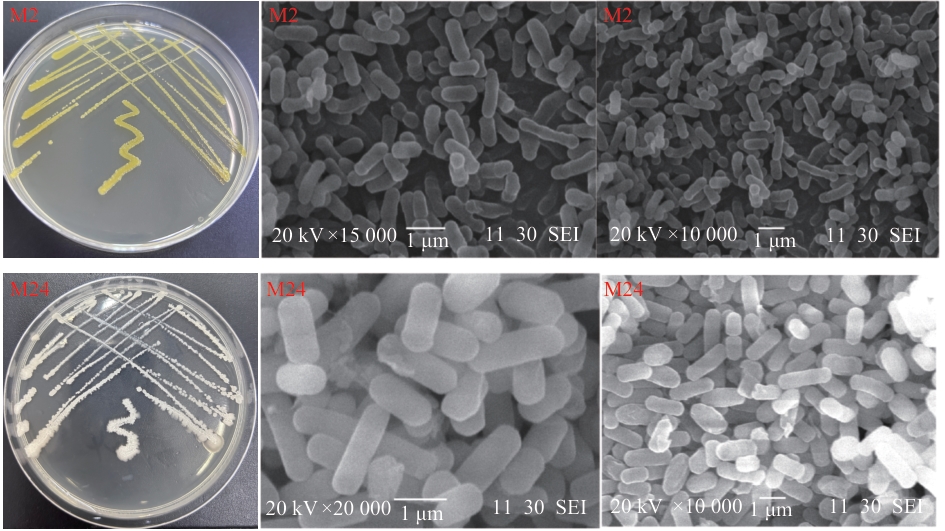
Fig. 1 Morphology and electron microscope scans of M2 and M24 strains
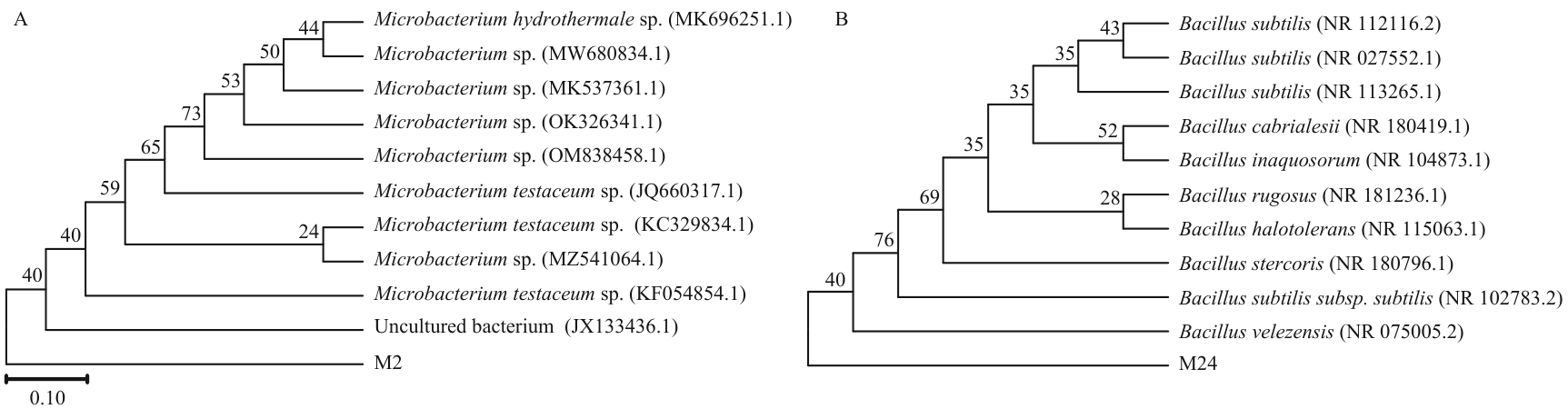
Fig. 2 Phylogenetic tree depicting the molecular identification of strains M2 and M24A:M2 strain;B:M24 strain. The values in parentheses are GenBank accession numbers. Numbers at the nodes are bootstrap values, and the scale bar indicates the nucleotide substitution rate
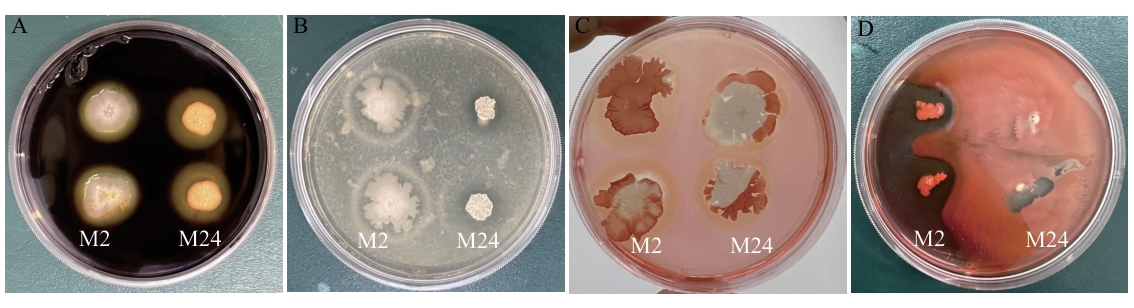
Fig. 3 Enzyme production capacity of strain M2 and M24A: Amylase. B: Protease. C: Cellulase. D: Hemicellulase
编号 ID | 葡萄糖发酵试验 Glucose fermentation test | 甲基红试验 Methyl red | 伏普试验 Voges-Proskauer | 吲哚 试验Indole | 硫化氢试验Hydrogen sulfide | 明胶液化试验 Gelatin liquefaction | 柠檬酸盐利用试验 Citrate utilization |
|---|---|---|---|---|---|---|---|
| M2 | - | - | + | - | + | + | + |
| M24 | - | + | - | - | - | - | + |
Table 1 Physiological and biochemical characterization of M2 and M24 strains
编号 ID | 葡萄糖发酵试验 Glucose fermentation test | 甲基红试验 Methyl red | 伏普试验 Voges-Proskauer | 吲哚 试验Indole | 硫化氢试验Hydrogen sulfide | 明胶液化试验 Gelatin liquefaction | 柠檬酸盐利用试验 Citrate utilization |
|---|---|---|---|---|---|---|---|
| M2 | - | - | + | - | + | + | + |
| M24 | - | + | - | - | - | - | + |
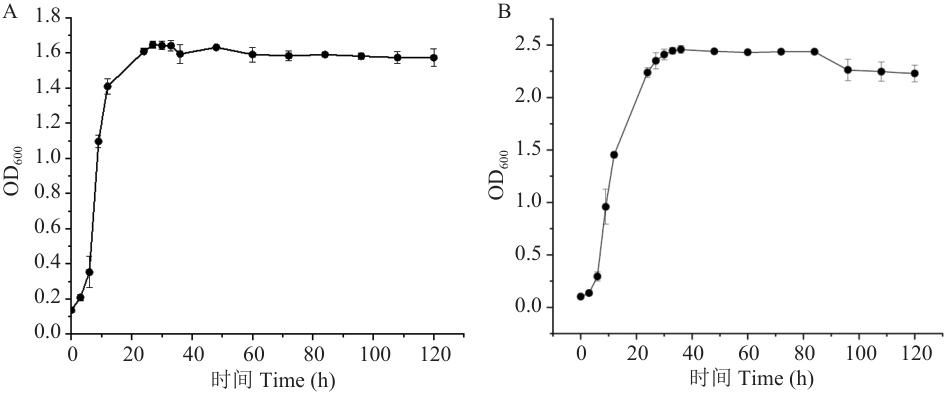
Fig. 4 Growth curves of the strainsA: Growth curve of strain M2. B: Growth curve of strain M24
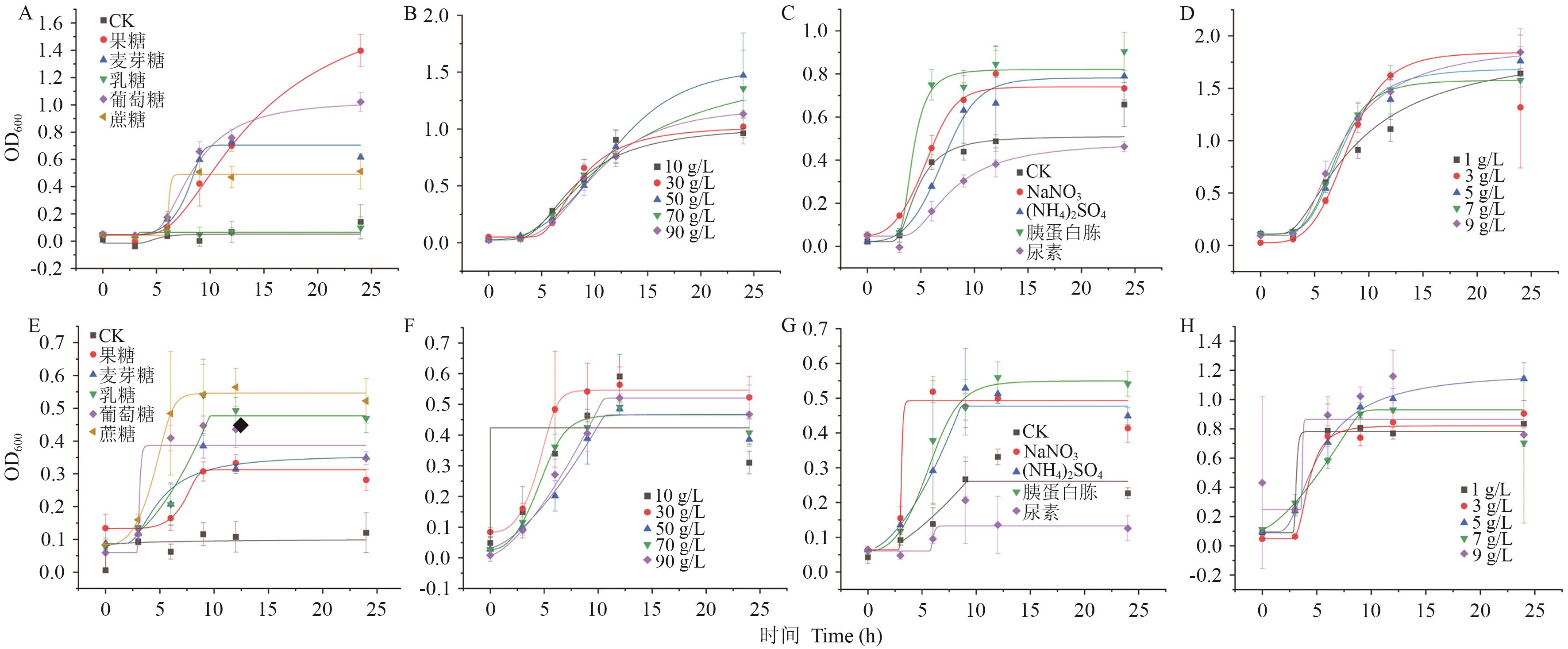
Fig. 5 Optimal growth conditions for strains M2 and M24A-D: The optimal carbon source type, optimal carbon source concentration, optimal nitrogen source type, and optimal nitrogen source concentration for strain M2, respectively. E-H: Represent the optimal carbon source type, optimal carbon source concentration, optimal nitrogen source type, and optimal nitrogen source concentration for strain M24, respectively
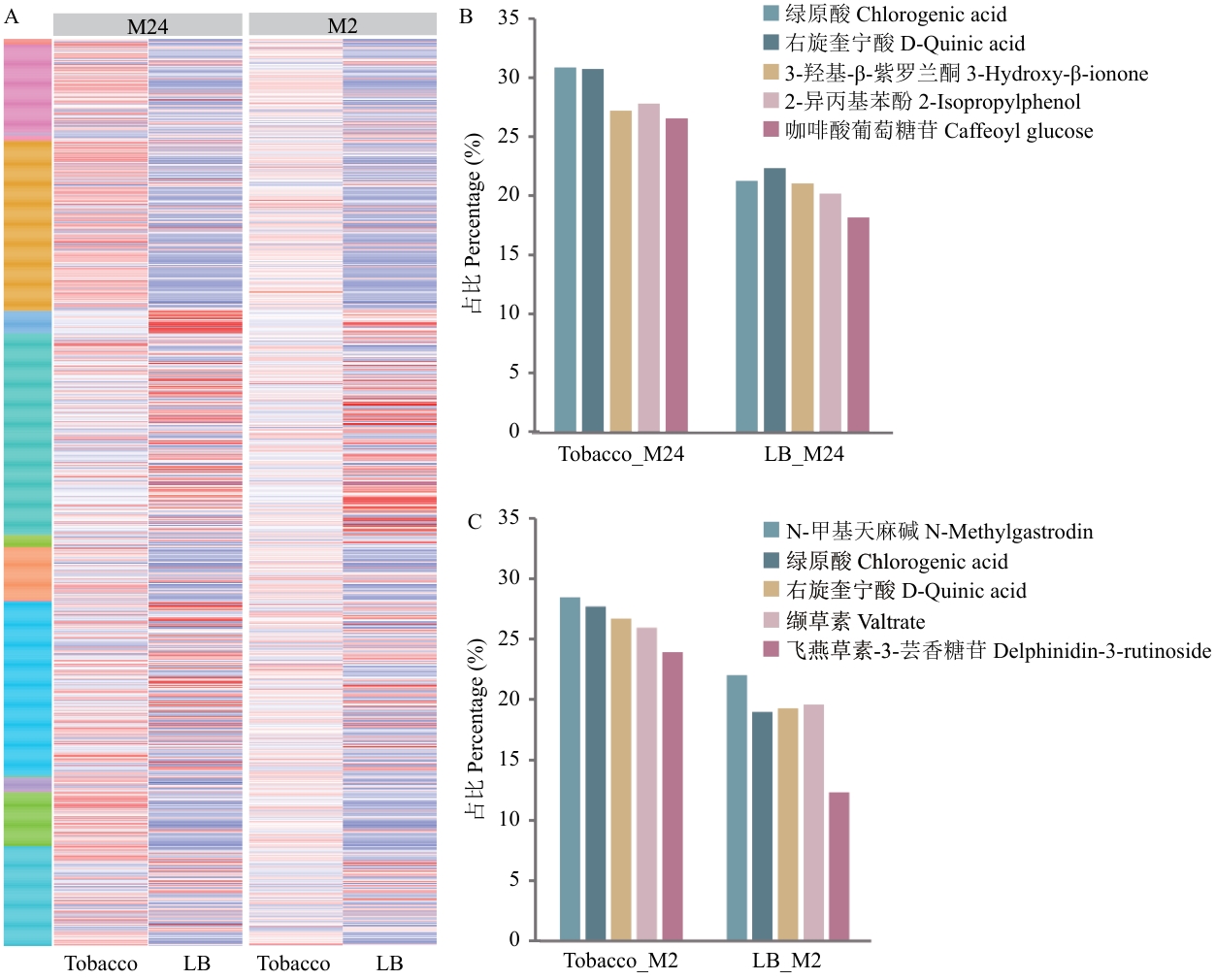
Fig. 6 Metabolite composition of fermentation broth from enriched strains on different mediaA: Cluster heatmap of metabolites in fermentation broth of enriched strains on different media. B: Contents of major polyphenolic compounds in fermentation broth of M24 strain. C: Contents of major polyphenolic compounds in fermentation broth of M2 strain, with proportions log2-transformed. Tobacco: Tobacco leaf culture medium; LB: LB culture medium
| 处理Treatment | 总氮 Nitrogen (%) | 全钾 Potassium (%) | 氯离子 Chloride ion (%) | 总糖 Total sugar (%) | 还原糖 Reduced sugar (%) | 烟碱Nicotine (%) | 糖碱比 Sugar-nicotine ratio | 氮碱比Nitrogen-nicotine ratio | 钾氯比Potassium-chloride ratio |
|---|---|---|---|---|---|---|---|---|---|
| CK | 1.96±0.03a | 2.94±0.07a | 0.42±0.07a | 32.60±1.59ab | 22.37±0.79c | 2.74±0.02a | 11.88±0.55b | 0.71±0.01bc | 6.99±0.42a |
| T1 | 1.97±0.11a | 2.96±0.12a | 0.42±0.12a | 30.61±0.97b | 23.65±1.25ab | 2.62±0.07a | 11.69±0.23b | 0.75±0.01a | 7.32±1.73a |
| T2 | 1.88±0.08cd | 2.91±0.15a | 0.39±0.15a | 34.13±0.47a | 24.66±1.04a | 2.62±0.16a | 13.04±0.43a | 0.72±0.02bc | 7.50±1.07a |
| T3 | 1.92±0.05bc | 3.03±0.26a | 0.35±0.26a | 31.75±1.00ab | 23.23±0.67ab | 2.62±0.04a | 12.11±0.32b | 0.73±0.03ab | 8.86±2.00a |
| T4 | 1.87±0.08d | 3.03±0.09a | 0.43±0.09a | 32.44±2.04ab | 25.19±0.86a | 2.69±0.12a | 12.04±0.57b | 0.69±0.02c | 7.13±1.47a |
Table 2 Chemical composition of tobacco leaves after bacterial treatment with fermentation broth
| 处理Treatment | 总氮 Nitrogen (%) | 全钾 Potassium (%) | 氯离子 Chloride ion (%) | 总糖 Total sugar (%) | 还原糖 Reduced sugar (%) | 烟碱Nicotine (%) | 糖碱比 Sugar-nicotine ratio | 氮碱比Nitrogen-nicotine ratio | 钾氯比Potassium-chloride ratio |
|---|---|---|---|---|---|---|---|---|---|
| CK | 1.96±0.03a | 2.94±0.07a | 0.42±0.07a | 32.60±1.59ab | 22.37±0.79c | 2.74±0.02a | 11.88±0.55b | 0.71±0.01bc | 6.99±0.42a |
| T1 | 1.97±0.11a | 2.96±0.12a | 0.42±0.12a | 30.61±0.97b | 23.65±1.25ab | 2.62±0.07a | 11.69±0.23b | 0.75±0.01a | 7.32±1.73a |
| T2 | 1.88±0.08cd | 2.91±0.15a | 0.39±0.15a | 34.13±0.47a | 24.66±1.04a | 2.62±0.16a | 13.04±0.43a | 0.72±0.02bc | 7.50±1.07a |
| T3 | 1.92±0.05bc | 3.03±0.26a | 0.35±0.26a | 31.75±1.00ab | 23.23±0.67ab | 2.62±0.04a | 12.11±0.32b | 0.73±0.03ab | 8.86±2.00a |
| T4 | 1.87±0.08d | 3.03±0.09a | 0.43±0.09a | 32.44±2.04ab | 25.19±0.86a | 2.69±0.12a | 12.04±0.57b | 0.69±0.02c | 7.13±1.47a |
| 处理Treatment | 蛋白质Protein (%) | 淀粉Starch (%) | 纤维素Cellulose (%) |
|---|---|---|---|
| CK | 12.22±0.20a | 6.47±0.21a | 13.30±0.98a |
| T1 | 11.97±0.30ab | 6.20±0.54ab | 13.17±1.70a |
| T2 | 11.77±0.19b | 5.75±0.09b | 12.47±1.27bc |
| T3 | 11.86±0.24ab | 6.45±0.41a | 13.47±1.86a |
| T4 | 11.73±0.10b | 5.99±0.18ab | 11.50±0.75c |
Table 3 Contents of macromolecular substances in tobacco leaves after bacterial treatment with fermentation broth
| 处理Treatment | 蛋白质Protein (%) | 淀粉Starch (%) | 纤维素Cellulose (%) |
|---|---|---|---|
| CK | 12.22±0.20a | 6.47±0.21a | 13.30±0.98a |
| T1 | 11.97±0.30ab | 6.20±0.54ab | 13.17±1.70a |
| T2 | 11.77±0.19b | 5.75±0.09b | 12.47±1.27bc |
| T3 | 11.86±0.24ab | 6.45±0.41a | 13.47±1.86a |
| T4 | 11.73±0.10b | 5.99±0.18ab | 11.50±0.75c |
处理 Treatment | 评吸单项得分 Score of single evaluation (0-9.0) | 综合得分Total score | |||||||
|---|---|---|---|---|---|---|---|---|---|
| 香气质Aroma quality | 香气量Aroma quantity | 刺激性Irritation | 杂气Offensive flavor | 余味 Aftertaste | 甜度Sweetness | 燃烧性Burning property | 灰色 Ash color | ||
| CK | 7 | 6.3 | 6.5 | 6.5 | 6 | 6.3 | 3 | 4 | 45.6 |
| T1 | 7.3 | 6.5 | 6.5 | 6.3 | 6 | 6.3 | 3 | 4 | 45.9 |
| T2 | 7.5 | 6.8 | 6.8 | 7 | 6.5 | 7 | 3 | 4 | 48.6 |
| T3 | 7 | 6.5 | 6.3 | 6.3 | 6.4 | 6.5 | 3 | 4 | 46.0 |
| T4 | 7.5 | 6.7 | 7 | 6.8 | 6.5 | 6.8 | 3 | 4 | 48.3 |
Table 4 Sensory quality scores of tobacco leaves after treatment with fermentation broth spray
处理 Treatment | 评吸单项得分 Score of single evaluation (0-9.0) | 综合得分Total score | |||||||
|---|---|---|---|---|---|---|---|---|---|
| 香气质Aroma quality | 香气量Aroma quantity | 刺激性Irritation | 杂气Offensive flavor | 余味 Aftertaste | 甜度Sweetness | 燃烧性Burning property | 灰色 Ash color | ||
| CK | 7 | 6.3 | 6.5 | 6.5 | 6 | 6.3 | 3 | 4 | 45.6 |
| T1 | 7.3 | 6.5 | 6.5 | 6.3 | 6 | 6.3 | 3 | 4 | 45.9 |
| T2 | 7.5 | 6.8 | 6.8 | 7 | 6.5 | 7 | 3 | 4 | 48.6 |
| T3 | 7 | 6.5 | 6.3 | 6.3 | 6.4 | 6.5 | 3 | 4 | 46.0 |
| T4 | 7.5 | 6.7 | 7 | 6.8 | 6.5 | 6.8 | 3 | 4 | 48.3 |
| [1] | 李正风, 夏玉珍, 王萝萍, 等. 云南不同产区醇化烟叶感官品质及物质组成的相似性 [J]. 云南农业大学学报, 2025, 40(4): 75-85. |
| Li ZF, Xia YZ, Wang LP, et al. Similarity of sensory quality and material composition of aged tobacco leaves from different producing areas in Yunnan [J]. J Yunnan Agric Univ Sci, 2025, 40(4): 75-85. | |
| [2] | 周乐, 周桂园, 胡巍耀, 等. 利用酶与微生物降低梗膏中果胶和蛋白质的研究 [J]. 中国烟草学报, 2025, 31(1): 123-134. |
| Zhou L, Zhou GY, Hu WY, et al. Study on the reduction of pectin and protein in stem paste using enzymes and microorganisms [J]. Acta Tabacaria Sin, 2025, 31(1): 123-134. | |
| [3] | 张鹏, 李炜, 师超, 等. 一株产果香型真菌的筛选、鉴定及在烟草增香中的应用 [J]. 中国烟草科学, 2021, 42(5): 95-101. |
| Zhang P, Li W, Shi C, et al. Screening and identification of a fungus with a sweet fruit aroma and its application in flavoured tobacco [J]. Chin Tob Sci, 2021, 42(5): 95-101. | |
| [4] | 韩晗, 赵思宸, 仵洁, 等. 用于发酵废次烟叶的酵母菌筛选及增香效果研究 [J]. 中国烟草科学, 2024, 45(6): 91-98. |
| Han H, Zhao SC, Wu J, et al. Isolation and identification of aroma-producing yeasts and effects on aroma increase of low grade tobacco leaves [J]. Chin Tob Sci, 2024, 45(6): 91-98. | |
| [5] | 王金棒, 邱纪青, 汪志波, 等. 生物技术在烟草发酵领域的专利布局现状及热点分析 [J]. 烟草科技, 2021, 54(10): 96-112. |
| Wang JB, Qiu JQ, Wang ZB, et al. Current status and hot spot analysis on patent portfolio of biotechnology in tobacco fermentation [J]. Tob Sci Technol, 2021, 54(10): 96-112. | |
| [6] | 李志豪, 张鸽, 貊志杰, 等. 一株产木聚糖酶的蜡样芽胞杆菌对雪茄烟叶成分及发酵产物的影响 [J]. 生物技术通报, 2022, 38(2): 105-112. |
| Li ZH, Zhang G, Mo ZJ, et al. Effects of a xylanase-producing Bacillus cereus on the composition and fermented products of cigar leaves [J]. Biotechnol Bull, 2022, 38(2): 105-112. | |
| [7] | 汪长国, 李宁, 戴亚, 等. 一种雪茄烟叶发酵用可湿性粉剂: CN103082402B [P]. 2013-05-08. |
| Wang CG, Li N, Dai Y, et al. A wettable powder for cigar tobacco leaf fermentation: CN103082402B [P]. 2013-05-08. | |
| [8] | 万仁鹏. 植物腐生、病原及内生真菌中CAZymes的比较基因组学分析[D]. 南昌:江西师范大学,2020. |
| Wan RP. Comparative genomics analysis of CAZymes in plant saprophytic, pathogenic and endophytic fungi [D]. Nanchang : Jiangxi Normal University, 2020. | |
| [9] | 朱宇, 郑琳, 刘煜宇, 等. 西瓜内生菌的挥发性成分分析及其发酵香料在卷烟中的应用 [J]. 光谱实验室, 2011, 28(4): 2093-2097. |
| Zhu Y, Zheng L, Liu YY, et al. Analysis of volatile components from watermelon endophyte and its application in fermentative cigarette spice [J]. Chinese J Spectrosc Lab, 2011, 28(4): 2093-2097. | |
| [10] | 全铭沁, 董惠忠, 沙云菲, 等. 黑曲霉发酵液改善上部烟叶风味品质的研究 [J]. 中国酿造, 2019, 38(3): 170-176. |
| Quan MQ, Dong HZ, Sha YF, et al. Flavor improvement of upper tobacco leaves by fermentation broth of Aspergillus niger [J]. China Brew, 2019, 38(3): 170-176. | |
| [11] | 邱燕玲, 周瑢, 朱鑫权, 等. 利用新型含烟叶培养基鉴定津巴布韦烟草叶面优势微生物群落 [J]. 安徽农业科学, 2025, 53(8): 1-6. |
| Qiu YL, Zhou R, Zhu XQ, et al. Identification of dominant microbial communities on the foliage of zimbabwean tobacco using a novel tobacco-containing medium [J]. J Anhui Agric Sci, 2025, 53(8): 1-6. | |
| [12] | Zhang G, Li SG, Xu YB, et al. Production of alkaline pectinase: a case study investigating the use of tobacco stalk with the newly isolated strain Bacillus tequilensis CAS-MEI-2-33 [J]. BMC Biotechnol, 2019, 19(1): 45. |
| [13] | Wen C, Zhang QY, Zhu PC, et al. High throughput screening of key functional strains based on improving tobacco quality and mixed fermentation [J]. Front Bioeng Biotechnol, 2023, 11: 1108766. |
| [14] | Dai JC, Dong AJ, Xiong GX, et al. Production of highly active extracellular amylase and cellulase from Bacillus subtilis ZIM3 and a recombinant strain with a potential application in tobacco fermentation [J]. Front Microbiol, 2020, 11: 1539. |
| [15] | 陈兴, 张天栋, 党立志, 等. 利用西姆芽胞杆菌改善烟叶品质的研究 [J]. 云南农业大学学报: 自然科学, 2016, 31(2): 322-327. |
| Chen X, Zhang TD, Dang LZ, et al. Study on improving tobacco quality by using Bacillus siamensis [J]. J Yunnan Agric Univ Nat Sci, 2016, 31(2): 322-327. | |
| [16] | Sun J, Guo JZ, Yang Q, et al. Diluted conventional media improve the microbial cultivability from aquarium seawater [J]. J Microbiol, 2019, 57(9): 759-768. |
| [17] | Taskin M, Ortucu S, Unver Y, et al. Invertase production and molasses decolourization by cold-adapted filamentous fungus Cladosporium herbarum ER-25 in non-sterile molasses medium [J]. Process Saf Environ Prot, 2016, 103: 136-143. |
| [18] | Najmalddin H, Yurdugül S, Hamzah H. Screening of enzyme activities for improvement of bread quality by potato peel addition to the yeast growth medium [J]. Food Biosci, 2023, 51: 102239. |
| [19] | Liu WC, Xiang HB, Zhang T, et al. Screening and selection of a new medium for diosgenin production via microbial biocatalysis of Fusarium sp. [J]. Pharmaceuticals, 2021, 14(5): 390. |
| [20] | 蔡文, 吴鑫颖, 张倩颖, 等. 高斯芽胞杆菌产中性蛋白酶条件优化及其对烟叶发酵的影响 [J]. 食品与发酵科技, 2022, 58(3): 92-98, 118. |
| Cai W, Wu XY, Zhang QY, et al. Optimization of neutral protease production by Bacillus kochii and its effect on fermentation of tobacco leaf [J]. Sichuan Food Ferment, 2022, 58(3): 92-98, 118. | |
| [21] | 王文颖, 张淑曼, 马宏, 等. 一株羊肚菌促生细菌菌株T3的筛选、鉴定及其发酵条件优化 [J]. 微生物学通报, 2025, 52(11): 5146-5159. |
| Wang WY, Zhang SM, Ma H, et al. Screening, identification, and fermentation condition optimization of a Morchella growth-promoting bacterial strain T3 [J]. Microbiol China, 2025, 52(11): 5146-5159. | |
| [22] | 司洪阳, 阳苇丽, 崔冰, 等. 不同产地雪茄烟叶叶际可培养微生物分离、鉴定及功能研究 [J]. 河南农业科学, 2024, 53(9): 37-45. |
| Si HY, Yang WL, Cui B, et al. Isolation, identification, and functional analysis of culturable microorganisms in cigar tobacco leaves from various regions [J]. J Henan Agric Sci, 2024, 53(9): 37-45. | |
| [23] | 顾桁浩, 王宇, 缪嘉鑫, 等. 百香果果酒酿造中产酯酿酒酵母的筛选、鉴定及其发酵特性研究 [J]. 食品与发酵工业, 2025, 51(17): 159-167. |
| Gu HH, Wang Y, Miao JX, et al. Screening, identification, and fermentation characteristics of ester-producing Saccharomyces cerevisiae in passion fruit wine production [J]. Food Ferment Ind, 2025, 51(17): 159-167. | |
| [24] | 胡路路, 宋雯, 余君, 等. 地衣芽胞杆菌发酵雪茄烟叶对香气成分生成的影响 [J]. 湖北农业科学, 2023, 62(7): 107-112. |
| Hu LL, Song W, Yu J, et al. Effects of cigar leaves fermentation by Bacillus licheniformis on aroma components formation [J]. Hubei Agric Sci, 2023, 62(7): 107-112. | |
| [25] | 张鸽, 梁开朝, 辛玉华, 等. 四个国家雪茄外包皮烟叶表面细菌分离与活性测定 [J]. 中国烟草科学, 2018, 39(2): 82-88. |
| Zhang G, Liang KC, Xin YH, et al. Isolation and activity determination of surface bacteria in cigar wrapper leaves from four different countries [J]. Chin Tob Sci, 2018, 39(2): 82-88. | |
| [26] | 吴巧茵, 施友志, 李林林, 等. 类胡萝卜素降解菌株的原位筛选及其在雪茄提质增香中的应用 [J]. 生物技术通报, 2023(9): 192-201. |
| Wu QY, Shi YZ, Li LL, et al. In situ screening of carotenoid degrading strains and the application in improving quality and aroma of cigar [J]. Biotechnol Bull, 2023(9): 192-201. | |
| [27] | Gong YN, Li JJ, Deng XH, et al. Application of starch degrading bacteria from tobacco leaves in improving the flavor of flue-cured tobacco [J]. Front Microbiol, 2023, 14: 1211936. |
| [28] | Ning Y, Mai J, Hu BB, et al. Study on the effect of enzymatic treatment of tobacco on HnB cigarettes and microbial succession during fermentation [J]. Appl Microbiol Biotechnol, 2023, 107(13): 4217-4232. |
| [29] | 毕浩东, 史久长, 李秋剑, 等. 基于代谢组学的烟草逆境胁迫及烟叶品质研究进展 [J]. 山东农业科学, 2024, 56(6): 165-172. |
| Bi HD, Shi JC, Li QJ, et al. Progress of research on adversity stress and leaf quality of tobacco based on metabolomics [J]. Shandong Agric Sci, 2024, 56 (6): 165-172. | |
| [30] | Guo SD, Li YS, Zhu BB, et al. Introducing CCD1 into isolated Rhodotorula strain enhances flavor production and improves cigar fermentation [J]. Front Bioeng Biotechnol, 2024, 12: 1510075. |
| [31] | 金辽, 刘银松, 林建枫, 等. 基于代谢组学解析‘翠碧一号’烟叶烘烤过程中多酚类代谢物动态变化 [J]. 中国农学通报, 2024, 40(6): 135-142. |
| Jin L, Liu YS, Lin JF, et al. Polyphenol metabolites during flue-curing in tobacco‘Cuibi NO.1’leaves: dynamic changes based on metabolomics analysis [J]. Chin Agric Sci Bull, 2024, 40(6): 135-142. | |
| [32] | 姜慧娟, 赵铭钦, 任伟, 等. 浓香型烤烟中性致香成分及多酚含量与香气质量的关系研究 [J]. 中国烟草学报, 2014, 20(5): 25-30. |
| Jiang HJ, Zhao MQ, Ren W, et al. Relationship between neutral aroma components, polyphenol content and aroma quality in flue-cured tobacco of strong aroma type [J]. Acta Tabacaria Sin, 2014, 20(5): 25-30. | |
| [33] | Singh V, Haque S, Niwas R, et al. Strategies for fermentation medium optimization: an in-depth review [J]. Front Microbiol, 2017, 7: 2087. |
| [34] | Wei JB, Song K, Zang ZP, et al. Influence of specific tobacco endophytic Bacillus on tobacco leaf quality enhancement during fermentation [J]. Front Microbiol, 2024, 15: 1468492. |
| [35] | Quintana-Bulla JI, Tonon LAC, Michaliski LF, et al. Testacosides A-D, glycoglycerolipids produced by Microbacterium testaceum isolated from Tedania brasiliensis [J]. Appl Microbiol Biotechnol, 2024, 108(1): 112. |
| [36] | Tao JM, Chen SY, Jiang ZK, et al. Fermentation process of tobacco leaves drives the specific changes of microbial community [J]. BMC Microbiol, 2024, 24(1): 534. |
| [37] | Najme R, Zhuang SL, Qiu JG, et al. Identification and characterization of Nornicotine degrading strain Arthrobacter sp. NOR5 [J]. Sci Total Environ, 2021, 764: 142894. |
| [38] | 李正风, 张鹏, 王萝萍, 等. 摩加夫芽胞杆菌产酶条件优化及对烟叶品质的影响 [J]. 中国烟草科学, 2023, 44(3): 69-76. |
| Li ZF, Zhang P, Wang LP, et al. Condition optimization of enzyme production from Bacillus mojavensis in tobacco leaf and its effect for improving tobacco quality [J]. Chin Tob Sci, 2023, 44(3): 69-76. | |
| [39] | Ega SL, Drendel G, Petrovski S, et al. Comparative analysis of structural variations due to genome shuffling of Bacillus Subtilis VS15 for improved cellulase production [J]. Int J Mol Sci, 2020, 21(4): 1299. |
| [40] | 毛多斌, 黄晓玉, 周利峰, 等. 枯草芽胞杆菌分离鉴定及其对烟叶化学成分和吸味品质的影响 [J]. 烟草科技, 2022, 55(8): 10-19. |
| Mao DB, Huang XY, Zhou LF, et al. Isolation and identification of Bacillus subtilis and its effects on chemical components and smoking quality of tobacco leaves [J]. Tob Sci Technol, 2022, 55(8): 10-19. | |
| [41] | Shang F, Chen JL, Wang LL, et al. Crystal structure of the nicotinamidase/pyrazinamidase PncA from Bacillus subtilis [J]. Biochem Biophys Res Commun, 2018, 503(4): 2906-2911. |
| [42] | 杨静, 李书贵. 混菌发酵对口含烟原料提质降害研究 [J]. 安徽农业科学, 2022, 50(22): 180-183. |
| Yang J, Li SG. Study on quality improvement and harm reduction of raw materials for oral tobacco by mixed bacteria fermentation [J]. J Anhui Agric Sci, 2022, 50(22): 180-183. |
| [1] | LI Ya-qi, SUN Meng, LI Xiu-li, WEI Jing-na, ZHAO Lin-lin, ZHAO Yun-ping, LIU Zheng-hui, SU Fan. Optimization of a High-performance and Low-cost Fluorescence Detection Buffer with Broad Compatibility across Cas12a Orthologs [J]. Biotechnology Bulletin, 2026, 42(4): 83-91. |
| [2] | TONG De-li, ZHANG Xin, CHEN Jia-qing, HE Hai-sheng. Isolation of Endophytic Bacteria from Blueberry and Its Alleviative Effects on Brassica chinensis L. under Aluminum Stress [J]. Biotechnology Bulletin, 2025, 41(4): 302-311. |
| [3] | ZHAO Chun-duo, LI Yu-e, LIU You-jie, WANG Xin-hang, ZHAO Wei, HUANG Yong-cheng, LI Hu-lin, JI Wen-xiu. Effects of Rotating Cropping and Continuous Cropping on Soil Nutrients, Enzyme Activities and Microbial Community Structure of Rhizosphere Soil in Tobacco [J]. Biotechnology Bulletin, 2025, 41(4): 312-322. |
| [4] | SONG Fen-fen, DUAN Yan-xue, SANG Yu, WANG Ji-peng, PENG Rui, SUN Nian-xi, LI Yong. Characteristics of the Mycosphere Microbial Community in Diseased and Healthy Morchella spp.Soil [J]. Biotechnology Bulletin, 2025, 41(4): 323-334. |
| [5] | XIANG Chun-fan, LI Le-song, WANG Juan, LIANG Yan-li, YANG Sheng-chao, LI Meng-fei, ZHAO Yan. Functional Identification and Expression Analysis of Cinnamonyl Alcohol Dehydrogenase AsCAD in Angelica sinensis [J]. Biotechnology Bulletin, 2025, 41(2): 295-308. |
| [6] | YU Xin-lei, HE Jie-wang, LIN Guo-ping, LI Jin-hai, WANG Da-ai, YUAN Yue-bin, LIU Sheng-gao, LI Zhi-hao, TAO De-xin. Metabolome Difference Analysis of Fermented Cigar Tobacco Leaves in Summer and Winter [J]. Biotechnology Bulletin, 2024, 40(6): 260-270. |
| [7] | JIANG Wen-ping, RAN Qiu-ping, LIU Jia-shu, ZHANG Hui-min, ZHANG Di, JIANG Zheng-bing, LI Hua-nan. Effects of Carbohydrate-binding Modules on the Enzymatic Properties of Xylanase [J]. Biotechnology Bulletin, 2024, 40(5): 269-279. |
| [8] | PAN Ping-ping, XU Zhi-hao, ZHANG Yi-wen, LI Qing, WANG Zhong-hua. Prokaryotic Expression, Subcellular Localization and Expression Analysis of PcCHS Gene from Polygonatum cyrtonema Hua [J]. Biotechnology Bulletin, 2024, 40(5): 280-289. |
| [9] | LI Xue, LI Rong-ou, KONG Mei-yi, HUANG Lei. The Growth Promoting Effect of Bacillus amyloliquefaciens SQ-2 on Rice [J]. Biotechnology Bulletin, 2024, 40(2): 109-119. |
| [10] | ZHAO Zhong-juan, YANG Kai, HU Jin-dong, WEI Yan-li, LI Ling, XU Wei-sheng, LI Ji-shun. Effects of Trichoderma harzianum ST02 on the Growth of Peppermint and Physicochemical Properties of Root Zone Soil Under Salt Stress [J]. Biotechnology Bulletin, 2022, 38(7): 224-235. |
| [11] | YUAN Cun-xia, LI Yan-nan, ZHANG Xiao-chong, YANG Rui, LIU Jian-li, LI Jing-yu. Physiological and Biochemical Response Characteristics of Bacillus sp. ZJS3 Under As3+ Stress [J]. Biotechnology Bulletin, 2022, 38(7): 236-246. |
| [12] | WANG Xiao-qin, HUANG Yin-ping, WANG Wei-qian, WU Ping, QUAN Shu. Expression and Purification of the MLL3SET Protein with a Site-directed Mutation of an Unnatural Amino Acid [J]. Biotechnology Bulletin, 2022, 38(3): 194-202. |
| [13] | JIA Hai-hong, LI Bing-qing. Research Progress in the Post-translational Modification of Superoxide Dismutase [J]. Biotechnology Bulletin, 2022, 38(2): 237-244. |
| [14] | WU Qi-man, TIAN Shi-han, LI Yun-ye, PAN Ying-jie, ZHANG Ying. Effects of Microbial Fertilizer on Cucumis sativus L. Growth,Yield and Quality [J]. Biotechnology Bulletin, 2022, 38(1): 125-131. |
| [15] | YUAN Yuan, WANG Lei, SHI Ya-wei. Research Advances in Strategies for Improving the Activity of Microbial-derived Alkaline Proteases [J]. Biotechnology Bulletin, 2021, 37(5): 231-236. |
| Viewed | ||||||
|
Full text |
|
|||||
|
Abstract |
|
|||||
