







Biotechnology Bulletin ›› 2026, Vol. 42 ›› Issue (5): 101-112.doi: 10.13560/j.cnki.biotech.bull.1985.2025-1115
WANG Yu1,2( ), LIAO Yong-qin2, JIA Jian-peng1,2, LIU Xin1,2, SHI Zhu-li1,2, SHI Zhu-feng2, PU Te2, HE Fei-fei1, YANG Pei-wen2()
Received:2025-10-17
Online:2026-05-26
Published:2026-06-10
Contact:
YANG Pei-wen
E-mail:1656416238@qq.com;pwyang2000@126.com
WANG Yu, LIAO Yong-qin, JIA Jian-peng, LIU Xin, SHI Zhu-li, SHI Zhu-feng, PU Te, HE Fei-fei, YANG Pei-wen. Effects of Phenolic Acid-degrading Bacterium Bacillus halotolerans YNK-FB0022 on Microbial Diversity in Soil Infected with Tomato Fusarium Wilt[J]. Biotechnology Bulletin, 2026, 42(5): 101-112.
| 指标 Index | CK | CK1 | T1 | T2 |
|---|---|---|---|---|
| pH | 7.66±0.00a | 7.40±0.10a | 7.65±0.01a | 7.65±0.01a |
| 有机质 Organic matter (g/kg) | 35.50±0.23b | 34.92±0.14c | 35.68±0.30b | 36.63±0.20a |
| 全氮 Total nitrogen (g/kg) | 1.60±0.00b | 1.62±0.00a | 1.59±0.02b | 1.55±0.00c |
| 全磷 Total phosphorus (g/kg) | 1.65±0.00b | 1.67±0.00a | 1.67±0.00a | 1.62±0.00b |
| 全钾 Total potassium (g/kg) | 10.79±0.05a | 10.75±0.05a | 10.66±0.11ab | 10.55±0.07b |
| 水解性氮 Hydrolyzed nitrogen (mg/kg) | 113.12±0.00a | 107.83±0.57c | 107.11±0.92c | 107.16±0.00c |
| 有效磷 Available phosphorus (mg/kg) | 68.36±0.92a | 66.47±0.87a | 66.39±0.65a | 63.07±0.39b |
| 速效钾 Fast-acting potassium (mg/kg) | 159.11±2.12b | 146.19±3.80c | 163.23±1.40b | 179.30±1.20a |
| 电导率 Electrical conductivity (μS/cm) | 197.17±0.15a | 175.40±0.53c | 188.40±0.36b | 172.00±0.20 d |
| 交换性钙 Exchangeable calcium (mg/kg) | 3 178.21±14.29b | 3 234.98±2.60a | 3 192.41±17.14ab | 3 101.58±22.49c |
| 交换性镁 Exchangeable magnesium (mg/kg) | 445.73±3.80bc | 461.26±9.93a | 454.64±3.35ab | 453.03±4.98ab |
| 有效铜 Effective copper (mg/kg) | 5.03±0.11a | 4.89±0.15ab | 4.57±0.14ab | 4.73±0.35b |
| 有效锌 Effective zinc (mg/kg) | 3.91±0.08b | 3.65±0.09c | 3.82±0.05b | 4.08±0.04a |
| 有效铁 Effective iron (mg/kg) | 27.55±1.54a | 27.36±0.06b | 27.51±0.49c | 27.74±1.20b |
| 有效锰 Available manganese (mg/kg) | 23.85±0.45a | 22.55±0.91a | 22.53±0.39a | 23.90±0.93a |
| 有效硼 Available boron (mg/kg) | 1.36±0.00c | 1.52±0.00b | 1.59±0.00a | 1.35±0.01c |
| 容重 Bulk density (g/cm³) | 0.96±0.02ab | 0.92±0.06bc | 0.81±0.06 d | 0.86±0.41cd |
| 孔隙度 Porosity (%) | 69.96±0.40a | 65.05±0.15c | 66.78±0.56b | 63.86±0.34 d |
Table 1 Changes in soil physical and chemical indexes under different treatments
| 指标 Index | CK | CK1 | T1 | T2 |
|---|---|---|---|---|
| pH | 7.66±0.00a | 7.40±0.10a | 7.65±0.01a | 7.65±0.01a |
| 有机质 Organic matter (g/kg) | 35.50±0.23b | 34.92±0.14c | 35.68±0.30b | 36.63±0.20a |
| 全氮 Total nitrogen (g/kg) | 1.60±0.00b | 1.62±0.00a | 1.59±0.02b | 1.55±0.00c |
| 全磷 Total phosphorus (g/kg) | 1.65±0.00b | 1.67±0.00a | 1.67±0.00a | 1.62±0.00b |
| 全钾 Total potassium (g/kg) | 10.79±0.05a | 10.75±0.05a | 10.66±0.11ab | 10.55±0.07b |
| 水解性氮 Hydrolyzed nitrogen (mg/kg) | 113.12±0.00a | 107.83±0.57c | 107.11±0.92c | 107.16±0.00c |
| 有效磷 Available phosphorus (mg/kg) | 68.36±0.92a | 66.47±0.87a | 66.39±0.65a | 63.07±0.39b |
| 速效钾 Fast-acting potassium (mg/kg) | 159.11±2.12b | 146.19±3.80c | 163.23±1.40b | 179.30±1.20a |
| 电导率 Electrical conductivity (μS/cm) | 197.17±0.15a | 175.40±0.53c | 188.40±0.36b | 172.00±0.20 d |
| 交换性钙 Exchangeable calcium (mg/kg) | 3 178.21±14.29b | 3 234.98±2.60a | 3 192.41±17.14ab | 3 101.58±22.49c |
| 交换性镁 Exchangeable magnesium (mg/kg) | 445.73±3.80bc | 461.26±9.93a | 454.64±3.35ab | 453.03±4.98ab |
| 有效铜 Effective copper (mg/kg) | 5.03±0.11a | 4.89±0.15ab | 4.57±0.14ab | 4.73±0.35b |
| 有效锌 Effective zinc (mg/kg) | 3.91±0.08b | 3.65±0.09c | 3.82±0.05b | 4.08±0.04a |
| 有效铁 Effective iron (mg/kg) | 27.55±1.54a | 27.36±0.06b | 27.51±0.49c | 27.74±1.20b |
| 有效锰 Available manganese (mg/kg) | 23.85±0.45a | 22.55±0.91a | 22.53±0.39a | 23.90±0.93a |
| 有效硼 Available boron (mg/kg) | 1.36±0.00c | 1.52±0.00b | 1.59±0.00a | 1.35±0.01c |
| 容重 Bulk density (g/cm³) | 0.96±0.02ab | 0.92±0.06bc | 0.81±0.06 d | 0.86±0.41cd |
| 孔隙度 Porosity (%) | 69.96±0.40a | 65.05±0.15c | 66.78±0.56b | 63.86±0.34 d |
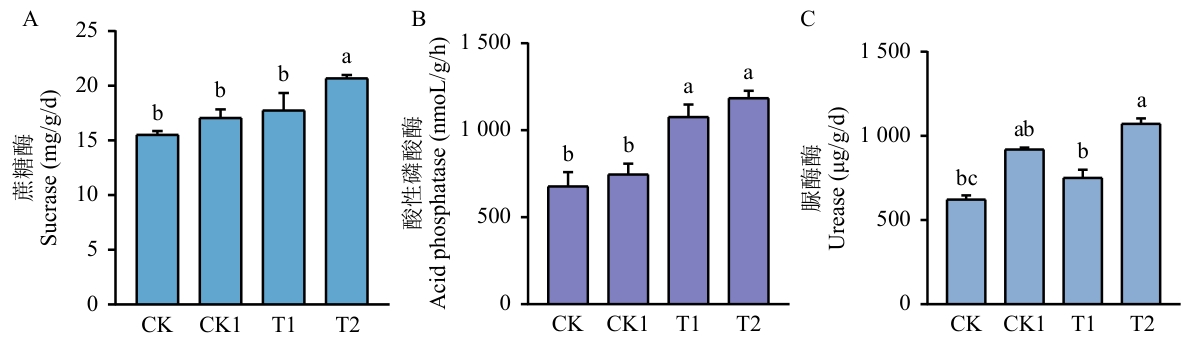
Fig. 1 Changes in the activities of sucrase (A), acid phosphatase (B), and urease (C) under different treatmentsCK: Water control. CK1: Benzoic acid treatment. T1: Benzoic acid + strain YNK-FB0022 treatment. T2: YNK-FB0022 treatment. Different letters represent different significance (P<0.05)
| 处理 Treatment | 株高Plant height (cm) | 茎粗Stem thick (mm) | 根长Root length (cm) | 根重Root weight (g) | 病情指数Disease index | 防效Control effect (%) |
|---|---|---|---|---|---|---|
| CK | 26.20±3.30b | 4.03±0.37b | 7.86±0.09b | 1.23±0.06a | 47.50±0.24a | - |
| CK1 | 24.60±2.95b | 3.97±0.40bc | 5.56±0.64c | 0.98±0.04c | 31.62±0.19b | - |
| T1 | 26.13±3.38b | 4.17±0.37b | 7.92±0.31b | 1.04±0.07bc | 25.52±0.48c | 46.27 |
| T2 | 30.37±3.00a | 4.47±0.44a | 8.76±0.20a | 1.26±0.09a | 20.17±0.19 d | 57.54 |
Table 2 Effects of different treatments on tomato seedling growth and control of tomato fusarium wilt
| 处理 Treatment | 株高Plant height (cm) | 茎粗Stem thick (mm) | 根长Root length (cm) | 根重Root weight (g) | 病情指数Disease index | 防效Control effect (%) |
|---|---|---|---|---|---|---|
| CK | 26.20±3.30b | 4.03±0.37b | 7.86±0.09b | 1.23±0.06a | 47.50±0.24a | - |
| CK1 | 24.60±2.95b | 3.97±0.40bc | 5.56±0.64c | 0.98±0.04c | 31.62±0.19b | - |
| T1 | 26.13±3.38b | 4.17±0.37b | 7.92±0.31b | 1.04±0.07bc | 25.52±0.48c | 46.27 |
| T2 | 30.37±3.00a | 4.47±0.44a | 8.76±0.20a | 1.26±0.09a | 20.17±0.19 d | 57.54 |
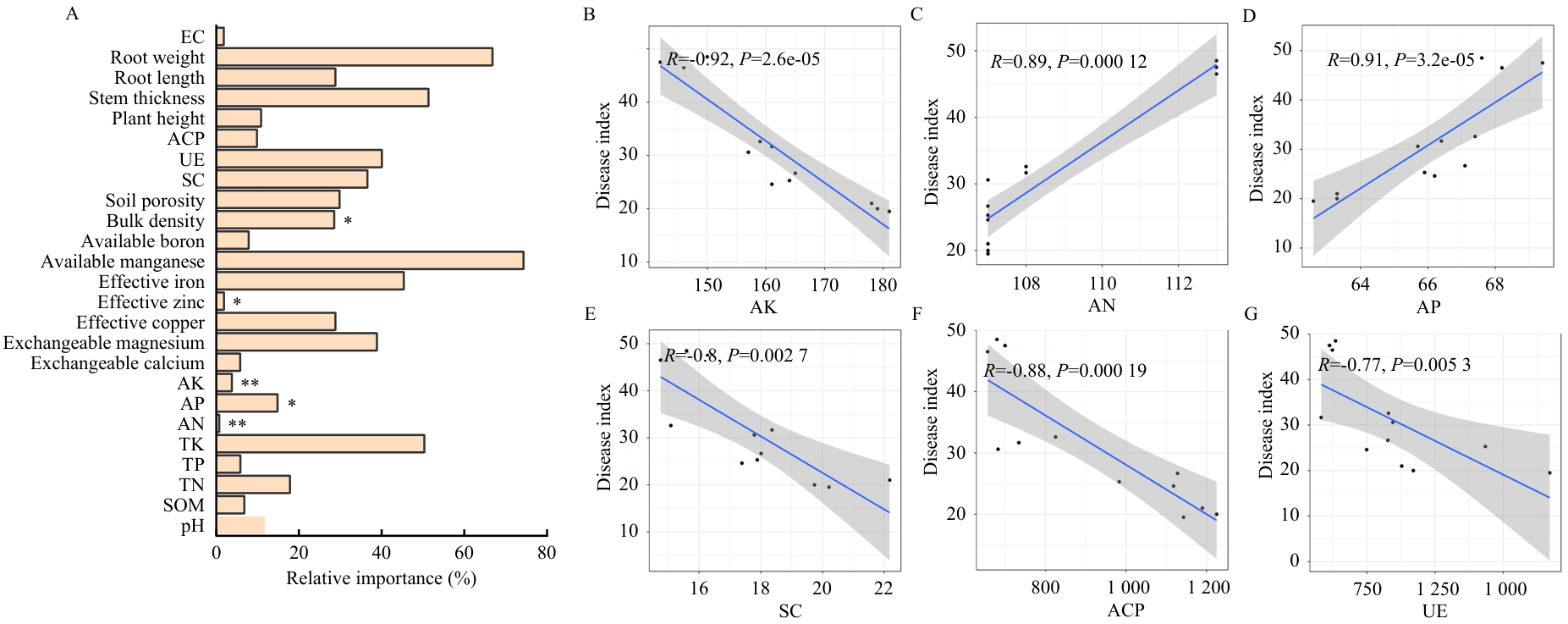
Fig. 2 Analysis of importance of different physical and chemical indexes to disease index and correlation between each index and disease indexA: Random forest analysis of physical and chemical indicators. B: Correlation between AK (available potassium) and disease index. C: Correlation between AN (Hydrolyzed nitrogen) and disease index. D: Correlation between AP (available phosphorus) and disease index. E: Correlation between SC (Sucrase) and disease index. F: Correlation between ACP (Acid phosphatase) and disease index. G: Correlation between UE (urease) and disease index
处理 Treatment | 细菌多样性 Bacterial diversity | 真菌多样性 Fungal diversity | ||||||
|---|---|---|---|---|---|---|---|---|
| Ace | Chao 1 | Shannon | Simpson 1-D | Ace | Chao 1 | Shannon | Simpson 1-D | |
| CK | 3 371.60±79.05a | 2 969.31±25.94a | 6.28±0.36a | 0.004 1±0.00a | 450.75±21.33a | 446.46±11.58a | 3.21±0.14a | 0.14±0.00a |
| CK1 | 3 319.25±86.47a | 3 143.62±28.47a | 6.36±0.23a | 0.003 4±0.00a | 421.21±18.96a | 425.78±45.36a | 3.58±0.27a | 0.08±0.00a |
| T1 | 3 276.56±32.46a | 3 223.40±32.68a | 6.41±0.05a | 0.004 9±0.00a | 385.00±36.69b | 385.82±24.56b | 3.25±0.34a | 0.07±0.00a |
| T2 | 3 778.66±26.97b | 3 298.09±90.45a | 6.60±0.10a | 0.007 0±0.00a | 370.37±14.89b | 372.70±17.89b | 3.01±0.11a | 0.05±0.00a |
Table 3 Changes in diversity indexes of bacteria and fungi under different treatments
处理 Treatment | 细菌多样性 Bacterial diversity | 真菌多样性 Fungal diversity | ||||||
|---|---|---|---|---|---|---|---|---|
| Ace | Chao 1 | Shannon | Simpson 1-D | Ace | Chao 1 | Shannon | Simpson 1-D | |
| CK | 3 371.60±79.05a | 2 969.31±25.94a | 6.28±0.36a | 0.004 1±0.00a | 450.75±21.33a | 446.46±11.58a | 3.21±0.14a | 0.14±0.00a |
| CK1 | 3 319.25±86.47a | 3 143.62±28.47a | 6.36±0.23a | 0.003 4±0.00a | 421.21±18.96a | 425.78±45.36a | 3.58±0.27a | 0.08±0.00a |
| T1 | 3 276.56±32.46a | 3 223.40±32.68a | 6.41±0.05a | 0.004 9±0.00a | 385.00±36.69b | 385.82±24.56b | 3.25±0.34a | 0.07±0.00a |
| T2 | 3 778.66±26.97b | 3 298.09±90.45a | 6.60±0.10a | 0.007 0±0.00a | 370.37±14.89b | 372.70±17.89b | 3.01±0.11a | 0.05±0.00a |
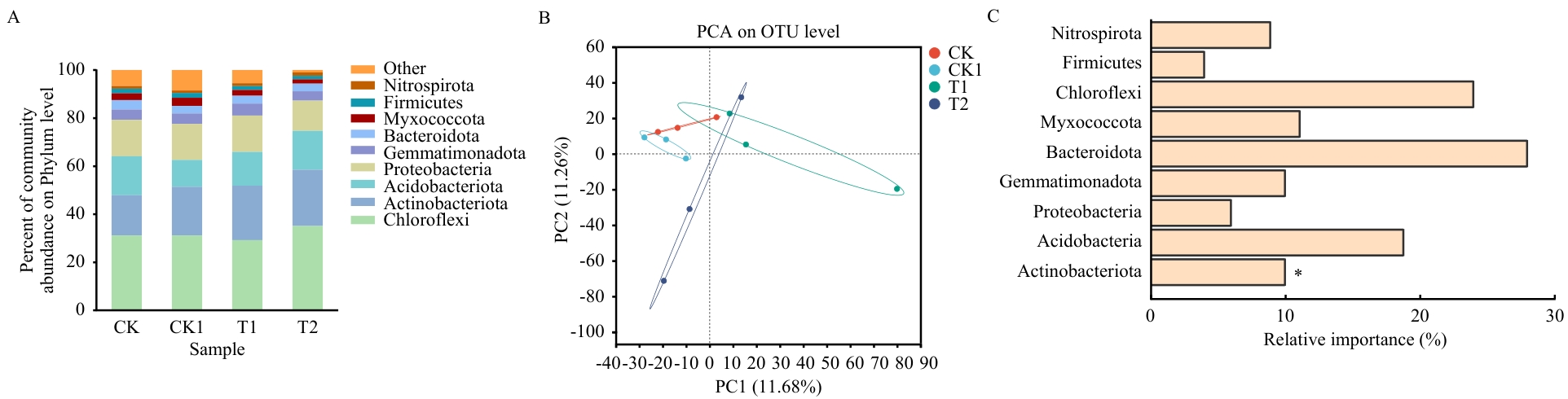
Fig. 3 Abundance of dominant phyla (A), principal component analysis of bacterial community (B) and importance of dominant phyla to disease index under different treatments (C). *P<0.05, the same below
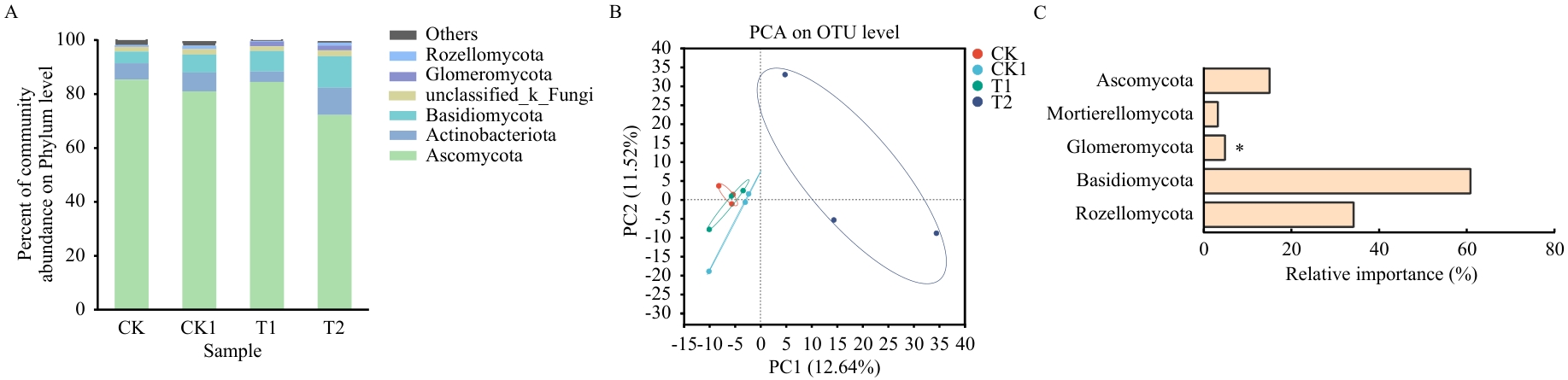
Fig. 4 Change of fungal dominant phylum abundance under different treatments (A), principal component analysis of fungal community (B), and the importance of fungal dominant phylum to disease index (C)
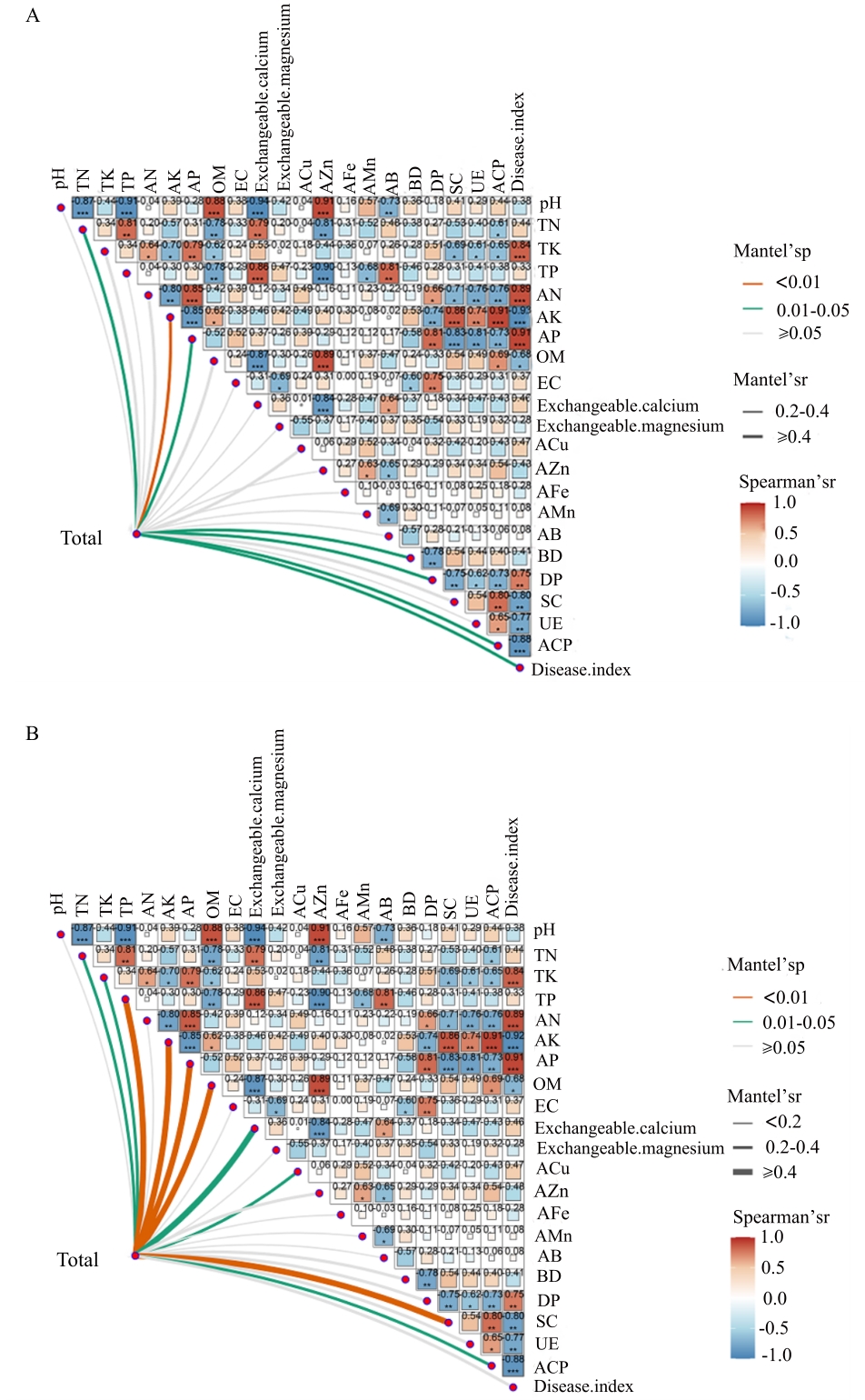
Fig. 5 Correlation analysis between soil microbial community structure and soil environmentA: Correlation analysis between bacterial community structure and soil index. B: Correlation analysis between fungal community structure and soil index
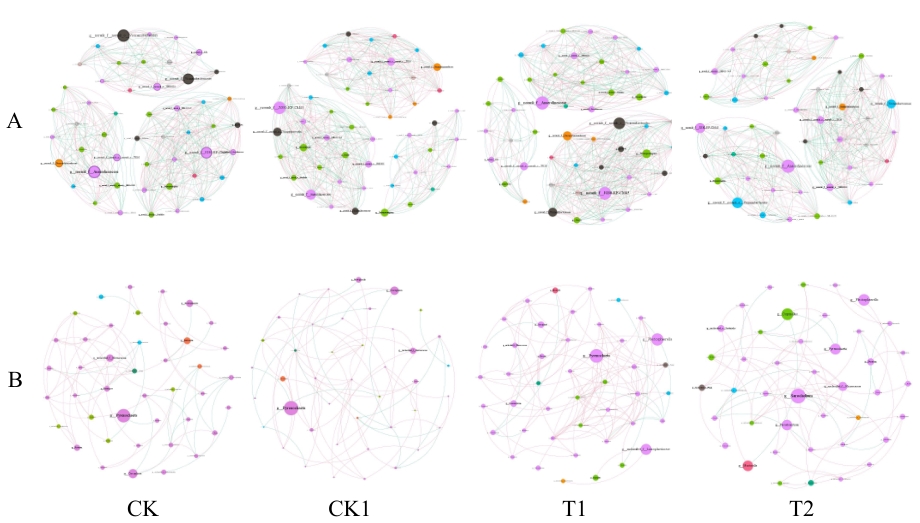
Fig. 6 Ecological network structure of microorganism under different treatmentsA: Bacterial ecological network structure. B: Fungal ecological network structure
| 处理Treatment | 细菌多样性 Bacterial diversity | 真菌多样性 Fungal diversity | ||||||
|---|---|---|---|---|---|---|---|---|
| CK | CK1 | T1 | T2 | CK | CK1 | T1 | T2 | |
| 节点 Nodes | 49 | 50 | 50 | 50 | 42 | 42 | 44 | 42 |
| 边 Edges | 386 | 406 | 402 | 426 | 70 | 70 | 113 | 69 |
| 网络密度 Network density | 0.387 | 0.389 | 0.408 | 0.587 | 0.146 3 | 0.170 73 | 0.279 07 | 0.142 5 |
| 模块化指数 Modular indices | 0.607 | 0.618 | 0.624 | 0.654 | 0.826 | 0.73 | 0.607 | 0.817 |
| 正连接边 Positive edge | 182 | 210 | 204 | 214 | 37 | 52 | 102 | 55 |
| 负连接边 Negative edge | 204 | 196 | 198 | 212 | 33 | 18 | 11 | 14 |
Table 4 Structural properties of microecological network of fungi and bacteria under different treatments
| 处理Treatment | 细菌多样性 Bacterial diversity | 真菌多样性 Fungal diversity | ||||||
|---|---|---|---|---|---|---|---|---|
| CK | CK1 | T1 | T2 | CK | CK1 | T1 | T2 | |
| 节点 Nodes | 49 | 50 | 50 | 50 | 42 | 42 | 44 | 42 |
| 边 Edges | 386 | 406 | 402 | 426 | 70 | 70 | 113 | 69 |
| 网络密度 Network density | 0.387 | 0.389 | 0.408 | 0.587 | 0.146 3 | 0.170 73 | 0.279 07 | 0.142 5 |
| 模块化指数 Modular indices | 0.607 | 0.618 | 0.624 | 0.654 | 0.826 | 0.73 | 0.607 | 0.817 |
| 正连接边 Positive edge | 182 | 210 | 204 | 214 | 37 | 52 | 102 | 55 |
| 负连接边 Negative edge | 204 | 196 | 198 | 212 | 33 | 18 | 11 | 14 |
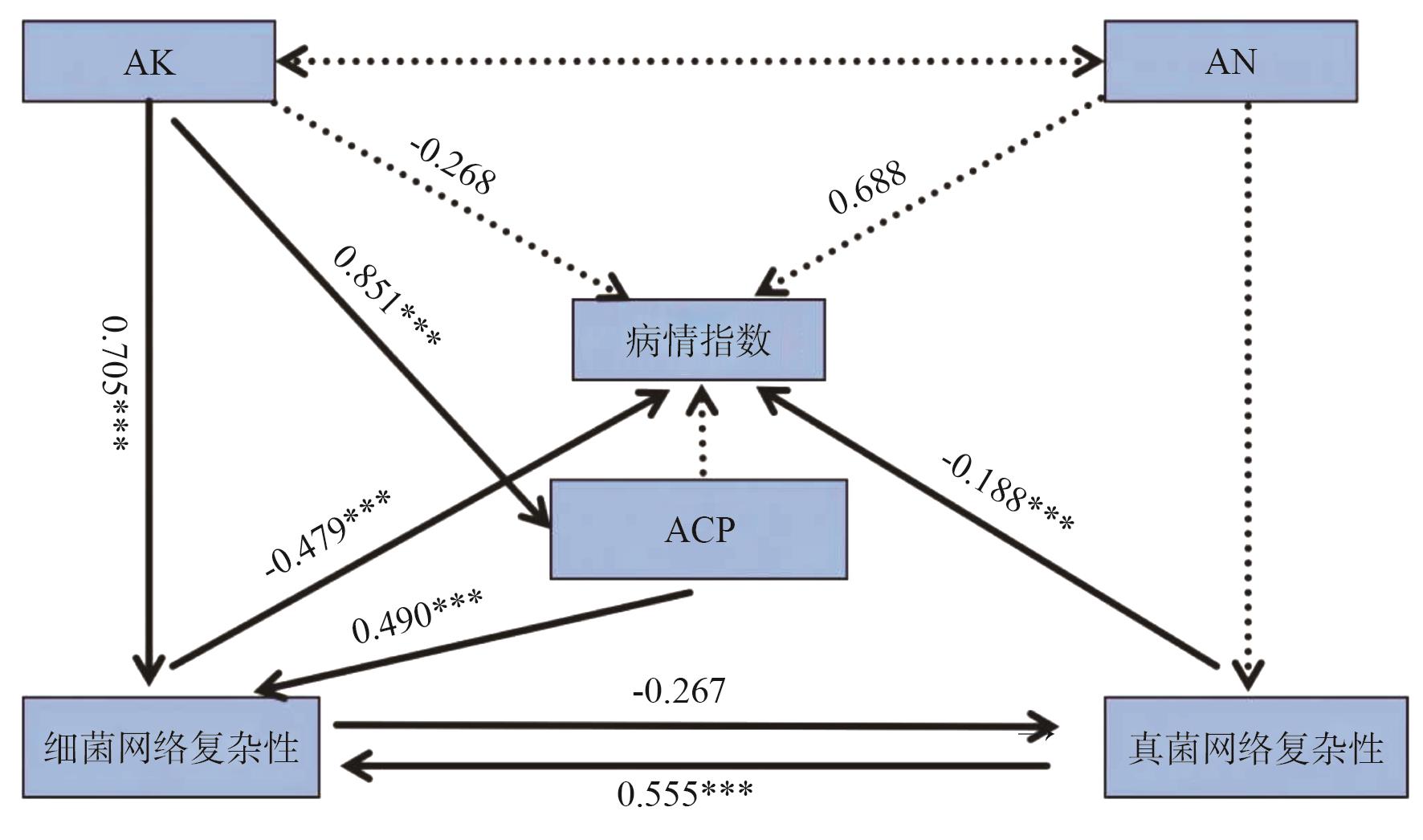
Fig. 7 Analysis of influencing factors of tomato fusarium wilt by SEM modelNumbers indicatepath coefficients, asterisks indicate significance level, and dotted lines indicate no significant effects
| [1] | Panke-Buisse K, Poole AC, Goodrich JK, et al. Selection on soil microbiomes reveals reproducible impacts on plant function [J]. ISME J, 2015, 9(4): 980-989. |
| [2] | Wang X, Xiao C, Ji C, et al. Isolation and characterization of endophytic bacteria for controlling root rot disease of Chinese jujube [J]. J Appl Microbiol, 2021, 130(3): 926-936. |
| [3] | 钟淑敏, 廖晓兰. 作物自毒作用研究进展 [J]. 作物研究, 2022, 36(3): 269-274, 286. |
| Zhong SM, Liao XL. Review of research progress on crops autotoxicity [J]. Crop Res, 2022, 36(3): 269-274, 286. | |
| [4] | Zhu W, Liu JW, Ye JL, et al. Effects of phytotoxic extracts from peach root bark and benzoic acid on peach seedlings growth, photosynthesis, antioxidance and ultrastructure properties [J]. Sci Hortic, 2017, 215: 49-58. |
| [5] | 李勇, 王梓, 龙期良, 等. 人参幼根对苯甲酸胁迫的形态学响应及基因差异表达 [J]. 中国现代中药, 2017, 19(7): 995-1000. |
| Li Y, Wang Z, Long QL, et al. Morphological response of ginseng root to benzoic acid and differential genes expression analysis [J]. Mod Chin Med, 2017, 19(7): 995-1000. | |
| [6] | 孙秀, 王秀峰, 魏珉, 等. 肉桂酸降解真菌的筛选及其降解液对黄瓜种子发芽的影响 [J]. 园艺学报, 2014, 41(4): 765-772. |
| Sun X, Wang XF, Wei M, et al. Screening and identification of cinnamic acid-degrading fungis and the effect of degradation liquid on the cucumber germination [J]. Acta Hortic Sin, 2014, 41(4): 765-772. | |
| [7] | 王兴祥, 张桃林, 戴传超, 等. 连作花生土壤障碍原因及消除技术研究进展 [J]. 土壤, 2010, 42(4): 505-512. |
| Wang XX, Zhang TL, Dai CC, et al. Advance in mechanism and countermeasures of peanut succession monocropping obstacles [J]. Soils, 2010, 42(4): 505-512. | |
| [8] | Bennett AJ, Bending GD, Chandler D, et al. Meeting the demand for crop production: the challenge of yield decline in crops grown in short rotations [J]. Biol Rev, 2012, 87(1): 52-71. |
| [9] | 王洁, 王蓓蓓, 尚方剑, 等. 香草兰酚酸类自毒物质降解菌的筛选和鉴定及其抑菌效果 [J]. 热带生物学报, 2022, 13(6): 595-604. |
| Wang J, Wang BB, Shang FJ, et al. Screening, identification and antimicrobial activity of microbial strains degrading autotoxic phenolic acids in the rhizosphere of vanilla [J]. Journal of Tropical Biology, 2022, 13(6): 595-604. | |
| [10] | 王丹丹, 孙丽, 于宏, 等. 花生种子相关促生菌分离鉴定及功能评价 [J]. 微生物学通报, 2023, 50(11): 4852-4862. |
| Wang DD, Sun L, Yu H, et al. Isolation, identification, and functional characterization of plant growth-promoting bacteria from peanut seeds [J]. Microbiol China, 2023, 50(11): 4852-4862. | |
| [11] | 李华玮, 赵绪永, 李鹏坤. 作物连做障碍中酚酸类物质的生物降解研究 [J]. 中国农学通报, 2011, 27(18): 168-173. |
| Li HW, Zhao XY, Li PK. Research on biodegradation effect to phenolic acid in even cook obstacles [J]. Chin Agric Sci Bull, 2011, 27(18): 168-173. | |
| [12] | Shen YX, Shi ZF, Zhao JY, et al. Whole genome sequencing provides evidence for Bacillus velezensis SH-1471 as a beneficial rhizosphere bacterium in plants [J]. Sci Rep, 2023, 13: 20929. |
| [13] | Vurukonda SSKP, Vardharajula S, Shrivastava M, et al. Enhancement of drought stress tolerance in crops by plant growth promoting rhizobacteria [J]. Microbiol Res, 2016, 184: 13-24. |
| [14] | 刘慧迪, 黄继宁, 成志军, 等. 作物镰刀菌枯萎病及其生物防治的研究进展 [J]. 植物医学, 2022, 1(5): 8-22. |
| Liu HD, Huang JN, Cheng ZJ, et al. Research progress on crop Fusarium wilt disease and its biological control [J]. Plant Health Med, 2022, 1(5): 8-22. | |
| [15] | 廖永琴, 王楠, 申云鑫, 等. 三株酚酸降解菌的筛选与鉴定及其生物活性 [J]. 微生物学通报, 2024, 51(6): 2193-2214. |
| Liao YQ, Wang N, Shen YX, et al. phenolic acid-degrading bacterial strains: screening, identification, and biological activities [J]. Microbiol China, 2024, 51(6): 2193-2214. | |
| [16] | 鲍士旦. 土壤农化分析 [M]. 3版. 北京: 中国农业出版社, 2000. |
| Bao SD. Soil and agricultural chemistry analysis [M]. 3rd ed. Beijing: China Agriculture Press, 2000. | |
| [17] | 周旭东, 韩天华, 申云鑫, 等. 4种轮作模式下长期连作烟田土壤微生态的响应特征 [J]. 中国农业科技导报, 2024, 26(3): 174-187. |
| Zhou XD, Han TH, Shen YX, et al. Response characteristics of soil microecology in long-term continuous cropping tobacco field under 4 rotation patterns [J]. J Agric Sci Technol, 2024, 26(3): 174-187. | |
| [18] | 中华人民共和国农业部. 土壤检测 第13部分:土壤交换性钙和镁的测定: [S]. 北京:中国标准出版社,2006. |
| Ministry of Agriculture of the People's Republic of China. Soil Testing.Part 13: Method for determination of soil exchangeable calcium and magnesium: [S]. Beijing: Standards Press of China, 2006. | |
| [19] | Li JY, Zhao QQ, Wuriyanghan H, et al. Biocontrol bacteria strains Y4 and Y8 alleviate tobacco bacterial wilt disease by altering their rhizosphere soil bacteria community [J]. Rhizosphere, 2021, 19: 100390. |
| [20] | 李娜, 信会男, 赖宁, 等. 不同土地利用方式对农田土壤有机碳组分及土壤微生物量碳的影响 [J]. 干旱区研究, 2024, 41(10): 1789-1796. |
| Li N, Xin HN, Lai N, et al. Effects of different land-use methods on the organic carbon composition and soil microbial biomass carbon of farmland soil [J]. Arid Zone Res, 2024, 41(10): 1789-1796. | |
| [21] | 焦硕,戚杰军,刘纪爱,等.旱区土壤微生物组与土壤健康评价 [J]. 土壤学报, 2023, 60(5): 1350-1362. |
| Jiao S, Qi JJ, Liu JA, et al. Soil microbiome and soil health assessment in arid regions [J]. Acta Pedol Sin, 2023, 60(5): 1350-1362. | |
| [22] | 杨颖,郭志英,潘恺,等.基于生态系统多功能性的农田土壤健康评价 [J]. 土壤学报, 2022, 59(2): 461-475. |
| Yang Y, Guo ZY, Pan K, et al. Farmland soil health assessment based on ecosystem multi-functionality [J]. Acta Pedol Sin, 2022, 59(2): 461-475. | |
| [23] | 东秀珠, 蔡妙英. 常见细菌系统鉴定手册 [M]. 北京: 科学出版社, 2001. |
| Dong XZ, Cai MY. Handbook of identification of common bacterial systems [M]. Beijing: Science Press, 2001. | |
| [24] | Jansson JK, Hofmockel KS. Soil microbiomes and climate change [J]. Nat Rev Microbiol, 2020, 18(1): 35-46. |
| [25] | 马慧媛, 黄媛媛, 刘胜尧, 等. 微生物菌剂施用对设施茄子根际土壤养分和细菌群落多样性的影响 [J]. 微生物学通报,2020, 47(1): 140-150. |
| Ma HY, Huang YY, Liu SY, et al. Effects of microbial agents on nutrient and bacterial community diversity in rhizosphere soil of eggplant cultivated in facilities [J]. Microbiol China, 2020, 47(1): 140-150. | |
| [26] | 黄文茂, 韩丽珍, 王欢, 等. 两株芽胞杆菌对花生幼苗生长及其根际土壤微生物群落结构的影响 [J]. 微生物学通报, 2020, 47(11): 3551-3563. |
| Huang WM, Han LZ, Wang H, et al. Effects of two Bacillus spp. strains on the growth of peanut seedling and microbial community structure in rhizosphere soil [J]. Microbiol China, 2020, 47(11): 3551-3563. | |
| [27] | Keshri J, Mody K, Jha B. Bacterial community structure in a semi-arid haloalkaline soil using culture independent method [J]. Geomicrobiol J, 2013, 30(6): 517-529. |
| [28] | 张继东, 张亚雄, 程伟, 等. 生物质炭和有机肥配施对苹果重茬育苗地土壤理化性质和微生物群落特征的影响 [J]. 中国农业科技导报, 2024, 26(8): 213-222. |
| Zhang JD, Zhang YX, Cheng W, et al. Effects of combined application of biochar and organic fertilizer on soil physicochemical properties and microbial community characteristics in apple recropping field [J]. J Agric Sci Technol, 2024, 26(8): 213-222. | |
| [29] | Hannula SE, Boschker HTS, de Boer W, et al. 13C pulse-labeling assessment of the community structure of active fungi in the rhizosphere of a genetically starch-modified potato (Solanum tuberosum) cultivar and its parental isoline [J]. New Phytol, 2012, 194(3): 784-799. |
| [30] | Guseva K, Darcy S, Simon E, et al. From diversity to complexity: Microbial networks in soils [J]. Soil Biol Biochem, 2022, 169: 108604. |
| [31] | Zhang JH. Soil microbial richness predicts ecosystem multifunctionality through co-occurrence network complexity in alpine meadow [J]. Acta Ecol Sin, 2022, 42(7): stxb202108162255. |
| [32] | Liu HW, Zhang XK, Zhang GZ, et al. Partial organic substitution weakens the negative effect of chemical fertilizer on soil micro-food webs [J]. J Integr Agric, 2022, 21(10): 3037-3050. |
| [33] | 雷进田, 刘俊杰, 刘株秀, 等. 保护性耕作增强了真菌群落生态网络稳定性 [J]. 微生物学报, 2023, 63(7): 2835-2847. |
| Lei JT, Liu JJ, Liu ZX, et al. Conservation tillage enhanced the stability of fungal community network [J]. Acta Microbiol Sin, 2023, 63(7): 2835-2847. | |
| [34] | Berry D, Widder S. Deciphering microbial interactions and detecting keystone species with co-occurrence networks [J]. Front Microbiol, 2014, 5: 219. |
| [35] | 孔丽丽, 尹彩侠, 侯云鹏, 等. 松嫩平原水稻高产高效氮肥运筹模式研究 [J]. 植物营养与肥料学报, 2023, 29(8): 1435-1448. |
| Kong LL, Yin CX, Hou YP, et al. Nitrogen fertilizer management for high yield and high efficiency of rice in the Songnen plain [J]. Plant Nutr Fert Sci, 2023, 29(8): 1435-1448. | |
| [36] | Li XG, Chen DL, Carrión VJ, et al. Author Correction: Acidification suppresses the natural capacity of soil microbiome to fight pathogenic Fusarium infections. [J]. Nat Commun, 2023, 14: 6188. |
| [37] | Gao C, Xu L, Montoya L, et al. Co-occurrence networks reveal more complexity than community composition in resistance and resilience of microbial communities [J]. Nat Commun, 2022, 13: 3867. |
| [38] | 刘继培, 汪洪, 李书因, 等. 草浆造纸木质素对土壤性质和小白菜生长的影响 [J]. 农业环境科学学报, 2011, 30(10): 2018-2023. |
| Liu JP, Wang H, Li ST, et al. Soil properties and cabbage growth as influenced by application of lignins derived from straw pulping [J]. Journal of Agro-Environment Science, 2011, 30(10): 2018-2023. |
| [1] | WANG Nan, LIAO Yong-qin, SHI Zhu-feng, SHEN Yun-xin, YANG Tong-yu, FENG Lu-yao, YI Xiao-peng, TANG Jia-cai, CHEN Qi-bin, YANG Pei-wen. Identification of Three Strains of Bacillus from the Forest Soil of Wuliang Mountain and Mining of Their Bioactivities [J]. Biotechnology Bulletin, 2024, 40(2): 277-288. |
| [2] | KANG Xiao-bo, ZHANG Jing-xi, LU Tian-tian, LIU Ya-yue, ZHOU Long-jian, ZHANG Yi. Variation of Bioactivities and Secondary Metabolomics of Marine Fungus Aspergillus unguis DLEP2008001 Cultured under Different Salinities [J]. Biotechnology Bulletin, 2024, 40(11): 296-311. |
| [3] | ZHAO Rui-meng, WANG Meng-yu, LYU Guo-ying, SONG Ting-ting, ZHANG Zuo-fa. Progress on the Medicinal Mechanism of Polyphenols in the Medicinal Fungus Sanghuang [J]. Biotechnology Bulletin, 2024, 40(11): 3-13. |
| [4] | YAN Hui-lin, LU Guang-xin, DENG Ye, GU Song-song, YAN Cheng-liang, MA Kun, ZHAO Yang-an, ZHANG Hai-juan, WANG Ying-cheng, ZHOU Xue-li, DOU Sheng-yun. Effects of Rhizobium Seed Dressing on the Soil Microbial Community of Grass-legume Mixtures in Alpine Regions [J]. Biotechnology Bulletin, 2022, 38(10): 204-215. |
| [5] | XIN Ya-fen, CHEN Chen, ZENG Tai-ru, DU Zhao-chang, NI Hao-ran, ZHONG Yi-hao, TAN Xiao-ping, YAN Yan-hong. Research Progress in the Effects of Additives to Silage on Microbial Diversity [J]. Biotechnology Bulletin, 2021, 37(9): 24-30. |
| [6] | WANG Ting, YANG Yang, LI Jin-ping, DU Kun. Research Progress in the Effects of Genetically Modified Crops on Soil Microbial Community [J]. Biotechnology Bulletin, 2021, 37(9): 255-265. |
| [7] | ZHANG Ying-chao, YIN Shou-liang, WANG Yi-wei, WANG Xue-kai, YANG Fu-yu. Research Progress in Woody Forage Silage [J]. Biotechnology Bulletin, 2021, 37(9): 48-57. |
| [8] | JIANG Fu-gui, CHENG Hai-jian, WEI Chen, ZHANG Zhao-kun, SU Wen-zheng, SHI Guang, SONG En-liang. Effects of Addition Amount of Molasses on the Fermentation Quality and Microbial Diversity of Hybrid Broussonetia papyrifera L. Vent Silage [J]. Biotechnology Bulletin, 2021, 37(9): 68-76. |
| [9] | XUE Fan-zheng, HUANG Hai-chen, WU Fu-quan, LI Xiao-min, WU Xiao-ping, FU Jun-sheng. Research Status and Industrial Application of Fungal Melanin [J]. Biotechnology Bulletin, 2021, 37(11): 32-41. |
| [10] | DILIREBA·Abudourousuli , MUYESAIER·Aosiman , ZULIHUMAER·Rouzi , MA Qin, LEI Rui-feng, AN Deng-di. Advances on Microbial Diversity and Biological Improvement of Saline-alkali Soil [J]. Biotechnology Bulletin, 2021, 37(10): 225-233. |
| [11] | HUANG Ting, FANG Yuan, FENG Zhou, SHEN He, NIE Yong, ZHENG Xin, WANG Jia-quan, XU Zi-mu. Bacterial Communities in a Middle School Campus Assessed by High-throughput Sequencing [J]. Biotechnology Bulletin, 2020, 36(8): 96-103. |
| [12] | XIE Xian, LIANG Jun, ZHANG Ming, HU Rui-rui, CHENG Yuan, ZHANG Xing-yao. Endophytic Fungi Diversity in the Needles of Pinus densiflora with Sphaeropsis sapinea [J]. Biotechnology Bulletin, 2020, 36(2): 119-125. |
| [13] | KANG Jie, ZHANG Shu-yan, HAN Tao, SUN Zhi-mei. Microbial Diversity and Community Structure Characteristics of Yam Rhizosphere Soil at Different Development Periods [J]. Biotechnology Bulletin, 2019, 35(9): 99-106. |
| [14] | ZHAO Xiang-jie, YANG Wen-jun, YANG Rong-ling, WU Ting-ting, WANG Zhao-yu, XU Ning-ning, HE Jia-mei. Research Progress on Biotransformation Modification of Anthocyanins [J]. Biotechnology Bulletin, 2019, 35(10): 205-211. |
| [15] | KANG Jie,ZHANG Shu-yan, HAN Tao,SUN Zhi-mei, LUO Tong-yang. Research on Rhizosphere Soil Microbial Diversity of Two Typical Kinds of Disease in Yam [J]. Biotechnology Bulletin, 2017, 33(7): 107-113. |
| Viewed | ||||||
|
Full text |
|
|||||
|
Abstract |
|
|||||
