







生物技术通报 ›› 2025, Vol. 41 ›› Issue (4): 227-242.doi: 10.13560/j.cnki.biotech.bull.1985.2024-0918
• 研究报告 • 上一篇
宋佳怡( ), 苏芸丽, 郑兴艳, 夏文念, 杨冬梅, 胡慧贞()
收稿日期:2024-09-21
出版日期:2025-04-26
发布日期:2025-04-25
通讯作者:
胡慧贞,女,博士,副研究员,研究方向 :植物细胞壁介导的植物抗性和生长发育机理;E-mail: Jenny_8729@163.com作者简介:宋佳怡,女,硕士研究生,研究方向 :植物抗核盘菌机理;E-mail: siklib-91@swfu.edu.cn
基金资助:
SONG Jia-yi(), SU Yun-li, ZHENG Xing-yan, XIA Wen-nian, YANG Dong-mei, HU Hui-zhen()
Received:2024-09-21
Published:2025-04-26
Online:2025-04-25
摘要:
目的 探究金鱼草(Antirrhinum majus)扩展蛋白(expansin, EXPs)在响应核盘菌(Sclerotinia sclerotiorum)侵染中的作用,并鉴定金鱼草EXPs基因家族,挖掘出抗核盘菌的关键候选基因,为进一步探究金鱼草EXPs基因家族的生物学功能提供基础。 方法 基于金鱼草全基因组数据,利用生物信息学方法分析该家族蛋白的理化性质、二三级结构、基因结构、蛋白质结构域、系统进化、共线性以及启动子顺式作用元件。利用金鱼草抗感材料转录组测序(RNA-seq)及实时荧光定量PCR (quantitative real-time PCR, RT-qPCR)检测AmEXPs基因在金鱼草响应核盘菌侵染过程中的表达模式。确定候选基因并构建候选基因的超表达载体,并瞬时转化入本氏烟草进行抗性初筛。 结果 金鱼草中共鉴定到32个AmEXPs,均具有保守结构域DPBB-1和Pollen allerg1,分为4个亚族(EXPA、EXPB、EXLA及EXLB),编码211‒297个氨基酸,蛋白分子量22 018.69‒31 787.97 Da,等电点5.01‒9.83;各亚族基因间有高度相似的结构和保守基序;每个基因的启动子都具有与激素或胁迫相关的顺式作用元件。根据表达模式挖掘出了10个候选基因,进一步对这10个候选基因进行超表达载体构建并瞬时转化入本氏烟草进行抗性初筛,发现与对照相比,AmEXP13和AmEXLB1基因可显著增强本氏烟草对核盘菌的抗性,而AmEXPA17、AmEXPA21、AmEXPA9和AmEXPA16基因则使本氏烟草表现得更易感,AmEXLB2、AmEXPB1、AmEXPA2和AmEXPA12基因则无明显差异。 结论 从金鱼草全基因组中鉴定出32个EXPs基因家族成员,其中6个EXPs基因响应核盘菌抗性,AmEXPA13和AmEXLB1这2个基因是正向介导抗病的关键候选基因,AmEXPA17、AmEXPA21、AmEXPA9和AmEXPA16这4个基因是负向介导抗病的关键候选基因。
宋佳怡, 苏芸丽, 郑兴艳, 夏文念, 杨冬梅, 胡慧贞. 金鱼草Expansin基因家族鉴定及其抗核盘菌相关基因筛选[J]. 生物技术通报, 2025, 41(4): 227-242.
SONG Jia-yi, SU Yun-li, ZHENG Xing-yan, XIA Wen-nian, YANG Dong-mei, HU Hui-zhen. Identification of the Snapdragon Expansin Gene Family and Screening of Its Genes Related to Resistance to Sclerotinia sclerotiorum[J]. Biotechnology Bulletin, 2025, 41(4): 227-242.
| Gene name | Forward primer sequence (5′‒3′) | Reverse primer sequence (5′‒3′) |
|---|---|---|
| AmUBI(RT-qPCR) | ATCCACCCTTCACCTTGTG | TTGTCAATGGTATCCGAGC |
| AmEXPA1(RT-qPCR) | ATGTGCCGATAATTTTGGTC | CATCACTGCCTCCATAGAAG |
| AmEXPA2(RT-qPCR) | GACTATGGCGGATGGGAAAG | TACTGGTGCCGTATCCTTCG |
| AmEXPA3(RT-qPCR) | ACCAACACCCTCTCTCGCTA | TATTGACGCCGTAGCCTTGG |
| AmEXPA4(RT-qPCR) | TTCTCATTCTTTGCCTACTGC | ATAACCACAAGCACCTCCCAT |
| AmEXPA5(RT-qPCR) | TCGCCAATGCCAATGCTTTC | AATGCAGTGCTCAATGCTGC |
| AmEXPA6(RT-qPCR) | GTGATGCTTCCGGCACAATG | GTCCACATGATGCCCCACTA |
| AmEXPA7(RT-qPCR) | TTCGTCGCTCTTCAGCTTGT | CGCAACTGTACCCGTTGTTG |
| AmEXPA8(RT-qPCR) | GGCTTCTTTGCTTCATTCAT | TAGAATGTAGCGTATGCCTG |
| AmEXPA9(RT-qPCR) | GTTGAAGCTAGGATTCCCGG | CTTCCGCCGTAGAATGTAGC |
| AmEXPA10(RT-qPCR) | CTCTTGGTGGGTTTCTTATCC | CCTTGGCTGTAAAGATTCCC |
| AmEXPA11(RT-qPCR) | TCATCAATCTTCGTCAACTCTCAC | CTTGAGGGAGGAGGAGGAGTC |
| AmEXPA12(RT-qPCR) | GGTATGGTACAAACACAGCAG | ACCACCCTCCGTCACTATTTG |
| AmEXPA13(RT-qPCR) | ATATTGATAGTTGTACCATTTTGTT | GATGAATACAAGTCTCCATATCC |
| AmEXPA14(RT-qPCR) | GGGTTTTTTCGCAATGGTTTC | GTAGAAGGTGGCATGAGCGTC |
| AmEXPA15(RT-qPCR) | GGCTGCAGTCATCTGCTACT | ATCCACAGGCACCCTCATTG |
| AmEXPA16(RT-qPCR) | CCATATTAGCCTGCATTGCC | TCGCTCCCACCGTAGAATGT |
| AmEXPA17(RT-qPCR) | GTGGGGCTTGTGGATATGGA | TGAGCAAGGTCGAAGTGGTG |
| AmEXPA18(RT-qPCR) | CAAGGTCGTGGTTGGCTGAA | CCCCAAAACCAGCTCCATAT |
| AmEXPA19(RT-qPCR) | CAAGGTCGTGGTTGGCTGAA | CCCCAAAACCAGCTCCATAT |
| AmEXPA20(RT-qPCR) | CAAGGTCGTGGTTGGCTGAA | GCCCCAAAACCAGCTCCATA |
| AmEXPA21(RT-qPCR) | TTCTGCTTACGCGGTGCTTA | TAGGCACCATTTGGGGTCAC |
| AmEXPA22(RT-qPCR) | GTGGTGCTTGTGGGTATGG | AATCTCAAAGCATTCCCCAC |
| AmEXPA23(RT-qPCR) | CCTATCAGACGACGAAGGGC | CGTATCCACATGCTCCTCCC |
| AmEXPA24(RT-qPCR) | TGAAGCCACTAATCTGCATTCTTAG | GCCATAGAACGTAGCGTGTGC |
| AmEXPA25(RT-qPCR) | GGCCACTTCTCAGCTATTTGTCA | GGATCCACCATAAAATGTTGCAT |
| AmEXPB1(RT-qPCR) | TTGTTTCGTTTCCACTTCACTTTTT | AGTAACCAGAGAAGAAAATGGAGCC |
| Am EXPB2(RT-qPCR) | TGCTTTTGCATACCATCAGTG | AGAGGTAAAACTTCGTCTGGA |
| Am EXPB3(RT-qPCR) | CCCTCCTTCTCCGGTATTTC | AACGGCTTCACGTCCACCA |
| Am EXPB4(RT-qPCR) | TATAGCTACCTTGGTTGTTCAAATT | GAGCCCTAGTTACATCTTCTCTATA |
| AmEXLA1(RT-qPCR) | GGGTATGACGGGAAATGGTATT | AACCATCTTGAGCAATATCGGTAA |
| AmEXLB1(RT-qPCR) | TCAGCAAAATTGATGATTATTCTGC | CAATCGGGACTTCCATAATAGGTT |
| AmEXLB2(RT-qPCR) | ATGACTCGTGTTAGACTTTCTTTGA | TCCCAGATTACACATAAAAAGAAAA |
| AmEXPA2(CDS) | GACTTGAACGGT | TCGGGGAAATTC |
| AmEXPA12(CDS) | GACTTGAACGGT | TCGGGGAAATTC |
| AmEXPA9(CDS) | GACTTGAACGGT CACAAAGTTCCTTGAAAATG | TCGGGGAAATTC ATTTTTGCCCATCAGACG |
| AmEXPA13(CDS) | GACTTGAACGGT ATCTTTCTTCATTAGACCCT | TCGGGGAAATTC CGAAATCGAAAACAATAGCT |
| AmEXPA16(CDS) | GACTTGAACGGT TTTAAACCCCTCTCCATCTC | TCGGGGAAATTC TTGTATTAAAACTGAGCCCCT |
| AmEXPA17(CDS) | GACTTGAACGGT | TCGGGGAAATTC |
| AmEXPA21(CDS) | GACTTGAACGGT CTCTGTGTACCATTTTCTCC | TCGGGGAAATTC AATTCGACCCTATAACAAAGT |
| AmEXPB1(CDS) | GACTTGAACGGT | TCGGGGAAATTC |
| AmEXLB1(CDS) | GACTTGAACGGT | TCGGGGAAATTC |
| AmEXLB2(CDS) | GACTTGAACGGT | TCGGGGAAATTC |
表1 RT-qPCR 引物
Table 1 Primers for RT-qPCR
| Gene name | Forward primer sequence (5′‒3′) | Reverse primer sequence (5′‒3′) |
|---|---|---|
| AmUBI(RT-qPCR) | ATCCACCCTTCACCTTGTG | TTGTCAATGGTATCCGAGC |
| AmEXPA1(RT-qPCR) | ATGTGCCGATAATTTTGGTC | CATCACTGCCTCCATAGAAG |
| AmEXPA2(RT-qPCR) | GACTATGGCGGATGGGAAAG | TACTGGTGCCGTATCCTTCG |
| AmEXPA3(RT-qPCR) | ACCAACACCCTCTCTCGCTA | TATTGACGCCGTAGCCTTGG |
| AmEXPA4(RT-qPCR) | TTCTCATTCTTTGCCTACTGC | ATAACCACAAGCACCTCCCAT |
| AmEXPA5(RT-qPCR) | TCGCCAATGCCAATGCTTTC | AATGCAGTGCTCAATGCTGC |
| AmEXPA6(RT-qPCR) | GTGATGCTTCCGGCACAATG | GTCCACATGATGCCCCACTA |
| AmEXPA7(RT-qPCR) | TTCGTCGCTCTTCAGCTTGT | CGCAACTGTACCCGTTGTTG |
| AmEXPA8(RT-qPCR) | GGCTTCTTTGCTTCATTCAT | TAGAATGTAGCGTATGCCTG |
| AmEXPA9(RT-qPCR) | GTTGAAGCTAGGATTCCCGG | CTTCCGCCGTAGAATGTAGC |
| AmEXPA10(RT-qPCR) | CTCTTGGTGGGTTTCTTATCC | CCTTGGCTGTAAAGATTCCC |
| AmEXPA11(RT-qPCR) | TCATCAATCTTCGTCAACTCTCAC | CTTGAGGGAGGAGGAGGAGTC |
| AmEXPA12(RT-qPCR) | GGTATGGTACAAACACAGCAG | ACCACCCTCCGTCACTATTTG |
| AmEXPA13(RT-qPCR) | ATATTGATAGTTGTACCATTTTGTT | GATGAATACAAGTCTCCATATCC |
| AmEXPA14(RT-qPCR) | GGGTTTTTTCGCAATGGTTTC | GTAGAAGGTGGCATGAGCGTC |
| AmEXPA15(RT-qPCR) | GGCTGCAGTCATCTGCTACT | ATCCACAGGCACCCTCATTG |
| AmEXPA16(RT-qPCR) | CCATATTAGCCTGCATTGCC | TCGCTCCCACCGTAGAATGT |
| AmEXPA17(RT-qPCR) | GTGGGGCTTGTGGATATGGA | TGAGCAAGGTCGAAGTGGTG |
| AmEXPA18(RT-qPCR) | CAAGGTCGTGGTTGGCTGAA | CCCCAAAACCAGCTCCATAT |
| AmEXPA19(RT-qPCR) | CAAGGTCGTGGTTGGCTGAA | CCCCAAAACCAGCTCCATAT |
| AmEXPA20(RT-qPCR) | CAAGGTCGTGGTTGGCTGAA | GCCCCAAAACCAGCTCCATA |
| AmEXPA21(RT-qPCR) | TTCTGCTTACGCGGTGCTTA | TAGGCACCATTTGGGGTCAC |
| AmEXPA22(RT-qPCR) | GTGGTGCTTGTGGGTATGG | AATCTCAAAGCATTCCCCAC |
| AmEXPA23(RT-qPCR) | CCTATCAGACGACGAAGGGC | CGTATCCACATGCTCCTCCC |
| AmEXPA24(RT-qPCR) | TGAAGCCACTAATCTGCATTCTTAG | GCCATAGAACGTAGCGTGTGC |
| AmEXPA25(RT-qPCR) | GGCCACTTCTCAGCTATTTGTCA | GGATCCACCATAAAATGTTGCAT |
| AmEXPB1(RT-qPCR) | TTGTTTCGTTTCCACTTCACTTTTT | AGTAACCAGAGAAGAAAATGGAGCC |
| Am EXPB2(RT-qPCR) | TGCTTTTGCATACCATCAGTG | AGAGGTAAAACTTCGTCTGGA |
| Am EXPB3(RT-qPCR) | CCCTCCTTCTCCGGTATTTC | AACGGCTTCACGTCCACCA |
| Am EXPB4(RT-qPCR) | TATAGCTACCTTGGTTGTTCAAATT | GAGCCCTAGTTACATCTTCTCTATA |
| AmEXLA1(RT-qPCR) | GGGTATGACGGGAAATGGTATT | AACCATCTTGAGCAATATCGGTAA |
| AmEXLB1(RT-qPCR) | TCAGCAAAATTGATGATTATTCTGC | CAATCGGGACTTCCATAATAGGTT |
| AmEXLB2(RT-qPCR) | ATGACTCGTGTTAGACTTTCTTTGA | TCCCAGATTACACATAAAAAGAAAA |
| AmEXPA2(CDS) | GACTTGAACGGT | TCGGGGAAATTC |
| AmEXPA12(CDS) | GACTTGAACGGT | TCGGGGAAATTC |
| AmEXPA9(CDS) | GACTTGAACGGT CACAAAGTTCCTTGAAAATG | TCGGGGAAATTC ATTTTTGCCCATCAGACG |
| AmEXPA13(CDS) | GACTTGAACGGT ATCTTTCTTCATTAGACCCT | TCGGGGAAATTC CGAAATCGAAAACAATAGCT |
| AmEXPA16(CDS) | GACTTGAACGGT TTTAAACCCCTCTCCATCTC | TCGGGGAAATTC TTGTATTAAAACTGAGCCCCT |
| AmEXPA17(CDS) | GACTTGAACGGT | TCGGGGAAATTC |
| AmEXPA21(CDS) | GACTTGAACGGT CTCTGTGTACCATTTTCTCC | TCGGGGAAATTC AATTCGACCCTATAACAAAGT |
| AmEXPB1(CDS) | GACTTGAACGGT | TCGGGGAAATTC |
| AmEXLB1(CDS) | GACTTGAACGGT | TCGGGGAAATTC |
| AmEXLB2(CDS) | GACTTGAACGGT | TCGGGGAAATTC |
试剂 Reagent | 母液浓度 Concentration of mother liquor/(mol·L-1) | 工作浓度 Concentration of working solution/(mmol·L-1) |
|---|---|---|
| MgCl2 | 1 | 10 |
| 2-(N-吗啉代)乙磺酸(pH=5.7) | 1 | 10 |
| 乙酰丁香酮 | 0.2 | 0.2 |
表2 浸润缓冲液组分
Table 2 Ingredient of infiltration buffer
试剂 Reagent | 母液浓度 Concentration of mother liquor/(mol·L-1) | 工作浓度 Concentration of working solution/(mmol·L-1) |
|---|---|---|
| MgCl2 | 1 | 10 |
| 2-(N-吗啉代)乙磺酸(pH=5.7) | 1 | 10 |
| 乙酰丁香酮 | 0.2 | 0.2 |
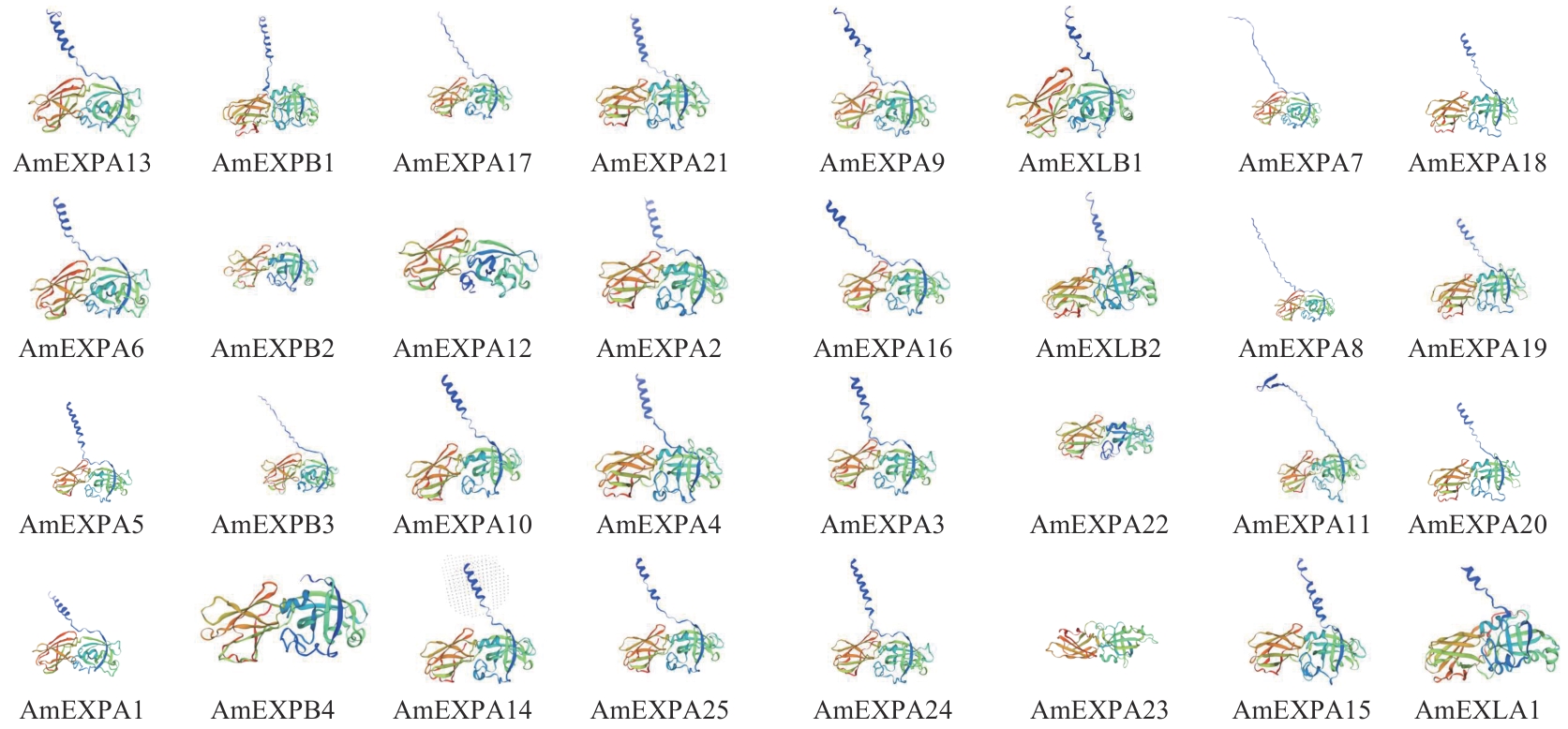
图1 AmEXPs蛋白三维结构预测
Fig. 1 3D structure prediction of AmEXPs proteins
基因名称 Gene name | 基因号 Gene ID | 最佳区比例 Most favoured region/% | 次允许区比例 Additional allowed region/% | 一般允许区比例 Generously allowed region/% | 不允许区比例 Disallowed region/% | 生成因子值 G-factor |
|---|---|---|---|---|---|---|
| AmEXPA1 | Am01g01950.T01 | 90.6 | 9.0 | 0.0 | 0.5 | -0.09 |
| AmEXPA2 | Am01g11840.T01 | 92.7 | 6.8 | 0.5 | 0.0 | -0.12 |
| AmEXPA3 | Am01g25390.T01 | 91.6 | 8.4 | 0.0 | 0.0 | -0.12 |
| AmEXPA4 | Am01g26640.T01 | 91.5 | 8.0 | 0.5 | 0.0 | -0.14 |
| AmEXPA5 | Am01g44550.T01 | 88.3 | 11.2 | 0.5 | 0.0 | -0.10 |
| AmEXPA6 | Am01g44560.T01 | 88.2 | 11.4 | 0.5 | 0.0 | -0.09 |
| AmEXPA7 | Am02g27260.T01 | 87.0 | 10.3 | 1.8 | 0.9 | -0.18 |
| AmEXPA8 | Am02g33780.T01 | 87.2 | 11.5 | 0.4 | 0.9 | -0.17 |
| AmEXPA9 | Am03g06850.T01 | 89.7 | 10.3 | 0.0 | 0.0 | -0.14 |
| AmEXPA10 | Am03g32100.T01 | 92.1 | 7.9 | 0.0 | 0.0 | -0.12 |
| AmEXPA11 | Am03g40550.T01 | 90.5 | 7.8 | 1.3 | 0.4 | -0.13 |
| AmEXPA12 | Am04g05250.T01 | 92.2 | 7.2 | 0.0 | 0.6 | -0.08 |
| AmEXPA13 | Am05g03930.T01 | 88.4 | 10.7 | 0.9 | 0.0 | -0.17 |
| AmEXPA14 | Am05g12940.T01 | 91.6 | 8.4 | 0.0 | 0.0 | -0.11 |
| AmEXPA15 | Am05g41720.T01 | 88.9 | 9.2 | 0.5 | 1.4 | -0.18 |
| AmEXPA16 | Am06g27420.T01 | 87.6 | 12.4 | 0.0 | 0.0 | -0.10 |
| AmEXPA17 | Am06g34470.T01 | 87.6 | 12.4 | 0.0 | 0.0 | -0.13 |
| AmEXPA18 | Am07g13940.T01 | 91.4 | 8.6 | 0.0 | 0.0 | -0.11 |
| AmEXPA19 | Am07g15820.T01 | 91.4 | 8.6 | 0.0 | 0.0 | 0.00 |
| AmEXPA20 | Am07g18170.T01 | 91.5 | 8.5 | 0.0 | 0.0 | -0.09 |
| AmEXPA21 | Am07g21430.T01 | 92.1 | 7.9 | 0.0 | 0.0 | -0.08 |
| AmEXPA22 | Am07g35680.T01 | 92.5 | 6.9 | 0.6 | 0.0 | -0.12 |
| AmEXPA23 | Am08g26500.T01 | 92.4 | 6.5 | 1.1 | 0.0 | -0.14 |
| AmEXPA24 | Am08g34570.T01 | 91.8 | 7.8 | 0.0 | 0.5 | -0.11 |
| AmEXPA25 | Am08g37200.T01 | 92.6 | 7.4 | 0.0 | 0.0 | -0.08 |
| AmEXPB1 | Am01g01300.T01 | 90.4 | 8.7 | 0.9 | 0.0 | -0.19 |
| AmEXPB2 | Am04g35520.T01 | 76.7 | 17.5 | 4.8 | 1.1 | -0.38 |
| AmEXPB3 | Am07g07660.T01 | 87.8 | 11.7 | 0.0 | 0.5 | -0.13 |
| AmEXPB4 | Am07g15580.T01 | 74.5 | 19.0 | 4.3 | 2.2 | -0.48 |
| AmEXLA1 | Am08g01880.T02 | 90.7 | 8.9 | 0.0 | 0.4 | -0.12 |
| AmEXLB1 | Am03g20060.T01 | 89.2 | 9.4 | 0.5 | 0.9 | -0.17 |
| AmEXLB2 | Am04g31120.T01 | 88.1 | 11.4 | 0.5 | 0.0 | -0.10 |
表3 AmEXPs三级结构预测分析
Table 3 3D structures prediction of AmEXPs protein
基因名称 Gene name | 基因号 Gene ID | 最佳区比例 Most favoured region/% | 次允许区比例 Additional allowed region/% | 一般允许区比例 Generously allowed region/% | 不允许区比例 Disallowed region/% | 生成因子值 G-factor |
|---|---|---|---|---|---|---|
| AmEXPA1 | Am01g01950.T01 | 90.6 | 9.0 | 0.0 | 0.5 | -0.09 |
| AmEXPA2 | Am01g11840.T01 | 92.7 | 6.8 | 0.5 | 0.0 | -0.12 |
| AmEXPA3 | Am01g25390.T01 | 91.6 | 8.4 | 0.0 | 0.0 | -0.12 |
| AmEXPA4 | Am01g26640.T01 | 91.5 | 8.0 | 0.5 | 0.0 | -0.14 |
| AmEXPA5 | Am01g44550.T01 | 88.3 | 11.2 | 0.5 | 0.0 | -0.10 |
| AmEXPA6 | Am01g44560.T01 | 88.2 | 11.4 | 0.5 | 0.0 | -0.09 |
| AmEXPA7 | Am02g27260.T01 | 87.0 | 10.3 | 1.8 | 0.9 | -0.18 |
| AmEXPA8 | Am02g33780.T01 | 87.2 | 11.5 | 0.4 | 0.9 | -0.17 |
| AmEXPA9 | Am03g06850.T01 | 89.7 | 10.3 | 0.0 | 0.0 | -0.14 |
| AmEXPA10 | Am03g32100.T01 | 92.1 | 7.9 | 0.0 | 0.0 | -0.12 |
| AmEXPA11 | Am03g40550.T01 | 90.5 | 7.8 | 1.3 | 0.4 | -0.13 |
| AmEXPA12 | Am04g05250.T01 | 92.2 | 7.2 | 0.0 | 0.6 | -0.08 |
| AmEXPA13 | Am05g03930.T01 | 88.4 | 10.7 | 0.9 | 0.0 | -0.17 |
| AmEXPA14 | Am05g12940.T01 | 91.6 | 8.4 | 0.0 | 0.0 | -0.11 |
| AmEXPA15 | Am05g41720.T01 | 88.9 | 9.2 | 0.5 | 1.4 | -0.18 |
| AmEXPA16 | Am06g27420.T01 | 87.6 | 12.4 | 0.0 | 0.0 | -0.10 |
| AmEXPA17 | Am06g34470.T01 | 87.6 | 12.4 | 0.0 | 0.0 | -0.13 |
| AmEXPA18 | Am07g13940.T01 | 91.4 | 8.6 | 0.0 | 0.0 | -0.11 |
| AmEXPA19 | Am07g15820.T01 | 91.4 | 8.6 | 0.0 | 0.0 | 0.00 |
| AmEXPA20 | Am07g18170.T01 | 91.5 | 8.5 | 0.0 | 0.0 | -0.09 |
| AmEXPA21 | Am07g21430.T01 | 92.1 | 7.9 | 0.0 | 0.0 | -0.08 |
| AmEXPA22 | Am07g35680.T01 | 92.5 | 6.9 | 0.6 | 0.0 | -0.12 |
| AmEXPA23 | Am08g26500.T01 | 92.4 | 6.5 | 1.1 | 0.0 | -0.14 |
| AmEXPA24 | Am08g34570.T01 | 91.8 | 7.8 | 0.0 | 0.5 | -0.11 |
| AmEXPA25 | Am08g37200.T01 | 92.6 | 7.4 | 0.0 | 0.0 | -0.08 |
| AmEXPB1 | Am01g01300.T01 | 90.4 | 8.7 | 0.9 | 0.0 | -0.19 |
| AmEXPB2 | Am04g35520.T01 | 76.7 | 17.5 | 4.8 | 1.1 | -0.38 |
| AmEXPB3 | Am07g07660.T01 | 87.8 | 11.7 | 0.0 | 0.5 | -0.13 |
| AmEXPB4 | Am07g15580.T01 | 74.5 | 19.0 | 4.3 | 2.2 | -0.48 |
| AmEXLA1 | Am08g01880.T02 | 90.7 | 8.9 | 0.0 | 0.4 | -0.12 |
| AmEXLB1 | Am03g20060.T01 | 89.2 | 9.4 | 0.5 | 0.9 | -0.17 |
| AmEXLB2 | Am04g31120.T01 | 88.1 | 11.4 | 0.5 | 0.0 | -0.10 |

图2 AmEXPs家族蛋白的氨基酸多序列比对
Fig. 2 Multiple sequence alignment of amino acids for AmEXPs family proteins
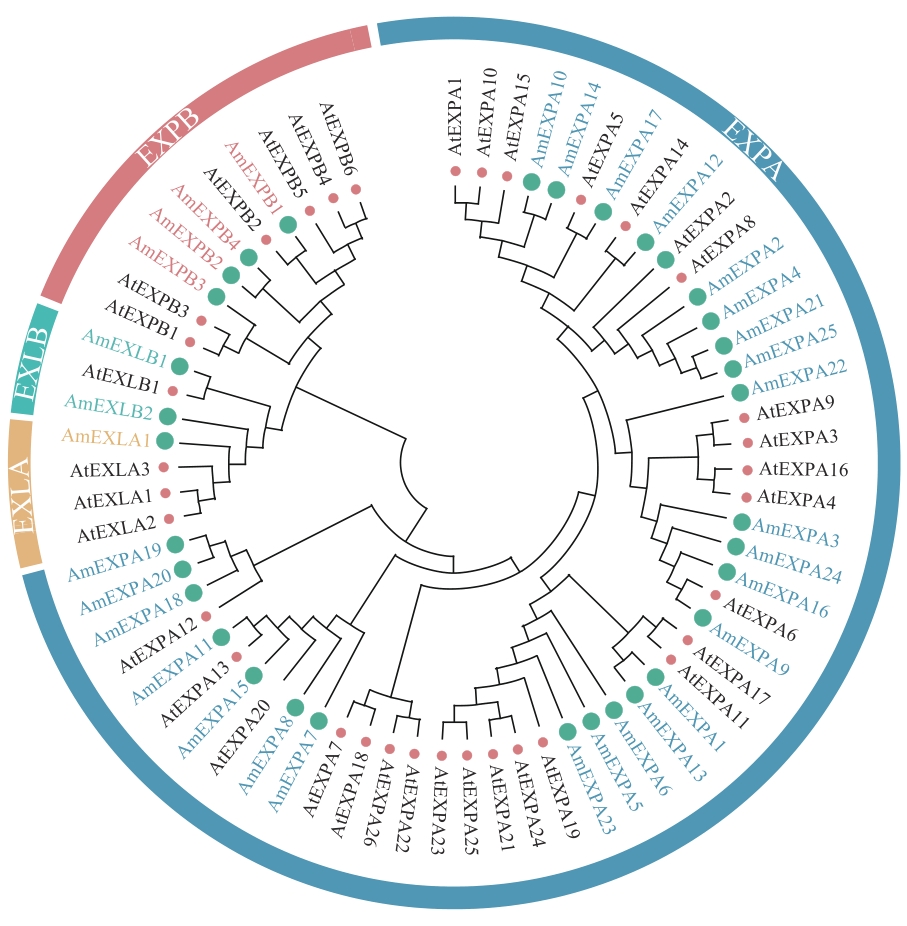
图3 金鱼草和拟南芥EXPs蛋白的系统发育树
Fig. 3 Phylogenetic tree of EXPs proteins in A. thalian and A. majus
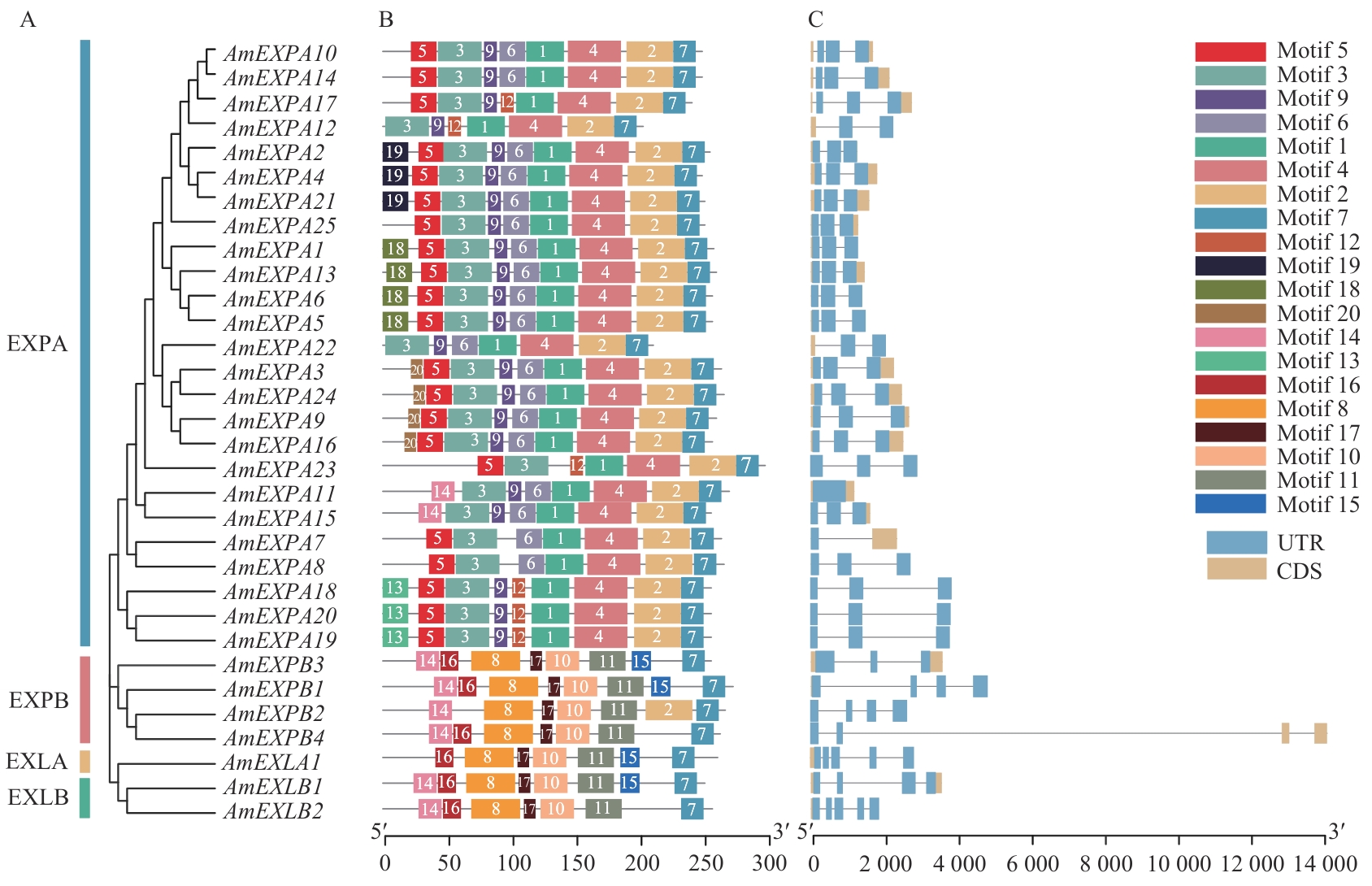
图4 AmEXPs基因家族的系统发育关系(A)、保守基序(B)和基因结构(C)
Fig. 4 Phylogenetic relationships (A), conserved motifs (B), and gene structure(C) of AmEXPs gene family
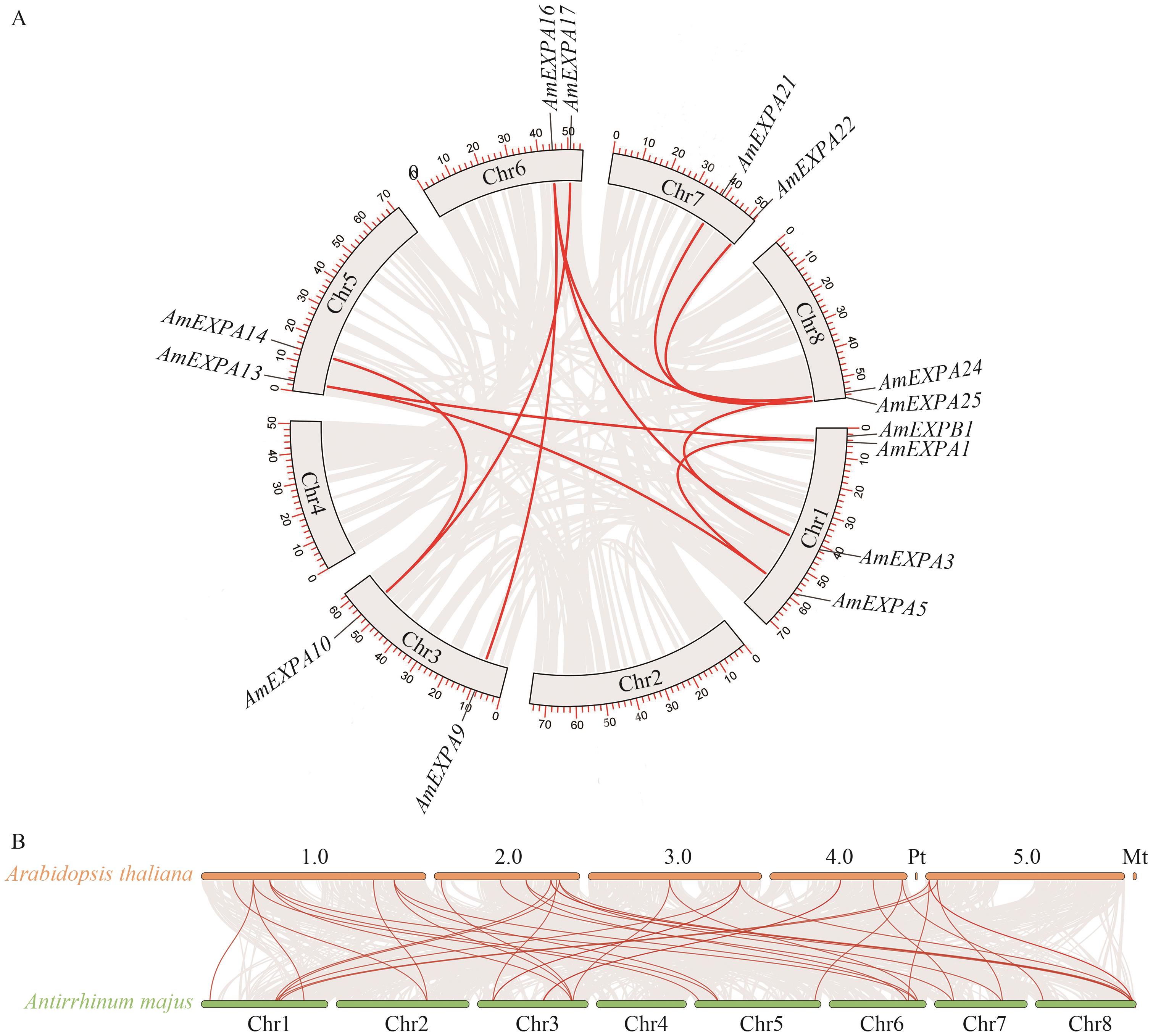
图5 AmEXPs家族的基因复制(A)和种间共线性分析(B)chr:染色体;红线表示 AmEXPs 基因的组内及种间共线性基因对
Fig. 5 Gene duplication (A) and interspecies collinearity analysis (B) of the AmEXPs familychr: Chromosome. The red line indicates the genomic and interspecific collinearity gene pairs of AmEXPs

图6 AmEXPs基因的启动子顺式作用元件分布(A)及统计数(B)
Fig. 6 Distribution (A) and number of the cis-acting elements (B) in the promoter region of the AmEXPs gene family

图 7 ‘Am1’和‘Am6’叶片离体接菌表型观察、菌斑面积统计及RNA-seq分析中的差异表达AmEXPs基因A:‘Am1’(S)和‘Am6’(R)经核盘菌侵染0、12、18、24、36和42 h 后表型,bars=1 cm;B:图A中的叶片菌斑面积;C:接种核盘菌24 h后差异表达的AmEXPs基因;* P<0.05,** P<0.01;hpi:接菌后小时数;下同
Fig. 7 Phenotype observation and the areas of the lesions on the leaves of ‘Am1’ and ‘Am6’ in vitro inoculation of S. sclerotiorum and differentially expressed AmEXPs genes in RNA-seq analysisA: The phenotypes of ‘Am1’ (S) and ‘Am6’ (R) were observed after 0, 12, 18, 24, 36, and 42 h of infection with S. sclerotiorum, bars=1 cm. B: The areas of the lesions on the leaves in Fig. A. C: Differential expressed AmEXPs genes after 24 h inoculation with S. sclerotiorum. * P<0.05, ** P<0.01. hpi: Hours after inoculation. The same below
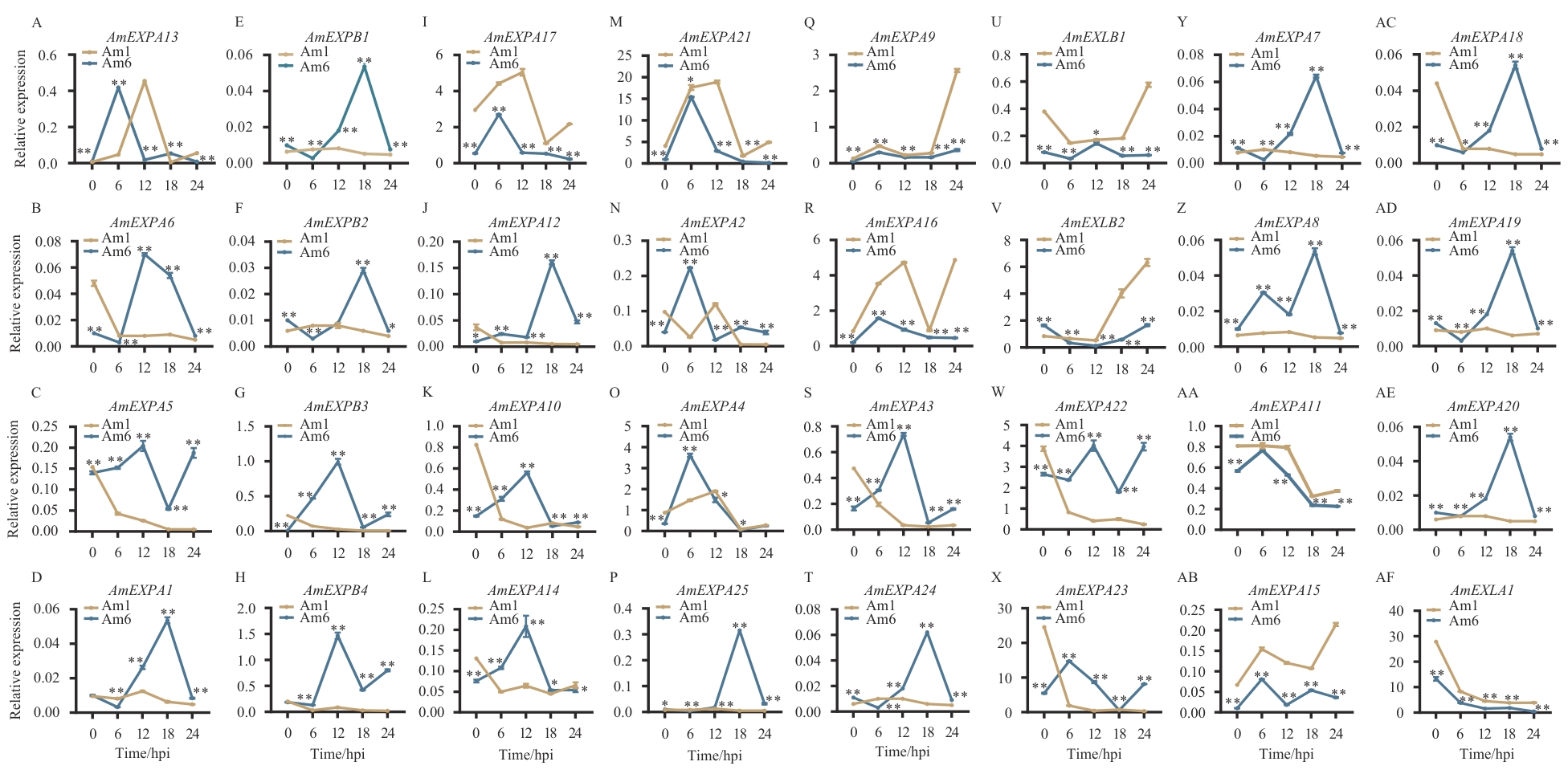
图8 RT-qPCR分析AmEXPs基因在响应核盘菌胁迫过程中的表达模式
Fig. 8 Analysis of AmEXPs gene expression patterns in the response to S. sclerotiorum via RT-qPCR
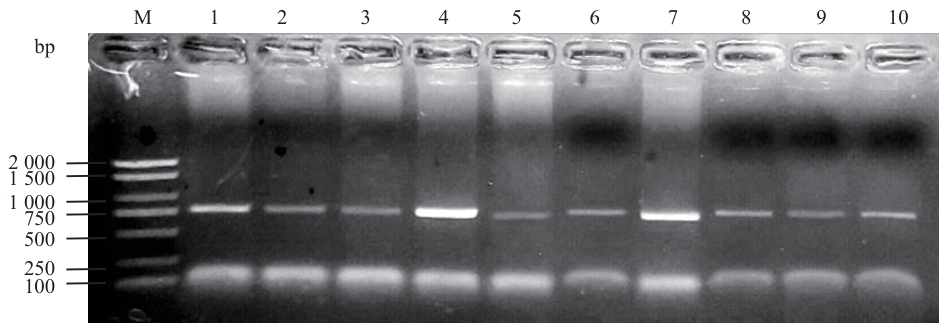
图9 AmEXPs候选基因PCR扩增产物电泳检测1‒10: AmEXPs gene of AmEXPA13 (780 bp), AmEXPA9 (780 bp), AmEXPA16 (771 bp), AmEXPA12 (619 bp), AmEXLB2 (771 bp), AmEXPA17 (723 bp), AmEXPA21 (753 bp), AmEXPA2 (753 bp), AmEXLB1 (753 bp), AmEXPB1 (765 bp). M: DL 2 000 DNA marker
Fig. 9 Electrophoresis detection of PCR amplified products of AmEXPs candidate genes

图 10 本氏烟草瞬时转化初步验证AmEXPs候选基因的抗性A-J:本氏烟草瞬时转化后经核盘菌侵染36 h的表型,bars=2 cm;K‒T:菌斑面积统计;U:AmEXPs蛋白家族系统发育树
Fig. 10 Preliminary validation of AmEXPs candidate gene resistance in transient transformation of N. benthamianaA-J: Phenotype of Nicotiana benthamiana after transient transformation and Sclerotinia sclerotiorum infection for 36 h, bars=2 cm. K‒T: Statistical analysis of lesion area. U: Phylogenetic tree of AmEXPs protein family
| 1 | 陈宇华, 陈剑锋, 钟声远, 等. 20份金鱼草种质资源花色性状鉴定与分析 [J]. 福建农业科技, 2022, 53(7): 1-7. |
| Chen YH, Chen JF, Zhong SY, et al. Identification and analysis of flower color traits of 20 germplasm resources of Antirrhinum majus [J]. Fujian Agric Sci Technol, 2022, 53(7): 1-7. | |
| 2 | 齐伟. 金鱼草常见病虫害及防治 [J]. 花木盆景: 花卉园艺, 2002(9): 26. |
| Qi W. Common pests and diseases of snapdragon and their control [J]. Flowers Trees Potted Landsc, 2002(9): 26. | |
| 3 | 师莹莹, 李大勇, 张慧娟, 等. 植物细胞壁介导的抗病性及其分子机制 [J]. 植物生理学报, 2011, 47(7): 661-668. |
| Shi YY, Li DY, Zhang HJ, et al. Cell wall-mediated disease resistance and its molecular mechanism in plants [J]. Plant Physiol J, 2011, 47(7): 661-668. | |
| 4 | Cosgrove DJ. Plant expansins: diversity and interactions with plant cell walls [J]. Curr Opin Plant Biol, 2015, 25: 162-172. |
| 5 | Marowa P, Ding AM, Kong YZ. Expansins: roles in plant growth and potential applications in crop improvement [J]. Plant Cell Rep, 2016, 35(5): 949-965. |
| 6 | 赵美荣, 李永春, 王玮. 扩展蛋白与植物抗逆性关系研究进展 [J]. 植物生理学报, 2012, 48(7): 637-642. |
| Zhao MR, Li YC, Wang W. Research progress on relationship between expansin and plant resistance [J]. Plant Physiol J, 2012, 48(7): 637-642. | |
| 7 | Fu J, Liu HB, Li Y, et al. Manipulating broad-spectrum disease resistance by suppressing pathogen-induced auxin accumulation in rice [J]. Plant Physiol, 2011, 155(1): 589-602. |
| 8 | Tan J, Wang ML, Shi ZY, et al. OsEXPA10 mediates the balance between growth and resistance to biotic stress in rice [J]. Plant Cell Rep, 2018, 37(7): 993-1002. |
| 9 | Abuqamar S, Ajeb S, Sham A, et al. A mutation in the expansin-like A2 gene enhances resistance to necrotrophic fungi and hypersensitivity to abiotic stress in Arabidopsis thaliana [J]. Mol Plant Pathol, 2013, 14(8): 813-827. |
| 10 | Nardi CF, Villarreal NM, Rossi FR, et al. Overexpression of the carbohydrate binding module of strawberry expansin2 in Arabidopsis thaliana modifies plant growth and cell wall metabolism [J]. Plant Mol Biol, 2015, 88(1/2): 101-117. |
| 11 | Chen LJ, Zou WS, Wu G, et al. Tobacco alpha-expansin EXPA4 plays a role in Nicotiana benthamiana defence against tobacco mosaic virus [J]. Planta, 2018, 247(2): 355-368. |
| 12 | 彭爱红, 张婧芸, 陈志毅, 等. CsEXPA8过表达对‘晚锦橙’生长及溃疡病抗性的影响 [J]. 园艺学报, 2024, 51(5): 971-981. |
| Peng AH, Zhang JY, Chen ZY, et al. Effects of overexpression of CsEXPA8 on growth and canker disease resistance in 'wanjincheng' orange [J]. Acta Hortic Sin, 2024, 51(5): 971-981. | |
| 13 | Brasileiro ACM, Lacorte C, Pereira BM, et al. Ectopic expression of an expansin-like B gene from wild Arachis enhances tolerance to both abiotic and biotic stresses [J]. Plant J, 2021, 107(6): 1681-1696. |
| 14 | 夏文念, 杨冬梅, 宋佳怡, 等. 金鱼草GAE基因家族鉴定及核盘菌抗性基因挖掘 [J]. 农业生物技术学报, 2024, 32(9): 2049-2059. |
| Xia WN, Yang DM, Song JY, et al. Identification of GAE gene family in Antirrhinum majus and mining of resistance genes to Sclerotinia sclerotiorum [J]. J Agric Biotechnol, 2024, 32(9): 2049-2059. | |
| 15 | 赵晗茜, 宋佳怡, 杨洁, 等. 金鱼草XTH家族基因鉴定及抗核盘菌和雄蕊瓣化相关基因筛选 [J]. 植物学报, 2024, 59(2): 188-203. |
| Zhao I, Song JY, Yang J, et al. Identification of XTH family genes in Antirrhinum majus and screening of genes involoved in Sclerotinia sclerotiorum resistance and stamen petalization [J]. Chin Bull Bot, 2024, 59(2): 188-203. | |
| 16 | Marchler-Bauer A, Bo Y, Han LY, et al. CDD/SPARCLE: functional classification of proteins via subfamily domain architectures [J]. Nucleic Acids Res, 2017, 45(D1): D200-D203. |
| 17 | Sánchez MA, Mateos I, Labrador E, et al. Brassinolides and IAA induce the transcription of four α-expansin genes related to development in Cicer arietinum [J]. Plant Physiol Biochem, 2004, 42(9): 709-716. |
| 18 | Chen YH, Xie B, An XH, et al. Overexpression of the apple expansin-like gene MdEXLB1 accelerates the softening of fruit texture in tomato [J]. J Integr Agric, 2022, 21(12): 3578-3588. |
| 19 | Muthusamy M, Kim JY, Yoon EK, et al. BrEXLB1, a Brassica rapa expansin-like B1 gene is associated with root development, drought stress response, and seed germination [J]. Genes, 2020, 11(4): 404. |
| 20 | Otulak-Kozieł K, Kozieł E, Lockhart BEL, et al. The expression of potato expansin A3 (StEXPA3) and Extensin4 (StEXT4) genes with distribution of StEXPAs and HRGPs-extensin changes as an effect of cell wall rebuilding in two types of PVYNTN- Solanum tuberosum interactions [J]. Viruses, 2020, 12(1): 66. |
| 21 | Sampedro J, Cosgrove DJ. The expansin superfamily [J]. Genome Biol, 2005, 6(12): 242. |
| 22 | Ding AM, Marowa P, Kong YZ. Genome-wide identification of the expansin gene family in tobacco (Nicotiana tabacum) [J]. Mol Genet Genomics, 2016, 291(5): 1891-1907. |
| 23 | Lu YE, Liu LF, Wang X, et al. Genome-wide identification and expression analysis of the expansin gene family in tomato [J]. Mol Genet Genomics, 2016, 291(2): 597-608. |
| 24 | Hou L, Zhang ZY, Dou SH, et al. Genome-wide identification, characterization, and expression analysis of the expansin gene family in Chinese jujube (Ziziphus jujuba Mill.) [J]. Planta, 2019, 249(3): 815-829. |
| 25 | 廖嘉明. 基于CRISPR/Cas9的拟南芥EXPA多基因突变体的表现及转黄梁木NcEXPA8的表达 [D]. 广州: 华南农业大学, 2020. |
| Liao JM. Expression of EXPA multigene mutant in Arabidopsis thaliana based on CRISPR/Cas9 and expression of NcEXPA8 in Pistacia chinensis [D]. Guangzhou: South China Agricultural University, 2020. | |
| 26 | Sánchez-Montesino R, Bouza-Morcillo L, Marquez J, et al. A regulatory module controlling GA-mediated endosperm cell expansion is critical for seed germination in Arabidopsis [J]. Mol Plant, 2019, 12(1): 71-85. |
| 27 | Jiang XS, Li HY, Wang T, et al. Gibberellin indirectly promotes chloroplast biogenesis as a means to maintain the chloroplast population of expanded cells [J]. Plant J, 2012, 72(5): 768-780. |
| 28 | Park CH, Kim TW, Son SH, et al. Brassinosteroids control AtEXPA5 gene expression in Arabidopsis thaliana [J]. Phytochemistry, 2010, 71(4): 380-387. |
| 29 | Kuluev BR, Knyazev AB, Lebedev YP, et al. Morphological and physiological characteristics of transgenic tobacco plants expressing expansin genes: AtEXP10 from Arabidopsis and PnEXPA1 from poplar [J]. Russ J Plant Physiol, 2012, 59(1): 97-104. |
| 30 | Dermatsev V, Weingarten-Baror C, Resnick N, et al. Microarray analysis and functional tests suggest the involvement of expansins in the early stages of symbiosis of the arbuscular mycorrhizal fungus Glomus intraradices on tomato (Solanum lycopersicum) [J]. Mol Plant Pathol, 2010, 11(1): 121-135. |
| 31 | Gal TZ, Aussenberg ER, Burdman S, et al. Expression of a plant expansin is involved in the establishment of root knot nematode parasitism in tomato [J]. Planta, 2006, 224(1): 155-162. |
| 32 | Mohanty SK, Arthikala MK, Nanjareddy K, et al. Plant-symbiont interactions: the functional role of expansins [J]. Symbiosis, 2018, 74(1): 1-10. |
| 33 | Sasidharan R, Voesenek LA, Pierik R. Cell wall modifying proteins mediate plant acclimatization to biotic and abiotic stresses [J]. Crit Rev Plant Sci, 2011, 30(6): 548-562. |
| 34 | Hu HZ, Tang YW, Wu J, et al. Brassica napus mediator Subunit16 induces BnMED25- and BnWRKY33-activated defense signaling to confer Sclerotinia sclerotiorum resistance [J]. Front Plant Sci, 2021, 12: 663536. |
| 35 | Balbi V, Devoto A. Jasmonate signalling network in Arabidopsis thaliana: crucial regulatory nodes and new physiological scenarios [J]. New Phytol, 2008, 177(2): 301-318. |
| 36 | 吴健, 周永明, 王幼平. 油菜与核盘菌互作分子机理研究进展 [J]. 中国油料作物学报, 2018, 40(5): 721-729. |
| Wu J, Zhou YM, Wang YP. Research progress on molecular mechanisms of Brassica napus-Sclerotinia sclerotiorum interaction [J]. Chin J Oil Crop Sci, 2018, 40(5): 721-729. | |
| 37 | Lou Y, Zhou HS, Han Y, et al. Positive regulation of AMS by TDF1 and the formation of a TDF1-AMS complex are required for anther development in Arabidopsis thaliana [J]. New Phytol, 2018, 217(1): 378-391. |
| 38 | Zhang SY, Wang J, Chen GH, et al. Functional analysis of a MYB transcription factor BrTDF1 in the tapetum development of Wucai (Brassica rapa ssp.) [J]. Sci Hortic, 2019, 257: 108728. |
| 39 | 徐佳文. 棉花α-Expansin-like基因GhEXLA1的功能解析 [D]. 武汉: 华中农业大学, 2022. |
| Xu JW. Functional analysis of cotton α-expansin-like gene GhEXLA1 [D]. Wuhan: Huazhong Agricultural University, 2022. | |
| 40 | 梁绮文. 干旱胁迫下普通烟草类扩展蛋白NtEXLA2和NtEXLA4基因功能分析 [D]. 昆明: 云南农业大学, 2022. |
| Liang QW. Functional analysis of NtEXLA2 and NtEXLA4 genes of common tobacco under drought stress [D]. Kunming: Yunnan Agricultural University, 2022. |
| [1] | 王天禧, 杨炳松, 潘荣君, 盖文贤, 梁美霞. 苹果PLATZ基因家族鉴定及MdPLATZ9基因功能研究[J]. 生物技术通报, 2025, 41(4): 176-187. |
| [2] | 张益瑄, 马宇, 王童童, 盛苏奥, 宋家凤, 吕钊彦, 朱晓彪, 侯华兰. 马铃薯DIR家族全基因组鉴定及表达模式分析[J]. 生物技术通报, 2025, 41(3): 123-136. |
| [3] | 宋姝熠, 蒋开秀, 刘欢艳, 黄亚成, 刘林娅. ‘红阳’猕猴桃TCP基因家族鉴定及其在果实中的表达分析[J]. 生物技术通报, 2025, 41(3): 190-201. |
| [4] | 匡健华, 程志鹏, 赵永晶, 杨洁, 陈润乔, 陈龙清, 胡慧贞. 激素和非生物胁迫下荷花GH3基因家族的表达分析[J]. 生物技术通报, 2025, 41(2): 221-233. |
| [5] | 黄颖, 遇文婧, 刘雪峰, 刁桂萍. 山新杨谷胱甘肽转移酶基因的生物信息学与表达模式分析[J]. 生物技术通报, 2025, 41(2): 248-256. |
| [6] | 杨涌, 袁国梅, 康肖肖, 刘亚明, 王东升, 张海娥. 板栗SWEET基因家族成员的鉴定及表达分析[J]. 生物技术通报, 2025, 41(2): 257-269. |
| [7] | 杜品廷, 吴国江, 王振国, 李岩, 周伟, 周亚星. 高粱CPP基因家族鉴定及表达分析[J]. 生物技术通报, 2025, 41(1): 132-142. |
| [8] | 李彩霞, 李艺, 穆宏秀, 林俊轩, 白龙强, 孙美华, 苗妍秀. 中国南瓜bHLH转录因子家族的鉴定与生物信息学分析[J]. 生物技术通报, 2025, 41(1): 186-197. |
| [9] | 吴娟, 武小娟, 王沛捷, 谢锐, 聂虎帅, 李楠, 马艳红. 彩色马铃薯花青素合成相关ERF基因筛选及表达分析[J]. 生物技术通报, 2024, 40(9): 82-91. |
| [10] | 刘丹丹, 王雷刚, 孙明慧, 焦小雨, 吴琼, 王文杰. 茶树海藻糖-6-磷酸合成酶(TPS)基因家族鉴定与表达分析[J]. 生物技术通报, 2024, 40(8): 152-163. |
| [11] | 王健, 杨莎, 孙庆文, 陈宏宇, 杨涛, 黄园. 金钗石斛bHLH转录因子家族全基因组鉴定及表达分析[J]. 生物技术通报, 2024, 40(6): 203-218. |
| [12] | 杜兵帅, 邹昕蕙, 王子豪, 张馨元, 曹一博, 张凌云. 油茶SWEET基因家族的全基因组鉴定及表达分析[J]. 生物技术通报, 2024, 40(5): 179-190. |
| [13] | 吴翠翠, 肖水平. 陆地棉HD-Zip家族全基因组鉴定及响应非生物胁迫的表达分析[J]. 生物技术通报, 2024, 40(2): 130-145. |
| [14] | 李亚男, 张豪杰, 梁梦静, 罗涛, 李旺宁, 张春辉, 季春丽, 李润植, 薛金爱, 崔红利. 雨生红球藻钙依赖蛋白激酶(CDPK)家族鉴定与表达分析[J]. 生物技术通报, 2024, 40(2): 300-312. |
| [15] | 张路阳, 韩文龙, 徐晓雯, 姚健, 李芳芳, 田效园, 张智强. 烟草TCP基因家族的鉴定及表达分析[J]. 生物技术通报, 2023, 39(6): 248-258. |
| 阅读次数 | ||||||
|
全文 |
|
|||||
|
摘要 |
|
|||||
