







生物技术通报 ›› 2026, Vol. 42 ›› Issue (1): 305-314.doi: 10.13560/j.cnki.biotech.bull.1985.2024-1049
郑婉婷( ), 曾千诺, 傅嘉懿, 饶敏欣, 何国振, 张英()
收稿日期:2024-10-26
出版日期:2026-01-26
发布日期:2026-02-04
通讯作者:
张英,女,博士,教授,研究方向 :中药资源循环利用;E-mail: tjxyzy@gzucm.edu.cn作者简介:郑婉婷,女,硕士研究生,研究方向 :中药资源循环利用;E-mail: wt158340811@163.com
基金资助:
ZHENG Wan-ting(), ZENG Qian-nuo, FU Jia-yi, RAO Min-xin, HE Guo-zhen, ZHANG Ying()
Received:2024-10-26
Published:2026-01-26
Online:2026-02-04
摘要:
目的 为实现中药药渣好氧堆肥中氮素的高效保留,旨在寻找具有高效硝化能力的微生物并揭示其硝化反硝化特性,以期为开发保氮微生物菌剂提供菌种资源与理论依据。 方法 采用富集培养法、涂布平板法和划线分离法从中药药渣堆肥中获得纯化菌株。通过异养硝化能力测定,筛选出1株能够高效转化铵态氮的硝化菌株。结合形态学特征及16S rDNA基因测序对所得菌株进行鉴定。通过调整碳源、碳氮比(C/N)、初始铵态氮浓度、pH、温度、转速6种培养条件,探究环境因素对菌株生长及硝化能力的影响。在以亚硝态氮或硝态氮为唯一氮源的培养基中培养该菌株,检测其反硝化能力。 结果 从堆肥中分离得到1株高效硝化菌,命名为YF-5,形态学观察及分子生物学鉴定为水生产碱杆菌(Alcaligenes aquatilis)。优化实验确定该菌株最佳硝化条件为:琥珀酸钠作碳源、C/N 20、初始铵态氮浓度100 mg/L、pH 7.0、温度35 ℃、转速160 r/min。硝化产物分析显示,菌株YF-5进行异养硝化作用,其过程中伴有亚硝态氮的积累。反硝化实验证实,菌株YF-5无法利用亚硝态氮或硝态氮进行反硝化。 结论 菌株YF-5在优化条件下能将铵态氮转化为稳定的亚硝态氮,且不具备反硝化能力。这一特性使其在中药药渣堆肥应用中能够通过定向转化氮素,同步减少氨挥发与反硝化作用,从而降低堆肥过程中的氮素损失,展现出良好的应用潜力。
郑婉婷, 曾千诺, 傅嘉懿, 饶敏欣, 何国振, 张英. 从中药药渣堆肥中分离鉴定的一株异养硝化菌及其硝化反硝化特性研究[J]. 生物技术通报, 2026, 42(1): 305-314.
ZHENG Wan-ting, ZENG Qian-nuo, FU Jia-yi, RAO Min-xin, HE Guo-zhen, ZHANG Ying. Isolation and Identification of a Heterotrophic Nitrifying Bacterium from the Compost of Chinese Medicinal Herbal Residues and Study of Its Nitrification and Denitrification Capabilities[J]. Biotechnology Bulletin, 2026, 42(1): 305-314.
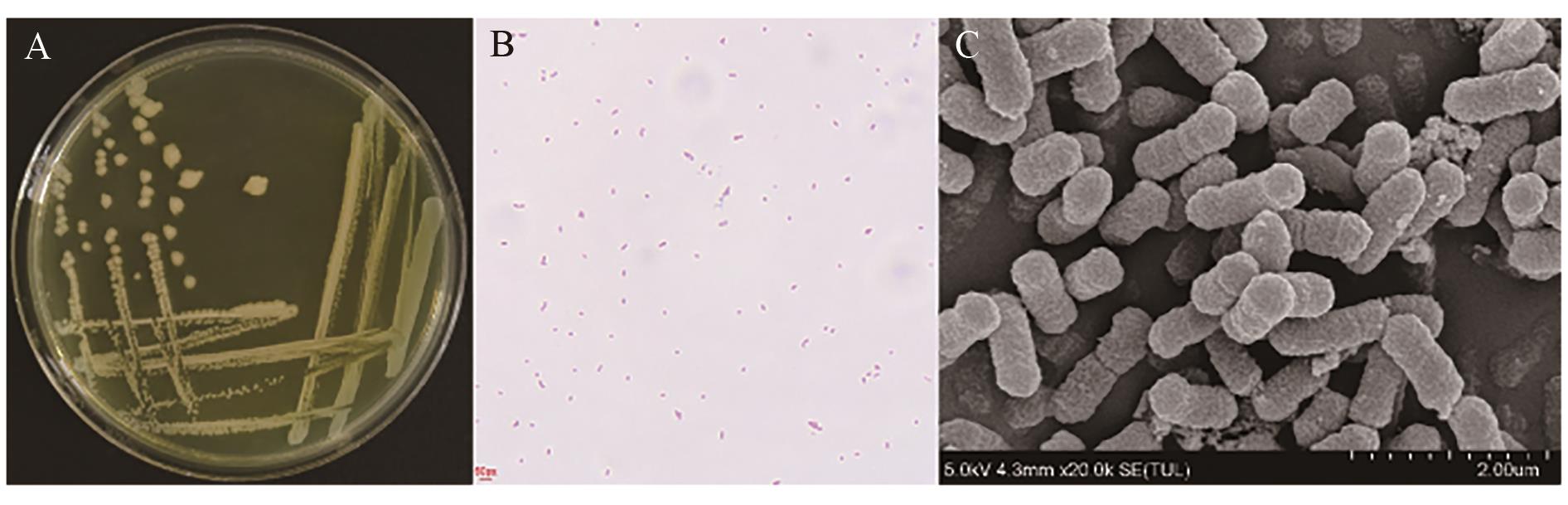
图1 菌株YF-5的形态学特征A:平板菌落形态;B:革兰氏染色结果;C:扫描电镜图
Fig. 1 Morphological characteristics of strain YF-5A: Plate colony morphology. B: Gram staining results. C: Scanning electron microscope image
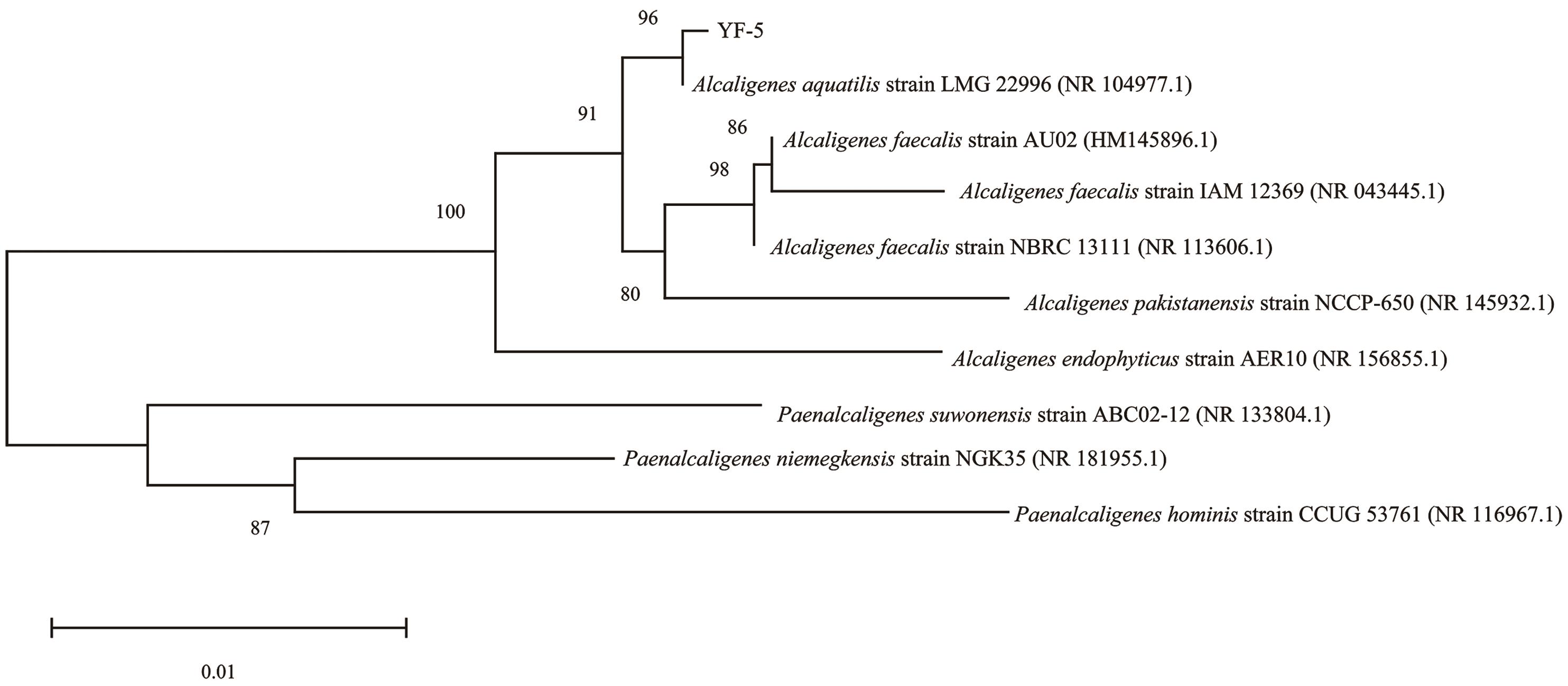
图2 菌株YF-5基于16S rDNA基因序列构建的系统发育树
Fig. 2 Phylogenetic tree of strain YF-5 based on 16S rDNA gene sequences
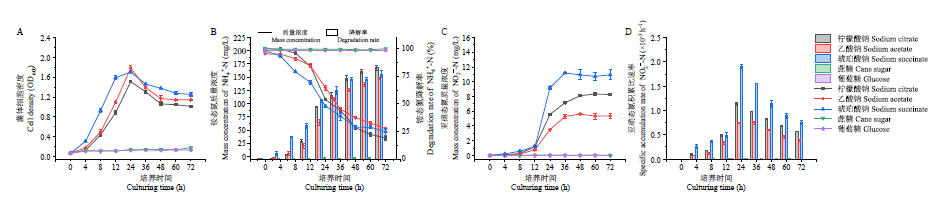
图3 不同碳源下菌株YF-5 的生长状况以及硝化特性
Fig. 3 Growth status and nitrification characteristic of strain YF-5 under different carbon sources
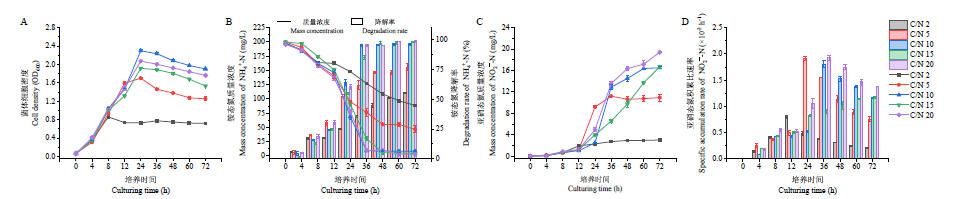
图4 不同C/N下菌株YF-5的生长状况及其硝化特性
Fig. 4 Growth status and nitrification characteristic of strain YF-5 under different C/N

图5 不同初始铵态氮浓度下菌株YF-5的生长状况及其硝化特性
Fig. 5 Growth status and nitrification characteristic of strain YF-5 under different initial ammonium nitrogen concentration
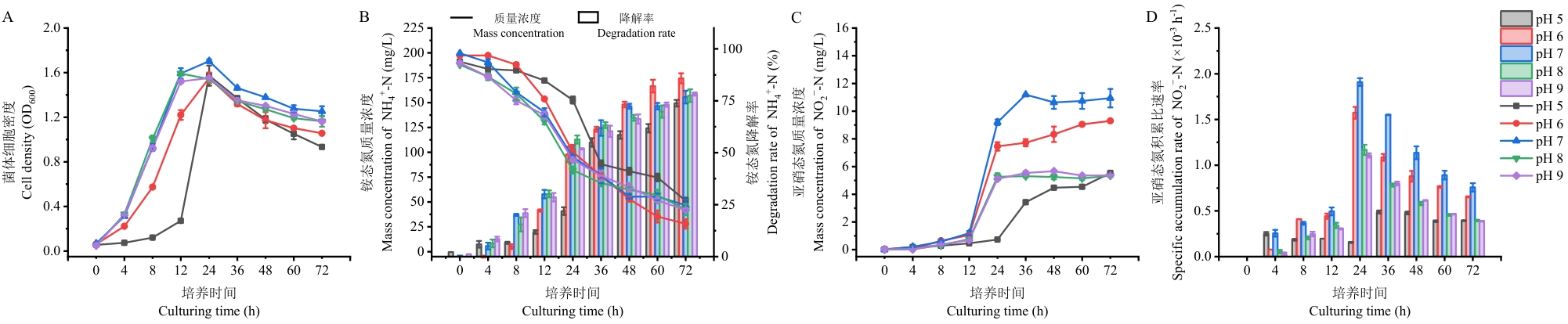
图6 不同pH下菌株YF-5的生长状况及其硝化特性
Fig. 6 Growth status and nitrification characteristic of strain YF-5 under different pH
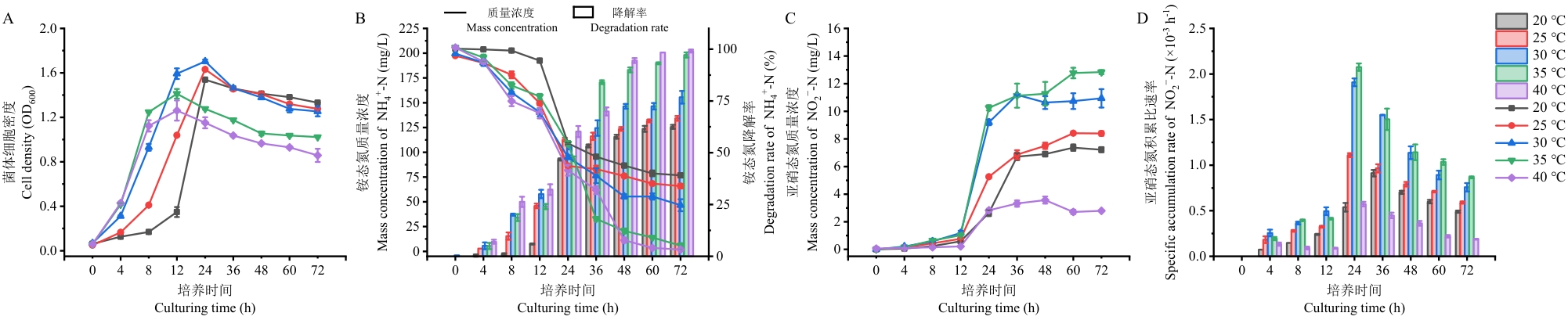
图7 不同温度下菌株YF-5的生长状况及其硝化特性
Fig. 7 Growth status and nitrification characteristic of strain YF-5 under different temperature
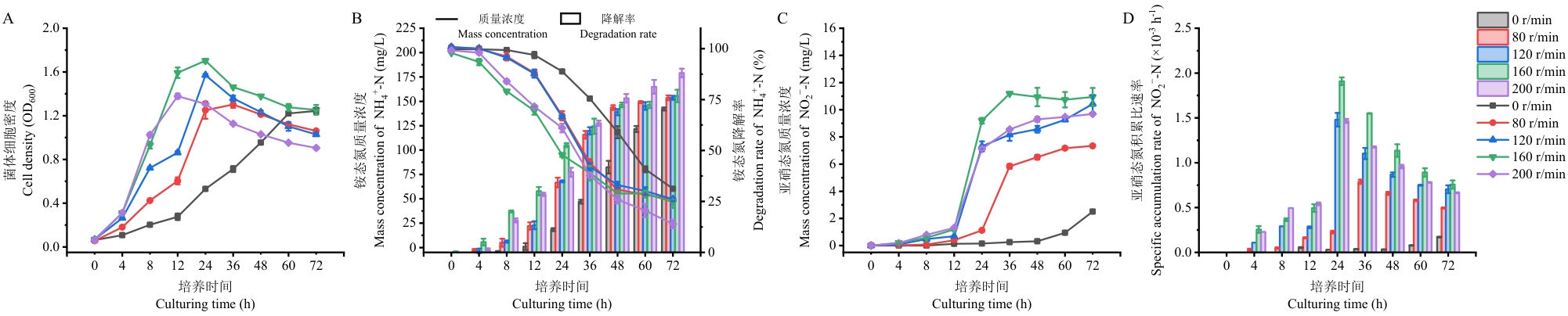
图8 不同转速下菌株YF-5的生长状况及其硝化特性
Fig. 8 Growth status and nitrification characteristic of strain YF-5 under different rotational speed

图9 菌株YF-5的反硝化特性A、B:亚硝态氮为氮源的菌体细胞密度(A)和质量浓度及降解率(B);C、D:硝态氮为氮源的菌体细胞密度(C)和质量浓度及降解率(D)
Fig. 9 Denitrification characteristic of the strain YF-5A, B: Cell density (A) and mass concentration and degradation rate of NO2‒-N (B) while nitrite as nitrogen source. C, D: Cell density (C) and mass concentration and degradation rate of NO3‒-N (D) while nitrate as nitrogen source
| [1] | 高静静, 庄新辉, 谭雪松, 等. 中药渣资源化利用研究进展 [J]. 中成药, 2024, 46(2): 536-541. |
| Gao JJ, Zhuang XH, Tan XS, et al. Research progress on resource utilization of traditional Chinese medicine residue [J]. Chin Tradit Pat Med, 2024, 46(2): 536-541. | |
| [2] | Luo JH, Yang R, Ma FF, et al. Recycling utilization of Chinese medicine herbal residues resources: systematic evaluation on industrializable treatment modes [J]. Environ Sci Pollut Res Int, 2023, 30(12): 32153-32167. |
| [3] | Saha A, Basak BB, Banerjee A. In-vitro antioxidant evaluation and production of biochar from distillation waste biomass of Mentha arvensis [J]. J Appl Res Med Aromat Plants, 2022, 31: 100428. |
| [4] | 刘倩, 赵茜, 申海进. 中药渣发酵工艺研究及其在饲料生产上的应用 [J]. 饲料研究, 2021, 44(18): 147-149. |
| Liu Q, Zhao Q, Shen HJ. Study on fermentation technology of traditional Chinese medicine residue and its application in feed production [J]. Feed Res, 2021, 44(18): 147-149. | |
| [5] | Choi JY, Nam J, Yun BY, et al. Utilization of corn cob, an essential agricultural residue difficult to disposal: Composite board manufactured improved thermal performance using microencapsulated PCM [J]. Ind Crops Prod, 2022, 183: 114931. |
| [6] | 陶迎泰, 郭清毅, 陈芳, 等. 中药产业化过程中固体副产物的综合利用研究进展 [J]. 中国中医药信息杂志, 2024, 31(3): 174-179. |
| Tao YT, Guo QY, Chen F, et al. Research progress in comprehensive utilization of solid by-products in the process of industrialization of Chinese materia medica [J]. Chin J Inf Tradit Chin Med, 2024, 31(3): 174-179. | |
| [7] | Liu Y, Zhang Y, Wang MH, et al. Comparison of the basic processes of aerobic, anaerobic, and aerobic-anaerobic coupling composting of Chinese medicinal herbal residues [J]. Bioresour Technol, 2023, 379: 128996. |
| [8] | 李健, 祝凉, 黄魁. 好氧堆肥体中硝化作用的研究进展 [J]. 广东化工, 2019, 46(16): 87-88, 75. |
| Li J, Zhu L, Huang K. A review of nitrification process within aerobic composting ppile [J]. Guangdong Chem Ind, 2019, 46(16): 87-88, 75. | |
| [9] | 杨赛, 朱琳, 魏巍. 土壤生态系统硝化微生物研究进展 [J]. 中国土壤与肥料, 2018(6): 1-10. |
| Yang S, Zhu L, Wei W. Research progress on nitrifying microorganisms of soil ecosystem [J]. Soil Fertil Sci China, 2018(6): 1-10. | |
| [10] | 亢宗静, 胡露星, 蔡凯, 等. 异养硝化细菌硝化途径及氮转化功能研究进展 [J]. 应用与环境生物学报, 2023, 29(4): 811-820. |
| Kang ZJ, Hu LX, Cai K, et al. Research status and prospect on the nitrification pathway and nitrogen-transforming function of heterotrophic nitrifying bacteria [J]. Chin J Appl Environ Biol, 2023, 29(4): 811-820. | |
| [11] | 曹雪松, 陈潇潇, 王丽艳, 等. 1株异养硝化细菌LLM-5的分离鉴定及其性能研究 [J]. 环境科学与技术, 2023, 46(4): 18-26. |
| Cao XS, Chen XX, Wang LY, et al. Isolation and identification of a heterotrophic nitrification bacteria LLM-5 and insight into its property [J]. Environ Sci Technol, 2023, 46(4): 18-26. | |
| [12] | 段亚军, 吴洪生, 李贞伟, 等. 畜禽粪便堆肥过程中CH4和N2O减排研究进展 [J]. 农业环境科学学报, 2025, 44(4): 869-879. |
| Duan YJ, Wu HS, Li ZW, et al. Review of progress on CH4 and N2O emissions mitigation during livestock and poultry manure composting [J]. J Agro Environ Sci, 2025, 44(4): 869-879. | |
| [13] | Tian XP, Qin W, Zhang YY, et al. The inoculation of thermophilic heterotrophic nitrifiers improved the efficiency and reduced ammonia emission during sewage sludge composting [J]. Chem Eng J, 2024, 479: 147237. |
| [14] | Yang XC, Han ZZ, Ruan XY, et al. Composting swine carcasses with nitrogen transformation microbial strains: Succession of microbial community and nitrogen functional genes [J]. Sci Total Environ, 2019, 688: 555-566. |
| [15] | Xu J, Xu XH, Men MQ, et al. Aliibacillus thermotolerans gen. nov., sp. nov.: a thermophilic and heterotrophic ammonia-oxidizing bacterium from compost [J]. Arch Microbiol, 2018, 200(9): 1357-1363. |
| [16] | Yang YL, Dong SJ, Yu Y, et al. Bioaugmentation performances with a powerful strain for nitrogen removal without N2O accumulation [J]. J Environ Manag, 2023, 325: 116506. |
| [17] | 孙将, 李建章, 袁月祥, 等. 高效除氨氮异养硝化细菌的分离鉴定及其脱氮条件优化 [J]. 农业工程学报, 2018, 34(S1): 35-41. |
| Sun J, Li JZ, Yuan YX, et al. Study on isolation and identification of heterotrophic nitrifying bacteria and optimal denitrification conditions [J]. Trans Chin Soc Agric Eng, 2018, 34(S1): 35-41. | |
| [18] | 张建云, 谷立坤, 王亚西, 等. 植物叶际好氧反硝化细菌的筛选及其脱氮性能研究 [J]. 微生物学报, 2024, 64(5): 1521-1537. |
| Zhang JY, Gu LK, Wang YX, et al. Aerobic denitrifying bacteria in the phyllosphere: screening and characterizing of nitrogen removal performance [J]. Acta Microbiol Sin, 2024, 64(5): 1521-1537. | |
| [19] | 高梦雯, 邢绍文, 李云. 异养硝化-好氧反硝化菌Rhodococcus sp. Y9-1的脱氮性能及生物强化修复氨氮污染地下水 [J]. 东华大学学报: 自然科学版, 2025, 51(3): 183-190. |
| Gao MW, Xing SW, Li Y. Nitrogen removal performance of heterotrophic nitrification-aerobic denitrification bacteria Rhodococcus sp. Y9-1 and its application in bioremediation of ammonia nitrogen contaminated groundwater [J]. J Donghua Univ Nat Sci, 2025, 51(3): 183-190. | |
| [20] | Basharat Z, Yasmin A, He TT, et al. Genome sequencing and analysis of Alcaligenes faecalis subsp. phenolicus MB207 [J]. Sci Rep, 2018, 8(1): 3616. |
| [21] | Chen JL, Xu J, Zhang SN, et al. Nitrogen removal characteristics of a novel heterotrophic nitrification and aerobic denitrification bacteria, Alcaligenes faecalis strain WT14 [J]. J Environ Manag, 2021, 282: 111961. |
| [22] | Zhang JY, Chen K, Liu X, et al. Treatment of high-ammonia-nitrogen wastewater with immobilized ammonia-oxidizing bacteria Alcaligenes sp. TD-94 and Paracoccus sp. TD-10 [J]. Processes, 2023, 11(3): 926. |
| [23] | Cao XH, Zhao BH, Wu YM, et al. Characterization of Alcaligenes aquatilis as a novel member of heterotrophic nitrifier-aerobic denitrifier and its performance in treating piggery wastewater [J]. Bioresour Technol, 2022, 354: 127176. |
| [24] | Yang JY, Xie XH, Miao YY, et al. Isolation and characterization of a cold-tolerant heterotrophic nitrification-aerobic denitrification bacterium and evaluation of its nitrogen-removal efficiency [J]. Environ Res, 2024, 242: 117674. |
| [25] | 武艳芳, 甄静, 郭光光, 等. 一株异养硝化菌(Alcaligenes sp. XN-1)的筛选分离及降解特性 [J]. 生物学杂志, 2024, 41(5): 42-47. |
| Wu YF, Zhen J, Guo GG, et al. Isolation and identification of a heterotrophic nitrification strain Alcaligenes sp. XN-1 and its degradation characteristics analysis [J]. J Biol, 2024, 41(5): 42-47. | |
| [26] | 阮明君, 钟梓杰, 余发杰, 等. 一株异养硝化细菌的分离鉴定及其在垃圾渗滤液中的应用 [J]. 广东农业科学, 2022, 49(3): 68-76. |
| Ruan MJ, Zhong ZJ, Yu FJ, et al. Isolation and identification of a heterotrophic nitrification bacterium and its application in landfill leachate [J]. Guangdong Agric Sci, 2022, 49(3): 68-76. | |
| [27] | Marek K, Pawęska K, Bawiec A. Treatment of wastewater with high ammonium nitrogen concentration [J]. J Ecol Eng, 2021, 22(4): 224-231. |
| [28] | 王梓宇, 王佳丽, 唐德富, 等. 一株水生产碱杆菌(Alcaligenes aquatilis)的分离鉴定及其氨氧化效果 [J]. 微生物学通报, 2023, 50(5): 2002-2016. |
| Wang ZY, Wang JL, Tang DF, et al. Isolation, identification, and deamination characterization of a strain of Alcaligenes aquatilis [J]. Microbiol China, 2023, 50(5): 2002-2016. | |
| [29] | Kabir MF, Ju LK. On optimization of enzymatic processes: Temperature effects on activity and long-term deactivation kinetics [J]. Process Biochem, 2023, 130: 734-746. |
| [30] | Wu ZS, Xu F, Yang C, et al. Highly efficient nitrate removal in a heterotrophic denitrification system amended with redox-active biochar: a molecular and electrochemical mechanism [J]. Bioresour Technol, 2019, 275: 297-306. |
| [31] | 谢尧旭, 张漫漫, 何腾霞, 等. Pseudomonas oryzihabitans EN-F4菌株的脱氮特征及羟胺对其脱氮过程的促进作用 [J]. 微生物学报, 2023, 63(10): 3858-3875. |
| Xie YX, Zhang MM, He TX, et al. Nitrogen removal characteristics of Pseudomonas oryzihabitans EN-F4 with/without the supplementation of hydroxylamine [J]. Acta Microbiol Sin, 2023, 63(10): 3858-3875. | |
| [32] | Wu J, He SZ, Liang Y, et al. Effect of phosphate additive on the nitrogen transformation during pig manure composting [J]. Environ Sci Pollut Res Int, 2017, 24(21): 17760-17768. |
| [33] | Gao YJ, Zhang T, Hu LK, et al. Denitrification characteristics of the low-temperature tolerant denitrification strain Achromobacter spiritinus HS2 and its application [J]. Microorganisms, 2024, 12(3): 451. |
| [34] | 夏远舰, 杨小丽, 李海华, 等. 异养硝化-好氧反硝化菌Acinetobacter johnsonii sp. N26的脱氮性能及代谢途径 [J]. 微生物学通报, 2023, 50(4): 1374-1395. |
| Xia YJ, Yang XL, Li HH, et al. Optimization of nitrogen removal performance and metabolic pathway of a heterotrophic nitrifying-aerobic denitrifying bacterial strain Acinetobacter johnsonii sp. N26 [J]. Microbiol China, 2023, 50(4): 1374-1395. | |
| [35] | Xu SQ, Zhang FY, Jiang YH, et al. Characterization of a new heterotrophic nitrification bacterium Pseudomonas sp. strain JQ170 and functional identification of nap gene in nitrite production [J]. Sci Total Environ, 2022, 806(Pt 1): 150556. |
| [36] | Hoang HG, Thuy BTP, Lin C, et al. The nitrogen cycle and mitigation strategies for nitrogen loss during organic waste composting: a review [J]. Chemosphere, 2022, 300: 134514. |
| [1] | 袁野, 周佳, 屈建航, 张博源, 罗宇, 李海峰. 高效反硝化聚磷菌的筛选及其脱氮除磷条件和性能研究[J]. 生物技术通报, 2023, 39(7): 266-276. |
| [2] | 张宇红, 董先博, 刘香宇, 许家琪, 徐子祾. 新型异养硝化-好氧反硝化菌Paracoccus sp. QD-19的分离及脱氮特性研究[J]. 生物技术通报, 2023, 39(3): 301-310. |
| [3] | 董怡华, 王凌潇, 任涵雪, 陈峰. 一株耐低温异养硝化-好氧反硝化菌的分离鉴定及其脱氮特性[J]. 生物技术通报, 2023, 39(12): 237-249. |
| [4] | 蒋慧慧, 王强, 付维来, 饶志明, 张显. 一株异养硝化-好氧反硝化细菌的筛选及氮转化特性研究[J]. 生物技术通报, 2023, 39(12): 250-260. |
| [5] | 高宇轩, 靳静晨, 徐利杉, 高雅娟, 张闻天, 李晨晨, 张国伟, 靳永胜. 耐盐异养硝化-好氧反硝化菌Bacillus megatherium N07的分离及脱氮特性[J]. 生物技术通报, 2022, 38(7): 247-257. |
| [6] | 丁晓艳, 王越, 王宁, 李婉婷, 丁国春, 李季. 外接堆肥微生物在餐厨废弃物好氧堆肥中的应用[J]. 生物技术通报, 2022, 38(5): 47-55. |
| [7] | 赵洋, 孙慧明, 林浩澎, 罗娉婷, 朱雅婷, 陈琼华, 舒琥. 一株安全高效的好氧反硝化菌Pseudomonas stutzeri DZ11的生物安全性及脱氮性能研究[J]. 生物技术通报, 2022, 38(10): 226-234. |
| [8] | 杨天杰, 张令昕, 顾少华, 潘子豪, 江高飞, 王世梅, 韦中, 徐阳春, 沈其荣. 好氧堆肥高温期灭活病原菌的效果和影响因素研究[J]. 生物技术通报, 2021, 37(11): 237-247. |
| [9] | 李珍阳, 姜润, 刘琳, 李思琦, 王晓慧. 低温异养硝化菌的筛选、鉴定及降解特性研究[J]. 生物技术通报, 2021, 37(10): 45-56. |
| [10] | 李思琦, 杨静丹, 刘琳, 刘二佳, 王晓慧. 好氧反硝化菌Achromobacter sp.L16的脱氮特性[J]. 生物技术通报, 2020, 36(6): 93-101. |
| [11] | 杜全能, 朱文娟, 兰时乐. 一株异养硝化-好氧反硝化皱褶念珠菌(Diutina rugosa)的分离及脱氮特性[J]. 生物技术通报, 2020, 36(1): 60-65. |
| [12] | 李誉琦, 马佩钰, 刘涵, 王灵芝, 高仁玲, 李慧娟. 一株耐高温亚硝酸盐型反硝化细菌的鉴定及脱氮特性[J]. 生物技术通报, 2019, 35(9): 194-201. |
| [13] | 李文甫, 杜柳冰, 刘思莹, 翁美遂, 舒琥, 陈琼华. 一株高效好氧反硝化细菌的分离鉴定及脱氮性能研究[J]. 生物技术通报, 2019, 35(9): 202-209. |
| [14] | 李秋芬, 刘启臣, 徐爱玲, 张艳, 宋志文. 基于LAMP的好氧反硝化菌筛选及其反硝化性能[J]. 生物技术通报, 2019, 35(9): 210-217. |
| [15] | 李丽, 严月根, 吴华明. 解淀粉芽孢杆菌M1摇瓶发酵条件优化及脱氮性能评价[J]. 生物技术通报, 2019, 35(5): 102-108. |
| 阅读次数 | ||||||
|
全文 |
|
|||||
|
摘要 |
|
|||||
