







生物技术通报 ›› 2026, Vol. 42 ›› Issue (2): 218-227.doi: 10.13560/j.cnki.biotech.bull.1985.2025-0456
刘梦茹1,2( ), 夏琳1, 刘瑞霞3, 闫新可1, 杨军1, 张菁华2, 武明珠1()
收稿日期:2025-05-04
出版日期:2026-02-26
发布日期:2026-03-17
通讯作者:
武明珠,女,博士,高级工程师,研究方向 :烟草功能基因;E-mail: mingzhuwus@126.com作者简介:刘梦茹,女,硕士,研究方向 :烟草功能基因;E-mail: liumengru54@163.com
基金资助:
LIU Meng-ru1,2(), XIA Lin1, LIU Rui-xia3, YAN Xin-ke1, YANG Jun1, ZHANG Jing-hua2, WU Ming-zhu1()
Received:2025-05-04
Published:2026-02-26
Online:2026-03-17
摘要:
目的 多酚氧化酶(polyphenol oxidase, PPO)是一种铜离子结合酶,其在植物的生长发育、抵御生物和非生物胁迫中具有重要作用。克隆栽培烟草(Nicotiana tabacum L.)K326 NtPPO1-2基因并分析其功能,为烟草多酚代谢调控机制研究奠定基础。 方法 以栽培烟草K326为材料,通过同源克隆获得1个新的多酚氧化酶(PPO)基因,命名为NtPPO1-2。进行生物信息学分析和基因表达分析;构建过表达载体并通过农杆菌介导法获得转基因植株;观察T1代表型、测定PPO酶活性及绿原酸和芦丁含量。 结果 NtPPO1-2基因全长1 821 bp,编码606个氨基酸。氨基酸序列比对和结构域分析结果显示,烟草NtPPO1-2与林烟草NsylPPO氨基酸序列相似度最高,并且NtPPO1-2包含保守的酪氨酸酶(tyrosinase)、PPO1_DWL及PPO1_KFDV结构域。T1代过表达植株的表型与栽培烟草K326相比,花蕾数目减少。且NtPPO1-2基因过表达植株多酚氧化酶的活性显著升高,烟草主要的多酚物质绿原酸和芦丁的含量显著下降。 结论 从栽培烟草K326中成功克隆到NtPPO1-2基因,其过表达通过增强PPO活性显著降低绿原酸和芦丁含量,并改变烟草植株表型。
刘梦茹, 夏琳, 刘瑞霞, 闫新可, 杨军, 张菁华, 武明珠. 烟草多酚氧化酶NtPPO1-2基因克隆及功能分析[J]. 生物技术通报, 2026, 42(2): 218-227.
LIU Meng-ru, XIA Lin, LIU Rui-xia, YAN Xin-ke, YANG Jun, ZHANG Jing-hua, WU Ming-zhu. Cloning and Functional Analysis of Tobacco Polyphenol Oxidase NtPPO1-2 Gene[J]. Biotechnology Bulletin, 2026, 42(2): 218-227.
| 引物名称 Primer name | 碱基序列 Base sequence (5′‒3′) | 用途 Usage |
|---|---|---|
| NtPPO1-2-F | CGCCATCTCTTCTTCATCT | 基因克隆 |
| NtPPO1-2-R | CAATCAATCCTCAAGCACAA | Cloning of gene |
| NtPPO1-2-Q-F | ACCATAGTTTCCAAGTCTCA | NtPPO1-2基因RT-qPCR检测 |
| NtPPO1-2-Q-R | ATGCCTCCTAATCCAAGTAG | RT-qPCR detecton of NtPPO1-2 gene |
| L25-Q-F | CCCCTCACCACAGAGTCTGC | RT-qPCR检测用内参引物 |
| L25-Q-R | AAGGGTGTTGTTGTCCTCAATCTT | Internal reference primers for RT-qPCR analysis |
表1 本研究所用引物序列
Table 1 Primer sequences used in this study
| 引物名称 Primer name | 碱基序列 Base sequence (5′‒3′) | 用途 Usage |
|---|---|---|
| NtPPO1-2-F | CGCCATCTCTTCTTCATCT | 基因克隆 |
| NtPPO1-2-R | CAATCAATCCTCAAGCACAA | Cloning of gene |
| NtPPO1-2-Q-F | ACCATAGTTTCCAAGTCTCA | NtPPO1-2基因RT-qPCR检测 |
| NtPPO1-2-Q-R | ATGCCTCCTAATCCAAGTAG | RT-qPCR detecton of NtPPO1-2 gene |
| L25-Q-F | CCCCTCACCACAGAGTCTGC | RT-qPCR检测用内参引物 |
| L25-Q-R | AAGGGTGTTGTTGTCCTCAATCTT | Internal reference primers for RT-qPCR analysis |
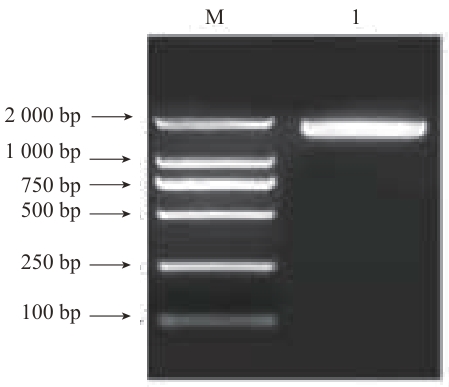
图1 NtPPO1-2基因PCR产物电泳图M:Marker 2000;1:NtPPO1-2基因扩增产物
Fig. 1 Electrophoresis pattern of PCR products of NtPPO1-2 geneM: Marker 2000. 1: Amplified product of NtPPO1-2

图2 烟草与林烟草、野生烟草、绒毛状烟草、枸杞、马铃薯以及辣椒PPO的氨基酸序列比对
Fig. 2 Amino acid sequence alignment of PPO from N. tabacum, N. sylvestris, N. attenuata, N. tomentosiformis, Lycium barbarum, Solanum tuberosum, and Capsicum annuum
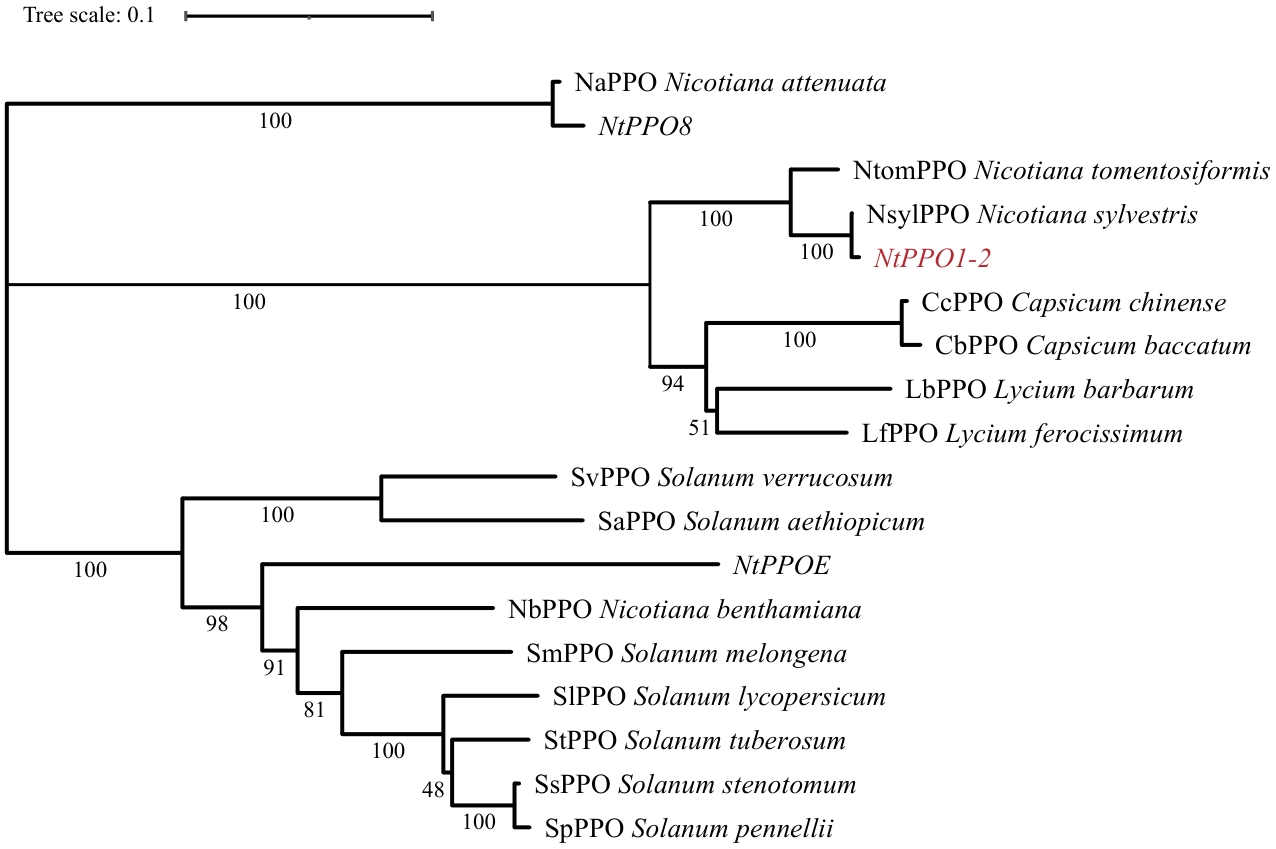
图3 植物PPO同源蛋白系统进化树
Fig. 3 Phylogenetic tree of plant PPO homologous protein
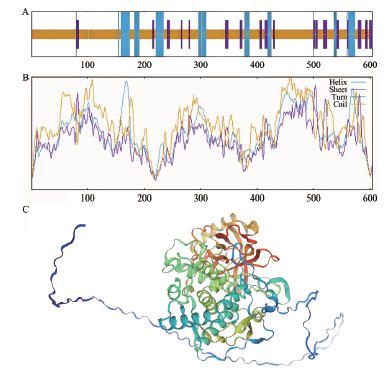
图4 NtPPO1-2蛋白二级(A、B)和三级结构(C)预测
Fig. 4 Prediction of the secondary (A, B) and tertiary structures (C) of NtPPO1-2 protein
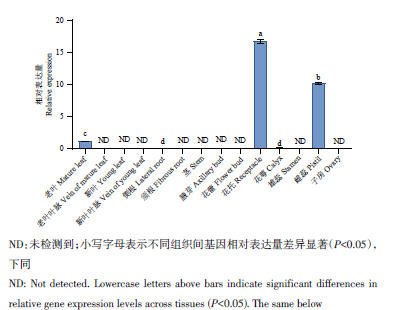
图5 盛花期烟草不同组织中NtPPO1-2基因的表达模式
Fig. 5 Expression patterns of NtPPO1-2 gene in varioustobacco tissues at full-bloom stage
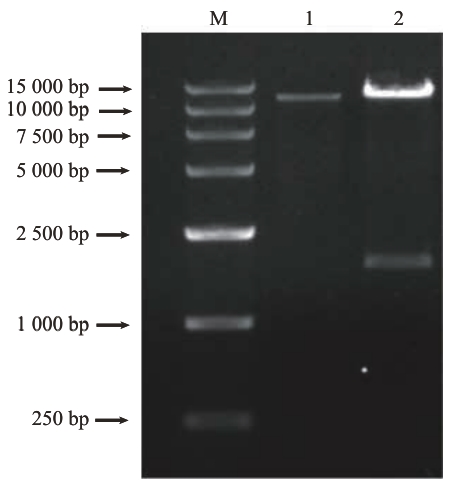
图6 NtPPO1-2基因双酶切验证M:Marker 15000;1:Hind III和Nco I双酶切sup1300空载体;2:Hind III和Nco I双酶切sup1300-NtPPO1-2质粒ND:未检测到;小写字母表示不同组织间基因相对表达量差异显著(P<0.05),下同
Fig. 6 Double digestion analysis of the NtPPO1-2 geneM: Marker 15000. 1: Double enzyme digestion of the sup1300 empty vector with Hind III and Nco I. 2: Hind III and Nco I double digestion of the sup1300-NtPPO1-2 plasmidND: Not detected. Lowercase letters above bars indicate significant differences in relative gene expression levels across tissues (P<0.05). The same below
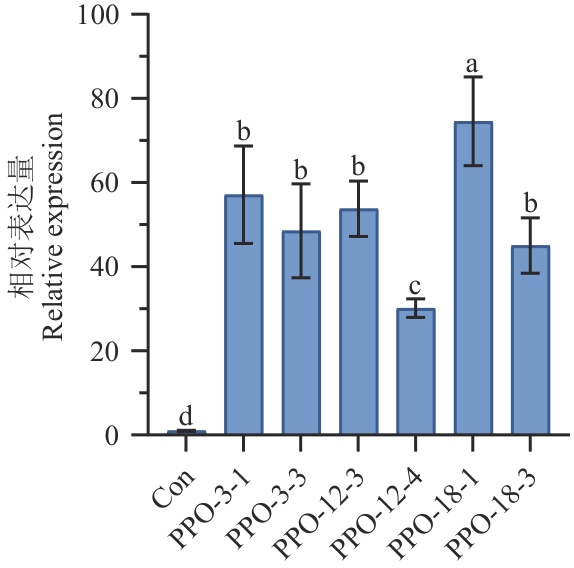
图7 T1代转基因植株NtPPO1-2基因表达分析
Fig. 7 Analysis of gene expression of NtPPO1-2 in T1 transgenic plants
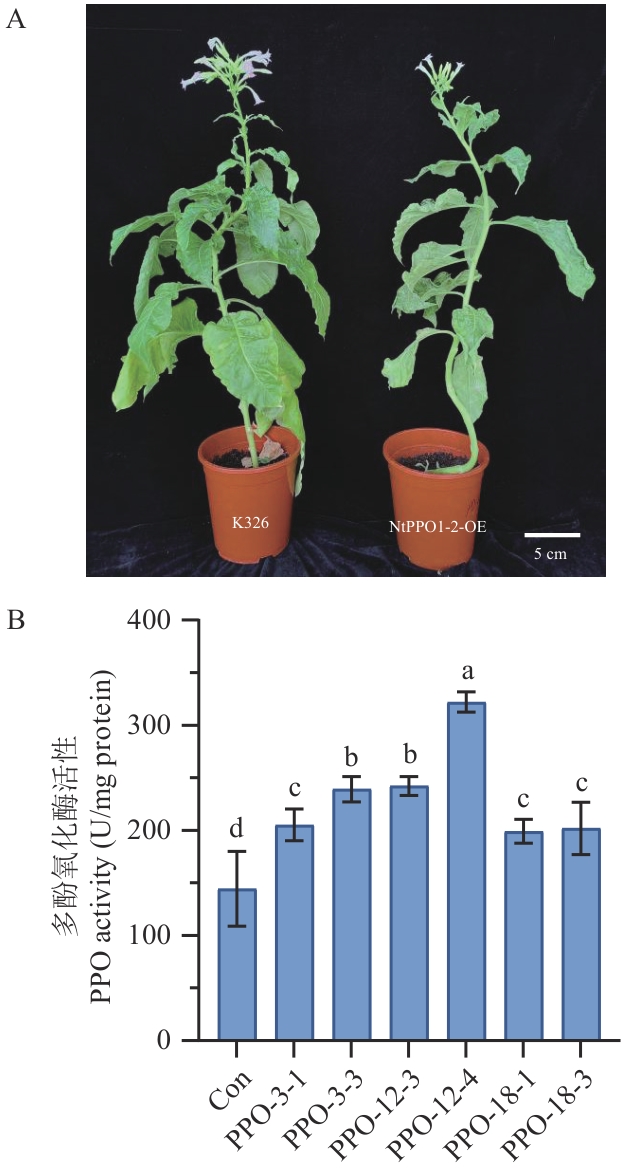
图8 NtPPO1-2基因过表达植株表型变化(A)和酶活分析(B)
Fig. 8 Phenotypic changes (A) and enzyme activity analysis (B) of NtPPO1-2 gene overexpressing plants
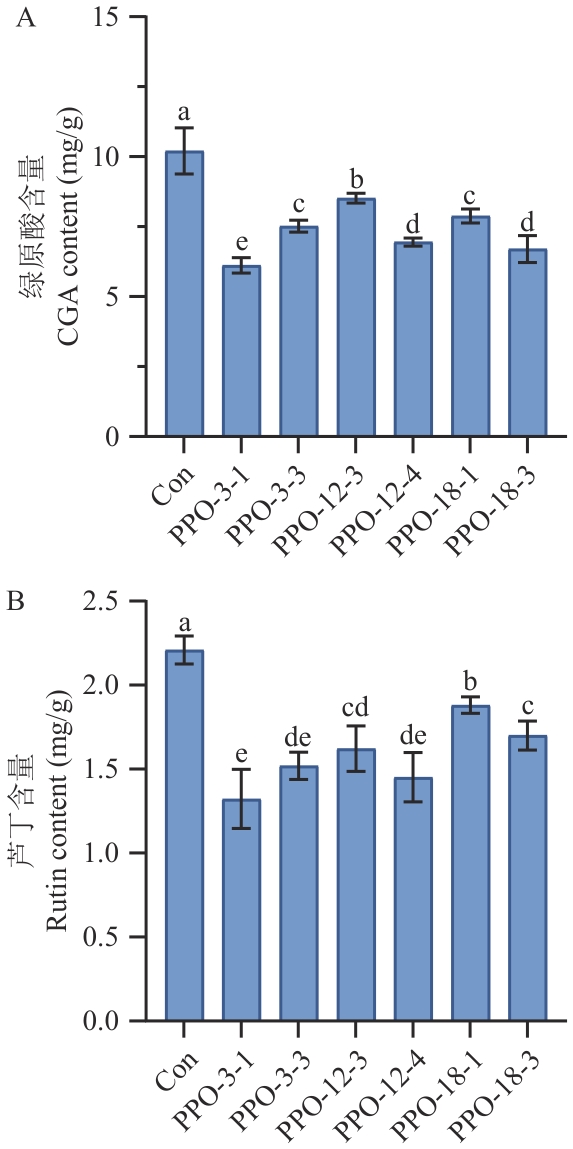
图9 NtPPO1-2基因过表达植株的绿原酸和芦丁含量分析
Fig. 9 Analysis of chlorogenic acid and rutin content of plants with NtPPO1-2 overexpressed
| [1] | 刘银松, 林建枫, 张永毅, 等. 烟草PPO基因家族鉴定与不同成熟度烟叶烘烤过程中PPO活性分析 [J]. 中国烟草学报, 2023, 29(3): 47-56. |
| Liu YS, Lin JF, Zhang YY, et al. Identification of tobacco PPO gene family and analysis of PPO activity during flue curing of tobacco at different maturity stages [J]. Acta Tabacaria Sin, 2023, 29(3): 47-56. | |
| [2] | 段晓娜, 陈宗懋, 任炳忠, 等. 植物多酚氧化酶的诱导 [J]. 吉林师范大学学报: 自然科学版, 2011, 32(2): 90-95. |
| Duan XN, Chen ZM, Ren BZ, et al. Inducement of plant polyphenol oxidase [J]. Jilin Norm Univ J Nat Sci Ed, 2011, 32(2): 90-95. | |
| [3] | 王丽, 王万兴, 索海翠, 等. 植物中多酚氧化酶基因研究进展 [J]. 分子植物育种, 2020, 18(14): 4629-4636. |
| Wang L, Wang WX, Suo HC, et al. Research progress of polyphenol oxidase gene in plants [J]. Mol Plant Breed, 2020, 18(14): 4629-4636. | |
| [4] | 李琼, 王雪云, 宋卫武, 等. 普通烟草PPO基因家族的鉴定与表达分析 [J]. 烟草科技, 2018, 51(8): 9-13. |
| Li Q, Wang XY, Song WW, et al. Identification and expression analysis of PPO gene family in Nicotiana tabacum [J]. Tob Sci & Technol, 2018, 51(8): 9-13. | |
| [5] | Bhonwong A, Stout MJ, Attajarusit J, et al. Defensive role of tomato polyphenol oxidases against cotton bollworm (Helicoverpa armigera) and beet armyworm (Spodoptera exigua) [J]. J Chem Ecol, 2009, 35(1): 28-38. |
| [6] | Koussevitzky S, Ne'eman E, Peleg S, et al. Polyphenol oxidase can cross thylakoids by both the Tat and the Sec-dependent pathways: a putative role for two stromal processing sites [J]. Physiol Plant, 2008, 133(2): 266-277. |
| [7] | Nakayama T, Sato T, Fukui Y, et al. Specificity analysis and mechanism of aurone synthesis catalyzed by aureusidin synthase, a polyphenol oxidase homolog responsible for flower coloration [J]. FEBS Lett, 2001, 499(1/2): 107-111. |
| [8] | Tran LT, Constabel CP. The polyphenol oxidase gene family in poplar: phylogeny, differential expression and identification of a novel, vacuolar isoform [J]. Planta, 2011, 234(4): 799-813. |
| [9] | Zhang S. Recent advances of polyphenol oxidases in plants [J]. Molecules, 2023, 28(5): 2158. |
| [10] | Boeckx T, Winters AL, Webb KJ, et al. Polyphenol oxidase in leaves: is there any significance to the chloroplastic localization? [J]. J Exp Bot, 2015, 66(12): 3571-3579. |
| [11] | Maioli A, Gianoglio S, Moglia A, et al. Simultaneous CRISPR/Cas9 editing of three PPO genes reduces fruit flesh browning in Solanum melongena L [J]. Front Plant Sci, 2020, 11: 607161. |
| [12] | 李玉娥, 尹启生, 宋纪真, 等. 烟草酶促棕色化反应及调控技术研究进展 [J]. 中国烟草科学, 2008, 29(6): 71-77. |
| LI YE, Yin QS, Song JZ, et al. Research advances in tobacco enzymatic browning reaction and its control techniques [J]. Chin Tob Sci, 2008, 29(6): 71-77. | |
| [13] | 杨树勋. 烟草酶促棕色化反应机理及其调控研究进展 [J]. 作物研究, 2019, 33(3): 246-250. |
| Yang SX. Study on mechanism and regulation technology of enzymatic browning of tobacco [J]. Crop Res, 2019, 33(3): 246-250. | |
| [14] | 王传义, 吕国新, 朱启法, 等. 烤烟烘烤特性与烟草多酚氧化酶活性相关性研究 [J]. 湖北农业科学, 2016, 55(6): 1495-1499, 1503. |
| Wang CY, Lyu GX, Zhu QF, et al. Study on the correlation between the leaf flue-curing characteristics and polyphenol oxidase activity of different flue-cured tobacco [J]. Hubei Agric Sci, 2016, 55(6): 1495-1499, 1503. | |
| [15] | Ortega-García F, Blanco S, Peinado MA, et al. Polyphenol oxidase and its relationship with oleuropein concentration in fruits and leaves of olive (Olea europaea) cv. ‘Picual’ trees during fruit ripening [J]. Tree Physiol, 2008, 28(1): 45-54. |
| [16] | Xiao K, Liu XH, Zhang AD, et al. Genome-wide identification of polyphenol oxidase (PPO) family members in eggplant (Solanum melongena L.) and their expression in response to low temperature [J]. Hortic Environ Biotechnol, 2022, 63(5): 747-758. |
| [17] | Sánchez R, Arroyo L, Luaces P, et al. Olive polyphenol oxidase gene family [J]. Int J Mol Sci, 2023, 24(4): 3233. |
| [18] | Qin F, Hu CH, Dou TX, et al. Genome-wide analysis of the polyphenol oxidase gene family reveals that MaPPO1 and MaPPO6 are the main contributors to fruit browning in Musa acuminate [J]. Front Plant Sci, 2023, 14: 1125375. |
| [19] | He F, Shi YJ, Zhao Q, et al. Genome-wide investigation and expression profiling of polyphenol oxidase (PPO) family genes uncover likely functions in organ development and stress responses in Populus trichocarpa [J]. BMC Genomics, 2021, 22(1): 731. |
| [20] | Chi M, Bhagwat B, Lane WD, et al. Reduced polyphenol oxidase gene expression and enzymatic browning in potato (Solanum tuberosum L.) with artificial microRNAs [J]. BMC Plant Biol, 2014, 14: 62. |
| [21] | 王俊, 马玉心, 贾文庆, 等. 九个牡丹品种总酚含量及其多酚氧化酶活性的变化 [J]. 北方园艺, 2010(6): 118-120. |
| Wang J, Ma YX, Jia WQ, et al. Changes of the total phenol content and the activation of polyphenol oxidase of nine tree peony culvitars [J]. North Hortic, 2010(6): 118-120. | |
| [22] | Livak KJ, Schmittgen TD. Analysis of relative gene expression data using real-time quantitative PCR and the 2-ΔΔCT method [J]. Methods, 2001, 25(4): 402-408. |
| [23] | 张军, 邱爽, 何佳琦, 等. 大豆GmGolS基因植物表达载体构建及烟草遗传转化 [J]. 齐齐哈尔大学学报: 自然科学版, 2020, 36(6): 22-25. |
| Zhang J, Qiu S, He JQ, et al. Plant expression vector construction and tobacco genetic transformation of soybean GmGolS gene [J]. J Qiqihar Univ Nat Sci Ed, 2020, 36(6): 22-25. | |
| [24] | 陈钰栋, 李冰雨, 许力, 等. 烟草NtPYL6表达模式及其调控芸香苷的合成功能分析 [J]. 烟草科技, 2025, 58(2): 29-40. |
| Chen YD, Li BY, Xu L, et al. Expression pattern of NtPYL6 and its role in regulating rutin synthesis in tobacco [J]. Tob Sci Technol, 2025, 58(2): 29-40. | |
| [25] | 杨琴, 罗倩, 孙光军, 等. NtMYB4a基因对烟草多酚类物质合成的影响 [J]. 分子植物育种, 2021, 19(8): 2588-2595. |
| Yang Q, Luo Q, Sun GJ, et al. Effect of NtMYB4a gene on synthesis of tobacco polyphenols [J]. Mol Plant Breed, 2021, 19(8): 2588-2595. | |
| [26] | 姜慧娟, 赵铭钦, 任伟, 等. 浓香型烤烟中性致香成分及多酚含量与香气质量的关系研究 [J]. 中国烟草学报, 2014, 20(5): 25-30. |
| Jiang HJ, Zhao MQ, Ren W, et al. Relationships between neutral aroma constituents, polyphenol contents and aroma quality of flue-cured tobacco of strong flavor type [J]. Acta Tabacaria Sin, 2014, 20(5): 25-30. | |
| [27] | 周培禄. 低温诱导苗期烟草叶片酚类物质合成的分子机制研究 [D]. 北京: 中国农业科学院, 2019. |
| Zhou PL. Molecular mechanism of low temperature induced synthesis of polyphenols in tobacco leaves at seedling stage [D]. Beijing: Chinese Academy of Agricultural Sciences, 2019. | |
| [28] | Thygesen PW, Dry IB, Robinson SP. Polyphenol oxidase in potato (a multigene family that exhibits differential expression patterns) [J]. Plant Physiol, 1995, 109(2): 525-531. |
| [29] | Wei XM, Tao KL, Liu ZM, et al. The PPO family in Nicotiana tabacum is an important regulator to participate in pollination [J]. BMC Plant Biol, 2024, 24(1): 102. |
| [30] | 段杜薇, 田培, 李芳芳, 等. 多酚氧化酶基因NtPPOE差异表达的效应分析 [J]. 分子植物育种, 2021, 19(3): 724-729. |
| Duan DW, Tian P, Li FF, et al. Effect of differential expression of polyphenol oxidase gene NtPPOE [J]. Mol Plant Breed, 2021, 19(3): 724-729. | |
| [31] | Li L, Steffens JC. Overexpression of polyphenol oxidase in transgenic tomato plants results in enhanced bacterial disease resistance [J]. Planta, 2002, 215(2): 239-247. |
| [32] | Esmaeili N, Ebrahimzadeh H, Abdi K. Correlation between polyphenol oxidase (PPO) activity and total phenolic contents in Crocus sativus L. corms during dormancy and sprouting stages [J]. Pharmacogn Mag, 2017, 13(): 519. |
| [33] | Ayaz FA, Demir O, Torun H, et al. Characterization of polyphenoloxidase (PPO) and total phenolic contents in medlar (Mespilus germanica L.) fruit during ripening and over ripening [J]. Food Chem, 2008, 106(1): 291-298. |
| [34] | Orak HH. Total antioxidant activities, phenolics, anthocyanins, polyphenoloxidase activities of selected red grape cultivars and their correlations [J]. Sci Hortic, 2007, 111(3): 235-241. |
| [1] | 刘青媛, 吴洪启, 陈秀娥, 陈剑, 姜远泽, 何燕子, 喻奇伟, 刘仁祥. 转录因子NtMYB96a调控烟草耐旱性的功能研究[J]. 生物技术通报, 2026, 42(4): 239-250. |
| [2] | 王亚乐, 李雪君, 孙计平, 孙焕. 烟草豫浓香201对低温胁迫的生理响应及转录组分析[J]. 生物技术通报, 2026, 42(2): 228-238. |
| [3] | 张驰昊, 刘晋囡, 董家乐, 晁跃辉. 紫花苜蓿酵母表达文库的构建及候选耐盐基因的筛选与鉴定[J]. 生物技术通报, 2026, 42(2): 239-249. |
| [4] | 倪莹, 李雷, 汪进萱, 马波, 孟昕, 冷平生, 吴静, 胡增辉. 紫丁香So4CL的克隆及功能分析[J]. 生物技术通报, 2026, 42(1): 139-149. |
| [5] | 张驰昊, 刘晋囡, 晁跃辉. 蒺藜苜蓿bZIP转录因子MtbZIP29的克隆及功能分析[J]. 生物技术通报, 2026, 42(1): 241-250. |
| [6] | 徐小萍, 杨成龙, 和兴, 郭文杰, 吴健, 方少忠. 百合LoAPS1克隆及其在休眠解除过程的功能分析[J]. 生物技术通报, 2025, 41(9): 195-206. |
| [7] | 董向向, 缪百灵, 许贺娟, 陈娟娟, 李亮杰, 龚守富, 朱庆松. 森林草莓FveBBX20基因的生物信息学分析及开花调控功能[J]. 生物技术通报, 2025, 41(9): 115-123. |
| [8] | 张永艳, 郭思健, 李晶, 郝思怡, 李瑞得, 刘嘉鹏, 程春振. 蓝莓花青素相关VcGSTF19基因的克隆及功能研究[J]. 生物技术通报, 2025, 41(9): 139-146. |
| [9] | 康琴, 汪霞, 谌明洋, 徐静天, 陈诗兰, 廖平杨, 许文志, 吴卫, 徐东北. 薄荷UV-B受体基因McUVR8的克隆与表达分析[J]. 生物技术通报, 2025, 41(8): 255-266. |
| [10] | 李开杰, 吴瑶, 李丹丹. 红花CtbHLH128基因克隆及调控干旱胁迫应答功能研究[J]. 生物技术通报, 2025, 41(8): 234-241. |
| [11] | 翟莹, 计俊杰, 陈炯辛, 于海伟, 李珊珊, 赵艳, 马天意. 异源过表达大豆GmNF-YB24提高转基因烟草抗旱性[J]. 生物技术通报, 2025, 41(8): 137-145. |
| [12] | 魏雨佳, 李岩, 康语涵, 弓晓楠, 杜敏, 涂岚, 石鹏, 于子涵, 孙彦, 张昆. 白颖苔草CrMYB4基因的克隆和表达分析[J]. 生物技术通报, 2025, 41(7): 248-260. |
| [13] | 董栩焜, 车永梅, 王明硕, 罗政刚, 管恩森, 赵方贵, 叶青, 刘新. 纳米硅和蜡样芽胞杆菌SS1共处理对烟草生长的影响[J]. 生物技术通报, 2025, 41(7): 292-298. |
| [14] | 黄旭升, 周雅莉, 柴旭东, 闻婧, 王计平, 贾小云, 李润植. 紫苏质体型PfLPAT1B基因的克隆及其在油脂合成中的功能分析[J]. 生物技术通报, 2025, 41(7): 226-236. |
| [15] | 裴景琪, 赵梦然, 黄晨阳, 邬向丽. 一个影响糙皮侧耳生长发育的功能基因的发现与验证[J]. 生物技术通报, 2025, 41(6): 327-334. |
| 阅读次数 | ||||||
|
全文 |
|
|||||
|
摘要 |
|
|||||
