







生物技术通报 ›› 2026, Vol. 42 ›› Issue (5): 113-123.doi: 10.13560/j.cnki.biotech.bull.1985.2025-1252
• 微生物组学专题 • 上一篇
胡逸超1( ), 秦天2, 孙建生1, 苏赞1, 周奕1, 刘金仓1, 刘政钦3, 张同琢4, 关铭鑫4, 马婷婷5, 黎娟2()
收稿日期:2025-11-19
出版日期:2026-05-26
发布日期:2026-06-10
通讯作者:
黎娟,女,博士,教授,研究方向 :烟叶质量与微生物生态;E-mail: adalee619@163.com作者简介:胡逸超,女,硕士,农艺师,研究方向 :烟叶发酵技术;E-mail: erica8801@163.com
基金资助:
HU Yi-chao1(), QIN Tian2, SUN Jian-sheng1, SU Zan1, ZHOU Yi1, LIU Jin-cang1, LIU Zheng-qin3, ZHANG Tong-zhuo4, GUAN Ming-xin4, MA Ting-ting5, LI Juan2()
Received:2025-11-19
Published:2026-05-26
Online:2026-06-10
摘要:
目的 探究采用烟叶源液体培养基进行靶向富集,对功能菌株发酵液代谢特性及烤烟提质效果的影响。 方法 从醇化烟叶中筛选得到两株功能菌株,经生理生化与16S rDNA鉴定为砖红微杆菌M2和枯草芽胞杆菌M24。分别在LB液体培养基和烟叶液体培养基中对菌株进行富集,利用非靶向代谢组学分析发酵液代谢物差异,并系统评估了经发酵液喷施处理后烟叶的化学成分、大分子物质含量及感官品质变化。 结果 菌株M2与M24均能产淀粉酶、蛋白酶和纤维素酶,且M2能产半纤维素酶。非靶向代谢组学分析表明,不同培养基富集后的发酵液代谢物组成差异显著,烟叶培养基组中绿原酸、右旋奎宁酸等多酚类物质含量显著高于LB培养基组。喷施处理后,烟叶培养基富集所得的发酵液(T2、T4)对烟叶提质效果更优,与LB培养基组相比,其处理的烟叶纤维素含量降幅达5.32%-14.63%,总糖与还原糖含量显著提升,糖碱比提高,总氮与氮碱比降低,感官评吸中杂气与刺激性明显减轻,香气质、香气量与甜度提升显著。 结论 烟叶培养基通过优化功能菌株的代谢特性,促使发酵液富集更多有益于烟叶品质的多酚类物质,从而更有效实现烤烟的增香降杂。本研究为微生物发酵技术在烟草加工中定向应用提供了新的理论依据。
胡逸超, 秦天, 孙建生, 苏赞, 周奕, 刘金仓, 刘政钦, 张同琢, 关铭鑫, 马婷婷, 黎娟. 富集功能菌株的烟叶培养基筛选及其对烤烟提质的影响[J]. 生物技术通报, 2026, 42(5): 113-123.
HU Yi-chao, QIN Tian, SUN Jian-sheng, SU Zan, ZHOU Yi, LIU Jin-cang, LIU Zheng-qin, ZHANG Tong-zhuo, GUAN Ming-xin, MA Ting-ting, LI Juan. Screening of Tobacco Leaf Medium for Enriching Functional Microorganisms and Its Effect on Improving Flue-cured Tobacco Quality[J]. Biotechnology Bulletin, 2026, 42(5): 113-123.
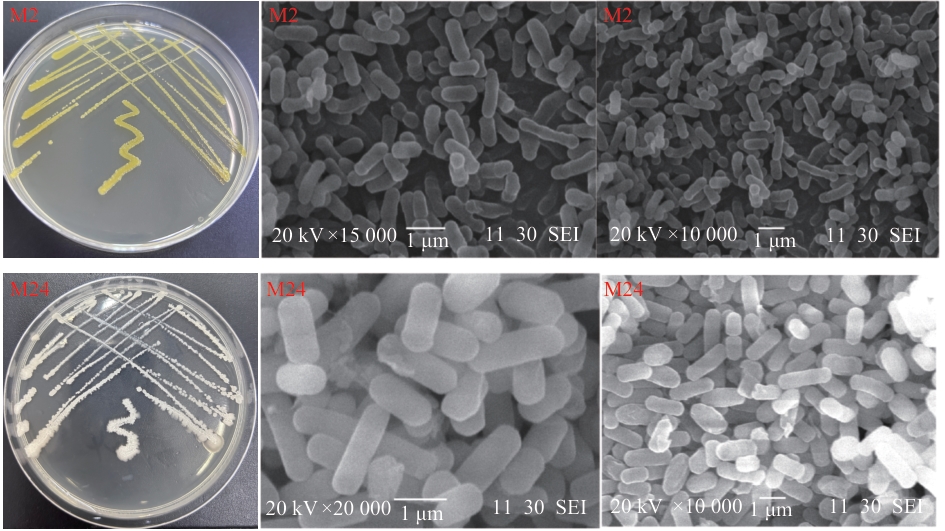
图1 M2及M24菌株菌落形态及电镜扫描图
Fig. 1 Morphology and electron microscope scans of M2 and M24 strains
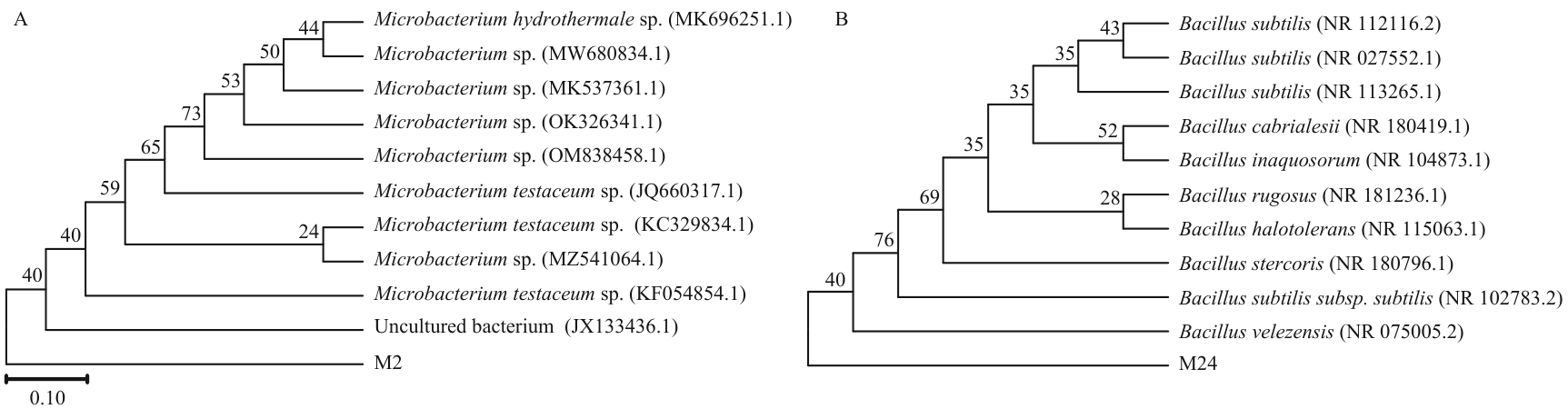
图2 M2及M24菌株分子生物学鉴定系统发育树A:M2菌株;B:M24菌株;括号中数值为GeneBank登录号,分支处数字为自展值,标尺为核苷酸替换率
Fig. 2 Phylogenetic tree depicting the molecular identification of strains M2 and M24A:M2 strain;B:M24 strain. The values in parentheses are GenBank accession numbers. Numbers at the nodes are bootstrap values, and the scale bar indicates the nucleotide substitution rate
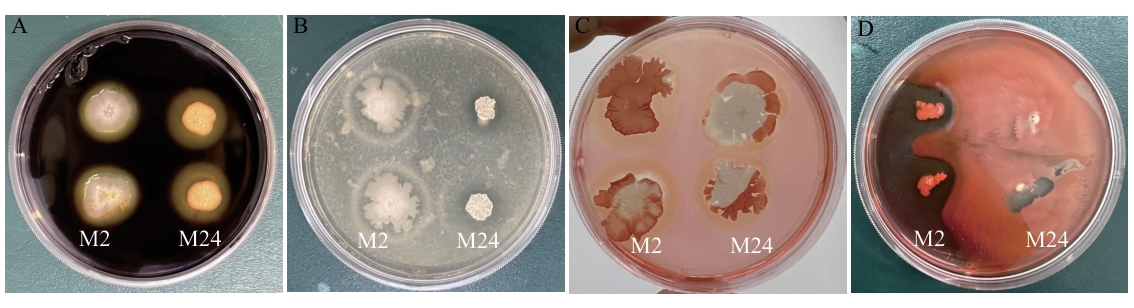
图3 M2及M24菌株产酶能力A:淀粉酶;B:蛋白酶;C:纤维素酶;D:半纤维素酶
Fig. 3 Enzyme production capacity of strain M2 and M24A: Amylase. B: Protease. C: Cellulase. D: Hemicellulase
编号 ID | 葡萄糖发酵试验 Glucose fermentation test | 甲基红试验 Methyl red | 伏普试验 Voges-Proskauer | 吲哚 试验Indole | 硫化氢试验Hydrogen sulfide | 明胶液化试验 Gelatin liquefaction | 柠檬酸盐利用试验 Citrate utilization |
|---|---|---|---|---|---|---|---|
| M2 | - | - | + | - | + | + | + |
| M24 | - | + | - | - | - | - | + |
表1 M2及M24菌株生理生化功能鉴定
Table 1 Physiological and biochemical characterization of M2 and M24 strains
编号 ID | 葡萄糖发酵试验 Glucose fermentation test | 甲基红试验 Methyl red | 伏普试验 Voges-Proskauer | 吲哚 试验Indole | 硫化氢试验Hydrogen sulfide | 明胶液化试验 Gelatin liquefaction | 柠檬酸盐利用试验 Citrate utilization |
|---|---|---|---|---|---|---|---|
| M2 | - | - | + | - | + | + | + |
| M24 | - | + | - | - | - | - | + |
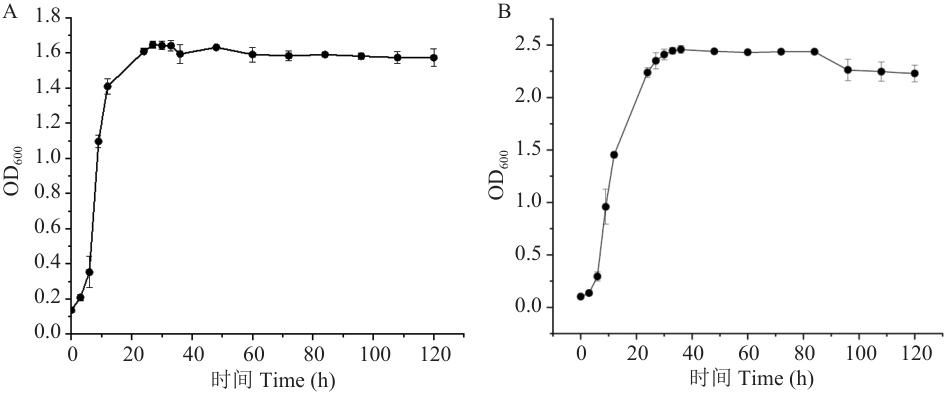
图4 菌株生长曲线A:菌株M2生长曲线;B:菌株M24生长曲线
Fig. 4 Growth curves of the strainsA: Growth curve of strain M2. B: Growth curve of strain M24
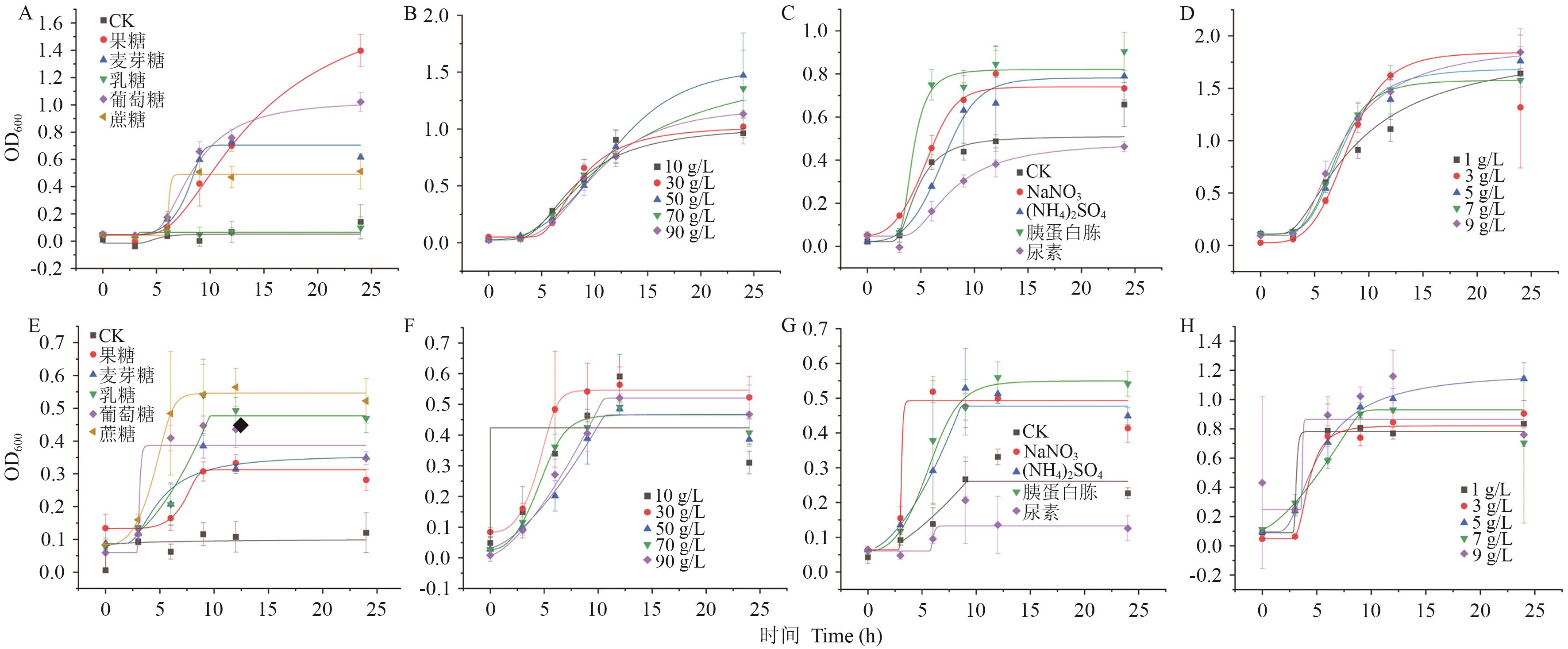
图5 菌株最适生长条件A-D:分别为M2菌株的最适碳源种类、最适碳源浓度、最适氮源种类、最适氮源浓度。E-H:分别为M24菌株的最适碳源种类、最适碳源浓度、最适氮源种类、最适氮源浓度
Fig. 5 Optimal growth conditions for strains M2 and M24A-D: The optimal carbon source type, optimal carbon source concentration, optimal nitrogen source type, and optimal nitrogen source concentration for strain M2, respectively. E-H: Represent the optimal carbon source type, optimal carbon source concentration, optimal nitrogen source type, and optimal nitrogen source concentration for strain M24, respectively
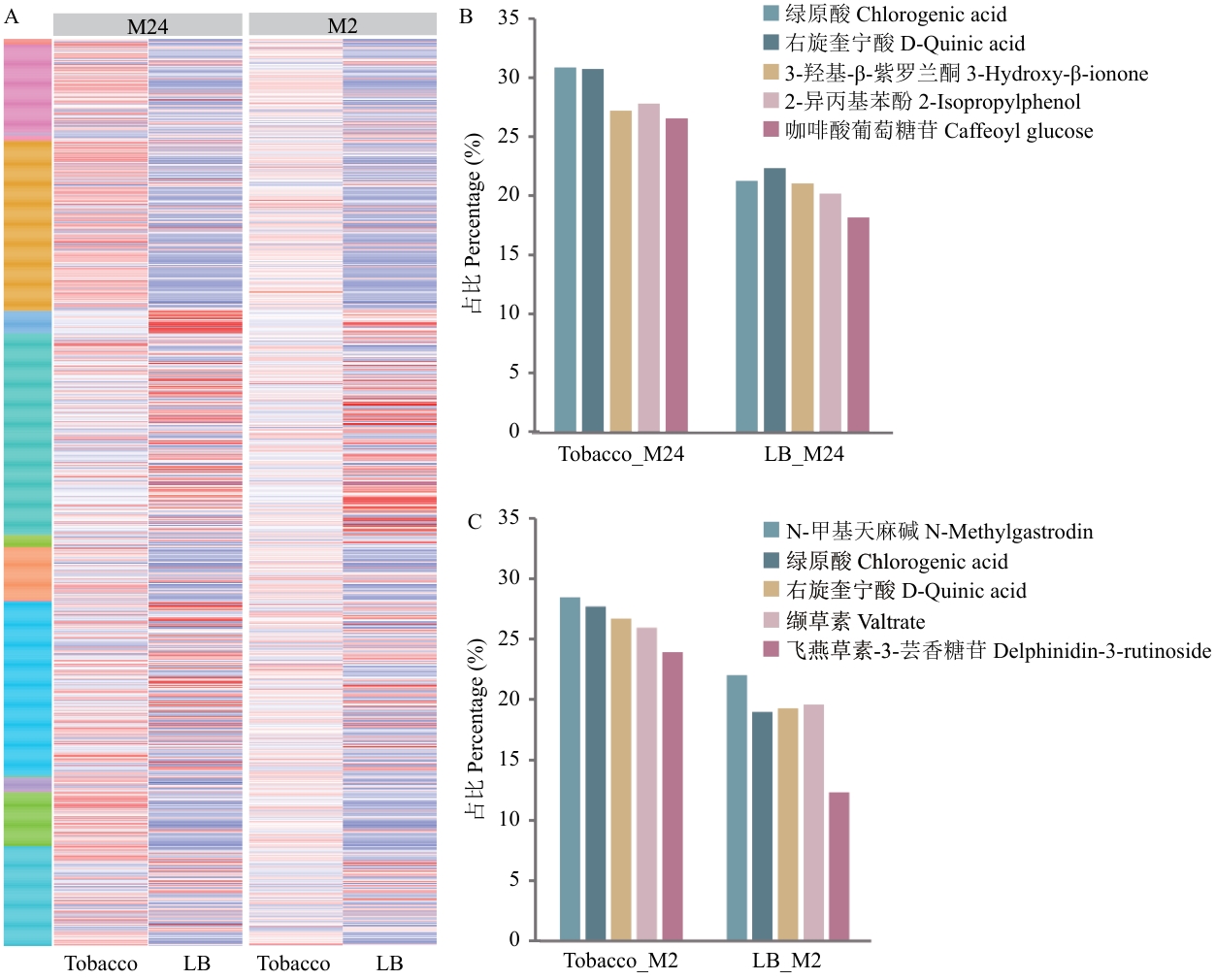
图6 不同培养基富集菌株发酵液代谢物组成A:不同培养基富集菌株发酵液代谢物聚类热图;B:M24菌株发酵液主要多酚类化合物含量;C:M2菌株发酵液主要多酚类化合物含量,占比经log2处理。Tobacco:烟叶培养基;LB:LB培养基
Fig. 6 Metabolite composition of fermentation broth from enriched strains on different mediaA: Cluster heatmap of metabolites in fermentation broth of enriched strains on different media. B: Contents of major polyphenolic compounds in fermentation broth of M24 strain. C: Contents of major polyphenolic compounds in fermentation broth of M2 strain, with proportions log2-transformed. Tobacco: Tobacco leaf culture medium; LB: LB culture medium
| 处理Treatment | 总氮 Nitrogen (%) | 全钾 Potassium (%) | 氯离子 Chloride ion (%) | 总糖 Total sugar (%) | 还原糖 Reduced sugar (%) | 烟碱Nicotine (%) | 糖碱比 Sugar-nicotine ratio | 氮碱比Nitrogen-nicotine ratio | 钾氯比Potassium-chloride ratio |
|---|---|---|---|---|---|---|---|---|---|
| CK | 1.96±0.03a | 2.94±0.07a | 0.42±0.07a | 32.60±1.59ab | 22.37±0.79c | 2.74±0.02a | 11.88±0.55b | 0.71±0.01bc | 6.99±0.42a |
| T1 | 1.97±0.11a | 2.96±0.12a | 0.42±0.12a | 30.61±0.97b | 23.65±1.25ab | 2.62±0.07a | 11.69±0.23b | 0.75±0.01a | 7.32±1.73a |
| T2 | 1.88±0.08cd | 2.91±0.15a | 0.39±0.15a | 34.13±0.47a | 24.66±1.04a | 2.62±0.16a | 13.04±0.43a | 0.72±0.02bc | 7.50±1.07a |
| T3 | 1.92±0.05bc | 3.03±0.26a | 0.35±0.26a | 31.75±1.00ab | 23.23±0.67ab | 2.62±0.04a | 12.11±0.32b | 0.73±0.03ab | 8.86±2.00a |
| T4 | 1.87±0.08d | 3.03±0.09a | 0.43±0.09a | 32.44±2.04ab | 25.19±0.86a | 2.69±0.12a | 12.04±0.57b | 0.69±0.02c | 7.13±1.47a |
表2 菌株发酵液处理烟叶后烟叶化学成分含量
Table 2 Chemical composition of tobacco leaves after bacterial treatment with fermentation broth
| 处理Treatment | 总氮 Nitrogen (%) | 全钾 Potassium (%) | 氯离子 Chloride ion (%) | 总糖 Total sugar (%) | 还原糖 Reduced sugar (%) | 烟碱Nicotine (%) | 糖碱比 Sugar-nicotine ratio | 氮碱比Nitrogen-nicotine ratio | 钾氯比Potassium-chloride ratio |
|---|---|---|---|---|---|---|---|---|---|
| CK | 1.96±0.03a | 2.94±0.07a | 0.42±0.07a | 32.60±1.59ab | 22.37±0.79c | 2.74±0.02a | 11.88±0.55b | 0.71±0.01bc | 6.99±0.42a |
| T1 | 1.97±0.11a | 2.96±0.12a | 0.42±0.12a | 30.61±0.97b | 23.65±1.25ab | 2.62±0.07a | 11.69±0.23b | 0.75±0.01a | 7.32±1.73a |
| T2 | 1.88±0.08cd | 2.91±0.15a | 0.39±0.15a | 34.13±0.47a | 24.66±1.04a | 2.62±0.16a | 13.04±0.43a | 0.72±0.02bc | 7.50±1.07a |
| T3 | 1.92±0.05bc | 3.03±0.26a | 0.35±0.26a | 31.75±1.00ab | 23.23±0.67ab | 2.62±0.04a | 12.11±0.32b | 0.73±0.03ab | 8.86±2.00a |
| T4 | 1.87±0.08d | 3.03±0.09a | 0.43±0.09a | 32.44±2.04ab | 25.19±0.86a | 2.69±0.12a | 12.04±0.57b | 0.69±0.02c | 7.13±1.47a |
| 处理Treatment | 蛋白质Protein (%) | 淀粉Starch (%) | 纤维素Cellulose (%) |
|---|---|---|---|
| CK | 12.22±0.20a | 6.47±0.21a | 13.30±0.98a |
| T1 | 11.97±0.30ab | 6.20±0.54ab | 13.17±1.70a |
| T2 | 11.77±0.19b | 5.75±0.09b | 12.47±1.27bc |
| T3 | 11.86±0.24ab | 6.45±0.41a | 13.47±1.86a |
| T4 | 11.73±0.10b | 5.99±0.18ab | 11.50±0.75c |
表3 菌株发酵液处理烟叶后烟叶大分子物质含量
Table 3 Contents of macromolecular substances in tobacco leaves after bacterial treatment with fermentation broth
| 处理Treatment | 蛋白质Protein (%) | 淀粉Starch (%) | 纤维素Cellulose (%) |
|---|---|---|---|
| CK | 12.22±0.20a | 6.47±0.21a | 13.30±0.98a |
| T1 | 11.97±0.30ab | 6.20±0.54ab | 13.17±1.70a |
| T2 | 11.77±0.19b | 5.75±0.09b | 12.47±1.27bc |
| T3 | 11.86±0.24ab | 6.45±0.41a | 13.47±1.86a |
| T4 | 11.73±0.10b | 5.99±0.18ab | 11.50±0.75c |
处理 Treatment | 评吸单项得分 Score of single evaluation (0-9.0) | 综合得分Total score | |||||||
|---|---|---|---|---|---|---|---|---|---|
| 香气质Aroma quality | 香气量Aroma quantity | 刺激性Irritation | 杂气Offensive flavor | 余味 Aftertaste | 甜度Sweetness | 燃烧性Burning property | 灰色 Ash color | ||
| CK | 7 | 6.3 | 6.5 | 6.5 | 6 | 6.3 | 3 | 4 | 45.6 |
| T1 | 7.3 | 6.5 | 6.5 | 6.3 | 6 | 6.3 | 3 | 4 | 45.9 |
| T2 | 7.5 | 6.8 | 6.8 | 7 | 6.5 | 7 | 3 | 4 | 48.6 |
| T3 | 7 | 6.5 | 6.3 | 6.3 | 6.4 | 6.5 | 3 | 4 | 46.0 |
| T4 | 7.5 | 6.7 | 7 | 6.8 | 6.5 | 6.8 | 3 | 4 | 48.3 |
表4 发酵液喷施处理后烟叶感官品质得分
Table 4 Sensory quality scores of tobacco leaves after treatment with fermentation broth spray
处理 Treatment | 评吸单项得分 Score of single evaluation (0-9.0) | 综合得分Total score | |||||||
|---|---|---|---|---|---|---|---|---|---|
| 香气质Aroma quality | 香气量Aroma quantity | 刺激性Irritation | 杂气Offensive flavor | 余味 Aftertaste | 甜度Sweetness | 燃烧性Burning property | 灰色 Ash color | ||
| CK | 7 | 6.3 | 6.5 | 6.5 | 6 | 6.3 | 3 | 4 | 45.6 |
| T1 | 7.3 | 6.5 | 6.5 | 6.3 | 6 | 6.3 | 3 | 4 | 45.9 |
| T2 | 7.5 | 6.8 | 6.8 | 7 | 6.5 | 7 | 3 | 4 | 48.6 |
| T3 | 7 | 6.5 | 6.3 | 6.3 | 6.4 | 6.5 | 3 | 4 | 46.0 |
| T4 | 7.5 | 6.7 | 7 | 6.8 | 6.5 | 6.8 | 3 | 4 | 48.3 |
| [1] | 李正风, 夏玉珍, 王萝萍, 等. 云南不同产区醇化烟叶感官品质及物质组成的相似性 [J]. 云南农业大学学报, 2025, 40(4): 75-85. |
| Li ZF, Xia YZ, Wang LP, et al. Similarity of sensory quality and material composition of aged tobacco leaves from different producing areas in Yunnan [J]. J Yunnan Agric Univ Sci, 2025, 40(4): 75-85. | |
| [2] | 周乐, 周桂园, 胡巍耀, 等. 利用酶与微生物降低梗膏中果胶和蛋白质的研究 [J]. 中国烟草学报, 2025, 31(1): 123-134. |
| Zhou L, Zhou GY, Hu WY, et al. Study on the reduction of pectin and protein in stem paste using enzymes and microorganisms [J]. Acta Tabacaria Sin, 2025, 31(1): 123-134. | |
| [3] | 张鹏, 李炜, 师超, 等. 一株产果香型真菌的筛选、鉴定及在烟草增香中的应用 [J]. 中国烟草科学, 2021, 42(5): 95-101. |
| Zhang P, Li W, Shi C, et al. Screening and identification of a fungus with a sweet fruit aroma and its application in flavoured tobacco [J]. Chin Tob Sci, 2021, 42(5): 95-101. | |
| [4] | 韩晗, 赵思宸, 仵洁, 等. 用于发酵废次烟叶的酵母菌筛选及增香效果研究 [J]. 中国烟草科学, 2024, 45(6): 91-98. |
| Han H, Zhao SC, Wu J, et al. Isolation and identification of aroma-producing yeasts and effects on aroma increase of low grade tobacco leaves [J]. Chin Tob Sci, 2024, 45(6): 91-98. | |
| [5] | 王金棒, 邱纪青, 汪志波, 等. 生物技术在烟草发酵领域的专利布局现状及热点分析 [J]. 烟草科技, 2021, 54(10): 96-112. |
| Wang JB, Qiu JQ, Wang ZB, et al. Current status and hot spot analysis on patent portfolio of biotechnology in tobacco fermentation [J]. Tob Sci Technol, 2021, 54(10): 96-112. | |
| [6] | 李志豪, 张鸽, 貊志杰, 等. 一株产木聚糖酶的蜡样芽胞杆菌对雪茄烟叶成分及发酵产物的影响 [J]. 生物技术通报, 2022, 38(2): 105-112. |
| Li ZH, Zhang G, Mo ZJ, et al. Effects of a xylanase-producing Bacillus cereus on the composition and fermented products of cigar leaves [J]. Biotechnol Bull, 2022, 38(2): 105-112. | |
| [7] | 汪长国, 李宁, 戴亚, 等. 一种雪茄烟叶发酵用可湿性粉剂: CN103082402B [P]. 2013-05-08. |
| Wang CG, Li N, Dai Y, et al. A wettable powder for cigar tobacco leaf fermentation: CN103082402B [P]. 2013-05-08. | |
| [8] | 万仁鹏. 植物腐生、病原及内生真菌中CAZymes的比较基因组学分析[D]. 南昌:江西师范大学,2020. |
| Wan RP. Comparative genomics analysis of CAZymes in plant saprophytic, pathogenic and endophytic fungi [D]. Nanchang : Jiangxi Normal University, 2020. | |
| [9] | 朱宇, 郑琳, 刘煜宇, 等. 西瓜内生菌的挥发性成分分析及其发酵香料在卷烟中的应用 [J]. 光谱实验室, 2011, 28(4): 2093-2097. |
| Zhu Y, Zheng L, Liu YY, et al. Analysis of volatile components from watermelon endophyte and its application in fermentative cigarette spice [J]. Chinese J Spectrosc Lab, 2011, 28(4): 2093-2097. | |
| [10] | 全铭沁, 董惠忠, 沙云菲, 等. 黑曲霉发酵液改善上部烟叶风味品质的研究 [J]. 中国酿造, 2019, 38(3): 170-176. |
| Quan MQ, Dong HZ, Sha YF, et al. Flavor improvement of upper tobacco leaves by fermentation broth of Aspergillus niger [J]. China Brew, 2019, 38(3): 170-176. | |
| [11] | 邱燕玲, 周瑢, 朱鑫权, 等. 利用新型含烟叶培养基鉴定津巴布韦烟草叶面优势微生物群落 [J]. 安徽农业科学, 2025, 53(8): 1-6. |
| Qiu YL, Zhou R, Zhu XQ, et al. Identification of dominant microbial communities on the foliage of zimbabwean tobacco using a novel tobacco-containing medium [J]. J Anhui Agric Sci, 2025, 53(8): 1-6. | |
| [12] | Zhang G, Li SG, Xu YB, et al. Production of alkaline pectinase: a case study investigating the use of tobacco stalk with the newly isolated strain Bacillus tequilensis CAS-MEI-2-33 [J]. BMC Biotechnol, 2019, 19(1): 45. |
| [13] | Wen C, Zhang QY, Zhu PC, et al. High throughput screening of key functional strains based on improving tobacco quality and mixed fermentation [J]. Front Bioeng Biotechnol, 2023, 11: 1108766. |
| [14] | Dai JC, Dong AJ, Xiong GX, et al. Production of highly active extracellular amylase and cellulase from Bacillus subtilis ZIM3 and a recombinant strain with a potential application in tobacco fermentation [J]. Front Microbiol, 2020, 11: 1539. |
| [15] | 陈兴, 张天栋, 党立志, 等. 利用西姆芽胞杆菌改善烟叶品质的研究 [J]. 云南农业大学学报: 自然科学, 2016, 31(2): 322-327. |
| Chen X, Zhang TD, Dang LZ, et al. Study on improving tobacco quality by using Bacillus siamensis [J]. J Yunnan Agric Univ Nat Sci, 2016, 31(2): 322-327. | |
| [16] | Sun J, Guo JZ, Yang Q, et al. Diluted conventional media improve the microbial cultivability from aquarium seawater [J]. J Microbiol, 2019, 57(9): 759-768. |
| [17] | Taskin M, Ortucu S, Unver Y, et al. Invertase production and molasses decolourization by cold-adapted filamentous fungus Cladosporium herbarum ER-25 in non-sterile molasses medium [J]. Process Saf Environ Prot, 2016, 103: 136-143. |
| [18] | Najmalddin H, Yurdugül S, Hamzah H. Screening of enzyme activities for improvement of bread quality by potato peel addition to the yeast growth medium [J]. Food Biosci, 2023, 51: 102239. |
| [19] | Liu WC, Xiang HB, Zhang T, et al. Screening and selection of a new medium for diosgenin production via microbial biocatalysis of Fusarium sp. [J]. Pharmaceuticals, 2021, 14(5): 390. |
| [20] | 蔡文, 吴鑫颖, 张倩颖, 等. 高斯芽胞杆菌产中性蛋白酶条件优化及其对烟叶发酵的影响 [J]. 食品与发酵科技, 2022, 58(3): 92-98, 118. |
| Cai W, Wu XY, Zhang QY, et al. Optimization of neutral protease production by Bacillus kochii and its effect on fermentation of tobacco leaf [J]. Sichuan Food Ferment, 2022, 58(3): 92-98, 118. | |
| [21] | 王文颖, 张淑曼, 马宏, 等. 一株羊肚菌促生细菌菌株T3的筛选、鉴定及其发酵条件优化 [J]. 微生物学通报, 2025, 52(11): 5146-5159. |
| Wang WY, Zhang SM, Ma H, et al. Screening, identification, and fermentation condition optimization of a Morchella growth-promoting bacterial strain T3 [J]. Microbiol China, 2025, 52(11): 5146-5159. | |
| [22] | 司洪阳, 阳苇丽, 崔冰, 等. 不同产地雪茄烟叶叶际可培养微生物分离、鉴定及功能研究 [J]. 河南农业科学, 2024, 53(9): 37-45. |
| Si HY, Yang WL, Cui B, et al. Isolation, identification, and functional analysis of culturable microorganisms in cigar tobacco leaves from various regions [J]. J Henan Agric Sci, 2024, 53(9): 37-45. | |
| [23] | 顾桁浩, 王宇, 缪嘉鑫, 等. 百香果果酒酿造中产酯酿酒酵母的筛选、鉴定及其发酵特性研究 [J]. 食品与发酵工业, 2025, 51(17): 159-167. |
| Gu HH, Wang Y, Miao JX, et al. Screening, identification, and fermentation characteristics of ester-producing Saccharomyces cerevisiae in passion fruit wine production [J]. Food Ferment Ind, 2025, 51(17): 159-167. | |
| [24] | 胡路路, 宋雯, 余君, 等. 地衣芽胞杆菌发酵雪茄烟叶对香气成分生成的影响 [J]. 湖北农业科学, 2023, 62(7): 107-112. |
| Hu LL, Song W, Yu J, et al. Effects of cigar leaves fermentation by Bacillus licheniformis on aroma components formation [J]. Hubei Agric Sci, 2023, 62(7): 107-112. | |
| [25] | 张鸽, 梁开朝, 辛玉华, 等. 四个国家雪茄外包皮烟叶表面细菌分离与活性测定 [J]. 中国烟草科学, 2018, 39(2): 82-88. |
| Zhang G, Liang KC, Xin YH, et al. Isolation and activity determination of surface bacteria in cigar wrapper leaves from four different countries [J]. Chin Tob Sci, 2018, 39(2): 82-88. | |
| [26] | 吴巧茵, 施友志, 李林林, 等. 类胡萝卜素降解菌株的原位筛选及其在雪茄提质增香中的应用 [J]. 生物技术通报, 2023(9): 192-201. |
| Wu QY, Shi YZ, Li LL, et al. In situ screening of carotenoid degrading strains and the application in improving quality and aroma of cigar [J]. Biotechnol Bull, 2023(9): 192-201. | |
| [27] | Gong YN, Li JJ, Deng XH, et al. Application of starch degrading bacteria from tobacco leaves in improving the flavor of flue-cured tobacco [J]. Front Microbiol, 2023, 14: 1211936. |
| [28] | Ning Y, Mai J, Hu BB, et al. Study on the effect of enzymatic treatment of tobacco on HnB cigarettes and microbial succession during fermentation [J]. Appl Microbiol Biotechnol, 2023, 107(13): 4217-4232. |
| [29] | 毕浩东, 史久长, 李秋剑, 等. 基于代谢组学的烟草逆境胁迫及烟叶品质研究进展 [J]. 山东农业科学, 2024, 56(6): 165-172. |
| Bi HD, Shi JC, Li QJ, et al. Progress of research on adversity stress and leaf quality of tobacco based on metabolomics [J]. Shandong Agric Sci, 2024, 56 (6): 165-172. | |
| [30] | Guo SD, Li YS, Zhu BB, et al. Introducing CCD1 into isolated Rhodotorula strain enhances flavor production and improves cigar fermentation [J]. Front Bioeng Biotechnol, 2024, 12: 1510075. |
| [31] | 金辽, 刘银松, 林建枫, 等. 基于代谢组学解析‘翠碧一号’烟叶烘烤过程中多酚类代谢物动态变化 [J]. 中国农学通报, 2024, 40(6): 135-142. |
| Jin L, Liu YS, Lin JF, et al. Polyphenol metabolites during flue-curing in tobacco‘Cuibi NO.1’leaves: dynamic changes based on metabolomics analysis [J]. Chin Agric Sci Bull, 2024, 40(6): 135-142. | |
| [32] | 姜慧娟, 赵铭钦, 任伟, 等. 浓香型烤烟中性致香成分及多酚含量与香气质量的关系研究 [J]. 中国烟草学报, 2014, 20(5): 25-30. |
| Jiang HJ, Zhao MQ, Ren W, et al. Relationship between neutral aroma components, polyphenol content and aroma quality in flue-cured tobacco of strong aroma type [J]. Acta Tabacaria Sin, 2014, 20(5): 25-30. | |
| [33] | Singh V, Haque S, Niwas R, et al. Strategies for fermentation medium optimization: an in-depth review [J]. Front Microbiol, 2017, 7: 2087. |
| [34] | Wei JB, Song K, Zang ZP, et al. Influence of specific tobacco endophytic Bacillus on tobacco leaf quality enhancement during fermentation [J]. Front Microbiol, 2024, 15: 1468492. |
| [35] | Quintana-Bulla JI, Tonon LAC, Michaliski LF, et al. Testacosides A-D, glycoglycerolipids produced by Microbacterium testaceum isolated from Tedania brasiliensis [J]. Appl Microbiol Biotechnol, 2024, 108(1): 112. |
| [36] | Tao JM, Chen SY, Jiang ZK, et al. Fermentation process of tobacco leaves drives the specific changes of microbial community [J]. BMC Microbiol, 2024, 24(1): 534. |
| [37] | Najme R, Zhuang SL, Qiu JG, et al. Identification and characterization of Nornicotine degrading strain Arthrobacter sp. NOR5 [J]. Sci Total Environ, 2021, 764: 142894. |
| [38] | 李正风, 张鹏, 王萝萍, 等. 摩加夫芽胞杆菌产酶条件优化及对烟叶品质的影响 [J]. 中国烟草科学, 2023, 44(3): 69-76. |
| Li ZF, Zhang P, Wang LP, et al. Condition optimization of enzyme production from Bacillus mojavensis in tobacco leaf and its effect for improving tobacco quality [J]. Chin Tob Sci, 2023, 44(3): 69-76. | |
| [39] | Ega SL, Drendel G, Petrovski S, et al. Comparative analysis of structural variations due to genome shuffling of Bacillus Subtilis VS15 for improved cellulase production [J]. Int J Mol Sci, 2020, 21(4): 1299. |
| [40] | 毛多斌, 黄晓玉, 周利峰, 等. 枯草芽胞杆菌分离鉴定及其对烟叶化学成分和吸味品质的影响 [J]. 烟草科技, 2022, 55(8): 10-19. |
| Mao DB, Huang XY, Zhou LF, et al. Isolation and identification of Bacillus subtilis and its effects on chemical components and smoking quality of tobacco leaves [J]. Tob Sci Technol, 2022, 55(8): 10-19. | |
| [41] | Shang F, Chen JL, Wang LL, et al. Crystal structure of the nicotinamidase/pyrazinamidase PncA from Bacillus subtilis [J]. Biochem Biophys Res Commun, 2018, 503(4): 2906-2911. |
| [42] | 杨静, 李书贵. 混菌发酵对口含烟原料提质降害研究 [J]. 安徽农业科学, 2022, 50(22): 180-183. |
| Yang J, Li SG. Study on quality improvement and harm reduction of raw materials for oral tobacco by mixed bacteria fermentation [J]. J Anhui Agric Sci, 2022, 50(22): 180-183. |
| [1] | 李雅琦, 孙萌, 李秀丽, 魏静娜, 赵琳琳, 赵云平, 刘征辉, 苏蘩. 多种Cas12a蛋白普适性的高性能低成本荧光检测缓冲体系优化[J]. 生物技术通报, 2026, 42(4): 83-91. |
| [2] | 付万祥, 王涛, 谭澍, 余思远, 熊欢, 邹锋. 外源糖对锥栗果实品质、淀粉酶活性及其基因表达的影响[J]. 生物技术通报, 2026, 42(3): 374-382. |
| [3] | 郝宛婷, 张超, 陈仔龙, 宋贤威, 高明原, 朱玉玺, 王世豪, 朱易春. 稀土钇对厌氧氨氧化系统的短期影响及作用机制[J]. 生物技术通报, 2026, 42(2): 113-120. |
| [4] | 佟德利, 张馨, 陈佳庆, 贺海升. 蓝莓内生细菌的分离及其对上海青铝胁迫的缓解作用[J]. 生物技术通报, 2025, 41(4): 302-311. |
| [5] | 宋奋奋, 段艳雪, 桑愉, 王继朋, 彭锐, 孙年喜, 李勇. 患病和健康羊肚菌菌丝际土壤微生物群落特征[J]. 生物技术通报, 2025, 41(4): 323-334. |
| [6] | 潘忠飞, 尹倩, 马容, 熊欢, 董文统, 邹锋. 外源溶磷菌促进油茶养分吸收的机制[J]. 生物技术通报, 2025, 41(10): 292-302. |
| [7] | 李雪, 李容欧, 孔美懿, 黄磊. 解淀粉芽孢杆菌SQ-2对水稻的促生作用[J]. 生物技术通报, 2024, 40(2): 109-119. |
| [8] | 张林林, 沈虎生, 杨冰, 何梦菡, 朴凤植, 申顺善. 生防细菌HK11-9对黄瓜棒孢叶斑病的防病能力及其鉴定[J]. 生物技术通报, 2023, 39(12): 209-218. |
| [9] | 赵忠娟, 杨凯, 扈进冬, 魏艳丽, 李玲, 徐维生, 李纪顺. 盐胁迫条件下哈茨木霉ST02对椒样薄荷生长及根区土壤理化性质的影响[J]. 生物技术通报, 2022, 38(7): 224-235. |
| [10] | 王小琴, 黄银萍, 王蔚倩, 吴萍, 全舒. 含非天然氨基酸定点突变的MLL3SET蛋白表达与纯化[J]. 生物技术通报, 2022, 38(3): 194-202. |
| [11] | 贾海红, 李冰清. 超氧化物歧化酶翻译后修饰的研究进展[J]. 生物技术通报, 2022, 38(2): 237-244. |
| [12] | 武杞蔓, 田诗涵, 李昀烨, 潘英杰, 张颖. 微生物菌肥对设施黄瓜生长、产量及品质的影响[J]. 生物技术通报, 2022, 38(1): 125-131. |
| [13] | 陈晓雨, 张建, 张新亚, 唐雨婷, 邵钰晨, 罗志丹, 卢辰. 一种快速精确测定Tth DNA聚合酶活性的方法[J]. 生物技术通报, 2021, 37(5): 281-286. |
| [14] | 谢果珍, 唐圆, 吴仪, 黄莉莉, 谭周进. 七味白术散总苷对菌群失调腹泻小鼠肠道微生物及酶活性的影响[J]. 生物技术通报, 2021, 37(12): 124-131. |
| [15] | 田庚, 高伟强, 陈晓波, 张春晓. 地衣芽孢杆菌KD-1β-甘露聚糖酶定点突变提高酶活性及稳定性[J]. 生物技术通报, 2021, 37(10): 100-109. |
| 阅读次数 | ||||||
|
全文 |
|
|||||
|
摘要 |
|
|||||
