







生物技术通报 ›› 2026, Vol. 42 ›› Issue (8): 22-34.doi: 10.13560/j.cnki.biotech.bull.1985.2025-1272
龙俊杰1, 何瑞茜1, 倪子富1, 张敏1, 齐艳利1( ), 李成伟1,2()
收稿日期:2025-11-21
出版日期:2026-08-26
发布日期:2026-08-17
通讯作者:
齐艳利yliqi2021@haut.edu.cn基金资助:
LONG Jun-jie1, HE Rui-xi1, NI Zi-fu1, ZHANG Min1, QI Yan-li1(), LI Cheng-wei1,2()
Received:2025-11-21
Published:2026-08-26
Online:2026-08-17
摘要:
紫杉醇是一种高效的四环二萜类抗肿瘤药物,广泛应用于卵巢癌、乳腺癌等多种肿瘤的临床治疗,其传统生产方式依赖红豆杉属植物提取,面临资源短缺与生态风险双重制约。植物内生真菌作为紫杉醇合成的替代来源,展现出可持续生产与工业化应用的潜力。本文系统论述植物内生真菌产紫杉醇的研究进展。从分离来源分析,产紫杉醇内生真菌已从裸子植物(如红豆杉)、被子植物(如欧洲榛)及草本植物(如艾蒿)等多种宿主植物中分离;从微生物分类看,已报道的产紫杉醇内生真菌至少涵盖链格孢霉属(Alternaria)、曲霉属(Aspergillus)、青霉属(Penicillium)等15个真菌类群。野生型菌株的紫杉醇合成能力存在显著差异,产量水平跨度较大(μg/L-mg/L级)。由于培养条件的异质性及缺乏统一的定量检测标准,目前尚未能明确界定具有显著优势的高产菌株。从遗传层面分析,植物紫杉醇合成途径中的部分关键基因在产紫杉醇内生真菌中已鉴定出同源序列,但内生真菌中完整的紫杉醇合成途径尚未被完全解析。当前主要通过菌株筛选、诱变育种及基因编辑等手段对内生真菌底盘细胞进行强化;与此同时,发酵工艺优化、代谢调控与共培养等策略在提升内生真菌紫杉醇产量方面也展现出显著的应用潜力。在合成生物学蓬勃发展的背景下,本文提出今后应加强内生真菌多组学整合分析、合成生物学工具开发和代谢工程等方面研究,旨在为以真菌为底盘的紫杉醇工业化生产提供理论依据和技术支撑。
龙俊杰, 何瑞茜, 倪子富, 张敏, 齐艳利, 李成伟. 植物内生真菌产紫杉醇:研究进展与发展前景[J]. 生物技术通报, 2026, 42(8): 22-34.
LONG Jun-jie, HE Rui-xi, NI Zi-fu, ZHANG Min, QI Yan-li, LI Cheng-wei. Paclitaxel Production by Endophytic Fungi in Plants: Research Advances and Prospects[J]. Biotechnology Bulletin, 2026, 42(8): 22-34.
| 来源 Source | 参考文献 References |
|---|---|
| 红豆杉属 Taxus spp. | [ |
小叶罗汉松 Podocarpus pilgeri 细叶罗汉松 P. gracilior | [ [ |
| 艾蒿 Artemisia judaica | [ |
| 印度紫檀 Terminalia arjuna | [ |
| 辣木 Moringa oleifera | [ |
| 长蒴黄麻 Corchorus olitorius | [ |
| 欧洲榛 Corylus avellana | [ |
| 棕榈 Trachycarpus | [ |
| 木橘 Aegle marmelos | [ |
| 诺丽果树 Morinda citrifolia | [ |
| 银杏 Ginkgo biloba | [ |
| 落叶松 Larix leptolepis | [ |
| 香橼 Citrus medica | [ |
| 朱槿 Hibiscus rosa-sinensis | [ |
| 马松子 Melochia corchorifolia | [ |
表1 部分已报道的产紫杉醇内生真菌的植物宿主
Table 1 Reported plant hosts of paclitaxel-producing endophytic fungi
| 来源 Source | 参考文献 References |
|---|---|
| 红豆杉属 Taxus spp. | [ |
小叶罗汉松 Podocarpus pilgeri 细叶罗汉松 P. gracilior | [ [ |
| 艾蒿 Artemisia judaica | [ |
| 印度紫檀 Terminalia arjuna | [ |
| 辣木 Moringa oleifera | [ |
| 长蒴黄麻 Corchorus olitorius | [ |
| 欧洲榛 Corylus avellana | [ |
| 棕榈 Trachycarpus | [ |
| 木橘 Aegle marmelos | [ |
| 诺丽果树 Morinda citrifolia | [ |
| 银杏 Ginkgo biloba | [ |
| 落叶松 Larix leptolepis | [ |
| 香橼 Citrus medica | [ |
| 朱槿 Hibiscus rosa-sinensis | [ |
| 马松子 Melochia corchorifolia | [ |
内生真菌 Endophytic fungi | 产量 Yield | 参考文献References |
|---|---|---|
| 曲霉 Aspergillus sp. | 432 μg/L | [ |
| 110.2 μg/L | [ | |
| 560 μg/L | [ | |
| 334.2 μg/L | [ | |
| 1 137.6 μg/L | [ | |
| 链格孢 Alternaria sp. | 140.8 μg/L | [ |
| 195.4 μg/L | [ | |
| 124.3 μg/L | [ | |
| 环纹炭团菌 Annulohypoxylon sp. | 282 μg/L | [ |
| 担子菌 Basidiomycete sp. | 382.2 μg/L | [ |
| 7.5 mg/L | [ | |
| 枝孢霉 Cladosporium sp. | 550 μg/L | [ |
| 毛壳菌 Chaetomium sp. | 77.2 μg/L | [ |
| 附球菌 Epicoccum sp. | 1 364.6 μg/L | [ |
| 1.32-1.75 μg/L | [ | |
| 镰孢菌 Fusarium sp. | 0.0153 mg/L | [ |
| 18.2 μg/L | [ | |
| 粘帚霉 Gliocladium sp. | 10.7 μg/L | [ |
| 二孢菌 Lasiodiplodia sp. | 245 μg/L | [ |
| 毛霉 Mucor sp. | 195.1 mg/L | [ |
| 假双球孢菌 Pseudodidymocyrtis sp. | 0.361 mg/g | [ |
| 茎点霉 Phoma sp. | 1.215 mg/L | [ |
| 拟盘多毛孢菌 Pestalotiopsis sp. | 64 μg/L | [ |
| 叶点霉 Phyllosticta sp. | 274 μg/L | [ |
表2 代表性内生真菌的物种分类及紫杉醇产量
Table 2 Taxonomic classification of representative endophytic fungi and their paclitaxel yield
内生真菌 Endophytic fungi | 产量 Yield | 参考文献References |
|---|---|---|
| 曲霉 Aspergillus sp. | 432 μg/L | [ |
| 110.2 μg/L | [ | |
| 560 μg/L | [ | |
| 334.2 μg/L | [ | |
| 1 137.6 μg/L | [ | |
| 链格孢 Alternaria sp. | 140.8 μg/L | [ |
| 195.4 μg/L | [ | |
| 124.3 μg/L | [ | |
| 环纹炭团菌 Annulohypoxylon sp. | 282 μg/L | [ |
| 担子菌 Basidiomycete sp. | 382.2 μg/L | [ |
| 7.5 mg/L | [ | |
| 枝孢霉 Cladosporium sp. | 550 μg/L | [ |
| 毛壳菌 Chaetomium sp. | 77.2 μg/L | [ |
| 附球菌 Epicoccum sp. | 1 364.6 μg/L | [ |
| 1.32-1.75 μg/L | [ | |
| 镰孢菌 Fusarium sp. | 0.0153 mg/L | [ |
| 18.2 μg/L | [ | |
| 粘帚霉 Gliocladium sp. | 10.7 μg/L | [ |
| 二孢菌 Lasiodiplodia sp. | 245 μg/L | [ |
| 毛霉 Mucor sp. | 195.1 mg/L | [ |
| 假双球孢菌 Pseudodidymocyrtis sp. | 0.361 mg/g | [ |
| 茎点霉 Phoma sp. | 1.215 mg/L | [ |
| 拟盘多毛孢菌 Pestalotiopsis sp. | 64 μg/L | [ |
| 叶点霉 Phyllosticta sp. | 274 μg/L | [ |
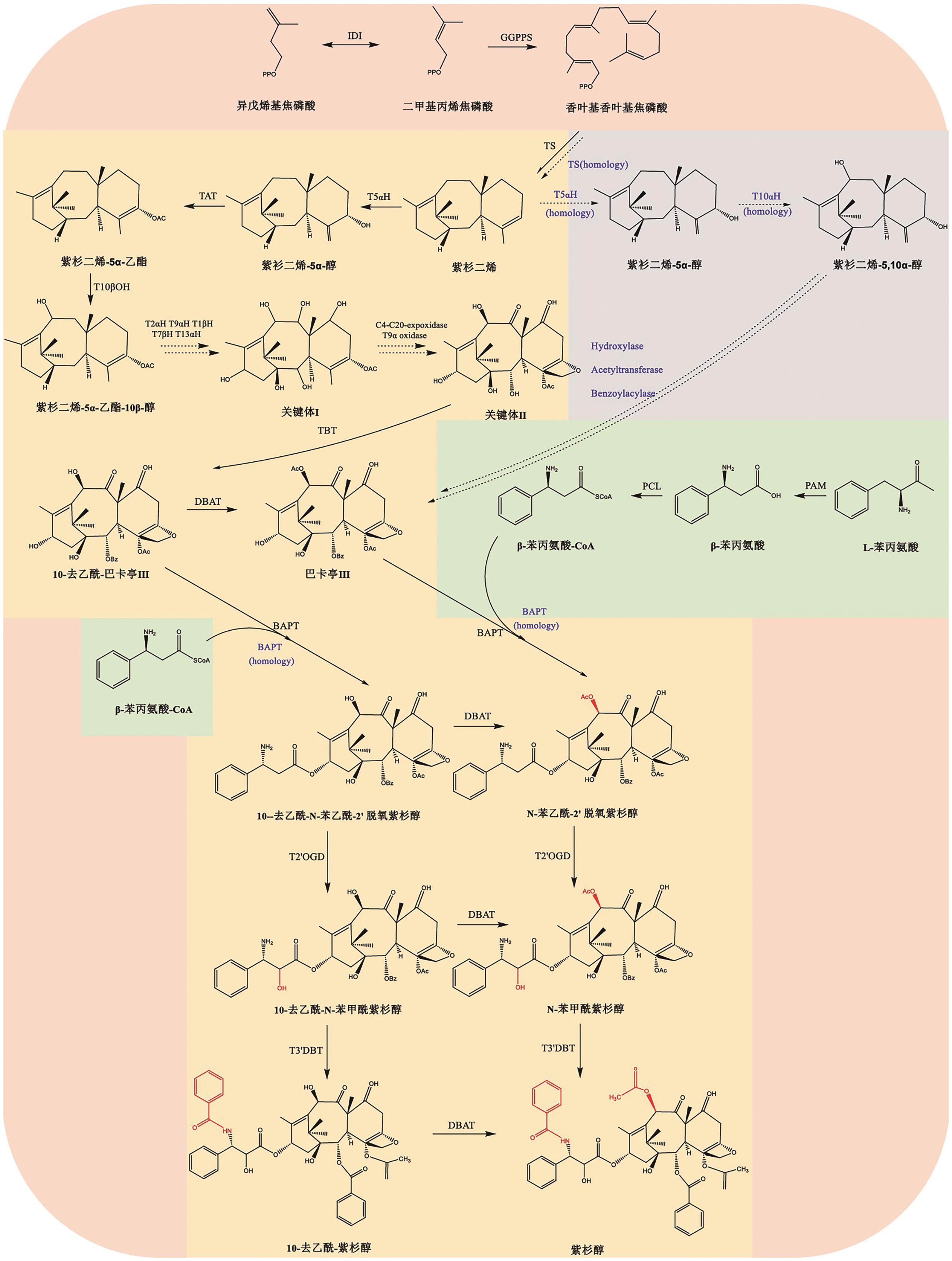
图1 紫杉醇生物合成通路示意图紫杉醇生物合成途径关键酶:(1)核心骨架合成酶:IDI, GGPPS, TS;(2)核心骨架修饰酶:多位点羟基化酶(T5αH, T10βH, T13αH, T9αH, T7βH, T2αH, T1βH, T2′OGD)与酰基转移酶(TAT, TBT, DBAT);(3)侧链合成与组装酶:PAM, BAPT, T3’DBT。红豆杉属内生真菌紫杉醇生物合成途径中羟化酶、乙酰转移酶和苯甲酰化的相关基因还有待阐明(用蓝色标记)
Fig. 1 Schematic diagram of paclitaxel biosynthetic pathwayThe key enzymes involved in the paclitaxel biosynthetic pathway include: 1) core skeleton synthases: IDI, GGPPS, TS; 2) core skeleton-modifying enzymes: multi-site hydroxylases (T5αH, T10βH, T13αH, T9αH, T7βH, T2αH, T1βH, T2'OGD) and acyltransferases (TAT, TBT, DBAT); 3) side-chain synthesis and assembly enzymes: PAM, BAPT, T3'DBT. The genes related to hydroxylases, acetyltransferases, and benzoylation in the paclitaxel biosynthesis pathway of endophytic fungi of the genus Taxus remain to be elucidated (marked in blue)
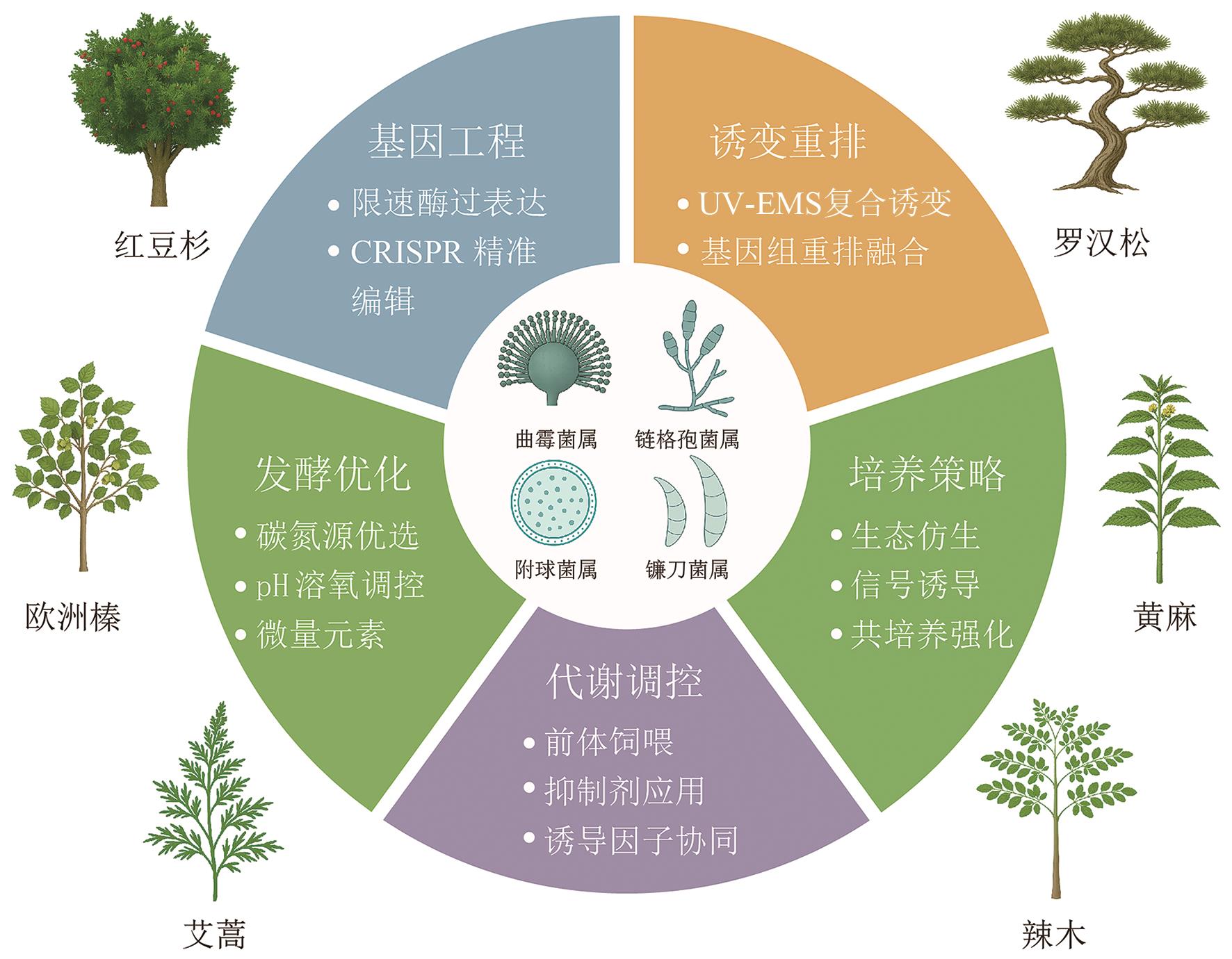
图2 植物内生真菌高产紫杉醇的工程策略
Fig. 2 Engineering strategies for high-yield production of paclitaxel by plant endophytic fungi
| [1] | Zwawiak J, Zaprutko L, Pawelczyk A. Strategies in taxol development: a review [J]. Mini Rev Med Chem, 2025, 25(5): 341-353. |
| [2] | Thiruvengadam M, Ahmed Khalil A, Rauf A, et al. Recent developments and anticancer therapeutics of paclitaxel: an update [J]. Curr Pharm Des, 2022, 28(41): 3363-3373. |
| [3] | Perez-Matas E, Hanano A, Moyano E, et al. Insights into the control of taxane metabolism: Molecular, cellular, and metabolic changes induced by elicitation in Taxus baccata cell suspensions [J]. Front Plant Sci, 2022, 13: 942433. |
| [4] | Gallego-Jara J, Lozano-Terol G, Sola-Martínez RA, et al. A compressive review about taxol®: history and future challenges [J]. Molecules, 2020, 25(24): 5986. |
| [5] | Tan RX, Chen XY. Uncovering the baccatin III biosynthetic pathway for sustainable taxoid supply [J]. Sci Bull, 2024, 69(9): 1182-1184. |
| [6] | Tomilova SV, Globa EB, Demidova EV, et al. Secondary metabolism in Taxus spp. plant cell culture in vitro [J]. Russ J Plant Physiol, 2023, 70(3): 23. |
| [7] | Jian ZY, Meng L, Hu XQ. An endophytic fungus efficiently producing paclitaxel isolated from Taxus wallichiana var. mairei [J]. Medicine, 2017, 96(27): e7406. |
| [8] | Bhunjun CS, Phukhamsakda C, Hyde KD, et al. Do all fungi have ancestors with endophytic lifestyles? [J]. Fungal Divers, 2024, 125(1): 73-98. |
| [9] | Li CY, Qi YL, Sun ZK, et al. Way to efficient microbial paclitaxel mass production [J]. Synth Syst Biotechnol, 2023, 8(4): 673-681. |
| [10] | Sonowal S, Gogoi U, Buragohain K, et al. Endophytic fungi as a potential source of anti-cancer drug [J]. Arch Microbiol, 2024, 206(3): 122. |
| [11] | Wang XC, Zhang W, Peng JB, et al. Lifestyle changes in Botryosphaeriaceae as evidenced by ancestral genome expansion and horizontal gene transfer [J]. Fungal Divers, 2024, 125(1): 221-241. |
| [12] | Kusari S, Singh S, Jayabaskaran C. Rethinking production of Taxol® (paclitaxel) using endophyte biotechnology [J]. Trends Biotechnol, 2014, 32(6): 304-311. |
| [13] | Qiao WC, Tang TH, Ling F. Comparative transcriptome analysis of a taxol-producing endophytic fungus, Aspergillus aculeatinus Tax-6, and its mutant strain [J]. Sci Rep, 2020, 10: 10558. |
| [14] | Qiao WC, Ling F, Yu L, et al. Enhancing taxol production in a novel endophytic fungus, Aspergillus aculeatinus Tax-6, isolated from Taxus chinensis var. mairei [J]. Fungal Biol, 2017, 121(12): 1037-1044. |
| [15] | Fu YF, Li XY, Yuan XH, et al. Alternaria alternata F3, a novel taxol-producing endophytic fungus isolated from the fruits of Taxus cuspidata: isolation, characterization, taxol yield improvement, and antitumor activity [J]. Appl Biochem Biotechnol, 2024, 196(4): 2246-2269. |
| [16] | Gauchan DP, Vélëz H, Acharya A, et al. Annulohypoxylon sp. strain MUS1, an endophytic fungus isolated from Taxus wallichiana Zucc., produces taxol and other bioactive metabolites [J]. 3 Biotech, 2021, 11(3): 152. |
| [17] | El-Sayed ER, Zaki AG, Ahmed AS, et al. Production of the anticancer drug taxol by the endophytic fungus Epicoccum nigrum TXB502: enhanced production by gamma irradiation mutagenesis and immobilization technique [J]. Appl Microbiol Biotechnol, 2020, 104(16): 6991-7003. |
| [18] | Somjaipeng S, Medina A, Kwaśna H, et al. Isolation, identification, and ecology of growth and taxol production by an endophytic strain of Paraconiothyrium variabile from English yew trees (Taxus baccata) [J]. Fungal Biol, 2015, 119(11): 1022-1031. |
| [19] | Jian ZY, Wang HS, Wang N, et al. Isolation and identification of an endophytic fungus producing paclitaxel from Taxus wallichiana var mairei [J]. Nutr Hosp, 2015, 32(6): 2932-2937. |
| [20] | Sharma A, Thakur P, Thakur V, et al. Paclitaxel production from endophytic Mucor circinelloides isolated from Taxus sp. of the Northern Himalayan region [J]. 3 Biotech, 2024, 14(10): 251. |
| [21] | Cao XY, Xu LX, Wang JY, et al. Endophytic fungus Pseudodidymocyrtis lobariellae KL27 promotes taxol biosynthesis and accumulation in Taxus chinensis [J]. BMC Plant Biol, 2022, 22: 12. |
| [22] | Vu THN, Quach NT, Pham QA, et al. Fusarium solani PQF9 isolated from Podocarpus pilgeri growing in Vietnam as a new producer of paclitaxel [J]. Indian J Microbiol, 2023, 63(4): 596-603. |
| [23] | El-Sayed ASA, Safan S, Mohamed NZ, et al. Induction of Taxol biosynthesis by Aspergillus terreus, endophyte of Podocarpus gracilior Pilger, upon intimate interaction with the plant endogenous microbes [J]. Process Biochem, 2018, 71: 31-40. |
| [24] | Obiedallah M, Yasien AA, Mohamed SS, et al. Endophytic Aspergillus fumigatiaffinis: Novel paclitaxel production and optimization insights [J]. Appl Microbiol Biotechnol, 2024, 108: 405. |
| [25] | Gill H, Vasundhara M. Isolation of taxol producing endophytic fungus Alternaria brassicicola from non-Taxus medicinal plant Terminalia arjuna [J]. World J Microbiol Biotechnol, 2019, 35(5): 74. |
| [26] | Ismaiel AA, Ahmed AS, Hassan IA, et al. Production of paclitaxel with anticancer activity by two local fungal endophytes, Aspergillus fumigatus and Alternaria tenuissima [J]. Appl Microbiol Biotechnol, 2017, 101(14): 5831-5846. |
| [27] | Raj KG, Manikandan R, Arulvasu C, et al. Anti-proliferative effect of fungal taxol extracted from Cladosporium oxysporum against human pathogenic bacteria and human colon cancer cell line HCT 15 [J]. Spectrochim Acta Part A Mol Biomol Spectrosc, 2015, 138: 667-674. |
| [28] | Das A, Rahman MI, Ferdous AS, et al. An endophytic Basidiomycete, Grammothele lineata, isolated from Corchorus olitorius, produces paclitaxel that shows cytotoxicity [J]. PLoS One, 2017, 12(6): e0178612. |
| [29] | Mohammadi Ballakuti N, Ghanati F, Zare-Maivan H, et al. Taxoid profile in endophytic fungi isolated from Corylus avellana, introduces potential source for the production of Taxol in semi-synthetic approaches [J]. Sci Rep, 2022, 12: 9390. |
| [30] | Ghaly M, Talat IE, Abeer A, et al. Isolation of anticancer drug taxol producing endophytic fungus Alternaria Alternata by using HPLC and LC-MS [J]. Am J Clin Pathol, 2020, 154(): S137-S138. |
| [31] | Gangadevi V, Muthumary J. Taxol, an anticancer drug produced by an endophytic fungus Bartalinia robillardoides Tassi, isolated from a medicinal plant, Aegle marmelos Correa ex Roxb [J]. World J Microbiol Biotechnol, 2008, 24(5): 717-724. |
| [32] | Pandi M, Kumaran RS, Choi YK, et al. Isolation and detection of taxol an anticancer drug produced from Lasiodiplodia theobromae an endophytic fungus of the medicinal plant Morinda citrifolia [J].Afr J Biotechnol, 2011, 10(8): 1428-1435 |
| [33] | Kumaran RS. Isolation of taxol, an anticancer drug produced by the endophytic fungus, Phoma betae [J]. Afr J Biotechnol, 2012, 11(4): 950-960. |
| [34] | Kumaran RS, Hur BK. Screening of species of the endophytic fungus Phomopsis for the production of the anticancer drug taxol [J]. Biotech And App Biochem, 2009, 54(1): 21-30. |
| [35] | Kumaran RS, Muthumary J, Hur BK. Taxol from Phyllosticta citricarpa, a leaf spot fungus of the angiosperm Citrus medica [J]. J Biosci Bioeng, 2008, 106(1): 103-106. |
| [36] | Kumaran RS, Muthumary J, Kim EK, et al. Production of taxol from Phyllosticta dioscoreae, a leaf spot fungus isolated from Hibiscus rosa-sinensis [J]. Biotechnol Bioproc E, 2009, 14(1): 76-83. |
| [37] | Kumaran RS, Muthumary J, Hur BK. Isolation and identification of an anticancer drug, taxol from Phyllosticta tabernaemontanae, a leaf spot fungus of an angiosperm, Wrightia tinctoria [J]. J Microbiol, 2009, 47(1): 40-49. |
| [38] | 孙端方, 冉雪琴, 王嘉福. 一株产紫杉醇罗汉松内生真菌的分离和鉴定 [J]. 微生物学报, 2008, 48(5): 589-595. |
| Sun DF, Ran XQ, Wang JF. Isolation and identification of a taxol-producing endophytic fungus from Podocrapus [J]. Acta Microbiol Sin, 2008, 48(5): 589-595. | |
| [39] | Sreekanth D, Sushim GK, Syed A, et al. Molecular and morphological characterization of a taxol-producing endophytic fungus, Gliocladium sp., from Taxus baccata [J]. Mycobiology, 2011, 39(3): 151-157. |
| [40] | Kathiravan G, Sri Raman V. In vitro TAXOL production, by Pestalotiopsis breviseta—a first report [J]. Fitoterapia, 2010, 81(6): 557-564. |
| [41] | Yang CS, Wang Y, Su Z, et al. Biosynthesis of the highly oxygenated tetracyclic core skeleton of Taxol [J]. Nat Commun, 2024, 15: 2339. |
| [42] | Xiong XY, Gou JB, Liao QG, et al. The Taxus genome provides insights into paclitaxel biosynthesis [J]. Nat Plants, 2021, 7(8): 1026-1036. |
| [43] | Zhang YJ, Wiese L, Fang H, et al. Synthetic biology identifies the minimal gene set required for paclitaxel biosynthesis in a plant chassis [J]. Mol Plant, 2023, 16(12): 1951-1961. |
| [44] | Jiang B, Gao L, Wang HJ, et al. Characterization and heterologous reconstitution of Taxus biosynthetic enzymes leading to baccatin III [J]. Science, 2024, 383(6683): 622-629. |
| [45] | Guerra-Bubb J, Croteau R, Williams RM. The early stages of taxol biosynthesis: an interim report on the synthesis and identification of early pathway metabolites [J]. Nat Prod Rep, 2012, 29(6): 683. |
| [46] | Sanchez-Muñoz R, Perez-Mata E, Almagro L, et al. A novel hydroxylation step in the taxane biosynthetic pathway: a new approach to paclitaxel production by synthetic biology [J]. Front Bioeng Biotechnol, 2020, 8: 410. |
| [47] | Sabzehzari M, Zeinali M, Naghavi MR. Alternative sources and metabolic engineering of Taxol: Advances and future perspectives [J]. Biotechnol Adv, 2020, 43: 107569. |
| [48] | Miao Z, Wang Y, Yu X, et al. A new endophytic taxane production fungus from Taxus chinensis [J]. Appl Biochem Microbiol, 2009, 45(1): 81-86. |
| [49] | Miao LY, Mo XC, Xi XY, et al. Transcriptome analysis of a taxol-producing endophytic fungus Cladosporium cladosporioides MD2 [J]. AMB Expr, 2018, 8: 41. |
| [50] | Kasaei A, Mobini-Dehkordi M, Mahjoubi F, et al. Isolation of taxol-producing endophytic fungi from Iranian yew through novel molecular approach and their effects on human breast cancer cell line [J]. Curr Microbiol, 2017, 74(6): 702-709. |
| [51] | Jiang L, Lv KJ, Zhu GL, et al. Norditerpenoids biosynthesized by variediene synthase-associated P450 machinery along with modifications by the host cell Aspergillus oryzae [J]. Synth Syst Biotechnol, 2022, 7(4): 1142-1147. |
| [52] | Weng CY, Han JY, Dong ZT, et al. Combinatorial strategy of modular metabolic engineering and fermentation optimization jointly improved gibberellic acid production in Fusarium fujikuroi [J]. Biotechnol J, 2025, 20(7): e70088. |
| [53] | Keller NP. Fungal secondary metabolism: regulation, function and drug discovery [J]. Nat Rev Microbiol, 2019, 17(3): 167-180. |
| [54] | Lutzoni F, Nowak MD, Alfaro ME, et al. Contemporaneous radiations of fungi and plants linked to symbiosis [J]. Nat Commun, 2018, 9: 5451. |
| [55] | Soliman SSM, Mosa KA, El-Keblawy AA, et al. Exogenous and endogenous increase in fungal GGPP increased fungal Taxol production [J]. Appl Microbiol Biotechnol, 2017, 101(20): 7523-7533. |
| [56] | El-Sayed ASA, Shindia AA, AbouZeid A, et al. Triggering the biosynthetic machinery of Taxol by Aspergillus flavipes via cocultivation with Bacillus subtilis: proteomic analyses emphasize the chromatin remodeling upon fungal-bacterial interaction [J]. Environ Sci Pollut Res, 2021, 28(29): 39866-39881. |
| [57] | El-Sayed ASA, Ali DMI, Yassin MA, et al. Sterol inhibitor “Fluconazole” enhance the Taxol yield and molecular expression of its encoding genes cluster from Aspergillus flavipes [J]. Process Biochem, 2019, 76: 55-67. |
| [58] | Soliman SSM, Raizada MN. Interactions between co-habitating fungi elicit synthesis of taxol from an endophytic fungus in host Taxus plants [J]. Front Microbio, 2013, 4: 3. |
| [59] | El-Sayed ER, Ismaiel AA, Ahmed AS, et al. Bioprocess optimization using response surface methodology for production of the anticancer drug paclitaxel by Aspergillus fumigatus and Alternaria tenuissima: Enhanced production by ultraviolet and gamma irradiation [J]. Biocatal Agric Biotechnol, 2019, 18: 100996. |
| [60] | Wei YM. Engineering taxol biosynthetic pathway for improving taxol yield in taxol-producing endophytic fungus EFY-21 (Ozonium sp.) [J]. Afr J Biotechnol, 2012, 11(37). |
| [61] | Subban K, Kempken F. Insights into Taxol® biosynthesis by endophytic fungi [J]. Appl Microbiol Biotechnol, 2023, 107(20): 6151-6162. |
| [62] | Wang T, Chen YM, Zhuang WB, et al. Transcriptome sequencing reveals regulatory mechanisms of taxol synthesis in Taxus wallichiana var. Mairei [J]. Int J Genom, 2019, 2019: 1596895. |
| [63] | He SQ, Bekhof AMW, Popova EZ, et al. Improved taxadiene production by optimizing DXS expression and fusing short-chain prenyltransferases [J]. New Biotechnol, 2024, 83: 66-73. |
| [64] | Do R, Kiss RS, Gaudet D, et al. Squalene synthase: a critical enzyme in the cholesterol biosynthesis pathway [J]. Clin Genet, 2009, 75(1): 19-29. |
| [65] | El-Sayed ASA, Abdel-Ghany SE, Ali GS. Genome editing approaches: manipulating of lovastatin and taxol synthesis of filamentous fungi by CRISPR/Cas9 system [J]. Appl Microbiol Biotechnol, 2017, 101(10): 3953-3976. |
| [66] | Callari R, Meier Y, Ravasio D, et al. Dynamic control of ERG20 and ERG9 expression for improved casbene production in Saccharomyces cerevisiae [J]. Front Bioeng Biotechnol, 2018, 6: 160. |
| [67] | Xu XR, Huang RY, Yin WB. An optimized and efficient CRISPR/Cas9 system for the endophytic fungus Pestalotiopsis fici [J]. JoF, 2021, 7(10): 809. |
| [68] | Xu F, Tao WY, Cheng L, et al. Strain improvement and optimization of the media of taxol-producing fungus Fusarium maire [J]. Biochem Eng J, 2006, 31(1): 67-73. |
| [69] | El-Sayed ER, Ahmed AS, Al-Hagar OEA. Agro-industrial wastes for production of paclitaxel by irradiated Aspergillus fumigatus under solid-state fermentation [J]. J Appl Microbiol, 2020, 128(5): 1427-1439. |
| [70] | Duan HT, Su X, Fan QQ, et al. Intergeneric protoplast fusion for probiotic strain improvement: Molecular mechanisms and metabolic analysis [J]. Food Biosci, 2025, 68: 106642. |
| [71] | Magocha TA, Zabed H, Yang MM, et al. Improvement of industrially important microbial strains by genome shuffling: Current status and future prospects [J]. Bioresour Technol, 2018, 257: 281-289. |
| [72] | Zhao K, Ping WX, Zhang LN, et al. Screening and breeding of high taxol producing fungi by genome shuffling [J]. Sci China Ser C-Life Sci, 2008, 51(3): 222-231. |
| [73] | Zhao K, Sun L, Ma X, et al. Improved taxol production in Nodulisporium sylviforme derived from inactivated protoplast fusion [J]. Afr J Biotechnol, 2011, 10(20):4175-4182. |
| [74] | Garyali S, Kumar A, Reddy MS. Enhancement of taxol production from endophytic fungus Fusarium redolens [J]. Biotechnol Bioproc E, 2014, 19(5): 908-915. |
| [75] | El-Sayed ASA, El Sayed MT, Nada HS, et al. Production and characterization of taxol as anticancer agent from Aspergillus terreus [J]. J Pure Appl Microbiol, 2019, 13(4): 2055-2063. |
| [76] | Naik BS. Developments in taxol production through endophytic fungal biotechnology: a review [J]. Orient Pharm Exp Med, 2019, 19(1): 352. |
| [77] | El-Sayed ASA, Fathalla M, Yassin MA, et al. Conjugation of Aspergillus flavipes taxol with porphyrin increases the anticancer activity of taxol and ameliorates its cytotoxic effects [J]. Molecules, 2020, 25(2): 263. |
| [78] | Subban K, Subramani R, Srinivasan VPM, et al. Salicylic acid as an effective elicitor for improved taxol production in endophytic fungus Pestalotiopsis microspora [J]. PLoS One, 2019, 14(2): e0212736. |
| [79] | Salehi M, Moieni A, Safaie N. Elicitors derived from hazel (Corylus avellana L.) cell suspension culture enhance growth and paclitaxel production of Epicoccum nigrum [J]. Sci Rep, 2018, 8: 12053. |
| [80] | Salehi M, Moieni A, Safaie N, et al. New synergistic co-culture of Corylus avellana cells and Epicoccum nigrum for paclitaxel production [J]. J Ind Microbiol Biotechnol, 2019, 46(5): 613-623. |
| [81] | Guo LC, Xi BW, Lu LS. Strategies to enhance production of metabolites in microbial co-culture systems [J]. Bioresour Technol, 2024, 406: 131049. |
| [82] | Yin JY, Lai M, Yu XY, et al. Comprehensive strategies for paclitaxel production: insights from plant cell culture, endophytic microorganisms, and synthetic biology [J]. Hortic Res, 2025, 12(3): uhae346. |
| [83] | Liang FY, Xie YM, Zhang C, et al. Elucidation of the final steps in Taxol biosynthesis and its biotechnological production [J]. Nat Synth, 2025, 4(10): 1212-1222. |
| [84] | Woodcraft C, Chooi YH, Roux I. The expanding CRISPR toolbox for natural product discovery and engineering in filamentous fungi [J]. Nat Prod Rep, 2023, 40(1): 158-173. |
| [85] | Mutanda I, Li JH, Xu FL, et al. Recent advances in metabolic engineering, protein engineering, and transcriptome-guided insights toward synthetic production of taxol [J]. Front Bioeng Biotechnol, 2021, 9: 632269. |
| [86] | Xie LF, Gao JQ, Zhou YJ. Synthetic biology for Taxol biosynthesis and sustainable production [J]. Trends Biotechnol, 2024, 42(6): 674-676. |
| [87] | Fernie AR, Liu F, Zhang YJ. Post-genomic illumination of paclitaxel biosynthesis [J]. Nat Plants, 2024, 10(12): 1875-1885. |
| [1] | 张欣, 陈骋, 霍元博, 黄仁丽, 张丽, 张凯, 童华荣, 袁连玉. 茶树CsCRD1基因的克隆及其对叶绿素生物合成的影响[J]. 生物技术通报, 2026, 42(5): 280-291. |
| [2] | 刘修平, 朱星宇, 汪光义. 梭菌属(Clostridium)产乙酸菌代谢工程改造与合成气定向转化研究现状[J]. 生物技术通报, 2026, 42(2): 65-76. |
| [3] | 刘语诗, 李镇, 邹宇琛, 汤维维, 李彬. 药用植物空间代谢组学研究进展[J]. 生物技术通报, 2025, 41(9): 22-31. |
| [4] | 蔡如凤, 杨宇轩, 于基正, 李佳楠. 人工智能重塑蛋白质工程:从结构解析到合成生物学的算法革命[J]. 生物技术通报, 2025, 41(8): 1-10. |
| [5] | 高婧, 陈益存, 高暝, 赵耘霄, 汪阳东. 植物单宁合成调控及其对环境的响应机制[J]. 生物技术通报, 2025, 41(7): 49-59. |
| [6] | 吴娅, 姚润, 杨含婷, 刘微, 杨帅, 宋驰, 陈士林. 凤梨薄荷SDR基因家族全基因组鉴定及表达分析[J]. 生物技术通报, 2025, 41(5): 175-185. |
| [7] | 刘爽, 江洲, 赵帅, 赵雷真, 黄峰, 周佳, 屈建航. 一株产蛋白酶细菌的筛选、鉴定及发酵工艺优化[J]. 生物技术通报, 2025, 41(4): 335-344. |
| [8] | 鲁天怡, 李爱朋, 费强. 生物合成聚乳酸研究进展[J]. 生物技术通报, 2025, 41(4): 47-60. |
| [9] | 李晓明, 尚秀华, 王有霜, 吴志华. 植物中苯并噁嗪类化合物的研究进展[J]. 生物技术通报, 2025, 41(4): 9-20. |
| [10] | 陈海敏, 孙菲, 袁源, 吴佳雯, 江红, 周剑. 紫外诱变选育巴弗洛霉素A1高产菌株及其培养基优化[J]. 生物技术通报, 2025, 41(3): 51-61. |
| [11] | 毛李晶, 金晓萱, 施婉婷, 胡飞杨, 张苑蓉, 熊亮斌, 任璐. 代谢工程改造益生菌E. coli Nissle 1917合成靛玉红[J]. 生物技术通报, 2025, 41(12): 74-81. |
| [12] | 周思延, 丁炜权, 董平, 翁含之, 胥睿睿, 康振. 大肠杆菌Nissle 1917的合成生物学平台开发及应用进展[J]. 生物技术通报, 2025, 41(11): 47-61. |
| [13] | 徐欣欣, 李彦君, 张伟, 黄火清, 罗会颖, 姚斌. 人造淀粉生物合成技术:进展、挑战与展望[J]. 生物技术通报, 2025, 41(11): 22-27. |
| [14] | 魏敏华, 李晓童, 姜亚文, 周飘飘, 汪凯, 孙浩, 芦楠, 张成林. |
| [15] | 杨熠辰, 朱宏宇, 苏小运, 王苑, 罗会颖, 田健, 姚斌, 黄火清, 张杰. 以果葡糖浆为底物高效合成肌醇细胞工厂的构建[J]. 生物技术通报, 2025, 41(11): 121-133. |
| 阅读次数 | ||||||
|
全文 |
|
|||||
|
摘要 |
|
|||||
